INTRODUCTION
Sea cucumbers Apostichopus japonicus (Selenka) are harvested as a dietary delicacy and medicinal cure with high nutritional value (Chen, Reference Chen, Lovatelli, Conand, Purcell, Uthicke, Hamel and Mercier2004). Moreover, A. japonicus play an ecological role as suspension feeders, detritivores and prey for different marine species. Through their trophic activities, deposit feeding holothurians can change the size of benthic particles and turn over sediment (Uthicke, Reference Uthicke1999; Anderson et al., Reference Anderson, Flemming, Watson and Lotze2010). As an obligate deposit-feeding species, the sea cucumber A. japonicus plays an important trophic role in marine ecosystems (Slater & Carton, Reference Slater and Carton2009; Ren et al., Reference Ren, Dong, Wang, Gao, Tian and Liu2010). The feeding activities of this species could effectively remove nutrient matter deposited in benthic habitats and consequently may reduce the nutrient loadings in coastal ecosystems (Zheng et al., Reference Zheng, Dong, Tian, Wang, Gao and Bai2009; Sun et al., Reference Sun, Gao, Dong, Shin and Wang2012).
Lipids are a non-protein energy source, which provide energy and essential fatty acids for normal growth and survival of aquatic animals (Seo & Lee, Reference Seo and Lee2011). Fatty acids (FA) are considered to serve a dietary function in benthic food webs (Kelly & Scheibling, Reference Kelly and Scheibling2012). FA and FA ratios are used as biomarkers to confirm and trace food resources and trophic relationships in different aquatic habitats (Penha-Lopes et al., Reference Penha-Lopes, Torres, Narciso, Cannicci and Paula2009; Coelho et al., Reference Coelho, Lopes da Silva, Reis, Queiroga, Serôdio and Calado2011).
Apostichopus japonicus is the main cultured species in northern China, and there are three main cultured ways: in ponds, at the coast and in cages. There has been much research on FA of A. japonicus, and many have shown that A. japonicus has different FA profiles in different sampling times and areas (Kasai, Reference Kasai2003; Dantong et al., Reference Dantong, Yaqing, Zhenhai, Wei, JunYa and GuoDong2009; Gao et al., Reference Gao, Xu and Yang2011; Han, Reference Han2011; Lee et al., Reference Lee, Kim, Moon, Kim, Kim, Cho, Yoon, Sim, Park and Lee2012). The fatty acid values varied depending on the sampling time and collection region, however, an FA biomarker was not used as a biomarker for many studies.
In the present study we compare FA contents in the body wall and ovary of A. japonicus and also study FA biomarkers in sea cucumbers from two different habitats with organic matter in sediment (Rongcheng Bay: kelp raft cultivation area, high organic matter in sediment; Laoshan Bay: strong current area with low sediment organic matter) to determine habitat effects on FA content. Our hypotheses were that (1) fatty acid value especially polyunsaturated FA in ovary was higher than that in body wall and gut sediment; (2) FA composition were different and FA biomarkers may reveal main food resources for A. japonicus in the two areas.
MATERIALS AND METHODS
Sampling sites
Samples were taken at two different period in two different habitats. The first samples were taken in Laoshan Bay, Qingdao in April 2011. Organic matter in sediment in this bay was about 1–2%, because of strong currents (0.6–0.8 m s−1) and low organic matter input. The second samples were taken in Rongcheng Bay (37°15.29′N 122°35.25′E), Weihai in June 2012, and where the organic content in sediment was high and can reach 7% (Xu et al., Reference Xu, Zhang, Zhang, Zhou, Xia, Liu and Yang2014) (Figure 1).
The two sample areas for the sea cucumber Apostichopus japonicus in Shandong peninsula (▴indicates Rongcheng Bay and Laoshan Bay).

Sea cucumbers were taken in Laoshan Bay (36°15.07′N 122°40.80′E), while sea cucumber, sediment in the stomach as well as gonads from females were sampled in Rongcheng Bay. The sampled sea cucumber weight from both habitats was 200–300 g.
The sea cucumber samplings (12 individuals in each area) were dissected in the field after being washed with distilled water. The body wall, female gonad tissues and in situ sediment in the stomach were frozen and stored in the laboratory in a freezer at −20°C.
Fatty acid analysis
Tissue, sediment and gonad samples were ground after being lyophilized. The same amount of three samples was chosen randomly to create a mixture sample. Fatty acid analyses of the mixture sample were carried out as in Liu et al. (Reference Liu, Li and Sun2011). Samples were placed in DCM: MeOH (dichloromethane: methanol) in a proportion of 2:1(v/v) with 0.01% BHT (butylhydroxytoluene) as an antioxidant. After sonication, the mixture was separated by centrifugation. The organic extracts were combined after three extractions and then evaporated under high purity nitrogen. Two millilitres of 6% KOH/MeOH was added to hydrolyse the samples at 80°C for 2 h under the protection of high purity nitrogen. After acidification to pH2 with aqueous hydrochloric acid (1:1), 1 mL of 14% boron trifluoride-methanol was added and the samples were esterified at 80°C for an hour under the protection of high purity nitrogen. Fatty acid methyl esters (FAMEs) were recovered from the mixture by extraction with 3 × 2 ml of hexane.
Quantification of FA was carried out using an Agilent 7890A instrument with FID (Agilent Technologies, Wilmington, DE, USA) equipped with a DB-FFAP capillary column (30 m × 0.25 mm ID coated with 0.25 µm film thickness). The program of temperature was as follows: 70°C for 3 min, held at 220°C for 33 min after increasing at 3°C min−1 rate. Temperatures of the injector and detector were maintained at 220 and 280°C, respectively. FAME identification was performed by comparing relative retention times with those of known single (see Supplementary material Figure S1) and mixture standard (37-FAME Mix, 46-FAME Mix; Sigma, USA). Equivalent chain lengths were used as an aid in peak localization and identification. Each FAME area was corrected from the corresponding FID response factor and from the difference in weight between the FAME and its corresponding free fatty acid (Dubois et al., Reference Dubois, Blanchet, Garcia, Massé, Galois, Grémare, Charlier, Guillou, Richard and Savoye2014). We then used the quantitative method from Bai et al. (Reference Bai, Song, You, Sun, Fu and Li2010) to calculate the FA content.
FA biomarkers
Biomarkers (also expressed as ratios) indicate the relative importance of one food source over another. We used Alfaro et al. (Reference Alfaro, Thomas, Sergent and Duxbury2006) and other articles to calculate FA biomarkers. The odd and branch-chain FA (odd&br FA), the ratio of C18:1ω7/C18:1ω9 was used to show bacterial food sources (Budge et al., Reference Budge, Parrish and McKenzie2001; Li et al., Reference Li, Peacock, White, Geyer and Zhang2007). The sum percentage content of C18:2ω6 and C18:3ω3 was used as a continental food source marker (above 2.5 implies a continental source) (Budge & Parrish, Reference Budge and Parrish1998; Cui et al., Reference Cui, Ying, Jing and Na2012). ∑C16/∑C18, C16:1/C16:0 and C20:5ω3/C22:6ω3 (EPA/DHA) ratios were used as markers for diatom food resources (Budge et al., Reference Budge, Parrish and McKenzie2001). C18:1ω9 indicates brown kelp food resources (Alfaro et al., Reference Alfaro, Thomas, Sergent and Duxbury2006).
The statistics analysis
FA values were presented as means ± SD. FA and FA biomarkers mentioned above were subjected to a one-way ANOVA with post hoc Tukey test using SPSS 15.0 statistical software package. Significance was accepted at P < 0.05. One-way analysis of similarities (ANOSIM) were calculated on the Bray–Curtis similarity of body wall in the two habitats, sediment, body wall and gonad. Differences in FA (using percentage content) in the sediment, body wall and ovary in Rongcheng, body wall in Rongcheng and Laoshan were explored using the similarity percentages routine (SIMPER) based on the Bray–Curtis similarity (Hughes et al., Reference Hughes, Catarino, Kelly, Barnes and Black2005; Budge et al., Reference Budge, Springer, Iverson and Sheffield2007). All multivariate analysis was carried out using the PRIMER-E V6.0 (Clarke & Warwick, Reference Clarke and Warwick2001; Clarke & Gorley, Reference Clarke and Gorley2006).
RESULTS
Differences in FA among sediment, body wall and gonads of sea cucumbers in Rongcheng Bay
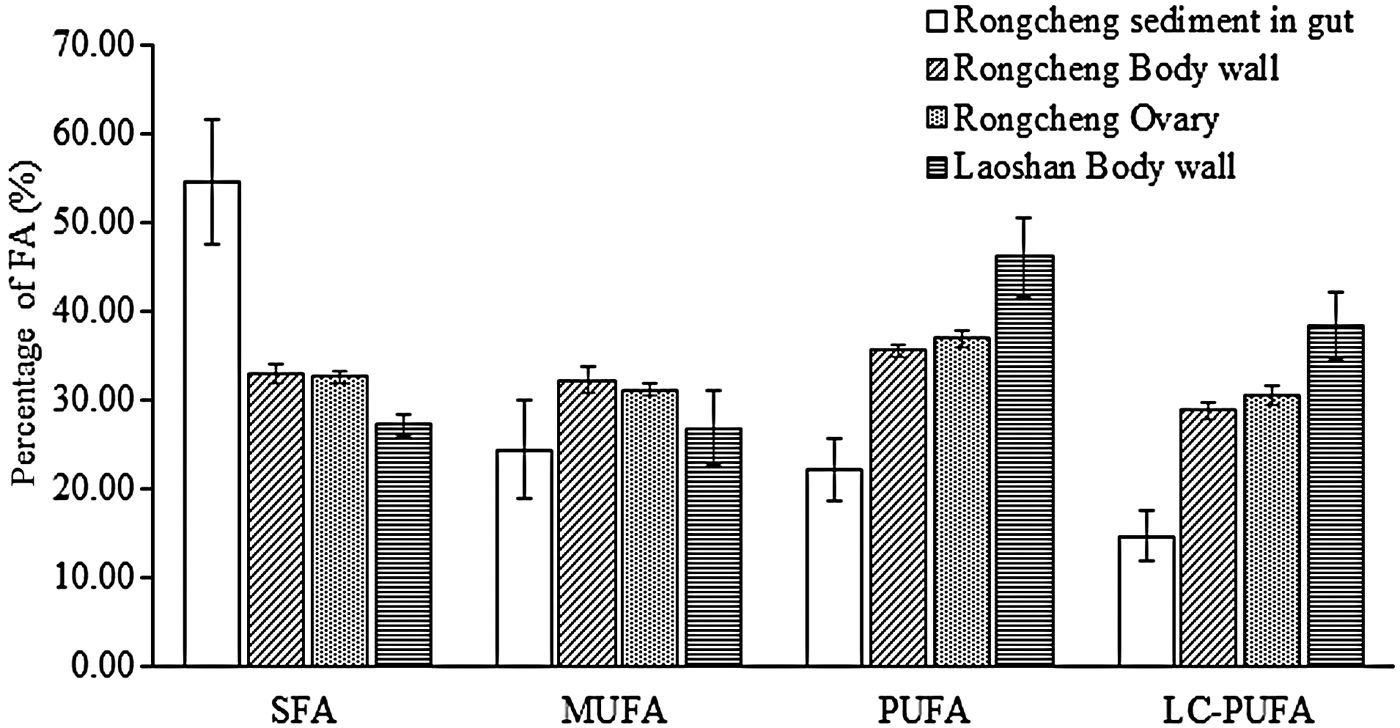
Total FA content was the lowest in gut sediment (700.96 ± 538.92 µg g−1) and highest in the ovary (89164.13 ± 8363.35 µg g−1) in Rongcheng Bay. FA in the body wall of sea cucumbers from Rongcheng Bay was 46746.99 ± 4196.47 µg g−1. Absolute FA content is shown in supplementary material. FA profiles were dominated by polyunsaturated FA (PUFA) in body wall and ovary tissues, and by saturated FA (SFA) in the sediment (Figure 2).
Percentage of fatty acid (FA) in sediment, body wall and ovary of Apostichopus japonicus from Rongcheng Bay and in the body of A. japonicus from Laoshan Bay SFA: Saturated FA, MUFA, monounsaturated FA, PUFA, Polyunsaturated FA; LC-PUFA, long chain PUFA.
Most FA, especially long chain PUFA (LC-PUFA, including 20 or more carbon atoms in polyunsaturated FA) were significantly different between body wall and gonad tissues, except for some monounsaturated FA (MUFA) and non PUFA (containing two or more double bonds, C14:1ω5, C16:2ω4, C16:4ω3, C20:1ω9, C22:6ω3). In gut sediment, C16:0 was the dominant FA, accounting for 20.46% of the total FA, followed by C18:0 (15.03%), C16:1ω7 (8.93%), C18:1ω7 (6.43%) and EPA (6.34%). EPA accounted for 15.24% of total FA in the ovaries, followed by C16:1ω7 (8.69%), C18:1ω7 (7.94%), C16:0 (7.92) and AA (7.35%).
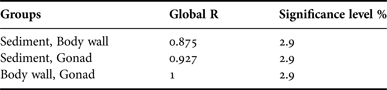
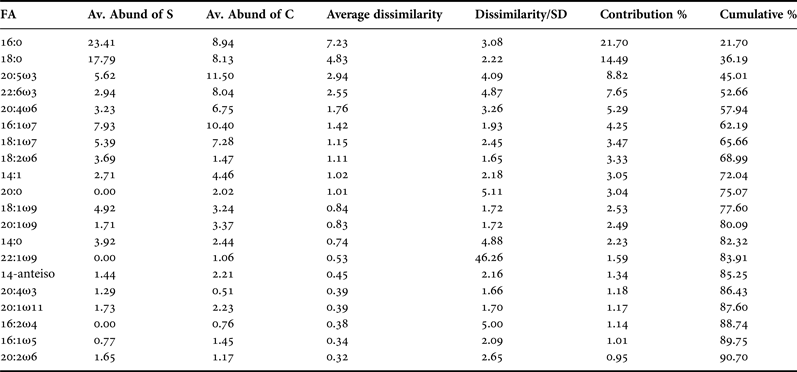
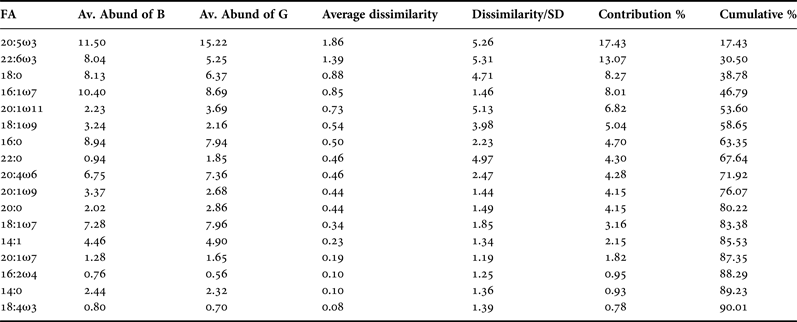
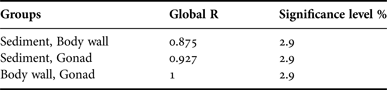
The ANOSIM results show that percentage content of FA in the sediment, body wall and gonad in Rongcheng Bay were significantly different (Table 1). The dissimilarity between sediment and body wall was 33% (Table 2). The SIMPER results showed that C16:0, C18:0, EPA, C22:6ω3, C18:1ω7, AA (arachidonic acid, C20:4ω6), C16:0, C14:1 and C20:1ω11 contribute most to the dissimilarity between sediment and body tissue of A. japonicus in Rongcheng Bay (Table 2). However, EPA, C18:1ω7, AA, C16:0, C14:1 and C20:1ω11 contributed most to differences between the body wall and ovary of A. japonicus in Rongcheng Bay (Table 3). LC-PUFAs contributed ~30.95% to the difference between the two tissues.
Pairwise ANOSIM results of FA profiles in sediment in gut, body wall and gonad of Apostichopus japonicus from Rongcheng Bay.
SIMPER results of sediment in gut (S) and the body wall (C) of Apostichopus japonicus from Rongcheng Bay (the dissimilarity of the two groups was 33.32%).
SIMPER results of the body wall (B) and the gonad (G) of Apostichopus japonicus from Rongcheng Bay (the dissimilarity of the two groups was 10.66%).
Differences in body wall FA
EPA was the most abundant FA in the body wall of sea cucumbers both in Rongcheng (11.51%, 5380.4 ± 607.11 µg g−1) and Laoshan (15.29%, 2978.3 ± 1113.68 µg g−1). C16:1ω7, C16:0, C18:0 and DHA were most abundant in Rongcheng sea cucumbers, accounting for 10.41, 8.92, 8.13 and 8.02% of total FA, respectively. However, C18:0, DHA, C16:0 and AA were most abundant in Laoshan sea cucumbers, accounting for 8.82, 8.61, 8.56 and 8.18% of total FA, respectively.
Results show that total FA, SFA, MUFA and PUFA in the body wall of sea cucumbers from Rongcheng were significantly higher than in Laoshan (see supplementary material). However, the percentage content of PUFA in Laoshan (44.67%) was higher than that in Rongcheng (35.83%, see Figure 2).
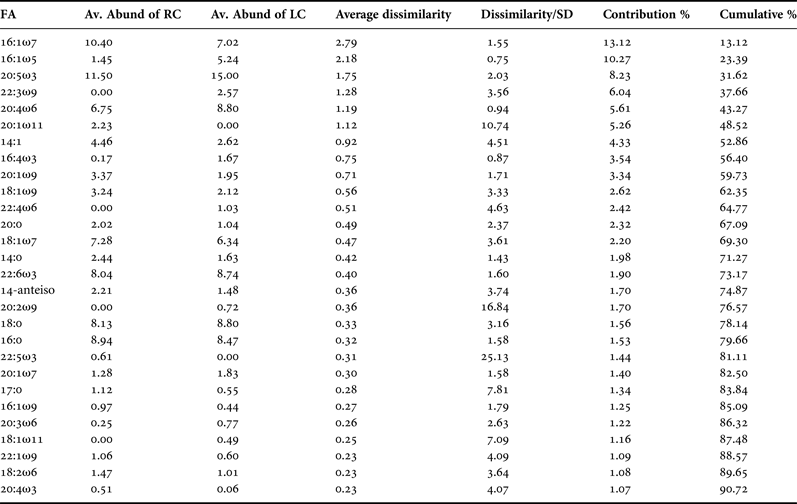
Absolute content of C14:1ω5, C16:1ω5, C16:2ω4, C16:3ω3, C16:4ω4, C18:2ω4, C18:4ω3, 20:1ω7, C20:3ω6, EPA and C22:0 were not significantly different in body wall tissues between Rongcheng and Laoshan while the other FAs were significantly different between the two habitats (Appendix 1). 16:1ω7, 20:5ω3, C16:0, C18:1ω7, C18:0 and C14:1 contributed most to the FA differences in the body wall from the two habitats (Table 4).
SIMPER results of the body wall of Apostichopus japonicus from Rongcheng Bay (RC) and Laoshan Bay (LC, the dissimilarity was 21.26%).
Food resources of sea cucumbers from different habitats
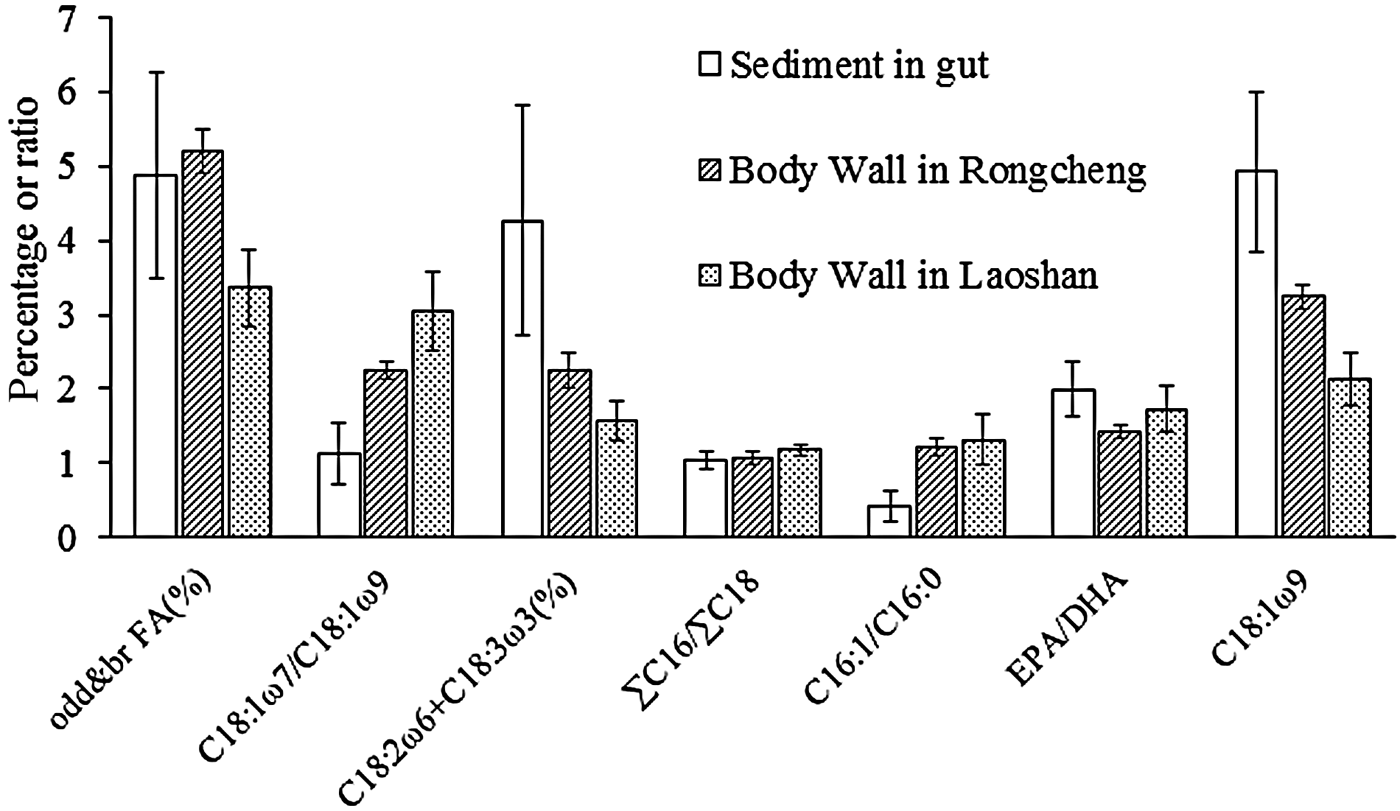
The odd&br FA content in Rongcheng was higher than that in Laoshan, while C18:1ω7/C18:1ω9 ratio (bacterial food sources) in the body wall of sea cucumbers from Laoshan (3.05 ± 0.54) was higher than that in Rongcheng (2.25 ± 0.13), but was not significantly different (Figure 3).
Fatty acid biomarkers of the body wall of Apostichopus. japonicus from Rongcheng Bay and Laoshan Bay and sediment in gut in Laoshan Bay odd&br FA: odd and branch-chain FA, EAP/ DHA: C20:5ω3/C22:6ω3.
In Roncheng sediment, continental food source biomarker was 4.26, which implies FA was mainly from a continental source. But this biomarker in the body wall of sea cucumbers from the two habitats was below 2.5, which showed continental organic matter took little percentage.
The diatom food resource biomarkers had different trends in the two areas. The ratio of total C16 and C18 in Laoshan was slightly higher (1.18 ± 0.07), but not significantly different, than that in Rongcheng (1.07 ± 0.09). The ratio of C16:1/C16:0 was also higher in Laoshan (1.49 ± 0.39) than in Rongcheng (1.43 ± 0.13). The ratio of EPA/DHA had the same trend (Laoshan: 1.73 ± 0.30, Rongcheng: 1.43 ± 0.08). This series of ratios indicates higher variability in diatoms as a food resource of sea cucumbers from Laoshan than that of Rongcheng.
The percentage of brown kelp food resources biomarker (C18:1ω9) in body wall in Rongcheng (3.24 ± 0.17) was significantly higher than in Laoshan (2.12 ± 0.35, Figure 3).
DISCUSSION
FA differences between sediment, body wall, ovary and role of sea cucumbers
Sea cucumbers are suspension and deposit feeders (Massin, Reference Massin, Jangoux and Lawrence1982). Deposit feeders have an important role in FA transformation from sediment and benthic creatures to the upper water ecosystem through eggs and larvae (Mileikovsky, Reference Mileikovsky1974). Some deposit feeding sea cucumbers, such as Holothuria (Halodeima) atra and Stichopus chloronotus have bioturbate effects and can disturb the entire upper 5 mm of sediment once a year (4600 kg (dry wet) year−1 km−2), significantly reducing the microalgal biomass in the sediment and playing a substantial role in the recycling of nutrients in oligotrophic environments where nutrients would otherwise remain trapped in the surface sediment (Uthicke, Reference Uthicke1999). Uthicke (Reference Uthicke2001) also showed that a small sediment area may be fertilized by nutrients released via the body wall of sea cucumber, approximately 25% of which is in direct contact with the sediment.
Species of other feeding types also have the same ecological role. Sea urchin can deliver more LC-PUFA to the pelagic and benthic food webs through their gonads and subsequently in producing larvae, than they can through production of faecal pellets (Hughes et al., Reference Hughes, Cook, Orr, Kelly and Black2011).
Most sea cucumbers have the ability to select the organic food. Some study revealed that Mediterranean holothuroids show different selectivity for organic matter (Plotieau et al., Reference Plotieau, Lepoint, Lavitra and Eeckhaut2014). In our study, the continental food source marker (sum of C18:2ω6 and C18:3ω3) in the body wall was lower than that in sediment, which indicates that A. japonicus have the ability to feed selectively.
In a benthic ecosystem, A. japonicus may select the much more organic sediment matter and then use some methods to transfer the nutrients. That is the same as sea urchins, related above. Sea cucumber may use their gonad to transfer nutrients. This study revealed that sea cucumbers can store more LC-PUFA in the ovary. The eggs released by sea cucumbers may be a suitable food source for other marine organisms especially carnivores living in upper water and can also provide abundant nutrients to the planktonic ecosystem.
However, the ecological role of holothuroids is often neglected by researchers. Seagrass habitat research using carbon and nitrogen stable isotopes showed holothurians enhanced the sediment uptake of organic carbon and total nitrogen by up to 30× and 3×, respectively (Costa et al., Reference Costa, Mazzola and Vizzini2014). Another study in a reef area revealed that sea cucumbers play an important ecological role in the coral reef CaCO3 cycle (Schneider et al., Reference Schneider, Silverman, Kravitz, Rivlin, Schneider-Mor, Barbosa, Byrne and Caldeira2013). So further laboratory and field simulation experiments are needed to fully understand the ecological effects of this species, which is the main cultured species in northern China coastal area.
FA in different habitats
FA composition, especially LC-MUFA, was different depending on sampling times, regions and age of species. Previous studies have shown differences in FA of A. japonicus. EPA, AA and DHA in the body wall of pond-cultured A. japonicus was between 7.24–14.45%, 4.54–8.16% and 2.41–4.45%, respectively over 1 year (Gao et al., Reference Gao, Xu and Yang2011), while higher EPA levels (9.94–11.24%) and lower DHA levels (5.83–7.02%) have been shown for A. japonicus caught in Zhangzi Island coast (Dantong et al., Reference Dantong, Yaqing, Zhenhai, Wei, JunYa and GuoDong2009). The percentage of EPA and AA in the present study are in agreement with the ranges reported above, but the DHA was a little higher. DHA content had a larger difference.
The absolute FA contents in the body wall of sea cucumbers from the two studied habitats were both high, which could be partially due to the sampling time. Apostichopus japonicus will reduce feeding activities in cold water and enter aestivation in summer (Gao et al., Reference Gao, Xu and Yang2011). The sampling of the two areas was done in spring, which is the optimal season for feeding in A. japonicus. Another reason is the habitats. Sea cucumber living in open areas may feed on more detritus from kelp and other materials, so those individual may have higher MUFA from food than that inhabited in pond and cage.
FA is known to be a useful biomarker, with FA profiles indicating different food resources in different habitats (Braeckman et al., Reference Braeckman, Provoost, Sabbe, Soetaert, Middelburg, Vincx and Vanaverbeke2012; Kelly & Scheibling, Reference Kelly and Scheibling2012). Some studies have used FA to indicate food supply in different habitats. Coelho et al. (Reference Coelho, Lopes da Silva, Reis, Queiroga, Serôdio and Calado2011) studied FA of mud snails Hydrobia vulvae from mudflats and seagrass meadows in the same estuary and found significant differences of food resources. SFA and MUFA were found in greater abundances in the eggs of crabs Uca annulipes’ inhabiting a peri-urban mangrove subjected to domestic sewage discharges compared with those inhabiting pristine mangroves (Penha-Lopes et al., Reference Penha-Lopes, Torres, Narciso, Cannicci and Paula2009). Further, FA can be used to distinguish different geographic populations. Dong et al. (Reference Dong, Shen, Li, Yan and Sun2013) showed that five kinds of FA, C18:1ω9, C20:1, C22:1ω9, C20:4ω6 and C20:5ω3, were effective in identifying six populations of crabs Portunus trituberculatus from the China Sea with a total discriminant accuracy of 88.46%.
Food supply has a significant effect on the FA profile of sea cucumbers (Alfaro et al., Reference Alfaro, Thomas, Sergent and Duxbury2006). Some studies have shown that FA composition may be influenced by the feeding and environmental conditions of the habitat (Iverson et al., Reference Iverson, Frost and Lowry1997). Neto et al. (Reference Neto, Wolff, Billett, Mackenzie and Thompson2006) studied FA of three types of deep sea holothurians and suggested that the FA profile response to variations in food supply appears to depend on feeding mode. Lipid content of Psychropotes longicauda showed a strong positive correlation with the contents of lipids in the surficial sediments (Neto et al., Reference Neto, Wolff, Billett, Mackenzie and Thompson2006). This may be because P. longicauda uses peltate tentacles to sweep sediments into the mouth to obtain food from the top ~5 mm of the sediment.
Similarly, the holothuria A. japonicus in the present study is also a surface sediment feeding species. Our results showed that some FA contents differed markedly between the body walls of A. japonicus from the two studied coastal areas. In this cultured environment, sea cucumber is often released and scatter-fed in the seabed. Rongcheng Bay is famous for raft cultivation of kelp S. japonica (previously known as Laminaria japonica), which can produce detritus on the seafloor (Zhang et al., Reference Zhang, Fang, Wang, Du, Gao and Zhang2012). Eelgrass Zostera marina is very abundant in nearby coastal areas (Gao et al., Reference Gao, Wei, Fu and Shao2013; Zhou et al., Reference Zhou, Liu, Liu, Liu, Wang, Zhang and Yang2014). Another factor is the culture raft influence, which can slow down currents and retain much more organic matter. Detritus is a primary food source in subtidal soft-sediment habitats (Krumhansl & Scheibling, Reference Krumhansl and Scheibling2012). Sea cucumbers in this organic matter environment with a high content of sediment may eat detritus from brown kelp or eelgrass Z. marina that lives off the coastal areas of Rongcheng. Our results revealed that brown kelp food resource C18:2ω6 and C18:3ω3 in Rongcheng was significantly higher than in Laoshan. The diatom food resource was the main food resource in Laoshan Bay.
More research is needed to further examine the complicated relationship between the FA profile of A. japonicus and the environment that they inhabit.
CONCLUSION
This study reveals significant differences among FA from sediment, the body wall and the female ovary of sea cucumbers. LC-PUFA contributed the greatest differences in FA between the body wall and ovary. FA biomarkers show that sea cucumbers inhabiting Rongcheng and Laoshan have different food resources. Diatoms may contribute more to the diets of sea cucumbers in Laoshan, while brown kelp and vascular plants may play a more significant role in the diets of those in Rongcheng. It is necessary to do further research over longer time periods to better understand differences in FA composition in different tissues and habitats.
SUPPLEMENTARY MATERIAL
To view supplementary material for this article, please visit http://dx.doi.org/10.1017/S002531541500168X
ACKNOWLEDGEMENTS
We are grateful to Dr Sigrun Jonasdottir for providing advice. We also thank D.S. Zhu and J.X. Wang for helping us to collect the sea cucumber samples.
FINANCIAL SUPPORT
This work was supported by the National Marine Public Welfare Research Project (No. 201305043), the Natural Science Foundation of China (No. 41406164), and the National Key Technology R&D Program (Nos 2011BAD13B02, 2010BAC68B01).