Introduction
Intracytoplasmic sperm injection (ICSI) is an assisted-reproductive technique used to cure human infertility, produce transgenic animals, and elucidate the fundamental mechanisms of fertilization in animals. It has been proved that directly injecting a single spermatozoon into an oocyte can produce apparently normal offspring even though it by-passes a series of biological processes necessary for normal fertilization, such as the acrosome reaction, sperm capacitation, and membrane fusion. ICSI operations can produce normal offspring regardless of spermatozoa concentration, morphology, and motility, as long as the sperm nucleus has an intact genetic identity. Since the first report of mammalian ICSI in rabbits (Hosoi et al., Reference Hosoi, Miyake, Utsumi and Iritani1988; Iritani, Reference Iritani1988), transfer of embryos produced by ICSI has given rise to live cattle (Goto et al., Reference Goto, Kinoshita, Takuma and Ogawa1990), mice (Kobayashi et al., Reference Kobayashi, Kato, Saga, Yamane, Rothman and Ogawa1992), sheep (Catt & Rhodes, Reference Catt and Rhodes1995), horses (Squires et al., Reference Squires, Wilson, Kato and Blaszczyk1996), cats (Pope et al., Reference Pope, Johnson, McRae, Keller and Dresser1998), and humans (Palermo et al., Reference Palermo, Joris, Devroey and Van Steirteghem1992). However, successful production of piglets using in vivo matured oocytes after ICSI was not reported until 2000 by Martin (Reference Martin2000). Moreover, porcine ICSI production efficiency remains quite low, compared with that of other species and needs to be improved.
Many laboratories add polyvinylpyrrolidone (PVP) into the operating medium during ICSI manipulation, as PVP slows down spermatozoa movement, lubricates the wall of the injection pipette, reduce conglutination between sperm and the injection pipette, and improves ICSI operating efficiency. However, the presence of PVP in the oocyte not only stabilizes the sperm plasma membrane and influences sperm nuclear decondensation but also impedes release of a sperm-borne protein and activation of the oocyte is aborted (Hlinka et al., Reference Hlinka, Herman, Vesela, Hredzak, Horvath and Pacin1998; Strehler et al., Reference Strehler, Baccetti, Sterzik, Capitani, Collodel, De Santo, Gambera and Piomboni1998). It was reported that decreasing the PVP concentration enhances the male pronuclear (MPN) formation rate (Wei & Fukui, Reference Wei and Fukui2000).
Furthermore, failure of MPN formation is the primary cause for failed fertilization and embryonic developmental failure in pig oocytes following ICSI. Failure to remove the sperm plasma membrane and acrosome leads to a low MPN formation rate during ICSI (Katayama et al., Reference Katayama, Sutovsky, Yang, Cantley, Rieke, Farwell, Oko and Day2005; Katayama et al., Reference Katayama, Koshida and Miyake2002). Various physical and chemical sperm treatments have been applied to improve the MPN formation rate after ICSI, such as a sperm brake, repetitive freeze/thawing without cryoprotectants (Tian et al., Reference Tian, Wu, Liu, Cai, Zeng, Zhu, Liu, Li and Wu2006), and using Triton X-100 (Lee & Yang, Reference Lee and Yang2004; Tian et al., Reference Tian, Wu, Liu, Cai, Zeng, Zhu, Liu, Li and Wu2006; García-Mengual et al., Reference García-Mengual, García-Roselló, Alfonso, Salvador, Cebrian-Serrano and Silvestre2011; Xiao et al., Reference Xiao, Zhang, Ahmad, Bai, Wang, Huo, Zhang, Li, Li and Yang2013), trehalose (Meng et al., Reference Meng, Gu, Wu, Dai, Zhang, Xie, Wu, Liu, Ma and Zhang2010), alkali (Li et al., Reference Li, Mizutani, Ono and Wakayama2009), or lysolecithin (Morozumi & Yanagimachi, Reference Morozumi and Yanagimachi2005; Morozumi et al., Reference Morozumi, Shikano, Miyazaki and Yanagimachi2006; Xiao et al., Reference Xiao, Zhang, Ahmad, Bai, Wang, Huo, Zhang, Li, Li and Yang2013) to treat sperm. These treatments are based on the strategy that removing the sperm membrane may improve MPN formation, accelerate sperm nuclear decondensation(Perry et al., Reference Perry, Wakayama, Kishikawa, Kasai, Okabe, Toyoda and Yanagimachi1999), and allow the sperm-borne oocyte activating factor to be more easily available in the cytoplasm to activate the oocyte (Garcia-Rosello et al., Reference Garcia-Rosello, Garcia-Mengual, Coy, Alfonso and Silvestre2009). Morozumi et al. (Reference Morozumi, Shikano, Miyazaki and Yanagimachi2006) showed that removing the mouse sperm plasma membrane and acrosome results in earlier onset of oocyte activation. Better embryonic development was observed by treating mouse sperm with lysolecithin and Triton X-100 before ICSI. Triton X-100 is an anionic detergent that damages membranes and dissolves nuclear proteins. Sperm treated with Triton X-100 will not completely depolymerize until the injection is completed; therefore, oocyte depolymerization is accelerated (Perry et al., Reference Perry, Wakayama, Kishikawa, Kasai, Okabe, Toyoda and Yanagimachi1999).
Lipase is a special type of ester-bonded hydrolase, and can be applied to degrade triglycerides to monoglycerides, diglycerides, and fatty acids and glycerol. Moreover, lipase has other enzyme activities, such as lysolecithin, phospholipase, cholesterol esterase, and acyl peptide hydrolase activities (Anobom et al., Reference Anobom, Pinheiro, De-Andrade, Aguieiras, Andrade, Moura, Almeida and Freire2014). Therefore, lipase not only can dissolve lipid and destroy acrosome and plasma membranes but also can degrade peripheral glycoproteins, glycosphingolipids, phospholipid and cholesterol on the sperm membrane surface (Lessig et al., Reference Lessig, Glander, Schiller, Petkovic, Paasch and Arnhold2006; Morozumi et al., Reference Morozumi, Shikano, Miyazaki and Yanagimachi2006; Xiao et al., Reference Xiao, Zhang, Ahmad, Bai, Wang, Huo, Zhang, Li, Li and Yang2013). Which could reduce the adhesion between the porcine sperm and injection pipette; improve the operational efficiency of ICSI. The removal of acrosomes and the plasma membrane can promotes the leak of sperm-borne oocyte-activating factor (SOAF), provokes Ca2+ oscillation, results in earlier onset of oocyte activation, guarantees normal depolymerization of the sperm nucleus, smooth formation of the male pronucleus and better embryonic development (Morozumi et al., Reference Morozumi, Shikano, Miyazaki and Yanagimachi2006; Garcia-Rosello et al., Reference Garcia-Rosello, Garcia-Mengual, Coy, Alfonso and Silvestre2009). In summary, we hypothesized that treating porcine sperm with lipase would not only replace PVP method to reduce the adhesion between the porcine sperm and injection pipette, but also enhance developmental competence of ICSI embryos. Therefore, we designed two experiments to verify this hypothesis.
In Experiment 1, we pre-treated porcine sperm with a series of lipase concentrations (0, 2.5, 5.0, and 10 mg/ml) before the ICSI procedure. Then, the MPN formation rates and developmental competence were observed and compared.
In Experiment 2, we compared the developmental competence (cleavage rate on days 1 and 2 and blastocyst rate on days 6 and 7) of ICSI embryos produced by lipase, Triton-X100 pretreatments and PVP treatment. Pretreating porcine sperm with lipase before ICSI reduced adhesion to the injection pipette, improved operational efficiency, and avoided the adverse effects of PVP on fertilization. In addition, it significantly improved MPN formation rate and developmental competence of the embryo.
Materials and methods
All chemicals used in this study were purchased from Sigma-Aldrich Chemical Co. (St. Louis, MO, USA).
Oocyte collection and in vitro maturation (IVM)
Porcine ovaries were obtained from prepubertal gilts at a local slaughterhouse and transported to the laboratory within 3 h. Cumulus–oocyte complexes (COCs) were aspirated from 3–8 mm diameter follicles using an 18-gauge hypodermic needle attached to a 10 ml disposable syringe. The supernatant was discarded after collecting the follicular contents into a 50 ml centrifuge tube. The COCs in sediment were rinsed three times in Tyrode's lactate–HEPES medium supplemented with 0.1 mg/ml PVA. COCs enclosed by more than three layers of compact cumulus cells and containing oocytes with an evenly granulated ooplasm were selected for IVM. The COCs were matured in tissue culture medium 199 supplemented with 10% porcine follicular fluid, 10 ng/ml epidermal growth factor, 0.5 mg/ml follicle stimulating hormone, 0.5 mg/ml luteinizing hormone, and 70 ng/ml cysteine for 40 h at 38.5°C in humidified air with 5% CO2.
Sperm collection and treatments
Fresh semen was collected from stud boars with known fertility using the gloved-hand method. The sperm-rich fraction was immediately transported to the laboratory and diluted in Beltsville thawing solution at 17°C. Fresh diluted spermatozoa were used at the same day of collection.
In Experiment 1, 2 ml diluted semen was added to 10 ml Dulbecco's phosphate-buffered saline (DPBS) containing different lipase (Sigma, L3126) concentrations (0 mg/ml, 2.5 mg/ml, 5.0 mg/ml, 10.0 mg/ml) and incubated at room temperature for 1 min. Then centrifuged at 600 g for 10 min. The supernatant was discarded, and the semen pellet was resuspended in 4 ml DPBS. A Percoll sperm pretreatment was used in both experiments. This treatment involves layering a 4-ml aliquot of semen on a 60% (v/v) Percoll gradient (Parrish et al., Reference Parrish, Krogenaes and Susko-Parrish1995) followed by centrifugation at 600 g for 10 min. The supernatant was discarded, and the semen pellet was resuspended and washed in 10 ml DPBS. The centrifugation step was repeated, the supernatant was discarded, and the semen pellet was resuspended to 103–104/ml.
The Triton X-100 sperm pretreatment used in Experiment 2 involved adding 2 ml fresh diluted semen to 10 ml DPBS solution containing 1.0 mg/ml Triton X-100 and incubated at room temperature for 1 min. Then centrifuged at 600 g for 10 min. The supernatant was discarded, and the semen pellet was resuspended in 4 ml DPBS.
In control and PVP group, diluted semen were washed and concentrated in the same way as lipase groups but no lipase was added in DPBS.
All sperm were subjected to sonication at room temperature for 1 min using an ultrasonic cleaner (SCIENTZ-IID; Scientz Biotechnology Co., Ningbo, China) to isolate the sperm heads before ICSI.
Intracytoplasmic sperm injection
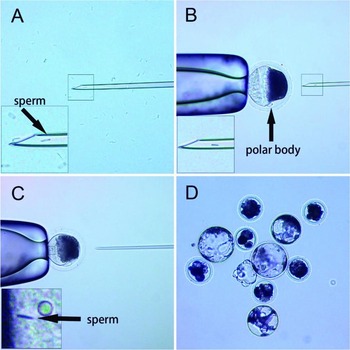
Oocytes were denuded of cumulus cells by repeated pipetting following 40 h of maturation. The oocytes were centrifuged for 10 min at 13,300 g in 500 μl H199 solution. High-quality intact oocytes with a visible polar body (PB) were selected for further use. In control group, lipase groups and Triton X-100 group, a small volume (5 μl) of sperm suspension was transferred to 30 μl DPBS drop and placed near the oocytes, but in PVP group, 5 μl sperm suspension was transferred to 30-μl DPBS drop containing 5% polyvinylpyrrolidone. All drops were covered with mineral oil (Sigma-Aldrich, M8410). ICSI was performed following a protocol described previously (Probst & Rath, Reference Probst and Rath2003). The ICSI process is shown briefly in Fig. 1. A sperm head was aspirated into the injection pipette (Fig. 1 A), and an oocyte was secured with a holding pipette (Fig. 1 B). Then the sperm head was expelled into the ooplasm (Fig. 1 C).
Process of intracytoplasmic sperm injection (ICSI) and the development of blastocysts from ICSI embryos. (A) A sperm head (arrow in box) is aspirated into the injection pipette. (B) A centrifuged oocyte with a visible polar body (arrow) is secured by a holding pipette and the sperm head (arrow in box) is about to be injected. (C) The sperm head (arrow in box) is expelled into the cytoplasm of the oocyte. (D) Blastocysts derived from ICSI oocytes after 168 h of in vitro culture.

Activation of ICSI oocytes
The oocytes were transferred to an electrical activation medium after injection (0.3 M mannitol, 0.5 mM HEPES,1.0 mM CaCl2.2H2O, and 0.1 mM MgCl2.6H2O) and placed in a chamber connected to an electrical pulse generator (CF-150/B; Cell Fusion, Budapest, Hungary) with two parallel electrodes at a distance of 0.46 mm. An electrical pulse was applied to activate the oocytes at a 1.3 kV/cm output voltage for 80 μs (Wu et al., Reference Wu, Xing, Liu, Zeng, Zhu, Zhang and Fu2002). After activation, the oocytes were washed three times with PZM-3 (100 μL) containing 3 mg/ml bovine serum albumin (BSA). Next, 15–20 oocytes were cultured in 50 μl PZM-3 medium droplets containing 3 mg/ml BSA under mineral oil at 38.5°C in humidified air with 5% CO2 for 7 days. The cleavage rate of the ICSI embryos on days 1 and 2 and blastocyst rate on days 6 and 7 were recorded, respectively. Pronuclear formation rate is also observed at 16–18 h after ICSI.
Assessment of male pronuclear formation
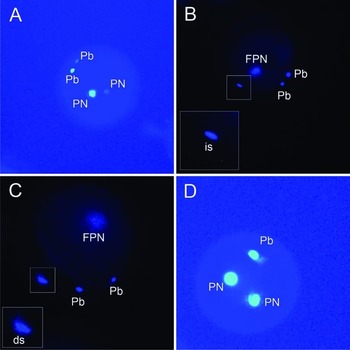
The oocytes were stained with Hoechst 33342 (10 μg/ml) 16–18 h after ICSI and examined for sperm decondensation or MPN formation under a phase-contrast microscope. The oocytes were classified into four groups: (i) one MPN with one female pronucleus (FPN) and two PBs (Fig. 2 A); (ii) one sperm head with one FPN and two PBs (Fig. 2 B); (iii) one decondensed sperm head with one FPN and two PBs (Fig. 2 C); and (iv) one MPN with one FPN and one PB (Fig. 2 D).
Four states of pig oocyte nuclei following intracytoplasmic sperm injection (ICSI). (A) An embryo with two pronuclei (PN) and two polar bodies (PBs) 16–18 h after ICSI, suggesting normal fertilization. (B) An oocyte with an intact sperm (is) head, female pronuclei (FPN), and two PBs 16–18 h after ICSI. (C) Oocyte with a decondensed sperm (ds) head, female pronuclei (FPN), and two PBs 16–18 h after ICSI. (D) An embryo with two PN and a PB 16–18 h after ICSI.

Statistical analysis
The embryo developmental experiments were repeated three times or more. All percentage data were subjected to arcsine transformation before statistical analysis. The data were analyzed by analysis of variance and Duncan's multiple-range test using SAS ver. 9.2 software (SAS Institute, Cary, NC, USA). A P-value < 0.05 was considered significant.
Results
Effects of pretreating porcine sperm with different concentrations of lipase on male pronuclear formation in porcine ICSI oocytes
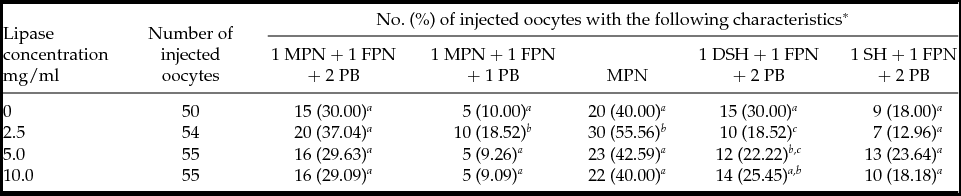
Experiment 1 was performed to investigate whether treating porcine sperm with lipase improved the MPN formation rate (Table 1). Fertilization rates (1 MPN + 1 FPN + 2 PB) were not different among the different treatment groups (Table 1; P > 0.05). However, the MPN formation rate in the 2.5 mg/ml lipase treatment group (55.6%) was significantly higher (P < 0.05) than those in the 5.0 (42.6%) and 10 (40.0%) mg/ml lipase treatment groups as well as the control group (40.0%). This result indicates that the MPN formation rate of ICSI embryos was significantly enhanced when using porcine sperm pre-treated with 2.5 mg/ml lipase.
Effects of pretreating porcine sperm with different concentrations lipase on male pronuclear formation following intracytoplasmic sperm injection

Replicates, n = 3.
DSH, decondensed sperm head; FPN, female pronucleus; MPN, male pronucleus; PB, polar body; SH, sperm head.
*1 MPN + 1 FPN + 2 PB, oocytes with two visible pronuclei and two polar bodies; 1 MPN + 1 FPN + 1 PB, oocytes with two visible pronuclei and one polar body; 1 DSH + 1 FPN + 2 PB, oocytes with a decondensed sperm head, a female pronucleus and two polar bodies; 1 SH + 1 FPN + 2 PB, oocytes with a sperm head, a female pronucleus and two polar bodies;
a,b,c Different lowercase superscript letters within the same column indicate a significant difference (P < 0.05).
Effects of pretreating porcine sperm with different concentrations of lipase on developmental competence of porcine ICSI oocytes
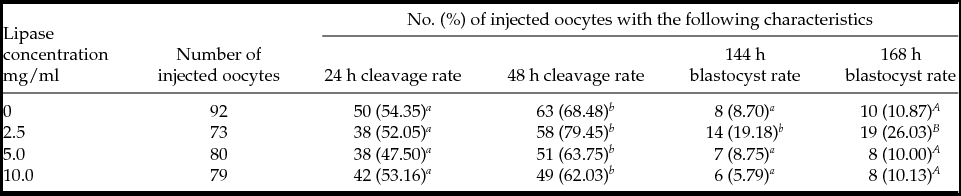
This experiment was designed to evaluate the impact of pretreating porcine sperm with different lipase concentrations on ICSI developmental competence. As shown in Table 2, the 24 h cleavage rates in all groups were not different (P = 0.56). The 48-h cleavage rates in the 2.5 mg/ml lipase treatment group tended to be higher than that in the other groups (P = 0.07), but has no significant diffidence. However, the percentage of 144 h blastocysts was significantly higher (P < 0.05) in the 2.5 mg/ml (19.2%) lipase treatment group than those in the 5.0 (8.8%) and 10 (5.8%) mg/ml lipase treatment groups, as well as the control group (8.7%). In addition, the 168-h blastocyst rate (Fig. 1 D) in oocytes injected with sperm treated with 2.5 mg/ml lipase (26.0%) was very significantly higher than those in the other groups (5.0 mg/ml, 10.0%; 10 mg/ml, 10.1%; control, 10.9%). As a result, pretreating porcine sperm with 2.5 mg/ml lipase improved the blastocyst rate better than any other treatment. Moreover, this result parallels the MPN formation rate result.
Effects of pretreating porcine sperm with different lipase concentrations on embryonic development following intracytoplasmic sperm injection

Replicates, n = 4.
a,b Different lowercase superscript letters within the same column indicate a significant difference (P < 0.05). A,B Different uppercase superscript letters within the same column indicate a very significant difference (P < 0.01).
Effects of different sperm treatment methods on male pronuclear formation following ICSI in pigs
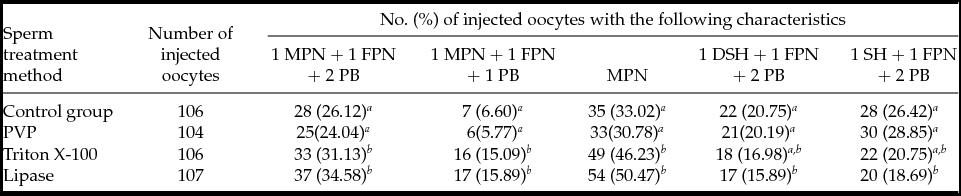
The highest ICSI efficiency rate in Experiment 1 was achieved with the 2.5 mg/ml lipase pretreatment. According to previous research (Perry et al., Reference Perry, Wakayama, Kishikawa, Kasai, Okabe, Toyoda and Yanagimachi1999), Triton X-100 can enhance the developmental competence of ICSI embryos. Therefore, to find which methods would be better, we compared MPN formation and developmental competence rates in the 2.5 mg/ml lipase treatment group and the 1.0 mg/ml Triton X-100 treatment group in Experiment 2. As shown in Table 3, the two treatment groups exhibited significantly higher (P < 0.05) fertilization rates (lipase, 34.6%; Triton X-100, 31.1%) and MPN formation rates (lipase, 50.5%; Triton X-100, 46.2%) than those in the control group (26.1% and 33.0%) and PVP group (24.0% and 30.8%), but no differences were observed between the two treatment groups. This result indicates that pretreating porcine sperm with lipase and Triton X-100 have comparable effects on enhancing ICSI fertilization and MPN formation. However, we observed that when performing ICSI operations, sperm treated by lipase tend to have less conglutination with the injection pipette, but Triton X-100 had no such effect.
Effects of different methods to pretreat porcine sperm on male pronuclear formation following intracytoplasmic sperm injection

Replicates, n = 4.
DSH, decondensed sperm head; FPN, female pronucleus; MPN, male pronucleus; PB, polar body; PVP, polyvinylpyrrolidone; SH, sperm head.
1 MPN + 1 FPN + 2 PB, oocytes with two visible pronuclei and two polar bodies; 1 MPN + 1 FPN + 1 PB, oocytes with two visible pronuclei and one polar body; 1 DSH + 1 FPN + 2 PB, oocytes with a decondensed sperm head, a female pronucleus and two polar bodies; 1 SH + 1 FPN + 2 PB, oocytes with a sperm head, a female pronucleus and two polar bodies.
a,b Different lowercase superscript letters within the same column indicate a significant difference (P < 0.05).
Effects of different sperm treatment methods on developmental competence following ICSI in pigs
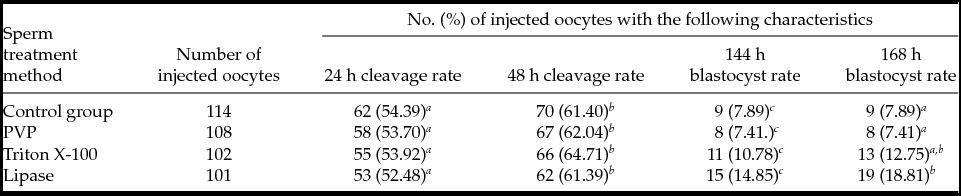
As shown in Table 4, no significant differences in 24-h cleavage, 48-h cleavage, or 144-h blastocyst rates were observed among the four groups (control, PVP, lipase and Triton X-100 groups). But the percentage of 168-h blastocysts after ICSI was significantly higher (P < 0.05) in the 2.5 mg/ml (18.8%) lipase treatment group than that in the control group (7.9%) and PVP group (7.4%). This is consistent with the result of Experiment 1 and indicates that lipase pretreatment method is better than control group or adding PVP in the operating medium. Pretreatment of sperm with 2.5 mg/ml lipase not only improve porcine ICSI operating efficiency but also enhance the development competence of ICSI embryos. However, no differences were observed between Triton X-100 and the other three groups. This result suggests that 2.5 mg/ml lipase was a better pretreatment than Triton X-100 for improving the later developmental competence.
Effects of different methods to pretreat porcine sperm on embryonic development following intracytoplasmic sperm injection

Replicates, n = 4.
a,b,c Different lowercase superscript letters within the same column indicate a significant difference (P < 0.05).
Discussion
During the normal mammalian fertilization process, sperm DNA contributes to embryonic development and oocyte chromatin depolymerization and MPN formation marks the completion of fertilization. However, a single spermatozoon is injected into oocytes during ICSI, which differs from natural fertilization and conventional in vitro fertilization. Therefore, ICSI by-passes penetration of the zona pellucida by the sperm and the plasma membrane and may bypass a number of biological processes necessary for normal fertilization, such as the acrosome reaction, sperm capacitation, and membrane fusion. The absence of these biological processes may delay MPN formation and decondensation of the sperm nucleus, resulting in a decreased fertilization rate and embryo quality. In addition, a series of acrosome hydrolyzing enzymes dissolve oocytes and have a negative effect on embryonic development (Morozumi & Yanagimachi, Reference Morozumi and Yanagimachi2005; Morozumi et al., Reference Morozumi, Shikano, Miyazaki and Yanagimachi2006). Various physical and chemical sperm treatments have been applied to destroy the integrity of the acrosome, plasma membrane, and nuclear membrane before ICSI. Some treatments are indispensable for normal depolymerization of the sperm nucleus, smooth formation of the male pronucleus, and normal embryonic development (Garcia-Rosello et al., Reference Garcia-Rosello, Garcia-Mengual, Coy, Alfonso and Silvestre2009).
Morozumi et al. (Reference Morozumi, Shikano, Miyazaki and Yanagimachi2006) showed that removing the mouse sperm plasma membrane and acrosome results in earlier onset of oocyte activation and better embryonic development before ICSI, after using lysolecithin to dissolve membrane phospholipids. In Experiment 1, we treated the porcine sperm with lipase in place of lysolecithin and then performed the ICSI procedure. Lipase has multi-catalytic abilities but particularly degrades the triglyceride ester bond to produce monoglycerides, diglycerides, and fatty acids and glycerol. In addition, lipase has other enzyme activities, such as lysolecithin, phospholipase, cholesterol esterase, and acyl peptide hydrolase activities(Anobom et al., Reference Anobom, Pinheiro, De-Andrade, Aguieiras, Andrade, Moura, Almeida and Freire2014). We discovered that the MPN formation rate was significantly higher (P < 0.05) in the 2.5 mg/ml lipase treatment group than that in the control group after ICSI. This result illustrates that pretreating porcine sperm with lipase may stimulate disintegration of the sperm acrosome and plasma membrane, promote the leak of SOAF, result in an immediate initiation of Ca2+ oscillations, started an earlier activation of the oocytes,as well as promote MPN formation and depolymerization of the sperm nucleus. The 144-h and 168-h blastocyst rates were significantly higher in the 2.5 mg/ml lipase group than those in the other groups. This result indicates that pretreating porcine sperm with lipase promoted embryonic developmental competence. Slightly lower sperm nuclear depolymerization rate, MPN formation rate, fertilization rate, cleavage rate, and blastocyst rate were observed in the 10.0 mg/ml lipase group than those in the control group. This result suggests that pretreating sperm with the appropriate lipase concentration enhanced MPN formation and post-embryonic development. High concentration lipase may damage the sperm plasma and nuclear membranes and destroyed sperm chromatin and sperm DNA stability; thus, affecting MPN formation and subsequent embryonic development. There is also another possibility: the high concentration lipase destroyed the sperm plasma and nuclear membranes at the same time, which would alter permeability resulting in reactions between exogenous harmful substances and the sperm nucleus during CO2 incubation and injection operations and eventually damaged the sperm nucleus (Xiao & Li, Reference Xiao and Li2007).
Triton X-100 is an anionic detergent that induces membrane damage and dissolves nuclear proteins and lipids. Some reports have indicated that pretreating porcine sperm with Triton X-100 significantly increases oocyte activation during ICSI and sperm decondensation rates (García-Mengual et al., Reference García-Mengual, García-Roselló, Alfonso, Salvador, Cebrian-Serrano and Silvestre2011). Our Experiment 2 results show that fertilization and MPN formation rates were significantly higher (P < 0.05) in the two treatment groups than those in the control group and PVP group. In addition, the 168-h blastocyst rate was significantly higher (P < 0.05) in the 2.5 mg/L lipase treatment group than that in the control group and PVP group, but the 1.0 mg/L Triton X-100 group was not significantly higher than the control. No significant differences in MPN formation or embryo developmental rates were observed to the blastocyst stage between the lipase and Triton X-100 groups. Our results are similar to those of Lee & Yang (Reference Lee and Yang2004); but different from those of Nakai et al. (Reference Nakai, Ito, Sato, Noguchi, Kaneko, Kashiwazaki and Kikuchi2011). Differences in the Triton X-100 concentrations used and treatment times may have caused these disagreements. Compared with Triton X-100, lipase dissolves lipid and destroys plasma membranes and can also degrade some glycoproteins, glycosphingolipids, and cholesterol on the sperm membrane surface; thus, solving the conglutination problem between the sperm and injection pipette. Thus lipase pretreatment method improved ICSI operating efficiency by decreasing the mechanical stimulus of injection pipette, and avoided the adverse effects of PVP. We believe that this method is useful to increase the production efficiency of ICSI in pigs.
According to previous studies (Wei & Fukui, Reference Wei and Fukui2000), adding polyvinylpyrrolidone (PVP) into the operating medium during ICSI manipulation can reduce conglutination between sperm and the injection pipette, and improves ICSI operating efficiency, but the presence of PVP in the oocyte not only delays sperm nuclear decondensation by stabilizing the sperm plasma membrane but also results in the failure of oocyte activation by impedes release of a sperm-borne protein (Hlinka et al., Reference Hlinka, Herman, Vesela, Hredzak, Horvath and Pacin1998; Strehler et al., Reference Strehler, Baccetti, Sterzik, Capitani, Collodel, De Santo, Gambera and Piomboni1998). However, in this study we did not observe any significant difference between PVP and control group, neither on male pronuclear formation rate (Table 3) nor on the developmental competence of ICSI embryos (Table 4). This may be due to the different sperm plasma membrane structure of swine and bovine. But it is advisable to replace PVP method with our lipase pretreatment method, as lipase pretreatment not only reduce conglutination but also enhance the developmental competence of ICSI embryos.
In conclusion, pretreating porcine sperm with 2.5 mg/L lipase enhanced the MPN formation rate and had a significant role in increasing the blastocyst formation rate. Therefore, lipase is a useful sperm pretreatment method for porcine ICSI and more effective than the Triton X-100 method.
Financial support
This work was supported by the Chinese Academy of Agricultural Sciences Foundation (grant number 2014-ywf-yb-9); the Agricultural Science and Technology Innovation Program (grant number ASTIP-IAS05); and the National Science and Technology Major Project of China (grant number 2015ZX08006-003).
Conflicts of interest
There are no conflicts of interest.