In July 1914, A. F. Hockenbeamer, the treasurer of the Pacific Gas & Electric Company, had a very good idea, at least from his perspective. California progressives had been calling for public ownership of utilities, so Hockenbeamer introduced a slight variation in terms in order to bring about entirely different results in practice. In place of public ownership, Hockenbeamer offered “customer ownership” by selling stock directly to his northern California customers. Because these customers were also voters in California’s new referendum process, the quarterly dividends they received were bound to pay dividends of their own: back to the company whenever measures regarding public utilities came up at the ballot box.
To inform customers about the new stock offer, the Pacific Gas & Electric Company (PG&E) “opened up with a veritable barrage of a quarter of a million circulars directed to the company’s consumers,” as the company’s employee magazine later recounted. Footnote 1 Newspaper advertisements reiterated the message. In addition—and in what became a hallmark of customer ownership campaigns well into the 1920s—PG&E began selling stock directly to customers from the company’s branch offices. Footnote 2 The company offered $100 shares at par value for $82.50, either in cash or on an installment plan, for as little as $5 down and with none of the minimum purchase requirements or commission fees that attended stock purchases made at brokerage firms. Footnote 3
Past and current scholarship has focused on customer stock ownership at AT&T after World War I, yet this was not where corporate executives and Wall Street Journal editors located the strategy’s origin. Footnote 4 They routinely credited the Pacific Gas & Electric Company with inventing customer ownership during the Progressive movement and praised the company for its organizational ingenuity in the face of the threat of municipal ownership. The Wall Street Journal called PG&E and another smaller company “pioneers,” while the president of the Southern California Edison Company told executives at an industry conference that customer stock ownership began with PG&E. Footnote 5
Identifying the origins of customer stock ownership with PG&E in 1914 is the first of three main arguments made in this article and the one that most complicates the historiography. The fact that customer ownership existed before World War I forces a reassessment of the influences that war bond sales, academic theorists, and AT&T executives had on customer ownership: influences that Roland Marchand and Julia Ott have stressed. At the same time, however, this article builds on the pioneering work of Marchand and Ott. Marchand focused on customer stock ownership at AT&T after World War I as part of his study on corporate public relations. Ott also emphasized customer ownership at AT&T after World War I while at the same time tracing the organizational and ideological connections between the Liberty Bond campaigns of the war and the customer ownership programs of the 1920s. The arc of Ott’s narrative is that, first, federal officials sold Liberty Bonds to Americans to raise capital and political support for an initially unpopular war. Harvard political economy professor Thomas Nixon Carver then modified the idea by suggesting that executives sell corporate stock to Americans in an attempt to reconcile the interests of “Everyman” with those of executives. “Inspired” by Carver’s ideas, Ott argues, AT&T and other corporations began selling stock to customers in the 1920s. Footnote 6
This article modifies that narrative by relocating the origins of customer stock ownership to before World War I. Utility executives did not learn the strategy of customer stock ownership from the Liberty Bond campaigns or Carver. Rather, utility executives invented customer stock ownership themselves and did so in response to the political threat of municipal ownership facing their monopoly utilities. Even Carver himself acknowledged that electric utilities invented customer stock ownership in 1914, which was long before he began advocating the strategy. Footnote 7 Customer stock ownership emerged not from the bureaucratic offices of Washington or the ivy-covered halls of academia but from the oak-coffered boardrooms of corporations.
The second main argument this article makes is that millions of Americans became corporate shareholders in the 1920s not only because of customer demand but also because of corporate supply. Utility companies did not merely offer stock to Americans, utility employees actively pressured their customers, friends, and neighbors to buy stock by knocking on their doors, calling them on the phone, and pitching them stock at electricity and telephone offices and streetcar stations. Historians often recount how Americans clamored to buy stock on margin in the 1920s, yet an understanding of corporate supply must augment this conception of customer demand. Footnote 8 The supply-side social history presented here reveals how utility clerks personally sold stock to 20 percent of the total number of shareholding Americans by the crash of 1929.
Did customer stock ownership work? Did utility executives accomplish their goals of reducing antimonopoly sentiment and improving public opinion toward monopoly capitalism in the 1920s? The answer to these questions is yes, to an extent. In elaborating on this last main argument, a new explanation for the decline of antimonopoly sentiment and the survival of corporate monopolies in the 1920s is offered.
Customer Stock Ownership Before World War I
The Pacific Gas & Electric Company, based in Northern California, launched its customer stock ownership program in direct response to events taking place in Southern California. In 1907 Los Angeles voters approved bonds for an ambitious water project in the Owens Valley. Three years later, Los Angeles residents added a small municipally owned power plant to the project. Over the next several years, plans for the small power plant evolved into proposals for a much larger plant. In May 1914, Los Angeles residents voted to construct a large municipally owned power plant and buy-out the city’s privately owned electricity distribution network, owned by the Southern California Edison Company. The vote delivered a crushing blow to the company, which lost nearly 75 percent of its business, and sent a wake-up call to the company’s largest neighbor to the north, the Pacific Gas & Electric Company, headquartered in San Francisco. Footnote 9 San Francisco residents also had been toying with municipal ownership, and in 1910 they approved a water project in the Hetch Hetchy Valley to free themselves from the city’s hated private water utility. Footnote 10 Like an earlier version of LA’s Owens Valley plan, San Francisco’s Hetch Hetchy project called for a small, municipally owned power plant. With LA’s 1914 vote to expand the city’s power plant, San Francisco’s plans began to look like creeping socialism to executives at PG&E. Not willing to sit back and watch while San Francisco residents followed in the footsteps of Los Angeles, PG&E executives quickly launched their customer stock ownership program. Just three months after residents voted for municipal ownership in Los Angeles, PG&E began selling stock to customers in San Francisco. Footnote 11
If the threat of public ownership provided PG&E with the initial motivation to sell stock to customers, state utility regulations provided a convenient justification. In 1914, after several years of record growth, PG&E wanted to build a new power plant and petitioned the California Railroad Commission for permission to issue additional bonds to pay for the project. Footnote 12 The Railroad Commission, however, which oversaw utility financing in the state, rejected PG&E’s financing plan. Footnote 13 The commission limited the total amount of bonded debt a utility could carry to a percentage of the firm’s annual profits, and PG&E had reached that limit. The commission also would not allow PG&E to raise electricity rates on customers. The only financing plan the commission would accept was for PG&E to issue additional stock. Footnote 14 It was in this context of both securities regulation and rate regulation that PG&E began selling stock to customers.
While the Railroad Commission essentially forced PG&E to sell stock, the decision to sell this stock directly to customers, rather than to large investors, was the company’s own choice, and an overwhelmingly political one. As the company’s magazine declared in 1915, “one of the surest ways of solving the so-called corporation problem and enlisting the good-will and support of the public is to appeal to its self-interest by giving it the opportunity of becoming a partner in the corporation enterprise and sharing in its profits.” Footnote 15 Less than a month after the company initiated its customer ownership plan, the San Francisco Chronicle observed that the program was “generally regarded as a master stroke of diplomacy.” Footnote 16 Four months later the Chronicle declared: “The distribution of this stock is the worst blow ever delivered municipal ownership on this Coast.” Footnote 17 It was still too early to tell, but PG&E certainly hoped it would be.
Despite the fact that PG&E only offered “preferred stock,” which did not include corporate voting rights, customer appetite proved stronger than the company and outside observers expected. Footnote 18 Each month hundreds of customers handed over $82.50 for one share of PG&E stock, yielding a 6 percent dividend on its $100 par value, or an actual return on investment of 7.27 percent, much better than the average savings account. Footnote 19
Although each individual customer did not typically subscribe to large quantities of the stock, the number of subscribers soon became large. By December 1916, PG&E had vaulted itself into the ranks of the top twenty corporations in terms of the number of shareholders, surpassing even the railroads. Footnote 20 Other electric companies began to take note. By the time of United States entry into World War I and the first Liberty Bond Campaign, thirteen additional electricity companies had launched customer ownership plans. During the war, fifteen more electric companies initiated customer stock ownership plans. Footnote 21
Customer Stock Ownership After World War I
After the war, customer stock ownership spread like wildfire throughout the electricity, gas, streetcar, and telephone industries. In 1919 and 1920, a total of forty-six electricity companies started customer ownership plans. In 1921 an additional thirty-seven electric utilities in all parts of the country began customer ownership plans, a number only exceeded by the next year’s totals. Footnote 22 Also in 1921, AT&T introduced its own customer stock ownership program. Footnote 23 In other words, AT&T adopted the strategy of customer stock ownership when the movement to initiate plans in the electricity industry was already nearing its peak. Far from being a post-World War I phenomenon inspired by war bond sales and Thomas Nixon Carver, customer stock ownership predated the war and emerged as an organizational response to Progressive agitation for public ownership. Footnote 24
As customer stock ownership became common throughout the utilities industries, credit to PG&E for inventing the strategy began pouring in from utility executives, industry journals, and the financial press. Members of the National Electric Light Association (NELA), the major electricity industry group, routinely credited PG&E with inventing customer ownership. Footnote 25 An executive at the Oklahoma Gas & Electric Company declared at the 1922 NELA convention: “The industry as a whole owes a debt of gratitude to the Pacific Gas & Electric Company for having inaugurated this scheme which is now being pushed so generally.” Footnote 26 A vice president of the Southern California Edison Company traced his company’s use of customer ownership to PG&E, informing a group of utility executives in Boston that “from San Francisco the scheme came down to Los Angeles.” Footnote 27 This was the same Southern California Edison Company that had lost nearly 75 percent of its business after Los Angeles residents voted for municipal ownership in 1914. After that experience, the company took no chances with public ownership in its remaining suburban markets and became a major practitioner of customer stock ownership. Footnote 28
The idea of selling stock to utility users was not entirely new in 1914 when PG&E began offering shares to customers. In the past, however, these efforts had been employed by fledgling utility organizations that sought to provide service in rural areas where it would otherwise not be available. Often, these small telephone and electricity organizations were boosted by farmers, merchants, or doctors who constructed rudimentary networks and offered service to nearby residents in exchange for users paying for a share of the equipment. These organizations can best be thought of in the same way they thought of themselves: as cooperative associations, or “mutuals.” In contrast, the Pacific Gas & Electric Company, when it first introduced its customer stock ownership, was a multimillion-dollar corporation, with tens of thousands of customers, and shares of its stock traded on the San Francisco Board of Stocks and Bonds. In terms of institutional size, technological sophistication, and a clear division between customers and the corporation, PG&E was a different kind of organization offering a different kind of ownership program. The customer stock ownership program introduced by PG&E in 1914 can, therefore, rightfully be considered the first program of its type in American business history. Footnote 29
After World War I, customer stock ownership spread rapidly because the strategy was now used to fight municipal ownership as well as another common enemy of utilities—low utility rates as set by regulatory commissions. In the inflationary period directly after the war, many Americans began scrutinizing their utility bills, as did utilities. Prices on labor and materials were going up, but state utility boards fixed the rates that utilities could charge. In order to secure rate increases, utilities needed approval from state regulatory commissions, but to receive that approval, utilities first needed to obtain public good will. That was because regulatory boards could not risk their own legitimacy by flagrantly violating public opinion. Their rulings ultimately had to be supported in the court of public opinion, executives believed. As Samuel Insull, the president of the Commonwealth Edison Company, declared before a group of utility executives in 1921: “Our income, our earning capacity, is dependent, primarily in my judgment, upon public good will.” Footnote 30 AT&T Vice President E. K. Hall agreed, telling a group of employees in 1922: “I want to emphasize this point—whether we get adequate rates and so can be assured of a safe margin depends almost absolutely in the last analysis on public opinion.” Footnote 31
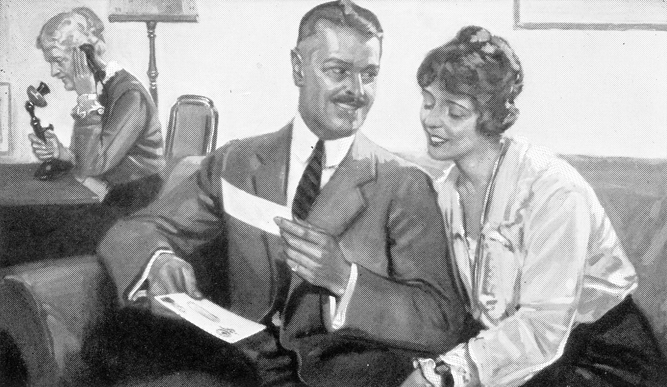
It was in this political-economic context that AT&T initiated its first customer stock ownership program in 1921 (Figure 1). The strategy provided the company with a solution to the difficult riddle of how to secure rate increases while at the same time improving public opinion. By selling stock to thousands of Americans and returning a portion of the company’s profits back to customer-shareholders, AT&T could cast itself not as a greedy monopoly but as the responsible steward of the nation’s small investors. To oppose AT&T rate increases would be to oppose the many small investors themselves. Footnote 32 AT&T executives also believed that stock ownership would make customers more willing to trade special privileges, such as a nationwide monopoly, for user benefits, such as quality service, if the deal came with the ultimate user benefit—a healthy $9 dividend. Footnote 33
AT&T advertisement for stock ownership, 1922.
Source: AT&T, “Owned by Those It Serves,” Southern Telephone News, October 1922, back cover, courtesy of AT&T Archives and History Center.
Note: AT&T hoped that any lingering antimonopoly sentiment would decline each time customers opened their dividend checks.

Before launching their own customer ownership program, Bell executives had been observing the strategy in the electricity industry; after adopting the idea, they received advice on its customer ownership program from electricity executives. In 1920, before AT&T initiated its customer ownership plan, a manager for the AT&T subsidiary Pacific Telephone and Telegraph Company (PT&T) observed: “A large public utility in the light and power field in our own territory advertises the issue of notes at a rate which will net the purchaser 7.70 per cent.” Footnote 34 He may have been referring to the Pacific Gas & Electric Company or the Southern California Edison Company. When PT&T began offering stock directly to customers, none other than A. F. Hockenbeamer, the man who invented customer ownership at PG&E, wrote to the president of PT&T and advised him that if PT&T wanted to sell any of its new preferred stock, the company would need to declare immediate dividends. Hockenbeamer’s letter eventually reached AT&T President Walter Gifford, the dividends were declared, and stock sales followed. Footnote 35 AT&T executives did not develop customer stock ownership on their own; they learned it from the electricity industry.
The Social History of Customer Stock Ownership
Employee Stock Selling
In order to sell as much stock as possible to customers, utility executives used advertising, but they were not content to wait for customer demand. Instead, executives compelled each employee to peddle stock to the employee’s family, friends, and neighbors. Footnote 36 Since the Bell System alone employed more than 400,000 workers in 1929—the largest employer in America at the time—and the electricity and gas industries employed another 230,000 workers, the relationship network utility executives tapped into was immense. Footnote 37 Additionally, since utilities employed not only managers, accountants, and engineers but also clerks, streetcar conductors, and switchboard operators, utility employees were able to reach thousands of Americans who would not normally have been solicited by securities salesmen or gone into a brokerage firm. Footnote 38 By farming these interstitial regions of America’s financial landscape, utility executives harvested millions of dollars of capital, but more importantly, they tied their customers’ financial future to the utilities’ political future.
Utility employees did not receive a great deal of training for their new job of stock selling. Typically, managers simply offered employees a few pointers on how to sell stock when the customer ownership program was announced at a large company meeting. When knocking on a customer’s door, managers instructed employees to say: “I have come to see you at the company’s request. They want me to tell you of an opportunity the Company is offering to its customers.” People in a rush were not receptive to sales offers, managers told employees, but “after a rest and a supper a man is likely to be in a buying mood.” Employees should therefore visit customers at night. Above all, employees should try to gain access to the customer’s house rather than make the pitch from the doorstep. Footnote 39
Also during introductory sales meetings, managers asked employees to subscribe to the company’s stock themselves because, according to Samuel Insull, no employee could be a good salesman “unless he takes a dose of his own medicine.” Managers sometimes planted an employee in the audience to be the first to volunteer to buy stock in order to get the other employees to do the same. Regarding these shills, executives cautioned managers to “tell them to say nothing about it.” Footnote 40
Managers also sought to develop a list of sales contacts at these introductory meetings. A manual written by executives experienced in customer ownership drives advised managers to require each employee:
[To provide the names and addresses of ten acquaintances] on whom he agrees to call. THEN LOCK THE DOOR AND LET NOBODY OUT UNTIL THEY TURN IN THE TEN CARDS EACH. Don’t be put off by those who say they will think it over and turn in a list later—experience has shown that it then becomes a tremendous task to get in the names. Footnote 41
According to a 1925 American Electric Railway Association (AERA) report, this practice was “often found useful.” Footnote 42
Though employees received little sales training, they received even less financial education. As a Bell executive admitted at a personnel conference in 1929, “no effort was made to acquaint the rank and file with the details of the financial statement of the Company.” If a potential investor asked a Bell employee whether the company’s stock had any value, the employee was simply instructed to reply, “It had or the company would not be selling it.” Footnote 43 Electricity employees were taught that if a potential shareholder were to ask the likelihood of the company failing, employees should answer: “None. Based upon the history of utility companies in the United States, there is much less chance of failure than in other sound enterprises.” Footnote 44
To motivate employees to sell stock, officers established quotas and set commissions. Footnote 45 Several companies divided departments into rival sales teams. Footnote 46 Managers at the Southern California Edison Company divided each office into a red team and a blue team, and set them against each other. Footnote 47 “Everything was done to arouse competition,” the company’s president told executives at an industry conference. Footnote 48 It was not surprising that employees at the company soon fell to bickering over who should get credit for stock sales when a customer had spoken with two employees before deciding to buy stock. Footnote 49
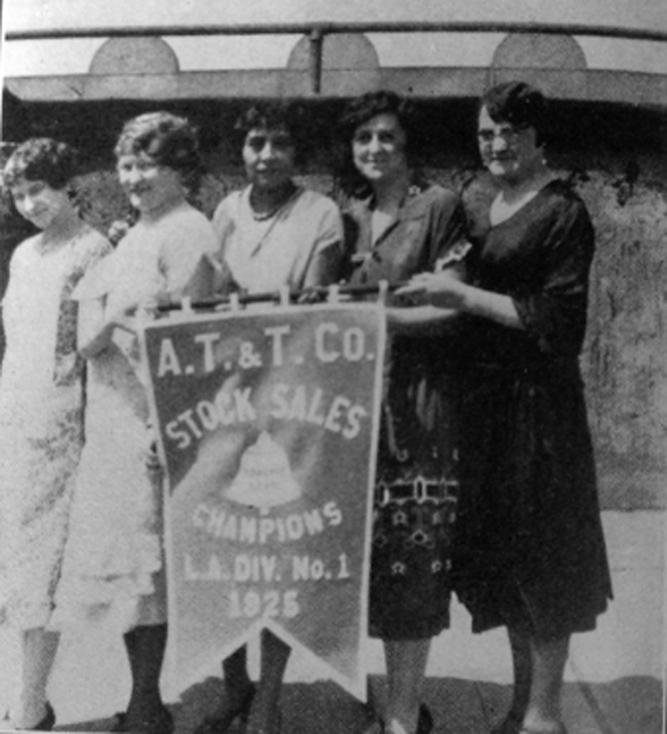
For the winning teams of monthly sales competitions, companies offered trophies and company pennants, while particularly enthusiastic individual employees received flowers, a letter of commendation, or a write-up in the company’s employee magazine (Figure 2). Footnote 50 Despite these inducements, most employees appear not to have been very enthusiastic about stock selling. One manager observed that employees at his office were overjoyed when news arrived that their company would not be assigning quotas that year. Footnote 51 Some managers, however, reported that employee morale increased as workers delivered sales pitches to neighbors. Footnote 52 One Bell employee was recognized for selling more dollars’ worth of stock than the value of the office building in which he worked. Footnote 53
Employees at the central information office of the Pacific Telephone & Telegraph display banner they received for selling the most stock in their region, November 1926.
Source: “Customer Ownership Helps,” Pacific Telephone Magazine, November 1925, 22, courtesy of AT&T Archives and History Center.

In addition to having employees sell stock to their friends and neighbors, utilities also sold stock directly to customers at local utility offices. As residential electricity and telephone use skyrocketed in the 1920s, utility branch offices received a steady stream of customers coming in to sign up for service, pay their monthly bill, or dispute a charge. This provided office clerks with numerous opportunities to sell stock. While most employees had to sell stock off the clock on their evenings and weekends, customer-service clerks were required to peddle stock to every customer who walked through the door. Footnote 54 To do this, one enterprising worker at the Southern California Edison Company stationed himself between the clerk who took the customers’ bills and the clerk who took the customers’ money in order to glance down at the names on the bills and then launch into a sales pitch before customers could complete their transactions. When that held up the line too much, clerks began intercepting customers as they walked from the front door to the counter in order to strike up a conversation with them about buying stock. Footnote 55 Streetcar station agents and platform attendants distributed pamphlets about stock to passengers while they sat in waiting rooms or stood on platforms, and conductors harangued them about buying stock as they traveled in the cars. In addition, streetcar companies plastered waiting rooms, platforms, and cars—inside and out—with posters and banners advertising stock. Footnote 56
Streetcar, gas, electricity, and telephone employees also gave speeches about customer ownership at factories, county fairs, civic clubs, high schools, and colleges. Footnote 57 As Julia Ott has shown, many of these sales tactics had been used during World War I to sell government bonds, though utility employees had solicited customers to buy stock at local offices as early as PG&E’s first customer ownership drive. Footnote 58
Eventually, this constant pressure to buy stock got on customers’ nerves. Managers reported that customers were demanding “peace” on the subject of stock ownership. “I don’t want to talk Edison stock, I want to pay my bill,” fumed one customer at a Southern California Edison office in 1921. Footnote 59
For Politics or Capital?
The goal of all this stock selling was not to raise capital but to raise political support, as utility executives explicitly stated. The president of the Southern California Edison Company flatly told an audience of electricity executives in 1924: “Our activity has been wholly along the line of securing partners, not of raising money.” David F. Houston, the president of the Bell Telephone Securities Company, made an almost identical statement in 1922, telling Bell managers at a personnel conference: “The central thought in this [customer ownership] plan is not that of raising large sums of money and of raising them quickly. It is rather that of establishing better public relations.” Footnote 60
These comments were not made for public consumption, but utility executives made no secret of their political designs. If a potential customer-owner asked, “Why do you not go to Wall Street for funds?,” a NELA manual instructed electric company employees to answer: “The company is now offering the citizens of the communities it serves an opportunity to invest … first, to increase public friendship and good-will.” Footnote 61 Customer ownership was clearly a political strategy. It was overwhelmingly about politics.
The Regional Aspect of Customer Stock Ownership
Like most of American politics, the politics of customer ownership had a regional dimension. This was especially true of AT&T’s customer ownership program. One of the main goals of the company’s stock ownership program was to reduce the concentration of AT&T stock in the Northeast and increase it in the South, West, and Midwest; a project AT&T officers called their “redistribution campaigns.” Footnote 62 Regarding this redistributed stock, David F. Houston, the president of the Bell Telephone Securities Company, stated that it was not “necessary or desirable to have it leave the territory. … This would not be consistent with the underlying purpose.” Footnote 63 Ironically, Gardiner Hubbard, the founder of the Bell Telephone Company, promoted decentralized ownership of the company because he hated Western Union’s telegraph monopoly and wanted to prevent a similar monopoly in the telephone industry. By the early 1920s, however, the Bell System was again promoting decentralized ownership, but this time in defense of its monopoly. Footnote 64
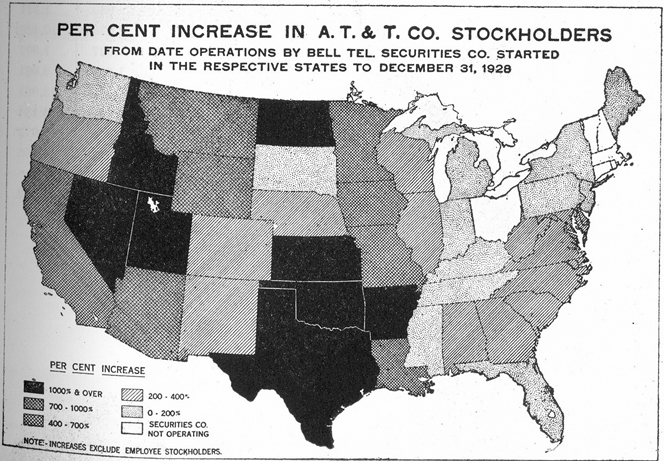
As AT&T and other utilities began selling stock to customers, shareholders began to appear in places far from the traditional centers of banking and finance. By 1927, gas and electric utilities had sold stock in every state (except Nevada, North Dakota, and Wyoming), including tens of thousands of shares in rural states such as Alabama, Kentucky, and West Virginia. Footnote 65 Between 1921 and 1928, AT&T increased the number of its shareholders by between 400 percent and 1,000 percent in California, Idaho, Iowa, Minnesota, Montana, Nevada, North Dakota, Wisconsin, and Wyoming (see Figures 3 and 4). Footnote 66 Considering that public ownership advocate Robert La Follette came in first or second in each of these states during the 1924 presidential election, AT&T’s stock redistribution effort was not an unwise decision from the viewpoint of management. Footnote 67
Increase in AT&T stockholders from 1921 to 1928. AT&T intentionally increased the percent of shareholders in the South and West.
Source: Annual Report of the Bell Telephone Securities Company, 1928, 7, courtesy of AT&T Archives and History Center.

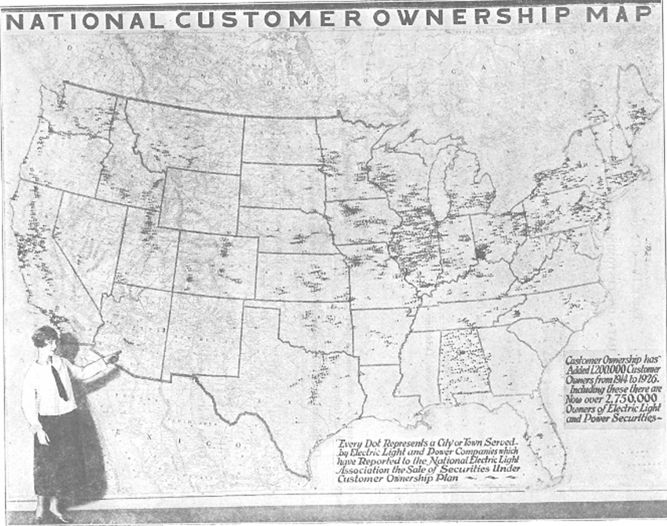
Map showing towns and cities where utilities operated customer stock ownership campaigns in 1925.
Source: “Customer Ownership Committee,” NELA Proceedings 1926, 324.

AT&T’s impressive stock sales feats demonstrated its organizational capability to supply stock to individual customers in all parts of the counry. Whenever AT&T directors approved new stock issues—which occurred almost every other year in the 1920s—Bell employees fanned out across their territories, soliciting friends and neighbors to buy shares and taking subscriptions from customers at local commercial offices. Footnote 68 The entire program functioned as a giant public education campaign in corporate securities ownership. New stock issues gave existing shareholders warrant rights to purchase new stock, but many customers did not know what warrant rights were, let alone that they possessed them. Bell clerks, therefore, called existing customer-owners to make sure they understood that they could buy one share of new stock for every five to ten shares that they already owned or could sell their warrant rights for cash. Customers who could not be reached by telephone often received personal visits from Bell company managers. One manager doing home visits reported that sixteen of his previous customers had torn up their warrants because they did not understand that they were worth money. Footnote 69 Another manager visited an elderly couple who lacked the finances to subscribe to more stock and had lost their warrant rights. The manager found the rights under a pile of papers and wrote the couple a check for $46.70, the going value of four warrants. Footnote 70 Other customers knew that they wanted stock but could not figure out how much it cost, so they mailed the Bell Securities Company a blank check and asked the company to fill it in, which required a personalized reply from the company. Footnote 71 Through these letters, calls, and visits, thousands of Americans learned to become shareholders in AT&T.
By turning every local office into a brokerage firm and every employee into a stockbroker, utilities supplied vast amounts of stock directly to Americans all over the country. At these offices, customers could buy stock for cash or on the installment plan and sell their shares, or warrant rights in the case of AT&T, for cash. Footnote 72 Considering that the Bell System maintained more than six thousand branch offices across the United States, even in small towns, it almost certainly became the largest U.S. brokerage during the 1920s in terms of geographic reach and possibly also in terms of volume (see Figure 5 and Figure 6). Footnote 73 Thousands of Americans bought AT&T stock in the 1920s, partly because of customer demand, but also because of a highly personalized campaign of corporate supply.
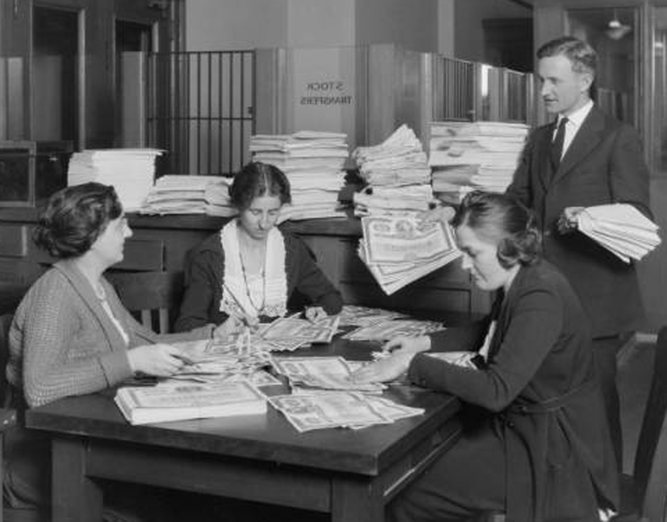
Piles of stock at the Southern California Edison Company in 1922.
Source: SCE 02 10450, Southern California Edison Photographs and Negatives, The Huntington Library, San Marino, California.
Note: The photo’s description reads, “Making out Stock Certificates in the Securities Department.”

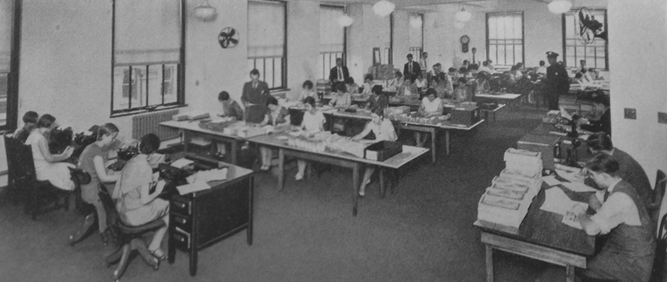
Processing stock at the Bell Telephone Securities Company in 1930.
Source: Blair-Smith, “The 1930 Stock Offer of the American Telephone and Telegraph Company,” Bell Telephone Quarterly, October 1930, photo opposite page 253, courtesy of AT&T Archives and History Center.
Note: A security guard stands watch in the back right corner as managers hover over each row of clerks.

The Twenty Percent
The results of these personalized selling techniques in numerical terms proved dramatic. Counting only those stock sales specifically attributed to customer stock ownership campaigns, and not counting sales made to institutional investors or through traditional brokerage firms via stock exchanges, the total number of shareholders obtained through customer ownership plans in the gas, electricity, and telephone industries exceeded two million by the crash of 1929. Footnote 74 If the number of stockholders in the United States by that date was ten million people—a commonly cited number—then utility employees sold stock through customer stock ownership programs to no less than 20 percent of the total number of stockholders in America by the late 1920s. Footnote 75
Who were the 20 percent? Many of them were first-time shareholders of moderate incomes. Utility executives specifically used their clerks to reach people of modest incomes. The Bell Telephone Securities Company 1923 Annual Report stated that its shareholders were often people of “small means, many of whom apparently are relatively unacquainted with investments.” Footnote 76 Customer-owners also came from a wide range of age groups, ethnic backgrounds, and occupations. According to company lists, shareholders included auto mechanics, bakers, barbers, beauticians, bell hops, boilermakers, bootblacks, brick layers, butchers, carpenters, chauffeurs, clerks, coal dealers, cobblers, contractors, cooks, coroners, druggists, farmers, fruit packers, housewives, janitors, movers, nurses, pawn brokers, porters, preachers, priests, sailors, salesladies, soda dispensers, teachers, telephone operators, stenographers, taxi drivers, and waiters. By far, the largest categories of shareholders were housewives and clerks. Footnote 77
After executives obtained customer-shareholders, they endeavored to mold their new investors’ political sentiments. Utility executives mailed shareholders the latest issue of their company’s magazine and stuffed dividend envelopes with political tracts about upcoming ballot measures. Footnote 78 The Byllesby Corporation, one of the largest utilities in the country, sent its shareholders a calendar featuring a specially commissioned painting depicting “Dividend Day,” with this new four-times-a-year holiday highlighted for each quarter. Footnote 79 Another company changed its dividend payment schedule from quarterly to monthly so it could have “12 favorable impressions in a year, instead of four.” Footnote 80 This repeated favorable contact between utilities and shareholders was one reason why executives preferred stocks to bonds. Bonds created partners only until the bonds matured, but stocks kept paying dividends year after year. Footnote 81
Combining the Political Economic and Social Histories
Did It Work?
Did customer stock ownership work in its stated goals of thwarting public ownership, obtaining public good will, and securing rate increases? Executives, regulators, and outside observers—even critical ones—agreed that it did. Herbert Pell Jr., a former congressman from New York, considered utility executives to be “utterly irresponsible” but acknowledged in 1925 that “so long as dividends are paid no complaints will come.” Also in 1925, Henry L. Stimson, the once and future secretary of war, stated at an academic conference on customer ownership that “some critics tend to belittle the new [customer ownership] movement. … I think that they underestimate the immense change which is being effected in public opinion and the power of that public opinion. … Upon that public opinion the new proprietorship is producing a most potent change.” Footnote 82
Many other observers confirmed Stimson’s view of the momentous influence of customer ownership. A 1929 NELA report on customer ownership found that “the effect upon public relations has been profound and far reaching—in fact, it has entirely changed the character of electric light and power companies in the public mind.” Footnote 83 In 1925 the vice president of the San Joaquin Light and Power Corporation observed that when a customer buys stock, “almost invariably, and usually unconsciously, he takes a new interest in the utility and its affairs. His dividend checks come as symbols of his ownership … he learns something of the doctrine of self-interest … ‘you scratch my back and I’ll scratch yours’.” Footnote 84
Only in the streetcar industry did executives find customer stock ownership less successful, though it was not for lack of trying. Streetcar companies had trouble convincing customers to invest in an industry facing the daunting challenge of jitneys and automobiles. Furthermore, streetcar companies served fewer people. For these reasons, streetcar utilities had difficulty selling stock to customers, and the strategy of customer stock ownership was not as widespread in the streetcar industry as it was in other monopoly utility industries. Footnote 85
In the gas, electricity, and telephone industries, however, observers believed that local agitation for public ownership and resistance to rate increases diminished as a result of customer ownership. A staffer for the California Railroad Commission observed in 1926 that “the sale of stock to customers has had a most beneficial effect. … As a result of the practice the tears of despair that formerly were shed at rate cases was changed into the radiant smile.” In 1929 an executive at Byllesby Corporation told the Wall Street Journal that, thanks to customer ownership, the company had enjoyed “a remarkable history of rate increases, the majority of which were obtained without controversy by simply showing facts. We hear little or nothing of municipal ownership any more, at properties where we have home-shareholders.” Footnote 86 A stronger endorsement could hardly be made.
Customer ownership even helped convert some former socialists to capitalism, including John Spargo, a founding member of the Socialist Party of America and biographer of Karl Marx. In 1924 Spargo penned a “confession” in Outlook magazine, in which he declared that “governmental ownership and operation of railroads, telegraphs, telephones, and similar public utilities now appears to me to be inherently inferior to the new type of enterprise we are so rapidly developing, characterized by popular ownership.” To call these companies “monopolies” with a “sinister meaning,” Spargo wrote, was “to misuse language.” Footnote 87 Spargo’s antimonopoly sentiment had disappeared, partly due to customer stock ownership. Newspapers also reported that some current socialists appeared on the shareholders rolls of corporate utilities. Footnote 88 Other socialists, however, had no such change of heart. Footnote 89
Customer-owners also played a role in defeating specific public-ownership referendums. In Radford, Virginia, shareholders of a corporate utility campaigned against a bond measure to build a municipally owned hydroelectric plant, and the bill was defeated. Footnote 90 In California, electricity executives believed that customer owners directly contributed to the defeat of the California Water and Power Act, a 1920s referendum measure that advocated municipal ownership of utilities in the state. Customer-owners could only have played a minor role, however, since the number of utility shareholders to total votes cast was about 12 percent. Many utility executives, nonetheless, believed that customer owners were more influential than their numbers suggested. Footnote 91 Executives argued customer ownership changed the opinions of even those Americans who did not own utilities stock, because corporate utilities could no longer be viewed as representing vast concentrations of individual wealth. Footnote 92 Instead, utilities could only be seen as owned by millions of small investors. Footnote 93
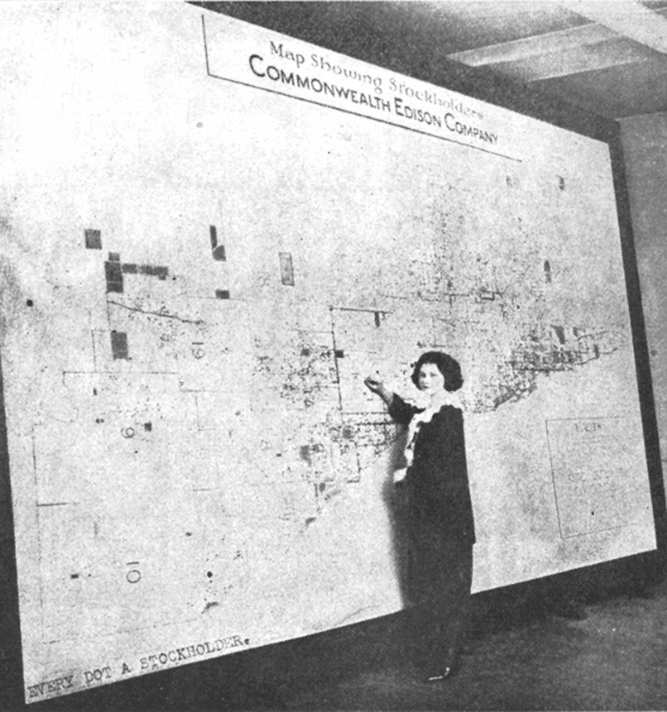
Because of the voting implications of customer ownership, managers kept careful track of how many customer-owners lived within their service territories. Footnote 94 A reliable study by NELA in 1928 found that 11.8 percent of electricity customers were shareholders. Footnote 95 Some executives even kept track of exactly where each of their shareholders lived. Insull’s Commonwealth Edison Company maintained a giant map of the city of Chicago with the residence of each shareholder literally pinpointed on the map (Figure 7).
Map showing stockholders, Commonwealth Edison Company.
Source: “Sales Manual for Public Utility Employees: Subcommittee for Use in Customer Ownership Campaigns,” NELA Proceedings 1922, 1:71.
Note: The text at the bottom left reads, “Every Dot a Stockholder.” This map of Chicago is orientated with north at the right and Lake Michigan at the bottom.

Crash and Depression
When the stock market crash of 1929 turned into the Depression of the 1930s, all the rhetoric about safe and secure utility stock made during sales pitches was put to the test. Shareholders in AT&T continued to receive their $9 dividends throughout the Depression, even though the company had to dip into its savings for the first time to pay them. Footnote 96 Customer-owners of PG&E, the Southern California Edison Company, and many other electric utilities also continued to receive their dividends. Footnote 97
Things ended differently for customer-shareholders in some of Samuel Insull’s companies. In the early 1930s, one of Insull’s operating companies and two of his holding companies went bankrupt and their shareholders lost everything. Footnote 98 After fleeing the country, being extradited back to the United States, standing trial, and being acquitted, Insull died in disgrace in 1938. Footnote 99
Conclusion
There was a painting of Insull that used to hang in Insull’s office; a space which doubled as the Commonwealth Edison Company’s board room. After the crash and Insull’s humiliation, the painting was taken down and given to his family. In an unguarded moment while writing his memoirs, Insull mused on the incident: “How the mighty hath fallen,” he wrote, then struck the line from the final draft. Footnote 100
As for A. J. Hockenbeamer, the inventor of customer stock ownership in 1914, he was promoted to president of the Pacific Gas & Electric Company in 1927 and continued in that position until he died in 1935 “of a weakened heart and a condition of general exhaustion,” according to the company. Footnote 101
The history of customer stock ownership helps answer some important questions of American political economy. How did corporate monopoly utilities, which sat so uncomfortably on the line between government ownership and private enterprise during the Progressive period, carve out a more comfortable seat for themselves in the American political economy by the late 1920s? How did Americans in the 1920s relinquish their traditional antimonopoly sentiment and come to accept the peculiar institution of monopoly capitalism? How did Americans come to own stock in the 1920s? One answer to these questions is that utility executives and their employees offered stock to customers, and customers literally bought into it.