


Introduction
Motivational interviewing (MI) was conceived as a mechanism for improving motivation and increasing the likelihood that problem drinkers would enter and engage in treatment to change their behaviour, with the expectation that the benefits of typical substance use treatments would be enhanced (Miller and Rollnick, Reference Miller and Rollnick2004). MI has since been adopted in a number of treatment domains, particularly to enhance typical treatment protocols by improving factors that may interfere with treatment (Arkowitz et al., Reference Arkowitz, Westra, Miller and Rollnick2008; Arkowitz et al., Reference Arkowitz, Miller and Rollnick2015). For example, while cognitive behavioural treatment (CBT) for anxiety disorders is efficacious, many people do not commence CBT (around 30%) or drop out of CBT (around 10%) (Issakidis and Andrews, Reference Issakidis and Andrews2004), suggesting that engagement with the treatment process may not be optimal (Westra et al., Reference Westra, Aviram and Doell2011). Research suggests that using MI prior to CBT or integrated with CBT may confer some benefit with respect to treatment outcome for generalised anxiety disorder (GAD), obsessive compulsive disorder (OCD) and social anxiety disorder (SAD) (Marker and Norton, Reference Marker and Norton2018; McCabe et al., Reference McCabe, Rowa, Farrell, Young, Swinson and Antony2019; Peters et al., Reference Peters, Romano, Byrow, Gregory, McLellan, Brockveld and Rapee2019; Randall and McNeil, Reference Randall and McNeil2017; Westra et al., Reference Westra, Arkowitz and Dozois2009; Westra et al., Reference Westra, Constantino and Antony2016).
MI may be appealing because it aims to directly address ambivalence towards change, which is a problem common to all treatment domains (Arkowitz et al., Reference Arkowitz, Westra, Miller and Rollnick2008; Arkowitz et al., Reference Arkowitz, Miller and Rollnick2015). Ambivalence refers to the simultaneous experience of desiring but also fearing change (Miller and Rollnick, Reference Miller and Rollnick1991; Miller and Rollnick, Reference Miller and Rollnick2002; Miller and Rollnick, Reference Miller and Rollnick2013) and within treatment may pave the way for resistance or opposition to the therapist or therapy process (Westra and Norouzian, Reference Westra and Norouzian2018). Slagle and Gray (Reference Slagle and Gray2007) suggest that anxious clients may be more likely to experience ambivalence in response to the methods used to achieve behaviour change as opposed to the idea of change itself. That is, anxious clients typically present as desiring change because anxiety symptoms are distressing and cause functional interference; however, typical treatment for anxiety disorders (namely CBT) requires clients to expose themselves to anxiety-provoking situations in order to overcome their fears, and it is towards exposure that clients may be ambivalent. Using the Treatment Ambivalence Questionnaire (TAQ), Rowa and colleagues (Reference Rowa, Gifford, McCabe, Milosevic, Antony and Purdon2014) demonstrated that individuals diagnosed with anxiety disorders express concerns about the consequences of treatment (e.g. personality change), adverse reactions to treatment (e.g. anxiety symptoms might increase or relapse occur), and inconvenience of treatment (e.g. treatment might be embarrassing), suggesting that treatment itself may be a significant factor in the experience of ambivalence for anxious clients.
Studies that have specifically examined self-reported treatment ambivalence using the TAQ have shown that MI does not seem to reduce treatment ambivalence (Barrera et al., Reference Barrera, Smith and Norton2015; McCabe et al., 2019) in SAD or OCD populations. Also, treatment ambivalence did not predict worry outcomes for individuals diagnosed with GAD (Lenton-Brym et al., Reference Lenton-Brym, Stewart, Coyne, Westra, Constantino and Antony2019). Although not focusing on treatment ambivalence specifically, there is some evidence that MI may ameliorate the negative effects of high levels of ambivalence on treatment outcome. One study used client in-session language as an indicator of ambivalence and found that participants with GAD who were highly ambivalent had better long-term outcomes if they received MI-CBT, while participants who were less ambivalent had better outcomes if they received CBT alone (Button et al., Reference Button, Westra, Constantino and Antony2016).
The results of prior research suggest that MI might not shift treatment ambivalence; however, when ambivalence is captured by in-session motivational language (i.e. change talk and counter-change talk), there is some evidence that MI has a positive impact for people who are highly ambivalent. These results could be accounted for by measurement type (e.g. self-report versus coded language), or it is also possible that MI is better suited to tackle ambivalence to change itself and not ambivalence specific to treatment. Given that past research has not typically employed multiple measurement indices of ambivalence, whether there are differences in the effect of MI on treatment ambivalence as opposed to ambivalence towards change itself is unclear. We therefore aimed to extend past research by examining the effect of MI on multiple forms of ambivalence in the context of treatment for SAD. We focused specifically on self-report measures of ambivalence as these may be appropriate for use in clinical practice due to time and cost-effectiveness that is difficult to achieve with behaviourally coded measures of ambivalence. Additionally, prior research has not examined ambivalence in a SAD population, specifically. SAD is characterised by fear of negative evaluation and avoidance of interaction with others (American Psychiatric Association, 2013) and thus, more so than in other anxiety disorders, individuals with SAD may experience a heightened degree of ambivalence about treatment because treatment involves interacting with another person. Also, CBT delivered in group format is a popular and effective treatment for SAD (Wersebe et al., Reference Wersebe, Sijbrandij and Cuijpers2013). While the group format can be particularly beneficial because it provides the opportunity for incidental exposure, interaction and bonding amongst group members (e.g. Asbrand et al., Reference Asbrand, Heinrichs, Schmidtendorf, Nitschke and Tuschen-Caffier2020), the format could provoke further ambivalence.
As part of a randomised controlled trial (RCT), participants diagnosed with SAD were randomised to receive either MI or supportive counselling (SC) prior to receiving group CBT. Participants completed self-report measures of ambivalence about change and ambivalence about treatment in order to answer the following research questions: (1) Is MI related to decreases in ambivalence to change and in ambivalence towards CBT therapy specifically? Given the directive of MI to resolve ambivalence, it is expected that participants with social anxiety randomised to receive MI will show greater decreases in ambivalence than those participants randomised to the SC control condition. (2) Are both forms of ambivalence related to treatment outcome following the group CBT programme? Given that both treatment ambivalence and ambivalence to change could hinder the treatment process, we expected that higher levels of baseline ambivalence would predict worse social anxiety symptom outcome.
Method
Sample and procedures
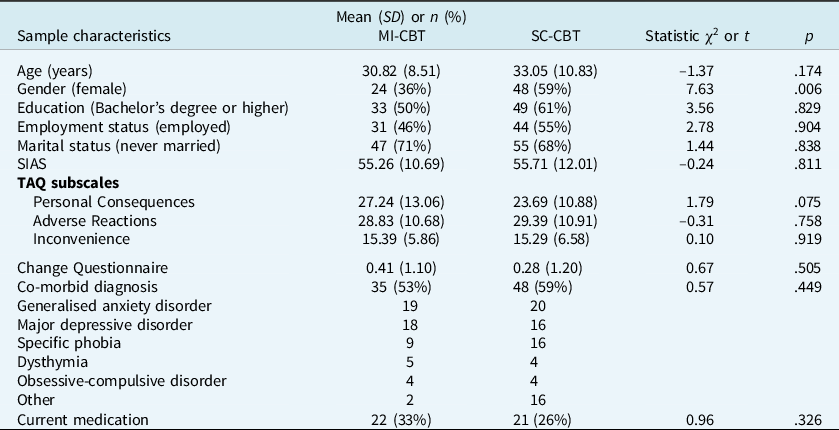
Participants were 147 adults (72 females; mean age 32.05 years, SD = 9.88) with a primary diagnosis of SAD drawn from an RCT that examined the effect of an MI pre-treatment prior to commencing a CBT group programme (Peters et al., Reference Peters, Romano, Byrow, Gregory, McLellan, Brockveld and Rapee2019).Footnote 1 All participants were over 18 years of age, had a primary diagnosis of SAD as measured by the Anxiety Disorders Interview Schedule-IV (Di Nardo et al., Reference Di Nardo, Brown and Barlow1994) that was judged to cause at least moderate impairment. Exclusion criteria were problems requiring immediate attention, such as clear suicidal intent, severe substance abuse or dependence, and active psychosis. Concurrent pharmacotherapy was allowed, provided that dosages had been consistent for 3 months and there were no plans to change during the course of treatment. Baseline demographic and symptom characteristics for the total sample and by treatment condition are presented in Table 1.
Baseline demographic and clinical characteristics of participants in MI-CBT (n = 66) and SC-CBT (n = 81)

SIAS, Social Interaction and Anxiety Scale; TAQ, Treatment Ambivalence Questionnaire.
Intervention
Participants engaged in 15 weeks of treatment conducted in two phases, the full details of which are presented in Peters et al. (Reference Peters, Romano, Byrow, Gregory, McLellan, Brockveld and Rapee2019). Phase 1 was either MI or supportive counselling (SC), both of which consisted of three 1-hour sessions delivered individually over the course of 3 weeks (one session per week). Phase 2 was the CBT intervention, which commenced the week following the final MI or SC session and ran for 12 weeks. Participants were randomised to receive either MI-CBT or SC-CBT. Randomisation occurred using a pre-assigned random number generator in blocks of eight to allow for the group delivery of the CBT programme.
Phase 1 (MI)
Participants (n = 66) engaged in a preparatory treatment programme based on the programme developed by Westra and Dozois (Reference Westra, Dozois and Arkowitz2008) to enhance engagement with treatment, but also explicitly address expectations about CBT treatment for SAD. The programme incorporated the MI principles of eliciting change talk, expressing empathy, developing discrepancy, rolling with resistance, and supporting self-efficacy described by Miller and Rollnick (Reference Miller and Rollnick2002). The MI sessions involved discussion of ambivalence and motivation, life values and the discrepancy between current behaviour and those values, obstacles to change, expectations about treatment process and outcome, and self-efficacy. All therapists followed the manual-based protocol for the MI sessions; however, in keeping with the client-centred spirit of MI, progression through session material was largely dependent on the client’s engagement with the material.
Phase 1 (SC)
Participants (n = 81) engaged in the SC sessions in order to control for the number of hours of therapist contact received by the MI condition. The rationale provided to SC participants was that SC sessions were intended for therapists to learn about the client’s background before entering the CBT programme. Therapists employed supportive counselling skills such as reflective listening and open-ended questions to engage the client in the sessions, but were proscribed from discussing anxiety or treatment concerns and from eliciting or reinforcing change language. If the client discussed anxiety or change the therapist responded in a supportive manner but aimed to redirect the conversation to life history.
Phase 2 (CBT)
After the three preparatory treatment sessions, participants engaged in group CBT for their social anxiety. Groups of between four and eight participants attended 3-hour treatment sessions delivered weekly over 12 weeks. The manualised CBT programme included thought monitoring and challenging, examination of core beliefs, attention training, realistic appraisal and feedback of social performance, and in vivo exposure including elimination of safety behaviours. Further details of the CBT intervention and efficacy of the protocol have been reported previously (Rapee et al., Reference Rapee, Gaston and Abbott2009).
Therapists
Therapists (MI: n = 12; SC: n = 14) were psychologists or graduate clinical psychology students who were trained to deliver all the treatment modalities (MI, SC and CBT), and received weekly supervision by a clinical psychologist with specialist skills in treating SAD. Supervision focused on ensuring adherence to the treatment protocol and on solving issues with implementation of the protocol for individual participants.
Treatment credibility and integrity
As documented in Peters et al. (Reference Peters, Romano, Byrow, Gregory, McLellan, Brockveld and Rapee2019), treatment credibility was assessed using a measure developed by Borkovec and Nau (Reference Borkovec and Nau1972). With respect to treatment integrity, MI and SC sessions were coded according to the Motivational Interviewing Skill Code (MISC 2.5; Houck et al., Reference Houck, Moyers, Miller, Glynn and Hallgren2013) and therapist MI proficiency was evaluated by comparing MISC codes against recommended proficiency and competency standards in the Motivational Interviewing Treatment Integrity Code (MITI 3.1.1; Moyers et al., Reference Moyers, Martin, Manuel, Miller and Ernst2010). Both MI and SC sessions were perceived by participants as equally credible; however, sessions were distinguishable on MI-relevant factors. MI therapists demonstrated higher levels of MI Spirit and Direction, and MI-consistent behaviours of open questions, complex reflections, advising with permission, affirming and emphasising control. MI sessions were also characterised by a greater degree of client change talk.
Materials
Measures in the current study were collected across the following four time points: (1) prior to MI/SC (i.e. baseline); (2) following completion of MI/SC and prior to CBT (i.e. post-MI/SC); (3) 1-month following completion of CBT (i.e. post-CBT) and (4) 6 months following completion of CBT (6-month follow-up). The time points at which specific measures were collected are detailed below.
Severity of symptoms
Social Interaction Anxiety Scale (SIAS; Mattick and Clarke, Reference Mattick and Clarke1998)
The SIAS is a 20-item scale that assesses the main fears and areas of avoidance in SAD. For the current study, SIAS scores at the following time points were utilised: prior to MI/SC (baseline; α = .82); following completion of CBT (post-CBT; α = .90); and 6 months following completion of CBT (6-month follow-up; α = .90).
Ambivalence
Participants’ completed two measures of ambivalence prior to MI/SC (at baseline) and following completion of three sessions of either MI or SC (post-MI/SC). One measure (the Change Questionnaire) was used to measure ambivalence about change in social anxiety and the other measure (the Treatment Ambivalence Questionnaire) was used to measure ambivalence about treatment.
Change Questionnaire (Brody et al., Reference Brody, Arkowitz and Allen2008)
The Change Questionnaire (CQ) uses a decisional balance (DB) methodology to assess ambivalence towards behaviour change. This questionnaire improves upon existing measures of ambivalence by capturing the emotional components of ambivalence and provides standardised measurement that is not restricted to specific problem areas. The CQ has two subscales, the first assesses the positives of change (P; 19 items) and the second assesses the negatives of change (C; 21 items). Each subscale requires participants to think of a change they wish to make and rate the extent to which the positive and negative items apply to them on a 5-point scale (0 – applies to me little or not at all to 5 – applies to me very much). The ambivalence score (DB) is created by calculating the mean rating for all items in each subscale, P and C, and then applying the following formula:
 $${\rm DB} = {{\rm {P+C}}\over{2}} - {\mid {\rm P} - {\rm C}\mid}$$
Higher total DB scores indicate greater levels of ambivalence. In the current study, instructions were geared towards change in social anxiety, and as such higher scores are reflective of more ambivalence to change social anxiety generally. Brody et al. (Reference Brody, Arkowitz and Allen2008) demonstrated high internal consistency for both subscales (Cronbach’s α = .88), with DB scores also significantly predicting responses to five change-related questions (failures to change, mixed feelings, rumination, confidence and commitment). In the current study internal consistency was also high for positive (α = .86) and negative (α = .89) subscales.
Treatment Ambivalence Questionnaire (Rowa et al., Reference Rowa, Gifford, McCabe, Milosevic, Antony and Purdon2014)
The Treatment Ambivalence Questionnaire (TAQ) is a 26-item self-report measure that assesses treatment concerns about engaging in psychological treatment for anxiety disorders. The TAQ has three subscales; Personal Consequences of Treatment (13 items); Adverse Reactions to Treatment (8 items) and Inconvenience of Treatment (5 items). Items are rated on a 7-point scale (1 – strongly disagree to 7 – strongly agree). In the current study, the Personal Consequences of Treatment and Adverse Reactions of Treatment subscales demonstrated good internal consistency, α = .86 and α = .85, respectively. The Inconvenience of Treatment demonstrated an adequate level of internal consistency (α = .73).
Analysis plan
To account for the hierarchical structure of the data, multi-level regression analyses were conducted in SPSS version 21.Footnote 2 For each analysis, the data structure consisted of three possible levels, with repeated measures (e.g. the baseline, post-MI/SC and post-CBT assessment points) at Level 1, nested within participants at Level 2, and nested within group (i.e. each participant attended one of 22 CBT groups) at the third level. Accounting for nesting within groups also accounts for therapist effects as each therapist was assigned to one of the 22 CBT groups. Each model included predictors as fixed effects (e.g. condition, time, ambivalence scores), as well as a random effect for participant. For all multi-level models, model fit statistics [–2 Restricted Log Likelihood (–2RLL)] and intra-class correlations (ICCs) were compared for the 2-level and 3-level models to determine the necessity of a third level. Models with three levels included a random effect for group and the interaction between participant and group.
Results
Sample characteristics
Treatment conditions (SC vs MI) did not differ on baseline anxiety, ambivalence scores or demographic characteristics, except that there were more female participants in the SC-CBT group (Table 1). Comparisons between males and females in the entire sample were conducted to evaluate the necessity of including gender as a covariate in multi-level model analyses. Males and females did not differ on any predictor or outcome variable (i.e. ambivalence or social anxiety measures) and, therefore, gender was not included as a covariate.
Multi-level regression analyses
First, variability that occurred at the group level was explored using separate 3-level unconditional models for (1) ambivalence scores and (2) SIAS scores. Inclusion of a third level to account for the effect of CBT treatment group did not account for a significant proportion of the variance in either ambivalence scores or social anxiety symptom scores. Only 2% of the total variance in SIAS scores was accounted for by differences between groups, and for the CQ, TAQ Adverse Reactions and Personal Consequences of Treatment, a statistically inadmissible solution was obtained, suggesting that variability in ambivalence scores due to nesting of clients within groups was negligible (implying an ICC very close to 0). For TAQ Inconvenience of Treatment, the ICC was .132, suggesting that 13.2% of the total variance in scores on this subscale was accounted for by differences in groups; however, fixed effects regression results for the 2- and 3-level models were comparable and thus we report on results pertaining to the 2-level model consistent with the other analyses.
Change in ambivalence from pre- to post-MI/SC
Separate 2-level models with a random intercept were estimated for the CQ and TAQ subscales using restricted maximum likelihood estimation. Time (i.e. the baseline and post-MI/SC assessment points) and condition (SC-CBT = 0, MI-CBT = 1) and the interaction between time and condition were entered as fixed effects to predict changes in ambivalence for change (CQ) and ambivalence for treatment (TAQ subscales).
CQ
The analysis comparing MI-CBT with SC-CBT on changes in CQ scores showed a significant main effect of time, F 1,142.62 = 5.78, p = .017, with CQ scores increasing from baseline to post-MI/SC. However, the effect of condition (MI vs SC) was non-significant, F 1,145.16 = 1.66, p = .200, as was the condition × time interaction, F 1,142.62 = 1.45, p = .231.
TAQ subscales
Neither time nor condition predicted change in TAQ subscale scores; Adverse Reactions to Treatment (time: F 1,142.91 = 2.81, p = .096, condition: F 1,145.08 = 0.09, p = .767, time × condition: F 1,142.91 = 1.58, p = .211); Personal Consequences of Treatment (time: F 1,143.25 = 0.16, p = .690, condition: F 1,145.44 = 2.81, p = .096, time × condition: F 1,143.25 = .83, p = .364); and Inconvenience of Treatment (time: F 1,143.35 = .01, p = .942, condition: F 1,145.57 = .07, p = .798, time × condition F 1,143.35 = 0.06, p = .814).
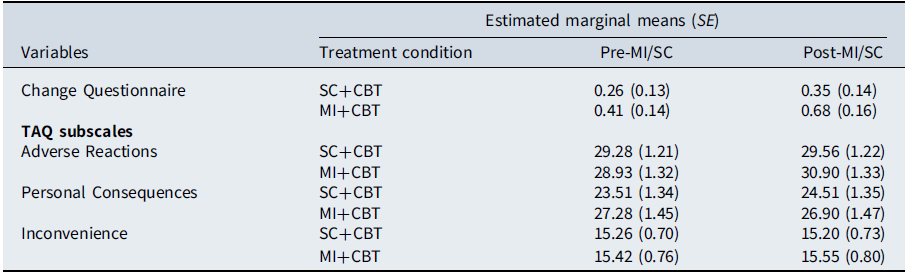
Estimated marginal means and standard errors for ambivalence measures pre- to post-MI and SC are presented in Table 2.
Estimated marginal means and standard errors for ambivalence measures pre- to post-MI/SC

TAQ, Treatment Ambivalence Questionnaire; MI+CBT, motivational interviewing plus cognitive behavioural treatment; SC+CBT, supportive counselling plus cognitive behavioural treatment; Pre-MI/SC, baseline measurement point.
Ambivalence as a predictor of treatment outcome
A 2-level regression model including a random intercept and slope was evaluated to examine the relationship between baseline ambivalence and anxiety severity after treatment (1-month post-CBT and 6-month follow-up time points). The dependent variable was SIAS scores (baseline, 1-month post-CBT, and 6-month follow-up), with baseline ambivalence (CQ and TAQ subscale scores) and condition (SC-CBT = 0, MI-CBT = 1) entered as predictors. Interaction terms between ambivalence and time, ambivalence and condition, and a three-way interaction between ambivalence, time and condition were also entered. All predictors and interaction terms were entered as fixed effects and grand-mean centred.
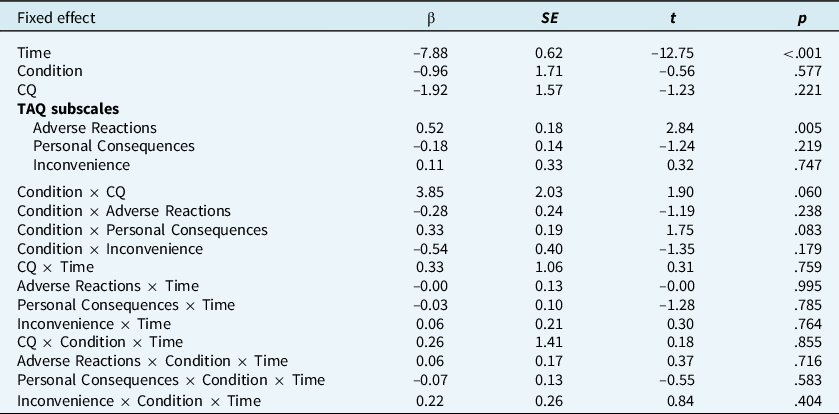
As demonstrated in Table 3, results showed that higher baseline scores on TAQ Adverse Reactions to Treatment were related to worse treatment outcome (β = .52, p = .005). The effect of TAQ Personal Consequences of Treatment, Inconvenience of Treatment and CQ scores as measured at baseline did not significantly predict SIAS change or trajectory of change. The interaction between baseline CQ scores and condition trended towards significance (β = 3.85, p = .060).Footnote 3
Multi-level model for ambivalence predicting social anxiety symptom outcome

β, standardised coefficient; SE, standard error; SIAS, Social Anxiety Severity Scale; CQ, Change Questionnaire; TAQ, Treatment Ambivalence Questionnaire; Condition, SC-CBT (coded 0), MI-CBT (coded 1). Baseline (pre-MI) ambivalence scores are entered as predictors.
Discussion
The overall aim of the current study was to investigate the effect of MI on different types of self-reported ambivalence during treatment of SAD. With respect to our first research question, the results demonstrated that MI did not facilitate reductions in ambivalence for treatment as measured by the TAQ, a finding that is consistent with results of past studies (Barrera et al., Reference Barrera, Smith and Norton2015; Lenton-Brym et al., Reference Lenton-Brym, Stewart, Coyne, Westra, Constantino and Antony2019; McCabe et al., Reference McCabe, Rowa, Farrell, Young, Swinson and Antony2019). It is possible that being exposed to the therapy process during MI was particularly anxiety provoking for our participants diagnosed with SAD and given that the sessions did not provide solutions to actively tackle anxiety, treatment ambivalence did not reduce. Contrary to expectations, there were increases over time in ambivalence for change, with scores on the CQ increasing following MI/SC. Because SAD is characterised by fear of negative evaluation (American Psychological Association, 2013), ambivalence may have surfaced throughout the individual sessions as participants began to open up to the therapists and perhaps due to the looming engagement in the group programme which would require further exposure to possible negative evaluation by group members. Given that a primary aim of MI is to resolve client ambivalence, it is surprising that participants in the MI condition did not show reductions in ambivalence. As admission to the treatment programme occurred in the context of a research trial, our participants may not have been particularly ambivalent, and the MI programme may have exposed them to personal obstacles and barriers to change which may have increased ambivalence. While it is important for clients to be aware of obstacles to change, perhaps three sessions of MI only provided an avenue to explore these possibilities but did not allow sufficient time to completely resolve ambivalence.
Analyses pertaining to our second research question demonstrated that higher scores on the Adverse Reactions to Treatment subscale of the TAQ predicted worse treatment outcome. Scores on the other TAQ subscales did not significantly predict anxiety severity change, nor did baseline CQ or CQ difference scores. These findings suggest that it may be particularly important for individuals with social anxiety to work through ambivalence related to adverse reactions to treatment, such as fear of anxiety symptoms increasing or fear of experiencing relapses in anxiety symptoms. Because CBT requires clients with SAD to become aware of negative thought content, and to confront social situations instead of avoiding them, clients may perceive increases in social anxiety symptoms, particularly where high levels of physiological arousal need to be temporarily tolerated during exposure tasks (e.g. Rowa et al., Reference Rowa, Gifford, McCabe, Milosevic, Antony and Purdon2014). Setbacks in the treatment process are also common, and for some clients, this may feel like symptoms are returning or they are relapsing (McEvoy et al., Reference McEvoy, Saulsman and Rapee2018). Because fears about adverse reactions to treatment have an element of truth (Rowa et al., Reference Rowa, Gifford, McCabe, Milosevic, Antony and Purdon2014), people who are highly ambivalent about these experiences might therefore be less likely to demonstrate continued engagement with CBT if they occur, which may be the reason for lower symptom reduction for these participants.
Past research by Button et al. (Reference Button, Westra, Constantino and Antony2016) has demonstrated that clients with higher levels of ambivalence had better long-term outcomes if they received MI-CBT versus CBT alone. In our study, there was a trend to suggest that condition moderated the effect of ambivalence to change (as measured by the CQ) on symptom outcome, which indicated that participants with higher ambivalence tended to have better outcome if they received MI prior to CBT. Our results are not definitive and due to a non-significant three-way interaction; we cannot comment on how ambivalence and treatment condition interact over time to predict treatment outcome. However, we might speculate that MI is more useful if tailored to the individual’s level of ambivalence. For clients who self-report more ambivalence, MI strategies may be particularly useful because they facilitate the management of ambivalence as treatment progresses, whereas for clients who self-report complete motivation to change, such strategies may not be as helpful. On the other hand, it could also be possible that having preparatory supportive counselling confers a similar benefit with respect to ambivalence and may be a helpful person-centred addition to a manualised CBT programme. This idea aligns with the findings of Peters et al. (Reference Peters, Romano, Byrow, Gregory, McLellan, Brockveld and Rapee2019), in which condition (MI vs SC) did not have an overall impact on treatment outcome, which may suggest that SC could represent a useful preparatory treatment in and of itself. Providing clients with pre-CBT sessions that focus on a life history approach could enhance the therapeutic relationship which could then foster engagement with CBT and long-term motivation to implement CBT strategies.
A first important implication of the current study is that preparatory MI prior to CBT for social anxiety does not decrease ambivalence. One reason for this could be related to the study design. That is, while the purpose of MI is to help people work through ambivalence about change until they no longer feel ambivalent (Miller and Rollnick, Reference Miller and Rollnick2013), this aim is difficult to adhere to in the context of an RCT in which each participant receives the same amount of MI whether or not they are ‘ready’ to engage in CBT. It is also possible, however, that MI techniques may be more effective if implemented throughout the CBT programme in active response to ambivalence, as opposed to within a preparatory programme. Ambivalence may shift upwards and downwards throughout a treatment programme, so therapist responsivity to moments of ambivalence may be more important than initial fluctuations (e.g. Aviram et al., Reference Aviram, Westra, Constantino and Antony2016). This may be especially important in CBT because as CBT progresses, clients are likely to encounter more difficult tasks that trigger increases in anxiety, which may result in more ambivalence as the cost (being anxious) begins to outweigh the benefits of improvement that the task provides (e.g. Slagle and Gray, Reference Slagle and Gray2007).
A second implication is that only ambivalence about adverse reactions to treatment predicted worse social anxiety symptom outcome, and MI did not moderate the effect of ambivalence on treatment outcome. This could be specifically related to the administration of MI in the current sample, but it could also imply that the effect of MI on ambivalence may be more apparent when captured by in-session language (utterances about change; see Button et al., Reference Button, Westra, Constantino and Antony2016). It is possible that MI does a better job at alleviating the negative effect of particular types of ambivalence, which were not captured in the current study. If the latter, it would be important to further examine which types of ambivalence are alleviated and how MI achieves these effects. For example, does MI help those that are highly ambivalent about change to attend more treatment sessions, do more homework, or demonstrate less resistance during CBT, and do these intermediary factors then predict better symptom outcome?
The results and implications need to be interpreted in light of study limitations, including sole reliance on self-report measures of social anxiety symptoms and the correlational nature of the study. For example, we cannot rule out other variables that may affect the relationships between ambivalence and treatment outcome. Given that the experience of ambivalence may set the stage for opposition to the therapy process (Westra and Norouzin, Reference Westra and Norouzian2018), it is possible that higher pre-treatment levels of ambivalence lend themselves to therapeutic alliance ruptures or disengagement that then impacts treatment outcome. It would be important for future research to examine the effects of ambivalence on intermediary variables but also conduct experimental research that manipulates these variables to help establish causation. Finally, while the CQ questionnaire has utility in predicting criterion variables, norms for the CQ have not yet been established. Although scores on the CQ were similar to those published in Brody et al. (Reference Brody, Arkowitz and Allen2008), as mentioned previously it is possible that our sample was relatively unambivalent about change, which may have had an impact on our results. Also, although the content of items on the CQ and TAQ differ, it may be difficult to completely distinguish between treatment ambivalence and general change-related ambivalence. For example, if participants are embarking on treatment for social anxiety and know treatment will be difficult, this knowledge could impact their ambivalence about changing social anxiety more generally and potentially blur scores on the measures.
The current study is the first to examine the construct of ambivalence in the context of MI for SAD in a relatively large treatment-seeking sample. Although support for study hypotheses was mixed, the findings suggest that in the context of a three-session preparatory intervention, MI may not reduce general and treatment-related ambivalence, suggesting that perhaps use of MI skills and techniques could be more beneficial in response to ambivalence throughout the active treatment component. The findings also suggest that ambivalence, particularly about adverse reactions to treatment predicted worse social anxiety symptom outcome, which may indicate that this type of ambivalence could be an important focus during MI for clients with SAD.
Acknowledgements
None.
Financial support
The research was supported in part by the National Health and Medical Research Council (NHMRC Project Grant 102411).
Conflicts of interest
Mia Romano and Lorna Peters have no conflicts of interest with respect to this publication.
Ethics statements
The authors of this paper have abided by the Ethical Principles of Psychologists and Code of Conduct as set out by the BABCP and BPS throughout this study. The Macquarie University Human Research Ethics Committee approved the procedures and all participants provided informed consent.
Data availability
Data available on request from the authors.



Comments
No Comments have been published for this article.