
Introduction
Chagas disease (ChD) or American trypanosomiasis is a life-threatening anthropozoonosis markedly related to poverty and caused by the protozoan parasite Trypanosoma cruzi (Bern, Reference Bern2015; Torrico et al., Reference Torrico, Gascón, Barreira, Blum, Almeida, Alonso-Veja, Barboza, Bilbe, Correia, Garcia, Ortiz, Parrado, Ramirez, Ribeiro, Strub-Wourgaft, Vaillant and Sosa-Estani2021). About 5.7–9.4 million people are infected with T. cruzi worldwide (Echeverría et al., Reference Echeverría, Marcus, Novick, Sosa-Estani, Ralston, Zaidel, Forsyth, Ribeiro, Mendoza, Falconi, Mitelman, Morillo, Pereiro, Pinazo, Salvatella, Martinez, Perel, Liprandi, Piñeiro and Molina2020a; Torrico et al., Reference Torrico, Gascón, Barreira, Blum, Almeida, Alonso-Veja, Barboza, Bilbe, Correia, Garcia, Ortiz, Parrado, Ramirez, Ribeiro, Strub-Wourgaft, Vaillant and Sosa-Estani2021), especially in 21 Latin American endemic countries and 19 non-endemic countries in North America and Europe (Bivona et al., Reference Bivona, Alberti, Cerny, Trinitario and Malchiodi2020; Torrico et al., Reference Torrico, Gascón, Barreira, Blum, Almeida, Alonso-Veja, Barboza, Bilbe, Correia, Garcia, Ortiz, Parrado, Ramirez, Ribeiro, Strub-Wourgaft, Vaillant and Sosa-Estani2021). Vector and oral transmission are the main forms of T. cruzi infection in endemic countries. However, donation of contaminated blood and organs from infected people, vertical transmission (e.g. mother to fetus) and laboratory accidents are the main causes of ChD spread in non-endemic areas (Nogueira et al., Reference Nogueira, Felizardo, Caldas, Gonçalves and Novaes2018; Guhl and Ramirez, Reference Guhl and Ramirez2021).
ChD is clinically divided into acute and chronic phases (Bern, Reference Bern2015). The acute phase courses with intense parasitaemia and marked cellular parasitism in multiple organs, especially the heart, skeletal muscles and cells of the phagocytic mononuclear system (Bivona et al., Reference Bivona, Alberti, Cerny, Trinitario and Malchiodi2020; Torrico et al., Reference Torrico, Gascón, Barreira, Blum, Almeida, Alonso-Veja, Barboza, Bilbe, Correia, Garcia, Ortiz, Parrado, Ramirez, Ribeiro, Strub-Wourgaft, Vaillant and Sosa-Estani2021). However, acute infections are often asymptomatic and associated with low mortality rates (0.2–0.5%) (Pérez-Molina and Molina, Reference Pérez-Molina and Molina2018; Echeverría et al., Reference Echeverría, Marcus, Novick, Sosa-Estani, Ralston, Zaidel, Forsyth, Ribeiro, Mendoza, Falconi, Mitelman, Morillo, Pereiro, Pinazo, Salvatella, Martinez, Perel, Liprandi, Piñeiro and Molina2020a). Once parasitaemia is controlled, the disease progresses to the chronic phase, which may remain asymptomatic for decades or evolve into a symptomatic form associated with digestive, nervous and/or cardiovascular manifestations (Bern, Reference Bern2015). Cardiac involvement characterizes chronic Chagas cardiomyopathy (CCC), which is the most severe form of ChD (Nogueira et al., Reference Nogueira, Felizardo, Caldas, Gonçalves and Novaes2018; Bivona et al., Reference Bivona, Alberti, Cerny, Trinitario and Malchiodi2020).
Chronic cardiomyopathy is the leading cause of ChD-associated mortality (Nogueira et al., Reference Nogueira, Felizardo, Caldas, Gonçalves and Novaes2018; Caldas et al., Reference Caldas, Santos and Novaes2019). In addition, CCC is the most common infectious cardiomyopathy worldwide and the third most frequent cause of heart transplantation in endemic countries (Nogueira et al., Reference Nogueira, Felizardo, Caldas, Gonçalves and Novaes2018). CCC exhibits a multifactorial and complex aetiology. It is often associated with parasite persistence, low-grade inflammation, autoimmunity, redox imbalance, thromboembolic events, myonecrosis, autonomic denervation and progressive myocardial fibrosis (Rassi et al., Reference Rassi, Marin-Neto and Rassi2017; Rodrigues et al., Reference Rodrigues, Caldas, Gonçalves, Almeida, Souza and Novaes2017; Bonney et al., Reference Bonney, Luthringer, Kim, Garg and Engman2019). Together, these events contribute to CCC progression, which often manifests electromechanical abnormalities such as conduction defects (e.g., bundle branch blocks), frequent and complex ventricular arrhythmias, and systolic ventricular dysfunction (Bonney et al., Reference Bonney, Luthringer, Kim, Garg and Engman2019; Caldas et al., Reference Caldas, Santos and Novaes2019).
The specific ChD treatment is limited to the nitroheterocyclic compounds nifurtimox (NFx) and benznidazole (BNZ) (Muñoz et al., Reference Muñoz, Murcia and Segovia2011; Diniz et al., Reference Diniz Lde, Urbina, de Andrade, Mazzeti, Martins, Caldas, Talvani, Ribeiro and Bahia2013; Novaes et al., Reference Novaes, Sartini, Rodrigues, Gonçalves, Santos, Souza and Caldas2016), which was developed almost 50 years ago (Muñoz et al., Reference Muñoz, Murcia and Segovia2011, Diniz et al., Reference Diniz Lde, Urbina, de Andrade, Mazzeti, Martins, Caldas, Talvani, Ribeiro and Bahia2013). Due to high toxicity and serious side effects (e.g. hypersensitivity reactions, anorexia, vomiting, polyneuritis and bone marrow depression), NFx is no longer available in most endemic countries (Urbina and Docampo, Reference Urbina and Docampo2003; Caldas et al., Reference Caldas, Santos and Novaes2019). Thus, BNZ becomes the first-line drug for ChD treatment (Caldas et al., Reference Caldas, Santos and Novaes2019). Despite its limitations (e.g. systemic toxicity, prolonged treatment and limited efficacy in chronic infections), the risk–benefit of BNZ-based chemotherapy is still favourable (Muñoz et al., Reference Muñoz, Murcia and Segovia2011; Caldas et al., Reference Caldas, Santos and Novaes2019), especially in acute infections where high cure rates can be obtained (Martinez et al., Reference Martinez, Romano and Engman2020; Caldas et al., Reference Caldas, Santos and Novaes2019). However, side effects often dictate treatment discontinuation, negatively influencing chemotherapy effectiveness and cure rates (Santos et al., Reference Santos, Novaes, Cupertino, Bastos, Klein, Silva, Fietto, Talvani, Bahia and Oliveira2015; Torrico et al., Reference Torrico, Gascón, Barreira, Blum, Almeida, Alonso-Veja, Barboza, Bilbe, Correia, Garcia, Ortiz, Parrado, Ramirez, Ribeiro, Strub-Wourgaft, Vaillant and Sosa-Estani2021).
Considering the limited effectiveness of the classic BNZ-based protocol in improving cardiac function, sustainably attenuating tissue parasitism, and achieving parasitological cure in chronic ChD (Molina-Morant et al., Reference Molina-Morant, Fernández, Bosch-Nicolau, Sulleiro, Bangher, Salvador, Sanchez-Montalva, Ribeiro, de Paula, Eloi, Correa-Oliveira, Villar, Sosa-Estani and Molina2020; Martín-Escolano et al., Reference Martín-Escolano, Medina-Carmona and Martín-Escolano2020); developing more efficient therapeutic regimens is an urgent need (Molina et al., Reference Molina, Gómez i Prat, Salvador, Treviño, Sulleiro, Serre, Pou, Roure, Cabezos, Valerio, Blanco-Grau, Sánchez-Montalvá, Vidal and Pahissa2014; Vallejo et al., Reference Vallejo, Monge-Maillo, Gutiérrez, Norman, López-Vélez and Pérez-Molina2016; Torrico et al., Reference Torrico, Gascón, Barreira, Blum, Almeida, Alonso-Veja, Barboza, Bilbe, Correia, Garcia, Ortiz, Parrado, Ramirez, Ribeiro, Strub-Wourgaft, Vaillant and Sosa-Estani2021). Thus, repositioning and combining drugs with antiparasitic effects and different mechanisms of action have emerged as potential alternatives to improve ChD treatment (Morillo et al., Reference Morillo, Waskin, Sosa-Estani, Del Carmen Bangher, Cuneo, Milesi, Mallagray, Apt, Beloscar, Gascon, Molina, Echeverria, Colombo, Perez-Molina, Wyss, Meeks, Bonilla, Gao, Wei, McCarthy and Yusuf2017; Mendonça et al., Reference Mendonça, Gonçalves-Santos, Souza-Silva, González-Lozano, Caldas, Gonçalves, Diniz and Novaes2020; Torrico et al., Reference Torrico, Gascón, Barreira, Blum, Almeida, Alonso-Veja, Barboza, Bilbe, Correia, Garcia, Ortiz, Parrado, Ramirez, Ribeiro, Strub-Wourgaft, Vaillant and Sosa-Estani2021). In addition to new NFx- and BNZ-based protocols, clinical trials currently registered on ClinicalTrials.gov for ChD treatment are based on drug repositioning, which admits that: (i) distinct diseases may share similar targets, (ii) drugs act on multiple targets and (iii) identifying new targets for a drug contributes to innovative therapeutic applications (Sardana et al., Reference Sardana, Zhu, Zhang, Gudivada, Yang and Jegga2011; Reddy and Zhang, Reference Reddy and Zhang2013). Allied to this repositioning strategy, drug combinations have been investigated in search of synergistic or additive interactions to increase the effectiveness of anti-T. cruzi chemotherapy (Mazzeti et al., Reference Mazzeti, Diniz, Gonçalves, WonDollinger, Assíria, Ribeiro and Bahia2019; Martinez et al., Reference Martinez, Romano and Engman2020). As combinations can increase drug half-life, reduce dose and treatment time, minimize systemic toxicity and side effects; this strategy can also increase chemotherapy adherence and improve clinical outcomes in ChD patients (Muñoz et al., Reference Muñoz, Murcia and Segovia2011; Rassi et al., Reference Rassi, Marin-Neto and Rassi2017; Torrico et al., Reference Torrico, Gascón, Barreira, Blum, Almeida, Alonso-Veja, Barboza, Bilbe, Correia, Garcia, Ortiz, Parrado, Ramirez, Ribeiro, Strub-Wourgaft, Vaillant and Sosa-Estani2021).
Currently, evidence on the types and effectiveness of different chemotherapy protocols applied to ChD treatment is based on diffuse initiatives. Thus, it becomes difficult to identify which drugs and combinations were investigated in clinical trials to delimit the most efficient protocols and potential risks associated with drug therapy. Therefore, we used a systematic review framework to map the evidence on specific ChD treatments included in randomized controlled trials (RCT). In addition to identifying the drugs administered (pharmacological class and dosimetry parameters), the effectiveness of the available chemotherapeutic protocols to control the parasite load, achieve negative seroconversion and therapeutic cure was investigated. Considering the pharmacological safety, adverse reactions and treatment discontinuation rates were also evaluated. Finally, the methodological quality of all studies reviewed and potential sources of bias associated with current evidence were objectively characterized, contributing to the refinement of further investigations.
Methods
Guiding question and protocol registration
Our research protocol was developed considering the patient, intervention, comparison and outcome (PICO) strategy (Huang et al., Reference Huang, Lin and Demner-Fushman2006), which was used to define the following guiding question adopted in this systematic review: Could ChD patients undergoing different chemotherapy regimens exhibit better parasitological control, cardiovascular function, lower rates of adverse reactions and mortality compared to untreated control patients? The present review protocol has been registered within the PROSPERO (International Prospective Register of Systematic Reviews) database (registration number CRD42021276800).
Search strategy and primary studies selection
Study selection was based on the updated Preferred Reporting Items for Systematic Reviews and Meta-Analyses strategy (PRISMA) (Page et al., Reference Page, McKenzie, Bossuyt, Boutron, Hoffmann, Mulrow, Shamseer, Tetzlaff, Akl, Brennan, Chou, Glanville, Grimshaw, Hróbjartsson, Lalu, Li, Loder, Mayo-Wilson, McDonald, McGuinness, Stewart, Thomas, Tricco, Welch, Whiting and Moher2021). The retrieval of indexed studies on the aetiological treatment for ChD was operationalized from 2 complementary strategies: (i) electronic database search and (ii) indirect searches in citations and/or reference lists of all studies identified from electronic databases (Pereira et al., Reference Pereira, Greco, Moreira, Chagas, Caldas, Gonçalves and Novaes2017). The direct strategy was based on advanced searches in PubMed/Medline, Embase, Scopus and Web of Sciences databases. To identify relevant studies, search filters were initially built using the MeSH Terms, which are standardized descriptors obtained from the PubMed thesaurus (https://www.ncbi.nlm.nih.gov/mesh/) (Felizardo et al., Reference Felizardo, Caldas, Mendonça, Gonçalves, Tana, Almeida and Novaes2018). The search filters were developed considering 2 levels: (i) disease (ChD) and (ii) intervention (aetiological treatment). All descriptors were associated with specific algorithms [(MeSH Terms) and (TIAB)] to optimize the retrieval of relevant studies in PubMed/Medline (Altoé et al., Reference Altoé, Alves, Sarandy, Morais-Santos, Novaes and Gonçalves2019), ensuring the identification of research records indexed and in the indexing process (Souza-Silva et al., Reference Souza-Silva, Diniz, Lia Mazzeti, Mendonça, Gonçalves and Novaes2019). The ‘human’ and ‘clinical trials’ search limits provided by the search engine were applied to refine the quality of the PubMed/Medline search.
The same search filters built for the PubMed/Medline database were adapted for Embase, Scopus and Web of Science. Therefore, the respective syntax and algorithms required in the search engine of each database were used, such as: de,ab,ti, TITLE-ABS-KEY or TS = . To refine the quality of the Embase search, studies also indexed in Medline were automatically excluded from the Venn diagram tool (Sources tab) (Silva et al., Reference Silva, Baldim, Chagas-Paula, Soares, Lago, Gonçalves and Novaes2018), selecting studies exclusively indexed in Embase. In addition, the standardized limits ‘human’, ‘major clinical study’ and ‘article’ were used in our search strategy applied to Embase. The search limits ‘human’ and ‘AND NOT INDEX (Medline)’ were applied to the Scopus database. This last limit was used to exclude duplicate Medline studies from the results. For the Web of Science database, a filter was built to select clinical studies and specific animal species (humans). No chronological or language limits were used (Silva et al., Reference Silva, Baldim, Chagas-Paula, Soares, Lago, Gonçalves and Novaes2018). The complete search strategies used in each database can be accessed in the supplementary material (Table S1).
Studies screening, eligibility criteria and inter-rater agreement
Only clinical studies investigating the impact of ChD aetiological treatment were included in this systematic review. All relevant studies were selected according to the PRISMA flowchart (Page et al., Reference Page, McKenzie, Bossuyt, Boutron, Hoffmann, Mulrow, Shamseer, Tetzlaff, Akl, Brennan, Chou, Glanville, Grimshaw, Hróbjartsson, Lalu, Li, Loder, Mayo-Wilson, McDonald, McGuinness, Stewart, Thomas, Tricco, Welch, Whiting and Moher2021). Two reviewers (S.S.N. and R.O.S.) retrieved and independently applied search strategies across all databases (Altoé et al., Reference Altoé, Alves, Sarandy, Morais-Santos, Novaes and Gonçalves2019). Disagreements were resolved by arbitration in consultation with an expert researcher (R.D.N). Duplicate studies that were not directly excluded by the search algorithms were removed using Mendeley software (Mendeley Desktop Version 1.19.8). After this step, the titles and abstracts of all research records were screened and irrelevant records (not related to the investigated topic) were excluded. The remaining studies were retrieved in full text and well-defined eligibility criteria were analysed. The exclusion criteria applied in this review were: (i) grey literature (not peer-reviewed and formally published), (ii) studies unavailable in full text (title and/or abstract only), (iii) studies with non-pharmacological interventions, (iv) studies with multiple interventions where it was not possible to isolate the aetiologic treatment effect, (v) secondary studies (literature reviews, comments, letters to the editor and editorials), (vi) studies without control groups and (vii) studies unrelated to parasitological control. After selecting all relevant studies from the primary search, reference lists were screened to identify additional studies (Felizardo et al., Reference Felizardo, Caldas, Mendonça, Gonçalves, Tana, Almeida and Novaes2018; Nogueira et al., Reference Nogueira, Felizardo, Caldas, Gonçalves and Novaes2018). These studies were retrieved in full text and the same eligibility criteria used in the direct search were analysed in this secondary strategy. The results obtained from the primary and secondary searches were compared and the inter-rater agreement (Kappa coefficient) was calculated (McHugh, Reference McHugh2012).
Data extraction
Qualitative and quantitative data were extracted from all relevant studies included in the systematic review. To this end, we use standardized spreadsheets (data extraction masks) (Marques et al., Reference Marques, Felizardo, Souza, Pereira, Gonçalves and Novaes2018) structured from basic methodological requirements to characterize studies at different descriptive levels, such as: (i) publication characteristics: research design, authors, year of publication and country where the study was conducted; (ii) patient characteristics: age, sex, and disease stage; (iii) treatment characteristics: drugs and dosimetry (doses, administration frequency and rout, treatment duration, and patient follow-up); (iv) primary outcomes: parasite load (parasitological cure), seroconversion and mortality rates; (v) secondary outcomes: cardiovascular function (electrocardiographic and echocardiographic data), adverse reactions and treatment discontinuation rates.
Reporting quality as a risk of bias
Methodological quality and potential risk of bias in all studies reviewed were analysed using the Downs and Black (D&B) checklist, which is targeted at randomized and non-randomized trials of health care interventions (Downs and Black, Reference Downs and Black1998). The scale is based on 27 questions and is structured in 5 categories or domains, such as: (i) reporting quality, (ii) external validity, (iii) bias, (iv) confounding and (v) statistical power. This scale has high test–retest reliability (r = 0.88) and internal consistency (KR20 formula = 0.89). Due to previous recommendations and high ambiguity, question 27 (statistical power) was not applied (Nogueira et al., Reference Nogueira, Felizardo, Caldas, Gonçalves and Novaes2018). The overall result obtained from the Downs and Black checklist was expressed graphically, and the average score was calculated (Nogueira et al., Reference Nogueira, Felizardo, Caldas, Gonçalves and Novaes2018).
Results
Publication characteristics
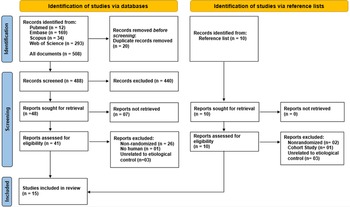
In the primary search, 508 papers published between 1996 and 2021 were retrieved from PubMed, Embase, Scopus and Web of Science. After removing duplicates and evaluating eligibility criteria, 11 relevant papers were identified. Four additional papers were identified in the secondary search. Therefore, 15 original studies were included in the systematic review. Most studies (n = 10, 66.6%) were developed in Latin American countries. Three (20%) multicentre studies were also identified, followed by 2 studies developed in Spain (13.3%). The list of all papers included and the PRISMA flowchart with the complete strategy are shown in Table S2 and Fig. 1, respectively. The Kappa coefficient obtained from our search strategy (κ = 0.842) indicated substantial agreement between independent evaluators (Table S2).
Flow diagram of the systematic review literature search results. Based on the PRISMA statement ‘Preferred Reporting Items for Systematic Reviews and Meta-Analyses

Patient characteristics
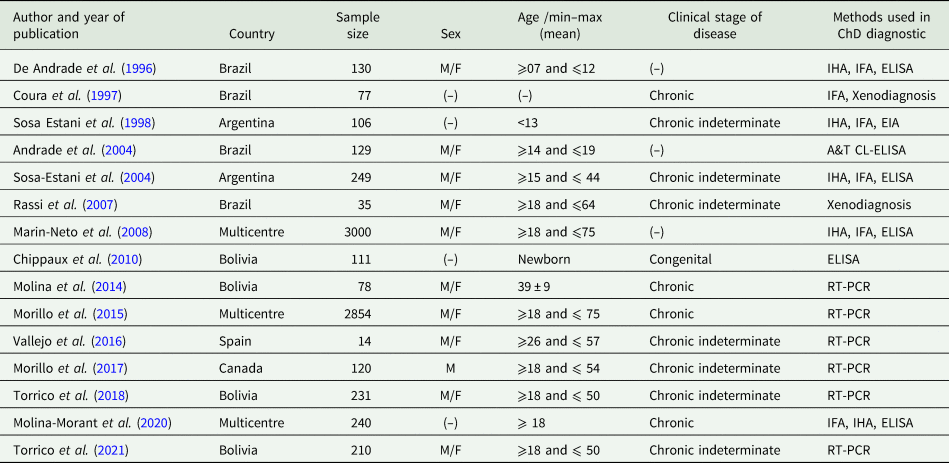
From all the studies reviewed, 6 (40%) classified participants by sex, and female patients were investigated in 3 studies (26.6%). Men were exclusively recruited in 1 study (6%), and gender was not reported in 4 studies (26.6%). In general, the patients' ages ranged from 7 to 75 years, and 1 study (6%) investigated newborns. Body mass was underreported in most studies (n = 12, 80%). Considering disease stage, 11 studies (73.3%) included patients in the indeterminate chronic phase. One study (6.6%) investigated congenital disease (acute phase), and the disease phase was not reported in 3 studies (20%). ChD diagnosis was based on indirect haemagglutination assay (IAH), indirect immunofluorescence assay (IFA), enzyme immunoassay (EIA), enzyme-linked immunosorbent assay (ELISA), or chemiluminescence immunoassay (CL-ELISA, A&T antigen) in 6 studies (40%). Polymerase chain reaction (PCR) was also used in 6 studies (40%). Xenodiagnostic alone or combined with IFA was applied in only 1 study (6%) each (Table 1).
Patient characteristics, ChD stage and diagnostic method of Trypanosoma cruzi infection used in randomized clinical trials

–, data not reported; M, male; F, female; IHA, indirect haemagglutination assay; IFA, indirect immunofluorescence assay; EIA/ELISA, enzyme-linked immunosorbent assay; A&T CL-ELISA ELISA, chemiluminescent ELISA with A&T antigen; RT-PCR, real-time reverse transcription polymerase chain reaction.
Chemotherapy protocols, seroconversion and cure rates
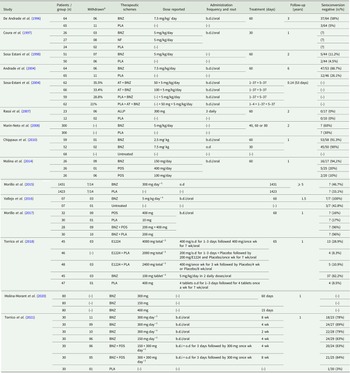
As indicated in Table 2, BNZ was the drug mainly investigated in monotherapy in 8 studies (53.3%). Monotherapy based on NFx, allopurinol, posaconazole or the prodrug ravuconazole (E1224) was reported in 7 studies (46.6%). Drug combinations based on BNZ + thioctic acid, BNZ + posaconazole and BNZ + fosravuconazole were investigated in 3 studies (20%). Negative seroconversion rates reported in Latin American studies using BNZ were: 11.2–82.2% at 5 mg kg day−1, 58–88.7% at 7.5 mg kg day−1, 91.3% at 2.5 mg kg day−1 and 94% at 150 mg day−1. Two other BNZ studies (developed in Canada and Spain), found 96% (200 mg day−1) and 100% (5 mg kg day−1) seroconversion rates, respectively. With respect to other treatments, seroconversion rates ranging from 10.9 to 28.9% were observed for E1224 (2000 and 4000 mg total−1), and 10–20% for posaconazole (100 and 400 mg day−1). Seroconversion was not achieved with allopurinol treatment. For drug combinations, a high seroconversion rate (96%) was obtained in patients treated with BNZ + posaconazole, while an 84% rate was achieved in patients receiving BNZ + fosravuconazole. This parameter was not investigated in studies with NFx and BNZ + thioctic acid. The parasitological cure was estimated from T. cruzi DNA detection in blood samples by PCR. This method was used in 6 studies (40%). Negative PCR ranged from 46.7 to 100% in BNZ-treated patients, 8.3–28.9% for E1224 treatment and 10–20% for posaconazole treatment. For drug combinations, negative PCR were obtained in 96% patients receiving BNZ + posaconazole, and 84% for patients treated with BNZ + fosravuconazole. Only 2 studies (13.3%) investigated potential changes in PCR results over time or over a year (Vallejo et al., Reference Vallejo, Monge-Maillo, Gutiérrez, Norman, López-Vélez and Pérez-Molina2016; Morillo et al., Reference Morillo, Waskin, Sosa-Estani, Del Carmen Bangher, Cuneo, Milesi, Mallagray, Apt, Beloscar, Gascon, Molina, Echeverria, Colombo, Perez-Molina, Wyss, Meeks, Bonilla, Gao, Wei, McCarthy and Yusuf2017). Negative PCR results were maintained in 46.7% to 100% of all patients investigated in a follow-up ranging from 1 to 5 years (Table 2).
Characteristics of treatments used in the management of Chagas disease patients in randomized clinical trials.

POS, posaconazole; BNZ, benznidazole; PLA, placebo; NF, nifurtimox; ALLP, allopurinol; AT, thioctic acid; b.d.i, twice day; o.d, once a day; –, data not reported; ?, incomplete information.
a For discontinuity, adverse events and other reasons.
a For discontinuity, adverse events and other reasons. E1224 (ravuconazole prodrug).
BNZ, benznidazole; POS, posaconazole; PLA, placebo; o.d, once a day; b.d.i, twice day; wk, week; –, data not reported; ?, incomplete information.
a For discontinuity, adverse events and other reasons.
BNZ, benznidazole; FOS, fosravuconazole; PLA, placebo; o.d, once a day, b.d.i, twice day; wk, week; –, data not reported; ?, incomplete information.
Cardiovascular and laboratory outcomes, treatment discontinuation and adverse effects
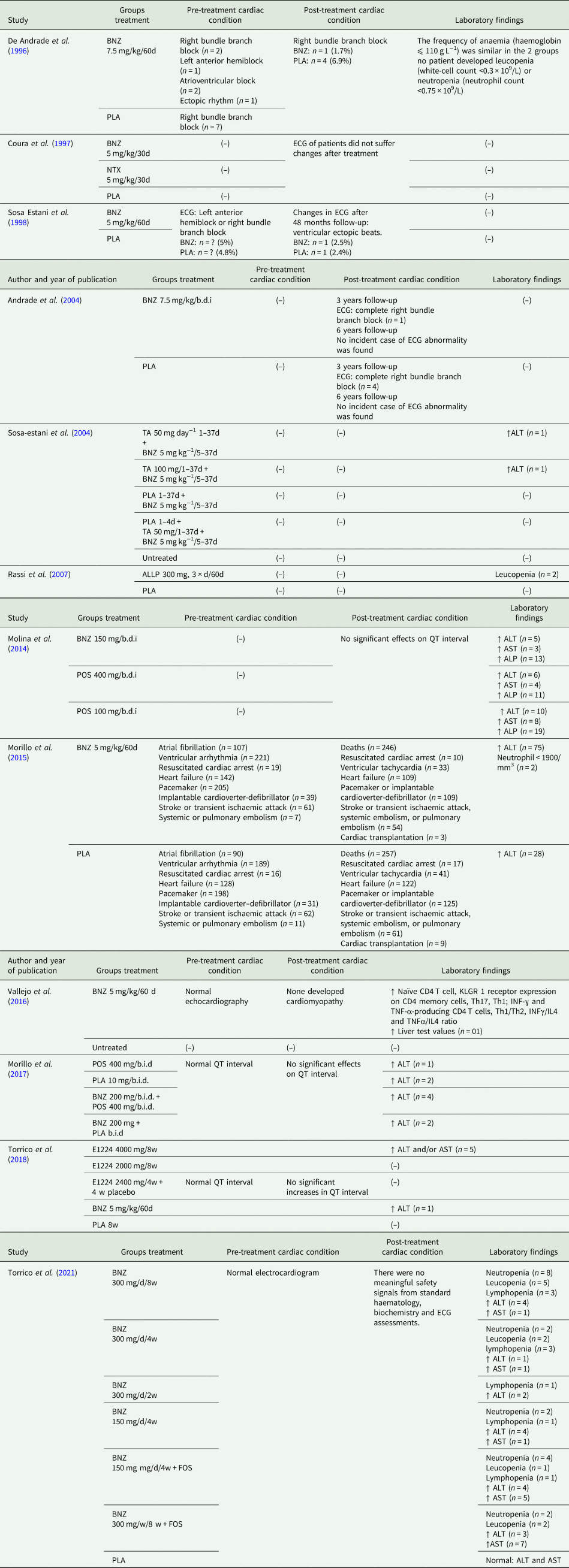
As indicated in Table 3, pre-treatment and post-treatment cardiovascular parameters were reported in 9 studies (60%). Right bundle branch block, left anterior hemiblock, atrioventricular block, ectopic rhythm, atrial fibrillation, ventricular arrhythmia, ventricular tachycardia, stroke, transient ischaemic attack, systemic embolism, pulmonary embolism, pacemaker or implantable cardioverter-defibrillator, cardiac arrest and transplantation were the main cardiovascular abnormalities/outcomes reported. No study reported significant improvement or worsening of cardiac function in patients treated with the different drugs and therapeutic regimens investigated.
Adverse events, cardiac function, immune response and laboratory findings in ChD patients

BNZ, benznidazole; PLA, placebo; POS, posaconazole; TA, thioctic acid; ALLP, allopurinol; –, data not reported; ?, incomplete information; ALT, alanine aminotransferase; ECG, electrocardiogram; d, day; NTX, nifurtimox; AST, aspartate aminotransferase; ALP, alkaline phosphatase; E1224, ravuconazole prodrug; w, week; FOS, fosravuconazole; b.d.i, twice day.
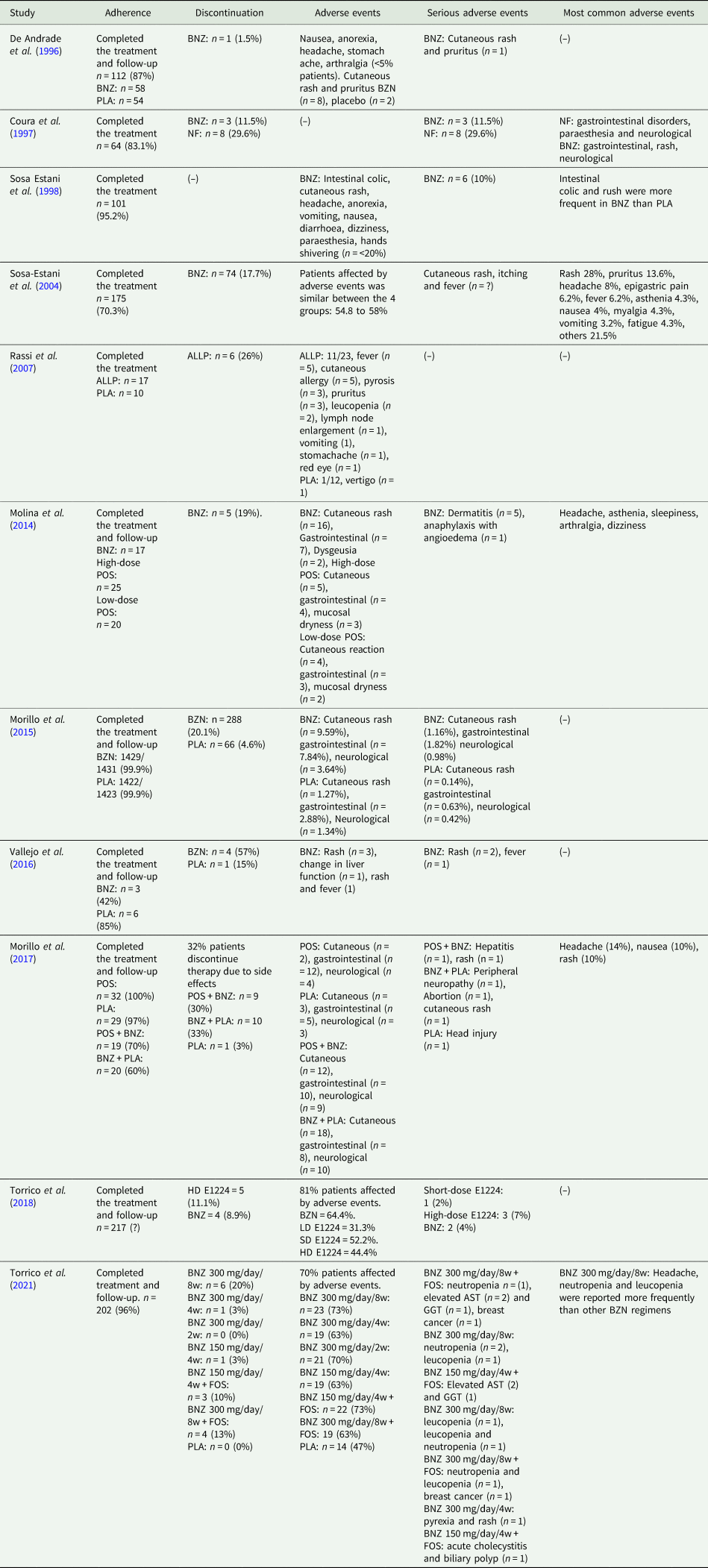
All treatments were associated with a low frequency of altered liver function estimated from alanine aminotransferase levels (2.2–38%) and reduced white blood cell counts (0.1–43%). Altered liver function, estimated from serum transaminase levels, was identified in patients treated with BNZ (Molina et al., Reference Molina, Gómez i Prat, Salvador, Treviño, Sulleiro, Serre, Pou, Roure, Cabezos, Valerio, Blanco-Grau, Sánchez-Montalvá, Vidal and Pahissa2014; Morillo et al., Reference Morillo, Marin-Neto, Avezum, Sosa-Estani, Rassi, Rosas, Villena, Quiroz, Bonilla, Britto, Guhl, Velazquez, Bonilla, Meeks, Rao-Melacini, Pogue, Mattos, Lazdins, Rassi, Connolly and Yusuf2015, Reference Morillo, Waskin, Sosa-Estani, Del Carmen Bangher, Cuneo, Milesi, Mallagray, Apt, Beloscar, Gascon, Molina, Echeverria, Colombo, Perez-Molina, Wyss, Meeks, Bonilla, Gao, Wei, McCarthy and Yusuf2017; Vallejo et al., Reference Vallejo, Monge-Maillo, Gutiérrez, Norman, López-Vélez and Pérez-Molina2016; Torrico et al., Reference Torrico, Gascon, Ortiz, Alonso-Veja, Pinazo, Schijman, Almeida, Alves, Strub-Wourgaft and Ribeiro2018, Reference Torrico, Gascón, Barreira, Blum, Almeida, Alonso-Veja, Barboza, Bilbe, Correia, Garcia, Ortiz, Parrado, Ramirez, Ribeiro, Strub-Wourgaft, Vaillant and Sosa-Estani2021), posaconazole (Molina et al., Reference Molina, Gómez i Prat, Salvador, Treviño, Sulleiro, Serre, Pou, Roure, Cabezos, Valerio, Blanco-Grau, Sánchez-Montalvá, Vidal and Pahissa2014; Morillo et al., Reference Morillo, Waskin, Sosa-Estani, Del Carmen Bangher, Cuneo, Milesi, Mallagray, Apt, Beloscar, Gascon, Molina, Echeverria, Colombo, Perez-Molina, Wyss, Meeks, Bonilla, Gao, Wei, McCarthy and Yusuf2017) and E1224 (Torrico et al., Reference Torrico, Gascon, Ortiz, Alonso-Veja, Pinazo, Schijman, Almeida, Alves, Strub-Wourgaft and Ribeiro2018) alone, as well as BNZ combined with thioctic acid (Sosa-Estani et al., Reference Sosa-Estani, Armenti, Araujo, Viotti, Lococo, Ruiz Vera, Vigliano, de Rissio and Segura2004), posaconazole (Morillo et al., Reference Morillo, Waskin, Sosa-Estani, Del Carmen Bangher, Cuneo, Milesi, Mallagray, Apt, Beloscar, Gascon, Molina, Echeverria, Colombo, Perez-Molina, Wyss, Meeks, Bonilla, Gao, Wei, McCarthy and Yusuf2017) or fosravuconazole (Torrico et al., Reference Torrico, Gascón, Barreira, Blum, Almeida, Alonso-Veja, Barboza, Bilbe, Correia, Garcia, Ortiz, Parrado, Ramirez, Ribeiro, Strub-Wourgaft, Vaillant and Sosa-Estani2021). Leucopenia, neutropenia and/or lymphopenia were identified in patients treated with allopurinol, BNZ alone or combined with fosravuconazole (Rassi et al., Reference Rassi, Luquetti, Rassi, Rassi, Rassi, DA Silva and Rassi2007; Morillo et al., Reference Morillo, Marin-Neto, Avezum, Sosa-Estani, Rassi, Rosas, Villena, Quiroz, Bonilla, Britto, Guhl, Velazquez, Bonilla, Meeks, Rao-Melacini, Pogue, Mattos, Lazdins, Rassi, Connolly and Yusuf2015; Torrico et al., Reference Torrico, Gascón, Barreira, Blum, Almeida, Alonso-Veja, Barboza, Bilbe, Correia, Garcia, Ortiz, Parrado, Ramirez, Ribeiro, Strub-Wourgaft, Vaillant and Sosa-Estani2021) (Table 3). Treatment discontinuation ranged from 1.5 to 57% in patients receiving BNZ alone or combined with thioctic acid, posaconazole or fosravuconazole. Cutaneous, gastrointestinal and neurological reactions were the most common adverse effects identified in 5–73% of all patients investigated. The mean rate of serious adverse reactions was 22.78% in BNZ-treated patients, while this rate was 2.56% in patients receiving placebo (Table 4).
Adherence, discontinuation and adverse events associated with the treatment administered in ChD patients.

BNZ, benznidazole; PLA, placebo; POS, posaconazole; ALLP, allopurinol; AT, thioctic acid; NF, nifurtimox; E1224, ravuconazole prodrug; LD, low-dose; SD, short-dose; HD, high-dose; –, data not reported; FOS, fosravuconazole; AST, aspartate aminotransferase; GGT, gamma-glutamyl transferase; ?, incomplete information.
Sources of methodological bias
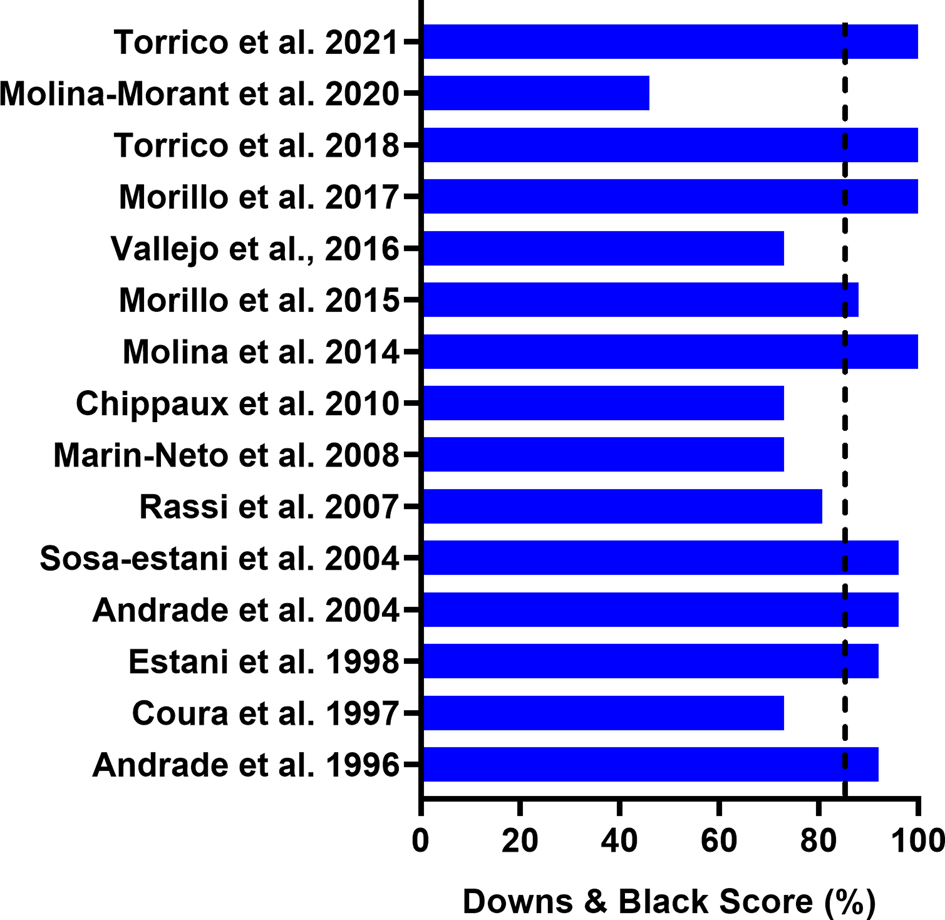
Based on the D&B checklist, compliance with the evaluated methodological criteria ranged from 46 to 100% (average result = 85.57%). Studies prior to 2014 were unable to meet all criteria. However, 4 studies (26.66%) after 2014 met all the methodological criteria analysed (Molina et al., Reference Molina, Gómez i Prat, Salvador, Treviño, Sulleiro, Serre, Pou, Roure, Cabezos, Valerio, Blanco-Grau, Sánchez-Montalvá, Vidal and Pahissa2014; Morillo et al., Reference Morillo, Waskin, Sosa-Estani, Del Carmen Bangher, Cuneo, Milesi, Mallagray, Apt, Beloscar, Gascon, Molina, Echeverria, Colombo, Perez-Molina, Wyss, Meeks, Bonilla, Gao, Wei, McCarthy and Yusuf2017; Torrico et al., Reference Torrico, Gascon, Ortiz, Alonso-Veja, Pinazo, Schijman, Almeida, Alves, Strub-Wourgaft and Ribeiro2018, Reference Torrico, Gascón, Barreira, Blum, Almeida, Alonso-Veja, Barboza, Bilbe, Correia, Garcia, Ortiz, Parrado, Ramirez, Ribeiro, Strub-Wourgaft, Vaillant and Sosa-Estani2021). Considering the items evaluated in the D&B checklist, criteria 8 and 10 were the least observed by the authors, namely: were the statistical tests used to assess the main outcomes appropriate? and were the main outcome measures used accurate (valid and reliable)? These criteria were met by 73.3% of the studies reviewed. Items 3 (Are the outcomes to be measured clearly described in the introduction or in the methods section?), 4 (Are the interventions of interest clearly described?) and 23 (Were the study subjects randomized to the intervention groups?) were consistently attended in all studies. The individual and overall results of bias can be accessed in Fig. 2 and Table S3.
Percentage of items met in the methodological bias analysis (reporting quality) for all RCTs included in the systematic review. Bias analysis was based on the Downs & Black checklist for randomized and non-randomized studies. The dotted line indicates the average percentage of methodological criteria met (85.51%). The complete bias analysis stratified by domains and items assessed can be found in Table S3.

Discussion
In this review, we identified that the evidence provided by randomized controlled clinical trials targeting ChD treatment is based on BNZ (De Andrade et al., Reference De Andrade, Zicker, de Oliveira, Almeida Silva, Luquetti, Travassos, Almeida, de Andrade, de Andrade and Martelli1996; Sosa Estani et al., Reference Sosa Estani, Segura, Ruiz, Velazquez, Porcel and Yampotis1998; Andrade et al., Reference Andrade, Martelli, Oliveira, Silva, Aires, Soussumi, Covas, Silva, Andrade, Travassos and Almeida2004; Marin-Neto et al., Reference Marin-Neto, Rassi, Morillo, Avezum, Connolly, Sosa-Estani, Rosas and Yusuf2008; Chippaux et al., Reference Chippaux, Clavijo, Santalla, Postigo, Schneider and Brutus2010; Morillo et al., Reference Morillo, Marin-Neto, Avezum, Sosa-Estani, Rassi, Rosas, Villena, Quiroz, Bonilla, Britto, Guhl, Velazquez, Bonilla, Meeks, Rao-Melacini, Pogue, Mattos, Lazdins, Rassi, Connolly and Yusuf2015; Vallejo et al., Reference Vallejo, Monge-Maillo, Gutiérrez, Norman, López-Vélez and Pérez-Molina2016; Molina-Morant et al., Reference Molina-Morant, Fernández, Bosch-Nicolau, Sulleiro, Bangher, Salvador, Sanchez-Montalva, Ribeiro, de Paula, Eloi, Correa-Oliveira, Villar, Sosa-Estani and Molina2020), NFx (Coura et al., Reference Coura, Abreu, Willcox and Petana1997), allopurinol (Rassi et al., Reference Rassi, Luquetti, Rassi, Rassi, Rassi, DA Silva and Rassi2007), posaconazole (Molina et al., Reference Molina, Gómez i Prat, Salvador, Treviño, Sulleiro, Serre, Pou, Roure, Cabezos, Valerio, Blanco-Grau, Sánchez-Montalvá, Vidal and Pahissa2014; Morillo et al., Reference Morillo, Waskin, Sosa-Estani, Del Carmen Bangher, Cuneo, Milesi, Mallagray, Apt, Beloscar, Gascon, Molina, Echeverria, Colombo, Perez-Molina, Wyss, Meeks, Bonilla, Gao, Wei, McCarthy and Yusuf2017), ravuconazole (Torrico et al., Reference Torrico, Gascon, Ortiz, Alonso-Veja, Pinazo, Schijman, Almeida, Alves, Strub-Wourgaft and Ribeiro2018) and fosravuconazole (Torrico et al., Reference Torrico, Gascón, Barreira, Blum, Almeida, Alonso-Veja, Barboza, Bilbe, Correia, Garcia, Ortiz, Parrado, Ramirez, Ribeiro, Strub-Wourgaft, Vaillant and Sosa-Estani2021); administered in monotherapy, as well as BNZ combined with thioctic acid (Sosa-Estani et al., Reference Sosa-Estani, Armenti, Araujo, Viotti, Lococo, Ruiz Vera, Vigliano, de Rissio and Segura2004), posaconazole (Morillo et al., Reference Morillo, Waskin, Sosa-Estani, Del Carmen Bangher, Cuneo, Milesi, Mallagray, Apt, Beloscar, Gascon, Molina, Echeverria, Colombo, Perez-Molina, Wyss, Meeks, Bonilla, Gao, Wei, McCarthy and Yusuf2017) and fosravuconazole (Torrico et al., Reference Torrico, Gascón, Barreira, Blum, Almeida, Alonso-Veja, Barboza, Bilbe, Correia, Garcia, Ortiz, Parrado, Ramirez, Ribeiro, Strub-Wourgaft, Vaillant and Sosa-Estani2021). In line with the perspective of efficacy for the treatment of neglected tropical diseases, most drugs used in monotherapy and in combination showed remarkable relevance in attenuating T. cruzi infection. Accordingly, therapeutic effects were primarily associated with better parasitological control, as evidenced by negative seroconversion rates obtained from different treatment protocols. Although studies do not report a definitive parasitological cure, a low frequency of functional cardiac deterioration has been identified. However, the therapeutic regimens administered were associated with important side effects, indicating variable systemic toxicity.
Interestingly, the RCT identified were mainly concentrated in 3 Latin American countries (i.e., Brazil, Argentina and Bolivia) (De Andrade et al., Reference De Andrade, Zicker, de Oliveira, Almeida Silva, Luquetti, Travassos, Almeida, de Andrade, de Andrade and Martelli1996; Coura et al., Reference Coura, Abreu, Willcox and Petana1997; Sosa Estani et al., Reference Sosa Estani, Segura, Ruiz, Velazquez, Porcel and Yampotis1998; Andrade et al., Reference Andrade, Martelli, Oliveira, Silva, Aires, Soussumi, Covas, Silva, Andrade, Travassos and Almeida2004; Sosa-Estani et al., Reference Sosa-Estani, Armenti, Araujo, Viotti, Lococo, Ruiz Vera, Vigliano, de Rissio and Segura2004; Rassi et al., Reference Rassi, Luquetti, Rassi, Rassi, Rassi, DA Silva and Rassi2007; Chippaux et al., Reference Chippaux, Clavijo, Santalla, Postigo, Schneider and Brutus2010; Molina et al., Reference Molina, Gómez i Prat, Salvador, Treviño, Sulleiro, Serre, Pou, Roure, Cabezos, Valerio, Blanco-Grau, Sánchez-Montalvá, Vidal and Pahissa2014; Torrico et al., Reference Torrico, Gascon, Ortiz, Alonso-Veja, Pinazo, Schijman, Almeida, Alves, Strub-Wourgaft and Ribeiro2018, Reference Torrico, Gascón, Barreira, Blum, Almeida, Alonso-Veja, Barboza, Bilbe, Correia, Garcia, Ortiz, Parrado, Ramirez, Ribeiro, Strub-Wourgaft, Vaillant and Sosa-Estani2021). In these endemic countries, environmental and socioeconomic factors create favourable conditions for T. cruzi infection (Mejía-Jaramillo et al., Reference Mejía-Jaramillo, Agudelo-Uribe, Dib, Ortiz, Solari and Triana-Chávez2014; Santos et al., Reference Santos, Silva, Leony, Freitas, Daltro, Regis-Silva, Del-Rei, Souza, Ostermayer, Costa, Silva, Ramos, Sousa, Gomes and Santos2020). However, poor early diagnosis favours the transmissibility of this parasite in non-endemic areas, which is mainly linked to migratory movements of infected people (Guarner, Reference Guarner2019; Echeverría et al., Reference Echeverría, González, Hernandez, Díaz, Eduardo Nieto, López-Romero, Rivera, Suárez, Ochoa, Rojas and Morillo2020a). In the studies reviewed, ChD was rigorously confirmed by one or more diagnostic tools, including xenodiagnosis, indirect haemagglutination, indirect immunofluorescence, ELISA and PCR. Although xenodiagnosis has traditionally been proposed to confirm ChD, this method has shown a marked decline in the last 3 decades (Zingales, Reference Zingales2018). On the other hand, indirect haemagglutination, indirect immunofluorescence and ELISA are the most used tests for ChD diagnosis (Andrade et al., Reference Andrade, Marin Neto, Paola, Vilas-Boas, Oliveira, Bacal, Bocchi, Almeida, Fragata Filho, Moreira Mda, Xavier, Oliveira Junior and Dias2011; Nogueira et al., Reference Nogueira, Felizardo, Caldas, Gonçalves and Novaes2018; Zingales, Reference Zingales2018). These methods exhibit high analytical sensitivity (96% – 99%) (Castro et al., Reference Castro, Luquetti, Rassi, Rassi, Chiari and Galvão2002; Nogueira et al., Reference Nogueira, Felizardo, Caldas, Gonçalves and Novaes2018), a characteristic consistent with most randomized studies published up to 2014. In the last 2 decades, PCR-based methods were frequently incorporated into clinical studies, increasing the sensitivity and specificity of parasitological diagnosis (Nogueira et al., Reference Nogueira, Felizardo, Caldas, Gonçalves and Novaes2018; Caldas et al., Reference Caldas, Santos and Novaes2019; Molina-Morant et al., Reference Molina-Morant, Fernández, Bosch-Nicolau, Sulleiro, Bangher, Salvador, Sanchez-Montalva, Ribeiro, de Paula, Eloi, Correa-Oliveira, Villar, Sosa-Estani and Molina2020). This method was predominant from 2014 onwards, being widely applied for ChD diagnosis, as well as for evaluating chemotherapy effectiveness. PCR is a remarkable tool for early detection of therapeutic failure (Caldas et al., Reference Caldas, Santos and Novaes2019), which has been clearly demonstrated in patients with chronic ChD treated with BNZ during recent (Silveira et al., Reference Silveira, Castillo and Castro2000; Solari et al., Reference Solari, Ortíz, Soto, Arancibia, Campillay, Contreras, Salinas, Rojas and Schenone2001) and late (Morillo et al., Reference Morillo, Waskin, Sosa-Estani, Del Carmen Bangher, Cuneo, Milesi, Mallagray, Apt, Beloscar, Gascon, Molina, Echeverria, Colombo, Perez-Molina, Wyss, Meeks, Bonilla, Gao, Wei, McCarthy and Yusuf2017) infections. Although PCR is the gold standard for T. cruzi detection, its applicability is quite restricted to clinical studies and specialized laboratories due to the higher cost, need for specialized devices and professionals with greater technical qualification (Caldas et al., Reference Caldas, Santos and Novaes2019). Thus, expanding access to this technology can improve the monitoring of populations exposed to greater risk of T. cruzi infection and the health care of newly infected patients.
Although BNZ is the first-line treatment for acute (Caldas et al., Reference Caldas, Santos and Novaes2019), recent (Silveira et al., Reference Silveira, Castillo and Castro2000; Solari et al., Reference Solari, Ortíz, Soto, Arancibia, Campillay, Contreras, Salinas, Rojas and Schenone2001) and late (Morillo et al., Reference Morillo, Waskin, Sosa-Estani, Del Carmen Bangher, Cuneo, Milesi, Mallagray, Apt, Beloscar, Gascon, Molina, Echeverria, Colombo, Perez-Molina, Wyss, Meeks, Bonilla, Gao, Wei, McCarthy and Yusuf2017) chronic infections, its effectiveness in achieving parasitological cure is still controversial, especially in chronic cases. Apparently, divergent parasitological results are influenced by parasite strain (e.g., tropism, virulence and pathogenicity), patient characteristics (e.g., age, immunological status and comorbidities) and infection phase (De Andrade et al., Reference De Andrade, Zicker, Luquetti, Oliveira, Silva, Souza and Martelli1992; Filardi and Brener, Reference Filardi and Brener1987). In addition, the toxicity profile and numerous side effects of different antiparasitic drugs have a marked impact on treatment adherence (Morillo, et al., Reference Morillo, Marin-Neto, Avezum, Sosa-Estani, Rassi, Rosas, Villena, Quiroz, Bonilla, Britto, Guhl, Velazquez, Bonilla, Meeks, Rao-Melacini, Pogue, Mattos, Lazdins, Rassi, Connolly and Yusuf2015, Reference Morillo, Waskin, Sosa-Estani, Del Carmen Bangher, Cuneo, Milesi, Mallagray, Apt, Beloscar, Gascon, Molina, Echeverria, Colombo, Perez-Molina, Wyss, Meeks, Bonilla, Gao, Wei, McCarthy and Yusuf2017). Accordingly, longer drug regimens that require high doses represent a greater clinical challenge, as dose-dependent and time-dependent toxicity favours treatment discontinuation and therapeutic failure (e.g., poor parasite control) (Vallejo et al., Reference Vallejo, Monge-Maillo, Gutiérrez, Norman, López-Vélez and Pérez-Molina2016; Caldas et al., Reference Caldas, Santos and Novaes2019; Molina-Morant et al., Reference Molina-Morant, Fernández, Bosch-Nicolau, Sulleiro, Bangher, Salvador, Sanchez-Montalva, Ribeiro, de Paula, Eloi, Correa-Oliveira, Villar, Sosa-Estani and Molina2020).
Currently, there is an objective recommendation to administer BNZ between 5 and 8 mg kg day−1, twice a day for 60 days (Andrade et al., Reference Andrade, Marin Neto, Paola, Vilas-Boas, Oliveira, Bacal, Bocchi, Almeida, Fragata Filho, Moreira Mda, Xavier, Oliveira Junior and Dias2011). However, marked variations in BNZ dose and treatment period are recurrent in clinical studies (De Andrade et al., Reference De Andrade, Zicker, de Oliveira, Almeida Silva, Luquetti, Travassos, Almeida, de Andrade, de Andrade and Martelli1996, Sossa-Estani et al., Reference Sosa Estani, Segura, Ruiz, Velazquez, Porcel and Yampotis1998; Andrade et al., Reference Andrade, Martelli, Oliveira, Silva, Aires, Soussumi, Covas, Silva, Andrade, Travassos and Almeida2004; Marin-Neto et al., Reference Marin-Neto, Rassi, Morillo, Avezum, Connolly, Sosa-Estani, Rosas and Yusuf2008; Chippaux et al., Reference Chippaux, Clavijo, Santalla, Postigo, Schneider and Brutus2010, Morillo et al., Reference Morillo, Marin-Neto, Avezum, Sosa-Estani, Rassi, Rosas, Villena, Quiroz, Bonilla, Britto, Guhl, Velazquez, Bonilla, Meeks, Rao-Melacini, Pogue, Mattos, Lazdins, Rassi, Connolly and Yusuf2015; Vallejo et al., Reference Vallejo, Monge-Maillo, Gutiérrez, Norman, López-Vélez and Pérez-Molina2016; Mollina-Morant et al., Reference Molina-Morant, Fernández, Bosch-Nicolau, Sulleiro, Bangher, Salvador, Sanchez-Montalva, Ribeiro, de Paula, Eloi, Correa-Oliveira, Villar, Sosa-Estani and Molina2020). Accordingly, we identified that therapeutic schemes based on 2–7.5 mg kg day−1 for 60 or 30 days were respectively reported for newborns (Chippaux et al., Reference Chippaux, Clavijo, Santalla, Postigo, Schneider and Brutus2010); while conventional dosimetry (5 mg kg day−1 for 60 days) was investigated in children aged 13 years and older (Andrade et al., Reference Andrade, Martelli, Oliveira, Silva, Aires, Soussumi, Covas, Silva, Andrade, Travassos and Almeida2004), and patients aged 26–57 years (Vallejo et al., Reference Vallejo, Monge-Maillo, Gutiérrez, Norman, López-Vélez and Pérez-Molina2016). The same conventional dose was assigned for patients aged 18–75 years; however, different administration periods (40, 60 or 80 days) were evaluated (Marin-Neto et al., Reference Marin-Neto, Rassi, Morillo, Avezum, Connolly, Sosa-Estani, Rosas and Yusuf2008). In addition, significant adaptations were recently incorporated into randomized studies with BNZ, which used 150 and 300 mg kg day−1 by 60 days or 400 mg kg day−1 by 15 days in patients aged 50–80 years (Molina-Morant et al., Reference Molina-Morant, Fernández, Bosch-Nicolau, Sulleiro, Bangher, Salvador, Sanchez-Montalva, Ribeiro, de Paula, Eloi, Correa-Oliveira, Villar, Sosa-Estani and Molina2020). Objectively, these variations express the urgent need to define more efficient protocols for the reference drug, whose dose ranges and administration periods were mainly established in clinical practice and not in unequivocal evidence of therapeutic efficacy.
Regardless of the therapeutic regimen adopted, parasitological clearance, negative seroconversion, as well as low systemic toxicity are desirable clinical outcomes of drug treatment, including BNZ (Caldas et al., Reference Caldas, Santos and Novaes2019). Thus, we found that 5 mg BNZ kg−1 day−1 per60 days administered to patients with chronic ChC aged 26–57 years was associated with 100% negative seroconversion compared to 45% in untreated patients after 1 year follow-up (Vallejo et al., Reference Vallejo, Monge-Maillo, Gutiérrez, Norman, López-Vélez and Pérez-Molina2016). Even using similar therapeutic regimens (2–7.5 mg kg day−1 for 30–80 days), BNZ-induced divergent negative seroconversion rates, ranging from 11.2 to 91.3% (De Andrade et al., Reference De Andrade, Zicker, de Oliveira, Almeida Silva, Luquetti, Travassos, Almeida, de Andrade, de Andrade and Martelli1996; Sosa Estani et al., Reference Sosa Estani, Segura, Ruiz, Velazquez, Porcel and Yampotis1998; Andrade et al., Reference Andrade, Martelli, Oliveira, Silva, Aires, Soussumi, Covas, Silva, Andrade, Travassos and Almeida2004; Chippaux et al., Reference Chippaux, Clavijo, Santalla, Postigo, Schneider and Brutus2010). Thus, the best parasitological results were obtained by Vallejo et al. (Reference Vallejo, Monge-Maillo, Gutiérrez, Norman, López-Vélez and Pérez-Molina2016), followed by Morillo et al. (Reference Morillo, Waskin, Sosa-Estani, Del Carmen Bangher, Cuneo, Milesi, Mallagray, Apt, Beloscar, Gascon, Molina, Echeverria, Colombo, Perez-Molina, Wyss, Meeks, Bonilla, Gao, Wei, McCarthy and Yusuf2017), Molina et al. (Reference Molina, Gómez i Prat, Salvador, Treviño, Sulleiro, Serre, Pou, Roure, Cabezos, Valerio, Blanco-Grau, Sánchez-Montalvá, Vidal and Pahissa2014) and Chippaux et al. (Reference Chippaux, Clavijo, Santalla, Postigo, Schneider and Brutus2010), who reported respectively 100, 96 and 94.1% cure rates for young adults and 91.3% cure for newborns, both after 1 year follow-up. Despite this response, clinical trials support BNZ efficacy for congenital ChD, corroborating a consistent trend of negative serology maintenance over time, an outcome that can be more easily reversed in adults (Blanco et al., Reference Blanco, Segura, Cura, Chuit, Tulián, Flores, Garbarino, Villalonga and Gürtler2000).
Although NFx is the second choice for ChD treatment, RCT with this drug are scarce. Thus, NFx was evaluated in only one trial identified in this review (Coura et al., Reference Coura, Abreu, Willcox and Petana1997). Unfortunately, this study reinforced the controversial effectiveness of this drug for chronic ChD. Accordingly, Coura et al. (Reference Coura, Abreu, Willcox and Petana1997) did not identify negative seroconversion in patients receiving 5 mg kg day−1 NFx for 30 days or BNZ after 1 year follow-up. Thus, the lack of evidence of parasitological cure attributed to NFx in addition to its recognized toxicity profile (e.g., polyneuritis and bone marrow depression) makes the clinical use of this drug inadvisable when BNZ is available and well tolerated (Urbina and Docampo, Reference Urbina and Docampo2003; Muñoz et al., Reference Muñoz, Murcia and Segovia2011; Nogueira et al., Reference Nogueira, Felizardo, Caldas, Gonçalves and Novaes2018). Despite clinical evidence generated in recent decades supporting BNZ-based treatment for indeterminate chronic ChD (Molina et al., Reference Molina, Gómez i Prat, Salvador, Treviño, Sulleiro, Serre, Pou, Roure, Cabezos, Valerio, Blanco-Grau, Sánchez-Montalvá, Vidal and Pahissa2014; Morillo et al., Reference Morillo, Waskin, Sosa-Estani, Del Carmen Bangher, Cuneo, Milesi, Mallagray, Apt, Beloscar, Gascon, Molina, Echeverria, Colombo, Perez-Molina, Wyss, Meeks, Bonilla, Gao, Wei, McCarthy and Yusuf2017; Torrico et al., Reference Torrico, Gascon, Ortiz, Alonso-Veja, Pinazo, Schijman, Almeida, Alves, Strub-Wourgaft and Ribeiro2018), more efficient and safer drugs are still needed. Thus, several studies reviewed were based on repositioning strategies involving drugs with trypanocidal potential, such as allopurinol (Rassi et al., Reference Rassi, Luquetti, Rassi, Rassi, Rassi, DA Silva and Rassi2007), posaconazole (Molina et al., Reference Molina, Gómez i Prat, Salvador, Treviño, Sulleiro, Serre, Pou, Roure, Cabezos, Valerio, Blanco-Grau, Sánchez-Montalvá, Vidal and Pahissa2014; Morillo et al., Reference Morillo, Waskin, Sosa-Estani, Del Carmen Bangher, Cuneo, Milesi, Mallagray, Apt, Beloscar, Gascon, Molina, Echeverria, Colombo, Perez-Molina, Wyss, Meeks, Bonilla, Gao, Wei, McCarthy and Yusuf2017), ravuconazole (Torrico et al., Reference Torrico, Gascon, Ortiz, Alonso-Veja, Pinazo, Schijman, Almeida, Alves, Strub-Wourgaft and Ribeiro2018) and fosravuconazole (Torrico et al., Reference Torrico, Gascón, Barreira, Blum, Almeida, Alonso-Veja, Barboza, Bilbe, Correia, Garcia, Ortiz, Parrado, Ramirez, Ribeiro, Strub-Wourgaft, Vaillant and Sosa-Estani2021).
Studies with allopurinol have confirmed its potent trypanostatic effect in vitro on 5 T. cruzi strains (Marr et al., Reference Marr, Berens and Nelson1978; Avila and Avila, Reference Avila and Avila1981). Interestingly, Berens et al. (Reference Berens, Marr, Steele da Cruz and Nelson1982) confirmed that allopurinol is metabolized by bloodstream trypomastigotes and intracellular amastigotes, which can be eradicated in vitro by this drug. Contrary to expectations, allopurinol administration (300 mg kg day−1 for 60 days) was not associated with negative seroconversion in patients with indeterminate chronic ChD (Rassi et al., Reference Rassi, Luquetti, Rassi, Rassi, Rassi, DA Silva and Rassi2007). In contrast, posaconazole and ravuconazole (e.g., antifungal drugs used in humans) have proven their trypanocidal activity in vitro and in vivo (Urbina et al., Reference Urbina, Payares, Contreras, Liendo, Sanoja, Molina, Piras, Piras, Perez, Wincker and Loebenberg1998; Molina et al., Reference Molina, Gómez i Prat, Salvador, Treviño, Sulleiro, Serre, Pou, Roure, Cabezos, Valerio, Blanco-Grau, Sánchez-Montalvá, Vidal and Pahissa2014). Accordingly, posaconazole induced marked parasitological cure compared to BNZ-based monotherapy in acute experimental ChD (Olivieri et al., Reference Olivieri, Molina, de Castro, Pereira, Calvet, Urbina and Araújo-Jorge2010; Calvet et al., Reference Calvet, Silva, Thomas, Suzuki, Hirata, Siqueira-Neto and McKerrow2020). Thus, all T. cruzi-infected mice (100%) receiving posaconazole and 50% receiving BNZ had negative blood cultures for this parasite (Calvet et al., Reference Calvet, Silva, Thomas, Suzuki, Hirata, Siqueira-Neto and McKerrow2020). Surprisingly, this effect was even better in chronic T. cruzi infection, with parasitological cure rates reaching 60 and 0% when these animals were respectively treated with posaconazole and BNZ (Urbina et al., Reference Urbina, Payares, Contreras, Liendo, Sanoja, Molina, Piras, Piras, Perez, Wincker and Loebenberg1998; Molina-Morant et al., Reference Molina-Morant, Fernández, Bosch-Nicolau, Sulleiro, Bangher, Salvador, Sanchez-Montalva, Ribeiro, de Paula, Eloi, Correa-Oliveira, Villar, Sosa-Estani and Molina2020). Conversely, BNZ (150 mg−1kg per 60 days) showed better results compared to posaconazole (100 or 400 mg−1kg per 60 days), returning a higher negative seroconversion rate (94.1%) for BNZ compared to posaconazole (10–20%) (Molina et al., Reference Molina, Gómez i Prat, Salvador, Treviño, Sulleiro, Serre, Pou, Roure, Cabezos, Valerio, Blanco-Grau, Sánchez-Montalvá, Vidal and Pahissa2014). Torrico et al. (Reference Torrico, Gascon, Ortiz, Alonso-Veja, Pinazo, Schijman, Almeida, Alves, Strub-Wourgaft and Ribeiro2018) identified a similar response in patients with chronic ChD receiving ravuconazole. Accordingly, this drug (4000 or 2000 mg for 65 days) determined lower negative seroconversion rates (28.9% or 8.3%) compared to BNZ (82.2%, 5 mg−1kg per 60 days).
Currently, available evidence indicates that negative seroconversion rates obtained with these azoles are lower than BNZ-based monotherapy (Moraes et al., Reference Moraes, Giardini, Kim, Franco, Araujo-Junior, Schenkman, Chatelain and Freitas-Junior2014; Chatelain, Reference Chatelain2015). However, combining these drugs has been suggested as a means to improve treatment efficacy, with the prospect of simultaneously interfering with multiple molecular pathways associated with T. cruzi parasitism (Bustamante et al., Reference Bustamante, Craft, Crowe, Ketchie and Tarleton2014; Morillo et al., Reference Morillo, Waskin, Sosa-Estani, Del Carmen Bangher, Cuneo, Milesi, Mallagray, Apt, Beloscar, Gascon, Molina, Echeverria, Colombo, Perez-Molina, Wyss, Meeks, Bonilla, Gao, Wei, McCarthy and Yusuf2017). Accordingly, Torrico et al. (Reference Torrico, Gascón, Barreira, Blum, Almeida, Alonso-Veja, Barboza, Bilbe, Correia, Garcia, Ortiz, Parrado, Ramirez, Ribeiro, Strub-Wourgaft, Vaillant and Sosa-Estani2021) identified that therapeutic regimens combining BNZ (e.g., 150 or 300 mg kg−1 for 2, 4 or 8 weeks, respectively) and fosravuconazole (300 mg kg−1 for 4 or 8 weeks) achieved better effects than BNZ-based monotherapy. Interestingly, this study supported the proposition that BNZ dose could be reduced without losing its effectiveness (Bustamante et al., Reference Bustamante, Craft, Crowe, Ketchie and Tarleton2014; Álvarez et al., Reference Álvarez, Ramírez, Bertocchi, Fernández, Hernández, Lococo, Lopez-Albizu, Schijman, Cura, Abril, Laucella, Tarleton, Natale, Castro, Eiro, Sosa-Estani and Viotti2020). In this sense, Torrico et al. (Reference Torrico, Gascón, Barreira, Blum, Almeida, Alonso-Veja, Barboza, Bilbe, Correia, Garcia, Ortiz, Parrado, Ramirez, Ribeiro, Strub-Wourgaft, Vaillant and Sosa-Estani2021) demonstrated similar negative seroconversion rates and cardiac function in patients exposed to conventional and low BNZ doses when combined with fosravuconazole in a 4-week protocol. Conversely, BNZ + posaconazole (200 + 400 mg kg−1 twice daily for 60 days) did not change seroconversion rates or improved cardiac function compared to BNZ-based monotherapy after 1-year follow-up (Morillo et al., Reference Morillo, Waskin, Sosa-Estani, Del Carmen Bangher, Cuneo, Milesi, Mallagray, Apt, Beloscar, Gascon, Molina, Echeverria, Colombo, Perez-Molina, Wyss, Meeks, Bonilla, Gao, Wei, McCarthy and Yusuf2017). A similar effect was reported combining BNZ and thioctic acid (50 and 100 + 5 mg kg−1 twice daily for 1–37 days), which showed no superior benefit over reference chemotherapy after 53 days follow-up (Sosa-Estani et al., Reference Sosa-Estani, Armenti, Araujo, Viotti, Lococo, Ruiz Vera, Vigliano, de Rissio and Segura2004). Thus, the efficacy of pharmacological combinations is not unequivocal, even considering drugs with potent antiparasitic effects in preclinical models (Diniz et al., Reference Diniz Lde, Urbina, de Andrade, Mazzeti, Martins, Caldas, Talvani, Ribeiro and Bahia2013; Echeverría et al., Reference Echeverría, González, Hernandez, Díaz, Eduardo Nieto, López-Romero, Rivera, Suárez, Ochoa, Rojas and Morillo2020b).
Despite successful examples, evidence of therapeutic failure indicates that ChD treatment is still challenging, especially considering that the long-term prognosis may not be favourable even with negative seroconversion in up to 1-year follow-up (Caldas et al., Reference Caldas, Santos and Novaes2019). Thus, parasite clearance may not improve or prevent cardiac deterioration in patients with chronic ChD (Marin-Neto et al., Reference Marin-Neto, Rassi, Morillo, Avezum, Connolly, Sosa-Estani, Rosas and Yusuf2008; Bern et al., Reference Bern, Montgomery, Herwaldt, Rassi, Marin-Neto, Dantas, Maguire, Acquatella, Morillo, Kirchhoff, Gilman, Reyes, Salvatella and Moore2007). Although this finding is discouraging, it also indicates that negative seroconversion and parasitological cure may not be ideal indicators for estimating the full spectrum of benefits related to antiparasitic chemotherapy (Gonçalves and Novaes, Reference Gonçalves and Novaes2018). From this perspective, De Andrade et al. (Reference De Andrade, Zicker, de Oliveira, Almeida Silva, Luquetti, Travassos, Almeida, de Andrade, de Andrade and Martelli1996) identified a positive association between negative seroconversion rates and cardiac function in ChD patients receiving BNZ, whose electrical abnormalities (e.g., right bundle branch block) were attenuated even in the absence of parasitological cure. Although Sosa Estani et al. (Reference Sosa Estani, Segura, Ruiz, Velazquez, Porcel and Yampotis1998) found low negative seroconversion rates (11.2%) in BNZ-treated children, no electrical conduction disturbances were identified after 48-months follow-up. Likewise, radiological or electrocardiographic changes were not detected in BNZ-treated adults (5 mg kg day−1 twice a day), who maintained positive serology 12 months after treatment (Coura et al., Reference Coura, Abreu, Willcox and Petana1997). These findings indicate the need to reframe the perception of therapeutic failure and success, since preventing progression to the symptomatic chronic phase and CCC evolution may be equally or more relevant outcomes than parasitological cure (Gonçalves and Novaes, Reference Gonçalves and Novaes2018).
Considering the evidence based on randomized clinical trials, BNZ clearly showed greater overall efficacy compared to NFx, allopurinol, posaconazole, ravuconazole and fosravuconazole. However, the toxicity profile of BNZ is still a serious limitation to be overcome, especially considering the negative impact on treatment adherence (Molina-Morant et al., Reference Molina-Morant, Fernández, Bosch-Nicolau, Sulleiro, Bangher, Salvador, Sanchez-Montalva, Ribeiro, de Paula, Eloi, Correa-Oliveira, Villar, Sosa-Estani and Molina2020; Martín-Escolano et al., Reference Martín-Escolano, Medina-Carmona and Martín-Escolano2020). In line with clinical experience, laboratory findings such as neutropenia, leucopenia, lymphopenia (De Andrade et al., Reference De Andrade, Zicker, de Oliveira, Almeida Silva, Luquetti, Travassos, Almeida, de Andrade, de Andrade and Martelli1996; Morillo et al., Reference Morillo, Marin-Neto, Avezum, Sosa-Estani, Rassi, Rosas, Villena, Quiroz, Bonilla, Britto, Guhl, Velazquez, Bonilla, Meeks, Rao-Melacini, Pogue, Mattos, Lazdins, Rassi, Connolly and Yusuf2015; Torrico et al., Reference Torrico, Gascon, Ortiz, Alonso-Veja, Pinazo, Schijman, Almeida, Alves, Strub-Wourgaft and Ribeiro2018, Reference Torrico, Gascón, Barreira, Blum, Almeida, Alonso-Veja, Barboza, Bilbe, Correia, Garcia, Ortiz, Parrado, Ramirez, Ribeiro, Strub-Wourgaft, Vaillant and Sosa-Estani2021), increased transaminases circulating levels, and upregulation in pro-inflammatory effectors (Vallejo et al., Reference Vallejo, Monge-Maillo, Gutiérrez, Norman, López-Vélez and Pérez-Molina2016) were reported in the studies reviewed. Accordingly, BNZ/placebo ratios for adverse events ranging from 1.64 (Morillo et al., Reference Morillo, Marin-Neto, Avezum, Sosa-Estani, Rassi, Rosas, Villena, Quiroz, Bonilla, Britto, Guhl, Velazquez, Bonilla, Meeks, Rao-Melacini, Pogue, Mattos, Lazdins, Rassi, Connolly and Yusuf2015) to 3.85 (Torrico et al., Reference Torrico, Gascón, Barreira, Blum, Almeida, Alonso-Veja, Barboza, Bilbe, Correia, Garcia, Ortiz, Parrado, Ramirez, Ribeiro, Strub-Wourgaft, Vaillant and Sosa-Estani2021) were identified in these studies. These findings were consistent with gastrointestinal, neurological and cutaneous adverse events, which can be reported in up to 90% of patients receiving trypanocidal chemotherapy (Francisco et al., Reference Francisco, Jayawardhana, Olmo, Lewis, Wilkinson, Taylor and Kelly2020). In general, treatment discontinuation is most often attributed to serious adverse effects associated with therapeutic regimens with higher doses administered for longer periods (Norman and López-Vélez, Reference Norman and López-Vélez2019; Morillo et al., Reference Morillo, Waskin, Sosa-Estani, Del Carmen Bangher, Cuneo, Milesi, Mallagray, Apt, Beloscar, Gascon, Molina, Echeverria, Colombo, Perez-Molina, Wyss, Meeks, Bonilla, Gao, Wei, McCarthy and Yusuf2017). However, the incidence of adverse effects does not always follow this quantitative logic, exhibiting marked variability even in similar therapeutic regimens (Torrico et al., Reference Torrico, Gascon, Ortiz, Alonso-Veja, Pinazo, Schijman, Almeida, Alves, Strub-Wourgaft and Ribeiro2018, Reference Torrico, Gascón, Barreira, Blum, Almeida, Alonso-Veja, Barboza, Bilbe, Correia, Garcia, Ortiz, Parrado, Ramirez, Ribeiro, Strub-Wourgaft, Vaillant and Sosa-Estani2021). Accordingly, adverse effects ranging from less than 20% (Sosa Estani et al., Reference Sosa Estani, Segura, Ruiz, Velazquez, Porcel and Yampotis1998) to 64.4% (Torrico et al., Reference Torrico, Gascon, Ortiz, Alonso-Veja, Pinazo, Schijman, Almeida, Alves, Strub-Wourgaft and Ribeiro2018) in patients with chronic ChD receiving the same treatment (e.g., 5 mg kg day−1 BNZ for ≅ 60 days), reinforce the proposition that patient characteristics influence the organic tolerability to antiparasitic drugs (Salvador et al., Reference Salvador, Sánchez-Montalvá, Martínez-Gallo, Sala-Cunill, Viñas, García-Prat, Aparicio, Sao Avilés, Artaza, Ferrer and Molina2015; Echeverría et al., Reference Echeverría, González, Hernandez, Díaz, Eduardo Nieto, López-Romero, Rivera, Suárez, Ochoa, Rojas and Morillo2020b). Apparently, sensitivity to BNZ may have an important genetic component, as a higher treatment discontinuation rate related to cutaneous adverse reactions was detected in patients carrying the HLA-B*3505 allele (Salvador et al., Reference Salvador, Sánchez-Montalvá, Martínez-Gallo, Sala-Cunill, Viñas, García-Prat, Aparicio, Sao Avilés, Artaza, Ferrer and Molina2015).
From a critical interpretation of the evidence, we identified that 85.51% ± 15.49% of all the basic methodological criteria investigated in the bias analysis instrument were met, with adherence scores ranging from 46% (Molina-Morant et al., Reference Molina-Morant, Fernández, Bosch-Nicolau, Sulleiro, Bangher, Salvador, Sanchez-Montalva, Ribeiro, de Paula, Eloi, Correa-Oliveira, Villar, Sosa-Estani and Molina2020) to 100% (Molina et al., Reference Molina, Gómez i Prat, Salvador, Treviño, Sulleiro, Serre, Pou, Roure, Cabezos, Valerio, Blanco-Grau, Sánchez-Montalvá, Vidal and Pahissa2014; Morillo et al., Reference Morillo, Waskin, Sosa-Estani, Del Carmen Bangher, Cuneo, Milesi, Mallagray, Apt, Beloscar, Gascon, Molina, Echeverria, Colombo, Perez-Molina, Wyss, Meeks, Bonilla, Gao, Wei, McCarthy and Yusuf2017; Torrico et al., Reference Torrico, Gascon, Ortiz, Alonso-Veja, Pinazo, Schijman, Almeida, Alves, Strub-Wourgaft and Ribeiro2018, Reference Torrico, Gascón, Barreira, Blum, Almeida, Alonso-Veja, Barboza, Bilbe, Correia, Garcia, Ortiz, Parrado, Ramirez, Ribeiro, Strub-Wourgaft, Vaillant and Sosa-Estani2021). Interestingly, these findings indicate that most of the studies reviewed presented high methodological rigour. Contrary to expectations, the quality index did not show a clearly time-dependent behaviour (influence of the publication year). Thus, the variability detected may be linked to the systematic replication of confounding factors (sources of bias) despite the advances applied to the design, operationalization and monitoring of randomized clinical trials, as well as greater availability of sensitive and specific analytical tools applicable to parasitology research. In cases of partial methodological adherence, the least met criteria were related to incomplete reporting of random variability estimates, specific delimitation of statistical probability, definition of appropriate statistical tests and precise use (validity and reliability) of the main outcome measures. Admittedly, these methodological limitations undermine the reproducibility, internal and external validity of the studies reviewed, limiting evidence reliability (Downs and Black, Reference Downs and Black1998; Torrico et al., Reference Torrico, Gascon, Ortiz, Alonso-Veja, Pinazo, Schijman, Almeida, Alves, Strub-Wourgaft and Ribeiro2018, Reference Torrico, Gascón, Barreira, Blum, Almeida, Alonso-Veja, Barboza, Bilbe, Correia, Garcia, Ortiz, Parrado, Ramirez, Ribeiro, Strub-Wourgaft, Vaillant and Sosa-Estani2021). However, it is important to consider that these quality scores do not indicate flaws in the experimental protocols, as they exclusively point out limitations in the research reports. Thus, by mapping potential bias sources in all investigated studies, this review provides objective support to delimit further clinical trials with greater methodological rigour.
Taken together, the RCT provide robust evidence that BNZ is the most viable therapeutic option for the aetiological treatment of acute and chronic ChD. However, adjustments in therapeutic protocols based on this drug are still underway in search of optimized responses to increase adherence to antiparasitic chemotherapy and therapeutic success rates (Molina-Morant et al., Reference Molina-Morant, Fernández, Bosch-Nicolau, Sulleiro, Bangher, Salvador, Sanchez-Montalva, Ribeiro, de Paula, Eloi, Correa-Oliveira, Villar, Sosa-Estani and Molina2020; Morillo et al., Reference Morillo, Waskin, Sosa-Estani, Del Carmen Bangher, Cuneo, Milesi, Mallagray, Apt, Beloscar, Gascon, Molina, Echeverria, Colombo, Perez-Molina, Wyss, Meeks, Bonilla, Gao, Wei, McCarthy and Yusuf2017; Torrico et al., Reference Torrico, Gascon, Ortiz, Alonso-Veja, Pinazo, Schijman, Almeida, Alves, Strub-Wourgaft and Ribeiro2018, Reference Torrico, Gascón, Barreira, Blum, Almeida, Alonso-Veja, Barboza, Bilbe, Correia, Garcia, Ortiz, Parrado, Ramirez, Ribeiro, Strub-Wourgaft, Vaillant and Sosa-Estani2021). Therefore, shorter regimens or lower BNZ doses appear to be viable options to ensure similar efficacy compared to the reference protocol, reducing the incidence of adverse effects potentially linked to dose- and time-dependent toxicity reactions. In addition, combining BNZ with other antiparasitic drugs such as posaconazole, fosravuconazole or ravuconazole may be relevant to attenuate the frequency of adverse effects, despite not having a significant impact on negative seroconversion and parasitological cure compared to BNZ-based monotherapy. In order to improve the pharmacological management of ChD patients, longer clinical follow-up is required to evaluate aetiological treatment efficacy, allowing objectively characterizing the relevance of negative seroconversion and parasitological cure as primary endpoints of therapeutic success or failure. Thus, an ambitious proposal is to design robust methodological protocols incorporating more sensitive and specific diagnostic methods (e.g., PCR), allowing the reassessment of patients included in these randomized trials to clarify the relationship between parasitological cure and ChD progression.
Supplementary material
The supplementary material for this article can be found at https://doi.org/10.1017/S0031182022001081
Author's contributions
Silas Santana Nogueira: Investigation, visualization, data gathering and writing – original draft. Eliziária Cardoso Santos: Investigation, visualization, data gathering and writing – original draft. Roberta Oliveira Silva: Investigation, visualization, data gathering and writing – original draft. Reggiani Vilela Gonçalves: Formal analysis, writing – review and editing. Graziela Domingues Almeida Lima: Formal analysis, writing – review and editing. Rômulo Dias Novaes: Conceptualization, data gathering, formal analysis, writing – original draft, review and editing, resources, supervision.
Financial support
This work was supported by the Brazilian agencies: Fundação do Amparo à Pesquisa do Estado de Minas Gerais (FAPEMIG, processes PPM-00077-18 and PPM-00687-17) and Conselho Nacional de Desenvolvimento Científico e Tecnológico (CNPq, processes 310331/2020-0, 423594/2018-4, 408503/2018-1 and 311105/2020-3). The Coordenação de Aperfeiçoamento de Pessoal de Nível Superior – Brasil (CAPES – Finance Code 001), partially funded this study.
Conflict of interest
None.
Ethical standards
Not applicable.