Introduction
Poultry genetic resources are considered to be the most endangered (Crawford, Reference CRAWFORD1990; Romanov et al., Reference ROMANOV, WEZYK, CYWA-BENKO and SAKHATSKY1996; Hoffmann, Reference HOFFMANN2009). Globally, 38% of the chicken breeds are considered to be at a critical risk and another 44% with unknown risk status (FAO, 2009). Native chicken breeds have a great potential contribution for rural livelihoods, in spite of their low productivity. Consumers prefer the products of native chickens (meat and eggs) due to their taste and leanness. Their productive performance can be improved by keeping them in appropriate housing, implementing disease control and feeding them a balanced diet. The indigenous chicken ecotypes of Africa represent a reservoir of chicken genomes and useful genes which are desirable for their productive adaptability under particular environmental conditions (Horst, Reference HORST1988; Katule, Reference KATULE1989; Halima et al., Reference HALIMA, NESER, VAN MARLE-KOSTER and DE KOCK2007; Melesse and Negesse, Reference MELESSE and NEGESSE2011; Melesse, Reference MELESSE2014). The study of biodiversity in indigenous chicken breeds is of interest to distinguish genes that have economic importance for local poultry farmers. Horst (Reference HORST1988) reported that local breeds in India and Egypt are preferred for meat or egg production.
The significance of native chickens for stakeholders, combined with consumers’ preference for their eggs and meat suggest that we must develop these genetic resources for food security in developing countries. However, a lack of reliable information regarding indigenous chickens is the major challenge in genetic improvement program strategies in the rural poultry sector. In Saudi Arabia, native chickens play an important role for rural farmers and households (Al-Yousef, Reference AL-YOUSEF2007; Al-Moshawah, Reference AL-MOSHAWAH2015; Fathi et al., Reference FATHI, AL-HOMIDAN, MOTAWEI, EL-ZAREI and ABOU-EMERA2017). Smallholders, medium scale poultry farmers and fanciers prefer raising native chickens because of their plumage colour, good disease tolerance, and the fact they are well adapted to harsh environmental conditions and have little nutritional requirements as compared to the exotic breeds. Unfortunately, Saudi native chicken genetic resources are becoming endangered due to genetic erosion resulting from irrational crossing procedures with exotic chicken breeds, coupled with unsuitable management conditions.
Several attempts have been made to improve the productive performance and potential of Saudi chickens with varying results (Al-Yousef and Najib, Reference AL-YOUSEF and NAJIB1997; Ahmed et al., Reference AHMED, AL-YOUSIF and NAJIB2009; Ahmed and Al-Abbad, Reference AHMED and AL-ABBAD2014). Extensive studies on the productive performance and genetic diversity of Saudi native chicken populations have recently been carried out to provide breeders with a broad vision for effective selection and genetic conservation strategies (Al-Homod, Reference AL-HOMOD2016; Fathi et al., Reference FATHI, AL-HOMIDAN, MOTAWEI, EL-ZAREI and ABOU-EMERA2017). At present, little information is available on the morphological characteristics and gene segregation in Saudi native chickens. Therefore, the current study aimed at reviewing the morphological appearance and productive performance of Saudi native chicken populations from published studies and/or from chicken flocks kept in the research station at Qassim University.
Normally feathered native chicken populations
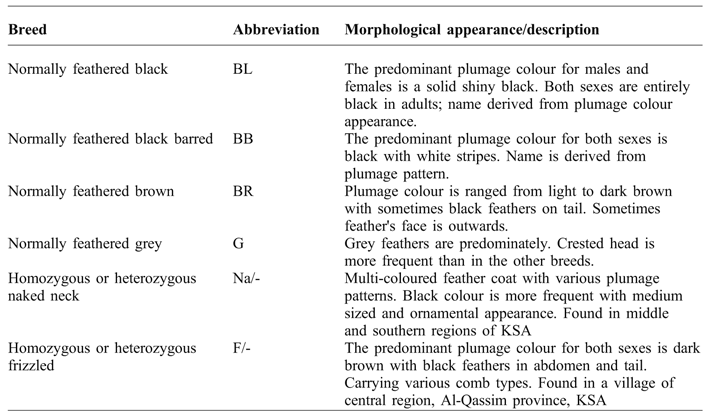
Most of the native chicken breeds in developing counties have no defined phenotypic pattern (Hoffmann, Reference HOFFMANN2005). In most Arabian countries, native chickens are called ‘Balady’ which means native (Horst, Reference HORST1989). Saudi native chickens exhibit a large variation in many morphological aspects along the different regions of Saudi Arabia (Al-Yousef, Reference AL-YOUSEF2007). According to the survey conducted by Al-Yousef (Reference AL-YOUSEF2007) in the western province, Saudi chickens could be classified into white (18%), red (21%), brown (22%), black (20%) and grey (17%) populations. They reported that 50% of the chicken farmers preferred birds with black feathers, while 43% preferred birds with brown plumage. Recently, Fathi et al. (Reference FATHI, AL-HOMIDAN, MOTAWEI, EL-ZAREI and ABOU-EMERA2017) genetically classified Saudi native chickens into five breeds based on 25 microsatellite markers. A description of morphological appearance for the different native chicken populations is explained in Table 1 . Additionally, photographs of the Saudi native chicken breeds are provided in Figure 1 .
Description of morphological appearance of the Saudi native chicken populations.

Photographs of Saudi native chicken breeds.
BL= Normally feathered black, BB= Normally feathered black barred, BR= Normally feathered brown, G= Normally feathered gray, Na/-= Homozygous or heterozygous naked neck, F/-= Homozygous or heterozygous frizzled

Native chicken genotypes segregating for major genes
As a result of natural selection, most local breeds possess genes and alleles that are appropriate to their adaptation to the prevailing environmental conditions (Romanov et al., Reference ROMANOV, WEZYK, CYWA-BENKO and SAKHATSKY1996; Ngeno et al., Reference NGENO, VANDER WAAIJ and KAHI2014). Native chickens segregating for Na, F and Cr genes exist in many locations in Saudi Arabia. These heat tolerant genes are considered important in hot climate areas and can be incorporated in other breeding programs (Horst, Reference HORST1988; Mtileni et al., Reference MTILENI, MUCHADEYI, MAIWASHE, GROENEVELD, GROENEVELD, DZAMA and WEIGEND2012; Fathi et al., Reference FATHI, FAHMY, AL-HOMIDAN and AL-MOSHAWAH2013; Reference FATHI, FAHMY, AL-HOMIDAN, ABOU-EMERA and AL-HOMOD2014). Several smallholder farmers confirmed that these genotypes exhibit higher performance in terms of egg production, survival rate and immunocompetence profile when compared with their normal plumage counterparts. However, there are attractive multi-coloured plumage patterns in native chickens that are ideal for free-range and backyard type housing. The large phenotypic variation among them is important for selection and crossing programs to produce variable local breeds. However, the productive performance of these diverse genotypes differs with the presence of one or more major genes (Fathi et al., Reference FATHI, FAHMY, AL-HOMIDAN and AL-MOSHAWAH2013; Ngeno et al., Reference NGENO, VANDER WAAIJ and KAHI2014). Naked neck chickens have better nutritive quality of meat for consumers (Pavlovski et al., Reference PAVLOVSKI, ŠKRBIĆ, LUKIĆ, VITOROVIĆ, PETRIČEVIĆ and MILOŠEVIĆ2009), whereas, the crested-head genotype is considered to be a superior egg layer (Ngeno et al., Reference NGENO, VANDER WAAIJ and KAHI2014).
High ambient temperatures are present in a wide area of Saudi Arabia. The better ability to lose body heat and superior disease resistance associated with the Na gene result in higher productive performance under tropical environments (Ariyadi et al., Reference ARIYADI, SIDADOLOG, HARIMURTI, SUDARYATI and WIHANDOYO2015). Sharifi et al. (Reference SHARIFI, HORST and SIMIANER2010) reported that the use of the naked neck gene in a homozygous manner (NaNa) results in a distinct improvement in reproductive traits, except for hatchability. Birds having the naked neck or frizzle gene appear to show superior performance compared to normal feathered birds and could be exploited for potential utilisation in local chicken production (Adomako et al., Reference ADOMAKO, OLYMPIO, HAGAN and HAMIDU2014a; Reference ADOMAKO, OLYMPIO, HAGAN and HAMIDU2014b; Reddy et al., Reference REDDY, PREETAM, REDDY, RAJ KUMAR, REDDY, GAUTHAM, HAREESH and VISHNU2015). In terms of dressing carcass and edible parts, the naked neck genotypes have higher growth, slaughter, dressing percentages and thigh yield indicating a favourable effect of the Na gene under hot climates, due to the lack of feathers (Reddy et al., Reference REDDY, PREETAM, REDDY, RAJ KUMAR, REDDY, GAUTHAM, HAREESH and VISHNU2015). Additionally, numerically higher giblet weight (liver, heart and gizzard) in NaNa and Nana genotypes was reported. In regards to the immune response profile, significantly higher haemolytic levels in the sera for SRBC and ND virus in the dominant and heterozygous birds suggests a positive effect of the naked neck gene (Reddy et al., Reference REDDY, PREETAM, REDDY, RAJ KUMAR, REDDY, GAUTHAM, HAREESH and VISHNU2015). Both Na and F genes enhance the bird's immunity and disease resistance under high and low ambient temperatures (Fathi et al., Reference FATHI, FAHMY, AL-HOMIDAN, ABOU-EMERA and AL-HOMOD2014). On the other hand, deleterious effects have been documented for Na and/or F genes at moderate and low ambient temperatures (Raju et al., Reference RAJU, SHYAM SUNDER, CHAWAK, RAMA RAO and SADAGOPAN2004; El-Safty et al., Reference EL-SAFTY, ALI and FATHI2006; Chen et al., Reference CHEN, GOURICHON, HUANG, LEE, BORDAS and TIXIER-BOICHARD2009; Magothe et al., Reference MAGOTHE, MUHUYI and KAHI2010).
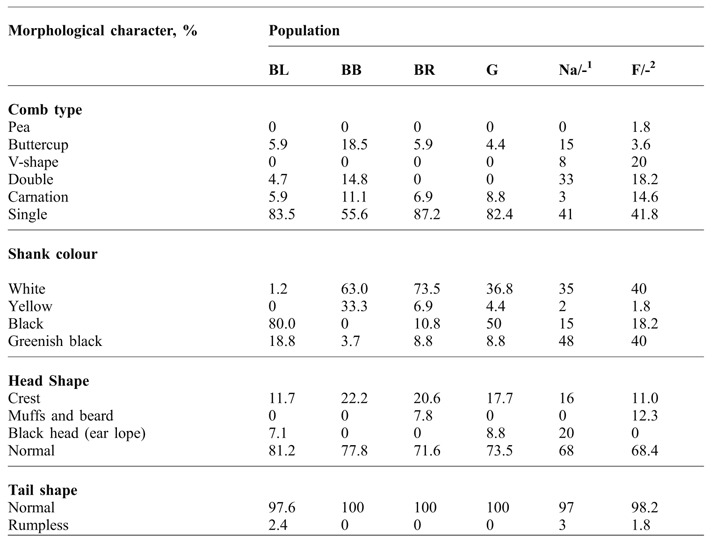
As shown in Table 2 , numerous comb types are seen in both the naked neck and frizzle genotypes. This may be due to the correlation between these genes and the different comb types. The V-shaped comb type was found in native birds carrying the Na or F gene (8 and 20%, respectively). Moreover, the carnation comb type is prevalent in the frizzled genotypes compared to the other breeds. Almost one third of naked neck birds have a double comb type. Greenish black or black leg is more frequent in naked neck and frizzle birds. In regards to head shape, muffs and beard mutation can mainly be found in both brown and frizzle chickens. This appearance is completely absent in naked neck chickens. On the other hand, black head trait was seen in naked neck genotypes (20%) rather than frizzled genotypes. Rumpless or tailless chickens could be found in birds barring Na and F genes, but this was more frequent in naked neck genotypes.
However, further studies are needed to investigate and document the productive performance of native chickens segregating for these major genes either alone or in combination under prevailing environmental conditions.
Morphological characteristics of Saudi native chicken populations.

Na/-1 = chickens segregating for naked neck gene in homozygous or heterozygous status.
F/-2 = chickens segregating for frizzle gene in homozygous or heterozygous status.
Growth performance and productive traits
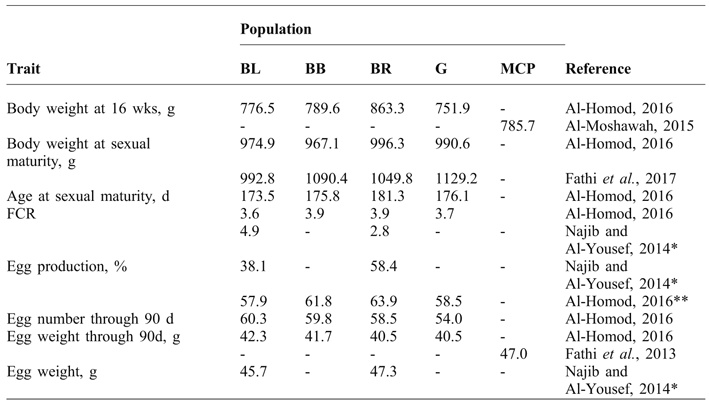
Summarised data of Saudi native chicken populations for growth performance and egg production traits with related references are shown in Table 3 . A significant increase in body weight at 16 weeks of age in brown breeds compared to the other counterparts was reported by Al-Homod (Reference AL-HOMOD2016). However, this advantage disappears at sexual maturity age. Al-Moshawah (Reference AL-MOSHAWAH2015) found a similar body weight at 16 weeks of age in multi-coloured Saudi chickens. On the other hand, a lighter body weight was recorded for black breeds when compared with the other studied breeds (Fathi et al., Reference FATHI, AL-HOMIDAN, MOTAWEI, EL-ZAREI and ABOU-EMERA2017). In regards to FCR, it could be concluded that the different native breeds have almost the same ratio (Al-Homod, Reference AL-HOMOD2016). However, the results of Najib and Al-Yousef (Reference NAJIB and AL-YOUSEF2014) suggested a deleterious feed conversion ratio associated with the black breed. In terms of egg production parameters, the native chicken breeds had lower egg production. However, the brown laying hens had higher productivity compared to the other breeds (Najib and Al-Yousef, Reference NAJIB and AL-YOUSEF2014; Al-Homod, Reference AL-HOMOD2016). Egg weight ranged from 40.5 to 42.3 g during the first six months of the laying period (Al-Homod, Reference AL-HOMOD2016). In the study of Najib and Al-Yousef (Reference NAJIB and AL-YOUSEF2014), black and brown breeds laid much heavier eggs (45.7 and 47.3 g, respectively) during the laying period from 28-50 weeks of age. However, native birds are generally small in size and found to have poor performance in terms of growth rate and egg production, achieving mature body weights of 1.33 kg for females and 1.77 kg for males and producing about 100 eggs per year (Al-Yousef, Reference AL-YOUSEF2007).
Summarised data of Saudi native chicken populations for growth performance and egg production traits.

MCP= multi-coloured population
FCR = Feed conversion ratio
*These traits recorded during the laying period of 28-50 weeks of age
**Egg production during the first 6 months of laying period.
Egg quality characteristics
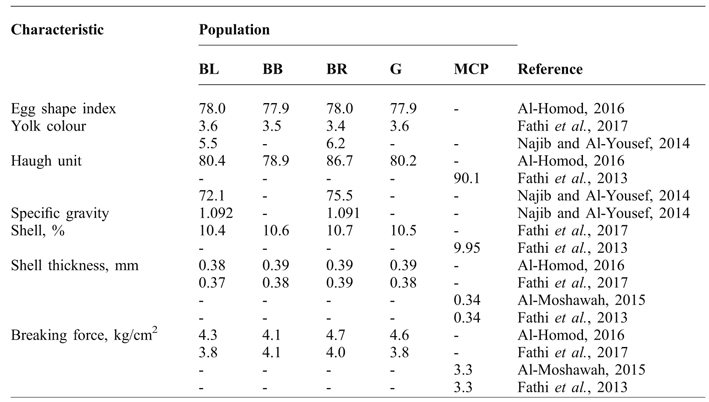
Internal and external egg quality characteristics and related references are listed in Table 4 . Egg shape in all of the studied native breeds was almost the same (78.0). Egg yolk colour ranged from 3.4 to 3.6 in the study of Fathi et al. (Reference FATHI, AL-HOMIDAN, MOTAWEI, EL-ZAREI and ABOU-EMERA2017). According to the report of Najib and Al-Yousef (Reference NAJIB and AL-YOUSEF2014) egg yolks produced from brown hens exhibited a dark yellow colour (6.2) compared to the eggs produced from their black sisters (5.5). With respect to Haugh unit, the results of both Al-Homod (Reference AL-HOMOD2016) and Fathi et al. (Reference FATHI, FAHMY, AL-HOMIDAN and AL-MOSHAWAH2013) referred to higher figures compared to those of Najib and Al-Yousef (Reference NAJIB and AL-YOUSEF2014). Attia et al. (Reference ATTIA, AL SOBAYEL, BAYOUMI and EL-BADRY1991) reported that Haugh unit and shell thickness of the Saudi Baladi chickens, fed different protein regimens during the growing period ranged from 71.69 to 73.02 for HU and 33.50 to 34.03 (mm x 1000) for shell thickness. No significant differences among different breeds for specific gravity and shell thickness have been reported (Najib and Al-Yousef, Reference NAJIB and AL-YOUSEF2014; Al-Homod, Reference AL-HOMOD2016). Fathi et al. (Reference FATHI, FAHMY, AL-HOMIDAN and AL-MOSHAWAH2013) and Fathi et al. (Reference FATHI, AL-HOMIDAN, MOTAWEI, EL-ZAREI and ABOU-EMERA2017), found a lower percentage of eggshell in multi-coloured breeds compared to native breeds. Moreover, Fathi et al. (Reference FATHI, FAHMY, AL-HOMIDAN and AL-MOSHAWAH2013) and Al-Moshawah (Reference AL-MOSHAWAH2015) reported the same shell thickness in multi-coloured birds. In terms of breaking force and eggshell strength, eggs from different mono-colour native breeds are stronger than that of multi-coloured breed. This improvement may be due to the selection programs applied in pure native breeds kept at Qassim University.
Summarised data of Saudi native chicken populations for internal and external egg quality characteristics.

MCP= multi-coloured population
Carcass characteristics
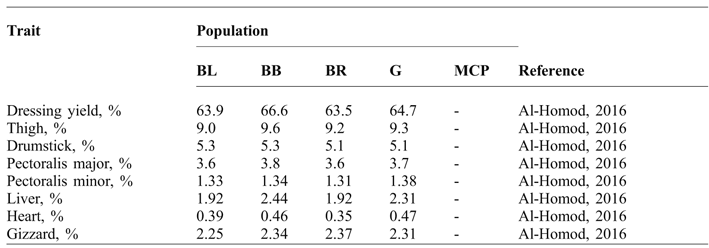
The most important carcass yield characteristics and related references are shown in Table 5 . According to the study of Al-Homod (Reference AL-HOMOD2016), the black barred breed had a significantly higher dressing carcass percentage when compared with the other breeds. There are no significant differences among breeds for thigh and drumstick relative weights. A similar trend is found for breast muscles. In regards to giblets, the black barred and grey chickens had higher relative weights of liver and heart compared to the black and brown counterparts. Gizzard percentage was almost the same in all of the breeds.
Summarised data of Saudi native chicken populations for carcass characteristics.

MCP= multi-coloured population
Haematological parameters and blood biochemistry
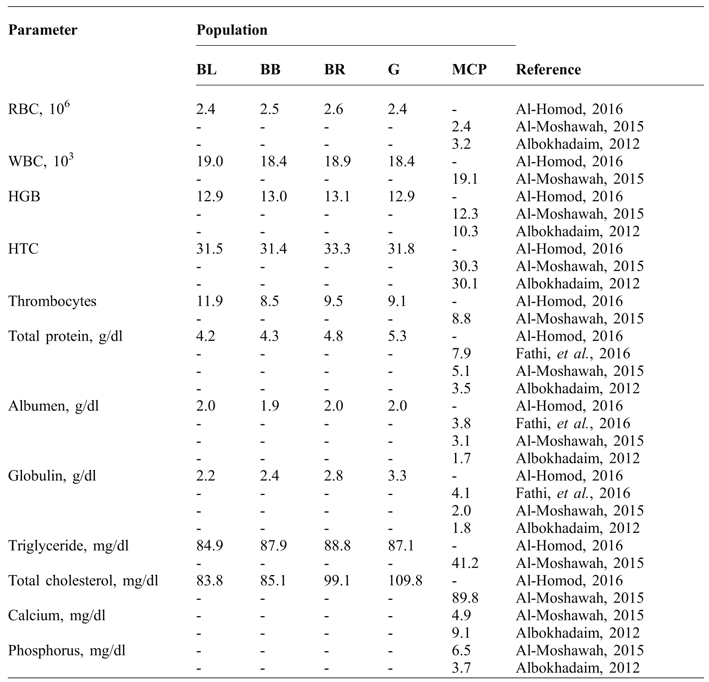
As shown in Table 6 , red blood cell (RBC) count ranged from 2.4 to 2.6 in the native chicken breeds studied by Al-Homod (Reference AL-HOMOD2016) and Al-Moshawah (Reference AL-MOSHAWAH2015). A higher figure (3.2) was reported in multi-coloured chickens (Albokhadaim, Reference ALBOKHADAIM2012). In regards to white blood cells (WBC), it could be concluded that there is no significant difference among native breeds (Al-Moshawah, Reference AL-MOSHAWAH2015; Al-Homod, Reference AL-HOMOD2016). In both studies (Al-Moshawah, Reference AL-MOSHAWAH2015; Al-Homod, Reference AL-HOMOD2016), the haemoglobin (HGB) concentrations were similar. A lower concentration of HGB in multi-coloured chicken flocks was reported by Albokhadaim (Reference ALBOKHADAIM2012). In all of the studies above the haematocrit (HTC) levels were in the range of 30 to 33. Thrombocytes in black breeds were significantly higher than that of the other breeds (Al-Homod, Reference AL-HOMOD2016).
Summarised data of haematological parameters and blood biochemistry for Saudi native chicken populations.

MCP= multi-coloured population
Studies determining various blood parameters are shown in Table 6 . It was reported that the levels of blood total protein, albumen and globulin were higher (7.9) in the multi-coloured flock of Fathi et al. (Reference FATHI, AL-HOMIDAN, ABOU-EMERA and AL-MOSHAWAH2016) compared to both studies of Al-Moshawah (Reference AL-MOSHAWAH2015) and Albokhadaim (Reference ALBOKHADAIM2012). These discrepancies may be due to the age of the flock. Al-Homod (Reference AL-HOMOD2016) didn't find any significant differences among breeds for the previous parameters. In terms of triglyceride and total cholesterol, lower levels were found in multi-coloured chickens compared to those of Al-Homod (Reference AL-HOMOD2016). Furthermore, brown and grey chicken breeds had significantly higher levels of total cholesterol compared to both black and black barred breeds. There is a wide difference in blood calcium and phosphorous levels reported in the studies of Al-Moshawah (Reference AL-MOSHAWAH2015) and Albokhadaim (Reference ALBOKHADAIM2012). This may have resulted from differences in age and productive status of the birds used to evaluate blood biochemistry.
Lymphoid organs and immune response
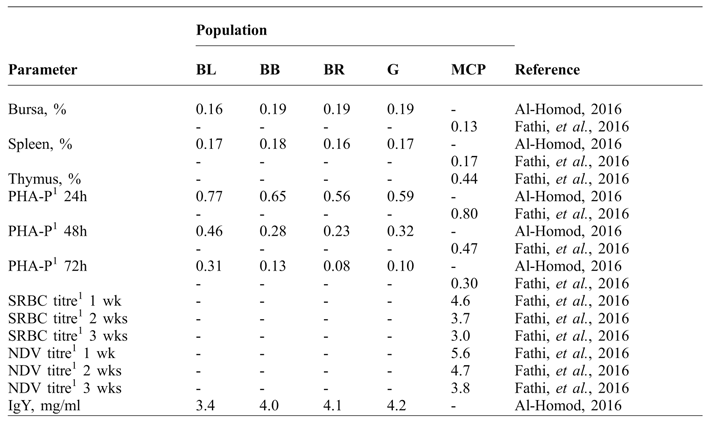
Few reports are available on the immunogenetic profile of Saudi native chicken breeds. Table 7 summarises the data which is available on lymphoid organs and cellular and humoral immune responses. Al-Homod (Reference AL-HOMOD2016) found a reduction in relative weight of the bursa of Fabricius in black breeds compared to the other studied breeds. Comparing with the results of Al-Homod (Reference AL-HOMOD2016), inferior relative weight of the bursa of Fabricius was found in multi-coloured native populations (Fathi et al., Reference FATHI, AL-HOMIDAN, ABOU-EMERA and AL-MOSHAWAH2016). Spleen percentage ranged from 0.16% to 0.18% (Al-Homod, Reference AL-HOMOD2016; Fathi et al., Reference FATHI, AL-HOMIDAN, ABOU-EMERA and AL-MOSHAWAH2016). The relative weight of the thymus gland in multi-coloured native populations was reported as 0.44% (Fathi et al., Reference FATHI, AL-HOMIDAN, ABOU-EMERA and AL-MOSHAWAH2016). With respect to cellular mediated immunity, Al-Homod (Reference AL-HOMOD2016) reported a significantly higher immune response for PHA-P in black breeds compared to the other breeds. Similarly, Fathi et al. (Reference FATHI, AL-HOMIDAN, ABOU-EMERA and AL-MOSHAWAH2016) stated that the multi-coloured native population has a higher immune response for both cellular mediated immunity and Newcastle antibody titre compared to exotic breeds (White Leghorn and Lohmann). Many reports have stated that the indigenous chicken breeds have a higher immunity compared to imported chickens (Minga et al., Reference MINGA, MSOFFE and GWAKISA2004; Singh et al., Reference SINGH, JOHRI, SINGH, NARAYAN and SINGH2004; Tirawattanawanich et al., Reference TIRAWATTANAWANICH, CHANTAKRU, NIMITSANTIWONG and TONGYAI2011; El-Safty, Reference EL-SAFTY2012). The use of sheep red blood cells as an antigen to compare specific humoral immunity in chicken breeds is well documented (Fathi et al., Reference FATHI, ALI and QURESHI2003; Osei-Amponsah et al., Reference OSEI-AMPONSAH, BOA-AMPONSEM, KAYANG and NAAZIE2013). There is no significant difference between native and exotic breeds for total antibody titre against SRBC at 7, 14 and 21 d post injection (Fathi et al., Reference FATHI, AL-HOMIDAN, ABOU-EMERA and AL-MOSHAWAH2016). With respect to immunoglobulin in serum, Al-Homod (Reference AL-HOMOD2016) reported an inferior IgY concentration in black chickens compared to the other breeds.
Summarised data of Saudi native chicken populations for relative weight of lymphoid organs and immune response.

MCP= multi-coloured population
PHAP-P= phytohemagglutinin-P
PHA-P1 = swelling response in wattle after 24 or 48 or 72 h of PHA-P injection
SRBC titre1 = total antibody titre against SRBC after 1 or 2 or 3 weeks of injection
NDV titre1 = antibody titre against Newcastle disease virus after 1 or 2 or 3 weeks of virus inoculation
Conclusions
Native chicken breeds play a significant rule for rural households and small poultry farmers. They possess many major genes adapted to harsh environmental conditions and display a strong natural immunity against common diseases. Genetic erosion and extinction resulting from natural disasters and irrational man-made crossing with other exotic and synthetic strains are increasingly observed. Consequently, it is highly recommended to conserve pure lines of native chickens as genetic resources for adapted genes to utilise them in sustainable breeding programs and for genetic improvement. Although Saudi native chickens have multiple variations in plumage colour and productive performance, recent attempts have been conducted to characterise their morphological appearance and productive performance. However, four normally feathered native breeds and two chicken populations carrying major genes have currently been recognised and characterised. According to our observations, most of the rural households and poultry farmers prefer to raise black chickens that can produce more eggs and have a higher survival rate compared to multi-coloured chickens.
Acknowledgments
We are very grateful to all faculty members and farm workers, who participated in the current study. Financial support of this study was funded by the National Plan for Science, Technology and Innovation, King Abdulaziz City for Science and Technology, Saudi Arabia (research project # 11-BIO1444-09). This work is dedicated to the soul of Dr M. O. Fahmy, who passed away during the course of the study.