



1 Introduction
The purpose of this article is to investigate the weighted properties of Toeplitz operators on the Fock spaces over
 $\mathbb {C}^n$
. We first recall some basic notions. A nonnegative function w on
 $\mathbb {C}^n$
is said to be a weight if it is locally integrable on
 $\mathbb {C}^n$
. Given
 $\alpha>0$
,
 $1\leq p<\infty ,$
and a weight w on
 $\mathbb {C}^n$
, the weighted space
 $L^p_{\alpha ,w}$
consists of measurable functions f on
 $\mathbb {C}^n$
such that
 $$ \begin{align*}\|f\|^p_{L^p_{\alpha,w}}:=\int_{\mathbb{C}^n}|f(z)|^pe^{-\frac{p\alpha}{2}|z|^2}w(z)dv(z)<\infty,\end{align*} $$
where
 $dv$
is the Lebesgue measure on
 $\mathbb {C}^n$
. Let
 $\mathcal {H}(\mathbb {C}^n)$
be the space of entire functions on
 $\mathbb {C}^n$
. Then the weighted Fock space
 $F^p_{\alpha ,w}$
is defined by
 $$ \begin{align*}F^p_{\alpha,w}:=L^p_{\alpha,w}\cap\mathcal{H}(\mathbb{C}^n)\end{align*} $$
with the inherited norm. If
 $w\equiv \left (\frac {p\alpha }{2\pi }\right )^n$
, then the above spaces are simply denoted by
 $L^p_{\alpha }$
and
 $F^p_{\alpha }$
. We refer to [Reference Janson, Peetre and Rochberg28, Reference Zhu43] for more information of the classical Fock spaces
 $F^p_{\alpha }$
. Since
 $F^2_{\alpha }$
is a closed subspace of
 $L^2_{\alpha }$
, there exists an orthogonal projection from
 $L^2_{\alpha }$
onto
 $F^2_{\alpha }$
. This map is the so-called Fock projection and is given by
 $$ \begin{align*}P_{\alpha}(f)(z):=\int_{\mathbb{C}^n}f(u)\overline{K_z(u)}d\lambda_{\alpha}(u),\end{align*} $$
where
 $K_z(u)=e^{\alpha \langle u,z\rangle }$
is the reproducing kernel of
 $F^2_{\alpha }$
, and
 $$ \begin{align*}d\lambda_{\alpha}(u):=\left(\frac{\alpha}{\pi}\right)^ne^{-\alpha|u|^2}dv(u)\end{align*} $$
is the Gaussian measure. It is well-known that for any
 $1\leq p<\infty $
,
 $P_{\alpha }$
actually extends to a bounded projection from
 $L^p_{\alpha }$
onto
 $F^p_{\alpha }$
(see [Reference Janson, Peetre and Rochberg28, Theorem 7.1]).
Given a function
 $\varphi $
on
 $\mathbb {C}^n$
, the associated Toeplitz operator
 $T_{\varphi }$
is formally defined by
 $$ \begin{align*}T_{\varphi}f:=P_{\alpha}(\varphi f).\end{align*} $$
By the mapping properties of the Fock projection
 $P_{\alpha }$
, it is clear that if
 $\varphi \in L^{\infty }:=L^{\infty }(\mathbb {C}^n)$
, then
 $T_{\varphi }$
extents to a bounded operator from
 $L^p_{\alpha }$
into
 $F^p_{\alpha }$
for
 $1\leq p<\infty $
. The properties of Toeplitz operators acting on classical Fock spaces have been investigated extensively (see [Reference Bauer, Choe and Koo4, Reference Bauer, Coburn and Isralowitz5, Reference Bauer, van Luijk, Stottmeister and Werner7, Reference Coburn, Isralowitz and Li17, Reference Fulsche20, Reference Hu and Lv22, Reference Isralowitz and Zhu27] and the references therein). A main theme in the study of Toeplitz operators is to characterize the compactness of operators from the Toeplitz algebra via the Berezin transform (see, for instance, [Reference Axler and Zheng3, Reference Engliš18, Reference Jovovic and Zheng29, Reference Mitkovski, Suárez and Wick35, Reference Suárez39, Reference Wang and Xia40] for the Bergman space case and [Reference Bauer and Isralowitz6, Reference Fulsche21, Reference Hu, Lv and Wick23, Reference Isralowitz25, Reference Isralowitz, Mitkovski and Wick26, Reference Xia and Zheng41] for the Fock space case). Recall that for a bounded linear operator T on the Fock space
 $F^p_{\alpha }$
, its Berezin transform is defined by
 $$ \begin{align*}\widetilde{T}(z):=\langle Tk_z,k_z\rangle_{\alpha},\quad z\in\mathbb{C}^n,\end{align*} $$
where
 $k_z(u)=e^{\alpha \langle u,z\rangle -\frac {\alpha }{2}|z|^2}$
is the normalized reproducing kernel of
 $F^2_{\alpha }$
, and the integral pairing
 $\langle \cdot ,\cdot \rangle _{\alpha }$
is given by
 $$ \begin{align*}\langle f,g\rangle_{\alpha}:=\int_{\mathbb{C}^n}f(z)\overline{g(z)}d\lambda_{\alpha}(z).\end{align*} $$
The following theorem, proved by Bauer and Isralowitz [Reference Bauer and Isralowitz6, Theorem 1.1], characterizes the compactness of operators in the Toeplitz algebra on
 $F^p_{\alpha }$
via the Berezin transform.
Theorem A [Reference Bauer and Isralowitz6]
Let
 $\alpha>0$
and
 $1<p<\infty $
. Suppose that T is an operator in the norm closure of the algebra generated by Toeplitz operators with
 $L^{\infty }$
-symbols acting on
 $F^p_{\alpha }$
. Then T is compact on
 $F^p_{\alpha }$
if and only if
 $\lim _{|z|\to \infty }\widetilde {T}(z)=0$
.
Recently, the weighted boundedness of the Fock projections has drawn some attention (see [Reference Cascante, Fàbrega and Peláez12, Reference Chen and Wang15, Reference Chen and Wang16, Reference Isralowitz24]). Let Q denote a cube in
 $\mathbb {C}^n=\mathbb {R}^{2n}$
with sides parallel to the coordinate axes, and write
 $l(Q)$
for its side length. As usual,
 $p'$
denotes the conjugate exponent of p, that is,
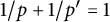 $1/p+1/p'=1$
. For
 $1<p<\infty $
, we say that a weight w belongs to the class
 $A^{\mathrm {restricted}}_p$
if for some (or any) fixed
 $r>0$
,
 $$ \begin{align*}[w]_{A_{p,r}}:=\sup_{Q:l(Q)=r}\left(\frac{1}{v(Q)}\int_{Q}wdv\right) \left(\frac{1}{v(Q)}\int_{Q}w^{-\frac{p'}{p}}dv\right)^{\frac{p}{p'}}<\infty,\end{align*} $$
and w is said to be in the class
 $A^{\mathrm {restricted}}_1$
if for some (or any) fixed
 $r>0$
,
 $$ \begin{align*}[w]_{A_{1,r}}:=\sup_{Q:l(Q)=r}\left(\frac{1}{v(Q)}\int_Qwdv\right)\|w^{-1}\|_{L^{\infty}(Q)}<\infty.\end{align*} $$
The following theorem, characterizing the boundedness of
 $P_{\alpha }$
on
 $L^p_{\alpha ,w}$
, was proved by Isralowitz [Reference Isralowitz24, Theorem 3.1] for the case
 $1<p<\infty $
and by Cascante–Fàbrega–Peláez [Reference Cascante, Fàbrega and Peláez12, Proposition 2.7] for the case
 $p=1$
.
Theorem B [Reference Cascante, Fàbrega and Peláez12, Reference Isralowitz24]
Let
 $\alpha>0$
,
 $1\leq p<\infty $
, and let w be a weight on
 $\mathbb {C}^n$
. Then the Fock projection
 $P_{\alpha }$
is bounded on
 $L^p_{\alpha ,w}$
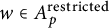
if and only if
 $w\in A^{\mathrm {restricted}}_p$
.
The aim of this article is twofold: we first generalize Theorem A to the weighted Fock spaces
 $F^p_{\alpha ,w}$
induced by
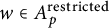 $w\in A^{\mathrm {restricted}}_p$
, and then establish the version of Theorem B for Toeplitz operators.
We now state the main results of this article. By Theorem B, the boundedness of Toeplitz operators with
 $L^{\infty }$
-symbols on the weighted Fock spaces
 $F^p_{\alpha ,w}$
induced by
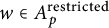 $w\in A^{\mathrm {restricted}}_p$
is out of question. Our first result characterizes the weighted compactness of Toeplitz operators via their Berezin transforms, which completely establishes the Fock space analogue of [Reference Stockdale and Wagner38, Open Question 1.14].
Theorem 1.1 Let
 $\alpha>0$
,
 $1<p<\infty $
,
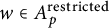 $w\in A^{\mathrm {restricted}}_p$
, and let T be a finite sum of finite products of Toeplitz operators with
 $L^{\infty }$
-symbols. Then T is compact on
 $F^p_{\alpha ,w}$
if and only if
 $\lim _{|z|\to \infty }\widetilde {T}(z)=0$
.
The proof of Theorem 1.1 is based on a Riesz–Kolmogorov type characterization of precompact sets in
 $F^p_{\alpha ,w}$
and the notion of weakly localized operators on
 $F^p_{\alpha ,w}$
, which is adapted from [Reference Isralowitz, Mitkovski and Wick26]. We will show that each Toeplitz operator with
 $L^{\infty }$
-symbol is weakly localized on
 $F^{p}_{\alpha ,w}$
, and all weakly localized operators on
 $F^p_{\alpha ,w}$
form an algebra. This, combined with the Riesz–Kolmogorov type compactness criterion, will give the proof of Theorem 1.1.
Our second result is a characterization of weighted boundedness of Toeplitz operators under a mild assumption on weights. For
 $r>0$
, a weight w on
 $\mathbb {C}^n$
is said to be r-doubling if there exists some constant
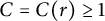 $C=C(r)\geq 1$
such that
 $w(Q_{2r}(z))\leq Cw(Q_{r}(z))$
for any
 $z\in \mathbb {C}^n$
. Here and in the sequel,
 $Q_r(z)$
denotes the cube centered at
 $z\in \mathbb {C}^n$
with side length
 $r>0$
, and
 $w(E)=\int _Ewdv$
for measurable sets E. It is easy to see that if w is r-doubling, then for each
 $m\geq 1$
, there exists
 $C=C(m,r)\geq 1$
such that
 $w(Q_{mr}(z))\leq Cw(Q_r(z))$
holds for any
 $z\in \mathbb {C}^n$
. We characterize the r-doubling weights w such that
 $T_{\varphi }$
is bounded on
 $L^p_{\alpha ,w}$
via a
 $\varphi $
-adapted
 $A_{p,r}$
-condition.
Theorem 1.2 Let
 $\alpha>0$
,
 $\varphi \in L^{\infty }$
, and let w be an r-doubling weight on
 $\mathbb {C}^n$
for some
 $r>0$
.
-
(1) For
 $1<p<\infty $
,
$T_{\varphi }$
is bounded on
$L^p_{\alpha ,w}$
if and only if
$$ \begin{align*}\sup_{Q:l(Q)=r}\left(\frac{1}{v(Q)}\int_{Q}wdv\right) \left(\frac{1}{v(Q)}\int_{Q}|\varphi|^{p'}w^{-\frac{p'}{p}}dv\right)^{\frac{p}{p'}}<\infty.\end{align*} $$
-
(2)
$T_{\varphi }$
is bounded on
$L^1_{\alpha ,w}$
if and only if
$$ \begin{align*}\sup_{Q:l(Q)=r}\left(\frac{1}{v(Q)}\int_{Q}wdv\right)\|\varphi w^{-1}\|_{L^{\infty}(Q)}<\infty.\end{align*} $$


To prove the necessary parts of the above theorem, we will consider a class of rank one operators induced by the normalized reproducing kernels of
 $F^2_{\alpha }$
. The sufficient parts are based on some elementary estimates of r-doubling weights.
Using the same method as in Theorem 1.2, we can also establish a two-weight inequality for the Fock projections. After the pioneering works of Sawyer [Reference Sawyer36, Reference Sawyer37], the two-weight inequalities for classical operators, such as the Hilbert transform and the Bergman projection, have become a main subject in harmonic analysis and operator theory (see, for instance, [Reference Aleman, Pott and Reguera1, Reference Brocchi11, Reference Fang and Wang19, Reference Lacey30–Reference Lacey, Sawyer and Uriarte-Tuero32] and the references therein). Generally, in order to obtain the two-weight boundedness, one needs to consider the Sawyer-type testing, which is usually hard to verify. We here characterize the two-weight boundedness of the Fock projections only by some joint
 $A_p$
-conditions, under the mild assumption that the weight of the target space is r-doubling. Let
 $r>0$
and
 $w,\sigma $
be two weights on
 $\mathbb {C}^n$
. For
 $1<p<\infty $
, the joint
 $A_{p,r}$
-characteristic of w and
 $\sigma $
is defined by
 $$ \begin{align*}[w,\sigma]_{A_{p,r}}:=\sup_{Q:l(Q)=r}\left(\frac{1}{v(Q)}\int_{Q}wdv\right) \left(\frac{1}{v(Q)}\int_{Q}\sigma^{-\frac{p'}{p}}dv\right)^{\frac{p}{p'}},\end{align*} $$
and the joint
 $A_{1,r}$
-characteristic is defined by
 $$ \begin{align*}[w,\sigma]_{A_{1,r}}:=\sup_{Q:l(Q)=r}\left(\frac{1}{v(Q)}\int_{Q}wdv\right)\|\sigma^{-1}\|_{L^{\infty}(Q)}.\end{align*} $$
We are now ready to state our two-weight inequality for the Fock projections, which generalizes Theorem B.
Theorem 1.3 Let
 $\alpha>0$
,
 $1\leq p<\infty $
, and let
 $\sigma ,w$
be two weights on
 $\mathbb {C}^n$
. Suppose that w is r-doubling for some
 $r>0$
. Then
 $P_{\alpha }:L^p_{\alpha ,\sigma }\to L^p_{\alpha ,w}$
is bounded if and only if
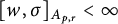 $[w,\sigma ]_{A_{p,r}}<\infty $
. Moreover,
 $$ \begin{align*}\|P_{\alpha}\|_{L^p_{\alpha,\sigma}\to L^p_{\alpha,w}}\asymp[w,\sigma]^{1/p}_{A_{p,r}},\end{align*} $$
where the implicit constant depends on
 $p,n,\alpha ,r,$
and the r-doubling constant of w.
Remark 1.4 The necessary part of Theorem 1.3 actually holds for any two weights w and
 $\sigma $
, that is, if
 $P_{\alpha }:L^p_{\alpha ,\sigma }\to L^p_{\alpha ,w}$
is bounded, then
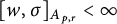 $[w,\sigma ]_{A_{p,r}}<\infty $
for any
 $r>0$
(see the proof in Section 4). On the other hand, each
 $A_p^{\mathrm {restricted}}$
weight w satisfies the r-doubling condition for any
 $r>0$
(see Lemma 2.1). Hence, Theorem 1.3 reduces to Theorem B when
 $\sigma =w$
.
The following example indicates that the r-doubling condition in Theorem 1.3 cannot be removed.
Example 1.5 Let
 $\alpha>0$
, and let the weights
 $\sigma ,w$
be defined by
 $$ \begin{align*}\sigma(z)=e^{-\alpha|z|^2},\quad w(z)=e^{-4\alpha|z|^2},\quad z\in\mathbb{C}^n.\end{align*} $$
Then it is easy to verify that for any
 $r>0$
,
 $$ \begin{align*}[w,\sigma]_{A_{2,r}}=\sup_{Q:l(Q)=r}\left(\frac{1}{v(Q)}\int_{Q}e^{-4\alpha|z|^2}dv(z)\right) \left(\frac{1}{v(Q)}\int_{Q}e^{\alpha|z|^2}dv(z)\right)<\infty.\end{align*} $$
However, by [Reference Bommier-Hato, Engliš and Youssfi10, Theorem 1],
 $P_{\alpha }:L^2_{\alpha ,\sigma }\to L^2_{\alpha ,w}$
is unbounded.
The rest part of this article is organized as follows. In Section 2, we recall some preliminary results. Theorem 1.1 is proved in Section 3. Section 4 is devoted to proving Theorems 1.2 and 1.3. In Section 5, we consider the weighted compactness of Toeplitz operators on the Bergman space over the unit ball
 $\mathbb {B}_n$
of
 $\mathbb {C}^n$
. For
 $1<p<\infty $
and a Békollè–Bonami
 $B_p$
-weight
 $\sigma $
, we show that the Bergman–Toeplitz operator
 $T_{\varphi }$
with bounded symbol
 $\varphi $
is compact on the weighted Bergman space
 $\mathcal {A}^p_{\sigma }$
if and only if its Berezin transform vanishes at the boundary of
 $\mathbb {B}_n$
, which answers [Reference Stockdale and Wagner38, Open Question 1.14] (see Theorem 5.1).
Notation. Throughout the article, we write
 $A\lesssim B$
to denote that
 $A\leq CB$
for some inessential constant
 $C>0$
, and if
 $A\lesssim B\lesssim A$
, then we write
 $A\asymp B$
. For a weight w on
 $\mathbb {C}^n$
, the weight
 $\widehat {w}$
is defined by
 $\widehat {w}(z)=w(Q_1(z))$
,
 $z\in \mathbb {C}^n$
, and the dual weight
 $w'$
is defined by
 $w'=w^{-p'/p}$
. For
 $r>0$
and
 $z\in \mathbb {C}^n$
, we use
 $B_r(z)$
to denote the Euclidean ball in
 $\mathbb {C}^n$
centered at z with radius r.
2 Preliminaries
In this section, we collect some preliminary results that will be used in the sequel.
We begin from the following elementary lemma concerning weights, which was established in [Reference Isralowitz24, Lemmas 3.2 and 3.4]. Here and in the sequel, we will treat
 $r\mathbb {Z}^{2n}$
as a subset of
 $\mathbb {C}^n$
in the canonical way.
Lemma 2.1 [Reference Isralowitz24]
Let w be a weight on
 $\mathbb {C}^n$
.
-
(1) If
$w\in A^{\mathrm {restricted}}_p$
for some
$1\leq p<\infty $
, then w is r-doubling for each
$r>0$
. -
(2) If w is r-doubling for some
$r>0$
, then there exists
$C>0$
such that for any
$\nu ,\nu '\in r\mathbb {Z}^{2n}$
,
$$ \begin{align*}\frac{w(Q_r(\nu))}{w(Q_r(\nu'))}\leq C^{|\nu-\nu'|}.\end{align*} $$


For fixed
 $r>0$
and any
 $u,z\in \mathbb {C}^n$
, there exist
 $\nu ,\nu '\in r\mathbb {Z}^{2n}$
such that
 $u\in Q_r(\nu )$
and
 $z\in Q_r(\nu ')$
. Consequently, if
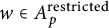 $w\in A^{\mathrm {restricted}}_p$
for some
 $1\leq p<\infty $
, then by Lemma 2.1, there exist
 $C,C_1>0$
such that
 $$ \begin{align} w(Q_r(u))&\leq w(Q_{2r}(\nu))\leq C_1w(Q_r(\nu))\leq C_1C^{|\nu-\nu'|}w(Q_r(\nu'))\nonumber\\ &\leq C^2_1C^{|\nu-\nu'|}w(Q_r(z))\leq C^2_1C^{\sqrt{2n}r+|u-z|}w(Q_r(z)). \end{align} $$
The following lemma can be deduced by [Reference Cascante, Fàbrega and Peláez12, Proposition 3.3 and Lemma 3.5].
Lemma 2.2 [Reference Cascante, Fàbrega and Peláez12]
Let
 $0<\alpha <\infty $
,
 $1<p<\infty ,$
and
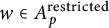 $w\in A^{\mathrm {restricted}}_p$
. Then for any
 $f\in F^p_{\alpha ,w}$
and
 $z\in \mathbb {C}^n$
,
 $$ \begin{align*}f(z)=P_{\alpha}f(z)=\langle f,K_z\rangle_{\alpha}.\end{align*} $$
We also need the following norm estimate, which was established in [Reference Cascante, Fàbrega and Peláez12, Proposition 4.1].
Lemma 2.3 [Reference Cascante, Fàbrega and Peláez12]
Let
 $0<\alpha <\infty $
,
 $1<p<\infty ,$
and
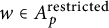 $w\in A^{\mathrm {restricted}}_p$
. Then for any
 $z\in \mathbb {C}^n$
,
 $$ \begin{align*}\|K_z\|_{F^p_{\alpha,w}}\asymp e^{\frac{\alpha}{2}|z|^2}w(Q_1(z))^{1/p}.\end{align*} $$
Note that if
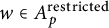 $w\in A^{\mathrm {restricted}}_p$
for some
 $1<p<\infty $
, then
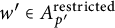 $w'\in A^{\mathrm {restricted}}_{p'}$
. Moreover, by Hölder’s inequality,
 $$ \begin{align*}w(Q_1(z))^{1/p}\asymp w'(Q_1(z))^{-1/p'},\quad z\in\mathbb{C}^n.\end{align*} $$
Consequently, by Lemma 2.3, if
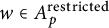 $w\in A^{\mathrm {restricted}}_p$
for some
 $1<p<\infty $
, then
 $$ \begin{align} \|K_z\|_{F^{p'}_{\alpha,w'}}\asymp e^{\frac{\alpha}{2}|z|^2}w'(Q_1(z))^{1/p'}\asymp e^{\frac{\alpha}{2}|z|^2}w(Q_1(z))^{-1/p},\quad z\in\mathbb{C}^n. \end{align} $$
In particular,
 $$ \begin{align} \|K_z\|_{F^p_{\alpha,w}}\cdot\|K_z\|_{F^{p'}_{\alpha,w'}}\asymp e^{\alpha|z|^2},\quad z\in\mathbb{C}^n. \end{align} $$
The following two lemmas were proved in [Reference Chen, He and Wang14, Lemmas 3.1 and 3.2].
Lemma 2.4 [Reference Chen, He and Wang14]
Let
 $\alpha>0$
,
 $1<p<\infty ,$
and
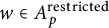 $w\in A^{\mathrm {restricted}}_p$
. Then the dual space of
 $F^p_{\alpha ,w}$
can be identified with
 $F^{p'}_{\alpha ,w'}$
under the pairing
 $\langle \cdot ,\cdot \rangle _{\alpha }$
.
Lemma 2.5 [Reference Chen, He and Wang14]
Let
 $\alpha>0$
,
 $1<p<\infty ,$
and
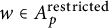 $w\in A^{\mathrm {restricted}}_p$
. Then
 $F^p_{\alpha ,w}=F^p_{\alpha ,\widehat {w}}$
with equivalent norms.
3 Weighted compactness
The purpose of this section is to prove Theorem 1.1. To this end, we introduce the following definition of weakly localized operators, which is adapted from [Reference Isralowitz, Mitkovski and Wick26]. For
 $z\in \mathbb {C}^n$
, we use
 $k_z^{(p,w)}$
to denote the “
 $(p,w)$
-normalized” reproducing kernel at z. That is,
 $$ \begin{align*}k^{(p,w)}_z:=\frac{K_z}{\|K_z\|_{F^p_{\alpha,w}}}.\end{align*} $$
Definition 3.1 Let
 $\alpha>0$
,
 $1<p<\infty $
, and let w be a weight on
 $\mathbb {C}^n$
. A bounded linear operator T on
 $F^p_{\alpha ,w}$
is said to be weakly localized if the following conditions hold:
 $$ \begin{align*} \sup_{z\in\mathbb{C}^n}\int_{\mathbb{C}^n}|\langle Tk^{(p,w)}_z,k^{(p',w')}_u\rangle_{\alpha}|dv(u)<\infty, \end{align*} $$
 $$ \begin{align} \sup_{u\in\mathbb{C}^n}\int_{\mathbb{C}^n}|\langle Tk^{(p,w)}_z,k^{(p',w')}_u\rangle_{\alpha}|dv(z)<\infty, \end{align} $$
 $$ \begin{align*} \lim_{r\to\infty}\sup_{z\in\mathbb{C}^n}\int_{B_r(z)^c}|\langle Tk^{(p,w)}_z,k^{(p',w')}_u\rangle_{\alpha}|dv(u)=0, \end{align*} $$
and
 $$ \begin{align} \lim_{r\to\infty}\sup_{u\in\mathbb{C}^n}\int_{B_r(u)^c}|\langle Tk^{(p,w)}_z,k^{(p',w')}_u\rangle_{\alpha}|dv(z)=0. \end{align} $$
We now establish two important properties for weakly localized operators on the Fock spaces
 $F^p_{\alpha ,w}$
induced by
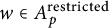 $w\in A^{\mathrm {restricted}}_p$
. The first one indicates that all Toeplitz operators with bounded symbols are weakly localized on
 $F^p_{\alpha ,w}$
, and the second one says that all weakly localized operators on
 $F^p_{\alpha ,w}$
form an algebra.
Proposition 3.1 Let
 $\alpha>0$
,
 $1<p<\infty ,$
and
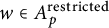 $w\in A^{\mathrm {restricted}}_p$
. Then for any
 $\varphi \in L^{\infty }$
,
 $T_{\varphi }$
is a weakly localized operator on
 $F^p_{\alpha ,w}$
.
Proof We only show that
 $T_{\varphi }$
satisfies the conditions (3.1) and (3.2). The other two are similar. To this end, we apply Lemmas 2.2 and 2.3 and the estimate (2.2) to obtain that for any
 $z,u\in \mathbb {C}^n$
,
 $$ \begin{align*} &|\langle T_{\varphi}k^{(p,w)}_z,k^{(p',w')}_u\rangle_{\alpha}|\\ &\ =|\langle P_{\alpha}\left(\varphi k^{(p,w)}_z\right),k^{(p',w')}_u\rangle_{\alpha}|\\ &\ =|\langle \varphi k^{(p,w)}_z,k^{(p',w')}_u\rangle_{\alpha}|\\ &\ =\left|\int_{\mathbb{C}^n}\varphi(\xi)k^{(p,w)}_z(\xi)\overline{k^{(p',w')}_u(\xi)}d\lambda_{\alpha}(\xi)\right|\\ &\ \leq\|\varphi\|_{L^{\infty}}\int_{\mathbb{C}^n}|\langle k^{(p,w)}_z,K_{\xi}\rangle_{\alpha}| |\langle K_{\xi},k^{(p',w')}_u\rangle_{\alpha}|d\lambda_{\alpha}(\xi)\\ &\ \asymp\|\varphi\|_{L^{\infty}}\left(\frac{\widehat{w}(u)}{\widehat{w}(z)}\right)^{1/p} \int_{\mathbb{C}^n}|\langle k_z,k_{\xi}\rangle_{\alpha}||\langle k_{\xi},k_u\rangle_{\alpha}|dv(\xi), \end{align*} $$
which, together with (2.1), implies that there exists
 $C>0$
such that
 $$ \begin{align*}|\langle T_{\varphi}k^{(p,w)}_z,k^{(p',w')}_u\rangle_{\alpha}| \lesssim\|\varphi\|_{L^{\infty}}C^{\frac{|u-z|}{p}}\int_{\mathbb{C}^n}|\langle k_z,k_{\xi}\rangle_{\alpha}||\langle k_{\xi},k_u\rangle_{\alpha}|dv(\xi).\end{align*} $$
Noting that
 $$ \begin{align*}|\langle k_z,k_{\xi}\rangle_{\alpha}|=e^{-\frac{\alpha}{2}|\xi|^2}|k_z(\xi)|=e^{-\frac{\alpha}{2}|z-\xi|^2},\end{align*} $$
we have
 $$ \begin{align} |\langle T_{\varphi}k^{(p,w)}_z,k^{(p',w')}_u\rangle_{\alpha}| \lesssim\|\varphi\|_{L^{\infty}}C^{\frac{|u-z|}{p}}\int_{\mathbb{C}^n}e^{-\frac{\alpha}{2}|z-\xi|^2-\frac{\alpha}{2}|\xi-u|^2}dv(\xi). \end{align} $$
Consequently, it follows from Fubini’s theorem that
 $$ \begin{align*} &\int_{\mathbb{C}^n}|\langle T_{\varphi}k^{(p,w)}_z,k^{(p',w')}_u\rangle_{\alpha}|dv(z)\\ &\ \lesssim\|\varphi\|_{L^{\infty}}\int_{\mathbb{C}^n}C^{\frac{|u-z|}{p}}\int_{\mathbb{C}^n} e^{-\frac{\alpha}{2}|z-\xi|^2-\frac{\alpha}{2}|\xi-u|^2}dv(\xi)dv(z)\\ &\ \leq\|\varphi\|_{L^{\infty}}\int_{\mathbb{C}^n}C^{\frac{|u-\xi|}{p}}e^{-\frac{\alpha}{2}|\xi-u|^2} \int_{\mathbb{C}^n}C^{\frac{|\xi-z|}{p}}e^{-\frac{\alpha}{2}|z-\xi|^2}dv(z)dv(\xi)\\ &\ \lesssim\|\varphi\|_{L^{\infty}}. \end{align*} $$
Since
 $u\in \mathbb {C}^n$
is arbitrary, we conclude that
 $T_{\varphi }$
satisfies (3.1). On the other hand, if
 $z\in B_r(u)^c$
for some
 $r>0$
, then for any
 $\xi \in \mathbb {C}^n$
, either
 $|z-\xi |\geq r/2$
or
 $|\xi -u|\geq r/2$
, which implies that
 $$ \begin{align*}e^{-\frac{\alpha}{2}|z-\xi|^2-\frac{\alpha}{2}|\xi-u|^2}\leq e^{-\frac{\alpha}{16}r^2-\frac{\alpha}{4}|z-\xi|^2-\frac{\alpha}{4}|\xi-u|^2}.\end{align*} $$
Hence, similarly as before, (3.3) gives that
 $$ \begin{align*} &\int_{B_r(u)^c}|\langle T_{\varphi}k^{(p,w)}_z,k^{(p',w')}_u\rangle_{\alpha}|dv(z)\\ &\ \lesssim e^{-\frac{\alpha}{16}r^2}\|\varphi\|_{L^{\infty}} \int_{B_r(u)^c}C^{\frac{|u-z|}{p}}\int_{\mathbb{C}^n}e^{-\frac{\alpha}{4}|z-\xi|^2-\frac{\alpha}{4}|\xi-u|^2}dv(\xi)dv(z)\\ &\ \lesssim e^{-\frac{\alpha}{16}r^2}\|\varphi\|_{L^{\infty}}, \end{align*} $$
which, in conjunction with the arbitrariness of
 $u\in \mathbb {C}^n$
, implies that
 $T_{\varphi }$
satisfies (3.2). The proof is complete.
Proposition 3.2 Let
 $\alpha>0$
,
 $1<p<\infty ,$
and
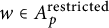 $w\in A^{\mathrm {restricted}}_p$
. Then all weakly localized operators on
 $F^p_{\alpha ,w}$
form an algebra.
Proof It is sufficient to show that if T and S are weakly localized operators on
 $F^p_{\alpha ,w}$
, then
 $TS$
is weakly localized on
 $F^p_{\alpha ,w}$
. Suppose that T and S are weakly localized on
 $F^p_{\alpha ,w}$
. We only verify that
 $TS$
satisfies the condition (3.2). The others are similar. Fix
 $\epsilon>0$
. By the definition of weakly localized operators, there exists
 $r_0>0$
such that
 $$ \begin{align} \sup_{u\in\mathbb{C}^n}\int_{B_{r_0/2}(u)^c}|\langle Tk^{(p,w)}_z,k^{(p',w')}_u\rangle_{\alpha}|dv(z)<\epsilon \end{align} $$
and
 $$ \begin{align} \sup_{u\in\mathbb{C}^n}\int_{B_{r_0/2}(u)^c}|\langle Sk^{(p,w)}_z,k^{(p',w')}_u\rangle_{\alpha}|dv(z)<\epsilon. \end{align} $$
For any
 $u\in \mathbb {C}^n$
, applying Lemma 2.2 and the estimate (2.3), we have
 $$ \begin{align*} I_{r_0}(u):&=\int_{B_{r_0}(u)^c}|\langle TSk^{(p,w)}_z,k^{(p',w')}_u\rangle_{\alpha}|dv(z)\\ &=\int_{B_{r_0}(u)^c}|\langle Sk^{(p,w)}_z,T^*k^{(p',w')}_u\rangle_{\alpha}|dv(z)\\ &=\int_{B_{r_0}(u)^c}\left|\int_{\mathbb{C}^n}Sk^{(p,w)}_z(\xi)\overline{T^*k^{(p',w')}_u(\xi)}d\lambda_{\alpha}(\xi)\right|dv(z)\\ &\leq\int_{B_{r_0}(u)^c}\int_{\mathbb{C}^n}|\langle Sk^{(p,w)}_z,K_{\xi}\rangle_{\alpha}| |\langle TK_{\xi},k^{(p',w')}_u\rangle_{\alpha}|d\lambda_{\alpha}(\xi)dv(z)\\ &\asymp\int_{B_{r_0}(u)^c}\int_{\mathbb{C}^n}|\langle Sk^{(p,w)}_z,k^{(p',w')}_{\xi}\rangle_{\alpha}| |\langle Tk^{(p,w)}_{\xi},k^{(p',w')}_u\rangle_{\alpha}|dv(\xi)dv(z)\\ &=\int_{B_{r_0/2}(u)}|\langle Tk^{(p,w)}_{\xi},k^{(p',w')}_u\rangle_{\alpha}| \int_{B_{r_0}(u)^c}|\langle Sk^{(p,w)}_z,k^{(p',w')}_{\xi}\rangle_{\alpha}|dv(z)dv(\xi)\\ &\quad+\int_{B_{r_0/2}(u)^c}|\langle Tk^{(p,w)}_{\xi},k^{(p',w')}_u\rangle_{\alpha}| \int_{B_{r_0}(u)^c}|\langle Sk^{(p,w)}_z,k^{(p',w')}_{\xi}\rangle_{\alpha}|dv(z)dv(\xi)\\ &=:I_{r_0,1}(u)+I_{r_0,2}(u). \end{align*} $$
Note that for
 $\xi \in B_{r_0/2}(u)$
,
 $B_{r_0}(u)^c\subset B_{r_0/2}(\xi )^c$
. Consequently, by (3.5) and the definition of weakly localized operators, we obtain that
 $$ \begin{align*} I_{r_0,1}(u)&\leq\int_{B_{r_0/2}(u)}|\langle Tk^{(p,w)}_{\xi},k^{(p',w')}_u\rangle_{\alpha}| \int_{B_{r_0/2}(\xi)^c}|\langle Sk^{(p,w)}_z,k^{(p',w')}_{\xi}\rangle_{\alpha}|dv(z)dv(\xi)\\ &<\epsilon\int_{\mathbb{C}^n}|\langle Tk^{(p,w)}_{\xi},k^{(p',w')}_u\rangle_{\alpha}|dv(\xi)\\ &\lesssim\epsilon. \end{align*} $$
Similarly, by (3.4), we establish that
 $$ \begin{align*} I_{r_0,2}(u)&\leq\int_{B_{r_0/2}(u)^c}|\langle Tk^{(p,w)}_{\xi},k^{(p',w')}_u\rangle_{\alpha}| \int_{\mathbb{C}^n}|\langle Sk^{(p,w)}_z,k^{(p',w')}_{\xi}\rangle_{\alpha}|dv(z)dv(\xi)\\ &\lesssim\int_{B_{r_0/2}(u)^c}|\langle Tk^{(p,w)}_{\xi},k^{(p',w')}_u\rangle_{\alpha}|dv(\xi)\\ &<\epsilon. \end{align*} $$
Therefore,
 $$ \begin{align*}I_{r_0}(u)=\int_{B_{r_0}(u)^c}|\langle TSk^{(p,w)}_z,k^{(p',w')}_u\rangle_{\alpha}|dv(z)\lesssim\epsilon.\end{align*} $$
Since
 $u\in \mathbb {C}^n$
is arbitrary, we conclude that
 $TS$
satisfies (3.2).
We will need the following Riesz–Kolmogorov type characterization of precompact sets in weighted Fock spaces, which is a direct application of [Reference Mitkovski, Stockdale, Wagner and Wick34, Theorem 1.4]. Before proceeding, recall that for a Banach space X,
 $p\in [1,\infty )$
, and a measure space
 $(\Omega ,\mu )$
, the system
 $\big (\{x_{\omega }\}_{\omega \in \Omega },\{x^*_{\omega }\}_{\omega \in \Omega }\big )\subset X\times X^*$
is said to be a continuous frame for X with respect to
 $L^p(\Omega ,\mu )$
if
-
(a)
$\sup _{\omega \in \Omega }\left \|x^*_{\omega }\right \|_{X\to \mathbb {C}}<\infty $
, -
(b) the function
$\omega \mapsto \langle x,x^*_{\omega }\rangle $
is in
$L^p(\Omega ,\mu )$
for all
$x\in X$
, -
(c) there exists
$C>1$
such that for all
$$ \begin{align*}C^{-1}\|x\|_X\leq \left\|\langle x,x^*_{\omega}\rangle\right\|_{L^p(\Omega,\mu)}\leq C\|x\|_X\end{align*} $$
$x\in X$
, and
-
(d) each
$x\in X$
satisfies
$$ \begin{align*}x=\int_{\Omega}\langle x,x^*_{\omega}\rangle x_{\omega}d\mu(\omega).\end{align*} $$



We restate [Reference Mitkovski, Stockdale, Wagner and Wick34, Theorem 1.4] as follows.
Theorem C [Reference Mitkovski, Stockdale, Wagner and Wick34]
Let
 $p\in [1,\infty )$
and X be a reflexive Banach space equipped with a continuous frame
 $\big (\{x_{\omega }\}_{\omega \in \Omega },\{x^*_{\omega }\}_{\omega \in \Omega }\big )$
with respect to
 $L^p(\Omega ,\mu )$
. Suppose that
 $\{\Omega _j\}_{j=1}^{\infty }$
is a sequence of subsets of
 $\Omega $
that satisfies
-
(i)
$\Omega _j\subset \Omega _{j+1}$
for each j, -
(ii)
$\bigcup _{j=1}^{\infty }\Omega _j=\Omega $
, and -
(iii)
$\mu (\Omega _j)<\infty $
for each j.


Then a bounded set
 $\mathcal {S}\subset X$
is precompact if and only if
 $$ \begin{align*}\lim_{j\to\infty}\sup_{x\in\mathcal{S}}\int_{\Omega\setminus\Omega_j}\left|\langle x,x^*_{\omega}\rangle\right|^pd\mu(\omega)=0.\end{align*} $$
We can now display the Riesz–Kolmogorov type characterization of precompact sets in weighted Fock spaces.
Lemma 3.3 Let
 $\alpha>0$
,
 $1<p<\infty ,$
and
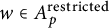 $w\in A^{\mathrm {restricted}}_p$
. A bounded set
 $\mathcal {S}\subset F^p_{\alpha ,w}$
is precompact if and only if
 $$ \begin{align*}\lim_{r\to\infty}\sup_{f\in\mathcal{S}}\int_{B_r(0)^c}|f(z)|^pe^{-\frac{p\alpha}{2}|z|^2}\widehat{w}(z)dv(z)=0.\end{align*} $$
Proof For
 $u\in \mathbb {C}^n$
, let
 $$ \begin{align*}f_u(z)=\left(\frac{\alpha}{\pi}\right)^n\|K_u\|_{F^{p'}_{\alpha,w'}}e^{\alpha\langle z,u\rangle-\alpha|u|^2},\quad z\in\mathbb{C}^n.\end{align*} $$
We claim that
 $\big (\{f_u\}_{u\in \mathbb {C}^n},\{k^{(p',w')}_u\}_{u\in \mathbb {C}^n}\big )$
is a continuous frame for
 $F^p_{\alpha ,w}$
with respect to
 $L^p(\mathbb {C}^n,dv)$
. In fact, for any
 $f\in F^p_{\alpha ,w}$
and
 $z\in \mathbb {C}^n$
, Lemma 2.2 yields that
 $$ \begin{align*} f(z)=P_{\alpha}f(z)&=\int_{\mathbb{C}^n}f(u)\overline{K_z(u)}d\lambda_{\alpha}(u)\\ &=\int_{\mathbb{C}^n}\langle f,K_u\rangle_{\alpha}K_u(z)d\lambda_{\alpha}(u)\\ &=\int_{\mathbb{C}^n}\langle f,k^{(p',w')}_u\rangle_{\alpha}\|K_u\|_{F^{p'}_{\alpha,w'}}K_u(z)d\lambda_{\alpha}(u)\\ &=\int_{\mathbb{C}^n}\langle f,k^{(p',w')}_u\rangle_{\alpha}f_u(z)dv(u). \end{align*} $$
Moreover, by Lemma 2.5 and (2.2),
 $$ \begin{align} \|f\|^p_{F^p_{\alpha,w}}\asymp\int_{\mathbb{C}^n}|f(u)|^pe^{-\frac{p\alpha}{2}|u|^2}\widehat{w}(u)dv(u) \asymp\int_{\mathbb{C}^n}|\langle f,k^{(p',w')}_u\rangle_{\alpha}|^pdv(u), \end{align} $$
and
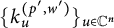 $\{k^{(p',w')}_u\}_{u\in \mathbb {C}^n}$
is a bounded set in
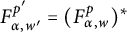 $F^{p'}_{\alpha ,w'}=(F^p_{\alpha ,w})^*$
due to Lemma 2.4. Therefore, for the space
 $F^p_{\alpha ,w}$
, the index
 $p,$
and the measure space
 $(\mathbb {C}^n,dv)$
, the system
 $\big (\{f_u\}_{u\in \mathbb {C}^n},\{k^{(p',w')}_u\}_{u\in \mathbb {C}^n}\big )\subset F^p_{\alpha ,w}\times (F^p_{\alpha ,w})^*$
satisfies the conditions (a)–(d). Consequently, the claim holds. Noting that Lemma 2.4 indicates that
 $F^p_{\alpha ,w}$
is reflexive, we can apply Theorem C to obtain that
 $\mathcal {S}$
is precompact if and only if
 $$ \begin{align*}\lim_{r\to\infty}\sup_{f\in\mathcal{S}}\int_{B_r(0)^c}|\langle f,k^{(p',w')}_u\rangle_{\alpha}|^pdv(u)=0,\end{align*} $$
which is equivalent to
 $$ \begin{align*}\lim_{r\to\infty}\sup_{f\in\mathcal{S}}\int_{B_r(0)^c}|f(u)|^pe^{-\frac{p\alpha}{2}|u|^2}\widehat{w}(u)dv(u)=0.\end{align*} $$
The proof is complete.
Based on Lemma 3.3, we can obtain the following characterization of compact operators immediately.
Corollary 3.4 Let
 $\alpha>0$
,
 $1<p<\infty ,$
and
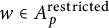 $w\in A^{\mathrm {restricted}}_p$
. Suppose that T is a bounded linear operator on
 $F^p_{\alpha ,w}$
. Then T is compact if and only if
 $$ \begin{align*}\lim_{r\to\infty}\sup_{\|f\|_{F^p_{\alpha,w}}\leq1}\int_{B_r(0)^c}|Tf(z)|^pe^{-\frac{p\alpha}{2}|z|^2}\widehat{w}(z)dv(z)=0.\end{align*} $$
The following lemma establishes a sufficient condition for compact operators on
 $F^p_{\alpha ,w}$
.
Lemma 3.5 Let
 $\alpha>0$
,
 $1<p<\infty ,$
and
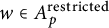 $w\in A^{\mathrm {restricted}}_p$
. Suppose that T is a bounded linear operator on
 $F^p_{\alpha ,w}$
such that (3.1) holds. If
 $$ \begin{align} \lim_{r\to\infty}\sup_{z\in\mathbb{C}^n}\int_{B_r(0)^c}|\langle Tk^{(p,w)}_z,k^{(p',w')}_u\rangle_{\alpha}|dv(u)=0, \end{align} $$
then T is compact on
 $F^p_{\alpha ,w}$
.
Proof Fix
 $f\in F^p_{\alpha ,w}$
with
 $\|f\|_{F^p_{\alpha ,w}}\leq 1$
. Then for any
 $z\in \mathbb {C}^n$
, Lemma 2.2 gives that
 $$ \begin{align*} |Tf(z)|&=|\langle Tf,K_z\rangle_{\alpha}|\\ &=\left|\int_{\mathbb{C}^n}f(u)\overline{T^*K_z(u)}d\lambda_{\alpha}(u)\right|\\ &=\left|\int_{\mathbb{C}^n}\langle f,K_u\rangle_{\alpha}\langle TK_u,K_z\rangle_{\alpha}d\lambda_{\alpha}(u)\right|, \end{align*} $$
which, combined with (2.3), implies that
 $$ \begin{align*} |Tf(z)|&\lesssim\int_{\mathbb{C}^n}|\langle f,k^{(p',w')}_u\rangle_{\alpha}||\langle Tk^{(p,w)}_u,K_z\rangle_{\alpha}|dv(u)\\ &=\|K_z\|_{F^{p'}_{\alpha,w'}}\int_{\mathbb{C}^n}|\langle f,k^{(p',w')}_u\rangle_{\alpha}||\langle Tk^{(p,w)}_u,k^{(p',w')}_z\rangle_{\alpha}|dv(u). \end{align*} $$
By Hölder’s inequality and the condition (3.1),
 $$ \begin{align} |Tf(z)|^p &\lesssim\|K_z\|^p_{F^{p'}_{\alpha,w'}}\left(\int_{\mathbb{C}^n}|\langle f,k^{(p',w')}_u\rangle_{\alpha}| |\langle Tk^{(p,w)}_u,k^{(p',w')}_z\rangle_{\alpha}|dv(u)\right)^p\nonumber\\ &\leq\|K_z\|^p_{F^{p'}_{\alpha,w'}}\left(\int_{\mathbb{C}^n}|\langle Tk^{(p,w)}_u,k^{(p',w')}_z\rangle_{\alpha}|dv(u)\right)^{p/p'}\cdot\nonumber\\ & \qquad\qquad\left(\int_{\mathbb{C}^n}|\langle f,k^{(p',w')}_u\rangle_{\alpha}|^p|\langle Tk^{(p,w)}_u,k^{(p',w')}_z\rangle_{\alpha}|dv(u)\right) \nonumber\\ &\lesssim\|K_z\|^p_{F^{p'}_{\alpha,w'}} \int_{\mathbb{C}^n}|\langle f,k^{(p',w')}_u\rangle_{\alpha}|^p|\langle Tk^{(p,w)}_u,k^{(p',w')}_z\rangle_{\alpha}|dv(u)\nonumber\\ &\asymp e^{\frac{p\alpha}{2}|z|^2}\widehat{w}(z)^{-1} \int_{\mathbb{C}^n}|\langle f,k^{(p',w')}_u\rangle_{\alpha}|^p|\langle Tk^{(p,w)}_u,k^{(p',w')}_z\rangle_{\alpha}|dv(u), \end{align} $$
where the last step is due to (2.2). For any
 $\epsilon>0$
, we can use (3.7) to find
 $r_0>0$
such that
 $$ \begin{align*}\sup_{u\in\mathbb{C}^n}\int_{B_r(0)^c}|\langle Tk^{(p,w)}_u,k^{(p',w')}_z\rangle_{\alpha}|dv(z)<\epsilon\end{align*} $$
whenever
 $r>r_0$
. Consequently, the estimate (3.8) together with Fubini’s theorem and (3.6) yields that for
 $r>r_0$
,
 $$ \begin{align*} &\int_{B_r(0)^c}|Tf(z)|^pe^{-\frac{p\alpha}{2}|z|^2}\widehat{w}(z)dv(z)\\ &\ \lesssim\int_{B_r(0)^c}\int_{\mathbb{C}^n}|\langle f,k^{(p',w')}_u\rangle_{\alpha}|^p|\langle Tk^{(p,w)}_u,k^{(p',w')}_z\rangle_{\alpha}|dv(u)dv(z)\\ &\ =\int_{\mathbb{C}^n}|\langle f,k^{(p',w')}_u\rangle_{\alpha}|^p\int_{B_r(0)^c}|\langle Tk^{(p,w)}_u,k^{(p',w')}_z\rangle_{\alpha}|dv(z)dv(u)\\ &\ <\epsilon\int_{\mathbb{C}^n}|\langle f,k^{(p',w')}_u\rangle_{\alpha}|^pdv(u)\\ &\ \lesssim\epsilon. \end{align*} $$
Since f is arbitrary in the closed unit ball of
 $F^p_{\alpha ,w}$
, we deduce from Corollary 3.4 that T is compact on
 $F^p_{\alpha ,w}$
.
To prove Theorem 1.1, we also need a family of weighted translations acting on standard Fock spaces. Given
 $a\in \mathbb {C}^n$
and an entire function f on
 $\mathbb {C}^n$
, define
 $$ \begin{align*}U_af(u):=f(a-u)k_a(u),\quad u\in \mathbb{C}^n.\end{align*} $$
Then a simple change of variables argument gives that
 $U_a$
is an isometry on the standard Fock space
 $F^p_{\alpha }$
. Furthermore, since a direct calculation shows that for all
 $a,z,u\in \mathbb {C}^n$
,
 $$ \begin{align*}|U_ak_z(u)|=|k_{a-z}(u)|,\end{align*} $$
the following lemma is implied by [Reference Isralowitz25, Proposition 1.5].
Lemma 3.6 [Reference Isralowitz25]
Let
 $\alpha>0$
,
 $1<p<\infty $
, and let T be a bounded linear operator on
 $F^p_{\alpha }$
. Then
 $\lim _{|z|\to \infty }\widetilde {T}(z)=0$
if and only if for any
 $r>0$
,
 $$ \begin{align*}\lim_{|z|\to\infty}\sup_{u\in B_r(z)}|\langle Tk_z,k_u\rangle_{\alpha}|=0.\end{align*} $$
We are now ready to prove Theorem 1.1.
Proof of Theorem 1.1
It is clear that T is bounded on
 $F^p_{\alpha ,w}$
. By Propositions 3.1 and 3.2, T is weakly localized. Suppose first that
 $\lim _{|z|\to \infty }\widetilde {T}(z)=0$
. Since each Toeplitz operator with
 $L^{\infty }$
-symbols is automatically bounded on the standard Fock space
 $F^p_{\alpha }$
, we know that T is bounded on
 $F^p_{\alpha }$
. Consequently, we may use Lemma 3.6 to deduce that for each
 $r>0$
,
 $$ \begin{align*}\lim_{|z|\to\infty}\sup_{u\in B_r(z)}|\langle Tk_z,k_u\rangle_{\alpha}|=0.\end{align*} $$
Fix
 $\epsilon>0$
. Since T is weakly localized, there exists
 $r_0>0$
such that
 $$ \begin{align} \sup_{z\in\mathbb{C}^n}\int_{B_{r_0}(z)^c}|\langle Tk^{(p,w)}_z,k^{(p',w')}_u\rangle_{\alpha}|dv(u)<\frac{\epsilon}{2}. \end{align} $$
For the above
 $r_0$
, there exists
 $r_1>0$
such that for
 $|z|>r_1$
,
 $$ \begin{align} \sup_{u\in B_{r_0}(z)}|\langle Tk_z,k_u\rangle_{\alpha}|<\frac{\epsilon}{2v(B_{r_0}(0))C^{r_0/p}}, \end{align} $$
where C is the constant provided by (2.1) such that for any
 $\zeta ,\xi \in \mathbb {C}^n$
,
 $$ \begin{align*}\frac{\widehat{w}(\zeta)}{\widehat{w}(\xi)}\lesssim C^{|\zeta-\xi|}.\end{align*} $$
Suppose now that
 $r>r_0+r_1$
. For any
 $z\in \mathbb {C}^n$
, (3.9) gives that
 $$ \begin{align*} &\int_{B_r(0)^c}|\langle Tk^{(p,w)}_z,k^{(p',w')}_u\rangle_{\alpha}|dv(u)\\ &\ \leq\int_{B_{r_0+r_1}(0)^c}|\langle Tk^{(p,w)}_z,k^{(p',w')}_u\rangle_{\alpha}|dv(u)\\ &\ =\int_{\big(B_{r_0+r_1}(0)\cup B_{r_0}(z)\big)^c}|\langle Tk^{(p,w)}_z,k^{(p',w')}_u\rangle_{\alpha}|dv(u)\\ &\qquad +\int_{B_{r_0+r_1}(0)^c\cap B_{r_0}(z)}|\langle Tk^{(p,w)}_z,k^{(p',w')}_u\rangle_{\alpha}|dv(u)\\ &\ <\frac{\epsilon}{2}+\int_{B_{r_0+r_1}(0)^c\cap B_{r_0}(z)}|\langle Tk^{(p,w)}_z,k^{(p',w')}_u\rangle_{\alpha}|dv(u). \end{align*} $$
If
 $|z|\leq r_1$
, then
 $B_{r_0+r_1}(0)^c\cap B_{r_0}(z)=\emptyset $
and the second term above is trivial. If
 $|z|>r_1$
, then by Lemma 2.3, (2.2), and (3.10),
 $$ \begin{align*} &\int_{B_{r_0+r_1}(0)^c\cap B_{r_0}(z)}|\langle Tk^{(p,w)}_z,k^{(p',w')}_u\rangle_{\alpha}|dv(u)\\ &\ \lesssim\int_{B_{r_0}(z)}|\langle Tk_z,k_u\rangle_{\alpha}|\left(\frac{\widehat{w}(u)}{\widehat{w}(z)}\right)^{1/p}dv(u)\\ &\ <\frac{\epsilon}{2v(B_{r_0}(0))C^{r_0/p}}\int_{B_{r_0}(z)}C^{\frac{1}{p}|u-z|}dv(u)\\ &\ <\frac{\epsilon}{2}. \end{align*} $$
Therefore,
 $$ \begin{align*}\sup_{z\in\mathbb{C}^n}\int_{B_r(0)^c}|\langle Tk^{(p,w)}_z,k^{(p',w')}_u\rangle_{\alpha}|dv(u)\lesssim\epsilon.\end{align*} $$
That is,
 $$ \begin{align*}\lim_{r\to\infty}\sup_{z\in\mathbb{C}^n}\int_{B_r(0)^c}|\langle Tk^{(p,w)}_z,k^{(p',w')}_u\rangle_{\alpha}|dv(u)=0,\end{align*} $$
which, combined with Lemma 3.5, implies that T is compact on
 $F^p_{\alpha ,w}$
.
Conversely, suppose that T is compact on
 $F^p_{\alpha ,w}$
. Since
 $\{k^{(p,w)}_z\}$
is bounded in
 $F^p_{\alpha ,w}$
and converges to
 $0$
uniformly on compact subsets of
 $\mathbb {C}^n$
as
 $|z|\to \infty $
(see [Reference Chen13, Lemma 2.3]), it is easy to see that
 $k^{(p,w)}_z\to 0$
weakly in
 $F^p_{\alpha ,w}$
as
 $|z|\to \infty $
. Therefore, by (2.3), Hölder’s inequality, and the compactness of T,
 $$ \begin{align*}\left|\widetilde{T}(z)\right|=|\langle Tk_z,k_z\rangle_{\alpha}| \asymp|\langle Tk^{(p,w)}_z,k^{(p',w')}_z\rangle_{\alpha}|\leq\|Tk^{(p,w)}_z\|_{F^p_{\alpha,w}}\to0\end{align*} $$
as
 $|z|\to \infty $
. The proof is complete.
4 Weighted boundedness
In this section, we are going to prove Theorems 1.2 and 1.3.
To establish the necessary parts of Theorem 1.2, we consider a class of rank one operators induced by the normalized reproducing kernels of
 $F^2_{\alpha }$
. Given
 $\varphi \in L^{\infty }$
,
 $u\in \mathbb {C}^n$
, and
 $r>0$
, the operator
 $T^{(u,r)}_{\varphi }$
is defined for
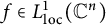 $f\in L^1_{\mathrm {loc}}(\mathbb {C}^n)$
by
 $$ \begin{align*}T^{(u,r)}_{\varphi}f:=\chi_{Q_r(u)}k_u\int_{Q_r(u)}\varphi f\overline{k_u}d\lambda_{\alpha},\end{align*} $$
where
 $\chi _{E}$
denotes the characteristic function of the set E. The following lemma can be proved by the same method as in [Reference Chen and Wang16, Proposition 3.2]. We here omit the details.
Lemma 4.1 Let
 $\alpha ,r>0$
,
 $1\leq p<\infty $
,
 $\varphi \in L^{\infty }$
, and let w be a weight on
 $\mathbb {C}^n$
. Suppose that
 $T_{\varphi }$
is bounded on
 $L^p_{\alpha ,w}$
. Then for any
 $u\in \mathbb {C}^n$
,
 $T^{(u,r)}_{\varphi }$
is bounded on
 $L^p_{\alpha ,w}$
, and
 $$ \begin{align*}\|T^{(u,r)}_{\varphi}\|\leq e^{\frac{n\alpha r^2}{2}}\|T_{\varphi}\|.\end{align*} $$
The following proposition gives the necessary conditions for
 $T_{\varphi }$
to be bounded on the weighted spaces
 $L^p_{\alpha ,w}$
.
Proposition 4.2 Let
 $\alpha>0$
,
 $1\leq p<\infty $
,
 $\varphi \in L^{\infty }$
, and let w be a weight on
 $\mathbb {C}^n$
. Suppose that
 $T_{\varphi }$
is bounded on
 $L^p_{\alpha ,w}$
.
-
(1) If
$1<p<\infty $
, then for any
$r>0$
,
$$ \begin{align*}\sup_{Q:l(Q)=r}\left(\frac{1}{v(Q)}\int_{Q}wdv\right) \left(\frac{1}{v(Q)}\int_{Q}|\varphi|^{p'}w^{-\frac{p'}{p}}dv\right)^{\frac{p}{p'}}<\infty.\end{align*} $$
-
(2) If
$p=1$
, then for any
$r>0$
,
$$ \begin{align*}\sup_{Q:l(Q)=r}\left(\frac{1}{v(Q)}\int_{Q}wdv\right)\|\varphi w^{-1}\|_{L^{\infty}(Q)}<\infty.\end{align*} $$


Proof (1) Let
 $r>0$
. We only need to consider the points
 $u\in \mathbb {C}^n$
such that
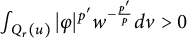 $\int _{Q_r(u)}|\varphi |^{p'}w^{-\frac {p'}{p}}dv>0$
. Fix such a point
 $u\in \mathbb {C}^n$
. For any sufficiently large
 $m>0$
, let
 $E_m$
be the set
 $$ \begin{align*}E_m:=\left\{\xi\in\mathbb{C}^n:|\varphi(\xi)|^{p'}w'(\xi)\leq m\right\}.\end{align*} $$
Write
 $\delta =\frac {p-2}{p-1}$
and define
 $$ \begin{align*} f_{m,u,r}(\xi):= \begin{cases} \frac{\overline{\varphi(\xi)}}{|\varphi(\xi)|^{\delta}}w'(\xi)k_u(\xi)\chi_{Q_r(u)\cap E_m}(\xi),& \text{if } \varphi(\xi)\neq0,\\ 0,& \text{if } \varphi(\xi)=0. \end{cases} \end{align*} $$
Then
 $$ \begin{align*} \|f_{m,u,r}\|_{L^p_{\alpha,w}}&=\left(\int_{Q_r(u)\cap E_m}|\varphi(\xi)|^{p(1-\delta)}w'(\xi)^p|k_u(\xi)|^p e^{-\frac{p\alpha}{2}|\xi|^2}w(\xi)dv(\xi)\right)^{1/p}\\ &=\left(\int_{Q_r(u)\cap E_m}|\varphi(\xi)|^{p'}e^{-\frac{p\alpha}{2}|u-\xi|^2}w'(\xi)dv(\xi)\right)^{1/p}\\ &\leq\left(\int_{Q_r(u)\cap E_m}|\varphi|^{p'}w'dv\right)^{1/p}. \end{align*} $$
On the other hand, for any
 $z\in \mathbb {C}^n$
,
 $$ \begin{align*} T^{(u,r)}_{\varphi}f_{m,u,r}(z) &=\chi_{Q_r(u)}(z)k_u(z)\int_{Q_r(u)}\varphi(\xi)f_{m,u,r}(\xi)\overline{k_{u}(\xi)}d\lambda_{\alpha}(\xi)\\ &=\left(\frac{\alpha}{\pi}\right)^n\chi_{Q_r(u)}(z)k_u(z) \int_{Q_r(u)}\varphi(\xi)f_{m,u,r}(\xi)e^{\alpha\langle u,\xi\rangle-\frac{\alpha}{2}|u|^2-\alpha|\xi|^2}dv(\xi)\\ &=\left(\frac{\alpha}{\pi}\right)^n\chi_{Q_r(u)}(z)k_u(z) \int_{Q_r(u)\cap E_m}|\varphi(\xi)|^{2-\delta}e^{-\alpha|u-\xi|^2}w'(\xi)dv(\xi), \end{align*} $$
which implies that
 $$ \begin{align*}|T^{(u,r)}_{\varphi}f_{m,u,r}(z)|\geq\left(\frac{\alpha}{\pi}\right)^ne^{-\frac{n\alpha r^2}{2}}\chi_{Q_r(u)}(z)|k_u(z)| \int_{Q_r(u)\cap E_m}|\varphi|^{p'}w'dv.\end{align*} $$
Consequently,
 $$ \begin{align*} \|T^{(u,r)}_{\varphi}f_{m,u,r}\|_{L^p_{\alpha,w}} &\geq\left(\frac{\alpha}{\pi}\right)^ne^{-\frac{n\alpha r^2}{2}}\int_{Q_r(u)\cap E_m}|\varphi|^{p'}w'dv\\ &\qquad\qquad \times\left(\int_{Q_r(u)}|k_u(z)|^pe^{-\frac{p\alpha}{2}|z|^2}w(z)dv(z)\right)^{1/p}\\ &\geq\left(\frac{\alpha}{\pi}\right)^ne^{-\frac{3n\alpha r^2}{4}}\left(\int_{Q_r(u)\cap E_m}|\varphi|^{p'}w'dv\right) \left(\int_{Q_r(u)}wdv\right)^{1/p}. \end{align*} $$
Combining the above estimates with Lemma 4.1 yields that
 $$ \begin{align*} \left(\frac{\alpha}{\pi}\right)^ne^{-\frac{3n\alpha r^2}{4}}&\left(\int_{Q_r(u)\cap E_m}|\varphi|^{p'}w'dv\right) \left(\int_{Q_r(u)}wdv\right)^{1/p}\\ &\qquad\leq e^{\frac{n\alpha r^2}{2}}\|T_{\varphi}\|\left(\int_{Q_r(u)\cap E_m}|\varphi|^{p'}w'dv\right)^{1/p}, \end{align*} $$
which is equivalent to
 $$ \begin{align*}\left(\int_{Q_r(u)}wdv\right)^{1/p}\left(\int_{Q_r(u)\cap E_m}|\varphi|^{p'}w'dv\right)^{1/p'} \leq \left(\frac{\pi}{\alpha}\right)^ne^{\frac{5n\alpha r^2}{4}}\|T_{\varphi}\|.\end{align*} $$
Letting
 $m\to \infty $
and using Fatou’s lemma, we obtain that
 $$ \begin{align*}\left(\int_{Q_r(u)}wdv\right)^{1/p}\left(\int_{Q_r(u)}|\varphi|^{p'}w'dv\right)^{1/p'} \leq \left(\frac{\pi}{\alpha}\right)^ne^{\frac{5n\alpha r^2}{4}}\|T_{\varphi}\|.\end{align*} $$
Since
 $u\in \mathbb {C}^n$
is arbitrary, we finally conclude that
 $$ \begin{align*}\sup_{u\in\mathbb{C}^n}\left(\int_{Q_r(u)}wdv\right)^{1/p}\left(\int_{Q_r(u)}|\varphi|^{p'}w'dv\right)^{1/p'} \leq \left(\frac{\pi}{\alpha}\right)^ne^{\frac{5n\alpha r^2}{4}}\|T_{\varphi}\|,\end{align*} $$
and the desired result is established.
(2) Fix
 $r>0$
. Note that under the pairing
 $$ \begin{align*}\langle f,g\rangle_{L^2_{\alpha/2,w}}:=\int_{\mathbb{C}^n}f(z)\overline{g(z)}e^{-\frac{\alpha}{2}|z|^2}w(z)dv(z),\end{align*} $$
the dual space of
 $L^1_{\alpha ,w}$
can be identified with
 $L^{\infty }$
, and the adjoint of
 $T_{\varphi }$
is given by
 $$ \begin{align*}T^*_{\varphi}f(z)=\left(\frac{\alpha}{\pi}\right)^n\frac{\overline{\varphi(z)}}{w(z)}\int_{\mathbb{C}^n}f(\xi) e^{\alpha\langle z,\xi\rangle-\frac{\alpha}{2}|z|^2-\frac{\alpha}{2}|\xi|^2}w(\xi)dv(\xi).\end{align*} $$
It follows from the boundedness of
 $T_{\varphi }$
on
 $L^1_{\alpha ,w}$
that for any
 $f\in L^{\infty }$
and almost every
 $z\in \mathbb {C}^n$
,
 $$ \begin{align*}\left(\frac{\alpha}{\pi}\right)^n\frac{|\varphi(z)|}{w(z)} \left|\int_{\mathbb{C}^n}f(\xi)e^{\alpha\langle z,\xi\rangle-\frac{\alpha}{2}|z|^2-\frac{\alpha}{2}|\xi|^2}w(\xi)dv(\xi)\right| \leq\|T_{\varphi}\|\|f\|_{L^{\infty}}.\end{align*} $$
Fix
 $u\in \mathbb {C}^n$
, and for
 $z\in Q_r(u)$
, define
 $f(\xi )=e^{\frac {\alpha }{2}\langle \xi ,z\rangle -\frac {\alpha }{2}\langle z,\xi \rangle }$
. Then we obtain that for almost every
 $z\in Q_r(u)$
,
 $$ \begin{align*} \|T_{\varphi}\|&\geq\left(\frac{\alpha}{\pi}\right)^n\frac{|\varphi(z)|}{w(z)}\int_{\mathbb{C}^n}e^{-\frac{\alpha}{2}|z-\xi|^2}w(\xi)dv(\xi)\\ &\geq\left(\frac{\alpha}{\pi}\right)^n\frac{|\varphi(z)|}{w(z)}\int_{Q_r(u)}e^{-\frac{\alpha}{2}|z-\xi|^2}w(\xi)dv(\xi)\\ &\geq\left(\frac{\alpha}{\pi}\right)^ne^{-n\alpha r^2}\frac{|\varphi(z)|}{w(z)}\int_{Q_r(u)}w(\xi)dv(\xi), \end{align*} $$
which is equivalent to
 $$ \begin{align*}\left(\frac{1}{v(Q_r(u))}\int_{Q_r(u)}wdv\right)\|\varphi w^{-1}\|_{L^{\infty}(Q_r(u))} \leq\left(\frac{\pi}{\alpha r^2}\right)^ne^{n\alpha r^2}\|T_{\varphi}\|.\end{align*} $$
The arbitrariness of
 $u\in \mathbb {C}^n$
finishes the proof.
We are now in a position to prove Theorem 1.2.
Proof of Theorem 1.2
The necessary parts follow from Proposition 4.2. We now consider the sufficient parts. Fix
 $f\in L^p_{\alpha ,w}$
and write
 $\tilde {f}(u)=f(u)e^{-\frac {\alpha }{2}|u|^2}$
for simplicity.
(1) Noting that if
 $\nu ,\nu '\in r\mathbb {Z}^{2n}$
and
 $z\in Q_r(\nu )$
,
 $u\in Q_r(\nu ')$
, then
 $$ \begin{align*}e^{-\frac{\alpha}{2}|z-u|^2}\leq e^{-\frac{\alpha}{4}|\nu-\nu'|^2+n\alpha r^2},\end{align*} $$
we have
 $$ \begin{align*} \|T_{\varphi}f\|^p_{L^p_{\alpha,w}} &=\int_{\mathbb{C}^n}\left|\int_{\mathbb{C}^n}\varphi(u)f(u)e^{\alpha\langle z,u\rangle}d\lambda_{\alpha}(u)\right|^pe^{-\frac{p\alpha}{2}|z|^2}w(z)dv(z)\\ &\lesssim\int_{\mathbb{C}^n}\left(\int_{\mathbb{C}^n}|\varphi(u)||f(u)|e^{-\frac{\alpha}{2}|u|^2}e^{-\frac{\alpha}{2}|z-u|^2}dv(u)\right)^pw(z)dv(z)\\ &=\sum_{\nu\in r\mathbb{Z}^{2n}}\int_{Q_r(\nu)}\left(\sum_{\nu'\in r\mathbb{Z}^{2n}} \int_{Q_r(\nu')}|\varphi(u)||\tilde{f}(u)|e^{-\frac{\alpha}{2}|z-u|^2}dv(u)\right)^pw(z)dv(z)\\ &\lesssim\sum_{\nu\in r\mathbb{Z}^{2n}}w(Q_r(\nu))\left(\sum_{\nu'\in r\mathbb{Z}^{2n}}e^{-\frac{\alpha}{4}|\nu-\nu'|^2} \int_{Q_r(\nu')}|\varphi(u)||\tilde{f}(u)|dv(u)\right)^p, \end{align*} $$
which, in conjunction with Hölder’s inequality and Fubini’s theorem, implies that
 $$ \begin{align*} \|T_{\varphi}f\|^p_{L^p_{\alpha,w}} &\lesssim\sum_{\nu\in r\mathbb{Z}^{2n}}w(Q_r(\nu))\sum_{\nu'\in r\mathbb{Z}^{2n}}e^{-\frac{p\alpha}{8}|\nu-\nu'|^2} \left(\int_{Q_r(\nu')}|\varphi||\tilde{f}|dv(u)\right)^p\\ &\leq\sum_{\nu\in r\mathbb{Z}^{2n}}w(Q_r(\nu))\sum_{\nu'\in r\mathbb{Z}^{2n}}e^{-\frac{p\alpha}{8}|\nu-\nu'|^2}\\ &\qquad\qquad \times\left(\int_{Q_r(\nu')}|\varphi|^{p'}w^{-\frac{p'}{p}}dv\right)^{\frac{p}{p'}} \left(\int_{Q_r(\nu')}|\tilde{f}|^pwdv\right)\\ &=\sum_{\nu'\in r\mathbb{Z}^{2n}}\sum_{\nu\in r\mathbb{Z}^{2n}}w(Q_r(\nu))e^{-\frac{p\alpha}{8}|\nu-\nu'|^2}\\ &\qquad\qquad\times\left(\int_{Q_r(\nu')}|\varphi|^{p'}w^{-\frac{p'}{p}}dv\right)^{\frac{p}{p'}} \left(\int_{Q_r(\nu')}|\tilde{f}|^pwdv\right). \end{align*} $$
Since w is r-doubling, by Lemma 2.1, there exists
 $C>0$
such that for any
 $\nu ,\nu '\in r\mathbb {Z}^{2n}$
,
 $w(Q_r(\nu ))\leq C^{|\nu -\nu '|}w(Q_r(\nu '))$
. Consequently, for each
 $\nu '\in r\mathbb {Z}^{2n}$
,
 $$ \begin{align*} &\sum_{\nu\in r\mathbb{Z}^{2n}}w(Q_r(\nu))e^{-\frac{p\alpha}{8}|\nu-\nu'|^2} \left(\int_{Q_r(\nu')}|\varphi|^{p'}w^{-\frac{p'}{p}}dv\right)^{\frac{p}{p'}}\\ &\ \ \leq\sum_{\nu\in r\mathbb{Z}^{2n}}C^{|\nu-\nu'|}e^{-\frac{p\alpha}{8}|\nu-\nu'|^2} w(Q_r(\nu'))\left(\int_{Q_r(\nu')}|\varphi|^{p'}w^{-\frac{p'}{p}}dv\right)^{\frac{p}{p'}}\\ &\ \ \lesssim\sup_{Q:l(Q)=r}\left(\frac{1}{v(Q)}\int_{Q}wdv\right) \left(\frac{1}{v(Q)}\int_{Q}|\varphi|^{p'}w^{-\frac{p'}{p}}dv\right)^{\frac{p}{p'}}. \end{align*} $$
Therefore,
 $$ \begin{align*}\|T_{\varphi}f\|^p_{L^p_{\alpha,w}}\lesssim \sup_{Q:l(Q)=r}\left(\frac{1}{v(Q)}\int_{Q}wdv\right) \left(\frac{1}{v(Q)}\int_{Q}|\varphi|^{p'}w^{-\frac{p'}{p}}dv\right)^{\frac{p}{p'}}\cdot\|f\|^p_{L^p_{\alpha,w}},\end{align*} $$
and the desired boundedness follows.
(2) We apply Lemma 2.1 again to obtain that
 $$ \begin{align*} \|T_{\varphi}f\|_{L^1_{\alpha,w}} &=\int_{\mathbb{C}^n}\left|\int_{\mathbb{C}^n}\varphi(u)f(u)e^{\alpha\langle z,u\rangle}d\lambda_{\alpha}(\xi)\right| e^{-\frac{\alpha}{2}|z|^2}w(z)dv(z)\\ &\leq\left(\frac{\alpha}{\pi}\right)^n\int_{\mathbb{C}^n}\int_{\mathbb{C}^n}|\varphi(u)||f(u)|e^{-\frac{\alpha}{2}|u|^2}e^{-\frac{\alpha}{2}|z-u|^2} dv(u)w(z)dv(z)\\ &\lesssim\sum_{\nu\in r\mathbb{Z}^{2n}}w(Q_r(\nu))\sum_{\nu'\in r\mathbb{Z}^{2n}}e^{-\frac{\alpha}{4}|\nu-\nu'|^2} \int_{Q_r(\nu')}|\varphi(u)||\tilde{f}(u)|dv(u)\\ &\leq\sum_{\nu'\in r\mathbb{Z}^{2n}}\sum_{\nu\in r\mathbb{Z}^{2n}}e^{-\frac{\alpha}{4}|\nu-\nu'|^2}C^{|\nu-\nu'|}w(Q_r(\nu')) \int_{Q_r(\nu')}|\varphi||\tilde{f}|dv\\ &\lesssim\sum_{\nu'\in r\mathbb{Z}^{2n}}w(Q_r(\nu'))\|\varphi w^{-1}\|_{L^{\infty}(Q_r(\nu'))} \int_{Q_r(\nu')}|\tilde{f}|wdv\\ &\lesssim\sup_{Q:l(Q)=r}\left(\frac{1}{v(Q)}\int_{Q}wdv\right)\|\varphi w^{-1}\|_{L^{\infty}(Q)}\cdot\|f\|_{L^1_{\alpha,w}}. \end{align*} $$
The proof is complete.
The proof of Theorem 1.3 is similar to that of Theorem 1.2. Nevertheless, we include it here for completeness.
Proof of Theorem 1.3
Suppose first that
 $P_{\alpha }:L^p_{\alpha ,\sigma }\to L^p_{\alpha ,w}$
is bounded. We first consider the case
 $1<p<\infty $
. Fix
 $u\in \mathbb {C}^n$
, and define
 $$ \begin{align*}P_{\alpha,u,r}f:=\chi_{Q_r(u)}k_u\int_{Q_r(u)}f\overline{k_u}d\lambda_{\alpha}.\end{align*} $$
Then by the same method as in [Reference Chen and Wang16, Proposition 3.2],
 $P_{\alpha ,u,r}:L^p_{\alpha ,\sigma }\to L^p_{\alpha ,w}$
is bounded, and
 $$ \begin{align*}\|P_{\alpha,u,r}\|_{L^p_{\alpha,\sigma}\to L^p_{\alpha,w}}\leq e^{\frac{n\alpha r^2}{2}}\|P_{\alpha}\|_{L^p_{\alpha,\sigma}\to L^p_{\alpha,w}}.\end{align*} $$
For any sufficiently large
 $m>0$
, let
 $$ \begin{align*}E_m=\left\{\xi\in\mathbb{C}^n:\sigma(\xi)^{-\frac{p'}{p}}\leq m\right\},\end{align*} $$
and define
 $$ \begin{align*}f_{m,u,r}(\xi)=k_u(\xi)\sigma(\xi)^{-\frac{p'}{p}}\chi_{Q_r(u)\cap E_m}(\xi).\end{align*} $$
Then similarly as in the proof of Proposition 4.2,
 $$ \begin{align*}\|f_{m,u,r}\|_{L^p_{\alpha,\sigma}}\leq\left(\int_{Q_r(u)\cap E_m}\sigma^{-\frac{p'}{p}}dv\right)^{1/p},\end{align*} $$
and
 $$ \begin{align*}\|P_{\alpha,u,r}f_{m,u,r}\|_{L^p_{\alpha,w}}\geq \left(\frac{\alpha}{\pi}\right)^ne^{-\frac{3n\alpha r^2}{4}}\left(\int_{Q_r(u)\cap E_m}\sigma^{-\frac{p'}{p}}dv\right) \left(\int_{Q_r(u)}wdv\right)^{1/p}.\end{align*} $$
Therefore,
 $$ \begin{align*} \left(\frac{\alpha}{\pi}\right)^ne^{-\frac{3n\alpha r^2}{4}}&\left(\int_{Q_r(u)\cap E_m}\sigma^{-\frac{p'}{p}}dv\right) \left(\int_{Q_r(u)}wdv\right)^{1/p}\\ &\qquad\leq e^{\frac{n\alpha r^2}{2}}\|P_{\alpha}\|\left(\int_{Q_r(u)\cap E_m}\sigma^{-\frac{p'}{p}}dv\right)^{1/p}, \end{align*} $$
which is equivalent to
 $$ \begin{align*}\left(\int_{Q_r(u)}wdv\right)^{1/p}\left(\int_{Q_r(u)\cap E_m}\sigma^{-\frac{p'}{p}}dv\right)^{1/p'} \leq\left(\frac{\pi}{\alpha}\right)^ne^{\frac{5n\alpha r^2}{4}}\|P_{\alpha}\|.\end{align*} $$
Letting
 $m\to \infty $
, and using Fatou’s lemma and the arbitrariness of
 $u\in \mathbb {C}^n$
, we obtain that
 $$ \begin{align*}[w,\sigma]_{A_{p,r}}^{1/p}\leq \left(\frac{\pi}{\alpha r^2}\right)^ne^{\frac{5n\alpha r^2}{4}}\|P_{\alpha}\|.\end{align*} $$
We now consider the case
 $p=1$
. Note that
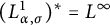 $(L^1_{\alpha ,\sigma })^*=L^{\infty }$
under the pairing
 $\langle \cdot ,\cdot \rangle _{L^2_{\alpha /2,\sigma }}$
,
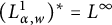 $(L^1_{\alpha ,w})^*=L^{\infty }$
under the pairing
 $\langle \cdot ,\cdot \rangle _{L^2_{\alpha /2,w}}$
, and the adjoint of
 $P_{\alpha }$
with respect to the above pairings is given by
 $$ \begin{align*}P^*_{\alpha}f(z)=\left(\frac{\alpha}{\pi}\right)^n\frac{1}{\sigma(z)}\int_{\mathbb{C}^n}f(\xi) e^{\alpha\langle z,\xi\rangle-\frac{\alpha}{2}|\xi|^2-\frac{\alpha}{2}|z|^2}w(\xi)dv(\xi).\end{align*} $$
Hence, by the boundedness of
 $P_{\alpha }:L^1_{\alpha ,\sigma }\to L^1_{\alpha ,w}$
, we obtain that for any
 $f\in L^{\infty }$
and almost every
 $z\in \mathbb {C}^n$
,
 $$ \begin{align*}\left(\frac{\alpha}{\pi}\right)^n\frac{1}{\sigma(z)}\left|\int_{\mathbb{C}^n}f(\xi) e^{\alpha\langle z,\xi\rangle-\frac{\alpha}{2}|\xi|^2-\frac{\alpha}{2}|z|^2}w(\xi)dv(\xi)\right| \leq\|P_{\alpha}\|\|f\|_{L^{\infty}}.\end{align*} $$
Arguing as in the proof of Proposition 4.2, we establish that
 $$ \begin{align*}[w,\sigma]_{A_{1,r}}\leq\left(\frac{\pi}{\alpha r^2}\right)^ne^{n\alpha r^2}\|P_{\alpha}\|.\end{align*} $$
Conversely, suppose that
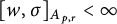 $[w,\sigma ]_{A_{p,r}}<\infty $
. Fix
 $f\in L^p_{\alpha ,\sigma }$
and write
 $$ \begin{align*}\tilde{f}(u)=f(u)e^{-\frac{\alpha}{2}|u|^2}.\end{align*} $$
In the case
 $1<p<\infty $
, we use Hölder’s inequality and Lemma 2.1 to obtain that
 $$ \begin{align*} \|P_{\alpha}f\|^p_{L^p_{\alpha,w}} &=\int_{\mathbb{C}^n}\left|\int_{\mathbb{C}^n}f(u)e^{\alpha\langle z,u\rangle}d\lambda_{\alpha}(u)\right|^pe^{-\frac{p\alpha}{2}|z|^2}w(z)dv(z)\\ &\lesssim\sum_{\nu\in r\mathbb{Z}^{2n}}w(Q_r(\nu))\left(\sum_{\nu'\in r\mathbb{Z}^{2n}}e^{-\frac{\alpha}{4}|\nu-\nu'|^2} \int_{Q_r(\nu')}|\tilde{f}|dv\right)^p\\ &\lesssim\sum_{\nu\in r\mathbb{Z}^{2n}}w(Q_r(\nu))\sum_{\nu'\in r\mathbb{Z}^{2n}}e^{-\frac{p\alpha}{8}|\nu-\nu'|^2}\left(\int_{Q_r(\nu')}|\tilde{f}|dv\right)^p\\ &\leq\sum_{\nu'\in r\mathbb{Z}^{2n}}\sum_{\nu\in r\mathbb{Z}^{2n}}e^{-\frac{p\alpha}{8}|\nu-\nu'|^2}w(Q_r(\nu))\\ &\qquad\qquad\times\left(\int_{Q_r(\nu')}\sigma^{-\frac{p'}{p}}dv\right)^{\frac{p}{p'}}\int_{Q_r(\nu')}|\tilde{f}|^p\sigma dv\\ &\leq\sum_{\nu'\in r\mathbb{Z}^{2n}}\sum_{\nu\in r\mathbb{Z}^{2n}}e^{-\frac{p\alpha}{8}|\nu-\nu'|^2}C^{|\nu-\nu'|}\\ &\qquad\qquad\times\left(\int_{Q_r(\nu')}wdv\right)\left(\int_{Q_r(\nu')}\sigma^{-\frac{p'}{p}}dv\right)^{\frac{p}{p'}} \int_{Q_r(\nu')}|\tilde{f}|^p\sigma dv\\ &\lesssim[w,\sigma]_{A_{p,r}}\|f\|^p_{L^p_{\alpha,\sigma}}. \end{align*} $$
In the case
 $p=1$
, we apply Lemma 2.1 to establish that
 $$ \begin{align*} \|P_{\alpha}f\|_{L^1_{\alpha,w}}&=\int_{\mathbb{C}^n}\left|\int_{\mathbb{C}^n}f(u)e^{\alpha\langle z,u\rangle}d\lambda_{\alpha}(u)\right| e^{-\frac{\alpha}{2}|z|^2}w(z)dv(z)\\ &\lesssim\sum_{\nu\in r\mathbb{Z}^{2n}}w(Q_r(\nu))\sum_{\nu'\in r\mathbb{Z}^{2n}}e^{-\frac{\alpha}{4}|\nu-\nu'|^2}\int_{Q_r(\nu')}|\tilde{f}|dv\\ &\leq\sum_{\nu'\in r\mathbb{Z}^{2n}}\sum_{\nu\in r\mathbb{Z}^{2n}}e^{-\frac{\alpha}{4}|\nu-\nu'|^2}C^{|\nu-\nu'|}w(Q_r(\nu'))\int_{Q_r(\nu')}|\tilde{f}|dv\\ &\lesssim\sum_{\nu'\in r\mathbb{Z}^{2n}}w(Q_r(\nu'))\|\sigma^{-1}\|_{L^{\infty}(Q_r(\nu'))}\int_{Q_r(\nu')}|\tilde{f}|\sigma dv\\ &\lesssim[w,\sigma]_{A_{1,r}}\|f\|_{L^1_{\alpha,\sigma}}, \end{align*} $$
which finishes the proof.
5 Weighted compactness on Bergman spaces
In this section, we consider the weighted compactness of Toeplitz operators on the Bergman spaces over the unit ball
 $\mathbb {B}_n$
of
 $\mathbb {C}^n$
. Given
 $1<p<\infty $
and a weight
 $\sigma $
on
 $\mathbb {B}_n$
, the weighted space
 $L^p_{\sigma }$
consists of measurable functions f on
 $\mathbb {B}_n$
such that
 $$ \begin{align*}\|f\|^p_{L^p_{\sigma}}:=\int_{\mathbb{B}_n}|f|^p\sigma dv<\infty.\end{align*} $$
Let
 $\mathcal {H}(\mathbb {B}_n)$
be the space of holomorphic functions on
 $\mathbb {B}_n$
. The weighted Bergman space
 $\mathcal {A}^p_{\sigma }$
is defined by
 $$ \begin{align*}\mathcal{A}^p_{\sigma}:=L^p_{\sigma}\cap\mathcal{H}(\mathbb{B}_n)\end{align*} $$
with the inherited norm. If
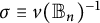 $\sigma \equiv v(\mathbb {B}_n)^{-1}$
, then we obtain the Lebesgue space
 $L^p$
and the unweighted Bergman space
 $\mathcal {A}^p$
.
It is well-known that
 $\mathcal {A}^2$
is a closed subspace of
 $L^2$
, so there exists an orthogonal projection from
 $L^2$
onto
 $\mathcal {A}^2$
. This map is called the Bergman projection and is given by
 $$ \begin{align*}Pf(z):=\int_{\mathbb{B}_n}f(w)\overline{K_z(w)}dv(w),\end{align*} $$
where
 $K_z(w)=\frac {1}{(1-\langle w,z\rangle )^{n+1}}$
is the reproducing kernel of
 $\mathcal {A}^2$
.
Békollè and Bonami [Reference Békollè8, Reference Békollè and Bonami9] initiated the study of the weighted theory of the Bergman projection. Given
 $a\in \mathbb {B}_n\setminus \{0\}$
, let
 $\mathcal {T}_a$
be the Carleson tent defined by
 $$ \begin{align*}\mathcal{T}_a:=\left\{z\in\mathbb{B}_n:|1-\langle z,a/|a|\rangle|<1-|a|\right\},\end{align*} $$
and we write
 $\mathcal {T}_0=\mathbb {B}_n$
. A weight
 $\sigma $
on
 $\mathbb {B}_n$
is said to be a Békollè–Bonami
 $B_p$
-weight, denoted by
 $\sigma \in B_p$
, if
 $$ \begin{align*}[\sigma]_{B_p}:=\sup_{a\in\mathbb{B}_n}\left(\frac{1}{v(\mathcal{T}_a)}\int_{\mathcal{T}_a}\sigma dv\right) \left(\frac{1}{v(\mathcal{T}_a)}\int_{\mathcal{T}_a}\sigma^{-\frac{p'}{p}}dv\right)^{\frac{p}{p'}}<\infty.\end{align*} $$
Békollè and Bonami [Reference Békollè8, Reference Békollè and Bonami9] showed that for
 $1<p<\infty $
, the Bergman projection P is bounded on
 $L^p_{\sigma }$
if and only if
 $\sigma \in B_p$
.
Recently, Stockdale and Wagner [Reference Stockdale and Wagner38] studied the weighted theory of Bergman–Toeplitz operators. Given
 $\varphi \in L^{\infty }(\mathbb {B}_n,dv)$
, the Bergman–Toeplitz operator
 $T_{\varphi }$
is defined by
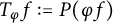 $T_{\varphi }f:=P(\varphi f)$
. Stockdale and Wagner characterized the compactness of
 $T_{\varphi }$
on the weighted Bergman spaces
 $\mathcal {A}^p_{\sigma }$
for
 $\sigma $
in a subclass of
 $B_p$
. Given
 $r>1$
, we say that a weight
 $\sigma $
is in the reverse Hölder class
 $\mathrm {RH}_r$
if there exists
 $C>0$
such that for any
 $K\in \mathcal {D}$
,
 $$ \begin{align*}\left(\frac{1}{v(\widehat{K})}\int_{\widehat{K}}\sigma^rdv\right)^{\frac{1}{r}}\leq \frac{C}{v(\widehat{K})}\int_{\widehat{K}}\sigma dv.\end{align*} $$
Here,
 $\mathcal {D}$
is a fixed finite collection of dyadic systems of
 $\mathbb {B}_n$
, whose elements are “dyadic cubes” in
 $\mathbb {B}_n$
, and for
 $K\in \mathcal {D}$
,
 $\widehat {K}$
denotes the associated dyadic tents (see [Reference Stockdale and Wagner38] for details). Stockdale and Wagner [Reference Stockdale and Wagner38, Theorem 1.3] established the following result. Recall that the Berezin transform
 $\widetilde {T}_{\varphi }$
is defined by
 $$ \begin{align*}\widetilde{T}_{\varphi}(z):=\langle T_\varphi k_z,k_z\rangle_{\mathcal{A}^2},\end{align*} $$
where
 $k_z=K_z/\|K_z\|_{\mathcal {A}^2}$
is the normalized reproducing kernel for
 $\mathcal {A}^2$
.
Theorem D [Reference Stockdale and Wagner38]
Let
 $\varphi \in L^{\infty }(\mathbb {B}_n,dv)$
,
 $1<p<\infty $
,
 $r>1,$
and
 $\sigma \in B_p\cap \text {RH}_r$
with
 $\sigma ^{1-p'}\in \text {RH}_r$
. Then
 $T_\varphi $
acts compactly on
 $\mathcal {A}^p_{\sigma }$
if and only if
 $\widetilde {T}_{\varphi }(z)\to 0$
as
 $|z|\to 1^-$
.
The main result of this section is as follows, which removes the reverse Hölder condition in Theorem D and answers [Reference Stockdale and Wagner38, Open Question 1.14].
Theorem 5.1 Let
 $\varphi \in L^{\infty }(\mathbb {B}_n,dv)$
,
 $1<p<\infty ,$
and
 $\sigma \in B_p$
. Then
 $T_{\varphi }$
acts compactly on
 $\mathcal {A}^p_{\sigma }$
if and only if
 $\widetilde {T}_{\varphi }(z)\to 0$
as
 $|z|\to 1^-$
.
To prove the above theorem, we need some preliminary results. Recall that the Bergman metric
 $\beta (\cdot ,\cdot )$
on
 $\mathbb {B}_n$
is defined by
 $$ \begin{align*}\beta(z,u):=\frac{1}{2}\log\left(\frac{1+|\phi_z(u)|}{1-|\phi_z(u)|}\right),\quad z,u\in\mathbb{B}_n,\end{align*} $$
where
 $\phi _z$
is the involution of
 $\mathbb {B}_n$
interchanging z and
 $0$
. Given
 $z\in \mathbb {B}_n$
and
 $\delta>0$
, we use
 $D(z,\delta )$
to denote the Bergman metric ball centered at z with radius
 $\delta $
. For a weight
 $\sigma $
on
 $\mathbb {B}_n$
, define
 $$ \begin{align*}\hat{\sigma}(z):=\frac{\sigma(D(z,1))}{v(D(z,1))},\quad z\in\mathbb{B}_n.\end{align*} $$
The following lemma indicates that
 $\hat {\sigma }\in B_p$
whenever
 $\sigma \in B_p$
.
Lemma 5.2 Let
 $1<p<\infty $
and
 $\sigma \in B_p$
. Then
 $\hat {\sigma }\in B_p$
, and
 $$ \begin{align*}[\hat{\sigma}]_{B_p}\lesssim[\sigma]_{B_p},\end{align*} $$
where the implicit constant depends only on n.
Proof Recall that for
 $a\in \mathbb {B}_n$
,
 $v(\mathcal {T}_a)\asymp (1-|a|^2)^{n+1}$
. Fix
 $a\in \mathbb {B}_n$
. If
 $|a|<\frac {19}{20}$
, then by Fubini’s theorem,
 $$ \begin{align*}\frac{1}{v(\mathcal{T}_a)}\int_{\mathcal{T}_a}\hat{\sigma}(z)dv(z) \lesssim\int_{\mathbb{B}_n}\frac{\sigma(D(z,1))}{(1-|z|^2)^{n+1}}dv(z)\asymp\int_{\mathbb{B}_n}\sigma dv,\end{align*} $$
and similarly, by Hölder’s inequality,
 $$ \begin{align*}\frac{1}{v(\mathcal{T}_a)}\int_{\mathcal{T}_a}\hat{\sigma}(z)^{-\frac{p'}{p}}dv(z) \leq\frac{1}{v(\mathcal{T}_a)}\int_{\mathcal{T}_a}\frac{\int_{D(z,1)}\sigma^{-\frac{p'}{p}}dv}{v(D(z,1))}dv(z) \lesssim\int_{\mathbb{B}_n}\sigma^{-\frac{p'}{p}}dv.\end{align*} $$
Consequently,
 $$ \begin{align*}\left(\frac{1}{v(\mathcal{T}_a)}\int_{\mathcal{T}_a}\hat{\sigma}dv\right) \left(\frac{1}{v(\mathcal{T}_a)}\int_{\mathcal{T}_a}\hat{\sigma}^{-\frac{p'}{p}}dv\right)^{\frac{p}{p'}} \lesssim\left(\int_{\mathbb{B}_n}\sigma dv\right)\left(\int_{\mathbb{B}_n}\sigma^{-\frac{p'}{p}}dv\right)^{\frac{p}{p'}}\lesssim[\sigma]_{B_p}.\end{align*} $$
Suppose now that
 $|a|>\frac {19}{20}$
and write
 $\tilde {a}=(1-20(1-|a|))\frac {a}{|a|}$
. Then
 $v(\mathcal {T}_a)\asymp v(\mathcal {T}_{\tilde {a}})$
, and we claim that
 $$ \begin{align} \bigcup_{z\in\mathcal{T}_a}D(z,1)\subset\mathcal{T}_{\tilde{a}}. \end{align} $$
To show this, recall the identity (see, for instance, [Reference Zhu42, Lemma 1.3])
 $$ \begin{align*}1-\langle \phi_a(z),\phi_a(u)\rangle=\frac{(1-\langle a,a\rangle)(1-\langle z,u\rangle)}{(1-\langle z,a\rangle)(1-\langle a,u\rangle)},\quad z,u\in\mathbb{B}_n.\end{align*} $$
Consequently, for any
 $z\in \mathcal {T}_a$
and
 $u\in D(z,1)$
, we have
 $$ \begin{align*} \left|1-\left\langle u,\tilde{a}/|\tilde{a}|\right\rangle\right|^{1/2} &\leq|1-\langle u,z\rangle|^{1/2}+\left|1-\left\langle z,a/|a|\right\rangle\right|^{1/2}\\ &\leq|1-\langle\phi_z(\phi_z(u)),\phi_z(0)\rangle|^{1/2}+(1-|a|)^{1/2}\\ &=\frac{(1-|z|^2)^{1/2}}{|1-\langle\phi_z(u),z\rangle|^{1/2}}+(1-|a|)^{1/2}\\ &\leq\frac{\sqrt{2}(1-|a|)^{1/2}}{(1-|\phi_z(u)|)^{1/2}}+(1-|a|)^{1/2}\\ &<\left(\sqrt{\frac{2}{1-\tanh1}}+1\right)(1-|a|)^{1/2}. \end{align*} $$
Note that
 $\tanh 1\approx 0.76<4/5$
, we obtain that
 $$ \begin{align*}\left|1-\left\langle u,\tilde{a}/|\tilde{a}|\right\rangle\right|<(\sqrt{10}+1)^2(1-|a|)<20(1-|a|)=1-|\tilde{a}|,\end{align*} $$
which gives that
 $u\in \mathcal {T}_{\tilde {a}}$
. Hence, (5.1) holds. Then, by Fubini’s theorem and (5.1),
 $$ \begin{align*}\frac{1}{v(\mathcal{T}_a)}\int_{\mathcal{T}_a}\hat{\sigma}(z)dv(z) \asymp\frac{1}{v(\mathcal{T}_a)}\int_{\mathcal{T}_a}\frac{\sigma(D(z,1))}{(1-|z|^2)^{n+1}}dv(z) \lesssim\frac{1}{v(\mathcal{T}_{\tilde{a}})}\int_{\mathcal{T}_{\tilde{a}}}\sigma dv\end{align*} $$
and
 $$ \begin{align*}\frac{1}{v(\mathcal{T}_a)}\int_{\mathcal{T}_a}\hat{\sigma}(z)^{-\frac{p'}{p}}dv(z) &\leq\frac{1}{v(\mathcal{T}_a)}\int_{\mathcal{T}_a}\frac{\int_{D(z,1)}\sigma^{-\frac{p'}{p}}dv}{v(D(z,1))}dv(z) \\ &\lesssim\frac{1}{v(\mathcal{T}_{\tilde{a}})}\int_{\mathcal{T}_{\tilde{a}}}\sigma^{-\frac{p'}{p}}dv.\end{align*} $$
Therefore,
 $$ \begin{align*} \left(\frac{1}{v(\mathcal{T}_a)}\int_{\mathcal{T}_a}\hat{\sigma}dv\right) &\left(\frac{1}{v(\mathcal{T}_a)}\int_{\mathcal{T}_a}\hat{\sigma}^{-\frac{p'}{p}}dv\right)^{\frac{p}{p'}}\\ &\lesssim\left(\frac{1}{v(\mathcal{T}_{\tilde{a}})}\int_{\mathcal{T}_{\tilde{a}}}\sigma dv\right) \left(\frac{1}{v(\mathcal{T}_{\tilde{a}})}\int_{\mathcal{T}_{\tilde{a}}}\sigma^{-\frac{p'}{p}}dv\right)^{\frac{p}{p'}}\leq[\sigma]_{B_p}. \end{align*} $$
Since
 $a\in \mathbb {B}_n$
is arbitrary, we conclude that
 $\hat {\sigma }\in B_p$
and
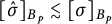 $[\hat {\sigma }]_{B_p}\lesssim [\sigma ]_{B_p}$
.
We also need the notion of
 $C_p$
-weights. For
 $1<p<\infty $
, a weight
 $\sigma $
on
 $\mathbb {B}_n$
is said to be in the
 $C_p$
-class if
 $$ \begin{align*}\sup_{a\in\mathbb{B}_n}\left(\frac{1}{v(D(a,1))}\int_{D(a,1)}\sigma dv\right) \left(\frac{1}{v(D(a,1))}\int_{D(a,1)}\sigma^{-\frac{p'}{p}}dv\right)^{\frac{p}{p'}}<\infty.\end{align*} $$
It was pointed out in [Reference Luecking33, p. 322] that
 $B_p\subset C_p$
. Moreover, by [Reference Luecking33, Corollary 3.8], if
 $\sigma \in C_p$
for some
 $1<p<\infty $
, then for all
 $R>0$
,
 $$ \begin{align} \hat{\sigma}(z)\asymp\hat{\sigma}(u)\quad \mathrm{whenever} \quad \beta(z,u)<R. \end{align} $$
A direct consequence of this fact is that
 $\hat {\sigma }\in C_p$
. The following lemma gives an equivalent norm for the weighted Bergman spaces
 $\mathcal {A}^p_{\sigma }$
with
 $\sigma \in C_p$
.
Lemma 5.3 Let
 $1<p<\infty $
and
 $\sigma \in C_p$
. Then
 $\mathcal {A}^p_{\sigma }=\mathcal {A}^p_{\hat {\sigma }}$
with equivalent norms.
The proof is based on the following lemma, which can be found in [Reference Luecking33, Lemma 3.1].
Lemma 5.4 [Reference Luecking33]
If
 $\delta>0$
and
 $\sigma \in C_q$
for some
 $1<q<\infty $
, then there is a constant
 $C=C(n,\delta ,q,\sigma )>0$
such that for any
 $f\in \mathcal {H}(\mathbb {B}_n)$
,
 $0<p<\infty ,$
and any
 $z\in \mathbb {B}_n$
,
 $$ \begin{align*}|f(z)|^p\leq\frac{C}{\sigma(D(z,\delta))}\int_{D(z,\delta)}|f|^p\sigma dv.\end{align*} $$
Proof of Lemma 5.3
We only prove the bounded embedding
 $\mathcal {A}^p_{\hat {\sigma }}\subset \mathcal {A}^p_{\sigma }$
. The other is similar. Suppose that
 $f\in \mathcal {A}^p_{\hat {\sigma }}$
. Let
 $0<\delta <1$
and
 $\{a_k\}\subset \mathbb {B}_n$
be a
 $\delta $
-lattice in the Bergman metric. Then
 $\mathbb {B}_n=\bigcup _kD(a_k,\delta )$
and there exists an absolute constant N such that each point
 $z\in \mathbb {B}_n$
belongs to at most N of the sets
 $D(a_k,4\delta )$
(see [Reference Zhu42, Theorem 2.23]). Consequently, by Lemma 5.4 and (5.2),
 $$ \begin{align*} \int_{\mathbb{B}_n}|f(z)|^p\sigma(z)dv(z) &\leq\sum_{k}\int_{D(a_k,\delta)}|f(z)|^p\sigma(z)dv(z)\\ &\lesssim\sum_{k}\int_{D(a_k,\delta)}\frac{1}{\hat{\sigma}(z)(1-|z|^2)^{n+1}}\int_{D(z,\delta)}|f|^p\hat{\sigma}dv\sigma(z)dv(z)\\ &\leq\sum_k\int_{D(a_k,\delta)}\frac{\sigma(z)dv(z)}{\hat{\sigma}(z)(1-|z|^2)^{n+1}}\int_{D(a_k,2\delta)}|f|^p\hat{\sigma}dv\\ &\lesssim\sum_k\int_{D(a_k,2\delta)}|f|^p\hat{\sigma}dv \\ &\lesssim\|f\|^p_{\mathcal{A}^p_{\hat{\sigma}}}. \end{align*} $$
Hence,
 $f\in \mathcal {A}^p_{\sigma }$
and
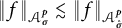 $\|f\|_{\mathcal {A}^p_{\sigma }}\lesssim \|f\|_{\mathcal {A}^p_{\hat {\sigma }}}$
, which finishes the proof.
It is known that
 $B_p$
-weights are ill-behaved in the sense that they do not satisfy a reverse Hölder property. However, it was proved in [Reference Aleman, Pott and Reguera2, Reference Stockdale and Wagner38] that when restricting to a class of weights that are “nearly constant” on each Bergman metric ball, the
 $B_p$
-condition does imply a reverse Hölder inequality. More precisely, using the inclusion relations between Bergman metric balls and dyadic cubes (see, for instance, [Reference Stockdale and Wagner38, p. 12]), one can deduce the following from [Reference Stockdale and Wagner38, Theorem 2.9].
Theorem E [Reference Stockdale and Wagner38]
Let
 $\sigma \in B_p$
for some
 $1<p<\infty $
. If for any
 $\delta>0$
, there exists
 $C_{\sigma ,\delta }>1$
such that
 $$ \begin{align*}C^{-1}_{\sigma,\delta}\sigma(u)\leq\sigma(z)\leq C_{\sigma,\delta}\sigma(u)\end{align*} $$
for all
 $z,u\in D(a,\delta )$
and all
 $a\in \mathbb {B}_n$
, then there exists
 $r_{\sigma }>1$
such that
 $\sigma \in \mathrm {RH}_r$
for any
 $r\in (1,r_{\sigma }]$
.
We are now ready to prove Theorem 5.1.
Proof of Theorem 5.1
Since
 $\sigma \in B_p\subset C_p$
, it follows from Lemma 5.3 that
 $T_{\varphi }$
is compact on
 $\mathcal {A}^p_{\sigma }$
if and only if it is compact on
 $\mathcal {A}^p_{\hat {\sigma }}$
. Therefore, in view of Theorem D, it suffices to verify that there exists
 $r>1$
such that
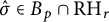 $\hat {\sigma }\in B_p\cap \mathrm {RH}_r$
and
 $\hat {\sigma }^{1-p'}\in \mathrm {RH}_r$
. By Lemma 5.2,
 $\hat {\sigma }\in B_p$
, and consequently,
 $\hat {\sigma }^{1-p'}\in B_{p'}$
, which, combined with (5.2) and Theorem E, shows that
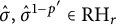 $\hat {\sigma },\hat {\sigma }^{1-p'}\in \mathrm {RH}_r$
for some
 $r>1$
. The proof is complete.
Acknowledgements
The author would like to thank the referee for his/her valuable comments and suggestions which improved the final version of presentation.



