The issue of trust is one that has been considered to be particularly important in the context of the Northern Ireland peace process. The stunted progress made between 1998 and 2007 was in large part blamed on the absence of trust between the key political protagonists. The levels of trust among the general public, in relation to the various political actors and newly established power-sharing institutions, were dismissed as secondary issues, particularly because the power-sharing institutions were, from 1998, more often in suspension than in operation. This has now changed. Since May 2007, almost 10 years after the signing of the Good Friday Agreement, Northern Ireland's devolved administration is once again operational. At an initial glance there appears to be much optimism about the political future of Northern Ireland. Such optimism sits uneasily with the widespread cynicism about politics and politicians in the UK more generally.Footnote 1 This raises an important question: how might such growing political disenchantment affect the progress of the Northern Ireland peace process, if at all, and with what consequence?
With this particular question in mind, this article seeks to examine levels of interest in and trust among the general public in relation to Northern Ireland's newly established political institutions and actors, through an analysis of the results of the 2007 Northern Ireland Life and Times Survey (NILT).Footnote 2 It does so with a view to revealing which are the specific groups of people who appear to have the highest levels of political disenchantment at present. The identification of such groups is particularly important in the context of the longer-term stability of the Northern Ireland Assembly and Executive, since such stability relies not only on the willingness of the different political parties to work together through the power-sharing arrangements currently in place but also on the willingness of the electorate to have faith and trust in the workability of these political institutions and in the various political actors in whose custody they lie. Should the public's disenchantment turn to an increased disengagement from the political process – manifested in a refusal to participate in electoral contests, for example – then the political parties in Northern Ireland will face a new political battle to assure the legitimacy and longer-term viability of the power-sharing institutions. The political relevance of trust in government, to borrow a phrase from Jack Citrin's comment piece in 1974,Footnote 3 needs little further explanation in the context of Northern Ireland or in any other deeply divided society. The reality is that without popular trust the politicians and political institutions may collapse once again.
TRUST IN DIVIDED SOCIETIES
It is argued that levels of social trust are based on the social circumstances in which people find themselves at a given time.Footnote 4 By extension, political trust should be based on the political circumstances in which people find themselves at a given time. In the context of a divided society engaged in a peace process, then, the difficulties in building trust both at a political and at a societal level are fairly obvious and need little further elucidation. First, the reality is that negotiations between warring factions often need to be conducted in secret before any peace agreement is delivered.Footnote 5 Such secrecy, while regarded as necessary, does little to inspire public confidence. In a recent example of this in Northern Ireland, the Democratic Unionist Party (DUP) has come under intense scrutiny in relation to allegations that it was engaged in ‘secret talks’ with Sinn Féin in the years preceding the re-establishment of the power-sharing institutions.Footnote 6 A second associated difficulty is that the political skills and choreography often needed and used to push forward particular agendas in a peace process can often be perceived as little more than ‘lying and manipulation’ by the general public.Footnote 7 In other words, there can be a dislocation between the public rhetoric of politicians and the realities in which they are often engaged. Once such ‘realities’ become apparent to constituents, it is inevitable that there will be an undermining of trust.Footnote 8 Last, any evidence of ‘political horse-trading’, ‘pork-barrelling’ and ‘sweeteners’ within peace processes can raise questions among constituents about what they have ‘lost’, whether real or perceived, as a consequence of such practices and can raise their suspicions about what has been won and lost.
Despite the obvious difficulties, the establishment of trust in a divided society is central to its eventual success or otherwise. It has long been argued that trust or civic culture act as a basis for stable and peaceful democracy.Footnote 9 In particular, trust in the core institutions of a political system is an important factor in whether people decide to become politically active, whether they favour the policy reforms undertaken by those elected and whether they are willing to comply with decisions taken by these policymakers.Footnote 10 Distrust, as articulated by Larry Diamond, can lead to increasing cynicism about the political system and the existing order.Footnote 11 By extension, many contemporary democracies face a threat of de-democratization if major segments of the population withdraw their trust networks from public politics.Footnote 12 Given the efforts made, through the liberal peace agenda, to make democratization one of the central strands of its approach to managing conflicts in divided societies, no threat of de-democratization can be ignored. It is with this in mind that this article seeks to identify those specific segments of the population in Northern Ireland who are least trusting of the actors and institutions as they now stand. In order to contextualize this, it first paints a broader picture of the issue of trust during Northern Ireland's prolonged peace process.
TRUST AND VIOLATIONS OF TRUST IN NORTHERN IRELAND
Energy, goodwill and trust have been used to explain much of the progress in the context of the Northern Ireland peace process. Though fairly nebulous concepts, a perceived lack of them has also been used to explain the various hitches, delays and setbacks between the signing of the Good Friday Agreement in 1998 and the eventual establishment of the current political dispensation. For instance, power was not initially devolved to the Northern Ireland Assembly until December 1999, 18 months after the signing of the Agreement. The Ulster Unionists, it was argued, did not ‘trust’ the IRA to decommission its weapons and wanted to see this take place before the establishment of the political institutions. Sinn Féin, on the other hand, did not ‘trust’ that the Ulster Unionist Party (UUP) were genuinely willing to share power with them in the newly devolved institutions, claiming that the Ulster Unionists ‘didn't want a Fenian about the place’.Footnote 13 As a consequence of such mutual mistrust, the political institutions were suspended four times in the following three-year period. The final suspension, in October 2002, resulted from allegations that a republican spy-ring was in operation within Stormont, which resulted in a controversial raid of the Sinn Féin offices within parliament buildings and the arrest of three men in connection with the allegations. Sinn Féin argued that the entire affair was politically motivated, designed to bring down the power-sharing institutions and to save David Trimble, leader of the Ulster Unionist Party, by providing him with a viable reason for withdrawing from the power-sharing arrangements.Footnote 14 Unionists compared the incident to Watergate: ‘At Watergate Nixon's cronies only broke into one filing cupboard whereas at Stormont hundreds of files, many of them marked confidential, were stolen. The volume here is greater than Watergate and the aim was the same: political intelligence and dirty tricks.’Footnote 15
Between the period of suspension in October 2002 and the eventual re-establishment of the institutions, the Northern Irish media was full of stories of other ‘incidents’ that could do little but add to the growing mistrust between the different political parties. The repeated postponement of the Northern Ireland Assembly election in 2003, the theft of £26.5 million in the 2004 Northern Bank robbery,Footnote 16 the publication of four reports from the Cory Inquiry into possible collusion between the security services in Northern Ireland in the murders of Robert Hamill, Pat Finucane, Rosemary Nelson and Billy Wright,Footnote 17 the DUP's desire for photographic evidence of decommissioning by the IRA rather than accepting, on trust, that the decommissioning was final and complete,Footnote 18 the IRA's retort that it would ‘not submit to a process of humiliation’ in 2004Footnote 19 and the murder of Belfast man, Robert McCartney, in 2005 all conspired against any possible thaw in relations between the various political positions. The political development minister, David Hanson MP, told delegates at the Northern Ireland Government Affairs Group (NIGAG) annual general meeting in 2005 that trust remained a key element to the peace process.Footnote 20 Instilling this trust among political representatives remained a difficult job. After the general election results in 2005, Ian Paisley, leader of the DUP, insisted that he would not serve as first minister with a Sinn Féin deputy first minister: ‘I don't see it because I don't trust them and the people don't trust them,’ he said.Footnote 21
This raises the primary questions that this article seeks to address. Who were the ‘people’ whom Paisley suggested didn't trust Sinn Féin? His comments validate the assertion that attention also needs to be paid to the issue of trust between the general public and the political actors and institutions. Although they were discussed with much less vigour during the course of the peace process in Northern Ireland, public trust in the political establishment and dispensation are just as critical to the conditioning of stability as are the levels of trust between political players. Such an examination of political disaffection, political distrust and dislike among the electorate can give us some measure of whether devolution in Northern Ireland has had a degree of success in the eyes of its electorate. In addition, it can provide party political strategists with an insight of to whom the greater attention needs to be paid. This article suggests that the various political parties have much work to do with their collective electorate in order to stabilize further the current political environment.
ABOUT THE SURVEY
Public attitudes towards politics and levels of trust in politicians and political institutions have been drawn from the NILT Survey, an annual survey that records the attitudes, values and beliefs of the general public in Northern Ireland on a wide range of public and social policy issues. Most of the questions reported in this article were asked as part of the International Social Survey Programme (ISSP), where the same module of questions is asked in over 40 countries worldwide. Some of the main difficulties in conducting survey research in conflicted societies such as Northern Ireland have already been articulated in previous work with NILT data.Footnote 22 The physical safety of survey workers, the use of language in the survey design – especially in relation to contentious place names – the timing of the survey and the effect of recent political incidents on survey responses, the possibility of respondents modifying their more extremist views in their replies to questions out of fears about the confidentiality of the survey and the likelihood of the survey results merely confirming the obvious political divisions present the researcher with a range of caveats to be borne in mind when analysing the survey results. In addition, unlike the academic discourse, which has sought to question and define what exactly ‘trust’ means, survey respondents have answered these questions from the perspective of what ‘trust’ meant to them, which may differ from person to person. Interviewees were not given any prompts to describe what ‘trust’ might mean in the context of the questions.Footnote 23 For example, some might have considered the question from a personal perspective (a socio-psychological response), others might have been conditioned by their cultural environment and others still may have only considered trust in the context of the government's performance.Footnote 24
The sampling frame for the survey was from the Land and Property Services Agency list of private addresses, and a random sample of households were selected. One adult aged 18 years or over was randomly selected from each household. In total, 1,179 adults aged 18 years or over were surveyed. It is important to highlight that the fieldwork for the 2007 NILT Survey ran from October 2007 to January 2008. Thus, the fieldwork began approximately five months after devolution was restored to the Northern Ireland Assembly on Tuesday 8 May 2007, after a gap of over four and a half years and almost 10 years after the signing of the Good Friday Agreement. Arguably then, the survey took place during the Assembly's ‘honeymoon period’, when public attitudes towards politics and politicians may well have been more amenable than if the survey had been conducted six months earlier or later. The 2007 Northern Ireland Assembly elections, held in March 2007, netted a voter turnout of 62.87 per cent of registered voters, which was just slightly higher than the 60 per cent response rate of the 2007 Survey.
SURVEY RESULTS
A series of questions was asked about individual attitudes towards politics and the role of government in Northern Ireland. These were cross-tabulated with a range of analysis variables, and chi-squared tests of significance were undertaken. The results presented here show some of the more striking contrasts by gender, age, religion and/or party affiliation (that is, where p < 0.05).Footnote 25 The purpose of this is to illustrate who the ‘us’ are in terms of trust. In other words, to use Charles Tilly's term, who might be the ‘major segments of the population’ that could withdraw their trust networks from public politics in Northern Ireland. Who, exactly, has the most interest in politics and how might this be best explained? Who feels most alienated or removed from the political process? Who feels best informed about the political situation in Northern Ireland? In the context of these general questions – which were used simply to contextualize subsequent responses further by identifying whether responses to questions on trust and efficacy were informed or uninformed responses – respondents were then asked specifically about their levels of trust in politics generally, whether they assume politicians keep the promises that they make, and whether Members of the Legislative Assembly (MLAs), the Northern Ireland Assembly and individual ministers could be trusted to work in Northern Ireland's best interests. The results show that the ‘us’ is wide and varied.
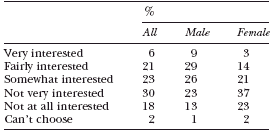
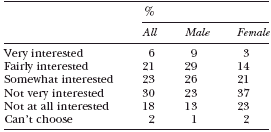
For example, the results show that Northern Ireland is almost equally divided between those with at least some personal interest in politics (50 per cent) and those with limited or no interest at all (48 per cent), as Table 1 demonstrates. Overall, people seem quite evenly divided in their personal interest levels, and no significant differences are detected when considered by age and religion, but there are some significant differences between males and females, with 64 per cent of men and only 38 per cent of women having some personal interest in politics. There are no differences among female respondents according to their religion. There are a number of explanations for this. First, despite the progress made by some of the political parties in Northern Ireland to promote women into leadership roles within their parties, the political environment in Northern Ireland continues to be male dominated and might serve to alienate the female electorate.Footnote 26 Second, women's interest in ‘politics’ is usually associated with the bread-and-butter issues of the day, therefore their responses to this question might have been influenced by their perception that they were being asked about how interested they were in highbrow politics.Footnote 27 Third, the female respondents may have conformed to the stereotypical view of women as peacemakers and facilitators rather than those happy to engage or show interest in the very conflictual and contested nature of politics in their responses.Footnote 28
How Interested Would You Say You Personally Are in Politics? By Gender
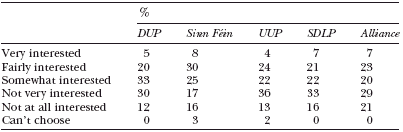
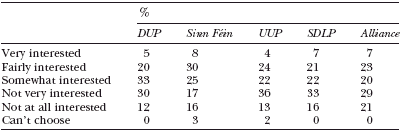
When the same question is examined from the perspective of the political party affiliations, significant differences can also be detected. Table 2 shows that Sinn Féin voters have the greatest personal interest in politics (63 per cent), followed by the supporters of the DUP (58 per cent), the Social Democratic Labour Party (SDLP – 50 per cent), the Alliance (50 per cent) and finally the Ulster Unionist Party (UUP – 50 per cent). The modal response for the UUP, SDLP and Alliance party supporters was ‘not very interested’. Given that the DUP and Sinn Féin are the largest parties in the Northern Ireland Assembly and hold the most ministerial seats, it is clear that there is a direct relationship between party prominence and interest levels.
How Interested Would You Say You Personally Are in Politics? By Party Support
These results are in keeping with other research that points to Sinn Féin as the party with the most highly mobilized electorate,Footnote 29 the eclipse of the UUP by the DUP in terms of engaging with the unionist votersFootnote 30 and the declining support for the SDLP.Footnote 31 For the UUP and the SDLP particularly, any reversal of recent party fortunes will necessitate the re-engagement of their supporters with their political agendas, especially because members of an uninterested electorate are more likely to become unregistered voters or non-voters in elections. The evidence of this from previous research has already shown that the DUP's overtaking of the UUP was not because of DUP successes at mobilizing the unionist electorate, but rather as a consequence of ‘under-performance and a lack of voter-mobilization of the UUP’.Footnote 32
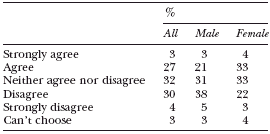
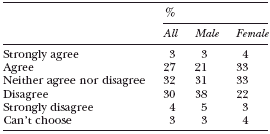
Male confidence was displayed again when respondents were asked to comment on the assertion: ‘I feel that I have a pretty good understanding of the important political issues facing our country’, 60 per cent of males agreed or strongly agreed, compared with 41 per cent of females. As might be expected, levels of interest in politics were significantly correlated with levels of understanding of political issues. Women (37 per cent), by contrast, were more likely to agree or strongly agree that others were better informed politically than they were, in comparison to 24 per cent of men, and these differences were statistically significant (see Table 3). The sense of alienation that women appear to experience is again evident here.
I Think Most People Are Better Informed About Politics and Government Than I Am. By Gender
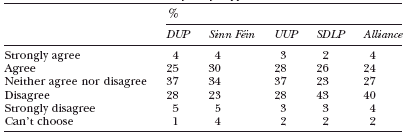
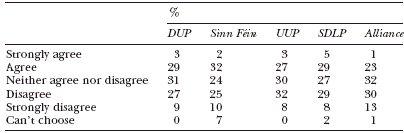
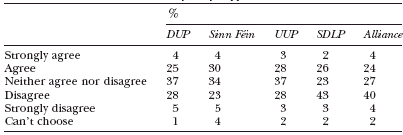
When considered by party affiliation, Sinn Féin voters assume that others are better informed about politics than they are (see Table 4), a result that seems to sit rather uneasily with their declared level of interest in politics. A number of reasons can be used to highlight why this might be the case. First, it could be argued that Sinn Féin supporters realize that they support a highly centralized political organization and accept that their party will sometimes not tell them the whole truth. Second, Sinn Féin supporters may feel a degree of media mistrust and suspect that the media is not interested in informing them about key issues.Footnote 33 Third, Sinn Féin supporters may conform, in their responses, to the cultural stereotype of a perceived excluded and second-class status.
I Think Most People Are Better Informed About Politics and Government Than I Am. By Party Support
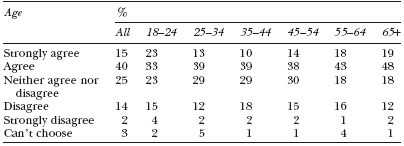
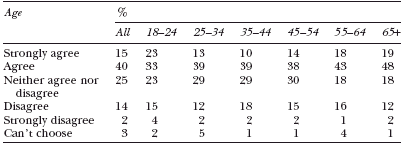
One might assume that there is a relationship between levels of interest in politics and whether respondents felt that they had impact on politics and policy-making. Statistically, there is no correlation between these two variables. When asked to comment on the assertion that ‘People like me don't have a say about what the government does’, more than half of the respondents concurred (55 per cent) and a minority disagreed to some degree (16 per cent) (see Table 5). A quarter of respondents neither agreed nor disagreed (25 per cent). Older people felt the most disenfranchised, with 67 per cent of respondents aged 65 years or over agreeing or strongly agreeing with the statement. This might be best explained in terms of social isolation, given that the 65+ age group will have left the workforce, their families will have probably grown up and moved on and/or they are less likely to be actively engaged in various social activities. As a result this age group may be more likely to feel that no one cares because no one ordinarily asks their opinion or because on a day-to-day basis they have so few people around with whom to share it. Equally, though, it could be argued that those aged 65 and over have a greater degree of realism or even cynicism about their responses and might well reason that they have been around for enough elections to realize that it ultimately doesn't matter what they say or whom they vote for. What is most interesting about this result is that, while this older age group may feel most disenfranchised, this has not stopped them from registering to vote. The most recent age analysis of the electoral register in Northern Ireland reveals that the proportion of people on the register aged 65 or over is actually higher than their population share.Footnote 34 Whether the negative attitudes expressed by those aged 65 or over is reflected in future election results in Northern Ireland remains to be seen.
People Like Me Don't Have a Say About What the Government Does. By Age Group
When considered by religion, Catholics were more likely (60 per cent) than Protestants (54 per cent) or those with no expressed religion (49 per cent) to agree or strongly agree that they did not have a say about what the government did. In addition, those respondents feeling close to Sinn Féin (66 per cent) were more likely than any other political group of voters to think that they didn't have a say. Thus, although Sinn Féin supporters had the most professed ‘interest’ in politics, their responses would imply that they also felt the most ‘excluded’ in terms of having their voice heard by government. This could present Sinn Féin party strategists with something of a problem, given that their supporters' interest in and impact on the political process appear to be mutually exclusive. One plausible explanation of this relates, again, to the language of the question. Sinn Féin supporters might be more inclined to interpret the word ‘government’ as meaning Westminster or central government specifically. If this is the case, then the fact that their elected representatives do not take their seats in Westminster nor have any influence over government voting in Westminster will have heavily influenced their responses. In contrast, unionist voters, both from within the UUP and the DUP have witnessed the leverage used by their parties in extracting concessions or currying favour with the government of the day at Westminster. When the nine DUP MPs voted in favour of Gordon Brown's troubled 42-day detention bill in June 2008, assumptions were made that the reward for their nine crucial votes would be significant economic benefits for Northern Ireland.Footnote 35 Moreover, the discussions between the Conservative Party and the UUP about a possible alliance or merger of the two had highlighted the possibility of a future cabinet post for the UUP should the merger be successful and should the Conservatives win the next general election.Footnote 36
Having set the contextual background in terms of general interest levels and knowledge about politics in Northern Ireland, we now turn to the specific questions of trust. How might public attitudes to trust of politicians and political institutions be related to interest and knowledge of politics in Northern Ireland?
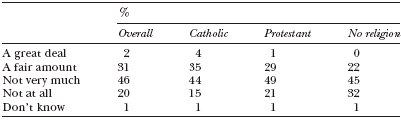
The NILT survey asked people to consider how much they trusted politicians generally; how much they trusted the Northern Ireland Assembly to work in Northern Ireland's best interest; and how much they trusted specific ministers in the Assembly Executive (by party affiliation). In order to contextualize these questions on political trust, respondents were also asked, very generally, whether they felt that there were only a few people that they could trust completely in terms of social trust. Overall responses to this particular question revealed that 69 per cent felt that they could only completely trust a few people. When considered against the levels of trust in politicians generally, a quite similar result can be found (see Table 6).
How Much Would You Trust Politicians Generally? By Religion
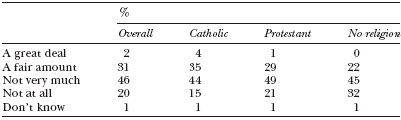
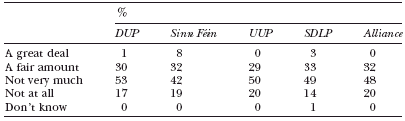
Of all respondents, 66 per cent felt that they didn't trust politicians very much or at all. Catholic respondents were the most trusting of respondents, while respondents with no religion were least trusting. For example, 35 per cent of the former said that they trusted politicians ‘a fair amount’, compared with 22 per cent of the latter. Sinn Féin and the SDLP supporters were most likely to trust politicians ‘a great deal’. Sinn Féin supporters were also the least likely to say that they trusted politicians not very much or not at all (see Table 7).
How Much Would You Trust Politicians Generally? By Party Support
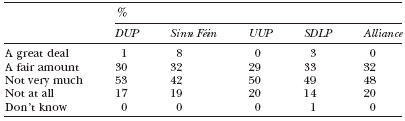
This is an interesting result when compared against previous results, which showed significant difference for Sinn Féin supporters. While professing to have more personal interest in politics than other party groupings, yet feeling that other people were better informed about politics and government than they were, these respondents were still more willing to trust. One explanation for this might be through the associations and interactions that respondents have had with individual politicians. For Sinn Féin supporters, the campaigning nature of Sinn Féin as a political party, the extent of the community involvement by Sinn Féin and the significance of its constituency profile in terms of attending local community-based events and campaigning on local issues are all illustrative of its strong grassroots link and approachability factor. It is perhaps these issues that condition Sinn Féin supporters into trusting politicians more than those voters who may only physically see their elected representatives during hustings and door-to-door canvassing initiatives in the run-up to elections.
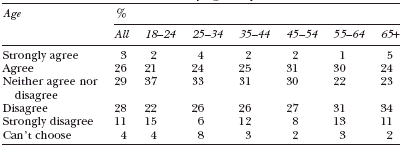
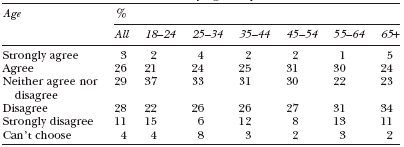
One obvious measure of trust in politicians is in terms of whether they actually deliver on the electoral promises made during hustings and in their electoral manifestos. In general, respondents did not seem convinced that the people that we elect as MPs try to keep the promises they have made during the election. Only 3 per cent strongly agreed with this statement, compared with 11 per cent who strongly disagreed. However, 28 per cent were equivocal, and said that they neither agreed nor disagreed. Responses for males and females were similar to each other. Younger respondents were much more likely to say that they neither agreed nor disagreed, while older respondents were much more likely to disagree (see Table 8). The negative response from the older respondents again compounds the earlier view that older people are some of the most disenfranchised people within our society at present and the least trusting of politicians to deliver on their promises to them. This may present something of a problem to the political parties when campaigning for the next election in Northern Ireland. The parties need to be acutely aware that the 60+ group are the largest single grouping by age, and make up 28 per cent of those who are registered to vote. An examination of the projected increase in population in the period from 2007 to 2012 reveals that the highest rates of increase are projected for the population aged 65 and over.Footnote 37
People We Elect as MPs Try to Keep the Promises They Have Made During the Election. By Age Group
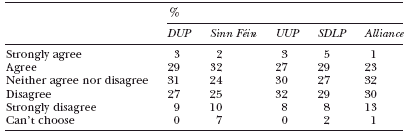
There were strong differences in line with political party affiliation. In particular, Alliance Party supporters were more sceptical, and Sinn Féin supporters more trusting (see Table 9). That said, the Alliance Party have never had an MP elected to Westminster. Moreover, when Alliance Party candidates in Westminster elections have been withdrawn in order to facilitate the election of ‘pro-agreement unionists’, the party voters have felt somewhat ‘compromised’.Footnote 38 Both these reasons may, in some part, explain their scepticism.
People We Elect as MPs Try to Keep the Promises They Have Made During the Election. By Party Support
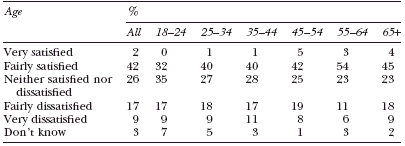
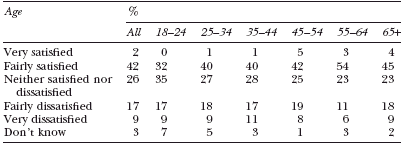
Within this context of fairly low levels of trust in politicians in general, respondents were then asked about Northern Ireland MLAs in particular. Overall, respondents appeared to be happy with the way that MLAs were doing their job. While only 2 per cent said that they were very satisfied, a much larger proportion (42 per cent) said that they were ‘fairly satisfied’. Around one-quarter of respondents were neither satisfied nor dissatisfied, and only 9 per cent were very dissatisfied. However, for males, this latter figure was significantly higher (11 per cent) than for females (6 per cent).
There were also significantly different opinions according to age (see Table 10), although much of this may be due to the more diverse attitudes of the youngest age group (18–24-year-olds). Almost equal proportions of this age group were ‘fairly satisfied’ or ‘neither satisfied nor dissatisfied’, and this group had the highest proportion of respondents saying that they didn't know. This may reflect the relatively low levels of interest in politics expressed by this group, a result that is consistent with the rest of the UK.
And Are You Satisfied or Dissatisfied with the Way Northern Ireland MLAs Are Doing Their Job? By Age Group
There were also significantly different opinions depending on religious affiliation. Thus, Catholics were most satisfied with the way MLAs were doing their jobs, especially compared with respondents with no religion. For example, 51 per cent of the former said that they were satisfied to some degree compared with a much lower proportion (34 per cent) of the latter.
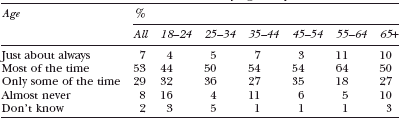
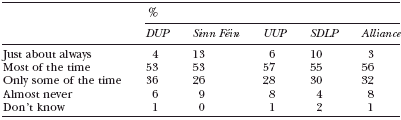
The final set of questions discussed in this article considered the bigger picture, which relates to political parties and institutions. Respondents were asked about their level of trust in the Northern Ireland Assembly to work in Northern Ireland's best interest. Overall, trust in the recently re-established Assembly was fairly high – while only 7 per cent said ‘just about always’, more than half (53 per cent) gave the response ‘most of the time’ (see Table 11). Three in ten said ‘only some of the time’, and only 8 per cent said ‘almost never’. Very few respondents said that they did not know, which suggests that the majority of respondents have some degree of interest and knowledge in the Assembly.
How Much Do You Trust the Northern Ireland Assembly to Work in Northern Ireland's Best Interests? By Age Group
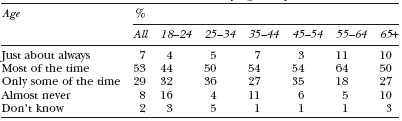
Results for different age groups are interesting, with respondents aged 55–64 having the most confidence in the Assembly to work in Northern Ireland's best interests – over three-quarters of these respondents said that the Assembly did so just about always or most of the time. It is, however, this age group that has had direct experience (as adults) of life in Northern Ireland before the most recent phase of the conflict from 1969, during the conflict and after the signing of the Good Friday Agreement in 1998. In contrast, respondents in the 18–24 year age group were much more cynical; for example, one-third of this group (32 per cent) gave the response ‘only some of the time’, compared with 18 per cent of those aged 55–64. Again, though, this younger age group would have had the least experience of the conflict in Northern Ireland and were aged approximately 8–14 when the Good Friday Agreement was signed, and therefore their responses are reflective of their ambivalence to the changed environment in Northern Ireland.
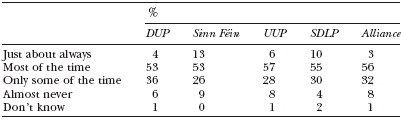
Interestingly, there was some variation among respondents with different political party affiliation (see Table 12). In particular, respondents who supported Sinn Féin were the most trusting, although these differences were not statistically significant.
How Much Do You Trust the Northern Ireland Assembly to Work in Northern Ireland's Best Interests? By Party Support
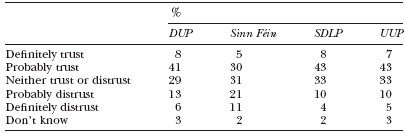
Respondents were then asked how much they would trust a minister from each of four political parties to act in the best interests of all people in Northern Ireland. The four political parties identified are those that currently hold ministerial positions, and so the Alliance Party is not included. While results for DUP, SDLP and UUP ministers were fairly similar, the level of trust of a Sinn Féin minister was lower across all respondents. Responses according to religious and political party affiliation were mostly as might be expected (see Table 13). Protestant respondents showed higher levels of trust for DUP and UUP ministers than did Catholic respondents. DUP supporters were least trusting of Sinn Féin and SDLP, while Sinn Féin supporters were least trusting of DUP and UUP. However, supporters of Sinn Féin were more likely to say that they would ‘definitely’ trust a minister from the DUP to act in the best interests of all people in Northern Ireland (8 per cent) than vice versa (1 per cent).
Do You Trust a Minister from the DUP to Act in Best Interests of All People in Northern Ireland? By Party Support
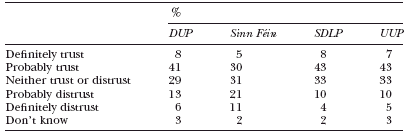
One interesting observation is that the SDLP supporters appear to trust a DUP minister more than DUP supporters themselves would. This might be explained by the growing mistrust of DUP members and party supporters since the re-establishment of the Northern Ireland Executive in May 2007. For example, it was suggested that there was growing disaffection both within the political party and at grassroots level over the nature of the relationship between the first minister, Ian Paisley and his deputy first minister, Sinn Féin's Martin McGuinness. In addition, the Dromore by-election in February 2008 saw the DUP majority in the area decline while a newly established anti-Agreement unionist party, the Traditional Unionist Voice (TUV), polled well for their first election, despite losing the seat to the UUP.
DISCUSSION
Overall then, who are the ‘us’ in trust in the Northern Ireland context? A number of key points have emerged from the analysis of the 2007 NILT Survey that give us an insight into exactly who is more interested, engaged and more trusting in Northern Ireland's current political environment. First, men have more interest in politics than women do and appear more confident that they have a good grasp of the important political issues in their country. Men are also less likely to admit that they think other people are better informed about politics and government than they are. These findings suggest that further efforts must be made specifically to engage the female electorate in Northern Ireland. Calls to do so are nothing new. When considered by party support, Sinn Féin supporters had most interest in politics, while UUP supporters had the least. This would suggest that the UUP may face a particularly difficult job in convincing their supporters of the merits of any potential merger or alliance with the Conservative Party in the UK, amid the levels of apathy currently evidenced.
Second, older people (those over the age of 65) were the most politically disenfranchised group and felt most strongly that they did not have a say about what the government did. All political parties in Northern Ireland would do well to remember that the older age group is the largest single age group who are registered to vote, and that the size of this group is projected to increase. Given these trends, the political parties will have to pay particular attention to current attitudes of the 65+ age group and consider ways to address the strongly negative attitudes held by them in relation to politics and politicians.
Third, the overall attitudes of Sinn Féin supporters will present something of an anomaly to their own strategic analysts. Although Sinn Féin supporters professed to have the greatest personal interest in politics, they were more likely to agree that others were better informed about politics than they were. In addition, when considered by party affiliation, Sinn Féin voters emerged as the most politically disenfranchised group, while also being the group that is most trusting of politicians in general. Reconciling these apparently contradictory responses seems difficult and raises important questions that their strategists will have to address. Why do these party supporters have a larger degree of trust in politicians while they feel uninformed about politics generally? Where does this trust come from and how sustainable is it? Moreover, what might the party strategists have to do by way of additional information-sharing to make their supporters feel better informed about politics?
Fourth, when obvious measures of trust were considered – such as whether Northern Ireland's MPs delivered on their electoral promises, whether Northern Ireland's MLAs were doing a good job, whether the Northern Ireland Assembly would work in Northern Ireland's best interest and whether Northern Ireland executive ministers could be trusted to act in the best interests of all people in Northern Ireland – the responses suggested that: older people were most sceptical about MPs and their electoral promises; although, broadly, the majority of people appeared to be happy with the job that MLAs were doing, Catholics were much more satisfied about this than Protestants; young people seemed to be the most cynical about the Northern Ireland Assembly; and although the level of trust in a Sinn Féin minister was lower than in the other ministers, the level of trust of Sinn Féin supporters in a DUP minister was higher than DUP supporters' trust in a Sinn Féin minister. Clearly, the levels of trust in politics and politicians are something of a mixture. On a positive note, there appears to be relatively little sectarian difference on some of the responses, which is interesting in the context of a deeply divided society, with age and party affiliation illustrating greater difference than the traditional Catholic–Protestant division. Given that sectarian-based political disenchantment has always given the greater cause for concern in terms of its potential effect on the progress in the Northern Ireland peace process, this may be seen as good news. From the negative perspective, those specific groups of people with the highest levels of uninterest, disaffection and distrust at the minute (women, young people and older people) may decide not to become politically active, not to favour the policy reforms undertaken by those elected and not to comply with decisions taken by these policymakers – with obvious consequences for the peace process and for the legitimacy of the revived institutions.
CONCLUSIONS
David Trimble, former leader of the UUP, has claimed that the issue of trust in the context of Northern Ireland was ‘overrated and frequently misplaced. The issue in politics is, rather, can you do business with the other side?’Footnote 39 Perhaps this is so. However, it is equally likely that the importance of the issue of trust in Northern Ireland has been underrated, especially by politicians and particularly in relation to the levels of trust that the electorate have in the politicians' ability to ‘do business with the other side’. While survey respondents might not interrogate the meaning of the word ‘trust’ in the same way that political analysts would do, and are unlikely to be versed in the various theories of trust and confidence in public institutions and actors – the sociopsychological and cultural environment and government performanceFootnote 40 – their instinctive and intuitive responses will warrant further analysis within the various political parties. Politicians and party strategists should take note on three levels. If it is the case that these results are indicative of the social psychological features of the individual then the political parties can do little to effect a change in public attitudes. If it is the case that trust is directly relational to the social and cultural environment, then greater emphasis must be placed on promoting social capital. If it is government performance that influences the level of trust, then responses to questionnaire items about institutional confidence are likely to be a good gauge of how well the political system is actually performing. In other words, questions about confidence are likely to provide an accurate measure of public life in Northern Ireland. In this scenario, the political actors in Northern Ireland will be faced with two choices: ‘lowering public expectations of performance (politicians can promise less) or in improving institutional effectiveness (politicians can deliver more)’.Footnote 41 The often-promised ‘peace dividend’ will make the former very difficult, though the latter continues to be complicated by evidence of executive deadlocks within the Northern Ireland Assembly and seemingly lower productivity levels in terms of legislation introduced compared with that of the first Assembly. Whether such issues will significantly affect responses on the 2008 NILT Survey remains to be seen.