In 1845, a travel guide was published in Leipzig, entitled Prag und die Prager, which reproduced the following dialogue between the author and a certain Alter, his host in Prague:
“I want to laugh,” I said to him, “with all my soul, with all my heart. I want to smother my bad mood with humor. Do you know a way to do this, Alter? Let me know. Otherwise, leave me alone with my thoughts.”
“Laugh?” he said, nodding his head, “Ah, that will soon be remedied. Your graces have not yet been in the Jewish Town …”
“Yes,” I said to him, “Yes, let's go there!”
We started walking.
We soon made our way from the Golden Angel to the small Old Town Square. We turned off the main street, and dark, narrow streets enveloped us. A heavy, oppressive air pressed against my chest. My breathing faltered. My blood forced itself with particular anxiety towards my heart. I wanted to laugh, to laugh heartily, when a passer-by bumped into a young Jewish boy carrying a pot of soup and the contents of the crockery spilled onto the ground. I wanted to laugh when the boy cried bitterly as he gathered the shards of his pot, while the other person went on his way, laughing heartily. I breathed the enormity of the sorrows, the size of the misery, the burden of the oppression that I would soon behold in its unveiled nakedness.
It was harder and harder to breath, and my feet moved only hesitatingly forward. A foul stench overcame me, and a few steps later, a thumping, buzzing tangle of languages of many voices let me know that we were in the immediate vicinity of the Jewish Town.
Left and right, there were small, low vaults with iron, leather and other junk stalls. Screeching women's voices offered disgusting wares for sale. Bearded and unbearded Jew-faces stood in our way, calling out nasally: “Anything to trade?” “Anything to haggle?” Among them, rabble, soldiers and day-laborers pushed themselves in, selling a pipe here, a worn-out piece of clothing there. Squawking children's sounds added to the continuous humming and buzzing whose dissonant sound surrounded us. For me, it was as if I had stumbled into a giant hornet's nest.Footnote 1
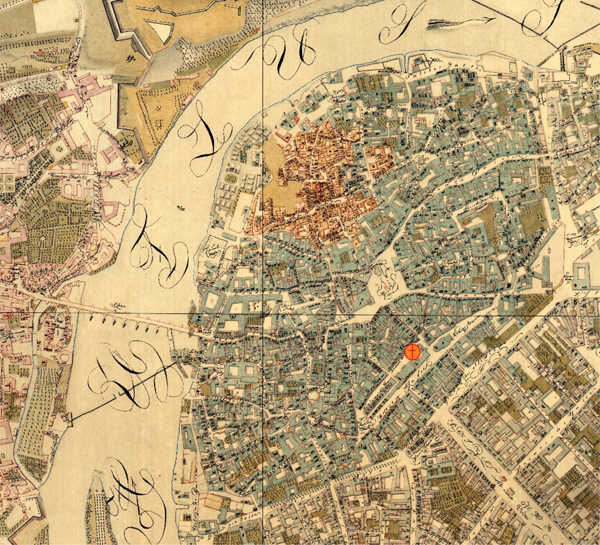
From this description, a casual, uniformed reader might be excused for thinking that the suffocating, cacophonous—and apparently not very laughable—marketplace was situated at the entrance to Prague's Jewish Town. One might be forgiven for thinking that this marketplace abutted Prague's synagogues, its Jewish town hall, or even its medieval Jewish cemetery—the final resting place of Judah Löw ben Betsalel, David Gans, and other distinguished Prague Jews. However, the marketplace—known as Tarmarkt or Tandelmarkt—was more than three hundred meters from the Jewish Town, and it was closer to the Church of St. Gall and to the Carmelite monastery than to any synagogue or house of study (see fig. 1).Footnote 2 All of the warehouses, shops, and stalls in the Tandelmarkt were owned by the Old Town. Jews were not allowed to own property in the Tandelmarkt, let alone live there. Nevertheless, the author of Prag und die Prager—like many of his contemporaries—elided the Jewish Tandelmarkt and the Jewish Town, portraying them as part of a seamless (and unseemly) Jewish space, a suppurating wound in the heart of Prague, characterized by its overcrowded, obstreperous, and oleaginous population, its uncouth and unbecoming rabble, and its unsanitary and unsavory streets.
The Tandelmarkt (or junk market), however, was not part of the Jewish Town, and herein lies its significance. The Tandelmarkt was an identifiably Jewish urban space, but it was a circumscribed, nonresidential exclave that fell under the jurisdiction of the (Christian) Old Town, and not under the jurisdiction of the Jewish Town. An “exclave,” as understood by political geographers, is a part of the territory of one sovereign entity, which is entirely surrounded by the territory of another sovereign entity.Footnote 3 Political geographers generally think in terms of countries and states, not in terms of municipalities and neighborhoods, but the scholarly literature on exclaves—which tends to portray these territorial anomalies as a source of both political instability and economic opportunity—also has bearing on the Jewish Tandelmarkt in Prague.Footnote 4 Indeed, this thriving marketplace afforded Prague's Jews an opportunity to ply their wares in the Old Town, beyond the confines of the overcrowded Jewish Town, but it also left these Jewish peddlers and traders unprotected in the face of physical and verbal attacks. The Tandelmarkt Jews were exposed and vulnerable, but the centrality—and visibility—of the marketplace also allowed non-Jews to observe their “exotic” Jewish neighbors. The Tandelmarkt served as a “theater,” in the words of a nineteenth-century memoirist, where passersby could “lose themselves … for half an hour in its disarray and commotion.” At times, it was a theater of violence, where Jews fell victim to physical and verbal attack. It was also a theater of emancipation, where Jews could show their neighbors—in the heart of the Old Town—that they were capable of self-improvement and change.
Prague's Old Town (in dark gray [blue online]) and Jewish Town (in light gray [yellow online]), 1811–16. The Church of St. Gall, at the northeastern end of the Tandelmarkt, is marked with a red and orange cross. (Source: Map of Prague by Josef Jüttner, 1811–16)

Prague's Jewish Town
The Jewish Tandelmarkt was located in the Old Town, one of four separate medieval towns that were amalgamated into the unified city of Prague in 1784. (The other three towns were the Castle, the Lesser Town, and the New Town.) The Jewish Town (Judenstadt, Židovské Město) was also part of the Old Town (Altstadt, Staré Město), but its inhabitants enjoyed a high degree of internal autonomy, to such an extent that it was sometimes called Prague's “Fifth Town.”Footnote 5 It had its own elected aldermen, its own tax collectors, its own sanitation officials, and its own town hall. Indeed, the Jewish Town Hall, whose tower features a Hebrew-lettered clock, served as a counterpart to the Old Town Hall, with its famous astronomical clock. Built in the seventeenth century, the Jewish Town Hall was situated in the heart of the Jewish Town, next to the thirteenth-century Old-New Synagogue (Altneuschul). There had been a number of Jewish settlements in medieval Prague, but from the fifteenth to the middle of the nineteenth century, Jews were only allowed to acquire property and only allowed to reside in the Jewish Town, unless they received special permission from the Christian authorities.Footnote 6
Throughout this period the circumference of the Jewish Town remained relatively fixed, but its population increased exponentially, from just over a thousand Jews in the mid-sixteenth century, to six thousand Jews in the early seventeenth century, and more than eleven thousand Jews by the beginning of the eighteenth century. On a number of occasions, the territory of the Jewish Town was expanded, but never enough to accommodate the rapid population growth. (In the seventeenth and eighteenth centuries, Christian burghers even tried to reduce the size of the Jewish Town.Footnote 7) Not surprisingly, the inhabitants of the Jewish Town compensated for the lack of space by cramming more people into existing houses, often subdividing apartments among multiple families. After major conflagrations in 1689 and 1754, the Jewish Town was largely rebuilt, but it always suffered from overcrowding.Footnote 8 Wealthier Jews increasingly sought permission to live in the Old Town, or other parts of Prague that were officially off-limits, but the vast majority of Prague's Jews remained in the dense squalor of the Jewish Town until the mid-nineteenth century. “[T]heir houses are divided into an incredible number of small tenements,” wrote an English traveler in 1837, “and several families frequently inhabit one floor. Their furniture, their stalls, their articles for sale, are scattered in the desolation, and this ghetto of the execrated race resembles in its disorder a dung-hill or an offal-tub of men.”Footnote 9 In 1844, another traveler described the Jewish Town as “a labyrinth of narrow, dirty streets and low houses,” but he used a slightly kinder metaphor than his English counterpart. Rather than compare it to a “dung-hill,” he observed that the Jewish Town was “swarming with population like an ant hill.”Footnote 10
While Jews were only permitted to reside in the Jewish Town, they had been permitted to ply their wares outside of the Jewish Town since as far back as the fifteenth or sixteenth century on a small parcel of land just north of the Church of St. Gall in the Old Town. There were plenty of artisans among Prague's Jews—including glassblowers and goldsmiths, sword makers and silversmiths, furriers and tailors, butchers and printers—but the majority of Bohemia's Jews (in Prague and in the countryside) eked out a meager living through petty trade, and the streets and marketplaces of the Jewish Town were not large enough for all of them.Footnote 11 There was only one other place in Prague where they were allowed to sell and store their wares, and this was at the marketplace next to the Church of St. Gall that came to be known as the Jüdischer Tandelmarkt, or Jewish junk market.
Prague's Jewish Tandelmarkt
Jews were not permitted to purchase property outside of the Jewish Town, but they were allowed to lease property in the Tandelmarkt “emphyteutically.” This term, which is derived from Roman law, meant that Jews could sign long-term leases on warehouses (Lagern), vaults (Gewölbe), and shops (Kramstellen), with the proviso that they also cover the taxes (and upkeep) of these properties. For all intents and purposes Jews could lease Tandelmarkt properties in perpetuity, and bequeath them to their children, but this did not come cheaply. In addition to rent, which was paid directly to the Christian landlords, the leaseholders also had to pay taxes to the Old Town municipality. Less affluent Jews could set up tables (Verkaufstische) and booths (Buden) on the streets of the Tandelmarkt in exchange for more modest “stall money” (Standgeld), which was generally collected by the overseers (in Hebrew: gabbaye de-mat tah or memunim ba-shuk) of the Jewish Town.Footnote 12
Until the middle of the nineteenth century, the Jewish Tandelmarkt was the center of Jewish commercial activity in Prague, even surpassing the Jewish Town in importance. According to Věra Leininger's legal history of Prague Jewry, there were 311 Jewish traders on the Tandelmarkt in 1846, compared with only 275 in the Jewish Town.Footnote 13 A century earlier, Pinḥas Katzenellenbogen noted in his Hebrew memoir that the tax collectors “were appointed over the whole Tandelmarkt, where most of the business is conducted.”Footnote 14
Indeed, the Tandelmarkt was an identifiably Jewish space—where Prague's Jews plied their wares, where Jewish Town officials even collected “stall money.” Yet, as an isolated commercial exclave in the heart of the (Christian) Old Town, the Tandelmarkt afforded Prague's Jews none of the security or protection of the autonomous Jewish Town, whose seven gates could be closed at times of danger.Footnote 15 In the Tandelmarkt, the Jewish traders and peddlers were more exposed and more vulnerable, and as such, this Jewish space frequently became a flashpoint in relations between Prague's Jews and Christians. The tensions manifested themselves in both the religious and economic spheres.
On a sunny day, the Jewish Tandelmarkt stood in the shadow of the Church of St. Gall. The Carmelite order, which had owned the church since 1620, must have viewed this as an apt metaphor for the theological relationship between Christianity and Judaism. Built in the thirteenth century—and remodeled several times since—the church was named after St. Gall (or Sv. Havel, in Czech), the seventh-century Irish missionary whose bones are said to rest in the reliquary. In the fifteenth century, Jan Hus, the Czech priest and reformer, delivered a sermon at a nearby church, a fact that the Carmelite monks may not have readily publicized, but the English and German tourist guides most certainly did.Footnote 16 As one tourist guide observed in 1844, “John Huss is said to have lived in the Bethlehem Platz, No. 257, a corner house, opposite to which originally stood the church in which he preached. Near that church is held a species of rag fair, or market of old clothes and other things, called Tandel Markt, the principal dealers being the Jews. It is an amusing and lively scene, and well deserves to be visited.”Footnote 17
The Carmelites did not share this impression of the Tandelmarkt. Far from viewing it as an “amusing and lively scene,” they disparaged it as a noisy and noisome marketplace that diminished the sanctity of the church and disturbed the solemn prayers of its parishioners. They would have more likely agreed with the English traveler who made the following observation in 1837: “All the cries of a cock-pit are soft music to the vociferations of this Jews’ Tandelmarkt in Prague.”Footnote 18 Or the Czech writer, K. L. Zap, who complained in 1835 of the “entangled mix of shouting and cunning Jews and bargaining Jewesses that one cannot escape this labyrinth without a feeling of dizziness.”Footnote 19 Or the German traveler who described it in 1835 as “an army of junk-dealers and shopkeepers crowded together on one spot [who] make a revolting impression on the passers-by.”Footnote 20 These descriptions of the discordant, cacophonous Tandelmarkt resemble contemporary descriptions of the “glib and noisy gabble” of Jews at prayer.Footnote 21 One English traveler even likened the “murmur of talk” in Prague's Altneuschul to “a discussion of questions left unfinished on the Tandelmarkt.”Footnote 22
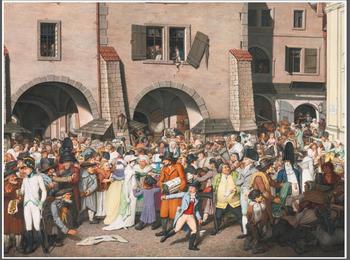
From the seventeenth century onward, the Carmelites repeatedly appealed to the royal and municipal authorities in an effort to ameliorate the intolerable situation. In 1680, they asked the Bohemian Chamber to forbid the Tandelmarkt Jews from plying their wares on St. Gall Square (right in front of the church), from entering the church itself, or from harassing parishioners as they exited the church.Footnote 23 Repeated complaints about the deafening noise of the marketplace led to a Carmelite demand in 1715 that the Tandelmarkt be relocated to another part of Prague. In the end, it was agreed that a three- to three-and-a-half-meter stretch between the Tandelmarkt and the church would be left clear and a separating wall would be built. But the fact that Emperor Charles VI ordered stalls in this area to be torn down in 1716—and then again in 1726—indicates that this agreement was honored more in the breach than in the observance.Footnote 24 (Georg Emanuel Opiz's 1806 painting of the Tandelmarkt depicts stalls right in front of the church; see fig. 2.)
Georg Emanuel Opiz, Tandelmarkt (1806)

The Tandelmarkt was also portrayed as a moral stain on the city, where Jews enticed unwitting customers, sold them shoddy or stolen wares, and worshipped their true god: Mammon. “The never-tiring zeal with which these indefatigable worshippers of Mammon pursue their calling,” wrote John Strang in 1831, “and their boring efforts to palm their wares on all who pass through the market-place, are truly astonishing, though quite characteristic of that money-making propensity which has been wrought into their nature by centuries of intolerance and persecution… . Their flattering tongues, and the tempting things that were offered to us, in fact emptied our purses in a twinkling.”Footnote 25 Other travelers described the cheating, conniving, hoodwinking activities of the Tandelmarkt Jews, their “immodest shouts” (unbescheidene Anrufen), and their “mischievous queries” (Unfug des Anfragens).Footnote 26 Naturally, such observations were often made by Christian traders and merchants, who plied their wares at the nearby Christian Tandelmarkt and viewed the Tandelmarkt Jews as inveterate competitors. In particular, they tried to prevent unlicensed Jews from setting up stalls in nearby streets and to forbid itinerant peddlers (Hausierer) from hawking their goods in the Jewish Tandelmarkt. The Old Town municipality frequently intervened, and often asserted the right to collect “stall money” from the traders—a right to which the Jewish Town municipality also laid claim.Footnote 27 (Contemporary Jewish sources also describe a Tandelmarkt rife with pickpockets and dealers in stolen goods. In these descriptions, however, the Jews are not portrayed as culprits, but rather as unsuspecting victims.Footnote 28)
The noticeable presence of women at the Tandelmarkt is striking, especially in literary and visual depictions of this marketplace. We have already encountered “screeching women's voices” and “bargaining Jewesses” in the descriptions of nineteenth-century travelers. Women shopkeepers and salesgirls are also featured in Selig Korn's The Jewish Gil Blas (1834), a picaresque novel partly set in Prague's Tandelmarkt, which in the author's words, “has been around for as long as the Prague burghers’ intolerance toward the archenemies of Christ.”Footnote 29 Korn describes a wizened old saleswoman quarreling with her husband after losing a sale; a female shopkeeper yelling at a salesgirl for undercharging a customer; and “an army of idle salesgirls offering sundry wares to passersby” as “dolled-up squawkers” fear their competition.Footnote 30 In a chapter entitled “The Salesgirls” (Die Ladendienerinnen), Korn observes that “only the textile and leather shops make do without the servile spirits of the weaker sex,” adding that “all other branches of commerce are plied … chiefly by daughters of Eve.”Footnote 31 Korn displays particular sympathy for the salesgirls at the Tandelmarkt, praising their intelligence and their thirst for knowledge; his protagonist, the “Jewish Gil Blas,” even marries one of the salesgirls and moves with her to Vienna.Footnote 32
The protagonists in Karl Schram's short story “Elkele and Eleonore” (1862) are also salesgirls at the Tandelmarkt, but Schram—a Bohemian-born Jewish writer—does not share Selig Korn's romanticized view of their chosen livelihood.Footnote 33 The Tandelmarkt ruined Elkele's “delicate femininity,” and turned courtship into nothing but a business transaction. “Among those peoples whose women perform manual labor,” Schram notes, “there is no poetry in the relations between the sexes.”Footnote 34 He excoriates the “demoralizing influence of commerce” and the “filthy morals” that it engenders in women. For Schram, women were not suited for “deal-making” (Geschäftemachen), and the presence of so many saleswomen at the Jewish Tandelmarkt was something to be lamented.
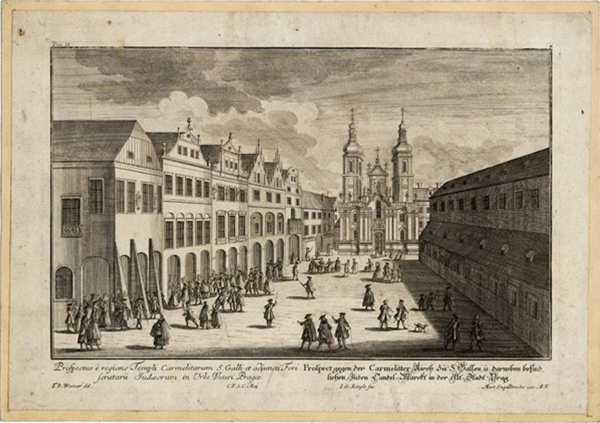
Women are depicted in two famous images of the Tandelmarkt, the first by Johann Georg Ringlin (1691–1761), an Augsburg-born engraver and mapmaker, the second by Georg Emanuel Opiz (1775–1841), a Prague-born writer and painter (see fig. 3).Footnote 35 Ringlin was known for his veduta (detailed cityscapes), and in the 1730s, he made a series of copperplate engravings depicting three of Prague's marketplaces: Old Town Square (Altstädter Ring, Staroměstské náměstí), Small Square (Kleiner Ring, Malé náměstí) and the Jewish Tandelmarkt.Footnote 36 There are eighty-odd people (and one dog) at Ringlin's Tandelmarkt, most of them milling around in front of the vaulted archways, with the Church of St. Gall in the background. A dozen women can be identified by their baroque bonnets and multilayered dresses, and their calm, demure demeanor seems to belie the cacophony and confusion so vividly described by contemporary observers. Opiz's Tandelmarkt, on the other hand, is a burst of color, a whorl of commotion, a flurry of wild, exaggerated gesticulations. It is highly reminiscent of Pieter Bruegel's genre paintings, with Jewish hawkers taking the place of Christian peasants. Like Bruegel, Opiz presents a panoply of animated faces expressing a wide range of emotions—trickery, suspicion, mischief, mockery, gullibility, curiosity, frivolity, and joviality—all with a flair for the comic and grotesque.Footnote 37 Jewish women, wearing kerchiefs (shterntikhlekh) on their heads, make up roughly half the crowd; they are selling onions, ribbons, and fabric; they are gossiping, bargaining, and bickering; and they are intermingling with hat vendors, rag dealers, and other male Jewish hawkers while French soldiers (and their wives) saunter through this most curious Jewish marketplace. (Opiz's painting is from 1806, a year after Napoleon's Grande Armée defeated Austrian and Russian troops at the Battle of Austerlitz.) A flag with Hebrew writing and a Star of David demarcates this as a Jewish space, as do the two fur hats (shtreimlekh) hanging on one of the doors. Nonetheless, the Church of St. Gall, visible on the right side of the painting (behind the onion sellers), serves as a reminder that the Jewish Tandelmarkt is beyond the confines of the Jewish Town.
Johann Georg Ringlin, Prospect gegen der Carmelitter-Kirch zu S. Gallen und danneben befindlichen Juden Tandel-Markt in der Alt-Stadt Prag

A Theater of Anti-Jewish Violence
The religious and economic tensions that embittered relations between Prague's Jews and Christians periodically exploded, and the Jewish commercial exclave abutting the Church of St. Gall was occasionally transformed into a theater of anti-Jewish violence. As Alexandr Putík has observed, this “Jewish island in the Christian district—some 320 meters far from the southern limits of the Jewish Town—was a frequent target of attacks.”Footnote 38 In the late sixteenth century, the overseers of the Tandelmarkt complained to the archbishop of Prague about a certain priest who incited violence against the Tandelmarkt Jews.Footnote 39 At the turn of the seventeenth and eighteenth centuries, violent incidents were reported in the Tandelmarkt on multiple occasions, and Christian students were often the instigators. In 1699, students attacked the Tandelmarkt and stole some ribbons.Footnote 40 On March 29, 1700, a gamekeeper stabbed several people at the Tandelmarkt with a hunting knife, and in June and November of the same year, rioting students wreaked havoc there as well.Footnote 41 Another riot took place in 1701, and two more riots took place in 1702.Footnote 42 During the Prussian-Bavarian siege of Prague in 1744–45, “the masses robbed and plundered the whole Jewish Town for twenty-four hours and then [they plundered] the whole Tandelmarkt until the very last item; fifteen Jews were killed.”Footnote 43 The Jews of Prague, accused of collaborating with the Prussians and Bavarians, were expelled by Empress Maria Theresa in 1745, and when they were readmitted three years later, they quickly secured the right to trade at the Tandelmarkt. An imperial decree from January 18, 1749, guaranteed them this right for one hundred years.Footnote 44
At the end of the eighteenth century, another incident spilled into the Tandelmarkt. Some Christian students attacked a Jew, who then boxed one of them on the ear before some policemen took them away. Afterwards, in the words of a contemporary account, “the students started a general attack on the Jewish Tandelmarkt, and the attack on the Jews, which lasted several days, finally came to an end when the Jew who had been the cause of the [initial] conflict was beaten twenty-five times with a stick.”Footnote 45 Similar violence almost repeated itself in 1819, when the “Hep Hep riots” swept much of the German-speaking world. On the morning of September 13, 1819, the words “Hep Hep” (the rallying cry of the anti-Jewish rioters) were scrawled in chalk on almost all of the shops of the Jewish Tandelmarkt, but the local authorities managed to prevent any anti-Jewish violence from occurring.Footnote 46
The specter of anti-Jewish violence was always present in debates and deliberations about the Jewish Tandelmarkt and the Jewish Town. In the first half of the nineteenth century, imperial and municipal authorities considered various proposals to ameliorate the wretched conditions in these two overcrowded spaces where most of Prague's Jewish peddlers and hawkers plied their wares. Municipal authorities occasionally supported proposals to enlarge the Jewish Town or to allow Jews to conduct business beyond its narrow confines, but Prague's Christian merchants and artisans consistently opposed such initiatives, warning that anti-Jewish riots would inevitably ensue.Footnote 47 Moreover, if overcrowding was the main problem, this could easily be solved by building houses in the one section of the Jewish Town that had not yet been developed: the Old Jewish Cemetery.Footnote 48
The only site in Prague that was more densely “populated” than the Jewish Town was the Old Jewish Cemetery, a sizeable parcel of land where as many as one hundred thousand Jews found their final resting place from the fifteenth century until 1787 (when an imperial decree prohibited burials within the city walls).Footnote 49 In the 1830s–1840s non-Jewish authors developed a fascination with the cemetery and started viewing it as a tourist destination.Footnote 50 At the beginning of the nineteenth century, municipal authorities even proposed building new “ghetto houses” on the site of the cemetery; imperial authorities, however, were reluctant to endorse such a measure, rightly fearing that it would arouse vehement opposition on the part of Prague Jewry.Footnote 51 In 1812, municipal authorities proposed yet another use for the Jewish cemetery: leveling it, turning it into a public marketplace, and relocating the Jewish Tandelmarkt there.Footnote 52 Had this proposal been implemented, it would have removed the Jewish commercial exclave from the Old Town, once and for all.
Jewish merchants also hoped to put an end to this Jewish commercial exclave, not by relocating the Tandelmarkt to the Jewish Town, but by opening the rest of Prague to Jewish commercial activity. In the 1830s and 1840s, more and more Jewish retailers, wholesalers, and manufacturers received permission to reside or ply their wares outside of Prague's Jewish Town, and the Christian lower and lower-middle classes increasingly viewed this “seemingly unstoppable infiltration of Jewish commercial activity … into the ‘Christian Town’” as a grave threat to their livelihood.Footnote 53 The Prague magistracy periodically ordered Jews to leave the “Christian Town” and return to the Jewish Town or the Tandelmarkt. When this happened in 1843, the Prague Jewish community protested the decision, arguing that neither the Jewish Town nor the Tandelmarkt offered favorable enough conditions for business. As the community's petition pointed out, eleven hundred people were crammed into five Tandelmarkt buildings (Höfe), and only by the grace of God had the marketplace been spared the ravages of a major conflagration. Moreover, the petition insisted that lifting restrictions on Jewish commercial activity would carry benefits for the common weal. Increased competition would reduce prices, which had risen precipitously following a string of bad harvests in the early 1840s, and enlightened policies would reduce Jew-hatred, which received nourishment from legislation that treated Jews as a separate group.Footnote 54 Predictably, the Jewish petition encountered strident opposition on the part of Prague's Christian burghers, who submitted a counterpetition in May 1844. If commercial restrictions were lifted, the 365 signatories warned, then “the Jewish Town would swell over and pour into the Christian Town like an unfettered swarm, devouring the fruits of Christian labor like a cloud of locusts [devouring] the fields, and squashing any remaining [Christian] life-force.”Footnote 55 The petition, which certainly did not signal a hoped-for reduction of Jew-hatred, was indicative of the volatile situation in Prague that would soon erupt into violence.
Even if the Prague magistracy had been inclined to relax the restrictions on Jewish commercial activity, the outbreak of workers’ riots in the summer of 1844 radically changed the picture.Footnote 56 On June 18, 1844, Prague's cotton printers attacked the city's textile factories, destroying the recently introduced cotton-printing machines that had already depressed wages and now threatened to make the cotton printers redundant. The targeted factories were owned by Jewish families (Porges, Dormitzer, Brandeis, Schick, and Epstein), and as Hillel J. Kieval has observed, “the riots expanded beyond the bounds of industrial protest and spilled over into acts of violence against Jews generally.”Footnote 57 Indeed, on June 20, as imperial troops tried to maintain order, “street urchins, journeymen and people from the lowest classes” gathered at the Tandelmarkt to vent their anger, and “the Jews and Jewesses were abused there with invectives and physical violence.”Footnote 58 Some days later, the Tandelmarkt served as a staging ground for attacks on Prague's Jewish Town. Hordes of rioters went on a rampage in the Tandelmarkt, scattering goods, upending stalls, and shattering windows, before storming the Jewish Town and wreaking more havoc there until the military finally restored order.Footnote 59
The workers’ riots of 1844, a milestone in the emergence of the Bohemian labor movement, also marked a precipitous deterioration in relations between Prague Jews and their Christian neighbors. The violent episode further emboldened Prague's non-Jewish merchants, shopkeepers, and guildsmen, who redoubled their efforts to place limits on Jewish commercial activity. In 1847, more than 1,800 guildsmen signed an anti-Jewish petition, calling on the authorities to enforce the existing residential and commercial restrictions; otherwise, they warned, “all of Prague will become a huge Jewish Town, where Christians render slave services to the Jews.”Footnote 60 In order to ease the overcrowding, the petitioners recommended that new houses be built on the Old Jewish Cemetery and they even suggested that the old tombstones be reused to shore up the dikes of the Vltava (Moldau) River.Footnote 61
The overcrowding of Prague's Jewish Town was further exacerbated in the 1840s by the ongoing renovation of several Tandelmarkt houses that had fallen into a state of disrepair. Because the shops were leased “emphyteutically,” it was often unclear who was responsible for major repairs, the magistracy or the Jewish leaseholders. In the mid-1840s, four of the larger Tandelmarkt houses were slated for destruction; the magistracy took on the expenses, but it was unclear whether the Jewish peddlers and shopkeepers would be relocated to the Jewish Town or the Christian Town during reconstruction.Footnote 62 There were even discussions of expanding the Jewish Tandelmarkt into the Christian Town, but the Revolution of 1848 erupted before any decisions could be made.
During the Revolution of 1848, the Tandelmarkt was again the target of anti-Jewish hatred, and this time, it was nearly shut down for good. In the early days of the revolution, the Tandelmarkt was attacked, and after the National Guard was called in to restore order, it was temporarily shut down.Footnote 63 In early May, a Prague burgher printed a broadsheet entitled “For Christians and Jews,” in which he outlined steps to be taken to lower the “oppressive relations between Jews and Christians.” In addition to forbidding the residence of Christians in the Jewish Town and Jews in the Christian Town, and reintroducing the Familiants Laws (which only allowed firstborn Jewish sons to marry), the broadsheet proposed the following: “The Jewish Tandelmarkt next to the Church of St. Gall should be shut down and relocated to the [market] in the Jewish Town.”Footnote 64 A few days later, a German Jewish newspaper reported that the Tandelmarkt “had been closed down or will be closed down and a bazaar will be erected on [the site of] the Old Jewish Cemetery.”Footnote 65
Efforts to close or relocate the Tandelmarkt were part of the larger debate on Jewish emancipation in 1848. Many of Prague's burghers, like the one who posted the abovementioned broadsheet, imagined the age-old restrictions on Jewish economic activity to be the last bulwark against the specter of “Jewish domination.” On the symbolic level, shutting down the Tandelmarkt, and relegating its traders and peddlers to the periphery, would not only limit the Jews’ rights, but also their visibility. What more suitable location than the Old Jewish Cemetery?
A Theater of Jewish Emancipation
Prague's Jews also recognized the centrality of the Tandelmarkt in the debates about emancipation. Indeed, its crowded, labyrinthine streets were often contrasted with the more respectable Christian parts of town, just as its shabby, dirty traders were contrasted with the proper and upstanding Christian merchants of the Old Town. The proximity between Jews and Christians often bred contempt, but it also confirmed that they were inhabitants of the same town. If certain Prague burghers wanted to reduce the centrality and visibility of the Tandelmarkt, certain Prague Jews recognized that a Jewish exclave in the heart of the Christian town could highlight their own self-improvement, thereby demonstrating their readiness to integrate into the surrounding society. As a young Prague Jew noted in May 1848, the Tandelmarkt had always been a mark of shame, but it could just as easily become an emblem of progress. Had the spirit of progress found its way in, he wrote,
The Tandelmarkt would not have become a scary phantom for terrified buyers; it would not have become a symbol of deceit … ; it would not have become target of mockery, derision and hate for all enemies of the Jews… . If the powerful voice of progress had made its way into the often windy, labyrinthine spaces of the Tandelmarkt, verily, it would have become impossible for the attacks on Jews—which have been instigated through petty competition [Krämerneid] and self-endangering selfishness, through intrigues and cabals.Footnote 66
Indeed, just as the ambiguous status of the Tandelmarkt—and its distance from the Jewish Town—had made its vendors and peddlers more vulnerable to verbal and physical attack, its centrality—and visibility—allowed them to show they were capable of change. If the Tandelmarkt had historically been a theater of anti-Jewish violence, it could now be transformed into a theater of Jewish emancipation.Footnote 67
Despite strenuous opposition from broad swaths of Habsburg society, including the burghers in Prague, Emperor Franz Joseph I emancipated the Jews of his realm with the octroyed constitution of March 4, 1849. The constitution, which remained in force until December 31, 1851, granted full legal equality to the Jews, which meant that residential and occupation restrictions would inevitably be lifted. As František Roubík put it, “After the proclamation of political equality for all religious confessions, the existence of a separate Jewish Town in Prague became an anomaly.”Footnote 68 As did the existence of a separate Jewish marketplace. On November 22, 1851, the Jewish Town officially ceased to exist as a separate Jewish municipality. Renamed Josefstadt (Josefov), after Emperor Joseph II, the former Jewish Town was incorporated into the city of Prague as the fifth ward. In the words of Cathleen M. Giustino, Prague's Jews were “emancipated from the Jewish Town.”Footnote 69 In theory, this meant that Prague's Jews had the freedom to work and live anywhere in the city, but in practice, many of the residential and occupational restrictions remained in place until 1859.Footnote 70
After 1859, Prague's Jews finally had the freedom to work and live anywhere in the city, and this freedom of movement transformed the demographic character of both Josefstadt/Josefov and the Jewish Tandelmarkt. As prosperous Jews moved out of the former Jewish Town and opened shops outside of the Tandelmarkt, these formerly “Jewish spaces”—like the city as a whole—began attracting a largely Czech-speaking, working-class, Catholic population. Josefov remained Prague's poorest and most densely populated ward, and by the 1880s, it had “the highest rate of prostitution” in the whole city.Footnote 71 At the turn of the century, it was largely demolished—and then rebuilt—as part of an urban renewal project aptly named “Finis ghetto.” (The Jewish cemetery was largely spared, though its northernmost end was leveled during the ghetto clearance.)
The Tandelmarkt continued to exist, but it ceased to be a Jewish exclave in the midst of Prague's Old Town.Footnote 72 To be sure, Jewish hawkers, peddlers, and shopkeepers remained a conspicuous presence there, but Jews could now open shops elsewhere in Prague. Indeed, those who plied their wares in the Tandelmarkt, like those who remained in Josefstadt/Josefov, generally lacked the financial means to relocate to other parts of the city. In 1857, Walter White, an English traveler, described the shabbily dressed, wildly gesticulating Jews of the Tandelmarkt in terms that were already familiar from earlier travelogues: “As you wander among the stalls, and push between the busy groups, noting how much of the merchandise appears utterly worthless,” he added, “you will find cause enough for laughter and for lamentation.”Footnote 73
By the 1870s, however, the “laughter” and “lamentation” gradually gave way to a whimsical nostalgia, as writers such as Johanna Rottová (1830–99) reminisced about the Tandelmarkt of their youth. Better known by her pen name, Karolina Světlá, Johanna Rottová was one of the most important Czech novelists of the nineteenth century. In her autobiography, first published in 1874, she portrayed the Tandelmarkt as a contact zone where she and her schoolmates had been able to brush up against—and steal a glance of—Prague's peculiar Jewish inhabitants.Footnote 74 She wrote,
Prior to 1848 the Tandelmarkt provided us with a theater [divadlo] that today can perhaps only be seen in some forgotten Polish town at the annual fair. It was among the memorable sights of the city, and few leisure travelers could resist losing themselves there for half an hour in its disarray and commotion. If the foreigner was in a good mood, then he surely ventured into the chaotic crashing of its waves, and for fun, he also let a piece of his coat get torn or let himself get cheated out of twenty hellers. Surely he did not regret this sacrifice, because what he saw, heard and discovered on that occasion was well worth it and certainly stayed in his memory forever. We also entertained ourselves by pressing through the Tandelmarkt on our way back from school, listening to the jargon [Yiddish] reverberating there, witnessing the characteristic scenes, and for a moment being pushed, pulled, yanked, etc. But never did we interpret these peculiarities of the Jews in a bad way; we always ascribed all of their flaws to the injustice that we saw other people treat them with. We kept them surrounded with a martyr's glow and gave them the warmest sympathy, until we sensed that, after finally attaining their desired freedom, they single-mindedly used it to enrich themselves and to help the oppressors of our nation in every way, as if they themselves never knew what it was like to be oppressed.
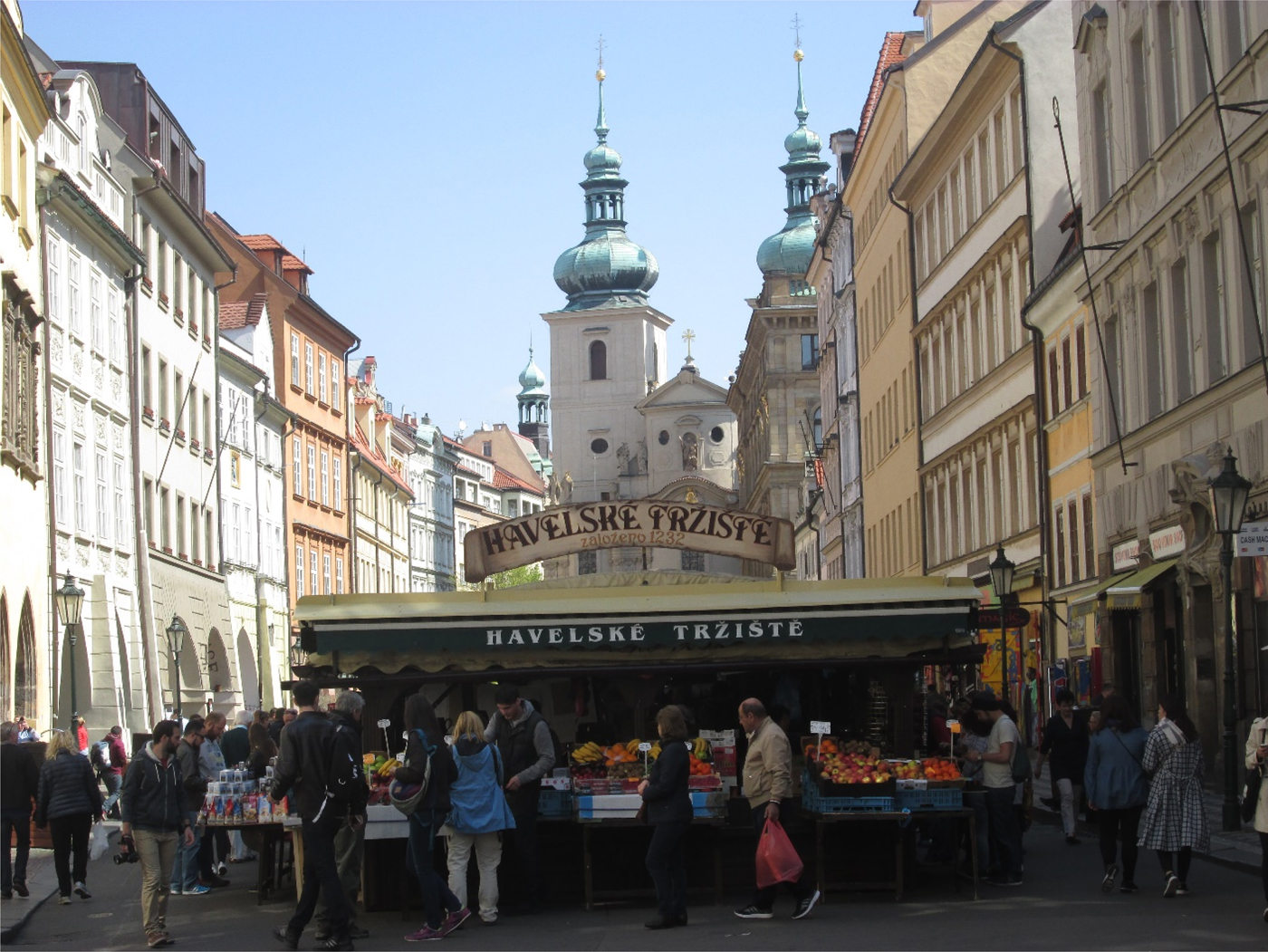
When Světlá (Rottová) penned these words, the Tandelmarkt was no longer a distinctively “Jewish space.” It was more commonly called Galliplatz (in German) or Havelské tržiště (in Czech)—which is how it is still known today (see fig. 4).
Havelské tržiště, 2016. Photo by author.

Světlá harked back to a time when Prague's Jews knew their place—both figuratively and literally—in the increasingly contested cityscape. In so doing, she unwittingly echoed the sentiments of the Prague burghers who, for centuries, had objected to lifting—or even relaxing—the commercial and residential restrictions that were in place. Prague's burghers cast the Jews as enemies of Christendom, arguing that without these restrictions, “all of Prague [would] become a huge Jewish Town, where Christians render slave services to the Jews.” Světlá, in contrast, framed the antagonism in national terms. Once the restrictions were lifted, she lamented, the Jews used their freedom “to enrich themselves and to help the oppressors of our nation in every way.” To Světlá, a Czech novelist and nationalist, the “oppressors of our nation” were the Germans, and she implicitly condemned the Jews for siding with them in the cultural, political, and economic spheres. She seemed to long for a time when the Jews were an exotic spectacle, cordoned off in their own residential enclave and a commercial exclave, and not part of Prague's larger body politic.