Introduction
Research suggests that smoking cessation is associated with increased happiness (Kahler et al., Reference Kahler, Spillane, Day, Clerkin, Parks and Leventhal2014; Mathew et al., Reference Mathew, Robinson, Norton, Cinciripini, Brown and Blalock2013; Shahab & West, Reference West2009, Reference Shahab and West2012; Wang, Wang, Lam, Viswanath, & Chan, Reference Wang, Wang, Lam, Viswanath and Chan2014). This association has not yet been studied in parents, a population that generally encounters greater negative emotions, sleep disturbance, financial difficulties, and more troubled marriages compared to adults who are not parents (Nelson, Kushlev, & Lyubomirsky, Reference Nelson, Kushlev and Lyubomirsky2014). A common role for paediatricians is helping parents cultivate resilience in the face of stressful life circumstances (Zand, Braddock, Baig, Deasy, & Maxim, Reference Zand, Braddock, Baig, Deasy and Maxim2013). Other health professionals such as general practitioners play a similar role in their care for families. While more than a decade of research demonstrates that efforts toward family-wide smoking cessation should be considered a fundamental aspect of paediatric practice (Winickoff et al., Reference Winickoff, Berkowitz, Brooks, Tanski, Geller and Thomson2005, Reference Winickoff, Park, Hipple, Berkowitz, Vieira and Friebely2008, Reference Winickoff, Hipple, Drehmer, Nabi, Hall and Ossip2012), it is not known if parental smoking cessation is associated with increased happiness and life satisfaction.
By helping parents quit smoking, paediatricians have the potential to improve the health of all family members. Unfortunately, efforts in the paediatric setting to provide evidence-based assistance to parents who smoke are strikingly low (Nabi-Burza et al., Reference Nabi-Burza, Regan, Drehmer, Ossip, Rigotti and Hipple2012; Winickoff et al., Reference Winickoff, McMillen, Carroll, Klein, Rigotti and Tanski2003). In a previous study, we found that the mean rate for delivering meaningful assistance for parental cigarette smoking was only 3.5% (range 0–8%) in the control group (Winickoff et al., Reference Winickoff, Nabi-Burza, Chang, Finch, Regan and Wasserman2013). An American Academy of Pediatrics (2006) Periodic Survey of Fellows highlighted barriers toward counselling of parents who smoke and found that 39% of paediatricians were unsure that paediatrician advice is one of the best ways to help parents stop smoking and only 17% of paediatricians believed parents wanted their help to stop smoking. Another survey showed that 20% of paediatricians believed delivering parental smoking cessation services would cause anger in parents (Pérez-Stable et al., Reference Pérez-Stable, Juarez-Reyes, Kaplan, Fuentes-Afflick, Gildengorin and Millstein2001). These percentages underscore the clinical importance of this study as many paediatricians appear unconvinced that helping parents quit smoking has lasting positive impacts on the paediatrician/parent relationship and this apprehension likely discourages child health care clinicians from providing assistance for parental smoking.
Research on the broaden-and-build theory of positive emotions has demonstrated that positive emotions trigger responses in people that may be beneficial when quitting smoking such as discovering new ways of thinking and behaving, enhancing emotional well-being, and building psychological resilience and the ability to cope with adversity (Fredrickson, Reference Fredrickson2001; Fredrickson & Joiner, Reference Fredrickson and Joiner2002). Understanding that parents derive positive emotions from quitting smoking can lead to developing new clinical strategies that may increase the chances that parents remain smoke-free. Furthermore, the knowledge gained from this study can aid in devising more effective health promotion messages to encourage quit attempts and increase smoking parents’ perceived benefits of quitting.
This study's first objective was to assess if quitting smoking was associated with increased parental happiness. Our second objective was to identify characteristics that were associated with increased happiness among parental quitters. According to the theory of authentic happiness, happiness consists of multiple elements: positive emotion, engagement, and meaning (Seligman, Parks, & Steen, Reference Seligman, Parks and Steen2004). Therefore, we hypothesized that parental quitters would report greater happiness, if they had engaged with cessation assistance such as a quitline, an online cessation assistance program, or nicotine replacement therapy while quitting than those who did not use these resources. We also hypothesized that parents who attributed greater meaning to quitting (i.e., quitting is more important to overall well-being and continuing to smoke would be more harmful to health) would be happier upon quitting. Similarly, we thought parents who reported greater parent/smoker role conflict would be happier after successfully quitting smoking. We also examined if goal-setting in relation to setting smoke-free home and car policies was associated with increased happiness among quitters. Lastly, self-efficacy has been identified in a number of studies as a predictor of succeeding with quit attempts (Ockene et al., Reference Ockene, Emmons, Mermelstein, Perkins, Bonollo and Voorhees2000; Smit, Hoving, Schelleman-Offermans, West, & de Vries, Reference Smit, Hoving, Schellerman-Offermans, West and de Vries2014), though the generalizability of these findings under different conditions remains unclear (Gwaltney, Metrik, Kahler, & Shiffman, Reference Gwaltney, Metrik, Kahler and Shiffman2009). We hypothesized that parents who had more confidence about being able to remain quit would also report more happiness after quitting smoking as previous research suggests there is an association between changes in general self-efficacy and changes in positive affect (Schutte, 2014).
Methods
Design
The data were collected as part of a larger randomized controlled trial, the Clinical Effort Against Secondhand Smoke Exposure (CEASE). This trial studied the implementation of an intervention to deliver smoking cessation services and smoke-free home and car advice to families in the outpatient paediatric office setting, and practices were randomized to an intervention or an usual care control arm (Winickoff et al., Reference Winickoff, Nabi-Burza, Chang, Finch, Regan and Wasserman2013). The trial was conducted in 20 paediatric offices recruited by Pediatric Research in Office Settings (PROS), a national network of paediatric practices within the practice-based research network of the American Academy of Pediatrics (Slora, Harris, Bocian, & Wasserman, Reference Slora, Harris, Bocian and Wasserman2010). The study protocol was approved by the Institutional Review Boards of the American Academy of Pediatrics, Massachusetts General Hospital and by individual practice review boards as necessary. Data were collected from 2009 to 2012.
Recruitment
Research assistants at each practice administered a screening questionnaire to adults exiting the paediatric office after their child's visit, with the goal of screening all adults. Adults who accompanied a child to an office visit were eligible to participate if they were a parent or legal guardian of the child, over 18 years old, English speaking, and reported they had “smoked a cigarette, even a puff, in the past 7 days.” The research assistant obtained informed consent from eligible parents, administered an enrollment survey and gave $5 to each parent upon completion of the survey. The research assistant continued consecutively screening all adults leaving the office until approximately 100 parents were recruited at each practice. The enrolled parents were prospectively followed and participated in a telephone survey at 12 months.
Measures
Each parent was asked if he/she had “smoked a cigarette, even a puff, in the past 7 days” at the baseline exit interview and at a follow-up telephone survey conducted at 12 months. Parents were considered to have quit smoking at 12 months, if he/she reported not smoking a cigarette, even a puff, within the past 7 days.
Parents’ level of happiness was measured at the 12-month interview using a single-item scale similar to those previously used in large-scale surveys such as the European Social Survey, the General Social Survey, the World Values Survey, and the British Household Panel Survey (Nelson et al., Reference Nelson, Kushlev and Lyubomirsky2014). Measuring happiness using a single-item self-rating scale has been demonstrated to be a reliable, valid, and appropriate method to measure happiness for large-scale surveys (Abdel-Khalek, Reference Abdel-Khalek2006). All interviewed parents were asked the following question: “On a 1 to 10 scale of general happiness, where 1 is ‘a very unhappy person’ and 10 is ‘a very happy person,’ how happy do you consider yourself?”
An additional measure of happiness reported by Shahab and West (Reference Shahab and West2009) in their study of happiness and smoking cessation in adult populations was asked of parents who successfully quit smoking at 12 months. Parents were asked, “Which of the following three statements best applies to you:
-
1. I feel happier now than when I was smoking,
-
2. I feel about the same now as when I was smoking, or
-
3. I feel less happy now than when I was smoking.”
Other variables measured at 12 months included ten-level Likert scale questions with responses coded from 1 (not at all) to 10 (extremely). Parents rated the statements, “How likely is it that continuing to smoke would have harmed you?” and “How likely is it that continuing to smoke would have harmed your children?” Parents rated “How important is it for your overall well-being that you successfully quit?” as well as “How important is it for your child's overall well-being that you successfully quit?” Additionally, parents were asked to rate “How confident are you that you can remain quit?” to assess abstinence self-efficacy.
The following variables were also measured at 12 months: whether or not the parent (1) used a form of evidence-based cessation assistance including a telephone quitline, a website/online program or a form of nicotine replacement therapy, (2) agreed with the statement, “My being a smoker got in the way of my being a parent” to assess parent/smoker role conflict (Friebely et al., Reference Friebely, Rigotti, Chang, Hall, Weiley and Dempsey2013), and (3) agreed with the statement, “Breathing air in a room today where people smoked yesterday can harm the health of babies and children” to assess thirdhand smoke harm belief (Social Climate of Tobacco Control, 2013). Additionally, the 12-month survey assessed if parents had a strictly enforced smoke-free home or car policy defined as having both a rule prohibiting smoking as well as reporting that no one had smoked in the home or car in the past three months. Parent's age and self-reported number of cigarettes smoked per day at baseline enrollment were also collected.
Analysis
Multivariable logistic regression was used to examine if parents’ level of general happiness at 12 months was independently associated with self-reported quitting at 12 months. Parent sex, age, education, race and ethnicity, the self-reported number of cigarettes smoked per day at baseline, and study arm assignment to the intervention or control arm were included in the model as control variables. A t-test was also conducted to determine if there was a difference in mean level of general happiness at 12 months based on attending a practice assigned to the control or intervention group.
Parents’ responses to the Shahab & West (Reference Shahab and West2009) measure of happiness for those who quit smoking were dichotomized as: (1) feeling happier or (2) feeling about the same or less happy, and t-tests were used to compare means of continuous dependent variables for the dichotomized happiness variable at 12 months following enrollment. Multivariable logistic regression models were constructed to examine the association between feeling happier compared to when smoking and each predictor variable while controlling for parent sex, age, education, race and ethnicity, and self-reported number of cigarettes smoked per day at baseline. The analysis for the car-related item was limited to parents who reported having a car. Parents with missing data were not included in the analyses. All results were evaluated using a significance level of p < 0.05. Systat 13 was used for the statistical analysis.
Results
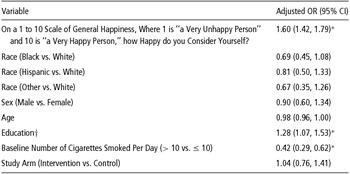
Baseline exit interviews were completed with 1980 smoking parents following a paediatric office visit and 1,355 parents completed the 12-month follow-up interview. The logistic regression model reveals the odds of quitting smoking at the 12-month follow-up interview increased by 60% for each single point increase on the 10-point happiness scale (95% CI: 1.42–1.79) after controlling for the other independent variables in the model. (Table 1) presents the adjusted odds ratios of the independent variables included in the model for quitting smoking at 12 months. There was no difference between means for parents’ level of general happiness based on attending a practice assigned to the control or intervention arm of the study, t(1,343) = 1.74, p = 0.08.
Adjusted odds ratios and 95% confidence intervals for quitting smoking at 12-months (N = 1355)

*p < 0.05.
†Four-level item (1 = < High school, 2 = High school graduate, 3 = Some college, 4 = College graduate).
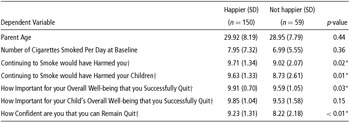
Data were analysed from a total of 209 parents who reported quitting smoking and who responded to the happiness item developed by Shahab & West (Reference Shahab and West2009) on the 12-month follow-up survey; 150 (71.8%) reported they were happier, 54 (25.8%) felt about the same, and only 5 (2.4%) said they felt less happy compared to when they had been smoking. The mean number of days that elapsed between parents’ self-reported quit date and their happiness rating was 154 days (SD = 129).
Parents who reported feeling happier compared to when they were smoking had a significantly higher mean rating for believing that continuing to smoke would have harmed themselves, t(78.0) = −2.38, p = 0.02, and their children, t(70.3) = −2.54, p = 0.01, compared to parents who reported feeling the same or less happy. Similarly, parents who felt happier reported higher mean ratings that quitting smoking was more important for their overall well-being than parents who felt the same or less happy t(78.7) = −2.16, p = 0.03. Happier parents also indicated higher mean scores about how confident they were that they would remain quit compared to parents who were the same or less happy t(74.9) = −3.32, p < 0.01. Results are presented in (Table 2).
Differences between means of dependent variables based on parents reporting feeling happier vs. not happier after quitting smoking

*p < 0.05.
† Ten-level Likert scale (1 = not at all, 10 = extremely).
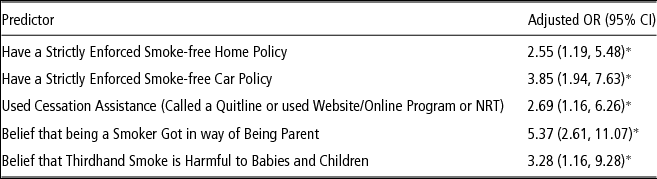
Adjusted odds ratios displayed in (Table 3) show parents who had a strictly enforced smoke-free home policy (aOR = 2.55, 95% CI = 1.19–5.48), had a strictly enforced smoke-free car policy (aOR = 3.85, 95% CI = 1.94–7.63), reported using cessation assistance such as NRT, calling a quitline or enrolling in an online program (aOR = 2.69, 95% CI = 1.16–6.26), believed that being a smoker got in the way of being a parent (aOR = 5.37, 95% CI = 2.61–11.07), and believed that thirdhand smoke is harmful to babies and children (aOR = 3.28, 95% CI = 1.16–9.28) were more likely to report feeling happier after quitting smoking.
Adjusted odds of parents reporting they feel happier after quitting smoking (N = 209)

*p < 0.05.
Note: Parents with missing data were not included in analyses. Each model included parent sex, parent age, parent education, parent race and ethnicity, and number of cigarettes smoked per day at baseline, all not significant.
Discussion
To our knowledge, this is the first study to show that happiness was associated with quitting smoking in parents. The majority (71.8%) of parents reported increased happiness after quitting and only a very small minority (2.4%) said they felt less happy. These results corroborate the findings in a previous study that determined 69.3% of adults reported increased happiness after quitting and only 3.3% were less happy (Shahab & West, Reference Shahab and West2009); the findings have important implications for clinical paediatric practice and health promotion. Letting paediatricians know that most parents who smoke report being happier when quitting may facilitate communication with parents around cessation and encourage delivery of meaningful tobacco control assistance in paediatric practice. It may also be particularly important information to communicate to parents who smoke, to strengthen their motivation to persist with quit attempts.
Smokers often hold perceptions that emphasize the benefits of smoking (West, Reference West2009). For instance, perceptions persist that smoking helps relieve stress (McEwen, West, & McRobbie, Reference McEwen, West and McRobbie2008) and quitters suffer as a result of losing an effective coping mechanism (Smith & Malone, Reference Smith and Malone2013), yet these commonly held beliefs propagate self-fulfilling prophecies that increase the likelihood of being unsuccessful in quitting smoking (Gilbert & Warburton, Reference Gilbert and Warburton2003). Inadequate coping often leads to a relapse of smoking (Friedman-Wheeler et al., Reference Friedman-Wheeler, Haaga, Gunthert, Ahrens and McIntosh2008), and holding beliefs that the resumption of smoking will help restore feelings of happiness in times of stress increase a quitter's desire to start smoking again (West, Reference West2009; Yong & Borland, Reference Yong and Borland2008). Therefore, health promotion messages that combat these misperceptions regarding the happiness benefits of smoking by countering that quitting smoking is associated with increased happiness may serve to increase parents’ motivation to remain quit.
A number of studies have demonstrated that people experience decreased anxiety after quitting smoking (Cohen & Lichtenstein, Reference Cohen and Lichtenstein1990; Hajek, Taylor, & McRobbie, Reference Hajek, Taylor and McRobbie2010; McDermott, Marteau, Hollands, Hankins, & Aveyard, Reference McDermott, Marteau, Hollands, Hankins and Aveyard2013; West & Hajek, Reference West and Hajek1997). Even among individuals with depression, research has shown that cessation does not increase the likelihood of exacerbating depression (Shahab et al., 2014; Shahab, Andrews, & West, Reference Shahab, Andrews and West2013). There is some evidence that those who try to quit and are unsuccessful may experience an increase in anxiety, though research does not support the widely held belief that smoking is effective at reducing stress (McDermott et al., Reference McDermott, Marteau, Hollands, Hankins and Aveyard2013). Instead successful smoking cessation has been shown to be associated with mental health benefits in this study and others (Cohen & Lichtenstein, Reference Cohen and Lichtenstein1990; Hajek et al., Reference Hajek, Taylor and McRobbie2010; Shahab & West, Reference Shahab and West2009). Educating both smokers and health care providers about the mental health benefits of quitting could encourage cognitive reframing away from exaggerated negative expectancies of quitting toward a more hopeful outlook for both smokers and health care providers.
The analysis also identified factors amenable to volitional control that are associated with increased feelings of happiness among parents who quit: (1) engaging in evidence-based cessation assistance, (2) attributing greater personal meaning to quitting, (3) experiencing parent/smoker role conflict, (4) having strictly enforced smoke-free home and car policies, and (5) having stronger feelings of self-efficacy about remaining quit.
The analysis revealed that parents who successfully quit smoking reported higher levels of happiness when they reported utilizing at least one form of evidence-based cessation assistance such as a quitline, an online cessation assistance program, or nicotine replacement therapy than parents who did not use any form of cessation assistance. A recent study showed that keeping people engaged with an internet-based smoking cessation intervention was positively associated with positive affect (Bränström, Penilla, Pérez-Stable, & Muñoz, Reference Bränström, Penilla, Pérez-Stable and Muñoz2010). These findings are consistent with a line of research in the positive psychology literature that demonstrates intentional activity-based changes that involve effort and engagement are more strongly associated with happiness than positive circumstantial changes which are more weakly associated with sustained happiness (Lyubomirsky, Sheldon, & Schkade, Reference Lyubomirsky, Sheldon and Schkade2005; Sheldon & Lyubomirsky, Reference Sheldon and Lyubomirsky2006).
Several associations with happiness that are consistent with parents attributing meaning to quitting smoking were also identified. Research has demonstrated that positive affect and psychological well-being increase when people pursue goals for intrinsic purposes and perceive their goals as important (Diener, Oishi, & Lucas, Reference Diener, Oishi, Lucas, Lopez and Snyder2009; Sheldon & Kasser, Reference Sheldon and Kasser1998). Parents who reported being more concerned that continuing to smoke would have harmed themselves or their children were more likely to report being happier after quitting smoking. Likewise parents who agreed that thirdhand smoke is harmful to children reported being happier after they quit compared to parents who quit and did not believe thirdhand smoke is harmful. Parents who believed more strongly that quitting smoking was important for their overall well-being were more likely to report being happier after quitting than parents who did not consider quitting smoking as important to their well-being. By helping parents associate meaning with their quit attempts, paediatricians may be able to aid in increasing the positive feelings parents derive from quitting. Research on the broaden-and-build theory of positive emotions has also demonstrated that positive meaning-finding increases people's resilience and ability to cope with stress (Tugade & Fredrickson, Reference Tugade and Fredrickson2004). As well, parents who reported experiencing parent/smoker role conflict indicated they were happier after quitting smoking. This finding suggests that parents who were experiencing cognitive dissonance between their identity as a parent and their identity as a smoker and acted to resolve that conflict by quitting smoking felt more happiness than quitters who did not experience this role conflict.
Feelings of happiness increase when people become actively involved in making progress towards valued goals (Myers & Diener, Reference Myers and Diener1995). Recent research suggests that setting specific, concrete prosocial goals similar to the smoke-free home and car policies examined in this study are associated with increased happiness (Rudd, Aaker, & Norton, Reference Rudd, Aaker and Norton2014). The analysis demonstrated the association of striving after concrete goals and happiness by showing parents who had set strictly enforced smoke-free home and car policies and had enforced them for at least three months report being happier after they quit smoking than parents who did not have strictly enforced smoke-free policies for their home and car. Pursuing appropriate goals is recognized as an important component of happiness (Watson, Reference Watson, Snyder and Lopez2002), therefore clinicians in the paediatric setting may find added benefit in assisting parents with setting meaningful self-concordant goals such as enforcing smoke-free home and car policies.
Higher abstinence self-efficacy, as measured by the question “How confident are you that you can remain quit?,” was positively associated with happiness in parents who reported they had quit. This finding is supported by a prior study that found an inverse association between abstinence self-efficacy and the expected positive effects of smoking (Gwaltney, Shiffman, Balabanis, & Paty, Reference Gwaltney, Shiffman, Balabanis and Paty2005). Parents with low confidence about remaining quit might benefit from counselling that boosts self-efficacy, as it has been proposed that self-efficacy might play an important role in the broaden-and-build process (Schutte, 2014). Motivational Interviewing is one example of a counselling technique designed to increase self-efficacy that has been used by paediatric primary care providers with parents (Resnicow et al., Reference Resnicow, McMaster, Woolford, Slora, Bocian and Harris2102) that could be tested to determine its influence on the happiness of parents who quit smoking.
Research on the broaden-and-build theory of positive emotions has established that positive emotions and broad-minded coping reciprocally and prospectively enhance one another (Fredrickson & Joiner, Reference Fredrickson and Joiner2002). Fredrickson & Joiner (Reference Fredrickson and Joiner2002) refer to this process as creating upward spirals of well-being. Future research should not only examine the degree to which smoking cessation leads to more happiness, but also determine if increasing happiness can be used as a risk reduction strategy in smoking cessation interventions as there is mounting evidence that suggests happiness often precedes a variety of successful outcomes (Lyubomirsky, King, & Diener, Reference Lyubomirsky, King and Diener2005). Recent analyses performed on smoking cessation interventions lend support to this theory as baseline positive affect was associated with abstinence at follow-up (Doran et al., Reference Doran, Spring, Borrelli, McChargue, Hitsman and Niaura2006) and positive affect increased persistence to quit smoking (Bränström et al., Reference Bränström, Penilla, Pérez-Stable and Muñoz2010).
Limitations of this study include recognizing that the happiness ratings may have been influenced by self-justification bias. Future studies may benefit from including a baseline measure of happiness from which to compare the post-quit measure and prospectively evaluating how the modifiable parental characteristics predict increased happiness. As is always the case with self-report data, the items analysed in this study may not accurately reflect the true incidence of quitting and the other behaviours examined.
Conclusion
Happiness was shown to be independently associated with quitting smoking in a large U.S. national sample of parents. The majority of parents reported feeling happier after quitting smoking, thus challenging a barrier to quitting for those who anticipate stopping smoking will inevitably result in suffering negative affect (Gilbert & Warburton, Reference Gilbert and Warburton2003). This knowledge could increase smoking parents’ perceived benefits of quitting and may boost their motivation to quit as well as help facilitate communication between clinicians and parents around cessation and encourage delivery of meaningful tobacco control assistance in paediatric practice. Implications for clinical practice include providing cessation assistance to smokers with the understanding that most parents who quit smoking report increased levels of happiness. Health promotion activities should focus on developing new evidence-based prevention strategies that draw on happiness experienced by parents who quit smoking.
Acknowledgements
We especially appreciate the efforts of the PROS practices and practitioners. The paediatric practices that enrolled participants in the larger study are listed here by AAP Chapter: Alaska: Anchorage Pediatric Group, LLC (Anchorage); Connecticut: Hospital of Saint Raphaels (New Haven); Illinois: Community Health Improvement Center (Decatur); Maryland: Cambridge Pediatrics LLC (Waldorf); Massachusetts: Quabbins Pediatrics (Ware), RiverBend Medical Group - Springfield Office (Springfield); Missouri: Priority Care Pediatrics LLC (Kansas City); New Mexico: Las Vegas Clinic for Children and Youth, PA (Las Vegas); Ohio: Bryan Medical Group (Bryan), The Cleveland Clinic Wooster (Wooster); Oklahoma: Shawnee Medical Center Clinic (Shawnee); Oregon: Siskiyou Pediatric Clinic LLP (Grants Pass); Pennsylvania: Pennridge Pediatric Associates (Sellersville); South Carolina: Inlet Pediatrics (Murrells Inlet); South Dakota: Avera McGreevy Clinic (Sioux Falls); Tennessee: Raleigh Group PC (Memphis); Virginia: Pediatrics of Kempsville PC (Virginia Beach), Riverside Pediatric Center (Newport News), The Clinic (Richlands); West Virginia: Shenandoah Community Health Center (Martinsburg).
Financial Support
This study was supported by the National Institutes of Health NCI grant R01-CA127127 (to Dr. Winickoff), National Institute on Drug Abuse, and the Agency for Healthcare Research and Quality. This study was also partially supported by a grant from the Flight Attendant Medical Research Institute to the AAP Julius B. Richmond Center, and the Pediatric Research in Office Settings (PROS) Network, which receives core funding from the HRSA MCHB (HRSA 5-UA6-10-001) and the AAP.
Conflict of Interest
None.
Ethical Standards
The authors assert that all procedures contributing to this work comply with the ethical standards of the relevant national and institutional committees on human experimentation and with the Helsinki Declaration of 1975, as revised in 2008.