I THE QUESTIONS
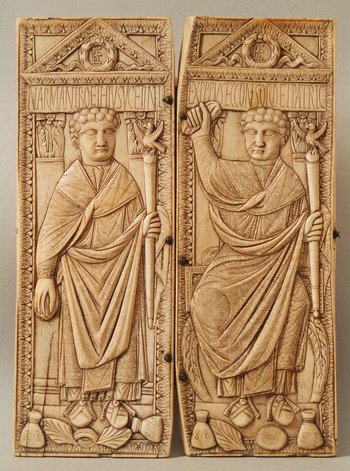
Beginning in the last quarter of the fourth century, members of the Roman élite commemorated the holding of certain offices and a variety of other occasions by the distribution of ivory diptychs, two often elaborately carved panels joined with a hinge or clasp so that they could be closed like a codex. The earliest securely dated example we have is that of Anicius Probus, consul in 406, though several others have been assigned with varying degrees of plausibility to late fourth-century Rome on historical and stylistic grounds. The most famous is the diptych that commemorates members of two of the great fourth-century pagan families, the Symmachi and Nicomachi. On this basis it has been generally assumed that the custom originated in late fourth-century Rome. Most of those that survive commemorate consuls of the late fifth and sixth centuries, whence the informal but (as we shall see) misleading categorization of the entire genre as ‘consular diptychs’.Footnote 1
This paper attempts to explain (1) how and why diptychs made of ivory came to play this rôle; to show (2) that they were not originally distributed by consuls but by any official who provided games; (3) that they had nothing to do with the ecclesiastical diptychs that, coincidentally, are first heard of at about the same time; (4) that the custom spread from east to west, not as hitherto assumed, from west to east; and (5) that the earliest western consular diptychs are not illustrated with scenes from games because there were no multi-day consular games at Rome before the fifth century.
II ORIGINS
Although there is no direct evidence on the origin of the practice, there can be little doubt why what I would prefer to call presentation diptychs took the form they did. From as early as the first century a.d., formal letters of appointment to office were known as codicilli, ‘little books’, or in (literary) Greek δελτοί, evidently because the imperial letter was despatched or presented in the form of a writing-tablet, two or more flat, rectangular pieces of (usually) wood joined by cord or metal clasps, coated with wax on the inside surface of both leaves for writing.Footnote 2 None survive in their original form, but we do have one contemporary copy of the letter of appointment they carried. Marcus Aurelius' letter appointing Domitius Marsianus procurator patrimonii of Narbonensis, publicly inscribed in Bulla Regia in North Africa under the heading ‘copy of the codicils’ (exemplum codicillorum), is brief and informative enough to be cited in full:Footnote 3
Exemplum codicillorum: Caesar Antoninus Aug(ustus) Domitio Marsiano suo salut(em). ad ducenariae procurationis splendorem iamdudum te provehere studens utor opportunitate quae nunc [o]btegit. succede igitur Mario Pudenti tanta cum spe perpetui favoris mei, quantam conscientiam retinueris innocentiae diligentiae experientiae. Vale, mi Marsiane, karissime mihi.
Copy of his codicils: Caesar Antoninus Augustus to his own Domitius Marsianus, greetings. Having long been eager to promote you to the splendour of a procuratorship at 200,000 sesterces, I seize the opportunity which now offers. Succeed therefore to Marius Pudens with every hope of my continued favour, so long as you know yourself to retain your integrity, diligence and experience. Farewell, my Marsianus, dearest to me.
Epictetus represents a proconsul of Achaea saying that ‘Caesar wrote me a codicil’ (Καῖσάρ μοι κωδίκελλον ἔγραψε),Footnote 4 and according to Suetonius, Claudius' codicils granting offices were ‘substituted or even openly altered’ by his freedmen.Footnote 5 Whoever made the actual decision, codicils of office were evidently presented in the form of a personal letter from the emperor. As late as the tenth century, the Book of Ceremonies shows officials receiving codicils of office directly from the emperor's hand. The formulas for the various offices preserved among Cassiodorus' Variae give some idea what the text of late antique codicils looked like, though earlier examples were obviously much shorter and less verbose.
Nothing suggests that early imperial codicils of office were made from precious materials. One of a series of epigrams by Martial on writing-tablets of various materials and sizes describes one of five leaves that confers high office on a man (‘quinquiplici cera cum datur altus honos’, 14.4). Since the preceding epigram describes tablets (pugillares) of citrus-wood and the following the advantage of ivory tablets (black letters on white ivory), the presumption is that the five-fold office-conferring tablet was not of ivory. But a number of passages in Themistius refer to writing-tablets (δέλτοι) as symbols of high office made from gold or ivory. Footnote 6
In earlier times the actual letter of appointment must have been written on the inside surface of a (probably wooden) diptych, running onto a third or more leaves if more space was required (Martial's appointive diptych ran to five leaves). But once diptychs began being made of ivory, that would no longer have been feasible. According to the Kletorologion of Philotheos (datable to 899), patricians were presented with the insignia of their office by the emperor in the form of ‘decorated ivory plaques’ (πλάκες ἐλεφάντιναι κεκοσμημέναι)Footnote 7 together with ‘codicils inscribed in the form of the law’ (σὺν κωδικέλλοις ἐγγεγραμμένοις εἰς τύπον τοῦ νόμου).Footnote 8 Since a number of passages in the tenth-century De Caerimoniis refer to the presentation either of codicils alone (Caer. 238, 239, 240, 241, 254, 255) or of ivory plaques alone (Caer. 248, 249, 251, 260), the implication is that the codicil was something different from the diptych, not just the document inscribed on its interior writing surface. In Caer. 1.56 the candidate for promotion receives codicils from the emperor's hand, in 1.57 plaques (πλάκες); 1.59 describes ‘plaques with codicils’ (τὰς πλάκας μετὰ τῶν κωδικέλλων); 1.60 ‘plaques without codicils’.Footnote 9 Since we find plaques both with and without codicils, the codicils were not (it seems) written directly on the plaques. Reiske long ago suggested that the actual letter was written on a strip of papyrus enclosed between the two leaves of the diptych, treated as a sort of envelope.Footnote 10 This may already have been fourth-century practice.
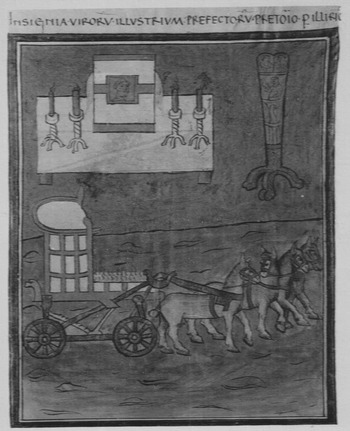
Our best source for the physical appearance of codicils of office is the miniatures of the early fifth-century Notitia Dignitatum. Unlike the miniatures of the Vienna Dioscorides, we do not have them in their original form, but in Renaissance copies. Thus the illustrators had no first-hand understanding of what they were copying and we cannot press details with any confidence. Among the insignia of the various offices depicted in successive illustrations, we regularly find a rectangular object represented by a series of lines on the right-hand side as a book with a number of pages, set up on a blue cloth-covered table with a candelabra on each side (Fig. 1). These rectangles are normally white (in the light of Themistius 224b suggesting ivory)Footnote 11 and decorated with various geometrical patterns, usually with some sort of gold trim, exactly like the codex held by Anicia Juliana.Footnote 12
Insignia of praetorian prefect in Notitia Dignitatum. (Photo: H. Omont)

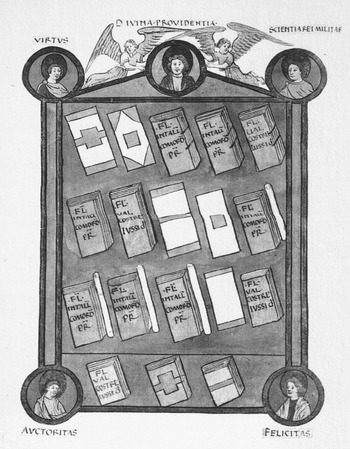
Many are also inscribed with names and offices: those of spectabilis grade with Fl(avius) Intall(ius) com(es) ord(inis) pr(imi); those of illustris grade with representations of a head or heads (presumably imperial); and those of lower rank with Fl. Val. and a variety of different continuations (Fig. 2).Footnote 13 It seems that the front leaf of the diptych bore either the emperor's portrait or the name and new office of the official (in the Notitia miniatures misread beyond recovery by successive copyists), while the writing surface inside carried the actual letter of appointment.Footnote 14 This is borne out by a law of Constantine that refers to a man's office being attested by either the ‘outer imprint’ or ‘inner writing’ of his codicils (‘superna codicillorum inpressio vel scribtura … interior’).Footnote 15 The obvious parallel here is the hundreds of surviving tabulae honestae missionis, sealed bronze codicilli attesting to the years of service and honourable discharge of Roman soldiers. The official notarized copy of the document is inscribed in full on the inside, but was often repeated on the outside, to save the veteran breaking the seal unless he really needed to.Footnote 16
Codicils of various offices in Notitia Dignitatum. (Photo: H. Omont)

A law issued at Milan in 381 appears to distinguish between codicilli, epistulae and insignia for different offices,Footnote 17 perhaps just literary variants. But the instruments for conferring some offices (notably the consulship) do appear to have been scrolls rather than diptychs. It would be unwise to assume that the forms remained constant between the fourth and tenth centuries, but this may have been so for some offices. According to Caer. 1.56, the patrician received codicilli, and the famous portrait of Anicia Juliana in the Vienna Dioscorides shows her holding what is clearly a gold-trimmed rectangular codex (the only official rank Juliana held, exceptionally enough for a woman, was that of patrician).
The tables in the Notititia Dignitatum miniatures suggest that officials displayed their codicils while conducting business, as a symbol of their authority. A striking parallel is provided by the blue cloth-draped table set in front of Pilate's throne in a miniature of the trial of Jesus in the Rossano Gospels.Footnote 18 Officials are also often depicted with codicil-diptych in hand. For example, Eucherius on the Stilicho diptych and Anicia Juliana in the Vienna Dioscorides. John Chrysostom refers in a sermon to emperors ‘offering their prefects gold writing-tablets as a symbol of their authority’.Footnote 19 While few of his listeners will have witnessed the actual ceremony in person,Footnote 20 many will have seen it represented in art, and it is probably such representations he had in mind.
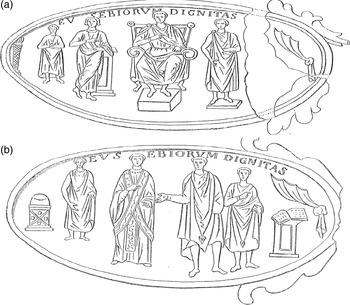
The original codicil-diptych presented by the emperor presumably existed in a single copy, no doubt treasured by the office-holder himself. If it carried a portrait, it must have been the emperor's portrait (as on some of the diptychs illustrated in the Notititia Dignitatum), not the office-holder's. But by the late fourth century people began to present their friends with diptychs of their own, decorated with elaborate depictions of the games they had given or insignia of the office they now held. As we shall see, office-holders also distributed other gifts: gold coins, silver plates, and even more modest mementos. Two large silver spoons (now lost) found near Aquileia and published in 1792 are evidently part of the sportula of a consul called Eusebius (there were consuls of that name in 347 and 359, perhaps father and son).Footnote 21 Both are decorated with consular tableaux: one shows the consul standing in trabea, the other seated on his sella curulis in tunic and chlamys; on both spoons he is accompanied by attendants and flanked by a curtain (Figs 3a and b). The curtain, different dress and different poses all appear in the consular portraits in the Calendar of 354 and reappear on consular diptychs.
Silver consular spoons from Aquileia. (After R. Garruci)

The repertory of scenes and motifs we find on consular diptychs has a long history. But the diptychs themselves, gifts commemorating the holding of certain offices, are an innovation. The reason these gifts took this new form is surely someone's brainwave of copying the form of his codicils of office as a memento for his friends, an innovation that rapidly caught on. We have seen that by the mid-fourth century codicils of office might be made of ivory, at least for the highest offices, so it is not surprising that ivory was the material chosen for these imitation, commemorative codicilli. The diptych Symmachus sent the emperor Eugenius in 393 was made of ivory with a gold trim, just like the codicilli depicted in the Notitia.Footnote 22
III DIPTYCHS AND GAMES
Most surviving diptychs date from the late fifth and sixth centuries, and were undoubtedly issued by consuls. But to start with it was only one category of magistrate who presented them: those who provided games.Footnote 23 For late fourth-century Rome the most informative evidence on the distribution and distributors of diptychs is Symmachus' correspondence. The most illuminating single text is Ep. 2.81, sent to his oldest and closest friend, the elder Nicomachus Flavianus in 393/94:
Now that his games as [quaestor] candidatus are over, my son [Memmius] Symmachus offers you his quaestorian gifts (dona quaestoria), and also honours the rest of our connections (ceteras necessitudines) with similar gifts. Please then, as one who made so many and such splendid contributions to his display, receive in his name the diptychs and souvenirs (diptycha et apophoreta). In addition I have sent our Lord and Emperor [Eugenius] a diptych with gold trim (auro circumdatum). I have also honoured the rest of our friends with ivory writing-tablets (eburneis pugillaribus) and silver bowls. To your initiative and discretion I entrust the disposition of the enclosed (quae missa sunt) to individuals as you think fit.
One or two additional details are supplied by another letter (Ep. 7.76) written at the same time to a plurality of addressees designated collectively ‘brothers’ (fratribus). Its ponderous formality and lack of personal detail suggest that it is Symmachus' standard ‘cover-letter’ to connections who were not intimates (copies sent to individual members of this group will naturally have been individually addressed):Footnote 24
It is a duty and a pleasure (religiosum atque votivum) to offer the customary gifts of quaestors candidati to eminent people and close friends (potissimis atque amicissimis), a category in which (of course) you are included. So I present you with an ivory diptych and two-pound silver bowl (eburneum diptychum et canistellum argenteum librarum duarum) in the name of my son, who has performed his quaestorian liturgy. I very much hope you will accept with pleasure this mark of respect.
The dona quaestoria (it appears) consisted of a diptych and silver bowl, and in 401 Symmachus distributed the same combination of diptych and bowl in commemoration of Memmius' praetorian games.Footnote 25 Another letter (5.56) sends the same package to a man who had missed the games. ‘Diptych’ (used five times by Symmachus)Footnote 26 was his standard term (pugillares in 2.81 for variety on his third reference in the same letter). Ep. 7.76 specifies that the bowl weighed two pounds, presumably as a check against substitution of a smaller bowl by the carrier. In 2.81 Symmachus claims to have sent sets of these two gifts to ‘the rest of our connections’ (necessitudines), later in the letter glossed as ‘friends’; 7.76 adds ‘eminent people’ (potissimi). For a prominent aristocrat like Symmachus in his mid-fifties, a former prefect of Rome who had already been accorded the (for a civilian) rare honour of an ordinary consulate, such ‘connections’ must surely have been numbered in the hundreds. In addition, he sent Flavianus a number of ‘spares’ to distribute at his discretion to suitably important people Symmachus himself might have overlooked. At the time Flavianus was serving as praetorian prefect at court, where he was likely to meet important people he knew Symmachus would want to add to the already generous roster of his ‘friends’. Aristocrat though he was, Symmachus was ever anxious to correspond with the latest arriviste ministers at court, however low their origins. Symmachus always knew who to tap for a favour for himself or those close to him.
The earliest surviving ivory that can be assigned a fairly firm date, place and social context (Rome, 402) is the celebrated SYMMACHORVM/NICOMACHORVM. Since several other panels have been linked to this diptych on stylistic groundsFootnote 27 and no surviving eastern diptych can be certainly dated before 506, it has been widely assumed that the custom originated as part of the ostentatious display of the aristocracy of Rome and only later spread to the East. The exact opposite may be nearer the truth. In the first place, the fact that the standard term ‘diptych’ was Greek in origin might be thought to imply an originally eastern custom. Both diptychum and δίπτυχον are neologisms of the late fourth century, of the age (in fact) when presentation diptychs first appear.Footnote 28 Instead of one of the well-established Latin terms for a writing-tablet (tabulae, tabellae, or pugillares), for Memmius' presentation diptychs even the purist Symmachus uses the previously unattested diptychum. By contrast, the term for the actual appointive document remained Latin codicilli, established in official usage since the first century and simply transliterated into Greek as κωδίκελλοι.
More important, the earliest securely datable evidence for presentation diptychs comes from the East, a law dated 25 July 384 at Heraclea (on the Black Sea) and addressed to the senate (ad senatum):Footnote 29
No private person shall be permitted to distribute (largiri) pure silk vestments (holosericam vestem) at any exhibition of games. We also confirm by this constitution that, with the exception of ordinary consuls, no one else shall have the right to give presents of gold (auream sportulam) or ivory diptychs (diptycha ex ebore). When public spectacles are celebrated, the presents (sportulis) shall be silver coin and the diptychs made of other materials (alia materia diptychis).
Scholars unfamiliar with the problems of using imperial legislation as a historical source have assumed that this law was of general application, and that non-consuls who issued diptychs must either have ignored it or obtained a special dispensation.Footnote 30 Others have inferred that ivory was reserved for consular diptychs as a special mark of honour.Footnote 31 In fact, though issued (like all imperial laws) in the names of the whole imperial college, this law was addressed by the eastern emperor, Theodosius I, to the senate of Constantinople. It did not apply to and was not valid in the West. A few months later Theodosius addressed another edict ad senatum (Cod. Theod. 6.4.25, issued at Constantinople), raising the number of praetors and fixing limits to the sums they were to spend on their games.Footnote 32 These limits were clearly intended as maxima rather than minima. That is to say, this law was part of the same concerted attempt to regulate expenditure on the games of Constantinople as Cod. Theod. 15.9.1. The details of 6.4.25 prove beyond question that it was solely concerned with the financing of games and the senate of Constantinople (the number and names of the praetors differed in the two capitals).Footnote 33
It is true that, in his capacity as prefect of Rome in the same year 384, Symmachus wrote to court with proposals for restricting expenditure on the games in Rome.Footnote 34 A law was no doubt issued in response, but it was not Cod. Theod. 6.4.25 or 15.9.1, nor even a suitably adapted or modified version. In the East the number of praetors was raised from four to eight in 384 (thus halving the cost of the games each gave at a stroke), and further reductions were added in the course of the next few years. No such drastic measures were taken at Rome.Footnote 35 A ban was imposed on distributing holosericae vestes (which Symmachus himself tried to evade),Footnote 36 but the number of praetors remained the same, and those who really wanted to make a splash were evidently free (as we shall see) to spend staggering sums (Symmachus himself laid out 2,000 pounds of gold). Not only is there no evidence for a corresponding western restriction on the issuing of diptychs. It would have made no sense in the Roman context.
It is often stated that diptychs were announcements of the honorand's promotion or invitations to the consular ceremonies. But we are fortunate enough to have the invitations Symmachus issued for Memmius' praetorian games in 401: Ep. 8.71 (headed ad praeturam multos invitat) and 72 (headed similis). They say nothing about diptychs. The eastern law of 384 includes the distribution of diptychs as one item in a series of regulations about expenditure on games in Constantinople. As for Rome, on three separate occasions Symmachus directly and explicitly links the presentation of Memmius' diptychs with the completion of his games.Footnote 37 Significantly enough it is while describing the animals captured for Stilicho's consular games that Claudian evokes the distribution of his diptychs (see below).
Representations and imagery of the games are ubiquitous on the figural consular diptychs of the sixth century:Footnote 38 almost every representation of the consul himself shows him holding the mappa (Section VII below). The games were after all the consuls' only real obligation as consuls.Footnote 39 Thus the earliest literary evidence bears out the abundant iconographic evidence that the original function of diptychs was to commemorate the games the official gave rather than the office he held. That is to say, diptychs were originally an obligation on the handful of magistrates who provided games: at Rome, quaestors, praetors and suffect consuls; at Constantinople, praetors and ordinary consuls; elsewhere, provincial priests.
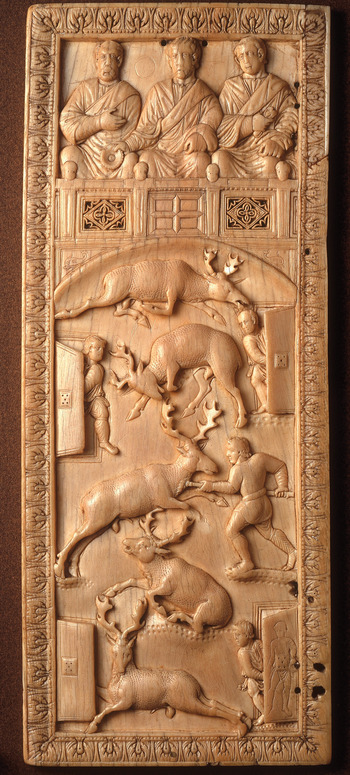
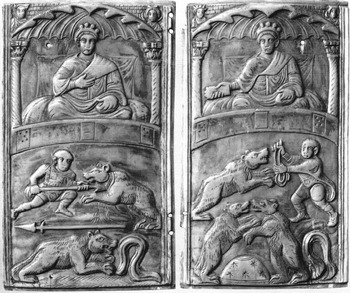
The uninscribed diptychs in Leningrad and Liverpool decorated with wild beast shows (59 and 60 V)Footnote 40 clearly commemorated the games of some magistrate, probably (as we shall see) those of a quaestor or praetor rather than consul (Fig. 4). Compare too the diptych in the Louvre (58 V), usually dated c. 400 (Fig. 5). The crown at once identifies the official presiding at the games illustrated in the lower register as a priest of the imperial cult, officials whose main responsibility, in East and West alike, was providing games.Footnote 41
Liverpool Venatio Diptych. (Photo: Liverpool Museum)

Louvre Venatio Diptych. (Photo: Louvre)

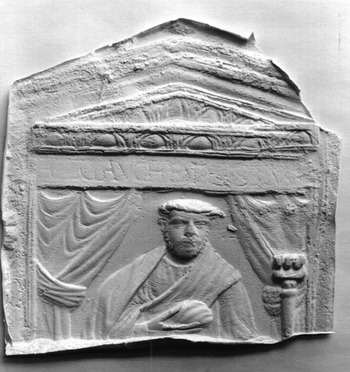
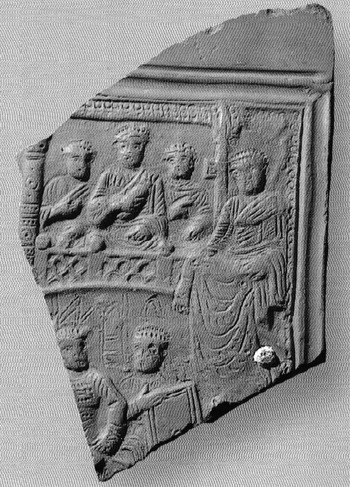
We also have the evidence of several clay tablets, most from North Africa, apparently cheap copies of ivory diptychs, perhaps made by actually pressing the original diptych into wet clay to form a mould. The most sensational of these is Jeffrey Spier's recent publication of two fragments that when joined make up the greater part of one leaf of a hitherto unknown consular diptych, that of Anicius Auchenius Bassus cos. 408 (Fig. 6).Footnote 42 But in some ways more historically interesting and important are the fragments of diptychs like the Liverpool and LAMPADIORVM panels, where three officials stand in a circus loge watching racing or venationes represented in the lower register. One is a fragment in the Benaki museum in Athens, showing three officials (Fig. 7);Footnote 43 a second, found at Ephesus, must originally have shown three officials, but the left-hand side is broken off, leaving only two. But in both there is another figure to the right-hand side of those in the loge, holding out over the arena a piece of fabric. It is tempting to identify this fabric with the ‘pure silk vestments’ (holosericam vestem) mentioned along with diptychs in the law of 384. What is so interesting about these two pieces is that, as on the Louvre diptych, all the presiding officials, including the man holding the fabric, are wearing crowns. Clearly these panels commemorated games given by provincial priests, the Ephesus fragment perhaps in Ephesus itself. That is to say, not all diptychs were either made in or made for distribution in Rome or Constantinople.
Clay mould for diptych of Anicius Bassus. (Photo: J. Spier)

Benaki panel. (Photo: Benaki Museum)

On the basis of the law of 384 and the fact that most surviving presentation diptychs (almost all much later) are consular, it has been generally assumed that the presentation of ivory diptychs was originally (in both East and West) a consular privilege subsequently usurped by lesser officials. But this law did no more than regulate the sportulae expected of the only two officials obliged to provide games at Constantinople: praetors and ordinary consuls. Its purpose was to reduce the expenses incurred by praetors by removing one of their obligations. That only left the consuls.
At Rome diptychs were clearly not originally a consular privilege. The earliest western consular diptych we know of is that of Anicius Probus in 406. But at least half a dozen non-consular diptychs probably earlier than this have survived.Footnote 44 We have both leaves of a particularly splendid diptych commemorating Rufius Probianus vicarius Romae (62 V), an official who never gave games (actually, the Probianus diptych may have been presented to rather than by its honorand).Footnote 45 Then there is the diptych of the general Stilicho (63 V), presented in honour of his son Eucherius, promoted to the fairly junior post of tribune and notary as a small boy; the SYMMACHORYM/NICOMACHORVM diptych (55 V) and the LAMPADIORVM panel (54 V), where the family names in the genitive plural suggest commemoration of shared family occasions (weddings or funerals);Footnote 46 the Leningrad Lion Hunt diptych (59 V), the Liverpool Venatio (60 V) and the Consecratio panels (56 V). All are western, and at Rome none of them would have fallen within the purview of the 384 law.
IV OFFICIAL OR UNOFFICIAL?
Together with the Notitia Dignitatum, consular diptychs are perhaps the most important surviving repertory of the motifs and conventions of the official art of Late Antiquity. Given that they are visual commemorations of the highest offices of state, this is not surprising. But that does not automatically give the artefacts themselves official status. The codicils of appointment came from the emperor himself, whereas consular diptychs were gifts presented by the consul to colleagues and friends.
Presentation diptychs were private mementos, with no official standing or significance. We have seen that Symmachus handed them out by the score. We have one or both leaves of two copies of the diptychs of Magnus cos. 518, three each of Justinian cos. 521 and Philoxenus cos. 525, five of Anastasius cos. 517, and no fewer than seven of Areobindus cos. 506. There has been some discussion about just how valuable ivory was,Footnote 47 but the labour and skill required must have added considerably to the cost of the raw material. The expense was evidently borne by the honorand, not the emperor. The cost of Symmachus' praetorian diptychs was surely part of the infamous 2,000 pounds of gold he spent on Memmius' games, and Areobindus was married to the fabulously wealthy heiress Anicia Juliana.
This point needs to be emphasized, since it is the implicit (often explicit) assumption of almost all modern writing on the subject that presentation diptychs are in some sense official. Robert Grigg's useful article on codicils repeatedly compares the evidence of ‘official ivories’; Kathleen Shelton distinguished between ‘official and private commissions’, remarking that Stilicho's wife Serena ‘appears to be the only woman represented on an official diptych’.Footnote 48 All surviving diptychs are private commissions. Let us examine a couple of cases.
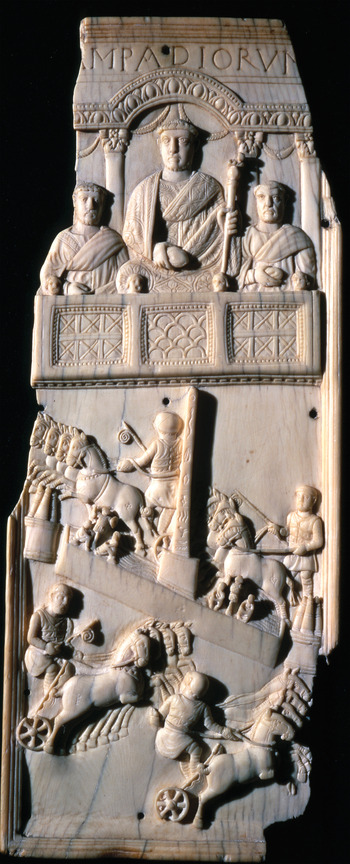
The central figure on the LAMPADIORVM panel is clearly shown as a consul, wearing the trabea, carrying a sceptre capped by two imperial busts, and presiding at circus games (Fig. 8). But no Lampadius held the ordinary consulate before 530, and even if it were possible to date the panel that late, the genitive plural of the family name shows that the emphasis falls on the family rather than the office.Footnote 49 The obvious alternative is that the games it commemorates were provided by a suffect consul. At Rome the suffect's principal (perhaps only) obligation was the games for the Natalis urbis on 19–21 April, known as Parilia. The LAMPADIORVM ivory was surely issued by a suffect for this occasion. But Kruse insisted that only an ordinary consul could be shown with imperial busts on his sceptre; suffects, he pointed out, were appointed by the senate, not the emperor.Footnote 50 That is an overly legalistic reading of the sceptre, presupposing that the diptych is official. But Ausonius evokes the trabea and sella curulis of his young friend Paulinus of Nola as suffect, and Symmachus describes an (unnamed) suffect of 401 as wearing full consular regalia, which surely included a sceptre.Footnote 51
Lampadiorum panel. (Photo: K. Shelton)

Then there is the Trier panel (34 V). We have only the rear leaf, but its inscription, Q(ue) PATR(icius) ET SECVNDO [consul ordinarius], unmistakably identifies it as a diptych commemorating the second consulship of a man who was already a patrician.Footnote 52 This combination allows two possible candidates: Fl. Aetius cos. II 437 or the future Emperor Constantius III, cos. II 417, for various reasons almost certainly the latter. The panel shows a Muse reclining against a pillar holding a scroll while to her right a putto holds up a palm leaf; in a rectangular field to itself beneath the pediment at the top there is a bust of a young man with curly hair. But for the consular inscription it would surely never have occurred to anyone to identify the panel as half of a consular diptych.
Taking it for granted that consular diptychs were official commissions, Delbrueck did his best to read some contemporary, political meaning into this unexpected scene. His solution was to identify the putto as Eros and the Muse as Erato, patroness of lyric (and so wedding poetry), and find a reference to the marriage of Constantius to Honorius' sister Galla Placidia. It is true that the couple did in fact marry on 1 January 417, the day Constantius entered his second consulship. But Shelton rightly objected that there is no basis for this identification of either the Muse or her function, and that putti by no means always have erotic connotations.Footnote 53 The motif of a Muse leaning on a pillar is very common on sarcophagi, where she is identified as either Polyhymnia or (when holding a scroll) Calliope. Calliope is generally seen as the Muse of epic, Polyhymnia of mime, neither appropriate for a wedding. Members of the late Roman élite liked to think of themselves as men of culture,Footnote 54 and that is surely the purpose of this scene. We are not meant to identify a particular Muse, nor is she performing a particular function for the new consul.
The aim of the scene as a whole is simply to present Constantius as a man of culture, or (perhaps more plausibly in a military man) a patron of letters.Footnote 55 Since we know that sixth-century consular diptychs were produced in multiple non-identical copies, sometimes tailored to individuals (two of Justinian's diptychs carry an address to senators), we might infer that this one was sent to a man of letters, someone who would recognize a Muse when he saw one, rather than (say) a fellow military man, who might be puzzled (if flattered) by the learned imagery. For proof that the Muse has no specific relevance to either Constantius or the year 417, we may turn to one of the silver spoons of Eusebius cos. 347 or 359, where to the left of the consul seated on his throne, we find — a Muse leaning on a column holding a scroll. Constantius was not even the first consul to employ this motif on his consular sportula.
As Shelton saw, this interpretation of the Trier panel has wide-ranging repercussions. This is not the only late antique diptych to represent Muses. One panel of the so-called poet and Muse diptych in Monza shows Erato facing right playing her lyre, while on the other a bald male figure holding a scroll faces Erato (68 V). Then there is a diptych in the Louvre (69 V) showing six Muses and six poets (or philosophers), distributed in pairs between three registers on each panel (Melpomene holding a tragic mask, Euterpe with a flute, Urania with a globe, etc.). Both these diptychs have been assumed to be ‘private’ commissions, as distinct from the ‘official’ diptychs presented by consuls and other officials. Perhaps so. But we now know that at least one leaf of a diptych guaranteed consular by its inscription represented a Muse. Most critics have assumed that the now lost pair to the Trier panel must have carried a portrait of Constantius in consular regalia, yet that would make a very odd pairing for the Muse. Much more likely the missing leaf portrayed a poet or philosopher, like the Monza and Louvre diptychs. If so, the Monza and Louvre diptychs might also have been the sportulae of a consul or some other official.Footnote 56 On both these diptychs the ‘poets’ have been variously identified with anyone from Anacreon to Boethius, but, in the light of the Constantius diptych, might again be no more than non-specific figural evocations of classical culture, so important to the late Roman élite. The fact that they lack identifying inscriptions need not be an objection. There is no identifying inscription on a number of other undoubted presentation diptychs. Since they were his personal gifts, the consul could put whatever he liked on his consular diptychs, it seems. Probus cos. 406 had a picture, not of himself or even his games, but of the emperor Honorius celebrating a rare victory over barbarians.Footnote 57 Constantius no doubt sent out other, more conventional, diptychs as well.
V WHAT'S (NOT) ON THE BACK
For Kim Bowes, the more or less exclusive attention moderns have paid to the complex iconography on the front of the diptychs has led them to overlook ‘the simple fact that consular diptchs are diptychs, and that in the ancient world the diptych was first and foremost used for writing’.Footnote 58 On this basis she argues that what was written on the back of the diptych is the key to its function. Her own suggestion is consular fasti, ‘intimately linked to Late Antique ideals of the consular office’. This presupposes as given that presentation diptychs were originally and after 384 exclusively reserved for consuls. But not only were they an obligation on all officials who provided public games. In the West at any rate they were also presented by a variety of other officials and indeed by members of the élite in general. Before the mid-fifth century specifically consular diptychs would actually have been in the minority.
Bowes's argument rests on two texts. First, Prudentius, Contra Symmachum 1.595–7, describing the few remaining pagan nobles, men who have won the highest honours,
though they have reached the height of the fasti and marked with their names the record of the years, and in wax or bronze are numbered among their ancestors …
According to Bowes, ‘the “record of the years” refers to a list of consuls, while the descriptive “of wax or bronze” indicates written lists, either monumental inscriptions with bronze lettering, or more significantly for us, lists kept on wax-filled writing tablets’.Footnote 59 But in context ‘annales … chartas’ refers to centuries of consular ancestors in the abstract rather than actual consular lists; and line 597 has nothing to do with consuls. The ‘wax’ undoubtedly refers to wax ancestor masks and ‘bronze’ to busts of ancestors, both on display in the atria of great houses.Footnote 60 What Prudentius has in mind is the nobility in general, not consuls in particular. Only one of the unrepentant pagans he was evoking had actually held the consulship — Symmachus himself.
Second, Sidonius' description of the consular inauguration of Astyrius cos. 449. There was a roar of applause as soon as the largesse (sportula) was distributed ‘and the fasti were presented’ (datique fasti).Footnote 61 As early as Sirmond (1652) these fasti were identified as diptychs, no doubt influenced by the fact that a copy of Astyrius' consular diptych has survived.Footnote 62 But even if this is correct, fasti need not (and surely does not) refer to a consular list inscribed on the reverse of his diptychs. At all periods, the word fasti was commonly used as a metaphor for the consulship (cf. arx fastorum in Prudentius, just cited).Footnote 63 In a passage contemptuously underlining the worldly pomp of the consulship (‘trabearum et curulium possessores … terreni munificentia triumphi … purpura vestra … gestatoria sella … census dispendia’), in the early sixth century Ennodius uses the phrase decora fastorum, again probably referring to diptychs.Footnote 64 In context, this cannot have been intended to evoke anything so mundane as a consular list.
It is true that Late Antiquity saw a widespread transference of consular lists from public monuments to private copies in manuscript form, but this had nothing to do with ‘ideals of the consular office’. Rather these consular lists were one aspect of the shift of ancient historiography from narrative and biography to chronography.Footnote 65 This is made clear by the fact that the polyonomous heroes of past centuries are invariably reduced to two names linked by et in the ablative case (e.g. Tatiano et Symmacho = 391):Footnote 66 they are simply dates. Bowes concedes that only an abridgment of the complete consular list (some 1,800 names by a.d. 400) could have been squeezed on to two tablets c. 30 by 10 cm each, but what could the symbolic value of an abridgment be? Actually a list of the consuls of the past twenty-five years would have served a practical purpose for anyone trying to calculate (say) when debts or loans fell due. But that would be to treat consular diptychs, not as creating continuity between the new consul and the glorious Roman past, but as calendars given out to customers by small businesses. In any case, by c. 400 most likely recipients would already have current consular lists of their own.
According to Bowes, diptychs ‘were a particularly fancy brand of writing-tablet, with an inset surface, probably of wax, upon which the text of the diptych was written’. But this is to confuse the appointive diptych with the presentation diptych. The function of the appointive diptych did indeed turn on the text written inside it, an imperial letter appointing the honorand to this or that office. Presentation diptychs were simply gifts, mementos of the occasion. That was their function. The list that mattered was nothing to do with the diptych itself; it was the list of recipients, a list prescribed by convention and politics rather than left to the donor's personal inclinations. Symmachus clearly thought he had been deliberately slighted when the consular gifts of Richomeres and Bauto arrived several months late.Footnote 67 On the other hand Libanius, a rhetor in far-off Antioch, was delighted to receive an unexpected diptych from Tatianus cos. 391.Footnote 68 They were gifts, but gifts that marked the recipient out as a person of consequence.
Many name the consul and all his titles in a grandiose inscription running across the front of both panels (Fig. 9). That was quite enough to identify both man and occasion. Some carry no inscription at all on the front. The now blank tabulae ansatae of the Liverpool Asclepius and Hygieia diptych (57 V) no doubt originally bore a painted inscription, and the Stilicho diptych (63 V) is a special case. No contemporary could have been in any doubt about the identity of the persons represented (a military man, exceptionally shown with his wife, holding up a rose, the symbol of imperial succession, over their small son, a grandnephew of the emperor Theodosius).Footnote 69 But there is no inscription and no place for one on the so-called Patrician diptych in Novara (64 V), the Liverpool Venatio panel (59 V), the Leningrad Lion Hunt diptych (60 V), and the two figural diptychs 29 V and 42 V. Yet even so recipients hardly needed to be told who the donor was. Sidonius describes diptychs (if that is what fasti means) being distributed in person at the consular inauguration itself. Symmachus despatched Memmius' quaestorian and praetorian diptychs to those who could not be present with cover-letters: form letters for the majority (Ep. 7.76; 8.71 and 72), something more personal for close friends (2.81; 5.56).Footnote 70
Diptych of Boethius. (Photo: British Museum)

There was simply no need for anything more on the back. Many presentation diptychs were not even functioning writing-tablets. Delbrueck claimed to have felt traces of wax with his finger in the recesses on the backs of diptychs he examined in person, but Tony Cutler, who has examined all the diptychs Delbrueck handled and others besides, could find no trace, in many cases not even a deep enough recess to sustain a bed of wax that would bear erasure and reuse.Footnote 71 They were imitation writing-tablets, meant to be admired for their exterior beauty rather than their interior writing surface. That is why so many have survived: some, incongruously enough, set in the covers of medieval bibles; the very pagan SYMMACHORVM/NICOMACHORVM decorates a twelfth-century reliquary.Footnote 72
What were recipients expected to do with their diptychs? Surely to display them, like modern Christmas cards, on the contemporary equivalent of a mantelpiece or sideboard or hung on a wall, exterior surface outwards, to show envious friends that they had been on the select list of recipients. From this perspective, the quaestorian or praetorian diptychs of young Memmius Symmachus might be more desirable than the consular diptychs of a barbarian general like Bauto, because everyone knew that the list had been drawn up by his father, Q. Aurelius Symmachus, the influential head of the clan. If anyone was expected to use them for writing, it was surely the recipient. Items of stationary (from pens, jotters and calendars to embossed briefcases and flashdrives) have always been popular gifts for guests at venues from academic conferences to the White House.
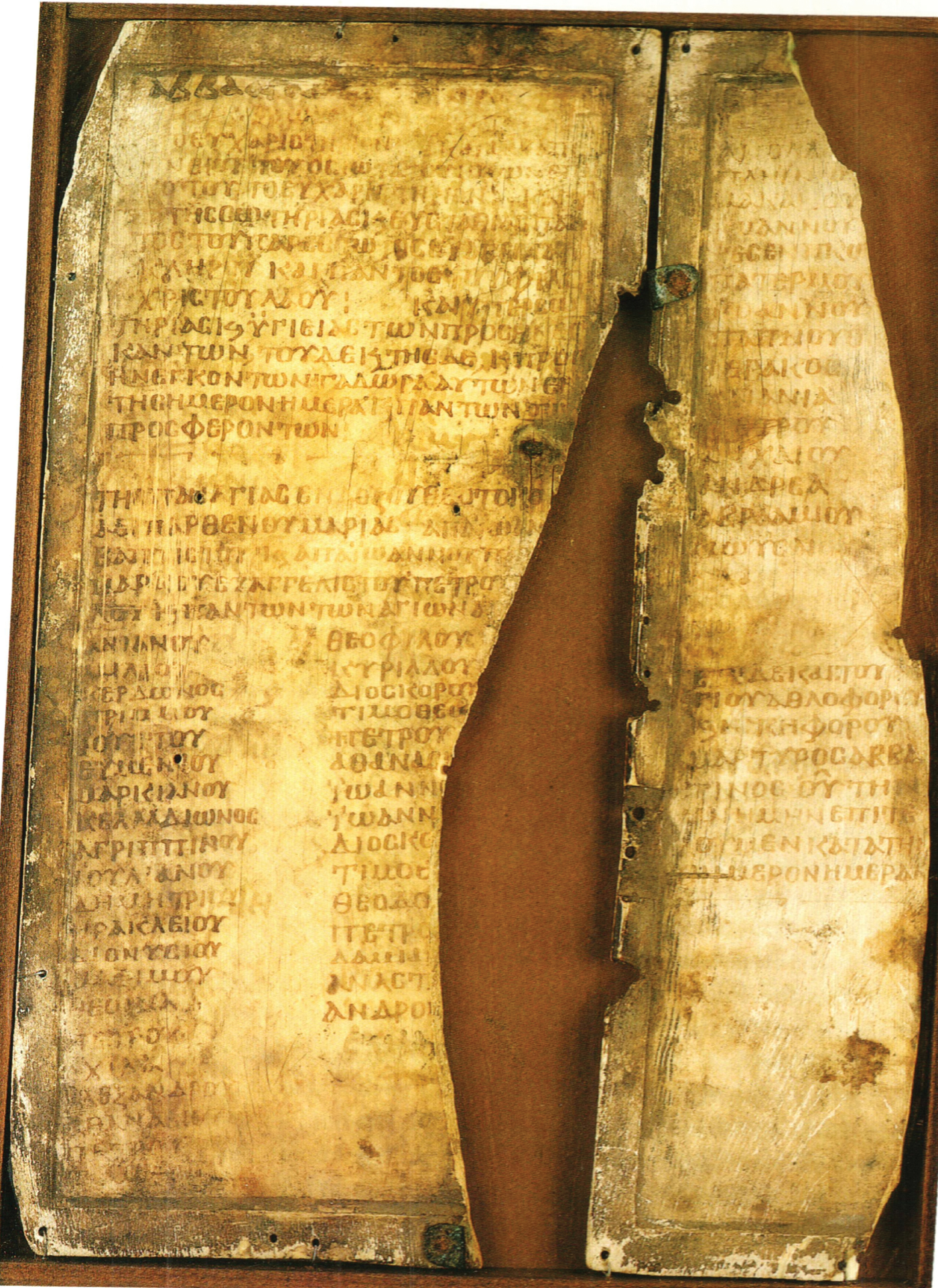
By an intriguing coincidence it is at about the same time, c. 400, that we first hear of diptychs inscribed with the names of martyrs, bishops and other heroes of the Church, read out by a deacon during the Eucharist.Footnote 73 Once again the use of the originally Greek term in West and East alike suggests that the practice originated in the East. Given the novelty of the term and the coincidence in time, it is tempting to link the two customs in some way.Footnote 74 It is true that the backs of a few consular diptychs were later inscribed with liturgical texts (for example, those of Boethius cos. 487, Areobindus cos. 506 and Clementinus cos. 513). But centuries later.Footnote 75 There is no continuity here. Presentation diptychs (not consular diptychs alone) were re-used for liturgical purposes simply because they were ornate writing-tablets with blank rear surfaces convenient for drawing up lists.Footnote 76 It may indeed have been precisely because the backs were blank that they were so used.
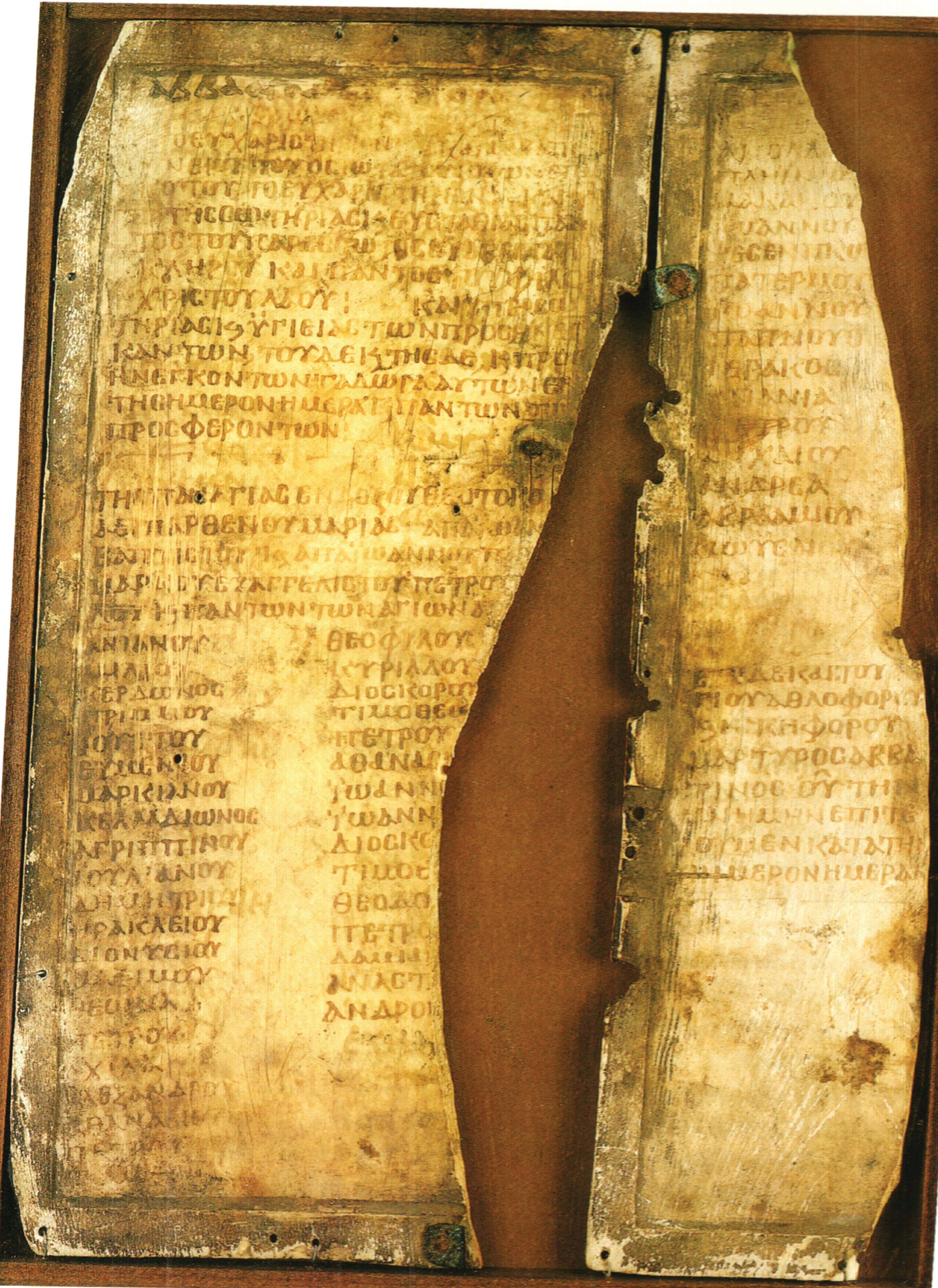
The written content was central to the function of ecclesiastical diptychs, while for presentation diptychs inscribed with the honorand's name and titles the front said it all. One of the only two ecclesiastical diptychs to survive in material form, datable to 661/77, is in fact made of ivory, of much the same proportions as the average presentation diptych (25.5 by 12 cm), but much lighter, with no decoration of any sort on the front surface (Fig. 10).Footnote 77 As it happens, the text was not inscribed on a wax surface but written directly onto the ivory in ink. The front was unimportant; what mattered were the names on the inside, written to be read aloud to the congregation from the text held by the deacon. That was its function.
Ecclesiastical diptych. (Photo: British Museum)
VI PRAETORIAN GAMES
As we shall see in more detail later, at Constantinople consular games took priority over praetorian games, so it made sense to reduce praetorian expenditure by restricting the burden of issuing diptychs to consuls. But in Rome praetorian games took priority well into the fifth century, and in the fourth at any rate western ordinary consuls seldom gave games, perhaps never in Rome itself. In fourth-century Rome it was quaestors, suffect consuls, and (above all, as they had been doing for centuries) praetors who provided games. It is enough to cite two passages of Juvenal that ridicule the pomp of the praetor presiding at the games:Footnote 78
The praetor is a ‘prey to the horses’ (praeda caballorum) because he has had to pay for them! Interestingly enough, after identifying the presiding official as praetor at 10.36, manuscripts surprisingly (and surely in error) call him consul at line 41, a reading variously emended by modern scholars.Footnote 79 And according to the scholia, which date from no earlier than c. 450,Footnote 80 ‘the poet describes the consul dropping the mappa in the circus’. Both corruption and scholion surely date from the late fifth century, by when it was now the consul, not the praetor, who gave the big circus games in Rome.Footnote 81 A poem of Martial about a dinner guest who steals his hosts' napkins claims that he even stole the praetor's mappa when he was on the point of dropping it in the circus.Footnote 82 By the late fifth century the joke would surely have turned on stealing the consul's mappa.
By 361 praetors were designated up to ten years in advance to allow families to prepare for the expense. Given the tender age at which these offices were held — quaestors often still in their teens, praetors and suffects in their early twenties, occasionally younger — it was normally father who footed the bill and made the arrangements. The centrality of the praetorian games at Rome and the rôle played by the father (amply attested in Symmachus' correspondence) emerges with especial clarity from a well-known passage of Olympiodorus:Footnote 83
When Probus the son of Alypius celebrated his praetorship during the reign of the usurper John, he spent 1,200 pounds of gold. Before the capture of Rome, Symmachus the orator, a senator of middling wealth, spent 2,000 pounds when his son, Symmachus, celebrated his praetorship. Maximus, one of the wealthy men, spent 4,000 pounds on his son's praetorship.
Olympiodorus concludes with the remark that ‘praetors celebrated their festivals for seven days’. Chastagnol identified these seven days as the first week of January,Footnote 84 supposedly the week-long games later provided by the ordinary consul. But the only evidence for consular games lasting for seven days comes from well over a century later, in Justinian's Novel 105 of 537, referring to Constantinople and clearly implied to be a reduction of the traditional programme:Footnote 85
It is our wish that [the consul's] processions (πρόοδοι, processus) shall number seven in all … The first procession shall be on 1 January, when he enters the office of consul and receives his codicils (σύμβολα, codicilli). The second spectacle will be horse-races, the so-called mappa (ἢν δὴ μάππαν προσαγορεύουσι). The third will be the chase of wild beasts in the (amphi-)theatre (τὴν τοῦ θεατροκυνηγίου), to be given not twice but once only. After that the so-called monhemerion (μονημέριον, quod dicitur totius diei) … the so-called pancarpon (πάγκαρπον), men fighting with beasts … The fifth procession will be the show called πόρναι… [theatrical entertainments] Next he will repeat the horse-races, called mappa, celebrating the sixth festal day. And then he will relinquish the annual honour … providing the usual entertainment for the people. And so the course of seven nights and processions will be completed.
The seven days are clearly not consecutive. While the first falls on 1 January, the day of the consul's inauguration, the seventh falls on 31 December, when he lays down his office. There is no indication when the other five fell, and the entertainments for the first and last days are not specified. While 2–6 January is one possibility, they might have been spread out at intervals over the year.Footnote 86 Polemius Silvius, in mid-fifth-century Gaul, records prima consulis mappa on 7 January, perhaps the second spectacle in Justinian's list.Footnote 87 It is usually assumed that consular diptychs were distributed at the consular inauguration, but it may be that those illustrating venationes were held back till the consul gave his venationes, on the third day (whenever that fell).
The obvious assumption is that, as in the Late Republic and Early Empire, the principal games provided by the praetors of Rome were the Ludi Apollinares, the responsibility of the urban praetor from as early as 212 b.c. By the mid-fourth century a.d., the Ludi Apollinares lasted from 5 to 13 July. Nine days are not seven days, but they were consecutive, as Olympiodorus implies, and it is possible that the number of days was reduced by the 420s when Olympiodorus was writing.Footnote 88 Furthermore, since consuls did give January games at court, this would have meant an embarrassing clash for VIPs with sons scheduled to give praetorian games if they fell in January. It was considered bad form to refuse invitations to consular inaugurations at court,Footnote 89 even if this meant going all the way from Rome to Milan in the depth of winter.
VII THE MAPPA
The close link between diptychs and games is a further argument against linking them too closely with either the consulship or the wealth of the western aristocracy. In an earlier article I remarked that none of the earliest western consular diptychs carry depictions of the games or even show their consul holding the mappa.Footnote 90 Gudrun Bühl thought she had refuted the argument by citing coins showing emperors in consular robes holding the mappa.Footnote 91 But emperors are irrelevant to my point. The emperor had always been the Spielgeber par excellence. According to a late story, it was Nero who ‘invented’ the mappa; he was still dining when the games began and simply used his table napkin (mappa) to start the races.Footnote 92
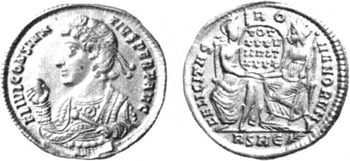
Even so, the first to be shown with the mappa on the coinage are eastern emperors. The motif first appears on the bronze coinage of the tetrarchs between 305 and 320.Footnote 93 The earliest example in gold is the solidus struck at Rome by Constantius II for his Roman visit of 357 (when he was cos. IX),Footnote 94 copied by almost all later emperors down to Phocas at the beginning of the seventh century (Fig. 11). Alföldi was shocked at what he saw as the official transformation of the soldier emperor of earlier times into an impresario of the games.Footnote 95 Games had in fact always been important to the way the emperors presented themselves in Rome, increasingly so by the fourth century,Footnote 96 but there can be little doubt that the consular mappa was an eastern innovation of the early fourth century.
Consular solidus of Constantius II. (Photo: British Museum)

The two best known pages of the Calendar of 354 are those that depict Constantius II and his Caesar Gallus, consuls that year, in full consular regalia. As Salzman rightly remarks, the ‘consular imagery is strikingly similar to contemporary consular diptychs’.Footnote 97 I would omit the ‘contemporary’, since the earliest datable consular diptychs are a half-century later, but the representations of Constantius and Gallus are indeed strikingly similar to the consuls of the diptychs, not only in their elaborate consular robes, but in the architectural setting, the half shell beneath which the two figures sit or stand,Footnote 98 and (above all) in the representations of consular sparsio. Constantius is scattering coins from his outstretched right hand, while a large sack of coins stands by Gallus' right foot. There was a long-standing tradition of distributing sportulae at Rome, but specifically consular sparsio is first shown on coins of Constantine and is rare outside the coinage.Footnote 99 It was to become a standard feature of the bottom register of consular diptychs (Fig. 9). But until the fifth century only imperial consuls are shown in the act of sparsio. Furthermore, one standard feature of all the later diptychs is missing from even the imperial consuls of the Calendar: the mappa. The Calendar was painted three years before Constantius' consular solidi were struck in Rome.
The mappa is also missing from the thousands of contorniates that survive from the city of Rome, despite the fact that the majority are decorated with scenes and emblems from the games. Only two, two of the very latest, show a consul holding the mappa, the future emperor Petronius Maximus, cos. 433 and 443, and the emperor Majorian, cos. 458.Footnote 100 Nor is the consular figure on both silver spoons of the mid-fourth-century consul Eusebius shown with either sacks of coins or a mappa.
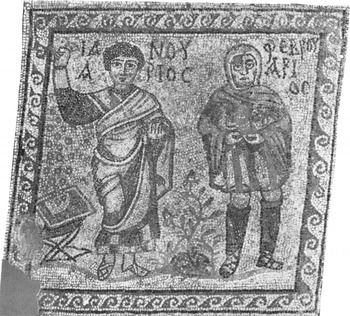
The evidence of yet another medium supports the inference that the motif of the consul with mappa originated in the East. Representations of the months were popular in Late Antiquity, particularly on mosaic pavements.Footnote 101 On one such pavement, in a villa in Argos, January is shown as a consul holding a mappa in an upraised right hand that is also dropping coins onto a stool, presumably his sella curulis.Footnote 102 On another, in a church in Gerasa, January is again shown as a consul with mappa in upraised right hand and a sceptre in his left.Footnote 103 The Argos January is a slightly incoherent combination of mappa, sparsio and sella curulis (on which the consul is usually shown sitting), but there can be little doubt that both scenes imply that consular games were the most characteristic or important event of January (Fig. 12). Then there is a January in the Vatican Ptolemy manuscript, again represented as consul with mappa in upraised right hand. The two pavements may be as late as the sixth century, but they must reflect a long-established tradition. The Vatican Ptolemy itself dates from 813/820, but the exact dates given for the entry of the sun into the various signs of the Zodiac on this page suggest that it is a careful copy of an original dating (according to Boll) from c. a.d. 250. Stern points out that the motif of the consul with mappa dates it to, at earliest, the first quarter of the fourth century.Footnote 104 But the astronomical indications will hardly permit a date much later than this.
Mosaic of January and February. (Photo: G. Akerström-Hougen)

‘The repertory of the allegories of the months’, as Doro Levi describes it, ‘is entirely composed of scenes referring to the characteristic events of each single month, which may be divided into two main categories: religious feasts … and civil events, mostly referring to life and activities in the country.’Footnote 105 Consular games, restricted to wherever the emperor might happen to be on the first few days of January, are an unexpected addition to this traditional, basically rural repertory. More interesting still, while appearing on eastern calendars as early as the fourth century,Footnote 106 on present evidence they never appear on western calendars before Polemius Silvius in 449. The best preserved, the codex calendar firmly dated to 354, offers for January a man with no insignia of office offering sacrifice. Some commentators see him as one of the new consuls, sacrificing on the Capitol; others identify him as a vicomagister sacrificing to the Lares at the festival of the Compitalia of 3–5 January, a better fit with the originally rural character of the repertory.Footnote 107 Since we have only Renaissance copies of the original, certainty is out of reach. But one thing is clear. Even if he is meant to be a consul, he is neither scattering coins nor starting circus games, and there is no hint of a mappa.
Most of the later western calendars are fragmentary and lack January, but we do know of one from Carthage, now lost, that was complete when R. Cagnat saw and described it in 1896.Footnote 108 The scenes have many similarities (as well as some differences) to those in the 354 calendar; Stern dated it no earlier than the first quarter of the fifth century. Like the January of the 354 calendar, the Carthage January is accompanied by a cockerel, but is otherwise shown in a heavy cloak carrying a basket with loaves of bread in one handFootnote 109 and a branch stripped of leaves in the other, in keeping with the season.
If the mosaic calendars are often incomplete, we have seven fourth- to sixth-century Latin poems on the months, most of them probably written to accompany illustrated calendars, all of which cover January. Three of them remark that January was the month when the new consuls entered office,Footnote 110 but none link them to games or mention the mappa. One of them, a fanciful, cosmological account of the circus and its games, refers to Janus ‘holding up a flag’, ‘vexillum … levans’, to start the races. Courtney plausibly suggests that the poet had in mind ‘a consul holding aloft his mappa’, but (with the exception of Tertullian) none of the other surviving cosmologies of the circus are earlier than the sixth century, and there is no way of being sure that the poet was writing of the Roman rather than Byzantine circus.Footnote 111
As a complement to the evidence of the calendars we have the similarly diverging evidence of accounts (mostly Christian diatribes) of the festival of the Kalends (held on the first few days of January) in the late fourth and early fifth centuries. For the West we have Augustine, Maximus of Turin and Peter Chrysologus (all writing before c. 430), none of whom mention chariot-racing among the evils that tempt the faithful.Footnote 112 For the East, we have Libanius, Chrysostom and Asterius of Amaseia. Libanius wrote both a eulogy and a description of the festival; the first mentions the consuls, the second chariot-racing. Chrysostom describes crowds cheering the eunuch consul Eutropius at the chariot-races.Footnote 113 Asterius denounces the consuls for lavishing gold on charioteers, pantomimes and venationes.Footnote 114
Despite the occasional assumption that they go all the way back to Augustus, there is no evidence that multi-day consular games were a regular event before c. a.d. 300. For centuries, on 1 January the new consuls, preceded by lictors carrying their fasces, climbed the Capitol and sacrificed to Jupiter before processing to the Senate, where they made their first formal speech as consul (in imperial times a gratiarum actio to the emperor), and at some point in the day publicly freed some slaves (manumissio remained part of the consular inauguration right down into the sixth century).Footnote 115 The only studies of the consular procession known to me uncritically combine evidence from six centuries and assume that games were always a central part.Footnote 116 Yet the earliest explicitly documented appear to be those given in Constantinople by Mamertinus cos. 362, which Ammianus dates precisely to 1 January, adding that he performed his manumissions in the circus, in the presence of the emperor.Footnote 117 Nor is there any evidence that Mamertinus' games extended beyond a single day's races.
We have seen that there is no hint of major circus games under January on illustrated calendars before the fourth century, and then only in the East. The only possibilities listed on surviving calendars for the first week of January at Rome are the Ludi Compitales on 4–6 January and circus games in honour of Janus pater on 7 January. It is likely enough that this or that consul in the course of the first three centuries of the Empire celebrated his inauguration with circus games — and scattered coins to the crowd while processing to the Capitol or Senate. But there is no evidence that multi-day consular games were a formal obligation before the fourth or (in the West) fifth century. The Calendar of Polemius Silvius, compiled in Gaul in 448–49, follows the tradition of the Calendar of 354 closelyFootnote 118 — except for the fact that it adds prima consulis mappa on 7 January. This and his secunda mappa on 13 January and consulis tertiae mappae on 19 April are events unknown to the earlier tradition.Footnote 119 It is fascinating to discover that mappa is now the Latin (and Greek) for ‘chariot-racing’.
There is no evidence that even imperial consuls regularly gave inaugural games before the tetrarchs are shown in consular robes holding a mappa c. 305. Why the tetrarchs? This is not a question anyone seems to have asked, yet there can be little doubt about the answer. It was the tetrarchs who, in order to better position themselves for dealing with threats on different frontiers, built a number of what might be called secondary capitals, some in the West (Milan and Trier), but more in the East: Thessalonica, Nicomedia, Antioch, and, last and most important (if technically not tetrarchic), Constantinople. In all these capitals they built themselves palaces, always with an adjoining circus. Chariot-racing in Greek lands is as old as Homer, but in Classical and Hellenistic times it had been limited to the traditional athletic festivals held every two or four years. By the second century a.d. Roman-style chariot-racing had caught on in many eastern cities, and by the fourth and fifth centuries we find the Roman circus factions all over the Greek East.Footnote 120 There is abundant literary evidence for the popularity of chariot-racing in fourth-century Antioch, where Diocletian built a palace and hippodrome complex a year or two before 300.Footnote 121 Antioch was the principal residence of Constantius II for much of his reign (337–50 and 360–61). Emperors had long sought the favour and loyalty of their subjects by providing and presiding at elaborate games in the circuses, theatres and amphitheatres of Rome, and it is not surprising that Diocletian and his fellow tetrarchs continued the tradition in their new capitals, to now enthusiastic Greek audiences. To judge from the mappa on their consular coinage, their one innovation seems to have been institutionalizing consular games, more specifically chariot-racing. Libanius describes the rivalry of a packed hippodrome at Antioch on 3 January, the third day of the festival of the Kalends.Footnote 122
One or other of the tetrarchs held one or both consulships most years between 305 and 320, and Constantine and his four sons more than twenty-five between them. If all or most gave circus games at their inauguration, this must have created an expectation of races in January, and it is understandable that non-imperial consuls and lesser officials too were pressured into following suit. Here we have the evidence of a series of statues, most from the Greek East (seven from Ephesus alone), representing ‘magistrates of high rank, clad in an unvarying dress of inner tunic, outer tunic or colobium, toga, and high shoes (calcei)’.Footnote 123 Most are shown with a sceptre in the left and mappa in the right hand. At one time they were all identified as consuls, but what would ordinary consuls be doing in Ephesus in such numbers? Foss argued from their dress that they were proconsuls of Asia, shown presiding at the games. There are two similar statues at Aphrodisias, one at Corinth, and a marble hand holding a mappa found at Sardis. There are also three bone statuettes found somewhere in Syria of ‘people of high status’ holding a mappa, identified by Archer St Clair as ‘a badge of imperial authority’.Footnote 124 One of them wears a diadem and so presumably is an emperor (bearded and so perhaps Julian), but there is no indication that the others are. Mention has already been made of a clay tablet found at Ephesus representing imperial priests presiding at the games holding mappae. The wide distribution of such artifacts in the Roman East explains why we find mappa-waving Januarys in eastern calendar mosaics. Better known are the only two such statues found in the West, in excavations on the Esquiline Hill in Rome, apparently a father and son, both in ceremonial dress and holding mappa aloft.Footnote 125 The three men presiding at the games shown on the Liverpool Venatio and Lampadiorum panels (Figs 3 and 7) are likewise all holding mappae.
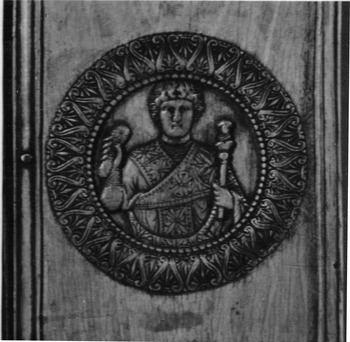
More puzzling are the numerous mappa-holders represented on the various faces of the base of the obelisk of Theodosius in Constantinople (390). In the top tier of the south-east and north-east faces, we have six togati, all holding lowered mappae. In the lower tiers of the south-west and north-east faces, ten with what look like raised mappae but might be no more than banners waved by enthusiastic spectators. Since all four faces show the emperor, accompanied by various members of the imperial family, presiding at the games, these togati cannot also be presiding at the same games. Bert Smith suggests that their mappa is simply ‘part of the new dress toga suit, an item of Constantinopolitan fashion’.Footnote 126 Yet it seems unlikely that it could have lost its association with the games so completely so early. Of seventeen fully figural sixth-century diptych panels, all show the consul with mappa (eleven raised, six lowered), eleven also have scenes of games. Perhaps more striking still, on no fewer than twelve panels which offer only the consul's bust in a medallion, his insignia are reduced to two: sceptre in left hand, symbolizing his authority as consul; and mappa in right. Given the well established link between diptychs and games, the mappa must here symbolize the consul's games (Fig. 13). It is natural to wonder if there is any significance in the different positions of the mappa. But surviving presentation diptychs show the Spielgeber with raised or lowered mappa almost indifferently (31 raised, 15 lowered), and the diptych of Boethius (487) shows it raised on one panel and lowered on the other.
Detail from diptych of Apion cos. 439. (Photo: Alinari)

One instructive feature of the obelisk base reliefs is that on none of the four faces does the emperor himself hold a mappa. While he continued to be shown with mappa in the stereotyped image on the consular coinage, the emperor no longer played the modest rôle of ‘starter’ at the games, nor even that of Spielgeber. He had become an actor in the (increasingly Christianized) ritual of the hippodrome, the ruler whose god-given victories were reflected in the earthly victories of charioteers.Footnote 127 Furthermore, the imperial box, the Kathisma, was now some 200 m from the carceres, too far for the emperor to be able to give the signal himself. As early as the fifth century Byzantine texts make it clear that it was an official called mapparius, stationed right by the carceres, who actually opened the gates for the racing to begin. Dagron suggests that the emperor gestured to officials in his immediate entourage who signalled to the mapparius. Whatever the nature of their signal, it was represented in art by showing them with the traditional mappa.Footnote 128
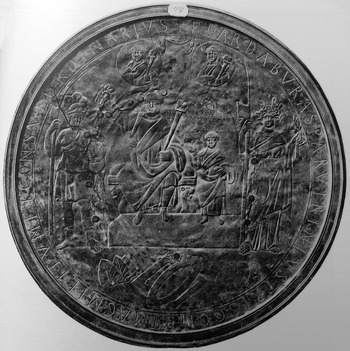
Most of the other mappa-holders on other monuments were surely neither emperors nor consuls but office-holders who provided games — though not necessarily high office. At Rome, the praetorship was a well-born young man's first office, and chariot-racing was a first liturgy for young members of the élite at Antioch too.Footnote 129 The father and son Roman mappa-holders on the Esquiline were surely a praetor and the father who had paid for his games. The missorium of Aspar shows Aspar as consul and his son Ardaburius, labelled as praetor, both holding up mappae (Fig. 14). A recently found fragment of a plate decorated with gold leaf inscribed at the top SYMMACHVS CONSVL O[rdinarius] shows a right hand holding a mappa and, just below it, the word IV[N]IOR and the head of a boy. The obvious inference is that the plate commemorated the quaestorian games of Symmachus' young son, paid for by his father.Footnote 130
Missorium of Apsar cos. 434. (Photo: Hirmer)

The single leaf of the Liverpool venatio shows three men presiding in the loge of an amphitheatre. The one on the right holds a mappa and the one in the centre a bowl, no doubt the silver bowl that formed part of the package presented by praetors. This is probably one half of a diptych issued by a praetor on the occasion of his games. Incidentally, the fact that the Liverpool panel depicts a venatio shows that the mappa no longer implied chariot-racing alone. To quote a much later illustration, five panels of Areobindus, eastern consul in 506, represent him holding a mappa while presiding at amphitheatre games. A relief from Foligno generally dated to the third century offers basically the same scene: three men in togas beneath a canopy looking down on racing chariots, the central figure holding a mappa in his right hand and sceptre in his left. A similar relief in the Vatican, datable to the third or fourth century, offers four men in a circus loge, one holding up a mappa in his left hand and a sceptre in his right. Once again, these are probably praetors,Footnote 131 accompanied by fathers and/or other kinsmen.
VIII CONSULAR GAMES
Only one surviving western consular diptych before that of Boethius in 487 carries any trace of imagery of the games: the recently published clay copy of one panel of the diptych of Anicius Auchenius Bassus cos. 408, the first western ordinary consul to be shown with the mappa (Fig. 5). There is no mappa on the diptych of Felix cos. 428, nor that of Astyrius cos. 449. Despite the interval of twenty years, the Bassus diptych is strikingly similar to that of Felix, the one difference being Bassus' mappa.
It is important to underline the qualifying ‘ordinary’ in this context. The suffect consul Lampadius, whose diptych may be dated to 396, is shown with a mappa, but suffect consuls had long given games on the Natalis Urbis (21 April) rather than in January. It was Hadrian who established major circus games in honour of the Natalis Urbis in a.d. 121.Footnote 132 It was on his way to preside at these games that Symmachus describes the suffect of 401 falling out of his triumphal carriage and having to be carried off with a broken leg in full regalia.Footnote 133
So what sort of games did Anicius Bassus give in 408? Since the consulate was the supreme mark of imperial favour, the new consul entered office and gave his inaugural January games at court. In the East, by the late fourth century this would normally be Constantinople, but in the West, Trier, Milan, Ravenna, even Sirmium — never Rome. Thanks to Symmachus' many letters accepting or rejecting invitations to consular inaugurations from non-imperial western consuls, we know that Syagrius (381), Richomeres (384), Bauto (385), Neoterius (390), Atticus (397), Theodorus (399), and Stilicho (400) all celebrated their consulates in Milan; Petronius Probus (371) and Ausonius (379) in Trier; Lollianus (355) and Olybrius (379) probably in Sirmium. Symmachus himself gave his consular games in Milan.Footnote 134 Claudian's panegyric on the two consuls of 395, Olybrius and Probinus, stops short of their inauguration and says nothing about games. The obvious inference is that both inauguration and games took place at court in Milan, and that Claudian performed his poem in Rome before the new consuls left for Milan.Footnote 135
Stilicho gave the traditional January games (in fact delayed by bad weather till February) at court in Milan, and then a second set of games in Rome later in the year,Footnote 136 probably the first time Rome had seen games presented by an ordinary consul in office in the best part of a century. Constantine made three visits to Rome, in 312/13, 315 and 326, when he was cos. III, IV and VII respectively; only in 313 could he have given consular games in the first week of January. The first explicit evidence for games given by an imperial consul in Rome itself is Claudian's account of Honorius' Roman visit of 404.Footnote 137 Stilicho's Milan games lasted for at at least three days. A letter Symmachus wrote his son from Milan happens to mention that the circus games were over and the ludi and munus (presumably theatrical and gladiatorial games) still awaited.Footnote 138 It is sometimes said that Claudian gives a description of Stilicho's Roman games. In fact he gives a mythologized picture of preparations for the games (Stil. 3.226–369). Diana summons her nymphs to hunt down every sort of wild animal, taking care not to kill them, so that Stilicho can exhibit them in the arena.Footnote 139 She would have supplied elephants but, afraid that their weight would delay the ships (a quaint touch of realism), collected only their tusks,Footnote 140
The subjunctive eant reveals this as Diana's plan rather than a description of what was actually done, yet we may reasonably assume that ivory diptychs were distributed, some of them with Stilicho's name and offices inscribed (or painted) in gold. We also learn the rather surprising fact that they were not just presented to VIPs, but tossed to the crowd (‘per proceres et vulgus’), as (it seems) were the holosericae vestes.
These diptychs of Stilicho are the earliest western consular diptychs known. They were established custom in the East by 384, and from a letter of Libanius we learn that the consular sportula of Eutolmius Tatianus, Symmachus' eastern colleague as ordinary consul in 391, was an ivory diptych (διθύρον) and silver bowl.Footnote 141 It might seem natural to assume that Symmachus too sent out diptychs and ascribe his failure to mention them to nothing more than chance. But it is not just that he does not mention them. Instead of diptychs we find him offering as consular sportula to an unnamed correspondent a gold solidus (Ep. 9.153), which he explicitly characterizes as the ‘customary offering’ (‘sollemnia officii mei libamenta’). The ‘customary offering’ (‘sollemnia … dona’) for quaestorian and praetorian games (on the evidence of the same Symmachus) was the bowl and diptych package. The eastern law of 384 mentions the aurea sportula together with an ivory diptych as the two exclusive consular privileges in the East.Footnote 142 Since his letters are so specific about the two components of the quaestorian and praetorian package, it is surely significant that when describing his consular sportula Symmachus mentions only the gold coin.
Four other letters thank consuls for their consular gifts: one to Syagrius cos. 381 (oblatio consularis, 1.103); one to Bauto cos. 385 (munus consulare, 4.15); and two to Richomeres cos. 384 (munus, 3.59; consulatus tui munera, 3.61). Tantalizingly enough, not one gives enough information to identify the gift. McGeachy assumed gold coins, Callu the package of bowl and diptych.Footnote 143 Symmachus' words are consistent with either. But his reference to Syagrius handing his gifts to those who were present in person (1.103) might be thought to fit coins better, as does his belittling characterization of the gift (‘quicquid in praesentes muneris contulisti’). He uses similar depreciatory formulas of the modesty of his own nuptial sportulae of two solidi.Footnote 144
When describing Astyrius' consular inauguration, Sidonius (who was present with his father as a very young man) indulges in a fanciful conceit about the sportula being distributed quickly (brevi) though not small (nec brevis). Translators have been unable to reproduce the wordplay, which, with its emphasis on the combination of value and smallness, perhaps implies a gold coin rather than a diptych.Footnote 145 Astyrius, it seems, presented both gold and ivory. The fact that imperial consuls distributed gold coins (the long series of consular solidi and multiples) may derive from an original custom of civilian consuls presenting gold coins. The fact that imperial consuls never gave diptychs may also reflect original civilian consular custom.Footnote 146
There are two other reasons why Symmachus in particular might as consul have preferred to stick with what he saw as the traditional custom of presenting coins as consular mementos. First, as we have seen, diptychs commemorated not the conferment of the office but the games that holders of the office were obliged to provide. But while all members of the great Roman houses began their public careers with the praetorship and the games it entailed, in the last half of the fourth century only five nobles other than Symmachus reached the ordinary consulship: Q. Flavius Maesius Egnatius Lollianus (355), Sex. Petronius Probus (371), Probus' father-in-law Clodius Hermogenianus Olybrius (379) and his sons Anicius Hermogenianus Olybrius and Anicius Probinus (joint consuls in 395). There was thus no tradition of big consular games in the West, certainly not in Rome itself. That is also why suffect consuls were appointed, to take care of the games for the Natalis Urbis. There is no evidence that suffect consuls ever existed in Constantinople. There was no need. There was normally an ordinary consul at the eastern court.
Second, the miniatures of the Notitia suggest that codicils varied in form from office to office, and some are shown as a scroll rather than a codex (Fig. 2). Probianus vicar of Rome is shown on one panel of his diptych holding an open roll across his lap, inscribed PROBIANE FLOREAS, presumably typical opening words of codicils of office. No consul is ever shown with a codex, while (as Delbrück saw, without exploiting the point in this connection) no fewer than three diptychs show consuls holding or being presented with a scroll.Footnote 147 The clearest case is that of Astyrius cos. 449. And on the sceptre of the Hermitage Areobindus, the consul is shown receiving a scroll from the seated emperor. Given the immense antiquity of the consulate, the most ancient form of text, the scroll, was clearly appropriate. If presentation diptychs were more elaborate copies of codicil diptychs, it may be that a punctilious traditionalist like Symmachus felt it improper to issue a diptych to commemorate one of the few offices conferred by scroll rather than diptych. The Probianus diptych actually illustrates the paradox of an official commemorating with a diptych an office that was conferred on him in a scroll.
Memmius' praetorian games were the biggest show Symmachus ever put on. These were the games that Olympiodorus singled out for their extravagance. Symmachus' letters make it clear that he devoted far more time and effort as well as money to Memmius' games than to his own consular games. His own big splash will have been his own praetorian games, staged by his father when he was Memmius' age. Only three letters mention preparations for his consular games as compared with almost fifty spread out over two years on one aspect or another of Memmius' games. And there was a very good reason for this. Consular games were held at court, which might be at Milan, Trier, or even distant Sirmium. Quaestorian and praetorian games invariably took place in Rome, the power base for a wealthy and well-connected noble like Symmachus. Their purpose was to introduce the heir of a great family both to his peers and his future clients, and to demonstrate that the Symmachi outshone all competition on their home turf. There was no point in spending a fortune to make a splash like that in Trier or even Milan.
But by the late fifth century Roman aristocrats had transferred the big family splash from their sons' praetorian games to their own consular games. Cassiodorus never even mentions praetors,Footnote 148 and suffects too had ceased to exist. By then it was the ordinary consul who presided at the April as well as January games. Proof of this is provided by the fact that Asterius' well-known poem about his consular games in 494 is dated 21 April.Footnote 149
There are two reasons for this change, both paradoxically enough consequences of what is popularly known as the fall of the Roman Empire in the West. First, it was not till the reigns of Odoacar and Theodoric (476–526) that Roman aristocrats were once more routinely appointed to the ordinary consulship, often very young: for example, every year from 480 to 490, then 493–495, 498, and 501–511. Second, although many of these nobles held a praetorian prefecture at court in Ravenna, after leaving office they returned to Rome, which was even more than before the centre of their social world. Most obviously, all consular games were now given in Rome. This is clear from the evidence of Cassiodorus, now studied in detail by Valérie Fauvinet-Ranson.Footnote 150 It is not even certain that there was a circus in Ravenna.Footnote 151
Since diptychs commemorated the games rather than the office, it is not surprising that it is not till the 480s that we encounter diptychs issued in consecutive years by western ordinary consuls (Boethius cos. 487 and Sividius cos. 488). When Ennodius asked Boethius cos. 510 for his sportula consularis, it was presumably a diptych he had in mind.Footnote 152 We also have complete diptychs from Orestes cos. 530 and Basilius cos. 541, the last citizen consul ever appointed. Orestes' diptych illustrates the sparsio, Basilius' circus games.