




No CrossRef data available.
Article contents
When Women Run Against Women: The Hidden Influence of Female Incumbents in Elections to the U.S. House of Representatives, 1956–2002
Published online by Cambridge University Press: 09 September 2005
Abstract
Although it is well known that “when women run, they win as often as men,” the literature on women and campaigns suggests that we should see significant differences in races involving male and female incumbents. Do female incumbents face the same competitive environment as their male counterparts in elections for the U.S. House of Representatives? Using the existing literature on the role of stereotypes and gender traits in campaigns, we formulate two hypotheses to explain the relationship between gender and incumbency. The Competition Hypothesis asserts that compared to male incumbents, women running for reelection will face more competition in retaining their seats. The Gender Effect Hypothesis predicts that female incumbents will induce other women to enter the race. On the basis of an analysis of House elections from 1956 to 2002, we find considerable support for both hypotheses. In House elections, female incumbents have a “hidden influence”: Not only do they face more competition but they also increase the participation of female candidates in their own party as well as the opposition party. Although female incumbents win at the same rates as male incumbents, they face a much more competitive environment.
Information
- Type
- Research Article
- Information
- Copyright
- © 2005 The Women and Politics Research Section of the American Political Science Association
Incumbency has long been recognized as one of the primary barriers limiting the election of women to the U.S. House of Representatives (see, for example, Andersen and Thorson 1984; Burrell 1988, 1994; Carroll 1994; Darcy and Choike 1986; Darcy, Welch, and Clark 1994; Palmer and Simon 2001; Seltzer, Newman, and Leighton 1997; Welch and Studlar 1996). Once candidates win an election and become members of the House, they accrue considerable advantages, such as name recognition, use of the franking privilege, and wider access to campaign funds. Consequently, incumbents are virtually assured of reelection (see, for example, Herrnson 1998; Jacobson 1997; Ornstein, Mann and Malbin 1998). Thus, women have a hard time winning seats in the House not because they are women but because of incumbency, and most incumbents are men.
For this reason, open seats are seen as one of the principle avenues of opportunity for women to increase their numbers. For example, the dramatic increase in the number of women in Congress in 1992, “The Year of the Woman,” is largely attributed to the unusually high number of open seats in that election cycle (Burrell 1994; Carroll 1994; Chaney and Sinclair 1994; Cook and Wilcox 1995; Duerst-Lahti 1998; Gaddie and Bullock 1995; Wilcox 1994; see also Berch 1996). In addition, a substantial subset of analyses within the literature uses open seat races as the unit of analysis to study the success of women candidates (Bernstein 1997; Burrell 1992; Gaddie and Bullock 1995; Green 1998; Herrick 1995; Hoffman, Palmer and Gaddie 2001).
While the focus on open seats is understandable and appropriate, there are relatively few of these opportunities in a given election cycle. On average, just over 9% (40 seats) of all House races are open, but it has been as low as 6% (27 seats) in recent elections (Palmer and Simon 2001, 66).1
The count of open seats includes those vacated by an incumbent and new seats created by the process of reapportionment and redistricting.
Our research focuses on electoral competition in districts where incumbents are running for reelection and, in particular, districts with female incumbents. Using the literature on the impact of sex-role stereotypes in campaigns, we formulate two hypotheses. The first, the Competition Hypothesis, asserts that compared to their male counterparts, female incumbents will face a more competitive electoral environment in their districts. The second, the Gender Effect Hypothesis, predicts that a female incumbent seeking reelection will induce other women to enter the race. Using all elections to the U.S. House of Representatives from 1956 through 2002, we develop seven indicators of the competitive environment to test these hypotheses. The data provide considerable support for each hypothesis and lead us to conclude that female incumbents have a “hidden influence” in House elections: Female incumbents are more likely to face competition than their male counterparts and are more likely to be challenged by other women.
EQUAL, BUT DIFFERENT
One reason for the relative inattention given to female incumbents is the evidence that women candidates have reached parity with men in terms of electoral success rates. Women no longer run as “sacrificial lambs” in races that they have no hope of winning any more often than men do (Darcy, Welch, and Clark 1994; Deber 1982; Fox 1997; Gertzog and Simard 1991; Lamson 1968; Seligman 1961). When women run for office, they win at rates comparable to men (Burrell 1992, 1994; Darcy and Schramm 1977; Darcy, Welch, and Clark 1994; Fox and Oxley 2003; Gaddie and Bullock 1995; Palmer and Simon 2001; Seltzer, Newman and Leighton 1997; Welch et al. 1985; but see Fox, Lawless, and Feeley 2001). Female incumbents are reelected at the same rates as men (Palmer and Simon 2001; Seltzer, Newman, and Leighton 1997). Female challengers are as likely to win (or lose) as male challengers (Seltzer, Newman, and Leighton 1997). Women candidates are as effective at raising money as men, and in some election cycles have, on average, done slightly better than men, particularly in primaries (Francia 2001; Gaddie and Bullock 1995; Herrick 1996; Seltzer, Newman, and Leighton 1997; Theilmann and Wilhite 1991; Uhlaner and Schlozman 1986).
Despite this parity, studies consistently demonstrate that campaigns with women candidates are fundamentally different from those where only men compete for nomination and election. In particular, there are differences in 1) how the media cover a campaign that includes a female candidate, 2) how voters perceive and evaluate male and female candidates, and 3) how candidates formulate campaign strategy in light of the stereotypes present in media coverage and voter perceptions. As a whole, this research suggests that the road to elective office is more hazardous for women than for men.
Media coverage
Campaign reporting has been found to vary substantially depending on the sex of the candidate. With respect to the amount of coverage, there is little research on House elections, although studies of campaigns for U.S. Senate show that women receive less media coverage than their male counterparts (Kahn and Goldenberg 1991; see also Kropf and Boiney 2001, Norris 1997). Beyond this, it is usually the content of coverage that makes the media “the bane of the political woman's existence” (Witt, Paget, and Matthews 1995, 184). Reporting tends to reinforce sex-role stereotypes and traditional attitudes about women's roles, particularly in campaigns for higher-level offices (Niven and Zilber 2001; Witt, Paget and Matthews 1995; see also Clift and Brazaitis 2000; Kahn 1995, 1996; Schroeder 1999). Women candidates have long complained about the “soft news” focus in which their wardrobe, hairstyles, femininity, and family relationships receive more emphasis than their political experience or issue positions (Braden 1996; Fox 1997; Jamieson 1995; Niven and Zilber 2001).2
Witt, Paget, and Matthews (1995, 181) provide numerous examples. Consider how the New York Times compared Carol Moseley-Braun (D) and Richard Williamson (R), the Illinois nominees for the Senate in 1992: “She is commanding and ebullient, a den mother with a cheerleader's smile; he, by comparison, is all business, like the corporate lawyer he is” (181). It should be noted that Moseley-Braun was also a lawyer and had served as a U.S. attorney.
Gender stereotypes
The manner in which the media frames campaigns involving female candidates serves to reinforce gender stereotypes held by voters. A substantial body of research demonstrates that male and female candidates are perceived as having different leadership traits and different abilities or competence in handling issues. Women are viewed as being more compassionate, trustworthy, and willing to compromise. Men are seen as more assertive, aggressive and self-confident (Alexander and Andersen 1993; Brown, Heighberger, and Shocket 1993; Burrell 1994; Huddy and Terkildsen 1993a, 1993b; Leeper 1991; Niven 1998; Sanbonmatsu 2002a). In addition to personality traits, there are perceived differences in “issue ownership,” the issues on which men and women are viewed as more competent (Petrocik 1996; see also Koch 2002). Women candidates are typically seen as more competent on issues such as education, health care, rights issues, the environment, and welfare, whereas men are seen as more competent on issues such as taxes, budgets, crime, national defense, and foreign policy (Alexander and Andersen 1993; Carroll 1994; Delli Carpini and Fuchs 1993; Dolan 2001; Fox and Oxley 2003; Huddy and Terkildsen 1993a, 1993b; Kaufman and Petrocik 1999; Leeper 1991; Sanbonmatsu 2002a; Shapiro and Mahajan 1986; but see Dolan 2004).
Finally, voter perceptions of a particular candidate's ideology are strongly related to the gender of that candidate. Compassion issues such as education, health care, and welfare are largely associated with the Democratic Party and liberal policy positions. In contrast, the Republican Party is generally considered more competent to deal with issues like taxes, national defense, and crime (Petrocik 1996). These general party associations interact with gender. Female Democrats are perceived as more liberal than they actually are, and female Republicans are perceived as less conservative than they actually are (Alexander and Andersen 1993; Huddy and Terkildsen 1993b; Koch 2000).
Thus, like a political party label, the sex of the candidate, which can usually be inferred from the name on the ballot, acts as a cue for voters; it provides a great deal of information associated with gender expectations (Atkeson 2003; Koch 2000, 2002; McDermott 1997, 1998; Sanbonmatsu 2002a; but see Thompson and Steckenrider 1997): “By knowing this one bit of information, respondents … make inferences about a candidate's issue positions, policy competencies, ideological leanings, and character traits” (Koch 2000, 414). It provides a shortcut to help “estimate the views of candidates” (McDermott 1997, 271). Because women running for office, especially statewide office, is still a rare event, voters are more likely to rely on sex as a cue (Koch 2002, 460; see also Atkeson 2003). These cues are especially salient when women are a “contextual novelty,” such as in a primary election with a woman candidate running against several male competitors (Koch 2002, 455).
Campaign strategy
All of this suggests that successful female candidates must adapt their campaign strategies to account for gender stereotypes about traits, issue competence, and ideology, as well as the media coverage that reinforces these stereotypes (see for example Witt, Paget, and Matthews 1995). In essence, women face particular challenges in their “presentation of self” (see Fenno 1977, 898). This is the fundamental act of campaigning in which candidates place themselves in the “immediate physical presence of others” and “make a presentation of themselves” (Fenno 1977, 898). The presentation of self is both verbal and nonverbal (Fenno 1977, 898). The nonverbal is critical, particularly for women, since it may enhance or undermine the credibility given to verbal presentations and the level of trust that audiences place in the candidate.3
An excellent example of this is when Lynn Yeakel, the Democratic nominee for a Senate seat from Pennsylvania in 1992, was described in the Washington Post as “a feisty and feminine fifty-year-old with the unmistakable Dorothy Hamill wedge of gray hair” (26 August 1992, sec. C). In one sentence, the reporter was able to link Yeakel's credibility as a candidate with her haircut.
Women candidates must also account for the “political mood” or temper of the times, both nationally and locally, in formulating their campaign message and issue agendas. There are two important ways political mood can affect women's success. The first pertains to the problems and issues deemed most important by their constituency and the degree to which these concerns mesh with voter perceptions of issue competency. If the focus rests on compassion issues, female candidates will be advantaged. In such circumstances, when women candidates use sex-role expectations to their advantage, run on compassion issues, and target women voters, they are substantially more likely to win (Herrnson, Lay, and Stokes 2003; Iyengar et al. 1997; Sanbonmatsu 2002a; Williams 1998; Witt, Paget, and Matthews 1995). To the extent that the political mood and agenda focus on foreign and defense policy or budgets and economic policy, women must formulate strategies to weaken the stereotypes and establish perceptions of issue competency on these traditional male issues. Second, there are times when the political mood is especially restive toward politics and officeholders. Women can take advantage of being perceived as “outsiders” and as more honest during election cycles when events and scandals call into the question the trustworthiness of politicians (Burrell 1994; Kahn 1996; Sanbonmatsu 2002a).
The election of 1992 provides an example where the temper of the times favored female candidates. The nation had turned from the first Gulf War to focus on domestic concerns;4
According to a Gallup poll released on 17 September 1992, 27% of the issues and concerns mentioned by respondents when asked about the most important problem facing the country were “compassion issues” (poverty, homelessness, health care, education, drug abuse, environment, abortion, and AIDS). Additionally, 7% of the responses cited dissatisfaction with government, ethics, and moral decline, and 15% mentioned unemployment and jobs. See the annual volume, The Gallup Poll (1992, 160). Because Gallup permits multiple replies to the “most important problem” question, the percentages we report are based upon the total number of responses, rather than the total number of respondents.
A final consideration in the formulation of strategy involves the character of the constituency. Research demonstrates that the ideology of a constituency is related to its demographic character and that there is considerable variation in the ideological leanings of congressional districts (see Ardoin and Garand 2003).5
Ardoin and Garand (2003) create simulated ideology scores that are an econometric function of the following district-level characteristics: home ownership, blue-collar workers, urban population, location in the Deep South, and the Democratic vote for president.
While not extensive, there is also research that examines the demographic characteristics of districts in which women run (Burrell, 1994; Darcy and Schramm, 1977; Welch and Studlar 1996).
Implications for the competitive environment
Two important implications emerge from the research on leadership traits, issue competence, ideology, and campaign strategy. The first pertains to electoral competition. The research suggests that female candidates, including female incumbents, will be perceived as more vulnerable, in the electoral sense, than male candidates. Perceived vulnerability flows from the gender stereotypes and media coverage that reinforce those stereotypes. In addition, despite the increasing presence of women in the electoral arena, a female nominee or incumbent remains a novelty, and the research demonstrates that reliance on stereotypes is stronger in exactly these circumstances (Koch, 2002).7
In the five election cycles from 1992 to 2000, for example, a woman won a Democratic nomination for the House in 176 districts (40.5%); voters in 259 districts (59.5%) saw no female Democratic nominee in that 10-year period. The nomination of a female Republican is even more of a rare event. For the same period, there were female Republican nominees in 113 districts (26.0%), with no female nominee in 322 districts (74.0%).
As much as a candidate's gender serves as a cue for voters, it can serve as a cue for potential opponents. As Sharon Rodine (1990), former president of the National Women's Political Caucus observed, “We know that women are targeted more often.” Male candidates typically reformulate their campaign strategies when they run against women, and many plan campaign activities that target women voters (Fox 1997, 49). They are often advised to “steal the rainbow,” by quickly and specifically raising women's issues or compassion issues in order to “[b]eat your opponent to her strongest issue” (quoted by Witt, Paget, and Matthews 1995, 226; see also Chaney 1998; Fox 1997).8
The quotation is drawn from an article entitled “How to Defeat Women and Blacks” written by David Beiler and published in Campaigns and Elections (August-September 1990), a widely read trade magazine. The next issue of the magazine (October-November 1990) featured a piece by Sharon Rodine entitled “How to Beat Bubba.”
The second implication is that this increased competition will not be gender neutral. Women candidates may also foster competition in a different way, as a role model for other women. For example, in states with competitive female candidates, women citizens are more likely to discuss politics, have higher levels of political knowledge, and are more likely to feel politically efficacious; viable women candidates “represent symbolic and substantive cues to women citizens that increase their political engagement” (Atkeson 2003, 1042; see also Hansen 1997). The logical extension of this is that successful women candidates inspire other women to run.
Beyond the role-model effect, running against another woman is a strategic decision (see for, example, Cooperman and Oppenheimer 2001; Palmer and Simon 2001, 2003; Rule 1981). Against the backdrop of gender stereotypes, it is important to consider what the success of a woman winning a House seat signifies. It demonstrates that the woman was able to neutralize the stereotypes or make them work to her advantage. Her victory serves as a cue signaling that a woman can overcome the hurdles and compete successfully in that district.
As with voters, stereotypes may work in a number of ways to stimulate competition. The gender stereotypes and the novelty of female candidates may suggest vulnerability. Female candidates as role models may inspire more women to run. A female incumbent may provide a “strategic signal” about the probability of winning a district. Accordingly, we suggest the following:
Competition Hypothesis: Women incumbents will face more competition for their House seats than their male counterparts.
Gender Effect Hypothesis: Women incumbents will face more competition for their House seats from female candidates than from their male counterparts.
DATA
To evaluate these hypotheses, we have developed a data set that includes all elections to the U.S. House of Representatives from 1956 through 2002. Our major source is the series America Votes. The unit of analysis is the congressional district. For each district in each election year, we gathered the following information: the number of female candidates running for the Democratic and Republican nominations, respectively, the total number of candidates seeking each party's nomination, whether a woman won the Democratic or Republican nomination, and the outcome of the general election.9
In gathering these data, there are several special cases. The states of Connecticut, Utah, and Virginia employ a mixed system of conventions and primaries to nominate their congressional candidates. The nominating conventions are held first, with primaries scheduled only if there is a significant challenge to the designated convention nominee. In instances where there is no primary, we coded the gender of the nominees only because the number of candidates seeking the nomination at the convention is unknown.
Louisiana is yet another special case. The state employs an open primary system in which candidates, regardless of party, run in a single primary. If a candidate wins an absolute majority of the primary vote, the candidate is elected to the House and there is no general election. For Louisiana, we coded the number of Democrats and Republicans (women and total) running in the initial primary. In instances where there was a general election, we followed the same conventions used with other states, noting, of course, instances in which the general election involved two candidates from the same party.
Finally, there are states that have a primary runoff system. In these states, a candidate must win an absolute majority of the primary vote to obtain the party nomination. If no candidate wins a majority, there is a runoff primary between the top two finishers. The winner of the primary then becomes the party nominee. Our coding records the number of candidates (women and total) in the initial primary and the gender of the ultimate nominees.
Identifying the sex of candidates was done by first examining the names listed in each district for each primary and general election. In the case of questionable names (e.g., Pat Lear), we consulted relevant editions of the Almanac of American Politics and Congressional Quarterly Weekly Report. Quite often, the coverage in these sources provides information about the sex of the party nominees. Second, for the more recent period (approximately 1974 forward), we conducted a Nexis search of newspaper coverage. In almost every case, we were able to find media coverage that revealed the sex of these candidates. Finally, if our methods of searching did not provide any information, the name was excluded from our count of candidates. The total number of exclusions was less than 2% of all candidate names examined. In applying these procedures to electoral data from 1956 through 2002, we coded 10,431 House elections involving more than 32,000 candidate names.
ANALYSIS
On the surface, electoral outcomes for the U.S. House do indicate parity between male and female candidates. Among incumbents, 94.8% of men (8,330 of 8,783) running in the general election were reelected; the comparable figure for female incumbents was 95.3% (506 of 531). Across all elections, the average share of the two-party vote won by male incumbents was 70.2% and 70.1% for female incumbents. In addition, only 1.2% (107 of 8,890) of male incumbents and 0.9% (5 of 536) of female incumbents lost their bids for renomination.10
A difference in means test on the average two-party vote won by male and female incumbents is insignificant (t = 0.240); similarly, there are no significant male-female differences between the proportions of males and females winning their general election race (t = −0.246) or losing in the party primary (t = 0.562).
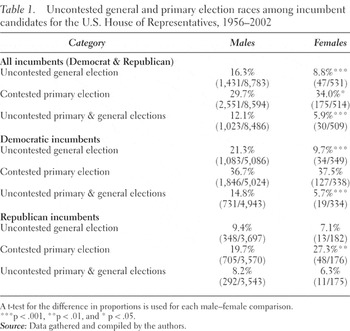
Uncontested general and primary election races among incumbent candidates for the U.S. House of Representatives, 1956–2002

The table reveals that female incumbents are less likely to enjoy the luxury of having no opponent. In districts where women stand for reelection, there are fewer uncontested general elections (8.8% versus 16.3% for males), more contested primaries (34.0% versus 29.7% for males) and fewer instances of no competition in the entire election cycle (5.9% versus 12.1% for males). The differences between the male and female proportions reported in the first row of the table are statistically significant according to the standard difference in proportions test.
The table also reveals that there are partisan differences. Among Democratic incumbents, women are substantially more likely to face major party opposition; the proportion of uncontested general elections (9.7%) is less than half the rate for men (21.3%). A similar result holds for the “free pass.” Only 5.7% of Democratic female incumbents avoid competition throughout the election cycle, compared to a rate of 14.8% for Democratic men. Male and female incumbents do face primary challenges at roughly comparable rates. The pattern is different among Republicans. While women experience fewer uncontested races in the general election and “free passes,” the differences are not as sizable as those for the Democrats. There is, however, a significant difference in the case of contested primary elections. Republican female incumbents are more likely to be challenged for renomination than their male counterparts (27.3% versus 19.7% for males).11
Note that, in general, Democrat incumbents face a more contentious primary arena than their Republican counterparts. Democrat incumbents face primary challenges in 36.8% of the cases, whereas the rate for Republicans is 20.1%.
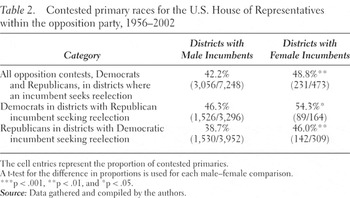
The relationship between the gender of the incumbent and contested elections should not be confined to intraparty competition. If, as we hypothesize, female incumbents are perceived as vulnerable, then it is expected that there will be greater competition for the nomination within the opposition party as well. Table 2 shows, for male and female incumbents, the proportion of contested primary elections within the opposition party. Competition for the opposition party nomination is significantly greater in districts with a female incumbent. This holds across all incumbents and within each party as well. When a female Republican holds the House seat, 54.3% of the Democratic nominees are chosen in contested primaries, compared to 46.3% when the incumbent is a Republican male. Similarly, when a female Democrat is the incumbent, 46.0% of Republican primaries are contested, compared to 38.7% in districts where the Democrat incumbent is male. Together, Tables 1 and 2 provide support for our Competition Hypothesis. Women incumbents are associated with a more competitive electoral environment; they face proportionally more contested races than their male colleagues and, at the same time, foster more contested primary races within the opposition party.
Contested primary races for the U.S. House of Representatives within the opposition party, 1956–2002

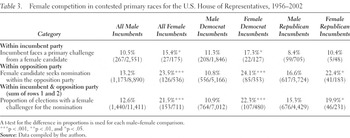
We turn next to the Gender Effect Hypothesis and the question of whether the presence of a female incumbent will draw other females into the campaign. In Table 3, we first calculated the proportion of contested primaries in which a woman challenged an incumbent of her own party. The first row of Table 3 displays the results for all incumbents and then a breakdown for Democrat and Republican incumbents separately. The second row shows the proportion of primaries in which a woman sought the nomination in the opposition party. Finally, in the third row of the table, we combined the first and second rows, incumbent and opposition party, to obtain an aggregate picture of female presence in all districts where an incumbent pursued reelection.
Female competition in contested primary races for the U.S. House of Representatives, 1956–2002

In general, the results support our hypothesis and show that the presence of a female incumbent leads to additional female candidacies in a district. Among all incumbents (row 1), the proportion of female officeholders being challenged by a female in the party primary exceeds the rate at which females challenge male incumbents (15.4% versus 10.5%). This intraparty gender effect is more pronounced among Democrats than Republicans. Female Democrats face challenges from another woman in 17.3% of contested primaries, while male Democrats are challenged by women in 11.3% of the contests. Among Republicans, the difference is smaller. Women challenge female Republicans in 10.4% of the contests, while male incumbents face a female opponent in 8.4% of the contested Republican primaries.
Table 3 also reveals that a female incumbent seeking reelection influences the gender distribution of candidates seeking the nomination within the opposition party. The proportion of opportunities in which a woman seeks the nomination of the opposition party is greater in districts with a female incumbent (23.5%) than in districts with male incumbents (13.2%).12
Additionally, within the opposition party, the incidence of two or more females contending for the nomination is greater in districts with female incumbents (3.5%) than in districts with male incumbents (1.3%).
The aggregate picture of primary elections for the U.S. House of Representatives presented in the third row of Table 3 is clear. The presence of female candidates is significantly greater in districts where a female incumbent holds the seat. This suggests then that female incumbents do provide, as role models or as testaments to the “win-ability” of the district, a signal that leads other women to run for the House seat.
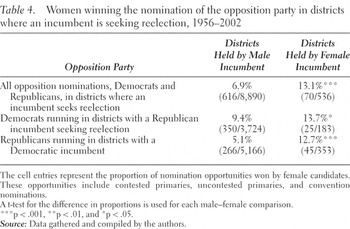
Moreover, within the opposition, not only do women seek the nomination more frequently in districts held by female incumbents but they win the nomination more frequently in these districts as well. Table 4 presents the proportion of nomination opportunities won by female candidates.13
The denominator used in calculating the percentages in Table 4 is based upon all nomination opportunities, including uncontested primary elections, contested primaries, and convention nominations.
At the suggestion of one reviewer, we divided the time frame of our study into two periods: 1956–80 and 1982–2002. We then examined our indicators of the competitive environment within each period. Among Democrats, the differences between male and female incumbents are similar in both periods. There are no departures from the patterns reported in Tables 1, 2, 3, and 4. For Republicans, three statistically significant relationships emerge in the 1982–2002 period: 1) the proportion of uncontested general elections is greater for male (15.2%) than for female (8.4%) Republican incumbents, 2) male Republicans (13.5%) enjoy more free passes than females (7.3%), and 3) the proportion of contested primary elections within the opposition party is substantially greater in districts with a female Republican incumbent (57.9% versus 42.7% for male Republicans).
Women winning the nomination of the opposition party in districts where an incumbent is seeking reelection, 1956–2002

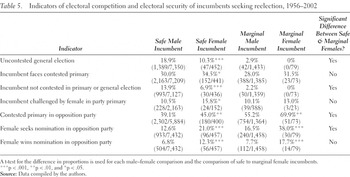
The results in Table 4 lend further credence to our earlier observation that the presence of a female incumbent may serve as a signal about the electoral prospects for women in a district. Given that more women seek nominations and win nominations in districts with a female incumbent, the presence of a female incumbent is likely to be a component in the strategic calculus in decisions women make about where to run. An additional question that arises from our analysis is whether the effect of female incumbents on the competitive environment varies with the electoral security of the incumbent. Table 5 presents the seven indicators used in our analysis for safe and marginal male and female incumbents. In this analysis, we rely upon the conventional definition of safe and marginal districts: A marginal district is one in which the incumbent won with less than 55% of the two-party vote in the previous election.
Indicators of electoral competition and electoral security of incumbents seeking reelection, 1956–2002

Three sets of tests are included in the table; we use a difference of proportions test to compare male and female incumbents from safe districts, male and female incumbents from marginal districts and, as reported in the last column of the table, females from safe and marginal districts. Table 5 demonstrates, first of all, that there is significant difference between safe female incumbents and their male counterparts on all seven indicators. Safe female incumbents face a more competitive electoral environment; there are fewer uncontested general elections (10.3% versus 18.9% for males), more contested primaries (34.5% versus 30.0% for men), and fewer “free passes” (6.9% versus 13.9% for men). In this sense, women enjoy less of the electoral security that is conventionally attributed to holding a safe seat. Note as well that women from safe districts face more primary challenges from women than do their male counterparts (15.8% versus 10.5% for men) and stimulate more competition within the opposition party and greater participation by women within the opposition party.
Turning to the comparison of male and female incumbents from marginal districts, the table reveals that there are no significant differences on the first four indicators; men and women running for reelection are equally likely to face major party competition in the general election, challenges in the primary election, and female competition in those primaries. The major differences between men and women from marginal districts are found in the activity of the opposition party. Marginal districts with female incumbents have a greater proportion of contested primaries (69.9% versus 55.2% for men), draw a larger proportion of female candidates (38.0% versus 16.5% for men), and nominate a larger proportion of women (17.7% versus 7.7% for men).
Finally, consider the extent to which safe and marginal female incumbents differ on the indicators.15
We also tested to determine whether there are significant differences in the competitive environment faced by safe and marginal male incumbents. The statistically significant differences are identical to our comparison of safe and marginal females. Compared to their safe male counterparts, marginal male incumbents enjoy fewer uncontested general elections and “free passes.” Within the opposition party, there are more contested primary elections and a higher incidence of female candidates seeking the nomination.
We also tested whether there are significant differences in the competitive environment faced by safe and marginal male incumbents. The pattern of significance is identical to what we report in the last column of Table 5 for marginal and safe female incumbents. Compared to safe male incumbents, marginal male incumbents have proportionately fewer uncontested general elections and “free passes.” Further, districts with marginal male incumbents have a larger proportion of contested primaries within the opposition party, as well as a larger proportion of female aspirants among opposition candidates.
As Table 5 shows, the Competition and Gender Effect Hypotheses are still supported even after controlling for electoral security.17
As an additional step, we treated the seven measures examined in our analysis as dependent variables and estimated a multivariate equation for each. Specifically, we cast each dependent variable as a function of three binary measures: party of the incumbent (coded one if Democrat), electoral security of the incumbent (coded one if safe), and gender of the incumbent (coded one if female). Because the dependent variables are themselves binary and their distribution is skewed, the equations were estimated using a “rare events” logit procedure (Tomz, King, and Zeng 1999). The results mirror those reported in Tables 1, 2, 3, 4, and 5. For six of the seven dependent variables, the coefficient for the gender of the incumbent was properly signed and statistically significant. The exception was the measure of whether an incumbent was challenged in the primary election. In this case, we found that the probability of a primary challenge significantly increases when a female Republican holds the seat. This is consistent with the results reported in Table 2. Overall, the exercise shows that the relationships reported in Tables 1, 2, 3, 4, and 5 hold when we control simultaneously for the political party and electoral security of the incumbent.
It is important to note that there are two difficulties with refining or expanding these models. First, the distribution of the binary dependent variables are skewed or unbalanced. For example, only 15.9% of all incumbents face no opposition in general elections; 11.7% of incumbents face no opposition in both the primary and general election. Further, while increasing over time (Palmer and Simon 2001), the presence of women in House elections remains, from a statistical viewpoint, a rare event. For example, only 10.8% of sitting incumbents face a challenge from a female candidate in their party primary; women as a proportion of all candidates seeking the nomination within the opposition party is 13.8% over the time frame of our study. The upshot of working with such unbalanced distributions is that while the estimated coefficients can be used to make reliable inferences about the impact of the independent variables, the estimated models are not terribly powerful in classifying the “positive cases” (for a similar difficulty in predicting military conflict in the international system, see Beck, King, and Zeng 2000, 2004).
Expanding the list of control or independent variables in these models presents a second difficulty. Suppose, for example, we modified each equation to include prominent demographic characteristics of the constituency (e.g., presidential vote in the district, urban dwellers, median income). In such an exercise, the objective is to determine whether the relationship between gender of the incumbent and the dependent variable holds in the face of such controls. Our most recent research (Simon and Palmer, 2005), however, provides strong evidence that the gender of the incumbents elected to the House is not independent of such constituency characteristics. There are distinct demographic profiles that make a district “woman friendly” and more likely to nominate and elect a female candidate. The statistical implication of this finding is that an equation that includes demographic variables and the gender of the incumbent will violate a fundamental assumption of the estimation technique—the explanatory variables are not independently distributed.
CONCLUSION
The point of departure for this analysis is the apparent equality between male and female incumbents and the resulting inattention given to women running for reelection. Consideration of the broader literature on women and campaigns, however, implies that there should be significant differences in races involving male and female incumbents. Using seven indicators of the competitive environment in House districts, our empirical analysis produces considerable support for both the Competition and Gender Effect Hypotheses. Women running for reelection face a more competitive environment as measured by uncontested general elections, contested primaries, and “free passes.” Female incumbents also face more challenges from female candidates in primary elections. This relationship extends to the opposition party in House districts. Within the opposition party in districts with female incumbents, there are more contested primaries and these primaries feature more women as candidates and ultimately as the chosen nominees. As a result, in spite of the parity that exists between male and female candidates in terms of electoral outcomes, female incumbents face a more rigorous electoral environment and incur higher “costs” in achieving reelection. Male and female incumbents may have the same success rates, but women have to work harder to retain their seats.
Our results thus reveal that female incumbents have a hidden influence: Their presence increases the entry and participation of female candidates in House elections. This may be due to party recruitment efforts. Although party chairs, who are still overwhelmingly male, might prefer candidates more like themselves (i.e., other men), there is an incentive to “neutralize” the advantages of a female opponent by persuading another women to run against her (see Niven 1998; Sanbonmatsu 2002b). The increase in female candidates could also be a function of a “role model effect.” The electoral success enjoyed by a female incumbent might, in and of itself, inspire more women to run. It also sends a strategic signal to groups active in candidate recruitment that women can be successful in that district. This would seem to enhance the symbolic representation of women in electoral politics (see Pitkin 1972; Mansbridge 1999); electoral success by women encourages more women to run. In addition, it also increases awareness and activity among female voters (Atkeson 2003; Hansen 1997).
On the other hand, given where women are more likely to run—in districts with female incumbents—the overall number of women in the House is not necessarily going to increase under these circumstances. Female candidacies are disproportionately concentrated in districts already represented by women. Once a woman is elected, she faces higher probabilities of being challenged for renomination by a woman and facing a female opponent in the general election. In our data, for example, there are 70 instances of female challengers running against female incumbents; well over half (46) of those have occurred since 1992. In these contests, incumbency maintained its supremacy; female incumbents lost to a female challenger in only five of those seventy elections (7.1%).18
For comparative purposes, it is worth noting that female challengers defeated male incumbents in 23 of 607 opportunities for a victory rate of 3.9%. This rate does not differ significantly from the 7.1% rate in races that feature women as both incumbents and challengers.
References
Alexander, Deborah, and
Kristi Andersen.
1993.
“Gender as a Factor in the Attribution of Leadership
Traits.”
Political Research Quarterly
46 (3):
527–45.CrossRefGoogle Scholar
America Votes.
1956–2002.
Washington, DC:
Elections Research Center, Congressional Quarterly.
Andersen, Kristi, and
Stuart Thorson.
1984.
“Congressional Turnover and the Election of
Women.”
Western Political Quarterly
37 (1):
143–56.Google Scholar
Ardoin, Phillip J., and
James C. Garand.
2003.
“Measuring Constituency Ideology in U.S. House Districts: A
Top-Down Simulation.”
Journal of Politics
65 (4):
1165–89.Google Scholar
Atkeson, Lonna Rae.
2003.
“Not All Cues are Created Equal: The Conditional Impact of
Female Candidates on Political Engagement.”
Journal of Politics
65 (4):
1040–61.CrossRefGoogle Scholar
Beck, Nathaniel,
Gary King, and
Langche Zeng.
2000.
“Improving Quantitative Studies of International Conflict: A
Conjecture.”
American Political Science Review
94 (1):
21–35.CrossRefGoogle Scholar
Beck, Nathaniel,
Gary King, and
Langche Zeng.
2004.
“Theory and Evidence in International Conflict: A Response to
de Marchi, Gelpi, and Grynaviski.”
American Political Science Review
98 (2):
379–89.CrossRefGoogle Scholar
Beiler, David.
1990.
“How To Defeat Women and Blacks.”
Campaigns and Elections.
August–September
[online version obtained from Lexis-Nexis].Google Scholar
Berch, Neil.
1996.
“The ‘Year of the Woman’ in Context: A Test of Six
Explanations.”
American Politics Quarterly
24 (2):
169–93.CrossRefGoogle Scholar
Bernstein, Robert.
1997.
“Might Women Have the Edge in Open-Seat House
Primaries?”
Women and Politics
17 (2):
1–26.Google Scholar
Braden, Maria.
1996.
Women Politicians and the Media.
Lexington:
University of Kentucky Press.
Brown, Clyde,
Neil Heighberger, and
Peter Shocket.
1993.
“Gender-Based Differences in Perceptions of Male and Female
City Council Candidates.”
Women and Politics
13 (1):1–17.CrossRefGoogle Scholar
Burrell, Barbara.
1988.
“The Political Opportunity of Women Candidates for the U.S.
House of Representatives in 1984.”
Women and Politics
8 (1):
51–68.CrossRefGoogle Scholar
Burrell, Barbara.
1992.
“Women Candidates in Open-Seat Primaries for the U.S. House:
1968–1990.”
Legislative Studies Quarterly
17 (4):
493–508.CrossRefGoogle Scholar
Burrell, Barbara.
1994.
A Woman's Place Is in the House.
Ann Arbor:
University of Michigan Press.
Carroll, Susan.
1994.
Women as Candidates in American Politics.
Bloomington:
Indiana University Press.
Chaney, Carole.
1998.
“Running Against a Woman: Advertising Strategies in Mixed-Sex
Races for the United States Senate and Their Impact on Candidate
Evaluation.”
Presented at the Western Political Science Association Annual
Meeting, Los Angeles.
Chaney, Carole, and
Barbara Sinclair.
1994.
“Women and the 1992 House Elections.” In
The Year of the Woman: Myths and Reality, ed.
Elizabeth Adell Cook,
Sue Thomas, and
Clyde Wilcox.
Boulder, CO:
Westview Press.
Clift, Eleanor, and
Tom Brazaitis.
2000.
Madam President: Shattering the Final Glass Ceiling.
New York:
Scribner.
Cook, Elizabeth Adell.
1998.
“Voter Reactions to Women Candidates.” In
Women and Elective Office: Past, Present and Future, ed.
Sue Thomas and
Clyde Wilcox.
New York:
Oxford University Press.
Cook, Elizabeth Adell, and
Clyde Wilcox.
1995.
“Women Voters in the Year of the Woman.” In
Democracy's Feast: Elections in America, ed.
Herbert Weisberg.
Chatham, NJ:
Chatham House.
Cooperman, Rosalyn, and
Bruce Oppenheimer.
2001.
“The Gender Gap in the House of
Representatives.” In
Congress Reconsidered, 7th Edition, ed.
Lawrence Dodd and
Bruce Oppenheimer.
Washington, DC:
Congressional Quarterly Press.
Darcy, R., and
James Choike.
1986.
“A Formal Analysis of Legislative Turnover: Women Candidates
and Legislative Representation.”
American Journal of Political Science
30 (1):
237–255.CrossRefGoogle Scholar
Darcy, R., and
Sarah Slavin Schramm.
1977.
“When Women Run Against Men.”
Public Opinion Quarterly
41:
1–12.CrossRefGoogle Scholar
Darcy, R.,
Susan Welch, and
Janet Clark.
1994.
Women, Elections, and Representation. 2d ed.
Lincoln:
University of Nebraska Press.
Deber, Raisa.
1982.
“The Fault Dear Brutus: Women as Congressional Candidates in
Pennsylvania.”
Journal of Politics
44 (2):
463–79.CrossRefGoogle Scholar
Delli Carpini, Michael, and
Ester Fuchs.
1993.
“The Year of the Woman? Candidates, Voters, and the 1992
Elections.”
Political Science Quarterly
108 (1):
29–36.CrossRefGoogle Scholar
Dolan, Kathy.
1998.
“Voting for Women in the ‘Year of the Woman.’”
American Journal of Political Science
42 (1):
272–93.CrossRefGoogle Scholar
Dolan, Kathy.
2001.
“Electoral Context, Issues, and Voting for Women in the
1990s.” In
Women and Congress: Running, Winning and Ruling, ed.
Karen O'Connor.
New York:
Haworth Press.
Dolan, Kathy
2004.
Voting for Women: How the Public Evaluates Women Candidates.
Boulder, CO:
Westview Press.
Duerst-Lahti, Georgia.
1998.
“The Bottleneck: Women Becoming Candidates.” In
Women and Elective Office: Past, Present and Future, ed.
Sue Thomas and
Clyde Wilcox.
New York:
Oxford University Press.
Fenno, Richard.
1977.
“U.S. House Members in Their Constituencies: An
Exploration.”
American Political Science Review
71 (3):
883–917.CrossRefGoogle Scholar
Fox, Richard.
1997.
Gender Dynamics in Congressional Elections.
Thousand Oaks, CA:
Sage.
Fox, Richard,
Jennifer Lawless, and
Courtney Feeley.
2001.
“Gender and the Decision to Run for Office.”
Legislative Studies Quarterly
26 (3):
411–34.CrossRefGoogle Scholar
Fox, Richard, and
Zoe Oxley.
2003.
“Gender Stereotyping in State Executive Elections: Candidates
Selection and Success.”
Journal of Politics
65 (3):
833–50.CrossRefGoogle Scholar
Francia, Peter.
2001.
“Early Fundraising by Nonincumbent Female Congressional
Candidates: The Importance of Women's PACs.” In
Women and Congress: Running, Winning and Ruling, ed.
Karen O'Connor.
New York:
Haworth Press.
Gaddie, Ronald Keith, and
Charles Bullock.
1995.
“Congressional Elections and the Year of the Woman: Structural
and Elite Influences on Female Candidates.”
Social Science Quarterly
76 (4):
749–62.Google Scholar
Gallup Poll.
1992.
Wilmington, DE:
Scholarly Resources.
Gertzog, Irwin, and
Michele Simard.
1991.
“Women and ‘Hopeless’ Congressional Candidacies:
Nomination Frequency, 1916–1978.”
American Politics Quarterly
19 (4):
449–66.Google Scholar
Green, Joanne Connor.
1998.
“The Role of Gender in Open-Seat Elections for the U.S. House
of Representative: A District Level Test for a Differential Value for
Campaign Resources.”
Women and Politics
19 (2):
33–55.CrossRefGoogle Scholar
Hansen, Susan.
1997.
“Talking About Politics: Gender and Contextual Effects on
Political Proselytizing.”
Journal of Politics
59 (1):
73–103.CrossRefGoogle Scholar
Herrick, Rebekah.
1995.
“A Reappraisal of the Quality of Women
Candidates.”
Women and Politics
15 (4):
25–38.CrossRefGoogle Scholar
Herrick, Rebekah.
1996.
“Is There a Gender Gap in the Value of Campaign
Resources?”
American Politics Quarterly
24 (1):
68–80.Google Scholar
Herrnson, Paul S.
1998.
Congressional Elections: Campaigning At Home and in
Washington.
Washington, DC:
Congressional Quarterly Press.
Herrnson, Paul,
Celeste Lay, and
Atiya Kai Stokes.
2003.
“Women Running ‘as Women’: Candidate Gender,
Campaign Issues, and Voter-Targeting Strategies.”
Journal of Politics
65 (1):
244–55.CrossRefGoogle Scholar
Hoffman, Kim,
Carrie Palmer, and
Ronald Keith Gaddie.
2001.
“Candidate Sex and Congressional Elections: Open Seats
Before, During, and After the Year of the Woman.” In
Women and Congress: Running, Winning and Ruling, ed.
Karen O”Connor.
New York:
Haworth Press.
Huddy, Leonie, and
Nayda Terkildsen.
1993a.
“The Consequences of Gender Stereotypes for Women Candidates
at Different Levels and Types of Office.”
Political Research Quarterly
46 (3):
503–25.Google Scholar
Huddy, Leonie, and
Nayda Terkildsen.
1993b.
“Gender Stereotypes and the Perception of Male and Female
Candidates.”
American Journal of Political Science
37 (1):
119–47.Google Scholar
Iyengar, Shanto,
Nicholas Valentino,
Stephen Ansolabehere, and
Adam Simon.
1997.
“Running as a Woman: Gender Stereotyping in Political
Campaigns.” In
Women, Media, and Politics, ed.
Pippa Norris.
New York:
Oxford University Press.
Jacobson, Gary C.
1997.
The Politics of Congressional Elections.
4th ed.
New York:
Harper Collins.
Jamieson, Kathleen Hall.
1995.
Beyond the Double Bind: Women and Leadership.
New York:
Oxford University Press.
Kahn, Kim Fridkin.
1995.
“Characteristics of Press Coverage in Senate and Gubernatorial
Elections: Information Available to Voters.”
Legislative Studies Quarterly
20 (1):
23–35.CrossRefGoogle Scholar
Kahn, Kim Fridkin.
1996.
The Political Consequences of Being a Woman.
New York:
Columbia University Press.
Kahn, Kim Fridkin, and
Edie Goldenberg.
1991.
“Women Candidates in the News: An Examination of Gender
Differences in U.S. Senate Campaign Coverage.”
Public Opinion Quarterly
55 (2):
180–99.CrossRefGoogle Scholar
Kaufman, Karen, and
John Petrocik.
1999.
“The Changing Politics of American Men: Understanding the
Sources of the Gender Gap.”
American Journal of Political Science
43 (3):
864–87.CrossRefGoogle Scholar
Koch, Jeffrey.
2000.
“Do Citizens Apply Gender Stereotypes to Infer
Candidates' Ideological Orientations?”
Journal of Politics
62 (2):
414–29.Google Scholar
Koch, Jeffrey.
2002.
“Gender Stereotypes and Citizens' Impression of House
Candidates' Ideological Orientations.”
American Journal of Political Science
46 (2):
453–62.CrossRefGoogle Scholar
Kropf, Martha, and
John Boiney.
2001.
“The Electoral Glass Ceiling? Gender, Viability, and the News
in U.S. Senate Campaigns.” In
Women and Congress: Running, Winning and Ruling, ed.
Karen O'Connor.
New York:
Haworth Press.
Lamson, Peggy.
1968.
Few Are Chosen.
Boston:
Houghton Mifflin.
Leeper, Mark.
1991.
“The Impact of Prejudice on Female Candidates: An Experimental
Look at Voter Inference.”
American Politics Quarterly
19 (2):
248–61.CrossRefGoogle Scholar
Mansbridge, Jane.
1999.
“Should Blacks Represent Blacks and Women Represent Women? A
Contingent ‘Yes.’ ”
Journal of Politics
61 (3):
628–57.Google Scholar
McDermott, Monika.
1997.
“Voting Cues in Low-Information Elections: Candidate Gender as
a Social Information Variable in Contemporary U.S.
Elections.”
American Journal of Political Science
41 (1):
270–83.CrossRefGoogle Scholar
McDermott, Monika.
1998.
“Race and Gender Cues in Low-Information
Elections.”
Political Research Quarterly
51 (4):
895–918.CrossRefGoogle Scholar
Niven, David.
1998.
“Party Elites and Women Candidates: The Shape of
Bias.”
Women and Politics
19 (2):
57–80.CrossRefGoogle Scholar
Niven, David, and
Jeremy Zilber.
2001.
“‘How Does She Have Time for Kids and Congress?’
Views on Gender and Media Coverage from House Offices.” In
Women and Congress: Running, Winning and Ruling, ed.
Karen O'Connor.
New York:
Haworth Press.
Norris, Pippa.
1997.
“Women Leaders Worldwide: A Splash of Color in the Photo
Op.” In
Women, Media, and Politics, ed.
Pippa Norris.
New York:
Oxford University Press.
Ornstein, Norman J.,
Thomas E. Mann, and
Michael J. Malbin, eds.
1998.
Vital Statistics on Congress.
Washington, DC:
Congressional Quarterly.
Palmer, Barbara, and
Dennis Simon.
2001.
“The Political Glass Ceiling: Gender, Strategy, and
Incumbency in U.S. House Elections, 1978–1998.” In
Women and Congress: Running, Winning and Ruling, ed.
Karen O'Connor.
New York:
Haworth Press.
Palmer, Barbara, and
Dennis Simon.
2003.
“Political Ambition and Women in the U.S. House of
Representatives, 1916–2000.”
Political Research Quarterly
56 (2):
127–38.CrossRefGoogle Scholar
Petrocik, John.
1996.
“Issue Ownership in Presidential Elections, with a 1980 Case
Study.”
American Journal of Political Science
40 (3):
825–50.CrossRefGoogle Scholar
Pitkin, Hanna.
1972.
The Concept of Representation.
Berkeley:
University of California Press.
Rodine, Sharon.
1990.
“How to Beat ‘Bubba,’”
Campaigns and Elections. October-November
[online version obtained from Lexis-Nexis].Google Scholar
Rule, Wilma.
1981.
“Why Women Don't Run: The Critical and Contextual Factors
in Women's Legislative Recruitment.”
Western Political Quarterly
34:
60–77.Google Scholar
Sanbonmatsu, Kira.
2002a.
“Gender Stereotypes and Vote Choice.”
American Journal of Political Science
46 (1):
20–34.Google Scholar
Sanbonmatsu, Kira.
2002b.
“Political Parties and the Recruitment of Women to State
Legislatures.”
Journal of Politics
64 (3):
791–809.Google Scholar
Schroeder, Pat.
1999.
Twenty-four Years of House Work and the Place is Still a
Mess.
Kansas City, MO:
Andrews McMeel.
Seligman, Lester.
1961.
“Political Recruitment and Party Structure: A Case
Study.”
American Political Science Review
5 (1):
77–86.CrossRefGoogle Scholar
Seltzer, Richard,
Jody Newman, and
Melissa Voorhees Leighton.
1997.
Sex as a Political Variable.
Boulder, CO:
Lynne Rienner Publishers.
Shapiro, Robert, and
Harpreet Mahajan.
1986.
“Gender Differences in Policy Preferences: A Summary of Trends
from the 1960s to the 1980s.”
Public Opinion Quarterly
50 (1):
42–61.CrossRefGoogle Scholar
Simon, Dennis, and
Barbara Palmer.
2005.
The Political Geography of Women-Friendly Districts.
Paper presented at the annual meeting of the Southern Political
Science Association, New Orleans, LA.
Theilmann, John, and
Al Wilhite.
1991.
Discrimination and Congressional Campaign Contributions.
New York:
Praeger.
Thompson, Seth, and
Janie Steckenrider.
1997.
“The Relative Irrelevance of Candidate Sex.”
Women and Politics
17 (4):
71–92.CrossRefGoogle Scholar
Tomz, Michael,
Gary King, and
Langche Zeng.
1999.
“RELOGIT: Rare Events Logistical Regression.”
Version 1.1.
Cambridge, MA:
Harvard University Press.
Uhlaner, Carole Jean, and
Kay Lehman Schlozman.
1986.
“Candidate Gender and Congressional Campaign
Receipts.”
Journal of Politics
48 (1):
30–50.Google Scholar
Welch, Susan,
Margery Ambrosius,
Janet Clark, and
R. Darcy.
1985.
“The Effect of Candidate Gender on Election Outcomes in State
Legislative Races.”
Western Political Quarterly
38 (3):
464–75.Google Scholar
Welch, Susan, and
Donley Studlar.
1996.
“The Opportunity Structure for Women's Candidacies and
Electability in Britain and the United States.”
Political Research Quarterly
49 (4):
861–74.CrossRefGoogle Scholar
Wilcox, Clyde.
1994.
“Why Was 1992 the ‘Year of the Woman’? Explaining
Women's Gains in 1992.” In
The Year of the Woman: Myths and Reality, ed.
Elizabeth Adell Cook,
Sue Thomas, and
Clyde Wilcox.
Boulder, CO:
Westview Press.
Williams, Leonard.
1998.
“Gender, Political Advertising, and the ‘Air
Wars.’”
Women and Elective Office: Past, Present and Future, ed.
Sue Thomas and
Clyde Wilcox.
New York:
Oxford University Press.
Witt, Linda,
Karen Paget, and
Glenna Matthews.
1995.
Running as a Woman: Gender and Power in American Politics.
New York:
Free Press.
Uncontested general and primary election races among incumbent candidates for the U.S. House of Representatives, 1956–2002
Contested primary races for the U.S. House of Representatives within the opposition party, 1956–2002
Female competition in contested primary races for the U.S. House of Representatives, 1956–2002
Women winning the nomination of the opposition party in districts where an incumbent is seeking reelection, 1956–2002
Indicators of electoral competition and electoral security of incumbents seeking reelection, 1956–2002
 You have
Access
- 26
- Cited by