In 1872, Sir John Strachey, the governor-general of India, was horrified to hear about the state of the finances of the recently completed Bombay province’s Government House at Gunnesh Khind in Pune. He was told that the cost in 1865 was estimated at 355,000 rupees and that the building would be completed in a couple of years. In 1869, however, costs were escalating out of control and building was proceeding at an alarmingly slow rate. The colonial government had already spent 960,181 rupees on the unfinished building, with the result that the “work had already progressed too far to render any stoppage possible.” A year earlier, Sir Stafford Northcote, the secretary of state for India, had written to Strachey’s predecessor, Sir John Lawrence, regretting that “your Government has practically set to nought the control which the government of India are by law required to exercise over expenditure of public money.” The letter continued with an outline of the various ways that the construction project had gone over costs and time. By the time it was finally completed in 1874, the building cost more than four times the 1867 estimate and was several years overdue.Footnote 1
Gunnesh Khind was not unique. As one commentator noted, the “systematic and reckless disregard” for building on time and budget was “a malady extending all over India.Footnote 2 Another opined that “it surely cannot be cause for surprise that Government works in India are hardly ever completed except at a considerable excess above the original estimates.”Footnote 3 Similar stories were found across the colonial world. The building of Singapore’s water supply system in the 1870s, for example, was 45 percent over budget and several years behind schedule, while the Suez Canal cost double its original estimate and took twelve years to complete.Footnote 4 Cost and time overruns were also endemic outside the colonial world. From the nineteenth-century railroads in North America and Europe to the Sydney Opera House, many of the world’s iconic mega projects have been plagued by large financial and timing overruns.Footnote 5 With few exceptions, large public infrastructures across the world have been completed late and substantially over budget. These outcomes have major social costs, including burdening governments with unexpected expenses, drawing resources away from other investment priorities, and reducing public trust in the capacity of governments to deliver public infrastructure. Indeed it is a paradox that while megaprojects have been an enduring policy choice in countries around the world and throughout history, their implementation has been endemically troubled. The unsuccessful development of megaprojects has made this a topic of critical importance for scholars of policy formulation and implementation.Footnote 6
Despite an extensive literature on contemporary megaproject construction and the issue of cost overruns in particular, very little is known about these schemes in the colonial past.Footnote 7 Scholarly work on colonial megaprojects focuses on the construction and implementation of projects. We know a great deal about how railroad and irrigation schemes incorporated agricultural areas into the broader imperial trading world, intensified the links between rural areas and cities, and created new urban hierarchies.Footnote 8 Several works have assessed the origins, morphology, and labor politics of the new docks lining the waterfronts of expanding colonial cities.Footnote 9 Scholars have also turned their attention to elucidating the ensemble of technologies, labor practices, institutions, and political practices that underpinned the development of publically funded sanitation regimes in colonial cities.Footnote 10 The focus in all of this work has been on the reasons behind and the use of these material landscapes.
The question of the financial and political viability of large urban colonial megaprojects and the implications this has for an understanding of policy formulation remains neglected. What we do know tends to be focused on projects that have experienced noteworthy overruns, such as Gunnesh Khind, the Suez Canal, and the Singapore water supply system. With a few notable exceptions, little research has documented the conditions leading to scheme completion on time and on budget. This is especially the case with respect to the place-based dynamics that contribute to successful delivery.Footnote 11 It is this task that we turn to in this article. A case study of the construction of Bombay’s Prince’s Dock in the 1870s furthers the understanding of the modern colonial city and the history of megaproject construction by linking the social relations of place to the building of a large public infrastructure project. A project controlled from London but contested in Bombay, the new docks inserted the colonial city into expanding imperial and global trading networks of the nineteenth century. As Bombay’s first modern dock demonstrates, financial and time overruns do not have to characterize the construction of large infrastructures. One of the largest docks in the world when it was opened in 1880, the Prince’s Dock was built within the estimates sanctioned and the time allotted by the Government of Bombay even though the ventures involved bitter conflict between the most powerful economic and political interests of the day.
The question of data reliability and accessibility is a key problem facing the historian of large public and private infrastructure ventures. Fortunately, extant archival material allows us to make a detailed study of the political and economic dynamics of Bombay’s dock construction.Footnote 12 Three sources have been invaluable. Colonial government records furnish correspondence between the various governments and other institutions. The annual reports of the Bombay Port Trust outline the progress of the dock building. Finally, the Times of India supplies verbatim accounts of key place-based agents, including the Chamber of Commerce and city merchants. Unlike present-day newspapers, the Times was a message board for the city’s elite, allowing them to communicate on the business of the day. Together, these sources provide a detailed history of the project, and allow us to work through the ways that the political, economic, and social relations of place in nineteenth-century colonial Bombay established the framework for the building of the Prince’s Dock.
What the case illustrates is that the ability to keep costs within approved allocations is embedded in the politics of place. Place-based dynamics linked to a range of scales identified in the case study are applicable to other large public infrastructure projects, even as their articulation in their own time and place will be very different. This may be a somewhat unsatisfying explanation for scholars and policymakers seeking reproducible lessons or rules to consistently deliver megaprojects on time and on budget. However, time and cost overruns on megaprojects have persisted despite decades of academic study and policy innovation. If there were commonly applicable solutions, they would have been successfully implemented already. Rather, our article highlights the need for policymakers to better understand the social relations and dynamics in the place where a megaproject is being developed, and the ways that these contextual conditions can either provide incentives for effective project delivery or encourage delays and rising costs.
Megaprojects and Place
Megaprojects are significant material and symbolic investments serving civic and profit-making ends. Technically sophisticated, financially large, and administratively complex, large, publicly controlled, single-purpose infrastructure schemes such as Prince’s Dock transform the urban and national landscape. Gigantic projects around the world have delivered a wide range of positive benefits, such as major urban renewal and job creation; established global networks of economic, political, and technological exchange; and promoted the circulation of goods, information, people, and money across space. Despite the obvious value in developing urban infrastructure megaprojects, project promoters have often exaggerated their expected benefits in order to gain approval for initiatives that otherwise would not justify their costs. Large schemes also convey a symbolic imagery of proactive leadership, technical efficiency, and global status. Given the large but unequal and uncertain benefits they create and the potential they pose for significant negative benefits, megaprojects are also political projects. Theodore Roosevelt, for instance, recognized this point when he implored Americans in 1902 to take on the task of completing the Panama Canal following the failure of the French contractor.Footnote 13 So did the British colonial rulers of India, who understood that the construction of a national railway and dock networks had the potential to breakdown traditional social and labor relations and to draw the country into networks of modern global capitalism.Footnote 14
Despite the enduring popularity and growing scale of large, publicly controlled infrastructure megaprojects, these massive capital expenditures are beset with an underlying problem: the prevalence of cost overruns. Stanley Engerman and Kenneth Sokoloff document how some of the most important large American infrastructural schemes of the nineteenth century, such as the Erie Canal, the Croton Aqueduct in New York City, and the Mississippi River Levee Line, were characterized by substantial costs escalations. Plagued by financial misfeasance, political conflict, and organizational incompetency, project after project experienced cost and time overruns.Footnote 15 The construction of the railroads in India was afflicted by a similar set of obstacles that led to similar outcomes.Footnote 16 Outside of colonial India, docks were built over budget and time. In the Ottoman city of Izmir, a dock, which was first started in 1869 by the British, was finally completed by Dussaud Bros., a French engineering company, in 1880. It went over budget and time because of acrimony from local merchants and British interests and the difficulty of finding sufficient private capital.Footnote 17 In British-controlled Zanzibar, the Colonial Office approved a plan to enlarge the harbor in 1919. However, the Malindi project quickly fell into trouble as the projected costs were far less than were actually required. Without an on-the-ground promoter and facing conflicting local and colonial pressures, it was only finished in the late 1920s, ten years after the initial approval and close to 60 percent over budget.Footnote 18
This is also the case with more recent large infrastructural projects. Working from a global dataset of 258 megaprojects from 1925, Bent Flyvbjerg and his colleagues show that nine out of ten large transportation schemes are completed late and over budget. Persistent patterns of cost and time overruns are unchanged from 1925 through the present, highlighting a historical durability that pervades updates in project delivery techniques over time.Footnote 19 From the above discussion, it is clear that the policy of megaproject development cannot be detached from the project’s implementation. When projects are so big, the costs so high, and success is measured in terms of both tangible and symbolic outcomes, policy formulation and execution are intimately linked as part of the same cycle of decision making.
To be certain, not all large infrastructure projects are completed over budget. Why this is the case demands an explanation about the factors that contribute to the small minority of schemes that are successfully delivered. Several writers make a similar point, although they tend to focus on either large-scale datasets that tell us little about actual cases or single explanations such as political corruption or technical inefficiencies.Footnote 20 Building on this work, we use a case-study approach to argue that the dynamics of the social relations in the place in which a project is built is a rich area of inquiry in understanding whether preconstruction estimates for time and cost are in fact met. Central to this is the idea that different social actors are placed in quite different ways in relation to the political economy of a locality and that this has important effects on what happens in that place.Footnote 21 Local businesses, politicians, developers, and workers fight over local resources and power. This locally contested world is connected with worlds elsewhere through a complicated web of material and symbolic interactions.Footnote 22
Put differently, the local context is more than a backdrop for decisions about specific megaprojects. It also creates conditions that can either support or exacerbate the incidence of cost and time overruns, aligning the interests between the various stakeholders. The importance of place on the outcome of megaproject development, however, varies by the type and scale of the project and the sociopolitical regime in which it occurs. Urban fixed projects such as docks and stadiums have a different politics of place than circulating commodities, such as military goods and information technologies, and extensive infrastructures that stretch across space such as canals and railroads. Nevertheless, we contend that the place-specific character of large infrastructure construction is a direct product of localized multi-scalar economic, social, and institutional arrangements. In particular places at particular times, public schemes are subjected to vigorous outside scrutiny embedded in the political, economic, and institutional environments in which they are planned. Project-financing regimes create accountability mechanisms for those producing forecasts and overseeing construction. Based on their social status within the local community, those championing megaprojects can either have greater or less incentive to make accurate forecasts and take measures to ensure that the scheme keeps on budget.
Our detailed analysis of the building of the Prince’s Dock in 1870s Bombay illustrates how the completion of the project on time and on budget was embedded in a specific alignment of multi-scalar political, economic, and social interests. Four dynamics are crucial to this story. First, the composition of those supporting and opposing a scheme create a climate of scrutiny that is accepted, often begrudgingly, by project planners. Schemes that face opposition from powerful political, economic, or social elites create a disciplinary regime over the cost and time estimates being produced, while widespread popular support limits the potential for unexpected and costly change orders. The building of a modern port in late nineteenth-century Chittagong, for example, developed around a consensus among the city’s shipping, railroad, and political interests for strict financial accounting.Footnote 23
Second, the role of a project champion as a politician, an entrepreneur, or technocrat is critical as they take responsibility for completing the scheme. Highly motivated, politically able, and powerful characters such as John Stevens and Major George Goethals were able to incorporate and neutralize dissident voices over the building of large-scale ventures such as the Panama Canal. The foundation of the scheme champion’s local reputation and future legacy can thus be central in influencing the prospects of major time and cost overruns. A project champion who is deeply embedded in a local civil service or technocratic community, and whose reputation is based on successful project delivery, has a strong incentive to take aggressive steps to meet the scheme’s proposed budget and timeline.
Third, local culture can strongly influence the strategies to limit cost and time overruns. In certain places at specific moments, such as colonial India and Africa, French-controlled Egypt, the Ottoman Empire, the late nineteenth-century Americas, and now contemporary India, cultures of limited professionalism in government procurement, pervasive nepotism or corruption, labor militancy, and public indifference can coalesce to create conditions where overruns become the norm. In many cases, the ability to complete large schemes on time and on cost centers on local unequal and exploitative labor relations.
Finally, the character of the project’s financing arrangement shapes the extent to which local and nonlocal actors make realistic construction cost estimates and then meet their obligations. Competition to attract senior government grants has in many cases led local governments to underestimate the costs and overestimate the benefits of their ventures. Financing ventures through government debt or bonds has created little private-sector scrutiny on major infrastructure schemes when it is believed that the government will repay their debts. By comparison, private loans that are repaid based on successful completion of a project or through revenues from operations create an incentive for the financiers to scrutinize project budgets and construction progress. Our study of the building of Bombay’s Prince’s Dock frames megaprojects within a broader set of place-based articulations and interactions.
Prince’s Dock: Built on Time and on Budget
By the 1860s it was evident to many people in India and Britain that changes had to be made to the Bombay harbor if the city was to strengthen its place as a significant imperial center. Seeking to strengthen India’s place within the imperial system, cotton merchants, textile manufacturers, and shipping companies pushed for the construction of a large and modern port complex on the colony’s western coast. With its significant trading, manufacturing, and transportation facilities, Bombay was the most obvious choice. The opening of the Suez Canal in 1869, which reduced travel time between Europe and western India by more than a half, was a further impetus to the building of a dock system. The first concrete step toward this was the creation in 1873 of the Bombay Port Trust, a financially independent state-owned enterprise, which was given the task of building a dock capable of servicing large, ocean-bound steamers.Footnote 24 In 1875 the Trust received approval to build a new dock. Opened in early 1880, the dock, named Prince’s Dock after the Prince of Wales, was built on budget and on time. Similar in scale to docks built in London and Liverpool at the time, it was India’s first modern, large-scale dock.Footnote 25
The planning and building of one of India’s largest colonial projects of the time was not straightforward.Footnote 26 It took several years of acrimonious debate between the secretary of state and the British Parliament, two levels of colonial government, the Bombay municipal government, the Bombay Port Trust, European shipping companies, and Indian merchants to reach a final decision about the dock’s cost and end date of construction. A final and binding decision was reached in April 1875, with the government approving a scheme to cost 7.6 million rupees. Funding came from a government of India loan to be repaid with interest at 4.5 percent once construction was finished. The principal and interest were to come out of dock dues. Several scope changes introduced after 1875, which resulted in the rewriting of the contract between the government and the main contractor during construction, did not produce overruns. While some of the scope-changing proposals were accepted, most were rejected as not bringing a “fair return” on expenditures.Footnote 27 Unlike many current projects, the changes that were accepted did not have an adverse effect on the scheme. Indeed, their successful incorporation into the original project speaks to the ability of local accountability mechanisms to keep time and costs within the mandate sanctioned in 1875.
The dock was completed on time and on budget. The first and last stones were laid on November 11, 1875, and April 10, 1879, respectively, and the dock was formally opened to shipping on January 1, 1880. Prince’s Dock was Bombay’s and India’s first modern large-scale dock, complete with 1.5 miles of dock wall, a deep water channel, forty-four hydraulic loading cranes, and a large set of sheds.Footnote 28 A month after the opening, John Macdonald, the secretary to the governor of Bombay, told J. Ponsonby Cox, the Trust’s chairman, that the time to completion was “a very short time for such a work.”Footnote 29
It is also clear that the project finished on budget. Certainly, the Trust did not receive more from the government than the 7.6 million rupee loan agreed upon in April 1875. Nor is there any evidence in the Trust’s financial accounts that funds were taken from elsewhere to pay for construction. According to Thomas Ormiston, the Trust’s chief engineer, the building of the dock itself, including masonry wall construction, dock excavation, channel dredging, and infrastructure installation, was completed within the allotted budget.Footnote 30 Macdonald agreed, writing that “not only has the work been executed with great rapidity; it has also been completed within the sanctioned estimate, although the area of the Dock is greater and the water is deeper than was originally estimated for.”Footnote 31 By 1880 the dock was open, seawater had been admitted, all of the berths had been leased to European steamship companies, and the Trust was collecting unloading, loading, and wharfage dues.Footnote 32 Indian’s first modern dock was open for business.
How can we explain the Trust’s ability to construct on time and on budget a massive infrastructural work? How can this be accounted for in colonial India, where the British administrator’s “profligate disregard” for building on time and budget was “a malady extending all over India” and where “there can be little doubt that systematic peculation of one sort or the other is largely prevalent”?Footnote 33 Without exploring the character of the place-based relations affecting both the day-to-day and the broader policy issues of dock construction, it is very difficult to ascertain the dynamics crucial to completion of the work. We argue that the Prince’s Dock’s success lay in a dynamic created by several interlocking place-based factors. The combination of judicious political oversight, contested political relationships at various spatial levels, dynamics specific to Bombay’s foreshore properties, and the character of the local labor regime ensured that construction costs would not escalate out of control and that the work would be completed on time.
The Docks, Contestation, and the Politics of Multiscale Governance
Building the dock was a hotly contested local issue. In the 1840s and 1850s, large steamship companies such as P&O and British India Steam Navigation demanded better dock facilities. Requiring rapid turnaround for their high-value services and commodities, they pressured local and imperial governments to modernize the city’s port facilities. Little was achieved, however, as governments were administratively incompetent and ideologically opposed to public investment in such facilities, while private companies were unable to assemble the necessary political drive and financial capital.Footnote 34 Beginning in the 1860s, a divisive debate involving the city’s elites took place over the foreshore properties where the dock would eventually be constructed. The central question revolved around what to do with the property of the Elphinstone Land and Press Company. Formed in 1858, the company’s mandate was to reclaim land from the city’s foreshore and to build tidal basins, roads, and warehouses, Experiencing little initial development and constant financial problems after the economic crash of 1865, the government of India forced the Government of Bombay to buy the property in 1870 even though powerful local interests questioned the wisdom of the purchase and the cost.Footnote 35
Conflict intensified once the property was suggested as the site for the new dock. For many, the government-owned property at Mody Bay, which was closer to the city’s business district, was a much better location for a harbor. As a result, the decision-making process for determining the location and cost of the new docks was highly divisive. The business of sanctioning construction was long, arduous, and contentious. Importantly, the divisions over the use of the Elphinstone property for the new docks forced the colonial state and its agents in Bombay to proceed very carefully and created a skeptical group of voluble and powerful people who closely scrutinized the construction process.
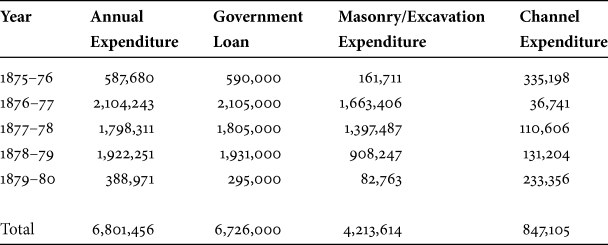
To deal with these divisive local issues, the Bombay and India governments placed strict financial oversight over the project. The 7.6 million rupees were spent by the Trust on the masonry and excavation contracts awarded to William Glover and Company, construction work undertaken by the Trust itself, and one-time expenditures of fixed capital items such as bollards, cranes, and dredgers. All of this was closely monitored. The specifics of the loan were a critical part of the successful completion of the project on time and on cost. The loan was provided on an annual basis for five years (1875–76 to 1879–80), with each new allocation doled out on the successful completion of the already-paid-for work (Table 1). In the first year, the Trust spent 587,681 rupees out of a loan of 590,000 rupees, most of which went to channel clearing and masonry work. The Trust only received the second-year portion of the loan once the previous year’s work had been verified and cleared. Over the next three years, almost 4 million of the 5.8 million rupee loan was spent on outsourced masonry and excavation work. Close oversight was given on most aspects of the construction. Glover was the focus of tight supervision, with each new annual payout only given after careful perusal of his work in the preceding year. A tight rein was placed on the loan, making it very difficult to obtain authorization for more money for a sanctioned task or to change the scope of the construction.
Expenditures on Prince’s Dock, 1875–1880 (rupees)

Source: Bombay Port Trust, Administration Report (Bombay, various years).
This oversight operated at various spatial levels of governance. The Trust reported to the Government of Bombay, which in turn reported to the government of India. The secretary of state in London had ultimate responsibility. Within this chain of command, the Trust was the on-the-ground power with Ormiston undertaking supervision of all aspects of the construction. He was the project’s champion. Not only had he convinced the government of India to use Elphinstone, but it was his plan that was used to build the dock.Footnote 36 His reputation as an engineer and as a respected Bombay citizen was embedded in the scheme’s success. As such, he, and his brother George, who took over when Thomas retired in 1877, exercised a constant presence on the site, overseeing, monitoring, and, in some cases, fighting with Glover. Even though they were not responsible for the actual construction, the Ormiston brothers worked hard to ensure that the project proceeded as quickly and as effectively as could be managed under the circumstances. As the project’s champions, their reputations were on the line.
Similarly, the Bombay government expected a strict accounting of the construction’s progress from the Trust. The Public Works Department received monthly reports from the chief engineer. The Ormistons’ end-of-year reports lay out all aspects of the year’s progress, including the work completed, problems confronted, and an itemized costing of the year’s construction. The Bombay government signed off on these reports. But this was not the final level of control. Through a series of reports, memos, and letters, Bombay reported on the works to the government of India. In some cases, reporting was nondescript and simply documented routine affairs. In other cases, it was nonroutine as the government was kept informed about specific problems or ongoing matters of concern. In the latter case, the state had to be a calculating agent that would strongly influence the building of the dock. In all cases, an intricate web of oversight of the financial and everyday building operations characterized the dock’s construction.
The Politics of Multiscale Governance
The building of the dock was shaped by the financial oversight emerging out of long-running political and economic conflict over local resources, the place of senior governments in local affairs, and imperial and local economies. The city’s political regime in the 1860s and early 1870s had three key features. First, the imperial government was intent on asserting its authority over the Indian urban landscape. Bombay, through its refashioning of the central business district and the modernization of the docks, was a material manifestation of imperial power in India.Footnote 37 Second, two distinct business blocs fought over Bombay’s economic trajectory and the distribution of the economic surplus generated in the colonial economy. While European business houses and their Indian allies sought to build new imperial economic relations, small-scale Indian traders and manufacturers looked to consolidate their hold over the Indian market.Footnote 38 Finally, political and economic elites, both British and Indian, controlled the municipal corporation. While ignoring pressing questions of sanitation, water, and housing, the city council allocated city resources to constructing an imperial business district that reflected colonial dominance, to building new transportation nodes that linked the city to the world outside, and to reordering the spatial form of the city to facilitate profit making. As the city’s major landowners, Indian government and civic elites sought to protect their property from the incursions of the state and other interested parties.Footnote 39 Prince’s Dock was one manifestation of this local politics.
The character of the city’s political regime ensured that conflict over political authority, the distribution of the colonial surplus, private property, and the allocation of municipal finances would promote ongoing and often bitter conflict between elite blocs. This conflict over what to do in Bombay was played out at different spatial scales. One site of conflict lay within the colonial state. The governments of India and Bombay had been at loggerheads over how to develop the city’s foreshore properties since the early 1860s. Bombay was a reluctant participant in India’s position, arguing against the Elphinstone location. As we have seen, their choice was Mody Bay. By September 1874, there was still a “difference of opinion between the two Governments,” with neither “inclined to surrender their views” on the matter.Footnote 40 Despite the support of the city’s mercantile and landed property interests, Bombay failed to convince India to build the dock at Mody Bay. Against its will, Bombay was forced to promote Elphinstone as the site of the new facilities and to take financial responsibility for dock construction.
Overseeing these conflicting layers of colonial government was the secretary of state for India. Beholden to the British government and parliament, the secretary was responsible for colonial matters, financial and otherwise. The Duke of Argyll signed off on the purchase of the Elphinstone estate in 1870. Five years later, the Marquees of Salisbury allowed the government of India to force the Bombay government to financially underwrite dock construction and to dictate the terms of construction. By becoming involved in matters they usually left to the lower levels of government, the succession of secretaries of state became implicated in the project’s successful outcome and city politics. The reason for this, in London’s view, was that to go over costs and time would be embarrassing. Moreover, it was believed that the local interests actively working against the scheme would demand a humiliating financial and political accounting from the government. This was not acceptable. The project would have to be pushed forward regardless of the limitations associated with the Elphinstone property’s location.
The local character of the dock and property issue was intensified by the British Government’s sensitivity at the time to massive colonial overruns. This sensitivity was apparent in the voluminous testimony compiled between 1872 and 1874 by the Select Committee on East India Finances.Footnote 41 Seeking to devise methods for making what the government considered appropriate funding decisions about Indian projects, the committee paid special attention to decisions made at the provincial level about local and imperial revenues. Concerned with the bad press that came with the committee’s ruminations, London went to great lengths to ensure that revenues were kept in check and that the various levels of government were responsible for their expenditures. One key approach was to phase the release of project financing based on the suitable completion of each dock component, creating an additional level of oversight on the local project managers and an incentive for the contractor to meet their construction expectations. The committee’s recommendations of course favored imperial accounts rather than Indian ones, and could be evaded by unscrupulous administrators, as they often were. But given its focus and the timing of its evidence gathering, the committee threw the spotlight onto large-scale undertakings such as dock construction. Accordingly, the administrative gaze of the 1870s allowed for more intensive forms of the monitoring of the cost and timing of colonial projects. This political reality forced Ormiston, port trustees, and the Bombay government to pay close attention to the scheme’s costs. The opportunities for corruption and learned incompetence were severely limited.
A Place for Elite Opposition
The need for government oversight of Bombay’s dock construction was strengthened by constant and vociferous questioning of the government’s decision by local journalists, politicians, and business people. Elite growth machines consisting of these groups are typically important supporters of large-scale, publicly financed infrastructure projects.Footnote 42 In Bombay, however, the tensions between the various government bodies, business leaders, and civil institutions turned the spotlight on construction details, forcing the Trust to be vigilant in its attempts to prevent overruns. The Bombay Samachar, an Anglo-Gujarati newspaper, for example, argued that the new dock was too expensive and pointed to the history of overspending on large projects. In their view, the Bombay docks would be no different.Footnote 43 Similarly, a petition from 222 Indian merchants to the Bombay government on June 25, 1874, argued that the Trustees’ decision to build at Elphinstone was harmful to their interests. Against all hope, they wrote to Sir Philip Woodhouse, the Bombay governor, praying that in consideration of the “hardship, inconvenience, and loss of trade that will be imposed on the extensive native trade of this port, if the proposals of the Trustees are adopted, your Excellency will graciously be pleased to refuse your Excellency’s assent thereto.”Footnote 44 Woodhouse was not pleased to do so.
Building on the social relations they had cultivated through their place-based business and social practices, the Indian merchants argued that the Elphinstone property was not the optimum choice for a new dock. They pointed out that the Trust had previously acknowledged that the dock would cause all manner of difficulties to the city’s trade. One of the Trust’s resolutions clearly stated this, pointing out that the dock would sever the links between the dock and the center of local trade in native town and cause a major loss in trade.Footnote 45 On top of this, the dock would allow private companies to divert trade from the Trust’s jetties, thus undermining the trading system operating along the foreshore. The memorial went on to say that the Trust’s deputy conservator and traffic manager supported their position.Footnote 46 This economic rationale pushed by Indian merchants and the owners of sail-based Indian trade who plied the coastal waters was rejected by the government of India, who supported the demands of the European merchants and shipping companies, the Chamber of Commerce, and the Trust, all of whom were in favor of building a modern dock capable of servicing large ocean steamers.Footnote 47
The Indian mercantile community remained vocal in its opposition even after construction had started. In 1876, the secretary of state received another memorial from merchants protesting against the dock. As before, they argued that halting construction would save money and protect the coastal boat trade. The secretary passed this onto Bombay for comment. The government’s response was to swat it away with disdain. “The views of the Government with respect to the construction of the Elphinstone Dock have been so fully stated on different occasions, that they feel it unnecessary to repeat them.”Footnote 48 Facing pressure from the city’s elites, this did not satisfy London. The secretary once more asked for Bombay’s opinion. Forced to voice their reasoning, Bombay said that the merchants’ position that the dock was not financially sound, had been fully considered over several years and had not changed.Footnote 49 Moreover, Bombay continued, discussion is irrelevant as half of the work is completed and a large expenditure incurred. For Bombay, it was too late to stop. Even though the merchants’ ongoing criticisms could not stop the project, they was able to keep the colonial and Trust authorities alert to the political necessity of finishing on time and on budget. The relations of place forced all levels of government to take conflicting elite opinion very seriously.
The Political Economy of Land and Labor
Local economic considerations permeated the issue. A key complaint laid against the decision to build at Elphinstone was that it would be economically detrimental to local business interests. Group after group railed against the decision. The relative merits of building the docks at Mody Bay and Elphinstone were discussed for several years. For many, the former was the better location. This was agreed upon as early as 1867, when the Trust’s Dock Committee noted that the native coastal trade, growing foreign trade, and property owners were best served by Mody Bay.Footnote 50 This was reiterated seven years later when one commentator noted the most common reason why Mody Bay was considered a superior location was that it was close to merchants’ offices at the Fort, and that Elphinstone was already making money through port fees.Footnote 51 For most people, Mody Bay was the rational economic decision as it was “unquestionably the best site.”Footnote 52
The government of India, however, was not moved by the opposition. The reason for this was that its main interest at this time lay not in providing the best location for the city’s business classes. Rather, it lay in recouping the contentious financial liability it had created when it bought the foreshore property from the Elphinstone Company in 1870. Costing 19 million rupees, the estate was a burden, making up 77 percent of the total capital debt of the Port Trust when it was established in 1873. In contrast, the Mody Bay’s share was only 12 percent.Footnote 53 Operating under these difficult financial considerations, which were of its own making, the Indian government was driven by the desire of “extricating the Port Trust from its serious insolvency,” which resulted from its purchase of the Elphinstone estate.Footnote 54 In a December 1873 memo, India reminded Bombay that the scheme was “needed for turning to account the large sum of money already laid out in the purchase of the Elphinstone Estate.”Footnote 55 This point was obvious to everyone involved in the debate. As the Trust’s chair noted in September 1874, the government of India wanted a dock built “as soon as possible in order to try to improve the value of the purchase.”Footnote 56
Thus, the drive to build the dock quickly and on budget has to be understood by looking at the government’s need to recoup its earlier financial losses on the Elphinstone estate. In order to extricate itself from a potentially embarrassing financial liability associated with the purchase, the Indian government was motivated to use all of its political leverage to ensure that the Prince’s Dock project proceeded successfully. They therefore replaced the economic rationale of the European business interests and their Indian allies that laid out Mody Bay as the best location for a dock with an economic rationale centered on another set of priorities: the improving of the value of the Elphinstone estate at all costs. To maintain their authority in the face of the hostility generated by this position, the government was forced to marshal the scheme along to completion expeditiously and on budget. One way they did this was through the mobilization of the cheap labor found in the local labor market.
A local labor regime based on cheap, disposable laborers was critical to the government’s success of building of the Prince’s Dock on time and budget, and to minimizing elite criticism. While there are few extant materials laying out labor practices used at the construction site, by stitching together several pieces of evidence we can see that Glover and Ormiston deployed an existing labor regime that was centered on the use of casual work, irregular employment practices, and workplace exploitation to get the docks built on time and on budget. Most of the manual laborers building India’s extensive nineteenth-century railroad system faced a working situation that was characterized by “oppression, exploitation, brutality and harsh conditions.”Footnote 57 A similar situation prevailed in Bombay, where “casual and irregular employment was the predominant condition” and where “employers tended to calculate rather harshly what they deemed to be the margin of fairness in the return to, or conditions of, labour.”Footnote 58 While work for the majority of Indian workers was temporary and day-to-day, their earnings were far from any margin of fairness. Even an apologist for the imperial system such as the Earl of Shaftesbury was appalled by the working conditions and wages of Bombay workers. He told the House of Lords in April 1879 that the state of conditions in the Bombay mills “has become so cruel and oppressive, and so disgraceful” that major changes had to be implemented.Footnote 59 While we must be careful not to conflate industrial with construction labor, the point remains that wage laborers in colonial Bombay experienced extremely exploitative working conditions.
The dock workers’ labor regime rested on three elements: workers greatly outnumbered jobs; workers were cheap and disposable; and employers and labor contractors had the economic and legal means to discipline and control labor. Under such conditions, the Trust, the Ormistons, and Glover would have been able to drive daily wages down, maintain exacting work practices, and impose long working hours. The vast majority of dock workers were coolies (manual laborers) who received poverty wages.Footnote 60 Coolies working on the construction of Prince’s Dock made 24 rupees a year if they were lucky enough to work six days a week for fifty-two weeks. This is in sharp contrast to the annual wages of an Indian draftsman, who received 250 rupees, and British boilermakers, who made 400 rupees.Footnote 61 Forced by the insecure conditions of work, high rents, and dependents, both in Bombay and in the surrounding villages, coolies would have little choice but to accept the conditions found on the construction site. The city’s vast reserve pool of cheap labor ensured that the day-by-day hiring practice of Glover’s labor contractors led to competition for jobs and facilitated the intensification of work at the site. The labor regime at the docks created an exploitative situation that kept costs low and sped up the work rate.
Finally, the Trust and Glover substituted cheap labor for machinery. One of the reasons for the shift from machine dredging to human labor excavation of the tidal basin in April 1876 was to use labor to make savings. Even though the Trust paid a considerable sum for a British-made dredging machine, it was apparent to Ormiston that its relative cost inefficiencies given the availability of cheap labor were detrimental to the construction’s progress. It was much easier to use the dredging machine on clearing the channels outside the dock, areas where it was difficult to deploy labor, and to employ thousands of desperate coolies to dig out the mud from the tidal basin. Ever flexible, coolie labor allowed the dock builders to deploy a labor-intensive strategy that brought construction costs down and allowed for a disciplinary regime that made it possible to complete the work on time. The Trust’s ability to mobilize local labor-market conditions was key to solving the government’s problems with the Elphinstone purchase.
Conclusion
The successful completion of the Prince’s Dock on time and on budget was embedded in the local politics of colonial Bombay. The particular composition of the support and opposition for the construction of the modern dock at Elphinstone rather than Mody Bay made it possible for the large infrastructure project to be built on time and on budget. The plan was imposed by an authoritarian government against the will of lower-level governments and most of the city’s elites. Despite their efforts, the latter were unable to reverse the government’s decision. In conjunction with the labor regime, this worked in favor of completion on time and budget as hostile support from many quarters ensured ongoing oversight of the building process and intense scrutiny of the plan’s details. The layered oversight, from the colonial office’s insistence on frequent reports from Bombay to Ormiston’s everyday oversight of the contractor Glover’s work, promoted careful construction. As well as this, Ormiston was the project’s champion, whose technical and administrative reputation was on the line. He was strongly motivated to turn the paper design into a material reality as effectively as he could, turning the available funds into a finished product as quickly as possible. The origins and conditions of the loan ensured that the Trust kept the costs within bounds. The politics of place underpinned the building of Prince’s Dock on time and on budget.
In important ways, the dynamics of the large infrastructure scheme in 1870s Bombay were unique. The character of the colonial city’s place-making, political machinations, and economic structure cannot be replicated elsewhere. Period and place contingencies are not transferable across time and space. The political and economic realities of colonial India were very different from elsewhere. The ability of the government of India in the 1870s to impose its will on the building of the dock stands in contrast, for example, to the obstacles faced by civic-based, limited-franchise electorates in nineteenth-century Europe and North America and to the way the civic government mediated the demands of businesses and the public sphere. While the Bombay case was a fight among elites that occurred within the embrace of an authoritarian imperial state, the situation in New York, London, Liverpool, and Hamburg revolved around harnessing support in some form from a broader, classically liberal, and quite different set of constituencies. It also stood in contrast to the colonial world of Sub-Saharan Africa, where the absence of a substantial indigenous urban middle class ensured a different set of politics from Indian cities such as Bombay, Calcutta, Madras, and Lucknow. The existence of industrial, commercial, literary, and propertied indigenous elites in these Indian cities is substantively different from the less developed sociopolitical structures of Dar es Salaam, Zanzibar, and Cape Town. The result was that the multiscale politics of building large-scale urban infrastructural projects such as docks are quite different across time and space.
Having said this, Prince’s Dock does have important lessons for understanding the political economy of state-controlled, -directed, and -financed megaprojects, colonial and otherwise. In the first place, the intricate web of financial controls and regulations that characterized the building of the large Bombay infrastructure scheme had parallels with similar projects in nineteenth- and twentieth-century Africa, Europe, and the Americas. The similarities that Prince’s Dock had with the docks built in London, Liverpool, and Chittagong, and the canals constructed in the United States, Egypt, and Panama, are a testament to the prevailing politics of place.
Second, the Bombay dock case raises important questions about who takes administrative and technical responsibility for the project and how this individual or group is related to the broader world in which it is embedded. The centrality of Ormistons to the dock’s design, finance solicitation, plan implementation, and construction oversight speaks to the persuasive power that one powerful agent situated at a central location within a supportive administrative structure can have over a large infrastructure’s construction process. A specialized expert’s ability to seize administrative and technical ownership can determine that a scheme does not get caught in a range of competing voices that work against each other and undermines the ability to bring the project in on cost and on time.
Third, megaprojects are never framed by local interests alone. While the immediate push for the building of canals, dams, docks, and so on typically comes from local businesses and politicians, the ability to mobilize financial resources, political sanction, and popular support is embedded in broader regional, national, and global worlds. In the case of Prince’s Dock, the ability to make material the demand for modern docking facilities rested on the instantiation of local needs with those across the world. The Bombay docks were one part of a series of nodes that circulated commodities, people, capital, and ideas through the British Empire. Other large schemes are promoted on a similar rationale. Projects such as the Hoover Dam, the Suez and Panama canals, and the Liverpool and London docks emerge out of the connectivity between local and global flows of people and goods. They connote important symbolic meanings of modernity and leadership in solving major urban and national challenges.
Finally, the Bombay docks are an example of a large infrastructure regime resting on a clear set of terms of reference administered by a select technocracy, a disciplined labor regime that exploited disposable labor, and an authoritarian upper-level government that brooked little dissent. As such, the colonial regime created a set of “efficiencies” that worked marvelously well to get the docks built on time and on budget. Problematic as these efficiencies were, the docks were built. This was made possible by the allocation of material and administrative resources to build a dock, while other schemes, such as modern sanitation facilities and workplace regulations, were neglected. Even though colonial and local elites fought over the location and impact of the docks, they did not question the role that the megaproject played in Bombay’s economic development. In their minds, the dock was the only option on the table. Accordingly, they made sure that political and economic capital flowed to the dock at the expense of other options.
Reflecting on the 150 years that has passed between the planning of the Prince’s Dock and the present day, it is striking how massive infrastructure schemes have been an enduring feature of the economic, political, and symbolic landscape of the colonial and postcolonial city. Today, the Prince’s Dock continues to be a contentious space. Since the opening of the huge container park at Jawaharlal Nehru Port across the harbor at Nhava Sheva in 1989, the Prince’s Dock has been in a state of decay. No longer able to accommodate the deeper drafts of modern container ships, the late nineteenth-century dock’s future is currently being subjected to a range of opinions. One proposal in the mid-2000s was to fill it in with concrete and use it as an appendix to the container port at Nhava Sheva. Another plan, dating from 1980, was to turn the dock into a gentrified space consisting of public parks and recreational facilities. More recently, the Mumbai Port Trust has been working with the Ministry of Shipping to expand the dock and make it amenable to modern shipping. Regardless of what does happen to the old dock, the implementation of megaprojects in the postcolonial city continues to be haunted by the strictures and failings of the past. Yet the growing awareness that cost and time overruns plague megaprojects can dampen the enthusiasm for ambitious ventures and undermine public confidence in the governments charged with addressing the most pressing challenges that societies face, both in the past and today. As this article illustrates, while large infrastructure schemes may be conceived with global and imperial ambitions in mind, they remain deeply rooted in their local context. Explaining how the constellation of interests, actors, and capital come together in one place is critical to understanding whether or not these projects are completed on time and on budget.