


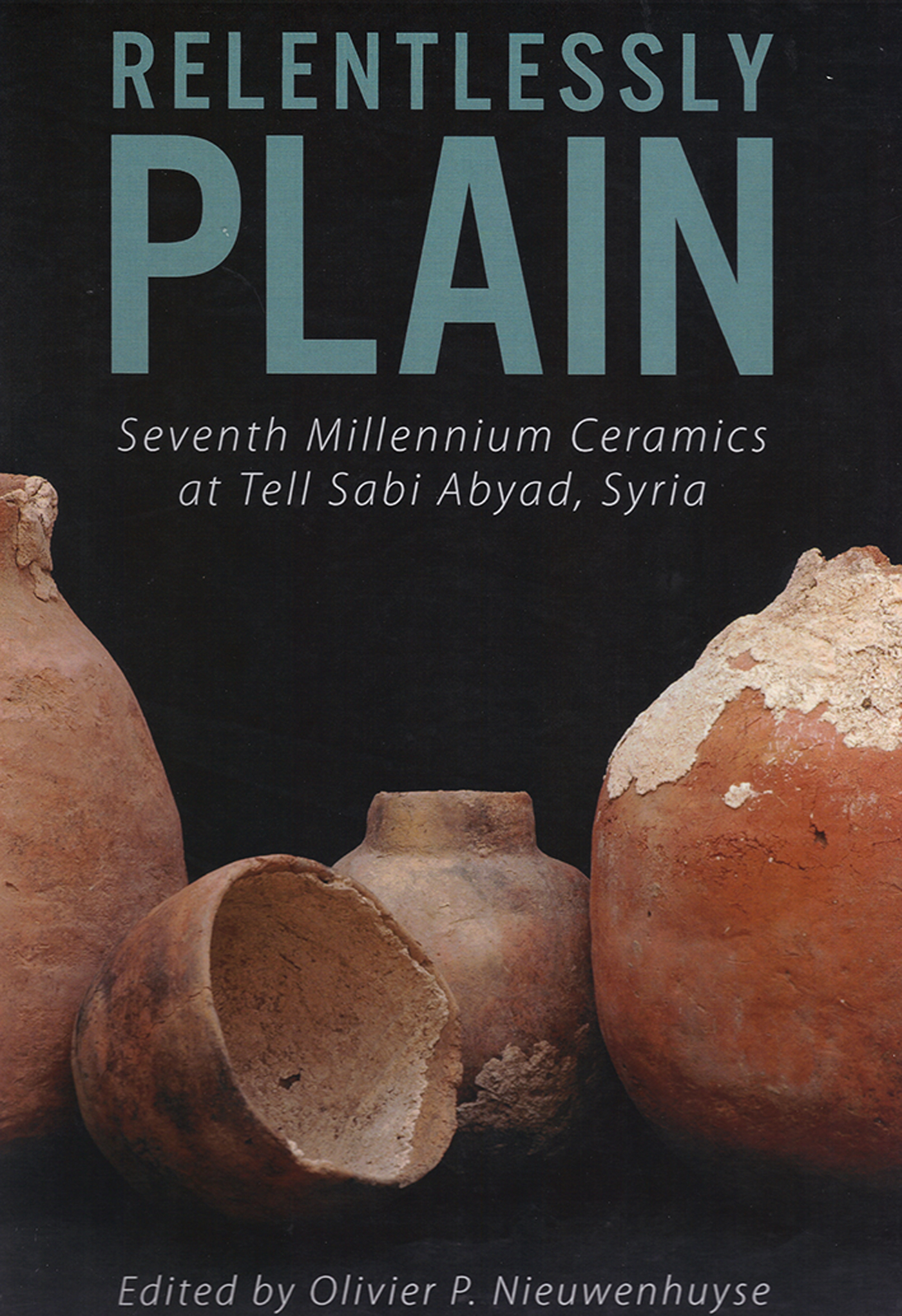
Archaeologists studying the Neolithic period in the Middle East during the 1980s and 1990s highlighted the importance and innovation of research focused on the first stages of the Neolithisation process. The so-called ‘Pre-Pottery Neolithic’ was the focus of both fieldwork and theoretical research frameworks. This dynamism helped to fill the gaps in our knowledge in various areas. Nevertheless, more recently, scholars have lamented the resulting dearth of information about the subsequent Pottery Neolithic.
The publication of the Tell Sabi Abyad ceramics must be placed in the context of current research on the first pottery in the Middle East. This field of study has seen a renewed dynamism, particularly by a group of international scholars who have set up an active system of sharing and discussion of new research. The last decade has seen three international workshops on Late Neolithic Ceramics, held in Brno, Czech Republic (2012), Barcelona, Spain (2015) and Antalya, Turkey (2019), with an initial meeting in Japan in 2009. These meetings have generated an exceptionally up-to-date research agenda for this problematic area of study (Cruells et al. Reference Cruells, Mateiciucova and Nieuwenhuyse2017; Tsuneki et al. Reference Tsuneki, Nieuwenhuyse and Campbell2017; Gómez-Bach et al. Reference Gómez-Bach, Becker and Molist2018).
The Relentlessly plain volume is an example of the new winds blowing through Western Asian Late Neolithic research. This fresh direction in studies on the Pottery Neolithic in the Middle East is supported by the development of excellent archaeological projects undertaking methodologically sound excavations—sites such as Tell Seker and Tell Halula in northern Syria and Tell Kurdu, Akarcay Tepe, Hakemi Use or Mezra Teleilat in south-eastern Anatolia are good examples. Nevertheless, if one had to select a single fieldwork project that has most comprehensively updated the basic knowledge of this period, it would be Tell Sabi Abyad, in the Balikh valley. After more than 20 years of archaeological excavations, the excellent research, documenting and disseminating new understanding of the period, has placed this site at the heart of the revitalisation of Pottery Neolithic studies. The research framework underpinning studies of this period has been revisited and now looks beyond the archaic ‘guide fossil’ paradigm and recognises that pottery is an excellent medium (and both abundant and interesting) to interpret and understand significant archaeological issues.
The publication of the ceramics from this site, edited by O.P. Nieuwenhuyse, has contributions from Bram van As and Koen Berguijs, Renske Dooijes, Richard P. Evershed, Loe Jacobs, Ewout Koek, Luc Megens, Marie Le Mière, Valèrie Thirion-Merle, Bonnie Nilhamn, Maurice Picon, Jo-Hannah Plug, Mélanie Roffet-Salque and Anna Russell, as well as Olivier Nieuwenhuyse himself. Relentlessly plain constitutes further evidence for this broad-ranging approach to the characteristics of the period, combining rigorous study of the ceramic assemblages from different theoretical perspectives and studies with wide interdisciplinary collaboration; it is also exquisitely edited by Oxbow.
The contents can be grouped in three parts. In the first, Nieuwenhuyse provides a detailed Introduction that includes an overview of the site and the methodologies that have been employed. A definition of pottery is included with a typology to avoid confusion over terminology, which has been a problem, as disparate and controversial terms have been adopted by different schools of thought since R. Braidwood's original work. The second part of the volume is devoted to the analysis of the ceramic assemblage itself, with contributions including: the study of raw material (B. Nilhamn, L. Jacobs and B. van As); the detailed analysis of different pottery production techniques by category—for example, Plastered Ceramics—(O. Nieuwenhuyse and E. Koek); the provenance of ceramics (M. Le Miere, V. Thirion-Merle and M. Pico); and technical elements such as the basketry-impressed pottery (K. Berghuijs). The third section is centred on the presentation of complementary studies such as stratigraphy and the context of deposition and the ceramics associated with grave goods (J.H. Plug), and the results of lipid residue analyses on pottery and how these support zooarchaeological studies regarding the type of meat that was being cooked and consumed. Finally, Nieuwenhuyse's synthesis discusses the range of data and considers in more detail those elements that require further investigation. Nieuwenhuyse addresses the origin and the mobility of ceramic production and its use for storage and cooking, and considers the rapid evolution of ceramic styles and the rise of painted and high-quality pottery. He concludes with a brief discussion of the direction of future research at Sabi Abyad. This is an excellent work that presents a detailed analysis of the ceramic productions in the seventh millennium BC at a settlement with an impressive archaeological record that has been the subject of outstanding research. Furthermore, the inclusion and consolidation of new analytical methodologies, such as raw material studies, organic residues and manufacturing techniques, generate optimism for the exciting new knowledge to come on the societies that were the foundation of the classic civilisations in the Middle East and Mesopotamia.


