Introduction
The nature and sources of policy advice received by decision-makers in the policy formulation process are subjects that have received their fair share of scholarly attention. Many journals and specialised publications exist on these topics and specialised graduate schools exist in most countries with the aim of training policy analysts to provide better advice to decision-makers based on their findings (Banfield, Reference Banfield1980; Geva-May and Maslove, Reference Geva-May and Maslove2007; Jann, Reference Jann1991; Tribe, Reference Tribe1972). Studies have examined hundreds of case studies of policy-making and policy formulation in multiple countries (Durning and Osama, Reference Durning and Osama1994; Fischer, Reference Fischer2003) and many texts chronicle various policy analytical techniques expected to be used in the provision of policy advice (Banfield, Reference Banfield1980; Weimer and Vining, Reference Weimer and Vining2004). Yet surprisingly little systematic thinking exists about this crucial component and stage of the policy-making process and many findings remain anecdotal and their paedagogical value suspect (Howlett, Perl and Ramesh, Reference Howlett, Ramesh and Perl2009).
One problem with the early literature on the subject was that many past examinations of policy advice focused on specific sets of policy advisory actors – such as Meltsner's (Reference Meltsner1975; Reference Meltsner1976; Reference Meltsner1979) work on the policy analysis function of bureaucracies – and attempted to assess their influence in isolation from that of other advisors (Dluhy, Reference Dluhy1981). More recent empirical studies of “policy supply” in countries such as the UK (Page and Jenkins, Reference Page and Jenkins2005), Australia (Weller and Stevens, Reference Weller and Stevens1998); New Zealand (Boston et al., Reference Boston, Martin, Pallot and Walsh1996); the Netherlands (Hoppe and Jeliazkova, Reference Hoppe and Jeliazkova2006), France (Rochet, Reference Rochet2004), Germany (Fleischer, Reference Fleischer2009), Canada (Howlett and Newman, Reference Howlett and Newman2010), and others, however, all emphasised the different sources and configurations of advisory actors and influence found in policy formulation in those countries (see also Glynn et al., Reference Glynn, Cunningham and Flanagan2003, and Mayer et al., Reference Mayer, Bots and v Daalen2004). This led to modifications in older modes of thinking about policy formulation and policy advice processes and, in order to better understand these cross-national and cross-sectoral variations, scholarly attention turned in the mid-1990s to the theorisation and explanation of the concept of a “policy advisory system”; that is, an interlocking set of actors, with a unique configuration in each sector and jurisdiction, who provided information, knowledge and recommendations for action to policy-makers (Halligan, Reference Halligan1995).
Such policy advisory systems are now acknowledged to be key parts of the working behaviour of governments as they go about their policy formulation and governance activities (Seymour-Ure, Reference Seymour-Ure1987; Plowden, Reference Plowden1987; Weaver, Reference Weaver2002). And accurately describing and understanding the nature of these systems is important for comparative policy and public administration and management research as are considerations of content and methodologies for the classification and assessment of advisory system actors (MacRae and Whittington, Reference MacRae and Whittington1997).
Despite several decades of examination, however, a significant research agenda still exists in this area (Howlett and Wellstead, Reference Howlett and Wellstead2009; James and Jorgensen, Reference James and Jorgensen2009). Little is known about the non-governmental components of policy advisory systems in most countries, for example (Hird, Reference Hird2005), except to note the general weakness of prominent actors in some systems – like think tanks and research institutes in many jurisdictions (Smith, Reference Smith1977; Stone and Denham, Reference Stone and Denham2004; McGann and Johnson, Reference McGann and Johnson2005; Abelson, Reference Abelson2007; Stritch, Reference Stritch2007; Cross, Reference Cross2007; Murray, Reference Murray2007). And even less is known about aspects such as the growing legion of consultants who work for governments in the “invisible public service” (Speers, Reference Speers2007; Boston, Reference Boston1994; Saint-Martin, 2005). However, conceptual problems continue to persist as well, and are the subject of this article.
One especially important conceptual issue with significant methodological and practical consequences has to do with considerations related to the sources and patterns of influence among advisory system actors (Fleischer, Reference Fleischer2006; Halffman and Hoppe, Reference Halffman and Hoppe2005). This is the case whether policy advice is investigated from a broad perspective on knowledge utilisation in government (Dunn, Reference Dunn2004; Peters and Barker, Reference Peters and Barker1993; MacRae and Whittington, Reference MacRae and Whittington1997; Webber, Reference Webber1991) or more specifically in relation to the workings of policy formulation processes (Scott and Baehler, Reference Scott and Baehler2010; James and Jorgensen, Reference James and Jorgensen2009). That is, the personal and professional components of a policy advice supply system, along with their internal and external sourcing, can be expected to be combined in different ratios in different policy-making situations (Dluhy, Reference Dluhy1981; Prince, Reference Prince1983; Wollmann, Reference Wollmann1989; Hawke, Reference Hawke1993; Rochet, Reference Rochet2004) with significant implications for the kinds of advice that are generated and which are listened to by governments. However, it is not clear in any given situation which actors are likely to exercise more influence and prevail over others in a formulation process. As is argued below, a required step in the development of an improved understanding of the structure and functioning of policy advice systems is the articulation of a more robust conceptual depiction of their component parts than presently exists along with the more detailed specification of the nature of their interactions in terms of the amount of influence actors exercise in providing advice to decision-makers.
Locational models of policy advice systems: the prevailing insider-outsider orthodoxy
Most existing conceptual models of policy advice systems associate different levels of influence with the location of advisors either inside or outside government (Halligan, Reference Halligan1995). These “location-based” models have served as the starting point for investigations into, for example, the roles played by think tanks (Lindquist, Reference Lindquist1998), public managers (Howlett, Reference Howlett2011) and others in policy formulation (Wilson, Reference Wilson2006).
This line of thinking underlay early efforts to classify the various components of advice-giving as a kind of marketplace for policy ideas and information often seen, for example, as comprising three separate locational components: a supply of policy advice, its demand on the part of decision-makers and a set of brokers whose role it is to match supply and demand in any given conjuncture (Lindquist, Reference Lindquist1998; Maloney et al., Reference Maloney, Jordan and McLaughlin1994; Clark and Jones, Reference Clark and Jones1999; March et al., Reference March, Toke, Befrage, Tepe and McGough2009). That is, advice systems were thought of as arrayed into three general “sets” of analytical activities with participants linked to the positions actors hold in the “market” for policy advice. The first set of actors was thought to comprise the “proximate decision-makers” who act as consumers of policy analysis and advice – that is, those with actual authority to make policy decisions, including cabinets and executives as well as parliaments, legislatures and congresses, and senior administrators and officials delegated decision-making powers by those other bodies. The second set was composed of those “knowledge producers” located in academia, statistical agencies and research institutes who provide the basic scientific, economic and social scientific data upon which analyses are often based and decisions made. And the third set was those “knowledge brokers” who served as intermediaries between the knowledge generators and proximate decision-makers, repackaging data and information into usable form (Lindvall, Reference Lindvall2009; Sundquist, Reference Sundquist1978). These included, among others, permanent specialised research staff inside government as well as their temporary equivalents in commissions and task forces, and a large group of non-governmental specialists associated with think tanks and interest groups. In these models, proximity to decision-makers equalled influence, with policy brokers playing a key role in formulation processes given their ability to “translate” distant research results into useable forms of knowledge – policy alternatives and rationales for their selection – to be consumed by proximate decision-makers (Verschuere, Reference Verschuere2009; Lindvall, Reference Lindvall2009).
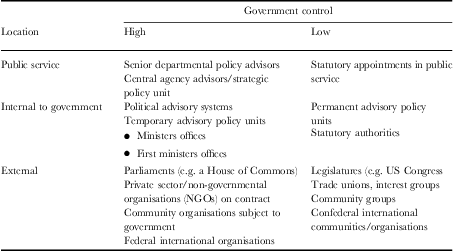
Halligan (Reference Halligan1995) sought to improve on this early formulation by adding in the dimension of “government control”. Viewing policy advice less as an exercise in knowledge utilisation and more as a specific part of the larger policy process, specifically as part of the policy formulation stage of policy-making. Halligan (Reference Halligan1998:1686) defined policy advice as “covering analysis of problems and the proposing of solutions” and emphasised not only location vis à vis proximate decision-makers as a key determinant of influence but also how and to what degree governments were able to control actors located internally or externally to government who provided them counsel (see Table 1). This model suggested that location was not the only factor which affected influence. That is, not only knowledge “brokers” but other actors located in the external environment in which governments operated could exercise continued influence upon decision-makers, with the key consideration being not just geographical or organisational location but also the extent to which decision-makers could expect proffered advice to be more or less congruent with government aims and ambitions.
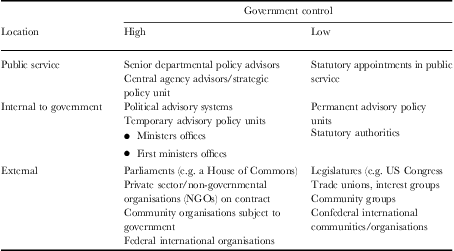
Although this model hinted at the key role played by “content” in considerations of advisory influence, at the root of this model, however, was still the inside-outside dimension since governments, generally, were thought to be able to exercise more control over internal actors than external ones. Halligan noted in each case, within the public service, within government and in the external environment, however, that some actors were more susceptible to government control than others and hence more likely to articulate advice that decision-makers would find to be acceptable; that is, matching the government's perceptions of best practices, feasibility, and appropriate goals and means for achieving them. However, as Table 1 shows, in general each control category remains “nested” within a locational one so that the extent of independence and autonomy enjoyed by an “inside” government actor is considerably less than that enjoyed by an “outside” actor whether or not that external actor is amenable to government direction.
These locational models and their insider-outsider logic are useful and help us to depict and understand many aspects of policy advice, the nature of advisory system members and their likely impact or influence on policy decision-making. As shall be discussed below, however, simply understanding these locational variations either with or without Halligan's “control” dimension, is not enough to provide a clear understanding of the nature of influence in contemporary policy advisory systems. This is because traditional locational models of such systems based only upon proximity measures of influence gloss over the equally important question of “influence over what?”, that is, about the content of advice provided by different actors, which has become a much more significant element of advice in its own right in recent years as more and different actors have entered into advisory system membership.
Adding the content dimension to locational models of policy advisory systems
Recent examinations of components of policy advisory systems such as political parties (Cross, Reference Cross2007), the media (Murray, Reference Murray2007) and partisan appointees (OECD, 2011; Connaughton, Reference Connaughton2010b, Eichbaum and Shaw, 2010), among others, have underlined the limitations of locational models in being able to provide an exhaustive map of policy advice system types and a clear picture of how the various sources, types and components of policy advice fit together and operate (Mayer, Bots and van Daalen, Reference Mayer, Bots and v Daalen2004; Howlett and Lindquist, Reference Howlett and Lindquist2004). What is needed is a better model that links the provision of advice to larger patterns of changes in the behaviour of political decision-makers and knowledge suppliers that condition how policy advice is generated and deployed in different governance arrangements (Peled, Reference Peled2002; Howlett and Lindquist, Reference Howlett and Lindquist2004; Bevir and Rhodes, Reference Bevir and Rhodes2001; Bevir, Rhodes and Weller, Reference Bevir, Rhodes and Weller2003; Aberbach and Rockman, Reference Aberbach and Rockman1989; Bennett and McPhail, Reference Bennett and McPhail1992). Such a richer understanding of the structure and functioning of policy advisory systems can be obtained through the better specification of the second, “content”, dimension highlighted in Halligan's work and clarification of its relationship to locational considerations of influence.
A growing body of evidence has for some time pointed to this need to incorporate a more detailed and nuanced sense of advice content to location-based models of advisory influence. The critique of locational models is both historical and definitional. On the one hand, while older models relied on a kind of “vertical” policy advice landscape in which inside advisors had more influence than outside ones, the emergence of a more pluralised “horizontal” advice-giving landscape than existed in earlier periods (Weller and Rhodes, Reference Weller and Rhodes2001; Radin, Reference Radin2000; Page, Reference Page and Wright2007 and Reference Page2010) has challenged any traditional monopoly of policy advice once held by such prominent inside actors as the public service.
Halligan's “control” dimension can be seen as an attempt to get at this second dimension of influence – modelled as congruent or less congruent with government aims – but is not specific enough about the nature of the content itself. Explicitly adding the content dimension of policy advisory systems to earlier location-based models, however, adds specificity to those models by integrating a substantive component to many otherwise contentless early considerations of advisory influence. Taken together with locational measures it is possible to use this additional dimension to get a better sense not only of which actors are likely to influence governments but also about the likely subjects of that influence.
Governance shifts and policy advice: from “speaking truth to power” to “sharing truths with multiple actors”
But how should this content dimension be modelled? As authors such as Radin (Reference Radin2000), Prince (Reference Prince2007) and Parsons (Reference Parsons2004) among others have argued, the well-known older “speaking truth to power” model of policy advice (Wildavsky, Reference Wildavsky1979) has given way in many policy-making circumstances to a more fluid, pluralised and polycentric advice-giving reality that has been characterised as “sharing truth with many actors of influence” or “weaving” policy knowledge (Maley, Reference Maley2011; Prince, Reference Prince2007; Parsons, Reference Parsons2004). This dispersed advisory capacity combines technical knowledge and political viewpoints in ways that differ from the way advice was generated, and conceived of, in early thinking on advisory systems based on producer-broker-consumer or autonomy-control considerations.
Studies in a range of countries have noted that government decision-makers now increasingly sit at the centre of a complex “horizontal” web of policy advisors that includes both “traditional” professional public service and political advisors in government as well as active and well-resourced non-governmental actors in NGOs, think tanks and other similar organisations, and less formal or professional forms of advice from colleagues, friends and relatives and members of the public and political parties, among others (Dobuzinskis, Howlett and Laycock, Reference Dobuzinskis, Howlett and Laycock2007; Maley, Reference Maley2000; Peled, Reference Peled2002; Eichbaum and Shaw, Reference Eichbaum and Shaw2007). As Hajer (Reference Hajer2003: 182) has argued:
When Wildavsky coined the phrase “speaking truth to power,” he knew whom to address. The power was with the state and the state therefore was the addressee of policy analysis. Yet this is now less obvious. We might want to speak truth to power but whom do we speak to if political power is dispersed? States, transnational corporations (TNCs), consumers, non-governmental organizations (NGOs), the people? The media? With hindsight we can see how policy making and policy analysis was always conducted with an idea of a stable polity in mind.
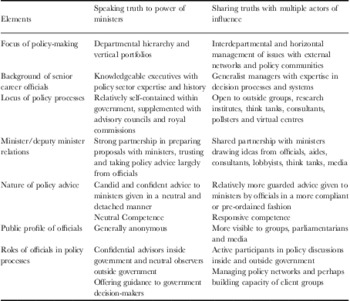
Following Prince (Reference Prince2007), the elements of the traditional and contemporary ideal-type models of advice-giving are set out in Table 2 below. These shifts in the nature of state-societal or governance relations and decision-making authority and responsiveness set out in Table 2 have important consequences for thinking about the nature of influence in policy formulation and policy advisory activities.
Two idealised models of policy advising

Source: adapted from Prince, Reference Prince2007: 179
The practical implications of such changes, for example, are obvious. As Anderson (Reference Anderson1996: 486) argued, for example, in the contemporary period “a healthy policy-research community outside government can (now) play a vital role in enriching public understanding and debate of policy issues” and can serve as a natural complement to policy capacity within government. This view can be contrasted with Halligan's (Reference Halligan1995) earlier admonition that:
The conventional wisdom appears to be that a good advice system should consist of at least three basic elements within government: a stable and reliable in-house advisory service provided by professional pubic servants; political advice for the minister from a specialized political unit (generally the minister's office); and the availability of at least one third-opinion option from a specialized or central policy unit, which might be one of the main central agencies (p. 162).
Changes in contemporary governance arrangements thus speak to shifts in the patterns of policy advisory activity and interaction found in policy advisory systems at both the political and administrative levels, both internally and externally, which thinking about the nature and activities of policy advisory systems should take into account.
Operationalising the content dimension of policy advice
As discussed above, while location-based models of policy advice provided a very useful and a clear advance on earlier approaches that focused attention only upon individual, isolated, sets of advisors or single locations of advice, they were largely silent on content dimensions. But as Peters and Barker (Reference Peters and Barker1993: 1) put it, if policy advice is conceived of as a means by which government “deliberately acquire, and passively receive … advice on decisions and policies which may be broadly called informative, objective or technical” then content becomes at least as important as location in determining the nature of the influence of both policy advice and policy advisors.
Moving beyond the “technical” vs “political” policy advice content dichotomy
Early thinking about the content of policy advice often contrasted “political” or partisan-ideological, value-based advice with more “objective” or “technical” advice and usually stressed the importance of augmenting latter while ignoring or downplaying the former (Radin, Reference Radin2000). Policy schools purporting to train professional policy advisors in government, for example, still typically provide instruction only on a range of qualitative and quantitative techniques that analysts are expected to use in providing technical advice to decision-makers about optimal strategies and outcomes to pursue in the resolution of public problems, downplaying or ignoring political or value-laden issues and concerns (MacRae and Wilde, Reference MacRae and Wilde1976; Patton and Sawicki, Reference Patton and Sawicki1993; Weimer and Vining, 2004; Irwin, Reference Irwin2003).
This “positivist” or “modern” approach to policy analysis dominated the field for decades (Radin, Reference Radin2000) and often pre-supposed a sharp conceptual division between internal governmental advisors armed with technical knowledge and expertise and non-governmental actors with only non-technical skills and knowledge.Footnote 1 Although often implicit, such a “political” vs “technical” advisory dichotomy often underlay location models, with advice assumed to become more technical as it moved closer to proximate decision-makers so that external actors provided political advice and internal ones technical ideas and alternatives.
While it is debatable the degree to which such a strict separation of political and technical advice was ever true even in “speaking truth to power” systems, it is definitely the case that the supply of technical advice is no longer, if it ever was, a monopoly of governments. Various external sources of policy advice have been found to be significant sources of substantive policy advisory content used by policy-makers to support existing policy positions or as sources of new advice (Bertelli and Wenger, Reference Bertelli and Wenger2009; McGann and Sabatini, Reference McGann and Sabatini2011). Professional policy analysts, for example, are now employed not only by government departments and agencies but also by advisory system members external to government; ranging from private sector consultants to experts in think tanks, universities, political parties and elsewhere who are quite capable of providing specific suggestions about factors such as the costs and administrative modalities of specific policy alternatives (Boston, Reference Boston1994; Boston et al., Reference Boston, Martin, Pallot and Walsh1996; Rhodes et al., Reference Rhodes, Wanna and Weller2010).
It is also the case that many advisors both internal and external to governments, today and in past years, provide political advice to decision-makers ranging from personal opinion and experience about public opinion and key stakeholder group attitudes and beliefs to explicit partisan electoral advice. Although often ignored in early accounts, this kind of advice has always been provided by prominent traditional inside actors such as political advisors attached to elected officials and political parties (Connaughton, Reference Connaughton2010a; Eichbaum and Shaw, Reference Eichbaum and Shaw2007 and Reference Eichbaum and Shaw2008; Leal and Hess, Reference Leal and Hess2004) as well as from public consultation and stakeholder interventions (Edelenbos and Klijn, Reference Edelenbos and Klijn2005; Bingham et al., Reference Bingham, Nabatchi and O'Leary2005, Pierre, Reference Pierre1998). While Westminster systems pride themselves on retaining at least part of this political-administrative dichotomy in the form of conventions about civil service neutrality in their specific “civil service bargain” (Hood, Reference Hood2002; Hondeghem, Reference Hondeghem2011; Salomonsen and Knudsen, Reference Salomonsen and Knudsen2011; Uhr and Mackay, Reference Uhr and Mackay1996), even in this strong case, this convention has been eroded. In their study of New Zealand policy advice, for example, Eichbaum and Shaw (Reference Eichbaum and Shaw2008: 343) noted many instances of “procedural politicisation” that was “intended to or has the effect of constraining the capacity of public servants to furnish ministers with (technical) advice in a free, frank, and fearless manner”. It was manifested when a “political” advisor “intervenes in the relationship between a minister and his or her officials. Alternatively it is argued to occur (due to) conduct by ministerial advisers which is intended to or which has the effect of constraining the capacity of officials to tender frank, and fearless advice by intervening in the internal workings of a department” (ibid). They also found many instances of “substantive politicisation”, which dealt specifically with “an action intended to, or having the effect of coloring the substance of officials advice with partisan considerations” (ibid, 343–44).
The increasingly pluralised and political nature of policy advice inputs underscores that while under the old “speaking-truth-to-power” model policy advice might not always have been largely a bipartite relationship involving public servants and executive politicians, with career officials offering technical advice to cabinet ministers, this is no longer the case (Jenkins-Smith, Reference Jenkins-Smith1982; Kirp, Reference Kirp1992). Maley (Reference Maley2000: 453) for example, elaborated on the various policy roles for political advisors that may exist in addition to their “in-house” policy work: “Dunn suggests an important brokering role within the executive; Ryan detects a significant role in setting policy agendas; Halligan and Power [Halligan and Power, Reference Halligan and Power1992] refer to advisers “managing networks of political interaction”. Additional studies have also pointed to the role “political” advisers can play in the brokerage, coordination and integration of various endogenous and exogenous sources of policy advice to decision-makers (Dunn, Reference Dunn1997: 93–97; Maley, 2011; Gains and Stoker, Reference Gains and Stoker2011; OECD, 2011).
Here, however, in the consideration of the theorisation of policy advisory systems, it is important to note that these changes in governance practices do not just lead to a shift in the location of advice, but rather also of its content. Even in Anglo-American “Westminster”-style political systems, the shift from the largely internal, technical, “speaking truth” type of policy advising towards the diffuse and fragmented “sharing of influence” approach paints a picture of contemporary policy advising that not only features the pronounced influence of external or exogenous sources of technical and political advice, but also the loss of whatever policy advisory monopoly or hegemony was once held or exercised by professional public service and advisors within government. The reduced utility of such distinctions when applied to other systems (i.e. Napoleonic, Scandinavian) with alternative administrative traditions where politico-administrative divisions may not be as pronounced, overlap or be configured differently (Peters and Pierre, Reference Peters and Pierre2004; Painter and Peters, Reference Painter and Peters2010) is even clearer. Moving beyond simple political-technical distinctions to a more robust content-based model of policy advice is thus essential in order to improve the generalisability of models of policy advisory systems.
Modelling the content of policy advice in contemporary governance arrangements
In the context of a more porous, fluid and diversified advisory landscape, the inside vs outside distinction lying at the base of traditional conceptions of advice systems has been thoroughly weakened. But what is the alternative?
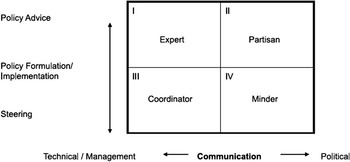
Explicitly dealing with the content dimensions of policy advice, Connaughton (Reference Connaughton2010a, 2010b), working from within the empirics of the Irish context, developed a set of what she terms “role perceptions” – Expert, Partisan, Coordinator and Minder – for classification of general advisory roles (see Figure 1). While these distinctions re-invent some aspects of discredited politics vs administration dichotomies, her analysis of the activities of these different actors is based, significantly, not upon whether advice was partisan or administrative, but rather whether it involved substantive on-the-ground policy formulation/implementation activities – ranging from “policy advice” to “policy steering” – or more procedural “communications” functions, which could be “technical/managerial” or “political” in nature.
Connaughton's configuration of advisor roles. Source: Connaughton, Reference Connaughton2010b: 351

This notion of distinguishing between content in terms of substance and process fits well the findings of other studies assessing the “politicisation of policy-making” such as Eichbaum and Shaw (Reference Eichbaum and Shaw2008). The Connaughton model has limitations however, principally by failing to provide mutually exclusive differentiation of the two concepts. Substantive advisory activity falling in the “expert” category could simultaneously be “partisan” or procedural types of policy advisory “roles” such as “coordinator” could arguably be both expert and partisan in nature, for example.
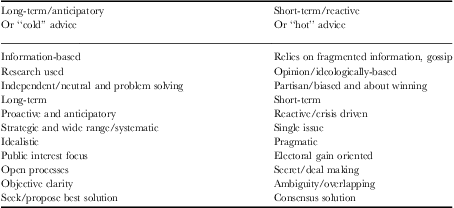
Prasser, in his studies of Royal Commissions in Australia (2006a), and more generally (2006b) suggested that distinguishing between “political” and “non-political” content of policy advice is less insightful than distinguishing between the content of the advice provided. Here he distinguished between what he termed “cold” – typically long-term and proactive – vs “hot” – short-term and crisis driven – types of advice (see Table 3). Although he noted some overlaps between these categories along the old “politics” vs “administration” divides, the general situation he describes is one in which neither partisan nor civil service actors have an exclusive monopoly on one type of advice.
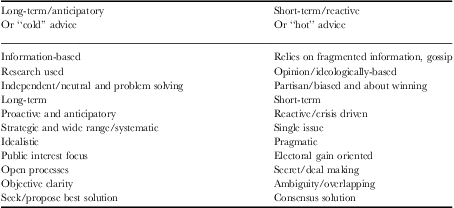
Such “hot” vs “cold” content dimensions can be usefully applied to various non-governmental sources of policy advice that may be seeking to influence policy-makers on a short- or long-term basis. Moreover, they further align considerations of policy advisory activity with specific content considerations rather than role-based classifications that continue to be tied to locational factors and/or traditional dichotomies such as technical vs political distinctions.
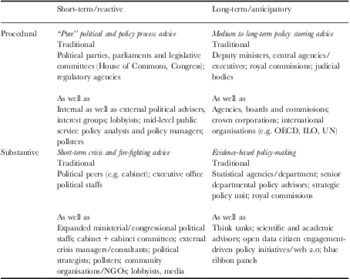
Although they interpret content slightly differently, Prasser's distinction between short-term “hot” and longer-term “cold” advice can be combined with Connaughton and Eichbaum and Shaw's distinction between substantive and procedural advice to generate an improved model of policy advisory system structure and behaviour. Together, they can be used to differentiate between types of policy advice content in a way that is more useful for the conceptualisation of the activities of policy advice system actors than older locational models (see Table 4).
Policy advisory system members organised by policy content

Source: Craft and Howlett
Such a model as that set out in Table 4 provides a more robust understanding of the influence dimension of policy advice-giving as content distinctions replace purely locational considerations in new governance arrangements. While location may be closely aligned with content in some such arrangements – as was the case historically in Westminster-style systems based on sharp political-administrative distinctions – this is not always the case. While purely locational models may help to capture some significant developments such as the growth in the exogenous sources of advice to government proper in contemporary governance situations, they do not help, as do content-based models, to capture the idea that the kinds of advice provided by both civil servants and non-governmental actors have also changed and, more to the point, that these changes represent changes in influence.
Conclusion
Policy advisory systems exist in all jurisdictions and are an important part of the working behaviour of governments as they go about their policy and governance activities (Plowden, Reference Plowden1987). Understanding the nature of these systems is important for comparative policy and public administration and management research.
Replacing existing location models with content-based ones generates a significant improvement in the ability of models of policy advisory systems to more accurately depict and categorise policy advice system structure and behaviour, and to understand the role played by different policy actors and the kinds of advice provided to governments by different advisory systems in contemporary circumstances.
While locational models have been useful in the past in some jurisdictions where the location and content of policy advice have overlapped – as was the case historically in many countries featuring strong political-administrative organisational dichotomies, their usefulness has waned along with the strength of those divisions, as discussed above. Although they have helped us to depict and understand aspects of the shift in location of advice from policy professionals to outside actors occasioned by changes in governance practices, many of locational models of influence in themselves provide few insights into the effects changes in governance modes have occasioned in many jurisdictions in the contemporary era.
This is because most locational models of policy advisory systems do not deal explicitly with the contents of policy advice but rather implicitly endorse a “political vs administrative” or “technical vs partisan” dichotomous logic of the content and influence of policy advice. Locational models present these two types of advice as discreet and separate within specific kinds of organisational actors.
As Weller (Reference Weller1987: 149) noted long ago, such divisions along administrative and political lines are typical in early thinking related to advice-giving, since, as noted above, political advice is often not considered “policy” advice at all:
by “policy” is usually meant technical and professional alternatives or the outcomes of “objective” or “rational analysis. “Political” is (then) taken to refer to consideration of the likely electoral or media consequences of a course of action. The former is seen as substantive while the other is often regarded as more self-interested”.
In the contemporary era, however, the juxtaposition of content and location is no longer justified, if it ever was. Not only governance studies but also studies of the behaviour of specific advisory system actors such as appointed partisan political advisers, for example, have highlighted the irrelevance of these older political vs administrative distinctions. Even in the “speaking truth to power” era Walter (Reference Walter1986) confirmed that policy advisors often extended advice on political options and “paid attention” to the policy agenda, often acting as policy “mobilisers” in the face of policy vacuum or playing a “catalyst” role in activating a policy process (Walter, Reference Walter1986: 152–154) and later scholars such as Dunn (Reference Dunn1997: 78–93) found that “political” advisors played a role in shaping policy through overseeing the policy development process, providing direction, evaluating of policy proposals and monitoring implementation.
Examining policy advice systems in terms of the content of advice provides a more useful conceptual frame in which to understand these effects and the nature of advisory systems in general. That is, the shift of content of inside and outside actors away from the “speaking truth to power” perspective of the provision of “objective” policy advice by insiders set out by Prince (Reference Prince2007) is revealing. Adding the content dimension to policy advisory systems in the form of a focus upon their substantive vs procedural and “hot” vs “cold” dimensions adds the specificity missing in locational model considerations of influence. And it improves on earlier models imbued with an implicit dichotomous “politics vs administration” differentiation by categorising policy advice more precisely as it relates to either substance, or processes of policy-making and to its short-term vs long-term nature (Svara, Reference Svara2006).Footnote 2
Of course this raises the question of how, exactly, content, influence and location have been linked in specific national and sectoral advisory systems and historical time periods above and beyond the general transition from old to new governance arrangements cited here. While this is a subject for future research, several interesting hypotheses relating to the locational and content dimensions of policy advice in different governance systems that future comparative formulation studies can test. These include such possibilities as that in bilateral “speaking truth to power” systems in which internal public service advice sources dominate, policy advice becomes increasingly evidence-based as one moves closer to policy decision-makers and less evidence-based as one moves further away. Or, conversely, that in more contested, pluralised and differentiated policy advice landscapes with various endogenous and exogenous advice sources, advice becomes less technical the closer it moves to government and more technical the further it moves away.
Such patterns would remain invisible when only locational criteria are taken into account in modelling policy advisory system structure and behaviour. When content if added in, however, it greatly enriches the concept and the models used to describe it. Among other things, it brings studies of policy advice and policy formulation into closer proximity to studies of governance shifts.Footnote 3 Adding a content dimension to older locational models helps show that as governments have moved away from command and control modes of governing towards the embrace of collaborative, interactive and networked models of governance and policy-making, the nature of policy advice and policy formulation also changes (Scott, Reference Scott2005). In such contexts, locational models of policy advisory systems predicated on government control as a key dimension of the analysis of policy formulation requires reconsideration.