The Moche culture emerged approximately 1,900 years ago on the arid north coast of Peru and flourished for centuries, producing artistic masterworks, monumental architecture, and a narrative art style, perhaps second only to that of the ancient Greeks. For most of the twentieth century, Moche studies drew from an art history paradigm and they were long envisioned as the first centralized territorial Andean state. Since the 1980s, the growth of Moche field archaeology has elucidated the intricacies of Moche political organization (Quilter and Castillo Reference Quilter and Castillo2010), forcing a fundamental rethinking of the Moche phenomenon.
To date, 22 Moche elite tombs have been excavated at the three centers of Moche political power on the north coast of Peru during the mid-first millennium AD: Sipán (Lambayeque valley), Úcupe (Zaña valley), and Dos Cabezas (Jequetepeque valley). What were the social identities and relationships between these individuals? How did these groups of Moche elites in neighboring valleys interact with each other? Were they a single dynasty distributed across the coast as part of centralized territorial Moche state? Alternatively, do they represent more insular groups reflecting a decentralized, plural, and contested political reality?
Bioarchaeological data provide often otherwise unobtainable insights on social structure, ideology, politics, and identity. Human remains from these sites provide an initial opportunity to reconstruct and interpret biological interaction patterns within and between the Moche lords at Sipán, Úcupe, and Dos Cabezas. We provide a bioarchaeological analysis on interindividual variation and preliminary population-structure-related patterns of inherited dental traits among 36 individuals to provide insights into the nature of Moche politics and organization and society.
The Moche Culture
Chronology and Characteristics
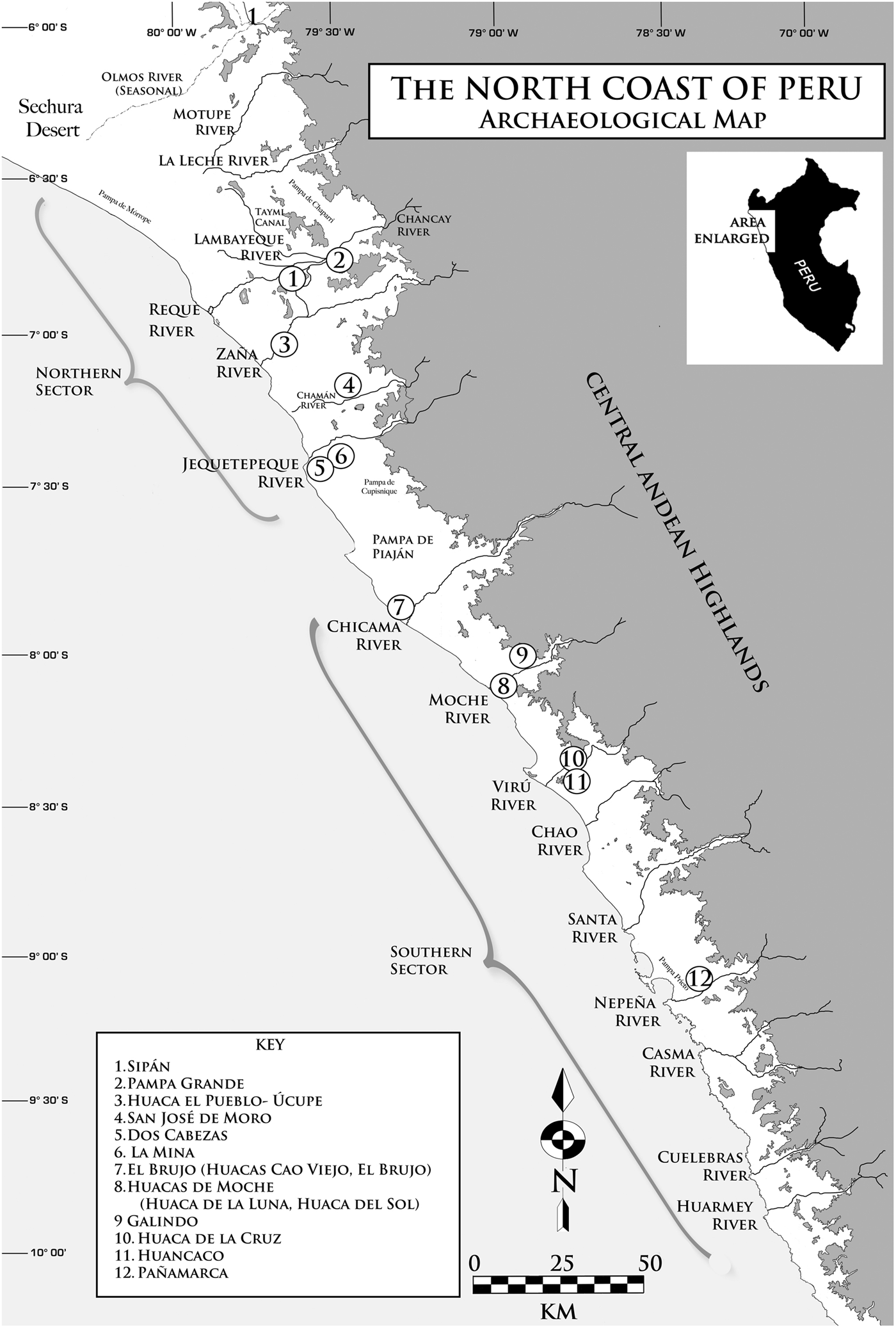
The desert coast of Peru has been home to a sequence of complex cultures since 2600 BC. Following the emergence and decline of several early complex societies, the Moche were the dominant cultural development in the north coast during the first millennium AD (Figure 1; Benson Reference Benson2012; Bourget and Jones Reference Bourget and Jones2008; Shimada Reference Shimada1994a; Uceda and Mujica Reference Uceda and Mujica1994, Reference Uceda and Mujica2003). Their iconography communicated a belief system institutionalizing themes surrounding death, sacrifice, and fertility (Bourget Reference Bourget2006; Donnan Reference Donnan and Dillehay1995; Millaire Reference Millare2002). Moche economy was fueled by large-scale systems of tribute and labor organization, irrigation agriculture, fishing, camelid herding, and trade (Bawden Reference Bawden1996; Benson Reference Benson2012). Moche politics appears unexpectedly complex, sparking various intense debates.
The north coast of Peru, highlighting major Moche sites including those discussed in the text. Map by Haagen Klaus.

Moche origins are poorly understood but probably spanned multiple locations between AD 100 and 300, involving growth of the political hierarchy of the preexisting Gallinazo culture, accompanied by a new religious formation (Bourget Reference Bourget2016). The two most prominent loci of these early developments occurred in a prevailing northern polity centered around Sipán in the Lambayeque region and in a southern polity located in the Moche-Chicama valley region (Castillo and Donnan Reference Castillo, Donnan and Makowski1994; Shimada Reference Shimada, Uceda and Mujica1994b). Separating these two regions was the Pampa de Paiján, a 90 km intervalley desert expanse serving as a natural geopolitical and cultural barrier. Southern territories were under the influence of the Huacas de Moche site, while to the north of the pampa, multiple autonomous polities developed in the Jequetepeque, Zaña, Lambayeque, and La Leche valleys. There are numerous differences between northern and southern Moche material culture, art styles, architecture, and historical trajectories (Shimada Reference Shimada, Quilter and Castillo2010). The five classical temporal phases developed by Larco Hoyle are applicable only to the southern Moche. In the north, an Early, Middle, and Late Moche sequence is recognized that can be further subdivided into Middle Moche A, B, and C phases (Bourget Reference Bourget2014; Supplemental Tables 1, 2).
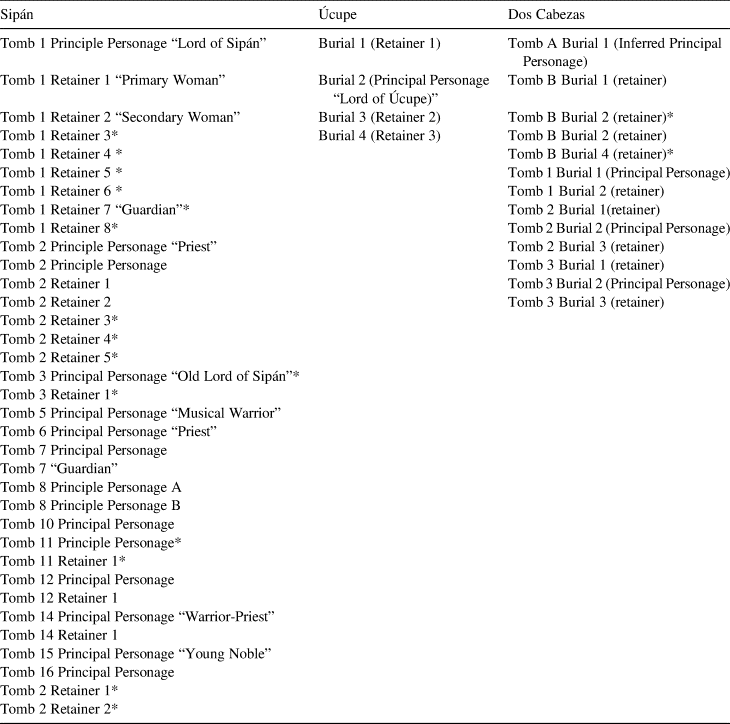
Individuals from Sipán, Úcupe and Dos Cabezas Examined in This Work.

* Not included in analysis due to more than 25% missing data.
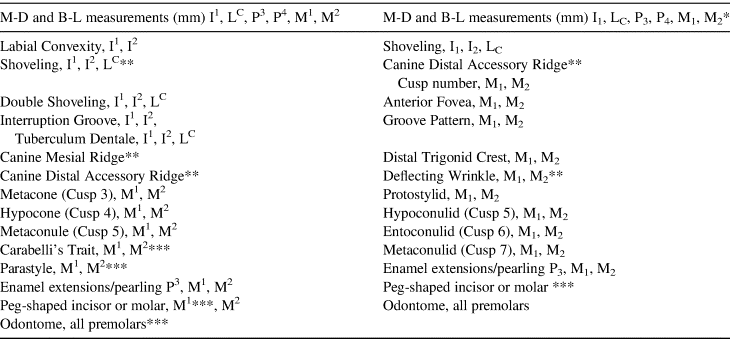
Traits Used in Biodistance Analysis of Sipán, Úcupe, and Dos Cabezas.

* Buccolingual measurements of the LC, LI1, and LI2 , removed from analysis due to more than 25% missing data.
** Nonmetric trait removed from analysis due to more than 25% missing data.
*** Nonmetric trait removed from analysis due to zero variance (universal absence).
An extended and abnormally intense El Niño Southern Oscillation (ENSO) event was associated with a series of social and political transformations beginning around AD 600. The southern Moche system mostly imploded, and a complex transition to the Moche V/Late Moche transpired (Koons and Alex Reference Koons and Alex2014). At this time, reconfigurations of Moche ideology and economy surfaced at Galindo (Moche valley), San José de Moro (Jequetepeque valley), and Pampa Grande (Lambayeque valley; Bawden Reference Bawden and Reycraft2005; Castillo Reference Castillo and Pillsbury2001; Shimada Reference Shimada1994a). The final political disintegration of the Moche unfolded around AD 800, although a few strongholds persisted for several more decades (Uceda Reference Uceda, Quilter and Castillo2010).
Moche Political Organization: Previous Thinking and Unresolved Questions
Over the years, Moche studies featured several prominent themes, from descriptive and chronology-building foci to art history (e.g., Donnan Reference Donnan1978; Kubler Reference Kubler, Rowe and Menzel1967). Thoughts on Moche politics by Larco Hoyle (Reference Larco Hoyle1938) and participants of the 1940s Virú Valley Project envisioned a single, centralized, hegemonic, and expansionist Moche state with its capital at the Huacas de Moche. This notion persisted for decades. More recently, field excavations point to a “many worlds of the Moche” model that sees evidence of intricate and distinct constellations of Moche peoples, politics, and social identities (Benson Reference Benson2012; Quilter and Koons Reference Quilter and Koons2012). These include a hybrid Moche-Vicús polity/art style in the far northern coast (Makowski Reference Makowski1994). Descendants of the earlier Gallinazo peoples persisted as one or more social or ethnic groups coexisting with, and even outliving, the Moche in places (Bourget Reference Bourget, Quilter and Castillo2010; Donnan Reference Donnan, Millaire and Morlion2009; Shimada and Maguiña Reference Shimada, Maguiña, Uceda and Mujica1994). Simultaneously, it has become increasingly apparent that northern Moche centers were closely linked to each other and with their southern counterparts (for a fuller exposition of this argument, see Bourget Reference Bourget2014). Both northern and southern Moche elites participated in a common cultural and religious framework. Yet, these ideas were expressed differently at the three northern Middle Moche centers: Sipán, Úcupe, and Dos Cabezas.
Research Questions
Archaeogenetic studies of the northern Moche lords of Sipán, Úcupe, and Dos Cabezas have been frustrated by poor ancient DNA preservation. Shimada and colleagues (Reference Shimada, Ken-ichi Shinoda, Alva, Uceda and Reed2005, Reference Shimada, Ken-ichi Shinoda, Steve Bourget, Uceda, Bourget and Jones2008) recovered authentic mitochondrial DNA (mtDNA) from only nine individuals at Sipán. The results point to the Sipán funerary platform being a mausoleum for a closely related Moche royal lineage. Here, we analyze the dental morphology of these and other Moche lords, whose teeth were far more intact, to provide strong indications of genetic relationships. Multivariate analysis of dentally inherited traits reflects both maternal and paternal genetic signal traits, providing a basis for reconstructing aspects of relationships among northern Moche elites, including for those with poor aDNA preservation. How were lords at different centers across different valleys related to one another? How did they interact? Did they intermarry? What kinds of organizational corollaries might be reflected in biological interaction patterns?
In light of growing evidence for multiple Moche “worlds,” we also recognize integrative and harmonizing interregional mechanisms that interconnected Moche rulers and their courts into a single, shared elite tradition (Bourget Reference Bourget2016; Donnan Reference Donnan, Quilter and Castillo2010). Accordingly, we address the traditional vision and hypothesize that patterns of elite kinship and intermarriage (gene flow) will demonstrate a biologically homogenous group of Moche elites between Sipán, Úcupe, and Dos Cabezas, reflecting an integrated and centralized leadership ruling over the northern Moche peoples and territories during the late Early and Middle Moche periods.
Materials and Methods
Sipán
Since 1987, 16 elite late Early Moche and Middle Moche tombs have been excavated at the high-status monumental funerary platform of Sipán Mound in the mid-Reque drainage in the Lambayeque river Valley Complex (Supplemental Figure 1). These adobe brick chamber tombs and their contents have been described in extensive detail (see Alva Reference Alva1994, Reference Alva and Pillsbury2001, Reference Alva2015; Alva and Donnan Reference Alva and Donnan1993), and include the iconic Lord of Sipán (Tomb 1), the Old Lord of Sipán (Tomb 3), a Warrior-Priest (Tomb 14), and a highly ranked Priest (Tomb 2). It contained an astonishing range of gold and silver diadems, backflap ornaments, exquisite drilled shell bead pectoral necklaces, ritual paraphernalia including knife-handled scepters, and the skeletal remains of six tomb retainers.
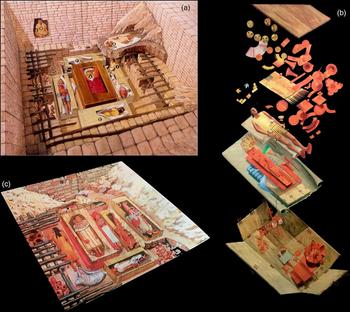
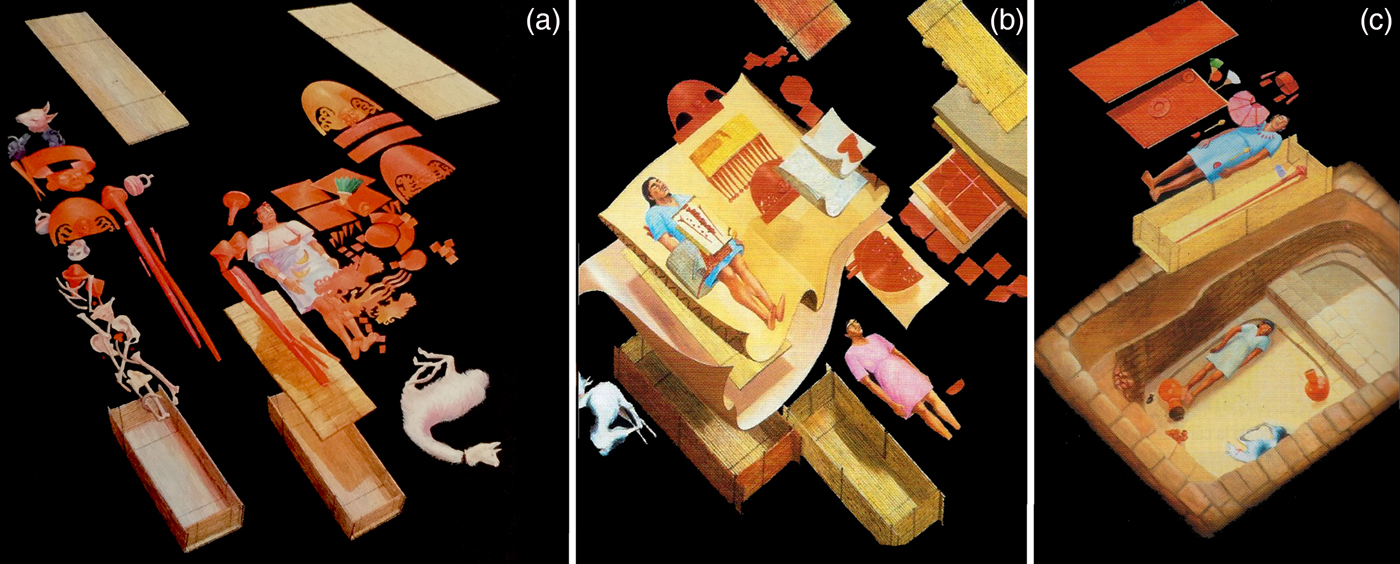
The tombs at Sipán appear to encompass four distinct categories: ruling male lords (Figure 2; Tombs 1, 3, 14, 15), high-status male priests (Tomb 2), a second-tier nobility (Figure 3) consisting of male individuals spanning inferred military leaders, and assistants to the lords and priests (Tombs 4–6, 7, 8, 9, 10, 11, 12, 16). The principal personages of inferred political or military roles were buried in the northern sector of the platform. Religious personnel were interred in the southern sector. Tomb retainers (the females and the few children placed adjacent to the principal personages in symbolically subordinate locations) have been varyingly inferred as sacrifice victims, wives, or deputies (Bentley and Klaus Reference Bentley, Klaus, Klaus and Toyne2016). Newly published calibrated Bayesian radiocarbon and thermoluminescence dates (Aimi et al. Reference Aimi, Walter Alva, Marco, Sibilia, Aimi, Makowski and Perassi2017) define their span from the mid-fourth century (Tomb 3) to the mid-seventh century (Tomb 1; Supplemental Tables 3, 4).
Examples of first-order (high elite) tombs at Sipán: the iconic Tomb 1, or “Lord of Sipán” (a), the “Warrior-Priest” Tomb 14 (b), and the “Priest” of Tomb 3 (c). Images by Museo Tumbas Reales de Sipán. (Color online)

Examples of second-order (lower nobility) tombs at Sipán: Tomb 8 (a), Tomb 10 (b), and Tomb 12 (c). Images by Museo Tumbas Reales de Sipán. (Color online)

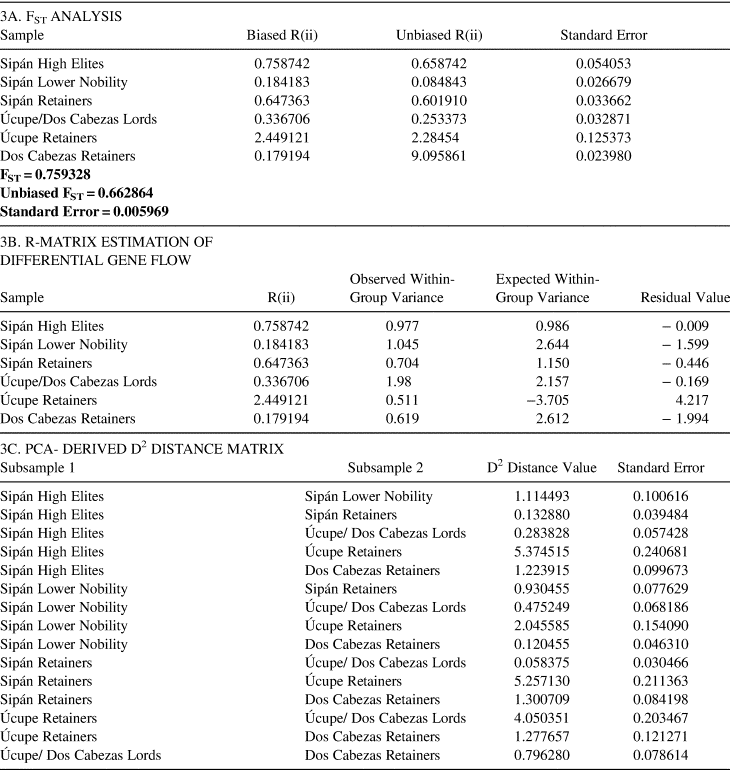
Diagonals of the R-matrix and Calculation of Unbiased FST and Standard Error (A), R-matrix Estimation of Differential Gene Flow (Residual Values; B), and Malhalanobis (D2) Distance Matrix Derived from the Principal Components Analysis of the R-matrix (C).

Úcupe
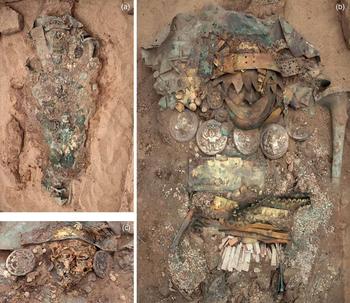
Another monumental Moche center was established south of the Reque region on the south bank of the Zaña river during the late Early Moche era. The architectural complex of El Pueblo de Úcupe covered 970 ha, the focal point of which was a truncated adobe platform mound some 81 m long, 55 m wide, and 18 m high. A chamber tomb contained an elite individual dating to the Middle Moche A period and was locally named the Lord of Úcupe (Figure 4; Bourget Reference Bourget2014). Tomb contents and internal organization closely mirrored practices at Sipán. This adult male principal personage was interred wearing full regalia (metal funerary masks, multiple nose clips and diadems, and full-sized metal war clubs fashioned from copper sheeting) and was accompanied by three tomb retainers (Supplemental Figure 2) and sumptuary ceramics.
The tomb of the “Lord of Úcupe” at Huaca El Pueblo, Zaña valley, with a view of the exposed funerary bundle (a); diadems, necklaces, and burial masks defined during excavation (b); and, the exposed principal personage of the tomb (c). Photos by Steve Bourget. (Color online)

Dos Cabezas
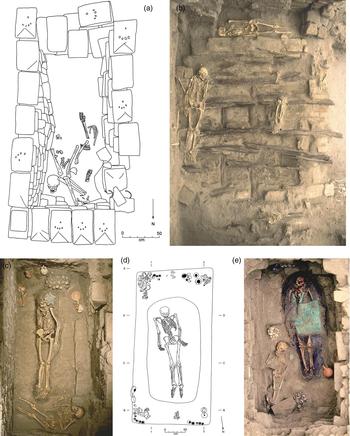
Between 1997 and 2000, Donnan (Reference Donnan2007) excavated five virtually contemporaneous elite tombs at Huaca Dos Cabezas in the Jequetepeque valley (Figure 5). The earliest contexts were Tomb A and Tomb B. Tomb A held the disarticulated remains of an adult male, but at some point in antiquity, the tomb was opened, and the skeletal remains were removed, manipulated, and replaced (sensu Shimada et al. Reference Shimada, Klaus, Segura, Matsumoto, Shimada and Fitzsimmons2015). Tomb B contained remains of four inferred retainers and isolated skeletal elements, and was probably a kind of an open sepulcher.
Tomb A (a), Tomb B (b), Tomb 1 (c), Tomb 2 (d), and Tomb 3 (e) at Huaca Dos Cabezas, Jequetepeque valley. Images by and courtesy of Christopher B. Donnan. (Color online)

Tombs 1, 2, and 3 occurred slightly later in this sequence. Each featured a centrally placed male principal personage accompanied by resplendent headdresses and diadems, gold, silver, copper, and gilded copper nose ornaments, and sumptuary ceramics. A single adolescent female accompanied the male in Tomb 1. Tomb 2, which was centrally located and the largest, featured a male principal personage accompanied by two retainers. A similar context was seen with the male in Tomb 3 buried with a woman and an older child. Radiocarbon dates place Dos Cabezas in Middle Moche A (averaging between AD 410 and 620) and are contemporaneous with the Lord of Úcupe. The skeletal remains of these Moche lords demonstrated unusually tall stature and anomalous growth patterns (Cordy-Collins and Merbs Reference Cordy-Collins, Merbs, Bourget and Jones2008). Biers and colleagues (Reference Biers, Merbs, Tyson and Hunt2017) considered these characteristics consistent with endocrine disruptions produced by castration.
Biodistance Analysis
Biological distance (biodistance) analysis is one of about a dozen areas of bioarchaeological research. It involves mathematical assessment of similarity of phenotypes that reflect microevolution or culturally structured patterns of genetic variation and inheritance (Larsen Reference Larsen2015). Biodistance analysis provides a record of kinship, gene flow, ethnic group boundaries, postmarital residence patterns, migration, and other forms of biological interactions, from intracemetery to global scales (Buikstra et al. Reference Buikstra, Frankenberg and Konigsberg1990; Larsen Reference Larsen2015; Pilloud and Hefner Reference Pilloud and Hefner2016; Stojanowski and Schillaci Reference Stojanowski and Schillaci2006).
The basis of biodistance research is well established by evolutionary theory. As populations exchange mates (genes), they become phenotypically and genetically more alike; those that do not exchange genes become increasingly dissimilar at a rate determined by genetic drift and their effective population sizes (Stojanowski and Schillaci Reference Stojanowski and Schillaci2006). Although there is never a 1:1 correspondence between phenotype and genotype, some dental and skeletal phenotypes do serve as useful proxies of underlying polygenic variation. While cranial size and shape provide more of a mirror on environmental factors (Katz et al. Reference Katz, Grotea and Weaver2017), tooth development is strongly canalized and developmentally invariant. Data include metric traits (linear measurements such as length and width of a tooth crown) and nonmetric traits (discrete or quasicontinuous features involving the presence, absence, or graded expressions of a trait; Hemphill Reference Hemphill, Irish and Scott2016a, Reference Hemphill, Irish and Scott2016b; Irish Reference Irish, Irish and Scott2016; Pilloud and Kenyhercz Reference Pilloud, Kenyhercz, Pilloud and Hefner2016; Pilloud et al. Reference Pilloud, Edgar, George, Scott, Pilloud and Hefner2016; Scott and Turner Reference Scott and Turner1997).
The heritability (h2) of various dental traits remains incompletely studied and understandings vary trait-by-trait. Mesiodistal incisor crown dimensions demonstrate an extremely high degree of genetic expression (h2 = 0.81 to 0.91; Dempsey et al. Reference Dempsey, Townsend, Martin and Neale1995). Most other dental metric and nonmetric h2 trait values fall between 0.70 and 0.90 to indicate varying but consistently dominant genetic (and not environmental) bases of expression. At least 300 genes, including key homeobox genes, play roles in tooth morphogenesis (Edgar and Ousley Reference Edgar, Ousley, Pilloud and Hefner2016). Some nonmetric traits appear selectively neutral (Scott and Turner Reference Scott and Turner1997), while others are varyingly shaped by selection (Mizoguchi Reference Mizoguchi, Scott and Irish2013). Still, on the timescale considered here, dental variation is most directly shaped by differences in population history and biological affinity.
Data Collection
Dental metric and nonmetric data were collected from 20 individuals from Sipán, four individuals in the tomb of the Lord of Úcupe, and nine individuals from the five tombs at Dos Cabezas, who had more than 75% of their dentitions preserved (Table 1). Metric data gathering was modeled after Jacobi's (Reference Jacobi2000) techniques based on classic protocols established by Moorres and Reed (Reference Moorres and Reed1964) and Kieser (Reference Kieser1990).
Metric data were gathered using a Mitutoyo digital sliding caliper with sharpened tips calibrated to 0.01 mm with a direct USB input into a Microsoft Excel spreadsheet. Measurements were made during two separate passes through the material separated by several hours. For each tooth, standard maximum mesiodistal and buccolingual tooth dimensions were documented (detailed measurement protocols are presented in the online Supplemental Text 1). Twenty-seven nonmetric traits were scored using Turner and others’ (Reference Turner, Nichol, Scott, Kelley and Larsen1991) Arizona State University Dental Anthropology Scoring System (Scott and Irish Reference Scott and Irish2017; Scott et al. Reference Scott, Maier, Heim, Irish and Scott2016).
Data Preparation and Analysis
The raw dataset consisted of 56 metric variables and 48 nonmetric variables per individual (Table 2; for complete descriptions of the statistical procedures conducted here, please see the online Supplemental Text 1). In summary, work began with removal of variables with zero variance and data categories consisting of more than 25% missing data. Interobserver error for metric data was evaluated using one-way ANOVA tests in SAS 9.4 (Supplemental Table 5), and for nonmetric traits, Cohen's kappa tests were used. Each test revealed strong nonsignificant error. Any missing metric data were imputed using an expectation-maximization algorithm. For nonmetric ordinal values, the multiple imputation technique was used. For each, missing data points were calculated via 10,000 iterations performed 25 times.
To maximize phenotypic coverage, metric and nonmetric dental traits were combined into a single dataset following Corruccini and Shimada (Reference Corruccini and Shimada2002), by converting them into z-scores in SPSS 24. Then, conversion of z-scores into c-scores minimized any effects of sexual dimorphism. A Kolmogrov-Smirnov test demonstrated a normal distribution of the dataset. Distances were calculated using Malhalanobis's (Reference Malhalanobis1936) generalized distance (D2) that employs a tetrachoric correlation in the calculation of a covariance matrix to eliminate distortional effects of trait intercorrelation. Hierarchical cluster analysis using the average linkage technique was used to represent distances. This method is simple, robust, and proven (Everitt et al. Reference Everitt, Landau, Leese and Stahl2001). To validate the clusters, a silhouette measure of cohesion and separation was employed.
A window on population structure was provided by an R-matrix analysis of the metric data. Based on wholly different mathematics, an R-matrix can also serve as an independent test of cluster analysis results and interpretations. The R-matrix is a standard method that estimates population genetic heterogeneity and variance via metric variation in RMET 5.0 (see Relethford Reference Relethford, Pilloud and Hefner2016) available at: http://employees.oneonta.edu/relethjh/programs/. It independently calculates a bias-corrected measurement of FST (an expression of population genetic diversity), the relative degree of external gene flow, and a principal component analysis plot of Malhalanobis distances calculated from the R-matrix.
Results
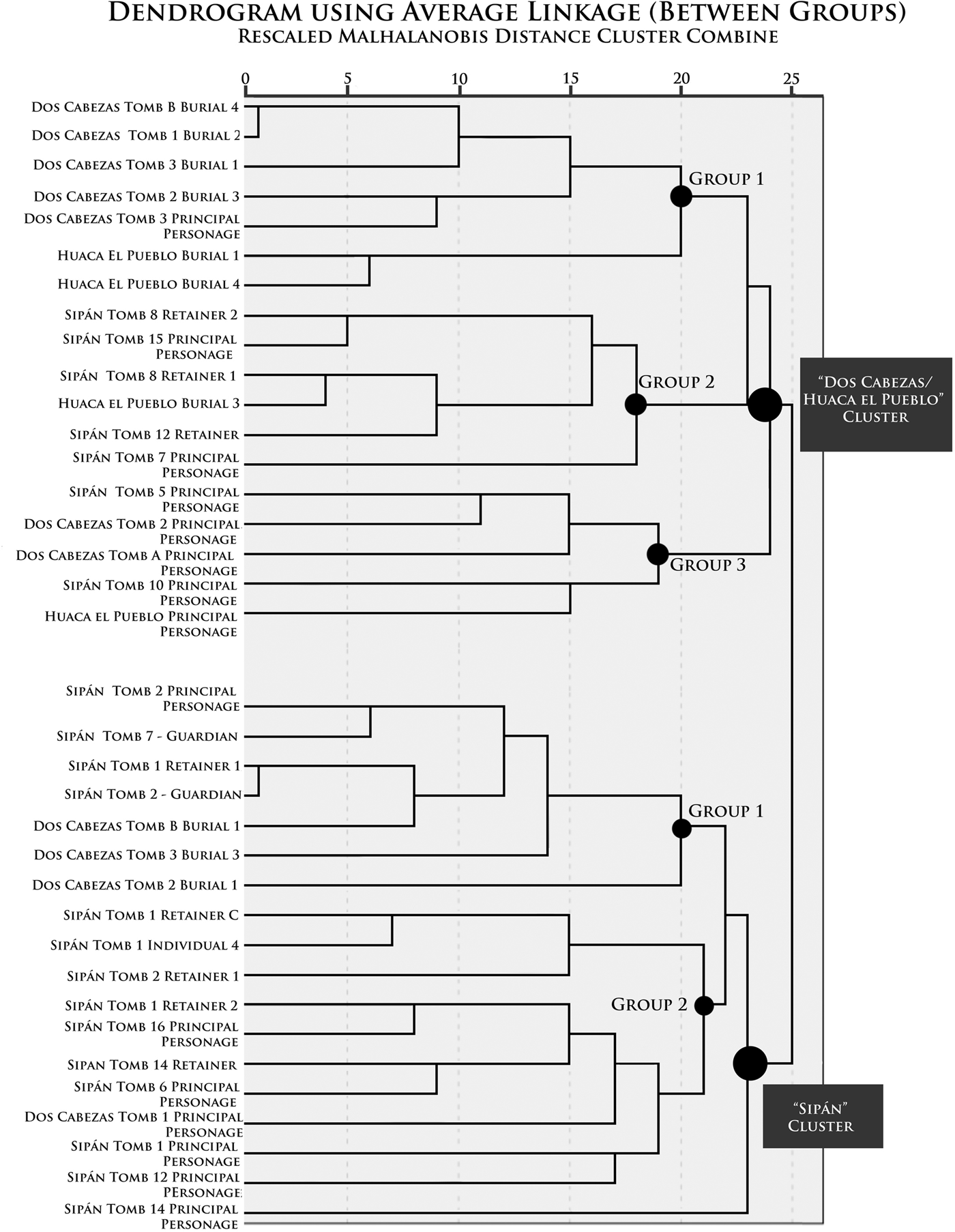
Based on the D2 proximity matrix, the average linkage algorithm produced a dendrogram with distinctive structure (Figure 6). The silhouette measure of cohesion and separation value was 0.50—the breakpoint between “fair” and “good” quality. Thus, we have confidence that the clusters represent nonrandom patterns and mathematically authentic relationships.
Dendrogram representing estimated phenetic distances between the individuals from Sipán, Huaca el Pueblo-Úcupe, and Dos Cabezas. Illustration by Haagen Klaus.

The individuals from Sipán, Úcupe, and Dos Cabezas grouped into two primary clusters—one dominated by the highest-ranking peoples from Sipán and the other by the lords of Dos Cabezas. The notional “Sipán Cluster” contains 18 individuals, 14 of whom were from Sipán. This cluster featured two primary constituent groupings. Cluster 1 Group 1 was composed of the principal personage of Sipán Tomb 2, the “guardians” of Tombs 2 and 7, and retainers from Dos Cabezas Tombs B, 2, and 3. A particularly close distance was observed between Sipán Tomb 1 Retainer 1 and the guardian of Sipán Tomb 2. Group 2 contains the Lord of Sipán and the principal personages of the Sipán Tombs 6, 12, 14, and 16, along with retainers from Tomb 1, 2, and 14. Also in this group was the principal personage of Dos Cabezas Tomb 1.
The “Dos Cabezas Cluster” contained 18 individuals. Three of the four principal personages of the Dos Cabezas tombs (Tombs A, 2, and 3) are found along with all members of the Úcupe tomb. In Cluster 2 Group 1, a strong phenetic similarity was observed between four Dos Cabezas retainers, two of the three retainers at Úcupe, and the principal personage of Dos Cabezas Tomb 3. Cluster 2 Group 2 contained the principal personages of Sipán Tombs 7 and 15, along with retainers from Sipán Tombs 8 and 12 and the final retainer from Úcupe. Cluster 2 Group 3 consisted of the principal personages of Sipán Tombs 5, 7, and 10, the principal personages of the Úcupe tomb, Dos Cabezas Tomb A, and Dos Cabezas Tomb 2.
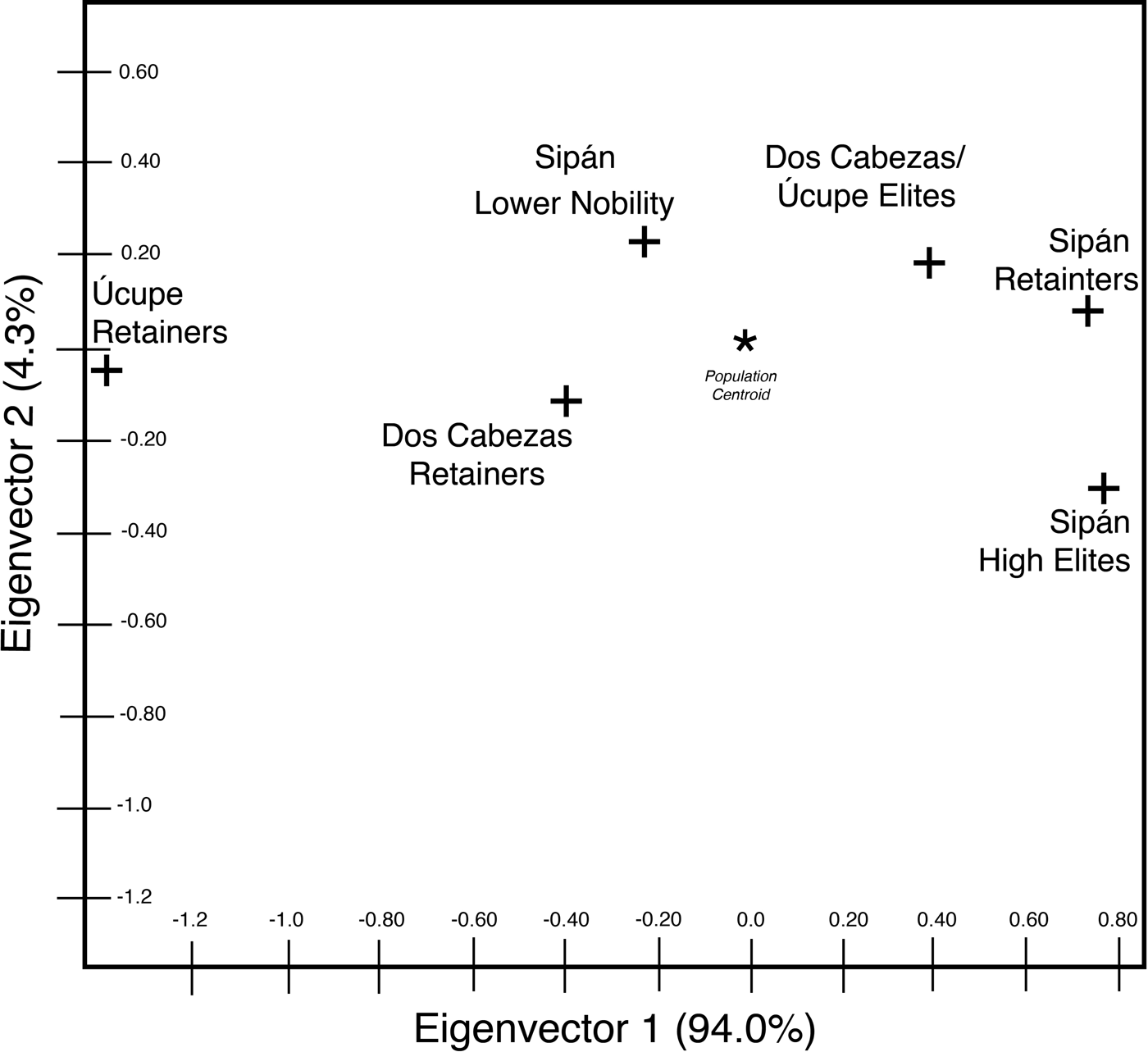
R-matrix analysis of population structure results in a bias-corrected FST of 0.66 with a low standard error (0.0059), meaning that the sample possesses an extremely strong degree of heterogeneous structure; put another way, the constituent subsamples are very different from one another (Table 3A). Except for the Úcupe retainersFootnote 1, all of the subsamples appear to possess varying degrees of relatively negative extralocal gene flow as compared to the model-derived expectation of the broader population as a whole (Table 3B). The PCA plot (Figure 7) derived from the R-matrix (Table 3C) illustrates closest similarity between the high Sipán elites and the Sipán retainers. Increasing distance emerges between them and the Lords of Dos Cabezas, lower Sipán nobility, the Dos Cabezas Retainers, and the Úcupe retainers.
Principal coordinates analysis plot of scaled Malhalanobis distances obtained from the R-matrix. Illustration by Haagen Klaus.

Discussion
Phenotypic data should be considered a reflection of underlying genotypes rather than a precise representation of actual genes. That said, the cluster analysis (a model-free, exploratory interindividual analysis) and the R-matrix (a model-bound, population genetic analysis) produced comparable results and indicate that it is appropriate to reject the hypothesis. Biodistance patterns between the lords of Sipán, Úcupe, and Dos Cabezas cannot be reasonably interpreted as a single, unified, or uniform elite lineage.
Any inferences drawn from these results must be conservative because the samples are small and we may never know how they may be skewed or otherwise nonrepresentational due to the devastating looting at these sites. Still, the correlation of biodistance patterns with multiple lines of archaeological contexts, the strong silhouette measure of cohesion and separation, and very low R-matrix standard error all independently speak to the likelihood that these observations capture reflections of ancient biocultural patterns that are mathematically reliable. Of significant interest, the bias-corrected FST value of 0.66 is extremely high, as the modern human average is approximately 0.16 (Templeton Reference Templeton and Fish2002). We can be virtually certain this value does not represent the Moche population as a whole. More likely, it is the signature of considerably intense endogamy among those represented in a small sample drawn from a proportionally very small breeding population (see below).
Intrasite Biodistance Structures
High Elites and the Lower Nobility at Sipán
Interindividual cluster analysis indicates the Lord of Sipán appears most similar to the principal personages of Sipán Tombs 6, 12, 14, and 16, whereas retainers from Tombs 1, 6, and 14 were assigned membership in other clusters. These tombs span more than a century at Sipán and indicate continuity of this inferred hereditary lineage between Middle Moche A and B periods. The largest distances appear between the grouping of the Lord of Sipán/Tomb 12 principal personage/Tomb 14 principal personage and the priest of Tomb 2. This reinforces previously defined distinctions between the tombs with more secular overtones (northern side of the platform) and those associated with religious leadership (southern side of the platform). They perhaps represented differentially ranked and spatially segregated lineages within the funerary platform.
Concerning the retainers, women buried with the Lord of Sipán appear to have been varyingly linked to him but at somewhat greater distances. At least one of these women (Tomb 1 Retainer B) was associated with the principal personage of the second-order Tomb 16. Perhaps female kin of lower-ranked lords became retainers to more highly ranked lords. Still, the identity of these women remains a vexing question (Bentley and Klaus Reference Bentley, Klaus, Klaus and Toyne2016). They are commonly inferred as either wives or kin. These results are consistent with either possibility, and the R-matrix analysis shows the Sipán high elite and Sipán retainers possessed very similar FST values and shared very close relationships on the PCA plot.
Kin and wife are not necessarily mutually exclusive concepts among Andean royalty. Rostworowski (Reference Rostworowski and Minelli2000) noted that the prevalent rule of succession among yunga (north coast region) nobility involved the brother of the deceased (rather than his son) who assumed rulership, and this pattern of succession continued to the last brother of that generation before passing to the subsequent generation. Given Shimada and others’ (Reference Shimada, Ken-ichi Shinoda, Alva, Uceda and Reed2005) evidence of maternal linkages between several Sipán lords, the Moche may have practiced an avunculate system of descent where the son of the ruler's sister had priority over the ruler's son, potentially promoting “cases of incestuous marriage between ruling brother and sister” (Rostworowski Reference Rostworowski and Minelli2000:178).
Kinship Heterogeneity at Dos Cabezas
At Dos Cabezas, most lords also appear to share close mutual relationships, particularly between the lords of Tomb A and Tomb 2. Because Tomb A preceded Tomb 2, temporal biological continuity of a local royal lineage is again likely. This linkage also indicates the disturbed remains in Tomb A was of a person biologically part of the local aristocracy, possibly even the original principal personage of the tomb. Other strong phenetic connections existed between the principal personage of Dos Cabezas Tomb 3, the retainers of Dos Cabezas Tombs B, 1, 2, and 3, and Retainers 1 and 4 at Úcupe. While they were spread across geographic space and overlapped during Middle Moche A, these people were evidently linked by kinship. And although the lord of Dos Cabezas Tomb 1 shared the same abnormal growth anomalies with the other lords of Dos Cabezas, it did not involve immediate biological ties. The larger Dos Cabezas cluster possessed a more heterogeneous FST value and contained a diverse cross-section of retainers and personages from other tombs and sites. Perhaps Sipán was somehow more “exclusive” or bounded.
Northern Moche Biodistance in Regional Perspective
Gene Flow and Intermarriage
The data indicate potential gene flow and intermarriage between the Moche leadership at Sipán and Dos Cabezas over the span of perhaps three to five generations (Middle Moche A [ca. AD 390–500] to Middle Moche B [ca. AD 550–700]). Cluster analysis demonstrates an intriguing pattern of principal personages grouping at the bottoms of Clusters 1 and 2. Eight Sipán individuals (principal personages of Sipán Tombs 5, 7, 10, and 15, along with Sipán Tomb 8 Retainers C and D, and the retainer of Tomb 12) show affinity with the Dos Cabezas Moche. The PCA plot of the R-matrix shows lower Sipán nobility (as a group buried mostly in the southern [lower] sector of the Sipán funerary platform) falling on the other side of the population centroid from the high Sipán elite. These dissimilarities could reflect a few possibilities.
One is that the lower nobility did not exchange significant quantities of genes with the lords of the Tombs 1, 2, 6, 12, and 14. Relative to the high Sipán elite, these lower-status lords were more homogenous (inbred) with a smaller FST and greater degree of negative gene flow. Cluster analysis suggests that the lord of Tomb 14 is in fact the most different (isolated) of all. Because it is highly probable that the Moche lordship featured a very small effective population size, intermarriage would rapidly make these people more similar.
Cluster analysis and R-matrix data indicate these distinctions may reflect a social status barrier to widespread intermarriage and that the lower Sipán elites represented a different lineage. Most second-order Sipán tombs held a biodistance affinity to the Jequetepeque lords, distinct from the principal Sipán dynastic core group. Knowledge and memory of this ancestry may have created a perception of “otherness,” and perhaps sometimes encoded in idiosyncrasies of funerary ritual. For example, Sipán Tomb 10 was atypical in several respects, containing the body of an adolescent male accompanied by only a few ornaments. The body was oriented north-south (looking to the south), unlike the standard south-north orientation. This young male's closest biological relationships included the principal personages of Dos Cabezas Tomb A and Tomb 2. Was the Sipán Tomb 10 personage positioned to face south looking towards the region of geographical ancestry?
Similarly, cluster analysis associated the principal personage of Sipán Tomb 15 with Dos Cabezas. This tomb represents one of the first burials at Sipán, and the corpse was also positioned to face south. Some of the grave goods are extremely reminiscent of Jequetepeque ceramic styles (in particular, two ceramic owl bottles; Chero Reference Chero2015:Figure 177). Although this person is unlikely to be a lineage founder at Sipán, a Dos Cabezas connection suggests biocultural linkages between Lambayeque and Jequetepeque valleys from the early days of Sipán, if not before.
Paralleling possible “otherness” at Sipán, three retainers in Dos Cabezas Tombs 1, 2, and 3 were evidently most closely related to the retainers from Sipán Tombs 1, 2, and 7. They were also clearly of a lower status. Similarly, a close affinity linked the principal personage of Dos Cabezas Tomb 1 (containing the least wealth and complexity of the Dos Cabezas tombs) to the principal personages of Sipán Tombs 1, 6 and 16Footnote 2.
Any gene flow between Sipán and Dos Cabezas might be understood in terms of strategies involving the different ways regional royal lineages maintained ties with one another. Nevertheless, these data indicate this interchange may not have been equal: more people buried at Sipán bore a biological correlation to the Dos Cabezas lineage. R-matrix results lend additional credence to this idea. High elites at Sipán demonstrate both higher (more diverse) FST values and a residual value closer to zero, indicating greater relative extralocal gene flow among the Dos Cabezas lords. Thus, directional gene flow is suggested with Sipán high elites characterized by a greater intake of genes (mates) from different sources other than themselves. One possibility is Dos Cabezas occasionally sending brides or grooms to Sipán to establish and maintain political alliances. We hypothesize that these people and their descendants formed part of this lower elite stratum.
Identity and Territory at Úcupe
The affinities between the Lord of Úcupe and his retainers with the Dos Cabezas Moche are surprising. At some point in Middle Moche times, the Collique intervalley canals were constructed. Sipán would have almost certainly controlled these canals to link themselves and the Lambayeque Valley Complex with the Zaña valley to the south (Shimada Reference Shimada1994a). This was not simply about increasing agricultural productivity. Considering the political significance of water access in north coast politics (Netherley Reference Netherly1984), canals embodied deep statements regarding political power and resource control. Sipán is geographically closer to Huaca el Pueblo-Úcupe than Dos Cabezas (Supplemental Figure 3), and it is reasonable to hypothesize that Huaca el Pueblo was a satellite of Sipán, extending their influence into the Zaña valley. Many prominent items including one of the Úcupe principal personage's funerary masks, V-shaped diadems, and other items resemble those at Sipán (Supplemental Figure 4A, B, C). We also think it likely that the Lord of Úcupe and the men in Sipán Tombs 2, 3, and 14 all shared the role of Figure B/D in the Moche Presentation Theme. Similar associations are absent at Dos Cabezas.
Beyond this, an Úcupe-Dos Cabezas connection is far more obvious. The iconography and design of some grave goods tie Úcupe to Dos Cabezas, such as ceramic representations of the so-called Moche “engineer,” diadems with the “Crested Animal/Seahorse,” and the similarities between the style and design of other masks worn by the Lord of Úcupe and the personage of Dos Cabezas Tomb 2 (Supplemental Figure 4D, E).
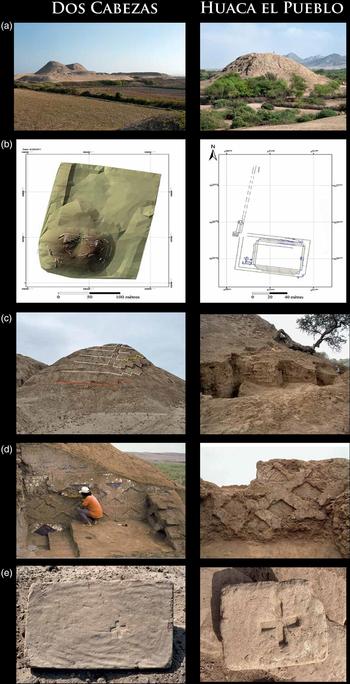
Architecturally, Huaca el Pueblo is a direct analog of Dos Cabezas (Figure 8). Although Dos Cabezas is twice the size of Huaca el Pueblo, their layouts and cardinal orientations are identical. They share identical superimposed stepped platform construction, a zigzag platform mound wall design, and identical adobe brick molds with shared “makers’ marks.” A long wall from the northwest corner of the platform turns north to delimit the border of the main plaza at Huaca el Pueblo and Dos Cabezas. The same wall at both sites is decorated with low-relief X-shaped geometric murals with a white diamond on a black background (Bourget Reference Bourget2014). Dos Cabezas and Úcupe lords were buried in adobe brick chamber tombs adjacent to the primary platform mound. Placement of a retainer beneath a principal personage is only seen at Dos Cabezas and Úcupe. Not one of these shared features is present at Sipán.
Comparison of features from Dos Cabezas (left column) and Huaca el Pueblo (right column) regarding overall form and layout (a, b), zigzag walls (c), X-shaped low relief wall decoration (d), and adobe brick makers’ marks (e). All are absent at Sipán. Photos by Steve Bourget. (Color online)

Huaca El Pueblo seems to have been a satellite of Dos Cabezas. Did it represent a northern expansion of the Jequetepeque Moche to secure water sources, subjects, tribute labor, and cultivatable land via implantation secondary center at Úcupe? This may be, but objects in the tomb of Lord of Úcupe demonstrate that something even more complicated unfolded here. At least, this lord appears literally and figuratively between two worlds, and we may be glimpsing some kind of hybrid sociopolitical identity bridging the Moche to his north and south. Further, it is important to recognize that Andean concepts of territory differed starkly from Western notions. Ethnohistorical sources describe how communities of one lord lived in the “territory” of another (Rostworowski Reference Rostworowski, Masuda, Shimada and Morris1985). Whatever was going on, it may represent something far less predatory. A better understanding of who built the Collique intervalley canals, and exactly when this happened will be important to explore this issue.
Moche Macropolitics
In terms of the larger political landscape, three considerations emerge. First, negative residual values lend support to a hypothesis of elite endogamy and minimal vertical gene flow coming from other (lower) social groups or strata—in other words, socially allopatric relationships driving observed heterogeneity (see Klaus et al. [Reference Klaus, Izumi Shimada, Muno, Klaus, Harvey and Cohen2017] for a comparative Middle Sicán study). Perhaps echoing this, elite/nonelite differences were expressed in early postcontact north coast mythology that justified social inequality via cosmology (Rowe Reference Rowe1948).
Second, cluster analysis produced distinctive Sipán and Dos Cabezas-dominated groups along with independent demonstration of large (heterogeneous) FST for the sample. Further corresponding subsample FST variation, residual variation, and principal components analyses results are equally consistent with expectation of a “many Moches” model that anticipates fairly explicit internal political differentiation and social and structural diversity (Benson Reference Benson, Quilter and Castillo2010, Reference Benson2012; Quilter and Koons Reference Quilter and Koons2012). This also resonates with Donnan's (Reference Donnan2011) vision of one or more Moche royal courts in the various north coast valleys and who marked distinctive group identities with divergent artistic substyles.
Shimada (Reference Shimada, Quilter and Castillo2010:72) further considered how Moche monuments were the seats of semi-autonomous elite lineages in each valley, loosely tied to each other through marriage alliances, gift exchange, and reciprocal obligations focused by a shared elite material culture and politico-religious system. Here, a footprint of between-lineage intermarriage among lower nobility seems apparent. Diachronic coherence of these lineages probably also reflects lasting and stable forms of kinship-based rule. Such would favor dispersed authority and power across a social landscape and not unstable charismatic kingship (Shimada Reference Shimada, Quilter and Castillo2010).
Third, the growing consensus regarding relative ideological and cultural unity among Moche lords in these diverse valleys does not necessarily imply biological unity. Structurally speaking, each northern valley likely possessed at least one elite administrational component and they were “Moche” in their own ways. Constructed on principles of kinship, they produced degrees of solidarity among those who managed the social, economic, and ceremonial functions of local society/societies in that valley—particularly among the lower nobility. We think our data resonate with Benson's (Reference Benson, Quilter and Castillo2010) model involving multiple lordships that involved elite competition and cooperation. Suzerainty (where a dominant polity permits subordinates extensive autonomy and sovereignty) and reciprocity-driven cooperation must also be investigated further.
Golte (Reference Golte1994) considered the Moche represented relatively independent political entities participating in overarching economic spheres, trade networks, and production of sumptuary elite goods most consistent with decentralized, competitive polities further preconditioned by geography (Benson Reference Benson2012). Each north coast river valley is circumscribed as mostly individual river drainages. This physiogeography likely encouraged development of distinct spatial systems resulting in self-generating and variable expressions of sociopolitical self-sufficiency and autonomy (Benson Reference Benson2012:27). In the north, there are V-shaped headdresses as Sipán, the “hat with bangles” in the looted Vicús metalwork, and associations with Figure B/D of the Presentation Theme among Sipán and Úcupe lords. In the south, there are multipointed crowns atop the heads of figures in the Huaca de la Luna and Huaca Cao Viejo Complex Theme murals, and at Huaca de la Luna, priests are associated with “flying feline” back ornaments. We strongly suspect that these are indexical of distinct elite groups, lineages, and identities within the broader constellation of a shared elite Moche system (Benson Reference Benson2012). This harkens back to Berezkin's (Reference Berezkin1978) iconographic analysis where he argued that prior to late Moche IV, the five sets of principal deities/supernatural actors were representative of five principal elite lineages. Perhaps this work has observed the biodistance signatures of two such lineages.
Conclusions
Not long ago, Alva (Reference Alva and Pillsbury2001:243) observed that the nature, scope, and extent of the Sipán dynasty in particular—and the rest of the elite Moche in general, was unknown—as was the nature of interactions of lords between valleys and the extent of Moche political centralization. This work represents a first step in addressing these questions using the phenotypic record of inherited dental traits. The data support the inference that the Sipán and Dos Cabezas lords were members of different dynastic kin groups generally concordant with a “many Moches” model of political organization, where these groups were linked on some levels but followed their own distinct trajectories, agendas, and approaches to alliance-building-inconsistent with neo-evolutionary visions of a single hegemonic Moche state.
In this and other work (Klaus et al. Reference Klaus, Izumi Shimada, Muno, Klaus, Harvey and Cohen2017; Sutter and Castillo Reference Sutter and Castillo2015), dental phenotypic variation is increasingly shown as a highly useful approach in the archaeology of the north coast of Peru. In the future, increased sample size and expanded geographic scope can further define the biological record of social interaction patterns and politics throughout Moche realms. We can further test the concept of a northern north coast/southern north coast geopolitical, ethnic, and linguistic bipartition (Rivet Reference Rivet1949; Shimada Reference Shimada, Uceda and Mujica1994b) and if these factors were barriers to gene flow. What might biodistance analysis data reveal about the maintenance of non-Moche sociopolitical identities at places such as the Virú and the Santa valleys (Bourget Reference Bourget, Quilter and Castillo2010; Chapdelaine Reference Chapdelaine, Bourget and Jones2008)? Was politically motivated intermarriage with the Moche either spurned or encouraged in their political calculus? Regional macropopulation structure and evolutionary processes can be pursued further (Klaus Reference Klaus2008), as well as defining the likely coexistence of finer-scale regional identities and interactions. That is, Sipán and Dos Cabezas may not have ruled their entire respective regions, and their interactions with other peers and subordinates await a clearer understanding, as does regional FST variation. Excavation of contemporaneous commoner skeletal samples will go far to meet these goals.
These findings represent a starting point and provide new hypotheses for the study of Moche biology, population structures, and politics. Future work must consider the fluidity, symbolisms, and situational dimensions of these relationships. Furthermore, the promise of next generation ancient DNA and proteomic sequencing technologies will no doubt expand our horizons in ways we cannot yet anticipate in the ongoing effort to reconstruct the history, structure, and legacy of one of the most remarkable societies of the ancient South America.
Acknowledgements
We owe debts of gratitude to Christopher Donnan, Ceyra Pasapera, Kimberly Jones, and the staffs of the Museo Tumbas Reales and the Museo del Sitio de Huaca Rajada for their numerous contributions. Joe Luce, Marisa McKane, and JoEllen Perez assisted in data collection between 2009-2011. Data collection was supported by grants from Utah Valley University. Dan Temple provided expert assistance with the RMET software. Chris Donnan, Clark Larsen, Charles Merbs, Izumi Shimada, and Dan Temple provided valuable critical commentary and editorial input on earlier drafts of this article.
Data Availability Statement
The raw biodistance datasets used in this study are digitally curated by HDK and can be shared with interested scholars.
Supplementary Materials
For supplementary materials accompanying this article, visit https://doi.org/10.1017/laq.2018.46.
Supplemental Figure 1. View of the superimposed funerary platforms at Sipán, demonstrating the complex building history of the structure and tomb locations in the northern (left) and southern (right) halves of the platform. Illustration by the Museo Tumbas Reales de Sipán.
Supplemental Figure 2. Retainer burials in the tomb of the Lord of Úcupe: Burials 1, 3, and 4 (A, B, and C, respectively). Illustrations by Bruno Alva.
Supplemental Figure 3. Geographic locations and distances between Sipán, Úcupe, and Dos Cabezas. Map by Haagen Klaus.
Supplemental Figure 4. Various items in the tomb of the Lord of Úcupe bear strong stylistic and iconographic resemblance to items discovered at Sipán to the north, such various V-shaped diadems with outstretched hands (A); pectoral necklace manufactured from Spondlyus spp. and Conus sp. shell (B), and spiral earspool repoussé decoration (C). Other items, such as a a blackware vessel of the so-called “Engineer” (D) and a diadem possessing “Crested Animal-Seahorse” elements (E) appear to be connections to Dos Cabezas to the south. Photos by Steve Bourget.
Supplemental Table 1. Northern Moche stylistic sequence and associated inferred chronology.
Supplemental Table 2. Correlation and overlap between Phase IV and Middle Moche subphases.
Supplemental Table 3. Stratigraphic distribution of tombs in the Sipán funerary platform.
Supplemental Table 4. Chronometric date estimations for Sipán and Dos Cabezas tombs.
Supplemental Table 5. ANOVA tests, metric data.
Supplemental Text 1. Statistical Procedures.