Marital adjustment appears to be an important aspect of well-being. For instance, many authors have argued that it can be negatively associated with psychological distress (Beach, Katz, Kim, & Brody, Reference Beach, Katz, Kim and Brody2003; Beach & O’Leary, Reference Beach and O’Leary1992; Bookwala & Franks, Reference Bookwala and Franks2005; Goldfarb, Trudel, Boyer, & Préville, Reference Goldfarb, Trudel, Boyer and Préville2007) and physical health (Bookwala, Reference Bookwala2005; Booth & Johnson, Reference Booth and Johnson1994; Yorgason, Booth, & Johnson, Reference Yorgason, Booth and Johnson2008). As Graham, Liu, and Jeziorski (Reference Graham, Liu and Jeziorski2006) have reported, assessments of marital adjustment have led to the development of many questionnaires, such as the Locke-Wallace-Marital Adjustment Test (Locke & Wallace, Reference Locke and Wallace1959), the Marital Satisfaction Scale (Roach, Frazier, & Bowden, Reference Roach, Frazier and Bowden1981), and the Dyadic Adjustment Scale (Spanier, Reference Spanier1976). The Dyadic Adjustment Scale (DAS) appears to be the most widely used questionnaire for the assessment of marital adjustment. Indeed, we conducted a search of the PsychINFO database using the keywords “Dyadic Adjustment Scale” and found more than 1,290 publications that used this questionnaire in their respective studies.
The Dyadic Adjustment Scale stems from a combination of many questionnaire items measuring marital adjustment. Spanier (Reference Spanier1976) initially defined dyadic adjustment as a process that includes five degrees: (a) troublesome dyadic differences, (b) interpersonal tension and personal anxiety, (c) dyadic satisfaction, (d) dyadic cohesion, and (e) consensus on the important aspects of marital adjustment. On the basis of this definition, Spanier compiled 300 items and asked three judges to evaluate them. Consequently, evaluators retained 200 of the items and administered the questionnaire to a population of married and separated people. Forty of these items discriminated between these groups. Thereafter, Spanier (Reference Spanier1976) conducted a factorial analysis and provided a final design for the DAS, including 32 items subdivided into four factors or subscales: Cohesion, Satisfaction, Consensus, and Affective Expression. The Cohesion subscale refers to the degree of agreement between partners regarding shared activities, while the Consensus subscale indicates the degree of agreement between partners regarding different aspects of their lives such as those involving money, friends, household tasks, and time spent together (Spanier, Reference Spanier1989). Satisfaction refers to the low-incident rate of quarrels, discussions of separation, and negative interactions, while the Affective Expression subscale indicates the satisfaction level regarding sexuality and manifestations of tenderness (Spanier, Reference Spanier1989).
Over the years, many authors have challenged the structure of the DAS because it occasionally fails to reproduce the multidimensional model proposed by Spanier (Reference Spanier1976). For example, Kazak, Jarmas, and Snitzer (Reference Kazak, Jarmas and Snitzer1988) tried to replicate Spanier’s model with a sample of 409 parents. The results of the factor analysis showed weak support for the existence of the four subscales, suggesting the presence of a single-factor model representing a global factor of dyadic adjustment. These results are similar to those obtained by Sharpley and Cross (Reference Sharpley and Cross1982) in a sample of 95 unrelated married people. Other authors have failed to replicate the four-factor model, suggesting a three-factor model instead. Thus, a study by Antill and Cotton (Reference Antill and Cotton1982), conducted with 176 married and cohabiting couples, found the existence of a strong single factor, but the authors were able to extract only three of the four DAS subscales: Consensus, Cohesion, and Satisfaction. Baillargeon, Dubois, and Marineau (Reference Baillargeon, Dubois and Marineau1986) found similar results with an adapted French-Canadian DAS and reported that these three subscales seem to have relatively stable factors of dyadic adjustment. Nevertheless, several authors were able to replicate the four-factor model proposed by Spanier among different samples: recently separated people, along with heterosexual and homosexual couples (Kurdek, Reference Kurdek1992; Sabourin, Lussier, Laplante, & Wright, Reference Sabourin, Lussier, Laplante and Wright1990; Spanier & Thompson, Reference Spanier and Thompson1982).
In line with the literature that has debated the DAS structure, Sabourin et al. (Reference Sabourin, Lussier, Laplante and Wright1990) proposed to conceptualize the DAS as a higher-order model of dyadic adjustment represented by four first-order factors hierarchically related to a second-order general factor. Indeed, these authors carried out a confirmatory factor analysis using structural equation modeling and found that the hierarchical model of the DAS presented a better fit than the unidimensional model. The authors also found that the hierarchical model’s fit was similar to that of the multidimensional model, but that the hierarchical model showed a better fit because no modification indexes were proposed. A study by Eddy, Heyman, and Weiss (Reference Eddy, Heyman and Weiss1991), conducted with 1,307 married men and 1,515 married women between the ages of 17 and 80, also found that the hierarchical solution best fit their data, as compared to the one-factor model. Moreover, a study by Vandeleur, Fenton, Ferrero, and Preisig (Reference Vandeleur, Fenton, Ferrero and Preisig2003), who validated the French translation of the DAS by Baillargeon et al. (Reference Baillargeon, Dubois and Marineau1986), found that the hierarchical model proposed by Sabourin et al. (Reference Sabourin, Lussier, Laplante and Wright1990) better fit the data, as compared to Spanier’s multidimensional model.
According to Sabourin et al. (Reference Sabourin, Lussier, Laplante and Wright1990), the inconsistent replications of the model proposed by Spanier (Reference Spanier1976) could be explained by the fact that many studies used samples with different characteristics (e.g., separated vs. married), represented different nationalities (e.g., Australians vs. Americans vs. French-Canadians), and used different factor-analysis methods (e.g., exploratory factor analysis vs. confirmatory factor analysis). Considering the multitude of factors that can explain the inconsistent study results, it would seem important to test Spanier’s Dyadic Adjustment Scale (1976) across a variety of samples. To our knowledge, no study on the DAS factorial structure has been conducted among older adults, who represent a growing population. Moreover, we should not assume that older couples would express marital adjustment the way younger couples would.
In this way, some aspects of marital adjustment for older couples appear to be different when compared to those of younger couples because, as many authors have argued, the marital interaction of older couples appears to differ slightly from the interaction of younger couples: older couples tend to exhibit more traditional gender roles along with fewer conflicts about children, finances, and leisure time spent together, while using different sources of pleasure in their sexual relations (Dargis et al., Reference Dargis, Trudel, Cadieux, Villeneuve, Préville and Boyer2012; Norris, Snyder, & Rice, Reference Norris, Snyder and Rice1997). Moreover, other authors have found that older couples show a high level of marital satisfaction compared to other studies with younger couples (Cartensen, Graff, Levenson, & Gottman, Reference Cartensen, Graff, Levenson, Gottman, Magai and McFadden1996; Goldfarb, Trudel, Boyer, & Préville, Reference Goldfarb, Trudel, Boyer and Préville2009; Trudel, Villeneuve, Préville, Boyer, & Fréchette, Reference Trudel, Villeneuve, Préville, Boyer and Fréchette2010). As suggested by Levenson, Cartensen, and Gottman (Reference Levenson, Carstensen and Gottman1993), this difference can be explained by the fact that older couples tend to have fewer sources of conflict and more sources of pleasure than younger couples. Some studies also found that older couples have fewer sources of disagreement, that their resolution of conflicts is less emotionally negative, and that they express more affection than do middle-aged couples (Cartensen, Gottman, & Levenson, Reference Cartensen, Gottman and Levenson1995; Levenson et al., Reference Levenson, Carstensen and Gottman1993).
Another study found that older couples perceive their spouse’s behaviour more positively during disagreement interactions than do younger couples (Story et al., Reference Story, Berg, Smith, Beveridge, Henry and Pearce2007). That being said, the Story et al. (Reference Story, Berg, Smith, Beveridge, Henry and Pearce2007) study claimed that this age effect disappears when marital satisfaction is taken into account as a mediator, indicating that marital satisfaction explains the impact of age on the spouse’s positive perception. Bookwala and Jacobs (Reference Bookwala and Jacobs2004) also showed that the association between marital satisfaction and depressive symptoms is stronger for older married couples than for younger married couples. For most older couples, life after retirement increases the time they spend together. Studies examining trends in marital satisfaction throughout life have observed two main post-retirement scenarios (Trudel, Turgeon, & Piché, Reference Trudel, Turgeon and Piché2000). According to the first scenario, retirement is associated with many changes in the lives of older spouses (e.g., loss of their social network, children leaving the house), and these changes can lead to marital dissatisfaction. Inversely, and according to the second scenario, older spouses invest more time in their relationship after retirement and the departure of their children, leading to an increase in marital satisfaction. In keeping with these scenarios, marital life seems to be a major part of life for older couples and is marked by a multitude of challenges.
Considering the specific characteristics of older couples, the main goal of our study was to examine the reliability and validity of the French translation and adaptation of the DAS (Spanier, Reference Spanier1976) among a representative sample of older French-Canadians living in relationships. We designed a confirmatory factor analysis using structural equation modeling to examine the factorial structure of the DAS among older people. Moreover, our study examined the criterion-related validity of the DAS questionnaire in relation to other relevant measures. Specifically, we estimated criterion-related validity with convergent and divergent validity. We used perceived spousal support and psychological distress to measure the convergent validity because these variables are frequently reported as being related to marital functioning (e.g., Bradbury, Fincham, & Beach, Reference Bradbury, Fincham and Beach2000; Tower & Kasl, Reference Tower and Kasl1995; Whisman & Uebelacker, Reference Whisman and Uebelacker2009). We assessed divergent validity according to the number of years of cohabitation, which represents another construct of marital functioning. Indeed, recent studies have found no association between length of time in relationship and marital functioning among couples (see Vaillant & Vaillant, Reference Vaillant and Vaillant1993; Van Laningham, Johnson, & Amato, Reference Van Laningham, Johnson and Amato2001).
Methods
Sample
The data stemmed from a prospective study of older couples aged 65 or older and living within French-speaking Quebec communities. Participants were recruited through a stratified random sampling method and were classified according to metropolitan, urban, and rural living environments. For budgetary and accessibility reasons, we excluded older couples living in the northern and peripheral regions of the province (North Shore, Gaspé and Îles-de-la-Madeleine, Saguenay-Lac St-Jean, and Abitibi-Témiscamingue). These areas represented 10 per cent of the Quebec population in 2005. Also excluded were participants presenting mild or severe cognitive impairments, that is, those who scored below 22 on the Mini-Mental State Examination (Folstein, Folstein, & McHugh, Reference Folstein, Folstein and McHugh1975). In order to take part in this study, participants had to be able to read and understand French (94% of the Quebec population spoke French in 2006), both spouses had to agree to participate, one of the spouses had to be 65 years old or older, and the couple had to have shared the same address for at least one year.
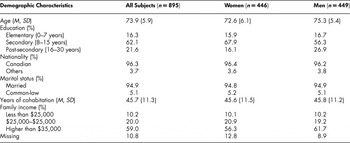
Couples selected by the sampling procedure were contacted by phone, and those wishing to participate in the study received a letter containing a description of the research project along with the interviewer’s name and photograph. All participants were interviewed at their home (or in a place of their choice) by a nurse trained in research projects. Spouses were asked to answer the questions separately, and each spouse answered the marital and sexual questionnaires using a keypad to ensure confidentiality between the spouses and the nurse. A star appeared on the interviewer’s computer screen to indicate that the participant had answered a question. Interviews were conducted between January 2008 and July 2008. Each couple received $30 (in Canadian dollars) as an incentive for their participation. The response rate was 71.6 per cent for a sample of 508 older couples (n = 1,016 participants). Of the initial sample, 88.1 per cent of participants (women = 446, men = 449) answered all the questions on the DAS and statistical analyses were performed using these participants. Demographic characteristics are presented in Table 1 and few significant gender differences were found. However, women were younger [t(893) = 7.02, p < .001] and had a lower level of education [χ2(2, 895) = 17.04, p < .001] than men.
Descriptive data by gender

M = mean
SD = standard deviation
Measures
Marital functioning is measured according to Spanier’s Dyadic Adjustment Scale (1976). This questionnaire was validated by Baillargeon et al. (Reference Baillargeon, Dubois and Marineau1986), who had translated it into French, and used it with a sample of younger couples. The questionnaire includes 32 questions representing four aspects of marital functioning (Consensus, Cohesion, Satisfaction, and Affective Expression). A higher score indicates a higher level of marital functioning and total scores range between 0 and 151 points. The validation study conducted by Baillargeon et al. (Reference Baillargeon, Dubois and Marineau1986) showed strong measurement reliability, with an internal Cronbach’s alpha coefficient consistency of .91 for all items.
Spousal support is measured using the Perceived Spousal Support Questionnaire (PSSQ; Guay & Miller, Reference Guay and Miller2000; Manne, Taylor, Dougherty, & Kemeny, Reference Manne, Taylor, Dougherty and Kemeny1997), which measures the respondents’ perceptions regarding the frequency of their spouse’s behaviour support over the previous month. Behaviour support is measured according to 24 items split into two subscales: Perceived Positive Spousal Support (11 items) and Perceived Negative Spousal Support (13 items). Scores range between 11 and 44 points for the Perceived Positive Spousal Support subscale, and between 12 and 48 points for the Perceived Negative Spousal Support subscale. A higher score indicates a high perception of positive or negative spousal support. A validation study showed a high level of reliability with an internal Cronbach’s alpha coefficient consistency of 0.87 and 0.85 for the Perceived Positive and Perceived Negative Spousal Support subscales respectively (St-Jean-Trudel, Guay, & Bonaventure, Reference St-Jean-Trudel, Guay and Bonaventure2003). In the present study that we conducted on the elderly French-Canadian population, the internal alpha coefficient consistency equalled 0.91 for the Perceived Negative Spousal Support subscale, and 0.88 for the Perceived Positive Spousal Support subscale.
Psychological distress is measured using the Quebec Health Survey’s Index of Psychological Distress (IDPESQ-14), developed by Préville, Boyer, Potvin, Perrault, and Légaré (Reference Préville, Boyer, Potvin, Perrault and Légaré1992). This questionnaire, adapted from the Psychiatric Symptom Index (Ilfeld, Reference Ilfeld1976), is designed to evaluate symptoms of depression, anxiety, irritability, and the cognitive problems experienced during the previous week. The version developed by Préville et al. (Reference Préville, Boyer, Potvin, Perrault and Légaré1992) contains 14 items, and scores range between 0 and 100 points. It shows a high level of reliability with an internal Cronbach’s alpha coefficient consistency of .89 for all items (Préville et al., Reference Préville, Boyer, Potvin, Perrault and Légaré1992). In our study, the internal alpha coefficient consistency equalled .84 for the entire sample.
Analyses
We performed the confirmatory factor analysis with correlations matrices, using a structural equation modeling strategy (Jöreskog & Sörbom, Reference Jöreskog and Sörbom1996) to test the hierarchical model proposed by Sabourin et al. (Reference Sabourin, Lussier, Laplante and Wright1990). The analyses were performed with AMOS 8.0 software and the model was estimated using the unweighted least square method (ULS). We chose this method of estimation over the maximum likelihood because, as many authors have pointed out (e.g., Sabourin et al., Reference Sabourin, Lussier, Laplante and Wright1990; Vandeleur et al., Reference Vandeleur, Fenton, Ferrero and Preisig2003), most of the questionnaire’s items are significantly skewed. The fit of the model is evaluated using the goodness-of-fit index (GFI), the adjusted goodness-of-fit index (AGFI), the parsimonious goodness of fit index (PGFI), the standardized root mean squared residual (SRMR) index, and modification indexes (MIs). The GFI measures the proportion of variances and co-variances explained by the model, whereas the AGFI takes into account the model’s degree of freedom in the analysis.
A GFI and AGFI value of close to 1.0 indicates a good fit and, according to Hu and Bentler (Reference Hu and Bentler1999), a value of .90 also indicates a good fit. According to Mulaik et al. (Reference Mulaik, James, Van Alstine, Bennett, Lind and Stilwell1989), a PGFI value of .50 or higher, combined with good GFI and AGFI values, indicates a parsimonious fit. The SRMR index indicates the average differences between the sample variances and co-variances, along with those of the estimated population. An SRMR value of less than .10 appears satisfying (Kline, Reference Kline2005). The MIs indicate the minimum improvements that the corresponding parameter could obtain if it was freed of estimation. Only MIs equal to or greater than 10 are considered to illustrate a significant change. Factor loadings are assessed for each DAS item to examine their contribution to the dyadic adjustment construct. According to Comrey and Lee (Reference Comrey and Lee1992), a factor loading of .30 or lower indicates that the item contributes poorly to the related construct.
Criterion-related validity is estimated with convergent and divergent validity. Convergent validity refers to the degree to which the measure is similar to another theoretically related measure, although divergent validity aims to check that these two theoretically different concepts can also be distinguished empirically (Hogan, Reference Hogan2003). To estimate convergent and divergent validity, we calculated Pearson’s correlations between relevant measures and, as recommended by Tabachnick and Fidell (Reference Tabachnick and Fidell2007), we used normalized scores of these measures. The scale’s reliability was calculated using Cronbach’s alpha coefficient (Cronbach, Reference Cronbach1951) of internal reliability. Moreover, the reliability of the measures was calculated using Hancock’s coefficient H, whose cut-off value should be .70, according to Hancock and Mueller (Reference Hancock, Mueller, Cudeck, du Toit and Sörbom2001). The H score value indicates the percentage of variance explained by the items for each subscale as well as for the entire measure.
Results
Preliminary Analyses
Although some authors have performed separate validation studies for women and men (e.g., Antill & Cotton, Reference Antill and Cotton1982; Kazak et al., Reference Kazak, Jarmas and Snitzer1988; Sabourin et al., Reference Sabourin, Lussier, Laplante and Wright1990), the models we used here were tested independently for each gender. However, our analyses found no gender differences. These results are in line with those of South, Krueger, and Iacono (Reference South, Krueger and Iacono2009), who found gender invariance in the structure of the DAS. As reported by those authors, the gender differences found with the DAS constitute a real mean difference rather than a measurement bias. Thus, this article presents only the results of the combined sample.
A confirmatory factor analysis was conducted on the second-order model of the DAS, representing a combination of 32 items regrouped into four factors, which conceptualized the main factor of dyadic adjustment. To define the metric of latent variables, the first item’s variance of each factor was set to 1.0 (Brown, Reference Brown2006). Results show that the model had a satisfying fit, considering the GFI and that no MI had been proposed (see Table 2).
Goodness-of-fit statistics for the Dyadic Adjustment Scale

AGFI = adjusted goodness of fit
GFI = goodness of fit
MI = modification index
PGFI = parsimonious goodness of fit
RMR = root mean squared residual
SRMR = standardized root mean squared residual
Factor Loadings
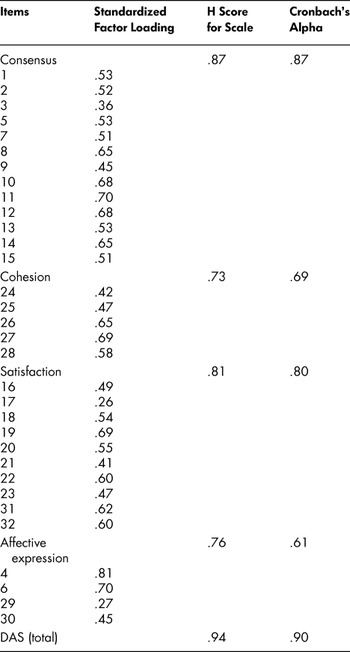
Factor loadings for each DAS item appear in Table 3. All factor loadings are greater than .30, except for items 17 (“How often do you or your partner leave the house after a fight?”) and 29 (“being too tired for sex”). As shown in Table 3, the factor loading for item 17 is 0.26 and for item 29, .27. According to Comrey and Lee (Reference Comrey and Lee1992), these values indicate that such items contribute slightly to the concept of their subscales and more globally to the dyadic adjustment of older couples. The pattern of responses for item 29 show that 84.7 per cent of the sample answered “No” to the question, indicating a ceiling effect. Similar results were found for item 17, in which 81.8 per cent of older men and women answered “Never”.
Standardized least-square estimations for DAS items, and reliability estimates for DAS subscales

H score = Hancock’s coefficient of variance
Reliability
The reliability of each subscale and the total score of the measure were calculated using Hancock and Mueller’s coefficient H (2001). As reported in Table 3, the coefficient H of the Consensus subscale indicates that 87 per cent of this subscale is explained by the items. Moreover, this analysis reveals that 94 per cent is explained by the 32 items of the DAS. The entire coefficient H is higher than Hancock and Mueller’s recommended cut-off point of .70 (2001), which ensures strong reliability for the DAS and its subscales.
Internal consistencies, as measured with Cronbach’s alpha, were calculated for each subscale and for the total score of the DAS. As shown in Table 4, Cronbach’s alpha coefficients appear satisfying for each subscale, varying between .61 and .87. The Affective Expression subscale shows fewer coefficient consistencies, with a Cronbach alpha of .61. This result appears to be insufficient when compared to the cut-off point of .70 proposed by Tavakol and Dennick (Reference Tavakol and Dennick2011). The Consensus subscale shows a higher coefficient consistency, with a Cronbach alpha of .87. The total score shows high coefficient consistency, with a Cronbach alpha value of .90.
Convergent and divergent validity of the DAS

** p < .01 ***p < .0001
M = mean
SD = standard deviation
Criterion-Related Validity
Criterion-related validity was examined with relevant measures like psychological distress and perceived spousal support. As indicated in Table 4, all of these measures appear to be significantly related to the DAS. Moreover, the divergent validity of the DAS with the number of years of cohabitation shows no significant relation between those measures, as expected.
Discussion
The main goal of this study was to conduct a confirmatory factor analysis of the DAS with a representative sample of older French-Canadians living in relationships. Results show that the second-order model of dyadic adjustment proposed by Sabourin et al. (Reference Sabourin, Lussier, Laplante and Wright1990) provides a satisfying fit among a sample of older people living in relationships, and is in keeping with other studies conducted with younger couples (e.g., Kurdek, Reference Kurdek1992; Sabourin et al., Reference Sabourin, Lussier, Laplante and Wright1990; Spanier & Thompson, Reference Spanier and Thompson1982).
The results indicate strong reliability of the scale with regard to Hancock and Mueller’s coefficient H for each subscale and for the questionnaire as a whole. Moreover, internal consistencies appear to be satisfactory for the DAS and its subscales, except for the Affective Expression subscale, whose reliability was low compared to other studies (e.g., Graham et al., Reference Graham, Liu and Jeziorski2006; Sabourin et al., Reference Sabourin, Lussier, Laplante and Wright1990; Spanier Reference Spanier1976). With regard to this result, it is possible that this subscale, composed of four items that measure affective and sexual components in the life of the participants, is less appropriate for older couples. Several authors have pointed out that sexual behaviour changes with age and tends to refer more to behaviours of tenderness, which may reflect affection (Dargis et al., Reference Dargis, Trudel, Cadieux, Villeneuve, Préville and Boyer2012; Jarousse, Reference Jarousse1995; Trudel, Reference Trudel2002). Therein, it is interesting to note that item 29, which asks about the level of agreement between partners on being too tired for sex, has the lowest factor loading for the Affective Expressive subscale.
Conversely, item 4, which asks about the level of agreement between partners on affective expression, has the highest factor loading. Therefore, it is possible that the Affective Expression subscale is less reliable due to the specific characteristics of older couples. However, it is important to underline that the results of other studies conducted among various samples also revealed lower reliability for this scale (Baillargeon et al., Reference Baillargeon, Dubois and Marineau1986; Graham et al., Reference Graham, Liu and Jeziorski2006; Kurdek, Reference Kurdek1992). Some authors have explained the lack of reliability for this subscale by the fact that it is composed of four items showing low answered variability and use different scales (Graham et al., Reference Graham, Liu and Jeziorski2006; Kurdek, Reference Kurdek1992). As emphasized by Baillargeon et al. (Reference Baillargeon, Dubois and Marineau1986), the total score of the DAS, as well as the Consensus, Cohesion, and Satisfaction subscales, can be trusted and used independently. Moreover, these authors argued that this measurement appears effective for the assessment of the dyadic adjustment despite the gap observed for the Affective Expression subscale.
In keeping with our results, the same recommendations can be made for older people. Item 17 of the Satisfaction subscale presents the lowest factor loading in the questionnaire. This result may be explained by a generation effect, in which the sampled couples do not commonly leave home after a fight. In fact, the majority of those sampled answered that they have never exhibited this behaviour. Thus, the questionnaire can still be used in its entirety for older couples, but clinicians and researchers must keep in mind that while items 17 and 29 do not negatively affect the validity and reliability of the questionnaire as a whole, these issues are probably not relevant factors in the evaluation of marital adjustment in older couples. Further studies are needed to confirm the reliability of the Affective Expression subscale among older people living in relationships. Until then, no recommendations can be made for its sole use.
In addition to the scale’s reliability, this study also calculated the criterion-related validity of the DAS. As expected, the results for convergent validity show that measurements of spousal support are significantly related to the questionnaire among older couples. Moreover, as in many other studies (e.g., Beach et al., Reference Beach, Katz, Kim and Brody2003; Beach & O’Leary, Reference Beach and O’Leary1992; Bookwala & Franks, Reference Bookwala and Franks2005; Goldfarb et al., Reference Goldfarb, Trudel, Boyer and Préville2007), psychological distress is negatively related to the DAS. Discriminant validity also shows that this measurement is not related to the number of years of cohabitation. While the earlier literature proposed a curvilinear model of marital satisfaction over time, many authors have not supported this model and fail to identify any relationship between length of time and marital functioning among couples (e.g., Vaillant & Vaillant, Reference Vaillant and Vaillant1993; Van Laningham et al., Reference Van Laningham, Johnson and Amato2001).
Whereas all items, except items 17 and 29, show satisfying factor loadings, it may be of interest if further studies examine the relevance of items that do not necessarily reflect the overall realities of older couples. Indeed, this may be the case for item 9 (“degree of agreement between spouses regarding ways of dealing with parents and in-laws”), as well as item 15 (“degree of agreement between spouses regarding career decisions”). Clinicians and researchers should pay special attention to these items with regard to older couples in which both spouses are retired, and those in which certain parents or in-laws have died. These items may be changed or deleted to better reflect their reality. Item 9 could be replaced with a question on the degree of agreement between spouses regarding ways of dealing with children and grandchildren, while Item 15 could be replaced with a question measuring the agreement between spouses regarding retreat decisions, for example, in order to better represent their lives.
The modification of questions could also be helpful for items 29 and 17 in order to improve the reliability of these items. Item 29 could be replaced with a question in line with item 4, which evaluates tenderness. For example, this item could be written to evaluate whether or not the participant is too tired to express tenderness towards his or her spouse. According to item 17, modifications could be made to assess how often the participant is not satisfied with the resolution of a fight. Although some modifications are proposed here, we must keep in mind that the study’s items do not have a negative effect on the validity of the questionnaire, as represented by the factor loadings, nor do they adversely affect the reliability of the subscales, or the questionnaire as a whole.
To the best of our knowledge, this represents the first study to examine the validity of the DAS among a representative sample of older people living in relationships. The DAS appears to adequately measure the marital adjustment of older people living in relationships. However, regarding the factor loadings of items 17 and 29, along with the reliability of the Affective Expression subscale, it seems that older couples may have specific characteristics that should be taken into consideration. Indeed, as reported by the low reliability score of the Affective Expression subscale, along with the low factor loading of item 29, questions on sexuality should be reviewed to reflect expressions of intimacy more adequately when evaluating marital adjustment for this population. Moreover, it would be of interest if the questionnaire were not biased by a generation effect in which some items may not be relevant for this sample, as item 17 seems to indicate. As noted earlier, other studies must be done with older couples to confirm these hypotheses. It would also be interesting to test the validity of the DAS among a variety of older couples, such as those living in institutions. Further studies could also be conducted to examine the validity of a shorter version of the Dyadic Adjustment Scale with older people, as suggested by other authors using different samples (e.g., Antoine, Christophe, & Nandrino, Reference Antoine, Christophe and Nandrino2008; Sabourin, Valois, & Lussier, Reference Sabourin, Valois and Lussier2005). Until then, the questionnaire can still be used in its entirety with older couples.