In June 2011, Reuters news service reported that a single firm in Wyoming housed mailboxes for more than 2,000 shell corporations—companies in name only with no employees or substantive business. The firm's website succinctly explained the attractions of shell corporations: “A corporation is a legal person created by state statute that can be used as a fall guy, a servant, a good friend or a decoy… A person you control … yet cannot be held accountable for its actions. Imagine the possibilities!”Footnote 2
Often acting anonymously, individuals purchased these Wyoming shell corporations to undertake illicit activities that included selling counterfeit parts to the Pentagon; processing payments for banned Internet poker businesses; vending controlled pharmaceuticals illegally; routing money earned from unlawful subprime credit cards; and sheltering the real estate assets of former Ukrainian Prime Minister Pavlo Lazarenko, who at the time of writing was in California serving an eight-year federal prison sentence for extortion, fraud, and money laundering.Footnote 3 Shell companies that cannot be traced back to their real owners are the standard vehicle of choice for those looking to hide illicit financial flows—from gun-runners such as Viktor Bout to corrupt dictators such as Muamar Gaddafi.
Many of the world's most noxious financial transactions thus occur behind the fronts of anonymous shell companies because such corporations are often remarkably easy to establish.Footnote 4 With an Internet connection and a credit card, in a matter of days or even hours, terrorists, money launderers, or corrupt politicians can form corporations while hiding their identities. Indeed, thousands of firms worldwide establish corporations quickly for clients, and anecdotal evidence has suggested that many appear willing to create new companies with few questions asked beyond “May I have your credit card number, please?” Precisely because such corporations are so dangerous, international rules mandate that those forming companies must establish the true identity of the customer. But given that the customer, provider, and legal domicile of the corporation may be in three different countries, the effectiveness of these rules is highly uncertain. This uncertainty motivates the present research.
While the anecdotes are often sensational, they also relate to some of the most important questions in IR theory. Does international law promulgated by global institutions have teeth in a borderless domain populated by thousands of private actors conducting business via the Internet? In other words, are international organizations effective and will firms comply with international law? Do rationalist notions of calculating costs and benefits really drive whether or not actors observe the rules? Alternatively, are individuals and organizations socialized to act appropriately, as suggested by constructivism? These questions are core to IR theory. In this article they are developed and tested in a way that allows scientific and practical investigation using random assignment.
In this study we perform what is to our knowledge the first randomized field experiment on a global scale to learn if these concepts drawn from mainstream IR theory, implemented as experimental interventions, can affect responses from incorporation services when foreigners inquire about forming new companies. After receiving clearance from our university's IRB, we adopted e-mail aliases, posed as international consultants, and requested confidential incorporation from 1,264 corporate service providers in 182 countries. Because this exercise involved mild deception, we take the ethics of the experiment very seriously—beyond the minimum requirement of clearing the project with the IRB. We discuss these ethical implications below.
In the placebo condition, the aliases claim to come from one of eight minor-power, low-corruption Organisation for Economic Cooperation and Development (OECD) countries and make no mention of international law, but they express a desire to maintain confidentiality. In each of the treatment conditions, the desire for confidentiality remains, but the e-mails in turn provide additional information to test the causal effect (if any) of this extra information.
In the first treatment, the e-mails state that the international institution responsible for setting standards on corporate transparency, the Financial Action Task Force (FATF), mandates that service providers ask for proof of applicants' identities. The logic for this treatment derives from managerial and legalization literatures suggesting that noncompliance with international rules may result from ignorance about what is required to comply. A second treatment tests the effects of U.S. origin compared with the innocuous placebo countries. In the third treatment condition, applying a rationalist logic of consequences, the e-mails make reference to possible legal penalties for failing to comply with the FATF standards. In the fourth treatment, drawing on a constructivist logic of appropriateness, the e-mails note that most countries in the world have signed onto the FATF standards and that the applicants are striving to “do the right thing” and behave as “reputable businessmen.”
The findings are often counterintuitive, questioning the conventional wisdom of both IR scholarship and policymakers in this domain. Our study provides the most systematic and detailed cross-national picture available of compliance with international corporate transparency law.Footnote 5 At the most basic level, more than one in four providers worldwide is willing to violate international standards by offering incorporation without certified proof of customer identity, meaning that in practice anonymous shell companies are readily available. For example, one provider replied to our inquiry: “It sounds like you want to form your company anonymously with the State, is that correct? We can do that for an extra $25. If we are just setting up a Corporation for you and that's it we don't require any documents from you at all.”
Nearly all of the treatments lower both the response rates and the compliance rates (though not always at statistically significant levels). The mention of FATF standards in conjunction with the rationalist reference to legal penalties significantly decreases subjects' response rates to our inquiries compared to the placebo condition but also makes them significantly less likely to require identity documentation. There is also some evidence that the constructivist treatment, raising norms and reputation, induced an increase in the rate of noncompliance. In contrast, mention of the FATF alone did not have a significant effect on responses or compliance. The United States treatment, where e-mail aliases hailed from the United States, had no significant effect on either response or compliance rates.
More broadly, this experiment provides an example of research using field experiments to study IR. We advocate for a renewed focus on—and a novel method of studying—the microfoundations of transnational relations among nonstate actors that are governed by international laws. In terms of the sheer number of exchanges, the day-to-day transnational dealings among individuals, firms, and nongovernmental organizations (NGOs) dwarf intergovernmental relations by many orders of magnitude. In building on earlier neoliberal and constructivist work on international institutions and transnational actors, this program of research using field experiments responds to long-standing calls for greater attention to nonstate entities in IR.Footnote 6
Critically, because such microfoundational experiments are premised on the importance of individuals, small groups, and firms, scholars can employ experiments both ethically and practically. In 1971 Lijphart commented that experiments are “the most nearly ideal method for scientific explanation.”Footnote 7 Other areas of political science have exploited the potential of experiments, but IR has been relatively slow to follow. Field experiments' strong internal validity can shed new light on causal relationships. Under the right conditions, such as those in our study, field experiments in IR also have the potential to generate externally valid results that may rival or exceed those of observational studies.
Experiments in Transnational Relations
Given the increasing volume of transnational interactions, an exclusive focus on state-to-state relations captures an ever-shrinking, though undoubtedly still important, proportion of cross-border interactions constrained by international rules and norms. A wide variety of other IR scholars and commentators have made a similar observation. Thus this article builds on the neoliberal agenda of international institutions and transnational politics. Yet in following calls for greater attention to the microfoundations of transnational relations, we adopt a new empirical approach emphasizing randomized field experiments.
Our approach hearkens back to unfinished business in the field: the important discussions of transnational relations.Footnote 8 In transnational relations the state remains a critical unit, but nonstate actors in the form of firms, NGOs, and transnational social movements also matter substantively for international affairs.
More recently in line with this concern, Hobson and Seabrooke note “the manifold ways in which everyday actions can transform the world economy.”Footnote 9 Avant, Finnemore, and Sell argue that there is “much more need for research on the microfoundations of global politics.”Footnote 10 Such calls for further research acknowledge that the normal interactions among nonstate actors are shaping IR and require serious scholarly attention. Specifically in reference to compliance with international law, which is particularly relevant for this study, Simmons emphasizes the need for scholars to study nonstate actors, which can better capture the actual locus of compliance.Footnote 11
In grappling with the importance of nonstate actors, constructivists have argued for the ability of NGOs to act as norm entrepreneurs in pressing new ideas and principles onto the global agenda and in advocating for the adoption and internalization of these new norms.Footnote 12 Neoliberal institutionalists, for their part, have sharpened the field's focus on private actors in international standards setting.Footnote 13
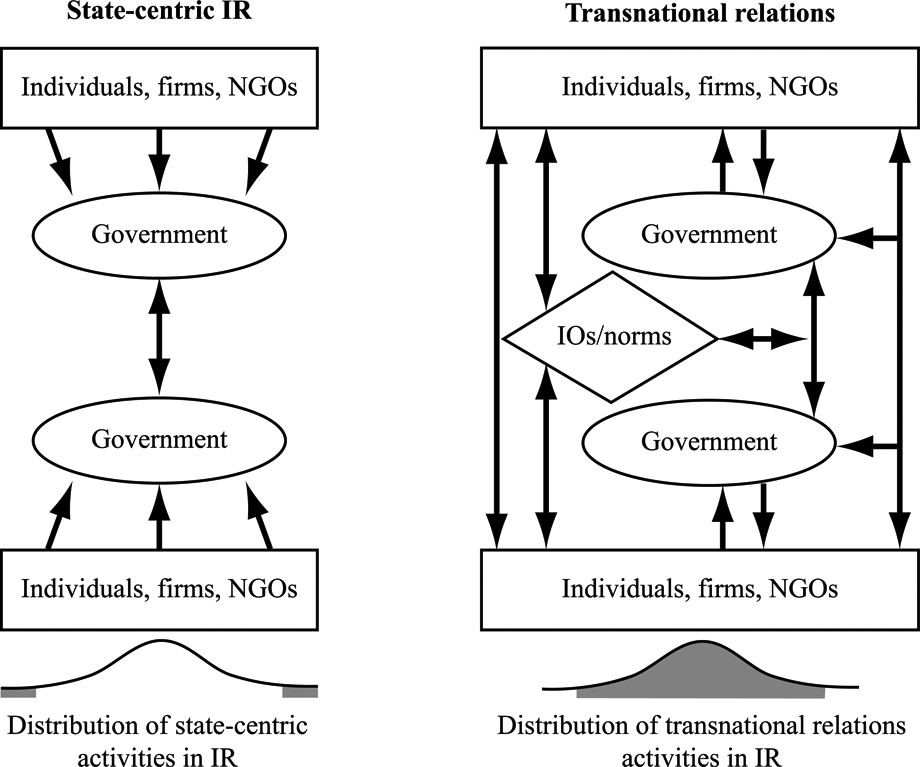
Building on this work and contrasting with state-centric approaches, we see state mediation of IR not as a constant but as a variable (see Figure 1). That is, in enacting and enforcing rules and procedures, governments may play a dominant role, and they perhaps even predominate in most of the international interactions that ultimately matter. But they may not. We recommend experiments to test related claims.
State-centric IR versus transnational relations

In Figure 1 the many additional arrows and their omnidirectionality on the transnational relations panel on the right-hand side may imply less theoretical and methodological elegance than the state-centric IR panel on the left-hand side. This may be true in terms of the overall framework. But it is not necessarily true when it comes to specific studies that select one or a few relationships to test experimentally. Though no single method represents a magic bullet, we advocate for tighter tests of hypotheses drawn or derived from mainstream theoretical propositions than has previously been possible in IR. By such testing of falsifiable causal mechanisms, analysts can alleviate fears that the complexity of transnational relations—compared with the relative simplicity of interstate relations—precludes the systematic accumulation of knowledge.
Theory, Hypotheses, and Treatments
The example of incorporating foreign shell companies grounds our interest in using experiments to study international institutions and nonstate actors. The relevant international rules are set by an international institution, the FATF, which is an intergovernmental institution of thirty-four states charged with developing and implementing global rules to counter money laundering, including those relating to corporate transparency.Footnote 14 But whether or not the rules are actually effective depends on private actors rather than states. States do not sell or withhold anonymous shell companies—private corporate service providers do.
Recognizing this fact, the FATF has explicitly acknowledged the autonomy private actors have in applying its rules. This autonomy is justified under the rubric of a risk-based approach, with separate FATF publications advising corporate service providers on how to apply international standards.Footnote 15 Our experiment is aimed at determining whether and when those private incorporation agents follow or violate international standards, and, crucially, why.Footnote 16
With the treatments we test whether or not corporate service providers respond to our inquiries in the first place and, if they respond, whether or not they comply with international rules. Nonresponse could itself be a form of soft compliance, where firms choose not to answer as the easiest way to avoid wrongdoing. However, nonresponse may also indicate either failure to receive the request or firms' inattention to e-mail. While we generally treat nonresponse as soft compliance, we are very open to the possibility that it may indicate indifference or incapacity. Accordingly, we consistently treat response/nonresponse as a separate outcome statistically, and we employ multiple statistical models to account for various possibilities in interpretation. In expectation, random assignment should balance these alternatives across experimental conditions and should therefore remove bias in assessing treatment effects for compliance with international rules.
These rules are promulgated by the FATF. The majority of shell companies are formed by thousands of private incorporation service providers. Generally operating online, these providers form millions of shell companies each year. This policy area thus epitomizes the challenge of making international rules work in a borderless environment, perhaps the central focus of scholarship on globalization.Footnote 17 In our experiment, we test for treatment effects on responses from incorporation services after randomly assigning different information about international standards.
The experimental treatments are compared to a placebo condition in which e-mail aliases claim to originate from one of eight randomly assigned minor-power OECD countries: Australia, Austria, Denmark, Finland, the Netherlands, New Zealand, Norway, and Sweden. Using a shorthand, we refer to these countries as “Norstralia.” In the placebo condition the e-mails request confidential incorporation but offer no additional information to subjects.
The first treatment, managerial, simply identifies that there is a rule requiring the disclosure of the customer's identity in forming a company and associates this rule with the FATF. (See the appendix for examples of treatment e-mails.) The managerial and legalization schools suggest that much noncompliance results either from ignorance about a given rule or a lack of precision concerning what is needed to comply.Footnote 18 If ignorance and lack of precision are important for compliance, as the managerial and legalization schools imply, we should see both lower reply rates and higher rates of requests for identity documentation relative to the placebo group.
We note that many subject firms may already be familiar with FATF standards; in these cases the intervention functions as a priming treatment by bringing the FATF and its standards to mind. However, our interviews and a follow-up survey of more than 300 corporate service providers suggest that roughly two-thirds of firms are not familiar with FATF rules, so the treatment does actually function to inform the vast majority of subject firms of the relevant international law. Nevertheless, both direct information and a priming mechanism reflect on observable implications derived from the managerial and legalization logics and should be interpreted in that light.
A second treatment explores the effects on compliance of customer origin in the United States. We initially intended this treatment to test the influence of U.S. power on compliance, given that the United States has been aggressive in exercising extraterritorial jurisdiction in its prosecution of financial crime.Footnote 19 However, the simple treatment, which varies only the origin of the alias, can merely discern the effects of U.S. customer citizenship generally compared to the placebo countries—rather than test the effects of U.S. power. We thus acknowledge that multiple confounds are wrapped into this treatment, and we leave it to future work to sort the different mechanisms that might be in play.
In recent analyses of whether and to what extent the international system is a law-governed environment, explanations of rule-following behavior have often divided on rationalist or constructivist grounds.Footnote 20 The former reasons that actors decide whether to comply on the basis of a cost-benefit calculation, usually conceived of in material terms. Actors comply when they believe the likely costs of penalties outweigh the benefits of noncompliance. This understanding is firmly rooted in the logic of consequences, according to which behavior is determined by a rational, utility-maximizing calculus.Footnote 21
The rationalist treatment explicitly taps into this logic by specifying the existence of the FATF's rule mandating identity disclosure and further noting that there are legal penalties for failing to comply. This treatment, by evoking legal consequences, subtly raises the issue of government enforcement. If service providers are sensitive to the prospect of legal sanctions in calculating their response to potential customers, then we would expect both the response rate for this treatment to be lower and the rate of requests for identity documentation to be higher. We emphasize here that we do not pretend to be providing a comprehensive test of rationalist IR theory with this treatment. Such a test—if it is even possible—is well beyond the scope of this project. Rather, we are merely testing a single observable implication of rationalist theory stemming from neoliberal institutionalism: that a priming treatment invoking legal consequences should cause greater adherence to international law.
The main alternative to the utilitarian cost-benefit view of compliance is that posited by constructivists, relying on shared norms of appropriate behavior.Footnote 22 Here, rather than engaging in instrumental ends-means calculations, shared norms have a taken-for-granted effect on behavior, or lead actors to ethical reasoning to find the appropriate course of action.Footnote 23 Norm compliance may be further bolstered by the prospect of social sanctioning (disapproval, ostracism, etc.) and internal feelings of guilt and shame associated with deviant behavior.Footnote 24
The constructivist treatment thus identifies the FATF's rule on identity disclosure and notes that it is almost universally accepted, suggesting a broadly observed social norm. The constructivist treatment further asserts the importance of acting in a proper, appropriate fashion as “reputable businessmen.” The customers assert their propriety and regard for the way they are perceived by others, and they enjoin the service provider to do the same. Similar to the rationalist treatment, if a constructivist logic is driving behavior, we should see lower rates of response and higher levels of requests for identifying information. Again, we are not claiming that this is a definitive test of constructivism. We are merely exploring a single observable implication derived from a constructivist logic: a priming treatment invoking reputation and behavioral norms should cause an increase in observed compliance with international law. We test these observable implications of mainstream IR theory using a field experiment, which provides some advantages over observational research.
Experiments
Because the units of analysis in transnational relations are private individuals and organizations, in both ethical and practical ways, individual human and organizational subjects can be randomly assigned to treatment and control conditions and theoretical arguments can be tested experimentally. The strong internal validity of experiments enables them to demonstrate causal effects with greater certainty than any other method. In expectation proper randomization permits the precise estimation of causal effects because it balances not only the observable factors that might confound results, but it also neutralizes all unobservable confounds. This is a significant advantage over observational research, which can never establish with certainty that the model employed is properly specified.Footnote 25 We emphasize, however, that the advantages of experiments hold only in expectation; problems with randomization, small subject pools, or confounding factors can undermine the effectiveness of random assignment. We address these concerns shortly.
Capitalizing on the expected advantages of experiments, IR scholars have fruitfully employed experimental approaches for several decades, especially in the realms of bargaining, negotiation, and foreign policy decision making.Footnote 26 These studies provide interesting, nuanced, and persuasive evidence about the conditions more or less likely to promote resolution of international conflicts. With few exceptions,Footnote 27 however, this scholarship has focused on the negotiations and decisions among elites (sometimes extrapolating from findings produced in experiments with undergraduates as subjects). This important work has thus generally proceeded under the conventional assumption of state centrism. In contrast, our study targets the day-to-day international actions of nonstate actors and the effects of their behavior on international organizations and norms, which may or may not involve governments as central gatekeepers.
Furthermore, experiments where nonstate actors as subjects represent the actual units of interest likely can be better defended as externally valid while retaining the internal-validity advantages of experiments. Our design ameliorates the external validity problems that critics have identified as limiting the value of many laboratory experiments, and in some cases field experiments also. For example, Levitt and List show that in many cases subjects' knowing they are being scrutinized in the laboratory, and the self-selection of volunteers for experiments, creates strong limits on the ability to generalize to the wider world.Footnote 28
Our study avoids many of these dangers: subjects are the actual locus of relevant behavior, they do not know they are being scrutinized, and they do not self-select into the experiment. Designs such as this one “place participants in a mental state where they will behave naturally.”Footnote 29 Subjects responded within the bounds of their normal day-to-day routines. Being able to systematically study such routines marks a major advance on the substantive literature addressing illicit international financial flows, which has been hamstrung by severe problems of data availability and bias.Footnote 30 If subjects were responding to conventional researcher surveys or interviews, many would likely have dissembled and hidden their customary actions. This would have produced a biased picture of financial transparency that could not teach us much about actual patterns involving the availability of anonymous shell corporations. These important advantages of external validity notwithstanding, it is important to acknowledge that the study draws on a convenience sample, an issue we discuss in connection with the subject pool and study design.
Compared to some other field experiments, our study promises relatively high external validity. When Cohen and Dupas argued that their experiment in western Kenya proved that free distribution of mosquito nets prevents malaria better than selling the nets, critics challenged the notion of extrapolating from findings in one region of one country to the developing world as a whole.Footnote 31 In our study, we have sampled incorporation services from 182 different countries, and importantly, block randomized within major blocs of countries, such as OECD, tax havens, and developing countries. Our web-based design allows us to transcend common geographical limitations and therefore insure greater external validity.
Despite the advantages of field experiments for both internal and external validity, few have been attempted in IR, in contrast to areas such as development economics.Footnote 32 This pattern persists despite the fact that experimental studies enable a tighter focus on the causal effects of interventions on the actual subjects of interest. Important exceptions to IR's neglect of field experiments come from Hyde's excellent work on international election observers.Footnote 33 Of course, due to practical or ethical concerns, experiments cannot address many important topics in IR and thus they can never displace high-quality observational studies.
Deception and the Ethics of Field Experimentation
Where scholars can employ field experiments, external validity requires that subjects behave in their normal day-to-day routines. In this case it required the use of deception. Human subjects committees of IRBs and government regulations balance the need for subjects' informed consent with the methods required for unbiased research. Acceptable standards for deception in the social sciences require that the benefits of the research be significant, that the costs be minimal, that the research avoids any physical or emotional pain, and that the research cannot be carried out in another way.Footnote 34 The present study meets these criteria.
In our case, the potential rewards of learning about the factors facilitating the use of anonymous shell corporations are very high. Research from a variety of international organizations indicates that anonymous shell companies are arguably the most important means by which bribes are given and received, corrupt officials loot their countries, drug-traffickers launder money, and individuals and corporations evade their tax obligations.Footnote 35 More knowledge about shell companies means a better chance of addressing these problems.
Additionally, the potential risks and costs from the research are very low. We estimate that, on average, subjects spent roughly five to ten minutes to respond to our e-mail inquiries, and these responses were very much in line with their normal day-to-day activities. Many providers responded with canned language they likely had used repeatedly with prior customers. What is more, any hint that subjects were being studied would have likely induced both debilitating nonresponse bias and significant additional bias as subjects dissembled in response to inquiries about the propriety of their actions. We thus opted to employ aliases to maximize the probability that subjects would behave normally.
Most of the prominent research using aliases appears in areas of discrimination, including racial bias in hiring and employment and prejudice in housing markets. Perhaps the best-known piece is the Bertrand and Mullainathan field experiment, published in the American Economic Review, on racial discrimination in job applications.Footnote 36 The researchers sent hundreds of resumes to Chicago- and Boston-area employers, randomly assigning each resume a false “Anglo” (Emily or Greg) or false “African American” (Lakisha or Jamal) name. They found significant evidence that the “African American” names received half as many callbacks from employers as the resumes with “Anglo” names did. This topic is, of course, very sensitive and would not have been possible without the use of aliases and the accompanying mild deception. In political science, Butler and Broockman published important work in the American Journal of Political Science that employed aliases and identified significant racial bias in state legislators' responses to constituents.Footnote 37 The present research thus builds on strong precedent.
Subject Pool and Study Design
Given that no systematic lists of incorporation services had previously been compiled, we built the subject pool using standardized Internet searches in Google using search terms such as “incorporation,” “company formation,” “corporate law,” and “business law,” along with the name of the target country. We then extracted contact and covariate information from the company websites. We carried out this experiment on a large pool (n = 1,264) of incorporation service providers and business law firms in 182 countries. The services contacted generally offered to incorporate new businesses within a specified range of countries on behalf of a client—for a fee, of course, usually ranging between $1,000 and $3,000. All identifying information was purged from the data before performing the analysis, and the firms' contact information was subsequently deleted once the research was concluded. All data collection and correspondence took place between January and July 2011.
This pool of providers represents a convenience sample, which may prevent the results from generalizing to all incorporation services. Nevertheless, this study is focused on transnational actors and cross-border economic activity, and these types of actors are much more likely to have a web presence than, for example, small firms catering to local customers within one country via face-to-face interactions. The mode of such personal interactions may not pose the sort of challenges that essentially anonymous online commerce between parties located in different jurisdictions creates for law enforcement and regulators. The convenience sample thus should capture a large share of the actual subjects of interest. Furthermore, given that we contacted only the incorporation services and law firms that the Internet searches produced, the subject pool was weighted toward the services that likely incorporate the greatest number of new businesses and that operate in more legitimate spheres. The results thus likely underestimate problems with noncompliance.
Before randomly assigning experimental conditions to the subject firms, we stratified the subject pool according to key covariates that might be expected to affect outcomes.Footnote 38 These blocking strata included the type of host country—OECD member, tax haven, or developing nation—and type of company—incorporation service or law firm. We further subdivided the developing countries according to the World Bank's biannual Ease of Doing Business index, with subclasses corresponding to the index categories for high, medium, and low friendliness to business. Random assignment to placebo and treatment conditions occurred within these blocking strata, improving balance across experimental conditions for key observable covariates. Table A1 in the appendix lists countries and their blocking strata.
Block randomization offers key advantages over simple random assignment without stratification. Simple randomization may result in imbalance among covariate values across experimental conditions. In our case, simple randomization would likely have led to the overrepresentation of law firms in a given condition versus incorporation services in another or to too many tax havens in one condition compared to OECD or developing countries. If covariates like these can be identified and measured ex ante, and random assignments are made within the blocks, the balance of covariate values across conditions is guaranteed rather than left solely to chance. The block design thus ensures equal numbers of the different types of subjects in each of the treatment and placebo groups.Footnote 39 As Gerber and Green note, blocking rules out given “rogue” randomizations by design.Footnote 40 Blocking also eliminates what Gerber and Green call the “collinearity penalty” in regression analysis,Footnote 41 where the covariates are correlated with the treatment assignment; blocking prevents such collinearity up front. It also ensures fairer testing of results because blocking precommits researchers to employ the blocks as control variables in estimation. In sum, as Gerber and Green note, “when difference-in-means estimation is used, block randomization tends to lead to substantially more precise estimates than simple randomization.”Footnote 42
In addition to experimental conditions, we also randomly assigned one of eight “Norstralia” countries of origin (and an associated alias) and one of thirty-three different versions of the e-mail text—all of which contained the same underlying information but were written using different style, diction, and syntax. These tactics minimized detection and worked against the possibility that peculiarities in e-mail language might bias results. In diagnostic statistical analysis, none of the assigned Norstralia countries was significantly associated with outcome measures in multinomial logit tests with no-reply as the base outcome, and only a few of the e-mail texts were significantly related to outcome differences. Controlling for the fixed effects of the offending e-mail texts did not alter the results qualitatively from those reported here.
Experimental Conditions
We randomly assigned the language in the e-mail to vary along the following lines, constituting the placebo and treatment conditions.
• Placebo Condition: Minor-power OECD country. The placebo e-mails originated from aliases based in “Norstralia,” or one of eight wealthy, low-corruption, minor-power countries (Australia, Austria, Denmark, Finland, the Netherlands, New Zealand, Norway, and Sweden). For aliases in countries where English is not the native language, we introduced two small errors of grammar, spelling, or syntax to enhance authenticity.
• Managerial Treatment. The e-mail references the FATF and its requirements for identity disclosure.
• U.S. Origin Treatment. The e-mail alias hails from the United States.
• Rationalist Treatment. The e-mail (1) mentions the FATF rules and (2) references possible legal penalties for violating international law.
• Constructivist Treatment. The e-mail (1) mentions the FATF rules, (2) notes that most countries have signed onto FATF standards, and (3) invokes norms of appropriateness, expressing an interest in “doing the right thing as reputable businessmen.”Footnote 43
Incorporation services received a placebo e-mail or one of the three treatment e-mails. Examples of each are included in the appendix. Each alias claims to be a consultant and expresses a desire to form a confidential offshore company in order to reduce taxes and limit legal liability. We selected the consultant role because financial criminals often use consultancy fees to hide illegitimate operations.Footnote 44
The e-mail design was the product of extensive interviews conducted prior to the experiment with corporate service providers and the national bodies designed to regulate them in the United States, Britain, Switzerland, Australia, Austria, Norway, the Netherlands, Hong Kong, Singapore, Panama, the Cayman Islands, and various other financial centers. From these interviews, and by attending the trade conferences of those in the business of creating shell companies, we learned that consultancy is a common reason why an individual or small group might seek international incorporation. We also learned that service providers are often first approached by potential clients via e-mail, especially given that customer and provider are often in different countries and different time zones.
A particularly important issue in designing the e-mail approaches was to strike the right balance between treatments that were sufficiently strong to prime recipients in line with the various theoretical rationales while also being plausible. Treatments had to be derived from key precepts of the different IR theoretical traditions we discussed earlier to serve as a fair test of key observable implications. Yet because the experiment was premised on convincing most providers that they were dealing with a prospective customer in order to elicit an authentic response, the verisimilitude of the e-mails was a key concern. Judging from the private-sector interviews as well as those with regulators from national governments and international organizations, any attempt to further strengthen the treatments would have endangered the plausibility of the approaches, raised the addressees' suspicions, and thereby threatened the experiment's validity.
Coding Protocol
International standards mandate that incorporation services should require notarized photo identity documents and proof of address when forming companies for clients.Footnote 45 The documents enable law enforcement officials to identify the true owners of the company should the need arise. Without identity documentation, the company becomes in effect anonymous and thus a perfect vehicle for engaging in a wide range of illicit activities.
To capture this, we classified services that did not request identity documentation of any kind as “noncompliant.” We coded subjects as “partially compliant” if they required a copy of photo identification but failed to demand notarization or the document's certification. We categorized services as “compliant” if they required notarized photo identification. Firms that declined service altogether were classified as “refusal.” Finally, when we received no reply to our inquiry after multiple prompts, we coded the subjects as “no response.” Two independent researchers coded each observation; in the case of disagreement a senior researcher arbitrated any discrepancies and assigned the final code. Examples of typical responses are included in the appendix.
Once the specified information on identity documentation was obtained, researchers informed providers that “needs have been met” and that incorporation assistance was no longer required. To preserve the security of the exercise, all correspondence took place through specially created Internet e-mail accounts. Cellular telephone numbers from an African country were employed to create and verify the e-mail accounts. To further preserve anonymity, the accounts were both created and always used within proxy servers, which randomly assign IP addresses throughout the globe (with a concentration in Europe and East Asia). This prevented service providers from learning that e-mails in fact came from within the United States. Once the correspondence from service providers was received and completed, all identifying information was deleted and subject companies were analyzed solely using randomized identification numbers.
Results
In the overall sample, 26.2 percent of the service providers contacted and 48.9 percent of those who actually responded were willing to defy international standards in providing a shell company without requiring certified proof of the customer's identity. The relatively high rate at which service providers are willing to offer anonymous, untraceable shell companies is a sobering comment on the difficulties faced in combating money laundering, corruption, the financing of terrorism, and other related crimes. Criminals can easily link up with providers who respond (to quote one of our respondents): “We don't need a whole lot of info from you. You can place the order on our website under ‘starting your company.’ It should only take 10 minutes and that is all the information we need from you.” It also suggests that our experimental method has addressed the problem of overstating compliance with international standards due to endogeneity and selection effects.Footnote 46
Before conducting our experiment, we surveyed a sample (n = 63) of international political economy scholars to ask them to make predictions regarding incorporation services' responses to our inquiries. On average, the scholars guessed that 58 percent of firms would fail to respond, which is significantly higher than the 46 percent nonresponse rate we actually saw. We also asked our surveyed IPE scholars to predict the compliance rate across the treatment and control conditions. Here, they overestimated compliance with international law, guessing that, on average, 64 percent of incorporation services would observe global standards. This was significantly more optimistic than the actual compliance rate of 49 percent.
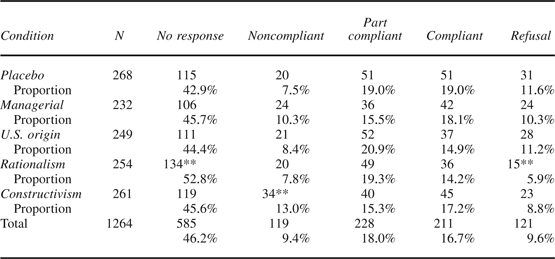
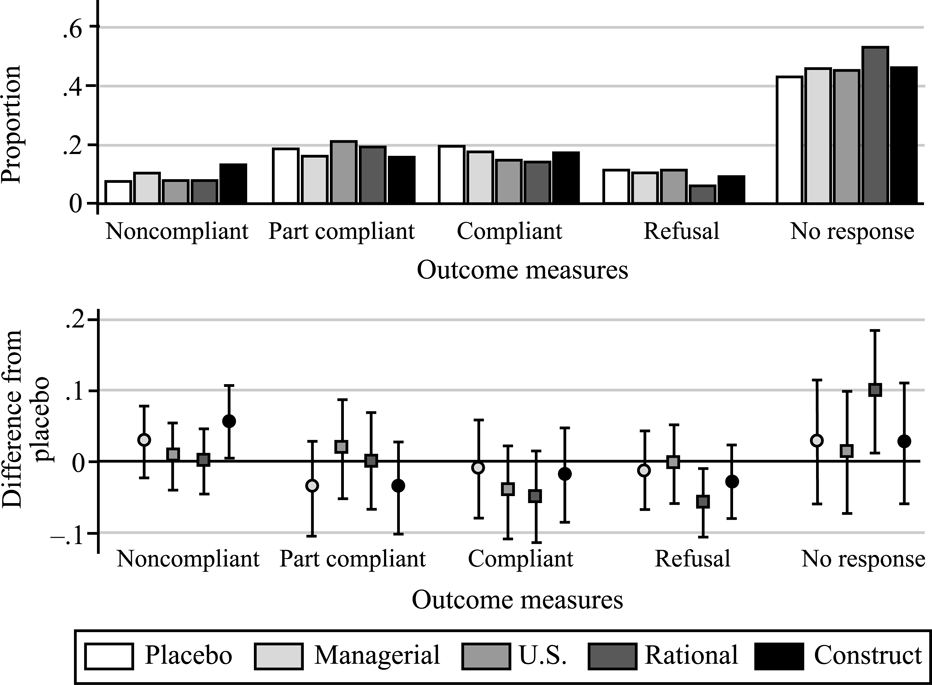
Table 1 lists the cell sizes and proportions for each of the outcome categories across experimental conditions. Asterisks indicate statistical significance in two-tailed t-tests. Figure 2 displays the treatment effects graphically, with the mean differences in each treatment from the placebo indicated by the points with small shapes (diamond, square, etc.) and statistical significance marked where the 95-percent confidence intervals (indicated by the vertical lines with bars) fail to overlap the horizontal zero line. Analysis of experimental data typically proves more straightforward than is usually the case with observational studies. In expectation the values of confounding variables—both observed and unobserved—have been balanced across the conditions. This claim for the relative strength of experiments holds only in expectation: subject pools that are too small can produce imprecise estimates of the average treatment effect.Footnote 47
Cell sizes and proportions across experimental conditions
Notes: Significant in difference of proportions and difference-in-means tests compared to placebo condition.
* p < .10;
** p < .05;
*** p < .01.
Outcome proportions and differences from placebo across treatment conditions
Power calculations performed before the experiment was executed in order to estimate the number of subjects needed per condition suggested that our proposed target of 250 subjects per condition was sufficient to detect treatment effects. And we did indeed find treatment effects that were statistically significant and robust to many alternative specifications. The power calculations provided some reassurance and the significant results reported below appear to vindicate the gamble, but we also caution that randomization imbalances may still occur even with the relatively large subject pool employed in this study. The blocking procedure and power calculations minimized this possibility, but not to zero. However, the relatively large subject pool significantly reduced the imprecision of the estimates. Thus, despite the risk of imbalance, and given the advantages of randomization in expectation, simple difference-in-means tests employing t-statistics can be used to report treatment effects.
As Table 1 and Figure 2 indicate, some results suggest significant treatment effects, but others indicate no significant differences from the placebo condition. Notably, the outcome categories for the managerial treatment, where we explicitly reference the FATF and its rules mandating identity disclosure, were not significantly different from the placebo condition where no mention was made of international law. This presents evidence against the managerial school of international law asserting that noncompliance with international law stems from ignorance. Informing subjects about international law did not increase their compliance rates. The same was also true of the U.S. origin condition—the alias's claim to be a U.S. citizen did not cause significant differences in response or compliance rates relative to the placebo. Apparently, despite U.S. extraterritorial jurisdiction, subject firms did not respond to inquiries from the U.S. in a significantly different manner than to requests from the other OECD countries.
On the other hand, both the rationalist and constructivist treatments caused significant differences compared to the placebo condition—but not necessarily in the direction predicted. The rationalist treatment caused a significant increase of roughly 10 percentage points in the rate of nonresponse compared to the placebo, with 52.8 percent of subjects failing to answer our inquiry in the rationalist condition compared to 42.9 percent nonresponse in the placebo condition. This difference is statistically significant at the .05 level in a two-tailed t-test (p = .024). These results suggest that a significant proportion of firms, when informed of international law and primed about legal penalties, may comply with international standards in a soft way by failing to answer inquiries.
However, this encouraging result was offset by the significantly lower proportion of services in the rationalist condition that actively refused service, a decrease of nearly one-half from 10.6 percent in the placebo condition to just under 5.9 percent in the rationalist treatment (p = .022). Thus, while an important set of services failed to respond to inquiries, those that did respond were significantly less likely to decline service. This result surprised us.
In speculating about the source of this anomaly, it seems plausible that different types of incorporation services populate the subject pool and that orientation to risk distinguishes them. One type of firm may shy away from the potentially sketchy customers in the rationalist condition. And the very firms most likely to ignore inquiries mentioning legal penalties may also be those most likely to comply with international standards or refuse service in response to the placebo e-mails.
Another group of firms may be unfazed by information suggesting increased risk. With this latter group we suspect a collusion effect. Telling these firms about international law requiring identity disclosure and possible legal penalties while at the same time persisting in a request for confidential incorporation suggests common knowledge between customer and service provider: “you know that I know that this is illegal, but I would like anonymous incorporation anyway.” Risk-acceptant firms may be reassured that the possibly risky customer will collude with them and thus be less likely to report impropriety.
Perhaps the most surprising finding, however, is related to the constructivist condition. In the constructivist treatment we noted the FATF and its disclosure standard, mentioned that most countries have signed onto the standard, and remarked that we understood that as “reputable businessmen” we want to “do the right thing by international rules.” Compared to the placebo this reference to reputation and norms caused services to offer incorporation without any identification at significantly greater rates. The noncompliance rate nearly doubled from 7.5 percent in the placebo condition to 13 percent for the constructivist treatment (p = .035).
An appeal to shared norms and reputation, rather than inducing firms to comply with international law, instead may have reassured some firms that the customer was trustworthy and thus required less scrutiny. Another possibility is that conspicuous claims of probity and respectability coupled with a request to evade rules may ironically suggest the same sort of signal for collusion in providing an untraceable shell company referred to earlier. Some providers may have reasoned that the prospective customers “doth protest too much” about their good reputation. These two possibilities are by no means mutually exclusive, remembering the importance of differing risk orientations in the same pool that give rise to different responses to the same treatment. It is important to note, however, that this increased noncompliance in the constructivist condition does not consistently apply in the robustness checks, so we present it here with less confidence.
Before addressing statistical robustness and reliability checks, however, it is necessary to address a key issue of validity: whether e-mail responses that did not require any supporting documentation can in fact be taken to represent noncompliance. Specifically, a skeptic might object that providers who initially did not require any identification documents may have done so at a later stage of the incorporation process: a bait-and-switch strategy. Although our study cannot disprove such a possibility, a closely related audit study relying on a similar strategy of soliciting incorporation agents for shell companies provides a powerful endorsement of our logic on this score.Footnote 48 This study employed a similar cover story of a consultant e-mailing incorporation agents about forming a shell company with a specific question of what identity documents were required. In forty-two instances, however, the audit study went through the entire process of incorporation except for the actual transfer of funds, and in no case did the incorporation agent alter the demands for identity documents once correspondence had begun.
This consistency held true for three additional cases where Sharman paid for and established actual shell companies, including instances where no identification was required to set up shell companies in Nevada and England. Interviews with corporate service providers and observations at their trade conferences and industry road-shows further confirm the notion that giving the same customer different answers about the documents required is only likely to lead to confusion and delay. Thus, it may jeopardize the actual purchase, which represents the payoff for the provider.Footnote 49 On this basis we can confidently defend the validity of our coding for noncompliance.
Randomization and Robustness Checks
We used two randomization checks to probe the balance of covariates among experimental conditions. First, we performed individual logistic regression analyses to learn if the key covariates used in the block randomization were significantly associated with the probability of assignment to any one condition versus the others. In general, we find that neither company type (incorporation service versus law firm) nor country group (OECD, tax haven, developing) was significantly related to the probability that a given firm would be assigned to a specific condition.Footnote 50 When controlling for relevant covariates, in addition to the significant negative result for the rationalist condition on refusal seen in the results above, the rationalist condition also appears to cause a significant decrease in the compliance rate (p = .072).
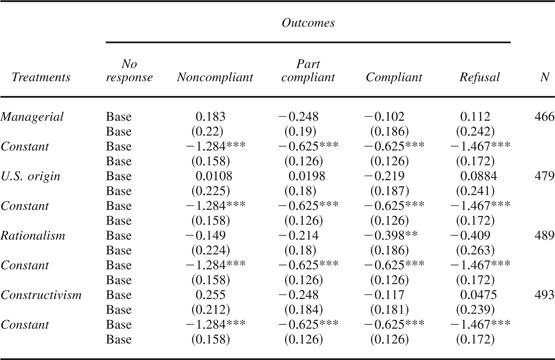
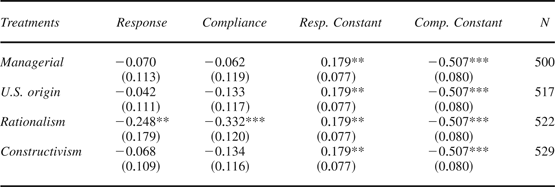
To further test the robustness of the results, we used multinomial probit and logit models to analyze the conditional probabilities of subjects' choosing a given outcome compared to a base outcome.Footnote 51 Multinomial models enable us to capture all possible categories of outcomes simultaneously without a loss of information from collapsing the data. Table 2 displays the results of four multinomial probit models corresponding to each of the four experimental conditions: managerial, U.S. origin, rationalist, and constructivist.
Multinomial probit results across conditions
Notes: Robust standard errors are in parentheses.
* p < .10;
** p < .05; *** p < .01.
In the models of Table 2, no response is set as the base outcome, which serves as the point of comparison for interpreting each of the coefficients. We selected no response as the base both because it is the most frequent category and because we are very interested in firms' decisions about whether to respond at all and, simultaneously, if replying how to react to the inquiry.Footnote 52 This tradeoff is core to the study.
As in the difference-in-means tests, those receiving the managerial prompt compared to the placebo were not significantly different for any of the outcome categories. The same was true for the U.S. origin treatment. The rationalist condition, however, appears to cause a significant decrease in the proportion compliant (p = .037) and an increase in no response (p = .022)Footnote 53 compared to the placebo. The significant negative result of the rationalist condition on refusal rates that we saw in the difference-in-means test and the logit regression with covariates does not appear to hold in this robustness check. Instead, it is replaced by a significant decrease in the compliance rate. Finally, in the multinomial probit estimation, the constructivist treatment no longer appears to cause a significant increase in the rate of noncompliance.Footnote 54
Because the multinomial probit model makes a more conservative assumption regarding the independence of irrelevant alternatives (IIA), we report its results here. But we also estimate multinomial logit models and find that the results are qualitatively similar to the probit; we report the logit results in Table A2 in the appendix.
We also subdivide the categories into nine different outcomes to consider the robustness of the results when considering that some subjects received more than one e-mail after failing to respond. The results of these analyses indicate that, in some cases, an additional round of communication is associated with statistically significant types of responses. But generally, the results are similar to those in Table 2. Augmenting the basic multinomial probit model, we estimated models in which we included interaction terms probing the conditional effects of the treatment conditions and covariates for company type (corporate service provider versus law firm), tax havens, OECD members, and upper-middle-income countries. With some interesting exceptions, few interaction effects were significant, suggesting limited heterogeneity in treatment effects across the values of the covariates.Footnote 55
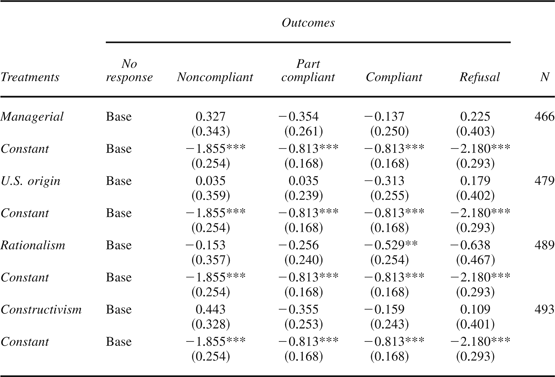
We further considered a statistical fix to connect the response rates to compliance in a selection model. No response was scored “0” in the selection equation of the model. We then collapsed the categories of noncompliant and part compliant together and scored them “0” for the outcome equation and also conjoined the compliant and refusal categories and scored them as “1” in the outcome equation. One challenge is that most two-stage models require the addition of different information to identify the model. We thus use the selection model developed by Sartori that allows the same identification parameter—in our case treatment condition—to estimate how it simultaneously affects selection (response) as well as the outcome (compliance).Footnote 56
The results are generally similar to those reported separately, as displayed below in Table 3. Again, only the rationalism treatment shows a statistically lower response rate than the placebo (p = .024). In terms of substantive significance, when controlling for covariates the shift from placebo to the rationalist treatment decreased the probability of a response by 12.9 percent. Further, in the selection model the rationalist treatment also demonstrates lower, and statistically significant (at the .01 level, where p = .006), rates of compliance compared to the placebo. Substantively, accounting first for the probability of a response and considering marginal effects, the rationalist treatment decreased the probability of compliance by 20.2 percent. Again, as in the multinomial logit robustness check (with no response as the base condition), the anomalous noncompliance outcome for the constructivist treatment does not recur here. This may be the result of collapsing the categories of noncompliant and part compliant, where the insignificance of the part compliant result may mask the noncompliant finding from Table 1 and Figure 2.
Selection model results across conditions
Notes: Standard errors are in parentheses.
* p < .10;
** p < .05;
*** p < .01.
We also estimated selection models with control variables including company type, OECD member, and tax haven, as well as several interaction models with economic groupings. The results are qualitatively similar to or stronger than the results reported.
Finally, we reconsidered the results while regarding all nonresponses as if the treatment e-mails did not arrive and the subjects were not treated. Thus, in contrast to the exercise where we considered nonresponse as substantively meaningful, we now treat the problem as a statistical fix. We add any bounced e-mails and foreign-language replies into this calculation. In doing so, we estimate the treatment effect on the treated and find that the results are similar to those reported in Table 1 in that there is still a negative treatment effect for each of the conditions. The rationalism treatment is still statistically significant at the levels reported in Table 2, and the constructivist condition is negative and significant for compliance at the 0.1 level.
Conclusion
To conclude, we briefly summarize four main points from the experimental findings before returning to the broader significance of experiments in transnational relations. First, there is a substantial level of noncompliance with the international standards mandating that providers obtain certified identification documents from beneficial owners when forming shell companies. Our data mark by far the most robust picture available of global compliance with the rules on corporate transparency.Footnote 57 The fact that our study discerns a significant level of noncompliance reinforces the objection that studies of international standards often create a false impression of a rule-governed world, thanks to the confirmation bias produced by endogeneity and selection effects.
Second, service providers are no more likely to comply with international rules when they are prompted about the existence and content of the rules. The managerialist school argues that ignorance, rather than opportunism, may underpin much noncompliance, as actors are simply unaware of what they should be doing. Legalization scholars also believe that knowledge of the rules (precision) will encourage compliance, as peers are better able to discern whether or not rules have been followed and make reputational judgments accordingly. At least in the case of obtaining shell companies, however, the results suggest that more information about the standards causes no significant improvement in compliance rates.
Third, service providers are most sensitive to the combination of information about international standards and mention of legal penalties for not following these standards. That the rationalist treatment produced a significant effect may not come as a surprise, yet the nature of this effect is counterintuitive. Although it depressed response rates (as might be expected), it also made providers less, not more, likely to either refuse service or demand certified documents (depending on the specification of the statistical analysis) compared to the placebo condition. This finding is at odds with the idea that sanctions enhance compliance. We speculate that the subject pool is heterogeneous: one set of firms appears wary of risky customers and may engage in soft compliance by failing to reply to inquiries; another group may interpret this treatment as a signal of collusive intent.
Fourth and finally, compared to the placebo condition, in some model specifications the constructivist treatment appeared to cause a significant increase in the proportion of firms willing to offer incorporation without any identity documentation whatsoever. This surprising result is attenuated by its inconsistent performance across statistical tests, but it may suggest that, rather than heightening vigilance and compliance with international standards, evoking norms and reputation instead may reassure a significant share of incorporation services that the inquirer is trustworthy and needs less scrutiny. Conversely, the protestations of good reputation combined with an invitation to violate international standards may be taken as an invitation to collude in transgressing the rules for mutual benefit.
Returning to the larger point about experiments in transnational relations, the findings further provide a useful example of how future research in this vein might be conducted. Matching attention to international institutions and nonstate actors with field experiments can reveal causal effects with relatively high external validity. This sort of experimental study of transnational relations represents a rigorous scientific method by which to discover the causes of individuals' and private organizations' international behavior and the effects of private actors—alongside state influence—on international organizations and norms. Even in global studies such as this one, field experiments should be practical and affordable as well as powerful. With creative use of the Internet and sufficient research assistance, many IR field experiments reflecting on important transnational patterns can be performed from a single location for far less than the cost of laboratory experiments. Especially when it comes to studying the behavior of firms, NGOs, and other transnational actors, experiments provide enormous potential for the accumulation of robust new insights.
For at least four decades some of the leading minds in the field have been calling for greater attention to nonstate actors in world politics. Though there have been some stimulating studies from a variety of theoretical perspectives, the complexity of this domain, and the corresponding lack of parsimony in the explanations adduced, has limited progress. The application of experimental methods in an environment in which transnational relations are increasingly the norm rather than the exception should help to advance this research agenda.
Appendix
Country groupings
Multinomial logit results
Examples of Letters Across Experimental Conditions
Placebo
Dear [name/company]
I am contacting you as I would like to form an international corporation for my consulting firm. I am a resident of [Norstralia] and have been doing some international consulting for variuos companies. We are now growing to a size that makes incorporation seem like a wise option. A lot of our newer business is in your region.
My two associates and I are accustomed to paying [Norstralia] income tax, but the rising tax rates make incorporation in another country a more economic alternative. Also, our contracts grow larger and more complicated, so reducing personal liability through incorporation seems more attractive.
As I am sure you understand, business confidentiality is very important to me and my associates. We desire to incorporate as confidentially as we can. Please inform us what documentation and paperwork is required and how much these services will cost.
I would like to start the process of incorporation as soon as possible. Also, how much can we expect your fees to be?
Due to numerous professional commitments, I would prefer to communicate through email. I hope to hear from you soon.
Thank you very much,
[alias]
Managerial Treatment
Dear [name/company]
I am contacting you regarding a business I am trying to set up. I am a consultant and my colleagues and I are seeking to establish an international corporation. I am a [Norstralia] resident, but I do business both locally and with some international client, including some in your region. Our business has been growing substantially, and our goal is to limit tax obligations and business liability.
We would like as much business confidentiality as possible in these early stages of formation. My Internet searches show that the international Financial Action Task Force requires disclosure of identifying information. But I would rather not provide any detailed personal information if possible.
So, we would like to know what identifying documents will be required to establish this company. We would also like to know what start-up costs will be.
Due to my travel schedule, email will be the best way to reach me. I look forward to hearing from you soon.
Regards,
[alias]
U.S. Origin Treatment
Dear [name/company]
I am an international consultant living in the United States. My associates and I have been based in the U.S. for some time and we have done extensive international work, especially in your area. After looking at the specific needs of our growing company, we were feeling that it would make sense for us to expand and to set up an international company.
We especially hope to limit taxes and reduce liability. We were wondering what you require us to give in order to do this.
We would like to form this corporation as privately as possible. What identifying documents will you need from us? We would also like to know what your usual prices are. We appreciate the help.
I travel a lot for my work, so I communicate best via email.
I hope to hear from you soon.
Yours,
[alias]
Rationalism Treatment
Dear [name/company]
I am seeking information on how to incorporate an international company. I hope that you might be able to offer what I need.
I am a consultant, and my business associates and I live in [Norstralia]. Much of our business originates here, where we operate, but our company also grows quickly among international clients. Many of them are in your area. So, we feel that incorporation is a necessary option for us. We hope to limit taxes obligations and business liability.
We would like to know if you feel that you will be able to service us with a corporation. What identifying documents will you request for this transaction? We would prefer to limit disclosure as much as possible.
My Internet searches show that the international Financial Action Task Force sets standards for disclosure of identifying information when forming a company. I also understand that legal penalties may follow violation of these standards. But I would like to avoid providing any detailed personal information if possible.
If you could answer these questions and also let us know about your prices, we very much appreciate it. Thank you for the time to address our query. Business obligations make communication difficult, so we would prefer to correspond with email.
Until we speak again,
[alias]
Constructivism Treatment
Dear [name/company]
I am a resident of [Norstralia] and would like to inquire about your process to form international corporations. With several associates, I operate consulting firm in [Norstralia]. We deal with a growing number of international clients, many that come from your area, and would like to pursue incorporation options for liability and taxes purposes.
We are particularly concerned with keeping business interactions private; thus, we are eager to limit information disclosure as much as possible.
My Internet searches show that the international Financial Action Task Force sets standards for disclosure of identifying information when forming a company and most countries have signed on to these standards. As reputable businessmen, I am sure we both want to do the right thing by the international rules. But I would like to avoid providing any detailed personal information if possible.
Can you please inform me what your start-up costs are and what kind of identification or documents we will need to provide? We are all fairly burdened with commitments, so email communication is preferable.
Thank you in advance,
[alias]
Examples of Replies
Compliant
In reply to your email requesting our price to form a Corporation, basically the cost of establishing (or acquiring a shelf) IBC is US$ 1,500 and the annual running costs (excluding time charges) are US$ 3,850 (being $ 350 Government Licence fee + $ 500 Registered Office / Registered Agents fee + $ 3,000 Directors Responsibility fee). It is also important to note that, apart from needing to understand the exact nature and purpose of the proposed structure (e.g. Business, Investment or Inheritance Plan), our current due diligence / client acceptance procedures generally involve :- (a) Signed Client Service Agreement (copy attached) (b) Proof of Identity (usually a certified copy passport). (c) Proof of Residential Address (usually an original utility bill, unless the bank reference includes an address confirmation). (d) Curriculum Vitae. (e) Bank and Professional References. (f) Source of funds. See our Due Diligence Requirements attached for further reference.
Partially Compliant
I deeply apologise for the delay in our response. This is a very abnormal situation and I thank you for your perseverance. I am not typically the person who would be dealing with your enquiry but am very happy to work with you to make this happen. My first question is could you please confirm if you would also be looking for an offshore bank account to accompany the company? In regards to the best tax haven we are currently recommending the jurisdiction of Belize. This is due to three reasons: 1/ Confidentiality, the registry in Belize is known as a closed registry therefore the shareholders& directors names are not disclosed 2/ Time Frame, it takes only one working day to form a company 3/ Documentation—the supporting documents required from you would be minimal, a clear scanned copy of your passport is enough to proceed Please let me know if you would like me to call and discuss anything with you.
Noncompliant
Dear Sir,
In order to prepare power of attorney and setting up the company I need full shareholders and director details as:
Full Name
Nationality Status
Address
Occupation
I look forward to hearing from you. We are at your disposal to clarify any questions that are made necessary. With our best personal regards.
Refusal
Thank you for your email and your kind enquiry. Unfortunately, it is likely that your business will be outside our area of business but I wish you all the best with your business ventures. Kind regards.