Introduction
Understanding how different phylogenetically close and potentially competing plant species manage to coexist is important, as it helps us to understand the ecological and evolutionary processes that structure biological communities (Cavender-Bares et al. Reference Cavender-Bares, Kozak, Fine and Kembel2009; Chase and Leibold Reference Chase and Leibold2009; Silvertown Reference Silvertown2004a). Niche theory (Elton Reference Elton1927; Grinnell Reference Grinnell1917; Hutchinson Reference Hutchinson1957) explains how species manage to coexist over time and space by relating abiotic and biotic factors to their abundance, distribution and the intensity at which they compete and share available resources in the environment (González et al. Reference González, Dézerald, Marquet, Romero and Srivastava2017). Niche theory suggests that the species achieving better performance (higher rank in a continuum of species competitive ability, henceforth competitive hierarchy) under low levels of a given limiting resource may drive the competitive exclusion of lower rank species (Chesson Reference Chesson2000). Stable species coexistence, however, is possible considering heterogeneity in time and space of limiting resource levels, particularly if two or more resources are taken into consideration (Kobe and Vriesendorp Reference Kobe and Vriesendorp2011; Silvertown Reference Silvertown2004b).
In fact, the stable coexistence of species is easier with two or more limiting conditions because the various possible combinations of these conditions over time and/or space can also allow for changes in the position of species in the competitive hierarchy (Dybzinski and Tilman Reference Dybzinski and Tilman2007). Thus, species coexistence is related to the sharing of multiple niche dimensions, with each species exhibiting different strategies for using and tolerating specific aspects of each niche dimension (Dybzinski and Tilman Reference Dybzinski and Tilman2007; Kim and Ohr Reference Kim and Ohr2020; Tilman et al. Reference Tilman, Mattson and Langer1981). For example, the classic study by MacArthur and Wilson (Reference MacArthur and Wilson1967) in which the coexistence of lizard species of the genus Anolis was observed on different islands. Each lizard species occupied different strata of the environment and exhibited distinct behaviours, which allowed for slightly different utilisation of island resources, thus promoting coexistence. Furthermore, high phenotypic plasticity may also play an important role in species coexistence, as it allows species to adjust their behaviour to reduce (or even avoid) niche overlap, especially considering the competition for multiple limiting resources (Meilhac et al. Reference Meilhac, Deschamps, Maire, Flajoulot and Litrico2020). Over time, it can lead to evolutionary differentiation within each species (‘ghost of past competition’; (Cavender-Bares et al. Reference Cavender-Bares, Ackerly, Baum and Bazzaz2004; Meilhac et al. Reference Meilhac, Deschamps, Maire, Flajoulot and Litrico2020), making species coexistence more likely. However, if these behavioural phenotypic plasticity adjustments are not possible or are unfavourable, one species can lead the other to local extinction (Esch et al. Reference Esch, Ashbacher, Kopp and Cleland2018; Levine and HilleRisLambers Reference Levine and HilleRisLambers2009; MacArthur and Levins Reference MacArthur and Levins1967).
Particularly for plants, environmental conditions such as light availability (Comita et al. Reference Comita, Uriarte, Thompson, Jonckheere, Canham and Zimmerman2009; Kobe Reference Kobe1999), water availability (Lin et al. Reference Lin, Comita, Zheng and Cao2012) and soil nutrients (Bai et al. Reference Bai, Queenborough, Wang, Zhang, Li, Yuan, Xing, Lin, Ye and Hao2012) are crucial for the establishment and development of many species, acting to select subsets of species capable of supporting them (Belyea and Lancaster Reference Belyea and Lancaster1999; Ettinger et al. Reference Ettinger, Ford and Hillerislambers2011). Within these subsets, biotic interactions, such as interspecific competition, influence the formation of local plant communities by modulating the coexistence of species through both sharing of multiple niche dimensions and species phenotypic adjustments (Holt Reference Holt2009; Wang et al. Reference Wang, Sun, Sedio, Glomglieng, Cao, Cao, Yang, Zhang and Yang2022). Consequently, although some niche overlap still occurs, plant species may occupy different positions in the multidimensional niche space, reducing competition (Belyea and Lancaster Reference Belyea and Lancaster1999; Esch et al. Reference Esch, Ashbacher, Kopp and Cleland2018) and increasing the chances of coexistence (including phylogenetically close species; Casper and Jackson Reference Casper and Jackson1997; Silvertown Reference Silvertown2004b). For example, within plant communities, coexistence among congeneric species with preferences for abiotic niche gradients (such as variation in soil texture and nutrient availability) can occur through root morphological differentiations, resulting in permanence in different soil textures and differences in soil nutrient uptake potential (see Chen et al. Reference Chen, Mi, Hao, He, Yang, Wan, Zhang, Liu and Lin2022; Eckhart et al. Reference Eckhart, Howland, Jennison, Kircher, Montgomery, Yuan and Geber2017).
In this study, we used three congeneric species belonging to the genus Erythroxylum (Eryhroxylaceae) as a study model. Because they are phylogenetically related species, it is more likely that they share common traits (for example, leaf size, height, fruit size and type) or life history characteristics (Silvertown Reference Silvertown2004b), making them excellent models for studies related to niche partitioning and species coexistence among congeneric plant. Here we investigate how three plant species belonging to the genus Erythroxylum, these being Erythroxylum simonis Plowman, Erythroxylum pauferrense Plowman and Erythroxylum citrifolium A. St.-Hil., share the dimensions of the ecological niche according to the abiotic characteristics of the environment in which they are located to allow coexistence. We hypothesise that multiple resources (light, water and mineral nutrients) or environmental conditions (soil texture) limit the three Erythroxylum species, and their niche space should be differentially fulfilled by individuals (differences in abundance and position in multidimensional space) along those environmental gradients, reducing competition and allowing coexistence. Thus, we expect that (1) a linear increase in the Erythroxylum species population as the availability of resource/environmental conditions increases and (2) the three Erythroxylum species, taken in pairs, must show a lower degree of multidimensional niche overlap than expected by chance.
Material and Methods
Study area
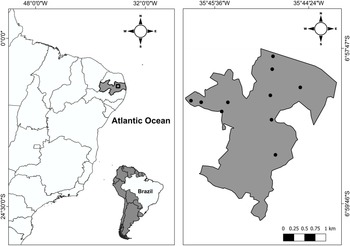
This study was conducted in Mata do Pau Ferro State Park, located in the municipality of Areia, State of Paraíba, Northeast Brazil (Figure 1). The park is in a 600 ha Atlantic Rainforest disjuncture, regionally known as ‘Brejos de Altitude’ (Barbosa et al. Reference Barbosa, Agra, Sampaio, Cunha and Andrade2004). ‘Brejos de altitude’ are enclaves of the Atlantic Rainforest within the Caatinga domain, a deciduous vegetation formation adapted to semi-arid climates (Andrade-Lima Reference Andrade-Lima1982; Pennington et al. Reference Pennington, Lavin and Oliveira-Filho2009). The Mata do Pau Ferro State Park is located 600 m above sea level with an average annual temperature of 22ºC, relative humidity of around 85% and annual precipitation of 1500 mm, with a humid climate and deep and medium fertile soils (Mayo and Fevereiro Reference Mayo and Fevereiro1982; Pôrto et al. Reference Pôrto, Cabral and Tabarelli2004). This State Park is home to the most representative high-altitude forest in the State of Paraíba, with about 309 species of Angiosperms, distributed in 84 families, of which Rubiaceae, Malvaceae and Solanaceae stand out as the most representative families in a number of species (Barbosa et al. Reference Barbosa, Agra, Sampaio, Cunha and Andrade2004). In addition, four species of the Erythroxylaceae family occur in the study site: Erythroxylum simonis, Erythroxylum pauferrense, Erythroxylum citrifolium and Erythroxylum deciduum A. St.-Hil.
Map with the location of the Mata do Pau Ferro State Park in the Municipality of Areia – PB, highlighting the sampling units (dark circles).

During the nineteenth century, the tropical Atlantic Forest cover located in the Northeast region of Brazil, suffered heavily from increased anthropic pressures driven by agricultural activities, which reduced it to a small fraction of its original area (Crouzeilles et al. Reference Crouzeilles, Santiami, Rosa, Pugliese, Brancalio, Rodrigues, Metzger, Calmon, Scaramuzza, Matsumoto, Padovezi, Benini, Chaves, Metzker, Fernandes, Scarano, Schmitt, Lui, Christ, Vieira and Pinto2019), resulting in a hyper-fragmented landscape (Pôrto et al. Reference Pôrto, Cabral and Tabarelli2004). The creation of the Mata do Pau Ferro State Park as a protected area has reduced habitat loss in the locality, however, impacts such as illegal logging are still recorded.
Experimental design
Focal species and population survey
The genus Erythroxylum is characterised by woody, shrubby or arboreal plants with alternate, entire leaves, monocline flowers and fleshy (less than 1 cm in size), reddish, single-seeded fruits (Loiola et al. Reference Loiola, de Agra, Baracho and Queiroz2007). This genus is exclusively tropical and comprises about 240 species, of which 187 present a distribution exclusively in the Neotropical region (Plowman and Hensold Reference Plowman and Hensold2004). Brazil is pointed as one of the main centres of diversity and endemism of plant species belonging to the genus Erythroxylum (Plowman et al. Reference Plowman, Berry, Steyermark, Berry, Holst and Yatskievych1999). Of the species with a distribution in the Neotropical region, approximately 50 per cent occur in Brazil (Cordeiro et al., Reference Cordeiro, de Araújo, Koch, Simões, Martins and Loiola2017), including species with a restricted distribution, such as Erythroxylum pauferrense Plowman, endemic to remnants of the Atlantic Rainforest in northeastern Brazil (Cordeiro et al. Reference Cordeiro, de Araújo, Koch, Simões, Martins and Loiola2017; Loiola et al. Reference Loiola, de Agra, Baracho and Queiroz2007). The species in this group show great ecological versatility, with species found in humid and semi-arid regions, and occurring at different levels of altitudes (Loiola et al. Reference Loiola, de Agra, Baracho and Queiroz2007). In the present research, we emphasise three species belonging to this genus, E. citrifolium, E. pauferrense (endemic species in small fragments of Atlantic Forest in Northeast Brazil) and E. simonis, because they are well represented in terms of abundance in the study area (Araújo Reference Araújo2016).
The species E. citrifolium has a tree to shrub life form, with a height of between 1.5 and 4 m. The leaves are large and elliptical, with a pointed apex (the size of the leaves can vary according to their distribution; at our study site, the leaves of this species are larger than those of the other two focal species). The branches are 2–4 mm in diameter (colour varies from greyish to brown), the flowers are small and yellowish-white and the fruit is fleshy, single-seeded, reddish and small (less than 1 cm in size; Plowman and Hensold Reference Plowman and Hensold2004). In the study area, flowering and fruiting usually take place between April and June. In addition, it is a species with a wide distribution in the Neotropical Region, being preferentially found in humid forest environments (Loiola et al. Reference Loiola, de Agra, Baracho and Queiroz2007).
The species E. pauferrense, like E. citrifolium, has a life form of tree to shrub, with a height of between 1.5 and 4 m. However, its leaves are small, slightly discoloured and generally elliptical (sometimes rounded). The branches can be 2–3 mm in diameter and vary in colour from greyish to brown, the flowers are also small and yellowish-white, the fruit fleshy, with a single seed (with grooves), reddish and small (less than 1 cm in size; Plowman Reference Plowman1986). Unlike E. citrifolium, its flowering and fruiting in the study area takes place over a longer period, from March to July. E. pauferrense is endemic to the Northeastern Region of Brazil and is found in remnant areas of the Atlantic Rainforest (Loiola et al. Reference Loiola, de Agra, Baracho and Queiroz2007). In addition, it is worth mentioning that this species has a great affinity in terms of characteristics and habitat with E. simonis and can be distinguished by the following features: E. simonis has a height of between 2 and 2.5 m, thick, elliptical leaves with a pointed apex, a bright green colour on the adaxial side and fruits with smooth seeds (Loiola et al. Reference Loiola, de Agra, Baracho and Queiroz2007). Its flowering and fruiting in the study area may be in two periods, the first between March and June and the second between October and November. The distribution of E. simonis is restricted to north-eastern Brazil, with occurrence in fragments of the Atlantic Forest in the states of Paraíba, Pernambuco, Ceará, Sergipe and Rio Grande do Norte (Cordeiro et al. Reference Cordeiro, de Araújo, Koch, Simões, Martins and Loiola2017).
To survey the species, we used ten 20 m × 50 m plots, previously established in the study area. The plots were distributed throughout the Mata do Pau Ferro State Park in order to cover its surface as much as possible. Within the plots, we marked and counted the individuals belonging to the three species of the genus Erythroxylum that were at least 10 cm in diameter at breast height (Felfili et al. Reference Felfili, Eisenlohr, Melo, Andrade and Meira-Neto2011).
Characterising the abiotic multidimensional niche overlap
Luminosity
In June 2019, we took hemispherical photographs of the canopy using a Digital Plant Canopy Imager – CID-110 analyzer (CID, Inc) to obtain the light availability through photosynthetically active radiation (PAR) present in the understory (Table S1). The photographs were taken 1 m above the ground, in the four corners and centre of the plots, at moments with diffuse light conditions (in our case, early in the morning) to allow the maximum possible contrast between the forest canopy and the sky (Whitford et al. Reference Whitford, Colquhoun, Lang and Harper1995). After the photographs were taken, the value of photosynthetically active radiation for each plot was obtained by calculating the average of the five photos taken in each plot.
Chemical composition and soil granulometry
In each plot, with the help of a Dutch auger, we collected six simple soil samples (depth between 0 and 20 cm), after this process, we mixed all the samples and took a 300 g aliquot for the chemical and granulometric analyses of the soils. Following the protocol described in (Donagema et al. Reference Donagema, de Campos, Calderano, Teixeira and Viana2011), the granulometric ratios and chemical composition of the soils were measured. In total, 13 soil chemical and physical variables were collected: clay, sand, silt, C, H+Al, Al, Na, K, P, pH, Mg, Ca and organic matter. The clay, sand and silt values were converted into percentages to be used in the statistical analysis.
Soil moisture
We collected soil twice, before and after the rainy season, to obtain the average moisture content of each plot. In each collection, we took a 100 g aliquot from the composite sample of each plot. We weighed the samples (fresh weight – FW) and dried them in an oven (temperature of 60ºC) until constant weight, which was considered as the sample dry weight (DW). With this, we calculated the moisture content (h, measured in percentage) of the soil following the formula (Donagema et al. Reference Donagema, de Campos, Calderano, Teixeira and Viana2011; Klar et al. Reference Klar, Villa Nova, Marcos and Cervellini1966; Papadakis Reference Papadakis1941):
 $$h = {{FW - DW\;\;} \over {DW}} \times 100$$
We calculated Spearman’s cross-correlation matrix to check (Figure S1) for multicollinearity among the 15 potential predictors (abiotic variables) of the study. Through the correlation matrix, we found that the 15 variables were highly correlated. Thus, we selected only those variables that had correlation values between −0.7 and 0.7 to ensure some degree of independence among the variables. The six continuous explanatory variables selected for inclusion in the models were PAR, moisture, sand, silt, potassium and calcium. Subsequently, we performed a variance inflation factor (VIF) analysis of each predictor using the car and MuMin statistical packages for R software version 3.6.0 (R Development Core Team 2020). In the analysis, the highest VIF obtained was 2.2, which indicates low collinearity between the predictor variables (Neter et al. Reference Neter, Wasserman and Kutner1990) thus allowing them to be included in our statistical model.
Analysis of data
We constructed generalised linear models (GLM) to understand how the three species of the Erythroxylum genus share the multidimensional niche space according to the abiotic variables considered in our study. We build three individual models (one model for each of the three Erythroxylum species) to see how each species responds separately to the environmental variables. In these models, the response variable is the abundance of the Erythroxylum species itself in each plot. The basic GLM model was AbunSp∼ PAR + moisture + sand + silt + K + Ca, where AbunSp is the abundance of species, PAR is photosynthetically active radiation, moisture is the variable related to the availability of water in the plots under study sand and silt represent the percentage concentration of sand and silt in the soils, K and Ca are the concentrations of potassium and calcium in the soils of the plots studied. As the abundance of the species is count data, we modelled it as a Poisson distribution with a logarithmic link function. In addition, the predictor variables used in the analyses were Z-transformed to ensure comparability between the variables.
We assessed the degree of abiotic niche overlap considering the three species taken in pairs. We produced relative density surfaces for each species based on the Kernel index, using the ecospat.grid.clim.dyn function provided by the ‘ecospat’ package (Di Cola et al. Reference Di Cola, Broennimann, Petitpierre, Breiner, D’Amen, Randin, Engler, Pottier, Pio Dorothea, Pellissier, Mateo, Hordjk, Salamin and Guisan2017). Subsequently, we determined the equivalence (and statistical significance) of their niches using the ‘ecospat.niche.equivalency.test’ function from the same package, based on the niche overlap index D (Warren et al. Reference Warren, Glor and Turelli2008). We adopted the hypothesis of niche separation and set the ‘overlap.alternative’ parameter to the ‘lower’ option. To check the validity of the hypothesis, the model was adjusted for 100 randomisations, and the observed D value was compared with the randomised values (Broennimann et al. Reference Broennimann, Fitzpatrick, Pearman, Petitpierre, Pellissier, Yoccoz, Thuiller, Fortin, Randin, Zimmermann, Graham and Guisan2012).
All the analyses were carried out in the R statistical software (R Development Core Team 2020).
Results
We sampled a total of 1027 individuals belonging to the three species of the genus Erythroxylum in the ten plots under study. Of this number, 781 individuals belonged to the species E. simonis (occurring in all plots, occurrence frequency = 1), 177 to E. pauferrense (0.8 occurrence frequency) and 69 to E. citrifolim (0.5 occurrence frequency) (Table S2).
Effect of predictor variables on the abundance of Erythroxylum species
Our abundance models for the three Erythroxylum species suggested that the availability of photosynthetically active radiation exerted different effects on the abundance of the three focal plant species in our study. The abundance of E. simonis increased in response to the light gradient, unlike E. citrifolium, which responded negatively to increased light availability. E. pauferrense on its turn, showed no consistent response across our gradient of PAR incidence (Table 1; Figure 2A).
Effect of abiotic variables of the ten study plots on the abundance of E. citrifolium, E. pauferrense and E. simonis in a landscape Brazilian Atlantic Tropical Rainforest

Notes: PAR, photosynthetically active radiation; K, potassium; Ca, calcium.
Response of the abundance of E. citrifolium, E. pauferrense and E. simonis along gradients of environmental variables in the ten study plots in a landscape Brazilian Atlantic Tropical Rainforest. Par: photosynthetically active radiation.

The species E. citrifolium and E. simonis exhibited similar patterns of monotonic increasing abundance as soil moisture rises (as illustrated in Figure 2B). In contrast, E. pauferrense showed a slightly negative response (driven by a single dry plot harbouring about 40 individuals), but with a higher concentration of occupied plots (consequently, higher proportion of relative abundance) in wetter plots (Table 1; Figure 2B). The proportions of sand and silt played different roles on the abundance of the three plant species. Our results show that E. citrifolium showed no influence of the sand gradient on its abundance but responded negatively to increasing silt proportion (Table 1; Figure 2C and 2D). The abundance of E. pauferrense was positively correlated to the proportion of sand but showed no response to silt proportion, while E. simonis showed increased abundance as the concentration of sand and silt increased (Table 1; Figure 2C and 2D).
The availability of potassium in the soil had a positive effect on the population of E. citrifolium and a marginally significant effect on the abundance of the species E. pauferrense but did not affect E. simonis abundance (Table 1, Figure 2E). In addition, the populations of E. simonis and E. pauferrense were positively affected by soil calcium concentrations, with a higher slope; consequently, a stronger effect on the species E. simonis (Table 1, Figure 2F).
Abiotic niche overlap of Erythroxylum species along environmental gradients
The relative abundance distribution of the three species of the genus Erythroxylum showed different responses along the gradients of environmental variables describing their observed ecological niche (Figure 3). The species E. simonis showed the highest relative abundance along all environmental gradients (Figure 3; Figure S2), with abundance peaking in wet environments under low to intermediate luminosity. In addition, E. simonis occurred at higher abundances on soil texture of about 60% of sand and 10% silt, with low potassium concentration, and showed high abundance across the whole calcium gradient (Figure 3C to 3F and Figure S2). E. pauferrense showed preferences for environments with low to intermediate incidence of photosynthetically active radiation (it is absent in sites with high luminosity), low to high water availability, soils with intermediate proportion of sand and silt and low concentrations of potassium and calcium (Figures 3A to 3F and Figure S2). E. citrifolium showed the lowest relative abundance along the gradients, exhibiting a conspicuous peak of relative abundance in sites with lower incidence of photosynthetically active radiation, higher water availability, soils with a significant presence of sand, low concentrations of silt, high availability of potassium and low calcium availability (Figures 3A to 3F and Figure S2).
Population distribution of the E. citrifolium, E. pauferrense and E. simonis along gradients of photosynthetically active radiation (PAR) (A), moisture (B), soil and (C) and silt (D) ratios, potassium (E) and calcium (F) in a landscape Brazilian Atlantic Tropical Rainforest. Abbreviations: RA, the proportion of relative abundance. The sum of the area under the curve equals 1 (or 100% of the individuals).

Taken together, species-specific response to each abiotic niche dimension produces its multidimensional abiotic niche, which showed different levels of niche overlap with the multidimensional abiotic niche of the remaining species. Two pairs of species showed lower niche overlap (D) than randomly expected. The species E. citrifolium and E. pauferrense presented D-value 2.18 times lower than the expected by chance (observed D = 0.395 vs. random D = 0.859 ± 0.041; p = 0.009), while E. simonis and E. pauferrense showed D-value 1.42 times lower than random D (0.508 vs. 0.721 ± 0.071; p = 0.009). E. simonis and E. citrifolium, however, showed D-value 1.04 times higher than randomly calculated (0.594 vs. 0.571 ± 0.059), but differences did not depart from expected by chance (p = 0.712).
Discussion
Our results indicate that the three species belonging to the genus Erythroxylum coexist along the different environmental gradients, with some level of ecological niche overlap. We found that, based on species abundance and occurrence frequency across plots, E. simonis is the best competitor, showing a generalist behaviour and the highest abundance across all environmental gradients. The species E. pauferrense, on its turn, appeared as the second stronger competitor. Its behaviour across environmental gradients is similar to E. simonis, but E. pauferrense showed a less generalist character and exhibited lower niche overlap than expected by chance with both remaining species. The species E. citrifolium occupies the lowest rank in the competitive hierarchy and showed a narrow pattern in resource use and habitat preference (specialist behaviour), although it presents high level of niche overlap with E. simonis. E. citrifolium, exhibited very conspicuous peaks of relative abundance concentration, achieving higher population density in sites with lower light incidence, higher water availability, moderate amounts of sand, low amounts of silt, higher levels of potassium and lower concentration of calcium in the soil. Additionally, it is important to emphasise that the adult population of the species studied has been able to adapt to various environmental and ecological challenges. Thus, the outcomes we report here are influenced by the species’ ability to perform well in terms of physiology, recruitment, growth and survival during their early life stages. Finally, we recognise that despite the considerable effort put into data collection, the sample size of the plots (n = 10) can be considered small. A larger sample could provide a more robust and detailed view of species dynamics and their ecological interactions. Therefore, future studies with a larger number of sample plots would be valuable to confirm and expand our results, offering a more comprehensive understanding of niche sharing between the three focal species of our study.
The monotonic increase in the population of a plant species in a resource gradient indicates that the plant’s performance is limited by that resource (Farrior et al. Reference Farrior, Tilman, Dybzinski, Reich, Levin and Pacala2013; Gleeson and Tilman Reference Gleeson and Tilman1992; Liebig Reference Liebig1855), our data suggests light, water and calcium as limiting resources. It is also known from literature (Dybzinski and Tilman Reference Dybzinski and Tilman2007; McPeek Reference McPeek2019; Tilman Reference Tilman1990; Tilman et al. Reference Tilman, Mattson and Langer1981) that increases in the availability of limiting resources must foster performance of the best competitor species, E. simonis in our case. The other two Erythroxylum species had more variable behaviour, showing opposite responses to the moisture gradient, and alternating from no-responsive to slightly responsive (either increasing or decreasing) to the other resource gradients (light, potassium and calcium). It suggests that E. citrifolium and E. pauferrense tend to segregate their ecological niche space and use resources differently, highlighting a possible fierce competition in the past. Additionally, gradients of environmental conditions, soil texture in our study, may modulate population size of the three species, with E. simonis achieving higher population density across the whole gradient, which points to high phenotypic plasticity. E. citrifolium and E. pauferrense, however, showed opposite trends concerning soil texture, indicating that these species are better adapted, respectively, to sandy and silty soils. This complex set of responses to resource availability and environmental conditions allows the three plant species to coexist, and the whole picture points to different levels of niche overlap amongst them.
The coexistence of phylogenetically close species requires some differentiation in the acquisition and use of available resources to minimise competitive pressures (Dybzinski and Tilman Reference Dybzinski and Tilman2007; Martin and Mallik Reference Martin and Mallik2023; Tilman et al. Reference Tilman, Mattson and Langer1981), which can drive niche overlapping or segregation (Weber and Strauss Reference Weber and Strauss2016). Our results show that the three species, in the absence of their close competitors, can occupy the whole resource and environmental condition gradients, but they alleviate competitive pressures by shifting their observed niche. For example, species pairs E. citrifolium with E. pauferrense and E. simonis with E. pauferrense fulfill different parts of the possible multidimensional niche space, with a coexistence strategy of reducing niche overlap and decreasing competition. Concerning E. simonis and E. citrifolium, however, the coexistence strategy seems different. In this case, the species E. citrifolium, concentrates its population in a restricted part of the multidimensional niche space, presumably around the optimal values for each resource and condition evaluated, which favours its persistence in the system, although this niche space still shared with E. simonis. From this, we believe that phenotypic plasticity plays a central role as it is involved in both coexistence strategies, either allowing species to modify their phenotype in order to segregate their niches, either allowing a species to restrict its population to sites where it achieves higher performance in order to maximise their survival likelihood. Additionally, the role of species characteristics such as root depth and resource use efficiency can collaborate in the efficient use of water, modulate population size and competitive strategy. For example, the species E. simonis has a deep root system that allows it to reach water and mineral deposits inaccessible to the other two remaining species (Briones et al. Reference Briones, Montaña and Ezcurra1996; Silvertown Reference Silvertown2004b), thus gaining access to these extra resources.
The processes underlying species coexistence in space and time rise in importance in the current scenario of increasing anthropogenic disturbances, like natural resources hyper-exploitation, land cover change and global climate change (Åkesson et al. Reference Åkesson, Curtsdotter, Eklöf, Ebenman, Norberg and Barabás2021; Descombes et al. Reference Descombes, Pitteloud, Glauser, Defossez, Kergunteuil, Allard, Rasmann and Pellissier2020). Such anthropogenic disturbances could favour the replacement of disturbance-sensitive organisms, the loser species sensu Filgueiras et al. (Reference Filgueiras, Peres, Melo, Leal and Tabarelli2021) by habitat-generalist and disturbance-adapted ones, the winner species sensu Filgueiras et al. (Reference Filgueiras, Peres, Melo, Leal and Tabarelli2021). Such replacement can be fostered by changes in species competitive hierarchy driven by anthropogenic disturbances, leading to increased taxonomic, functional and phylogenetic similarity among ecological communities (i.e. biotic homogenisation; Tabarelli et al. Reference Tabarelli, Peres and Melo2012). Thus, investigating and understanding how environmental changes act on the responses of species with different limited resource utilisation strategies is fundamental for building appropriate conservation protocols (Daru et al. Reference Daru, Davies, Willis, Meineke, Ronk, Zobel, Pärtel, Antonelli and Davis2021), especially when it comes to species that are more restricted to certain environmental conditions, phylogenetically close, or rare, as is the case of E. pauferrense (Loiola et al. Reference Loiola, de Agra, Baracho and Queiroz2007). Our results also suggest that phenotypic plasticity plays an important role in species coexistence as it could allow, on one side, niche segregation leading to character displacement and, on the other side, constraining observed ecological niche to the optimal zones even though it elicits a reduction in population size as a handicap. Finally, we acknowledge that the processes behind the niche partitioning among the three species may be related to other mechanisms, such as biotic interactions (i.e. seed dispersal or pollination), which can reverberate across local communities’ assembly processes, deserving further investigation in the future.
Supplementary material
The supplementary material for this article can be found at https://doi.org/10.1017/S0266467424000282.
Acknowledgements
We are grateful to Prof. Ph.D. Lenyneves Duarte Alvino de Araújo for sharing the information on Erythroxylum populations. And to Prof. Ph.D. Rejane Mendonça for providing the equipment used to measure the light density data. We are also grateful to Prof. Ph.D. Rosemberg Menezes and Prof. Ph.D. Fredy Alvarado for their valuable comments and suggestions on the project and statistical analysis.
Author’s contribution
T.A.V.D e J.D.R.N designed the work program.
T.A.V.D., J.S.S. and A.D. collected the data. T.A.V.D, J.D.R.N. and A.D. analysed the data. T.A.V.D wrote the first draft of the manuscript and J.D.R.N., A.D. and J.S.S. contributed substantially to preparing the final manuscript.
Financial support
This study was carried out with the support of Coordenação de Aperfeiçoamento de Pessoal de Nível Superior and Fundação de Apoio à Pesquisa do Estado da Paraíba (grant numbers: 88887.221624/2018-00).
Competing interests
The authors declare none.