1 Introduction
Data mining (DM), knowledge discovery in databases (KDD), knowledge discovery, and data mining and knowledge discovery (DM & KD) are terms used to refer to results of research, techniques and tools used to extract useful information from large volumes of data (Agrawal & Shafer, Reference Agrawal and Shafer1996). The complete process of extracting information is known as KDD process (Piatetsky-Shaphiro & Frawley, Reference Piatetsky-Shaphiro and Frawley1991; Fayyad et al., Reference Fayyad, Piatetsky-Shapiro, Smith and Uthurusamy1996c). Data mining is just one step in the whole KDD process.
In general, data mining is used by many researchers as a synonym of the KDD process (Cabena et al., Reference Cabena, Hadjinian, Stadler, Verhees and Zanasi1997; Chapman et al., Reference Chapman, Clinton, Kerber, Khabaza, Reinartz, Shearer and Wirth2000; Piatetsky-Shapiro, Reference Piatetsky-Shapiro2000; Kurgan & Musilek, Reference Kurgan and Musilek2006). In general, in industrial and press worlds, data mining is used to refer to the whole KDD process. Therefore, both terms can be used indistinctly when referring to this area.
Lately, the term data mining and knowledge discovery has been proposed as the most adequate name for the overall process of KDD (Reinartz, Reference Reinartz2002; Cios & Kurgan, Reference Cios and Kurgan2005; Kurgan & Musilek, Reference Kurgan and Musilek2006; SpringerLink, 2008).
In the early 90s, when the KDD term was first coined (Piatetsky-Shapiro, Reference Piatetsky-Shapiro1991), there was a rush to develop data mining algorithms that were capable of solving all the problems related to the search for useful knowledge in large volumes of data. Apart from developing algorithms, some specific tools, such as: clementine (ISL, 1995; Khabaza & Shearer, Reference Khabaza and Shearer1995; Shearer, Reference Shearer1996), IBM Intelligent Miner (Tkach, Reference Tkach1998; IBM, 1999), Weka (Witten & Frank, Reference Witten and Frank2005), and DBMiner (The Data Mining Research Group, 1997) were also developed to simplify the application of data mining algorithms and provide some kind of support for all the activities involved in the KDD.
From the viewpoint of data mining methodologies and process models, the year 2000 marked the most important milestone: Cross-Industry Standard Process for Data Mining (CRISP-DM) was first proposed (Chapman et al., Reference Chapman, Clinton, Kerber, Khabaza, Reinartz, Shearer and Wirth2000). CRISP-DM is the most widely used methodology for developing data mining projects (KdNuggets.Com, 2007b). It is considered the de facto standardFootnote 1 (Chapman et al., Reference Chapman, Clinton, Kerber, Khabaza, Reinartz, Shearer and Wirth2000).
This model describes the activities that must been done to develop a data mining project. Every activity is composed of tasks. For every task, generated outputs and needed inputs are detailed. CRISP-DM comes up to resolve the problems that existed in data mining project developments. Their main objectives are listed below (Presutti, Reference Presutti1999):
• Ensure quality of data mining projects results
• Reduce skills required for data mining
• Capture experience for reuse
• General purpose (i.e., widely stable across varying applications)
• Robust (i.e., insensitive to changes in the environment)
• Tool and technique independent
• Tool supportable
The number of applied projects in the Data Mining area is expanding rapidly (KdNuggets.Com, 2007a; Kriegel et al., Reference Kriegel, Borgwardt, Kröger, Pryakhin, Schubert and Zimek2007). This growth is confirmed by the annual reports by the Gartner Group (McDonald et al., Reference McDonald, Blosch, Jaffarian, Mok and Stevens2006; Gartner, Inc., 2008a, 2008b). They claim that business intelligence (BI)Footnote 2 is the area in which companies are investing the most since 2006. Data Mining investment grew by 4.8% from 2005 to 2006 (McDonald et al., Reference McDonald, Blosch, Jaffarian, Mok and Stevens2006), and by 11.2% from 2007 to 2008 (Gartner, Inc., 2008b).
On the other hand, Figure 1 shows that a great growth in the BI area (business to consumer commerce) is expected from 2006 to 2010.
Internet commerce in Europe, 2006–2010, in billion Euro (EITO (European Information Technology Observatory), 2007)

Having seen data, it can be said that data mining is continuously growing. However, not all data mining results are positive. While it is true that a lot of data mining projects are being developed, neither all the project results are in use (Eisenfeld et al., Reference Eisenfeld, Kolsky and Topolinski2003a, Reference Eisenfeld, Kolsky, Topolinski, Hagemeyer and Grigg2003b; Zornes, Reference Zornes2003; KdNuggets.Com, 2008), nor all projects end successfully (Edelstein & Edelstein, Reference Edelstein and Edelstein1997; Strand, Reference Strand2000; Gartner, Inc., 2005; Gondar, Reference Gondar2005; KdNuggets.Com, 2008; McMurchy, Reference McMurchy2008).
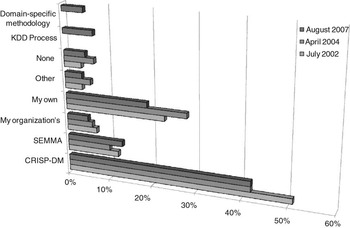
CRISP-DM is the most commonly used methodology for developing data mining projects (KdNuggets.Com, 2002, 2004, 2007b). However, its use is not becoming any more widespread due to rivalry with other, in-house methodologies developed by work teams and sample, explore, modify, model, assess (SEMMA) methodology (see Figure 2).

This decrease in the use of CRISP-DM is due to the fact that it just defines what to do and not how to do. Because of that, work teams have started to use its own methodologies. Another inconvenience is that CRISP-DM does not include project management activities such as quality management or change management (Marbán et al., Reference Marbán, Segovia, Menasalvas and Fernandez-Baizan2008). On the other hand, the use of SEMMA methodology has lightly increased because of the growth in the use of its data mining support tool, Enterprise Miner, developed by SAS and based in SEMMA methodology. SAS is a leader company in BI and it has the most comprehensive BI platform in the industry with the most advanced analysis capabilities. It is corroborated by the Magic Quadrant for BI platforms published by Gartner (Richardson et al., Reference Richardson, Schlegel, Hostmann and McMurchy2008), where SAS has been placed in the Leaders Quadrant. It confirms that SAS is the leader in BI and analytical software and services.
In the study by Yang and Wu (Reference Yang and Wu2006), one of the 10 challenging problems to be solved in data mining research is the need to build a new methodology to help users avoid many common data mining mistakes, by improving the automation of the KDD process. As it will be seen later, there are a lot of proposed methodologies for data mining projects, but a correct and complete methodology, which complies with the methodology definition detailed in the next section, has not been developed yet.
Previously, some surveys about process models and methodologies have been published. It is fitting to point out (Kurgan & Musilek, Reference Kurgan and Musilek2006), it presents a historical overview, description and future directions concerning a standard for a data mining process model.
It presents a comparison of five data mining process models and methodologies: KDD process (Fayyad et al., Reference Fayyad, Piatetsky-Shapiro and Smyth1996b), Cabena et al. (Reference Cabena, Hadjinian, Stadler, Verhees and Zanasi1997), Anand and Buchner (Reference Anand and Buchner1998), CRISP-DM (Chapman et al., Reference Chapman, Clinton, Kerber, Khabaza, Reinartz, Shearer and Wirth2000); and proposes a six-step generic model based on the five surveyed models (Application domain understanding, data understanding, data preparation and identification of data mining technology, data mining, evaluation and knowledge consolidation and deployment). The survey also proposes to enhance existing models by embedding other current standards to enable automation and interoperability of the entire process.
The five approaches analyzed in the study by Kurgan and Musilek (Reference Kurgan and Musilek2006) are included in this survey (and nine more). In later sections, we also propose a new approach based on the comparison of the 14 analyzed approaches. And we agree with Kurgan and Musilek (Reference Kurgan and Musilek2006) that standardization of data mining process models should be an essential research line in present and future of data mining and knowledge discovery.
This paper presents a review of most used and cited process models and methodologies for data mining and knowledge discovery projects. First of all, some technical terms referenced along the paper are defined. After describing most important models and methodologies, a comparative study between all of them is built. As a result, a new refined data mining process, including specific steps taken out of studied approaches, is presented. Finally, some conclusions are listed.
2 Basic terms about process models
Process models, paradigms, methodologies, techniques and tools are essential strategic, tactical and technical elements for developing an engineering project. In the next sections every element is described:
• Process model
A process model can be defined as the set of framework activities and tasks to get the job done, including inputs and outputs in every task (Pressman, Reference Pressman2005). The final objective of a process model is to do it manageable, repeatable and measurable. A good process model should comply the following characteristics (McCall et al., Reference McCall, Richards and Walters1977; Tyrrell, Reference Tyrrell2000).
o Effective. An effective process must help us produce the right product.
o Maintainable. So we can quickly and easily find and remedy faults or work out where to make changes.
o Predictable. Any new product development needs to be planned, and those plans are used as the basis for allocating resources: both time and people. A good process will help us do this. The process helps lay out the steps of development.
o Repeatable. If a process is discovered to work, it should be replicated in future projects. Ad hoc processes are rarely repeatable unless the same team is working on the new project. Even with the same team, it is difficult to keep things exactly the same.
o Quality. Quality in this case may be defined as the product’s fitness for its purpose.
o Improvable. No one would expect his or her process to reach perfection and need no further improvement itself. Even if we were as good as we could be now, both development environments and requested products are changing so quickly that our processes will always be running to catch up.
o Traceable. A defined process should allow the project staff to follow the status of a project.
• Paradigm
In a study by Harman (Reference Harman1970) paradigm is defined as a basic way of perceiving, thinking, valuing and doing things that are associated with a particular vision of reality. On the other hand, in Barker (Reference Barker1992) and Capra (Reference Capra1996) paradigm is defined as a set of rules that define limits, and state what is necessary to be successful within those limits.
• Methodology
Methodology can be defined as a process model instance, in which not only tasks, inputs and outputs must be specified but also the way in which the tasks must be carried out. It has to be taken into account that a methodology can be an instance of different process models, and vice versa, such as shown in Figure 3. Tasks are executed by using techniques that defines how to do them (Pressman, Reference Pressman2005). After selecting the techniques, a tool can be used to support the carrying out of the established tasks. These tools apply the techniques, and tasks are made easier. To sum up, process models define what to do, methodologies define how to do.
Figure 3Process models with different methodologies

• Life cycle
Life cycle determines the order in which activities will be done (McConnell, Reference McConnell1997). A life cycle model is the description of different ways of developing a project. The main functions of a life cycle are:
o To establish the order of phases and processes involved in project development.
o To establish the criteria to step forward from a phase to the next (intermediate deliverable). It includes the criteria to validate a phase and select the next one.

Life cycles provide an order guide (phases, activities, prototypes, validations) in which the most important activities of the project should be done. Project success depends on the selected life cycle, since it can help to assure every step takes us to achieve the objective. A wrong choice can be a source of delays and unnecessary work.
As an example, if we take a software project development, the process model defines tasks to carry out, such as requirements specification, implementation, maintenance, management and support activities. As process model we could use ISO 12207 (ISO, 1995). The paradigm would show the approach of developing the software, for instance with object-oriented techniques, structured techniques, real-time techniques. The methodology must be consistent with techniques. For example, if we choose an object-oriented paradigm, the methodology would be object-oriented. An object-oriented methodology could be rational unified process (RUP) (Jacobson et al., Reference Jacobson, Booch and Rumbaugh1999), widespread and accepted by software industry. Techniques would be requirement elicitation, test techniques and analysis and design techniques for object-oriented software. About tools, we can use CASE tools like rational rose that supports analysis and design of software tests. About life cycle, if RUP is selected as methodology, life cycle would be iterative and incremental.
3 Data mining and knowledge discovery process models and methodologies
In this section, there will be presented the evolution of data mining and knowledge discovery process models and methodologies to provide a review of them.
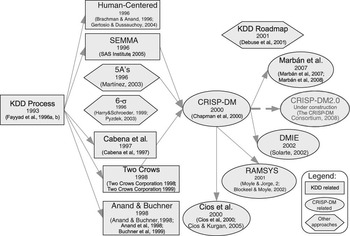
Figure 4 shows the evolution of 14 data mining process models and methodologies. We can point out KDD as the initial approach, and CRISP-DM as the central approach of the evolution diagram. Most of the approaches are based on them.
Evolution of data mining process models and methodologies

The two main approaches, KDD and CRISP-DM, are described in depth. The rest of the approaches are briefly described as they are based on KDD or CRISP-DM. Apart from that, contributions and disadvantages of every approach are shown.
The description of the 14 existing data mining and knowledge discovery methodology and process model approaches are divided into three subsections:
• KDD related approaches: this subsection includes a detailed description of the original KDD process proposed by Fayyad et al. (Reference Fayyad, Piatetsky-Shapiro and Smyth1996a) and a brief description of the approaches directly derived from the original KDD process.
• CRISP-DM related approaches: this subsection includes a detailed description of CRISP-DM (Chapman et al., Reference Chapman, Clinton, Kerber, Khabaza, Reinartz, Shearer and Wirth2000) and a brief description of the approaches directly derived from CRISP-DM.
• Other approaches: this subsection includes a brief description of other independent approaches.
3.1 KDD related approaches
3.1.1 KDD process
The term KDD, appeared first time in latest 1980s (Piatetsky-Shapiro, Reference Piatetsky-Shapiro1991) to emphasize that knowledge is the product of a discovery process guided by data, and it is a joint point of different research areas focused on data analysis and knowledge extraction from different points of view, such as data bases, statistics, mathematics, logic or artificial intelligence.
KDD is defined as the non-trivial process of identifying valid, novel, potentially useful and ultimately understandable patterns in data (Fayyad et al., Reference Fayyad, Piatetsky-Shapiro, Smith and Uthurusamy1996c). Here, data are a set of facts, and pattern is an expression in some language describing a subset of the data or a model applicable to the subset. Extracting a pattern also designates fitting a model to data. The discovered patterns should be valid on new data with some degree of certainty. We also want patterns to be novel (at least to the system and preferably to the user) and potentially useful, that is, lead to some benefit to the user or task. Finally, the patterns should be understandable, if not immediately then after some postprocessing.
The term process implies that KDD comprises many steps, which involve data preparation, search for patterns, knowledge evaluation and refinement, all repeated in multiple iterations. By non-trivial, authors mean that some search or inference is involved.
According to the aforementioned, KDD refers to the overall process of discovering useful knowledge from data. It involves the evaluation and possibly interpretation of the patterns to make the decision of what qualifies as knowledge. It also includes the choice of encoding schemes, preprocessing, sampling and projections of the data before the data mining step.
Data mining step refers to the application of algorithms for extracting patterns from data without the additional steps of the KDD process.
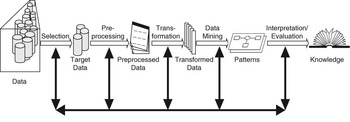
The KDD process is outlined in Figure 5 from the data viewpoint.
Overview of the steps constituting the knowledge discovery in databases (KDD) process (Fayyad et al., Reference Fayyad, Piatetsky-Shapiro and Smyth1996b)

The KDD process is interactive and iterative (with many decisions made by the user), involving nine steps, described from the practical viewpoint as:
• Learning the application domain
It includes developing an understanding of the relevant prior knowledge and the goals of the application.
• Creating a target data set
It includes selecting a data set or focusing on a subset of variables or data samples on which discovery is to be performed.
• Data cleaning and preprocessing
It includes basic operations, such as removing noise or outliers if appropriate, collecting the necessary information to model or account for noise, deciding on strategies for handling missing data fields, and accounting for time sequence information and known changes, as well as deciding data base management system issues, such as data types, schema and mapping of missing and unknown values.
• Data reduction and projection
It includes finding useful features to represent the data, depending on the goal of the task, and using dimensionality reduction or transformation methods to reduce the effective number of variables under consideration or to find invariant representations for the data.
• Choosing the function of data mining
It includes deciding the purpose of the model derived by the data mining algorithm (e.g., summarization, classification, regression and clustering).
• Choosing the data mining algorithm
It includes selecting method(s) to be used for searching for patterns in the data, such as deciding which models and parameters may be appropriate and matching a particular data mining method with the overall criteria of the KDD process.
• Data mining
It includes searching for patterns of interest in a particular representational form or a set of such representations, including classification rules or trees, regression, clustering, sequence modeling, dependency, association rules and line analysis.
• Interpretation
It includes interpreting the discovered patterns and possibly returning to any of the previous steps, as well as possible visualization of the extracted patterns, removing redundant or irrelevant patterns and translating the useful ones into terms understandable by users.
• Using discovered knowledge
It includes incorporating this knowledge into the performance system, taking actions based on the knowledge or simply documenting it and reporting it to interested parties, as well as checking for and resolving potential conflicts with previously believed (or extracted) knowledge.
3.1.2 Human-centered approach of data mining
Brachman and Anand (Reference Brachman and Anand1996) and Gertosio and Dussauchoy (Reference Gertosio and Dussauchoy2004) gave a practical view of the KDD process, emphasizing the interactive nature of the process. The human-centered model emphasized the interactive involvement of a data analyst (data miner) during the process.
Its basic steps are shown in Figure 6: task discovery, data discovery, data cleaning, model development, data analysis and output generation.
Human-centered process

These six steps cover the same tasks that are included in Fayyad et al. (Reference Fayyad, Piatetsky-Shapiro, Smith and Uthurusamy1996c) KDD process.
The main difference between both approaches is that human-centered process is focused in the tasks from the data miner viewpoint, while KDD process is more focused in data transformations. Human-centered model shows in a clearer way which decisions the user has to make.
3.1.3 SEMMA
SAS Institute defines SEMMA as a logical organization of the functional tool set of SAS enterprise miner for carrying out the core tasks of data mining (SAS Institute, 2005). Enterprise miner can be used as part of any iterative data mining methodology adopted by the client. SEMMA is focused on the model development aspects of data mining. Figure 7 shows SEMMA steps.
Sample, explore, modify, model, assess (SEMMA) methodology steps

The main difference between the original KDD process and SEMMA is that SEMMA is integrated into SAS tools such as Enterprise Miner and it’s unlikely to use SEMMA methodology out of them, while KDD is an open process and it can be applied in very different environments.
There are other two important differences between SEMMA and the original KDD process. On the one hand, SEMMA skips the first step of KDD process, learning the application domain, and starts directly with sample step. On the other hand, SEMMA does not include an explicit step to use the discovered knowledge, while KDD includes using discovered knowledge step. These two steps are considered essential to carry out a data mining project with success.
3.1.4 Cabena et al.
Cabena et al. define in (Cabena et al., Reference Cabena, Hadjinian, Stadler, Verhees and Zanasi1997) data mining (referring to the complete KDD process) as the process of extracting previously unknown, valid, and actionable information from large databases and then using the information to make crucial business decisions.
Figure 8 shows the steps of data mining process according to Cabena et al: business objectives determination, data preparation (that includes data selection, data preprocessing and data transformation), data mining, analysis of results, and assimilation of knowledge.
Data mining process according to (Cabena et al., Reference Cabena, Hadjinian, Stadler, Verhees and Zanasi1997)

There are not big differences between the data mining tasks proposed by the original KDD process and Cabena et al. approach, although they structure the process in a different number of steps.
3.1.5 Two Crows
The Two Crows data mining process model is proposed by Two Crows Corporation (1999). This model is derived from the previous edition of the Two Crows process model (Two Crows Corporation, 1998), and also takes advantage of some insights from first versions of CRISP-DM (before CRISP-DM 1.0 is released).
While the steps appear in a list, the data mining process is not linear you will inevitably need to loop back to previous steps.
Figure 9 shows the basic steps of Two Crows: define business problem, build data mining data base, explore data, prepare data for modeling, build model, evaluate model, and deploy model and results.
Two crows data mining process model

Two Crows approach is very closed to the original KDD process, although they use different names for similar steps.
3.1.6 Anand and Buchner
Anand and Buchner (Buchner et al., Reference Buchner, Mulvenna, Anand and Hughes1999) have proposed a model covering the entire life cycle of an online customer, the available operational and materialized data, as well as the incorporation of marketing knowledge. The web-enabled knowledge discovery process, also known as internet-enabled knowledge discovery process, is an adoption of a generic process defined in earlier work (Anand & Buchner, Reference Anand and Buchner1998; Anand et al., Reference Anand, Patrick, Hughes and Bell1998) adapted to web mining projects in this case.
As shown in Figure 10, the model consists of eight steps: human resource identification, problem specification, problem specification, data prospecting, methodology identification, data preprocessing, pattern discovery, and knowledge postprocessing. While it is true that Anand and Buchner (Reference Anand and Buchner1998) provide a detailed analysis of initial steps of the process, unfortunately, it does not include the needed activities to use the discovered knowledge.
Anand and Buchner process model (Buchner et al., Reference Buchner, Mulvenna, Anand and Hughes1999)

3.2 CRISP-DM related approaches
3.2.1 CRISP-DM
In response to common issues and needs in data mining project in the mid 90’s, a group of organizations involved in data mining (Teradata, SPSS -ISL-, Daimler-Chrysler and OHRA) proposed a reference guide to develop data mining projects, named CRISP-DM (CRoss Industry Standard Process for Data Mining) (Chapman et al., Reference Chapman, Clinton, Kerber, Khabaza, Reinartz, Shearer and Wirth2000). CRISP-DM is considered the de facto standard for developing data mining and knowledge discovery projects. One important factor of CRISP-DM success is the fact that CRISP-DM is industry-, tool- and application-neutral.
The CRISP-DM data mining methodology is described in terms of a hierarchical process model, consisting of sets of tasks described at four levels of abstraction (from general to specific) (see Figure 11). At the top level, the data mining process is organized into a number of phases; each phase consists of several second-level generic tasks. This second level is called generic, because it is intended to be general enough to cover all possible data mining situations. The third level, the specialized task level, is the place to describe how actions in the generic tasks should be carried out in certain specific situations. The fourth level, the process instance, is a record of the actions, decisions and results of an actual data mining engagement.
Four-level breakdown of the Cross-Industry Standard Process for Data Mining (CRISP-DM) methodology

Horizontally, the CRISP-DM methodology distinguishes between the reference model and the user guide. The reference model presents a quick overview of phases, tasks, and their outputs and describes what to do in a data mining project. The user guide gives more detailed tips and hints for each phase and each task within a phase and depicts how to do a data mining project.
CRISP-DM distinguishes between four different dimensions of data mining contexts:
• The application domain is the specific area in which the data mining project takes place.
• The data mining problem type describes the specific classes of objectives that the data mining project deals with.
• The technical aspect covers specific issues in data mining that describe different (technical) challenges that usually occur during data mining.
• The tool and technique dimension specifies, which data mining tool(s) and/or techniques are applied during the data mining project.
The CRISP-DM process model for data miningFootnote 3 provides an overview of the life cycle of a data mining project. It contains the corresponding phases of a project, their respective tasks, and relationships between these tasks.
The life cycle of a data mining project according to CRISP-DM consists of six phases (Figure 12). The sequence of the phases is not strict. Moving back and forth between different phases is always required. It depends on the outcome of each phase, which phase or which particular task of a phase, that has to be performed next. The arrows indicate the most important and frequent dependencies between phases.
Cross-Industry Standard Process for Data Mining (CRISP-DM) process model (Chapman et al., Reference Chapman, Clinton, Kerber, Khabaza, Reinartz, Shearer and Wirth2000)

Below follows a brief outline of the phases:
• Business understanding
This initial phase focuses on understanding the project objectives and requirements from a business perspective, and then converting this knowledge into a data mining problem definition, and a preliminary plan designed to achieve the objectives.
• Data understanding
The data understanding phase starts with an initial data collection and proceeds with activities in order to get familiar with the data, to identify data quality problems, to discover first insights into the data, or to detect interesting subsets to form hypotheses for hidden information.
• Data preparation
The data preparation phase covers all activities to construct the final data set (data that will be fed into the modeling tool(s)) from the initial raw data. Data preparation tasks are likely to be performed multiple times, and not in any prescribed order. Tasks include table, record and attribute selection as well as transformation and cleaning of data for modeling tools.
• Modeling
In this phase, various modeling techniques are selected and applied, and their parameters are calibrated to optimal values. Typically, there are several techniques for the same data mining problem type. Some techniques have specific requirements on the form of data. Therefore, stepping back to the data preparation phase is often needed.
• Evaluation
At this stage in the project you have built a model (or models) that appears to have high quality, from a data analysis perspective. Before proceeding to final deployment of the model, it is important to more thoroughly evaluate the model, and review the steps executed to construct the model, to be sure it properly achieves the business objectives. A key objective is to determine if there is some important business issue that has not been sufficiently considered. At the end of this phase, a decision on the use of the data mining results should be reached.
• Deployment
Generally, the creation of the model is not the end of the project. Even if the purpose of the model is to increase knowledge of the data, it will be necessary to organize the knowledge extracted, as well as to present it in a useful way to the customer. Depending on the requirements, the deployment phase can be as simple as generating a report or as complex as implementing a repeatable data mining process. In many cases it will be the customer, not the data analyst, who will carry out the deployment steps. However, even if the analyst will not carry out the deployment effort it is important for the customer to understand up front what actions will need to be carried out in order to actually make use of the created models.
3.2.2 CRISP-DM 2.0
Many changes have occurred in the business application of data mining since CRISP-DM 1.0 was published (CRISP-DM, 2007). Emerging issues and requirements include:
• The availability of new types of data (e.g., text, web and attitudinal data) along with new techniques for preprocessing, analyzing and combining them with related case data.
• Integration and deployment of results with operational systems such as call centers and web sites.
• Far more demanding requirements for scalability and for deployment into real-time environments.
• The need to package analytical tasks for non-analytical end users and integrate these tasks in business workflows.
• The need to seamlessly integrate the deployment of results and closed-loop feedback with existing business processes.
• The need to mine large-scale databases in situ, rather than exporting an analytical data set.
• Organizations’ increasing reliance on teams, making it important to educate greater numbers of people on the processes and best practices associated with data mining and predictive analytics.
In response to evolving business needs, the CRISP-DM methodology is to be updated. For this purpose, it has been established the CRISP-DM 2.0 special interest group (SIG) to work in the new methodology. Apart from members of the original consortium established for CRISP-DM 1.0, vendors, service providers, researchers and end-users are being sought to join them in the consortium. Although there is not a definitive model yet, the CRISP-DM 2.0 SIG is working on it. This new methodology is expected to include changes such as adding new steps, renaming existing phases and/or deleting any old phase (The CRISP-DM Consortium, 2008).
3.2.3 Cios et al.
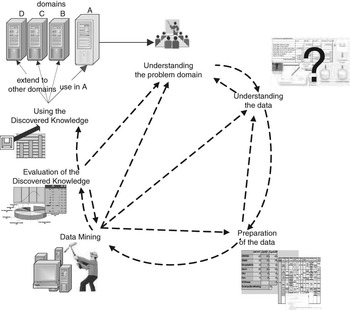
The process model of Cios et al. (Cios et al., Reference Cios, Teresinska, Konieczna, Potocka and Sharma2000; Cios & Kurgan, Reference Cios and Kurgan2005) was first proposed in 2000 by adapting the CRISP-DM model to the needs of academic research community. The main extensions of the latter model include a more general, research-oriented description of the steps, introduction of several explicit feedback mechanisms and a modification of the description of the last step, which emphasizes that knowledge discovered for a particular domain may be applied in other domains. Cios et al. process model is based on technologies like XML, PMML, SOAP, UDDI and OLE BD-DM.
The model, as shown in Figure 13, consists of six steps: understanding the problem domain, understanding the data, preparation of the data, data mining, evaluation of the discovered knowledge and using the discovered knowledge.
Cios et al.’s process model (Cios & Kurgan, Reference Cios and Kurgan2005)

Figure 13 shows that the process is iterative and interactive. Since any changes and decisions made in one of the steps can result in changes in later steps, the feedback loops are necessary.
3.2.4 Rapid collaborative data mining system (RAMSYS)
In Moyle and Jorge (Reference Moyle and Jorge2001) and Blockeel and Moyle (Reference Blockeel and Moyle2002) RAMSYS methodology is described. RAMSYS is a methodology for performing data mining work where different groups are geographically dispersed, but work together on the same problem in a collaborative way. The RAMSYS methodology attempts to achieve the combination of a problem solving methodology, knowledge sharing and ease of communication. It is guided by the following principles: it should enable light management, it should allow collaborators to start and stop any time and leave them problem-solving freedom, it should provide efficient knowledge sharing and security.
The RAMSYS methodology is based on CRISP-DM and keeps the same steps and generic tasks (see Figure 14). It can be regarded as a refinement of CRISP-DM, where some of the generic tasks have to be carried out in a collaborative mode, while accounting for the possibility of the ‘remote’ restriction. In the RAMSYS Methodology, the current best understanding of the problem is kept in the information vault, where information is shared between the different groups.
Rapid collaborative data mining system (RAMSYS) methodology

The RAMSYS methodology proposes a new task called model submission into the modeling step, where the current best models from each of the nodes will be selected, evaluated and delivered.
3.2.5 Data mining for industrial engineering (DMIE)
In a study by Solarte (Reference Solarte2002) a methodology is presented for data mining projects oriented to industrial engineering domain. This methodology is based on CRISP-DM, but DMIE methodology establishes different phases (see Figure 15). DMIE consists of five steps: analyze the organization, structure the work, develop the data model, implement the model, establish on-going support.
Data mining process for industrial engineering (DMIE) (Solarte, Reference Solarte2002)

The main contribution of the DMIE approach is a phase that is included only in it (until the moment DMIE was published), named on-going support. It consists of a support and maintenance phase, involving data backups, data maintenance, data mining model updates and software updates when needed.
3.2.6 Marbán et al.
This approach (Marbán et al., Reference Marbán, Mariscal, Menasalvas and Segovia2007, Reference Marbán, Segovia, Menasalvas and Fernandez-Baizan2008) is based on the idea that data mining problems are taking on the dimensions of an engineering problem. Therefore, the processes to be applied should include all the activities and tasks required in an engineering process, tasks that CRISP-DM (the most currently used data mining model) does not cover. (Marbán et al., Reference Marbán, Mariscal, Menasalvas and Segovia2007) enhances CRISP-DM by embedding other current standards, as suggested in (Piatetsky-Shapiro, Reference Piatetsky-Shapiro2000; Kurgan & Musilek, Reference Kurgan and Musilek2006), inspired by the work done recently in software engineering derived from other branches of engineering and from developer experience. This approach proposes a data mining engineering process model that covers the above points, making a distinction between a process model and a methodology and life cycle.
Figure 16 shows a general scheme of Marbán et al. process model including most relevant subprocesses, pointing out the KDD process (based on Fayyad et al. (Reference Fayyad, Piatetsky-Shapiro and Smyth1996b) KDD process and CRISP-DM) as the core of the development processes. The rest of management and development processes are based on two software engineering standard process models: IEEE 1074 (IEEE, 1991) and ISO 12207 (ISO, 1995).
Process model for data mining engineering (Marbán et al., Reference Marbán, Mariscal, Menasalvas and Segovia2007)

3.3 Other approaches
3.3.1 The five A’s
SPSS defines the five A’s methodology (de Piśon Ascacibar, Reference de Pisón Ascacibar2003; SPSS, 2007) (assess, access, analyze, act, automate) as a general vision of data analysis and data mining processes. Five A’s is closer to a trend in data mining project development than a process model, so that it does not describe how to develop a data mining project.
Figure 17 shows five A’s steps.
5 A’s methodology phases

The main contribution of five A’s approach is the automate step. It is based on the interesting idea of the automation of data mining process in order to let non-expert data mining users to apply previous obtained models to new data. The resulting tool can be very useful for supporting non-expert data mining users to get new knowledge from new data in an easy way.
The negative aspect of five A’s is that it does not establish other alternative ways of applying the built model or discovered knowledge, that is why automate step of five A’s is only partially equivalent to deployment step of five A’s.
Another important disadvantage of five A’s is that five A’s does not include data understanding step that is considered an essential step in CRISP-DM to understand the data and test its quality to prevent possible problems during the project development.
The five A’s approach was abandoned by SPSS in 1999 when it joined CRISP-DM consortium to develop the CRISP-DM process model.
3.3.2 The six sigma (6-σ)
In mid-1996, Motorola developed the 6-σ method (Harry & Schroeder, Reference Harry and Schroeder1999; Pyzdek, Reference Pyzdek2003). The 6-σ is a paradigm for quality and excellence in management. In other words, it defines how to improve quality and customer’s satisfaction and, at the same time, reduce production costs.
On account of Motorola’s success in applying 6-σ method, other companies like Texas Instrument, IBM, Kodak, General Electric, Ford, Microsoft or American Express have decided to apply this method in its production process (Arranz, Reference Arranz2007).
The 6-σ method has also been applied in data mining projects (StatSoft, Reference StatSoft2005). It is based on DMAIC (define, measure, analyze, improve and control). The steps and tasks of 6-σ are shown in Figure 18.
6-σ paradigm

3.3.3 KDD Roadmap
KDD Roadmap (Debuse et al., Reference Debuse, de la Iglesia, Howard and Rayward-Smith2001) is a data mining methodology used in Witness Miner toolkit (Group, Reference Group2006). As shown in Figure 19, KDD roadmap is an iterative methodology and it consists of eight steps: problem specification, resourcing, data cleansing, preprocessing, data mining, evaluation, interpretation and exploitation.
Knowledge discovery in databases (KDD) Roadmap

The main contribution of KDD roadmap is the resourcing task. It is considered an essential task in the knowledge discovery process as it becomes an independent step in KDD roadmap.
4 Data mining and knowledge discovery methodologies and process models comparative analysis
This section is intended to provide a detailed comparison between all methodologies and process models described above, focusing on phases and tasks included in every approach.
First of all, detailed and outlined descriptions of KDD process will be compared with CRISP-DM. In earlier sections of this paper, it was shown that CRISP-DM is the central approach of the evolution of data mining methodologies and process models. Moreover, CRISP-DM is the most used data mining methodology and it is considered the de facto standard. For all these reasons, we choose CRISP-DM as the reference model to be compared with the rest of the approaches in order to detect specific differences in the steps of the discovery process proposed by each approach in comparison with CRISP-DM.
Therefore, the comparison is divided in three different mappings:
• KDD vs. CRISP-DM: To start with, the two main approaches will be compared. A mapping of the steps of every approach is shown, including KDD-detailed, KDD-outlined and CRISP-DM.
• CRISP-DM vs. KDD related approaches: The second mapping includes a comparison between CRISP-DM and KDD related approaches.
• CRISP-DM vs. CRISP-DM related approaches: The third mapping includes a comparison between CRISP-DM and CRISP-DM related approaches.
• CRISP-DM vs. other approaches: The last mapping includes a comparison between CRISP-DM and other independent approaches that are five A’s, 6-σ and KDD Roadmap.
4.1 KDD process vs. CRISP-DM
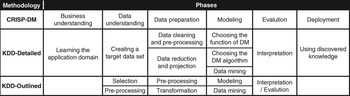
Figure 20 shows the mapping between KDD process (KDD-outlined and KDD-detailed) steps and CRISP-DM steps.
Knowledge discovery in databases (KDD) process vs. Cross-Industry Standard Process for Data Mining (CRISP-DM)

The mapping focuses on phases and tasks included in every approach. When two different steps of two different approaches carry out a common task, it will be noticed with a match between both steps.
In the first two rows of Figure 20, we compare the six steps shown in Figure 12 (CRISP-DM) with the KDD nine steps (KDD-detailed). Both of them cover the same tasks, although KDD-detailed proposes more specific phases in this high-level analysis (six steps in CRISP-DM vs. nine steps in KDD). To be precise, data preparation step of CRISP-DM is split up into two steps in KDD-detailed: on the one hand, data cleaning and preprocessing, on the other hand, data reduction and projection. In addition, modeling step of CRISP-DM is separated into three steps in KDD-detailed: choosing the data mining function, choosing the data mining algorithm and data mining.
On the other hand, according to KDD-outlined vs. CRISP-DM comparison, it is shown that KDD-outlined is incomplete, as it does not include business understanding or deployment steps.
4.2 CRISP-DM vs. KDD related approaches
Figure 21 shows the mapping between CRISP-DM and KDD related approaches. We consider it is interesting to analyze if they propose contributions to CRISP-DM process (the currently most used process model).
Cross-Industry Standard Process for Data Mining (CRISP-DM) vs. knowledge discovery in databases (KDD) related approaches

In the first two rows, human-centered and CRISP-DM steps are compared. In general, both solutions cover the same tasks. For instance, task discovery step of human-centered sets the business objectives and it analyzes the data sources and its understanding, while CRISP-DM sets the business objectives in the business understanding step, and it analyzes the data sources and its understanding in the subsequent data understanding step.
On the other hand, in CRISP-DM, the data preprocessing step includes the data segmentation task that is carried out in the model development step in the human-centered approach.
Moreover, the modeling step of CRISP-DM is separated into two steps in the human-centered approach. The first one is the model development step and it includes selecting the model, parameters and tools to be used. The second step is data analyzing, in which the model is performed, validated and refined, whereas in CRISP-DM the model is validated in the evaluation step.
Focusing on the mapping between the steps proposed by SEMMA and CRISP-DM approaches, SEMMA and CRISP-DM methodologies share the same philosophy because they structure the data mining project in steps connected among themselves. This is why the data mining process becomes iterative and interactive.
SEMMA methodology is more focused on the technical characteristics involved in the process development, whereas CRISP-DM methodology has a broader perspective regarding the business objectives of the project. This difference is shown from the beginning in the first data mining step, where SEMMA methodology starts with a data sampling, while CRISP-DM starts analyzing the business problem in order to turn it into a technical problem, as shown in Figure 21. From this viewpoint, looking at the project as a whole, it can be considered that CRISP-DM methodology is closer to the real project concept. Moreover, SEMMA does not include an explicit step to use the discovered knowledge, while CRISP-DM includes the deployment step.
Focusing on the mapping between (Cabena et al., Reference Cabena, Hadjinian, Stadler, Verhees and Zanasi1997) and CRISP-DM steps. Both approaches cover practically the same tasks to complete the whole KDD process. There are some overlaps between tasks of each process. For instance, preprocess step of Cabena et al. apart from detecting mistakes in data, prepares a set of suited data for the later analysis, while data understanding step of CRISP-DM just selects data sources and analyze data quality without preparing data for the next step.
Apart from that, we can point out that Cabena et al. model joins evaluation and deployment CRISP-DM steps in analyze and assimilate step. Although analyze and assimilate step in Cabena et al. model carries out equivalent tasks to two named steps of CRISP-DM, it does not include reports or documents related to obtained knowledge.
Focusing on the mapping between Two Crows data mining process model steps and CRISP-DM steps, Figure 21 shows that both models are quite similar, although there is a clear difference. Data understanding and data preparation steps of CRISP-DM that are distributed in Two Crows in three steps: build data mining data base, explore data and prepare data for modeling. Explore data step of Two Crows consists of tasks extracted from both data understanding and data preparation CRISP-DM steps.
In Figure 21, Anand and Buchner (Reference Anand and Buchner1998) steps are compared with CRISP-DM steps. As shown, Anand and Buchner (Reference Anand and Buchner1998) does not include deployment step of CRISP-DM to use discovered knowledge. Anand and Buchner approach is the only one that proposes carrying out the algorithm selection (in methodology identification step) before data preprocessing. In CRISP-DM, algorithm selection task is included in modeling step, after preparing the data.
4.3 CRISP-DM vs. CRISP-DM related approaches
Figure 22 shows a comparison between CRISP-DM and CRISP-DM related approaches. It is worthwhile examining the possible contributions of these approaches to CRISP-DM.
Cross-Industry Standard Process for Data Mining (CRISP-DM) vs. CRISP-DM-related approaches

The first two rows of the figure shows the mapping between Cios et al. (Reference Cios, Teresinska, Konieczna, Potocka and Sharma2000) approach steps and CRISP-DM steps, Figure 22 shows that both approaches are quite similar from a high-level viewpoint. To find differences, it is necessary focusing on process iterations. For example, Cios approach let the process go back from data preparation step to data understanding step, while CRISP-DM does not show it as a common transition.
The RAMSYS methodology is based on CRISP-DM and keeps the same steps and generic tasks (Figure 22). It can be regarded as a refinement of CRISP-DM, where some of the generic tasks have to be carried out in a collaborative mode, while accounting for the possibility of the ‘remote’ restriction. As RAMSYS only introduce some changes at task level and it does not change the CRISP-DM steps, the mapping in figure shows the same steps.
Figure 22 also shows the mapping between DMIE (Solarte, Reference Solarte2002) steps and CRISP-DM steps. There are clear differences between both models as shown in that figure. First, business understanding step of CRISP-DM is considered by DMIE as two different steps: analyze the organization and structure the work. According to this, DMIE separates tasks related to organization from tasks related to project management. However, DMIE joins develop data model, data understanding and data preparation steps. DMIE also joins modeling, evaluation and deployment steps of CRISP-DM in implement model step. The main contribution of DMIE approach is a phase that only it includes (until the moment DMIE was published), named on-going support. It consists of a support and maintenance phase, involving data backups, data maintenance, data mining model updates and software updates when needed.
About Marbán et al. (Reference Marbán, Segovia, Menasalvas and Fernandez-Baizan2008), it is a process model based on software engineering standard process models, CRISP-DM model and KDD process.
It classifies processes in three large groups: project management processes (including life cycle selection processes), development processes (including predevelopment processes, development processes itself, and postdevelopment processes) and integral processes.
Figure 22 shows the mapping between process groups (or subgroups) included in Marbán et al. and CRISP-DM steps.
From the comparison of CRISP-DM with a software engineering process model (Marbán et al., Reference Marbán, Segovia, Menasalvas and Fernandez-Baizan2008), it is found that many of the processes defined in software engineering that are very important for developing any type of DM engineering project are missing from CRISP-DM. This could be the reason why CRISP-DM is not as effective as it should be.
The activities missing from CRISP-DM are primarily project management processes, integral processes (that assure project function completeness and quality) and organizational processes (that help to achieve a more effective organization).
4.4 CRISP-DM vs. other approaches
Figure 23 shows the mapping between CRISP-DM and other independent approaches: five A’s, 6-σ and KDD Roadmap. Five A’s and 6-σ approaches are early approaches that were proposed after KDD and before CRISP-DM. In contrast, KDD Roadmap was proposed after CRISP-DM.
Cross-Industry Standard Process for Data Mining (CRISP-DM) vs. other approaches

Focusing on the comparison between the steps proposed by five A’s (de Piśon Ascacibar, Reference de Pisón Ascacibar2003) and CRISP-DM, Figure 21 shows that there are two main differences between them. First, five A’s does not include data understanding step that is considered an essential step in CRISP-DM to understand the data and test its quality to prevent possible problems during the project development.
The main contribution of five A’s approach is the automate step. The result is a useful tool for supporting non-expert data mining users to get new knowledge from new data in an easy way.
Analyzing CRISP-DM vs. 6-σ comparison in Figure 21, 6-σ joins data understanding and data preparation steps of CRISP-DM in measure step of 6-σ.
However, 6-σ considers important to separately analyze and improve steps in order to build the model.
These tasks are joint in the modeling step of CRISP-DM, although CRISP-DM points out the need of carrying out both tasks in an iterative way before going forward with the next step. According to this, CRISP-DM tries out different models before ending the modeling step, whereas 6-σ does not go back after analyzing and improving the steps just once.
Taking into account the comparison between KDD Roadmap (Debuse et al., Reference Debuse, de la Iglesia, Howard and Rayward-Smith2001) steps and CRISP-DM steps, although both approaches are quite similar, a clear difference is shown: KDD Roadmap includes one phase more than CRISP-DM. To be precise, KDD Roadmap considers that the business understanding step of CRISP-DM must be divided into problem specification and resourcing steps. According to this, KDD Roadmap emphasize the importance of the resourcing task by creating an independent step.
5 Refined data mining process
In this section, a global mapping of all approaches will be shown. After that, a new refined data mining process is built, based on this global comparative analysis.
Figure 24 shows a global comparison of steps of every described approaches. In addition, a generic data mining process model is proposed and detailed in last two columns of the table in that figure. We have named it Refined Data Mining Process.
Cross-Industry Standard Process for Data Mining (CRISP-DM) vs. rest of the approaches and refined data mining process.

We consider that a new process model for developing data mining and knowledge discovery projects is necessary as any of the existing approaches is complete. Some steps are included only in some specific proposals; that is, life cycle selection in Marbán et al. (Reference Marbán, Mariscal, Menasalvas and Segovia2007) model, on-going support in DMIE (Solarte, Reference Solarte2002), or automate in five A’s (de Piśon Ascacibar, Reference de Pisón Ascacibar2003). Hence, new important phases are appearing in new approaches.
CRISP-DM is the most widely used methodology for developing data mining projects, but it does not include some project management activities. Currently, not all data mining results are positive.
On the other hand, the proposed Refined Data Mining Process includes more specific phases than other approaches. One of the reasons of the problems in data mining and knowledge discovery is the numerous dependencies between the various phases and tasks of a data mining project (Sharma & Osei-Bryson, Reference Sharma and Osei-Bryson2009). Therefore, it will be easier to follow the Refined Data Mining Process and identify dependencies between phases. Anyway, this new approach is just a proposal and it has not been tested yet in real projects.
The refined data mining process consists of three large processes: analysis, development and maintenance. At the same time, these processes are divided into subprocesses. The refined data mining process is composed of 17 subprocesses extracted from the methodologies and process models described above.
The names of the three large processes (analysis, development and maintenance) have been chosen based on terminology commonly used in project development methodologies in any engineering area. Every subprocess of the refined data mining process are included in one of the three main processes.
The names of the 17 subprocesses have been chosen based on terminology used in described approaches. The established criteria to select steps from the described approaches is based on concreteness and relevance of phases defined in any approach. Each approach considers different tasks and steps as the most important and relevant in the KDD process. After building the global comparative table (see Figure 24) we have selected the most specific steps avoiding overlaps and covering every task included in any data mining and knowledge discovery project development.
According to that selection of steps, we propose the refined data mining process as a new theoretical process model for developing data mining and knowledge discovery projects. We will focus on the description of subprocesses, but we will not establish a concrete life cycle for the refined data mining process because we consider that a process model defines what to do, and a methodology defines how to do it including the order in which tasks had to be carried out. The definition of a methodology (with a concrete life cycle) based on the refined data mining process is proposed as a future challenge.
The 17 subprocess of the refined data mining process are described below:
• Analysis process
o Life cycle selection
This subprocess has been extracted from Marban et al. process model (Marbán et al., Reference Marbán, Mariscal, Menasalvas and Segovia2007), and it consists of three essential tasks to be carried out in any engineering project: acquisition, supply and life cycle selection.
The purpose of this subprocess is to identify and select a life cycle for the project that is to be developed. Possible life cycle models are identified and analyzed based on the type of project to be developed and its requirements. Then a model that provides proper support for the project is selected. This set of processes also extends to third party resource acquisition and supply. These two processes cover all the tasks related to supply or acquisition management.
CRISP-DM does not include any of the acquisition or supply processes at all. Authors own experience in DM project development suggests that acquisition and supply processes may be considered necessary and third parties engaged to develop or create DM models for projects of some size or complexity. Their management should therefore be specified as processes.
• Domain knowledge elicitation
This subprocess is extracted from Anand and Buchner (Reference Anand and Buchner1998), and it must be considered as an important one because domain knowledge elicitation can be a complex and useful task to have a better understanding of the data and the problem. The main objective of domain knowledge elicitation and later incorporation at the pattern discovery stage is to constrain the learning algorithms search space and to reduce the number of patterns discovered. Marketing knowledge is a type of domain expertise, obtained internally or externally has usually been formulated by (human or artificial) marketing experts.
• Human resource identification
This subprocess is extracted from Anand and Buchner (Reference Anand and Buchner1998) too, and it is an essential task to define a proper project team and project participants.
After a problem has been identified at the management level of a virtual enterprise, human resource identification is the first stage of the knowledge discovery process, which requires domain, data and data mining expertise. The synergy of these human resources as early as possible within any project is imperative to its success.
• Problem specification
This subprocess is extracted from Anand and Buchner (Reference Anand and Buchner1998). DMIE (Solarte, Reference Solarte2002) also includes it as Structure the work. This subprocess is important to establish concrete data mining objectives. Otherwise, we could make wrong efforts answering the wrong questions during the KDD process and it would cause delays.
At the problem specification stage, a better understanding of the problem is developed by the human resources identified in the previous stage. Project objectives and goals are defined from the data mining viewpoint. These objectives and goals have to be clear, concrete and understandable by every participant in the project. At the same time, it has to be considered that objectives and goals are dynamic due to changes in the requirements of the organization or business, and they must be reviewed and updated regularly. The problem is decomposed into tasks and those tasks that can be solved using a knowledge discovery approach are identified. Each of these tasks is associated with a particular goal.
In addition, tasks, techniques and tools to be used in the project must be selected in this step, taking into account objectives and goals.
• Data prospecting
This subprocess is extracted from Anand and Buchner (Reference Anand and Buchner1998), Two Crows (Two Crows Corporation, 1999) (where named Build Data Mining data base), and SEMMA (SAS Institute, 2005) (where named Sample).
This subprocess needs to be included in refined data mining process because it includes complex and important tasks. This subprocess is usually the first of the four subprocesses that constitute the data preparation. All four together take more time and effort than all the other subprocesses combined.
In order to perform data prospecting, the data mined should be collected. In addition, you may want to bring data from outside your company or you may want to add new fields computed from existing fields. Apart from that, a model is selected to research the efficacy of data mining.
• Data cleaning
This subprocess is extracted from KDD Roadmap methodology (Debuse et al., Reference Debuse, de la Iglesia, Howard and Rayward-Smith2001), where it is named data cleansing. Human-centered (Brachman & Anand, Reference Brachman and Anand1996) also includes this subprocess as data cleaning. This task is very important in KDD process to get cleaned data to work with later.
The aim of the data cleaning stage is to prepare and clean the data for subsequent tasks of the process. The cleaning stage involves operations such as searching for and removal of errors, sampling, dealing with outliers, missing and unreliable values and possibly balancing.
• Development process
o Preprocessing
This subprocess is included in KDD (Fayyad et al., Reference Fayyad, Piatetsky-Shapiro and Smyth1996b), KDD Roadmap (Debuse et al., Reference Debuse, de la Iglesia, Howard and Rayward-Smith2001), (Cabena et al., Reference Cabena, Hadjinian, Stadler, Verhees and Zanasi1997), and Anand and Buchner (Reference Anand and Buchner1998) approaches.
Although the entire process is iterative, the preprocessing is one of the main subprocesses that is applied a number of times; second only to the data mining subprocess. For which reason, we include the preprocessing subprocess in the refined data mining process.
Preprocessing is usually the first place where learning takes place and potentially useful patterns can be found.
o Data reduction and projection
This subprocess is extracted from the original KDD process Fayyad et al. (Reference Fayyad, Piatetsky-Shapiro and Smyth1996b). It includes essential tasks to complete the data preparation.
It includes finding useful features to represent the data, depending on the goal of the task, and using dimensionality reduction or transformation methods to reduce the effective number of variables under consideration or to find invariant representations for the data.
o Choosing the data mining function
According to KDD process by Fayyad et al. (Reference Fayyad, Piatetsky-Shapiro and Smyth1996b), this subprocess involves deciding the purpose of the model derived by the data mining algorithm and deciding the data mining techniques to apply (e.g., summarization, classification, regression and clustering).
o Choosing the data mining algorithm
According to KDD process by Fayyad et al. (Reference Fayyad, Piatetsky-Shapiro and Smyth1996b), it includes selecting method(s) to be used for searching for patterns in the data, such as deciding which models and parameters may be appropriate and matching a particular data mining method with the overall criteria of the KDD process.
o Build model
All approaches include this subprocess. This step is also called data mining, as some approaches refer to it. In this subprocess, the data mining model or models are applied to the data.
o Improve model
This subprocess is only included in 6-σ (Harry & Schroeder, Reference Harry and Schroeder1999). Most of the approaches include this subprocess as part of Build model subprocess. Six Sigma is focused in quality aspects and we agree that Improve model must be considered as an independent subprocess including concrete tasks to do it.
It involves an iterative process repeated as many times as necessary. It includes reviewing a model that was applied in Build model subprocess and trying to improve it.
o Evaluation
Most of the approaches include this subprocess, although there is a range of approaches, which can be used for evaluating the results of the Build model subprocess. The decision as to which method to use will depend on the data mining goal and the interest measure chosen to compare results. This subprocess includes evaluating the performance of the discovered knowledge with previously unseen examples (a test database is needed).
o Interpretation
This subprocess is only included in KDD Roadmap (Debuse et al., Reference Debuse, de la Iglesia, Howard and Rayward-Smith2001) as an independent task out of evaluation. Interpreting the results is an advanced task of evaluation that is performed by domain experts.
The crucial test for discovered knowledge is to satisfy the domain experts who can justify the results using their much deeper knowledge of the problem domain. Patterns that differ greatly from the knowledge of the domain expert should be carefully analyzed to explain such an anomaly.
o Deployment
This subprocess is extracted from CRISP-DM (Chapman et al., Reference Chapman, Clinton, Kerber, Khabaza, Reinartz, Shearer and Wirth2000). Other approaches includes this subprocess with other names as using discovered knowledge (KDD; Fayyad et al., Reference Fayyad, Piatetsky-Shapiro and Smyth1996b), Output generation (human-centered; Brachman & Anand, Reference Brachman and Anand1996), deploy model and results (Two Crows; Two Crows Corporation, 1999), Using the discovered knowledge (Cios et al., Reference Cios, Teresinska, Konieczna, Potocka and Sharma2000), and exploitation (KDD Roadmap; Debuse et al., Reference Debuse, de la Iglesia, Howard and Rayward-Smith2001). This is an essential subprocess that consists of applying the discovered knowledge. Creation of the model is generally not the end of the project. Even if the purpose of the model is to increase knowledge of the data, the knowledge gained need to be organized and presented in a way that the customer can use it. Depending on the requirements, the deployment phase can be as simple as generating a report or as complex as implementing a repeatable data mining process. In many cases it will be the customer, not the data analyst, who will carry out the deployment steps. However, even if the analyst will not carry out the deployment effort it is important for the customer to understand up front what actions need to be carried out in order to actually make use of the created models.
o Automate
This subprocess is only included in five A’s methodology (SPSS, 2007; de Piśon Ascacibar, Reference de Pisón Ascacibar2003). It is based on the interesting idea of the automation of data mining process in order to let non-expert data mining users to apply previous obtained models to new data.
We include this subprocess because we consider that the resulting tool can be very useful for supporting non-expert data mining users to get new knowledge from new data and existing models in an easy way.
• Maintenance process
o Establish on-going support
This subprocess is only included as an independent subprocess in DMIE (Solarte, Reference Solarte2002), although Marbán et al. proposal also includes maintenance tasks. We totally agree that maintenance tasks are essential in any engineering project, and it is not different in data mining projects. Data mining projects need a support and maintenance subprocess.
This maintenance involves data backups, data maintenance, data mining model updates (because new data appears and data mining models can change their behavior), and software updates when needed.
6 Conclusions
To date, many data mining and knowledge discovery methodologies and process models have been developed, with varying degrees of success. In this paper, we have described the most used (in industrial and academic projects) and cited (in scientific literature) data mining and knowledge discovery methodologies and process models, providing an overview of its evolution along with data mining and knowledge discovery history and setting down the state of the art in this topic.
For every approach, we have provided a detailed description of the proposed KDD process, discussing about special features, outstanding advantages and disadvantages of every approach.
Currently, the most widely used data mining model is CRISP-DM (Chapman et al., Reference Chapman, Clinton, Kerber, Khabaza, Reinartz, Shearer and Wirth2000), considered as the de facto standard. CRISP-DM does not cover many tasks related to project management, organization and quality in the way required by the increasing complexity of the more recent data mining and knowledge discovery projects. These projects not only involve examining huge volumes of data, but also managing and organizing big interdisciplinary human teams. All the above goes to show that while CRISP-DM was an improvement on the earlier state of affairs, the process model is not perhaps yet mature enough to deal with the complexity of the problems it has to address. And this detracts from the effectiveness of its deployment, as it does not produce the expected results.
As explained in Piatetsky-Shapiro (Reference Piatetsky-Shapiro2000) and Kurgan and Musilek (Reference Kurgan and Musilek2006), the challenge for the 21st century data miners is to develop and popularize widely accepted standards that, if adopted, will stimulate major industry growth and interest. Perhaps it is time to take a look at other mature engineering fields as software engineering, with over 40 years of experience, and taking up widely accepted standards from it and adapt them to data mining. We found that many of the processes defined in software engineering that are very important for developing any type of DM engineering project are missing from CRISP-DM. The activities missing from CRISP-DM are primarily project management processes, integral processes (that assure project function completeness and quality) and organizational processes (that help to achieve a more effective organization). This could be the reason why CRISP-DM is not as effective as it should be.
The idea behind Marbán et al. approach (Marbán et al., Reference Marbán, Mariscal, Menasalvas and Segovia2007), is that data mining problems are taking on the dimensions of an engineering problem. Therefore, the processes to be applied should include all the activities and tasks required by an engineering process, that are not covered by CRISP-DM. Marbán et al. (Reference Marbán, Mariscal, Menasalvas and Segovia2007) enhances CRISP-DM by embedding other current standards. This approach proposes a data mining engineering process model that covers CRISP-DM mistakes, making a distinction between a process model and a methodology and life cycle. Marbán et al. process model is based on the current data mining de facto standard CRISP-DM, and the two most used software engineering standard process models: IEEE 1074 (IEEE, 1991) and ISO 12207 (ISO, 1995).
From a formal and strict engineering viewpoint, only Marban et al. approach (Marbán et al., Reference Marbán, Mariscal, Menasalvas and Segovia2007) can be considered as a true process model according to the definition given in Section 2. Although some authors classify its proposals as process models (Fayyad et al., Reference Fayyad, Piatetsky-Shapiro and Smyth1996b; Cabena et al., Reference Cabena, Hadjinian, Stadler, Verhees and Zanasi1997; Two Crows Corporation, 1999; Chapman et al., Reference Chapman, Clinton, Kerber, Khabaza, Reinartz, Shearer and Wirth2000), they cannot be considered correctly as it. They must be better classified as methodologies that establish tasks to do with a concrete life cycle that sets the order in which tasks must be done.
From the standardization viewpoint in data mining and knowledge discovery area, the year 2000 marked the most important milestone when CRISP-DM 1.0 was launched in response to common issues and needs in data mining project in the mid 90s by a group of organizations involved in data mining (Teradata, SPSS -ISL-, Daimler, Chrysler and OHRA). These organizations established a consortium called SIG.
In addition, the future methodology CRISP-DM 2.0 (CRISP-DM, 2007), currently under development, seems to follow the right steps for standardization. In this case, apart from members of the original consortium established for CRISP-DM 1.0, vendors, service providers, researchers and end-users are being sought to join them in the CRISP-DM 2.0 SIG consortium. The CRISP-DM 2.0 methodology is to be developed in response to evolving business needs.
Apart from the approaches description and comments, a global comparative of all the described data mining approaches has been provided, focusing on the different steps in which every approach interprets the whole KDD process. Previously, some surveys about process models and methodologies have been published. It is fitting to point out (Kurgan & Musilek, Reference Kurgan and Musilek2006), but it focuses in the comparison of just five process models and methodologies, and it does not go into how they work in depth as it has been done in this paper.
As a result of the presented comparison, we have proposed a new data mining and knowledge discovery process model named Refined Data Mining Process for developing any kind of data mining and knowledge discovery project. The refined data mining process has been built based on specific steps taken out of analyzed approaches.
The refined data mining process is composed of three large processes: analysis, development and maintenance. At the same time, these processes are divided into subprocesses. The refined data mining process is composed of 17 subprocesses extracted from analyzed methodologies and process models: life cycle selection, domain knowledge elicitation, human resource identification, problem specification, data prospecting, data cleaning, preprocessing, data reduction and projection, choosing the data mining function, choosing the data mining algorithm, Build model, Improve model, evaluation, interpretation, deployment, automate, and establish on-going support.
The established criteria to select steps from the described approaches were based on concreteness and relevance of phases defined in any approach. We have selected the most specific steps avoiding overlaps and covering every task included in any data mining and knowledge discovery project development. We have focused on the description of subprocesses, but we have not established a concrete life cycle for the refined data mining process. The definition of a concrete methodology (with a concrete life cycle) based on the refined data mining process is proposed as a future challenge.
Acknowledgement
This work has been partially funded by the project no. TIN 2008-05924/TIN of the Ministry of Science and Innovation of Spain.