INTRODUCTION
In southern Africa, large-mammal herbivores have been shown to selectively feed on nutrient-rich patches, for instance termite mounds (Holdo & McDowell Reference HOLDO and MCDOWELL2004, Loveridge & Moe Reference LOVERIDGE and MOE2004), abandoned animal enclosures (van der Waal et al. Reference VAN DER WAAL, KOOL, MEIJER, KOHI, HEITKONIG, DE BOER, VAN LANGEVELDE, GRANT, PEEL, SLOTOW, DE KNEGT, PRINS and DE KROON2011), former human settlements (Owen-Smith & Cooper Reference OWEN-SMITH and COOPER1987a) and artificially fertilized plots (Pretorius et al. Reference PRETORIUS, DE BOER, VAN DER WAAL, DE KNEGT, GRANT, KNOX, KOHI, MWAKIWA, PAGE, PEEL, SKIDMORE, SLOTOW, VAN WIEREN and PRINS2011). Forage selection has been observed to be influenced by edaphic factors which determine the distribution of palatable and unpalatable herbaceous and woody plant species (Fleming & Loveridge Reference FLEMING and LOVERIDGE2003, Holdo & McDowell Reference HOLDO and MCDOWELL2004, Pretorius et al. Reference PRETORIUS, DE BOER, VAN DER WAAL, DE KNEGT, GRANT, KNOX, KOHI, MWAKIWA, PAGE, PEEL, SKIDMORE, SLOTOW, VAN WIEREN and PRINS2011). Vegetation growing in nutrient-poor environments has been demonstrated to have high concentrations of secondary compounds which influence feed palatability and selection (Coley et al. Reference COLEY, BRYANT and CHAPIN1985, Owen-Smith Reference OWEN-SMITH1993, Owen-Smith & Cooper Reference OWEN-SMITH and COOPER1987a).
In this study we focus on termite mounds built by Macrotermes (Termitidae). These are a conspicuous feature of the savanna ecosystem (Pomeroy Reference POMEROY1977, Traore et al. Reference TRAORE, NYGARD, GUINKO and LEPAGE2008) and create nutrient-rich islands for animals and plants (Dangerfield et al. Reference DANGERFIELD, MCCARTHY and ELLERY1998, Harris Reference HARRIS1966, Lee & Wood Reference LEE and WOOD1971, Traore et al. Reference TRAORE, NYGARD, GUINKO and LEPAGE2008, Turner Reference TURNER2000, Wood Reference WOOD1982). Studies have shown a distinct vegetation utilization pattern on and off termite mounds, whereby herbivory was more evident on termite mounds than in the surrounding environment (Holdo & McDowell Reference HOLDO and MCDOWELL2004, Okullo & Moe Reference OKULLO and MOE2012, Loveridge & Moe Reference LOVERIDGE and MOE2004, Mobaek et al. Reference MOBÆK, NARMO and MOE2005, Searle et al. Reference SEARLE, HOBBS and SHIPLEY2005). However, a recent study by Van der Plas et al. (Reference VAN DER PLAS, HOWISON, REINDERS, FOKKEMA and OLFF2013) revealed that herbivory can be lower on termite mounds. Their findings have been explained to be a result of fertile soils in the nearby environment (O'Connor Reference O'CONNOR2013).
Elephant herbivory has been linked to plant nutrients in several studies (Holdo Reference HOLDO2003, Jachmann Reference JACHMANN1989, Jachmann & Bell Reference JACHMANN and BELL1985, Owen-Smith & Chafota Reference OWEN-SMITH and CHAFOTA2012) but contradictory observations have been detected, with other studies finding no association between elephant feeding and plant nutrients (Anderson & Walker Reference ANDERSON and WALKER1974, Thomson Reference THOMSON1975) and others showing a relationship between browse preference and browse nutrients (Cooper & Owen-Smith Reference COOPER and OWEN-SMITH1985, Holdo Reference HOLDO2003, Holdo & McDowell Reference HOLDO and MCDOWELL2004, Jachmann & Bell Reference JACHMANN and BELL1985, Loveridge & Moe Reference LOVERIDGE and MOE2004). All these studies were carried out in dystrophic systems with nutrient-poor soils. The novelty of our study is that it was placed in the Zambezi valley with rich alluvial and basaltic soils. As such the study was premised on the hypothesis that termite mounds have no influence on herbivory patterns of large mammalian herbivores in soil nutrient-rich environments. To test this hypothesis, herbivory by elephants was assessed on termite mounds and control plots.
METHODS
Vegetation was surveyed on and off termite mounds in Chewore North Safari area located 15°37′–16°25′S, 29°08′–30°20′E. Altitude varies between 350 and 400 m asl. The geology of the area ranges from the recent river alluvial and the valley floor to the ancient gneisses overlain by thin lithosols. The area receives a mean annual rainfall of 700 mm mainly from December to March and a mean annual temperature of 25 °C. The survey area was dominated by Colophospermum mopane (Benth.) J. Léonard, Combretum elaeagnoides Klotzsch, Combretum collinum Fresen., Croton gratissimus Burch. and Diospyros quiloensis (Hiern) F. White. Common fauna of the area include kudu Tragelaphus strepsiceros (Pallas, 1766), elephant Loxodonta africana (Blumenbach, 1797), buffalo Syncerus caffer (Sparrman, 1779), impala Aepyceros melampus (Lichtenstein, 1812), zebra Equus quagga Boddaert, 1785 and water buck Kobus ellipsiprymnus (Ogilby, 1833).
The study constituted 20 circular sampling plots with a radius at least 4 m. Of these plots 10 were situated on termite mounds, and the other 10 were off termite mounds in the nearby woodland, acting as control plots. None of the mounds included in the survey had any fresh signs of termite activity. In addition, only mounds with trees ≤ 10 m in height were included in the study, so as to ensure accessibility of browse material for elephant (Jachmann & Bell Reference JACHMANN and BELL1985). One sampling transect, 10 km long, was constructed 30 m from the road, running perpendicular to it. Two termite mounds were sampled after every 2 km excluding the starting point. Termite mounds were surveyed in the opposite directions perpendicular to the transect at each sampling point along a 30-metre-wide belt transect. The first inactive mound was sampled as long as it met the criterion explained above. A tape measure was used to measure the long and short diameter of the termite mound at right angles. A circular control plot for each mound was placed at least 30 m away from the centre of the study termite mound or from the centre of any other nearest mound in the area. The bearing of the control plot from the mound was taken as the first value between zero and 360 generated from a scientific calculator. A new bearing was generated if the control plot was < 30 m from another termite mound in the vicinity.
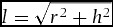
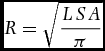
Termite mounds were assumed to be purely conical and size of control plot was determined using the following procedure. First the slant height (l) of the mound was estimated using the following equation:
 \begin{equation}
l = \sqrt {r^2 + h^2 }\end{equation}
 \begin{equation}
LSA = \pi rl\end{equation}
 \begin{equation}
R = \sqrt {\frac{{LSA}}{\pi }}\end{equation}
Tree basal diameter was measured using a forest calliper at just above the buttress swelling. Most shrubs on the termite mounds were multi-stemmed, and diameters were measured for each individual stem. Basal area for each stem was calculated separately and summed up to get the total for that individual tree or shrub. Tree species diversity was estimated using the Shannon Weiner index. Diameter of branches removed by elephants from the previous 2 y with distinct signs of elephant feeding were measured and included in the analysis.
To determine biomass removed we conducted a diameter-mass calibration, whereby fresh branches were cut from the most commonly eaten trees and measured. First, a huge branch was cut and branchlets from that same branch were subsequently cut and their diameter and mass recorded. Least squares regression was used to fit the curves of weight as a function of branch diameter for each species (Holdo & McDowell Reference HOLDO and MCDOWELL2004). The linear equation: y = mx + c was used to estimate fresh biomass removal for each species. However, biomass removal measured was limited to 2.5 m, the maximum height that researchers could reach.
Acceptance and availability of woody species on termite mounds and control plots
Species selection by elephants was calculated as an index of acceptance. Acceptance is a behaviour-based measure of selection defined as the proportional frequency with which a food type is eaten (removed) when encountered (Owen-Smith & Cooper Reference OWEN-SMITH and COOPER1987a). The corresponding availability measure is the frequency with which the food type was encountered either on termite mounds or in the control plots. Acceptance and availability can be assessed at different scales of aggregation, from individual plants or plant parts of particular species to feeding patches or foraging sites (Owen-Smith & Chafota Reference OWEN-SMITH and CHAFOTA2012). Although fine-scale measures provide more precise differentiation of use among food types, feeding decisions governing acceptance are not independent when plants are encountered in clusters. In these circumstances, statistical assessments need to fall back on site-based acceptance frequencies, provided these sites are sampled independently (Owen-Smith & Chafota Reference OWEN-SMITH and CHAFOTA2012).
Acceptance frequency takes values with the range 0–1, where ‘0’ indicates a species rejected and ‘1’ a species highly favoured. Species availability and acceptance were calculated separately for termite mounds and control plots. Species availability was calculated as the total number of plots in which a species was present divided by the total number of sampled plots. Species acceptance was calculated by dividing the number of plots where feeding on the species was evident by the number of plots in which the species was present (Owen-Smith & Cooper Reference OWEN-SMITH and COOPER1987b). Both species availability and acceptance were calculated separately for termite-mound plots and control plots.
Soil samples were collected from all mounds and control plots at a depth of 20 cm using a soil auger. Soil samples were air dried to drive out all the moisture before analysis. Soils were tested for Mg, Na, K, P, N and pH, and for physical properties % sand, % clay and % silt were investigated. Foliar samples were analysed for Mg, Na, Ca, K, N and crude protein (CP). Soil and foliar samples were analysed at the Department of Research and Specialist Services in Harare. Total Ca, Mg, K and Na were extracted using the aqua regia digestion method (Anderson & Ingram Reference ANDERSON and INGRAM1993). Foliar samples were first ashed, then dissolved using aqua regia and the mixture dried under ultraviolet light. The resulting compound was then dissolved in concentrated HCl and filtered. The solution was diluted with distilled water. Using a spectrophotometer, total Ca and Mg were determined at 0.460 nm and 0.595 nm and flame emission was used for K and Na. Determination of total N and P was based on a Kjeldahl method (Okalebo et al. Reference OKALEBO, GATHMA and WOOMER2002). Also soil texture was obtained using the hydrometer method as in Okalebo et al. (Reference OKALEBO, GATHMA and WOOMER2002). Soil pH was determined using the CaCl2 method (Thomas Reference THOMAS, Sparks, Page, Helmke, Loeppert, Soltanpour, Tabatabai, Johnston and Sumner1996).
Data analysis
Data were first tested for normality, and soil variables measured were analysed using the paired t-test in SPSS (Holdo & McDowell Reference HOLDO and MCDOWELL2004, Moe et al. Reference MOE, MOBAEK and NARMO2009). Biomass removal was estimated through building regression equations of diameter against mass of the branches of trees which were cut fresh during data collection (Holdo & McDowell Reference HOLDO and MCDOWELL2004). Data on biomass removal was tested using an independent t-test. Other variables such as tree density, tree basal area, tree diversity, number of broken branches per stem were non-normal and were analysed using the Wilcoxon signed rank test.
RESULTS
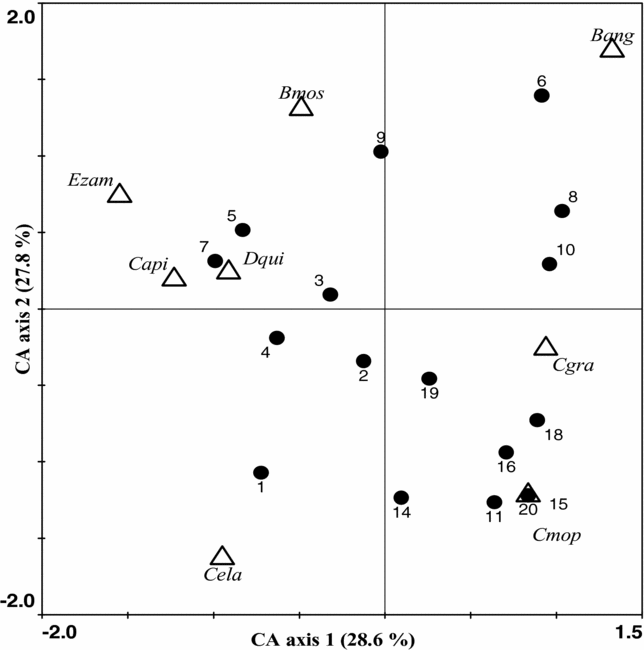
The survey comprised 10 termite mounds with a mean (± SE) height of 2.65 ± 0.28 m and a mean area of 81.5 ± 8.06 m2. A total of 377 plants were identified on termite mounds and 286 in the control plots. The plant species richness of termite mounds was 14 and that of the surrounding woodland control plots was 16. A correspondence analysis (CA) based on the abundance of the most common tree species separated species from termitaria and the control plots (Figure 1). Species with positive scores on axis 2 were common on termitaria and those with negative scores were common in the control plots.
Correspondence Analysis (CA) based on the species-by-plot classification table for the abundances of the eight most common species. The most common species on termite mounds were Erythroxylum zambesiacum N.K.B. Robson (Ezam), Boscia mossambicensis (Bmos), Boscia angustifolia (Bang), Diospyros quiloensis (Dqui) and Combretum apiculatum Sonder (Capi) and on control plots were Croton gratissimus (Cgra), Combretum elaeagnoides (Cela) and Colophospermum mopane (Cmop). Triangles represent the different trees species and solid circles represent the plots which contained at least one of the eight common tree species. Plots numbered 1 to 10 are termite mounds and those numbered 11 to 20 are corresponding control plots where termite mound 1 is paired with plot 11 etc.

Soil and foliar characteristics
Soil from control plots had significantly higher sand content than soil from termitaria (P < 0.01). Soil from the termite mounds had significantly higher clay content (P < 0.01) compared with control plots. However, there was no significant variation in silt content between the termite mounds and the control plots.
Termite mounds had significantly higher concentrations of all the measured soil chemical variables (P, Ca, Mg and Na) compared with control plots (Table 1). Also soil pH varied significantly (t = −8.05; P < 0.0001) between termite mounds (7.5 ± 0.1) and control plots (5.8 ± 0.2). However, K was not significantly different.
Mean (± SE) milli-equivalent per cent (meq per 100 g) of soil chemical variables compared between termite mounds (On) n = 10 and control plots (Off) n = 10 in Chewore North, Zimbabwe, using a paired t-test.
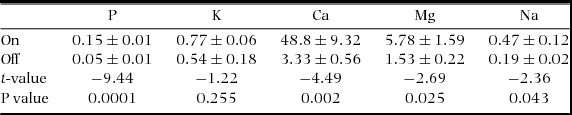
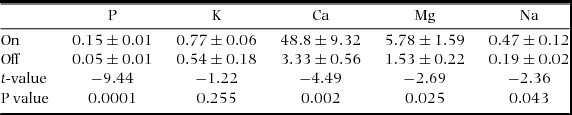
There was a significant difference in phosphorus and total nitrogen between leaf samples from termitaria and the control plots (Table 2). Crude protein was also significantly (t = −4.55; P < 0.001) different between leaf samples from termite mounds (13.3 ± 0.58% DM) and control plots (9.60 ± 0.65% DM). However, there was no significant difference in K, Mg, Ca and Na between leaf samples from termite mounds and control plots.
The mean (± SE) foliar samples mineral concentration (%) expressed on a dry matter basis and compared using the paired t-test between termite mounds (On) n = 10 and their control plots (Off) n = 10 in Chewore North, Zimbabwe.

Vegetation structural variables
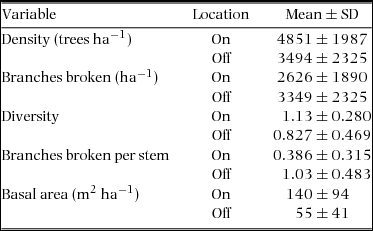
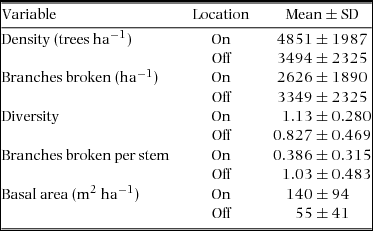
There was no significant difference in stem density (Z = −1.48; P = 0.139) between termite mounds and control plots. Also vegetation diversity did not vary significantly (Z = −1.72; P = 0.086) between termite mounds and their control plots (Table 3). Even though stem density did not vary significantly between termite mounds and control plots, basal area was significantly different (Z = −2.80; P = 0.005) (Table 3). The number of branches broken per stem were significantly higher (Z = −2.50; P = 0.013) on control plots than on the termite mounds. However, the number of branches broken expressed per unit area were not significantly different (Z = −1.07; P = 0.285) on termite mounds and control plots.
Mean (± SD) of the vegetation variables that were recorded on termite mounds (On) n = 10 and control plots (Off) n = 10.
Biomass removal
Biomass removal for all the species that were utilized on termite mounds and control plots had few replicates for statistical analysis except C. mopane. Mean (± SE) biomass removal was significantly higher (t = −2.75, df = 13.4, P = 0.016) in control plots (7800 ± 2200 kg ha−1) than on termite mounds (1580 ± 523 kg ha−1) for all tree species eaten. There was no significant difference (t = −0.748, df = 7.59, P = 0.477) in the biomass of C. mopane consumed between termitaria and control plots.
Woody species acceptance on termitaria and control plots
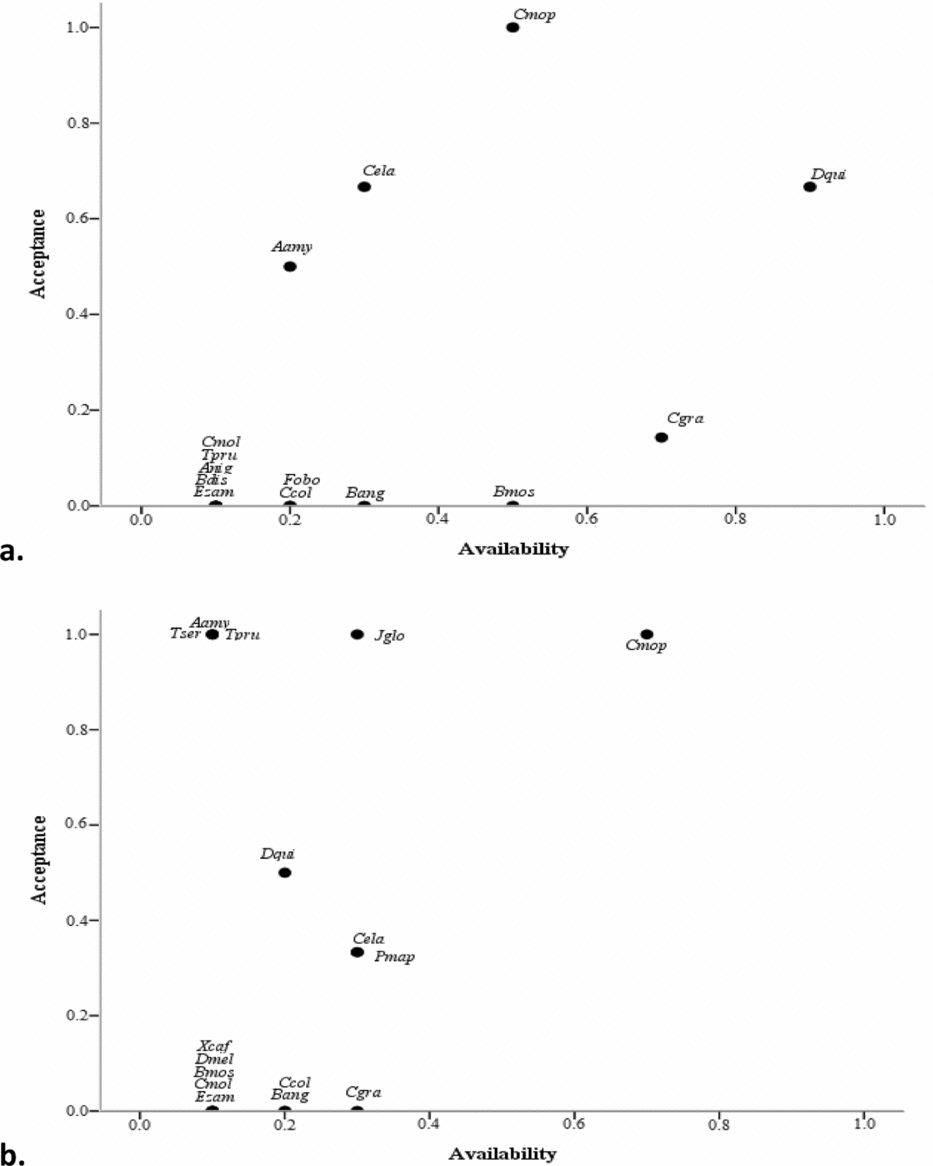
More woody species were accepted on control plots. Only five woody tree species were accepted on termite mounds out of the 14 species that were occurring there. In control plots, 50% of the woody species were accepted by elephants. Of all the species that were occurring on termite mounds and control plots only Colophospermum mopane had a 100% acceptance. However, it was noted that although occurring on termitaria and control plots, Boscia angustifolia A. Rich, Boscia mossambicensis Klotzsch, Erythroxylum zambesiacum N. Robson and Commiphora mollis (Oliv.) Engl. were totally unaccepted by elephants (Figure 2a, b).
Availability and acceptance of 19 woody species on termite mounds (a) and control plots (b). Species acronyms: Cmop = Colophospermum mopane; Cela = Combretum elaeagnoides; Pmap = Pseudolachnostylis maprouneifolia Pax; Ezam = Erythroxylum zambesiacum; Cmol = Commiphora mollis Engl; Bmos = Boscia mossambicensis; Dmel = Dalbergia melanoxylon Guillemin & Perrottet; Xcaf = Ximenia caffra Sonder; Dqui = Diospyros quiloensis; Ccol = Combretum collinum; Bang = Boscia angustifolia; Aamy = Acacia amythethophylla Steud. ex A. Rich.; Tser = Terminalia sericea Burch. ex DC.; Tpru = Terminalia prunioides C. Lawson; Jglo = Julbernardia globiflora Troupin; Fobo = Friesodielsia obovata Verdc.; Anig = Acacia nigrescens Oliver; Bdis = Berchemia discolor Hemsley and Cgra = Croton gratissimus.
DISCUSSION
Soils from termite mounds had higher clay content and significantly lower sandy content compared with the soils in control plots that were placed in the inter-mound matrix. However, silt content was the same on termite mounds and control plots. Soil sampled from termite mounds had higher amounts of P, Ca, Mg and Na than control plots. Similar findings were observed by Holdo & McDowell (Reference HOLDO and MCDOWELL2004) and van der Waal et al. (Reference VAN DER WAAL, KOOL, MEIJER, KOHI, HEITKONIG, DE BOER, VAN LANGEVELDE, GRANT, PEEL, SLOTOW, DE KNEGT, PRINS and DE KROON2011). The elevated levels of inorganic elements on termite mounds can be attributed to soil mineralization by termites (Holt & Lepage Reference HOLT, LEPAGE, Abe, Bignell and Higashi2000, Konate et al. Reference KONATE, LE ROUX, TESSIER and LEPAGE1999, Wood & Lee Reference WOOD and LEE1971).
Foliar samples from termite mounds had higher concentrations of P, CP and N than foliar samples from control plots. However, there was no difference in Ca, Mg, Na and K between foliar samples from termite mounds and control plots. Our findings are contrary to several studies on termitaria and herbivory in African savannas (Brody et al. Reference BRODY, PALMER, FOX-DOBBS and DOAK2010, Holdo & McDowell Reference HOLDO and MCDOWELL2004, Mobaek et al. Reference MOBÆK, NARMO and MOE2005, Pringle et al. Reference PRINGLE, DOAK, BRODY, JOCQUE and PALMER2010). For instance, in a study by Jachmann (Reference JACHMANN1989) trees with higher foliar mineral concentration (Ca, Mg, Na and K) were preferred more by elephants than those with low mineral concentration. Also, Holdo & McDowell (Reference HOLDO and MCDOWELL2004) observed that foliar samples from termite mounds had higher concentration of K, Ca and Mg than that from control plots and was thus preferred by elephants. The unique findings in our study compared with most studies can be elucidated by environmental context (O'Connor Reference O'CONNOR2013). Most studies focusing on termite mounds and large-mammal herbivory were carried out in nutrient-poor dystrophic systems (Holdo & McDowell Reference HOLDO and MCDOWELL2004, Jachmann Reference JACHMANN1989, Levick et al. Reference LEVICK, ASNER, KENNEDY-BOWDOIN and KNAPP2010, Loveridge & Moe Reference LOVERIDGE and MOE2004, Mobaek et al. Reference MOBÆK, NARMO and MOE2005, Van der Plas et al. Reference VAN DER PLAS, HOWISON, REINDERS, FOKKEMA and OLFF2013) which are deficient of plant nutrients (Frost Reference FROST and Campbell1997) while our study was carried out in rich alluvial and basaltic soils of the Zambezi valley. Sodium concentration which has been noted to influence browsing selectivity of elephants (Jachmann & Bell Reference JACHMANN and BELL1985) was not different on termite mounds and control plots, which could explain why termite mounds could not come out as browsing hotspots. Although CP was significantly higher in foliar samples from termite mounds than the control plots, it may have had no influence on forage preference of the elephants (Holdo Reference HOLDO2003, Jachmann Reference JACHMANN1989). As such, our study supports the hypothesis that termite mounds may not emerge as nutrient hotspots for mega-herbivores like elephants in some environments (O'Connor Reference O'CONNOR2013).
Elephants have been shown to selectively forage on nitrogen-rich foliage (Jachmann & Bell Reference JACHMANN and BELL1985, Mattson Reference MATTSON1980). However, our study has failed to uphold this observation. Common species found on termite mounds, for example B. angustifolia and B. mossambicensis, were not being browsed by elephants even though evergreen. Elephant feeding was not significantly different between termite mounds and control plots contrary to other studies like Loveridge & Moe (Reference LOVERIDGE and MOE2004) where mega-herbivores fed more on termitarium vegetation. It is important to note that they did not test nutrient composition of trees on termite mounds and control plots; hence they were not clear on what could have caused observed differences in vegetation preference of elephants.
Biomass removal by elephants was greater on control plots than termite mounds. Abundant species on termite mounds such as B. mossambicensis and B. angustifolia were not being consumed by elephant, while abundant tree species in control plots such as Colophospermum mopane, Pseudolachnostylis maprouneifolia and Julbernardia globiflora were highly consumed by elephants. However, this was not so in other studies where elephants removed more biomass from termite mounds than control plots (Holdo & McDowell Reference HOLDO and MCDOWELL2004), and utilization of forage was higher on mounds and decreased with distance from the mound (Grant & Scholes Reference GRANT and SCHOLES2006, Levick et al. Reference LEVICK, ASNER, KENNEDY-BOWDOIN and KNAPP2010, Loveridge & Moe Reference LOVERIDGE and MOE2004, Sileshi & Arshad Reference SILESHI and ARSHAD2012).
Colophospermum mopane has been shown to be a primary food source of elephants across the savanna (Ben-Shahar Reference BEN-SHAHAR1996, Coates-Palgrave Reference COATES PALGRAVE2002, Holdo Reference HOLDO2003, van Wyk & Fairall Reference VAN WYK and FAIRALL1969), and occurred on both termite mounds and control plots and was selected equally on both types of site. Species like D. quiloensis and C. eleagnoides were highly selected on mounds and had a moderate acceptance level in control plots which can be correlated to high concentrations of P, N and crude protein in foliar samples from termite mounds. However, this observation is divergent from Holdo (Reference HOLDO2003) who found no relationship between elephant feeding and crude protein. Our study amplifies the hypothesis that even though classified as a bulk feeder (Hofmann Reference HOFMANN1989), the African elephant is also a selective feeder (Holdo Reference HOLDO2003, Jachmann & Bell Reference JACHMANN and BELL1985, Owen-Smith & Chafota Reference OWEN-SMITH and CHAFOTA2012). We found that some of the common species that occurred on termite mounds such as B. mossambicensis, B. angustifolia, C. gratissimus, C. mollis and C. collinum were not selected by elephants. However, it is important to note that the way acceptance was calculated could have exaggerated our deductions about species selection. Acceptance was calculated by dividing the number of plots in which the species was eaten by the number of plots in which it was observed, meaning if a species was eaten in one plot and at the same time observed in one plot it would have an acceptance level of one. For instance both T. sericea and T. prunioides in control plots had low availability but they recorded high acceptance levels.
Tree species diversity and stem density did not differ between termite mounds and their control plots. The similarity in stem density on termite mounds and control plots could be linked to uniform utilization of vegetation on and off termite mounds by elephants. Also, the number of branches broken was higher on control plots than on termite mounds, an observation which is different from other studies (Holdo & McDowell Reference HOLDO and MCDOWELL2004, Loveridge & Moe Reference LOVERIDGE and MOE2004). Our study did not uphold the notion that elephants utilize vegetation more on termite mounds than their surrounding environments. Therefore, we conclude that termitaria may not act as nutrient hotspots in nutrient-rich environments and utilization of vegetation by elephants can be influenced by the tree species present and soil quality in the inter-mound matrix.
Acknowledgements
We would like to thank the two anonymous reviewers of this manuscript.