Self-consciousness (SC) is defined as the process through which we can become the subject of our own conscious experience (de Caso et al., Reference de Caso, Poerio, Jefferies and Smallwood2017; Fenigstein, Scheier, & Buss, Reference Fenigstein, Scheier and Buss1975), and is composed of two dimensions: Public and private (Carver, Reference Carver, Leary and Tangney2012). The public dimension refers to awareness of the "self" in the social environment, that is, the extent to which people examine how public aspects of the self may be perceived by others (DaSilveira et al., Reference DaSilveira, DeSouza and Gomes2015). The private dimension refers the extent to which people introspect and examine hidden aspects of the self (DaSilveira et al., Reference DaSilveira, DeSouza and Gomes2015). This two-dimension explanatory model is empirically supported in adolescents (Rankin et al., Reference Rankin, Lane, Gibbons and Gerrard2004).
During adolescence, two critical events take place that correspond with these two dimensions. On the one hand, the need for social acceptance (public dimension) makes the peer group an indispensable agent in the development of the young person's self-concept and identity (Ragelienė, Reference Ragelienė2016). On the other hand, changes in brain structure and function, including complex areas such as cognition and emotions, allow young people to reflect abstractly and meta-cognitively on their actions, emotions, thoughts, and values (private dimension) (Rankin et al., Reference Rankin, Lane, Gibbons and Gerrard2004; Weil et al., Reference Weil, Fleming, Dumontheil, Kilford, Weil, Rees, Dolan and Blakemore2013).
Self-consciousness has been widely studied for its relationship with psychological problems (Šeboková & Popelková, Reference Šeboková and Popelková2016). It has been observed that it is directly involved in emotion regulation and, therefore, also related to the development of internalizing disorders such as depression and anxiety (Andela et al., Reference Andela, Auzoult and Truchot2014; Bowker & Rubin, Reference Bowker and Rubin2009). Specifically, higher private SC is more strongly related to depressive symptoms and generalized anxiety, and higher public SC is more closely related to anxiety (mainly social anxiety) (Mor & Winquist, Reference Mor and Winquist2002; Newman & Nezlek, Reference Newman and Nezlek2019). Girls seem to manifest higher levels of SC, which leads to a higher prevalence of internalizing problems in females (Mor & Winquist, Reference Mor and Winquist2002; Rankin et al., Reference Rankin, Lane, Gibbons and Gerrard2004). Regarding age, public SC is predominant in early adolescence, whereas private SC is more frequent in older youth (Bowker & Rubin, Reference Bowker and Rubin2009; Rankin et al., Reference Rankin, Lane, Gibbons and Gerrard2004).
Although the implications of SC for the development of psychopathology have been reported by different researchers, the public and private dimensions have received less attention (Bowker & Rubin, Reference Bowker and Rubin2009). Most of the studies aimed at the evaluation of SC in young people have adapted scales developed for adults (Higa et al., Reference Higa, Phillips, Chorpita and Daleiden2008; Rankin et al., Reference Rankin, Lane, Gibbons and Gerrard2004), for example, the Self-Consciousness Scale (SCS; Fenigstein et al., Reference Fenigstein, Scheier and Buss1975). Therefore, typical adolescent experiences or situations are not reflected.
Nie and Ding developed the Adolescent Self-Consciousness Questionnaire (ASC) for Chinese adolescent population (Nie & Ding, Reference Nie and Ding2009; Nie et al., Reference Nie, Li, Dou and Situ2014). Subsequently, its psychometric properties were analyzed in Italian adolescents (Delvecchio et al., Reference Delvecchio, Mabilia, Lis, Mazzeschi, Nie and Li2014). In both samples, the results of the confirmatory factor analysis were adequate. The total reliability score for the Chinese and Italian samples was .94 and .90, respectively (Delvecchio et al., Reference Delvecchio, Mabilia, Miconi, Chirico and Li2015). This instrument is divided into three first-order factors (Self-knowledge, Self-control, and Self-experience) and nine second-order factors (Nie et al., Reference Nie, Li, Dou and Situ2014). Self-knowledge (the cognitive component of SC) includes Physical appearance, Morality, and Socialization. Self-control (the motor component of SC) is characterized by the control of thoughts, feelings, and behaviors and includes Self-restraint, Self-monitoring, and Initiative taking. Finally, Self-experience (the affective component of SC) is formed by Self-learning, Satisfaction, and the level of Anxiety. The first two components (Self-knowledge and Self-control) are related to public SC, whereas Self-experience refers to private SC (Delvecchio et al., Reference Delvecchio, Mabilia, Miconi, Chirico and Li2015).
Although the relationship between SC and the development of psychopathology is empirically supported, there are no instruments with good psychometric properties to evaluate them in Spanish-speaking adolescents of the general population. The ASC is based on the self-consciousness theory of Nie et al., Reference Nie, Zhang, Peng and Ding2007) and among its advantages is that it includes typical situations and feelings of adolescence (Delvecchio et al., Reference Delvecchio, Mabilia, Miconi, Chirico and Li2015). It also includes self-experience and self-control as a part of SC, in accordance with other authors (Peng et al., Reference Peng, Ames, Knowles and Matsumoto2001; Shepherd, Reference Shepherd2017), and evaluates feelings about the “self”, such as the ability to control thoughts, feelings, and behaviors. Thus, it achieves an assessment more in keeping with the complexity of the SC and conforms to the model of public and private dimensions, which have gained empirical evidence. In addition, this instrument may favor cross-cultural research, especially between individualist and collectivist countries.
The objectives of this research were to analyze: (a) The psychometric properties of the ASC in a Spanish adolescent sample aged 13 to 18, seeking evidence of internal consistency, test-retest reliability, criterion validity, and factor structure; and (b) exploring the possible gender and age differences of its factors. In accordance with previous research, we hypothesize that girls will obtain higher scores in anxiety, Self-control, and Moral Self-consciousness, and boys will obtain higher scores in Physical appearance (Delvecchio et al., Reference Delvecchio, Mabilia, Miconi, Chirico and Li2015). Similarly, higher total SC scores are expected for girls. Finally, we expect to find a higher level of Self-experience (private SC) in older adolescents, and higher scores of Self-knowledge and Self-control (public SC) in younger adolescents.
Method
Participants
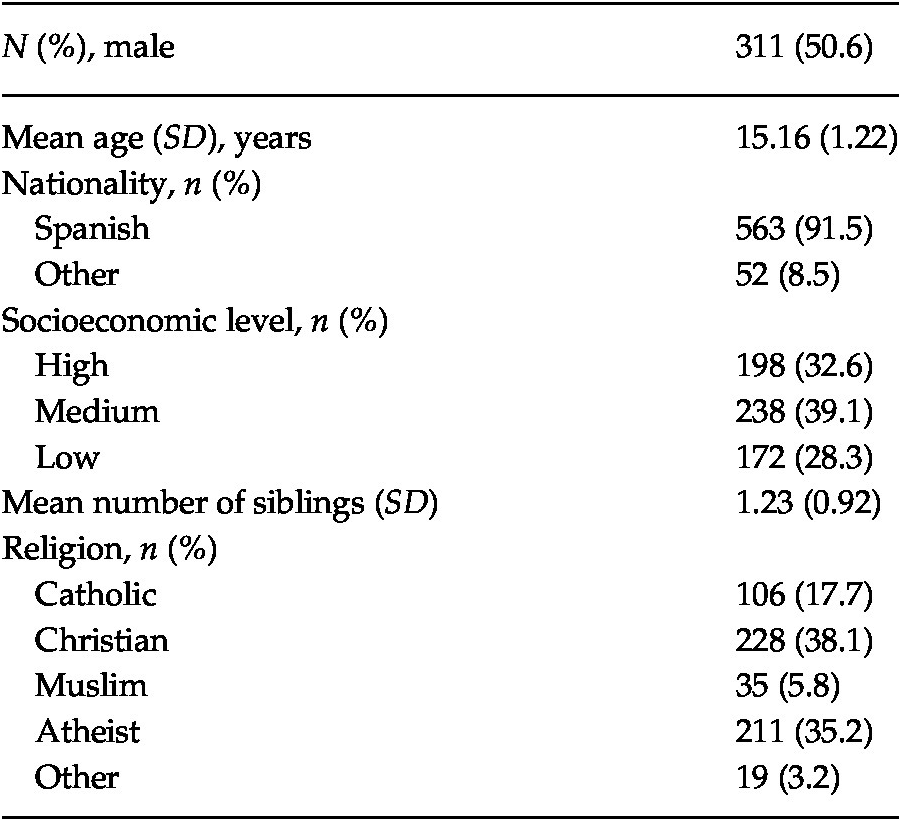
A total of 615 students aged between 13 and 18 years participated (M = 15.16, SD = 1.22), of whom 50.6% were boys. Age was distributed as follows: 13-year-olds (8.6%), 14-year-olds (22.7%), 15-year-olds (30%), 16-year-olds (24.5%), 17-year-olds (11.4%), and 18-year-olds (2.8%). The participants were students of the following Spanish educational levels: 2nd grade of Compulsory Secondary Education (CSE) (n = 95, 15.4%), 3rd grade of CSE (n = 178, 28.9%), 4th grade of CSE (n = 175, 28.5%), 1st grade of High School (n = 86, 14%), Vocational Training (n = 61, 9.9%), and Curriculum Adaptation (n = 20, 3.3%). Of them, 28.3% belonged to a low socioeconomic level, 39.1% to a medium level, and 32.6% to a low level. The mean number of siblings and the religion of the participants are presented in Table 1.
Characteristics of the Sample (N = 615)

Note. SD = Standard deviation.
Measures
Adolescent Self-Consciousness Questionnaire (ASC; Nie & Ding, Reference Nie and Ding2009). The ASC includes 67 items organized into three first-order scales (Self-knowledge, Self-control, and Self-experience, representing the cognitive, motor, and affective components of SC), each one made up of three second-order factors: (a) Self-knowledge contains the factors of Appearance self, Social self, and Morality appraisement; (b) Self-control includes Initiative-taking, Self-restraint, and Self-monitoring; and (c) Self-experience reflects Learning self, Sense of anxiety, and Sense of satisfaction. The scale is rated on a 5-point Likert-type scale, ranging from 1 (strongly disagree) to 5 (strongly agree). Higher scores indicate a higher level of self-consciousness. In the original Chinese version of the ASC, Cronbach alphas ranging from .64 to .84 (Nie & Ding, Reference Nie and Ding2009). Evidence of reliability and validity of the ASC have also been provided for the Italian version of the ASC (Delvecchio et al., Reference Delvecchio, Mabilia, Lis, Mazzeschi, Nie and Li2014).
Family Affluence Scale III (FAS–III; Torsheim et al., Reference Torsheim, Cavallo, Levin, Schnohr, Mazur, Niclasen and Currie2016). This scale assesses socio-economic level. It has recently been revised, including current technological trends. Participants report whether they have a dishwasher and their own room, how many bathrooms, computers, and cars they own, and how many times they have travelled abroad last year. The total score is obtained by adding the answers to these six questions and distinguishes low (20%), medium (60%) and high economic affluence (80%). Evidence of adequate reliability and validity was provided in the original version of the FAS–III (pooled test-retest correlation was r = .90).
Children’s Depression Inventory (CDI; Kovacs, Reference Kovacs1992). The Spanish version of this instrument was used (Del Barrio & Carrasco, Reference Del Barrio and Carrasco2004). This scale consists of 27 items that evaluate symptoms of depression (e.g., low self-esteem and sad mood). The range of responses ranges from 0 to 1, where 0 is absence of the symptom; 1 (some intensity) and 2 (presence of the symptom). The total score indicates the respondent’s level of depressive symptomatology, with a maximum score of 54. The scale has satisfactory psychometric properties, obtaining in the present study an ordinal alpha of .86. The CDI correlates with other measures of self-reported depressive symptomatology (from .56 to .78 with Reynolds’ Adolescent Depression Scale, and from .70 to .73 with Reynolds’ Child Depression Scale) (Del Barrio & Carrasco, Reference Del Barrio and Carrasco2004).
Strengths and Difficulties Questionnaire (SDQ; Goodman, Reference Goodman1997). The Spanish versionFootnote 1 was applied in this study. It is made up of 25 items rated on a 3-point Likert-type scale: 0 (Not true), 1 (Somewhat true), and 2 (Certainly true). This scale evaluates four difficulties (behavioral problems, hyperactivity, emotional symptoms, and peer problems) and one strength (prosocial behavior). The total score is obtained by adding the difficulties scores, and higher scores indicate more difficulties. The level of prosocial behavior is obtained by adding the items that make up this subscale. This instrument allows the calculation of a score for externalizing problems (adding up the subscale hyperactivity and behavioral problems) and internalizing problems (adding up the subscales emotional problems and peer problems). Internal consistency of the subscales was: conduct problems (α = .51), hyperactivity (α = .60), emotional problems (α = .70), peer problems (α = .53), prosocial behavior (α = .58), internalizing problems (α = .75) and externalizing problems (α = .68). Several studies have provided evidence of its validity and reliability in Spain (Ortuño-Sierra et al., Reference Ortuño-Sierra, Aritio-Solana and Fonseca-Pedrero2018; Ortuño-Sierra et al., Reference Ortuño-Sierra, Fonseca-Pedrero, Paíno and Aritio-Solana2014).
Rosenberg Self-Esteem Scale (RSES; Rosenberg, Reference Rosenberg1989). We used the Spanish version validated by Martín-Albo et al. (Reference Martín-Albo, Núñez, Navarro and Grijalvo2007), who provided evidence of the reliability (α = from .85 to .88), test-retest (r = .84), and validity with dimensions of self-concept (r = .28 to .50). It contains 10 items rated on a 4-point Likert-type scale, ranging from 1 (strongly disagree) to 5 (strongly agree). The total score shows the respondent’s level of self-esteem or positive self-appraisal. A higher score (maximum 40) indicates higher self-esteem. In this study, the internal consistency was .83.
Procedure
An informative email including the objectives of the study was sent to the directors of three secondary education schools in the province of Alicante, Spain. The centers were randomly selected considering one from the north; another from the center and another in the south of the province, in order obtain a more representative sample. A few days later, the directors were contacted by telephone, and any doubts they had about the procedure were clarified. Two of them accepted to participate. Informed consent forms were sent to the parents of students under 18 years old, enrolled in the following levels: 2nd, 3rd, and 4th grade of CSE, 1st grade of High School, Vocational Training, and curriculum adaptation. The participation rate in the study was very high (approx. 96%). The self-reports were applied collectively during tutoring hours (50 min) in groups of 10 to 30 adolescents. Members of the research team supervised the data collection, and two evaluators previously trained in application of the questionnaires were present in the classroom, clarifying students’ possible doubts. The approval by the ethics committee of the Miguel Hernández University (DPS.JPE.01.18) was obtained for this study.
The ASC translation from English into Spanish was done following the guidelines of Muñiz et al. (Reference Muñiz, Elosua and Hambleton2013) and the International Test Commission (2017). Two bilingual psychologists translated the scale. One of them translated the original version into Spanish and then the other translated the new version back into English. After comparing the two versions, small differences were resolved.
Statistical Analysis
Descriptive analyses were performed for the ASC items. Before carrying out the analyses, the 4.12% missing values of the ASC were replaced by the median of nearby points. The median (compared to the mean) is a more robust imputation technique for replacing missing data (< 10%) (Gmel, Reference Gmel2001). A second-order confirmatory factor analysis (CFA) was conducted in accordance with the Chinese (Nie & Ding, Reference Nie and Ding2009) and Italian (Delvecchio et al., Reference Delvecchio, Mabilia, Lis, Mazzeschi, Nie and Li2014) validations of the ASC, to determine its adequacy in a Spanish sample. The classic latent structure was tested using the Lavaan package for structural equation modeling version, following the criteria recommended by Hu and Bentler (Reference Hu and Bentler1999). Adequate fit was established by values greater than .90 for the comparative fit index (CFI) and the Tucker-Lewis index (TLI), and less than .08 for Root Mean Square Error of Approximation (RMSEA). Because of the ordinal nature of the scale, the diagonally weighted least squares (DWLS) estimator was used. DWLS is recommended due to its robustness with ordinal data and small samples (Li, Reference Li2016). Cronbach alpha was calculated to compare the reliability index of the Spanish version with the previous ones (Delvecchio et al., Reference Delvecchio, Mabilia, Lis, Mazzeschi, Nie and Li2014; Nie & Ding, Reference Nie and Ding2009). Because of the ordinal nature of the ASC, McDonald’s omega (ω) was also calculated. Temporal stability of the ASC was calculated using a subsample of 266 participants (43.3%) from the original sample, according to the availability of the schools. Intraclass correlation coefficients (ICC) were obtained to estimate the temporal reliability of the ASC and its subscales from baseline to day 60. An ICC value of .60 or above was considered acceptable (Anastasi, Reference Anastasi1998). We compared the equivalence in sociodemographic variables, and ASC, RSES, SDQ, and CDI scores between the subsample used for test-retest and the total sample using attrition analyses. Pearson correlations were calculated to determine external validity of the Spanish version of the ASC using the RSES (convergent validity) and CDI and SDQ scores (divergent validity). Following previous studies of the ASC, differences for subscales of the ASC by gender and age were explored using Multivariate Analyses of Variance (MANOVA) and effect size statistics. The assumptions of MANOVA were met, except for normality. Pillai’s Trace was used as it is one of the most powerful and robust statistics, especially for departures from assumptions (Seber, Reference Seber1984).
Results
Psychometric Properties of Items
Most of the corrected item-total correlations were higher than .30, indicating an adequate performance of the items, according to the recommendations of Nunnally and Bernstein (Reference Nunnally and Bernstein1995). Items 20 (I often worry a lot about what is going to happen), 46 (I am an impetuous person), 59 (After finishing doing one thing, I often think what the result would be if I did it another way), and 62 (I cannot help doing some little trick in classroom when the teacher is teaching) had item-total correlation values lower than .25. The experts involved in the study agreed to remove these items because the alpha significantly increased, and their low contribution to the measurement of the construct. After the removal of these items from the Spanish version of the ASC, each factor was represented by at least 5 items, which is considered appropriate. The correlations of the items with the second-order factors were higher, ranging from .56 to .70.
Evidence of Validity based on Internal Structure
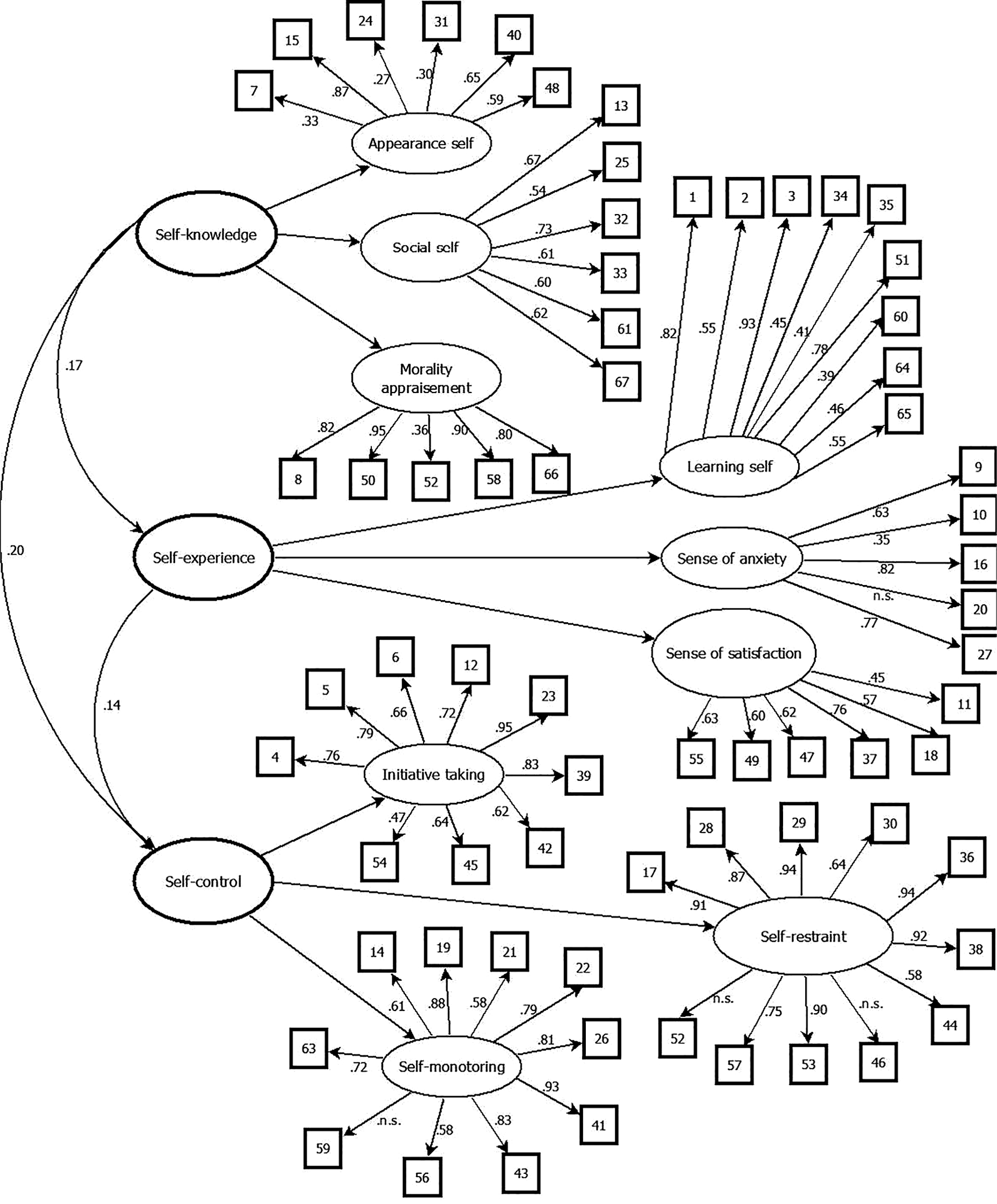
Confirmatory Factor Analysis was performed to test the original model of the ASC, excluding Items 20, 46, 59, and 62. The model showed adequate fit indices, CFI = .90, TLI = .89, RMSEA = .078, 95% CI [.076, .080]. Figure 1 shows the second-order model of the Spanish version of the ASC. Factor loadings ranged from .30 to .95, except for Item 24 (.27).
The Second-order Model of the Spanish Version of the ASC.

Evidence of Internal Consistency
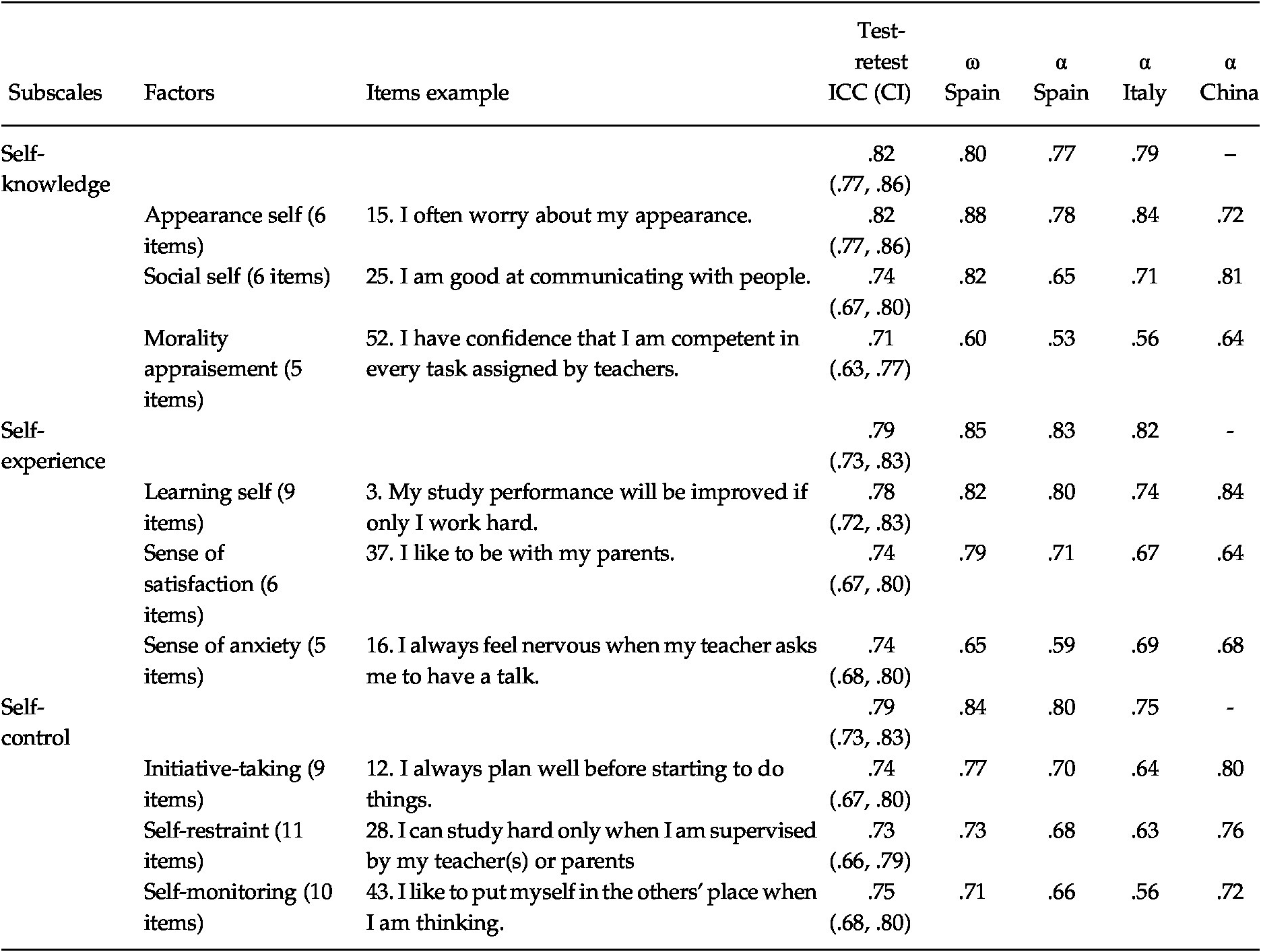
Table 2 shows the excellent reliability (α = .91/ω = .92) of the Spanish version of the ASC subscales compared to the previous Italian and Chinese versions. Cronbach’s alpha of the subscales were above .70 except for the Social self and Morality appraisement (Self-knowledge), Sense of anxiety (Self-experience), Self-restraint and Self-monitoring (Self-control). McDonald’s omega (ω) coefficients were higher compared to Cronbach’s alpha coefficients. McDonald’s omega (ω) coefficients were also above .70, except for Morality appraisement (Self-knowledge) and Sense of anxiety (Self-experience).
Internal consistency (α) for ASC Subscales and Factors in the Spanish sample, and in the Original study in China (Ding, 2008) and the Italian Validation (Delvecchio et al., Reference Delvecchio, Mabilia, Lis, Mazzeschi, Nie and Li2014)

Note. ω = McDonald's omega; α = Cronbach alpha; ICC = Intraclass Correlation; CI = Confidence Interval.
Test-retest
A subsample of 266 participants (43.3%) was used to test temporal stability of the ASC. Of them, 46.6% (n = 124) were female and the group’s mean age was 15.42 years (SD = 1.08). The retest sample was equivalent to the rest of the sample in gender (p = .22), nationality (p = .66), and ASC subscales and total score (p > .05). Group differences were found in age (p ≤ .001) and socioeconomic level (p ≤ .001). The retest participants were older (d = .38) and, to a greater proportion, belonged to a lower socioeconomic level (d = .41) than the rest of the sample. The two groups were equivalent in ASC, RSES, SDQ, and CDI scores at baseline.
The ICC values for each ASC subscale and for the total score (ranging from .71 to .82) were adequate (ICC = .81, 95% CI: .76, .85). These values indicated adequate temporal stability of the Spanish version of the ASC.
Evidence of Criterion Validity
Both the first-order factors (Self-knowledge, Self-experience, and Self-control) and the second-order factors of the ASC had positive and significant correlations with self-esteem (RSES; evidence of convergent validity), and the highest correlation was with the Self-experience factor. On the other hand, all ASC factors correlated negatively and significantly with depressive symptomatology (CDI), which was a measure of divergent validity. The highest score was obtained between the Self-experience factor and CDI. Furthermore, ASC scores correlated negatively with internalizing and externalizing scores of the SDQ (evidence of divergent validity). The highest score was obtained between Self-restraint and externalizing problems (Table 3).
Correlations between ASC, RSES, CDI and SDQ

Note. ASC = Adolescent Self-Consciousness; RSES = Rosenberg Self-Esteem Scale; CDI = Children’s Depression Inventory (CDI); SDQ = Strengths and Difficulties Questionnaire; EMO = Emotional symptoms; COND = Conduct problems; HYP = Hyperactivity/Inattention; PEER = Peer relationship problems; PRO =Prosocial behavior; INT = Internalizing symptoms; EXT = Externalizing symptoms.
** Correlation is significant at the .01 level (2-tailed).
Age and Gender Differences
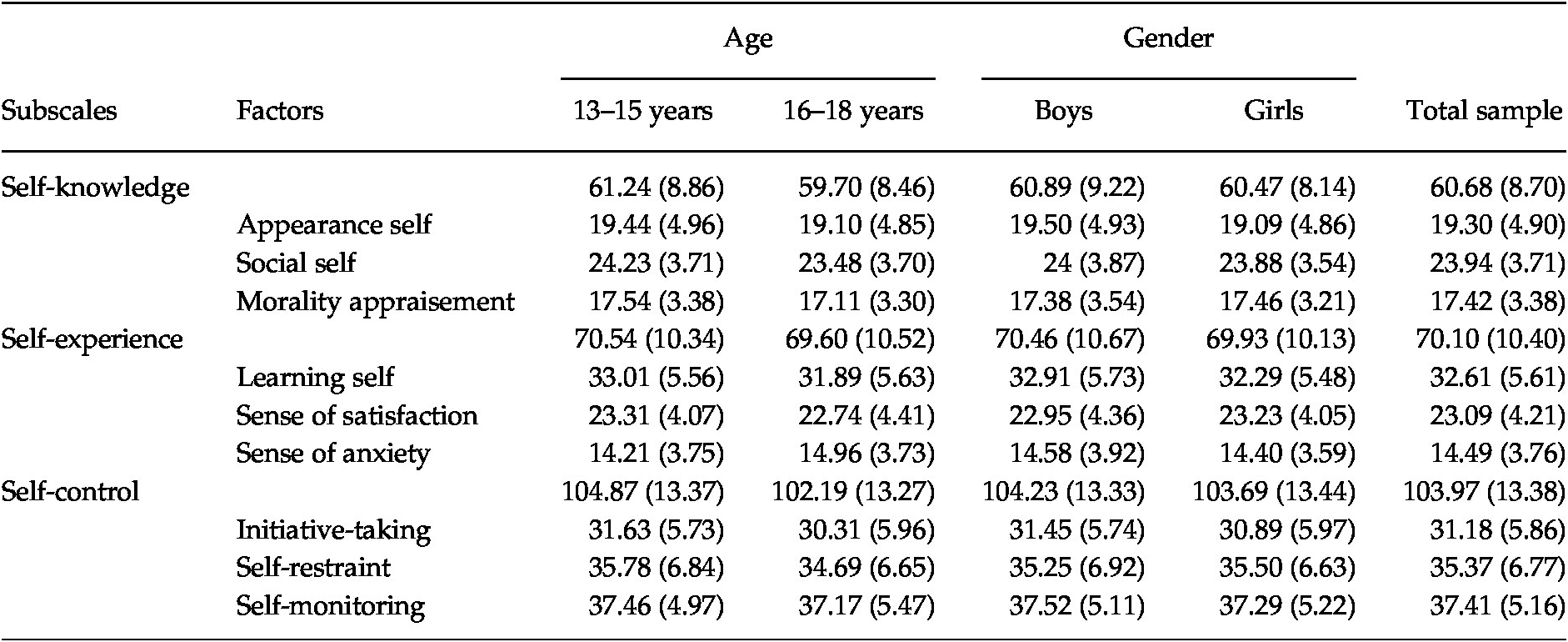
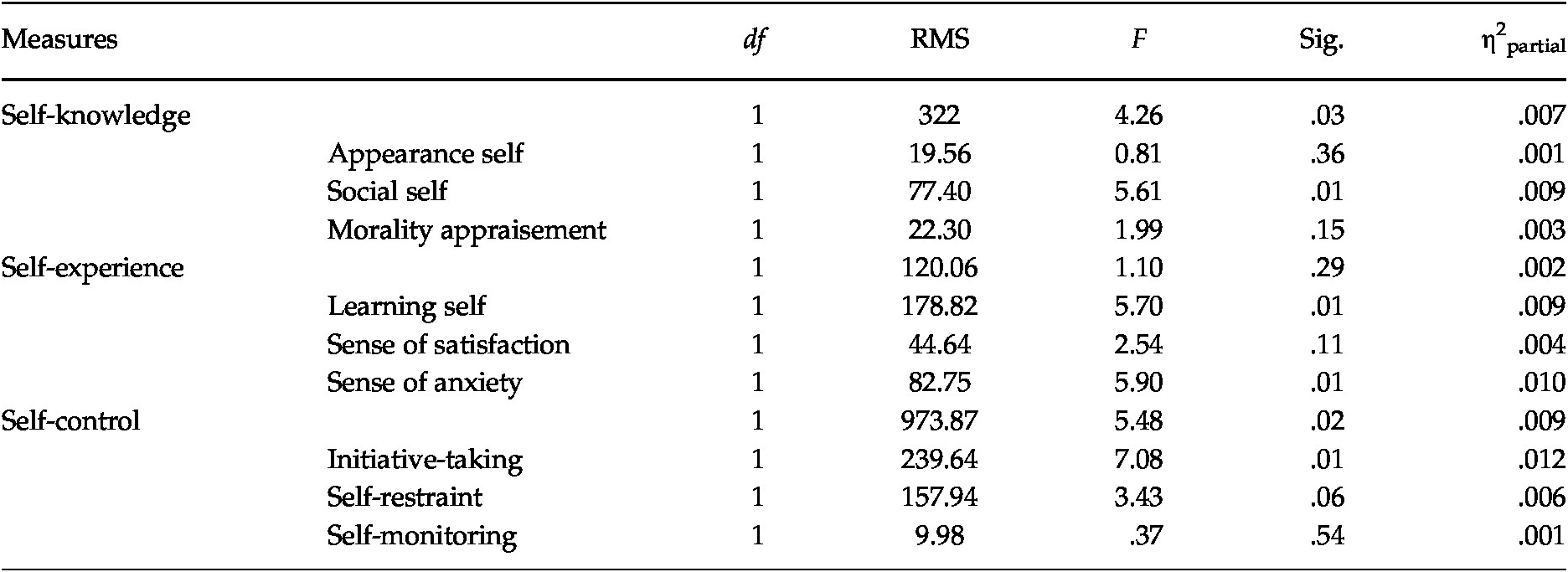
Table 4 shows means and standard deviations in ASC subscales by gender and age group (13–15 vs. 16-18-year-olds). Two-way MANOVA results indicated that scores in ASC differed by age, F(9, 590) = 3.45, p < .001, Pillai’s Trace = .05; η2partial = .05, but not by gender (p = .25). The interaction between gender and age was not significant (p = .08). Because only age was statistically significant, results of MANOVA main effects, between-subject effects for age are presented in Table 5. A significant main effect was detected for age in 6 of the 12 subscales of the ASC. The subscale score differences between the 13-15-year-olds and the 16-18-year-olds on Self-knowledge, F (1, 598) = 4.26, p = .03, η2partial = .007; Social self, F (1, 598) = 5.61, p = .01, η2partial = .009; Learning self, F (1, 598) = 5.70, p = .01, η2partial = .009; Sense of anxiety, F (1, 598) = 5.90, p = .01, η2partial = .01; Initiative-taking, F (1, 598) = 7.08, p = .008, η2partial = .01; and Self-restraint, F (1, 598) = 3.43, p = .06, η2partial = .006, were statistically significant.
Means and standard deviations (in parenthesis) for the ASC subscales and factors according to gender and age

One-way MANOVA for Age in ASC Subscales: between-subject Effects

Discussion
The objective of this study was to examine the psychometric properties of the ASC in Spanish adolescents aged 13 to 18, analyzing its factor structure, and providing evidence of internal consistency, test-retest reliability, and validity. In addition, differences according to age and gender were analyzed. Confirmatory factor analysis supported the original second-order model after the exclusion of four items. Good indices of internal consistency and test-retest reliability were found, as well as evidence of convergent and divergent validity. Age differences in Self-Consciousness were found but no significant gender differences were observed in Spanish adolescents.
The ASC was initially designed for the Chinese adolescent sample (n = 439; 11–19 years; Nie & Ding, Reference Nie and Ding2009; Nie et al. Reference Nie, Li, Dou and Situ2014). Despite this, the indices derived from confirmatory factor analysis after exclusion of Items 20, 46, 59 and 62 were adequate for Spanish teenagers, as the fit obtained in a study with an Italian sample (n = 598; 14–19 years; Delvecchio et al. Reference Delvecchio, Mabilia, Lis, Mazzeschi, Nie and Li2014). Both in the Spanish and Italian adolescent samples, low factorial loads were obtained for some items. This may be due to possible cultural differences, as some aspects that evaluate these items do not appear to be common behaviors in Western culture, for example "after finishing doing one thing, I often think what result I could have obtained if I did it another way" (Delvecchio et al., Reference Delvecchio, Mabilia, Lis, Mazzeschi, Nie and Li2014). Although both countries are part of Western culture, there are cultural differences in variables such as individualism or collectivism. In this sense, Spain shows a collectivist tendency in comparison with some European countries, but an individualistic orientation if compared with other countries. In contrast, Italy can be characterized as an individualistic orientation, and China as a collectivist country, according to HofstedeFootnote 2. For this reason and considering that the relationship between the public and private dimensions of SC and culture has been previously demonstrated, more cross-cultural research is needed.
The internal consistency data provide evidence of the reliability of the Spanish version of the ASC, in line with the reference studies. As for the internal consistency of the first-order factors, the data obtained with Spanish and Italian adolescents (respectively) were as follows: Self-knowledge (α = .77 and α = .79), Self-experience (α = .83 and α = .82), and Self-control (α = .80 and α = .75). The internal consistency indices obtained by the 9 second-order factors ranged from .64 to .84 for the Chinese sample, and slightly lower but adequate for the Italian (.56 and .84), and Spanish (.53 and .83) samples.
As in previous studies (Delvecchio et al., Reference Delvecchio, Mabilia, Lis, Mazzeschi, Nie and Li2014), associations were found between self-consciousness (ASC) and self-esteem (RSES), that is, adolescents with greater self-consciousness (Self-knowledge, Self-control, and Self-experience) tended to value themselves more positively. On the other hand, greater levels of Self-consciousness were related to less externalizing and internalizing problems (SDQ). Similarly, the negative correlations found between the ASC and the CDI suggest that adolescents with a higher level of self-consciousness have a lower predisposition to develop depressive symptoms. Depressive symptoms were more strongly related to the affective component of the ASC (Self-experience), as found in a Chinese adolescent sample (Nie et al., Reference Nie, Li, Dou and Situ2014). These data are congruent with the studied bibliography, in which it was found that a higher private SC is related to higher depressive symptomatology.
In terms of age, the hypothesis that a younger age would be associated with higher levels of public SC and lower levels of private SC (Rankin et al., Reference Rankin, Lane, Gibbons and Gerrard2004) was partially supported. Although adolescents aged 13 to 15 had higher levels in all the variables studied in public SC (Self-knowledge and Self-control), only the Self-knowledge score (including the Social Self subscale) and the Self-control score (including the Initiative-taking subscale) showed statistically significant differences. As for the variables that make up private SC (Self-experience), adolescents aged 16 to 18 years presented significantly higher levels of anxiety. Furthermore, contrary to our expectations, younger adolescents presented significantly higher levels of the Learning self. It should be noted that the effects sizes were low (η2partial between .007 and .012).
On another hand, although in accordance with some studies (Mor & Winquist, Reference Mor and Winquist2002; Rankin et al., Reference Rankin, Lane, Gibbons and Gerrard2004), we expected gender differences in the total SC score, this did not happen. In any case, the inconsistency found in the literature in the study of gender differences in the ASC (Delvecchio et al., Reference Delvecchio, Mabilia, Miconi, Chirico and Li2015) shows the need for greater attention to this by researchers. Regarding the different scales, we observed that Spanish boys scored higher in Self-knowledge, Self-experience, and Self-control, whereas girls obtained higher levels of Morality appraisement, Sense of satisfaction, and Self-restraint. These data are similar to those found in the Italian and Chinese samples, except for Self-control, where boys scored higher (Delvecchio et al., Reference Delvecchio, Mabilia, Miconi, Chirico and Li2015). Another similarity of the two samples was higher score in Morality appraisement in girls, which could be related to their sense of responsibility towards others, as Delvecchio et al. (Reference Delvecchio, Mabilia, Miconi, Chirico and Li2015) argued.
This study has some limitations. First, although the sample size is adequate, the large number of items that make up the ASC may require a larger sample. Future studies including a larger sample size should test invariance measurement in order to shed light on aspects of interpretation and equivalence of responses as a function of gender and age, and across cultures. Similarly, the sample was not randomly selected, but instead comes from two Spanish regions, which makes it difficult to generalize the results. It would be interesting to explore participants’ intelligence functioning, as well as its relationship with self-consciousness. However, this work also presents certain strengths. The instrument studied in the Spanish adolescent population was designed exclusively for adolescents, including situations specific to adolescents (Delvecchio et al., Reference Delvecchio, Mabilia, Miconi, Chirico and Li2015). Furthermore, its development and creation were based on the public and private dimensions of the SC, which are empirically supported (Peng et al., Reference Peng, Ames, Knowles and Matsumoto2001). The ASC also includes Self-experience and Self-control as part of the construct (Rankin et al., Reference Rankin, Lane, Gibbons and Gerrard2004).
Self-consciousness is a very powerful capacity in people's lives, especially in adolescence, where the development of self-concept and identity are key aspects of psychological well-being. However, this capacity can be related to a multitude of psychological problems. The results obtained in this study indicate that the ASC could be a suitable instrument for assessing Self-consciousness in Spanish adolescents, although its results should be taken with caution. The ASC is a multidimensional measure, which assesses the complexity of self-consciousness beyond the public and private dimensions and, as there is ample evidence about the relationship between Self-consciousness and the development of internalizing symptomatology, the ASC could be a critical tool for detecting psychopathological problems among Spanish adolescents. Increasingly high rates of anxiety and depression in adolescents support the need to study related variables. In addition, the validation of instruments that assess Self-consciousness in the Spanish population could facilitate future cross-cultural studies.