Introduction
In the face of disasters caused by natural hazards and complex emergencies, health needs assessments are essential for government bodies, international agencies, and local and international non-governmental organizations (NGOs) to plan which health interventions to provide and on which priority areas to focus. In the initial phase of a complex emergency, considerable effort often is diverted toward conducting Rapid Health Needs Assessments (RHNAs).Reference Guha-Sapir1 Therefore, appropriate methods are needed to ensure that reliable and relevant information is collected in the most time- and resource-efficient manner possible.Reference Korteweg, van Bokhoven, Yzermans and Grievink2 With the advent of the Cluster System for coordinating NGOs during disasters, new tools can be used to conduct these assessments efficiently. These tools can be used by international agencies and local government and civil bodies, usually under the umbrella of lead cluster organizations such as the World Health Organization (WHO) or United Nations Children's Fund (UNICEF). This paper critically discusses the present RHNA processes under the Cluster System using the responses to the recent Pakistan flood as an example.
Brief History
The Inter-Agency Standing Committee (IASC) of the UN Office for the Coordination of Humanitarian Affairs (OCHA) was established in 1992 through a UN General Assembly resolution, and had the defined role of being the primary mechanism for inter-agency coordination of humanitarian assistance.3 A significant achievement of its activities was the 2005 establishment of the Global Health Cluster (GHC) with the WHO assuming the lead agency role.4 Over the past four years, as part of the Global Health Cluster, >30 international humanitarian health organizations have worked together to build partnerships and to develop common approaches to humanitarian health actions.
With the relatively new mechanism for coordinating relief responses through the UN Cluster System, unified systems for conducting needs assessments also have evolved. The UN, through OCHA, used the Multi-Cluster Rapid Assessment Mechanism (McRAM) during the Pakistan floods to design single primary surveys, and used the presence of cluster members in the field to conduct the surveys.5 Furthermore, individual NGOs that perform their own assessments using primary and secondary data sources are encouraged to upload their findings onto a joint disaster website established and administered by OCHA for that particular emergency.
Since the initiation of the GHC, it has continued to develop systems and processes to strengthen coordination activity in relation to health during major disasters and ongoing complex emergencies.
RHNAs and Recent Developments in the Management of Complex Emergencies
The primary stages for reinforcing any health needs assessment are as follows:
1. Quantifying and qualifying health needs through a range of primary and secondary data sources;
2. Quantifying and qualifying current service provisions that address the need;
3. Identifying a desired future state of service provision to address identified needs; and
4. Identifying the steps and measures that will move the current state of provision to the desired state of provision to meet that need.
Bearing these four principle stages in mind, a number of broadly similar methodologies for rapid needs assessments have been developed. Common methods include face-to-face interviews with members of the affected population, and data abstraction from existing registries.Reference Korteweg, van Bokhoven, Yzermans and Grievink2
During the Pakistan floods, the GHC faced significant challenges in assessing needs, prioritizing resource allocation, and responding rapidly to evolving changes.Reference Bhutta and Bhutta6 The UN estimates indicate that >18 million people were affected by the floods. The numbers of houses reported as damaged or destroyed stands at 1.7 million.7
Thus, the flood disaster in Pakistan provides an opportunity to assess the benefits of this cluster system for coordinated relief operations, and highlight some of the weaknesses. To illustrate key issues in conducting RHNAs, an assessment conducted during the early stages of the flood in August 2010 by the author (OD) for Doctors Worldwide (DWW) (Box 1). A number of important lessons in terms of process and methodology relevant to wider disaster management are discussed here; the full needs assessment with all its results, figures, and conclusions is presented elsewhere.Reference Dar8

RHNAs during the Pakistan Flood Emergency: What Worked and What Could Be Improved
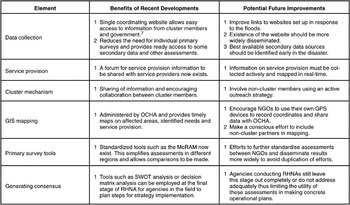
The experience of conducting a RHNA in Pakistan provided an opportunity to experience the workings of the GHC system in coordinating relief efforts during an ongoing disaster. Key observations from that experience are discussed below and a summary of these is in Table 1.
Summary of key elements identified for conducting rapid health needs assessments in the cluster era (GPS = global positioning system; McRAM = Multi Cluster Rapid Assessment Mechanism; NGO = non-governmental organization; OCHA = (UN) Office for the Coordination of Humanitarian Affairs; RHNA = rapid health needs assessment; SWOT = Strengths Weakness Opportunities Threat)

Active and enhanced surveillance systems now are in place to keep coordinators informed of evolving needs. The Disease Early Warning System (DEWS)Reference Rahim, Kazi, Bile, Munir and Khan11–Reference Bashir and Ikram12 administered by the WHO allows for evolving disease patterns to be monitored. Ongoing nutritional and maternal and child health surveys by government departments and UNICEF provide feedback for assessing needs in these crucial arenas. These systems have been strengthened and improved to provide real-time assessments of evolving need
by encouraging participant NGOs to contribute to data being fed back in a consistent manner on a similar platform.
A central Strategic Health Operations Centre (SHOC) was set up by the Pakistan National Health Emergency Preparedness and Response Network and the WHO to provide support, guidance, and coordination for agencies working in the flood disaster. However, its services tended to be overwhelmed by demands for assistance. A careful examination of adequate staffing numbers for such centers is required so that the ability to respond in a timely fashion is adequate.
The use of a single disaster coordination website (www.pakresponse.info)7 under the administration of OCHA to house surveillance data, situation reports, assessments, and the latest maps of the evolving disaster hugely facilitated the collaboration of organizations working toward the relief effort. The Pakistani government also has published websites outlining its response to the crisis,9–10 and these are provided as links on the flood disaster website so that information from NGOs and the government can be accessed easily. To further improve this platform, links to other websites set up specifically in response to the Pakistan floods, such as the Cochrane library special collection,13 could have been added to the website.
It is recommended that as NGOs conduct assessments, they should promptly upload the information obtained onto the OCHA website; the new system allows real-time assessments of evolving needs. However, the use of this website both by Cluster partner NGOs and non-cluster NGOs in planning their activities may be limited by the lack of awareness associated with its existence and of the benefits of shared understanding and partnership efforts.
The McRAM survey tool provided a standardized template for use by NGOs in conducting joint RHNAs in the KPK Province. This was a useful development, as it allowed data to be shared more easily by agencies. However, it was observed that many NGOs not directly involved in the McRAM survey, were conducting their own similar surveys—thus replicating efforts while not necessarily obtaining any new information. With the disaster covering such a large geographical area, there has been considerable variability in the methodology and quality of reporting findings amongst agencies conducting assessments.
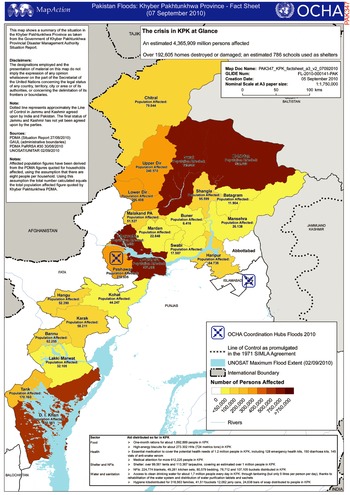
A tool that could have been used more broadly in the Pakistan flood emergency is Geographical Information System (GIS) mapping. Global Positioning Satellite (GPS) coordinate mapping devices are widely available, robust, and easy to use. The Mapping Section of OCHA has made good use of these tools in the Pakistani flood situation to identify locations of camps, health facilities, and other important sites (Figure 1).14 However, mapping staff at OCHA appeared to have inadequate capacity to make maps on request by relief agencies, a service which they profess to offer. As with the ability of the SHOC room to process requests in a timely fashion, this too is most likely to have been a function of inadequate staffing numbers for a disaster of such magnitude. Here, a possible improvement would occur if agencies that have GPS devices used them to record relevant coordinates, e.g., the location of a refugee camp they might be working in, and send the information to OCHA. This would reduce the workload on OCHA and make mapping information available to a wider set of organizations.
(Color online) Summary GIS map of the post-flood situation in Khyber Pakhtunkhwa Province produced for service planning by OCHA in September 2010.

Another important issue noted under the current system was that RHNAs placed too little emphasis on quantifying the numbers of service providers with different areas of expertise and specialization in operation in a particular geographic area. This crucial component for determining unmet need has been inadequately addressed during the Pakistan flood emergency. Service provision still is largely being assessed through a passive process whereby cluster partner organizations voluntarily provide information about their activities. Thus, the service activities of local NGOs, community organizations, large international agencies such as the International Committee of the Red Cross and Médecins Sans Frontières, and the work of government bodies that are active in the emergency such as the military are not adequately mapped and described. This situation leads to a distorted picture of service provision being drawn and can lead to the incorrect focus for delivery and prioritization of resources. In the context of the Pakistan flood, this has led to NGOs duplicating efforts in the same camps and district health units, with some being “over-served” at the expense of others. Furthermore, services that are provided by organizations outside of the Health Cluster often are not used by Health Cluster partners. New, innovative ways of including information from non-cluster members is needed in planning and moving forward. One option is to develop a system of active surveillance of providers to improve assessments. With limited resources, a shift in emphasis is required from primary interviews and surveys of the affected population to surveys of local and international service providers. This allows for more information to be gathered without over-burdening an already traumatized population.
Lastly, conducting a SWOT analysis with key stakeholders was an important element in generating consensus and agreeing on a plan for next steps in NGO' responses. It is important to recognize that an integral part of the RHNA process is to agree on a process within an organization in order to move the current state of affairs from one of unmet needs to the desired future state.
Conclusions
While there are a small number of publications that comment on the Pakistan flood situation and the need for ongoing relief support, there is a distinct paucity of robust research evaluating the coordination response, especially that critically appraises its processes.Reference Warraich, Zaidi and Patel15–Reference Burki17
The floods in Pakistan highlighted the need for effective and improved collaboration of local, national, and international agencies during ongoing and future disasters caused by natural hazards. With better knowledge of the new tools available to conduct RHNAs in the field, GHC members and relief agencies that are not part of the Cluster can improve the quality of their assessments and disseminate their findings more widely to facilitate knowledge sharing and improved responses. The further development of these tools and systems for gathering and sharing vital information should be maintained and encouraged among all participants in disaster relief work.
Abbreviations:
GPS = global positioning system
McRAM = Multi-Cluster Rapid Assessment Mechanism
NGO = non-governmental organization
OCHA = (UN) Office for the Coordination of Humanitarian Affairs
RNHA = rapid needs health assessment
SWOT = Strengths, Weakness, Opportunities, Threat
UNICEF = United Nations Children's Fund
WHO = World Health Organization