Introduction
The global distribution of termites (infraorder Isoptera) is limited primarily by temperature and moisture (Collins, Reference Collins, Leith and Werger1989; Bignell et al., Reference Bignell, Roisin and Nathan2011). In the tropics, termites are predominant at lower altitudes and are scarce or absent at higher latitudes (Collins, Reference Collins, Sutton, Whitmore and Chadwick1983; Eggleton et al., Reference Eggleton, Williams and Gaston1994; Jones and Eggleton, Reference Jones, Eggleton, Bignell, Roisin and Lo2011), occurring between latitudes of 30–51°N and 40–45°S (Wood, Reference Wood and Marshall1979). Worldwide, the infraorder Isoptera comprises more than 2958 described species in 271 genera and seven families (Engel et al., Reference Engel, Grimaldi and Krishna2009). The 3105 living and fossil species are classified into 12 families and 330 living and fossil genera according to the recent Treatise on the Isoptera of the World (Krishna et al., Reference Krishna, Grimaldi, Krishna and Engel2013).
Many termite species still remain undescribed, particularly in the tropical and subtropical regions (Eggleton et al., Reference Eggleton, Bignell, Sands, Mawdsley, Lawton, Wood and Bignell1996). In lowland tropical and subtropical forest ecosystems, termites are of key ecological importance as they mediate decomposition processes and nutrient recycling, and thereby exert a strong influence over soil functioning (Lavelle et al., Reference Lavelle, Bignell, Lepage, Wolters, Roger, Ineson, Heal and Dhillion1997). However, there are only a few studies on altitudinal distribution of termites in the tropics. Studies conducted on soil macrofauna in Sarawak, northwestern Borneo (Collins, Reference Collins1980), have shown a significant negative correlation between increasing altitude and the abundance of soil termites. Based on a study in Sumatra, Indonesia, Gathorne-Hardy et al. (Reference Gathorne-Hardy, Syaukani, Davies and Eggleton2001) reported that altitude has a significant effect on termite species richness, which declined even within a 100 m increase in altitude. Detailed information on montane termites is scarce (Jones and Eggleton, Reference Jones and Eggleton2000). Studies conducted on species composition of termites in Malawi in the African continent, over an altitudinal gradient, have inferred that the structure of the assemblages was clearly due to a mixture of altitudinal and site history factors (Donovan and Eggleton, 2002). A study by Palin et al. (Reference Palin, Eggleton, Malhi, Girardin, Rozas-Dávila and Parr2011) along an Amazon–Andes elevation gradient in Peru suggests that key drivers of the elevation pattern of termite diversity are reduced temperature with altitude and mid-elevation peaks in soil water content.
This study was carried out in Sri Lanka, an island in the Indian Ocean whose land area covers an extent of 65,793.3 km2. About 23% of its land area is under closed-canopy indigenous forests (MALF, 1995). Very little is known about the role of forest termites of Sri Lanka despite its dwindling forest cover. Apart from a few taxonomic studies reported during the British period, later studies have concentrated on termites of plantation crops, mainly tea, coconut, rubber and sugarcane. Species so far documented from Sri Lanka have been listed by Hemachandra et al. (Reference Hemachandra, Edirisinghe, Karunaratne and Gunetilleke2012) and Krishna et al. (Reference Krishna, Grimaldi, Krishna and Engel2013). In view of forest fragmentation resulting from large-scale forest clearances for development projects, especially during the recent past, there is the need to document forest termites. In Sri Lanka, of the five major natural forest types recognized, tropical montane forests in the highlands are unique in having a rich biodiversity. Two types of montane forests are recognized. Those above 1300 m are referred to as upper montane forests, which cover 0.05% of the island's total land area with an extent of 3108 ha. These are found in the mountain tops, such as Pidurutalagala, Hakgala, Peak Wilderness and Knuckles. Those between 900 and 1300 m are the lower montane forests, which are restricted to 1.04% of the island with an extent of 68,616 ha.
In this study, we surveyed termites in three different montane forest types in the Knuckles Forest Range (KFR), and assessed species richness, abundance and functional group diversity in each forest type. We hypothesized that species assemblages and functional groups of termites will differ in the three montane forest types. This is to be further confirmed in comparison with a high-altitude forest in Hantane hills in central Sri Lanka (Hemachandra et al., Reference Hemachandra, Edirisinghe, Karunaratne and Gunetilleke2010).
Materials and methods
Study sites
Knuckles Forest Range
The Knuckles Conservation Forest of 17,500 ha lies within the KFR in central Sri Lanka and is located at 900–1852 m. It has been nominated for an International Man and Biosphere Reserve, due to its ecological and hydrological importance. The forests therein are classified according to vegetation as (i) upper montane forests (>1300 m), (ii) lower montane forests (wet and dry, 600–1300 m), (iii) semi-evergreen forests ( < 600 m), (iv) patana grasslands ( < 100 m), (v) savannah, (iv) riverine forests (along the river banks) and (v) disturbed habitats due to ‘chena’ (shifting) cultivation and plantations of cardamom, Pinus and Eucalyptus (Bambaradeniya and Ekanayake, Reference Bambaradeniya and Ekanayake2003).
The Knuckles Forest receives monsoonal rain from both southwest monsoon (May–September) and northeast monsoon (December–February) (de Rosayro, Reference de Rosayro1958), resulting in higher rainfall during these periods. The location of the forest region has resulted in a wide range of rainfall patterns in different parts of the region.
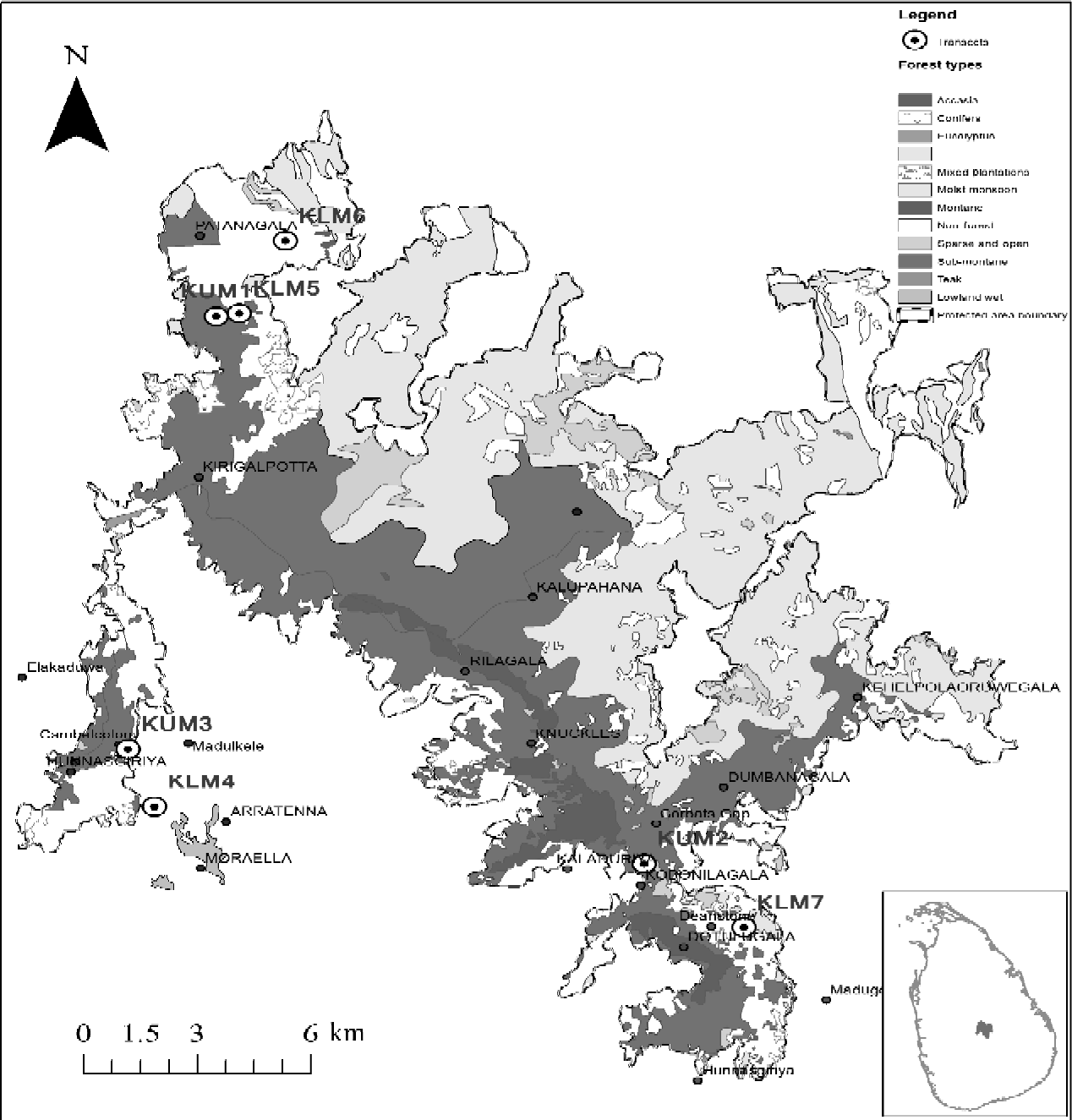
The choice of forest sites for the study of termites in the montane zone of the KFR was intended to cover the variation in altitude, climate and vegetation. A total of seven transects representing three different montane forest types, namely the upper montane forests and the lower montane forests (wet and dry), were selected for the study. Their distribution in the KFR is given in Fig. 1.
Montane transects (seven species) located within the conservation area of the Knuckles Forest Range in Sri Lanka (inset). KUM, Knuckles upper montane; KLM, Knuckles lower montane.

The upper montane (KUM) forests are the climax vegetation above 1300 m. A dense fog layer often covers the wet forests. Forests have a dense canopy and a scanty to thick shrubby layer. Trees are short and much branched, gnarled and the stems are covered with lichens, mosses and ferns. The highland area of the Knuckles Forest is extremely wet throughout the year with an annual average rainfall of 5000 mm. The upper montane forest sites are accessible only by four-wheel drive vehicles and then uphill by foot through tea plantations or abandoned tea land. Three transects, KUM1, KUM2 and KUM3, were laid in the upper montane forests. The lower montane (KLM) forests represent a transition belt between the highland and lowland forests and occur on the wet, western and dry, eastern slopes of the KFR. The lower western slopes are wet with an annual rainfall of 3350 mm and the eastern slopes are much drier with less than 2500 mm. Patches of wet KLM forests and sclerophyllous dry KLM forests are found between 700 and 1300 m (Bambaradeniya and Ekanayake, Reference Bambaradeniya and Ekanayake2003; Giragama and Wickramaratne, Reference Giragama, Wickramaratne and de Silva2005; Ratnayake, Reference Ratnayake and de Silva2005). The lower montane forest sites were reached by road, from where footpaths led to the relatively undisturbed interior forests. Two transects were laid in each of the lower montane wet forests (KLM4 and KLM5) and the lower montane dry forests (KLM6 and KLM7).
Hantane Forest Range
The Knuckles termite assemblages were compared with two lower montane (HLM) forest sites in Hantane hills. It is a relatively small, isolated, forest range in the wet zone of central Sri Lanka (7° 17′N and 80° 36′E, 518–1110 m elevation). One (HLM) forest site is a primary forest at 900 m and the other is an Albizia-dominant secondary forest at 1000 m. The phytosociological features and the vegetation types therein are given in Greller et al. (Reference Greller, Gunetilleke, Gunetilleke and Balasubramanium1980) and Ratnayake (Reference Ratnayake2001). The high-altitude lower montane forest sites in Hantane Hills where transects (HLM2 and HLM3) were laid are also accessible only by foot.
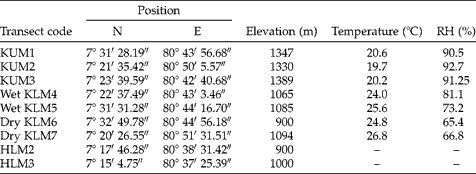
The standard belt transect method had already been used there, and the findings have been reported in Hemachandra et al. (Reference Hemachandra, Edirisinghe, Karunaratne and Gunetilleke2010). Location and altitude of forest sites in the KFR and Hantane hills where transect sampling was carried out and the ambient temperature and relative humidity at the time of sampling are given in Table 1. The ground cover in the different transects was closely examined at the time of sampling, and a descriptive record made.
Locations and environmental conditions of montane forest sites in the Knuckles Region and Hantane, Sri Lanka, where transects were laid
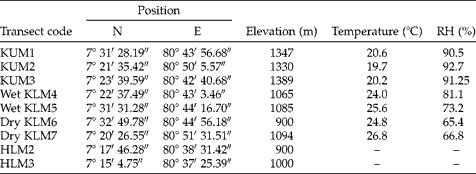
RH, relative humidity; KUM, Knuckles upper montane; KLM, Knuckles lower montane; HLM, Hantane lower montane.
Sampling of termites
The standard belt transect method of Jones and Eggleton (Reference Jones and Eggleton2000) was used for sampling. Each transect (100 × 2 m) was divided into 20 contiguous sections, and each section was sampled for 30 min by two people. Within each transect, the following microhabitats were searched for termites: surface soil (12 samples, each 12 × 12 cm, to 10 cm depth); leaf litter on surface soil, tree buttresses; dead tree stumps, logs, branches and twigs; runways on trees and arboreal nests up to 2 m height. Soldier and worker termites were collected into vials containing 80% isopropyl alcohol and labelled with the section and transect number. The number of encounters with each species in a transect was used as a measure of relative abundance of that species in the transect. An encounter is all the species collected from one point of excavation (Davies et al., Reference Davies, Hernandez, Eggleton, Didham, Fagan and Winchester2003). As no termites were collected from transect sampling in the KUM, it was supplemented with casual searching, spending roughly equal time and effort in each of the KUM sites where the known microhabitats of termites were searched.
Identification of termites and their feeding habits
Termites found in each point of excavation (hit) in a transect section were collected separately into 80% isopropyl alcohol, and identified to possible taxa using keys and descriptions of Roonwal and Chhotani (Reference Roonwal and Chhotani1989) and Chhotani (Reference Chhotani1997). The wet collection was stored in the Entomology laboratory, and the voucher collection is held in the Peradeniya University Museum Insect collection.
Feeding habits of termites were deduced from generic identity and feeding group classification of Donovan et al. (Reference Donovan, Eggleton and Bignell2001). In addition, slide-mounted mandibles of worker termites of recorded species were examined for molar plate ridges in the right mandibles for confirmation of feeding groups. Accordingly, species were assigned to the following four feeding groups and five feeding habits: group I (W), live-wood-feeding lower termites; group II (WF), fungus-growing wood feeders; group II (NF), non-fungus-growing wood feeders; group III (I), soil–wood interface feeders; group IV (S), true soil feeders.
Data analysis
We followed the general pattern shown in Jones (Reference Jones2000) for examining and interpreting the data on montane termites. Similarity in termite species composition among transects in the KUM and KLM forest sites of the KFR, and the two HLM transects in Hantane was examined by cluster analysis. Bray–Curtis ordination (similarity index) was carried out on square root-transformed abundance data using the computer software package PRIMER (Clarke and Warwick, Reference Clarke and Warwick2001), and the classification was displayed as a dendrogram. Transect variables (elevation, temperature and humidity) were correlated with each other using Pearson's correlation. Species variables, richness and abundance were not subjected to any analysis, as the three upper montane transects failed to yield any termites.
Results
Species composition and richness
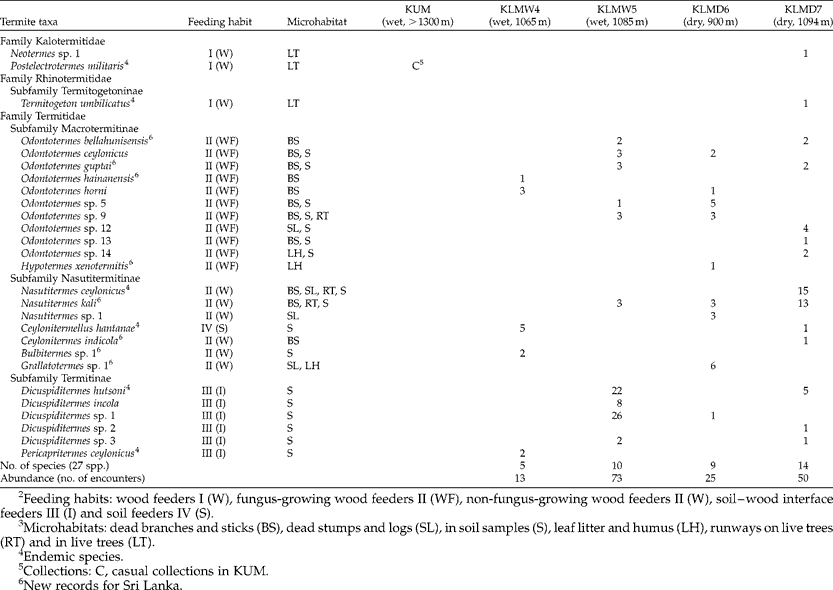
Overall, a total of 26 termite species in 12 genera and three families were collected from transect sampling in the dry and wet KLM sites, and none from the three transects in the KUM sites (Table 2). Casual searching in the KUM sites yielded a single, live-wood lower termite species, Postelectrotermes militaris (Kalotermitidae). Among the termites recorded were six endemic species, a previously unrecorded genus, Grallatotermes, and seven previously unrecorded species. The live-wood species P. militaris was found in two live trees: under the bark of a thunder struck Syzygium umbrosum Thw. and a wind struck Litsea ovalifolia (Wight) Trimen. In the KLM site at 1094 m, there were two other lower termite species: Neotermes sp.1 (Kalotermitidae) collected under the burnt bark of a live tree and Termitogeton umbilicatus (Rhinotermitidae) collected from a dead branch of a live tree. The dry KLM transect at 1094 m yielded two previously unrecorded species, Ceylonitermes indicola and Nasutitermes kali, for Sri Lanka (Table 2). Termites showed a restricted distribution in the different montane sites. There were six species that were encountered only once (and were unique to a transect). The genus Odontotermes includes the most number of species (10) followed by Dicuspiditermes (5) (Table 2).
Species composition, abundance1, feeding habits2 and microhabitats3 of termites in montane forest transects in the Knuckles Forest Range, Sri Lanka
1No. of hits/encounters of a species per transect.
2Feeding habits: wood feeders I (W), fungus-growing wood feeders II (WF), non-fungus-growing wood feeders II (W), soil–wood interface feeders III (I) and soil feeders IV (S).
3Microhabitats: dead branches and sticks (BS), dead stumps and logs (SL), in soil samples (S), leaf litter and humus (LH), runways on live trees (RT) and in live trees (LT).
4Endemic species.
5Collections: C, casual collections in KUM.
6New records for Sri Lanka.
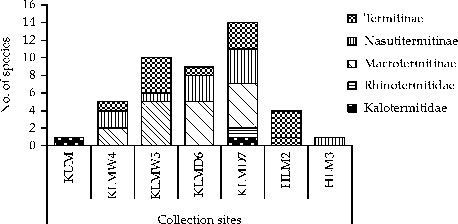
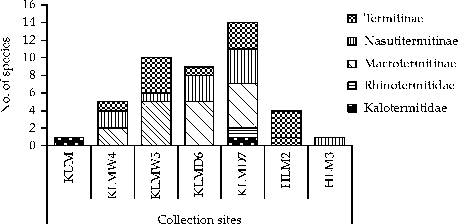
The KLM transects were more diverse with five and 10 species in the two dry KLM transects; nine and 14 species in the two wet KLM transects (Table 2). The most striking feature in the taxonomic composition of recorded termites is that the two lower termite families, Kalotermitidae (dry wood termites) and Rhinotermitidae, were restricted to the two highest elevations (Table 2 and Fig. 2). All the other species recorded belonged to the three higher termite subfamilies, Termitinae, Nasutitermitinae and Macrotermitinae (with 6, 7 and 11 species, respectively) of the family Termitidae. Of these species, 11 were found only in one of the four lower montane forest transects sampled, 10 others in two of the transects and just one species in three transects, indicating that most species are localized to some degree among the different montane sites/transects (Table 2 and Fig. 2).
Taxonomic composition of termites from transects and casual collections in upper montane (KUM) and dry and wet lower montane forest (KLM) sites.
Species abundance
Overall, the total number of termite encounters varied greatly among the transects, with a total of 13 and 73 in the two wet KLM transects, and 25 and 50 in the two dry KLM transects (Table 2). The number of encounters of the different termite species also varied widely in the wet and dry KLM transects. Dicuspiditermes sp.1 and Dicuspiditermes hutsoni in particular had unusually high encounters with 26 and 22 hits, respectively, within one transect (wet KLM5 at 1085 m). Most other species had fewer encounters in their respective transects. Species composition and abundance showed different patterns in relation to altitude. The two KLM transects at higher elevations (1094 and 1085 m) recorded a higher number of species (14 and 10 species) and higher relative abundances (50 and 73 encounters), respectively, compared with the corresponding values in the two lower elevation transects (Table 2).
The transect site elevation in the different forests correlated significantly with the physical variables: temperature (P= 0.05) and humidity (P= 0.018).
Microhabitats
Apart from the three termite species collected from damaged live trees (LT) in sites at higher elevations (KUM and KLM at >1300 and 1094 m, respectively), majority (24 species) were collected from the forest floor (Table 2), and several from more than one microhabitat, namely excavated soil samples (S), dead plant material comprising branches and sticks (BS), stumps and logs (SL), leaf litter and humus (LH) and runways on live trees (RT). Termites inhabiting these microhabitats are largely foraging species (deadwood feeders and soil feeders) that wander away from their nest sites. The likelihood of the presence of more live-wood species in transects and sites cannot be ruled out, as live trees (with no symptoms of damage) were not examined for termites by invasive methods, because it required destructive sampling. Mounds were not found in any transect or during casual searching in the study sites. Certain termite genera occurred in specific microhabitats: Odontotermes were mostly confined to dead BS in the forest floor and Dicuspiditermes to soil. A few species were collected from leaf litter at different stages of decomposition. Four of the five endemic species recorded, except the live-wood species, were present in soil (Table 2).
Ground cover
Ground cover in the upper montane transects was most characteristically wet and covered mostly with organic-rich topsoil with large earthworm casts, a thin to sparse leaf litter layer with an occasional damp and decaying dead branches riddled with beetles and ants. Ground cover in the wet KLM was moist with a thick layer of decomposing leaf litter. In contrast, in the dry KLM, soils were drier with a relatively undecomposed leaf litter layer and with a greater amount of dry dead sticks and branches.
Functional group diversity of termites
Of the three species of live-wood-feeding lower termites of group I (W) recorded during the study, P. militaris was the only species recorded from the KUM. It was collected from a live tree during casual searching. The other two species, Neotermes sp. 1 (Kalotermitidae) and T. umbilicatus (Rhinotermitidae), found in the highest elevation KLM transect (1094 m), were also collected from live trees. The termites of group I (W) were absent from all the other transects at lower elevations. Thus, it is clear that montane forest sites at a high altitude are poor in termite abundance, except for a few distinct lower termite species having a specific feeding habit.
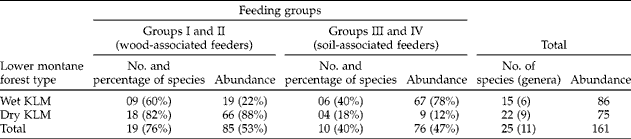
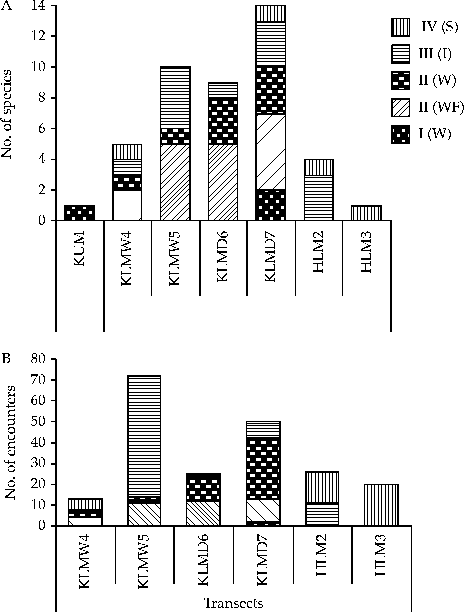
In comparison with KUM sites, KLM transects were more diverse, having termites belonging to almost all the feeding groups, but the relative number of species belonging to a particular feeding group differed according to elevation and forest type, irrespective of the wet or dry KLM site. The higher termite species (group II) that included 17 species of fungus-growing wood feeders [group II (WF)] and eight non-fungus-growing wood feeders [group II (W)] were present in all the transects, but differed in the number of species in the different transects (Table 3 and Fig. 3A and B). There were more non-fungus-growing wood-feeding species [group II (W)] in the two dry KLM transects (three species in each) and fewer in the two wet KLM transects (one species in each). The distribution of soil–wood interface-feeding species was somewhat similar in the dry and wet KLM transects, with the two wet transects recording one and four species and the dry transects one and three species. Overall, the wet KLM transect at 1065 m recorded a lower number of species (five species), representing the different feeding groups, while the dry KLM transect at the highest elevation of 1094 m recorded a higher number of species (14 species), representing all the feeding groups. A distinct difference was observed in the distribution of the soil-feeding species, Ceylonitermellus hantanae. It was present only in two transects: dry KLM transect at 1065 m and wet KLM transect at 1094 m.
Distribution and abundance of termite species belonging to different feeding groups in the wet and dry lower montane (KLM) forest transects of the Knuckles Forest Range+
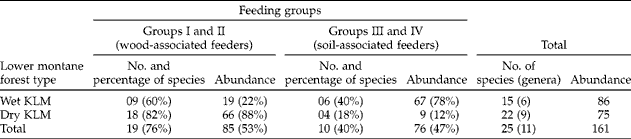
+ Percentage refers to the number of species or abundance in relation to the total in that forest type.
(A) Number of termite species with different feeding habits. (B) Abundance (no. of encounters) of species with different feeding habits in the upper montane (KUM) and lower montane (KLM) forests of the Knuckles Region. I (W), live wood feeders; II (NF), fungus growing wood feeders; II (W), non-fungus growing wood feeders; III (I), soil-wood interface feeders; IV (S), soil feeders.
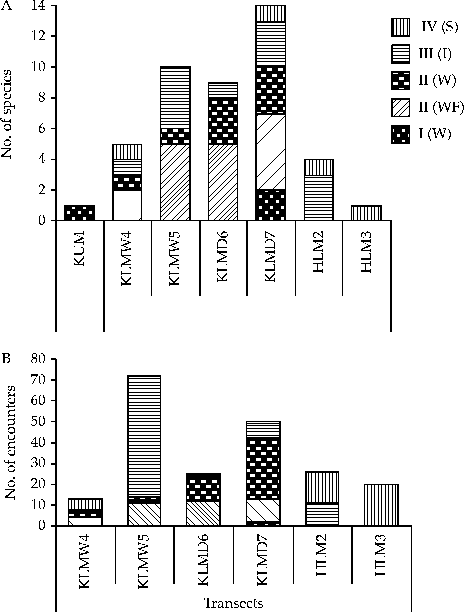
When soil-feeding and soil–wood interface-feeding species (soil-associated feeders) were grouped together (groups III and IV combined, Table 3), a distinct difference in their distribution and abundance was observed; the wet KLM transects harboured a higher relative abundance, though not a higher number, of such species that fed on soil and extremely decayed soil-like wood compared with their representation in the dry KLM transects. The wet KLM5 transect at 1085 m was distinct in having the highest relative abundance (58 encounters) of soil–wood interface-feeding species (Fig. 3B). Similarly, when both non-fungus and fungus-growing wood-feeding species were grouped together (groups I and II combined, wood-associated feeders), a distinct difference in their distribution was also observed. The dry KLM transects had a greater richness and a higher relative abundance of species that fed on wood and wood-associated fungi, compared with species in the wet KLM transects (Table 3). The dry KLM7 transect at the highest elevation of 1094 m had the highest relative abundance (29 encounters) of non-fungus-growing wood-feeding species (Fig. 3B).
Overall, the dry KLM transects were distinct in having a greater species richness and abundance (encounters) of wood and wood-associated non-fungus-growing species, while the wet KLM transects were distinct in having a greater species richness and abundance of termite species that fed on soil and decayed soil-like wood. When soil-feeding termites were grouped together with soil–wood interface species (groups I and II combined), it was clear that the two dry KLM transects had a higher species composition and abundance of species that fed on wood and wood-associated fungi compared with the two wet KLM sites that had a greater richness and abundance of species that fed on soil and extremely decayed soil-like wood (Table 3).
Comparison of montane sites in the Knuckles Region with Hantane sites
The Hantane transect at a high elevation (HLM3, 1000 m) recorded only a single species, the soil-feeding C. hantanae (with 20 encounters), while that at a low elevation (HLM2, 900 m) recorded a total of four species, namely C. hantanae (15 encounters), Dicuspiditermes incola (soil–wood interface feeder with six encounters), Dicuspiditermes sp. 1 (soil–wood interface feeder with four encounters) and Dicuspiditermes sp. 2 (soil–wood interface feeder with one encounter) (Hemachandra et al., Reference Hemachandra, Edirisinghe, Karunaratne and Gunetilleke2010).
Wood feeders (groups I and II) were totally absent in the Hantane transects, whereas the Knuckles transects yielded 20 such species. The Hantane transects included only soil (one species) and soil–wood interface feeders (three species) (groups II and IV), but the Knuckles transects yielded seven such species. Endemic C. hantanae was common to the high-altitude Hantane transect where it occurred in high abundance (20 encounters), and to the KLM transects where it occurred in lower abundance (KLM5: five encounters; KLM7: one encounter). The three species of soil–wood interface feeders (Dicuspiditermes sp. 1 and 2 and D. incola) were also common to both Hantane hills and KFR. The higher relative abundances of Dicuspiditermes sp. 1 (26 encounters) and D. hutsoni (22 encounters) in one and the same transect (KLM5), in contrast to all the other termite species recorded during the study, are of interest.
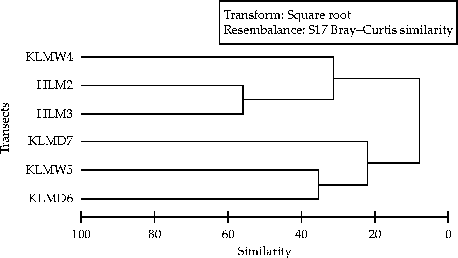
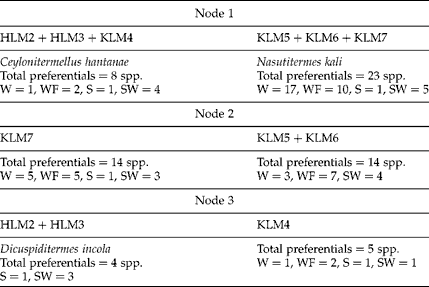
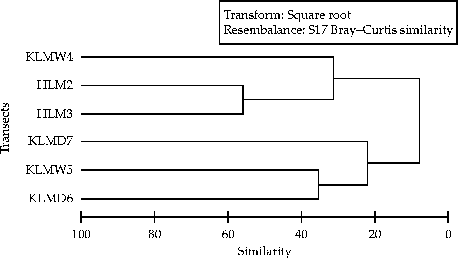
Cluster analysis using Bray–Curtis ordination (Fig. 4) showed that species composition of termites in the wet KLM4 transect at 1065 m in the Knuckles Region is similar to species in the Hantane transects (HLM2 and HLM3). While species composition in the other wet KLM5 transect at 1085 m is more similar to the two dry transects (KLM7) at 1094 and (KLM6) at 900 m elevations in the KFR (Fig. 4). The first node separated the two groups at around 7% similarity level, the Hantane sites and wet KLM sites having more soil-associated feeders than the dry KLM transects that were rich in wood-associated feeders. Furthermore, N. kali, a new record for Sri Lanka, was present in all the KLM transects except KLM4. The second node in the dendrogram separated the dry KLM7 transect at 1094 m from the wet KLM5 transect at 1085 m and the dry KLM6 transect at 889 m at around 22% similarity level. The preferentials included C. hantanae, which is an endemic soil-feeding species absent in the KLM5 and KLM6 transects. The third node in the dendrogram separates the wet KLM4 transect at 1065 m in the KFR from the two transects in Hantane (HLM2) at 1000 and (HLM3) 900 m, and the preferential species reflect the differences between the Hantane and KFR termite assemblages, where wood feeders were absent in the Hantane tansects.
Bray–Curtis ordination dendrogram showing the similarity of termite assemblages in montane forests based on species composition recorded from casual collections and transect sampling in the upper montane (KUM) and lower montane wet (KLM4 and KLM5) and dry (KLM6 and KLM7) forests of the Knuckles Region and Hantane (HLM2 and HLM3).
The two Hantane transects (HLM2 and HLM3) and the wet KLM4 transect at 1065 m had predominantly more soil and soil–wood-feeding preferential species (8:5) compared with the remaining three transects (23:6) (Table 4). The ratio of wood feeders in the Hantane transects and the wet KLM transects at 1065 m was much smaller (8:3) compared with that in the remaining three transects (23:17).
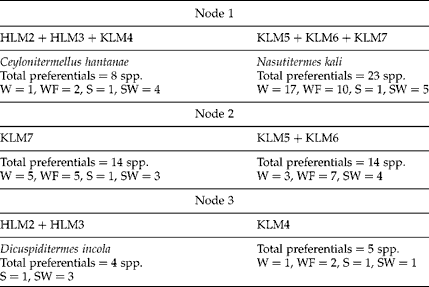
W, non-fungus-growing wood feeders; WF, fungus-growing wood feeders; S, soil feeders; SW, soil–wood interface feeders.
+ Only those preferential species occurring in all transects on the respective side of the node are listed. The total number of preferential species in each feeding group is provided.
Discussion
Further studies are needed to confirm the finding that the upper montane sites are depauperate in termites compared with the lower montane sites in other upper montane sites in the KFR and elsewhere in Sri Lanka. Similar studies carried out in upper montane tropical forests in Southeast Asia have confirmed that upland forests are relatively depauperate (Jones, Reference Jones2000). It is of significance that termite species at a high elevation (i.e. KUM and KLM7 at >1300 and 1094 m) belong to the lower termite families Kalotermitidae and Rhinotermitidae. These species (P. militaris, T. umbilicatus and Neotermes sp. 1) are non-foraging live-wood feeders of group I (W) (Donovan et al., Reference Donovan, Eggleton and Bignell2001) that are one-piece nesters (Higashi et al., Reference Higashi, Abe and Burns1992).
Furthermore, the noteworthy absence of ground-dwelling termites in KUM forests is most probably due to the soil therein being very wet and moist dominated by earthworms and hence would not support soil termites. Similarly, the beetle-infested damp and rotting wood from fallen parts of trees would not favour wood-feeding termites. In contrast, wet lower montane forests are distinct in having a richer soil and soil-like wood-feeding termite assemblage, while dry lower montane forests are characterized by a greater number and abundance of wood-feeding species. According to Gathorne-Hardy et al. (Reference Gathorne-Hardy, Syaukani, Davies and Eggleton2001), with an increase of altitude, deadwood-feeding foraging termites of group II (W) gradually diminish before soil feeders (groups III and IV).
Postelectrotermes militaris, recorded only from damaged living trees in KUM sites, is common in living tea bushes at high elevations in the Central Province and in the Ratnapura District (Green, Reference Green1913). It is a tea pest, mainly at 1066–1372 m, and hence commonly known as the ‘Up-country Tea Termite’ (Ranaweera, Reference Ranaweera1962). It also occurs in live trees such as Albizia falcataria, Crotalaria micans, Erythrina subumbrans, Grevillea robusta, Neolitsea cassia, Shorea zeylanica and Syzygium gardneri (Wijeratne, Reference Wijeratne1999), which are grown as shade trees in upcountry tea plantations.
The dry KLM transects are relatively species rich and abundant in non-fungus-growing wood-feeding species, while the lower wet KLM transects are abundant in soil–wood interface-feeding species. These differences may be attributed to the climate and ground cover conditions in montane forest types. A rich layer of decomposing leaf litter in the forest floor of wet KLM is more suitable for humus feeders. In dry KLM, dry dead sticks and branches that are plentiful in the ground cover favour wood feeders. The near absence of termites in KUM forests may be attributed to (i) high altitude with low temperatures, adverse for foraging termites, (ii) wet and humid climate, lower stature and almost closed canopy and earthworm dominance in wet soil, adverse for soil-feeding termites, as well as (iii) damp and decomposed wood riddled with beetles and ants in the forest floor, adverse for wood-feeding termites. It was evident that the role of termites in KUM was taken over by soil-feeding earthworms and wood-boring beetles, abundant in KUM forest sites.
Small differences in altitude and temperature, especially between the KUM and KLM sites, give rise to very different climatic and microclimatic conditions within these two forest types. Studies carried out in Peninsular Malaysia identified forest and soil type as the most important factor in explaining the structure of termite assemblages (Salick and Tho, Reference Salick and Tho1984). Gathorne-Hardy et al. (Reference Gathorne-Hardy, Syaukani, Davies and Eggleton2001) considered altitude as having a significant effect on the species composition and richness of termites from a study in the Leuser Ecosystem in Sumatra, Indonesia. Termites exhibit a wide range of feeding habits with a high degree of resource specialization. Hence, their distribution in forest ecosystems in part will be determined by resource availability at different altitudes (Eggleton et al., Reference Eggleton, Davis and Bignell1998). Considering all these factors and the absence of soil, soil–wood interface and deadwood feeders in KUM, the study indicates that termites have a reduced impact on decomposition and recycling processes in KUM forest types compared with those in KLM sites.
The location of KUM sites may be another overriding factor that contributes to the distinctiveness in termite assemblages. Tea plantations were established at high elevations in the distant past by clearing much of the natural forest. Hence, it is likely that P. militaris has moved in to living tea bushes from nearby natural forests. As live trees (with no external symptoms of damage) were not examined for termites during this survey, their increased occurrence cannot be ruled out. The ‘live wood tea termites’, Glyptotermes dilatatus and Neotermes greeni (family Kalotermitidae) (Ranaweera, Reference Ranaweera1962) were not detected in montane forest transects and could be attributed to live trees not being subjected to invasive sampling.
Considering the limited termite fauna so far recorded from the forests of Sri Lanka (Hemachandra et al., Reference Hemachandra, Edirisinghe, Karunaratne and Gunetilleke2012) in comparison with the fauna in Southeast Asia (Gathorne-Hardy et al., Reference Gathorne-Hardy, Syaukani, Davies and Eggleton2001), it is likely that further collecting efforts would certainly lead to the documentation of other species represented at least in the transition zones of upper and lower montane forests. The present findings and results of ongoing studies in other forest types in the KFR when put together may shed more light on factors influencing termite distribution in the KFR.
Conclusion
Termite distribution in montane forests of the KFR infers that altitude, temperature, moisture levels (wet and dry forests) and forest floor litter composition probably have an important effect on termite species richness and functional group diversity of termites. The total absence of soil-living termites and deadwood feeders in the forest floor litter in the upper montane forest sites in the KFR is an important finding. For further confirmation, a comparison with similar forests elsewhere in Sri Lanka needs to be made. Dry montane forests harbour a greater diversity of species and deadwood-feeding functional groups, inferring the role of forest floor litter composition in determining the species composition of termites.
Acknowledgements
This work forms part of a larger study in the KFR funded by the National Science Foundation of Sri Lanka. We thank the several field assistants for their help during sampling. We are indebted to Mr A. Medawatta, formerly of the Department of Botany, University of Peradeniya, for help with site selection and for leading us through the difficult forest terrain. Mr Malika Gunawardena formatted the GPS data.