Introduction
Much of the Earth’s surface remains largely unexplored. This includes the more remote parts of Canada. Despite our limited knowledge about them, we know that many of these regions are critically important ecosystems. One such area is northern Ontario, Canada, which comprises almost 42% of the province’s land mass. The region covers an area larger than Germany, is largely inaccessible, and has a low population density and few roads (Ontario Ministry of Natural Resources and Forestry 2014). Approximately 441 000 km2 in area, it encompasses one of the largest intact ecosystems in the world (Ontario Ministry of Natural Resources and Forestry 2015) and remains relatively unaltered by anthropogenic activity. This forested region contains the Hudson Bay Lowlands (Crins et al. Reference Crins, Gray, Uhlig and Wester2009), which make up the core of the third-largest wetland on Earth (Crins et al. Reference Crins, Gray, Uhlig and Wester2009; Ontario Ministry of Natural Resources and Forestry 2015).
Syrphids (Diptera: Syrphidae) are an important, diverse family of flies best known for their Batesian mimicry of Hymenoptera. They are ecologically important as pollinators (Howarth and Edmunds Reference Howarth and Edmunds2000) and can be zoophagous, saprophagous, phytophagous, or mycophagous (Sommaggio Reference Sommaggio1999). Their species, together, span the range from highly specialised to widespread generalists. Often, the distribution of syrphid species is determined by larval habitat, especially for the slow-dispersing specialist species (Schweiger et al. Reference Schweiger, Musche, Bailey, Billeter, Diekötter and Hendrickx2007; Aguirre-Gutiérrez et al. Reference Aguirre-Gutiérrez, Kissling, Carvalheiro, WallisDeVries, Franzen and Biesmeijer2016). This variability of life history makes syrphids potentially ideal bioindicators, particularly for tracking landscape changes, changes to forests (Sommaggio Reference Sommaggio1999; Deans et al. Reference Deans, Smith, Malcolm, Crins and Bellocq2007; Sommaggio and Burgio Reference Sommaggio and Burgio2014), and environmental changes (Danks Reference Danks1992).
To understand how a changing landscape affects these species, baseline distributional data are needed (Kearns Reference Kearns2001). Currently, our understanding of Syrphidae species’ distributions in North America is largely derived from well-known and accessible parts of North America; little is known about the Syrphidae in northern Ontario because of a near-complete absence of sampling effort throughout much of the region. What is known comes from collections that occurred near larger communities such as Moosonee and Fort Severn (Freeman and Twinn Reference Freeman and Twinn1954; Huckett Reference Huckett1965; Shorthouse et al. Reference Shorthouse, Goulet and Shorthouse2003; Jones et al. Reference Jones, Sinclair and Keller2014; Cordero et al. Reference Cordero, Sánchez-Ramírez and Currie2017). Until recently, few invertebrate surveys have been conducted in the remote interior of northern Ontario, and none have included Syrphidae. Those surveys that did occur in the region include collections of, for example, Tabanidae (Ringrose et al. Reference Ringrose, Abraham and Beresford2013), Culicidae (Ringrose et al. Reference Ringrose, Abraham and Beresford2014), molluscs (Forsyth and Oldham Reference Forsyth and Oldham2016), Carabidae: Cicindelinae (Jumean et al. Reference Jumean, Oldham, Fleming, Duran and Beresford2017), Dytiscidae (Degasparro et al. Reference DeGasparro, Brown, Alarie and Beresford2018), Bombus Latreille (Hymenoptera: Apidae) (Gibson et al. Reference Gibson, Bennett, Brook, Langer, Macphail and Beresford2018), leeches (Langer et al. Reference Langer, Vezsenyi, de Carle, Beresford and Kvist2018), Carabidae: Elaphrinae (Fleming and Beresford Reference Fleming and Beresford2019), and Nicrophorus Fabricius (Coleoptera: Silphidae) (Ringrose et al. Reference Ringrose, Langer, Fleming, Burt, Bourne, Brand and Beresford2019).
In this paper, we present the first extensive inventory of syrphids from across northern Ontario, report on nearly a decade’s worth of collected specimens, and summarise the most significant discoveries from this region. Specimens were collected from more than 400 sites in the interior of northern Ontario during the Ontario Ministry of Natural Resources and Forestry’s Far North Biodiversity Project and other projects.
Materials and methods
Collection
Specimens were gathered from three different projects conducted in northern Ontario, Canada. All projects were general surveys, and collections were nonspecific to syrphids. Dates, locations, and collecting methods differed between each project. The following projects provided collections for this study.
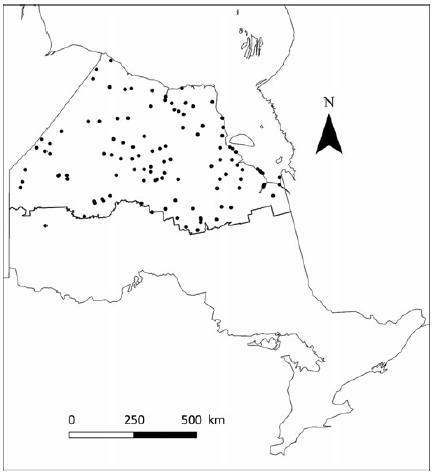
The Far North Biodiversity Project was conducted by the Ontario Ministry of Natural Resources and Forestry to identify and catalogue biodiversity in the far north region of Ontario, which lies north of the Area of Undertaking where timber harvesting is permitted and north of Woodland Caribou and Wabakimi provincial parks (Far North Act 2010, S.O. 2010, c. 18; Fig. 1). The project took place over six years (see Ringrose et al. Reference Ringrose, Abraham and Beresford2013 and Ontario Biodiversity Council 2015). Collecting began in 2009, based on available helicopter access. From 2010 to 2014, more systematic and large-scale sampling was undertaken. Each year, sample sites were randomly located within a 150-km radius of a First Nations’ community: Webequie in 2010 and 2013, Big Trout Lake and Sandy Lake in 2011, Fort Albany in 2012, and Fort Severn in 2014 (see Ringrose et al. Reference Ringrose, Abraham and Beresford2013). Sites were sampled intensively for one week each. Insect sampling methods included Malaise traps, Nzi traps (a cloth biting-fly trap; Mihok Reference Mihok2002), terrestrial bottle traps baited with carrion, pan traps, vegetation sweeps, net sweeps, pitfall traps, and aquatic sampling. All specimens were stored in 70% ethanol. Simultaneous to this, additional surveys were conducted by hand netting, with helicopters used to access remote areas. These surveys were conducted as part of a larger study of plant and animal diversity.
All sites from which syrphids were collected, 2009–2015, (black circles) during the Far North Biodiversity Project. The far north boundary was, with one exception, the southern limit of the study area.

Sampling was also conducted in a different project near Moosonee, Ontario from 19 to 28 July 2015. Two Malaise traps (Lightweight Malaise Trap, Townes Style, 176 cm high, 165 cm long, model no. 2868, BioQuip Products, Rancho Dominguez, California, United States of America) were set up with nontoxic antifreeze and were emptied daily. Coloured pan traps (yellow (RAL 1026), light blue (RAL 5012), dark blue (RAL 5017), white (RAL 9010), and pink (RAL 4003)) were also deployed using soapy water and were emptied every other day. Pan traps were set up in similar fashion to those of the Far North Biodiversity Project and used three similar colours (yellow, light blue, and white). All specimens were placed in 70% ethanol after collection.
In a third project, a single Malaise trap (Lightweight Malaise Trap, Townes Style, 176 cm high, 165 cm long, model no. 2868, BioQuip Products) was deployed at the Ontario Ministry of Natural Resources and Forestry research station in Polar Bear Provincial Park near Burnt Point, Ontario (Beresford Reference Beresford2011) from 18 June to 30 June 2016. Specimens were placed into 70% ethanol.
Processing
Syrphids were removed from all samples. Once all previously pinned individuals were excluded, all specimens were critically point dried using a Leica critical point dryer (Leica EM CPD300, Leica Microsystems Inc., Concord, Ontario, Canada) and then pointed onto pins. Identifications were conducted using Skevington et al. (Reference Skevington, Locke, Young, Moran, Crins and Marshall2019a), supplemented by keys from Vockeroth (Reference Vockeroth1992), Miranda et al. (Reference Miranda, Young, Locke, Marshall, Skevington and Thompson2013), and Young et al. (Reference Young, Marshall and Skevington2016).
Voucher specimens were housed at Trent University, Peterborough, Ontario, Canada, with plans to move them to the Canadian National Collection of Insects, Arachnids and Nematodes, Ottawa, Ontario, Canada for curation and long-term storage.
Analysis
Range records
Range records were determined using Skevington et al. (Reference Skevington, Locke, Young, Moran, Crins and Marshall2019a), using the same methods as Vezsenyi et al. (Reference Vezsenyi, Skevington, Moran, Young, Locke, Schaefer and Beresford2019). Specimens were divided into three categories, based on their distance to the nearest collected specimen of that species: near (less than 400 km), intermediate (400–800 km), and far (more than 800 km). Although these distances are arbitrary, they were chosen so that near records pass through few plant hardiness zones, intermediate records pass through a number of plant hardiness zones but tend to stay within the two ecozones found in northern Ontario, and far records pass through plant hardiness zones and ecozones that are different than those found in northern Ontario. Records were also classified as gap infill, edge of range, and range extension. Gap infills are defined as records that fall between multiple points within the species’ range, regardless of the distance between these points. Edge-of-range records are defined as records that are found near the edge of the species’ range but do not extend the overall range in any particular direction. Range extensions are defined as records that extend the overall distribution in a particular direction.
Range maps were produced using ArcMap 10.6.1 (Environmental Systems Research Institute 2011). Previous ranges were approximated using Skevington et al. (Reference Skevington, Locke, Young, Moran, Crins and Marshall2019a).
We used Preston’s lognormal and Chao 1 (Hammer et al. Reference Hammer, Harper and Ryan2001) to estimate how many remaining, undocumented species might be found in northern Ontario (Preston Reference Preston1948; Ludwig and Reynolds Reference Ludwig and Reynolds1988; Gotelli and Colwell Reference Gotelli, Colwell, Magurran and McGill2010). We used work by Vockeroth and Thompson (Reference Vockeroth, Thompson, McAlpine, Peterson, Shewell, Teskey, Vockeroth and Wood1987), Sommaggio (Reference Sommaggio1999), and Skevington et al. (Reference Skevington, Locke, Young, Moran, Crins and Marshall2019a) to categorise specimens collected into mycophagous, phytophagous, saprophagous, and zoophagous categories.
Results
A total of 1514 individuals were collected, 1304 of which were subsequently identified to 122 species (Table 1). Of these species, six are new provincial records for Ontario (Table 2). The most abundant species caught were Melanostoma mellinum (Linnaeus) (n = 124), Eristalis dimidiata Wiedemann (n = 98), and Syrphus vitripennis Meigen (n = 88), which made up 8.2%, 6.5%, and 5.8% of the total catch, respectively. Species with only a single collected individual made up 29.5% of all species found (n = 36). For 61.5% (75) of species, five or fewer individuals were caught. We were unable to identify 210 individuals to species level, mainly because the females of several genera are not yet distinguishable (e.g., Eupeodes Osten Sacken, Sphaerophoria Le Peletier & Serville, and some species of Platycheirus Le Peletier and Serville). In terms of life history traits, four species were phytophagous or mycophagous (n = 34 individuals), 47 species were saprophagous (n = 384 individuals), and 69 species were zoophagous (n = 877 individuals). Four subfamilies were represented: 54 species of Eristalinae, 1 species of Microdontinae, 2 species of Pipizinae, and 65 species of Syrphinae.
All species of Syrphidae collected from Ontario’s far north, from 2009 to 2016, with female and male counts, and capture methods (pan, pan trap; Nzi, Nzi trap; pit, pitfall; bottle, bottle trap; net, hand netting), sorted alphabetically within subfamilies (bold headings).

Note: Species noted with * are new Ontario records. Distribution is based on Skevington et al. (Reference Skevington, Locke, Young, Moran, Crins and Marshall2019a) and is indicated here using the following symbols: Uppercase directionals (E, W, N, and S) for main or predominant distributions, and lowercase directionals (e, w, n, and s) for some records found in the indicated direction. For example, W–E means distributed from west to east across North America; W is western distribution, W/e means predominantly western with some records in the east. Record notes indicate new records more than 400 km away from nearest previously collected record: inf, gap infill; edg[direction], edge of range; r.e.[direction], range extension. Records found more than 800 km from the nearest record are indicated by > 800. The species and genus numeral codes listed here are used in supplementary material Table S1 and are assigned alphabetically.
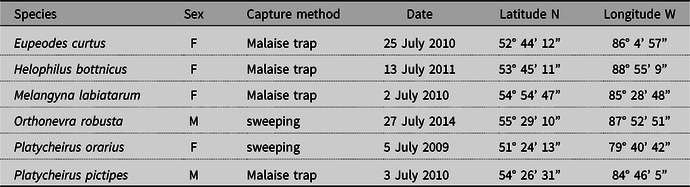
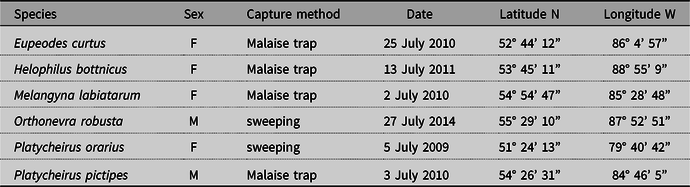
New provincial records of Syrphidae, with dates captured, sex (male (M) and female (F)), capture method, and locations. All six species were collected as singletons.
It was estimated that there are from 17 (lognormal distribution estimate = 139) to 48 more Syrphidae species in this region (Chao 1 estimate = 170.5).
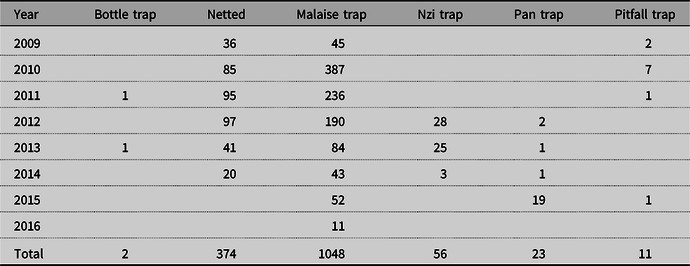
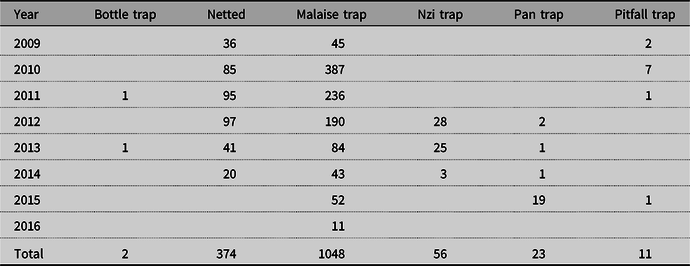
The largest proportion of syrphids (69.2%) was caught with Malaise traps, followed by net sweeps (21.3%), Nzi traps (3.7%), and vegetation sweeps (2.91%). All other trap types accounted for 2.9% of individual catches (Table 3).
Number of syrphids caught in each trap type per year.
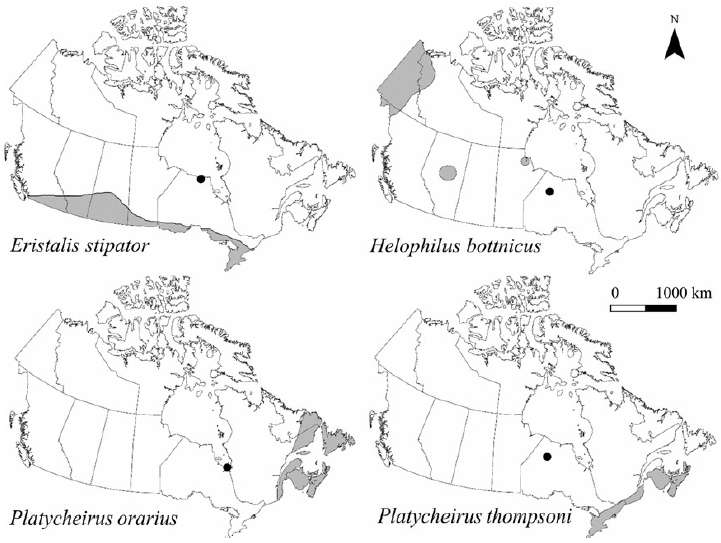
Five syrphid species were found far (more than 800 km) from their nearest known record. We classified one of these new records as a range extension (Fig. 2). The other four records appear to be gap infills of known distributions (Table 1). Thirty-one species were found an intermediate distance away (400–800 km). Of these, three represented range extensions (Fig. 2), three represented edge-of-range records, and 25 represented gap infills (Table 1). Eighty-four species were found near their nearest record (within 400 km). Of these, 11 were edge-of-range records and 73 were gap infills (supplementary material Table S1).
Species maps of new Syrphidae records (black dots) collected from northern Ontario that represent large extensions of the known range distribution (light-grey regions). Original ranges based on Skevington et al. (Reference Skevington, Locke, Young, Moran, Crins and Marshall2019a).

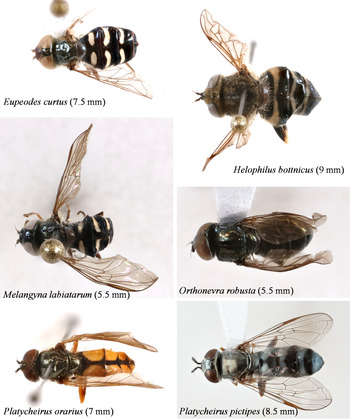
Six species, all of which had only one specimen collected, were first records for the province of Ontario (Fig. 3). These are Eupeodes curtus (Hine), Helophilus bottnicus Wahlberg, Melangyna labiatarum (Verrall), Orthonevra robusta (Shannon), Platycheirus orarius Vockeroth, and Platycheirus pictipes (Bigot).
New Ontario species records of Syrphidae collected in northern Ontario (body length in millimetres).

Although the number of species caught in this study was similar to those caught in studies from more southerly regions of Ontario, fewer specimens were caught (Deans et al. Reference Deans, Smith, Malcolm, Crins and Bellocq2007: Lake Abitibi Model Forest, 105 species, 3209 specimens; Proctor et al. Reference Proctor, Nol, Burke and Crins2012: Algonquin Park, 141 species, 7992 specimens). Thirty-eight species caught in northern Ontario were not reported in the Lake Abitibi Model Forest or Algonquin Park studies.
Discussion
This study provides the first extensive look at the Syrphidae from the more remote parts of northern Ontario. It fills in distributional gaps for many different species and extends the ranges of several species. The 122 species collected from Ontario’s far north represent one-third of all syrphid species known provincially. Given species richness estimates of 137 and 173, the number of species found in northern Ontario is likely half of the provincial total.
Of five species reported previously from Polar Bear Provincial Park (Beresford Reference Beresford2011), which occurs within our study region, two were not found in our collection. Some species were almost certainly missed because we collected only during the summer months. More highly specialised species, such as those of the subfamilies Microdontinae and Pipizinae, were also likely missed because we used generalist-collecting methods and did not target those groups. Pipizinae specialise in root aphids. Microdontinae live in association with ants and rarely venture far from their colonies, and for the most part, traps do not work with Microdontinae, except when used for emergence trapping over ants nests or when Malaise traps are located near ant nests – both methods tend to pick up a large number of microdons (Marcos-Garcia et al. Reference Marcos-Garcia, Garcia-Lopez, Zumbado and Rotheray2012). Syrphinae are widespread predators of insect larvae and were the most abundant group in our collections. Although Malaise traps preferentially sample Syrphidae, strong fliers such as many Eristalinae likely are able to escape from trap heads before they are caught. The Eristalinae are the most diverse subfamily of syrphids in terms of life history, and many species live in tree holes and are able to navigate in and out of obstacles. Hand collecting at flowers should yield a more complete sample, but some Eristalinae spend most of their time around larval substrates, such as sap runs. Targeting their preferences would make habitat searching more productive.
Most of the specimens caught for this study were zoophagous species (58%), which tend to be more generalist species that feed on soft-bodied insects. Saprophagous species accounted for the next highest proportion of individuals caught (25%). These proportions, in terms of life history traits, seem to be consistent with two other extensive Ontario studies of Syrphidae (Deans et al. Reference Deans, Smith, Malcolm, Crins and Bellocq2007; Proctor et al. Reference Proctor, Nol, Burke and Crins2012). Both of these studies were conducted in regions south of our study area, in the Lake Abitibi Model Forest (Deans et al. Reference Deans, Smith, Malcolm, Crins and Bellocq2007) and in Algonquin Park (Proctor et al. Reference Proctor, Nol, Burke and Crins2012). Our collections included 38 species not reported from either of these two studies.
It is not surprising that Malaise traps collected the most individuals because they are known for collecting syrphids (Skevington et al. Reference Skevington, Locke, Young, Moran, Crins and Marshall2019a). In comparison, our pan traps yielded few syrphids: only four individuals in the three years that the entire Far North Biodiversity Project used these traps (2012–2014) and another 19 from the 2015 Moosonee collection. Of the 17 species caught by methods other than Malaise traps, 13 comprised single specimens only. Most of the 17 species were caught by hand netting or sweeping vegetation. Two species were caught only in Nzi traps (Pipiza macrofemoralis Curran and Sphegina brachygaster (Hull)), and two were caught only in pan traps (Eristalis tenax (Linnaeus) and Polydontomyia curvipes (Weidemann)), all four as single specimens. This is consistent with other studies (Cane et al. Reference Cane, Minckley and Kervin2000; Proctor et al. Reference Proctor, Nol, Burke and Crins2012) and provides evidence that pan traps may not be effective for collecting syrphids. Nonetheless, our results demonstrate that, for insect surveys, an array of different sampling techniques should be used.
New records
Of the 122 species identified from 1514 specimens, six are new Ontario records. New provincial records were expected because of the limited work done previously in northern Ontario. With one exception, these species have been previously recorded from adjacent jurisdictions: from Churchill, Manitoba, Canada, from Québec, Canada, from Akimiski Island, Nunavut, Canada, and the southern mainland of Nunavut. The exception is Orthonevra robusta, which has not been recorded from Québec (Skevington et al. Reference Skevington, Locke, Young, Moran, Crins and Marshall2019a). Only two of the species, Eupeodes curtus and Platycheirus pictipes, are common. Platycheirus orarius is a locally common eastern species found near salt marshes and tidal flats; our record extends its known range westwards. The remaining three species that are new Ontario records, Helophilus bottnicus, Melangyna labiatarum, and Orthonevra robusta, are uncommon or rare across their ranges (Skevington et al. Reference Skevington, Locke, Young, Moran, Crins and Marshall2019a). Only single specimens were collected of the species comprising these new Ontario provincial records.
Range extensions and gap infills
Anasimyia bilinearis (Williston) is known to be evenly distributed from east to west in both Canada and the United States of America. Eupeodes volucris Osten Sacken is very common in western Canada and less common towards the east coast. Conversely, Platycheirus quadratus (Say) and Sphegina brachygaster Hull are commonly found in the east, but only sparse populations extend westwards. Platycheirus orarius (Fig. 3) is known only from the east coast; the nearest record is from eastern Québec near New Brunswick, Canada. Although our new record of Platycheirus orarius was unexpected, the habitat in the Hudson Plains ecozone has salt marshes and tidal flats, which are associated with this species (Skevington et al. Reference Skevington, Locke, Young, Moran, Crins and Marshall2019a).
All other range extension records were intermediate, between 400 km and 800 km away from the nearest previously known records. These include Eristalis stipator Osten Sacken (Fig. 2), which is common in western North America and has populations extending eastwards to a lesser extent. Our record of this species represents the northernmost location from which this species has been collected. Helophilus bottnicus (Fig. 2) is another species more commonly found in northwest North America, ranging around northern Yukon and Northwest Territories; our specimen represents its easternmost collection in North America. The closest previous record was also from the Hudson Plains ecozone, in Churchill, Manitoba. Lastly, Platycheirus thompsoni Vockeroth (Fig. 2) has a range similar to that of Platycheirus orarius, being strictly found in the eastern half of the continent, except for one record from northern Minnesota, United States of America. Our record represents the northernmost known record for this species and extends the species’ overall distribution to the northwest. Ecologically, the range extension was not surprising because this species is commonly associated with marshes and bogs (Skevington et al. Reference Skevington, Locke, Young, Moran, Crins and Marshall2019a).
One species that we expected to find was absent in our collections: Eristalis brousii Williston used to be found across southern Canada and the northern half of the United States of America but has been pushed out of its original range since the introduction of Eristalis arbustorum (Linnaeus), which was also absent from our collections. Since 2000, E. brousii has been recorded only from the Hudson Bay–James Bay coastal region (Skevington et al. Reference Skevington, Locke, Young, Moran, Crins and Marshall2019a) and Akimiski Island in James Bay (Vezsenyi et al. Reference Vezsenyi, Skevington, Moran, Young, Locke, Schaefer and Beresford2019).
Anasimyia diffusa Locke, Skevington, and Vockeroth (Skevington et al. Reference Skevington, Young, Locke and Moran2019b) had been listed previously in Skevington et al. (Reference Skevington, Locke, Young, Moran, Crins and Marshall2019a, p. 78) as Anasimyia undescribed. Known from British Columbia to New Brunswick, Canada, our northern Ontario records were expected. Vezsenyi et al. (Reference Vezsenyi, Skevington, Moran, Young, Locke, Schaefer and Beresford2019, table 1) provisionally listed three specimens now known to be A. diffusa as Anasimyia anausis (Walker) from neighbouring Akimiski Island, in James Bay.
With increased pressure for development and modern industrial resource extraction in northern Ontario, concomitant changes to the landscape and habitat will likely alter the syrphid communities found there (Sommaggio Reference Sommaggio1999; Kremen and M’Gonigle Reference Kremen and M’Gonigle2015). Our study begins the process of mapping the distribution of syrphid species in the region’s Hudson Bay Lowlands and boreal forest. However, continued sampling is necessary to obtain a complete understanding of these important habitats while they are still largely intact.
Acknowledgements
The authors thank Ontario Ministry of Natural Resources and Forestry and Trent University for logistical support and funding, specifically Ken Abraham, Glenn Brown, Rod Brook, Dave Etheridge, Dean Phoenix, and John Ringrose (Baffin Regional Wildlife Biologist, Government of Nunavut, Nunavut, Canada), and field collectors Julie Belliveau, Kim Bennett, Curtis Bosson, Tore Buchanan, Cheryl Chetkiewicz, Todd Copeland, Kevan Cowcill, Tamara Cowie, Jane Devlin, Kevin Downing, Ian Dunn, George Edwards, Michael Elgar, Ian Fife, Bonny Fournier, Tyler Genereaux, Derek Goertz, Patrick Hodgson, Megan Hornseth, Alex Howard, Tim Irvin, Zaid Jumean, Izabela Kalhowski, Andrew Keaveney, Charles Latremouille, Chris Lewis, Michael Light, Kelly Major, David McGeachy, Gordon Meadows, Steve Mills, Michael Oldham, Shannon Page, Mark Peck, Stan Phippen, Sarah Poole, Dan Potvin, Marco Raponi, Caleigh Sinclair, Lori Skitt, Eric Snyder, Chris Stratton, Tanya Taylor, Stan Vasilauskas, and Kaitlin Wilson. We thank colleagues at the Canadian National Collections of Insects, Arachnids and Nematodes for training K.V., and Sarah Langer, Kaitlyn Fleming (photos), Kayla Vizza, and Ayden Ricker-Held for their help in processing samples.
Supplementary material
To view supplementary material for this article, please visit https://doi.org/10.4039/tce.2020.68.