I recently began a classroom discussion on U.S. foreign policy toward the
Middle East by asking a question concerning the likely actions of the
administration toward Iraq. I was immediately greeted with this response
from most of the class: “Do you mean in the simulation or in real-life?”
This response only amplifies the reactions of other students—“der
Deutsche Weg” was constantly advocated by the student representing
Germany, the student representing Argentina sought the commitment of “funds”
from U.S. officials before and after every class, and most students claimed
that the Iraqi representative had been co-opted by his role and called him
“Saddam.”1
These comments were made during
the simulation running in the fall semester of 2002. Throughout this
article I refer to the Blackboard system, but the principles are
easily transported to WebCT or other platforms.
These and similar student comments show that students like and immerse
themselves in the simulation. Yet the real payoffs of the exercise lie
elsewhere: increased attentiveness to other materials presented in class,
greater knowledge of contemporary events, and deeper overall understanding
of complex concepts. The simulation is designed to give students a better
understanding of the international constraints placed upon U.S. policymakers
when crafting the foreign policy agenda. Students role-play various country
leaders and other international actors and attempt to bargain and place
pressures on the U.S. in order to alter both the content and saliency of
items on the foreign policy agenda. The simulation represents an effective
“active learning” technique that has proven to be quite useful at getting
students involved in the class material while teaching both effective
research and communication skills. Additional benefits include the
relatively little preparation and maintenance time required of the
instructor, the modest amount of classroom time that must be dedicated to
the simulation, and the adaptability of the simulation to alternative
learning goals. I outline the simulation here in the hope that other
international relations teachers can use it effectively in their American
Foreign Policy, Introduction to International Relations, and other related
classes.
Outline of the Simulation
The First Assignment: A Short Paper
I begin the simulation by assigning students the roles that will play
throughout the semester. This should be done after the first few
meetings or whenever the instructor has a good idea of the final
class size. Roles can be assigned in many ways, often dependent upon
class size. Large classes are more likely to have multiple
representatives for influential actors, thus ensuring proper
coverage of important issues. Smaller class sizes may force the
instructor to more carefully select the assigned roles, as an
important actor who stops contributing in the middle of the semester
can greatly damage the simulation for other actors. In my class of
50 students, I had the students choose two possible roles and then
assigned the students a role based upon their selections, coverage
of the major actors, and my assessment of the potential quality of
student participation.
Actual roles played in the simulation are at the discretion of the
instructor. The instructor may decide to focus upon NGOs or IGOs, or
perhaps upon European or Middle Eastern actors. The focus can be
easily shifted by manipulating the composition of available actors
at the start of the simulation. My goal in the simulation is to have
the students identify important international constraints in the
U.S. policymaking process; I therefore concentrate role selection on
major states like China, Germany, Russia, and Japan, key U.S.
Administration officials (chief of staff, national security
director, secretary of state, etc.), and the more influential states
of the Middle East—Israel, Iraq, and Saudi Arabia, for example. I
also include representatives from NGOs (Greenpeace and Amnesty
International) and a few smaller countries such as Venezuela and
Argentina; these actors represent the gadflies of the simulation,
and these students have to bargain extensively in order to be heard.
All role assignments are posted in the Course Material section of
Blackboard so as to facilitate communication throughout the
simulation.
After the roles are selected, I give each student approximately two
weeks to research and write a short (threepage) paper that assesses
the interests, resources, and possible tools their actor has in
affecting U.S. foreign policy. I give no details of the simulation
so that the students will not be influenced by the rules of the
game; at this point, the student should simply begin to develop a
general knowledge of their actor.
Second Assignment: Threaten, Cajole, Bargain, and Otherwise
Manipulate
The simulation runs throughout the semester. After collecting the
first set of papers, I tell the students that their goal is to shape
the stated policies of the U.S. administration to better coincide
with preferences of their assigned role. The students are then told
that their performance in the simulation is going to be judged by
how well they threaten, cajole, bribe, or otherwise influence the
policy process. This means that the students will be pooling
resources, linking issues, and creating and maintaining personal
relationships in the simulation—any action that increases their
ability to affect U.S. foreign policy.
The simulation takes place almost entirely on the Blackboard web
platform according to the following weekly schedule:
1. By
noon, Wednesday, of every week, a rank-ordered list of U.S.
administration agenda items is broadcast on Blackboard's
Announcements page and via email. These agenda items also
comprise separate fora in the Discussion Board section of
the course web site. These fora may be used by all
participants as rhetorical tools to influence other
actors.
2. By 5pm, Friday, of every week, non-U.S.
administration actors post responses to these Discussion
Board postings. Postings are not required, but the
simulation grade in the class is determined largely by how
often students try to influence policy, as well as their
effectiveness. Instructions for postings are as
follows:
a. Students may respond to one, two, or all
of the original postings.
b. Postings should include
the actor's response to the issue, what the actor plans to
do to influence policy, or anything else the actor feels is
pertinent. Students should emphasize the resources that can
be brought to the issue by their actor, and why their actor
is concerned.
c. Groups of actors, like the United
Nations, EU, OPEC, etc., often carry more weight than
individual actors. However, groups must often provide a
consensus view on issues in order to be effective.
Dissension will likely cause a loss of influence, and the
group will be ignored by the U.S.. Students are cautioned to
use their resources wisely.
3. By noon, Monday, of
every week, the U.S. government officials are required to
assess international opinion on their issues of interest and
communicate these to the chief of staff for the president.
These assessments take the form of short emails (one
paragraph) detailing suggestions for revised (stronger or
weaker) foreign policy goals for the administration. All of
these emails are sent through the U.S. administration
officials group communication tool (more on this later). The
simulation grade for U.S. officials is determined by how
effectively they communicate both their position and the
position of the administration on these issues. In other
words, the U.S. officials try to influence as well as report
on public opinion. How this is done is up to each
official.
4. The chief of staff submits revised U.S.
administration responses to the Simulation Administrator
(the instructor) by 10am every Wednesday morning, and the
instructor begins the process anew, posting revised agenda
items by noon each Wednesday.
This formal process
should not preclude bargaining or other communication among the
actors. Students are instructed to carbon copy emails to the
Simulation Administrator in order to make sure credit is given for
their participation.
At the end of the simulation rules discussion, the instructor
announces (and posts on Blackboard) five initial U.S. administration
agenda items. I often choose to be as controversial as possible in
this posting so as to better facilitate discussion and conflict
among the actors. I also mirror several current U.S. administration
proposals and actions—most recently these have included steel
tariffs, the role of Israel, increased visas for foreign tourists,
and Amnesty International policy papers. These choices allow the
students to see how they should initially react (as their real-life
actors had done) and also makes the simulation a closer fit to
contemporary world politics.
For example, the first five agenda items in the simulation run
described at the beginning of this article were: 1) weapons
inspections in Iraq; 2) an outline of a free and democratic
Palestinian state; 3) the U.S. relationship with Pakistan and Saudi
Arabia; 4) increased immigration restrictions; and 5) possible steel
tariffs on European exports. The European states immediately (and
rightly) felt that several of these agenda items conflicted with
their economic and political goals. In order to add weight to their
argument, they responded to each of the agenda items in unison via
the EU group page. The individual country representatives also sent
emails to U.S. administration officials and tried to solicit support
from several Middle Eastern and South American countries. They
threatened retaliatory tariffs and included an analysis of the
potential impact and legality of unilateral sanctions by the U.S..
The “pressure” wrought by the EU countries was great enough to limit
and eventually curtail any mention of future tariffs.
Of course, not all agenda items are met with such concerted
opposition, and effective U.S. officials can take advantage of
“sleeping” actors, pushing the overall agenda to favor ultimate U.S.
goals. Pitting the actors against each other in this way results in
a fairly accurate representation of international interests and
politics.
Third Assignment: Another Short Paper
The third and final assignment completes the simulation by assessing
how active and effective students were in representing their actor.
In a short paper (three pages), the students describe their
strategies during the simulation, assess how these strategies
impacted the other actors in the system, and make some general
conclusions about the constraints placed upon the U.S.
administration. This paper is an excellent guide to assessing the
overall simulation grade for each student. It also gives the
instructor a chance to gain feedback on how well the assignments
worked.
Running the Simulation
Blackboard has several tools that reduce the costs involved in running
this simulation. Blackboard's email system allows for private
communication where email addresses can remain confidential, encouraging
safe student-student contacts. Groups (within Communication Tools) can
also be set up for the major actors (United Nations General Assembly,
United Nations Security Council, OPEC, and the EU), facilitating
semiprivate communication, coordination, and the pooling of resources.
Student postings, representing most of the student simulation activity,
take place on the Discussion Board section of the course.
I use at least five fora on the Discussion Board—one for each agenda
item. Student postings can take place at anytime and represent either
separate responses to the agenda items or responses to other student
postings. I also use a separate forum in the Discussion Board section to
relay “News Flashes” to the course; these news flashes are contained in
the first forum of the screen shot above. News updates allow the
instructor to keep the simulation within the bounds of reality by
threatening the simulated roles with domestic riots and crises over
unpopular actions or punishing the U.S. administration with declining
polls for poor performance. If relations between simulated countries
degenerate too greatly, news flashes become a useful way of pulling the
students back to the overall goals of the simulation. In other words,
the instructor can threaten riots, the possibility of overthrow, or
other domestic disturbances to make students aware that their actions
violate the interests of their citizens.
The order of the remaining fora is important; actors in the simulation
have an interest in both the content and intensity of the U.S.
administration preferences. For example, the Chinese representative may
not be able to alter the simulated U.S. stance on Taiwan; however, the
importance of this issue could decline enough to greatly aid Chinese
interests, perhaps even leaving the “top five” listing of U.S. policy
goals.
Students are encouraged to bargain with other simulation actors in order
to gain as much leverage as possible in influencing the agenda of the
U.S.. They are also encouraged to provide links to Internet sources that
detail specific analyses on the merits of their positions. These
rhetorical moves may put enough pressures on the U.S. administration or
other actors to elicit a change of policies. The simulation is adaptable
so that the bargaining of simulated actors can influence the importance
of issues, just as world politics suggest. The instructor can also
control the emergence of “unforeseen issues” and the occurrence of
“unforeseen events” in the simulation, also mirroring the reactions
found in real-world politics.
The Group Pages of Blackboard allow for private, group-only communication
and discussion postings. These Group Pages can be defined so widely as
to include all UN voting members or more narrowly construed to include
only Security Council members. Other international organizations such as
the EU may wish to pool their resources, and the group emails and
discussion board can facilitate consensus building. The second screen
shot details a list of five groups I used during the last run of this
simulation. I generally allow any actors to form groups but also
encourage students to mirror extant international organizations and
other institutions. Copying real world institutions increases student
attention in these organizations and also demonstrates to students the
power and limits of these actors.
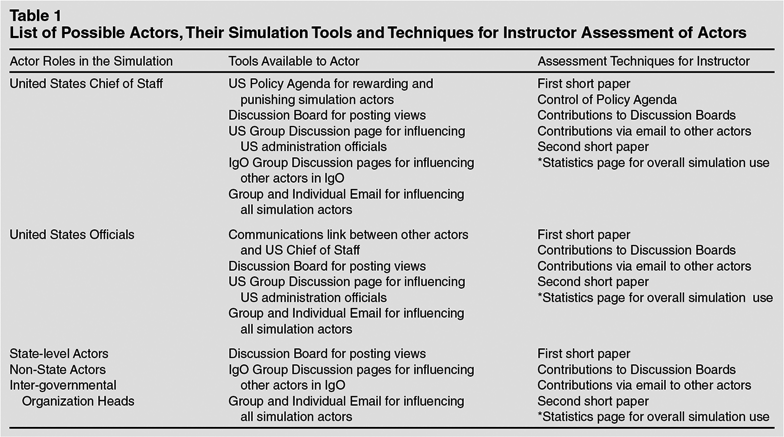
Table 1 presents a summary of the tools
available to each of the different simulation actors. The chief of staff
should be chosen carefully because this position represents the direct
link between both “sides” of the game. U.S. officials guide the chief of
staff, analyzing the actions and views of non-U.S. actors, and the chief
of staff collates the analyses of the U.S. officials and responds to the
rest of the simulated world. As with other simulation actors, the U.S.
officials can communicate through a private group page or through larger
groups aimed at specific sets of actors— the Security Council, the WTO,
the UN, or the world page. The chief of staff and other U.S. officials
can also threaten or promise policy changes through emails to individual
simulation actors. All of these actions can be monitored by the
instructor and, together with the short papers and Blackboard statistics
page, provide ample evaluation opportunities.
The U.S. foreign policy agenda is the item by which all actors are
judged. Representatives of other states and nonstate actors all must
compete to influence the agenda, and they do so through threats and
promises to the U.S. and other actors in the simulation. Again, the
group pages and discussion fora facilitate communication and resource
pooling, as large blocs of actors can threaten trade embargoes,
increased tariffs, or even conflict should the U.S. officials not
respond. It is the responsibility of the instructor to see that these
threats and promises remain within real-world bounds. The instructor can
also use these emails, postings, and overall statistics to evaluate the
progress of in dividual actors or the simulation in general.
In sum, I hope it is apparent to readers that little direct classroom
time is needed to run this simulation. The instructor needs to 1) post
the U.S. agenda items once a week, 2) monitor the simulation activity of
the students through the Statistics page of Blackboard's Control Panel,
and 3) occasionally play the role of facilitator in order to aid
struggling students. The simulation takes place out of the classroom
throughout the semester while the instructor monitors student activity
through Blackboard's tools. A provocative agenda encourages simulation
activity, and an excellent “chief of staff” can often guide both U.S.
officials and other actors to be more effective in their communication
strategies. Students benefit through increased attention to the course
and to world politics. The instructor should feel free to amend this
generalized outline and tailor the simulation to their course and the
teaching objectives they wish to pursue.
My thanks to Stephen Yoder and an anonymous reviewer for helpful comments
on an earlier draft and to the students of PS430 American Foreign Policy
during the fall of 2002 for making the simulation so successful. All
errors remain mine.