


 (‘it was the case that...’) and
 (‘it will be the case that...’). In this paper, I show that there is at least one viable A-theory that does not require a logic with tense operators. And I will argue that three common indispensability arguments for tense operators are unsound.
1. Introduction
A-theorists think there is a metaphysical difference between the present and other times. This difference influences how many A-theorists understand the nature of change, what objects they think exist and what kinds of properties they take to be instantiated. It also influences how they formalize their views. Nearly every contemporary A-theorist assumes that her metaphysics requires a tense logic with operators like  (‘it was the case that...’) and
 (‘it will be the case that...’). In semantics, a tense operator takes a well-formed formula to a ‘time’ (or ‘times’) in a specified model, where the formula is then evaluated. In metaphysics, A-theorists often take indispensable operators to reflect a primitive ‘tensed’ structure of reality. Still it remains obscure what precisely this structure is. Moreover, Priorian tense operators have logical and metaphysical complications which have long been an albatross for A-theorists. Do we have any alternatives?
In this essay, I aim to question the operator dogma. I will show that there is at least one well-defined ideology for the A-theory that does not require tense operators, and I will raise objections to three common arguments for the indispensability of tense operators. Here is how the essay will proceed. Section 2 outlines the typical commitments of an A-theory of time and contrasts it with the two most common formulations of the B-theory. Section 3 considers three arguments that A-theories require tense operators and discusses some of the costs associated with irreducible tense operators. Section 4 proposes a theory of ‘was’ and ‘will’ as predicate modifiers and outlines ways we could adapt predicate logic to include the modifiers. Section 5 uses this apparatus to introduce an operator-free A-theory and argues that the primary indispensability argument is unsound. It also addresses some metaphysics-based objections to the proposal. Section 6 discusses ways the operator-free theory might be expanded to accommodate more robust A-theoretic assumptions, in particular the assumption that propositions change truth-value and the assumption that objects come into and out of existence. As we’ll see, the operator-free A-theory fits best with a permanentist ontology. In the conclusion, I’ll raise questions about whether necessitists about modal ontology should likewise dispense with modal operators.
2. Three accounts of property change
As I write this, Barack Obama is President. He won’t always be President. The Obama administration is temporary. For some, this induces anxiety. For others, it comes as a great relief. But only the most downtrodden Republican, the most pie-in-the-sky Democrat, or the most inflexible nominalist would deny that being President is some kind of temporary property of Obama. More generally, almost all of us believe in:
Property Change: There is at least one object, x, and at least one property, C, such that x is C only temporarily.
Philosophers nevertheless disagree about how this principle is to be expressed most precisely and what the principle entails about objects, properties and the structure of time. One major fault line in this debate is between the A-theorists of time and B-theorists of time. In a nutshell, the A-theorists assume that there is some objective, metaphysically privileged distinction between the present and other times. Accordingly, some kinds of change in the world can only be expressed by distinguishing ways an object is from ways it was or will be. Obama is President, but was not always president and will not always be President. B-theorists, in contrast, think of space and time as components of a multi-dimensional manifold, with objects ‘spread out’ in the manifold much the way we ordinarily think objects are spread out in space. Just as there is no objective, privileged ‘here’ in space, there is no objective, privileged present, past and future in the B-theory manifold. There are merely regions of space and time and objects that are located earlier or later with respect to others. So for B-theorists, marking any kind of change involves nothing more than marking how an object is with respect to different parts of the manifold. For example, the B-theorist may describe Obama as someone who is President at our part of the manifold, but isn’t President at some other parts.
This is an admittedly rough and pictorial way of characterizing the A-theory/B-theory distinction. We can make the debate even more precise by considering how the different parties explicitly formulate the property change principle. A-theorists think that there are some temporary properties that a single object can have or lack without any relativization to a space–time manifold. We will call these A-properties. For a toy example, suppose we treat is President as an A-property. Then Obama is temporarily President because (i) Obama has the property is President, (ii) he is an enduring object (not an object spread out in a manifold) and (iii) he – the very same, numerically identical object – has lacked that property or will lack it. More generally, A-theorists think the following principle is true of our world and time:
A-Property Change: There is at least one enduring object, x, and at least one non-time-relational property, C, such that x is C only temporarily.
Let us say that if A-property change is, was or will be true of some world, then it is an A-theoretic world. There are different ways the A-property change principle might be satisfied. Many A-theorists think most or all objects change by enduring and gaining or losing non-time-relational properties. Others think A-property change is limited to special properties like is present which a particular time can have or lack. For these A-theorists, A-property change occurs for regions of space–time rather than for particular objects. What unites A-theorists is the view that at least some kinds of change in our world cannot be explained as mere variation in a spatiotemporal manifold.Footnote 1
The B-theorists, in contrast, explain all change as variation in a space–time manifold. There are differences of thought within the B-theory about how objects and properties relate to the manifold. One camp insists that all temporary properties are relations between an object and a region of space–time. Such relational B-theorists understand property change as:
Relational Change: An object o changes with respect to a property, C, if and only if there are at least two times,  and
 , C is a time-relational property, o is C at
 and o is not C at
 .
In other words, for relational B-theorists, objects change their properties by varying the relations they have to different times. If Obama is temporarily President, this means he is President-at–2012 but is not President-at-some-other-time. Footnote 2
Other B-theorists explain change using the doctrine of temporal parts. Suppose we took the multi-dimensional manifold and ‘sliced’ it down one of its time indices. According to temporal parts theorists, if an object has any parts at that slice, then it has a temporal part at that slice. The temporal part is the maximal region of that slice that the object fills. We can use this notion of a temporal part to give the informal temporal part principle of property change:
Temporal Part Change: An object o changes with respect to a property, C, if and only if o has at least two temporal parts,  and
 , such that
 is C and
 is not.
On this account, if Obama is temporarily President, this is because he has a temporal part located at 2014 which is President, and he has at least one other temporal part that is not President. According to some adherents, an upshot of the temporal parts account over the relational account is that it does not require the changing property C to be a time-relation. At least some temporary properties can be intrinsic properties.Footnote 3
Each of these three principles – A-property change, relational change and temporal parts change – carry particular commitments about the structure of changing properties and the objects that instantiate them. For example, if the relational B-theorists are right, many properties have hidden structure. Nothing just has a property C; something is only C-at-a-time. If the temporal parts theorists are right, property change entails that objects have multiple temporal parts. If the A-theorists are right, objects don’t need to have temporal parts or relational properties to undergo property change – some change is not to be described relative to a space–time manifold. Some philosophers doubt that these differences between the theories run very deep. But for the purposes of this essay, I will assume that the endurantism/temporal parts and time-relational/non-time-relational debates are substantive.Footnote 4
So much for sketching the metaphysical terrain of this debate. Many A-theorists and B-theorists think that they also have distinctive logical commitments. (Indeed, retreating to a less ambiguous formal language is one way to reply to charges of non-substantivity.) Say we wanted to express the different principles of property change in a dialect of logic-ese. And say we wanted the logical representation of our theory to provide a somewhat accurate guide to our ontological and ideological commitments. Both kinds of B-theorist would only need the resources of predicate logic to express their principles. Relational B-theorists can express their view as:
Relational Change 1: An object o changes with respect to a property, C iff  .
And temporal parts theorists will make use of a precise, primitive parthood relation. Here is one way to formalize the temporal parts view. Let TPART(x, y) abbreviate the regionally maximal parthood relation: x is a regionally maximal part of y iff for some arbitrary time-like slice of the space–time manifold, if y has parts located at the slice, then every part of y at that slice is also a part (proper or improper) of x. The view can then be expressed in predicate logic as:
Temporal Part Change 1: An object o changes with respect to a property, C iff  .
In English: Some object has temporal parts and one part instantiates C while another does not. As with the relational theory, the logical backdrop for the temporal parts theory is purely extensional. To know whether there is change, we just need to know what objects are temporal parts of other objects and which objects instantiate C.
In contrast to the B-theorists, A-theorists assume that they need a formal language with tense operators to capture their view. Most commonly, they use a logic based on the four Priorian operators:
 ‘it was the case that’;
 ‘it will be the case that’;
 ‘it has always been the case that’; and
 ‘it is always going to be the case that’.
These operators behave like the  and
 of modal logic; they shift formulas in their scope to be evaluated at other ‘times’ just as modal operators shift formulas to other ‘worlds’, where times and worlds are points in the model theory. For example,
 is true if and only if for some past time,
 was true then. In a quantified tense logic, the A-property change principle is expressed as:
A Property Change 1: For some property C,  .
In English, there is some object and some property C such that the object has the property and either it was the case that the object lacks the property or it will be the case that the object lacks the property.Footnote 5
From the earliest days of presentism, this added commitment to tense operators has been widely assumed to be part and parcel of adopting A-theoretic metaphysics. Prior – the godfather of the contemporary A-theories – declares in Past, Present and Future: ‘The formation rules of the calculus of tenses are not only a prelude to deduction but a stop to metaphysical superstition’.Footnote 6 And elsewhere: ‘Tense logic is for me, if I may use the phrase, metaphysically fundamental, and not just an artificially torn-off fragment of the first-order theory of the earlier-later relation’.Footnote 7 But more recently, the link between A-theories and Priorian tense logic has come into question. Zimmerman argues persuasively that a commitment to irreducible tense operators in one's metaphysics is not sufficient for having an A-theory of time, since some B-theorists may need tense operators to express their views about propositional content.Footnote 8 Could we argue the other direction? Are tense operators even necessary for expressing an A-theory? More precisely, can we describe the A-property change principle in a rigorous logical system without using tense operators? To answer this, we must consider arguments for the indispensability of tense operators. There are at least three such arguments suggested in the literature, and as we will see, each depends on some problematic background assumptions. Consider each in turn.
3. Three indispensability arguments
3.1. The argument from expressive adequacy
The first indispensability argument for tense logic requires the fewest assumptions but will serve as the touchstone for most of this essay. In Section 2, I assumed that what distinguishes A-theorists is their commitment to the A-property change principle. Most A-theorists will want to express their distinctive metaphysical claim in a formal language. As we saw, if the A-theorist adopts some version of Priorian tense logic, this is easy enough to do. And it does not seem possible to express that an object has a temporary, non-time-relational property with just a version of predicate logic. For suppose an A-theorist tried to work without tense operators. She could either use time-indexed predicates to formulate her view or not. If she doesn’t use time-indexed predicates, it seems she’ll be forced to say that an object has contradictory properties. She’ll have to formulate A-property change as:
A Property Change 2: For some property C,  .
This principle is never true. She could avoid the problem by relativizing C to particular times and expressing the principle as:
A Property Change 3: For some property C,  .
But then her view collapses into the relational B-theory. Here, then, is the argument from expressive adequacy. A-theorists can either choose some logic with tense operators as the background for their metaphysics or they can choose some version of predicate logic. If they choose tense operators, they can express their distinctive metaphysical commitment in a consistent and interesting way. If they choose predicate logic, they cannot. If an ideology is required for giving a consistent and interesting version of a theory, then that ideology is indispensable. Therefore, tense operators are indispensable to the A-theory. The problematic assumption, as we will see, concerns the expressive limitations of an operator-free logic.Footnote 9
3.2. The argument from propositional temporalism
A second, related argument motivates the link between A-theories and tense logic by way of propositions. Many A-theorists are serious about propositions in the following sense. First, they believe propositions are the bearers of truth and falsity. Second, they believe true propositions accurately represent the actual world, and false propositions do not. As we’ve defined it, an A-property is a property which is not held relative to a space–time manifold. Suppose is President is one of Obama's temporary A-properties. It seems the accurate way to represent this state of affairs is to use a proposition like [Pres(o)]. (I will use brackets when I intend to be explicit about the logical form of a proposition.) Call this the Obama proposition. As I write this sentence, the Obama proposition is true. And given that is President is a temporary property, the Obama proposition is only temporarily true. The Obama proposition will not always accurately reflect the world. How do we express that the proposition is only temporarily true? It seems we can either build a time-index into the proposition or append a tense operator. If we take the former option, we’d think sentences like ‘It is temporary that Obama is President’ really express the same proposition as ‘Obama is President at 2014, and there is some time such that he is not President then’. (In logic-ese:  .) But then the Obama proposition does not accurately represent the actual world because, according to the A-theorists, the property is President is not time-relational. So it must be that we express the temporariness of the Obama proposition using a tense operator, i.e.
 . Likewise for any other temporary A-property. Therefore, the A-property change principle and seriousness about propositions entail a commitment to tense logic. Call this the argument from propositional temporalism.Footnote 10 The problematic assumption, as we’ll see, is that only tense operators or time-indexing can capture temporary truth.
3.3. The argument from ontological change
The last argument for the indispensability of tense operators also has the most background assumptions. Many metaphysicians nowadays are neo-Quineans.Footnote 11 Neo-Quineans endorse a package of views about the existence:
-
There is a single sense of ‘exists’ of interest to metaphysics.
-
Existence is not a monadic property of objects.
-
Existence is properly expressed by the existential quantifier (
 ) and the identity relation (=).
 ) and the identity relation (=).
Neo-Quineanism is a popular view and with good reason. It precisely captures widely held convictions about the univocity of existence, and it provides adherents with a defense against charges that their ontological debates are non-substantive. When deflationists complain that A-theorists and B-theorists are merely talking past one another, neo-Quineans can insist that if the debates are appropriately regimented in a quantified logic, they are carrying on a substantive debate in a common, unambiguous language.Footnote 12
Neo-Quineanism coupled with a further view about change seems to entail the indispensability of tense operators. The most common A-theories are presentism and the growing block theory. Presentists think that only the present is real. On one way of precisifying the view, presentists think that every non-abstract object is located at, at most, one region of space–time, and over time objects and/or regions of space–time come to exist and cease to exist. There are no merely past or future objects. Footnote 13 Growing blockers think that present and past objects are real. They think that no concrete objects are located at future times, and as time passes, objects and/or regions of space–time come to exist.Footnote 14 Both kinds of traditional A-theory supplement the A-property change principle with an additional principle:
Temporary Existence: Some object exists only temporarily.Footnote 15
Growing blockers think some objects haven’t always existed. Presentists think some objects haven’t always existed and some objects won’t always exist.Footnote 16 Notice, for Neo-Quineans, this temporary existence principle must be an extra assumption in addition to the A-property change principle, because neo-Quineans do not think existence is a property that objects gain and lose.
Like every other sensible person, presentists and growing blockers think there are truths expressed by claims like ‘There was a dinosaur’ or ‘There will be a 64th President’. But neither thinks that the future President exists yet, and presentists further deny there are any dinosaurs. Call any merely past or merely future object a temporal alien. To handle what seem to be true existential claims about temporal aliens, neo-Quinean A-theorists turn to the resources of tense logic. It is widely thought that tense operators like  and
 have a prophylactic effect on quantifiers in their scope, akin to the effect that possibility and fiction operators have on quantifiers. Suppose Ruth and Jake are planning to have a child in a few years. Presentists and growing blockers will maintain that a de dicto claim of the form
 is true. But they will deny this entails any de re claim like
 or
 , because they deny that any merely future object exists. Their child will come to exist, but nothing is their future child. The wide-scope prophylactic tense operators block unwanted ontological commitments, and there is no other explicit mechanism in the neo-Quinean framework for doing this. So given neo-Quineanism, temporary existence and truths about temporal aliens, traditional A-theorists conclude that tense logic is indispensable. We see such reasoning explicitly in Zimmerman: ‘The presentist must, I think, be a serious tenser. At the very least, tenseless statements that require ontological commitment to past and future things must be treated as equivalent to tensed truths that do not’.Footnote 17 Call this the argument from ontological change. The problematic assumption, as we’ll see, is that prophylactic tense operators can help traditional A-theorists capture truths about temporal aliens.
3.4. But tense operators have baggage…
If the three foregoing arguments succeed, tense operators are a necessary component of the ideology for A-theories of time. This is not a universally welcome result, for at least three broad reasons. First, some metaphysicians think that their logical primitives ought to reflect their views about the structure of reality. The A-theories are often characterized as theories which hold that tense operators reflect something metaphysically fundamental. But – we might wonder – what could it be for an intensional operator to reflect some aspect of reality? Wouldn’t it be better if, like the B-theories, every logical device required by the A-theory mapped to more familiar categories like objects and properties? So the first major problem with Priorian tense logic is that indispensable tense operators seem objectionably mysterious when compared with the B-theoretic ideology, which merely requires the more familiar object/property distinction.Footnote 18
Second, Priorian tense logic has well-known difficulties capturing the appropriate truth conditions for tensed sentences in natural language. In particular, Priorian tense logic has difficulty accounting for true claims involving cross-time relations and inferences that involve temporal anaphora. For these reasons (among others), the overwhelming trend in natural language semantics is to model tense as quantification over times, just the way B-theorists do. Shouldn’t it give the B-theorists some advantage if their ideology maps more closely to the framework that best predicts the validity of natural language inferences about time?Footnote 19
The third problem is, in my opinion, the most severe. According to the usual dogma about tense operators, they are supposed to block unwanted ontological commitments. Operators allow A-theorists to theorize about merely future or past objects without entailing that those objects exist. But Priorian tense logic inherits all of the problems of the modal logic it is based on. In particular, if you add the standard logic of quantifiers to even the weakest versions of tense logic, then you can prove that the temporary existence principle is false. (This is the well-known problem of the Barcan formulas, which can be derived in tense logic just as in modal logic). And to date, no alternative version of tense logic has been defended that upholds the neo-Quinean scruples. So while tense operators are supposed to be a refuge for certain A-theorists – the presentists and growing blockers – in practice, tense logic has never fulfilled this promise. And in the absence of an appropriate quantified tense logic, a major premise of the argument from ontological change is unjustified.Footnote 20
These problems with tense operators should lead us to question whether A-theorists need even bother with them. For too long, the Priorian dogma has gone unquestioned. Here is the proposed engineering project: can we build a theory of time – a metaphysical theory and corresponding ideology (i.e. formal language)–that upholds the distinctive commitments of an A-theory of time without making use of tense operators? In the remainder of this paper, I will show that we can. First I will devise a version of predicate logic with a different tool for expressing tense. Then I will use this logic to give an interpretation of the A-property change principle, showing that the argument from expressive adequacy is unsound. In the final part of the paper, I will describe how the theory could be extended to handle propositional temporalism and ontological change, ultimately concluding that the theory fits best in a permanentist setting.
4. Step 1: Tense as a predicate modifier
4.1. The basic idea
The first step in devising the new A-theory requires us to expand the language of predicate logic. This section will provide a broad overview of the expanded logic and some independent motivations for it. It is a straightforward matter to develop an explicit version of the system using type-theoretic semantics or lambda abstraction.Footnote 21 But here I will use a simpler notation more suited to understanding the key philosophical ideas.
We start with standard predicate logic. Standard predicate logic contains a set of terms (constants and first-order variables)  and
 , a set of predicates each with positive arity n,
 , truth-functional operators
 quantifiers
 and parentheses and brackets. The grammar for standard predicate logic is familiar: the simplest, atomic well-formed formula results from a predicate with n arity being satisfied by n terms;
 or any quantifier placed to the left of a wff yields a wff; and any two wffs connected with a
 ,
 ,
 , or
 yields a wff.
We are going to add a new component to this language, a predicate modifier. Predicate modifiers have been studied in some detail by philosophers and linguists as a formal tool for capturing reasoning with adverbs, prepositions and relative adjectives.Footnote 22 We will symbolize predicate modifiers using capital letters with non-negative superscripts and subscripts  . Semantically, predicate modifiers behave as functions from predicates to predicates. In my notation, the superscript, n, indicates the arity of the predicates that the modifier can modify. Call this the modifier's degree. The subscript, m, indicates the arity of the complex predicate that the modifier returns. Some predicate modifiers are what I will call simple: they return a complex predicate of the same arity as the one that they modify. For example, suppose the English modifier ‘slowly’ is simple. It takes intransitive verbs like ‘runs’ and results in complex one-place predicates like ‘slowly runs’. ‘Runs’ and ‘slowly runs’ each need just one variable or constant in order to produce a well-formed formula. But other predicate modifiers are expanders: they return a predicate with a higher arity than the predicate that they modify. Suppose the English preposition ‘in’ is an expander. The modifier ‘in’ takes a one-place predicate like ‘runs’ and returns a relation of the form ‘runs in (...)’ where the new argument place is meant to be filled with a location. Some predicate modifiers might even be reducers, reducing the arity of predicates they modify. We have no need for reducers here, so we will ignore this option.Footnote 23
We’ll need a more systematic account of the formation rules for modifiers, which is easily provided. First, for any simple predicate modifier  and any wff
 such that
 does not contain any quantifiers or logical constants,
 is a wff. Second, for any expander
 and any wff
 such that
 does not contain any quantifiers or logical constants,
 is a wff. Here the notation
 abbreviates
 with i argument places added to the right and satisfied with i variables or constants. In this notation, we use the brackets to distinguish the new argument places from the argument places that were already in the unmodified predicate. Finally, all of the usual grammatical rules for quantifiers and logical constants hold. It is easiest to grasp how these grammatical rules work with examples. Let
 be the predicate ‘yells’. In our toy version of predicate logic with modifiers, we can express ‘John yells furiously’ as
 . In this case, ‘furiously’ behaves as a simple modifier. We can express ‘John yells at Tony’ by treating the preposition ‘at’ as an expander:
 . We can express ‘John yells at something’ using a quantifier as
 . We can express ‘John yells at something furiously’ as
 . And we can express ‘John does not yell furiously at anything’ as
 .
4.2. Motivations for predicate modifier logic
Why go through all of the trouble to include predicate modifiers in our logic? One historically important motivation comes in explaining the logic of adverbs, relative adjectives and prepositional phrases. Other approaches to formalizing these features of language in predicate logic are awkward and have unacceptable entailments. Reichenbach and Davidson developed the first approaches to adverbial phrases in predicate logic. They did not treat modifiers as functions from first-order predicates to first-order predicates, but rather treated them as second-order predicates or first-order predicates of events.Footnote 24 Begin by considering Reichenbach, who treats modifier phrases as second-order predicates. In Reichenbach's system, ‘John yells’ expresses the same proposition as ‘There is a property John has and it is a yelling property’. Let  be the second-order predicate that denotes is a yelling property. In predicate logic-ese, Reichenbach formulates ‘John yells’ as:
 . Adverbs and prepositions are then treated as additional second-order predications. For example, let
 be a second-order predicate for is a furiously property; in Reichenbach's system, ‘John yells furiously’ is
 . Or let
 be a second-order relation for is a property directed at (...). ‘John yells at Tony’ is
 . Inspired by Reichenbach, Davidson takes a similar approach to adverbs and prepositions. But instead of using second-order properties, Davidson treats modifiers as predicates of events. He formulates sentences like ‘John yells furiously’ as
 where the quantifier ranges over events. In English: There is an event of John yelling and the event has the property of furiousness.
There are at least three difficulties for these early proposals. First, the approaches require quantification over either properties or events. Some metaphysicians may find this controversial insofar as they take the quantifiers to reveal ontological commitments. Second, the instantiation relations seem wrong – in the ‘John yells furiously’ case it seems odd to think of a property or event as instantiating furiousness rather than John. Third and most important, neither system can straightforwardly handle non-standard predicate modifiers. Consider a sentence like ‘John is apparently drinking’. We can formalize the sentence in Reichenbach's system just as before:  . Here we treat the modifier ‘apparently’ and verb ‘drinking’ as distinct second-order properties, denoted by
 and
 , respectively. This is equivalent to the claim that John has a property that is a drinking property and is an apparent property. And this entails
 . In English: John has a drinking property. But if one is apparently drinking, this in no way entails that one is drinking. Something's gone wrong with the Reichenbachian translation. Similarly, a naive Davidsonian treatment translates ‘John is apparently drinking’ as
 ; there is an event of John drinking and it is an apparent event. And this entails
 ; there is an event of John drinking. Once again, the entailment is wrong.
The predicate modifier approach does not have these problems. There is no need for explicit quantification over properties or events, rather there is only an implicit commitment to whatever properties modified and unmodified predicates pick out. There is no mis-ascription: in the case of ‘John yells furiously’, the modifier approach represents John as having the complex property is yelling furiously. And there is no problem reasoning with non-standard modifiers like ‘apparently’, since the modifiers can map to a set of entities completely distinct from the set of entities picked out by the unmodified predicate. The set of objects who are drinking can be completely distinct from the set of objects who are apparently drinking.
It is an interesting question whether modifiers give a successful treatment of adverbs and prepositions in natural language, or whether some updated version of the Davidsonian system should be adopted. But I am less interested in the role modifiers play in philosophy of language and more interested in the role they might play in theorizing about time and change. Can we use modifiers to draw the past–present–future distinction that is central to the A-theory?
4.3. Options for a tense modifier logic
Here is the proposal. Let  be the predicate modifier ‘was’ and
 be the predicate modifier ‘will’. These modifiers act on a stock of tenseless or present-tensed predicates like ‘is running’ or ‘is President’ to yield past or future-tensed predicates like ‘was running’ or ‘will be President’. Just as before, we have options for typing these modifiers:
Option 1: ‘was’ and ‘will’ are simple modifiers – they do not change the arity of a predicate that they modify.
Suppose John was running. If  is a simple modifier, we would express this as
 . Or:
Option 2: ‘was’ and ‘will’ expand the arity of the predicate they modify by one argument place–a time slot.
If  is a one-place expander, we would express ‘John was running’ as
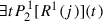 . In this case, we assume that the sentence ‘John was running’ elides a preposition phrase. It expresses the same proposition as ‘There is some time such that John was running at that time’.
Each option guides how we reason about time in interesting ways. I prefer Option 2, for reasons I will elucidate. But Option 1 is also viable, with some provisos.Footnote 25
Option 1 is awkward in cases when we want to describe a series of changes that are entirely past or entirely future. For example, suppose is alive is a temporary monadic property. Understated historical fact: Caesar was alive and then he wasn’t alive. How would an Option 1-er formalize this? On first pass, she might try:  . But then she encounters a major problem: the formula ascribes inconsistent properties to Caesar.
Can an Option 1-er avoid this by embedding predicate modifiers? Note that the formation rules as stated at the beginning of this section allow this. So she might try to express Caesar's life and death as:  . This brings new problems for Option 1. First problem: doubly tense modified predicates like
 don’t translate well back to English – ‘Caesar was was alive’ seems badly formed. So Option 1 requires a more dramatic break from English grammar. Second problem: we will want to distinguish sentences like ‘John was not drinking’ from ‘John never drank’. To do this, the Option 1-er could introduce additional primitive predicate modifiers:
 for ‘not’ and
 for always. Then she could formalize these sentences as
 and
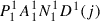 , respectively. But if she treats ‘always’ and ‘not’ as primitive modifiers, then she will also need to introduce new postulates to explain the obvious entailment relations between sentences like ‘John never drank’ and ‘John was not drinking’, since sentences with mixed embedded modifiers do not automatically entail sentences with fewer modifiers. This is one of the lessons of the apparent drinking cases.
Option 2 has none of these problems, though the notation is somewhat more cumbersome. An Option 2-er would express the sentence ‘Caesar was alive and then wasn’t’ as follows:  . In English: There is a time when Caesar was alive, a time when he wasn’t and the first time is earlier than the second. The sentence is logically consistent and has a natural English translation. And with Option 2, we need never multiply embed the same tense modifiers, since the sequence of events is determined by the earlier/later-than clause rather than the order of the modifiers. With Option 2, we can also easily distinguish ‘John was not drinking’ from ‘John never drank’. We formalize ‘John never drank’ as:
 . We formalize ‘John was not drinking’ as
 . And the former entails the latter assuming our modifier logic keeps the usual axioms and rules for quantifiers.
Still there is a philosophical worry with Option 2 – what should we make of these times that are being quantified over? Some presentist A-theorists might balk at the approach, because it requires quantification over past and future times, and they do not believe the past or future exist. And some growing blockers will worry about the future times introduced by the ‘will’ modifier. This worry is most serious if you are an A-theorist who thinks any quantification over times must be illegitimate. But many A-theorists are happy to quantify over times so long as they are treated as abstract states, or something other than regions of a B-theoretic manifold. They should have no problem, in principle, with the suggested system.Footnote 26 We’ll come back to what presentists and growing blockers should make of the proposal in Section 6.
Let's take stock. I’ve offered a proposal for thinking of tenses as special kinds of predicate modifiers that expand the arity of a predicate by one argument place – a time slot. And I have given a sketch of how a logic of tense modification would work. The logic will simply be a special case of a more general version of predicate logic with modifiers. Note that there are a wide range of options for formally implementing a tense modifier logic, and the basic proposal is flexible depending on your other commitments. We won’t further pursue the issue of whether a logic of tense modifiers is adequate for capturing natural language tenses. Instead, I want to return to the primary philosophical ambition for this project. In the next section, I will argue that predicate logic expanded with tense modifiers is expressive enough to capture the most basic commitments of an A-theory of time. So if the modifier approach is successful, we have a viable alternative to Priorian tense logic.Footnote 27
5. Step 2: A-theory metaphysics without operators
5.1. Describing change with tense modifiers
The argument from expressive adequacy in Section 3 contends that there is no way to consistently describe A-property change without resort to tense operators. With tense modifiers in hand we can show that this argument is unsound, by stating a version of the A-property change principle that is consistent and does not make use of tense operators. Initially, our operator-free A-theory will consist of three principles:
(1) A-Property Change: There is at least one enduring object (possibly a region of spacetime), x and at least one non-time-relational property, C, such that x is C only temporarily.
(2) Core Properties and Predicates: There is a set of core predicates that denote properties. These predicates are either tenseless or present-tensed. (It does not matter for our purposes.) At least some of these predicates do not have time slots, and they denote properties that are not held relative to a particular time. And at least some of the properties denoted by these predicates are temporary properties. An example of a core property might be is charged, denoted by  .
(3) Past and Future Analogue Properties and Predicates: ‘Was’ and ‘will’ are predicate modifiers, as described in Section 4. The expressions formed by joining modifiers to core predicates denote past and future analogue properties of objects. An example of a past analogue property might be was charged at a time, denoted by  .
The operator-free A-theorist then formalizes the A-property change principle as:
A-Property Change 4: For some property  ,

According to this version of the A-theory, there is A-property change because something has a core property, endures and lacks either the past or future analogue of that property. The minimal A-theoretic commitments are both respected: (1) the change only involves a single enduring object – the object assigned to x – and (2) the temporary property,  , need not be time-relational. Only
 's past or future time analogues are time-relational. So the tense modifier logic can express a consistent A-theory without collapsing into a version of the relational B-theory.
5.2. Objections to the operator-free A-theory
Unlike the relational B-theory, the operator-free A-theory holds that (1) some temporary properties are non-relational and (2) properties ought to be differentiated based on whether they are core, past or future properties. A question arises at this juncture: don’t the arguments that support treating past and future analogue properties as time relations also support treating the core properties as time relations? This would eliminate at least one of the two differences between the proposed A-theory and the relational B-theory. One might argue as follows. Before we have given it much thought, we might think a sentence like ‘Peter is ready’ conveys that Peter has the monadic property is ready. But when we probe further, this expression appears incomplete. Peter might be ready for work but not ready for a softball game. How we fill in the missing argument place will determine the truth-value of the sentence. And once we realize that the predicate ‘is ready’ often suppresses a prepositional phrase, our natural reaction is to suppose that there simply is no monadic property is ready. So why don’t we draw the same conclusion about core properties once we realize that their tensed analogues require a further argument place? According to the collapse objection, the same considerations that lead us to treat tenses as expanders ought to motivate us to treat all temporary properties as time relations.
There are two reasons we should reject the collapse objection. First and most important, while there is no deep philosophical reason to postulate a monadic readiness property, A-theorists typically think there is good metaphysical reason to take some temporary properties as non-time-relational. A-theorists have philosophical arguments for why core properties are indispensable. One important set of arguments concerns the central role that temporalist propositions play in how A-theorists since Prior conceive of temporariness and the flow of time.Footnote 28 According to one prominent understanding of A-theory, the most accurate description of reality is subject to change – indeed, this is part of what it is to take the flow of time seriously. But if all changing properties are fixed relations between an object and a time, then the most accurate description of reality never changes. Second, there are arguments against the assumption that predicates like ‘is ready’ are always context-sensitive in the way described. The most important work in philosophy of language on this topic has come from Lepore and Cappelen.Footnote 29
One might also worry that the operator-free A-theory does not adequately capture property change because it does not express change with respect to a single property,  ; rather, it only expresses that an object varies with respect to two distinct properties – the core property and the past or future analogue. Call this the too many properties objection. The objection closely parallels one we might raise against the temporal parts B-theory. Recall the temporal parts formulation of property change:
Temporal Part Change 1: An object o changes with respect to a property, C iff
 .
According to the view, the object which changes does not directly instantiate the changing properties; rather, its distinct temporal parts stand-in as the instantiators. One might object that this account of change fails to capture our intuition that a single object changes by gaining and losing properties over time. Call this the too many objects objection to temporal parts theories.Footnote 30
We shouldn’t take the too many properties or too many objects objections seriously. Every theory of change surveyed so far has a surprising entailment. If supporters of the operator-free A-theory are right, having a temporary property entails lacking at least one of the temporal analogue properties. If the temporal parts camp is right, having a temporary property entails having multiple temporal parts. If the relational B-theories are right, change involves having and lacking relations to regions of space–time. If the Priorian A-theorists are right, having a temporary property entails some fact that can only be expressed with tense operators. How should we weigh these different ideological commitments? On this point, I agree with Sider: ‘What is certain is that things persist somehow, that things change somehow, and that things have properties at time somehow. It is not a part of reasonable common belief just how this occurs’.Footnote 31
Related to the too many properties objection is a worry that past and future analogue properties are incoherent. At first pass, the temporal analogue properties seem to be properties that are either ungrounded or – at best – grounded in past or future facts about an object. But this account of analogue properties violates a typical A-theoretic assumption that the present is most fundamental. If you think the present is most fundamental, then presumably present facts ought to ground all other facts about an object. Call this the grounding objection to analogue properties.
I think operator-free A-theorists should reject the assumption that the present is most fundamental. The characteristic feature of A-theories is that they postulate a fundamental distinction between the present and other times: if some A-theorists think the present is more or most fundamental, then this requires further explanation and argument. Of course, there is a sense in which past and future analogue properties are related to core properties; they are related in whatever sense properties denoted by modified predicates are related to properties denoted by unmodified predicates. Surely there is some sense in which is drinking and is apparently drinking are importantly similar properties. Perhaps we only grasp what it is to have the latter property in virtue of understanding what it is to have the former. But there is no sense in which something's being apparently drinking is grounded in that object drinking simpliciter. Likewise, core properties and their past and future analogues are importantly similar, but the former do not ground the latter. And without some strong grounding assumption, there is no reason to think that operator-free A-theorist is cheating if she postulates a primitive similarity between core properties and their past and future analogues.
6. Accommodating temporalism and ontological change
I’ve argued that A-theorists do not need tense operators to express the distinctive kind of property change they believe in. I did this by proposing an alternative, operator-free A-theory. But most self-described A-theorists think they are committed to much more than a theory of property change. As we saw in Section 3, many think tense operators are indispensable because they are propositional temporalists or believe in ontological change. Can an operator-free A-theory describe these other kinds of change? Here the verdict is mixed. Predicate logic with modifiers has the resources to support propositional temporalism, but only if we are willing to introduce substantive truth predicates. And predicate logic with modifiers can express a kind of temporary existence claim, but one that requires a departure from neo-Quineanism. I’ll close by sketching these extensions of the operator-free A-theory, raising objections to the remaining indispensability arguments.
According to the argument from propositional temporalism, tense operators are indispensable for capturing the temporary truth of propositions about objects and their A-properties. Propositional temporalists think that a proposition  's temporary truth is expressed by the truth of the following schema:
 . For example, the proposition that Obama is President is temporarily true. We express this as [
 ]. Do we have a schema for expressing temporary truth that eliminates the tense operators? We do if we add the following assumption to the operator-free A-theory's metaphysics:
(4) Truth Property: At least one core truth predicate,  , denotes a property of propositions.
With the truth property principle, we can express the temporariness of certain propositions using tensed truth predicates:
Propositional Temporalism 2: For some proposition  ,
 .
On this construal, propositional temporalism is the view that there is some proposition which is true, and which either was not true at some time or will not be true at some time. This version of the proposal requires not only a core truth predicate (and corresponding property) but also past and future truth predicates (and corresponding properties). Some A-theorists may welcome this alternative for expressing temporalism, and with the truth predicates we can recover many of the inference patterns typically formalized by tense operators.Footnote 32 But others may balk at the truth property principle. Presumably one could take propositions seriously, endorse the A-property change principle, but nevertheless contend that truth-predicates are extraneous or problematic. The usual tense logics, in contrast, can be developed with or without an explicit truth predicate. While temporalist deflationism seems to be Prior's mature view, I am not aware of any other A-theorists tempted by truth-predicate deflationism.Footnote 33 Barring another way to capture propositional temporalism, the operator-free A-theory will not be of much use to temporalist deflationists. Happily, this doesn’t exclude many A-theorists after Prior.
What about A-theorists who believe in ontological change? Expressing the temporary existence principle in the operator-free A-theory is more problematic. The system lacks any tense operators, so a fortiori it lacks prophylactic tense operators. But we can express temporary existence claims if we assume:
(5) Existence Property: A first-order existence predicate,  , denotes a property.
With this assumption, we can express a version temporary existence using tense modifiers:
Temporary Existence 2:  .
On this construal, ontological change occurs if there is some object which exists, endures and for some time lacks the property of existing at that time.Footnote 34 We’d express truths about temporal aliens as truths about objects which have only past or future analogue existence properties. For example, ‘Caesar existed’ is  . From this we cannot infer that Caesar exists any more than we can infer ‘John is drinking’ from ‘John is apparently drinking’. So there is no worry about facts about temporal aliens entailing that those objects still exist simpliciter.
The trouble is, as noted earlier, many A-theorists (and B-theorists) are neo-Quineans, and neo-Quineans reject the existence property assumption. So expressing temporary existence in the operator-free A-theory requires a departure from the neo-Quinean program. How bad is this? Not as bad as you might think. Many A-theorists are forced away from neo-Quineanism anyways. Because of the Barcan formulas, there is no acceptable version of Priorian tense logic that uses the standard univocal existence quantification theory and upholds the temporary existence assumption. So presentists and growing blockers already have good reason to look for new ways to express their temporary existence claim. The operator-free A-theory provides such an option.
7. Conclusions: narrow and more ambitious
We see that fundamental tense operators – at least the operators given to us by Prior – are not an automatic commitment of an A-theory of time and change. We might wonder further whether the theory of tense modifiers is just another animal in Russell's ‘logical zoo’ or whether it more accurately represents the commitments of our best theory of time and change. And as we have seen, answering this question requires some heavy philosophy. Are there past and future analogue properties? Do objects endure or perdure? Are all temporary properties relations between an object and a region of space–time? I submit that the pressing work for A-theorists is finding principled answers to these questions, rather than refining Priorian tense logic or looking for metaphysical structure that corresponds to tense operators.
More ambitiously, A-theorists who doubt either neo-Quineanism or temporary existence should be especially interested in developing this new system. Predicate logic with tense modifiers perspicuously and parsimoniously reflects the basic ontological and ideological commitments of an A-theory, without forcing adherents to believe in anything more than new sets of properties. And treating tense modifiers as expanders further gives the A-theorist the semantic benefits of quantification over times, without collapsing her view into a B-theory.
Still more ambitiously, developments in the logic of time often go hand in hand with developments in the logic of possibility and necessity. If we determine that predicate logic with modifiers provides a suitable background for the metaphysics of time, it may also provide an alternative to modal logic. On this approach, we would treat ‘possibly’ and ‘necessarily/essentially’ as predicate modifiers. A system like this seems most congenial to necessitists, like Williamson.Footnote 35 These are issues worth pursuing.Footnote 36
Acknowledgements
Thanks to Andy Egan, Ted Sider, Jeff Speaks, Dean Zimmerman, Tim Williamson and audiences at Rutgers University, University of Toronto, University of Virginia, University of Iowa, University of Arizona, the Metaphysical Virtues Conference at WMU, the Carolina Metaphysics Workshop, the Birmingham Time Workshop, and the Barcelona As and Bs of Time Workshop.
 .
 . On this approach, we could define an atomic sentence as any complex predicate with arity 0. The proposal has a certain affinity with Quine's program for eliminating variables with ‘de-relativizing’ operators in Quine (
 . With expanders, we would have to relativize to a time. For example, we might express it as
 . But this construction looks strange – it expresses that 2008 was an election year at 2008. Some past and future properties of times themselves seem non-relational, and so might be better captured with simple tenses along the lines of Option 1.
 in the meaning postulates of the new, operator-free theory. A temporalist of the kind discussed above could do this by quantifying over propositions:
 . In English, for any proposition
 , if
 is true then the proposition that there will be a time when
 will be true has always been true. The main difference is this isn’t an axiom of a proof theory anymore.


