Introduction
The liver is a fundamental organ in the regulation of body energy metabolism, and the synchronism of glycemic and lipid metabolism is destabilized in situations of nutritional changes, predisposing individuals to excessive accumulation of lipids in the hepatocyte and the consequent development of non-alcoholic fatty liver disease (NAFLD).Reference Berlanga, Guiu-Jurado and Porras1 NAFLD includes a group of chronic liver diseases, ranging from simple hepatic steatosis to non-alcoholic steatohepatitis and hepatocellular carcinoma. The molecular mechanism underlying NAFLD progression is not completely understood; its pathogenesis has been interpreted by the hypothesis of “two-hits.” The “first hit” concerns the accumulation of greater than 5.5% lipids in hepatocytes in individuals with no history of excessive alcohol consumption, resulting in steatosis due to the excessive lipid influx or impaired lipid efflux.Reference Brunt2 Hepatocytes activate metabolic pathways to minimize lipotoxicity in response to elevated hepatic lipid uptake, thus steatosis develops when lipid influx overwhelms these protective mechanisms (β-oxidation, ketogenesis, and VLDL export), mainly in response to fasting, high-fat diet (HFD), or lipodystrophies.Reference Berlanga, Guiu-Jurado and Porras1–Reference Anstee and Goldin3 In numerous experimental animal models of hepatic steatosis, including HFD, fructose or ethanol, and genetic lipodystrophy, fatty liver is associated with peripheral metabolic dysfunction.Reference Geisler and Renquist4 In addition to the accumulation of lipids, there is inflammation and hepatocellular degeneration featuring the “second hit.”Reference Day and James5 Bacterial toxins, hyperproduction of cytokines, tumor necrosis factor α, changes in adenosine triphosphate stocks, and cytochrome P450 activity appear to be important triggers for this progression, which can be accompanied by the appearance of fibrosis and even progress to liver cirrhosis and carcinoma.Reference Angulo6–Reference Chalasani, Younossi and Lavine8
Epidemiological studies show that the environment in critical periods, including gestation, breastfeeding, and adolescence, exerts a strong influence on the development of an individual and is associated with the onset of diseases throughout life, in particular, obesity and its comorbidities.Reference Zambrano, Ibanez and Martinez-Samayoa9 This phenomenon, known as metabolic programming, is related to the developmental origins of health and disease hypothesis.Reference Barker10–Reference Haugen, Schug and Collman12 In humans, exclusive breastfeeding during the first six months of life is usually recommended, since shortening this period has been linked to adverse metabolic effects later in life.Reference Victora, Bahl and Barros13,Reference Horta, Victora and Franca14 In rodents, the shortening of the standard period of breastfeeding through experimental early weaning (EW) can program the offspring for metabolic disturbances later in life.Reference Bonomo, Lisboa and Pereira15–Reference Lima, Moura and Passos17
In an attempt to mimic the effects caused by EW in humans and to increase the understanding concerning the metabolic programming mechanisms involved in this process, animal models of EW have been developed. In this context, our research group has previously demonstrated that EW caused by pharmacological (PEW) or non-pharmacological (NPEW) inhibition of breastfeeding in the last three days of lactation promotes metabolic changes in rats throughout the life.Reference Bonomo, Lisboa and Pereira15–Reference Nobre, Lisboa and Lima18 This short period for a suckling rat corresponds to 1 month for a human baby,Reference Quinn19 i.e., this experimental model mimics a child weaned at the 5th month of age. The PEW experimental model decreases milk consumption through maternal administration of a type 2 dopaminergic agonist (bromocriptine (BRO)) that inhibits the synthesis of prolactin (PRL),Reference Bonomo, Lisboa and Passos20 whereas the NPEW experimental model uses an adhesive bandage to prevent pup’s access to maternal nipples, with consequent deprivation of breastfeeding.Reference Lima, Moura and Passos17 When adults, both NPEW and PEW male rats are overweight and have metabolic syndrome, although some parameters in liver function differ between models. NPEW offspring have hepatic microsteatosis accompanied by an increase in oxidative stress,Reference Franco, Lisboa and Lima21 while PEW offspring show improved redox status and absence of steatosis,Reference Peixoto-Silva, Conceição and Carvalho22 perhaps by a protection against NAFLD induced by BRO.Reference Davis, Pei and Trush23 This phenotype is not stress-dependent, since NPEW males do not have alterations in serum corticosterone concentrations at weaning and the dams continued to groom and lick their pups, minimizing any stress effect caused by the maternal adhesive bandage.Reference Lima, Moura and Franco24
BRO can be found in both placenta and milkReference Bigazzi, Ronga and Lancranjan25 and does not completely block milk production.Reference Zhang and Cheng26 In rats, BRO-treated mothers (1 mg/kg per day) showed lower serum PRL at the end of lactation, which caused a significant failure in milk production, although milk PRL of the BRO dams and serum PRL of the BRO pups were not altered.Reference Bonomo, Lisboa and Passos27 Peixoto-Silva et al. (2017) showed that BRO treatment of the pups during the last 3 days of lactation prevents the hepatic fat accumulation associated with an improvement in adiposity at adulthood, but in a dose 4 times higher than the administrated to the dams (4 mg/kg per day).Reference Peixoto‐Silva, Moura and Carvalho28 Thus, in the PEW model, both maternal lower PRL levels and BRO (even in small quantities) could be responsible for the programming of the liver function in the adult male offspring.
Therefore, considering the unexpected effects of BRO on the liver function of male offspring programmed by EW during the critical window of breastfeeding, in the present study, our primary aim was to assess morphological parameters of the liver tissue as well as main molecular pathways associated with hepatic metabolism to better understand the underlying mechanisms responsible for the altered function in each of the EW models (PEW and NPEW) used in our laboratory. We hypothesize that liver energy metabolism is programmed by different mechanisms in each model since, as previously reported, only PEW protected male rat offspring against liver steatosis. Furthermore, considering that the effects of EW could be sex-dependent, we also investigated, for the first time, in both EW models, the female offspring’s phenotype. We therefore studied the main molecular pathways related to energy hepatic metabolism (lipogenesis, β-oxidation, VLDL export, and gluconeogenesis) in male and female adult rat offspring that were submitted either to the non-pharmacological model of EW (teat blockage by adhesive bandage) or to the pharmacological one (BRO treatment).
Experimental methods
Animals
All experimental procedures were approved by the Animal Care and Use Committee of the Biology Institute of the State University of Rio de Janeiro (CEUA/014/2017), which was based on its decision on Brazilian Law 11.794/2008, which regulates the procedures for the scientific use of animals.
Wistar female rats 3 months of age were housed under controlled temperature (23 °C ± 1 °C) and artificial light/dark cycles (lights on at 07:00 a.m. and lights off at 07:00 p.m.). The mating period covered 2 weeks (two females: one male), and after pregnancy confirmation by estrous cycle monitoring, pregnant females were housed in individual maternity cages. During pregnancy and breastfeeding, rat dams received free access to water and standard chow (Nuvilab, Sogorb, São Paulo, Brazil). Diet composition is described in Table 1. In the first postnatal day (PN0), litters were adjusted to six pups per dam (three males and three females).
Macronutrients and micronutrients composition of standard rat chow

BHT, butylated hydroxytoluene.
Standard rat chow (Nuvilab, Sogorb, São Paulo, SP, Brazil). Composition of diet: whole corn, soybean bran, wheat bran, calcium carbonate, dicalcium phosphate, sodium chloride, vitamin A, vitamin D3, vitamin E, vitamin K3, vitamin B1, vitamin B2, vitamin B6, vitamin B12, niacin, calcium pantothenate, folic acid, biotin, choline chloride, iron sulfate, manganese sulfate, zinc sulfate, copper sulfate, calcium iodate, sodium selenite, cobalt sulfate, lysine, methionine.
Experimental design of NPEW and PEW
On the last 3 days of the breastfeeding period (PN18–PN20), the lactating rats were randomly divided into three groups (n = 10 dams/group): (1) NPEW group, dams were anesthetized with xylazine (9-mg/kg body mass; Xilazin®, Paulinia, SP, Brazil) and ketamine (90-mg/kg body mass; Cetamin®, Paulinia, SP, Brazil) and then wrapped with an adhesive bandage that covered all the teats, thereby restricting pups’ access to themReference De Albuquerque Maia, Lisboa and de Oliveira29; (2) PEW group, dams received 0.5-mg BRO (Parlodel; Novartis, São Paulo, Brazil) intraperitoneally (i.p), two times per dayReference Lima, Moura and Franco24 to inhibit PRL synthesis; and (3) control group (CON), dams whose weaning of the pups occurred at PN21 (standard period). Both NPEW and PEW pups were also separated from their respective dams at PN21. After separation, male siblings were kept separated from female siblings. From PN21 to PN180, offspring from the three groups received water and standard chow (Nuvilab). We randomly evaluated one offspring/sex/litter, and the other pups in each litter were used for other studies.
One month before euthanasia, which occurred at PN180, the estrous cycle of the female offspring of all three groups was evaluated every day (08:00 a.m.) by vaginal smears collected in a solution containing 0.9% NaCl. The female offspring showed regular estrous cycles (4–5 days). They were killed during diestrus.
Intraperitoneal pyruvate tolerance test
To analyze the gluconeogenesis rate of adult rats, the intraperitoneal pyruvate tolerance test (iPTT) was performed in one animal/sex/litter at PN175. Pyruvate was used because it is the common intermediary metabolite in the gluconeogenic pathways, being generated from lactate, amino acids, and glycerol. The animals were fasted for 12 h, and blood samples were taken from the tip of the tail vein to obtain fasting glycemia (time 0) using a handheld glucometer (Accu-Chek Advantage; Roche Diagnostics, Mannheim, Germany). Subsequently, the animals received an i.p. injection of 2-g/kg body mass of pyruvate, and additional blood samples were recorded at 15, 30, 60, and 120 min.Reference Frankenfeld, De Oliveira and Ignacio30
Euthanasia and tissues
Prior to euthanasia (PN180), animals were fasted for 12 h. After measurement of fasting glycemia, the rats were anesthetized with xylazine (100-mg/kg body mass; Xilazin®, Paulinia, SP, Brazil) and ketamine (50-mg/kg body mass; Cetamin®, Paulinia, SP, Brazil) and euthanized by cardiac puncture. The retroperitoneal, perigonadal, and mesenteric white adipose tissues (visceral fat mass (VFM)), and the liver were collected and weighed. Blood samples were centrifuged (1500 × g for 20 min at 4 °C) to obtain plasma, which was kept at −20 °C until use. Tissue samples were frozen at −80 °C until analysis.
Plasma and hepatic levels of cholesterol and triglycerides
The quantifications of total cholesterol (CHOL), high-density lipoprotein-cholesterol (HDL-c), and triglycerides (TGs) were performed using a commercial kit in accordance with the manufacturer’s instructions (Bioclin, Rio de Janeiro, RJ, Brazil). Left-lobe hepatic samples of approximately 100 mg were removed to determine total lipids using the Folch method.Reference Folch, Lees and Sloane Stanley31 The extract was evaporated and then diluted in isopropanol. The CHOL and TG liver content were measured using a commercial kit in accordance with the manufacturer’s instructions (Bioclin, Rio de Janeiro, RJ, Brazil). Additionally, the TG and glucose index (TyG index) were calculated (Ln[fasting TG (mg/dL) × fasting glycemia (mg/dL)/2) and used to evaluate insulin resistance.Reference Guerrero-Romero, Simental-Mendía and González-Ortiz32
Hepatic histology
A liver sample was removed from the left lobe of each animal in the direction transverse to the board. The material was fixed in 4% paraformaldehyde for 24 h, then dehydrated in alcohol of increasing concentration, and, after diaphanization in xylene, was embedded in histologically Paraplast (Sigma-Aldrich, St. Loius, MO, USA). Slices of 5-µm thickness were prepared for staining with hematoxylin and eosin (H&E). For this, photomicrographs (10 per animal, ×60 magnification) were randomly acquired with an Olympus DP71 camera coupled to an Olympus BX40 epifluorescence microscope (Olympus, Tokyo, Japan). Images were displayed on a high-resolution liquid crystal display flat-panel monitor (LG Electronics, Seoul, South Korea). For volume density of hepatic steatosis (Vv[steatosis, liver]) determination, a test system consisting of 36 test points was used.Reference Catta-Preta, Mendonca, Fraulob-Aquino and Aguila33 The values were classified in accordance with Brunt’s classification of steatosis magnitude. Thus, steatosis was graded as follows: 0 (none to 5% of hepatocytes affected); 1 (>5%–30% affected); 2 (>30%–60% affected); and 3 (>60% affected).Reference Brunt34
Hepatic protein expression
To determine protein expression, 30 mg from the liver was homogenized in radioimmunoprecipitation assay buffer (50-mM Tris-HCl, pH 7.4; 150-mM NaCl; 1% Triton X-100; sodium dodecyl sulfate (SDS) 0.1%; 5-mM ethylenediaminetetraacetic acid; 50-mM NaF; 30-mM Na4P2O7; 1-mM Na3VO4,) containing a complete cocktail of protease inhibitors (La Roche Ltd., Basel, Canton of Basel-Stadt, SW). After centrifugation (7500 × g/15 min/4 °C), the total protein content of the supernatant was measured using a Pierce bicinchoninic acid protein assay kit (Thermo Scientific, San Jose, CA, USA). For SDS gel electrophoresis, 30 µg of the samples were initially denatured in sample buffer containing beta-mercaptoethanol and then transferred to polyvinylidene fluoride membranes (Amersham Pharmacia Biotech, Amersham, Bucks, UK) along with the molecular weight standard (Kaleidoscope; Bio-RadTM, USA). The membranes were incubated overnight with the appropriate primary antibodies and then, for 90 min, with the secondary antibodies conjugated to horseradish peroxidase (Table 2). Visualization of the specific protein bands was performed by chemiluminescence (Bio-RadTM) using an ImageQuant Las 500 (GE Healthcare, Chalfont St Giles, Bucks, UK) image capture system. The band intensities were quantified by optical densitometry using the ImageJ software (Media Cybernetics, Rockville, MD, USA). α-Tubulin was used as an internal control, and the results were expressed as percentages relative to the control group.
Antibodies used for Western blotting

ACC-1, acetyl-CoA carboxylase-1; pACC, phosphorylated acid-acetyl-CoA carboxylase; FAS, fatty acid synthase; SCD-1, stearoyl-CoA desaturase-1; CPT-1α, carnitine palmitoyl-transferase-1α; MTTP, microsomal triglyceride transfer protein; SREBP-1c, sterol regulatory element-binding protein-1c; PPAR-α, peroxisome proliferator-activated receptor alpha; PPAR-γ, peroxisome proliferator-activated receptor gamma; G6Pase-α, glucose 6-phosphatase-α; PEPCK-1, phosphoenolpyruvate carboxykinase-1; AMPK-α, AMP-activated protein kinase-α; pAMPK, phosphorylated AMP-activated protein kinase.
Statistical analysis
The Kolmogorov–Smirnov one sample test (K–S) was used to assess the normality of the distributions of each of the variables. Data are compiled as means and standard errors of the means (SEM). Only one animal per sex per litter was used in the analyses. Univariate analyses of variance were used to analyze all the data except those pertaining to the pyruvate-response assessment. Group and sex were used as the between-subjects factors. Repeated measures analyses of variance (rANOVA) were used to analyze the pyruvate-response data. Group and sex were used as the between-subjects factors, and interval was used as the within-subjects factor. Whenever the sphericity assumptions appeared to be violated (Mauchly’s test) in the rANOVAs, an adjustment to the numerator and denominator degrees of freedom was made by using parameter ε.Reference Huynh and Feldt35 Lower order ANOVAs and Fisher Protected Least Significant Difference tests were used post hoc. Significance is assumed at the level of P < 0.05. For interactions at P < 0.10 (two-tailed), we also examined whether lower order main effects were detectable after subdivision of the interactive variables.Reference Snedecor and Cochran36
Results
Body composition
As indicated in Table 3, body mass gain was increased between PN21 and PN180 in both EW models, irrespective of sex, when compared to controls (F 2,52 = 12.3, P < 0.001). NPEW animals had 13% more (P = 0.006) body mass gain than controls, while PEW animals had 20% more (P < 0.001). No differences were observed between NPEW and PEW in this parameter. Males had higher body mass gain (+122%) than females (F 1,52 = 558, P < 0.001). The same pattern of results was observed regarding VFM at PN180. Both EW models, irrespective of sex, showed higher VFM (F 2,51 = 18.7, P < 0.001): NPEW +55% (P < 0.001) and PEW +64% (P < 0.001) vs. controls. Males had higher VFM (+17.6%) than females (F 1,51 = 6.2, P = 0.016). All these data are in accordance with our previous published studies.Reference Bonomo, Lisboa and Pereira15,Reference Lima, Moura and Passos17,Reference Pietrobon, Bertasso and Silva37
Somatic and plasma data separated by sex and group in both early weaning models at PN180

VFM, visceral fat mass; BM, body mass; TG, triglycerides; CHOL, cholesterol; HDL-c, high-density lipoprotein; TyG index, plasma triglycerides-glucose index. Values represent mean (SEM) of 8–10 animals per group from different litters. Significance is assumed at the level of P < 0.05.
Plasma parameters of both sexes
The Intraperitoneal Pyruvate Tolerance Test (iPPT) analysis at PN175 indicated that all groups showed variations in plasma glucose levels throughout the test (interval: F 2.7, 128.4 = 64.3, P < 0.001) (Fig. 1). The profiles of these variations were affected both by group (F 2,47 = 7.4, P = 0.002) as well as by sex (interval × sex: F 2.7, 128.4 = 4.7, P = 0.005). Given these results, the analyses proceeded separated by sex. Regarding females (Fig. 1a), all three groups showed that similar increases were present from 0 to 15 min and that levels remained relatively stable from 15 to 30 min. It is at 60 (F 2,23 = 4.5, P = 0.023) and 120 (F 2,23 = 4.0, P = 0.031) min that differences become apparent: PEW females show higher values than controls at both time points (60 min: +18%, P = 0.014; 120 min: +24%, P = 0.009) and higher than NPEW at 60 min (+18%, P = 0.014). As for males (Fig. 1b), significant differences between groups were observed from 30 min onwards: PEW males show higher values than controls at 30 (+22%, P = 0.009) and 60 (+26%, P = 0.001) min; NPEW males show higher values than controls at 60 (+18%, P = 0.013) and 120 (+23%, P = 0.005) min. The area under curve (AUC) of iPTT showed an effect of group both in females (F 2,23 = 5.4, P = 0.012) and males (F 2,24 = 4.5, P = 0.020) (Fig. 1c). PEW females had higher values than control (+17%, P = 0.005) and NPEW (+14%, P = 0.013) females. Both PEW (+20%, P = 0.010) and NPEW (+23%, P = 0.024) males had higher values than controls.
iPTT of female (a) and male (b) offspring at PN175. (c) iPTT AUC. Values are mean ± SEM (n = 8–10). G, group factor. ¢ PEW females vs. CON females; ¥ PEW females vs. NPEW females; # NPEW or PEW males vs. CON males. Significance is assumed at the level of P < 0.05.

At PN180, fasting plasma glucose (Table 3) showed no group effect, but females, irrespective of group assignment, had higher values (+16%) than males (F 1,50 = 39.8, P < 0.001). Regarding TG levels (F 2,44 = 4.5, P = 0.016) and the TyG index (F 2,44 = 39.8, P = 0.014), only group effects were present (Table 3): NPEW had higher values than controls (TG: +57%, P = 0.014; TyG: +6%, P = 0.014). Plasma total CHOL showed no effects or interactions (Table 3). As for HDL-c, the effects of group (F 2,29 = 30.8, P < 0.001) and sex (F 2,29 = 32.8, P < 0.001) were identified: Both EW groups showed lower levels than control animals (PEW vs. C: −52%, P < 0.001; NPEW vs. C: −51%, P < 0.001); females had lower levels than males (−43%).
Liver parameters
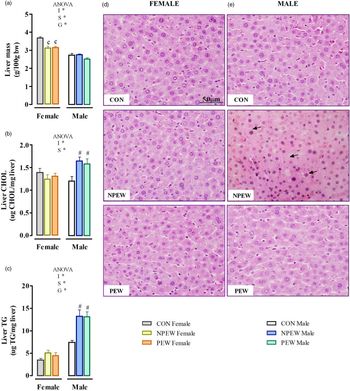
At PN180, liver mass (Fig. 2a) was affected both by the weaning procedure and by the sex of the offspring (group: F 2,51 = 8.9, P < 0.001; sex: F 1,51 = 75.4, P < 0.001; group × sex: F 2,51 = 4.7, P = 0.013). In females, both PEW (−14%, P < 0.001) and NPEW (−15%, P < 0.001) animals had lower liver masses than control ones. No differences were observed among male groups. As for the liver CHOL content (Fig. 2b), it was also observed that both factors affected the outcome (sex: F 1,42 = 4.4, P = 0.043; group × sex: F 2,42 = 4.5, P = 0.017). In males, both EW groups showed higher contents than controls (PEW vs. C: +31%, P = 0.010; NPEW vs. C: +36%, P = 0.022). No differences were observed among female groups. Regarding liver TG content (Fig. 2c), it was affected both factors (group: F 2,42 = 10.5, P < 0.001; sex: F 1,42 = 88.3, P < 0.001; group × sex: F 2,42 = 4.4, P = 0.018). In males, both EW groups showed higher contents than controls (PEW vs. C: +78%, P = 0.002; NPEW vs. C: +80%, P = 0.001). No differences were observed among female groups.
Liver parameters of female and male offspring at PN180. (a) Liver mass. (b) CHOL, and (c) TG liver contents. Representative photomicrographs of the liver (×60 magnification) of female (d) and male (e) rats (bar: 50 µm). Values are mean ± SEM (n = 8–10). Arrows indicate microvesicular liver steatosis in NPEW males at PND180. I, intersection; S, sex factor; G, group factor. ¢ NPEW or PEW females vs. CON females; # NPEW or PEW males vs. CON males. Significance is assumed at the level of P < 0.05.

The liver histomorphologic analysis showed hepatocytes with preserved architecture, arranged in rows, delimited by connective tissue containing sinusoidal capillaries and lipid droplets in less than 5% of the analyzed area in all female groups (Fig. 2d; Table 4) as well as in CON and PEW male groups (Fig. 2e; Table 4); this is considered absence of steatosis (degree 0). Only the NPEW male group had hepatocytes with several cytoplasmic lipid droplets in approximately 25% of the analyzed area on 75% of samples, indicating a profile of microvesicular hepatic steatosis that is considered degree 1 (Fig. 2e; Table 4).
Degree of steatosis (Brunt’s classification) in rats’ liver in both early weaning models at PN180

Eight animals from different litters per group.
The evaluation of protein contents of key enzymes involved in hepatic lipid metabolism is depicted in Fig. 3. Total acetyl-CoA carboxylase-1 (ACC-1) content (Fig. 3a) showed a group effect (F 2,38 = 7.8, P < 0.001): NPEW animals had a higher content than control (+28%, P < 0.001) and PEW (+18%, P < 0.001) ones. Fatty acid synthase (FAS) content (Fig. 3b) showed a clear sex (F 1,44 = 11.4, P = 0.002) effect (females had less (−29%) than males) as well as a group × sex interaction that approached significance (F 2,44 = 2.9, P = 0.063). After subdivision by sex, EW males showed higher contents than control ones (PEW vs. C: +31%, P = 0.037; NPEW vs. C: +40%, P = 0.010). Stearoyl-CoA desaturase-1 (SCD-1) content (Fig. 3c) showed a pattern of results that was similar to those observed for the ACC-1 context: A group effect was present (F 2,48 = 5.4, P = 0.008) and this effect is explained by the fact that NPEW animals had a higher content than control (+10%, P = 0.010) and PEW (+10%, P = 0.006) ones. As for microsomal triglyceride transfer protein (MTTP) (Fig. 3d), its context was affected by both factors (group: F 2,41 = 7.8, P = 0.001; sex: F 1,41 = 4.9, P = 0.033). Overall, both EW groups had higher contents than the control one (PEW vs. C: +48%, P = 0.001; NPEW vs. C: +39%, P = 0.004). A planned comparison separated by sex further indicated that both EW females had higher contents than the control ones (PEW vs. C: +73%, P = 0.022; NPEW vs. C: +49%, P = 0.022); no significant differences were observed among the male groups. All representative western blot bands are shown in Fig. 3e.
Expression, in male and female offspring at PN180, of total ACC-1 (a), FAS (b), SCD-1 (c), and MTTP (d). These enzymes are involved in hepatic metabolism. Representative Western blot bands for each protein are shown in (e). Values are mean ± SEM (n = 8–10). I, intersection; S, sex factor; G, group factor. ¢ NPEW or PEW females vs. CON females; ¥ NPEW females vs. PEW females; # NPEW or PEW males vs. CON males; + NPEW males vs. PEW males; θ Females vs. respective males. Significance is assumed at the level of P < 0.05.

The following proteins showed no effects or interaction: ACC-1/phosphorylated acid-acetyl-CoA carboxylase (pACC), carnitine palmitoyl-transferase-1α (CPT-1α), sterol regulatory element-binding protein-1c (SREBP-1c), peroxisome proliferator-activated receptor (PPAR) α (PPAR-α), PPAR-γ, glucose 6-phosphatase-α (G6Pase-α), phosphoenolpyruvate carboxykinase-1 (PEPCK-1), total Adenosine Monophosphate (AMP)-activated protein kinase (AMPK), and phosphorylated AMP-activated protein kinase (pAMPK)/AMPK) (Supplementary Fig. 1).
Discussion
The two EW models seem to mimic the two main situations of human early interruption of exclusive breastfeeding. The most common situation is that of the mother gradually reducing the frequency of breastfeeding, which could be best reproduced by the PEW model, which reduces the amount of milk that is made available to the baby but does not totally cease breastfeeding, while the NPEW model reproduces a complete interruption.
Corroborating previously published data, we demonstrated here the occurrence of hepatic steatosis among adult males depending on the type of EW. In addition, in the present study, the enzymatic alterations, which were studied for the first time here, partially help explaining this process. Intriguingly, the adult females that were programmed by EW, despite having a higher accumulation of abdominal fat, did not display steatosis, which may be related to the protective action of estrogen on the liver of these animals, a possibility that will be discussed later.
EW programs adult male rats for greater body mass gain and VFM. Since pyruvate is preferentially used by hepatocytes as a substrate for gluconeogenesis, the pyruvate challenge is a good tool to examine gluconeogenic activity in vivo. In the first glucose measurement (15 min after injection), EW animals of both sexes showed unchanged levels. Corroborating this finding, PEPCK and G6Pase, which catalyze the rate-limiting step of gluconeogenesis, were similar among groups.
At 30 min, PEW males showed higher glucose levels only when compared to the CON group. At this moment, increased glycemia under iPTT can be due to an impairment of glycogen synthesis by lower insulin action in the liver as well as to lower peripheral sensitivity to this hormone, reducing glucose uptake by muscle and adipose tissue. At 60 min, males of both EW models had impaired maintenance of the glycemic homeostasis. At 120 min, PEW males showed a drop in glucose levels, while NPEW glycemia remained high. Despite the differences in the iPPT profiles, the AUCs of both EW groups were increased. Pietrobon et al. (2020) reported that both EW groups have insulin resistance in the skeletal muscle,Reference Pietrobon, Miranda and Bertasso38 which is responsible for the uptake of 70%–80% of the plasma glucose.Reference Jornayvaz, Samuel and Shulman39 Thus, EW seems to program muscle insulin resistance prior to the liver one. To reinforce this idea, the content in the liver made of the proteins that play key functions in the lipid metabolism homeostasis, which is insulin-regulated, was not altered in EW animals (SREBP-1c, PPAR-α and PPAR-γ, CPT-1α, pACC/ACC, and pAMPK/AMPK).
The hepatic steatosis characteristic of NPEW males seems to be related to other factors that are independent of insulin action on this tissue. The high hepatic TG observed in this group may be due to an increase in de novo lipogenesis (increased ACC-1, FAS, and SCD-1). Also, NPEW males can have higher diacylglycerol O-acyltransferase 1 (DGAT-1), a key enzyme for TG biosynthesis, and compromised TG uptake, possibly by transporter-mediated hepatic fatty acid uptake alterations, for example,Reference Jiang, Zhang and Bai40 since this lipid was higher in hepatocytes and plasma. A limitation of our study in this regard was that we have not analyzed these parameters. The increase in TG synthesis concurrently with unaltered mitochondrial β-oxidation and TG exportation through VLDL, as shown in this work, can promote hepatic lipid accumulation and increased oxidative stress, which has already been demonstrated in the NPEW model.Reference Franco, Lisboa and Lima21
Plasma CHOL was not altered in the EW models. However, this lipid content was higher in the liver of males, which could be related to dysfunctions in synthesis and/or esterification caused by, respectively, alterations in 3-hydroxy-3methyl-glutaryl-CoA reductase or Acyl CoA: CHOL acyltransferase1.Reference Ikonen41 Despite normal total CHOL in plasma, EW animals showed lower HDL-c, which indicates a higher atherogenesis riskReference Pownall and Gotto42 and suggests that EW females and males have a higher risk of developing cardiovascular diseases.
PEW males had normal ACC-1 and SCD-1, absence of steatosis, higher TG and CHOL in the liver, but unchanged in the plasma. Compared to NPEW males, PEW males had reduced SCD-1, which can be an attempt to contain TG and fatty acids synthesis (higher FAS). However, higher TG in the hepatocytes of PEW males suggests that DGAT-1 was higher.
As previously reported by our research group, BRO appears to have a long-term protective effect on the hepatic functions of EW male rats.Reference Peixoto-Silva, Conceição and Carvalho22 Thus, we hypothesize that the protective role of BRO is related to an increase in Sirtuin 1, an enzyme involved in NAFLD inhibition.Reference Peixoto-Silva, Conceição and Carvalho22 Despite the higher TG in the liver, PEW males had normal TG in the plasma. This lipid could be uptaken by other tissues, such as pancreas and muscle. Indeed, our group have previously reported the impairment of insulin secretion at higher glucose concentrations and muscle insulin resistance in EW males.Reference Pietrobon, Miranda and Bertasso38 Thus, impairment of glycemic homeostasis could be due to lipotoxicity related to steatosis development in other tissues.
Clinical studies demonstrate that NAFLD manifestations occur with a higher prevalence in men than in women.Reference Browning, Szczepaniak and Dobbins43 In fact, the accumulation of hepatic lipids and the consequent development of liver steatosis are twice as common in the postmenopausal period compared to the reproductive age.Reference Clark44–Reference Polyzos, Kountouras and Tsatsoulis46 In addition, mice fed with a diet deficient in choline and methionine for two weeks show steatosis, an increase in hepatic transaminases, and an increased expression of inflammatory markers with these changes more pronounced in males,Reference Lee, Kim and Kim47 corroborating our present findings where EW females did not have alterations in liver morphology or in serum and hepatic CHOL and TG levels.
In the literature, it is well known that estrogens play an important role in the regulation of energy homeostasis in different organs, especially suppressing ingestion and increasing energy expenditure,Reference Gruber, Tschugguel and Schneeberger48 as changes in the synthesis and/or action of 17β-estradiol predispose to obesity, metabolic syndrome, and type 2 diabetes.Reference Jia, Dahlman-Wright and Gustafsson49 The biological effects of this hormone are mainly mediated by nuclear estrogen receptors α (ER-α) and β (ER-β)Reference Nilsson, Makela and Treuter50,Reference Hevener, Clegg and Mauvais-Jarvis51 and also by the G protein coupled receptor.Reference Rettberg, Yao and Brinton52,Reference Morselli, Santos and Criollo53 ER-α appears to be the mediator of the protective anti-inflammatory effects of estrogen in several tissues, such as the liver.Reference Shimizu, Yu and Suzuki54 According to Barsalani et al. (2010), the accumulation of hepatic lipids observed in ovariectomized rats is not strictly related to the accumulation of adipose tissue and hyperphagia caused by the absence of estradiol but is also due to the dysregulation of the lipid metabolism of the organ itself.Reference Barsalani, Chapados and Lavoie55,Reference D’Eon, Souza and Aronovitz56 In Sprague–Dawley rats, the reduction of estrogenic activity in the liver promoted an increased expression of lipogenic genes, such as SREBP-1c, ACC-1, FAS, and SCD-1, and a reduced gene expression of proteins related to hepatic lipid oxidation.Reference Paquette, Wang and Jankowski57–Reference Chen, Yue and Liu59 Additionally, the activation of only one of the ER-α domains (Activation Function 1/ Activation Function 2) is sufficient to prevent obesity, steatosis, and insulin resistance in mice submitted to HFD.Reference Guillaume, Handgraaf and Fabre60 The replacement of estradiol levels in ovariectomized females improved cholesterolemia, reduced liver damage due to reduced macrophage infiltration and the expression of pro-inflammatory genes,Reference Kamada, Kiso and Yoshida61 and reduced the expression of lipogenic genes in the liver of obese mice (ob/ob), which improved the glucose tolerance and response to insulinReference Gao, Bryzgalova and Hedman62 and demonstrates the protective role of estrogen on the development of NAFLD.Reference Barsalani, Chapados and Lavoie55,Reference Chukijrungroat, Khamphaya and Weerachayaphorn63 Considering that the increase in the biological effects of estradiol can cause the reduction of adipose tissue and that, in our study, NPEW and PEW females had a greater increase of visceral adiposity, we suggest a greater estrogenic action specifically at the liver level regardless of the EW model. A study of ER in liver and adipose tissues is necessary to confirm this hypothesis.
The role of estrogens on the maintenance of normal lipid accumulation in the hepatocytes is also related to the regulation of VLDL production. Ovariectomized rats have decreased VLDL in plasma, indicating that the reduction in the hepatic production of this molecule may be responsible for increased lipid accumulation in the absence of estrogen.Reference Barsalani, Chapados and Lavoie55 The assembly and secretion of VLDL are complex mechanisms that mainly involve the MTTPReference Gao, Bryzgalova and Hedman62 whose activity is a limiting factor for this process.Reference Gibbons, Wiggins and Brown64–Reference Améen and Oscarsson66 Ovariectomized rats showed lower gene and protein expression of MTTP,Reference Paquette, Wang and Jankowski57,Reference Picard, Deshaies and Lalonde67 which was recovered with the administration of estrogen,Reference Barsalani, Chapados and Lavoie55 demonstrating that estrogens are involved in the regulation of all lipid pathways in the liver (de novo lipogenesis, lipid oxidation, and export). In our study, despite higher liver ACC-1 and SCD-1 in the NPEW group, both EW females showed an increase in MTTP protein expression, without showing changes in oxidative enzymes, possibly due to a protective effect of estradiol preventing excessive accumulation of lipids in hepatocytes by new metabolic challenges, for example, as the supply of HFD throughout life.
Additionally, in the pyruvate challenge, PEW females had higher glucose levels only at 60 and 120 min after injection, which were responsible for the higher AUC observed in this group. This finding could be related to a higher uptake by peripheral tissues since hepatic content of G6Pase and PEPCK enzymes was unchanged and isolated insulin secretion was lower.Reference Pietrobon, Miranda and Bertasso38 It is possible that, in challenging situations, the maintenance of normal levels of glycemia is compromised in PEW females. Of note, the activities or metabolites of the studied enzymes were not evaluated, which is a limitation of the present research.
It is possible that females developed an adaptive mechanism during evolution to deal with insults during lactation better than males as these mechanisms are related to the need for satisfactory reproduction. In this sense, MTTP could be a key enzyme in protecting the liver from steatosis and its grave consequences.
Conclusion
Taken together, our findings demonstrate that the alterations in the liver cytoarchitecture only in NPEW males are explained by the differences in the expression of FAS and SCD-1. Unlike males, the adult female offspring from both EW models did not develop hepatic steatosis but showed increased MTTP content, which may have a role in improving the outcomes of the EW programming.
Acknowledgments
The authors are grateful to Mr Ulisses Risso, Mrs Fabiana Gallaulckydio, and Miss Monica Moura for technical assistance.
Financial support
This research was supported by Conselho Nacional de Desenvolvimento Científico e Tecnológico, Fundação Carlos Chagas Filho de Amparo à Pesquisa do Estado do Estado do Rio de Janeiro, and Coordenação de Aperfeiçoamento de Pessoal de Nível Superior.
Conflicts of interest
None.
Ethical standards
The experimental design was approved by the Animal Care and Use Committee of the Biology Institute of the State University of Rio de Janeiro (CEUA/014/2017). Experiments were carried out in accordance with the Brazilian Law 11.794/2008, which regulates the procedures for the scientific use of animals.
Supplementary material
To view supplementary material for this article, please visit https://doi.org/10.1017/S2040174420000495