Passing sound waves of frequency ⩾20 kHz can generate acoustic cavitation in liquids (Leighton, Reference Leighton1994). Acoustic cavitation involves the growth and violent collapse of bubbles generating hot spots with temperatures over 5000 K and pressures of several thousand bar (Ashokkumar & Mason, Reference Ashokkumar and Mason2007). The implosion or collapse of the cavitation bubbles within the liquid media subjected to ultrasound can produce shear forces sufficient to disrupt dairy fat globules and break apart polymer chains (Price & Smith, Reference Price and Smith1993).
Sonication as a concept has been tested in several dairy applications, including inactivation of enzymes and bacteria (Villamiel & de Jong, Reference Villamiel and de Jong2000), homogenisation (Villamiel & de Jong, Reference Villamiel and de Jong2000) and extraction of enzymes (Villamiel et al. Reference Villamiel, van Hamersveld and de Jong1999). A number of workers (Villamiel & de Jong, Reference Villamiel and de Jong2000; Ertugay et al. Reference Ertugay and Sengul2004; Bermudez-Aguirre et al. Reference Bermudez-Aguirre, Mawson and Barbosa-Canovas2008) have reported that ultrasound treatment of milk reduced fat globule sizes similar to those resulting from mechanical homogenization. Similar findings were also reported by Vercet et al. (Reference Vercet, Oria, Marquina, Crelier and Buesa2002), where the fat globules were reduced to <0·8 μm in size by ultrasound treatment. Wu et al. (Reference Wu, Hulbert and Mount2001), argued that the reduction in fat globule size and hence increase in fat globule membrane surface in yoghurt milk resulted in improved water holding capacity, reduced syneresis and increased viscosity due to increases in water-retaining casein on fat globule surfaces.
Simultaneous application of heat and ultrasound under pressure improved the texture of yoghurts (Vercet et al. Reference Vercet, Oria, Marquina, Crelier and Buesa2002). Villamiel & de Jong, (Reference Villamiel and de Jong2000) also observed an increase in the gel strength of yoghurts made using sonicated milk. The particle size reduction of sonicated milk led to increased gel strengths. Hence, Kuo & Harper, (Reference Kuo and Harper2003) have used sonication to alter the physical properties of rennet gels made from milk protein concentrate.
More recently, a number of workers have shown that ultrasound can affect the conformation of dairy proteins and the extent of their aggregation. Villamiel & de Jong, (Reference Villamiel and de Jong2000) were the first to report that ultrasound could cause some changes in the quaternary structure of dairy proteins. A similar effect of ultrasound mediated denaturation of β-lactoglobulin and α-lactalbumin was reported by Vercet et al. (Reference Vercet, Oria, Marquina, Crelier and Buesa2002). Stathopulos et al. (2004), showed that sonication of a range of structurally diverse proteins, including BSA, resulted in the formation of aggregates that had similarities to amyloid aggregates with high β content. These aggregates could act as seeds for accelerated and enhanced formation of additional aggregates upon heating. Partial unfolding of helical structures has been suggested to cause improved foaming ability of whey protein solutions that were subjected to ultrasound treatment (Jambrak et al. Reference Jambrak, Mason, Lelas, Herceg and Herceg2008). Similarly, Gulseren et al. (Reference Gülseren, Güzey, Bruce and Weiss2007) concluded that sonication of bovine serum albumin (BSA) induced a state that differed from a thermally, mechanically or solvent induced state. This was based on experimental results that showed that sonicated BSA samples required less energy to unfold and surface hydrophobicity increased. There was also some loss of free sulphydryl groups. Similar non-native structures have been reported to result from high pressure or heat treatments (Iametti et al. Reference Iametti, Transidico, Bonomi, Vecchio, Pittia and Rovere1997; Manderson et al. Reference Manderson, Hardman and Creamer1998).
Whey protein concentrate (WPC) powders consist of whey proteins, lactose, fat, mineral salts and moisture. Whey protein isolate (WPI) powders have greater protein content and contain small amounts of fat and lactose. The functionality of the whey powders is determined not only by composition but also by the processing history. The aim of this work was to study the effect of ultrasound, heat and pH on the physico-chemical characteristics of reconstituted WPC and WPI solutions.
Materials and Methods
Materials
Commercial WPC & WPI powders were obtained from Warrnambool Cheese and Butter Factory (Allansford, Victoria, Australia) and MG Nutritionals (Cobram, Victoria, Australia), respectively. The WPC powder contained 81·5% protein, 10·4% lactose and 4·4% fat whereas, the WPI powder contained 91·6% protein, 0·3% lactose and 0·6% fat. The powders were each reconstituted by dispersing the required amount of powder in MilliQ water at room temperature (∼22°C), stirring for 1 h and then allowing the solution to stand overnight at 4°C. Some solutions were pH adjusted by addition of 2 m-HCl or NaOH.
Sonication
Reconstituted WPC and WPI solutions (60 ml) were sonicated in a glass vessel equipped with a cooling jacket, using a 20 kHz, 450 W ultrasonic horn (19 mm diameter, Branson Sonifier 450, Danbury, CT) at an amplitude of 50% for 1, 5, 10, 20 and 60 min. The actual power delivered to the solution was determined by using a standard calorimetric technique (Ratoarinoro et al. Reference Ratoarinoro, Wilhelm, Berlan and Delmas1995). During sonication chilled water was continuously circulated through the cooling jacket to maintain the sample temperature at 6±4°C.
Particle size distribution
The particle size distribution was determined using a Malvern Mastersizer 2000 Laser diffraction system (Malvern Instruments Ltd, Malvern, UK). A refractive index of 1·56 for whey proteins and 1·33 for the dispersant (H2O) was used with an absorption coefficient of 0·001. Data was taken as the average of three measurements and expressed as the weight average particle size (D [4, 3]).
The particle size was also determined in a Zetasizer (Malvern Instruments Ltd, UK) using the method described by Anema et al. (Reference Anema, Lowe and Lee2004). Solutions were first filtered using a 0·8 μm filter to remove large particulates. A refractive index of 1·456 for whey proteins and 1·33 for the dispersant (H2O) were used. The results were taken as the average of three measurements each consisting of 8 runs.
Turbidity measurements
For turbidity measurements, a 5 ml aliquot of 15% (w/w) solution was dispensed into a clear cylindrical container with a diameter of 4 cm. This gave a depth of liquid of 0·5 cm. An image was placed at the bottom of the container and illuminated from below.
PAGE analysis
Precast 10–20% linear gradient Tris-HCl gels (Bio-Rad Laboratories, NSW, Australia) were used. For Native PAGE, samples were diluted using native PAGE sample buffer to obtain 50 μg protein/10 μl, whereas for SDS-PAGE, samples were diluted with Laemmli sample buffer with reductive agent 2-β-mercaptoethanol in a 19:1 volume ratio. The samples were centrifuged for 5 min at 14,254 g to remove precipitated matter. This was followed by sample immersion in boiling water for 5 min to denature all of the proteins, and then immediate cooling on ice. Aliquots (10 μl) of samples were loaded into the wells and run at 100 V for 2 h. Tris/glycine buffer solution (Bio-Rad Laboratories, NSW, Australia) was used as the running buffer for Native PAGE and Tris/glycine/SDS premixed running buffer was used for SDS-PAGE. The gels were stained using Bio-Safe Coomassie G250 staining kit (Bio Rad Laboratories, NSW, Australia) following the manufacturer's instructions.
Gel formation
To test for heat-induced gel formation, samples were heated in an 80°C water bath for incremental periods of time for up to 20 min followed by immediate cooling in an ice-water bath. Samples were inverted to determine the time at which a firm gel was formed.
Syneresis
Gel syneresis was determined as the ratio of the liquid mass expelled during centrifugation (Heraeus Biofuge Primo, Germany) at 1449 g for 20 min to the weight of the original sample.
Gel strength
Gel strength was measured using a TA-XT2 texture analyser (Stable Microsystems, Godalming, UK), fitted with a 5 kg load cell and a P/5–5 mm diameter stainless steel cylinder probe attachment. Such samples were allowed to equilibrate to 4°C prior to testing. A two stage compression test was performed at 2 mm/s with a compression distance of 15 mm. The process was repeated three times and the average of these readings was recorded as the gel strength.
Microscopy
For imaging purposes, protein gels were cut, fixed and dehydrated using the method described by Bhaskaracharya & Shah, (Reference Bhaskaracharya and Shah2000).
For Transmission Electron microscopy (TEM), the dehydrated cut portions were infiltrated stepwise (6 h each step) with increasing concentrations of White resin (LR) in ethanol at 25, 50, 75, 100 and 100% resin, embedded in fresh resin in gelatine capsules and allowed to gently sink to the bottom. The gelatine capsules were capped to exclude air and the resin coating was polymerised in an oven at 60°C for 24 h and sectioned with a diamond knife on a Leica Ultracut R microtome into ultra-thin (90 nm) sections. The sections were collected onto Formvar-coated 200 mesh hexagonal copper grids, sequentially stained with saturated uranyl acetate for 15 min and Triple Lead Stain for 10 min and viewed on a Phillips CM120 Biotwin transmission electron microscope at 120 kV.
For Scanning Electron microscopy (SEM), the dehydrated cut portions were dried with a Balzers CPD030 critical point drier and mounted onto aluminium SEM stubs using double-sided carbon tabs. The samples were sputter coated with gold with an Edwards S150B sputter coater (Bhaskaracharya & Shah Reference Bhaskaracharya and Shah2000) and viewed in a Philips XL30 field-emission scanning electron microscope at an accelerating voltage of 2·0 kV.
Results and Discussion
Sonication of whey protein solutions
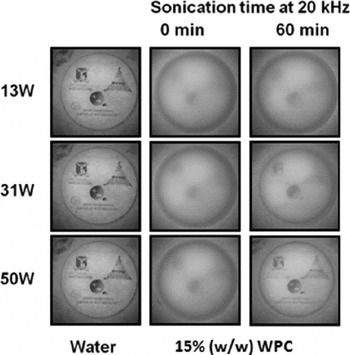
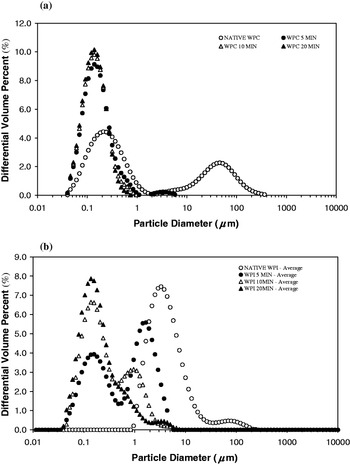
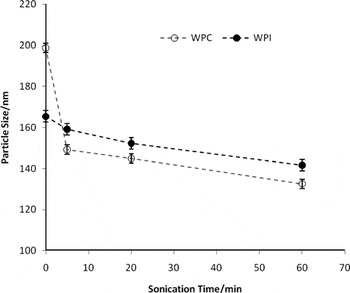
Sonication of reconstituted 15% (w/w) WPC solutions at 20 kHz resulted in reduced turbidity with an increase in both sonication time and power. Figure 1 shows turbidity of 15% reconstituted WPC solutions sonicated for 60 min at 13, 31 and 50 W. The turbidity was unchanged when higher frequencies were used (data not shown). The decrease in turbidity is due to a decrease in the aggregate size as supported by particle size analysis data. As shown in Fig. 2a, unsonicated WPC samples show a relatively large peak in the 10–100 μm range (comprising mainly of large insoluble powder aggregates) which is reduced upon sonication to <1μm. Insoluble powder aggregates form during the WPC manufacturing process usually triggered by thermal processing of whey that may include pasteurisation and evaporation. Particle size analysis below 1μm (Fig. 3) showed the mean particle size in this range was 200 nm for unsonicated samples but reduced to ∼125 nm when sonicated at 20 kHz and 31 W calorimetric power for 60 min. However, these sizes are still well above that of the individual whey proteins (∼e.g., β-lg, the main whey protein is ∼4–5 nm at pH 3, 6 and 7 and ∼200 nm at pH 4 (Harnsilawat et al. Reference Harnsilawat, Pongsawatmanit and McClements2006), indicating that some aggregation still persisted after sonication.
The clarity of 15% (w/w) reconstituted WPC solutions sonicated at 20 kHz at a range of calorimetric power levels (Note: Turbidity measurements presented are representative of a single measurement. The experiment was repeated to confirm the observed trends.).

Laser diffraction particle size distribution of reconstituted 5% (w/w) (a) WPC & (b) WPI solutions sonicated at 20 kHz and a calorimetric power of 31 W for 1–20 min (n=3).

Light scattering particle size distribution of reconstituted 5% (w/w) WPC and WPI solutions sonicated for different time periods at 20 kHz and a calorimetric power of 31 W (n=3).

Conversely, unsonicated WPI samples showed much fewer large aggregates (>25 μm) with the largest aggregates in the 1–25 μm range; these aggregates gradually reduced in size upon sonication to <1μm (Fig. 2b). WPI powders are manufactured via a different and often unique process from WPC involving selective protein separation and minimal heat treatment. The combination of selective separation and mild processing conditions results in powders with different compositional characteristics in comparison to WPC and WPI has fewer insoluble components. Due to the smaller particles, reconstituted WPI solutions were relatively clear even without sonication (images not shown). The mean particle size of unsonicated WPI samples below 1 μm (Fig. 3) was also initially lower than for WPC (170 nm) and sonication had less impact; reducing these smaller aggregates to an average size of 145 nm upon sonication for 60 min.
Similar reductions in aggregate size for whey proteins and caseins have been reported by Onwulata et al. (Reference Onwulata, Konstance and Tomasula2002). An improvement in solubility of reconstituted WPC (Kresic et al. Reference Kresic, Lelas, Jambrak, Herceg and Brncic2008) and WPI (Jambrak et al. Reference Jambrak, Mason, Lelas, Herceg and Herceg2008) solutions following sonication at 20 kHz has also been reported. The reduction in particle size is possibly related to the observed solubility improvements. A technique such as sonication capable of improving the solubility of powders can reduce hydration time and has potential application across the food industry. In addition, by targeting particle size the technique may potentially be used in the manufacturing process of powders themselves.
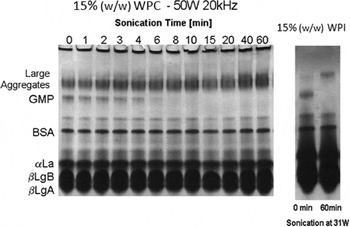
The Native PAGE profile of reconstituted WPC and WPI solutions (Fig. 4) sonicated at 20 kHz similarly showed an increase in bands corresponding to large aggregates of whey proteins. It is presumed that these aggregates were produced by the breaking-up of even larger aggregates (from material that was trapped at the top of the stacking gel, within the stacking gel and at the interface between stacking and resolving gels) due to sonication. Another band corresponding to glycomacropeptide (GMP) disappeared with an increase in sonication time. The disappearance of the GMP band was accompanied by an increase in density of a number of small bands below the BSA band. There was no significant change in the band corresponding to BSA similar to results reported by Gulseren et al. (2007).
Native PAGE profile of reconstituted 15% (w/w) WPC and WPI solutions sonicated at 20 kHz for various periods of time.

Unlike Native PAGE, SDS PAGE did not show changes regardless of the sonication treatment applied (data not shown). This observation confirms that the molecular weights of the proteins were not reduced by sonication. Similarly, reversed phase HPLC analysis after treatment with urea was unable to detect any changes to the underlying protein composition upon sonication for either WPI or WPC. Results thus far suggest that sonication of whey protein solutions at a frequency of 20 kHz cause predominantly physical modifications at a macro level and the native proteins themselves remains unchanged.
Effects of sonication on heat induced gels
It is widely known that heating of whey protein solutions causes a reversible dissociation of native β-lg dimers into monomers followed by unfolding of the helical structure and modifications to the intra-molecular hydrophobic interactions to inter-molecular hydrophobic interactions, as well as changes in disulphide bonds; which all lead to increased aggregation and subsequent gelation (Creamer et al. Reference Creamer, Bienvenue, Nilsson, Paulsson, Van Wanroij, Lowe, Anema, Boland and Jimenez-Flores2004).
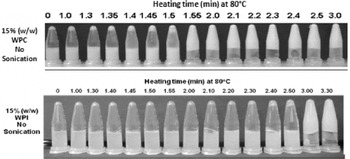
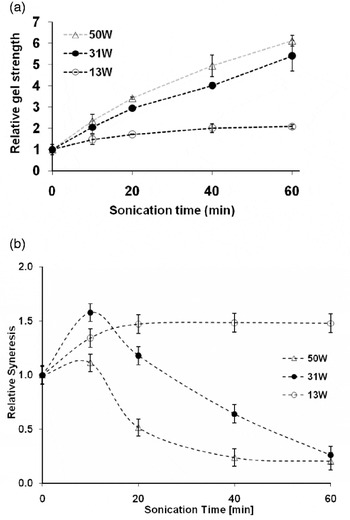
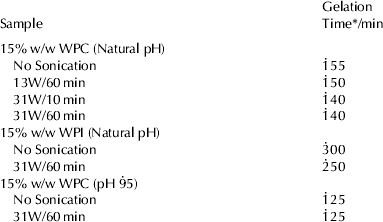
Figure 5 shows an illustration of the gelling behaviour of unsonicated WPC and WPI solutions. Under all conditions, the sonication of WPC solutions reduced the time required to form a gel. For example, unsonicated 5% (w/w) WPC samples containing a small amount of protein did not gel when heated at 80°C for 20 min but readily formed a gel when sonicated prior to heating for 60 min at 20 kHz and 31 W (data not shown). Similarly, sonication led to a decrease in the gelling time for reconstituted 15% (w/w) WPC solutions containing a greater amount of protein (Table 1). The gel strengths of these solutions similarly all increased with increasing sonication time (Fig. 6a). We have also recently reported similar results for fresh whey solutions (Zisu et al. Reference Zisu, Bhaskaracharya, Kentish and Ashokkumar2010). The gel syneresis increased gradually with sonication time at a lower calorimetric power of 13 W (Fig. 6b). However, samples sonicated at 31 W showed an initial increase in syneresis which then decreased to less than that of the unsonicated samples. Based on previous results the enhanced gelling properties of reconstituted WPC solutions are believed to be associated with improved solubility rather than direct manipulation of disulphide interactions.
Gelation of reconstituted 15% (w/w) WPC and WPI solutions heated at 80°C.

(a) Relative gel strength and (b) syneresis of reconstituted 15% (w/w) WPC solutions sonicated at 20 kHz and variable calorimetric power. Gel strength and syneresis for unsonicated sample were 12·30±2·74 g and 12·97±0·11% respectively (n=3).

Gelation times of reconstituted 15% w/w WPC & WPI solutions at natural pH and at pH 9·5 heated at 80°C as affected by sonication at 20 kHz and varying calorimetric power levels

* Gelation time is representative of a single measurement. The experiment was repeated to confirm the observed trends.
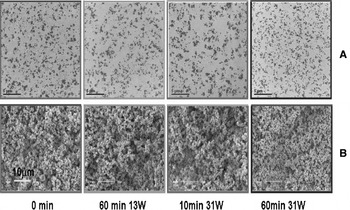
Figure 7 shows the TEM and SEM images of reconstituted 15% (w/w) WPC solutions which were sonicated and then gelled at 80°C for 20 min. The electron micrographs for samples sonicated for 60 min at 13 W and for 10 min at 31 W show relatively large void spaces between the heat induced whey protein aggregate network. More extended sonication (60 min at 31 W) result in a denser, more compact network. The TEM images also show a greater number of small protein aggregates that are homogeneously distributed. This compact gel network resulted in a firmer gel with enhanced water holding properties, consistent with the gel syneresis results presented in Fig. 6b.
Reconstituted 15% (w/w) WPC solutions gelled at 80°C for 20 min observed under TEM (A) and SEM (B).

Conversely, sonication of similar 15% (w/w) solutions of WPI caused no significant change in either gel strength or gel time. The unsonicated WPI gels were significantly stronger than the WPC gels (160 versus 12 g) and so sonication may not have been able to have as much of an impact. The results may reflect the WPI solutions initially containing fewer large aggregates (>25 μm) supporting the physical effect and solubility theory or may reflect the different composition of these powders.
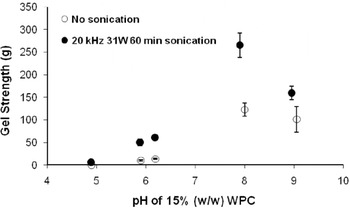
It is well known that the strength of whey protein gels induced by heat is affected by pH. Whey proteins have an isoelectric point (pI) at approximately pH 5. At pH greater than the pI fine stranded gels are formed and consequently the optimum pH for gel formation occurs in the pH 7–8 region (Fennema, Reference Fennema1996; Dickinson, Reference Dickinson2005). At pH values >6·9, the disulphide bonds of β-lg are reduced upon heating which facilitates aggregate formation (Singh, Reference Singh2004). This is reflected in Fig. 8, which shows the gel strength of a 15% (w/w) WPC solution peaking at pH 8. At pH around the pI, a particulate protein network is expected to form (Dickinson Reference Dickinson2005) and consequently these gels were weak (Fig. 8). However, sonication prior to heating at any pH value is effective in further increasing gel strength. This implies that sonication is causing changes in addition to the disulphide bond disruption that act to enhance these pH effects. Conversely, while sonication at the natural pH reduced the gelling time (Table 1), sonication at pH 9·5 did not alter the gelation time (Table 1).
Gel strength of reconstituted 15% (w/w) WPC solutions at different pH values. Solutions were sonicated prior to heating at 80°C for 20 min (n⩾2).

Conclusion
Ultrasound treatment was instrumental in reducing the particle size of insoluble aggregates in reconstituted WPC solutions. The changes observed were mainly due to physical shear forces that were generated at 20 kHz and these led to reduced turbidity and improved gelling capacity. Heat-set gels formed from WPC solutions that had been sonicated at 20 kHz showed higher gel strengths, reduced syneresis and differences in gel microstructure, compared with gels made from non-sonicated WPC. Conversely, WPI solutions were relatively unaffected by sonication, possibly reflecting the absence of larger aggregates in the initial solution, or differences in composition. Adjustment of pH prior to ultrasound treatment did not result in significant differences compared with samples that were sonicated at neutral pH. This suggests that the mechanism for gel promotion is different from effects induced by pH changes.
This work was supported by Dairy Innovation Australia and Australian Research Council.