The aims of the study presented in this article are twofold: to examine second language (L2) acquisition of Chinese wh-topicalization by English speakers and to unveil properties of the L2 Chinese syntax-discourse interface underlying L2 Chinese wh-topicalization. In both linguistic research and L2 studies, Mandarin Chinese (hereafter, Chinese) has been widely considered a wh–in situ language in which the wh-word remains in its original position in wh-questions, unlike the wh-word in languages like English, which has to move to the left periphery of the wh-question. Recent years have witnessed an increasing number of studies of L2 acquisition of wh–in situ languages by speakers of wh-movement languages (see Kim, Reference Kim, Beachley, Brown and Conlin2003; Yuan, Reference Yuan2007a, Reference Yuan2007b). However, wh-topicalization in wh–in situ languages seems to have received little attention in L2 research. This study is intended to fill in the gap.
Although the wh-word generally stays in situ in Chinese wh-questions, as in (1a),Footnote 1 it can be topicalized, moving from the base-generated position to the sentence initial position, as in (1b).
(1) a. Ni zai chi shenme cai?
you prog eat what dish
“What dish(es) are you eating?”
b. [Shenme cai]i ni meiyou chi ti?
what dish you didn’t eat
“What dish(es) did you not eat?”
The movement of shenme cai “what dish” in (1b) has been analyzed as an instance of wh-topicalization, with the wh-phrase base generated as an object of the verb chi “eat” and raised to the initial position of the wh-question as a wh-topic (see Li, Reference Li1996; Pan, Reference Pan2006; Tang, Reference Tang1988; Wu, Reference Wu1999; and Xu & Langendoen, Reference Xu and Langendoen1985). The possible syntactic movement of the wh-topic to the initial position is determined at the syntax-discourse interface, and only discourse-linked (D-linked) wh-words can undergo topicalization.Footnote 2
The relative difficulty of acquiring interface properties has very much been at the center of debate in recent L2 research. In their interface hypothesis, Sorace and Filiaci (Reference Sorace and Filiaci2006) propose that narrow syntactic properties in L2 acquisition are completely acquirable, but grammatical aspects that involve an interface between the syntactic domain and other cognitive domains may not be fully acquirable in L2 acquisition. However, it has been argued that not all interfaces between syntax and other cognitive domains are problematic and that a distinction should be made between internal interfaces and external interfaces (Belletti, Bennati, & Sorace, Reference Belletti, Bennati and Sorace2007; Sorace, Reference Sorace, Cornips and Corrigan2005, Reference Sorace2009; Sorace & Serratrice, Reference Sorace and Serratrice2009; Tsimpli & Sorace, Reference Tsimpli, Sorace, Bamman, Magnitskaia and Zaller2006; and White, Reference White, Ritchie and Bhatia2009). Yuan (Reference Yuan2010) questions the holistic ways of L2 interface studies and proposes a variable-dependent approach, arguing that the success or failure in acquiring an interface in L2 may not necessarily be across the whole interface and that it may depend on different variables involved. Given that Chinese wh-topicalization involves the syntax-discourse interface, it is the aim of the present study of L2 acquisition of Chinese wh-topicalization to make valuable contributions to the understanding of L2 grammars in general and to the understanding of L2 interfaces in particular.
WH-TOPICALIZATION IN CHINESE QUESTIONS
It is clear from the two Chinese wh-questions in (1) that the movement of shenme cai “what dish” in (1b) cannot be motivated by checking the wh-feature because the wh-phrase can stay in situ in Chinese, as in (1a). What then triggers the movement of the wh-phrase in (1b), and where does it move to? Wu (Reference Wu1999) makes an important distinction between wh-topicalization questions and wh–in situ questions. For wh-topicalization questions to be felicitous, the interlocutors in the discourse must “have a set of things in the presupposition background,” whereas in wh–in situ questions, “no particular set of things . . . is presupposed” (p. 83). The answer to the question in (1a) is not constrained by a particular set of dishes, and in fact, anything that can be called a cai “dish” can be used to answer the question in (1a). The answer to the question in (1b), however, is restricted to a set of dishes that has already been established in the previous discourse. For instance, if 10 people attended a dinner party—and everyone got food poisoning afterward except for Zhangsan—to find out what dish(es) caused the food poisoning, an investigator asked Zhangsan the question in (1b) with a preestablished knowledge of the set of dishes that was provided at the dinner party. Zhangsan was then naturally expected to answer the question by naming a dish or dishes only from the dishes provided at the dinner party. This makes it possible for the wh-phrase shenme cai “what dish” to be topicalized in (1b).
The examples in (2)–(4) demonstrate that only D-linked wh-words can undergo wh-topicalization and that non-D-linked wh-words cannot.
(2) a. Ni xihuan shei?
you like who
“Who do you like?”
b. *[Shei]i ni xihuan ti?
who you like
“Who do you like?”
(3) a. Ni xihuan na yi ge ren?
you like which one cl person
“Which person do you like?”
b. [Na yi ge ren]i ni xihuan ti?
which one cl person you like
“Which person do you like?”
(4) a. Ni zui xihuan shei?
you most like who
“Who do you like most?”
b. [Shei]i ni zui xihuan ti?
who you most like
“Who do you like most?”
As shei “who” in (2) is a non-D-linked wh-word, it can only stay in situ, as in (2a), and it is not felicitous if it is topicalized in Chinese wh-questions, as in (2b). In (3), the wh-phrase is D-linked, which consists of na “which” and a nominal phrase yi ge ren “one person.” In this case, both the speaker and the listener have a shared group of people in mind, and the person who answers the question is expected to choose one person from this group. This makes wh-topicalization possible in (3b). The sentences in (4) are identical to those in (2), except for the insertion of zui “most.” Here it is possible to assume that the word zui “most” creates a presupposed group of people in (4) and converts the wh-word shei “who” in (4) to a D-linked wh-word and thus enables its topicalization in (4b).
It is also possible to make a distinction between wh-elements like na “which”–noun phrase (NP) and wh-elements like shei “who”; na-NP can be considered a wh-determiner phrase (DP) and shei a wh-NP. In na-NP, the wh-word is a determiner and selects a NP as its complement, as na yi ge ren “which person” in (3),Footnote 3 whereas with shei, the wh-word is the head of the wh-NP, as in (2) and (4).Footnote 4 The head of the DP is typically considered to be the locus of references and is believed to host expressions related to references. Following this line of analysis, it is possible to assume that the wh-determiner has a [+/−] deictic feature attached to it, which can link the wh-DP to the relevant discourse information and cause the wh-DP to be D-linked. This makes wh-topicalization possible in Chinese. In contrast, the wh-NP shei “who” has no deictic feature attached to it and has to rely on an element like zui “most” to be related to the discourse, as shown in (2) and (4). The adverb zui “most” is an adjunct, and it adjoins to the verb phrase (VP) in (4b) and c-commands the wh-NP shei “who” in object position. Here, it is zui “most” that licenses the wh-NP as a D-linked wh-element. This creates a presupposition background in the discourse and enables the wh-NP to topicalize.
Wu (Reference Wu1999) makes a clear distinction between wh-movement in English and wh-topicalization in Chinese. In English, the wh-word raises to the specifier (Spec) of the complementizer phrase (CP) to check the wh-feature,Footnote 5 whereas in Chinese, the wh-word raises to the Spec of the topic phrase (TopP) to check the topic feature, as shown in (5) for (4b). According to Wu, the topic feature in Chinese is strong and must be checked before spell-out.
(5) [TopPSheii [IPni [VPzui [VPxihuan ti]]]]?
who you most like
“Who do you like most?”
The distinction between D-linked wh-words and non-D-linked wh-words has been recognized since Pesetsky (Reference Pesetsky, Reuland and ter Meulen1987). In English, for example, the D-linked wh-word which is not subject to the superiority condition, as in (6).Footnote 6 The behavior of which is in striking contrast to that of what and who in (7), both of which Pesetsky considers to be non-D-linked wh-words. The superiority effect is also absent in Chinese D-linked wh-words, as shown in (8b), which is perfectly acceptable in Chinese in spite of the fact that the lower wh-phrase shenme shu “what book” raises over the higher wh-word shei “who” to the left periphery of the multiple wh-question. In (8), there is a presupposed set of books, and the answer must be from this set. The absence of the superiority effect should not be surprising if the movement in sentences like (8b) is considered an instance of wh-topicalization rather than wh-movement.
(6) a. [Which singer]i ti sang which song?
b. [Which song]i did which singer sing ti?
(7) a. [Who]i ti sang what song?
b. *[What song]i did who sing ti ?
(8) a. Shei zui xihuan shenme shu?
who most like what book
“Who likes what book most?”
b. [Shenme shu]i shei zui xihuan ti?
what book who most like
*“What book does who like most?”
Following Wu’s (Reference Wu1999) assumption that the economy condition (Chomsky, Reference Chomsky1995) only applies to wh-feature checking in wh-movement but not to wh-topicalization, economy considerations will rule out any derivation like (7b) in which the lower wh-phrase what song raises over the higher one who, given that the alternative derivation in (7a) in which the higher wh-word who raises is more economical. Unlike wh-movement, wh-topicalization involves checking the topic feature, which is assumed not to be inherently attached to a wh-word. As a result, it is legitimate to raise either the higher or the lower wh-word to serve as a topic; thus the absence of the superiority effect in wh-topicalization.
It is clear from the examples in (3), (4), and (8) that D-linking is a necessary condition but not a sufficient condition for wh-topicalization in Chinese because D-linked wh-words are allowed to stay in situ, as in (3a), (4a), and (8a). What then triggers wh-topicalization in Chinese? Pan (Reference Pan2006) argues that D-linked wh-words bear an underspecified [+/− topic] feature and that two requirements are involved in wh-topicalization: (a) a [+topic] feature and (b) a D-linked wh-word that is linked to a set of things or a group of people in the presupposition background. It seems feasible to assume that when the head of TopP has a [+topic] feature, it can trigger wh-topicalization, attracting a D-linked wh-word to Spec TopP to get its value and specification as a wh-topic with a [+topic] feature. However, the wh-topicalization triggered by the [+topic] feature at the head of TopP is subject to a condition under which the wh-word must have a D-linked reading to be topicalized, and the wh-topicalization must be licensed by a presupposed set of things or a presupposed group of people. In other words, both the [+topic] feature and the relevant discourse condition are indispensable for wh-topicalization in Chinese, and neither of them can trigger the wh-topicalization by itself. In English, the wh-word which is inherently D-linked lexically, whereas the other wh-words are not. However, Chinese wh-words are underspecified with regard to the D-linked reading and become D-linked when they are licensed by a relevant discourse—for example, by a set of things or a group of people in the presupposed background, as in (1b) and (3); by words like zui “most,” as in (4), (5), and (8); or by both. This analysis is in conformity with the proposal that Chinese is a discourse-oriented language (see Huang, Reference Huang1984, Reference Huang, Jaegglie and Safir1989; Shi, Reference Shi1989; Tsao, Reference Tsao1977). A D-linked wh-word with a [−topic] feature stays in situ in Chinese wh-questions, as in (3a) and (4a). As discourse lies outside the linguistic computation, the syntax-discourse interface involved in Chinese wh-topicalization is considered an external interface in the sense of Belletti and colleagues (2007), Sorace (Reference Sorace, Cornips and Corrigan2005, Reference Sorace2009), Sorace and Serratrice (Reference Sorace and Serratrice2009), Tsimpli and Sorace (Reference Tsimpli, Sorace, Bamman, Magnitskaia and Zaller2006), and White (Reference White, Ritchie and Bhatia2009). This interpretation of topicalized wh-words is also in conformity with the widely accepted definition of topics proposed by Li and Thompson (Reference Li, Thompson and Li1976, Reference Li and Thompson1981); that is, topics are generally definite and provide old, shared, and preestablished information. A wh-word becomes definite when it is D-linked because it is what both the speaker and the listener have in their presupposition.
In sum, wh-words can be topicalized to Spec TopP in Chinese, but the wh-topicalization takes place at the syntax-discourse interface. This syntactic movement has to be licensed by reference to a set of things or a group of people in the presupposition background; that is, only D-linked wh-words can be topicalized, and non-D-linked wh-words cannot. Unlike the wh-word which in English, which is inherently D-linked lexically, Chinese wh-words become D-linked when they get licensed by a set of things or a group of people in the presupposition background, by words like zui “most,” or by both.
L2 INTERFACE STUDIES
Why are adult L2 learners rarely able to acquire native competence of the target language? What are the possible causes of the divergence between L2 grammars and the native grammar? To find answers to these questions, an increasing number of L2 researchers have investigated interfaces in L2 grammars as a possible cause of the divergence. Sorace and Filiaci (Reference Sorace and Filiaci2006) studied the interpretation of Italian intrasentential anaphora by native Italian speakers and English near-native speakers of Italian. Results showed that the English near-native speakers of Italian had nativelike interpretations of Italian null subject pronouns in both forward and backward anaphora conditions. However, with respect to overt subject pronouns, the near-native speakers were found to be divergent from the native Italian speakers, particularly in the interpretation of overt subject pronouns in the backward anaphora condition. On the basis of this finding, Sorace and Filiaci propose the interface hypothesis, according to which narrow syntactic properties in L2 acquisition are completely acquirable, but aspects of grammar that involve an interface between the syntactic domain and other cognitive domains may not be. This is believed to be due to the fact that L2 grammars have insufficient processing resources at their disposal to integrate the multiple types of information involved at the interfaces between syntax and other cognitive systems, and that these insufficient processing resources make it difficult for L2 grammars to coordinate the L2 syntax domain with other cognitive domains.
Evidence in support of the interface hypothesis has been found in a number of studies in the L2 literature. These include Hopp’s (Reference Hopp, Foster-Cohen, Sharwood-Smith, Sorace and Ota2004) study of the syntax-discourse interface in the acquisition of German scrambling by English and Japanese speakers and Sorace’s (Reference Sorace2004, Reference Sorace, Cornips and Corrigan2005, Reference Sorace, Belletti, Bennati, Chesi, Di Domenico and Ferrari2006) investigations of pragmatic-discourse factors in near-native speakers’ L2 Italian use of null and overt subjects. However, there is also evidence in the L2 literature showing that targetlike grammars are attainable in L2 interfaces and that vulnerability in L2 interfaces is not inevitable. For example, Dekydtspotter, Sprouse, and Thyre’s (1999/Reference Dekydtspotter, Sprouse and Thyre2000) study showed that English-speaking learners of French and native French speakers exhibited similar knowledge of the syntax-semantics interface involving the interpretations of French quantification at a distance. Similar results were also obtained in studies by Borgonovo, Bruhn de Garavito, and Prévost (Reference Borgonovo, Bruhn de Garavito, Prévost, Burgos, Clark-Cotton and Ha2005) and by Borgonovo, Bruhn de Garavito, Guijarro-Fuentes, Prévost, and Valenzuela (Reference Borgonovo, Bruhn de Garavito, Guijarro-Fuentes, Prévost, Valenzuela, Foster-Cohen and Krajnovic2006). In Borgonovo et al. (Reference Borgonovo, Bruhn de Garavito, Prévost, Burgos, Clark-Cotton and Ha2005), English-speaking learners were found to be able to acquire the syntax-semantics interface involved in the choice of mood in relation to the specificity of the DP head in Spanish relative clauses, whereas Borgonovo et al. (Reference Borgonovo, Bruhn de Garavito, Guijarro-Fuentes, Prévost, Valenzuela, Foster-Cohen and Krajnovic2006) showed that Brazilian-Portuguese speakers were able to acquire the syntax-semantics interface regarding the specificity restrictions on null objects in their L2 Spanish.
A more fine-tuned approach to L2 interfaces has been proposed and argues that not all interfaces between syntax and other cognitive domains are problematic (Belletti et al., Reference Belletti, Bennati and Sorace2007; Sorace, Reference Sorace, Cornips and Corrigan2005, Reference Sorace, Belletti, Bennati, Chesi, Di Domenico and Ferrari2006, Reference Sorace2009; Sorace & Serratrice, Reference Sorace and Serratrice2009; Tsimpli & Sorace, Reference Tsimpli, Sorace, Bamman, Magnitskaia and Zaller2006; White, Reference White, Ritchie and Bhatia2009). A distinction should therefore be made between internal interfaces and external interfaces, in which internal interfaces include syntax-morphology, syntax-lexicon, and syntax-semantics, and external interfaces include syntax-discourse and syntax-pragmatics. According to these researchers, internal interfaces involve different modules internal to the grammar. Because the operations are within the linguistic computation, internal interfaces are relatively easier for L2 learners to acquire. However, external interfaces (e.g., syntax-discourse and syntax-pragmatics interfaces) involve external conditions of contextual appropriateness, which are outside the grammar proper and therefore impose extra burdens on the processing of information from different resources.
The distinction between internal interfaces and external interfaces is useful in accounting for the findings in the L2 interface studies reviewed previously. Syntax-semantics interfaces, being internal in the linguistic computation and involving formal properties of the language system alone, are acquirable, whereas syntax-discourse or syntax-pragmatics interfaces are particularly problematic in L2 grammars because they involve external conditions and are likely to lead to interface vulnerability. This distinction is also supported by the results in Tsimpli and Sorace’s (Reference Tsimpli, Sorace, Bamman, Magnitskaia and Zaller2006) study of Russian learners of Greek. In the study, Russian learners were found to be able to acquire the syntax-semantics interface involved in focusing and verb raising in their L2 Greek. In contrast, the vulnerability of the syntax-discourse interface was found in Russian learners’ overuse of Greek overt subject pronouns, whose distribution was regulated by discourse factors.
However, the contrast between the relatively less problematic acquisition of internal interfaces and the vulnerability of external interfaces in L2 is not consistently supported by data of all relevant studies. Lozano and Mendikoetxea (Reference Lozano, Mendikoetxea, Chandlee, Franchini, Lord and Gudrun-Marion2009) examined verb-subject (VS) structures using experimental data from English and Greek speakers’ L2 Spanish and corpus data from Spanish and Italian speakers’ L2 English. Their results indicated that both groups of learners were sensitive to discourse status (i.e., focus) in their L2s, but they had problems encoding the discourse information syntactically. This raises the possibility that vulnerability of L2 syntax-discourse interfaces can be related to a deficit in underlying representations of L2 grammars. Evidence in support of this argument is also provided in a study of Belletti and Leonini (Reference Belletti, Leonini, Foster-Cohen, Sharwood-Smith, Sorace and Ota2004), in which L2 learners of Italian were shown to have problems with the VS word order related to focus. There was, however, clear evidence that they were sensitive to the pragmatic focus of the construction because they were found to use stress—transferred from their first language (L1)—on the focused element in their L2 Italian. Belletti and Leonini attributed this problem to defective representations of a functional category (i.e., the focus projection) in L2 Italian grammars.
It should be pointed out that the studies of L2 interfaces reviewed previously have mostly dealt with L2 interface issues in holistic terms. In other words, researchers tend to treat the L2 syntax-semantics interface, the L2 syntax-discourse interface, or L2 interfaces in general in a domain-wide fashion. This is questioned by Yuan (Reference Yuan2010), who proposed a variable-dependent approach to L2 interfaces, arguing that success or failure in acquiring a particular interface in L2 may not necessarily be across the whole interface domain and is likely to be affected by different variables involved. Yuan’s argument was based on a study of the syntax-semantics interface involved in English speakers’ acquisition of Chinese wh-words used as existential polarity words (EPWs). Chinese wh-words are ambiguous and can be interpreted as EPWs as well as interrogative words.Footnote 7 When used as EPWs, Chinese wh-words are subject to strict syntactic and semantic conditions. Semantically, an EPW must fall within a context in which the proposition containing the EPW is a nonfact or in which the truth value of the proposition is not positively fixed in a definite manner. Syntactically, an EPW must occur in the c-commanding scope of its licenser. The licensers for wh-words used as EPWs in Chinese include negators, the yes-no particle ma, words such as ruguo “if” in conditional clauses, uncertainty adverbs, the sentence final particle le indicating inference, nonfactive verbs, and so forth. The results of Yuan’s study indicated that the syntax-semantics interface could be established between EPWs and some of their licensers but not the others, which provides evidence of a nondomain-wide success or failure in L2 acquisition of interfaces. On the basis of a variable-dependent approach, Yuan argued that English speakers’ L2 acquisition of the syntax-semantics interface involved in Chinese wh-words used as EPWs is affected by a number of variables, including the categorical natures of individual elements involved in the interface relationship, the status of these elements in the target language speakers’ grammar, the input that L2 learners are exposed to, crosslinguistic influences, and so forth.
However, Yuan’s (Reference Yuan2010) study only involved an internal interface (i.e., the syntax-semantics interface), which is considered to be relatively less problematic in the L2 acquisition of interfaces. Can Yuan’s variable-dependent approach apply to L2 acquisition of external interfaces like the syntax-discourse interface, which is deemed to be vulnerable in L2 grammars (see Belletti et al., Reference Belletti, Bennati and Sorace2007; Sorace, Reference Sorace, Cornips and Corrigan2005, Reference Sorace2009; Sorace & Serratrice, Reference Sorace and Serratrice2009; Tsimpli & Sorace, Reference Tsimpli, Sorace, Bamman, Magnitskaia and Zaller2006; White, Reference White, Ritchie and Bhatia2009)? This study is expected to provide an answer as it focuses on the syntax-discourse interface involved in English speakers’ L2 acquisition of Chinese wh-topicalization.
THE EMPIRICAL STUDY
Research Questions
The empirical study was guided by six principal research questions:
1. Can English-speaking learners of L2 Chinese establish a [+topic] feature at the head of TopP, which can trigger wh-topicalization and attract a D-linked wh-word to Spec TopP to get it valued and specified as a wh-topic with a [+topic] feature?
2. Are learners able to make a distinction in their L2 Chinese grammars between D-linked wh-words and non-D-linked wh-words by allowing only the D-linked, but not the non-D-linked, wh-words to be topicalized?
3. In English, only the wh-word which is D-linked, but the other wh-words are not, whereas in Chinese all wh-words can be D-linked when they are licensed by a set of things or a group of people in the presupposition background, by words like zui “most,” or by both. Is there any crosslinguistic influence in English speakers’ L2 Chinese grammars so that na-NP, which is the equivalent of which-NP in English, is more readily topicalized than other wh-words in English speakers’ L2 Chinese?
4. Does the word zui “most” have a reinforcing power to make a wh-word more likely to be topicalized when the wh-word is D-linked?
5. Is the wh-topicalization affected by the distinction between wh-DPs and wh-NPs in English speakers’ L2 Chinese grammars?
6. If English speakers are successful in establishing the syntax-discourse interface involved in the Chinese wh-topicalization, will the success be across the domain of the syntax-discourse interface? Is it possible that the syntax-discourse interface is established in certain aspects but not in others? If this occurs, what variables are involved that lead to partial success or partial failure in the syntax-discourse interface in L2 Chinese wh-topicalization?
Participants
To answer these questions, an empirical study was conducted involving 71 English-speaking learners of Chinese and a control group of 20 native speakers of Chinese. The English-speaking learners included students studying Chinese at universities in Beijing as well as students and lecturers of Chinese studies at some British universities. The lecturers were teaching Chinese or Chinese-related courses. A purpose-designed cloze test, which consisted of three passages written in both Chinese characters and pinyin (i.e., a Chinese phonetic writing system), was used as a proficiency test. The total score of the proficiency test was 40.
To examine wh-topicalization in L2 Chinese, it is a prerequisite to ensure that general topicalization has been established in the L2 Chinese grammars of the participants involved in the experiment. To do this, a stringent criterion was adopted to select participants who were considered to have acquired topicalization in Chinese. There were four types of NP-topicalization control sentences in categories I–IV, each of which contained three tokens (see Appendix). In total, there were 12 NP-topicalization sentences in the experiment. Only those learner participants who accepted at least 11 out of the 12 NP-topicalization sentences were included in this study; that is, 92% of their judgments of the sentences with the NP-topicalization had to be +1 or higher on the Likert scale provided.
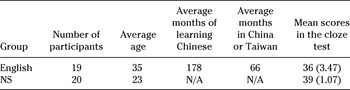
On the basis of this criterion, 19 English speakers were selected for the study who had mastered topicalization in Chinese. Those who did not meet the criterion were eliminated from the analyses of L2 Chinese wh-topicalization. Detailed information on the English group (English) and the native Chinese group (NS) is provided in Table 1.
Information on participants who mastered topicalization in Chinese

Note.
Values enclosed in parentheses represent standard deviations.
The result of a two-sample Kolmogorov-Smirnov test indicates that there was no significant difference between the two groups in their performance in the cloze test (Z = 1.314, p = .063). Given (a) the lack of a significant difference between the English group and the NS group in the cloze test, (b) the fact that the English group’s average length of learning Chinese was 178 months (i.e., nearly 15 years), and (c) the fact that their average stay in China or Taiwan was 66 months (i.e., 5.5 years), the English group is considered a possible representative of English speakers’ end states of L2 Chinese grammars.
Procedures
Each participant had to do an acceptability judgment test, which followed the cloze test. The acceptability judgment test included 45 types of sentences, of which 19 types were related to the investigation of wh-topicalization in L2 Chinese and the rest were either sentences relevant to studies of other L2 Chinese aspects or distracters. Each type had three tokens, and in total 57 test sentences were used for the study of L2 Chinese wh-topicalization. These 57 sentences were put into five categories (see Appendix for sample sentences of all the sentence types used for the investigation of L2 Chinese wh-topicalization). The test sentences were presented in Chinese characters. To minimize any possible effect of vocabulary on the participants’ judgment, efforts were made to include only basic words of daily life, and additionally, English translations of some words—potentially unfamiliar to L2 Chinese learners—were provided. Instructions for the tasks in the experiment were given in the participants’ native languages—that is, English and Chinese, respectively. Examples were given before the acceptability judgment test to demonstrate what the participants were expected to do.
In categories I–IV, the wh-topicalization in all the experimental sentences is licensed by a set of things or a group of people in the presupposition background—that is, a group of girls in category I, a set of films in category II, a group of people who write novels in category III, and a group of girls mentioned in the context in category IV. There is no such presupposition, however, involved in wh-questions in category V. As a result, the wh-arguments are not D-linked and cannot be topicalized. Each category had experimental sentences and control sentences in which the vocabulary was kept the same. All the experimental sentences had a wh-argument that was topicalized, but all the in situ control sentences had the wh-argument in situ. The difference between the experimental sentences in the same category was whether the word zui “most” was used to reinforce the D-linking of the wh-argument; the difference between control sentences was that the in situ control sentence had a wh-argument in situ, whereas the NP-topicalization control sentence had a NP-argument that was topicalized.
Participants were asked to judge the acceptability of each sentence by circling a number on a Likert scale. In the acceptability judgment test, +3 stood for completely acceptable, +2 for likely to be acceptable, +1 for possibly acceptable, 0 for I don’t know, −1 for possibly unacceptable, −2 for likely to be unacceptable, and −3 for completely unacceptable. Any mean score of +1 or above that the participant assigned to a particular type was treated as acceptance for that type of sentence. Conversely, any mean score of −1 or below was treated as a rejection. Mean scores around 0 were treated as signs that participants were not sure.
Results
The results presented in this section are based on the judgment data of wh-questions by the English and NS groups. The judgment data of sentences with a topicalized NP (i.e., the NP-topicalization control sentences) are not included because participants in the English group have all met the stringent criterion for Chinese topicalization and are therefore considered to have established Chinese topicalization in their L2 Chinese grammars. In Figure 1, it is possible to see that—like the NS group—the English group accepted wh-questions with a topicalized D-linked na-NP “which-NP.” The same was found in wh-questions with a topicalized D-linked na-NP when it was reinforced by zui “most.” The results of Kolmogorov-Smirnov tests show that there was no significant difference between the two groups in their judgments of either type of sentences. For wh-questions with a D-linked topicalized na-NP, Z = 1.002, p = .268; for wh-questions with a D-linked topicalized na-NP + zui, Z = 1.183, p = .122. In regard to judgments of wh-questions when na-NP was left in situ, the result of a Kolmogorov-Smirnov test indicates that no significant difference existed between the two groups, Z = 0.304, p = 1.000.
Mean scores of groups’ judgments of Chinese wh-questions with D-linked which-NP topicalized, with most and which-NP topicalized, and with which-NP in situ (see examples in Appendix, section I).

These results suggest that a D-linked which-NP is allowed to be topicalized in English speakers’ L2 Chinese grammars as long as the Chinese topicalization is established in their L2 Chinese grammars. However, as the wh-word which is an inherently D-linked word in English, it could be argued that the English group’s nativelike behaviors in judging Chinese wh-questions with na-NP topicalized may be influenced by properties of the wh-word which in their native language. For this reason, it is necessary to look at the behaviors of other wh-words in the English group’s L2 Chinese when they are D-linked and topicalized.
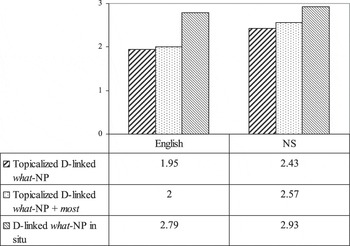
Figure 2 presents the results of the judgments of wh-questions with a topicalized D-linked shenme-NP “what-NP,” wh-questions with a topicalized D-linked shenme-NP reinforced by zui “most,” and wh-questions with a D-linked shenme-NP left in situ. The results of Kolmogorov-Smirnov tests indicate that there was no significant difference between the two groups in their judgments of any of the sentence types. For the wh-questions with a topicalized D-linked shenme-NP, Z = 0.748, p = .631; for the wh-questions with a topicalized D-linked shenme-NP reinforced by zui, Z = 0.863, p = .447; and for the wh-questions with a D-linked shenme-NP in situ, Z = 0.682, p = .741. These results clearly demonstrate that it is possible to topicalize D-linked shenme-NP in English speakers’ L2 Chinese wh-questions in spite of the fact that the English equivalent of shenme-NP is not D-linked in their native language.
Mean scores of the groups’ judgments of Chinese wh-questions with D-linked what-NP topicalized, with most and D-linked what-NP topicalized, and with D-linked what-NP in situ (see examples in Appendix, section II).

Figure 3 presents results concerning another D-linked wh-argument sheide-NP “whose-NP” in Chinese wh-questions. The English group’s judgment was similar to that of the NS group, and the participants in the English group accepted (a) Chinese wh-questions with the D-linked wh-argument topicalized, (b) wh-questions with a D-linked topicalized wh-argument reinforced by zui “most,” and (c) wh-questions with the D-linked wh-argument in situ. The results of Kolmogorov-Smirnov tests show that there was no significant difference between the two groups in their judgments of any of these sentence types. For the wh-questions with a topicalized D-linked sheide-NP, Z = 0.394, p = .998; for the wh-questions with a topicalized D-linked sheide-NP reinforced by zui “most,” Z = 1.060, p = .211; and for the wh-questions with a D-linked sheide-NP in situ, Z = 0.723, p = .673.
Mean scores of the groups’ judgments of Chinese wh-questions with D-linked whose-NP topicalized, with most and D-linked whose-NP topicalized, and with D-linked whose-NP in situ (see examples in Appendix, section III).

The results, however, concerning shei . . . zui “who . . . most” present a different picture, as shown in Figure 4. Although the English group, like the NS group, allowed the D-linked shei “who” to remain in situ in their L2 Chinese wh-questions, unlike the NS group, they did not accept Chinese wh-questions with the D-linked shei topicalized—despite the presence of the word zui “most” in the sentence. The results show that participants in the English group were indeterminate about the acceptability of Chinese wh-questions with the D-linked shei topicalized because their mean score in judging this type of wh-questions was −0.12. The result of an independent-samples t test shows that a significant difference existed between the two groups in their judgments of the wh-questions with topicalized shei . . . zui, t(37) = 5.029, p < .001. However, no significant difference was found in a Kolmogorov-Smirnov test between the two groups in their judgments of wh-questions zui . . . shei “most . . . who” in situ, Z = 0.674, p = .755. The English group’s nonacceptance of the topicalization of the D-linked shei with the presence of zui in the wh-question is rather unexpected, and this provides some evidence that not all D-linked wh-arguments can be topicalized in L2 Chinese wh-questions.
Mean scores of the groups’ judgments of Chinese wh-questions with most and D-linked who topicalized, and with most and who in situ (see examples in Appendix, section IV).

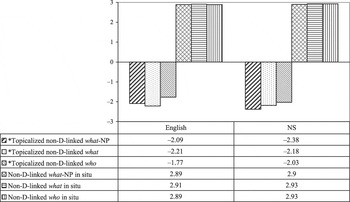
The results presented have all been concerned with D-linked wh-arguments. To examine wh-topicalization in L2 Chinese, it is also necessary to find out whether L2 grammars, at the same time, are able to reject topicalization of non-D-linked wh-arguments in L2 Chinese wh-questions. Figure 5 presents data of this type. The English group, like the NS group, rejected incorrect wh-questions with non-D-linked shenme-NP “what-NP,” shenme “what,” or shei “who” that were topicalized. At the same time, they were nativelike in accepting wh-questions with these non-D-linked wh-arguments in situ. No significant difference was found in independent-samples t tests between the two groups in rejecting wh-questions with a topicalized non-D-linked shenme-NP, t(37) = −1.799, p = .078, and in rejecting incorrect wh-questions with topicalized non-D-linked shenme and shei—for shenme, t(37) = 0.116, p = .909; for shei, t(37) = −0.939, p = .354. Like the NS group, the English group readily accepted wh-questions with non-D-linked wh-arguments in situ, and there was no significant difference in Kolmogorov-Smirnov tests between the two groups in accepting the non-D-linked shenme-NP in situ, Z = 0.164, p = 1.000, and in accepting wh-questions with the non-D-linked shenme and shei in situ—for shenme, Z = 0.164, p = 1.000; for shei, Z = 0.329, p = 1.000.
Mean scores of the groups’ judgments of ungrammatical Chinese wh-questions with non-D-linked what-NP, what, and who topicalized, and grammatical wh-questions with non-D-linked what-NP, what, and who in situ (see examples in Appendix, section V).

Figure 4 shows that the English group did not accept Chinese wh-questions with the D-linked shei “who” topicalized in spite of the presence of the word zui “most” in the sentence. An examination of individual data reveals that of the 19 participants in the English group, only 3 participants were found to be able to consistently accept the correct topicalization of the D-linked shei while—at the same time—also consistently rejecting the incorrect topicalization of the non-D-linked shei in their L2 Chinese wh-questions.Footnote 8 Although this suggests that Chinese wh-questions with the D-linked shei topicalized are not completely unacquirable by English speakers, the fact that only a very small number of very advanced learners managed to do this indicates that this is a vulnerable area in English speakers’ L2 Chinese grammars.
DISCUSSION
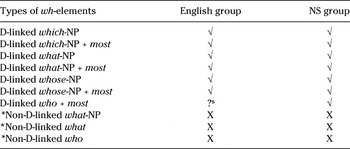
Table 2 provides a summary of the findings in the empirical study of L2 Chinese wh-topicalization. English speakers, in general, are able to topicalize D-linked wh-elements in their L2 Chinese wh-questions, and this provides evidence that English speakers’ L2 Chinese can establish a [+topic] feature at the head of TopP that can trigger wh-topicalization and attract a D-linked wh-word to Spec TopP where it is valued and specified as a wh-topic with a [+topic] feature. Additionally, these data indicate that English speakers are able to reject ungrammatical Chinese wh-questions in which non-D-linked wh-elements are incorrectly topicalized, which is illustrated by the contrast in the English group’s judgment between the D-linked which-NP, what-NP, and whose-NP on the one hand and the non-D-linked what-NP, what, and who on the other. This suggests that English speakers’ L2 Chinese grammars are sensitive to discourse conditions that govern wh-topicalization in Chinese and that their L2 Chinese grammars allow only D-linked—but not non-D-linked—wh-elements to topicalize in their L2 Chinese wh-questions. The findings here do not seem to lend support to Sorace and Filiaci’s (Reference Sorace and Filiaci2006) interface hypothesis that narrow syntactic properties are completely acquirable, but grammatical aspects that involve an interface between the syntactic domain and other cognitive domains may not be fully acquirable in L2 acquisition. These data show that as long as the Chinese topicalization is established in their L2 Chinese grammars, the wh-topicalization in English speakers’ L2 Chinese can be governed by discourse conditions that operate at the syntax-discourse interface. The [+topic] feature in the head of TopP can attract a D-linked wh-element to Spec TopP where it is valued and specified as a wh-topic with a [+topic] feature in L2 Chinese.
Summary of groups’ judgments of wh-topicalization

Note.
√ = the group accepted the type of sentences (the mean score being ≥ +1); X = the group rejected the type of sentences (the mean score being ≤ −1); ? = the group’s judgment was indeterminate (the mean score being between −1 and +1); s= the group’s judgment was significantly different from that of the native Chinese group.
Additionally, the distinction between internal and external interfaces in terms of L2 acquisition difficulty (Belletti et al., Reference Belletti, Bennati and Sorace2007; Sorace, Reference Sorace, Cornips and Corrigan2005, Reference Sorace, Belletti, Bennati, Chesi, Di Domenico and Ferrari2006, Reference Sorace2009; Sorace & Serratrice, Reference Sorace and Serratrice2009; Tsimpli & Sorace, Reference Tsimpli, Sorace, Bamman, Magnitskaia and Zaller2006; White, Reference White, Ritchie and Bhatia2009) is not supported by the results of our study. According to this proposal, internal interfaces—like syntax-semantics and syntax-morphology—involve internal features and operate within the linguistic computation. They are, therefore, relatively easier for L2 learners to acquire. However, syntax-discourse and syntax-pragmatics interfaces are likely to be a locus of persistent difficulty in L2 acquisition because they are external interfaces involving external conditions, which may impose an extra burden on processing information from different resources. As wh-topicalization in Chinese is subject to a discourse requirement that both the speaker and the hearer must have a set of things or a group of people in the presupposition background, it obviously involves the syntax-discourse interface, an external interface that, according to many researchers, is assumed to cause persistent difficulty in L2 acquisition.Footnote 9 Given that the participants in the English group were successful in establishing the syntax-discourse interface in their L2 acquisition of Chinese wh-topicalization, it seems reasonable to argue that external interfaces, like the syntax-discourse interface, may not always be vulnerable in L2 acquisition and that they are acquirable, at least in advanced stages.
However, the English group’s success in establishing the syntax-discourse interface in their L2 Chinese wh-topicalization is not across the board. Although there were three participants in the English group who were found to be able to consistently accept the correct topicalization of the D-linked shei “who” and also consistently reject the incorrect topicalization of the non-D-linked shei in their L2 Chinese wh-questions, the wh-word shei, in general, did not have D-linking properties in the shei . . . zui “who . . . most” wh-question in the English group’s L2 Chinese grammars. As shown in Table 2, the participants in the English group generally did not accept the topicalization of the D-linked shei in the wh-question. This forms a contrast with the behaviors of the other D-linked wh-arguments, which were readily topicalized in the English group’s L2 Chinese. What causes the deviant behavior of shei in L2 Chinese shei . . . zui wh-questions? The problem seems unlikely to be due to unsuccessful integration of syntax and discourse in L2 Chinese or to limited resources available to L2 learners to process various types of information from different domains. If this were the case, it would be difficult to explain (a) why there was no integration or processing problem with the other types of wh-topicalization in English speakers’ L2 Chinese and (b) why they were able to make a distinction between D-linked and non-D-linked wh-topicalization in the other types of wh-words, which obviously demonstrates that advanced English-speaking learners of Chinese are sensitive to the discourse conditions governing the syntactic derivation of wh-topicalization in Chinese.
An examination of all the D-linked wh-elements in Table 2 indicates that there is a difference in the composition between shei “who” and the other wh-elements. Shei is a simplex wh-argument, whereas the other wh-elements are complex wh-arguments that consist of a wh-word and a NP. On the basis of the difference in composition, it could be argued that complex wh-arguments are D linked in L2 Chinese but simplex wh-arguments are not. However, this possibility is ruled out by the fact that the English group correctly rejected wh-topicalization of the non-D-linked what-NP, which is a complex wh-argument—as shown in Figure 5 and Table 2. This clearly shows that wh-topicalization in English speakers’ L2 Chinese is not simply governed by the pure composition of the wh-argument involved and that not all complex wh-arguments are D-linked in L2 Chinese.
It is necessary to note that in the experiment, the word zui “most” was inserted into wh-questions with a D-linked wh-element, which was designed to provide reinforcement to the D-linking properties of the wh-element in the wh-questions. The reinforcement of zui does not seem to have much effect on L2 Chinese grammars because only in the native Chinese grammar—but not in English speakers’ L2 Chinese grammars—could shei “who” be licensed as a D-linked wh-argument by zui and become topicalized. In other words, shei is generally not licensed as a D-linked wh-word in L2 Chinese wh-questions in spite of the presupposed discourse information available, which provides a group of people in the presupposition background. The English group’s correct rejection of wh-questions with the non-D-linked shenme-NP “what-NP,” shenme “what,” and shei “who,” as shown in Figure 5 and Table 2, indicates that L2 Chinese grammars are sensitive to the absence of presupposed discourse information required for wh-topicalization. However, not all wh-elements in L2 Chinese grammars are susceptible to the presupposed information available with regard to wh-topicalization. Recall that a distinction is made between wh-DPs (e.g., na-NP “which-NP,” sheide-NP “whose-NP,” and shenme-NP “what-NP”) and wh-NPs (e.g., wh-elements like shei “who”). In wh-DPs, the wh-word is a determiner and selects a NP as its complement, whereas in wh-NPs, the wh-word is the head of the wh-NP. These results suggest that L2 wh-determiners are sensitive to presupposed discourse information and can be topicalized in L2 Chinese together with their NP complement. However, the wh-NP shei “who” in English speakers’ L2 Chinese is not susceptible to such discourse information available as far as wh-topicalization is concerned, and as a result, it cannot be readily topicalized in their L2 Chinese wh-questions. As previously argued, the head of DP is typically considered to be the locus of references and is believed to host expressions related to references. On the basis of this analysis, it is possible to assume that the wh-determiner has a [+/−] deictic feature attached to it, which can link the wh-DP to the relevant discourse information, turn the wh-DP to be D-linked, and make it possible to topicalize in L2 Chinese. In contrast, the wh-NP shei “who,” which has no deictic feature attached to it, is insusceptible to the discourse-related information in L2 Chinese. Thus, the only possible way to make D-linking possible is for zui “most” in the sentence to license shei “who” as a D-linked wh-element. However, if the word zui is unable to wire a link between the wh-word and the discourse information available, as was believed to be the case in English speakers’ L2 Chinese, then this may explain why topicalization of shei “who” appears to be problematic in L2 Chinese.Footnote 10
A similar case of the licenser-licensee relationship breakdown is reported in a L2 Chinese study by Yuan (Reference Yuan2010), in which the Chinese inferential particle -le and a special form of yes-no questions A-not-A, which can license Chinese wh-words as EPWs in the native Chinese grammar, did not have such a licensing power in English and Japanese speakers’ L2 Chinese grammars, even though these items can fulfill their semantic functions in their L2 Chinese grammars. In contrast, the syntax-semantics interface was found to be established in L2 Chinese between Chinese wh-words as EPWs and other licensers like nonfactive verbs, uncertainty adverbs, negators, if-words in conditional clauses, and so forth. On the basis of this evidence, Yuan argues that the L2 acquisition of interfaces may not always take place in a holistic manner and may depend on different variables, such as the categorical natures of individual elements involved in the interface relationship, the status of these elements in the target language speakers’ grammar, the input that L2 learners are exposed to, crosslinguistic influences, and so forth. It seems that Yuan’s variable-dependent approach applies to both L2 internal interfaces and L2 external interfaces because neither the success in the L2 Chinese syntax-semantics interface, as reported in Yuan (Reference Yuan2010), nor the success in the L2 Chinese syntax-discourse interface, as reported in this study, was found to be across the whole interface domain. Both seemed to depend on different variables. In this study, the lack of the deictic feature in wh-NPs like shei “who” is believed to make wh-elements of this type less susceptible to the presupposed discourse information than wh-DPs.Footnote 11 Furthermore, the lack of the licenser-licensee relationship between zui “most” and shei “who” in L2 Chinese makes it difficult to turn shei into a D-linked wh-element. The difference between wh-DPs and wh-NPs is likely to be a variable affecting wh-topicalization in L2 Chinese.Footnote 12
Questions must then be asked as to why it should be difficult to attach a deictic feature to wh-NPs like shei “who” and why the licenser-licensee relationship between zui “most” and shei should be vulnerable in English speakers’ L2 Chinese grammars.Footnote 13 It seems likely that L2 grammars can only see the deictic feature locally—that is, the deictic feature attached to the wh-determiner, which licenses the whole wh-phrase (i.e., wh-determiner + NP) as a D-linked wh-element. However, English speakers are not sensitive to a licenser like zui, an adjunct that adjoins to the VP of the sentence and c-commands the wh-element in object position. Because the licenser zui is distant from the wh-element, it cannot properly function as a licenser for wh-NPs in L2 Chinese grammars, and as a result, wh-NPs are not D-linked and cannot be topicalized in L2 Chinese. The implication of this analysis is that the licenser-licensee relationship in L2 grammars can be established in the same way as that in the native grammar as long as the establishment only requires local licensing; when the licensing is required at a macro-level, such a relationship may become vulnerable in L2 grammars. Future studies must be carried out to investigate this particular aspect of L2 grammars.
CONCLUSION
The study reported in this article shows that English speakers’ L2 Chinese can establish a [+topic] feature at the head of TopP, which can trigger wh-topicalization and attract a D-linked wh-element to Spec TopP. Additionally, English speakers are sensitive to the discourse condition that governs the syntactic derivation of wh-topicalization in Chinese because they were found to be able to make the distinction in their L2 Chinese grammars by allowing D-linked—but not non-D-linked—wh-elements to topicalize. This provides evidence that external interfaces like the syntax-discourse interface are acquirable and may not always be vulnerable in L2 acquisition. However, these results also indicate that the successful interface in L2 grammars may not necessarily take place in a holistic manner. It has been found in this study that wh-DPs and wh-NPs differ in their sensitivity to presupposition background information in L2 Chinese wh-topicalization, and it is argued that the availability of the deictic feature in the wh-element involved is likely to be a variable that affects the D-linking properties of wh-elements in the development of L2 Chinese wh-topicalization. This analysis implies that the vulnerability involved in English speakers’ wh-topicalization of shei “who” is more likely to be representational in nature than to be related to a processing problem. This, however, does not mean that all problems with L2 external interfaces are likely to result from a deficit in underlying representations of L2 grammars. Interfaces, whether internal or external, are complex enterprises in L2 acquisition and may not always lead to domain-wide problems.
APPENDIX Categories and sentence types:
I. D-linked na-NP “which-NP”
1. Wh-questions with D-linked na-NP “which-NP” topicalized (experimental)
Na yi ge nuhai ta bu xihuan?
which one cl girl he not like
“Which girl does he not like?”
2. Wh-questions with D-linked na-NP “which-NP” topicalized + reinforcement of zui “most” (experimental)
Na yi ge nuhai ta zui bu xihuan?
which one cl girl he most not like
“Which girl does he dislike most?”
3. Wh-questions with D-linked na-NP “which-NP” in situ (in situ control)
Ta zui bu xihuan na yi ge nuhai?
he most not like which one cl girl?
“Which girl does he dislike most?”
4. Affirmative sentences with a topicalized NP (NP-topicalization control)
Na ge nuhai ta zui bu xihuan.
that cl girl he most not like
“He most dislikes that girl.”
II. D-linked shenme-NP “what-NP”
1. Wh-questions with D-linked shenme-NP “what-NP” topicalized (experimental)
Shenme dianying ni xihuan kan?
what film you like watch
“What film do you like (to watch)?”
2. Wh-questions with D-linked shenme-NP “what-NP” topicalized + reinforcement of zui “most” (experimental)
Shenme dianying ni zui xihuan kan?
what film you most like watch
“What film do you like (to watch) most?”
3. Wh-questions with D-linked shenme-NP “what-NP” in situ (in situ control)
Ni zui xihuan kan shenme dianying?
you most like watch what film
“What film do you like (to watch) most?”
4. Affirmative sentences with a topicalized NP (NP-topicalization control)
Faguo dianying wo zui xihuan kan.
French film I most like watch
“I like (to watch) French films most.”
III. D-linked sheide-NP “whose-NP”
1. Wh-questions with D-linked sheide-NP “whose-NP” topicalized (experimental)
Sheide xiaoshuo Zhangsan xihuan kan?
whose novel Zhangsan like read
“Whose novels does Zhangsan like (to read)?”
2. Wh-questions with D-linked sheide-NP “whose-NP” topicalized + reinforcement of zui “most” (experimental)
Sheide xiaoshuo Zhangsan zui xihuan kan?
whose novel Zhangsan most like read
“Whose novels does Zhangsan like (to read) most?”
3. Wh-questions with D-linked sheide-NP “whose-NP” in situ (in situ control)
Zhangsan zui xihuan kan sheide xiaoshuo?
Zhangsan most like read whose novel
“Whose novels does Zhangsan like (to read) most?”
4. Affirmative sentences with a topicalized NP (NP-topicalization control)
Luxunde xiaoshuo Zhangsan zui xihuan kan.
Luxun’snovel Zhangsan most like read
“Zhangsan likes to read Luxun’s novels most.”
IV. D-linked shei . . . zui “who . . . most”
1. Wh-questions of shei . . . zui “who . . . most” with D-linked shei “who” topicalized (experimental)
(Xiao Wang, Xiao Liu, Xiao Li, zhe jige nuhai dangzhong,) shei Zhangsan zui xiang jian?
(Xiao Wang, Xiao Liu, Xiao Li, these few girls among) who Zhangsan most like meet
“(Of the girls, i.e., Xiao Wang, Xiao Liu, and Xiao Li,) who does Zhangsan like to meet most?”
2. Wh-questions of zui . . . shei “most . . . who” with D-linked shei “who” in situ (in situ control)
(Xiao Wang, Xiao Liu, Xiao Li, zhe jige nuhai dangzhong,) Zhangsan zui xiang jian shei?
(Xiao Wang, Xiao Liu, Xiao Li, these few girls among) Zhangsan most like meet who
“(Of the girls, i.e., Xiao Wang, Xiao Liu, and Xiao Li,) who does Zhangsan like to meet most?”
3. Affirmative sentences with a topicalized NP (NP-topicalization control)
(Xiao Wang, Xiao Liu, Xiao Li, zhe jige nuhai dangzhong,) Xiao Wang Zhangsan zui xiang jian.
(Xiao Wang, Xiao Liu, Xiao Li, these few girls among) Xiao Wang Zhangsan most like meet
“(Of the girls, i.e., Xiao Wang, Xiao Liu, and Xiao Li,) Zhangsan likes to meet Xiao Wang most.”
V. Non-D-linked wh-element
1. *Wh-questions with non-D-linked shenme-NP “what-NP” topicalized (experimental)
*Shenme wai yu Xiao Wang zai xuexi?
what foreign language Xiao Wang prog study
“What foreign language is Xiao Wang studying?”
2. Wh-questions with non-D-linked shenme-NP “what-NP” in situ (in situ control)
Xiao Wang zai xuexi shenme wai yu?
Xiao Wang prog study what foreign language
“What foreign language is Xiao Wang studying?”
3. *Wh-questions with non-D-linked shenme “what” topicalized (experimental)
*Shenme ta xihuan chi?
what he like eat
“What does he like to eat?”
4. Wh-questions with non-D-linked shenme “what” in situ (in situ control)
Ta xihuan chi shenme?
he like eat what
“What does he like to eat?”
5. *Wh-questions with non-D-linked shei “who” topicalized (experimental)
*Shei ni xihuan?
who you like
“Who do you like?”
6. Wh-questions with non-D-linked shei “who” in situ (in situ control)
Ni xihuan shei?
you like who
“Who do you like?”