Introduction
Dementia is more frequent in older people and, in many countries, suicide rates increase with age (London School of Economics Personal Social Services Research Unit and Institute of Psychiatry King's College London, 2007; De Leo and Evans, Reference De Leo, Evans, De Leo and Evans2004). Depression is strongly associated with suicide in older people (e.g. Conwell et al., Reference Conwell2000; Harwood et al., Reference Harwood, Hawton, Hope and Jacoby2001; Waern et al., Reference Waern2002b), but whether dementia has a similar association is uncertain. The question as to whether there is an association between the two is important given the aging population of industrialized nations. Suicide might be expected to be infrequent in advanced dementia where cognitive and functional impairments lead to loss of insight, as well as inability to plan and execute an act of self-harm or suicide. In the early stages of dementia such impairments are absent or mild and suicidal behavior might, therefore, be expected to be more common, especially following diagnosis when patients might become distressed at the prospect of loss of autonomy and becoming a burden upon relatives.
Many different types of study have explored the relationship between dementia and suicide and also non-fatal self-harm. They include post-mortem studies of older people who died by suicide, psychological autopsy studies, series of patients presenting to general hospitals following self-harm and community surveys of older people screened for suicidal ideation and psychiatric diagnoses. The literature also contains a number of case reports, some of which provide useful insights into the possible mechanisms underlying suicide and self-harm but which must be interpreted with caution due to their being single cases and the problem of publication bias. On first reading, the literature suggests that both suicide and self-harm are uncommon events in patients with dementia. However, on closer examination a large proportion of studies of the relationship between suicide and psychiatric disorder are found to have methodological problems, for example in their exclusion of patients known to have organic disorders, failing to screen for mild cognitive impairment thereby missing cases of mild dementia, absence of a suitable control group and selective reporting of unusual cases. The significance of these problems will be examined in more detail in the discussion section of this paper.
We have conducted a review of the research literature with the aim of describing what is known about the epidemiology and risk factors for suicidal ideation, self-harm and suicide in dementia. We have also examined the evidence concerning self-harm and suicide associated with the inherited dementias and genetic testing for these disorders.
Methods
Search strategy and selection criteria
Electronic searches of MEDLINE (1966–January 2009), EMBASE (1980–January 2009), PsycINFO (1872–January 2009) and CINAHL (1982–January 2009) were conducted using index and free-text searches of the following terms: dementia, Alzheimer's, Huntington's, fronto-temporal, Pick, Creutzfeldt-Jakob, Parkinson's, multi-infarct, vascular, stroke, cerebrovascular, elderly, older person, older people and cognitive disorders; combined with terms for suicidal ideation, self-harm, self-injury, suicide, attempted suicide, self-mutilation, self-poisoning and self-cutting. Also, the terms psychological autopsy and suicide were combined in order to identify psychological autopsy studies of older people. No language restrictions were applied to the search. The references listed in relevant papers were scrutinized for further suitable papers. Papers were included if they contained significant findings relating to suicidal ideation, self-harm or suicide in patients with dementia, and excluded if they did not. Review articles were also included where appropriate. Where necessary we approached original authors for further information.
Results
Results of literature search
The literature search generated a total of 1485 references. All references were screened by the first author and the full text of 141 articles was obtained and read. A total of 128 references are cited in this review paper.
Suicidal ideation in dementia
A major problem when comparing the findings of studies of suicidal ideation is their differing definitions of the term. These range from asking patients if they have ever felt they would rather be dead or that life is not worth living (Dewey et al., Reference Dewey, Davidson and Copeland1993), to having had thoughts within the past week that life is not worth living or if they have attempted suicide in the past (Callahan et al., Reference Callahan, Hendrie, Nienaber and Tierney1996), to the use of the Scale for Suicidal Ideation (SSI), a 19-item standardized rating scale for assessing suicidal ideation which generates a total score (Rao et al., Reference Rao, Dening, Brayne and Huppert1997). Studies have also used varying definitions of cognitive impairment and dementia.
In a community survey, depression (but not dementia) was found to be associated with suicidal thinking (Callahan et al., Reference Callahan, Hendrie, Nienaber and Tierney1996). A weak association between suicidal thinking and mild cognitive impairment or dementia found in one study disappeared after controlling for depression (Forsell et al., Reference Forsell, Jorm and Winblad1997), while, in another, cognitive impairment was a risk factor even after controlling for depression (Jorm et al., Reference Jorm, Henderson, Scott, Korten, Christensen and MacKinnon1995). Mild cognitive impairment was a risk factor for passive (e.g. feeling as if you would be better off dead) and active (e.g. thoughts of self-harm) suicidal ideation in one large survey which excluded patients with dementia (Ayalon et al., Reference Ayalon, Mackin, Arean, Chen and McDonel Herr2007). In a comparison of older people with and without suicidal thinking who had been referred to psychiatric or social services, dementia was more common in the group without suicidal ideation (42% vs 8%) (Florio et al., Reference Florio, Hendryx, Jensen, Rockwood, Raschko and Dyck1997).
Among patients with dementia attending an Australian memory clinic, 5.4% felt life was not worth living, 3% “wished to die” or had thoughts of death, 0.9% had suicidal ideas and none had made suicide attempts (Draper et al., Reference Draper, Maccuspie-Moore and Brodaty1998). Suicidal ideation was associated with depression, particularly in Alzheimer's disease (AD), but not with the presence of insight into memory loss. Only 12 patients felt life was not worth living, so firm conclusions about the characteristics of these patients are limited. In a U.S. memory clinic study, 10% of AD patients reported “life is not worth living” and hopelessness was more prominent in those with greater awareness of cognitive deficits or with anxiety and depression, but again, the number of patients who felt life was not worth living was very small (N = 9) (Harwood and Sultzer, Reference Harwood and Sultzer2002). In a U.K. study of patients with cognitive impairment a link was found between suicidal thinking and mixed AD/vascular dementia but not between dementia severity and insight or suicidal ideation (Rao et al., Reference Rao, Dening, Brayne and Huppert1997). Suicidal thinking or a “wish to die” is associated with increased mortality in residential care and day hospital patients (MacDonald and Dunn, Reference MacDonald and Dunn1982; Ashby et al., Reference Ashby, Ames, West, MacDonald, Graham and Mann1991; Dewey et al., Reference Dewey, Davidson and Copeland1993).
In summary, suicidal ideation may be a feature of mild dementia, but is strongly linked to mood disorder.
Self-harm and dementia
Many studies in this section are general studies of the frequency of psychiatric disorder in older patients who have self-harmed, and it is often not clear whether patients have been screened specifically for the presence of cognitive disorders. Inclusion criteria for subjects are often not described, the papers merely stating patients had self-harmed (i.e. non-fatal intentional self-poisoning or self-injury) or attempted suicide. Low rates of dementia are found in studies of individuals who present to hospital following self-harm, with reported frequencies of between 0–12% (Pierce, Reference Pierce1987; Lyness et al., Reference Lyness, Conwell and Nelson1992; Nowers, Reference Nowers1993; Chiu et al., Reference Chiu, Lam, Pang, Leung and Wong1996; Hepple and Quinton, Reference Hepple and Quinton1997; Ruths et al., Reference Ruths, Tobiansky and Blanchard2005). However, dementia has been found to be associated with an elevated risk of attempted suicide compared with that of the general population of the same age (Lawrence et al., Reference Lawrence, Almeida, Hulse, Jablensky and Holman2000). Mild cognitive impairment and mild dementia were found to be common in older suicide attempters (Osvath et al., Reference Osvath, Kovacs, Voros and Fekete2005). Higher daily functioning and previous suicide attempts have been found to be associated with self-harm in AD. Where dementia and other organic brain syndromes are present in suicide attempters they may be relatively mild and accompanied by depression (Draper, Reference Draper1994; Tsai et al., Reference Tsai, Tsai, Yang and Hwang2007). Impulsivity, possibly secondary to frontal lobe impairment, may also be a feature of dementia associated with self-harm (Pierce, Reference Pierce1987; Draper, Reference Draper1994; Upadhyaya et al., Reference Upadhyaya, Conwell, Duberstein, Denning and Cox1999) and also delirium and self-harm (Takahashi et al., Reference Takahashi1995). The impulsive nature of some suicidal acts in dementia may explain why fewer life events may precipitate self-harm in dementia than in other elderly self-harm patients (Draper, Reference Draper1994). There is evidence that cognitive impairment is associated with lower suicidal intent (apparent wish to die) in older self-harm patients, although their acts are no less potentially lethal than those of more cognitively intact patients (Upadhyaya et al., Reference Upadhyaya, Conwell, Duberstein, Denning and Cox1999). Dementia may be associated with an increased risk of repetition of self-harm (Pierce, Reference Pierce1996; Lebret et al., Reference Lebret, Perret-Vaille, Mulliez, Gerbaud and Jalenques2006).
There are problems with the quality of some of the above mentioned studies, including small sample size, retrospective design with clinical diagnoses being made on the basis of case note review, and lack of a standardized definition of self-harm. However, the evidence suggests that non-fatal self-harm, including attempted suicide, is associated with mild dementia, which may also increased risk of repetition of self-harm.
Self-injurious behavior in nursing homes
Older people, particularly those in care facilities, sometimes engage in behaviors which, although not directly suicidal, cause injury or increase the chance of dying. In those with cognitive impairment the suicidal intent of such behaviors is difficult to ascertain. So-called “self-injurious behavior” is very varied and hence difficult to define but has been defined as “any intentional or deliberate act that results in organ or tissue damage, regardless of motivation or mental state” (Pies and Popli, Reference Pies and Popli1995). It includes refusal to eat or drink and head banging. Attempts have been made to categorize patients by the specific type of self-injurious behavior they manifest and the associated clinical variables, which include cognitive impairment (Draper et al., Reference Draper, Brodaty and Low2002). Studies in this area have mainly been conducted by a group of Australian researchers who report such behavior to be very common in nursing home residents, with 61% of residents manifesting indirect harmful behaviors (such as refusal to eat) and 14% direct harmful behaviors (for example, self-cutting) (Draper et al., Reference Draper, Brodaty and Low2002). But in a study of self-injurious behavior in nursing home residents with dementia in the Netherlands, self-injurious behavior was much less common and seen in only 22% of residents (de Jonghe-Rouleau et al., Reference de Jonghe-Rouleau, Pot and de Jonghe2005). Self-injurious behavior is associated with increased mortality (Draper et al., Reference Draper, Brodaty, Low and Richards2003). Putative risk factors for these behaviors include physical dependence (Draper et al., Reference Draper, Brodaty and Low2002), low religiosity, dissatisfaction with treatment, and loss events (Nelson and Farberow, Reference Nelson and Farberow1980). Residents in large, low-cost nursing homes with high staff turnover may have an increased risk of such behaviors (Osgood et al., Reference Osgood, Brant, Lipman, Osgood, Brant and Lipan1991).
One study of suicides among nursing home residents reported increased rates of suicide relative to the general population (Scocco et al., Reference Scocco2006), and another decreased rates (Menghini and Evans, Reference Menghini and Evans2000). However, each of these studies only reported five suicides, so conclusions are difficult to draw. In both studies cognitive impairment was reported as uncommon among the suicides but little clinical information was available as full psychological autopsy methodology was not used.
Suicide and dementia
Mortality/cause of death studies in dementia
Suicide is uncommon in studies of causes of death in dementia, but dementia is often omitted from death certificates if cognitive impairment is mild and has not been confirmed by clinical assessment (Keene et al., Reference Keene, Hope, Fairburn and Jacoby2001). A review of the excess mortality in different psychiatric disorders cited only two papers including “organic mental disorder” (Harris and Barraclough, Reference Harris and Barraclough1998). The same authors conducted a meta-analysis of suicide rates in psychiatric disorders which showed no evidence for an increased rate in dementia except in Huntington's disease (HD), but there was a paucity of studies concerning the more common types of dementia (Harris and Barraclough, Reference Harris and Barraclough1997).
Recent studies on the frequency of suicide as a cause of death in dementia have also shown low rates. In a large Danish case register study, dementia was associated with the lowest rate of suicide of all mental disorders (Hiroeh et al., Reference Hiroeh, Appleby, Mortensen and Dunn2001). In a Danish case-control study of people aged over 60 years who had been admitted to a psychiatric hospital and subsequently died by suicide, patients with dementia had a low risk of suicide (odds ratio 0.2) (Erlangsen et al., Reference Erlangsen, Zarit, Tu and Conwell2006). The true risk of suicide in dementia is difficult to ascertain from these studies since the subjects were psychiatric inpatients and the patients without dementia were likely to be more severely ill and at high risk of suicide, as suicide risk is a frequent reason for admission.
Other studies of mortality in dementia support the finding that most deaths are due to infection and there is no increased suicide risk (Knopman et al., Reference Knopman, Kitto, Deinard and Heiring1988; Burns et al., Reference Burns, Jacoby and Levy1990; Keene et al., Reference Keene, Hope, Fairburn and Jacoby2001).
Rates of dementia in people dying by suicide
Cohort studies
In a U.S. prospective cohort study of 14,456 people aged 65 years and over followed up for 10 years, 21 died by suicide (Turvey et al., Reference Turvey2002). Cognitive impairment at baseline was not a risk factor for later suicide.
A recent longitudinal Danish population study using prospective data from national case registers examined suicide risk in people diagnosed with dementia during hospitalization (Erlangsen et al., Reference Erlangsen, Zarit and Conwell2008). During the 11-year study period, 136 people with dementia died by suicide. Relative suicide risk for patients with dementia aged 50– 69 years was increased 8.5-fold for males and 10.8-fold for females compared to age-matched people without dementia, with a three-fold increased risk in dementia patients aged 70 years and over. Suicide risk was highest shortly after diagnosis and the increased risk persisted even after controlling for mood disorders.
Coroner and medical record data
In an Australian study based on coroners' records of 210 people aged over 65 years who died by suicide, 7% had a history consistent with mild to moderate dementia and awareness of cognitive difficulties was the “main precipitant” in about half of these. However, use of coroners' records is a relatively insensitive method of investigating factors contributing to suicide and would not be expected to detect mild dementia (Snowdon and Baume, Reference Snowdon and Baume2002). Examination of suicide rates in older people in Ontario, Canada in which type of medication was used as a surrogate for illness diagnosis showed that those taking multiple medications were more likely to die by suicide, whereas those taking Parkinson's disease medications had no increased suicide risk (Juurlink et al., Reference Juurlink, Herrmann, Szalai, Kopp and Redelmeier2004). However, anti-dementia drugs were not examined as these were not in widespread use at that time.
Psychological autopsy studies
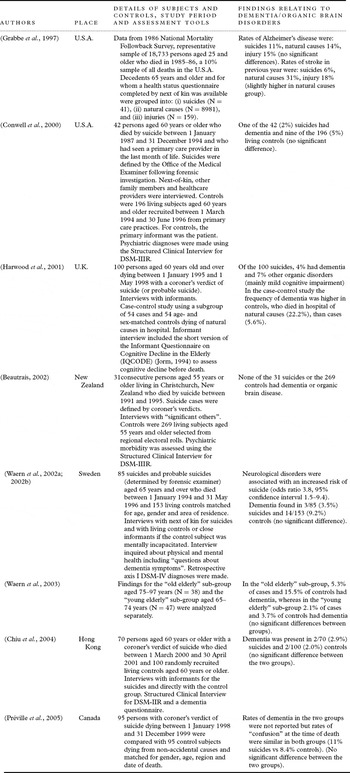
The psychological autopsy method involves the collection of detailed information about a deceased person from case records and interviews with relatives to study factors associated with suicide (Hawton et al., Reference Hawton1998). There are two types of study design: case-control studies and descriptive case series. The findings in each of the seven case-control studies of older adults in which dementia or organic brain disorders were investigated was that dementia was not associated with an increased risk of suicide (Table 1).
Psychological autopsy case-control studies of suicides in older persons

Studies based on case series of suicides in the elderly do not always specifically comment on rates of dementia, or they may refer broadly to “organic mental disorder” (Barraclough, Reference Barraclough1971; Henriksson et al., Reference Henriksson1995). Where dementia is specified the frequency is similar to general population rates (Conwell et al., Reference Conwell, Olsen, Caine and Flannery1991; Carney et al., Reference Carney, Rich, Burke and Fowler1994; Suominen et al., Reference Suominen, Henriksson, Isometsä, Conwell, Heilä and Lönnqvist2003). However, the findings of these studies are difficult to interpret because of the lack of a control group.
In summary, there is no good evidence that rates of dementia are higher in those dying through suicide, except for the findings of a recent Danish population cohort study (Erlangsen et al., Reference Erlangsen, Zarit and Conwell2008). Otherwise rates appear similar to, or lower than, general population rates, including studies which have used a sensitive method to detect cognitive impairment (Harwood et al., Reference Harwood, Hawton, Hope and Jacoby2001).
Suicide and self-harm in specific dementias and neurological disorders
Most of the studies previously discussed have grouped together all types of dementia. In older populations, most dementias are due to AD. Rarer causes of dementia, more prevalent in younger people, may be associated with different suicide rates.
Parkinson's disease and dementia with Lewy bodies
Dementia occurs in up to 60% of patients with Parkinson's disease (PD) (Buter et al., Reference Buter, van den Hout, Matthews, Larsen, Brayne and Aarsland2008). Depression occurs in up to 50% (Ravina et al., Reference Ravina2007) and may be a forerunner of dementia (Lieberman, Reference Lieberman2006). Thus it might be expected that PD patients would be at increased risk of suicide, but a review of suicide risk in physical illnesses did not find this (Harris and Barraclough, Reference Harris and Barraclough1994). Higher levels of suicidal ideation in PD patients than in matched controls have been reported (Robins, Reference Robins1976). However, in one epidemiological study there was no increased rate of suicide in PD (Stenager et al., Reference Stenager, Wermuth, Stenager and Boldsen1994) and, in another, suicide was less common in PD than in the general population (Myslobodsky et al., Reference Myslobodsky, Lalonde and Hicks2001). Suicide and self-harm have occurred following subthalamic nucleus stimulation (Doshi et al., Reference Doshi, Chhaya and Bhatt2002; Funkiewiez et al., Reference Funkiewiez2004), and with co-morbid depression (Hierholzer, Reference Hierholzer2002). It has been postulated that the low rate of suicide in PD could be due to motor and psychic slowing together with executive dysfunction (Faber, Reference Faber2003).
Studies have not, as yet, specifically examined the suicide rate in dementia with Lewy bodies (DLB), but it has been suggested that the strong link with mood disorders could result in an increased risk of suicide (Peisah et al., Reference Peisah, Snowdon, Gorrie, Kril and Rodriguez2007).
Cerebrovascular disease and vascular dementia
Up to 65% of individuals who suffer a stroke develop resultant cognitive impairment (Donovan et al., Reference Donovan, Kendall, Heaton, Kwon, Velozo and Duncan2008) and about a third of older patients with stroke have dementia (Selnes and Vinters, Reference Selnes and Vinters2006). Risk factors for cerebrovascular disease are more common in older people dying by suicide than in matched living controls (Chan et al., Reference Chan, Lyness and Conwell2007). Several studies have reported increased suicide rates in stroke patients, in whom there is a strong link with depression (Kishi et al., Reference Kishi, Robinson and Kosier2001). In one study, males under 60 years had a six-fold increased rate of suicide and females under 60 years a 13-fold increase (Stenager et al., Reference Stenager, Madsen, Stenager and Boldsen1998). In another study, both males and females aged under 50 had almost twice the expected suicide rate (Teasdale and Engberg, Reference Teasdale and Engberg2001). Suicidal ideation is more common later (15–24 months) than at 3 months after stroke (Kishi et al., Reference Kishi, Robinson and Kosier1996; Pohjasvaara et al., Reference Pohjasvaara, Vataja, Leppävuori, Kaste and Erkinjuntti2001). The increased rates of suicide in stroke patients may be due to lesions disrupting frontal and/or subcortical brain circuitry, since such lesions are associated with depression and impulsivity (Robinson et al., Reference Robinson, Morris and Fedoroff1990; Kaye et al., Reference Kaye, Grigsby, Robbins and Korzun1990; Rao et al., Reference Rao, Dening, Brayne and Huppert1997).
Depressive illness is more common and more severe in vascular dementia (VaD) than in AD and so VaD might be expected to be associated with a higher suicide rate (Ballard et al., Reference Ballard, Bannister, Solis, Oyebode and Wilcock1996). However, based upon a single study, suicide and self-harm in VaD appear to be less common than in the general population. Out of 241 cases of VaD diagnosed during inpatient assessment, five patients subsequently attempted suicide and four died by suicide (Ito et al., Reference Ito2002). All had mild dementia and most had depression. There is one case report of suicide in mild VaD with depression (Margo and Finkel, Reference Margo and Finkel1990).
Suicide and self-harm in Huntington's disease
Dementia in Huntington's disease (HD) can be a presenting feature, but often follows after the presentation of neurological symptoms. In his original description of this condition, George Huntington recognized the association with suicide (Huntington, Reference Huntington1872). It has been suggested that suicidal ideation is most common immediately before receiving a formal diagnosis of HD and at the stage of the illness when the ability to live independently is declining (Paulsen et al., Reference Paulsen, Hoth, Nehl and Stierman2005). An increased suicide risk in HD was reported in another study, peaking at 9–12 years after manifestation of the disorder (Di Maio et al., Reference Di Maio, Squitieri, Napolitano, Campanella, Trofatter and Conneally1993). Both of these studies used subjects registered on national HD databases. In a study of deceased HD patients based upon medical records, death certificates and questioning relatives, 28% had a history of attempted suicide and 5.7% died by suicide, both rates being four times that of the general population (Farrer, Reference Farrer1986). A meta-analysis of four studies reported a three-fold increased risk of suicide in HD compared with the general population (Harris and Barraclough, Reference Harris and Barraclough1994). In another study of 40 HD patients who died by suicide, death was said to have occurred mostly in the early or late stages of the disorder but data to support this assertion were not provided (Baliko et al., Reference Baliko, Csala and Czopf2004). Other “at risk” family members without neurological signs and spouses are also at increased risk of suicide (Di Maio et al., Reference Di Maio, Squitieri, Napolitano, Campanella, Trofatter and Conneally1993).
Risk factors for suicide in dementia
There is a paucity of good data on risk factors for suicide in dementia. There are few case-control studies, with information largely coming from case reports and case series. Most studies do not specify dementia subtypes. Many of the findings, therefore, are tentative.
Depressive symptoms are consistently mentioned as a risk factor for suicide in dementia (Alexopoulos, Reference Alexopoulos1991; Cohen et al., Reference Cohen, Vergon and Malphurs1998; Rubio et al., Reference Rubio, Vestner, Stewart, Forbes, Conwell and Cox2001; Cooper, Reference Cooper2002; Lim et al., Reference Lim, Rubin, Coats and Morris2005). A history of depression may itself be a risk factor for AD, given that hippocampal neurofibrillary tangles are increased in AD patients with a history of major depression compared to AD patients with no such history (Rapp et al., 2008). It has been postulated that depression and hopelessness mediate the effect of cognitive functioning on suicidal ideation and that there is an inverse relationship between cognitive functioning and suicidal ideation (Heisel et al., Reference Heisel, Flett and Besser2002). Suicidal ideation is associated with depression in patients with AD (Draper et al., Reference Draper, Maccuspie-Moore and Brodaty1998).
Several case reports illustrate how patients with mild AD and preserved insight may be at risk (Margo and Finkel, Reference Margo and Finkel1990; Rohde et al., Reference Rohde, Peskind and Raskind1995; Vega et al., Reference Vega, Kishikawa, Ricanati and Friedland2002; Lim et al., Reference Lim, Rubin, Coats and Morris2005; Kishikawa et al., Reference Kishikawa, Friedland, Ueda, Kitabayashi and Fukui2007). However, a study of 118 people aged over 81 years found associations between both depression and AD/VaD, but no association between suicidal ideation and awareness of cognitive impairment or dementia severity (Rao et al., Reference Rao, Dening, Brayne and Huppert1997). Some authors have proposed that preservation of insight may lead to depression and hopelessness, which in turn leads to suicidal ideation. AD patients with feelings of hopelessness have more mood disturbance and more insight into their cognitive and functional impairments than those without hopelessness (Harwood and Sultzer, Reference Harwood and Sultzer2002). Hopelessness may be exacerbated by failure to respond to anti-dementia medication. There are case reports of patients in the early stages of AD who died by suicide having failed to respond to a cholinesterase inhibitor (Rohde et al., Reference Rohde, Peskind and Raskind1995; Ferris et al., Reference Ferris, Hofeldt, Carbone, Masciandaro, Troetel and Imbimbo1999). Among patients who had been diagnosed with dementia during hospital admission, the risk of suicide was greater in younger patients (those aged 50–69 years) and in the first six months after diagnosis (Erlangsen et al., Reference Erlangsen, Zarit and Conwell2008). However, patients for whom the diagnosis is made while they are inpatients would be expected to be atypical of dementia patients as a whole, with greater psychiatric comorbidity.
In most studies suicide, self-harm and suicidal ideation are more frequent in mild dementia (Forsell et al., Reference Forsell, Jorm and Winblad1997; Barak and Aizenberg, Reference Barak and Aizenberg2002; Osvath et al., Reference Osvath, Kovacs, Voros and Fekete2005). Among nursing home suicides, none occurred in those with severe cognitive impairment (Menghini and Evans, Reference Menghini and Evans2000). A case report describes an elderly man who in the early stages of AD self-harmed on several occasions (Lim et al., Reference Lim, Rubin, Coats and Morris2005). These episodes ceased as his dementia progressed, presumably as his ability to plan and carry out an act of self-harm diminished.
Both previous expression of suicidal intent and a past history of self-harm have been reported as risk factors for suicide in dementia (Cohen et al., Reference Cohen, Vergon and Malphurs1998; Barak and Aizenberg, Reference Barak and Aizenberg2002). Also, specific psychiatric symptoms have been linked to suicide and self-harm in dementia, such as aggression (Aarsland et al., Reference Aarsland, Cummings, Yenner and Miller1996), a resurgence of painful memories (Heinik, Reference Heinik1997), and command hallucinations (in the context of co-existent bipolar affective disorder) (Cooper, Reference Cooper2002).
Suicide in dementia may occur in response to minor life events which highlight the individual's inability to deal with day-to-day problems (Hierholzer, Reference Hierholzer2002). Loss of dignity (Kishikawa et al., Reference Kishikawa, Friedland, Ueda, Kitabayashi and Fukui2007) and high premorbid social status (Margo and Finkel, Reference Margo and Finkel1990; Alexopoulos, Reference Alexopoulos1991; Rohde et al., Reference Rohde, Peskind and Raskind1995; Ferris et al., Reference Ferris, Hofeldt, Carbone, Masciandaro, Troetel and Imbimbo1999; Lim et al., Reference Lim, Rubin, Coats and Morris2005) may also be risk factors, but these variables have a very limited evidence base.
Biology and neuropsychology of suicide and self-harm in dementia
Post-mortem studies and neuropathology
A small U.S. case-control study showed increased rates of AD pathology in older people dying through suicide compared with those dying through natural causes (Rubio et al., Reference Rubio, Vestner, Stewart, Forbes, Conwell and Cox2001). However, a subsequent larger study using an accidental death control group did not confirm these findings (Peisah et al., Reference Peisah, Snowdon, Gorrie, Kril and Rodriguez2007). Further studies are needed, particularly in relation to DLB and VaD, as there are theoretical reasons why these disorders may be associated with higher rates of suicide.
Neurochemistry
Decreases in brain 5HT have been reported in AD, with degeneration of 5HT input into the cortex and loss of S1 and S2 receptors in the temporal lobe, the latter occurring in mild disorder (Meltzer et al., Reference Meltzer1998). Low brain 5HT is known to be linked to suicide in general (Mann, Reference Mann2003). The apparent infrequency of suicide in AD is surprising given the high frequency of depression and reduced brain serotonin levels (Teri et al., Reference Teri, Baer and Reifler1991; Rubio et al., Reference Rubio, Vestner, Stewart, Forbes, Conwell and Cox2001).
Neuropsychology
Many hypotheses have been proposed to explain the mechanism of suicide in dementia. Suicide may be more likely in mild dementia when executive function is retained but memory and reasoning impaired (Cohen et al., Reference Cohen, Vergon and Malphurs1998). Depressed suicide attempters of all ages appear to have impaired executive functioning (King et al., Reference King, Conwell, Cox, Henderson, Denning and Caine2000; Keilp et al., Reference Keilp, Sackeim, Brodsky, Oquendo, Malone and Mann2001; Dombrovski et al., Reference Dombrovski2008), so when frontal or sub-cortical lesions occur in dementia they could predispose to suicide or self-harm. In a study of older depressed patients, those with lifetime histories of self-harm had significantly more sub-cortical gray matter hyperintensities on MRI than did matched controls with no previous episodes of self-harm (Ahearn et al., Reference Ahearn2001). Self-harm has been reported in the context of fronto-temporal dementia (FTD) (Mendez et al., Reference Mendez, Bagert and Edwards-Lee1997). Although FTD is associated with impulsive aggression, there are no data on suicide in this disorder.
Disclosing the diagnosis of dementia and predictive testing in dementia
Discussion of this is relevant given the current trend for early diagnosis and information giving in AD, supported by the recent U.K. National Dementia Strategy (Department of Health, 2009). In a systematic review of 59 studies of the effects of disclosing a diagnosis of dementia, the negative impact of disclosure was discussed but no mention was made of suicide or self-harm (Bamford et al., Reference Bamford, Lamont, Eccles, Robinson, May and Bond2004).
In a survey of people over 65 years without cognitive impairment, 92% wanted to be told if they had AD, which is roughly the same proportion who wanted to be told if they had cancer (Turnbull et al., Reference Turnbull, Wolf and Holroyd2003). Those with a personal experience of AD were less likely to want to be told the diagnosis. Only 1.7% said they would consider suicide if they were told they had dementia.
Most of the data on predictive testing comes from studies on HD patients. Predictive genetic testing has been available since the mid 1980s. However, only about 25% of those at risk of developing HD avail themselves of testing (Bird, Reference Bird1999) and those that do are better adjusted psychologically than those who do not (Meiser and Dunn, Reference Meiser and Dunn2000).
Genetic testing for HD carries complex psychological consequences for carriers and non-carriers (Robins Wahlin, Reference Robins Wahlin2007). High rates of suicidal ideation and self-harm have been found in participants prior to undergoing predictive testing, both among those who subsequently tested positive and those who did not (Robins Wahlin et al., Reference Robins Wahlin, Bäckman, Lundin, Haegermark, Winblad and Anvret2000). In one study depression was more common before than after testing but there was no difference in frequency between those testing positively or negatively, although the study lacked sufficient statistical power (Codori et al., Reference Codori, Slavney, Rosenblatt and Brandt2004). In another study, half of the carriers and non-carriers had suicidal ideation prior to and following testing but this declined more in non-carriers than carriers (Larsson et al., Reference Larsson, Luszcz, Bui and Wahlin2006). Prior to genetic testing, over 30% of carriers said they expected to consider suicide when they developed middle or advanced HD. Two years post-testing this had risen to 52%.
In a world-wide study of 4,527 people who had undergone HD testing, at follow-up one year later, only 44 (0.97%) had had a “catastrophic event” (five had died by suicide, 21 had self-harmed and 18 had been admitted to a psychiatric hospital) (Almqvist et al., Reference Almqvist, Bloch, Brinkman, Craufurd and Hayden1999). Most (84.6%) of these subjects had tested positive for HD. However, only 84% of the cohort could be traced and “catastrophic events” would be expected to be more likely in those lost to follow-up. Increased risk of a “catastrophic event” was associated with a past psychiatric history and unemployment. A subject's reaction to test results may depend more on psychological adjustment before testing than on the actual result (Meiser and Dunn, Reference Meiser and Dunn2000). This finding is supported by a study in which psychological distress five years after predictive testing for HD appeared to be uncommon in both carriers and non-carriers, but those with less “ego-strength” were found to be more vulnerable to distress (Decruyenaere et al., Reference Decruyenaere2003). It has been suggested there is a need for pre-test emotional assessment to inform targeted post-test counseling (Broadstock et al., Reference Broadstock, Michie and Marteau2000).
Some families affected by familial AD and FTD with PD request genetic testing. In a small short-term follow-up study of 21 people at risk of these disorders there were no suicide attempts or psychiatric hospitalizations in those tested. Most subjects reported testing to be beneficial (Steinbart et al., Reference Steinbart, Smith, Poorkaj and Bird2001).
Discussion
Most of the evidence that we have reviewed suggests that the rate of suicide in dementia is lower than that found in the general population, the exception being HD where there is a three-fold increase in the risk of suicide. Virtually no information is available about suicide and VaD, FTD, DLB and HIV dementia, although in relation to VaD, it is of note that stroke is associated with an increased risk of suicide. In PD, a disorder in which dementia occurs in up to 60% of cases, the risk of suicide is not increased. This is surprising given the high rates of depression in PD. Our overall findings in relation to dementia and suicide are consistent with the conclusions in an earlier German review article (Schneider et al., Reference Schneider, Maurer and Frölich2001). In one recent large cohort study, a substantially increased risk of suicide was found where the diagnosis of dementia was made during hospitalization, especially for younger patients (Erlangsen et al., Reference Erlangsen, Zarit and Conwell2008). However, it is likely these patients represent a high risk group.
The majority of studies have not reported increased rates of self-harm in dementia but a few have reported increased rates in patients with mild cognitive impairment. Self-injurious behavior, an ill-defined polymorphous concept covering behaviors with varying degrees of suicidal intent, is reported to be common among nursing home residents, many of whom have dementia. It may in part relate to the quality of care. Risk factors for suicide in dementia described in the literature include depression, hopelessness, mild cognitive impairment, preserved insight, younger age and failure to respond to anti-dementia drugs. It has been suggested that suicide in people with dementia can be triggered by minor life events with which the individual can no longer deal but there is no supporting evidence to indicate how often this is the case. There is conflicting evidence as to whether predictive testing in HD is associated with increased rates of suicide or self-harm, although such acts are not uncommon in subjects prior to testing.
Much of the published research that we have reviewed has methodological weaknesses. Many studies have not used standardized or sensitive tools to screen for mild dementia (where the risk of suicide is thought to be greatest) and in older studies cases of dementia have been lumped together with other organic disorders. Studies based on death certificates frequently under-report cases of dementia, since mild cases are often missed. Psychological autopsy studies that employ a case-control design and use standardized assessment tools can provide good quality evidence about suicide in dementia, though low participation rates by relatives can be a problem and mild degrees of cognitive impairment can be difficult to detect with a psychological autopsy method. As suicide appears so uncommon in dementia, most studies report very few suicides; hence it is difficult to draw conclusions about the characteristics of these cases. Case reports can assume unjustified significance in the literature, although they can provide valuable insights into underlying mechanisms that can then be investigated in further studies. The term suicidal ideation covers a wide range of thoughts varying from not wanting to live to detailed plans involving a specific method of suicide, so comparisons of different studies is difficult. Similar problems arise with the definition of attempted suicide, since it is sometimes difficult to decide if intent to die was present. Use of the broader term self-harm or deliberate self-harm, avoids this problem and is the term used in the U.K. and much of the rest of Europe.
Further research is needed to improve knowledge about suicide and self-harm in dementia, including the mechanisms underlying such acts. Good quality prospective, longitudinal studies focusing on the association between dementia, suicide and self-harm are needed, with the emphasis on recruiting mild cases and using standardized definitions of the type of suicidal behavior under investigation and standardized assessment tools. Standardized and validated methods of cognitive assessment need to be used in order to assess the degree and pattern of cognitive impairment. The measurement of insight into cognitive decline and severity of depressive symptoms at various stages in the illness are important too. In this way information on how rates of suicide and self-harm change during the course of the illness can be determined. Further post-mortem studies of older people dying by suicide should investigate brain pathology to determine whether signs of early pathological changes associated with dementia occur more frequently than in people of the same age in the general population. Post-mortem studies that examine the distribution by specific brain area of neurofibrillary plaques and tangles in demented patients dying by suicide would add to our knowledge of the relationship between dementia and suicide. It might be expected that frontal pathology, especially in the orbitofrontal area, would be linked to impulsivity and hence to suicide and self-harm. Functional neuroimaging may in future shed light on the anatomical correlates of specific suicidal thoughts or acts of self-harm and may elucidate “faulty” thinking in dementia.
Another requirement is for studies investigating the frequency of suicide and self-harm in the various different sub-types of dementia, some of which, for example DLB, might be expected to have higher rates of suicide than AD. As genetic testing for familial AD, FTD and PD become more widely requested, studies of patients who wish to undergo testing could be followed up at regular intervals and would provide information about self-harm over the course of their illness. Studies on suicide in uncommon sub-types of dementia, such as FTD, will require multi-center collaboration in order to recruit samples of sufficient size.
At present, the message for psychiatrists and physicians caring for patients with dementia is that suicide in the condition is thought to be rare, except in HD or possibly where the diagnosis of dementia is made during hospitalization. In both these high risk groups younger patients are at highest risk. Suicide in dementia appears to be more common early in the course of the illness. Because most studies have focused on AD, the risk of suicide in less common dementia sub-types is unknown but it may be increased because of the underlying neuropsychological deficits and the association with depression.
Conflict of interest
None.
Description of authors' roles
All three authors were involved in the design of the study and contributed to the writing of the review. CH carried out the literature search.
Acknowledgments
We thank Dr. Robert Robinson and Dr. Tom Dening for their helpful advice and Lesley Sutton for her help with the references. Camilla Haw is supported by St. Andrew's Healthcare, Northampton and Professor Keith Hawton by Oxfordshire and Buckinghamshire Mental Health NHS Foundation Trust.