INTRODUCTION
Humans have moved thousands of species around the globe, and many of them now occupy regions from which they did not originate (Meyerson & Mooney Reference Meyerson and Mooney2007; Hulme Reference Hulme2009). The spread (often termed invasion) of many such ‘non-native’ species has been identified as one of the greatest threats to biodiversity (Sala et al.
Reference Sala, Chapin, Armesto, Berlow, Bloomfield, Dirzo, Huber-Sanwald, Huenneke, Jackson and Kinzig2000; MA [Millennium Ecosystem Assessment] 2005; Simberloff et al.
Reference Simberloff, Martin, Genovesi, Maris, Wardle, Aronson, Courchamp, Galil, Garcia-Berthou, Pascal, Pysek, Sousa, Tabacchi and Vila2013). Addressing this threat has become a major, and increasingly costly, challenge to natural resource management worldwide (TEEB [The Economics of Ecosystems and Biodiversity] 2010; Py
 ek & Richardson Reference Pysek and Richardson2010). The sheer extent of the problem has led to widespread use of the label ‘non-native’ as a proxy for harmfulness, implying the need for control (Simberloff et al.
Reference Simberloff, Souza, Nunez, Barrios-Garcia and Bunn2012). Recently, a group of 19 ecologists made a strong plea to stop this practice of judging species on their origins (Davis et al.
Reference Davis, Chew, Hobbs, Lugo, Ewel, Vermeij, Brown, Rosenzweig, Gardener and Carroll2011). Rather than manage species on the basis of whether or not they are native, they urged ‘conservationists and land managers to organize priorities around whether species are producing benefits or harm to biodiversity, human health, ecological services and economies’. Their persuasive call for a change in attitude presents a turning point in environmental conservation, and suggests permeation of critique from social scientific disciplines and society at large regarding the morality, logic and utility of using nativeness as a guiding principle in nature conservation and restoration management (Warren Reference Warren2007; Schlaepfer et al.
Reference Schlaepfer, Sax and Olden2011; Head Reference Head2012; Young & Larson Reference Young and Larson2012; Valéry et al.
Reference Valéry, Fritz and Lefeuvre2013). However, this view is by no means widely accepted (Simberloff et al.
Reference Simberloff2011; Richardson & Ricciardi Reference Richardson and Ricciardi2013) and it is criticized partly on the argument that non-nativeness is an appropriate shorthand for harmfulness because, empirically, non-native species are more likely to be harmful than native species (Salo et al.
Reference Salo, Korpimäki, Banks, Nordström and Dickman2007; Simberloff et al.
Reference Simberloff, Souza, Nunez, Barrios-Garcia and Bunn2012; Paolucci et al.
Reference Paolucci, MacIsaac and Ricciardi2013). Despite these polarized views, both camps agree that species management should be based on sound empirical evidence, and not on unfounded claims of harm caused by non-native species (Davis et al.
Reference Davis, Chew, Hobbs, Lugo, Ewel, Vermeij, Brown, Rosenzweig, Gardener and Carroll2011; Simberloff et al.
Reference Simberloff, Souza, Nunez, Barrios-Garcia and Bunn2012).
However, at present, the extent to which nativeness influences attitudes and decision-making in natural resource management remains unknown. We used social scientific methodology to attempt to fill this void. We conducted a questionnaire-based survey of members of the general public and invasive species experts in both Scotland (UK) and Ontario (Canada), to determine empirically the role that perceptions of a species’ nativeness play in informing attitudes towards its management relative to other concepts. We focused on nativeness and four conceptually-related attributes, namely abundance, human role in range expansion, impact on the economy, and impact on nature, the last two aspects having been identified by Davis et al. (Reference Davis, Chew, Hobbs, Lugo, Ewel, Vermeij, Brown, Rosenzweig, Gardener and Carroll2011) as meriting greater influence on such decision-making than nativeness.
METHODS
We conducted a questionnaire-based survey in Scotland (UK) and Ontario (Canada), sampling the general public (n = 276 and 270, respectively) and professionals engaged with non-native invasive species as part of their work (n = 93 in both countries). In Scotland, members of the general public were randomly sampled from a commercially available list of residents, and contacted by post. In Ontario, we made use of a survey panel administered by a market research company. Professionals were defined as experts, not necessarily scientists, whose work related to invasive species, and included members of governmental and non-governmental organizations and private companies. These were contacted through relevant e-mail lists, and data were collected through an online survey (see Fischer et al. Reference Fischer, Selge, Van der Wal and Larson2014 for further detail on sampling and survey administration). Using two study areas provided some measure of generality, as well as a sufficiently large sample size of professionals for robust statistical analysis. Both sample areas are English-speaking (a factor that facilitates cross-country application of questionnaires), within an industrialized Western cultural context, and have broadly similar climates and thus functionally similar biota. Given the purpose of this paper, we neither compare the views of Scottish and Ontario respondents, which would require a different research design, nor those of professionals and the public, which are instead analysed elsewhere (Fischer et al. Reference Fischer, Selge, Van der Wal and Larson2014).
The survey included two sets of species (one for each country), with each set containing five species distributed among the following types: native mammal, non-native mammal, native tree and non-native tree/tall shrub. We chose species that were familiar to a broad lay audience; where possible, we chose similar species for the two study areas. As native mammals, we selected red deer (Cervus elaphus) and white-tailed deer (Odocoileus virginianus) for Scotland and Ontario, respectively; as non-native mammals, grey squirrel (Sciurus carolinensis) and Virginia opossum (Didelphis virginiana); as native trees, Scots pine (Pinus sylvestris) and Eastern white pine (Pinus strobus); and as non-native tree/tall shrub, rhododendron (Rhododendron ponticum) and Scots pine. Finally, we included the beaver (Castor fiber and C. canadensis), a mammal that is culturally significant in both study areas; the species is native to Ontario, but ambiguous in Scotland because it has been recently reintroduced (after historical extirpation from the UK; Arts et al. Reference Arts, Fischer and Van der Wal2012). Although our choice of species could have some impact on our results (Bremner & Park Reference Bremner and Park2007; Verbrugge et al. Reference Verbrugge, Van den Born and Lenders2013), the diversity of species reduces the likelihood that this is the case and implies some degree of generalizability.
We examined respondents’ perceptions of five conceptually-related attributes using semantic differentials (on five-point scales): (1) native–non-native; (2) rare–overabundant; (3) beneficial–detrimental to the economy; (4) beneficial–detrimental to nature; and (5) introduced by humans–natural range expansion. These covered the spectrum of relevant attributes identified through previous qualitative research (Selge et al. Reference Selge, Fischer and Van der Wal2011; see also Montgomery Reference Montgomery2002; Fischer et al. Reference Fischer, Bednar-Friedl, Langers, Geamana, Skogen and Dumortier2011). Invasiveness was operationalized through three separate notions (2–4), which concern, respectively, perceptions of a species’ abundance, harm to the economy, and harm to nature. As understandings of non-nativeness among the general public diverge and do not necessarily imply human responsibility for the introduction (a factor that had been identified as important by Selge et al. Reference Selge, Fischer and Van der Wal2011), we also explicitly elicited perceptions of the human role in a species’ introduction (5). In line with this previous research, we hypothesized that species that were viewed as more abundant, harmful, non-native or as introduced by humans would be more likely to be regarded as in need of management.
We explored attitudes towards species management with three further questionnaire items, namely: (1) not a severe problem–a severe problem; (2) no need to reduce species’ numbers–need to reduce species’ numbers; and (3) killing this species is not OK–killing this species is OK. To obtain a robust measure of attitudes towards species management, we averaged these three five-level attitude items to a single multi-level ‘management attitude index’ that had good inter-item reliability (Cronbach's α across the whole sample and all five species = 0.801). Our decision to allow participants to assess a species’ nativeness on a five-point scale, rather than as a dichotomy, was based on prior work (see for example Chew & Hamilton Reference Chew, Hamilton and Richardson2011) that has highlighted the diversity of people's temporal and geographical points of reference for thinking about nativeness (for example native to Great Britain versus native to only part of it; recent introduction versus dating further back in time; see also Humair et al. Reference Humair, Edwards, Siegrist and Kueffer2014).
Fischer et al. (Reference Fischer, Selge, Van der Wal and Larson2014) revealed that perceptions of a species’ nativeness correlated with attitudes towards its management. Using the same large data set, we set out to investigate whether this association was due to perceptions of nativeness in itself (namely, a species’ perceived origin) or due to other, related notions (see above). Prior to our analysis, we conducted two further analytical steps. First, we assessed collinearity among the five species attributes through inspecting the correlations between them. Although correlations between nativeness and the other four species attributes were not particularly high (Pearson's r ranging from –0.29 to 0.55; see Supplementary material, Table S1), we conducted a second analytical step, in which we used AIC (Akaike information criterion) based model selection to determine whether nativeness explained people's perceived need for species management equally well as the combination of the four related concepts (Table 1; using the full data set and model structure as described below). Because this was not the case (see Results), we used sums of squares Type 1 models (see below) and appraised them on the basis of F and p values, which enabled us to unpack the relationship between nativeness and people's attitudes to species control, as reported by Fischer et al. (Reference Fischer, Selge, Van der Wal and Larson2014).
Summary of AIC (Akaike information criterion) based model comparison; a lower AIC indicates a better, more parsimonious, model capturing variation in people's perceived need for species management. Df = total degrees of freedom of a model.

We ran linear mixed models with normal error distribution in SPSS Version 21 to determine how much of the variation in the management attitude index could be attributed to nativeness, using F-values as the main heuristic (calculated as the ratio of the explained variability and the unexplained variability; the larger the F-statistic, the more variability is explained by a term). We used Type I calculation (hierarchical decomposition) of sums of squares (SS Type 1) so that each term in the model was adjusted for the preceding terms. In this way, we could compare F-values associated with nativeness before and after fitting the other conceptually-related species attributes. Model assumptions were scrutinized graphically by creating histograms and normal probability (QQ) plots of the residuals; we observed no skewness or departure from assumed normality, indicating that the models captured structure in the data well. Plotting predicted values against observed values also revealed that models fitted the data well.
We computed four sets of models, all including ‘individual respondent’ as a random effect because each respondent expressed beliefs about five species. First, we analysed the data from members of the public, using the five species attributes along with the factors ‘country’ (two levels) and ‘species set’ (five levels) (Table 2). We fitted ‘nativeness’ as either the first or final attribute to determine its effect on the F-value associated to this term. Second, we split the public data by country and species set to obtain species-specific F-values for nativeness, as either first or last attribute (Fig. 1). Third, we repeated the first analysis using the data obtained from professionals (Table 2). Finally, we pooled data for the public and professionals and added the terms ‘group’, ‘group × nativeness’ and ‘nativeness × country’ (although neither interaction was significant) to obtain the parameter estimates required to construct the relationship between perceived nativeness and perceived need for species management (Fig. 2). Parameters for all models were computed using maximum likelihood estimation.
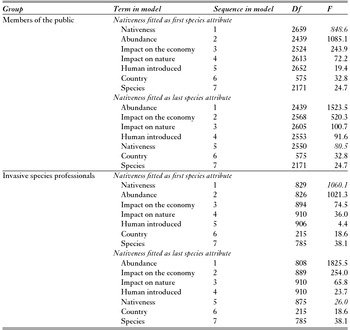
Factors explaining variation in people's perceived need for species management for members of the public and professionals engaged with non-native invasive species. The factors are listed in their sequence in the model. Tabulated values show that, for both members of the public and invasive species professionals, variance explained by nativeness is strongly reduced (lowered F value) when fitted as the last (5th term in model) rather than first species attribute (1st term in model), whilst F-values of the other four attributes increase. Df = total degrees of freedom of a model. All p < 0.001 except for invasive species professionals, human introduced, 5th term: F = 4.4, p = 0.05.

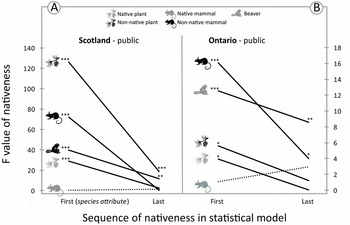
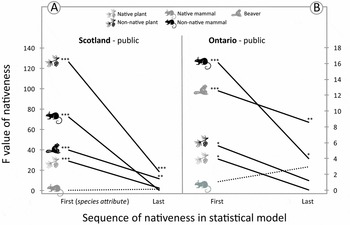
F-values for alternative statistical models for the Scottish and Canadian public samples. Variation in the perceived need for species control explained by the term nativeness fitted as either the first or last species attribute in (a) Scotland, UK and (b) Ontario, Canada. F-values were derived from linear mixed models and connected by lines for easier visualization (the larger the F-statistic, the more variation in the data is explained by nativeness). Each panel shows data for five species; grey icons are used for species native to the area and black icons for non-native species. The beaver in Scotland is dark grey to reflect its ambiguous (reintroduction) status. Asterisks above the beginning and end of lines indicate the significance level of the term nativeness in each model (***p < 0.001; **p < 0.01; *p < 0.05; otherwise p > 0.05); the dotted line (native mammal) indicates lack of significance of nativeness as either first or last term in the model.
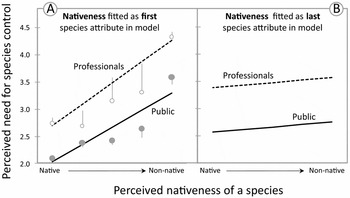
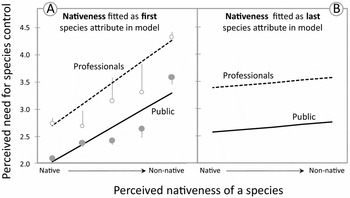
Relationship between perceived nativeness and need for species control. (a) The relationships when nativeness is fitted as first species attribute in a linear mixed model; (b) the relationships after correcting for other species’ attributes (see text). Mean scores for the management attitude index (white and grey circles for professionals and public, respectively) are indicated, with 95% confidence intervals shown in one direction only for clarity.
RESULTS
A model that sought to explain people's attitudes to species management solely in terms of nativeness compared unfavourably with a model containing species abundance, impact on the economy, impact on nature, and human introduced (Table 1; ΔAIC = 1376). However, a model comprising all five species attributes was best in AIC terms (Table 1), meaning that nativeness did enhance model performance (ΔAIC = 102).
When investigating statistical relationships in greater depth, we found nativeness to be a strong explanatory variable (F1, 2659 = 848.6) of people's attitudes towards species management, almost as powerful as the perceived abundance of a species (Table 2). However, this was conditional upon nativeness being entered as the first term in the model, in which case it could explain variance in the data that otherwise could have been absorbed by other variables. When other conceptually-related species attributes were fitted to the data first (each one explaining a significant part of the variation in people's attitudes to species control), the strength of nativeness as an explanatory variable was reduced to the weakest of all attributes tested in the model (F1, 2550 = 80.5). These results suggest that, among the general public, a species’ perceived abundance, impact on economy and nature, and human role in range expansion all played an important part in informing attitudes towards species management, and conceptually replaced nativeness to a large extent.
Separate models run for the focal species in their respective geographical regions confirm this finding (Fig. 1). In Scotland, where we found greatest overall levels of support for species control, nativeness explained much less variation in people's attitudes (as shown by the drop in F-values) when it was fitted last (as opposed to first) in the models for the focal non-native plant (rhododendron) and animal (grey squirrel) (Fig. 1 a). More modest reductions in explanatory power were found for the (reintroduced) beaver and the native plant (Scots pine), while for the native animal (red deer) the variation explained by nativeness was close to zero, even when it was entered into the model first. In Ontario, patterns were less pronounced, but similar, with the greatest change being the proportion of variation explained for the Virginia opossum (Fig. 1 b).
We found that professionals used nativeness in a remarkably similar way when evaluating the need for species management (Table 2): nativeness was a highly significant explanatory variable when fitted as the first term in the model (F1, 829 = 1060.1; Fig. 2 a), but it explained little variation when fitted as the last species attribute (F1, 875 = 26.0; Fig. 2 b). In the latter case, considerably greater variation in professionals’ attitudes towards species management was again explained by the other species attributes.
Whilst our analyses demonstrate nativeness has little explanatory value when stripped of connotations related to harm, overabundance and human responsibility, they also show that nativeness did not fully encompass the meanings of these four species attributes. For both professionals and the public, when fitting nativeness as first term (Table 2), all four conceptually-related attributes remained highly significant additional factors explaining variation in people's attitude to species control. Despite its significance, nativeness was thus a poor proxy for harmfulness and therefore inadequate at approximating people's support for managing a species.
DISCUSSION
The control of invasive species is a focus of contemporary nature conservation, yet most definitions of invasiveness confound the non-native origin of a species with its impact, using a species’ origin as shorthand for its harmfulness, and thereby implying the need for conservation action (Simberloff et al. Reference Simberloff, Souza, Nunez, Barrios-Garcia and Bunn2012). We provide strong empirical evidence that, when stripped of connotations of overabundance, harm and human responsibility, the label non-native in itself does not do much to inform attitudes towards intervention among either the public or professionals. This result suggests that people judge species primarily in terms of factors other than their origins, most notably their abundance and impact.
To some degree, however, nativeness brought together several conceptually-related species attributes; that is, it appeared to explain a large part of the variation in perceived need for species control when fitted as first variable in our model. Nativeness could therefore be considered an umbrella concept, yet its umbrella function was limited because each of the other attributes explained a considerable amount of additional variation in attitudes towards species management (Table 2). Invasion biological debates that exclusively focus on non-nativeness as undifferentiated shorthand thus fall short of the actual concerns of both professionals and the public, both of whom tend to concentrate on a species’ abundance and impact on the economy and nature.
Many invasion biologists argue that human agency is a crucial aspect of biological invasions (Hulme Reference Hulme2009; Py
ek & Richardson Reference Pysek and Richardson2010). Yet, ‘human responsibility’ is usually not included in quantitative surveys on attitudes towards non-native species (Bremner & Park Reference Bremner and Park2007; Verbrugge et al.
Reference Verbrugge, Van den Born and Lenders2013), and the conceptual nestedness of human responsibility (logically, only species that are seen to originate in a different place can be perceived as introduced by humans) might obscure the strength of its statistical effect (note the relatively high correlation between human introduced and nativeness; see Supplementary material, Table S1). Here, we found that perceptions of human responsibility did indeed significantly explain variation in attitudes towards species management, with the effect being substantially greater when non-nativeness was entered into the model last (Table 2).This confirms findings from a preceding qualitative study (Selge et al.
Reference Selge, Fischer and Van der Wal2011), and signposts the need for incorporating attributions of responsibility into future research, policy development and dissemination. Future studies could also include the notion of responsibility in combination with ideas of the human-nature relationships (Verbrugge et al.
Reference Verbrugge, Van den Born and Lenders2013), as we might expect a moderating effect of such ideas on the way in which perceptions of responsibility inform attitudes towards management.
Our findings on the role of nativeness relative to other, related attributes are important, particularly for biodiversity management, which increasingly seeks and relies upon public support for conservation implementation, and where prioritization and clear communication based on different attributes are critical (Davis Reference Davis2009; Urgenson et al. Reference Urgenson, Prozesky and Esler2013). Although there are many efforts to increase critical reflexivity in the debate over non-native invasive species management, and, in practice, many conservation professionals will base their decisions on a species’ impact rather than its origin (Davis et al. Reference Davis, Chew, Hobbs, Lugo, Ewel, Vermeij, Brown, Rosenzweig, Gardener and Carroll2011; Humair et al. Reference Humair, Edwards, Siegrist and Kueffer2014), nativeness as a key criterion maintains a high profile in both science and policy (Environment Canada 2004; DEFRA [UK Department of the Environment, Food and Rural Affairs] 2008; Shine et al. Reference Shine, Kettunen, Genovesi, Essl, Gollasch, Rabitsch, Scalera, Starfinger and Ten Brink2010; Simberloff et al. Reference Simberloff, Martin, Genovesi, Maris, Wardle, Aronson, Courchamp, Galil, Garcia-Berthou, Pascal, Pysek, Sousa, Tabacchi and Vila2013). We suggest that information campaigns and high-level policy documents could provide a more accurate and differentiated analysis of the attributes that underpin the proposed need for species control. In some instances, the control of a species may be motivated by its impact on the human economy, whereas, in others, by its impact on local ecology. Given our survey results, we are confident that the general public would appreciate more open dialogue of this sort. We therefore recommend more careful use of nativeness as a motivator of nature conservation policy and action where, in fact, detrimental consequences of a species’ spread or other attributes are more relevant to people's concerns.
ACKNOWLEDGEMENTS
The Canadian component of the study was funded through a Standard Research Grant to Brendan Larson from the Social Sciences and Humanities Research Council of Canada (SSHRC). We are grateful to Mark Brewer and Thomas Cornulier for statistical advice and to Aaron MacNeil and an anonymous referee for their constructive comments on our work.
Supplementary material
To view supplementary material for this article, please visit http://dx.doi.org/10.1017/S0376892915000053.