Introduction
While global poultry production and consumption have grown nearly 4% over the last decade, total European poultry consumption has increased more slowly. European per-capita poultry consumption has followed the same trend, increasing from 21.5 kg/year for the EU-15 to 23.3 kg/year for the EU-27 (European Commission, Reference EUROPEAN COMMISSION2009). Most poultry-consumption trends observed in Europe are qualitative, related to an increase in chicken consumption at the expense of turkey, as well as to evolving consumer preferences which favour cuts and especially processed products. The rapid growth of these products, for which the origin of the raw material is not promoted, has favoured imports from new producing regions which are highly competitive on the global market. European imports from Brazil, Thailand and other non-EU countries rose from 280,000 tonnes in 1998 to 890,000 tonnes in 2008 (European Commission, Reference EUROPEAN COMMISSION2009). These trends, together with the development of intra-European trade, have led to sharply contrasting national strategies and dynamics: some countries which were not meeting domestic demand, such as Poland and Germany, increased production, whereas the production of leaders such as France and the United Kingdom (UK) decreased. Over the last ten years, poultry production in France, which remains Europe's leading poultry-meat producer and exporter to non-EU countries, has decreased by 20%. This can be explained by stiffer competition in the European market, compounded by an increase in imports from the rest of the world (Magdelaine, Reference MAGDELAINE2008). In France, as in other European countries, additional factors include the context of gradual liberalisation of trade in agricultural products, food-safety alerts, emerging concerns over the sustainability of production systems, and animal welfare. Uncertainties regarding longer-term trends have led the research institute INRA and the technical institute ITAVIFootnote * to reflect on possible future trends for the poultry sector in FranceFootnote †.
The idea of bringing together the two institutes’ skills and professional networks led to the launching of a scenario-building exercise. The aim was to provide food for thought to decision makers involved in setting guidelines for public research and government policy and, more specifically, to define collective strategies for the French poultry sector. This article presents the main results and findings of this exercise from a European perspective.
The exploration of possible futures using scenarios
Past and current trends teach us that monitoring market trends alone is not enough to anticipate the future. It is also necessary to identify the main uncertainties about, risks of, and opportunities for disruptive change by looking at developments in the geopolitical context, society, technology, and business strategies. Since uncertainties in these trends make forecasting difficult, one must consider possible futures for each driver of change. This project therefore opted for scenario building to explore the future, using a foresight method called morphological analysis. The aim was not to predict the future, but to explore it through a variety of visions to prepare for possible changes and perhaps even to initiate them. Scenario-building exercises allow for relevant stakeholders and decision makers to be alerted to emerging phenomena and issues, to anticipate their consequences, and to devise proactive strategies (De Jouvenel, Reference DE JOUVENEL2004).
For this foresight exercise, an INRA-ITAVI team facilitated and fuelled the reflection of a panel in charge of building the future scenarios. This panel, which met over an 18-month period (2008-2009), brought together researchers and stakeholders from the poultry sector and civil society. Representatives of the sector, professions and interests who were not represented on the panel were also interviewed. Although the aim was to build scenarios for the French poultry sector, the panel also undertook an in-depth analysis of European and global trends. The time-span of the projection was about 15 years (2025), so as to take into account a wide range of key driving forces affecting trends and potential shifts while still remaining relevant to decision makers.
The first step in building the scenarios was to identify the driving forces that would influence the development of the poultry sector up to 2025 and to organise them into main themes. Past and current trends were then analysed to determine possible future trends and shifts. The panel made plausible assumptions about each driver for the period up to 2025. Together, these assumptions formed scenarios. From a plethora of possible combinations, the choice of scenarios was based on the following criteria:
• relevance to the project, effectively highlighting the issues, uncertainties, risks and opportunities that strategic reflection must take into account
• coherence
• plausibility
• transparency (i.e. comprehensible and justified)
• varied enough to offer broad insight into possible futures.
Special emphasis was put on challenges for the future and the development of strategic options for stakeholders in the poultry sector, policy-making and research.
Poultry production: three main key driving forces
About forty drivers influencing the evolution of the poultry sector were highlighted. They were prioritised, ranked and grouped into three main components that formed the basis for building the scenarios:
consumption: towards a new market segmentation?
Since the early 1990s, total meat consumption in Europe has stagnated. The share of poultry in meat consumption has increased slightly, however, owing to its low price, the good image of white meat, the fact that it can easily be processed, and its resistance to food-safety crises (Magdelaine et al., Reference MAGDELAINE, SPIESS and VALCESCHINI2008). At the same time, the consumption of processed products has increased at various rates among EU countries (Spiess, Reference SPIESS2005). In France, as in the UK, Germany and the Netherlands, this trend has encouraged imports at the expense of domestic production. Yet the stark trends presented here can be subject to fluctuation. In times of economic crisis, consumers may prefer cheaper raw products. Conversely, in times of greater purchasing power, the influence of purchase criteria other than price (environmental impact, animal welfare, local preference, etc.) may render domestic products more attractive to consumers. These trends could lead to new product segmentations, new supply choices, and a redefinition of product quality (Jez et al., Reference JEZ, BEAUMONT, MAGDELAINE and PAILLARD2009).
public policies: major uncertainties
The public policies and international regulations governing production and international trade are seen as the most decisive ones for the future of the poultry sector. They have a direct impact on the price competitiveness of European poultry farming and therefore on this sector's ability to maintain or develop its market shares. However, the difficulties encountered in the Doha Round of WTO agricultural negotiations make it difficult to anticipate the regulations that will govern trade in agricultural and agri-food goods in 2025 (Tregaro and Vallin, Reference TREGARO and VALLIN2009). The same goes for European policies and regulations, especially agricultural policies, which until now have had little to do with poultry farming, apart from measures to support exports. These uncertainties regarding their evolution suggest possible shifts by 2025.
industrial strategies: concentration and strong non-EU competition
In France, as in Italy and the UK, the poultry sector is based on strong contractual relations between production stages, whereas in other countries such as the Netherlands, these stages function more independently. Either way, the poultry sector is concentrated around leading groups that control 35-50% of the market of their home country. Most of these groups remain national, although a few have expanded their activity internationally (OECD, Reference OECD2006). There currently is no European transnational corporation in the poultry sector, whereas in other countries (e.g. Brazil, Thailand and the United States) large global companies are shaping and consolidating the meat sector. The possibility of these powerful corporations taking over European firms makes it difficult to foresee the supply strategies of future leaders in the poultry sector. The greater price competitiveness of these rivals leaves European companies with limited room to manoeuvre. However, opportunities in favour of local production seem to exist, owing to the development of new relations between producers and consumers, as well as changes to the rules regulating quality labels, which guarantee the origin, freshness, mode of production or environmental impact of products (Jez et al., Reference JEZ, BEAUMONT, MAGDELAINE and PAILLARD2009). The marketing strategies of mass retailing and processing companies will also play an important role, as they could contribute to the emergence of purchase criteria that promote certain product characteristics guaranteed by the French or European poultry sector.
Poultry production in 2025: four future scenarios
Four scenarios were built based on various assumptions about the three components discussed above. Two of the scenarios emphasise existing trends: Scenario 1 (‘The poultry industry caught up in globalisation’) sees the future within the context of increasingly open agricultural markets, while Scenario 3 (‘The poultry sector boosted by sustainable development’) sees the environment as a crucial concern determining the behaviour of French or European citizens and consumers. The other two scenarios signal a greater shift. Scenario 2 (‘The poultry Industry acquires a European dimension’) supposes a shift in EU policies that gives more importance to the protection and creation of jobs. Scenario 4 (‘The poultry sector joins the global food regulation’) is set in a context of recurrent food crises that leads to a global regulation of food trade to ensure food security and the protection of natural resources.
scenario 1: The poultry industry caught up in globalisation
In 2025, the European market will be fully open to imports of poultry products as long as they comply with international health standards. The poultry industry is dominated by large American and Brazilian companies which obtain supplies from world markets and focus on minimising meat-production costs. Their products cater to changes in European lifestyles and consumer attitudes influenced by openness to multiple cultural influences. High economic growth has increased the purchasing power of consumers, who demand a greater supply and variety of convenience foods.
Half of the poultry meat consumed in France is imported, sold as processed food in a wide range of products to meet a variety of individual preferences: international cuisine, snacks, products for special events, and labels indicating respect of animal welfare, the environment, and fair trade. Consequently, French poultry production has decreased by almost 50% in the past 25 years, with poultry farms largely concentrated in the most competitive zones and mainly supplying the fresh and ultra-fresh market.
scenario 2: The poultry industry acquires a European dimension
In 2025, the EU market for poultry products remains protected by tariffs and specific health standards which are higher than international ones. The global economic crisis of 2008-2015 and the absence of long-term economic recovery have slowed down global trade liberalisation, while regional blocs such as the European Union have grown stronger, or developed through trade agreements.
The industry has restructured and modernised, due to the significant development of coordinated industrial policies and stabilised tariffs in Europe, with an emphasis on employment and health issues. Dominated by large European companies, the industry obtains its supplies from a highly standardised and price-focused domestic market. The downward trend of French poultry production has slowed markedly, and European production is concentrated in a few large and highly competitive production poles.
scenario 3: The poultry sector boosted by sustainable development
In 2025, Europe has used its experience and history of sustainable development to counter international competition and raise the quality of its agricultural production by taking advantage of its technological skills and high consumer expectations. Consumers, who eat less meat than they did in the early 2000s, prefer fresh, high-quality products because of concerns about health impacts, environmental protection and animal welfare. These developments, in a context of strong economic growth, have favoured the European poultry sector, which experienced a lower decline in consumption than other meat sectors. It has managed to coordinate its efforts to adopt practices which reduce local pollution, decrease global impacts such as greenhouse-gas emissions, and offer high standards of animal welfare. In relaying consumers’ and citizens’ expectations, mass marketing has played a leading role in these developments. European and French production is now more competitive due to the improvement of product quality; however, because of international competition and diet changes, it has failed to maintain the volume of production that it had in 2008.
scenario 4: The poultry sector joins the global food regulation
Since 2008, major climate changes and global health epidemics have threatened world food supply and distribution, even in Western Europe and North America. To manage the global risks of food shortage, the world community established an international organisation to help secure food supply, distribution, and quality across the globe. The regulation of food production and supply is furthermore essential to protect natural resources via sustainable methods of food production.
Thus, food production is encouraged everywhere, especially in regions which have problems sustaining their food production. It is a priority for Europe as well, to reassure its citizens, who fear food shortages and watch prices closely. Large multinational corporations control the poultry industry, operating on all continents in an effort to secure their supplies. Despite a difficult global economic situation, France and other European countries have achieved the consistency, sustainability and safety of their food production. In 2025, only 20% of poultry meat consumed in France is imported, a slight decrease from the 2008 level. Production and export volumes, which had bottomed out in 2020, are again on the rise with the development of high-tech and ecologically knowledgeable farms.
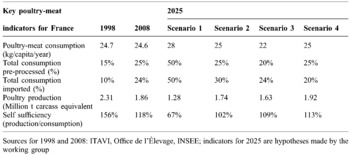
Indicators for the scenarios for France.

Sources for 1998 and 2008: ITAVI, Office de l’Élevage, INSEE; indicators for 2025 are hypotheses made by the working group
None of the scenarios foresees a revival of French poultry production. On the contrary, the corresponding figures (Table 1) reveal difficulties sustaining current levels of production given possible trends in consumption, a decrease in exports and, in some cases, an increase in imports. However, except in Scenario 1, France retains self-sufficiency for poultry meat.
Some lessons from the scenarios
The conclusions drawn from the scenarios relate mainly to the French poultry sector, but the scenarios themselves appear relevant to the entire European poultry sector. For the purposes of this paper, and in order to widen the debate, we will focus on common issues and strategic options throughout the European sector, especially those relating to research.
All four scenarios highlight advantages of poultry meat likely to sustain its consumption, given multiple changes in consumer behaviour. Still, this is not enough to maintain European production, which is less price-competitive than competitors’ products. For instance, the difference in production costs between the European and Brazilian poultry industries is about 50% (Van Horne, Reference VAN HORNE2009). This gap is unlikely to be reduced significantly by 2025, which means that the long-term survival of European production will rely either on protectionist measures (tariff barriers or production norms identical to those imposed on European producers) or on the promotion of non-price related criteria such as the quality, proximity or freshness of products. A supranational reinforcement and structuring of the European poultry sector also could help to deal more effectively with competition.
Many jobs depend on the maintenance of this sector, particularly in areas with a high density of poultry farming. In countries such as France, where the number of livestock farmers is decreasing due to retirement and farm specialisation, it may be possible to cushion the social impact of this decline. In several European regions, however, geographical reorganisation of production could be limited by the lack of farmers, particularly in regions where poultry farming is less common. Thus, promoting poultry farming by emphasising its acceptability by neighbours, its lack of difficulty compared to other livestock production, and its ability to generate income could become a major goal.
The environmental issues at stake need consideration, whether with regard to the protection of local natural resources or the global effort against climate change. Reducing the pressure of poultry farming may decrease local problems, as in Scenario 1, where overall production decreases, and Scenario 3, where it is distributed across the entire territory. Conversely, further concentrating production in regions already having a high density of poultry farming could intensify environmental concerns and impacts, which may result in stricter regulations. Yet deconcentrating poultry farming would have other consequences, as it would require new buildings and could be slowed by opposition from local communities and increased distances from zones of production or importation of poultry-feed ingredients.
Climate change plays an important role in Scenarios 3 and 4. In Scenario 3, the Eurocentric focus does not help to reduce the risks of worsening global environmental problems, but does improve protection of local resources and energy consumption. In Scenario 4, international coordination guarantees a global impact of environmental measures, but also raises the issue of competition for food between human beings and livestock, as well as among livestock species themselves. In this context, the low feed-conversion ratio of poultry puts it at an advantage, but poultry require cereals (unlike grazing cattle) and do not fare as well as pork on agricultural by-products. The scenarios thus raise the issue of the definition of environmental sustainability and how it is perceived by consumers. It is necessary to specify the primary concerns for poultry production (e.g. carbon footprint, biodiversity conservation, landscape preservation, pollution control). The coexistence of multiple criteria and differing corporate strategies risks confusing consumers and frustrating producers’ efforts to improve the quality of their products.
In its economic, social and environmental dimensions, the sustainability of poultry farming is becoming an important aspect of food production and security, set against a background of mounting concern over how to feed a growing human population without jeopardising the renewal of natural resources. Faced with food-safety and animal-welfare issues, there are real incentives for production to develop synergies between these three dimensions wherever possible; otherwise, organisational and technological innovations will be necessary. Scenario 3 addresses some of the difficulties involved, such as increasing egg production while at the same time forbidding most battery-cage farming. Such a challenge can be met only through the improvement of production systems; for example, aviaries (multi-tier non-cage systems) may be one solution to explore to meet these constraints. Other difficulties arise in re-establishing a geographical balance of production density across a territory, particularly when it comes to promoting production systems that combine cereal and livestock production or use short supply chains.
Solutions to reconcile conflicting production objectives cannot ignore European citizens’ general dislike of factory farming, currently a weak point in poultry production. Will consumers be prepared to accept factory farming, even with stronger environmental regulations, as in Scenario 4? Or will they prefer free-range or organic products using slower-growing animals, as in Scenario 3, even if the increased feed consumption creates products with a higher carbon footprint?
Implications for research
In the 1960s, innovations in the fields of genetics, animal feed, animal health, and farm buildings and equipment constituted the major factors accounting for the development of poultry production in Europe and North America (Boyd, Reference BOYD2001). In Europe, research and development gradually broadened, along with the evolution of market trends, regulations and consumer demands regarding animal welfare and food safety (hygiene, preservation and traceability of products), product convenience, and the economic, social and environmental sustainability of production systems (notably waste management). The scenarios confirm the relevance of current research orientations, and reinforce those that improve sustainability, influence product quality and food safety, and organise and regulate the sector.
Addressing issues of sustainability requires developing both innovative livestock farming systems and sustainability indicators that can accommodate contradictory demands. Paths for improving the sustainability of European production systems include:
• identifying new animal-feed ingredients that reduce cereal use and dependence on soya imports;
• considering animal welfare in the selection of livestock and farming conditions;
• making poultry farming a more attractive profession, since its working conditions and income depend on the sector's economic performance and the sharing of added valueFootnote ‡.
Product quality requires objective evaluation criteria, especially in a context of strong competition where product differentiation is crucial for domestic production. These criteria should be relevant, reliable and indisputable, easy to measure, and understandable to consumers. Research on chicken-meat characteristics should be extended to other poultry species and to all production stages of the sector. The scenarios emphasise the importance of multi-criteria assessment of product quality (e.g. sensory, technological, nutritional), regardless of the type of commercialisation or consumption. In all cases, the socio-economic aspects of poultry consumption should be taken into account to increase recognition of quality criteria by consumers and retailers. To optimise multi-criteria goals, research should analyse the influence of breeding and slaughtering methods, genetic capacities, processing methods, etc. At the same time, processes to guarantee food safety are also important. The production stages to target with additional research need to be considered in advance, however, as applying such processes upstream in the supply chain can strengthen the French or European poultry sector (as in Scenario 2), whereas aiming downstream could encourage imports. These changes will influence retailer strategies by helping them to guarantee product quality and modify stock management. In addition, it seems important to increase socio-economic research on the impact of commercial policies, production regulations, and contract systems. In many countries, relations between the poultry sector and farmers are characterised by integration (or rather, ‘quasi-integration,’ since farmers retain ownership of buildings and sometimes of poultry). While such organisation has adapted supply to demand effectively, it does not always permit on-farm optimisation of technical performance. Comparing the strengths and weaknesses of the variety of existing European poultry systems would have the potential to change the ways in which this sector is organised.
Finally, sociological research on poultry farming and its attractiveness would improve understanding of the factors (economic or not) which influence production decisions. This, in turn, would suggest ways to improve the living conditions of poultry farmers. At the same time, it is important to develop a system to characterise the quality of poultry products and, by extension, that of the poultry farming profession. In summary, these research perspectives require both multidisciplinary approaches to identify potential solutions and objective criteria by which to evaluate production systems. Subsequently, the research results should be transferred to other stakeholders, who can apply them to production systems with the aim of improving their future and consequently that of the European poultry sector.