Ground-dwelling ants should occur at both higher densities and species numbers where there is greater availability of nesting sites and biomass of nutrient-rich leaf litter (McGlynn et al. Reference McGlynn, Fawcett and Clark2009, Queiroz et al. Reference Queiroz, Ribas and França2013). These ants play a key role in litter processes because they alter the physical and chemical environment and affect the presence of other organisms such as their invertebrate prey (Armbrecht et al. Reference Armbrecht, Perfecto and Vandermeer2004). Ants are active foragers and can extend their foraging range into the canopy (Hashimoto et al. Reference Hashimoto, Morimoto, Widodo, Mohamed and Fellowes2010, Longino & Nadkarni Reference Longino and Nadkarni1990). In fact, typically epigeic ant species have also been reported nesting in epiphytes that accumulate organic matter in the canopy at heights exceeding 25 m (DaRocha et al. Reference DaRocha, Neves, Dáttilo and Delabie2016, Klimes et al. Reference Klimes, Fibich, Idigel and Rimandai2015).
The leaves, small branches and detritus accumulating in the rosettes of understorey plants provide favourable conditions for ground-dwelling ants, including newly fertilized founder females that may use suspended litter as nesting sites (Fernandes et al. Reference Fernandes, Silva, Souza, Araújo and Morini2012, Paoletti et al. Reference Paoletti, Taylor, Stinner, Stinner and Benzing1991). However, the suspended stratum has been shown to support fewer ant species than the ground, despite the overlap in species composition between these microhabitats (Longino & Nadkarni Reference Longino and Nadkarni1990). Differences in the amount of associated organic matter (Wilkie et al. Reference Wilkie, Mertl and Traniello2010), habitat location and suspended litter size (Campos et al. Reference Campos, Vasconcelos, Ribeiro, Neves and Soares2006, DaRocha et al. Reference DaRocha, Neves, Dáttilo and Delabie2016, Klimes et al. Reference Klimes, Fibich, Idigel and Rimandai2015) may directly affect the occurrence of nesting sites, food resources and refuges for ground-dwelling ants.
In this study, we compared the ant fauna associated with the suspended litter stratum (here called suspended litter) and that of the ground immediately below (here called ground litter) Erythrochiton brasiliensis (Rutaceae), a tropical understorey treelet that traps considerable amounts of litter in its leaf rosettes (Figure 1). We hypothesized that the ant fauna in the suspended litter would vary depending on plant size and accumulated litter biomass. Specifically, we predicted (1) that the suspended litter might support fewer worker ants and ant species than the litter on the ground and that the suspended-litter ant assemblage should be a subset of the ground litter ant assemblage; (2) that species turnover between the ground and the suspended litter (here called suspended ground pairs) would increase with the distance between strata (plant height); and (3) that ant species richness should be higher in taller plants that, consequently, should accumulate more biomass.
Schematic drawing of Erythrochiton brasiliensis Nees & C. Martius (Rutaceae), a treelet species commonly found in the understorey of Neotropical forests. It has a rosette that can trap considerable amounts of leaf litter around the tip of the trunk.

We carried out this study in Rio Doce State Park (Parque Estadual do Rio Doce – PERD) Minas Gerais state, Brazil (19°29′S, 42°28′W). The main vegetation type is semi-deciduous seasonal forest characterized by 20–50% deciduous trees (Veloso et al. Reference Veloso, Filho and Lima1991). The climate is tropical wet, Aw (tropical hot semi-humid), with a dry season from April to September, a rainy season from October to March, and annual rainfall ranging from 1350–1900 mm (Alvares et al. Reference Alvares, Stape, Sentelhas, Gonçalves and Sparovek2013). Our focal area, called the Vinhático trail, encompassed mature forest with large trees reaching up to 40 m and an understorey with small trees, treelets and shrubs (Campos et al. Reference Campos, Vasconcelos, Ribeiro, Neves and Soares2006), in which E. brasiliensis occurs in a clumped fashion, forming population patches in shaded areas.
In July 2013, during the dry season, we selected 30 E. brasiliensis individuals spaced from 5 m to 150 m apart. Paired samples of litter were taken from each E. brasiliensis individual; one sample consisted of the suspended litter resting on leaves and the other was taken from the ground immediately below (ground litter) in a 0.3 × 0.3-m quadrat. Ants were extracted from litter samples using the mini-Winkler extractor technique, for 48 h (Agosti & Alonso Reference Agosti, Alonso, Agosti, Majer, Alonso and Schultz2000). We measured the height and number of leaves of all E. brasiliensis individuals and weighed each litter sample (dry weight biomass). We used generalized linear models (GLMs), with number of worker ants and species richness per unit biomass as response variables and the two strata (ground and suspended litter) as the explanatory variables. We calculated the contribution of species turnover and nestedness to β-diversity using the Sørensen (βSOR) and Simpson (βSIM) indices (Baselga Reference Baselga2010). The total species loss due to nestedness (βNES) is given by differences between those indices (βNES = βSOR − βSIM). We performed the analysis on the entire ant fauna between ground and suspended samples and, separately, each suspended ground pair using the ‘beta.multi’ function in the betapart package in R version 3.2.5. We used GLMs with the contribution of species turnover between the suspended ground pair as the response variable and plant height (distance between strata) as the explanatory variable. To determine the effect of suspended litter structure on species richness, we first investigated the relationship between explanatory variables (plant height, number of leaves and biomass) using correlation analysis. Collinear variables – Pearson’s correlation coefficient (r) > 0.7 – were grouped into a single explanatory variable in the same GLM, using ant species richness as the response variable. All analyses were performed using R 3.2.5 software.
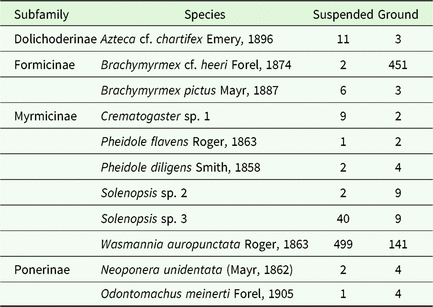
Total ant species richness was higher in the ground litter (24 species) than in the suspended litter (13 species). However, even though ground litter biomass was three times higher (0.12 ± 0.1 kg; range = 0.02–0.38 kg) than suspended litter biomass (0.04 ± 0.02; range = 0.01–0.20 kg), the mean species richness (P = 0.47) and mean abundance (P = 0.63) per unit biomass were not significantly different between the strata. Wasmannia auropunctata accounted for 49% of all ants and its number in the suspended litter was three-fold higher than in ground samples, whereas Brachymyrmex heeri accounted for 33% of the ants, but only two worker ants were collected in suspended litter (Table 1). Both ant species are very conspicuous in the ground litter in the region (Castro et al. Reference Castro, Gontijo, Castro and Ribeiro2012). In effect, the habitat requirements and food resources used by these two species are similar (Brandão et al. Reference Brandão, Silva, Delabie, Panizzi and Parra2012). However, W. auropunctata was reported by previous studies as the dominant species in disturbed areas, which reflects this species’ effective use of mass recruitment and nesting adaptations for several substrates, including many plant species (Achury et al. Reference Achury, Ulloa-chacón and Arcila2008, Armbrecht & Ulloa-Chacón Reference Armbrecht and Ulloa-chacón2003, Foucaud et al. Reference Foucaud, Rey, Robert, Crespin, Orivel, Facon, Loiseau, Jourdan, Kenne, Masse, Tindo, Vonshak and Estoup2013). It is likely that colonies of W. auropunctata gained some advantage by using the suspended litter stratum to nest within the vegetation.
Total ant number and species sampled in the suspended- and ground-litter strata, in Rio Doce State Park (PERD), south-east Brazil

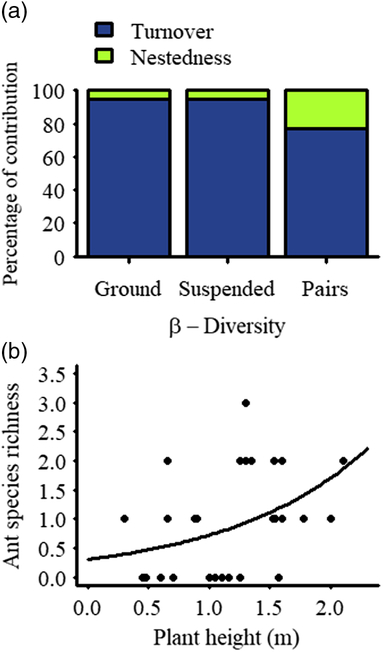
We found high turnover and low nestedness among ground litter samples (βSIM = 0.89, βSOR = 0.94, 94.7% of ant species turnover) and suspended litter samples (βSIM = 0.91, βSOR = 0.96, 94.8% of ant species turnover). However, the mean of ant species turnover (βSIM = 0.62, βSOR = 0.80, 77% turnover) decreased when suspended ground pairs were compared (Figure 2a). This result highlights the high spatial heterogeneity of the litter ant assemblage, as previously reported by Castro et al. (Reference Castro, Gontijo, Castro and Ribeiro2012). Nevertheless, we found that the majority of the ant species present in the suspended litter formed a subset of the ant assemblage present in the ground litter. In fact, there were 13 ant species unique to the ground litter, but only two ant species (Camponotus crassus and Crematogaster cf. limata) unique to the suspended litter, and the two strata shared 11 ant species.
The contribution of turnover and nestedness to ant species β-diversity in ground litter and suspended litter and the mean of ant species turnover and nestedness among suspended-ground pairs (a). The relation of ant species richness with plant height (b) in Rio Doce State Park (PERD), south-east Brazil.

The distance between suspended and ground litter (plant height) ranged from 0.3–2.1 m and did not affect species turnover between strata (P = 0.74). A total of 13 suspended ground pairs lacked species in one of the strata and these were excluded from the analysis because this analysis requires species to be shared between the strata (Baselga Reference Baselga2010). We found that epigeic ants can occur at different heights in the vegetation, depending on the presence of suspended litter. A similar result was reported by DaRocha et al. (Reference DaRocha, Neves, Dáttilo and Delabie2016), which collected epigeic ants at heights up to 25 m, from bromeliads in the canopy that accumulate organic matter.
The number of leaves was positively correlated with plant height (Pearson’s correlation coefficient r = 0.77, P < 0.01), whereas biomass of suspended litter was not significantly correlated with plant height (Pearson’s correlation coefficient r = 0.34, P = 0.06). We found that plant height (Poisson: Deviance [1.28] = 4.16, P = 0.04; Figure 2b), but not suspended litter biomass (P = 0.53), was important in determining ant species richness in the suspended litter. The increase in plant height and number of leaves taken together (collinear variables) resulted in an increased number of microhabitats and ways of exploiting litter resources (Campos et al. Reference Campos, Vasconcelos, Ribeiro, Neves and Soares2006, DaRocha et al. Reference DaRocha, Neves, Dáttilo and Delabie2016, Klimes et al. Reference Klimes, Fibich, Idigel and Rimandai2015). Hence, changes in environmental conditions resulting from increased plant size may promote higher ant species richness regardless of litter biomass (Campos et al. Reference Campos, Vasconcelos, Ribeiro, Neves and Soares2006, DaRocha et al. Reference DaRocha, Neves, Dáttilo and Delabie2016, Klimes et al. Reference Klimes, Fibich, Idigel and Rimandai2015). The occurrence of arboreal ant species (e.g. Azteca and Crematogaster) in suspended litter from tall plants indicates the presence of microhabitat conditions and resources that are similar to those found in trees (Brandão et al. Reference Brandão, Silva, Delabie, Panizzi and Parra2012, Hashimoto et al. Reference Hashimoto, Morimoto, Widodo, Mohamed and Fellowes2010).
Our results reveal that suspended litter in the forest understorey can provide the conditions for specialized ground-dwelling ants to forage and nest, functioning as a vertical extension of resources and microhabitat conditions present in the ground litter. Further, such microhabitats also provide suitable conditions for arboreal ants that usually forage on vegetation near the ground. Further studies at broader scales might show that the contribution of suspended leaf litter to the maintenance of ant diversity in tropical forests could be greater than previously thought.
Author ORCID
Luiz Eduardo Macedo-Reis https://orcid.org/0000-0001-9082-0245
Acknowledgements
We thank Flavio S. Castro for ant identification and Thiago Tropia for the schematic drawing. We thank PPG–ECMVS for the opportunity to conduct fieldwork during the Field Ecology Course 2013. We thank PERD and GSG for logistical support. FSN acknowledges financial support from CNPq and FAPEMIG.