Introduction
Climatic and edaphic factors are the main determinants of plant species’ distributions (Cain Reference Cain1944). It has been suggested that if global temperatures increase 1 °C, the ecological zones on Earth will move 160 km poleward (Thuiller Reference Thuiller2007). As the climate is currently rapidly changing, there has been an increasing interest in predicting species’ potential future distributions (Chen et al. Reference Chen, Hill, Ohlemuller, Roy and Thomas2011; Ren et al. Reference Ren, Zagorchev, Ma, Yan and Li2020; Speed et al. Reference Speed, Austrheim, Hester and Mysterud2011; Walther et al. Reference Walther, Post, Convey, Menzel, Parmesan, Beebee, Fromentin, Hoegh-Guldberg and Bairlein2002). Indeed, many studies have shown that climate change will directly or indirectly affect species distribution patterns. Such information is vital to develop long-term conservation strategies and to manage weeds and other pests in agriculture (Gomes et al. Reference Gomes, Bianchi, Cardoso, Fernandes, Filho and Schulte2020; Jayasinghe and Kumar Reference Jayasinghe and Kumar2019; Ma and Sun Reference Ma and Sun2018; Oteros et al. Reference Oteros, Garcia-Mozo, Vazquez, Mestre, Dominguez-Vilches and Galan2013; Qin et al. Reference Qin, Liu, Guo, Bussmann, Ma, Jian, Xu and Pei2017; Wan and Wang Reference Wan and Wang2019; Wang and Wan Reference Wang and Wan2020; Yi et al. Reference Yi, Cheng, Yang and Zhang2016). Of the approximately 4,750 parasitic plant species, many are major pests in agricultural crops (Hershey Reference Hershey1999; Marvier Reference Marvier1996; Nickrent Reference Nickrent2020; Press and Phoenix Reference Press and Phoenix2010). How the distributions of parasitic plants and their host crops might change with ongoing climate change remains largely unknown.
Previous studies on parasitic plants have mainly focused on their physiology, species conservation, and weed control (Bouwmeester et al. Reference Bouwmeester, Sinha and Scholes2021; Liu et al. Reference Liu, Yang, Wei, Zhang, Zhang, Zhang and Gu2019; Ren et al. Reference Ren, Zagorchev, Ma, Yan and Li2020; Wang et al. Reference Wang, Cui, Duan, Chen, Fan, Lu and Zheng2019; Zhang et al. Reference Zhang, Chen, Tian, Li, Wang and Yang2016). In recent years, there has also been an increase in research on the relationships between the distributions of parasites and those of their hosts (Lira-Noriega and Peterson Reference Lira-Noriega and Peterson2014; Liu et al. Reference Liu, Yang, Wei, Zhang, Zhang, Zhang and Gu2019; Yun et al. Reference Yun, Lee and Yoo2020). Understanding these relationships can provide important insights and enable forecasting of potential future distributions, which can guide conservation management, as well as pest control (Liu et al. Reference Liu, Yang, Wei, Zhang, Zhang, Zhang and Gu2019; Ren et al. Reference Ren, Zagorchev, Ma, Yan and Li2020).
Dodder (Cuscuta spp.) is a unique genus of approximately 200 mostly holoparasitic species in the Convolvulaceae family. At germination, Cuscuta species form a rudimentary and short-lived (approximately 4 to 5 d) root system before they connect to the host plant (Teixeira-Costa and Davis Reference Teixeira-Costa and Davis2021; Truscott Reference Truscott1966). Cuscuta can cause serious crop yield losses (Dawson et al. Reference Dawson, Musselman, Wolswinkel and Dorr1994; Li et al. Reference Li, Hu, Kong and Tan2007; Tepe et al. Reference Tepe, Celebi, Kaya and Ozkan2017). It is considered to be the third most detrimental genus of parasitic plants worldwide, after Striga and Orobanche, as it can infect nearly all dicotyledonous species and occurs in a wide variety of climates and ecosystems on all continents except Antarctica (Albert et al. Reference Albert, Belastegui-Macadam, Bleischwitz, Kaldenhoff, Lüttge, Beyschlag and Murata2008; Costea et al. Reference Costea, Spence and Stefanoviæ2011). Two legume crops that can be highly infected by Cuscuta are soybean [Glycine max (L.) Merr.] and alfalfa (Medicago sativa L.), both of which are cultivated on many continents for various economic uses, primarily because of their high protein content (Johnson et al. Reference Johnson, White and Galloway2008; Wang et al. Reference Wang, Li, Sun, Feng and Li2014). Recently, a species distribution modeling study by Ren et al. (Reference Ren, Zagorchev, Ma, Yan and Li2020) showed that the suitable range size of soybean dodder (Cuscuta chinensis C. Wright) may decline in response to climate change. However, it remains unknown how the distribution of some of its major host crop species as well as the distribution of other Cuscuta pest species might change.
Cuscuta species are usually generalists; they can use multiple species from different families as host plants (Kelly et al. Reference Kelly, Venable and Zimmerer1988). Many Cuscuta species have strong preferences for legumes, likely because these hosts have high nitrogen content (Kelly et al. Reference Kelly, Venable and Zimmerer1988; Pennings and Callaway Reference Pennings and Callaway2002). Therefore, the legumes soybean and alfalfa are important hosts for the Cuscuta species that co-occur with them. Cultivated soybean, with its main distribution in eastern Asia, is an important host for C. chinensis (Flora of China Editorial Committee 1995) and for Peruvian dodder [Cuscuta australis R. Br.]. Alfalfa, with its main distribution in Europe, is an important host for alfalfa dodder (Cuscuta europaea L.) (Flora of China Editorial Committee 1995) and for smoothseed alfalfa dodder (Cuscuta approximata Bab.) (Yergin-Ozkan and Tepe Reference Yergin-Ozkan and Tepe2018). However, it is likely that soybean and alfalfa can both be infected by all four of these Cuscuta species, as well as by others. For example, although Japanese dodder (Cuscuta japonica Choisy) is frequently found on shrubs, experiments have shown it can also grow on soybean and alfalfa.
In this study, we modeled the potential current and future environmentally suitable ranges of five Cuscuta species and two of their major host crops (soybean and alfalfa). For future suitable ranges, we used the year 2070 to make our study more comparable to other studies (Carlson et al. Reference Carlson, Albery, Merow, Trisos, Zipfel, Eskew, Olival, Ross and Bansal2022; Gwendolyn Reference Gwendolyn2022; Tang et al. Reference Tang, Dong, Herrando-Moraira, Matsui, Ohashi, He, Nakao, Tanaka, Tomita, Li, Yan, Peng, Hu, Yang and Li2017, Reference Tang, Ohashi, Matsui, Herrando-Moraira, Dong, Li, Han, Huang, Shen, Li and López-Pujol2020; Velazco et al. Reference Velazco, Svenning, Ribeiro and Laureto2021). We used species distribution models (SDMs) to assess the potential distributional range under current and future climate scenarios (Liu et al. Reference Liu, Yang, Wei, Zhang, Zhang, Zhang and Gu2019). We then explored the potential current and future overlap in suitable areas between the parasites and hosts. This study addresses the following specific questions: (1) Does climate change affect the environmental suitability of the parasites and their host species? (2) Does climate change affect the overlap of suitable environments between the parasites and their host species?
Materials and Methods
Species Occurrence Data
The occurrence points for the five parasitic species (C. approximata, C. australis, C. chinensis, C. europaea, and C. japonica) and the two crop species (soybean and alfalfa) were obtained from the Global Biodiversity Information Facility (GBIF; https://www.gbif.org). In addition, because some important distribution data from China are not included in GBIF, occurrence data from the National Specimen Information Infrastructure (http://www.nsii.org.cn, accessed on September 20, 2018), the Chinese Virtual Herbarium (http://www.cvh.org.cn, accessed on September 20, 2018), and the Plant Photo Bank of China (http://ppbc.iplant.cn, accessed on September 20, 2018) were obtained. Each record was assigned to a 2.5′ grid cell (approximately 4.3 km × 4.3 km) (Ren et al. Reference Ren, Zagorchev, Ma, Yan and Li2020). Duplicate records within the same grid cells and potentially invalid records were excluded. Records for which both longitude and latitude were zero or longitude and latitude values were identical were deemed potentially invalid, as they probably represent erroneous repetitive data entries (Wang and Wan Reference Wang and Wan2020; Warren et al. Reference Warren, Glor and Turelli2010). The final distribution records of C. approximata (204 occurrences), C. australis (251), C. chinensis (377), C. europaea (5,748), C. japonica (621), soybean (1,285), and alfalfa (11,070) were used in combination with environmental variables (see next section) to model the potential distributions of the seven species (Supplementary Table S1). The Kernel density tool from the spatial analysis toolbox of ArcGIS v. 10.2 (ESRI, Redlands, CA, USA) was used to estimate the current distribution areas for the seven target species (Supplementary Figure S1).
Environmental Variables
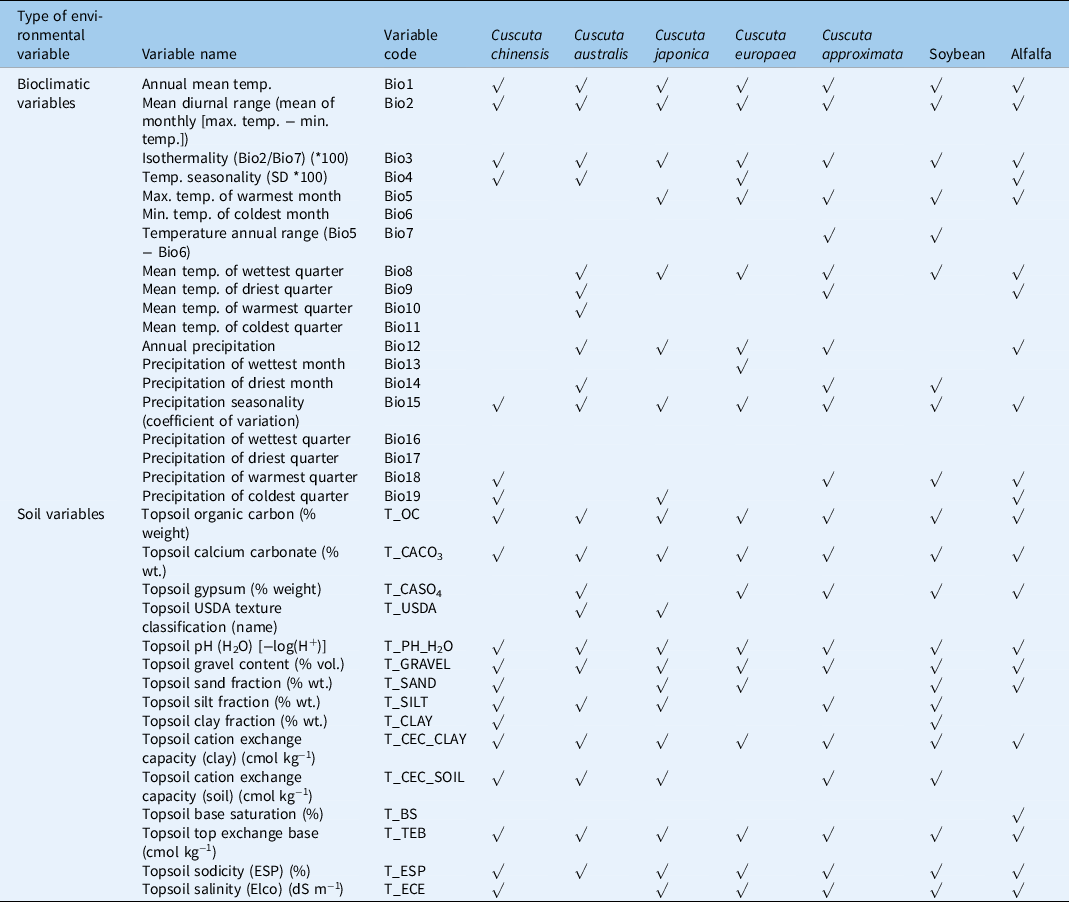
To model the currently suitable areas of the species, all 19 bioclimatic variables (Table 1) were extracted for the period 1960 to 1990 from the WorldClim database (http://www.worldclim.org) at a 5′ resolution. This period was used because it covers the period in which many of the species occurrence data were collected. As edaphic factors may also codetermine species’ distributions, 15 soil variables (Table 1) were extracted at 0.5′ resolution from the SoilGrids database (http://soilgrids.org). Little is known about the important edaphic factors for Cuscuta. Although Cuscuta has only a very short soil-bound phase (Truscott Reference Truscott1966), edaphic factors could indirectly determine Cuscuta distributions by affecting the distribution of their hosts. To make the resolutions of the climatic and soil variables match, the soil variable data were aggregated at a resolution of 5′ using ArcGIS.
Environmental variables used for predicting the potential distributions of the five parasitic and two host plants.

Abbreviations: ESP, Exchangeable sodium percentage; Elco, Electric conductivity.
To avoid severe multicollinearity among the bioclimatic variables in the SDMs, calculated Pearson correlation coefficients were calculated for all pairs of bioclimatic and soil variables. Then, for each pair of variables with a Pearson correlation coefficient |r| > 0.75, the variable with the lowest contribution was removed from the final SDMs (Dormann et al. Reference Dormann, Elith, Bacher, Buchmann, Carl, Carré, Marquéz, Gruber, Lafourcade, Leitão, Münkemüller, McClean, Osborne, Reineking and Schröder2013; Du and Chen Reference Du and Chen2010; Sun et al. Reference Sun, Shi, Peng, Zhu, Liu, Wu, He and Chen2014; Yi et al. Reference Yi, Cheng, Yang and Zhang2016).
To model the potential future suitable ranges of the species in 2070, forecast values of the 19 bioclimatic variables were extracted from WorldClim for the period 2061 to 2080. These forecast values are based on four different representative concentration pathways (RCPs), which are different scenarios of greenhouse gas concentration trajectories developed by the Intergovernmental Panel on Climate Change (IPCC) (Ma and Sun Reference Ma and Sun2018). Here, climate change forecasts based on RCPs 2.6, 4.5, 6.0, and 8.5, which represent net radiative forcings of 2.6, 4.5, 6.0, and 8.5 W m−2 by the end of the year 2100 (John et al. Reference John, Christian, Mikiko, Jiang, Nakicenovic, Shukla, La and Gary2009; Moss et al. Reference Moss, Babiker, Brinkman, Calvo, Carter, Edmonds, Elgizouli, Emori, Erda, Hibbard, Jones, Kainuma, Kelleher, Lamarque and Manning2008) and the CCSM4 global climate model (IPCC Reference Stocker, Qin, Plattner and Midgley2013) were used.
Environmental Suitability Modeling
MaxEnt v. 3.4.1 (https://biodiversityinformatics.amnh.org/open_source/maxent) was used to model environmentally suitable ranges of the five parasitic plant species and the two host crop species under current and potential future (2070) climates by relating the occurrence records to the climatic and soil variables (Evangelista et al. Reference Evangelista, Kumar, Stohlgren and Young2011; Phillips et al. Reference Phillips, Anderson and Schapire2006, Reference Phillips, Anderson, Dudík, Schapire and Blair2017). For each species, the occurrence and environmental variables were used to run the MaxEnt models with 30 replicates using the bootstrap method (Efron Reference Efron1979). The MaxEnt models were run with a convergence threshold of 10−5, a maximum number of iterations of 500, a maximum number of 10,000 background points (Phillips and Dudik 2008), and a regularization parameter value of 1 (Radosavljevic and Anderson Reference Radosavljevic and Anderson2013). The auto-feature option and the logistic output format were used. Other settings were the same as described in Merow et al. (Reference Merow, Smith and Silander2013). In each of the 30 replicates per species, 10% of the total database was randomly selected as test data, with the remaining data (90%) used as training data to evaluate the accuracy and quality of the model predictions. Then, model accuracy was tested using the area under the curve (AUC) of the receiver operating characteristic as implemented in MaxEnt (Phillips et al. Reference Phillips, Anderson and Schapire2006). The AUC can vary from 0.5 to 1, and a larger AUC value indicates a higher discrimination (Yi et al. Reference Yi, Cheng, Yang and Zhang2016). Based on the AUC values, model performance is categorized as insufficient (0.5 to 0.6), poor (0.6 to 0.7), average (0.7 to 0.8), good (0.8 to 0.9), or excellent (0.9 to 1) (Swets Reference Swets1988).
Predicting the Suitable Area of Species under Global Climate Change
Among the available tools for SDMs, the maximum entropy (MaxEnt) approach is one of the most widely used, as it does not require absence data points (Brambilla et al. Reference Brambilla, Caprio, Assandri, Scridel, Bassi, Bionda, Celada, Falco, Bogliani, Pedrini, Rolando and Chamberlain2017; Liu et al. Reference Liu, Yang, Wei, Zhang, Zhang, Zhang and Gu2019; Ren et al. Reference Ren, Zagorchev, Ma, Yan and Li2020). Based on the MaxEnt output results, ArcGIS was used to map the predicted suitable areas for the five parasitic and two crop species at the global scale. The environmental suitability of a location, as predicted by the MaxEnt model, varied from 0 to 1. The Jenks’s natural breaks method in ArcGIS was used to convert the environmental suitability scores of MaxEnt to suitability maps with four categories of suitability based on the 10th percentile training presence logistic threshold (marginal value): optimally suitable area (>0.6), intermediately suitable area (0.4 to 0.6), marginally suitable area (marginal value to 0.4), or unsuitable area (less than the marginal value; Wan et al. Reference Wan, Wang, Han and Yu2014; Yang et al. Reference Yang, Kushwaha, Saran, Xu and Roy2013). Then, the raster calculator in ArcGIS was used to calculate the area of the potential geographic distributions of the seven species.
Environmental Niche Overlap Analysis
Schoener’s (1968) D, implemented in ENMTools, was used to measure niche overlap between pairs of parasitic and crop species (Jiao et al. Reference Jiao, Zeng, Sun and Lei2016; Legault et al. Reference Legault, Theuerkauf, Chartendrault, Rouys, Saoumoé, Verfaille and Gula2013; Warren et al. Reference Warren, Glor and Turelli2008). Schoener’s D values can range from 0 to 1, with values closer to 0 representing a small degree of niche overlap, and values closer to 1 representing a high degree of niche overlap (Warren et al. Reference Warren, Glor and Turelli2008, Reference Warren, Glor and Turelli2010). Based on the predictions of the MaxEnt models, the areas with potential niche overlap of the five parasitic plant species and the two host plant species were visualized for the suitability area (the combination of the marginally, intermediately, and optimally suitable areas) in ArcGIS. The MaxEnt model with the highest performance was selected, and then the Reclassify tool in ArcGIS was used to convert the potential distribution area into 0/1 raster files, where 0 indicates unsuitable and 1 indicates suitable. After that, the raster calculator of ArcGIS was used to overlay the environmental suitability results of each pair of species to identify the potential overlapping distribution areas.
Results and Discussion
Current Global Distribution
Kernel density estimation maps of the current records of the five parasitic species and the two host species are shown in Supplementary Figure S1. In the final SDMs, the number of bioclimatic variables ranged from 7 (C. japonica) to 10 (alfalfa), and the number of soil variables ranged from 10 (C. europaea) to 13 (soybean; Table 1; Supplementary Figure S2). Among the bioclimatic variables, the annual mean temperature (Bio1) was important in the SDMs of all species (Supplementary Figure S3). Among the soil variables, the topsoil gravel content was important in the SDMs of all species (Supplementary Figure S3). The mean value and standard deviation of the AUCs for the models developed for C. approximata, C. australis, C. chinensis, C. europaea, C. japonica, soybean, and alfalfa were 0.994 ± 0.002, 0.970 ± 0.010, 0.980 ± 0.006, 0.965 ± 0.010, 0.984 ± 0.003, 0.950 ± 0.007 and 0.927 ± 0.001, respectively, indicating excellent model performance.
We found that for all seven species, the bioclimatic variables were more important determinants of their distributions than soil variables. For the Cuscuta species, which are stem parasites and do not grow in the soil (at least not after having attached to a host stem), this is not surprising, as the soil should only affect them indirectly through the soil preferences of their hosts. Among the climatic factors, the annual mean temperature (Bio1) was a particularly strong determinant of the environmental suitability for all seven species. For some species, isothermality (Bio3, Supplementary Figure S3) also played a strong role. Similarly, Ren et al. (Reference Ren, Zagorchev, Ma, Yan and Li2020) showed for C. chinensis that annual mean temperature and isothermality were the most important climatic factors determining the suitable environment. In other words, our study showed that the seven species are more sensitive to temperature variables than to precipitation variables. This could reflect that they might use crops that grow on irrigated lands as hosts and are therefore less restricted by natural precipitation.
Current and Future Suitable Areas
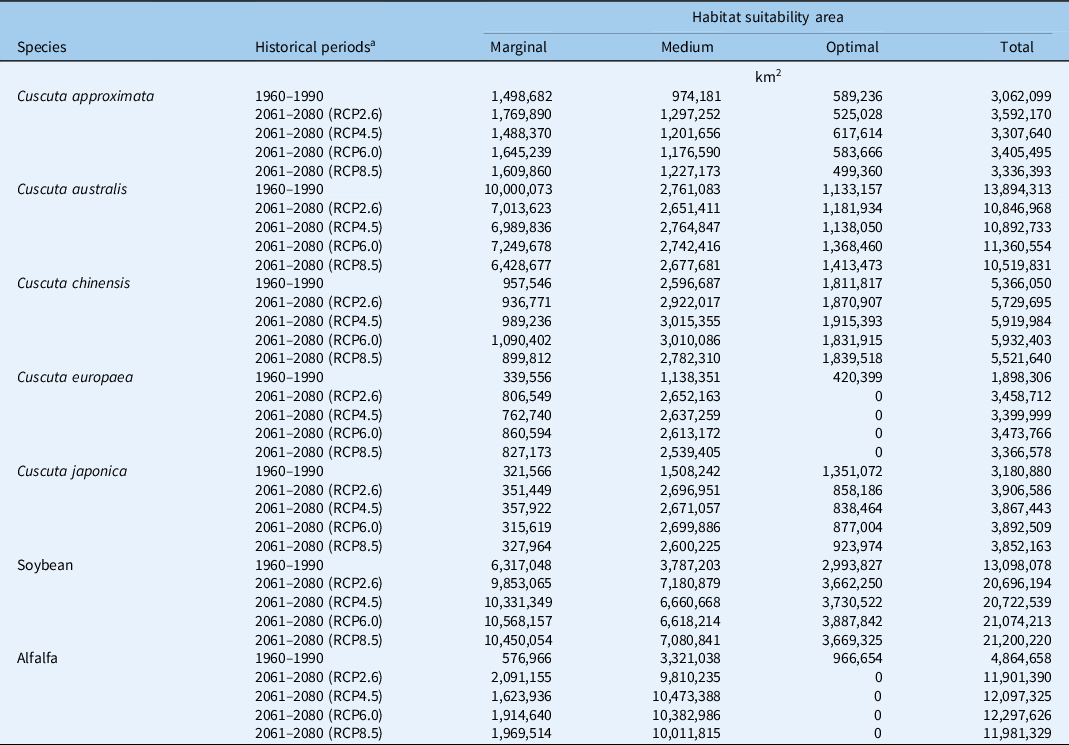
The host species soybean has most of its currently suitable area (marginally to optimally suitable area) in eastern Asia, Europe, and North America (Supplementary Figure S4a). By 2070, its suitable area will increase by 58.0% (RCP 2.6) to 61.9% (RCP 8.5), and its optimally suitable area will increase by 22.3% (RCP 2.6) to 30.0% (RCP 6.0; Table 2; Supplementary Figure S4). The other host species, alfalfa, has most of its currently suitable area in Europe, but also has some suitable area on other continents (Supplementary Figure S5a). Until 2070, its suitable area will increase by 144.7% (RCP 2.6) to 152.8% (RCP 6.0), but its optimally suitable area will completely disappear under all four scenarios (Table 2; Supplementary Figure S5). Its marginally to intermediately suitable area will not only increase in Europe, but also in other parts of the world, particularly in Australia, western North America, and southern South America (Supplementary Figure S5).
Sizes of the areas for the different suitability classes of the five parasitic and two host plants under the current climate and potential future climates in 2070.

a RCP, representative concentration pathway.
The parasitic species C. approximata has most of its currently suitable area in Europe, South America, South Africa, Pakistan, Iran, and Australia (Supplementary Figure S6a). Until 2070, its suitable area will slightly increase by 8.0% (RCP 4.5) to 17.3% (RCP 2.6), and its optimally suitable area will decrease by 15.3% (RCP 8.5) or increase up to 4.8% (RCP 4.5; Table 2; Supplementary Figure S6). Most of the currently suitable area for C. australis is in eastern Asia, Europe, South America, and Australia (Supplementary Figure S7a). Until 2070, its suitable area will decrease by 18.2% (RCP 6.0) to 24.3% (RCP 8.5), and its optimally suitable area will increase by 0.4% (RCP 4.5) to 24.7% (RCP 8.5; Table 2; Supplementary Figure S7). Most of the currently suitable area for C. chinensis is in eastern and southeast Asia, but it also has suitable areas on other continents (Supplementary Figure S8a). Until 2070, its suitable area will increase by 2.9% (RCP 8.5) to 10.6% (RCP 6.0), and its optimally suitable area will increase by 1.1% (RCP 6.0) to 5.7% (RCP 4.5; Table 2; Supplementary Figure S8). Most of the currently suitable area for C. europaea is in central China and Europe (Supplementary Figure S9a). Until 2070, its suitable area will increase by 77.3% (RCP 8.5) to 83.0% (RCP 6.0), but its optimally suitable area will completely disappear in all four scenarios (Table 2; Supplementary Figure S9). For C. japonica, most of its currently suitable area is in eastern Asia, but it also has suitable areas on other continents (Supplementary Figure S10a). Until 2070, its suitable area will increase by 21.1% (RCP 8.5) to 22.8% (RCP 2.6), and its optimally suitable area will decrease by 37.9% (RCP 4.5) to 31.6% (RCP 8.5; Table 2; Supplementary Figure S10).
The five Cuscuta species in our study are, like most species in this genus (Nickrent Reference Nickrent2020), holoparasitic plants that absorb nutrients, carbohydrate, and water from their host plants via haustoria (Albert et al. Reference Albert, Belastegui-Macadam, Bleischwitz, Kaldenhoff, Lüttge, Beyschlag and Murata2008; Zhang et al. Reference Zhang, Wang, Wang, Dong, Yuan, Yang, Lai, Zhang, Jiang and Li2020). Their distributions might thus be largely determined by the distributions of their hosts. Indeed, a previous study indicated that the environmental suitability of the host (soybean) can influence the environmental suitability of the parasite (C. chinensis; Ren et al. Reference Ren, Zagorchev, Ma, Yan and Li2020). That study also found that the parasite is likely to benefit from climate change, which is in agreement with our finding that four of the five Cuscuta species, just like the two Leguminosae hosts, are projected to have larger suitable ranges by 2070. The only exception was C. australis, but interestingly, although its suitable range will decrease, the percentage of this range that will be optimally suitable will actually increase. So this species might also benefit from climate change. On the other hand, while C. europaea and alfalfa are projected to have larger suitable ranges, they will no long have any optimally suitable areas, suggesting that overall they might not benefit strongly from climate change. It should be noted, however, that we only considered climatic and edaphic factors for predicting species’ distributions, although other factors (e.g., biological factors, human activities) may also restrict the potential distributions of the species (Guan et al. Reference Guan, Li, Ju, Lin, Wu and Zheng2021; Zou et al. Reference Zou, Ge, Guo, Zhou, Wang and Zong2020). In particular, as mentioned earlier, the parasitic species might be protected from climatic limitations (e.g., through irrigation of the crops) and from some biotic factors (e.g., competition alleviated by weeding). Therefore, our results only predict the potentially suitable area and not the area that will actually be occupied by the species in the future.
Changes in Environmental Niche Overlap between Parasitic and Host Plants
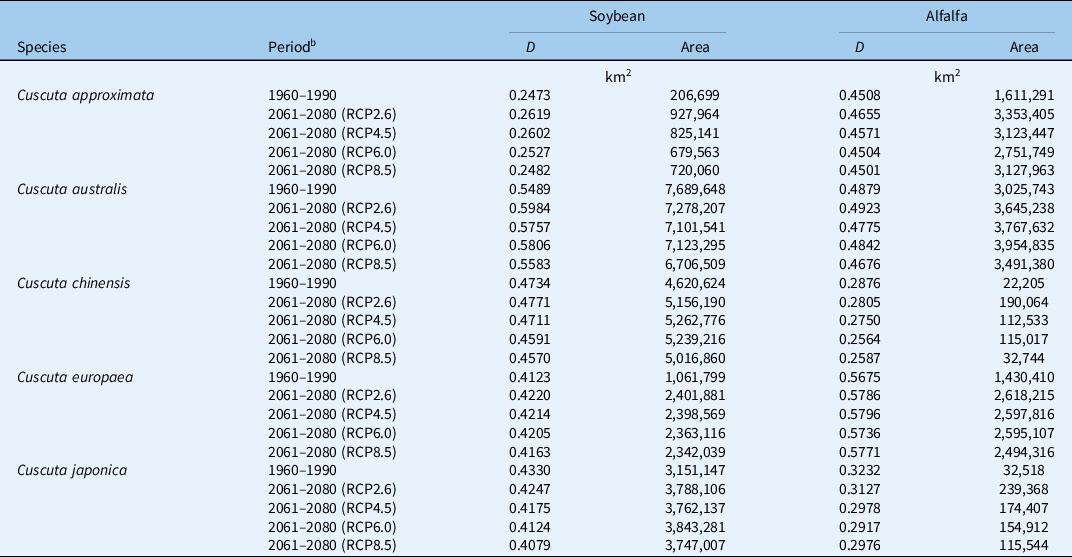
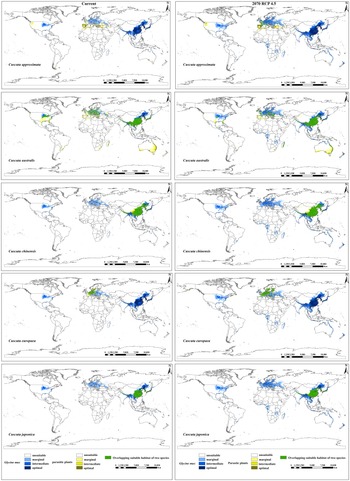
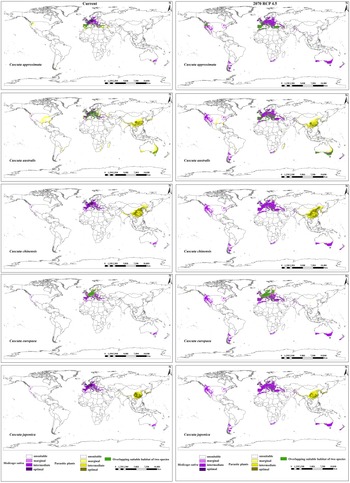
Based on Schoener’s D, as well as on the absolute area, the host species soybean currently has the largest niche overlap with C. australis and the lowest with C. approximata (Table 3; Figure 1; Supplementary Figures S11, S13, and S15). Based on Schoener’s D, the host species alfalfa currently has the largest niche overlap with C. europaea and the lowest with C. chinensis (Table 3; Figure 2; Supplementary Figures S12, S14, and S16). However, in terms of absolute area, alfalfa has the largest overlap with C. australis (Table 3).
Schoener’s D values and the absolute overlapping area between the five parasitic and two host plants in the current climate and under potential future climates in 2070. a

a Schoener’s D values can range from 0 to 1, with values closer to 0 representing a small degree of niche overlap, and values closer to 1 representing a high degree of niche overlap.
b RCP, representative concentration pathway.
Maps showing the overlap of suitable habitat between soybean and five Cuscuta species in the current climate (left) and potential future climatic scenario representative concentration pathway (RCP) 4.5 in 2070 (right). Based on the value of the 10th percentile training presence logistic threshold, four suitability categories were distinguished: optimally suitable area (>0.6), intermediately suitable area (0.4–0.6), marginally suitable area (marginal value–0.4), or unsuitable area (less than the marginal value).

Maps showing the overlap of suitable habitat between alfalfa and five Cuscuta species in the current climate (left) and potential future climatic scenario representative concentration pathway (RCP) 4.5 in 2070 (right). Based on the value of the 10th percentile training presence logistic threshold, four suitability categories were distinguished: optimally suitable area (>0.6), intermediately suitable area (0.4–0.6), marginally suitable area (marginal value–0.4), or unsuitable area (less than the marginal value).

By 2070, these patterns will remain largely the same for both host species, although there will be changes in the degree of overlap of the hosts with each of the five parasites, depending on the specific RCP scenario considered (Table 3) and on whether one considers the relative or the absolute overlap. For soybean, the relative niche overlap (Schoener’s D) will slightly decrease for a couple of Cuscuta species by RCP combinations (the strongest decrease will be −5.8% for the relative overlap with C. japonica in RCP 8.5), but in most cases will slightly increase (the strongest increase will be +9.0% for the relative overlap with C. australis in RCP 2.6; Table 3; Supplementary Figures S11 and S15). However, the absolute overlap of soybean will decrease for C. australis (by up to −12.8% for RCP 8.5) and increase for all other Cuscuta species (by up to +348.9% for C. approximata in RCP 2.6; Table 3; Supplementary Figures S11 and S15). Similarly, for alfalfa, the relative niche overlap will slightly decrease for about half of the Cuscuta species by RCP combinations (the strongest decrease will be −10.8% for the relative overlap with C. chinensis in RCP 6.0), but slightly increase for the other half (the strongest increase will be +3.3% for the relative overlap with C. approximata in RCP 2.6; Table 3; Supplementary Figures S12 and S14). On the other hand, the absolute overlap of alfalfa will increase for all Cuscuta species (from a minimum of +15.4% for C. australis in RCP 8.5 up to +636.1% for C. japonica in RCP 2.6; Table 3; Supplementary Figures S12 and S16).
Most Cuscuta species are generalists that can use many species as hosts (Kelly et al. Reference Kelly, Venable and Zimmerer1988), but whether a potential host will actually be infested by a Cuscuta species will depend on their actual ranges. In its current distribution, mainly in eastern Asia, soybean is mainly infested by C. chinensis and C. australis. In line with this, the current potential environmental niche overlap values are high for those host–parasite combinations. However, the overlap in potentially suitable area will decrease for C. australis. On the other hand, it will increase for the other four Cuscuta species. As C. japonica already has its main distribution in eastern Asia, it is most likely that this could become a more problematic parasite for soybean in the future. Furthermore, as more and more soybean is grown on other continents, like Europe, it is likely that the European Cuscuta species might become more problematic. This might be exacerbated by the fact that some of the Cuscuta species are spreading outside their native continents, where they might come into contact with soybean.
In its current distribution, alfalfa is mainly infested by C. europaea and C. approximata. In line with this, the current potential environmental niche overlap values are high for those host–parasite combinations. However, alfalfa’s highest absolute area of potential overlap is with C. australis, indicating that if both species continue to spread outside their native ranges, the realized niche overlap might increase considerably. While the relative overlap in environmental suitability with some of the Cuscuta species might decrease for alfalfa, under some RCP scenarios, the absolute area of potential niche overlap will increase considerably for all Cuscuta species. So the potential area where alfalfa might be infested with any of the five Cuscuta species is also likely to increase with ongoing climate change and naturalization of host and parasites.
Studies have shown that numerous weed species have already invaded regions where they are nonnative (Pyšek et al. Reference Pyšek, Pergl, Essl, Lenzner, Dawson, Kreft, Weigelt, Winter, Kartesz, Nishino, Antonova, Barcelona, Cabesaz, Cárdenas and Cárdenas-Toro2017). Species distribution modeling can help in identifying key areas for monitoring and developing efficient management programs. In this study, we found that the marginally to optimally suitable area for both host species will increase by the year 2070 for all four RCP scenarios, although the optimally suitable area for alfalfa will actually disappear. For most of the Cuscuta species, the marginally to optimally suitable area will also increase. An exception is C. australis, which will lose suitable area, although the remaining suitable area will increase in suitability. As the suitable areas for both hosts and parasites increase overall, the relative overlap in suitable area, as indicated by Schoener’s D, changes only within a relatively narrow range from −10.8 to +9.0%. However, in absolute terms, the change in overlap of suitable area ranges from −12.8% up to +636.1%. Overall, our results indicate that larger parts of the globe will be suitable for both soybean and alfalfa but that these crops could also suffer from Cuscuta parasitism in larger parts of their suitable ranges. These results might be helpful to increase awareness among crop protection services across the globe and might help national crop-health authorities to prepare for changes in crop pest risks.
Supplementary material
To view supplementary material for this article, please visit https://doi.org/10.1017/wsc.2022.45
Data Availability Statement
All occurrence records (Supplementary Table S1) in this study are available under the Dryad data accession: https://doi.org/10.5061/dryad.05qfttf50.
Acknowledgments
This work was supported by the Ten Thousand Talent Program of Zhejiang Province (grant no. 2019R52043) and the National Natural Science Foundation of China (grant no. 30800133). The authors declare no conflicts of interest.