


Introduction
Accumulating evidence supports behavioral activation (BA) as an effective treatment for reducing depression and related conditions across young, middle-aged, and older adults (Cuijpers, van Straten and Warmerdamn, Reference Cuijpers, van Straten and Warmerdam2007; Dobson et al., Reference Dobson, Hollon, Dimidjian, Schmaling, Kohlenberg and Gallop2008; Mazzucchelli, Kane and Rees, Reference Mazzucchelli, Kane and Rees2009). BA is based on the theoretical framework that symptoms arise from a low rate of response-contingent positive reinforcement (RCPR) that leads to negative mood, behavioral avoidance, and, over time, depression. According to this model, individuals may experience low rates of RCPR due to: (1) decreased number of reinforcing events; (2) decreased availability of reinforcers; (3) deficits in instrumental behavior needed to experience reward; and (4) increased experience of aversive/punishing stimuli (Dimidjian, Barrera, Martell, Muñoz and Lewinsohn, Reference Dimidjian, Barrera, Martell, Muñoz and Lewinsohn2011; Lewinsohn, Reference Lewinsohn and Katz1974; Lewinsohn, Sullivan and Grosscup, Reference Lewinsohn, Sullivan and Grosscup1980). Therefore, in the context of decreased environmental reinforcers, individuals may experience the cognitive, emotional, and/or somatic symptoms of dysphoria, further withdraw, and continue to decrease opportunities for RCPR. Thus, avoidance functions to maintain distress.
Across BA procedures, such as Behavioral Activation (Martell, Addis and Jacobson, Reference Martell, Addis and Jacobson2001) or Brief Behavioral Activation Treatment for Depression (Lejuez, Hopko and Hopko, Reference Lejuez, Hopko and Hopko2001; Lejuez, Hopko, Acierno, Daughters and Pagoto, Reference Lejuez, Hopko and Hopko2011), interventions seek to promote decreased avoidance, increased environmental rewards, and increased social skills to promote attainment of those rewards (Dimidjian et al., Reference Dimidjian, Barrera, Martell, Muñoz and Lewinsohn2011; Hopko, Lejuez, Ruggiero and Eifert, Reference Hopko, Lejuez, Ruggiero and Eifert2003; Manos, Kanter and Busch, Reference Manos, Kanter and Busch2010). Moreover, these BA procedures are idiographic and emphasize individual values in the selection of meaningful activities (Lejuez et al., Reference Lejuez, Hopko, Acierno, Daughters and Pagoto2011). From a training/dissemination perspective, BA is considered user-friendly and therefore has particular potential as a highly transportable intervention (Dimidjian et al., Reference Dimidjian, Barrera, Martell, Muñoz and Lewinsohn2011). Thus, continued research on BA is essential to improve quality care for individuals suffering from an emotional disorder, and there is a specific gap in the literature on factors that influence positive outcomes in BA (Dimidjian et al., Reference Dimidjian, Barrera, Martell, Muñoz and Lewinsohn2011; Hopko et al., Reference Hopko, Lejuez, Ruggiero and Eifert2003; Manos et al., Reference Manos, Kanter and Busch2010). Identification of these factors will enhance the propensity for BA to be disseminated more effectively.
One particular sample for whom highly transportable interventions are increasingly relevant is older adults, particularly older adults who have lost a loved one. Loss of a loved one is considered one of the most stressful and common life events for this growing population (Kessler, Reference Kessler1997), a life event that will grow increasingly more common as the baby boomers age (Lichtenthal, Cruess and Prigerson, Reference Lichtenthal, Cruess and Prigerson2004). Beyond normative grief responses, a significant minority of these individuals will experience complicated bereavements (CB), endorsing separation distress, cognitive and emotional difficulties such as yearning for the loved one or emotional numbing, and behavioral difficulties such as impaired role functioning (Zhang, El-Jawahri and Prigerson, Reference Zhang, El-Jawahri and Prigerson2006). However, these individuals are also less likely to seek treatment than those presenting with depression who have not lost a significant other (Lichtenthal et al., Reference Lichtenthal, Cruess and Prigerson2004) and are at risk for persistent physical, psychological, and interpersonal difficulty if left untreated (Boelen and Prigerson, Reference Boelen and Prigerson2007; Ott, Reference Ott2003; Prigerson et al., Reference Prigerson, Bierhals, Kasl, Reynolds, Shear and Day1997).
Increasingly, although viewed as distinct phenomenological disorders, approaches to depression and complicated bereavement (and posttraumatic stress disorder) utilize exposure-based principles that involve reducing avoidance, increasing pleasure and access to social rewards, and improving role functioning via participation in daily activities, consistent with BA (Acierno et al., Reference Acierno, Rheingold, Amstadter, Kurent, Amella and Resnick2012; Gros et al., Reference Gros, Price, Strachan, Yuen, Milanak and Acierno2012; Strachan, Gros, Ruggiero, Lejuez and Acierno, Reference Strachan, Gros, Ruggiero, Lejuez and Acierno2011). Indeed, for these older individuals who have likely experienced a drastic shift in their daily routine with the loss of their significant other and grown increasingly withdrawn in response to emotional pain (Kessler, Reference Kessler1997), therapeutic strategies target behavior in an effort to break dysfunctional cycles of avoidance. Thus, examining the factors that contribute to the successful treatment of these vulnerable individuals – within highly transportable interventions that promote patient access to services – is of major public health importance. Accordingly, our study focused on a BA treatment comprised of older adults who had lost a loved one and were demonstrating symptoms of CB and depression. Given preliminary evidence that BA is an evidence-based treatment of these individuals (Acierno et al., Reference Acierno, Rheingold, Amstadter, Kurent, Amella and Resnick2012), we sought to conduct a preliminary examination of those BA factors that might be associated with outcome.
Role of activities in Behavioral Activation
Since the seminal study in which BA was found to be as effective as other cognitive-behavioral protocols (Jacobson et al., Reference Jacobson, Dobson, Truax, Addis, Koerner and Gollan1996), researchers have begun to examine factors that contribute to positive change in BA. For example, greater pretreatment expectations (Addis and Jacobson, Reference Addis and Jacobson1996) and greater homework completion (Busch, Uebelacker, Kalibatseva and Miller, Reference Busch, Uebelacker, Kalibatseva and Miller2010) are associated with positive outcome. Moreover, neurobiology research has identified correlates of and changes following receipt of BA, particularly changes in reward processing (Dichter et al., Reference Dichter, Fedler, Petty, Bizzell, Ernst and Smoski2009; Dichter, Felder and Smoski, Reference Dichter, Felder and Smoski2010; Gawrysiak et al., Reference Gawrysiak, Carvalho, Rogers, Nicholas, Dougherty and Hopko2012). Notably, in a meta-analysis of the influence of a variety of participant and intervention characteristics (Mazzucchelli et al., Reference Mazzucchelli, Kane and Rees2009), severity of depression, pretreatment level of activity, participant age, treatment format, and number of sessions failed to account for variance in effect size; however, there was a relationship between BA and activity level when compared to control conditions (Mazzucchelli et al., Reference Mazzucchelli, Kane and Rees2009). Beyond these efforts, there is a general paucity of research on factors that contribute to positive change in BA.
One specific gap in the literature regards the differential impact of various activities participated in during the course of BA (Busch et al., Reference Busch, Uebelacker, Kalibatseva and Miller2010; Dimidjian et al., Reference Dimidjian, Barrera, Martell, Muñoz and Lewinsohn2011). Specifically, BA protocols direct patients to engage in activities that may be pleasurable (to increase positive mood) or functional (to increase a sense of mastery or reduce aversive consequences of avoidance) and often emphasize social relationships in the pursuit of these activities (Lejuez et al., Reference Lejuez, Hopko, Acierno, Daughters and Pagoto2011; Martell et al., Reference Martell, Addis and Jacobson2001). Though these activities are a cardinal component of the treatment, little is known about the differential contributions of these types of activities. Indeed, an area in both affective science and intervention research that has been systematically ignored until recently concerns responses to positive events and positive emotions in depression and related conditions (Dunn, Reference Dunn2012); the small but emerging data suggest that dysphoric individuals generally benefit from positive daily events (Bylsma, Taylor-Clift and Rottenberg, Reference Bylsma, Taylor-Clift and Rottenberg2011; Peeters, Nicolson, Berkhof, Delespaul and deVries, Reference Peeters, Nicolson, Berkhof, Delespaul and deVries2003), a finding consistent with the overall positive effects of behavioral activation. However, the literature does not yet provide data to guide clinical decision-making with regard to which activities to promote in order to maximize outcomes. Thus, our study aims to bridge this gap by distinguishing between types of events and outcome.
Though not examined in tandem, independent lines of work support bi-directional linkages between pleasant, functional, and social activities and symptomatology and thus suggest that targeting these types of events may be appropriate within a BA context. For example, participation in pleasant events increases positive mood (Lewinsohn and Graf, Reference Lewinsohn and Graf1973; Lewinsohn and Libet, Reference Lewinsohn and Libet1972) and reduces negative affect (Cohen et al., Reference Cohen, Gunthert, Butler, Parrish, Wenze and Beck2008) and depressive symptoms (Lewinsohn et al., Reference Lewinsohn, Sullivan and Grosscup1980). With regard to functional activities, depressive and bereavement symptoms are associated with poorer role functioning (Posmontier, Reference Posmontier2008; Zhang et al., Reference Zhang, El-Jawahri and Prigerson2006); when symptoms improve, role functioning also improves (Logsdon, Wisner, Hanusa and Phillips, Reference Logsdon, Wisner, Hanusa and Phillips2003). Lastly, negative and positive social events, and unsupportive and supportive social relationships have consistently represented both risk and protective factors, respectively, in disorder onset and maintenance (Prigerson et al., Reference Prigerson, Maciejewski, Reynolds III, Bierhals, Newsom and Fasiczka1995; Schotte, Van Den Bossche, De Doncker, Clases and Cosyns, Reference Schotte, Van Den Bossche, De Doncker, Claes and Cosyns2006; Stroud, Feinstein, Bhatia, Hershenberg and Davila, in press). Moreover, depressed and bereaved individuals engage in fewer social activities (Hopko and Mullane, Reference Hopko and Mullane2008) and are less positively reinforced socially for their behaviors (Lewinsohn and Shaffer, Reference Lewinsohn and Shaffer1971; Libet and Lewinsohn, Reference Libet and Lewinsohn1973). Thus, these types of activities are theoretically and empirically linked to depressive and bereavement outcomes but have not been investigated simultaneously related to treatment outcome.
The present study
In the present study, we examined the relationship between patient activity records and CB and depressive symptomatology within a larger 5-week BA outcome study for depression and CB among older adults who had lost a loved one (Acierno et al., Reference Acierno, Rheingold, Amstadter, Kurent, Amella and Resnick2012). Participants’ weekly planners were reviewed and coded for the total number of events. Participants rated whether each event was engaged in to be functional (i.e. to take care of a necessary task) or pleasurable, and an independent coder assessed if it was social (interpersonal) in nature. As primary predictors, we focused on engagement in overall number of and the three specific types of BA activities: functional, pleasurable, and social. Given our sample size and methods, we were not able to formally test a mediational (causal) model (i.e. treatment leads to symptom improvement because of increases in these activities). Thus, as a preliminary examination of this research question, we focused our analyses on activities and their relation to change in symptomatology. To examine specificity – that is, to see if activities relate to symptoms of depression, CB, or both – we investigated both outcomes. Based on the efficacy of BA (Cuijpers et al., Reference Cuijpers, van Straten and Warmerdam2007; Mazzucchelli et al., Reference Mazzucchelli, Kane and Rees2009), independent bodies of research on types of activities and symptoms (Lewinsohn et al., Reference Lewinsohn, Sullivan and Grosscup1980; Logsdon et al., Reference Logsdon, Wisner, Hanusa and Phillips2003; Schotte et al., Reference Schotte, Van Den Bossche, De Doncker, Claes and Cosyns2006), and initial findings that activity level and homework completion influence outcomes (Busch et al., Reference Busch, Uebelacker, Kalibatseva and Miller2010; Mazzucchelli et al., Reference Mazzucchelli, Kane and Rees2009), we hypothesized that greater engagement in reported total activity, regardless of type, would be associated with greater reductions in symptomatology. Due to the lack of previous research, we did not make differential hypotheses regarding greater engagement in functional, pleasurable, and social activities and symptomatology.
Method
Participants
Participants were a high-risk sample, all of whom had lost a loved one and had at least one risk factor for CB (e.g. longing and yearning for the loved one, difficulty moving on, feeling emotionally numb) and were seeking counseling services for CB. Participants were required to be without dementia or psychosis. Twenty-six participants enrolled in the study and completed all procedures. Of 26 initial participants, 21 participants provided completed planners, of whom 20 completed the outcome measure for symptoms of CB and 19 completed the outcome measure for symptoms of depression. Participants were predominately older age (M = 65.7 years; SD = 11.8), women (17 women and 3 men), 16 years of education (30%), an average yearly income of $12,000–29,000 (45%), and with an average of 171.7 days (SD = 142.7) since death of their loved one.
Procedure
All procedures were approved by the local Institutional Review Board. Participants were referred by local hospice agencies, other agencies that served bereaved individuals, university hospital nurse supervisors, or self-referred in response to posted brochures. Participants completed informed consent and study measures. Participants were included if they reported significant distress on the Grief Assessment Interview (CGA-I; Prigerson et al., Reference Prigerson, Maciejewski, Reynolds III, Bierhals, Newsom and Fasiczka1995) with interview scores of greater than 13 and at least one risk factor for CB. One week following completion of the assessment, participants began treatment. Symptoms of depression and CB were also assessed at posttreatment, approximately one week after the final session.
Treatment
Participants attended five weekly sessions over 5 weeks (three in person and two via telephone). BA was based on established protocols (Acierno et al., Reference Acierno, Rheingold, Amstadter, Kurent, Amella and Resnick2012; Gros et al., Reference Gros, Price, Strachan, Yuen, Milanak and Acierno2012; Strachan et al., Reference Strachan, Gros, Ruggiero, Lejuez and Acierno2011). Rationale for treatment was presented in Session 1 along with a psychoeducational video, focusing on (1) the relationship between what one does and how one feels, and (2) the consequences of avoidance, particularly avoidance that follows the loss of a loved one. Participants also generated a list of 10–20 highly defined activities that were pleasant (e.g. playing cards, meeting a friend for lunch) or functional (e.g. completing chores, going to the post office), with an emphasis on social activities, as well as activities incompatible with bereavement-related avoidance (e.g. going to religious services, visiting the gravesite). Participants rated each activity in terms of its reinforcing potential and level of difficulty to complete. Therapists helped participants begin scheduling reinforcing and relatively easily accomplished activities for the next 2 days in their weekly planners, and participants were instructed to plan one additional day each night, maintaining 2 days of planning in the future.
In Sessions 2 (in person), 3–4 (telephone) and 5 (in person), adherence to weekly planners and engagement in scheduled activities were reviewed. Sessions included providing verbal reinforcement for completed planners and behaviors, problem solving barriers to completion, and generating additional behaviors to schedule. Relapse prevention strategies were presented in Session 5.
Project therapists
One of the primary goals of the larger project was to develop a highly transportable intervention to be used by bereavement service agencies with staff of varying training backgrounds (Acierno et al., Reference Acierno, Rheingold, Amstadter, Kurent, Amella and Resnick2012), and thus study therapists varied in experience, including providers who had recently completed their BA in psychology, predoctoral psychology interns, and social workers. Participants were evenly distributed across therapists. A licensed psychologist with over 10 years of experience providing and training providers in BA conducted weekly supervision meetings with all treating therapists, during which behavioral planning and recording forms were reviewed. To make such a review possible, all participants’ BA planners consisted of “carbon copy sheets” in which activities were recorded and subsequently reviewed to assure that events took place. For telephone sessions, therapists entered the activities for review. In this manner, therapists and the supervisor could ascertain that activities were being planned and executed, and activities that were planned but not completed were removed from the planner. As is the case in most BA studies, no external verification of reported activities was conducted.
Measures
Complicated Grief Assessment Interview
The CGA-I is a semi-structured interview based on the Inventory of Complicated Grief (Prigerson et al., Reference Prigerson, Maciejewski, Reynolds III, Bierhals, Newsom and Fasiczka1995) and provides a total intensity score, ranging from 9 (no symptoms) to 45 (extreme symptoms). The CGA-I assesses criterion A (separation distress), criterion B (other symptoms such as difficulty accepting the death, trusting others, and feeling on edge), and criterion C (impairment in functioning) due to current symptoms.
Beck Depression Inventory-II
(BDI-II; Beck, Steer and Brown, Reference Beck, Steer and Brown1996). The BDI-II is among the most widely used instruments to measure depressive symptoms. Each item on the 21-item self-report scale contains four statements reflecting current manifestations of depression in increasing intensity, from neutral (e.g. “I am not particularly discouraged about the future”) to severe (e.g. “I feel that the future is hopeless and that things cannot improve”). Each item is scored 0 to 3, and total scores range from 0 to 63, with higher scores indicating greater depressive severity. Psychometric properties have been established (Dozois, Dobson and Ahnberg, Reference Dozois, Dobson and Ahnberg1998; Steer and Clark, Reference Steer and Clark1997). Alpha in this study was .94 at assessment and .89 at follow-up.
Weekly planners
Planners were legal sized papers with carbon copy paper below wherein one page represented one week. Each day of the week was comprised of blank hourly time slots from 8:00 a.m. to 9:00 p.m. When participants recorded events, they were asked to make a subjective rating if the event was engaged in for pleasure (P) or if the event was engaged in to be functional (F). This distinction was a forced choice; thus, each event rated as functional or pleasurable was mutually exclusive and subjective per participant's report. Despite instructions, participants varied in the extent to which every recorded event received either a P or F, and 34% of events did not include the corresponding rating of P or F.
We also investigated the influence of participation in social activities. To do so, we used an independent coder because the investigation of social activities, while empirically and theoretically related to both depression and CB, was not included in the initial study design. Thus, as a more comprehensive test of our hypotheses, we had an independent coder, blind to participants’ pre- and posttreatment symptomatology, rate if each event was social, that is, if the participant completed the activity with another person (e.g. meeting a friend for lunch). Professional activities (e.g. doctor's appointments) and activities engaged in alone but among others (e.g. grocery shopping) were not coded as social. Each activity, regardless of previous identification as P or F, received this dichotomous social/non-social code.
Consistent with previous research (Carvalho and Hopko, Reference Carvalho and Hopko2011), we defined engagement in functional, pleasant, and social activities as ratios. Thus, functional activities were defined as the total number of functional activities engaged in throughout the study divided by the sum of pleasant and functional activities engaged in throughout the study. Conversely, pleasant activities were defined as the total number of pleasant activities divided by the sum of pleasant and functional activities. Because all activities were coded as social or non-social in nature (regardless of its rating as functional or pleasant), we derived the ratio of social activities by calculating the total number of social activities divided by the sum of all activities.
Data analysis
Mean substitution was used to address any missing data, with minimal (<1%) substitution of missing values required. Evaluation of data normality using standardized residuals and Cook's distance scores identified no statistical outliers in this data. The study involved several primary analyses. First, to demonstrate the overall treatment effect, we conducted paired-samples t-tests. Second, to examine the association between activity and symptom improvement, we used repeated measures analysis of covariance (ANCOVA), with each analysis including a main effect for time and the interaction between time and the activity variable of interest (total activities, functional, pleasant, social). Due to the size of the sample, we could not examine these predictors simultaneously, nor did we include covariates. Our rationale to limit inclusion of covariates was further guided by Acierno et al. (Reference Acierno, Rheingold, Amstadter, Kurent, Amella and Resnick2012), in which number of days post-death served as the covariate in all analyses and did not emerge as significant. Both symptoms of depression and CB were included as outcomes to allow for tests of specificity. Finally, due to the sample size, post-hoc power analyses were completed to determine the necessary sample size to approach significance with the observed effect sizes.
Results
Treatment outcome
Participants began with moderate levels of depressive symptoms at pre-treatment (M = 20.0, SD = 12.1) that significantly decreased at the posttreatment assessment (M = 13.64, SD = 9.29), t = 3.7, p = .002, d = 0.69. Similarly participants also endorsed symptoms of CB at pretreatment (M = 23.87, SD = 6.95) that significantly decreased at posttreatment (M = 18.42, SD = 6.15), t = 4.60, p < .001, d = .72. These findings were consistent with previous reports of the full-sample (Acierno et al., Reference Acierno, Rheingold, Amstadter, Kurent, Amella and Resnick2012).
Influence of total activities on treatment outcome
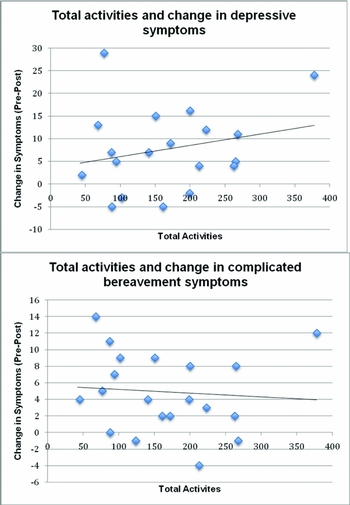
The mean total number of events engaged in throughout the course of the study was 160.05 (SD = 87.56, range = 42–378). For descriptive purposes, the associations between change in depressive symptoms and total number of events and CB symptoms and total number of events are plotted in Figure 1. The magnitude of the associations between total events and depressive symptoms and CB were small and not statistically significant, rs = .24 and −.08, ps >.32. In the ANCOVAs examining the influence of total activities on improvement in symptoms of depression and CB, neither the main effects of time, Fs < 0.7; ps > .40; ηp2s < .24, nor the interaction between time and the total number of events, Fs < 1.1; ps > .32; ηp2s < .07,were statistically significant.
Association between total activities and change in symptomatology

Influence of functional and pleasant activities on treatment outcome
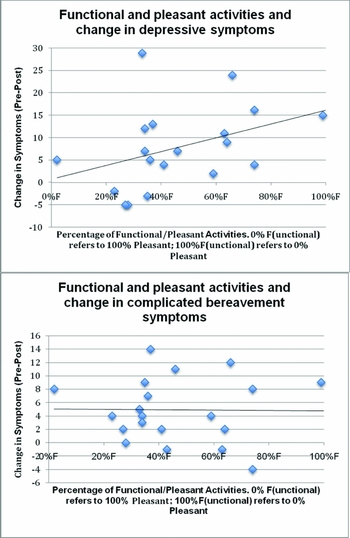
The mean total number of functional events engaged in throughout the course of the study was 55.2 (SD = 59.3, range = 1–215), and the average percentage of functional (relative to pleasant) events was 48% (SD = 0.3). The mean number of pleasant events engaged in throughout the course of the study was 58.8 (SD = 57.0, range = 0–242), and the average percentage of pleasant (relative to functional) events was 52% (SD = 0.3). For descriptive purposes, the associations between change in depressive symptoms and CB and functional and pleasant events are plotted in Figure 2. The magnitude of the association for depressive symptoms was small-medium and not significant; this effect was positive for functional events and negative for pleasant events, r = .39, p = .10. The magnitude of the associations for CB was negligible, and this effect was positive for functional events and negative for pleasant events, r = .01, p = .96. ANCOVAs were run for functional and pleasant events for both depressive symptoms and CB. With functional events as the interaction term, the main effects of time were not significant, Fs < 3.9; ps > .06; ηp2s < .05, nor were the interactions between time and functional events, Fs < 3.1; ps > .09; ηp2s < .16. Similarly with pleasant events as the interaction term, the main effects of time were not significant, Fs < 2.7; ps > .11; ηp2s < .14, nor were the interaction between time and pleasant events, Fs < 1.1; ps > .32; ηp2s < .07.
Association between functional and pleasant activities and change in symptomatology

Influence of social activities on treatment outcome
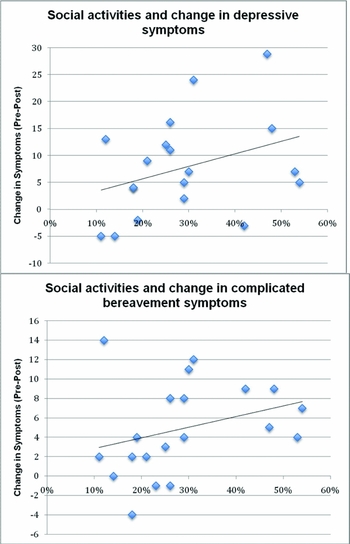
The mean number of social events engaged in throughout the course of the study was 43.8 (SD = 27.6, range = 8–119), and the average percentage of social (relative to nonsocial) events was 28.4% (SD = 0.1). The associations between change in depressive symptoms and CB and social events are plotted in Figure 3. The magnitude of these associations were small-medium and positive but not statistically significant, rs < .29, p > .21. The ANCOVAs did not find significant main effects, Fs < 0.6; ps > .47; ηp2s <.04 or interaction between time and social events, Fs < 2.3; ps > .14; ηp2s <.13.
Association between social activities and change in symptomatology

Power analysis
Due to the size of the sample, we also computed post-hoc power analyses to determine the sample size necessary to detect significant findings based on the observed effect sizes. For functional events and depressive symptoms, the variable with the largest effect (estimated power at .37), we computed a power analysis to determine how large a sample we would need to obtain a significant interaction with .8 power. Based on this analysis, a sample size of 66 participants would be required to detect significant differences, in the largest observed effect in the present study.
Discussion
Increasingly, BA has been demonstrated as a widely effective treatment for patients of varying ages and presenting problems (Cuijpers et al., Reference Cuijpers, van Straten and Warmerdam2007; Mazzucchelli et al., Reference Mazzucchelli, Kane and Rees2009). BA is user-friendly and straightforward in its general approach and thus of great interest from a dissemination perspective as a way to increase vulnerable population's access to services (Dimidjian et al., Reference Dimidjian, Barrera, Martell, Muñoz and Lewinsohn2011). One population for whom BA approaches are increasingly needed is older adults, particularly those who have lost a loved one and experience symptoms of CB beyond that of a normative grief response (Kessler, Reference Kessler1997). These patients, less likely to seek treatment, are often engaging in avoidance cycles that lead to impaired role functioning and perpetuate negative emotions and decreased experience of positive emotions (Lichtenthal et al., Reference Lichtenthal, Cruess and Prigerson2004; Zhang et al., Reference Zhang, El-Jawahri and Prigerson2006). To increase the ability to effectively treat this population using BA, we conducted a preliminary investigation of treatment factors that might relate to positive outcomes in a sample of older adults who had lost a loved one and endorsed symptoms of CB and depression. Specifically, we coded the weekly planners of 20 older adults who completed a 5-week BA and examined the relationship between total number of activities, and ratio of activities that were functional, pleasant, and social, and improvement in symptoms. Overall, we found that the treatment was significantly associated with a reduction in symptoms of depression and CB. However, contrary to predictions, the total number of activities participants engaged in was not significantly associated with change in symptomatology. Moreover, greater ratios of functional, pleasurable, and social events were also not significantly associated with change in symptomatology.
Upon closer inspection of the trend-level findings, the specificity between activity variables and the outcome measures presented an interesting pattern of findings. Although the findings suggested that any activation seemed to improve symptoms of depression and CB (i.e. the treatment effect), greater overall activity level and greater relative participation in functional activities seemed to relate more specifically to depressive symptoms, whereas participation in social activities seemed to relate to both depression and CB symptoms. As a possible explanation of these trends, recall that CB symptoms may be maintained by behavioral avoidance as well as by avoidance of thoughts and experiences tied to the loved one (Prigerson et al., Reference Prigerson, Maciejewski, Reynolds III, Bierhals, Newsom and Fasiczka1995). Thus, it may be possible that in-session aspects of the therapy that were not captured in the weekly planners were more directly tied to improvement in symptoms of bereavement, such as continually acknowledging the loss, identifying the function of bereavement-related avoidance, and forming a connection with a therapist. The new connection may be especially relevant to interpersonal difficulties specifically characteristic of CB, such as difficulty connecting with and trusting others. Toward that end, this may also help to explain why greater engagement in “social” activities was similarly related to symptom improvements in depression and CB. Examining both outcomes in tandem, findings tentatively suggest that for older adults with symptoms of CB, there may be particular developmental and contextual relevance of increasing role functioning and social connection via increases in overall activity level that is purposeful and has meaning to the participant. As such, clinicians might be cognizant of the evolving and diminished role demands of individuals who have lost significant others. Correspondingly, participating in daily functional chores and social engagements could be helpful in re-establishing a routine and breaking dysfunctional avoidance cycles. The preliminary nature of these trends suggests that additional research is needed to support these hypotheses.
Overall, the present findings demonstrated that a treatment approach that encouraged patients to intentionally re-engage in their environments improved their symptoms of depression and CB; however, the total number of activities and the precise nature of activities that were completed did not significantly influence treatment outcomes. These findings are in contrast to guidelines of BA protocols that encourage providers to focus on activities that may be pleasing to them, often involving nurturing their social relationships, immediately fun or pleasant, and/or activities that are functional in that they complete important or necessary tasks (Dimidjian et al., Reference Dimidjian, Barrera, Martell, Muñoz and Lewinsohn2011; Manos et al., Reference Manos, Kanter and Busch2010). This is true across BA protocols targeting individuals with depression, individuals at risk for CB, and/or individuals with related conditions (e.g. posttraumatic stress disorder). Potentially, one interpretation is that these findings are consistent with the proposition that countering behavioral avoidance is the major change strategy within BA (Lejuez et al., Reference Lejuez, Hopko and Hopko2001, Reference Lejuez, Hopko, Acierno, Daughters and Pagoto2011; Martell et al., Reference Martell, Addis and Jacobson2001), and countering avoidance – regardless of the specific frequency or form – may more generally contribute to the amelioration of symptomatology (Mazzucchelli et al., Reference Mazzucchelli, Kane and Rees2009). Of course, the present study did not operationalize avoidance (instead measuring only the inferred opposite, that is activity participation), and so this is a deduction that warrants future study. Nevertheless, we tentatively suggest that what could be essential in clinical intervention is helping patients increase their awareness of their patterns of avoidance and then choosing to intentionally engage in any activity counter to that avoidance.
Limitations inherent in this preliminary investigation suggest caution when interpreting findings and set the stage for future research. First, the sample was relatively small and specific, comprised of older adults with a common precipitating event and experiencing symptoms of depression and CB. Second, we did not collect baseline information and cannot infer causality regarding the treatment, only that it was significantly associated with improvement in symptomatology. In addition, because the BA was relatively brief, it is possible that effects may have been stronger with more treatment and more opportunities for activation. That being said, sudden gains are relatively common, particularly within the first two to three sessions (Hopko, Robertson and Carvalho, Reference Hopko, Robertson and Carvalho2009). Moreover, there was no validation of participant self-report of activity. As such, there remains the possibility that improvement was related to increases in these types of activities, but that participants did not report their behavior accurately.
Additional aspects of the study that we did not include similarly set the stage for future research. For example, we did not formerly operationalize the function/motivation behind engagement in each activity, and there may be different associations with outcome for activities that represent approach motivation (i.e. moving toward a desired outcome) such as feelings of closeness with another person or that represent avoidance-motivation such as engaging in the behavioral target to avoid unwanted cognitive or emotional experiences. Related to this, whereas therapists crossed out activities that were planned but not completed, future research could actively incorporate “non-compliance” (that is, lack of participation in a scheduled activity) into the research question and statistical analyses. Last, in addition to focusing on the count and ratio of activities, future research might also examine time spent in activities as a predictor. Indeed, it could be suggested that those who spent the most time participating in activities would have participated in a fewer number of them, and/or participants who reported engaging in more meaningful (or values-based) activities engaged in fewer activities overall (i.e. “quality over quantity”).
Overall, the present findings provide preliminary support that BA, a treatment that encourages patients to intentionally re-engage in their environments, was associated with improvement in their symptoms of depression and CB. However, contrary to common guidelines in BA protocols (Lejuez et al., Reference Lejuez, Hopko, Acierno, Daughters and Pagoto2011; Martell et al., Reference Martell, Addis and Jacobson2001), these findings potentially suggest that the total activities engaged in, as well as the precise nature of these activities, did not significantly influence this improvement. Replication is essential given the size of the sample on which these analyses are based. These findings may provide preliminary guidance to clinicians, suggesting that this greater awareness of avoidance patterns and willingness to act opposite to that avoidance may be of greater significance to help their patients improve, rather than focusing on participation in a specific number and/or type of activity.
Acknowledgements
This work was partially supported by a grant from the National Institute of Aging (R21-AG023495-01A2). This paper was prepared with the support of the VISN 4 Mental Illness Research, Education, and Clinical Center, Philadelphia Veterans Affairs Medical Center, Philadelphia, PA, USA. The views expressed in the article are those of the authors and do not necessarily reflect the position or policy of the Department of Veterans Affairs or the United States government. There were no conflicts of interest related to this project or its authors. We would like to thank Carl Lejuez and Julia Rossi for their feedback during the preparation of this manuscript.



Comments
No Comments have been published for this article.