Developing countries vary widely in their rates of female labor force participation (FLFP), with some profound social consequences.Footnote 1 Higher FLFP can increase women's political engagement,Footnote 2 improve women's bargaining power in the home,Footnote 3 and liberalize gender attitudes.Footnote 4
Given these consequences, it is no surprise that social scientists want to understand why women participate in market labor at such different rates around the world. Prominent explanations often highlight the role of culture, asserting that attitudes toward the appropriate roles for women affect the supply of female labor by influencing fertility decisions, human capital accumulation, and the choices pertaining to the labor–leisure trade-off.Footnote 5 Such arguments are often persuasive, and they will be not be refuted here. Nevertheless, cultural arguments are not well suited for some explananda, and the short- and medium-run fluctuations in FLFP that countries often exhibit pose a particular challenge. The issue is readily apparent. Cultures change slowly over these time horizons, while FLFP can vary significantly over them. Consider the case of India, where FLFP has declined steadily from 37 percent in 2005, to 30 percent in 2009, and only 27 percent by 2015. Patriarchal attitudes undoubtedly contribute to the country's low level of FLFP, but to attribute causality to those attitudes for this further decline presumes an attitudinal change not observed in the data. For instance, a commonly used gauge of gender attitudes is the World Values Survey's item asking “whether men should have more right to scarce jobs than women.”Footnote 6 That question was posed to Indian respondents in 2001 (four years before the sharp decline in FLFP began), 2006 (as the decline began), and again in 2014. Across those survey waves, the share of respondents agreeing with the proposition was stable at 50 percent, making such attitudes an unlikely explanation for the declining rate of FLFP over that time span.
So, what can cause such short- and medium-run variations? This paper draws attention to international political economy considerations, specifically the consequences of fluctuations in the real effective exchange rate (REER). The argument is derived from two stylized facts. The first is that national economies tend to exhibit occupational segregation by gender. In developing economies, segregation is such that women are disproportionately employed in low-skilled and export-oriented industries.Footnote 7 The second is that increasing international economic integration puts exporters under intense competition by making international demand for their goods more elastic.Footnote 8
The juxtaposition of these persistently segregated national economies operating in an increasingly integrated world implies that, as a practical matter, the conditions influencing export competitiveness disproportionately affect women's labor market activity. Movements in the REER are therefore expected to have identifiable gendered distributional consequences. To elaborate, currency appreciation reduces export competitiveness by raising export prices. When women are disproportionately employed in (low-skilled) export-oriented industries, the practical consequence of the falling export volumes implied by currency appreciation is a disproportionate reduction in the domestic demand for female labor in the economy. In turn, this falling demand frustrates women seeking employment and ultimately drives some of them out of the labor force altogether. Accordingly, REER overvaluation is expected to be particularly harmful for FLFP in developing economies. Naturally, an undervalued currency is expected to have the opposite effect.
In this research note, I test that expectation on a time-series cross-sectional sample of about 150 low- and middle-income countries in 1990 through 2015 and find support for it. Notably, I also find that overvaluation reduces the ratio of female to male labor force participation. This is an especially important result because it indicates that the effects of overvaluation are indeed gendered, rather than hurting women and men equally. Though it may not surprise readers to learn that macroeconomic conditions affect labor market participation, research tends to assume that such effects are gender neutral. But why must this be so? If men and women work in different parts of the economy, then we might reasonably expect macroeconomic conditions to affect men and women differently. This is what I show here, and in light of the common presumption of gender neutrality, the finding that overvaluation reduces FLFP and the labor force ratio is a provocative one that invites future research.
Segregated Economies in an Integrated World
A persistent feature of national economies is occupational segregation by gender.Footnote 9 In industrialized economies, for example, women are disproportionately employed in the service sector and in white-collar jobs.Footnote 10 By contrast, in developing economies—this study's subject—it is well documented that women are disproportionately employed in industries that are simultaneously low-skilled and export-oriented.Footnote 11 Among the explanations for the segregation are the discriminatory hiring practices that result from employers’ information problems.Footnote 12 To elaborate, the jobs from which women in low- and middle-income economies are excluded are often characterized by sizable and increasing returns to human capital and specific skills. This matters because if productivity is increasing with human capital and employment tenure, employers will prefer hiring workers that have considerable human capital and who will remain at the firm for a long time. The problem is that ex ante, these attributes are imperfectly observed. For example, human capital is fully on display only after one is put to the task of production. In other cases, the imperfect observability is strategic. If job candidates know an employer prefers long-term employment contracts, all of them will say that they will remain at the job for a long time regardless of their true intentions.
Such information problems often lead to discriminatory hiring practices.Footnote 13 Consider: in many countries, patriarchal attitudes and structures are in place that result in girls receiving less education than boys. Likewise, patriarchal norms and structures mean that women are more likely than men to interrupt their careers for child rearing and other family responsibilities. Theories of employment discrimination argue that in light of the imperfect observability of job applicants’ productivity, employers use these statistical tendencies as informational shortcuts. Although employers do not know for certain the human capital and tenure preferences of any particular candidate in the labor pool, if women on average have less human capital than men do, then the employer with a demand for high human capital will prefer hiring men. Likewise, if a randomly drawn woman has a higher probability of interrupting her career than a randomly drawn man, then the employer who has imperfect information about job candidates’ productivity and who prefers long-term employment contracts will also discriminate against women. This “statistical discrimination” excludes women in developing countries from jobs that require considerable human capital and that are characterized by increasing returns to skill. Notably, though, in the low-skilled manufacturing industries that tend to employ more women, the human capital requirements are lower and the returns to specific skills not so steeply increasing. Accordingly, employers in these industries have smaller premiums on human capital and long-term employment contracts and are more amenable to hiring women.
The same information problems have another, related effect. It is common in many communities to stereotype women as possessing greater manual dexterity than men and as being more docile and honest than men. Such stereotypes are used by employers to infer that women are more productive than men in low-skilled, labor-intensive work.Footnote 14 In combination, these forces lead to the segregation of women in low-skilled occupations.
Notably, this concentration in low-skilled occupations is increasing for export-oriented firms.Footnote 15 To see why this is so, consider that when developing economies rushed to free trade in the 1980s and 1990s, one consequence was that exporters everywhere found themselves in an increasingly competitive environment characterized by a flatter demand curve for their products abroad.Footnote 16 This more elastic demand, in turn, obliged employers in exporting firms to place a high premium on reducing their costs—which, given the labor intensity of the production, often amounted to keeping the wage bill low. In a perverse twist, the labor market disadvantages noted in the previous paragraphs produce an overabundance of women applying for these low-skilled jobs. This oversupply keeps wages low, which in turn makes the export-oriented employers seeking to keep their labor costs low particularly amenable to hiring women.Footnote 17
Exchange Rates in a Segregated Economy
Given that women in developing economies are disproportionately employed in export-oriented industries (particularly when low-skilled), it can be demonstrated that REER movements have gendered implications. It is well known that an overvalued exchange rate increases export prices and reduces export volumes. Because labor-intensive, export-oriented industries tend to hire women disproportionately, the practical consequence of the overvaluation is a disproportionate reduction in the demand for female labor in the economy. Over time, this low demand will frustrate women seeking employment and cause some of them to exit the labor force altogether. An undervalued currency is expected to have the opposite effect, increasing export competitiveness and increasing the demand for female labor commensurately.
This baseline model is a useful starting point, but it simplifies relevant economic realities by ignoring the increasingly international nature of production. This matters because many exporters are also importers, and these supply chain linkages can reduce the pass-through of exchange rates to export prices and volumes.Footnote 18 We are therefore obliged to ask whether internationalized production eliminates the relationship between appreciation and FLFP sketched earlier. Here, I show that it need not. The crux of the matter regards factor intensity. To elaborate, consider a firm producing Q = F(K, L), where K is imported capital equipment, L is the firm's domestic labor force, and Q is produced entirely for the export market. Exchange rate movements alter the relative prices of capital and labor and necessitate using one factor more intensively and the other less so. Figure 1 illustrates the consequences. Let curve Q express the various ways the firm can combine K and L to produce Q. C is the firm's cost curve, and A is the cost-minimizing mix of capital and labor in the production of Q in the status quo situation. Because capital is imported, appreciation reduces the price of K relative to L, shifting the cost curve from C to C′. Now, cost minimization obliges the firm to produce at B, using capital more intensively in the production of Q and labor less so. Thus, even though export volumes are unchanged, appreciation can still affect employment by changing the relative prices of factor inputs.
Capital substitution in response to overvaluation

One other issue warrants discussion. To say that (low-skilled) export-oriented manufacturing is a particularly important source of female employment in developing countries is not to say that such jobs are the only source of female employment. Women also frequently work in nontraded services. Importantly, standard models suggest that by reducing import prices overvaluation increases purchasing power and thus constitutes a boon for nontraded services. This could offset the effects of overvaluation described before. However, Frenkel and Ros suggest that this account oversimplifies the dynamics at work.Footnote 19 In more detail, they study a two-sector economy—where one sector is export oriented and formal and the other is nontraded and informal—and identify several pathways by which overvaluation can reduce labor market activity, even if labor can easily move between sectors.
First, while acknowledging that appreciation increases purchasing power and thereby stimulates demand for services, Frenkel and Ros also show that overvaluation-induced unemployment in the traded sector reduces demand for services and thereby offsets the purchasing-power effect. Second, Frenkel and Ros argue that if movement between sectors is easy, then overvaluation-induced unemployment in the traded sector increases the labor supply in the nontraded sector as the unemployed in the former seek employment elsewhere. The increased labor supply reduces nontraded wages and causes some share of those workers to exit the labor force altogether. Finally, in a manner similar to Figure 1, Frenkel and Ros argue that, to the extent the nontraded services rely on imported intermediate goods, overvaluation encourages using labor less intensively and capital more intensively, further reducing employment and labor market activity. Thus, the net effect of overvaluation might still be to reduce labor market activity.
Though neither Frenkel and Ros nor the analysis in Figure 1 pertains specifically to female employment and FLFP, it stands to reason that in an economy where women are disproportionately employed in low-skilled and export-oriented jobs, the employment consequences they highlight will be felt most acutely by women workers.
Data and Methods
These ideas yield the following.
H1 In developing countries, an overvalued real effective exchange rate reduces female labor force participation.
I test this hypothesis using time-series cross-sectional data for 1990 through 2015, covering about 150 low- and middle-income countries.Footnote 20 The dependent variable is the rate of FLFP. The main independent variable is reer overvaluation, measured according to the procedures outlined by Rodrik.Footnote 21 Start by calculating the logarithm of the real exchange rate,
 $${\rm logRE}{\rm R}_{i, t} = {\rm log}\left({\displaystyle{{{\rm XRA}{\rm T}_{i, t}} \over {{\rm PP}{\rm P}_{i, t}}}} \right), \;$$
where XRAT is the nominal exchange rate between country i and the US dollar and PPP is the purchasing power parity conversion factor. Then, adjust logRER to account for the Balassa–Samuelson effect by regressing it on per capita GDP and year fixed effects:
 $${\rm logRE}{\rm R}_{i, t} = \alpha + \beta _1{\rm GD}{\rm P}_{i, t} + f + \mu _{i, t}, \;$$
and finally, calculate
 $${\rm logOvervalue}{\rm d}_{i, t} = {-}1 \, \ast \, ( {{\rm logRE}{\rm R}_{i, t}-\widehat{{{\rm logRE}{\rm R}_{i, t}}}} ) , \;$$
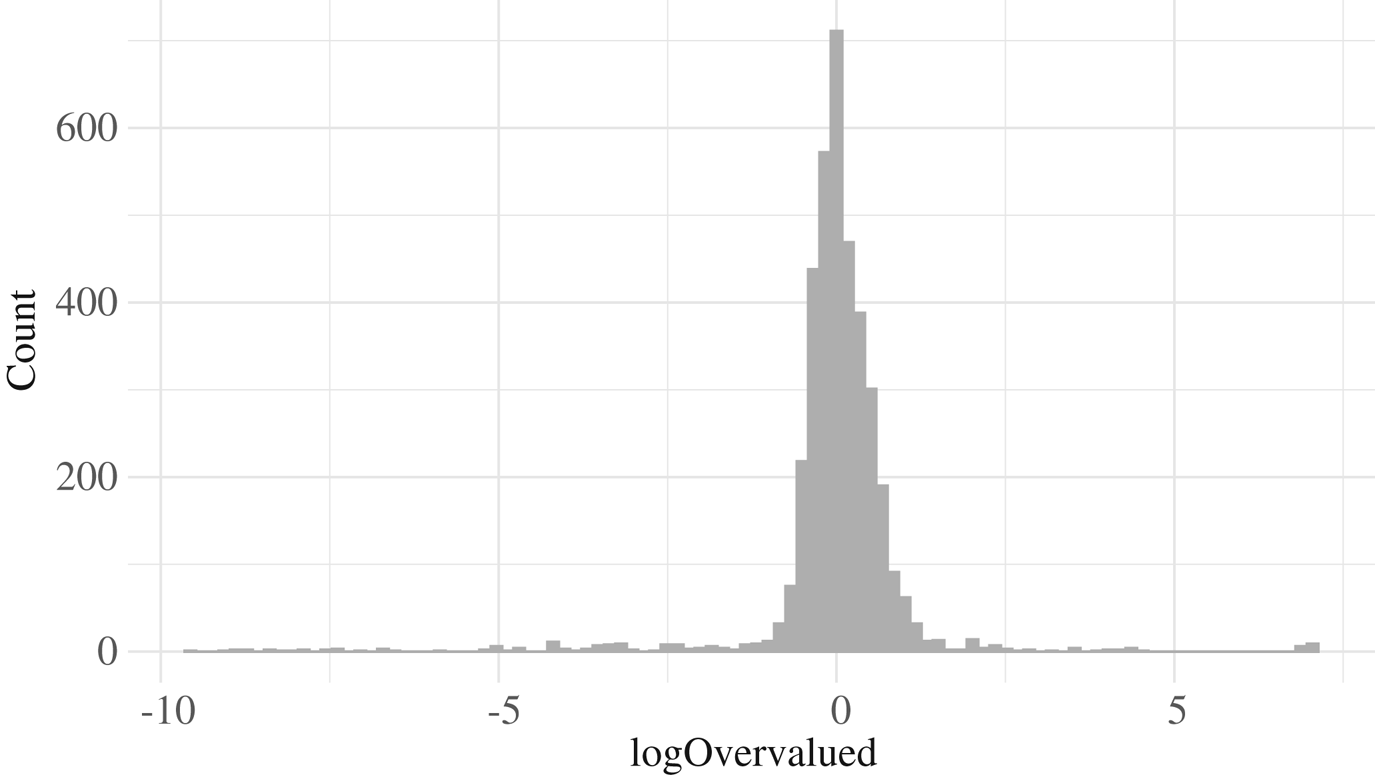
where  $\widehat{{{\rm logRE}{\rm R}_{i, t}}}$ in (3) are the predicted values from (2). Rodrik shows that Overvalued = exp (logOvervalued) is a cross-nationally comparable measure of overvaluation. However, as the distribution for Overvalued is highly skewed, the logarithmic transformation directly calculated in (3) is more appropriate for empirical analysis and is used in the regressions that follow. Figure 2 shows that variable's distribution for low and middle-income countries between 1990 and 2015.Footnote 22
Distribution of logOvervalued among low- and middle-income countries, 1990–2015

The regression also includes several control variables. Together, per capita gdp (logged) and squared per capita gdp (logged) account for the U-shaped relationship between economic development and FLFP.Footnote 23 I also control for oil wealth. This is for several reasons. First, oil wealth has long been linked to overvalued exchange rates.Footnote 24 Second, to this Ross adds that oil might be especially bad for FLFP for two reasons.Footnote 25 On the demand side, oil causes overvaluation, which then lowers FLFP through the processes developed here. On the supply side, oil wealth increases women's nonlabor income and thereby reduces the number of hours women allocate to market labor. The supply-side effect constitutes a “backdoor path” for which my model must adjust, lest the effects of logOvervalued be biased.Footnote 26 I make the adjustment by controlling for the logarithm of per capita oil and gas rents. Finally, I include country fixed effects to adjust for all time-invariant and slowly moving confounds. For instance, democracy influences both exchange rate orientations and FLFP.Footnote 27 Likewise, a country's culture affects both FLFP and exchange rate choices.Footnote 28 History matters, too. For instance, countries that implemented import substitution often chose overvalued exchange rates to make imported capital equipment cheaper,Footnote 29 but such countries were often also associated with lower FLFP.Footnote 30
Tests cannot rule out the possibility of nonstationarity for several of these variables, though all are stationary when differenced.Footnote 31 Accordingly, I estimate the single-equation error-correction model recommended by DeBoef and Keele, wherein the change in FLFP is regressed on its lagged level, lags and differences of the independent variables, and a sufficient number of lagged differences of the dependent variable to rule out serially correlated errors.Footnote 32 In the present context, this yields
 $$\eqalignb{& {\rm \Delta }Y_{i, t} = \beta _1Y_{i, t-1} + \beta _2{\rm \Delta }Y_{i, t-1} + \beta _3{\rm logOvervalue}{\rm d}_{i, t-1} + \beta _4{\rm \Delta logOvervalue}{\rm d}_{i, t} \cr & \qquad \quad + \beta _5{\rm GD}{\rm P}_{i, t-1} + \beta _6{\rm \Delta GD}{\rm P}_{i, t} + \beta _7{\rm GDP}_{i, t-1}^2 + \beta _8{\rm \Delta GDP}_{i, t-1}^2 \cr & \qquad \quad + \beta _9{\rm resourceRent}{\rm s}_{i, t-1} + \beta _{10}{\rm \Delta resourceRents}_{i,t} + \gamma + \epsilon _{i, t}, \;} $$
where γ represents the vector of county dummies, i indexes countries, and t indexes time. Hypothesis 1 predicts negative coefficients on either β 3 or β 4, or both. Table 1 shows the summary statistics for the variables in the equation.Footnote 33
Summary Statistics

Note: L.X and ΔX refer to the lagged and differenced values of X.
Results
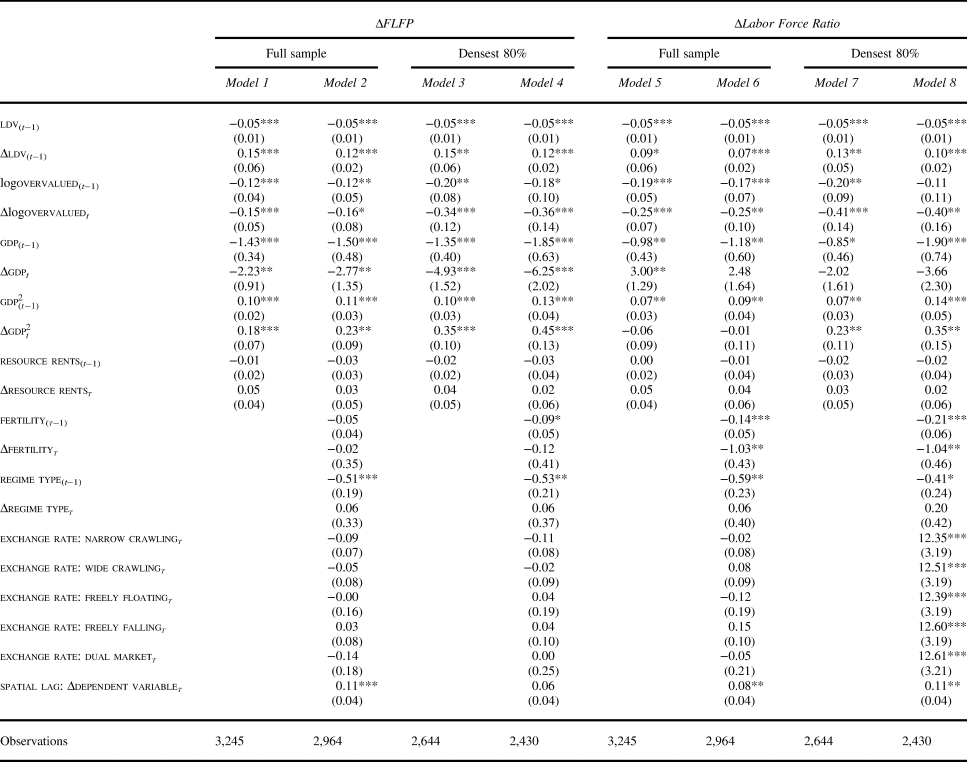
Model 1 in Table 2 presents the results from estimating (4) and reveals evidence consistent with Hypothesis 1. The coefficient estimates on lagged and differenced logOvervalued are both negative and statistically significant at conventional levels. The substantive effect is that a one-unit increase in logOvervalued at time t causes an immediate 0.15-percentage-point reduction in FLFP. For context, in this sample, the average yearly change in FLFP is only 0.14 (see Table 1), so such a change is appreciable.
REER Overvaluation and Female Labor Force Participation

Note: All models include country-specific fixed effects. *p < .10; **p < .05; ***p < .01.
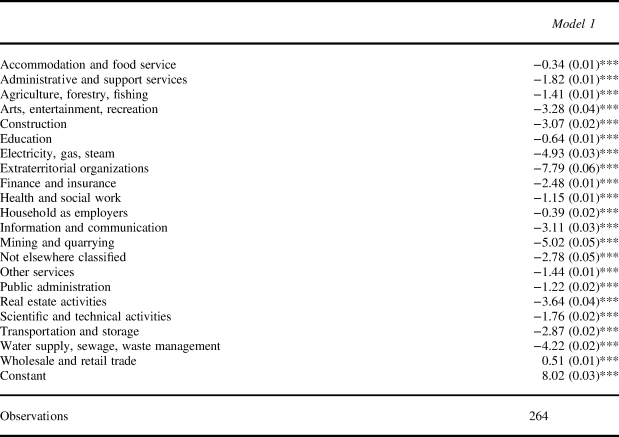
Female Employment in Mexico Across 21 Industries

Note: Standard errors clustered by industry and year. *p < .10; **p < .05; ***p < .01.
Several of the control variables also correlate with FLFP. The U-shaped relationship between FLFP and economic development identified by Goldin is observed here in the statistically significant coefficients on lagged per capita GDP and lagged squared per capita GDP.Footnote 34 Meanwhile, per capita GDP growth (that is, the change in the logarithm of per capita GDP) is positively related to FLFP. Natural resource rents are uncorrelated with FLFP in this model, however. In all likelihood, this is because the logOvervalued variable controls for one process by which the effects of resource wealth on FLFP are transmitted.Footnote 35
These results are robust to alternative model specifications. To start, model 2 in Table 2 adds several control variables. For instance, fertility rate is included to account for an important factor determining women's labor supply. Political regime type is added because democracy correlates with both exchange rate orientation and FLFP.Footnote 36 I also control for the “coarse” six-category exchange rate regime classification created by Ilzetzki, Reinhart, and Rogoff.Footnote 37 Finally, a spatial lag is included to account for any spatial clustering.Footnote 38 These alterations do not change the substantive conclusions.
Next, because Rodrik cautions that the effect of exchange rates is often driven by large outliers, models 3 and 4 replicate the regressions in models 1 and 2 while limiting the observations to the densest 80 percent of the logOvervalued distribution displayed in Figure 2. The negative effects of logOvervalued remain.
Lastly, models 5 to 8 alter the dependent variable. I have argued that overvaluation is gendered in the sense that it harms women disproportionately. Notice though that because overvaluation may hurt the entire export sector, the negative coefficients on lagged and differenced logOvervalued in models 1 to 4 need not indicate a gendered dynamic per se. It is possible that the effect of overvaluation is the same for men and women or that overvaluation reduces men's participation more than women's. Also, if men work disproportionately in import-competing industries, then overvaluation can reduce male labor force activity by making imports cheaper. To consider whether overvaluation disproportionately affects women, I replicate models 1 to 4 but change the dependent variable to the ratio of female to male labor force participation, thus explicitly comparing overvaluation's effect on women's economic activity to that of men. The results, displayed in models 5 to 8, continue to support H1. There is one small change, though: in model 8, only the differenced REER variable is statistically significant.
Nor are the results due to endogeneity. To demonstrate, I treat logOvervalued as an endogenous variable in a generalized method of moments framework and continue to observe a negative and statistically significant coefficient on logOvervalued (Table SM2 in the online supplement).
Demonstrating the Mechanisms
The Table 2 results support Hypothesis 1. Here, I use the case of Mexico to assess whether the argument identifies a plausible causal pathway linking overvaluation to FLFP. Mexico is a useful case in this regard because in the mid-1990s it experienced two pertinent macroeconomic changes. First, NAFTA went into effect in 1994 and brought with it an explosion of export-oriented factories along the country's northern border. The maquiladoras had long been an important source of female employment in the country—for many of the reasons documented earlier—and that trend continued with NAFTA's arrival.Footnote 39 Second, following the balance-of-payments crisis in late 1994, the government floated the peso in 1995. If the theory developed here is correct, we should expect to observe correspondence between movements in the now-floating peso and movements in women's labor market participation.
The argument's crucial assumption is that low-skilled export-oriented manufacturing is an especially important source of female employment. To assess whether this claim holds for Mexico, Table 3 regresses female employment in Mexico in industry i in year t (in thousands, logged) on a categorical variable that identifies the twenty-one economic sections specified by Revision 4 of the International Standard Industrial Classification (ISIC). What we would like to know is whether the manufacturing industry is an important source of female employment in the country. To that end, manufacturing is the excluded category in the regression, such that all coefficient estimates indicate whether industry i employs more or fewer women than manufacturing. Notice that nearly every industry has a negative and statistically significant coefficient estimate, implying that it employs fewer women than manufacturing. The exception is wholesale and retail trade, which employs more women.Footnote 40
Though useful, the Table 3 results do not speak to whether women are disproportionately employed in low-skilled occupations by export-oriented firms in the manufacturing sector. However, an extensive literature has found that they are. For instance, Anderson and Dimon conduct labor surveys in two cities: Tijuana, a major hub for export-oriented manufacturing; and Torreón, where most production is domestically oriented agriculture. They draw two important conclusions. First, demand for female labor is higher in Tijuana than in Torreón. Second, while labor force participation is higher in Tijuana for both men and women, the effect for women is proportionally larger, so the participation gap between men and women is smaller.Footnote 41 Villarreal and Yu concur. Using data from a nationally representative labor survey, they find that export-oriented firms employ more women than firms producing for the domestic market do.Footnote 42 Likewise, Aguayo-Tellez and colleagues find that trade liberalization in Mexico increased the demand for female labor by expanding industries that already employed female labor intensively.Footnote 43
There is similarly compelling evidence that, in these maquiladoras, women are disproportionately employed in low-skilled jobs. Kopinkak presents a particularly striking piece of evidence. In a study of Nogales, Mexico, she notes that, at the time of her study, it was common for maquiladoras to place job advertisements in the local paper that specified the gender of the successful candidate. Some 40 percent of job advertisements did so, and of that set of advertisements, nearly 90 percent were for an unskilled job, while none of the advertisements for skilled jobs specified a female employee.Footnote 44 Fussell concurs.Footnote 45
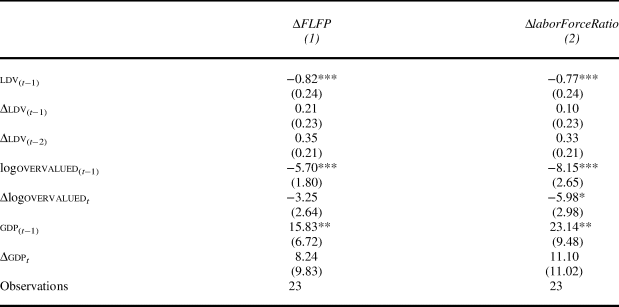
Finally, there is also evidence that overvaluation causes negative growth in Mexico's manufacturing sector and that this effect is particularly pronounced in labor-intensive manufacturing.Footnote 46 Given the combination of all these results, Hypothesis 1 suggests that movements in the peso will correspond with movements in FLFP. Regression analysis supports this prediction. The results in model 1 of Table 4 derive from an error-correction model predicting the change in FLFP with lagged and differenced values of logOvervalued for Mexico. Because there are so few observations (only twenty-three, after adding the appropriate lagged and differenced variables), only a subset of the control variables included in the cross-national results are included here—namely just lagged and differenced GDP. The results are consistent with expectations. Though we do not observe an immediate effect of overvaluation (ΔlogOvervalued is negative but statistically insignificant), the lagged level of the variable in question is both negative and statistically significant. Model 2 in Table 4 uses the labor force ratio as the dependent variable and reaches a similar conclusion, though in this case both logOvervalued entries are statistically significant. All of the results presented thus far are consistent with Hypothesis 1: An overvalued REER appears to be particularly bad for women's labor market participation.
REER Overvaluation and Female Labor Force Participation in Mexico

Note: *p < 0.10; **p < 0.05; ***p < 0.01.
The Choice of Exchange Rate Valuation
To this point, we have left a country's exchange rate valuation exogenous. This is helpful for expository purposes, but as a practical matter, governments are able to keep currencies undervalued or overvalued for considerable lengths of time,Footnote 47 and they are presumed to do so in response to competing societal interests. For instance, an undervalued currency promotes exports and helps import-competing firms, but also raises inflation and reduces purchasing power. Naturally, an overvalued currency has the opposite effects.Footnote 48 Accordingly, consumers and producers are expected to oppose each other with regard to the exchange rate and to compete to have their preferences reflected in national policy.
I do not dispute these arguments. But notice that, according to the results here, women might also constitute a social group with preferences relevant to the choice of exchange rate. Indeed, in low- and middle-income countries, women might face a trade-off that has been underappreciated in current scholarship. Overvaluation has the aforementioned purchasing power effect, but by reducing women's labor force participation, it also exerts a negative income effect. And consider also that because working outside of the home gives women more bargaining power within it,Footnote 49 overvaluation also has a second-order (but no less important) household bargaining effect. How might women navigate this trade-off? It seems plausible that the combination of the latter two effects trumps the first, such that women in developing economies will tend to prefer a neutral or undervalued currency to an overvalued one.
That said, our interest here is not these preferences per se but national policy—or, more accurately, the consequences thereof as reflected in exchange rates. However, we can presume that whether women's opposition to an overvalued currency is reflected in national policy will depend on two factors: the extent to which women are engaged in political life, and whether the country is democratic and therefore responsive to citizen demands. These conditions allow us to formulate an extension of this paper's main argument:
H2 In democratic developing countries, women's political engagement will correspond to a less overvalued (that is, “neutral” or even undervalued) exchange rate. In nondemocracies, however, increasing women's political engagement will not affect exchange rates.
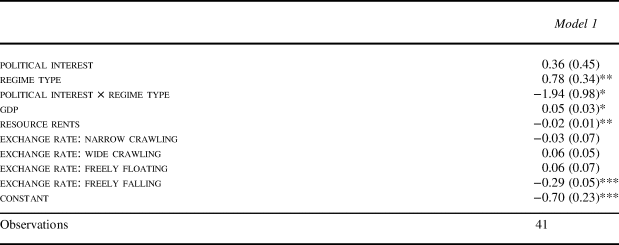
A complete investigation of Hypothesis 2 is beyond the scope of this brief note, but a preliminary investigation can proceed by regressing logOvervalued on a measure of women's political engagement, on regime type, and on the multiplicative interaction of the two (Table 5). The expectation in Hypothesis 2 is that the marginal effect of political engagement will be statistically or substantively insignificant in nondemocracies and negative and statistically significant in democracies. Political engagement is measured with an item in Wave 6 of the World Values Survey, “How interested would you say you are in politics?” (possible responses: very, somewhat, not very, not at all).Footnote 50 For each female respondent, I code a dummy variable as 1 for “very” or “somewhat” and 0 otherwise. Then, for each country, I calculate the proportion of female respondents with a score of 1, producing a country-level measure of women's political engagement. Finally, note that because the engagement variable uses survey data, the regression is necessarily cross-national rather than relying on panel data. Specifically, Wave 6 of the World Values Survey was conducted between 2010 and 2014, depending on the country, and all the economic and political variables in the model are measured during the same year the survey was fielded in country i.
Women's Political Engagement, Democracy, and Exchange Rate

Note: Robust standard errors in parentheses. *p < 0.10; **p < 0.05; ***p < 0.01.
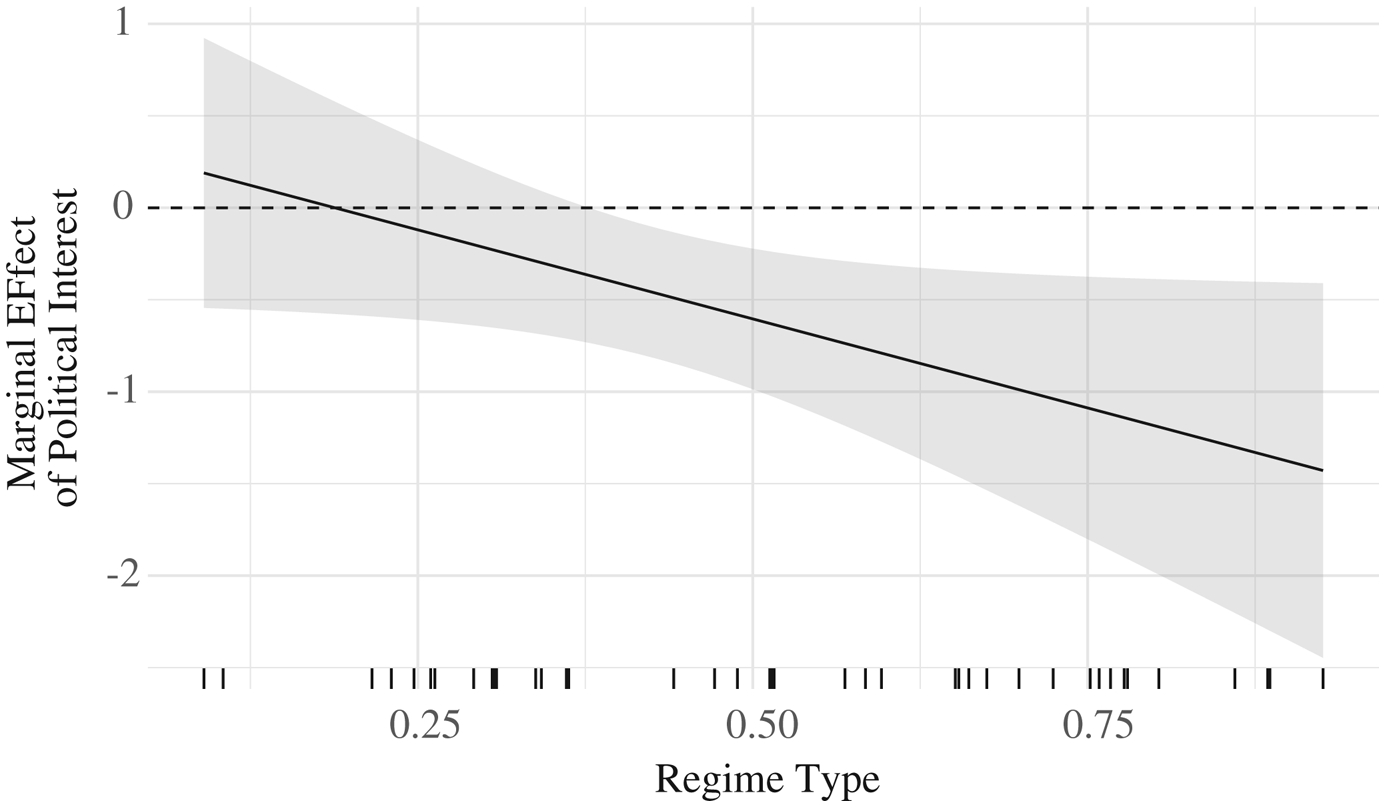
The coefficient estimates are presented in Table 5, but a more useful way to understand the results is with Figure 3. The solid line traces the marginal effect of women's political engagement on logOvervalued as levels of democracy change in the sample; the shaded area is the 95 percent confidence interval. The rug plot displays the distribution of regime type in this sample of about forty low- and middle-income countries. The results are consistent with H2 Women's engagement has no effect on logOvervalued in the most authoritarian regimes. For values of the democracy measure—which comes from the Varieties of Democracy data setFootnote 51 and spans the interval [0–1]—between 0.01 (Qatar) and 0.4 (Algeria), there is no statistically reliable effect of women's political engagement on logOvervalued. In more democratic settings, though, women's political engagement has the predicted statistically significant negative effect.
Marginal Effect of Women's Political Engagement on logOvervalued

Though these results comport with Hypothesis 2, caution should be taken with them. They are correlational and thus may suffer from reverse causality or some other endogenous process, and they derive from a small sample, since they are based on coverage of Wave 6 of the World Values Survey. Nevertheless, the results are provocative and consistent with the hypothesis. In that regard, they invite further research into the topic.
Conclusion
In this research note I present an underappreciated juxtaposition: even as segregation is a pervasive feature of most national economies, those same economies are increasingly integrated with each other. The implications of the contrast are striking. In light of the fact that women workers in low- and middle-income countries are disproportionately found in low-skilled occupations within export-oriented industries, the macroeconomic conditions that affect export competitiveness are de facto phenomena that disproportionately affect the demand for female labor. Thus, while overvaluation may hurt exports in general, such a currency regime seems to be especially bad for women.
On its own, this is an important result because it helps explain the fluctuations in FLFP that countries often exhibit. However, I also hope to speak to other important literatures. For instance, the results are relevant to the “gendered resource curse” debate. Recall that Ross argues that oil-induced Dutch disease—not Islam—best explains why FLFP is so low in Arab countries,Footnote 52 but dissent is robust.Footnote 53 Ultimately, this is an empirical matter, so it is noteworthy that these results are consistent with Ross's assessment.
Likewise, these results add further support to arguments that export-oriented industrialization strategies increased female employment, while capital-intensive import-substitution ones reduced it.Footnote 54 To see why, note that the export-led and import-substitution strategies require very different exchange rate orientations. Countries that industrialized through import substitution prefer appreciated exchange rates to make capital imports cheaper,Footnote 55 while export-oriented economies must guard against a too rapidly appreciating currency. In light of the different exchange rate orientations, the result presented here, that REER influences FLFP, is additional evidence connecting industrialization strategies to women's economic activity.
These results also encourage future research. Specifically, a similar study on advanced industrial economies could be fruitful, though expectations about the effect of overvalued REER may be quite different. Because women in rich countries tend to work in high-skilled, white-collar, service jobs,Footnote 56 some share of which are in the nontraded sector, and because overvaluation increases purchasing power and benefits nontradables, it is possible that overvaluation may increase FLFP in rich economies rather than reduce it as observed here. In a similar vein, future research might also consider whether the effects of REER are conditioned by the extent of occupational segregation in the economy.
Data Availability Statement
Replication files for this research note may be found at <https://doi.org/10.7910/DVN/RAX3SG>.
Supplementary Material
Supplementary material for this research note is available at <https://doi.org/10.1017/S0020818323000139>.
Acknowledgments
Thanks to Irfan Nooruddin for comments on an earlier draft of this manuscript as well as discussants and participants at the Southern Political Science Association and the Midwest Political Science Association.