A longstanding challenge in research on language development has been determining the types of information infants extract from linguistic input. One important discovery has been that language learners of all ages are capable of tracking distributional information in speech input and using it to infer linguistic structure. The experimental approach for testing this type of ability, termed statistical learning, has typically involved familiarizing learners with a stream of artificial language input and then gauging learning through behavioral (e.g., looking time for infants, post-hoc choice tests for adults) and/or neurophysiological measures. While the theoretical and empirical roots of statistical learning span many decades (e.g., Harris, Reference Harris1955; Hayes & Clark, Reference Hayes and Clark1970), a recent surge of interest in this field emerged after a landmark study by Saffran, Aslin, and Newport (Reference Saffran, Aslin and Newport1996). They demonstrated that 8-month-old infants are capable of tracking rudimentary statistical information in a running speech stream to infer the location of word boundaries. Subsequently, statistical learning studies have spanned an array of language learning milestones, ranging from phonetic learning (e.g., Maye, Weiss & Aslin, Reference Maye, Weiss and Aslin2008; Maye, Werker & Gerken, Reference Maye, Werker and Gerken2002) through the acquisition of aspects of grammar (e.g., Gomez & Gerken, Reference Gomez and Gerken1999; Reeder, Newport & Aslin, Reference Reeder, Newport and Aslin2013). While some statistical learning studies have used natural language stimuli as input (e.g., Pelucchi, Hay & Saffran, Reference Pelucchi, Hay and Saffran2009), most have made use of artificial languages. This approach not only affords a fine-grained level of control over the regularities available to learners in the input, but also promotes the use of relatively compact periods of familiarization to measure learning.
Over the past decade, statistical learning studies have been extended to the realm of bilingualism. Research in bilingual statistical learning can be divided into two broad categories with complementary goals. One goal is to determine whether bilingualism itself might influence either the aptitude or nature of statistical learning. A second, not mutually exclusive, goal has been to model one of the presumed challenges for young bilingual learners, namely tracking multiple sets of statistics. Here we review this growing body of work, dividing the studies by whether learners encountered one or two patterns.
Bilingualism and statistical learning of a single pattern
A large body of research finds that experience learning and using two languages accrues cognitive benefits for bilinguals, particularly for constructs such as executive control (e.g., Bialystok & Martin, Reference Bialystok and Martin2004; Costa, Hernández & Sebastián-Gallés, Reference Costa, Hernández and Sebastián-Gallés2008), task switching (Prior & Macwhinney, Reference Prior and Macwhinney2010), and working memory (Morales, Calvo & Bialystok, Reference Morales, Calvo and Bialystok2013 though see de Bruin, Treccani & Della Sala, Reference de Bruin, Treccani and Della Sala2015; Paap, Johnson & Sawi, Reference Paap, Johnson and Sawi2015; Dick, Garcia, Pruden, Thompson, Hawes, Sutherland, Riedel, Laird & Gonzalez, Reference Dick, Garcia, Pruden, Thompson, Hawes, Sutherland, Riedel, Laird and Gonzalez2019 for dissenting views). Given the possible relationship between statistical learning and aspects of general cognitive functioning (e.g., see Hsu & Bishop, Reference Hsu and Bishop2010), Yim and Rudoy (Reference Yim and Rudoy2013) surmised that bilingualism might also confer advantages relative to monolingualism in statistical learning abilities. Using a statistical learning segmentation paradigm, they presented monolingual and bilingual children (between 5–13 years old) with artificial “languages” comprised of nonsense sounds or shapes. By avoiding language input, the authors ensured that the results would not reflect a spurious advantage due to familiarity with a greater range of linguistic stimuli. While overall performance on the tasks was modest, both groups nonetheless scored significantly above chance in each domain. Notably, there were no differences between groups, suggesting that bilingual cognitive advantages do not extend to statistical learning.
This contention has been challenged by experiments using different statistical learning paradigms. For example, Kuo and Anderson (Reference Kuo and Anderson2012) tested monolingual and bilingual children 6–9 years old using a task that presented novel phonotactic regularities in an artificial language. Bilinguals outperformed monolinguals in identifying artificial words that either conformed to the regularities presented during familiarization or represented violations. The authors suggest that bilingual children may have developed greater sensitivity to similarities and differences in the structural properties of language, as they are regularly required to contend with interlingual interference (e.g., Martin-Rhee & Bialystok, Reference Martin-Rhee and Bialystok2008). Further, exposure to two languages might orient bilinguals to better detect the parameters along which languages tend to vary, and thus they become more adept at detecting new patterns of linguistic input, a proposal that has been termed the structural sensitivity hypothesis (Kuo & Anderson, Reference Kuo and Anderson2010, Reference Kuo and Anderson2012; Kuo & Kim, Reference Kuo and Kim2014).
In a further test of the structural sensitivity hypothesis, de Bree and colleagues (de Bree, Verhagen, Kerkhoff, Doedens & Unsworth, Reference de Bree, Verhagen, Kerkhoff, Doedens and Unsworth2017) presented monolingual and bilingual 24-month-olds with two artificial grammar learning tasks using artificial languages that contained non-adjacent dependencies (in which the first and third elements of a 3-item string were related). The first language contained consistent input whereas the second was inconsistent with several incorrect sequences that violated the established non-adjacent dependency. Interestingly, neither group appeared to learn from exposure to the consistent language. Nevertheless, the bilinguals did learn from the inconsistent language whereas the monolinguals did not. While the lack of any learning effects from the monolinguals is rather curious, this finding, along with the results of the study on phonotactic regularities (Kuo & Anderson, Reference Kuo and Anderson2012), suggests that bilingualism may confer some advantages for statistical learning, though perhaps restricted to the context of linguistic stimuli (an issue that is ripe for further investigation).
The literature on statistical learning in bilingual adults also lends some support to differences across monolinguals and bilinguals. Bartolotti, Marian, Schroeder, and Shook (Reference Bartolotti, Marian, Schroeder and Shook2011) presented monolinguals, low proficiency bilinguals (collapsed into one group) and highly proficient bilinguals with artificial languages created using Morse code. Unlike the aforementioned studies, these languages had multiple cues to segmentation (transitional probabilities between elements and pauses) that were either congruent or incongruent. In the congruent (low-interference) condition, highly experienced bilinguals outperformed late bilingual learners whose age of L2 acquisition was 12 or older. Similarly, Wang and Saffran (Reference Wang and Saffran2014) tested monolinguals and two groups of bilinguals (one that spoke a tonal language and one that did not) on a statistical learning task using an artificial language in which both tone cues and statistical cues were available. Notably, both bilingual groups were able to segment the stream, whereas the monolinguals, including those who spoke a tonal language, could not. The authors do note the possibility that the bilinguals were better able to ignore the tone cues and focus on the statistics, consistent with the study by Bartolotti and colleagues (Reference Bartolotti, Marian, Schroeder and Shook2011), implying that the bilingual advantage in these dual-cue tasks may arise as a function of enhanced inhibitory control abilities. Alternatively, the results of Wang and Saffran (Reference Wang and Saffran2014) may be understood as broadly supporting the structural sensitivity hypothesis, as learning a second language may enhance sensitivity for uncovering new patterns in artificial language input, even if they occur over cues that do not correspond to the input patterns found in the bilinguals’ natural languages.
The studies reviewed thus far involve testing proficient bilinguals (though they vary in age of acquisition) using artificial language learning tasks. Recent evidence suggests that beginning to learn a second language might also impact statistical learning. Potter, Wang, and Saffran (Reference Potter, Wang and Saffran2017) tested monolinguals and late L2 learners of Mandarin using the same artificial language as Wang and Saffran (Reference Wang and Saffran2014) that afforded tonal and transitional probability cues to word boundaries, as well as a visual statistical learning task (developed by Fiser & Aslin, Reference Fiser and Aslin2001). Learners were tested at two time points, early in the semester (at the beginning of second language exposure for the Mandarin learners) and six months later. While both groups showed improvement on the visual statistical learning task across testing periods, only the Mandarin learners improved in the language task, and notably performance on the language and visual tasks were not correlated. While the underlying cause of the advantage is unclear, these results suggest that second language learning may impact statistical learning abilities, perhaps constrained to linguistic stimuli. It is worth noting, however, that a similar study of visual statistical learning (segmenting shape triplets from a continuous visual stream) in early learners of Hebrew discovered a positive correlation between statistical learning performance and structural aspects of literacy acquisition (Frost, Siegelman, Narkiss & Afek, Reference Frost, Siegelman, Narkiss and Afek2013). Together, these studies point to a relationship between statistical learning and L2 acquisition, even for late L2 learners.
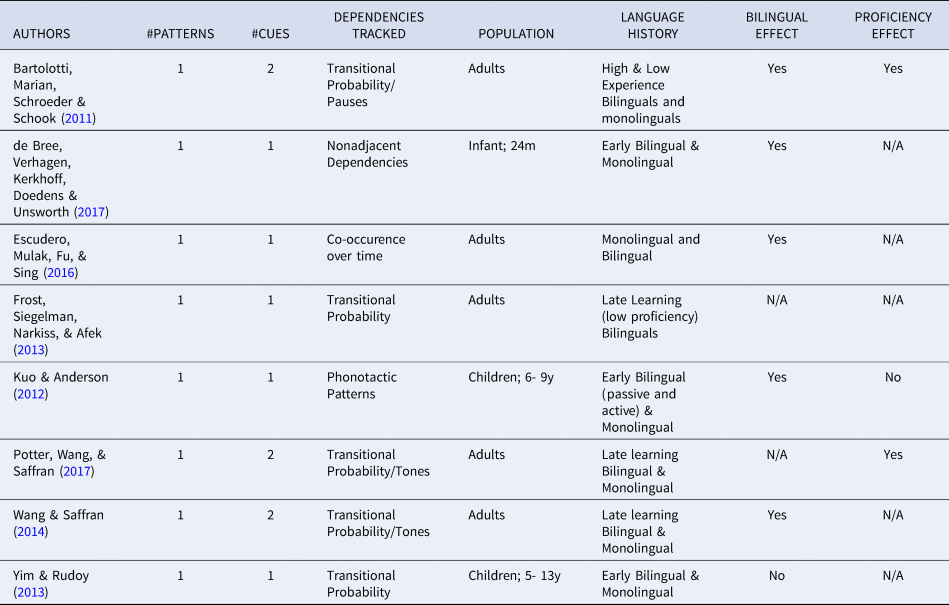
To summarize, many studies lend support to the notion that bilinguals differ from monolinguals in statistical learning abilities, particularly those that have tested participants with linguistic stimuli (see Table 1). Notwithstanding, there is not enough data using the original task pioneered by Saffran and colleagues (Reference Saffran, Aslin and Newport1996) to really understand whether some of these differences arise as a result of more general cognitive differences across groups (e.g., inhibitory control), sensitivity to linguistic variability (i.e., the structural sensitivity hypothesis), or a true difference in core statistical learning abilities. Given that one of the central challenges for infants raised in multilingual environments is acquiring the statistical regularities associated with each of the input languages (see Bosch & Sebastián-Gallés, Reference Bosch and Sebastián-Gallés2001; Bulgarelli, Lebkuecher & Weiss, Reference Bulgarelli, Lebkuecher and Weiss2018; Curtin, Byers-Heinlein & Werker, Reference Curtin, Byers-Heinlein and Werker2011; Weiss, Poepsel & Gerfen, Reference Weiss, Poepsel and Gerfen2015), several studies have sought to address this issue using paradigms with multiple patterns in the input.
Overview of artificial language studies on bilingualism using a single pattern

Statistical learning of multiple structures in monolinguals and bilinguals
In the two decades following the study by Saffran et al. (Reference Saffran, Aslin and Newport1996), studies of statistical learning using artificial languages primarily exposed learners to a uniform distribution of structure over the entire corpus of input. This affords the learner the same structural information, regardless of when the input is sampled (see Gebhart, Aslin & Newport, Reference Gebhart, Aslin and Newport2009). Thus, these studies could be viewed, at least in broad strokes, as being modeled on monolingual language acquisition (though arguably even within a single language there are many sources of variability; see Qian, Jaeger, and Aslin, Reference Qian, Jaeger and Aslin2012, Reference Qian, Jaeger and Aslin2016). Nevertheless, a more realistic approximation of the problem confronting language learners encounter should account for substantial variability in the statistics of linguistic input. Infants raised in multi-language environments must ultimately form statistical representations for each language, which may represent one of the earliest indicators that an infant is aware, even at an unconscious level, that multiple languages are present in the input (Weiss et al., Reference Weiss, Poepsel and Gerfen2015). Consequently, several studies have investigated how learners track multiple artificial languages, a research agenda that has clear implications for understanding early bilingual language development, as well as contributing to the understanding of how bilingualism might impact statistical learning.
The initial forays into multi-pattern statistical learning involved speech segmentation research with adult monolingual learners (Gebhart et al., Reference Gebhart, Aslin and Newport2009; Weiss, Gerfen & Mitchel, Reference Weiss, Gerfen and Mitchel2009). Weiss and colleagues (Reference Weiss, Gerfen and Mitchel2009) presented learners with two artificial languages interleaved in two-minute intervals. When the statistics across languages were incongruent (such that the combined statistics across languages yielded increased noise and thus weaker probabilistic cues to word boundaries) learners were at chance on a post-test. However, if the languages were presented using an indexical cue of speaker voice (i.e., one language presented in a male voice, the second in a female voice) both languages were learned at above chance levels. If the statistics across languages were congruent (i.e., the combined statistics still afforded robust cues to word boundaries), then learners could acquire both even in the absence of contextual cues.
These findings were somewhat mirrored in the study by Gebhart and colleagues (Reference Gebhart, Aslin and Newport2009) in which two incongruent languages were presented back-to-back for longer durations with only a single switch between the languages. In the absence of contextual cues, learners exhibited a primacy effect in which the first language was acquired but the second was unlearned. However, if there was a pause between languages and learners received explicit instructions that there would be multiple languages in the input, both artificial languages were acquired. The inclusion of a salient contextual cue (see Mitchel and Weiss, Reference Mitchel and Weiss2010) may elicit greater sampling of the input. When learners are exposed to lengthy periods of uniform artificial language input, they are more likely to become entrenched in the statistics of the first language (Bulgarelli & Weiss, Reference Bulgarelli and Weiss2016) and this may lead to reduced sampling of the input that precludes acquisition of the second structure (see Karuza, Li, Weiss, Bulgarelli, Zinszer & Aslin, Reference Karuza, Li, Weiss, Bulgarelli, Zinszer and Aslin2016). We note that similar primacy effects have been reported for bilinguals (Bulgarelli & Weiss, Reference Bulgarelli and Weiss2016).
Given the particular importance of statistical learning for language acquisition, the two-language statistical learning paradigm has been extended to infants. Antovich and Graf Estes (Reference Antovich and Graf Estes2017) tested 14-month-old monolinguals and bilinguals with two artificial languages that were interleaved during familiarization. While both groups were able to segment the languages when presented in isolation, only bilingual infants with regular exposure to two languages were able to learn both languages when they were interleaved. Notably, the languages were congruent and thus it is unknown whether this pattern reflects enhanced statistical learning abilities for acquiring a single language with a larger inventory and increased variance, or whether the bilingual children acquired the input as two distinct structures. Irrespective, this finding supports the results of a rule-learning study by Kovács and Mehler (Reference Kovács and Mehler2009) that tested 12-month old infants on the learning of rudimentary rules (e.g., items conforming to an AAB pattern such as wo wo fe; see Marcus, Vijayan, Bandi Rao & Vishton, Reference Marcus, Vijayan, Bandi Rao and Vishton1999). Only infants raised in bilingual environments were capable of acquiring multiple rules, as gauged by an anticipatory looking time procedure. However, monolinguals were able to perform on par with the bilinguals if contextual cues were provided. Similar to the aforementioned study (Antovich & Graf-Estes, Reference Antovich and Graf Estes2017), it is unclear whether the bilingual infants were actually acquiring two structures or perhaps just mastering one rule and its inverse (that is, identifying tokens that did not conform to the rule, rather than acquiring a second rule). Further, a recent study failed to find a difference between monolinguals and bilinguals using a similar task (Tsui & Fennell, Reference Tsui and Fennell2019).
While some of these studies raise the possibility that young bilinguals may differ from monolinguals in their ability to track distributional regularities, evidence from even younger infants is limited. A recent study presented monolingual 8-month-infants with two artificial languages presented consecutively and found that the infants struggled to learn, even when provided with correlated contextual cues for each language, such as pitch and accent changes (Benitez, Bulgarelli, Byers-Heinlein, Saffran & Weiss, Reference Benitez, Bulgarelli, Byers-Heinlein, Saffran and Weissin press; Bulgarelli, Benitez, Saffran, Byers-Heinlein & Weiss, Reference Bulgarelli, Benitez, Saffran, Byers-Heinlein and Weiss2017). While it is possible that infants raised in a bilingual environment might fare better in this task, experiments using natural language stimuli suggest this difficulty may reflect similar issues in real-world acquisition. Polka, Orena, Sundara, and Worrall (Reference Polka, Orena, Sundara and Worrall2016) tested 8-month old English and French monolinguals as well as French-English bilinguals on a bi-syllabic segmentation task that presented stimuli drawn from two languages (English and French) within a single session. Both groups of monolinguals could segment only their native language, but the bilingual infants struggled to segment words from either language. The authors suggest that segmenting words in a dual-language task is particularly challenging for bilinguals and may reflect the difficulty of learning to segment languages that are rhythmically different (Polka et al., Reference Polka, Orena, Sundara and Worrall2016).
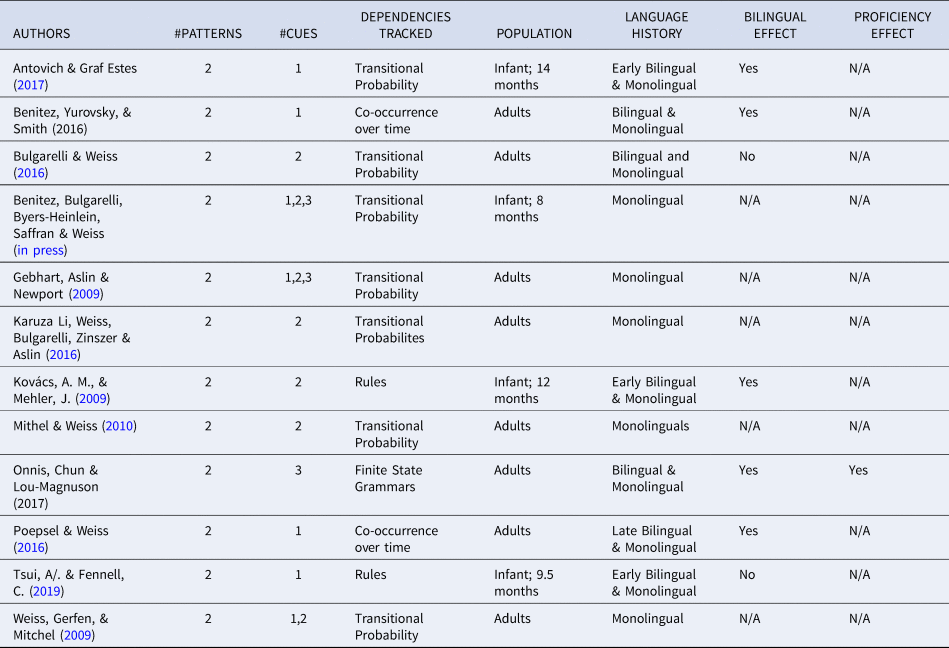
Further research with adults has employed a cross-situational statistical learning paradigm (Yu & Smith, Reference Yu and Smith2007), in which learners must track the co-occurrence of words and referents across multiple trials. Poepsel and Weiss (Reference Poepsel and Weiss2016) discovered that two groups of late learning bilinguals were faster and more accurate than monolinguals in discovering words that were remapped to new referents (i.e., 2:1 mappings in which one word was mapped to two objects). For one-to-one mappings, however, performance was similar across groups. The authors surmised that core features of statistical learning may be similar across monolinguals and bilinguals, but bilinguals may be more likely to notice when the input could arise from multiple distributions. Similarly, Benitez, Yurovsky, and Smith (Reference Benitez, Yurovsky and Smith2016) found that individuals who had experience learning multiple languages were better able to acquire two-word pairings in a cross-situational statistical learning task relative to monolinguals, in the absence of any additional contextual cues. Moreover, a study comparing simultaneous bilinguals with monolinguals on a cross-situational statistical learning task using phonologically similar words found that bilinguals outpaced the monolinguals even for one-to-one mappings (Escudero, Mulak, Fu & Singh, Reference Escudero, Mulak, Fu and Singh2016). Unlike research on statistical learning in the context of speech segmentation, these studies all point to monolinguals and bilinguals differing in their abilities to engage in statistical word learning (see Table 2 for summary).
Overview of artificial language studies with two patterns

The importance of language background was also highlighted by a study of artificial grammar learning comparing monolinguals and bilinguals, using a task with two audiovisual artificial languages arising from simple underlying grammars (Onnis, Chun & Lou-Magnuson, Reference Onnis, Chun and Lou-Magnuson2017). Across all participants, the rules of both artificial languages were learned with no differences in performance between the two languages. However, participants who were more balanced in their bilingualism outperformed those who had clear language dominance in one of their languages.
Concluding remarks
Research on statistical learning and bilingualism is clearly at an inchoate stage, as reflected by the range of findings emerging from the studies summarized above (see Tables 1 and 2). Nevertheless, several important themes have emerged. Perhaps the most important insight is that the learner's prior language experience impacts the expectations about and processing of novel artificial language inputs. While these effects may not be as evident when only a single pattern is presented, it does seem more pervasive in the context of multiple inputs or inputs with multiple cues. This influence of language experience has been corroborated by experiments using natural language input (e.g., Kittleson, Aguilar, Line Tokerud, Plante & Asbjørnsen, Reference Kittleson, Aguilar, Line Tokerud, Plante and Asbjørnsen2010; Orena & Polka, Reference Orena and Polka2019). Thus, it seems less likely that the core computational mechanisms differ across monolinguals and bilinguals or early versus late bilinguals. Rather, learners become attuned to the regularities in their input, and attempt to identify similar regularities with new input.
We close by noting one of the upcoming challenges for research in this field for which artificial language experiments may be particularly informative. Given that bilinguals contend with parallel activation from both languages during production and that there are cross-linguistic influences at many levels of processing (e.g., see Kroll, Dussias, Bogulski & Valdes Kroff, Reference Kroll, Dussias, Bogulski and Kroff2012), it will be important to develop a more nuanced understanding of what it means to form multiple statistical representations. While some statistics may be encapsulated by language at the earliest stages of processing, there are clearly rich interactions that have yet to be modeled in artificial language research.