Adolescent alcohol consumption is linked to a broad range of problems, including greater likelihood of concurrent risk behaviors and problems in school, and future problems with alcohol (Odgers et al., Reference Odgers, Caspi, Nagin, Piquero, Slutske and Milne2008; Windle et al., Reference Windle, Spear, Fulgni, Angold, Brown and Pine2008). As such, policymakers have emphasized prevention of youth alcohol use, especially among early adolescents (Spoth, Greenberg, & Turrisi, Reference Spoth, Greenberg and Turrisi2008). Fortunately, substance use prevention programs targeting youths’ perceptions of social norms, decision making, and peer relationship skills have been shown to delay substance use initiation and reduce rates of misuse (Spoth et al., Reference Spoth, Redmond, Clair, Shin, Greenberg and Feinberg2011).
Although generally effective, intervention effects on substance misuse, in particular alcohol use, vary across adolescents (see Smit, Verdurmen, Monshouwer, & Smit, Reference Smit, Verdumen, Monshouwer and Smit2008). This variability in intervention effects may be due to environmental and genetic factors working alone or in concert. An important potential source of environmental influences on interventions is adolescents’ family experiences, because main effects for family environments are well established. For example, parents’ greater involvement in their children's lives has been directly linked to lower rates of adolescent alcohol use (Goncy & van Dulmen, Reference Goncy and van Dulmen2010; Jordan & Lewis, Reference Jordan and Lewis2005; Petraitis, Flay, & Miller, Reference Petraitis, Flay and Miller1995; Pilgrim, Schulenberg, O'Malley, Bachman, & Johnston, Reference Pilgrim, Schulenberg, O'Malley, Bachman and Johnston2006; Ryan, Jorm, & Lubman, Reference Ryan, Jorm and Lubman2010). Consistent with the importance of parenting for alcohol use, some research has found that parenting factors, such as positive parenting, moderate the effect of family-based interventions (Jones et al., Reference Jones, Olson, Forehand, Gaffney, Zens and Bau2005), whereby greater intervention effects are observed among families with more positive and supportive parenting practices. However, not all examinations of family environmental moderation of family-based intervention effects provide supportive results. For example, other environmental factors, such as parents’ social emotional adjustment, have not been shown to moderate such intervention effects (see Guyll, Spoth, Chao, Wickrama, & Russell, Reference Guyll, Spoth, Chao, Wickrama and Russell2004). Evidence that variability in responses to preventive interventions may also be due to genetics comes from recent candidate gene research. In particular, the dopamine receptor D4 (DRD4) gene, but also other specific genetic variants such as serotonin transporter linked polymorphic region (5-HTTLPR), has been found to change the impact of interventions (see Bakermans-Kranenberg, van IJzendoorn, Pijlman, Mesman, & Juffer, Reference Bakermans-Kranenberg, van IJzendoorn, Pijlman, Mesman and Juffer2008; also Brody, Beach, Philibert, Chen, & Murry, Reference Brody, Beach, Philibert, Chen and Murry2009).
Based upon evidence that preventive interventions may vary in effect based upon both family environments and genetic factors, this study focused on how both maternal factors and specific genetic influences may jointly impact intervention effects on early adolescent alcohol use. We focus on maternal involvement due to consistent findings indicating its role in adolescent substance use (see Goncy & van Dulmen, Reference Goncy and van Dulmen2010; Jordan & Lewis, Reference Jordan and Lewis2005; Pilgrim et al., Reference Pilgrim, Schulenberg, O'Malley, Bachman and Johnston2006). Our primary genetic target is DRD4, due to the compelling evidence of its influence on differential reactivity to both interventions (see Bakermans-Kranenberg et al., Reference Bakermans-Kranenberg, van IJzendoorn, Pijlman, Mesman and Juffer2008) and social influences on alcohol use (see Larsen et al., Reference Larsen, van der Zwaluw, Overbeek, Granic, Franke and Engels2010). We also consider the role of the serotonin transporter (5-HTT) associated variant, 5-HTTLPR, not only because findings indicate it can moderate intervention effects (Brody, Beach, Philibert, Chen, & Murry, Reference Brody, Beach, Philibert, Chen and Murry2009), but also to determine whether primary findings are limited to DRD4.
To address these topics, the study draws on the PROSPER project's in-home assessments in conjunction with information on participant genotypes. Analyses make use of the randomized control design of the PROSPER project, candidate gene information from a subset of PROSPER participants, and self-report data collected during several years of intensive in-home survey assessments. Before delineating hypotheses, we describe the PROSPER project, the importance of maternal involvement on adolescent alcohol use, and why DRD4 and 5-HTTLPR variation might play an important role in moderating the impact of community-based preventive interventions on early adolescent alcohol use.
PROSPER Project
PROSPER is a community-based research project designed to study the impact of a partnership model for delivering evidence-based preventive interventions through a university, school, and Cooperative Extension collaboration. For the PROSPER project, 28 participating school districts in Iowa and Pennsylvania were randomized into control and intervention conditions. The 14 intervention communities utilized the PROSPER partnership model to deliver family-focused and school-based interventions (Spoth, Greenberg, Bierman, & Redmond, Reference Spoth, Greenberg, Bierman and Redmond2004). Teams of 8–12 individuals, including the local Cooperative Extension Staff based team leader, a public school co-leader, representatives of local human service agencies (e.g., mental health and substance abuse), and parent and youth representatives, were formed. The intervention team in each community selected an evidence-based universal family-focused program for implementation in sixth grade and an evidence-based, in-school program for implementation in seventh grade.
All 14 community teams chose the Strengthening Families Program: For Parents and Youth 10–14 (SFP 10–14) as their family-focused program. Approximately 17% of all eligible families across the PROSPER project's two study cohorts participated in the SFP 10–14. For the seventh-grade in-school program, Life Skills Training (Botvin, Reference Botvin2000) and Project Alert (Ellickson, McCaffrey, Ghosh-Dastidar, & Longshore, Reference Ellickson, McCaffrey, Ghosh-Dastidar and Longshore2003) were each selected by four teams; and the All Stars curriculum (McNeal, Hansen, Harrington, & Giles, Reference McNeal, Hansen, Harrington and Giles2004) was selected by the other six. The core logic of the three programs is more similar than different in that all target social norms, personal goal setting, decision making, and peer group affiliation. All interventions were delivered through lessons provided during required classes as part of the seventh-grade curriculum, so nearly all students in participating schools took part. Number of lessons varied between 11 (Project Alert) and 18 (Life Skills Training). Lesson activities included participation in question–answer sessions, role-play, and small-group activities. Assignments focused on recognizing and resisting peer pressure, benefits of not using alcohol and drugs, and practicing decision-making skills. Very high levels of implementation quality have been confirmed across family-focused and school-based interventions and cohorts (Spoth, Guyll, Lillehoj, Redmond, & Greenburg, Reference Spoth, Guyll, Lillehoj, Redmond and Greenberg2007). For more details on each program see Spoth et al. (Reference Spoth, Greenberg, Bierman and Redmond2004).
In-school student surveys began when participants were in the 6th grade, and continued annually in schools until 12th grade. The results at 4.5 and 6.5 years postbaseline indicate that youth in PROSPER intervention communities show reductions in an array of substance misuse outcomes (Spoth et al., Reference Spoth, Redmond, Clair, Shin, Greenberg and Feinberg2011, Reference Spoth, Redmond, Shin, Greenberg, Feinberg and Schainker2013) relative to controls. The largest differences between intervention and comparison communities existed for illicit substance use outcomes. For example, at the 10th-grade assessment, the relative reduction in rates for intervention compared to control communities were 25.1% and 42.2%, respectively, for marijuana and methamphetamine use. In contrast, the average effects of intervention condition on alcohol outcomes were more modest. For example, of several individual alcohol outcomes examined at the 10th grade, drinking more than a few sips had relative risk reduction of 5% and being drunk had a relative risk reduction of 7.4%. Other 10th-grade alcohol outcomes, such as past-month alcohol use and past-year alcohol use did not significantly differ by intervention status (Spoth et al., Reference Spoth, Redmond, Clair, Shin, Greenberg and Feinberg2011). Such relatively weak effects on alcohol use suggest it is particularly important to understand the source of variability in intervention effects on alcohol due to its wide use in order to guide future enhancements of the interventions (Gardner, Hutchings, Bywater, & Whitaker, Reference Gardner, Hutchings, Bywater and Whitaker2010).
Maternal Involvement, Adolescent Alcohol Use, and Interventions
We chose to examine the effects of maternal involvement in this study based on consistent findings from nonintervention research that maternal involvement is linked to lower adolescent alcohol use. For example, using a measure of shared behaviors between mothers and children similar to the one employed in the current study, Goncy and van Dulmen (Reference Goncy and van Dulmen2010) found maternal involvement was negatively related to both alcohol use and alcohol problems (also see Jordan & Lewis, Reference Jordan and Lewis2005). Similarly, Pilgrim et al. (Reference Pilgrim, Schulenberg, O'Malley, Bachman and Johnston2006), which did not distinguish between maternal versus paternal involvement, demonstrated that parental involvement (e.g., parents helping children with homework) is linked to reduced substance use generally and alcohol use specifically across all age, gender, and ethnic groups.
The importance of maternal involvement may not be limited to its direct effect on adolescent alcohol use. Maternal involvement in their children's lives promotes positive parent–adolescent relationships, which can attenuate the effects of negative peer influences by instilling characteristics and values that can help adolescents navigate risky peer environments (Brook, Brook, Gordon, Whiteman, & Cohen, Reference Brook, Brook, Gordon, Whiteman and Cohen1990). Child-directed maternal support, a domain closely linked to the adolescents’ report of positive maternal–child interactions used here to assess maternal involvement, has been found to moderate the link between affiliation with substance-use-promoting peers and alcohol use (Marshal & Chassin, Reference Marshal and Chassin2000). Thus, maternal involvement may lower alcohol use risk by buffering the impact of other risk factors and may work in tandem with effective prevention programs, increasing the benefit of these programs.
DRD4 Genotype, Differential Susceptibility, and Intervention Sensitivity
The way in which maternal involvement and intervention experiences combine to affect adolescent alcohol use may be further conditioned by genetics. We primarily focus here on the DRD4 gene, which participates in dopamine signaling and has been studied extensively with respect to how it affects behavioral traits. The most commonly tested genetic variant in DRD4 is the variable number of tandem repeat (VNTR) that alters protein length. This polymorphism is generally analyzed by comparing the presence or absence of the seven-copy repeat (i.e., 7+ vs. 7−, respectively). The 7+ variant of the polymorphism has been linked to less effective receptor signaling (Asghari et al., Reference Asghari, Sanyal, Buchwaldt, Paterson, Jovanovic and Van Tol1995) and possibly lower gene expression (Schoots & Van Toll, Reference Schoots and Van Tol2003). Behavioral research has conventionally focused on the negative implications of this polymorphism. DRD4 7+ has been linked to attention-deficit disorder (Faraone & Mick, Reference Faraone and Mick2010; Rowe et al., Reference Rowe, Stever, Giedinghagen, Gard, Cleveland and Terris1999) and novelty seeking (Benjamin et al., Reference Benjamin, Li, Patterson, Greenberg, Murphy and Hamer1996; Ebstein et al., Reference Ebstein, Novick, Umansky, Priel, Osher and Blaine1996).
In addition to the genetic associations to behavior traits, DRD4 has been associated with differences in neurocognitive function as reflected by magnetic resonance imaging of regional brain activation patterns and connectivity patterns in the frontal cortex (Gilsbach et al., Reference Gilsbach, Neufang, Scherag, Vloet, Fink and Herpertz-Dahlmann2012), an area critical for executive control of behavior (Barnes, Dean, Nandam, O'Connell, & Bellgrove, Reference Barnes, Dean, Nandam, O'Connell and Bellgrove2011; Le Moal & Simon, Reference Le Moal and Simon1991). Dopamine's action on this region of the brain, exerted in part through the receptor encoded by DRD4, is critical for recognizing and paying attention to salient information in the environment (reviewed by Bromberg-Martin, Matsumoto, & Hikosaka, Reference Bromberg-Martin, Matsumoto and Hikosaka2010). Differences in the degree to which the environment affects subsequent behavior in children are moderated by the DRD4 genotype from as early as the prenatal period. In a recent prospective study, conduct disorder/oppositional defiant disorder was found more frequently in offspring experiencing prenatal stress, but the effect was limited to those children who were 7+ at DRD4 (Zohsel et al., Reference Zohsel, Buchmann, Blomeyer, Hohm, Schmidt and Esser2014). Similarly, in a study of children ages 1 to 3 years old, an intervention focused on maternal behavior was effective in reducing externalizing behavior, but only in 7+ children whose mothers changed their behavior in response to an intervention (Bakermans-Kranenberg et al., Reference Bakermans-Kranenberg, van IJzendoorn, Pijlman, Mesman and Juffer2008). Differences in neural circuitry related to attention are also dependent on DRD4 genotype in the relationship of childhood behavioral inhibition to subsequent anxiety during adolescence. In an functional magnetic resonance imaging analysis, Pérez-Edgar et al. (Reference Pérez-Edgar, Hardee, Guyer, Benson, Nelson and Gorodetsky2013) showed that childhood behavioral inhibition was associated with adolescent anxiety among those with the 7+ genotype who also had elevated levels of activity in the striatum (caudate nucleus). These results suggest that attention to changes in the environment that result in behavioral modulation is dependent in part on genotype at the DRD4 gene. They also raise the idea that specific pathways and regions in the brain may be differentially active based on DRD4 genotype.
DRD4 and differential susceptibility
Associations between DRD4 and behavioral outcomes have not been consistently replicated (Kluger, Siegfried, & Ebstein, Reference Kluger, Siegfried and Ebstein2002; Malhotra et al., Reference Malhotra, Virkkunen, Rooney, Eggert, Linnoila and Goldman1996; Munafò, Yalcin, Willis-Owens, & Flint, Reference Munafò, Yalcin, Willis-Owen and Flint2008), suggesting that if there is a relationship between DRD4 and individual differences in behavior, it may be more nuanced. Recent research has considered such a possibility; specifically, investigating whether the DRD4 seven-repeat allele, rather than simply placing carriers at risk for negative outcomes, may create a greater openness to environmental influences (Bakermans–Kranenberg & van IJzendoorn, Reference Bakermans-Kranenberg and van IJzendoorn2011) more generally. This research is informed by differential susceptibility theory (DST; Belsky, Bakermans-Kranenburg, & van IJzendoorn, Reference Belsky, Bakermans-Kranenburg and van IJzendoorn2007; Belsky & Pluess, Reference Belsky and Pluess2009, Reference Belsky and Pluess2013; Ellis, Boyce, Belsky, Bakermans-Kranenburg, & van IJzendoorn, Reference Ellis, Boyce, Belsky, Bakermans-Kranenburg and van IJzendoorn2011), which suggests that factors conveying a risk for undesirable outcomes in negative environments may convey potential advantages in positive environments.
Early research on the DST employing nonexperimental designs suggested how DRD4 variability may contribute to associations between children's experiences and different behaviors. For example, maternal insensitivity at 10 months predicts externalizing at 39 months among DRD4 7+ children, but not among youth without the DRD4 7 allele (Bakermans-Kranenberg & van IJzendoorn, 2006). Similarly, there is a stronger relation between overall parental quality and lab-measured sensation-seeking behavior for DRD4 7+ than for DRD4 7− youth (Sheese, Voelker, Rothbart, & Posner, Reference Sheese, Voelker, Rothbart and Posner2007). More recently, Bakermans-Kranenberg and van IJzendoorn (Reference Bakermans-Kranenberg and van IJzendoorn2011) found that maternal attachment predicted altruistic behaviors among 7-year olds who were 7+ , but not among those who were DRD4 7−.
Most relevant to the current study are efforts to systematically manipulate experiences experimentally and so determine whether intervention effects vary as a function of the genetic makeup of recipients. As van IJzendoorn et al. (Reference van IJzendoorn, Bakermans-Kranenburg, Belsky, Beach, Brody and Dodge2011) make clear, a great strength of such approaches is that they overcome the possibility that gene–environment correlation is masquerading as gene–environment interaction while increasing statistical power to detect a Gene × Environment (G × E) interaction. In the first investigation to examine the genetic moderation of intervention efficacy focused on child behavior, Bakermans-Kranenberg et al. (Reference Bakermans-Kranenberg, van IJzendoorn, Pijlman, Mesman and Juffer2008) found that the effects of a randomly assigned parenting intervention varied in effectiveness by DRD4 genotype. Specifically, compared to DRD4 7− children, DRD4 7+ children showed greater change in externalizing behavior as a result of a parenting intervention designed to enhance maternal sensitivity and positive discipline strategies (Bakermans-Kranenburg et al., 2008). Particularly strong evidence that DRD4 7− afforded a heightened sensitivity to the parenting intervention was provided by post hoc analyses demonstrating that intervention effects were strongest among DRD4 7+ children whose parents showed the largest increase in the use of positive discipline. Thus, there is strong evidence that variability in the DRD4 gene, as well as other genes (particularly the serotonin transporter gene; see Brody, Beach, Philibert, Chen, & Murry, Reference Brody, Beach, Philibert, Chen and Murry2009, considered below) may moderate intervention effects.
Experimental settings also provide some of the more convincing work regarding DRD4 and its potential role in alcohol behaviors. Larsen et al. (Reference Larsen, van der Zwaluw, Overbeek, Granic, Franke and Engels2010) found that when exposed to heavy-drinking confederates, young adults who were DRD4 7+ consumed more alcohol than did those who did not carry this allele. A second study suggests a mechanism behind this DRD4× Social Pressure interaction: Creswell et al. (Reference Creswell, Sayette, Manuck, Ferrell, Hill and Dimoff2012) found that DRD4 7+ carriers were more sensitive to the social bonding effect of alcohol than were 7− individuals. Because these findings demonstrate that DRD4 can impact how influential and rewarding the social behaviors that surround drinking can be, they suggest a reason why DRD4 carriers may be more susceptible to the training provided by substance use interventions meant to help youth negotiate the social pressures to use substances, such as alcohol.
Beyond DRD4: 5-HTTLPR
Although the wealth of evidence demonstrating DRD4’s involvement in differential susceptibility (Bakermans-Kranenberg & van IJzendoorn, 2006) and its link to peer processes involving alcohol make DRD4 our primary target for this study's G × E analyses, it is important to note that evidence for differential susceptibility extends to other genetic variants. Several studies by Brody and colleagues highlight the relevance of a polymorphism, 5-HTTLPR, in the promoter of a different gene, 5-HTT (Brody, Beach, Philibert, Chen, & Murry, Reference Brody, Beach, Philibert, Chen and Murry2009; Brody, Beach, Philibert, Chen, Lei, et al., Reference Brody, Beach, Philibert, Chen, Lei and Murry2009). This polymorphic site exists as two alleles, long and short, and the short allele causes low expression of the serotonin transporter (Bradley, Dodelzon, Sandhu, & Philibert, Reference Bradley, Dodelzon, Sandhu and Philibert2005; Heils et al., Reference Heils, Teufel, Petri, Stöber, Riederer and Bengel1996; Little et al., Reference Little, Mclaughlin, Zhang, Livermore, Dalack and McFinton1998). This difference in expression makes it a potential causal genetic variant in genetic analyses of behavior (Lesch et al., Reference Lesch, Bengel, Heils, Sabol, Greenberg and Petri1996). The first study by Brody, although not experimental, found a Parenting × 5-HTTLPR interaction, whereby the short 5-HTTLPR allele was associated with increased risk of substance use over time, but that this increased risk was greatly reduced when youth had more involved parents (Brody, Beach, Philibert, Chen, Lei, et al., Reference Brody, Beach, Philibert, Chen, Lei and Murry2009). The second relevant study by Brody and colleagues used an experimental design to examine the moderating effect of the 5-HTTLPR genotype on the impact of the Strong African American Families (SAAF) intervention on the initiation of risk behaviors among 641 African American youth. These youth, 11 years old at baseline, were randomly assigned to the SAAF or the control condition. The primary finding was that youth who did not receive the intervention and carried the at-risk 5-HTTLPR genotype (the short allele) showed twice the increase in risk behaviors at the 29-month follow-up compared to both those youths who were not at genetic risk (lacking the short allele) in either condition and those who were at genetic risk but took part in the SAAF intervention (Brody, Beach, Philibert, Chen, & Murry, Reference Brody, Beach, Philibert, Chen and Murry2009). These findings are relevant for the present analysis in two ways: first, they demonstrate that specific genetic risk can condition the relationship between parental involvement and substance use, an aspect of which we investigate in this study; and second, they demonstrate that 5-HTTPLR as well as DRD4 can interact with intervention effects.
The relationship between the 5-HTTLPR site and alcohol use in adolescents has not been studied to the same extent as the DRD4 gene. Most research studies have focused on 5-HTTLPR and its potential role in mood and anxiety disorders (Kenna et al., Reference Kenna, Roder-Hanna, Leggio, Zywiak, Clifford and Edwards2012; Lesch et al., Reference Lesch, Bengel, Heils, Sabol, Greenberg and Petri1996). Inconsistent findings have brought about some controversy as to the exact relationship, especially regarding studies that include significant stress events as an environmental factor (see Kaufman, Gelernter, Kaffman, Caspi, & Moffitt, Reference Kaufman, Gelernter, Kaffman, Caspi and Moffitt2010; Munafò, Durrant, Lewis, & Flint, Reference Munafò, Durrant, Lewis and Flint2009).
In addition to these psychopathological states, 5-HTTLPR has been related to emotion processing (Jonassen & Landro, Reference Jonassen and Landro2014), and to modulation of brain circuits between the amygdala and several regions of the cortex such as the cingulate (Pezawas et al., Reference Pezawas, Meyer-Lindenberg, Drabant, Verchinski, Munoz and Kolachana2005) and the ventromedial prefrontal cortex (Holmes, Reference Holmes2008; Jasinska, Lowry, & Burmeister, Reference Jasinska, Lowry and Burmeister2012). These circuits are involved in interpretation of the emotional component of external stimuli. Thus, these traits are particularly relevant to our findings in light of the differential susceptibility theory.
The short allele of 5-HTTLPR has been associated with alcohol dependence in adults (Kreek, Nielsen, Butelman, & LaForge, Reference Kreek, Nielsen, Butelman and LaForge2005) and alcohol consumption in college-age youths (Covault, Reference Covault, Tennen, Armeli, Conner, Herman and Cillessen2007; Herman, Philbeck, Vassilopoulos, & Depetrillo, Reference Herman, Philbeck, Vassilopoulos and Depetrillo2003), but studies that focused on alcohol initiation and use in adolescence are limited (see Brody, Beach, Philibert, Chen, Lei, et al., Reference Brody, Beach, Philibert, Chen, Lei and Murry2009). In contrast to the prevailing expectation that short alleles are linked to alcohol use, Skowronek, Laucht, Hohm, Becker, and Schmidt (Reference Skowronek, Laucht, Hohm, Becker and Schmidt2006) found long allele homozygotes reported more drinking among midadolescents, at least among girls. This uncertain state of the field suggests that analysis of the manner in which the 5-HTTLPR might modulate the relationship between maternal involvement and adolescent alcohol use would be valuable.
PROSPER Data and G × E Research
The PROSPER project provides a unique opportunity to examine policy-relevant G-E interplay with two key advantages. The first advantage is the use of school district-level random assignment to intervention versus control conditions. By removing effects of self-selection into the intervention, it also removes the threat of gene–environment correlation between adolescents’, as well as families’, genetics and intervention exposure. In addition, because randomized prevention trial designs generally have substantially more power to detect interactions than cross-sectional studies (see McClelland & Judd, Reference McClelland and Judd1993), the analyses have more power to detect possible G × E interactions. Thus, intervention studies are especially well suited to examine G × E interactions (Bakermans-Kranenburg & Van IJzendoorn, in press). The second advantage of the PROSPER project for G × E research is the extensive phenotypic measurement of family processes in the subsample participants, analyzed herein, who took part in intensive in-home interviews from sixth through ninth grades.
These advantages provided the opportunity to examine the contributing roles of maternal involvement and genotypes, primarily DRD4 but also 5-HTTLPR, on adolescent alcohol use in the context of a preventive intervention trial. More specifically, our study investigated whether maternal involvement and genotype variability may individually or in combination modify the effects of combined family- and school-based interventions. Because our primary genetic interest is DRD4, with 5-HTTLPR used as an opportunity to extend our analyses into a secondary candidate gene, we first specify hypotheses for DRD4. These hypotheses are as follows: we expected to find main effects for 6th-grade pretest maternal involvement on 9th-grade alcohol use. We did not expect, however, to find that alcohol use varies as a main effect of intervention status, given that the PROSPER intervention effects of alcohol at 10th grade (Spoth et al., Reference Spoth, Redmond, Clair, Shin, Greenberg and Feinberg2011) were inconsistent. Similarly, based on differential susceptibility theory, we did expect main effects for DRD4 status. In addition to predicting a main effect for maternal involvement, we also predicted that maternal involvement would moderate the influence of intervention status. This prediction was based on findings that maternal factors have been shown to moderate links between other environmental exposures (viz., peer associations) and alcohol use (see Marshal & Chassin, 2000). Based on the above-cited literature, we expected to find that DRD4 moderates the influences of both maternal involvement and intervention on alcohol use. Finally, given the importance of family influences on adolescent alcohol use and prior findings on the interaction between parenting and DRD4 (see Bakermans-Kranenberg et al., Reference Bakermans-Kranenberg, van IJzendoorn, Pijlman, Mesman and Juffer2008; Sheese et al., Reference Sheese, Voelker, Rothbart and Posner2007), we considered it likely that level of maternal involvement would modify the manner in which DRD4 and intervention effects co-act upon alcohol use. We accordingly investigated the presence of a three-way interaction among our study variables, whereby levels of maternal involvement would condition the interaction between DRD4 variability and intervention status.
As noted above, although our primary genetic focus is DRD4, there is evidence that 5-HTTLPR can moderate the effects of both interventions and parenting involvement (Brody, Beach, Philibert, Chen, & Murry, Reference Brody, Beach, Philibert, Chen and Murry2009; Brody, Beach, Philibert, Chen, Lei, et al., Reference Brody, Beach, Philibert, Chen, Lei and Murry2009). Based on these findings, we expected to find similar results for 5-HTTLPR analyses. Specifically, we expected to find that 5-HTTLPR moderates the influences of both maternal involvement and intervention on alcohol use, in a three-way interaction among 5-HTTLPR, maternal involvement, and intervention.
G × E Research and Population Stratification
Several analytic challenges exist in studying the role of genetics in G × E intervention research. One of the more important analytic issues confronting investigations of associations between variations in candidate genes and phenotypes, regardless of whether associations are considered within an intervention design, is population stratification, or structure (Keller, Reference Keller2014). Population stratification refers to allelic associations that are due to systematic differences in genetic ancestry (i.e., certain alleles are found more frequently in one population than another) rather than an actual causal association between a gene's alleles and the outcome (Freedman et al., Reference Freedman, Reich, Penney, McDonald, Mignault and Patterson2004). In other words, population stratification presents a confound in genetic analyses that can lead to spurious associations between alleles and outcomes (Cardon & Palmer, Reference Cardon and Palmer2003).
Principal coordinates analysis (PCA) was used to assess and control for population stratification in this study. This method has been shown to accurately assess genetic differences due to geographical ancestry and admixture (Halder, Shriver, Thomas, Fernandez, & Frudakis, Reference Halder, Shriver, Thomas, Fernandez and Frudakis2008). These analyses use average allele-sharing distance to identify dimensions of population structure. As such, these analyses require across-genome data for each case analyzed. Depending on the genetic characteristics of the sample, such as the different geographic locations of sampled individuals’ ancestral origins and number of individuals in the sample drawn from different subgroups, this statistical technique can identify multiple principal coordinates that describe dimensions of population stratification. The steps taken by the current study to address population stratification are detailed in the Methods Section below.
Methods
Participants
As mentioned above, the PROSPER project includes 28 communities, each based around a school, in Iowa and Pennsylvania. These communities were randomized into intervention and control conditions. Interventions and data collections were organized into two cohorts. The data analyzed herein were drawn from the in-home data collections. In-home interviews were conducted twice in sixth grade (in the fall and spring, Waves 1 and 2) and annually in the spring thereafter for 3 years (Waves 3, 4, and 5). The in-home procedures included written questionnaires completed independently by the adolescent and one (nearly always the mother) or both parents/guardians.
A random sample of 2,267 families of youth from Cohort 2 participating in the PROSPER project were invited to participate in the in-home data collection; 979 (43%) participated. Some comparisons, such as for differences in perceiving benefits from using substances (M = 4.71 vs. 4.77), F (1, 27) = 12.36, p < .01, indicate that the in-home sample may be at slightly lower risk for problem behavior than the full sample of youth in the PROSPER project responding to school-based assessments (all sixth-grade students in participating school districts were invited to participate in in-school surveys; approximately 90% did so at Wave 1). However, in other domains the in-home sample was not different from the total in-school population at Wave 1. For example, the two groups were similar for receipt of school lunch (33.6% vs. 33.0%) and living with two biological parents, (59.3% vs. 62.5%) (Lippold, Greenberg, & Collins, in press).
Considering attrition across in-home waves
A total of 977 families took part in the Wave 1 in-home interview. Of these, 574 (58.75%) were from intervention communities and 403 from control communities. Of the original 977 families, 740 took part in the Wave 5 interview. Although participation dropped across waves, the distribution across conditions did not change from Wave 1 to Wave 5, with 435 (58.78%) and 301 families in intervention and control conditions, respectively, taking part in the Wave 5 interviews. During Wave 5 of the in-home assessment, parents were asked to consent for youth DNA data collection. A later data collection in young adulthood provided an opportunity to supplement the number of in-home participants who provided DNA. A total of 594 in-home participants provided saliva samples for DNA data collection (537 provided samples during Wave 5, 57 others provided samples through the mail as part of follow-up data collections during early adulthood). Of these 594 DNA-providing youth, 347 (58.42%) were from the intervention condition.
Of those who provided DNA, 98.5% were successfully genotyped for the DRD4 polymorphism. Less than 4.0% of participants had missing data for any one variable (see below). In total, 8.2% of cases were dropped for missing data, leaving the final analytical sample of N = 545. Sources of missing data are described in more detail below. The analytic sample was primarily self-identified non-Hispanic White (89.7%) with smaller groups identifying as Hispanic/Latino (4.4%), African American (1.5%), Asian (<1.0%), or other non-Caucasian (2.6%). Seven participants (1.3%) did not report their ethnicity. A small majority of participating youth was female (N = 297, 54.5%). Participants were on average 11.27 (SD = 0.50) years of age during the initial assessment in sixth grade and on average 14.88 (SD = 0.46) years of age at the ninth grade follow-up.
Measures
Genotyping
DNA was collected by buccal swabs and extracted using a modified phenol-chloroform technique (Freeman et al., Reference Freeman, Smith, Curtis, Huckett, Mill and Craig2003). A portion of the collected DNA was genotyped for the variable number of tandem repeat polymorphic site in the DRD4 gene at the Penn State Genomics Core (Anchordoquy, McGeary, Liu, Krauter, & Smolen, Reference Anchordoquy, McGeary, Liu, Krauter and Smolen2003; Sander et al., Reference Sander, Harms, Dufeu, Kuhn, Rommelspacher and Schmidt1997) using primer sequences developed by Lichter et al. (Reference Lichter, Barr, Kennedy, Van Tol, Kidd and Livak1993) with the forward primer fluorescently labeled. Amplification products were analyzed using a 3730XL DNA Analyzer and Genotyper software v4.0 (Applied Biosystems, Foster City, CA).
DRD4
The amplification method resulted in the following products listed in base pairs (repeat number): 372 (2), 419 (3), 466 (4), 513 (5), 568 (6), 616 (7), 660 (8), 705 (9), 740 (10), and 800 (11). Regenotyping 10% of the samples revealed an error rate of 7.5%. This rate is not surprising given the difficulty of amplifying the seven-copy allele in the presence of the four-copy allele. In addition, the genotypes were in Hardy–Weinberg equilibrium, χ2 (1) = 0.03, ns. DRD4 variability was coded on the basis of the presence versus absence of at least one copy of the DRD4 seven-repeat allele. Participants with at least one copy of the seven-repeat allele were coded 1 (7+; N = 196, 36.0%) and all other participants were coded 0 (7−; N = 349, 64.0%).
5-HTTLPR
A total of 511 participants with nonmissing maternal involvement data and alcohol use data were successfully genotyped on 5-HTTLPR (44 cases were missing 5-HTTLPR) using a modification of the original method (Anchordoquy et al., Reference Anchordoquy, McGeary, Liu, Krauter and Smolen2003; Lesch et al. Reference Lesch, Bengel, Heils, Sabol, Greenberg and Petri1996) with primers from Gelernter, Cubells, Kidd, Pakstis, and Kidd (Reference Gelernter, Cubells, Kidd, Pakstis and Kidd1999) and touchdown (Don, Cox, Wainwright, Baker, & Mattick, Reference Don, Cox, Wainwright, Baker and Mattick1991) polymerase chain reaction conditions (95 oC for 10 min, followed by one cycle each of 95 oC for 30 s, 65 oC for 30 s, and 72 oC for 90 s, decreasing the annealing temperature in 1 oC increments with a final 30 cycles of 95 oC for 30 s, 55 oC for 30 s, 72 oC for 90 s, and a final 30-min incubation at 72 oC). Of the 511 genotyped, there were 156 adolescents with two copies of the long allele (coded 0) and 355 with one or two copies of the short allele (coded 1). In addition, the genotypes were in Hardy–Weinberg equilibrium, χ2 (1) = 0.02, ns.
Intervention
Of the 545 participants included in the primary DRD4 analysis, 323 (59.3%) were in the intervention condition (i.e., attended intervention schools); the remaining 222 (40.7%) resided in the control communities. For 5-HTTLPR analyses, 304 (59.5%) were in the intervention and 207 (40.5%) were in the control condition.
Sixth-grade maternal involvement
A four-item measure was used to assess positive mother–child activities based on target youth's Wave 1 (sixth-grade) perceptions of how frequently in the last month that they and their mother (or stepmother/female guardian) participated in activities together. Example items include “Work on homework or a school project together” and “Do some other fun activity you both enjoy.” Items were scored on a scale of 1 = never to 4 = often and showed good internal consistency (α = 0.73; M = 3.33, SD = 0.64). Items were then used to create unit-weighted factor scores (e.g., Figueredo, McKnight, McKnight, & Sidani, Reference Figueredo, McKnight, McKnight and Sidani2000), calculated by multiplying each item by its respective correlation with an average composite of all items. Unit-weighted factor scores have the advantage of differentially weighting composite indicators according to each item's zero-order correlation with the composite, similar to factor loadings in confirmatory factor analysis. Higher scores indicate greater overall maternal involvement. This measure was then standardized with M = 0 and SD = 1. Thirteen cases were missing on this variable for youth who did not have a referent maternal figure. Seventeen other cases were missing due to nonresponse (3.1%)
Ninth-grade alcohol use
During ninth-grade in-home assessments, youth were asked three items about initiation of alcohol use: “Have you ever had a drink of alcohol,” “Have you ever drunk more than just a few sips of alcohol,” and “Have you ever been drunk from drinking alcohol?” Responses were coded as 0 = no, 1 = yes, and summed to create an overall alcohol use index that ranged from 0 to 3 (M = 1.09, SD = 1.16). Higher scores indicated greater experience with alcohol. This composite was created only for those participants with complete data on all three variables. Ten cases were missing on this variable due to attrition (1.7%).
Population stratification based on genotype and identifying siblings
PCA was carried out on data drawn from the genotyping of a portion of participant DNA with the Axiom™ Genome-Wide Exome Array by Affymetrix Inc. (Santa Clara, CA), which produces genotypes from 318,000 single nucleotide polymorphisms localized to the human genome's exons. All single nucleotide polymorphisms with a minor allele frequency of >0.05 (41,126) were selected and used to generate a matrix of pairwise allele-sharing distances among all pairs in the sample. PCA was then performed on the distance matrix using R to generate principal coordinates (PCs) representing the major axes of genetic variation in the sample. Biplots of the resulting PCs were generated and merged with self-reported ancestry to visualize the axis of genetic variation represented by each PC.
The first PC (PC1) accounted for approximately 10% of the total allele-sharing distance, while PC2 accounted for approximately 6%. Based on biplots of population structure overlaid with self-reported race and ethnicity, PC1 provided a clear index of non-European ancestry. For example, the highest PC1 scores belonged to individuals who self-reported African American ancestry. Comparing PC1 means across self-reported non-Hispanic Whites (M = −0.008, SD = 0.008, n = 493) and those reporting a different ethnicity (e.g., Hispanic and African American; M = 0.067, SD = 0.035, n = 53) revealed a significant difference, t (544) = 39.79, p < .001. The Cohen d for this difference was 3.0. Based in part upon the overlap between self-reported race/ethnicity and values on PC1, this PC was selected as our primary indicator of non-European ancestry. PC2 appeared to largely distinguish African Americans and Hispanics. Given the small sample-size of these subgroups and the resulting low power of any comparisons based on this distinction, PC2 was not used in analyses.
In addition to using PC1 as a linear indicator of European ancestry, we also used this score to identify and drop the subsample of individuals with significant non-European ancestry. To do so, a value was selected equal to 1 SD below the mean PC1 score of all self-reported non-Europeans (0.0664). This value (0.031) classified 507 participants as having European ancestry and 48 participants as having significant non-European ancestry. This cutoff classified 6 of 7 individuals who self-reported as African American, 26 of 27 who self-reported as Hispanic, and 3 of 4 who self-reported as Asian. This cutoff also classified 2 self-reported Whites as having significant non-European ancestry. Finally, the allele-sharing analysis allowed us to identify three pairs of siblings in the participants. One of each pair was removed randomly with a coin toss to ensure that all analyses were carried out on unrelated individuals.
Results
The results are organized into several sections. First, demographics and preliminary population stratification analyses are presented. These analyses are preliminary to the analyses involving DRD4. Second, primary results examine the moderation of intervention effects by both maternal involvement and DRD4. Third, supplemental results investigate findings for subgroups that underlie the primary DRD4 findings. Fourth, models examine whether 5-HTTPLR acts similarly to DRD4. These analyses mirror those that investigate DRD4 interactions. Fifth, a final set of analyses investigates whether intervention experiences may have affected maternal involvement.
DRD4 analyses
Preliminary demographics and genotypes
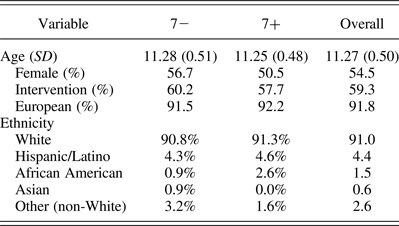
Table 1 presents demographics for the DRD4 analysis sample, for both the full analysis sample and by DRD4 genotype. Across these demographic characteristics, the genotype groups appear very similar. DRD4 7+ versus 7− participants did not significantly differ on any Table 1 demographic characteristic, based on t test and chi-square comparisons.
Demographic comparisons by DRD4 genotype and for full sample

Note: The percentage European is based on principal coordinate 1 (PC1), and ethnicity is based on participant self-report. PC1 is reported here in standard deviations. 7−, Absence of a seven-repeat variant; 7+, presence of a seven-repeat variant.
Preliminary analyses of population stratification and DRD4
In addition to being used to statistically control for population stratification and to select a European-only subsample for supplemental analyses, PC1 was used in preliminary analyses to consider the association between genetic ancestry and analysis variables. Significant correlations between PC1 and the primary study variables, such as DRD4 seven repeat and alcohol use, would indicate that population stratification might contribute to spurious associations between genotypes and other study variables. However, correlations between PC1 and the nongenetic study variables were small and nonsignificant, ranging from 0.04 to −0.04. Moreover, PC1 values, which were −0.03 (SD = 0.92) and 0.05 (SD = 1.14), respectively, across 7− and 7+ youth, did not significantly vary by DRD4 genotype. These findings indicate little or no risk that population stratification could present a meaningful confound in the analyses that follow.
Primary DRD4 analyses
Because the sampling framework consisted of families nested within communities, analyses were conducted using the REPEATED statement in SAS PROC MIXED to model correlated residuals. However, as the intraclass correlation indicates, there was only a trivial amount of variance in alcohol use at the school district level (intraclass correlation = 0.028).
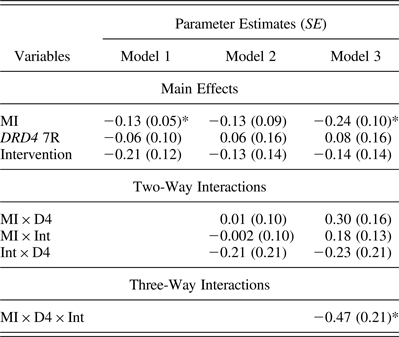
Primary analyses were run in three steps: a main effects model was run, all two-way interactions were added, and the three-way interaction was added. Table 2 provides parameter estimates as unstandardized regression coefficients (b) and standard errors for these three models. Model 1 included main effects for maternal involvement, intervention, and DRD4 status. The hypothesis that alcohol use would be predicted by maternal involvement was supported (b = −0.13, p < .05), whereby higher levels of activities the mother reported in sixth grade were associated with reduced alcohol use when youth were in ninth grade. At the conventional .05 level, which we are using across analyses presented here, there was no main effect of the intervention (b = −0.21, ns). It should be noted, however, that at the 0.10 alpha level that has been applied to directional hypotheses in prevention research, including PROSPER (see Spoth et al., Reference Spoth, Redmond, Shin, Greenberg, Feinberg and Schainker2013), intervention status was significantly related to reduced alcohol use. Finally, as expected, there was no main effect of DRD4 genotype on alcohol use.
Parameter estimates (standard errors) for DRD4 models predicting alcohol initiation
Note: 7R, Seven repeat; MI, maternal involvement (mean centered); D4, DRD4 7R (0 = 7−, 1 = 7+); Int, intervention (0 = control, 1 = intervention).
*p < .05.
The second model added the three two-way interactions between these variables (Table 2). None of these two-way interactions were significant, failing to support the three hypotheses positing moderation at this level. However, the three-way interaction among maternal involvement, DRD4 status, and intervention status (see Table 2, Model 3) was significant (b = −0.47, p < .05; d = 0.41). The significance of this three-way interaction indicates that associations between any of these factors, maternal involvement, DRD4 status, or intervention status, and alcohol use is dependent upon levels of the other factors experienced by youth.
Interpreting the three-way DRD4 interaction with simple effects
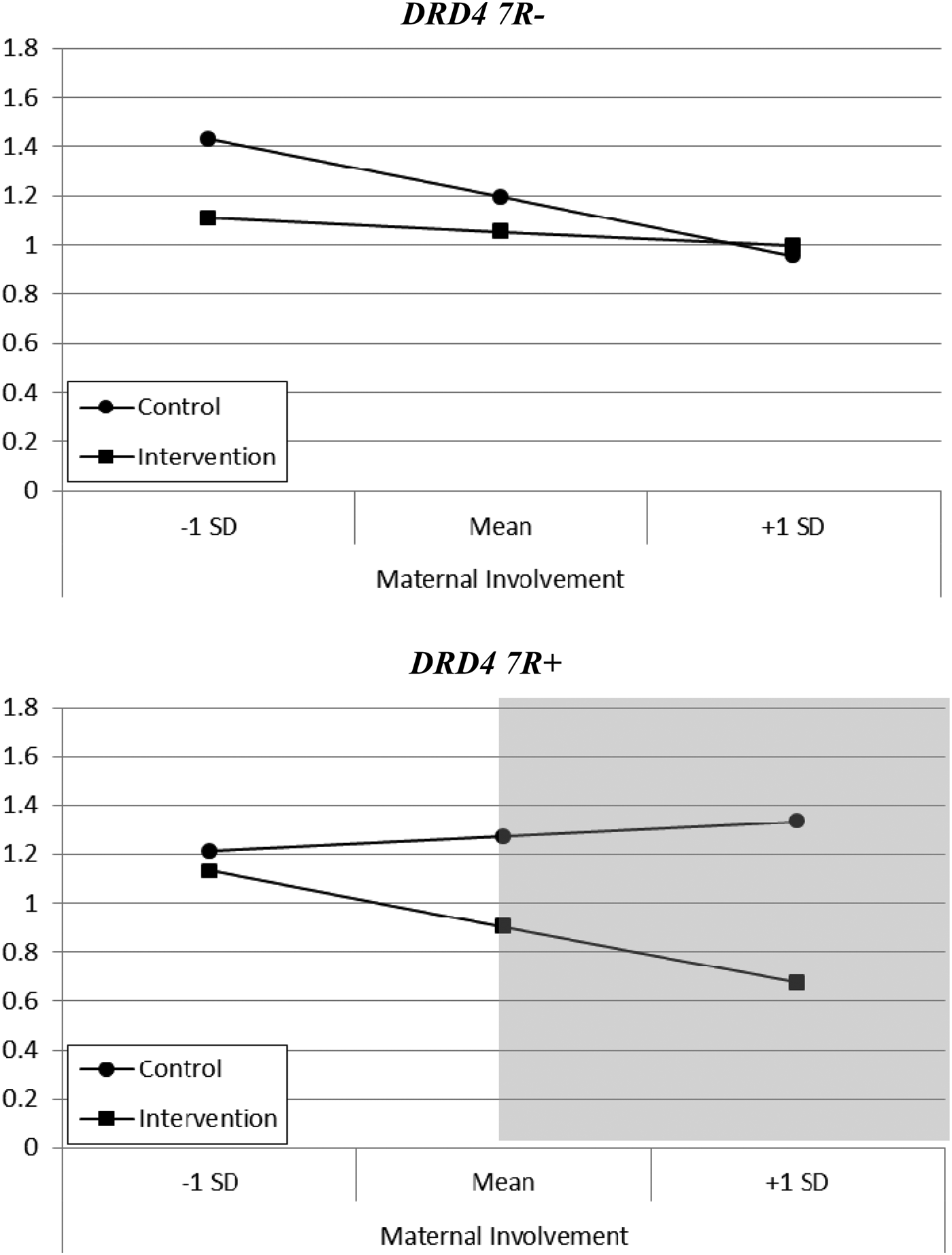
To determine whether the three-way interaction is consistent with our expectation that the two-way interaction between DRD4 and intervention status was dependent upon maternal involvement, a series of conditional main effects was examined, per the moderation probing techniques recommended by Frazier, Tix, and Barron (Reference Frazier, Tix and Barron2004). Specifically, analyses were conducted wherein categorical variables (e.g., 0 = 7− vs. 1 = 7+) were reverse-coded (e.g., 1 = 7− vs. 0 = 7+) and continuous variables were recentered around ±1 SD around their mean. Figure 1 presents results from these analyses. It provides slopes for the association between maternal involvement and alcohol use separately for 7− participants (top) and 7+ participants (bottom).
Differential effects of intervention status on alcohol initiation by DRD4 genotype and maternal involvement.
The top of Figure 1 provides results for DRD4 7− youth. The slopes for control (b = −0.24, p < .05) versus intervention (b = −0.06, ns) conditions do not differ (b = 0.18, ns).
The bottom of Figure 1 provides the slopes for the 7+ youth. For this genotype, the association between maternal involvement and alcohol use was b = 0.06 (ns) in the control condition and b = −0.23, p < .05 within the intervention condition. The difference between these slopes approached, but did not reach, significance at the .05 level (b = 0.29, p = .07). Although this interaction was not significant, comparing alcohol use means across low, mean, and high levels of maternal involvement reveals the level of maternal involvement at which intervention experiences make a difference for 7+ youth. At the low level (−1 SD; b = 0.08, ns) no differences existed, but at both mean (b = 0.37, p < .05) and high (b = 0.66, p < .05) levels of maternal involvement, controls reported significantly higher levels of alcohol use. Intervention effect sizes were one-third of a standard deviation (d = 0.32) at the mean level of maternal involvement and over one-half of a standard deviation (d = 0.57) at the high level (+1 SD) of maternal involvement. These simple effects comparisons demonstrate that the three-way interaction is largely due to differences between intervention and control groups among DRD4 7+ youth who report average or greater levels of maternal involvement. Consistent with these genotype-specific differences, the two-way interaction between DRD4 and intervention was significant at high maternal involvement (b = 0.70, p < .05; d = 0.60). This result confirmed that the magnitude of the difference between control and intervention groups at high maternal involvement was significantly larger among the 7− youth compared to 7− youth (among whom it is essentially zero).
Because the specific cutoffs used to block the sample into low, medium, and high terciles of maternal involvement in the above analyses are somewhat arbitrary, a regions of significance analysis (RoS; see Kochanska, Kim, Barry, & Philibert, Reference Kochanska, Kim, Barry and Philibert2011; Roisman et al., Reference Roisman, Newman, Fraley, Haltigan, Groh and Haydon2012) was conducted using the Johnson–Neyman technique (see Preacher, Curran, & Bauer, Reference Preacher, Curran and Bauer2006). The results showed differences between control and intervention 7+ youth with values for maternal involvement ranging from −0.08 to 11.43. Using the −0.08 value, a shaded area was added to the bottom of Figure 1 to indicate the area of maternal involvement wherein differences in alcohol use were significant across control versus intervention conditions. In other words, consistent with the tercile-blocking results above, differences in alcohol use between the control and intervention 7+ youth manifest when level of mother–child activities are close to average and higher. Similar analyses were performed within the 7− youth; however, no significant differences were found between intervention and control at any levels of maternal involvement, confirming the previous null results for youth with this genotype (Figure 1). Taken together, these results indicate an effect of the intervention specific to 7+ youth, but only when youth were exposed to average and above average levels of mother–child involvement. Based on the −0.08 value, the affected subgroup represented 19% of the all adolescents receiving PROSPER and 61% of all 7+ youth in the intervention (see bottom of Figure 1).
Population stratification and DRD4 models
To ensure that the DRD4 results were not confounded by population stratification, Model 3 was rerun, first by statistically controlling for non-European ancestry and second by dropping non-Europeans and rerunning analyses. Compared to the parameter for three-way interaction in Model 3 (b = −0.47), the same parameter was -0.45 (p < .05, n = 511) and −0.51 (p < .05, n = 470), respectively, in models statistically controlling for degree of non-European ancestry (n = 511) and dropping those identified as non-European based on their PC score (n = 470), respectively. As a final check, we added statistical controls for participant sex and age to the primary model (n = 545), and the parameter for the three-way interaction was similar and significant (b = −0.43). These results demonstrated that the three-way interaction was robust to these potential confounds.
5-HTTLPR analyses
Preliminary 5-HTTLPR analyses
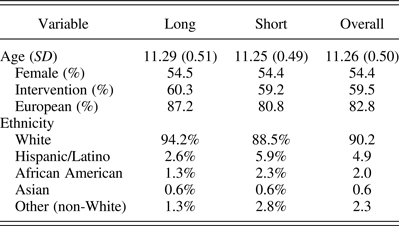
Analyses of 5-HTTLPR were carried out on data from 511 participants (see Table 3). Preliminary analyses found that associations between 5-HTTLPR and both PC1 and maternal involvement were nonsignificant. Moreover, levels of PC1, –0.11 (0.71) and −0.05 (1.10), respectively, for long and short carriers, did not significantly differ by 5-HTTLPR genotype.
Demographic comparisons by 5-HTTLPR genotype and for full sample
Note: The percentage European is based on principal coordinate 1 (PC1), and ethnicity is based on participant self-report. PC1 is reported here in standard deviations.
Primary 5-HTTLPR analyses
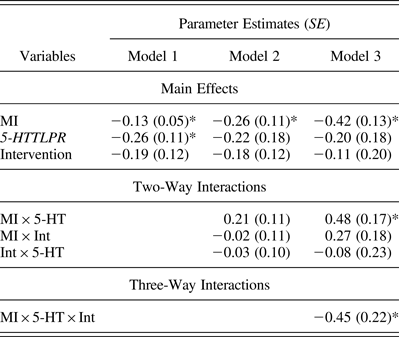
Following the format of DRD4 analyses, primary 5-HTTLPR analyses were run in three steps consistent with the main effects, two-way interaction, and three-way interaction framework outlined above, and the results are shown in Table 4. Model 1 included main effects for maternal involvement, intervention, and 5-HTTLPR status. Alcohol use was predicted by maternal involvement (b = −0.13, p < .05; d = 0.11), where higher levels of activities the mother reported in sixth grade were associated with reduced alcohol use when the youth were in ninth grade. In addition, there was a main effect of 5-HTTLPR genotype on alcohol use (b = −0.26, p < .05; d = 0.23) indicating that, overall, youth with the long allele tended to drink more than youth with at least one copy of the short allele. As in DRD4 analyses, no association was found between the intervention and alcohol use (b = −0.19, p = .12).
Parameter estimates (standard errors) for 5-HTTLPR models predicting alcohol initiation
Note: MI, Maternal involvement (mean centered); 5-HT, 5-HTTLPR (0 = long, 1 = short); Int, intervention (0 = control, 1 = intervention).
*p ≤ .05.
The second model added the three two-way interactions between these variables (Table 4). None of these three two-way interactions were significant at the .05 level; however, the two-way interaction between maternal involvement and 5-HTTLPR was near significant (b = 0.21, p = .05). We examined this parameter in two ways. First, analyses were rerun without the other to-way interactions and their main effects. In this simplified model, the two-way interaction between maternal involvement and 5-HTTLPR was significant (b = 0.22, p < .05). Second, follow-up analyses then revealed a significant reduction in reported alcohol use with higher levels of maternal involvement among adolescents with the long 5-HTTLPR allele (b = −0.27, p < .01; d = 0.23), but not among adolescents with the short allele (b = −0.06, ns). Examining mean differences revealed that adolescents with the long allele tended to drink more than adolescents with the short allele at low (b = −0.47, p < .01; d = 0.41) and mean levels (b = −0.27, p < .05; d = 0.23) of maternal involvement. However, with high maternal involvement, this genetic effect was not present (b = −0.05, ns). Regions of significance tests showed differences in alcohol use between adolescents with the short and long alleles at just above zero and below on maternal involvement (RoS = −104.02–0.18).
In the final model, the added three-way interaction among maternal involvement, DRD4 status, and intervention status (see Table 2, Model 3) was significant (b = −0.45, p < .05; d = 0.39). The significance of this three-way interaction indicates that associations between alcohol use and maternal involvement, 5-HTTLPR status, and intervention status are dependent upon levels of the other factors experienced by youth. It is worth noting that the two-way interaction between maternal involvement and 5-HTTLPR was significant in this model (b = 0.48, p < .05; d = 0.41). However, the main effect for 5-HTTLPR was no longer significant.
Interpreting the three-way 5-HTTLPR interaction with simple effects
The magnitude and direction of the three-way interaction parameter in the 5-HTTLPR analyses were similar to the corresponding parameter in the DRD4 analyses. To determine whether the 5-HTTLPR three-way interaction was analogous to the three-way DRD4 interaction, the conditional main effects with 5HTTLPR were examined (see Frazier et al., Reference Frazier, Tix and Barron2004). These results did not reveal a pattern of associations similar to those underlying the three-way DRD4 interaction: first, the two-way interactions between intervention condition and maternal involvement were not significant for either the long (b = 0.27, ns) or the short (b = −0.18, ns) 5-HTTLPR groups. Second, unlike DRD4, there were no significant differences in alcohol use between the control and intervention youth regardless of level of maternal involvement in either the long or the short 5-HTTLPR conditions.
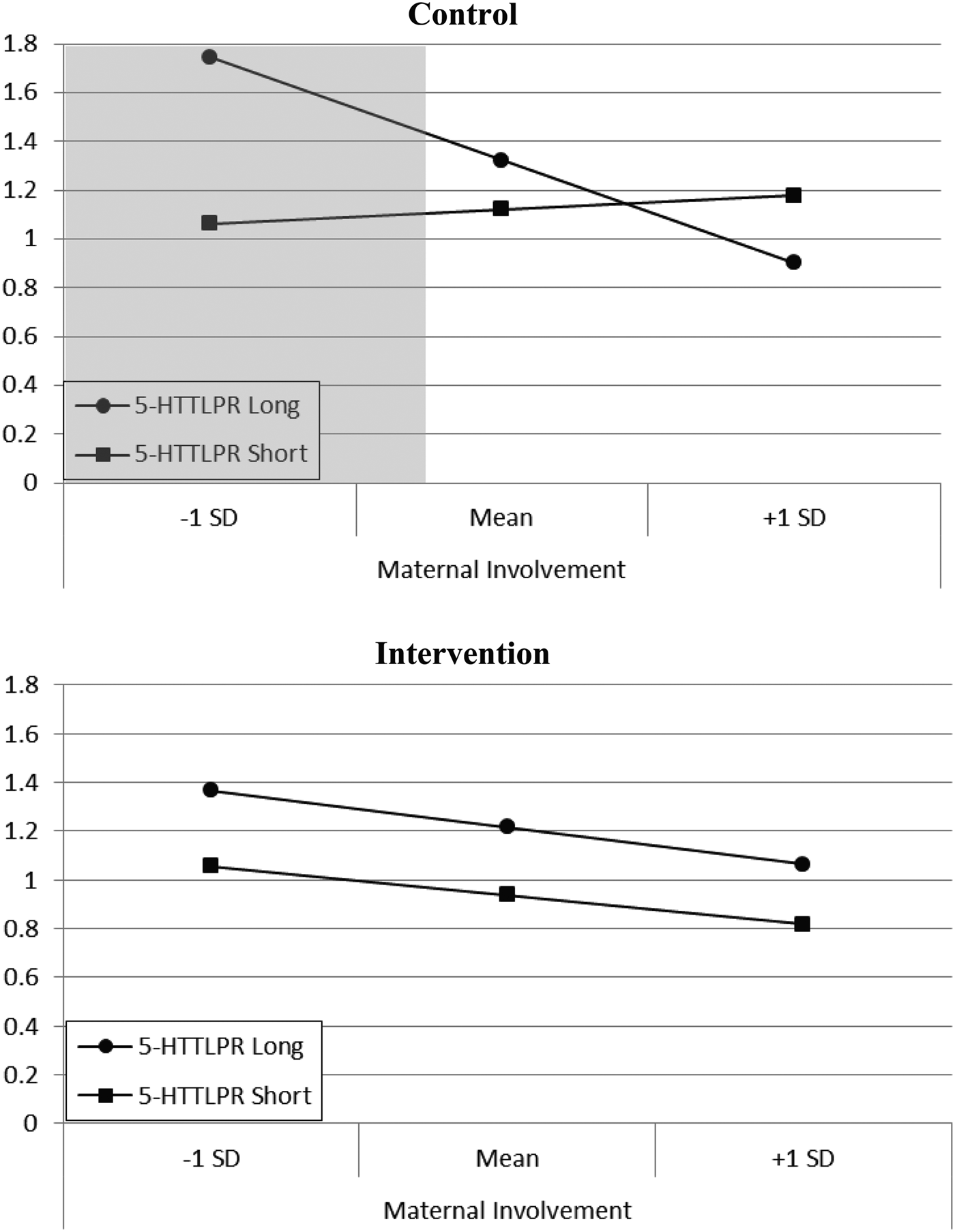
As a next step, the conditional main effects were further examined, but this time blocked by intervention, rather than genetic, status. These analyses revealed a significant two-way interaction between maternal involvement and 5-HTTLPR among control (b = 0.49, p < .01; d = 0.42) but not intervention (b = 0.03, ns) youth. The differences in these patterns are shown in Figure 2. Among the control participants, on the top of Figure 2, there was a significant decline in alcohol use with higher reports of maternal involvement for youth with long alleles (b = −0.42, p < .01; d = 0.36). Among youth in the intervention, the decline in alcohol use with higher maternal involvement was not statistically significant (b = −0.15, ns). Thus, the significant three-way interaction for 5-HTTLPR in Model 3 appears to be driven largely by the two-way interaction between 5-HTTLPR and maternal involvement being conditioned by intervention status: the genetic moderation of the association between maternal involvement and alcohol use observed among controls is tempered by the intervention. Within the control condition, there was a significant difference in alcohol use at low levels of maternal involvement (−1 SD) whereby long carriers reported higher levels of ninth-grade alcohol use compared to short carriers (b = −0.68, p < .01; d = 0.59; RoS = −2.11 to −0.31; see Figure 2 shaded area). In contrast to the controls, the relative differences in alcohol use among intervention youth were constant across levels of maternal involvement, reaching statistical significance only within a small region around the mean (RoS = −0.27 to 0.05).
Differential effects of 5-HTTLPR genotype and maternal involvement on Alcohol Initiation × Intervention Status.
Population stratification and 5-HTTLPR models
Similar to DRD4 analyses, sensitivity analyses were run to consider whether population stratification might be contributing to spurious results. The three-way interaction shown in Model 3 (b = −0.45) for 5-HTTLPR was tested against a control for non-European ancestry, again dropping participants with meaningful non-European ancestry. The results of these analyses demonstrated that the three-way interaction was robust to these potential confounds (b = −0.52, p < .05, n = 479 and b = −0.53, p < .05, n = 423, respectively).
Maternal involvement supplemental analyses
The PROSPER project was not designed to test the a priori hypothesis that maternal involvement moderated intervention effects or that such maternal behaviors moderated the combined effect of genes and interventions. Given the importance of maternal involvement conditioning the influence of other factors, further analyses were performed to investigate whether the intervention modified maternal involvement at Wave 5. It did not, t (532) = 1.70, ns; means: intervention = 2.34, control = 2.26. Thus, the school-implemented aspect of PROSPER did not affect involvement at Wave 5.
In addition, we considered whether the primary results held up when controlling for participation in the family-based intervention, the Strengthening Families Program (SFP) intervention, in which 17% of those in the intervention communities took part. First, there was no difference on Wave 5 maternal involvement between SFP participants and either all others, t (532) = 0.22, ns, or intervention community members whose families did not take part in the SFP intervention, t (318) = 0.850, ns. Second, adding a dummy variable indicating SFP participation to the main interaction analyses did not change results. Specifically, compared to −0.47 (p < .05) in the primary DRD4 results, the three-way interaction parameter was −0.46 (p < .05). Similar reanalyses of the 5-HTTLPR results did not change the magnitude or significance of the three-way interaction parameter, which was −0.45 (p < .05). This last set of analyses demonstrates that the results presented herein are not driven by the subgroup of families that took part in the family-based intervention.
Discussion
The primary finding of this study is that being in a school district randomly assigned to the PROSPER intervention condition can reduce risk for ninth-grade alcohol use, but that such intervention effects depend on the combination of genotype and youth-reported maternal involvement. For analyses of DRD4, intervention–control differences in alcohol use by ninth grade were found for youth who carry at least one copy of the DRD4 seven repeat allele (7+) and experience average and higher levels of maternal involvement. A total of 19% of the intervention sample met the two criteria of carrying a 7+ allele and reporting moderate or higher levels of maternal involvement. These youth were susceptible to the beneficial, and preventive, effects of PROSPER on alcohol use. Although similar in magnitude and direction, the significant three-way interaction involving 5-HTTLPR was not driven by genetic variance and maternal involvement conditioning intervention effects. Rather, in the case of 5-HTTLPR analyses, the intervention appeared to remove the two-way interaction between maternal involvement and 5-HTTLPR. This interaction, whereby lower levels of maternal involvement corresponded with heightened risk of alcohol use among carriers of long 5-HTTLPR alleles, only existed among controls. In contrast, among intervention participants, differences in alcohol use levels across 5-HTTLPR genotypes did not vary by level of mother involvement. An additional finding, in both DRD4 and 5-HTTLPR analyses, was a main effect of sixth-grade report of maternal involvement on reduced alcohol use in the ninth grade, consistent with prior research (Goncy & van Dulmen, Reference Goncy and van Dulmen2010; Jordan & Lewis, Reference Jordan and Lewis2005; Pilgrim et al., Reference Pilgrim, Schulenberg, O'Malley, Bachman and Johnston2006).
Null findings from this analysis include the lack of main effects for DRD4 and intervention status on alcohol use. The first of these is consistent with a central tenet of differential susceptibility theory: inheriting specific alleles, such as the DRD4 seven repeat, may not convey risk per se. Rather, inheriting specific alleles provides an openness or responsivity to environmental experience, and such an openness can lead to either negative or positive outcomes depending on other factors such as the characteristics of the environment (Bakermans-Kranenberg & van IJzendoorn, Reference Bakermans-Kranenberg and van IJzendoorn2011; Belsky, Bakermans-Kranenburg, & van IJzendoorn, Reference Belsky, Bakermans-Kranenburg and van IJzendoorn2007; Belsky & Pluess, Reference Belsky and Pluess2009, Reference Belsky and Pluess2013). Thus, in the absence of evidence to the contrary, it may be useful to consider that any given gene, given a plausible biological function, may play an important role in determining a phenotype in some environments, even though the effect of that given gene is neutral when averaged across a range of environmental exposures. This point will be elaborated upon below.
That we did not find a main effect for intervention status is not surprising. Prior analyses of 10th-grade alcohol outcomes based on the entire PROSPER sample showed inconsistent effects on alcohol outcomes (Spoth et al., Reference Spoth, Redmond, Clair, Shin, Greenberg and Feinberg2011). However, based on the analyses reported herein, the effect of the intervention can be interpreted as conditional: intervention effects were evident for DRD4 carriers when they reported moderate to high levels of maternal involvement; but at low levels of reported maternal involvement, there were no intervention effects on alcohol use. Adequate maternal involvement may provide a supportive context for positive change that allows preventive interventions to work.
At first blush, it may seem unusual that the DRD4 analyses did not reveal a two-way G × E (either Gene × Intervention or Gene × Parenting) interaction. It is possible that just like simple effects between genes and outcomes, two-way interactions between genes and specific aspects of the environment may depend on other aspects of the environment. For example, the Brody, Beach, Philibert, Chen, and Murry (Reference Brody, Beach, Philibert, Chen and Murry2009) finding of genetic risk, conveyed in this case by variation in 5-HTTLPR, moderation of SAAF intervention effects on externalizing behaviors may not be generalizable to populations with different experiences than the rural African American youth in that sample. In contrast, the sample of youth and families in the PROSPER study, although also drawn from rural areas, are largely White and less economically challenged. Stated differently, the interaction found in Brody, Beach, Philibert, Chen, and Murry (Reference Brody, Beach, Philibert, Chen and Murry2009) might be conceptualized as a two-way interaction that occurs in a sample of individuals who exist within a specific social and economic context. It may be that if the Brody sample included a higher proportion of, for example, middle- to high-socioeconomic status African American youth, the two-way interaction would be conditioned by socioeconomic status (and thus would be a three-way interaction). Furthermore, the Brody, Beach, Philibert, Chen, and Murry (Reference Brody, Beach, Philibert, Chen and Murry2009) study focused on a family-focused intervention. In contrast, in PROSPER only 17% of the PROSPER community youths’ families participated in the family intervention in Grade 6, but virtually all PROSPER intervention youth experienced one of the three school-based programs. Thus the PROSPER intervention effects, compared to those studied by Brody, Beach, Philibert, Chen, and Murry (Reference Brody, Beach, Philibert, Chen and Murry2009), may be more directly targeted toward individual children than on family processes, and thus preexisting family factors may have been more important to the intervention's success in the PROSPER case.
As noted above, DRD4 analyses did not reveal the two-way interactions we expected. However, analyses of 5-HTTLPR did reveal a significant two-way interaction between 5-HTTLPR and maternal involvement. This moderation existed among the control condition, but not in the intervention condition, thus, the three-way interaction. This two-way interaction is similar to Brody, Beach, Philibert, Chen, Liu, et al.’s (2009) finding that 5-HTTLPR variability was associated with risk of substance use over time, but that risk was greatly reduced when youth had more involved parents (Brody, Beach, Philibert, Chen, Liu, et al., Reference Brody, Beach, Philibert, Chen, Lei and Murry2009). More parental involvement, in our case maternal involvement, was linked to reduced risk among those carrying the allele linked to greater use among control condition youth. However, unlike Brody, we present results for the intervention condition that show that the two-way interaction is not present when youth are exposed to the intervention.
What is also different between our results and Brody, Beach, Philibert, Chen, Liu, et al.’s (2009) findings is that in our models the long/long genotype was linked to greater alcohol use. In Brody et al.’s study, the presence of the short allele was linked to more drinking. This makes Brody's finding more consistent with general expectations, because the short allele is generally linked to greater alcohol use and dependence (Feinn, Nellissery, & Kranler, Reference Feinn, Nellissery and Kranzler2005). For example, Herman et al. (Reference Herman, Philbeck, Vassilopoulos and Depetrillo2003) found the short allele to be related to more frequent heavy episodic drinking and drinking to “get drunk” among college students. However, findings regarding the association between different 5-HTTLPR alleles and drinking outcomes are mixed, and our sample's age should be taken into account. Skowronek et al. (Reference Skowronek, Laucht, Hohm, Becker and Schmidt2006) found long allele homozygotes reported more drinking, at least among girls. It is important that the outcome from Skowronek et al. was drinking among 15-year-olds, who age was similar to the ninth graders assessed in our study.
Theoretical implications
This study adds to an emerging line of research on differential susceptibility that leverages randomized trial designs to understand the conditional processes that link specific genes and experiences to behavioral outcomes (see Bakermans-Kranenberg et al., Reference Bakermans-Kranenberg, van IJzendoorn, Pijlman, Mesman and Juffer2008; Brody, Beach, Philibert, Chen, & Murry, Reference Brody, Beach, Philibert, Chen and Murry2009). Randomized prevention designs offer substantial advantages for researchers who seek to investigate gene–environment transactions, including reduced confounds related to gene–environment correlations (Brody, Beach, Hill, Howe, & Prado, Reference Brody, Beach, Hill, Howe and Prado2013; Jaffe & Price, Reference Jaffee and Price2007; Price & Jaffe, Reference Price and Jaffee2008; Rutter, Thapar, & Pickles, Reference Rutter, Thapar and Pickles2009) and increased statistical power (McClelland & Judd, 1993; Bakermans-Kranenburg & van IJzendoorn, in press). This latter advantage may be particularly important given that many of the genetic variants investigated as susceptibility alleles show disproportionately low minor allele frequencies and thus the power of interaction terms are reduced due to unbalanced groups (for an overview, see Frazer et al., 2004). Examining G × E in the context of interventions may help address persistent criticisms regarding reliability and small effect sizes directed at many of the relatively small sample size G × E candidate gene studies (e.g., Flint & Munafo, Reference Flint and Munafò2013).
Beyond leveraging the advantages of random assignment, DST research also is notable for how it conceptualizes genetic influences. In the case of DRD4, for instance, rather than directly positing 7+ carriers as “at risk,” DRD4 variation contributes to differing levels of sensitivity to the environment, both negative and positive aspects. Although DST does not explicitly frame genetic variants in this way, within this framework alleles, rather than being causes of outcomes, can be considered insufficient nonredundant parts of unnecessary but sufficient (INUS) conditions (Mackie, Reference Mackie1965). INUS conditions only contribute to the likelihood of outcomes when combined with other factors. More formally, INUS conditions are combinations or clusters of conditions that together lead to outcomes. We invoke this perspective because it permits consideration of two practical implications. First, when main effects are found for specific genes, it may be best to consider such findings as presumptively dependent upon the specific characteristics of the sample, such as age and socioeconomic status, with specific environments that might be associated with these characteristics, or of the study design, such as measurement of outcomes. Second, it should not be surprising when such main effects are not replicated across samples. Intrinsic to DST and consistent with the INUS perspective, genetic effects are presumptively conditioned by environments. In other words, genes should always be considered to co-act with environments.
This coactive framework for genetic effects may provide a perspective for replicating main effects by placing the questions “For whom?” and “Under what conditions” at the forefront. Although this conditionality is likely true to some extent for all behavioral science, it may be especially true for G × E research. As the differential susceptibility framework suggests, it may make sense to think about at least some genes, not as conveyers of risk, but as conveyers of susceptibility to environments (see Belsky et al., Reference Belsky, Bakermans-Kranenburg and van IJzendoorn2007). Thus, genetic effects should be conditioned by environments and vice versa. As a result, answering “For Whom” and “Under what conditions” is complicated. It appears that PROSPER's preventive interventions are more effective in preventing adolescent alcohol use for youth whose genetics make them more susceptible to environmental variation and who also have average or better levels of maternal involvement.
Practical implications
Some may conclude that our findings could be used to justify targeting interventions toward genetic subgroups. To the extent that targeting interventions based on genetic or other biological profiles would be effective, it seems that more progress needs to be made in understanding the genetics involved as well as the range of environments across which genetic variance interacts. In terms of genetics, although single gene approaches may provide insight into the conditional nature of gene–environment transactions, considering multiple genes (e.g., using multilocus dopamine gene scores; see Nikolova, Ferrell, Mnuck, & Hariri, Reference Nikolova, Ferrell, Manuck and Hariri2011) may help us advance toward more translational findings. In terms of environments, our field struggles deeply with a poor record of replication. Our findings can be read to suggest that this problem may, in part, be related to an incomplete understanding of the environment and how the range of the environment captured across samples may limit or potentiate the importance of variance in different genes, singly or in concert. Thus, viewed in terms of complexity, the current work represents an early stage of research into gene–environment transactions. Much more progress in this line of work is needed before it can translate to practice. The more immediate implication of finding clear intervention benefits for a genetic subgroup across most levels of maternal involvement is that it underscores the downside of rushing to endorse the conclusion that an intervention does not work simply based on the null outcome for a main effects analyses. Dismissing interventions based on such null findings ignores the impact that interventions can have on substantial subgroups of youth.
Strengths, limits, and future directions
In addition to taking advantage of community-level random assignment and the annual assessments of the PROSPER project to examine the interplay between family environments, genetics, and interventions, this study was able to carefully assess and control for population stratification. By assessing degree of European ancestry, statistically controlling for the same, and replicating findings after dropping participants identified as non-European in descent, we are confident that findings presented here did not result from population stratification. However, one notable limitation is that in order to maintain the largest sample size possible in our G × E interactions, we used the in-home measure of alcohol use. This reduces our ability to directly compare to some other investigations of PROSPER effects that rely on the in-school outcome assessments. Another limitation is uncertainty about the presumptive total environmentality of maternal involvement. Although not correlated with DRD4 variability in this study, and thus not analytically confounded with the specific genetic variance examined herein, adolescents’ reports of maternal involvement may very well be influenced by gene–environment correlations. First, adolescents’ genetics may affect their perceptions of maternal behaviors. Second, genetic influences on their own behaviors may actually evoke differences in maternal involvement. Thus, although we interpret our findings as indicating a Gene × Intervention × Family Environment interaction, the findings could at least partially reflect a Gene × Intervention × Genetic Influences interaction.
Future studies from PROSPER and other genetically informed intervention data sets will be useful in further elucidating a broader range of differential genetic, environmental, and intervention effects on behavioral and developmental outcomes. In particular, studies utilizing a DST approach may operationalize susceptibility factors genetically and endophenotypically and/or through behavioral phenotypes (Ellis et al., Reference Ellis, Boyce, Belsky, Bakermans-Kranenburg and van IJzendoorn2011). This type of research will lead to a greater understanding of how interventions work and to improving their effectiveness.