Introduction
In August of 1828, the young German geometer Julius Plücker (1801–1868) received a letter in Bonn from Joseph-Diez Gergonne (1771–1859), the editor of the French journal Annales des mathématiques pures et appliquées. Plücker had recently published his first article in the 1826 volume of the Annales, and the previous summer Gergonne had complimented Plücker's style of analytic geometry, which used coordinate equations “without excessive computation” (Gergonne Reference Gergonne1827b). Here Gergonne responded to an apparent inquiry by Plücker on a matter of some gravity.
Gergonne's tone was friendly, but formal as he told Plücker that the rumors were very true, Jean Victor Poncelet (1788–1867) had openly accused Plücker of plagiarism. Gergonne explained the circumstances,
At first I had not wanted, in his [Poncelet's] own interest, to publish what he had written to me on this subject; but he has subsequently accused me publicly of a kind of complicity with you; so I published everything with appropriate comments. He has once again returned to the charge; but I will again send him a few words announcing your work. M. Poncelet has much talent; but he has a bad stomach, and when one digests badly one is sometimes in a bad mood. He tolerates only with little patience that one looks at things that have occupied him and above all if one does not know his book by heart. (Gergonne Reference Gergonne1828a)Footnote 1
With this brief reassurance, Gergonne changed the subject to geometry and Plücker's recent remarkable researches. He closed in again praising Plücker's “innovative and fruitful” use of analytic geometry.
Poncelet's accusations first appeared within the pages of the Annales in 1827, shortly before Gergonne's response (Poncelet Reference Poncelet1827a). Gergonne's promised defense of Plücker had little effect and Poncelet repeated his accusations twice more in the Bulletin universel des sciences mathématiques, astronomiques, physiques et chimiques in 1827 and 1828 (Poncelet Reference Poncelet1827b, Poncelet 1828c). Faced with these public statements, Plücker composed his own defense, which appeared in the Bulletin that year (Plücker 1828c). His response was succinct: the objectionable features of his text had been added by the editor of the Annales, Gergonne himself. Moreover, Plücker declared the form of his work was so altered that he would not have recognized it if his name was not at the top. The article “Théorèmes et problèmes sur les contacts des sections coniques” by Dr. Pluker [sic] thus was not the work of Plücker alone.Footnote 2
Plücker's original manuscript, as we will see, aimed to promote the method of analytic geometry. However, the published version contained no coordinate equations or algebraic symbols typical of this method. Moreover, it was strikingly written in parallel columns of text, which had not been a feature of Plücker's original work and were a key aspect of Gergonne's recent geometry. Every theorem, proof, problem, and solution textually aligned opposite a corresponding dual, in which each coplanar point corresponded to a coplanar line and reciprocally. For example, the left side included a theorem about the properties of a curve passing through four given coplanar points and on the corresponding right side the dual of this theorem concerned properties of a curve tangent to four given coplanar lines. This use of dual columns was especially objectionable to Poncelet because of an ongoing controversy between himself and Gergonne over the origins and scope of duality.Footnote 3
At the time of the Pluker publication, Poncelet and Gergonne agreed that Poncelet had published first on different versions of what would soon be called duality, and that Gergonne's duality was more “philosophical.” However, they disagreed as to proper attribution of authorship, the potential applications of the new principle(s), and the necessity of a fixed reference conic section (Poncelet Reference Poncelet1822; Poncelet Reference Poncelet1826; Gergonne Reference Gergonne1826a; Gergonne Reference Gergonne1827c).Footnote 4 Though they recognized themselves as working toward the same results and using similar techniques, each saw his own contributions as more valuable than the other's. We will see that relations between the two geometers remained professionally cordial, but the tension was such that any publications on duality could be perceived as allying with one side or the other. By presenting Plücker's content in double columns and his results without analytic geometry, Gergonne transformed an innocent contribution into a charged declaration.Footnote 5
We intend to analyze the writings on duality of Poncelet and Gergonne (and related work of Plücker) specifically as texts in a scientific controversy. Since the 1980s, historians and sociologists of science have increasingly advocated studying controversies as tools of research. Perhaps most iconically exemplified in Steven Shapin and Simon Schaffer's Leviathan and the Air Pump and Martin Rudwick's The Great Devonian Controversy, the historical study of scientific controversies has been praised as a tool toward gaining deeper understanding of “knowledge in the making” (Shapin and Schaffer 1985; Rudwick Reference Rudwick1985). However, more recent authors have proposed that controversies are essential to the very process of science.Footnote 6
Though historians have also analyzed controversies in mathematics, they are generally not viewed as indispensable to mathematical theory formulation, nor do they always conclude with compromise, nor do they even necessarily lead to epistemic gains.Footnote 7 The potential roles of controversies within mathematics can be explored in light of the duality controversy.
Further, the debate over what does and does not constitute a scientific controversy remains open among many historians and sociologists of science. We will follow Cyril Lemieux in characterizing a controversy as having a triadic structure, “they refer to situations where a dispute between two parties takes place before a public, third party consequently placed in a position to judge” (Lemieux Reference Lemieux2007, 195).Footnote 8 Consequently, the “public” of the duality controversy was delimited by the controversy itself. Moreover, with respect to the arguments presented, H. Tristram Engelhardt and Arthur L. Caplan's define a controversy as an exchange that takes place between “disputants who share common rules of evidence and reasoning with evidence” (Engelhardt and Caplan Reference Engelhardt and Caplan1987, 12). Following these criteria, we find that the exchange concerning duality initiated by Poncelet and Gergonne constituted a scientific controversy, in which two parties presented opposing viewpoints using shared rules of evidence before a number of overlapping audiences. Through the duality controversy we will show that Poncelet and Gergonne courted different publics and used evidence to address issues of priority, the value of generality, and the introduction of new principles within geometry. In this last aspect, we will determine the role of the controversy itself as a tool for disseminating and promoting geometrical research. We will limit technical mathematical details to occasional clarifying footnotes, which supplement but are not mandatory for approaching the texts examined here.
While the historical literature offers valuable resources toward understanding the development, content, and effects of Poncelet's polar reciprocity and Gergonne's duality, the nature of the controversy itself seems to have deterred an in-depth textual study of the explicitly polemical writings that we will consider here. Despite Poncelet's and Gergonne's purported mathematical motivations, later historians have perceived their written rancor as subject to reproach. The literature has described the events as an “unpleasant controversy” (Coolidge Reference Coolidge1940), a “regrettable polemic” (Friedelmeyer Reference Friedelmeyer and Bioesmat-Martagnon2011), a “rather violent quarrel” (Otero Reference Otero1997), and (bizarrely, given the addresses of the participants) a “typically Parisian controversy” (Gray Reference Gray2010). The historical consensus seems to be that while Poncelet and Gergonne had different and valid viewpoints that ultimately required compromise to achieve resolution, the controversy offered little merit in itself.
However, as a public exchange the duality controversy extended beyond the personal agendas of Gergonne and Poncelet to become a collective scientific enterprise. Beginning with Plücker's re-appropriated article, the publicity created by the dispute engaged and informed several participating publics who could address unanswered questions and direct research in unanticipated directions, resulting in epistemic benefits to practicing geometers. By using the term publicity we identify the geometers' rhetoric as a means of advertisement and persuasion. In publicizing their research, geometers aimed to be read, and accordingly adapted their presentations to suit a range of audiences through an assortment of publications.
The public nature of scientific controversy has been discussed in detail for particular controversies. To take one well-known example, Martin Rudwick showed that, among the gentlemen specialists of the Devonian controversy, the most vicious critiques were communicated through private correspondence, while the geologists' printed publications remained cordial. The gain for preserving a unified scientific front was to show “natural science as straightforward and objective knowledge” (Rudwick Reference Rudwick1985, 25). Similarly, Caroline Ehrhardt portrayed how an acrimonious controversy among the Parisian mathematicians, Guillame Libri and Joseph Liouville, over similar issues of priority, generality and accuracy in the study of functions during the 1840s, was edited into a disciplined interchange within publications by the Parisian Académie des Sciences (Ehrhardt Reference Ehrhardt2011). In both of the above instances, alternative media outlets popularized more sensational, argumentative versions of the events. Although the duality controversy was roughly contemporary, it involved neither a formal academic institution nor the popular press. We will see that the duality controversy was relatively delocalized, although mostly confined to readers of Gergonne's Annales, Ferussac's Bulletin, and eventually Crelle's Journal. Other contemporary journals of science or books on geometry did not contain explicit mention of duality or the controversy.Footnote 9 While contemporary periodicals, such as Le Globe, reported on the proceedings of the Académie des sciences, the duality controversy does not appear to have featured in journals beyond the ones carrying texts by the antagonists.Footnote 10 Perhaps as a result of this more intimate public independent from the establishments of Parisian science, eventually neither Gergonne nor Poncelet chose to restrain their insults and insinuations.
In fact, private correspondence between the mathematicians suggested a much more polite communicative atmosphere. Public animosity coupled with private amicability has been noted in Frédéric Brechenmacher's study of a late nineteenth-century mathematical controversy concerning the priority and equivalence of two theorems between the German mathematician Leopold Kronecker and French mathematician Camille Jordan. Although Brechenmacher is documenting a later time period, we will similarly see that cordiality between Poncelet and Plücker was restored only in private. These contrasts allow us to examine to what extent the public or private nature of the controversy determined the choice of rhetoric. In particular, we will consider how Plücker's obscure background, German nationality, and misspelled name (Pluker) constrained him to undergo criticism in a very public arena.
Over the course of the published texts, each side attempted to fashion the terms of the dispute and delineate those who were capable of determining its resolution (a list of the published texts in the duality controversy can be found in the appendix at the end of the article). We will see that Poncelet framed the duality controversy as a narrow polemic over priority between two persons, but to his dismay, the polemical dialogue attracted new participants who instead focused on the concept and practice of duality itself. Through various mediums of publication the duality controversy included other geometers who chose to adopt duality, the general readers of existent mathematical journals, and those who would later historicize the turn of events in histories of geometry, biographies, and eulogies. These participants dramatically changed the outcome and the nature of the controversy.
Though Plücker only joined midway, we will see that his ultimate resolution was found acceptable by later historical assessment and most of his contemporaries, but neither Poncelet nor Gergonne. Their enduring obstinacy demonstrates how the controversy could be resolved despite a lack of compromise among its original instigators. Notably, Plücker's mathematical contributions to duality did nothing to resolve the issue of priority, which he carefully evaded.
The Annales began in 1810 as the first French journal devoted exclusively to mathematics, and which furthermore was not affiliated with an institution. When Poncelet first published in the Annales in 1817, it was still the only publication of its kind. By 1827, when the Annales printed the “Mathematical polemic,” there were at least two further European journals accepting similar content: Adolphe Quetelet and Jean Guillaume Garnier's Correspondance mathématique et physique in Belgium (1825–1839) and August Leopold Crelle's Journal für die reine und angewandte Mathematik in Berlin (1826–present). Further, in France the Baron de Ferussac's Bulletin printed summaries, reviews, and corrections of mathematics articles.
The peculiar nature of the duality controversy was largely shaped by Gergonne's Annales and the reviews and rebuttals in the Bulletin. To this end, we will consider what was (and was not) published and the dissemination of the published material. This line of inquiry will help to unravel some of the aspects of these publications, including the importance of venues and accessibility in the origins and growth of the controversy. The duality controversy was carried out employing a variety of publications, from monographs to articles to public letters to reviews to catalogue summaries to footnotes to footnotes of footnotes. We will observe how the medium of distribution informed the intended message.
We will begin our study in Section 1 with the first set of exchanges between Gergonne and Poncelet over the best choice of method in geometry in 1817. The initial debate between our two protagonists will serve to establish their respective positions as well as expected standards among Annales readers. In Section 2, we will introduce Plücker and the development of his first published article, submitted in 1826. These earlier publications will serve as preliminaries to Section 3, where the duality controversy will unfold in texts from the Annales, the Bulletin, and existent archival letters between Poncelet, Gergonne, and Plücker between 1826 and 1828. Here we will examine the development of duality through the competing publicities that the controversy engendered. In Section 4, we will consider how Poncelet attempted to redefine the scope of the controversy and Plücker's contributions to duality. Finally, in Section 5, we reach the end of the controversy and contrast its resolution with the final accounts of Gergonne in 1847 and Poncelet in 1865.
1. On Method: Analytic versus Pure Geometry (1817)
By the early nineteenth century, the appropriate use of algebra in solving geometric problems had long been a contested issue.Footnote 11 Technically, in this period the solution of a geometric problem was a construction, that is, a procedure to be carried out using designated operations (such as drawing lines or circles, the famed ruler-and-compass construction). Geometers concurred that algebraic methods could be used to derive correct geometric results, but questioned how elegant, simple, evident, and expedient these methods were. Solving a geometric problem using analytic geometry required translating the problem into coordinate equations, applying algebra to these equations to solve for variables, and then translating these solutions back into geometric objects or constructions. This many-step process remained unwieldy, especially when applied to seemingly simple elementary planar geometry. However, in a series of papers beginning in 1810, Gergonne claimed that analytic geometry, or the coordinate method, was superior in elegance and simplicity to pure geometry (Gergonne Reference Gergonne1810; Gergonne Reference Gergonne1814; Gergonne Reference Gergonne1817a; Gergonne Reference Gergonne1817b). His arguments took the form of solving previously difficult geometric problems by analytic means, such as in a paper on the Apollonius problem (to construct a circle tangent to three given coplanar circles). “I will try to prove that this analytic geometry, appropriately handled, will offer the most direct, the most elegant, and the most simple solutions of two long-famous problems, which are thought of as difficult” (Gergonne Reference Gergonne1817a, 289).Footnote 12
Poncelet responded to these methodological claims in “Réflexions sur l'usage de l'analise algébrique dans la géométrie; Suivies de la solution de quelques problèmes dépendant de la géométrie de la règle” published in Gergonne's Annales under the subject Philosophie mathématique (Poncelet Reference Poncelet1817c). “Réflexions” was a two-part paper: a self-described philosophical commentary followed by mathematical evidence in support of the arguments advanced. Poncelet formatted the first half as a letter to the editor, addressed in first person to Gergonne but also designed for the journal's readers. This form of correspondence was fairly common in Annales publications, including two other letters by Poncelet (Poncelet Reference Poncelet1817a; Poncelet Reference Poncelet1827b). He prefaced his critique with a compliment, praising the editorial open-mindedness of publishing divergent philosophical viewpoints on science. As a researcher, Poncelet noted Gergonne's advancement of the analytic method in geometry, and admired his recent successes in deriving elegant solutions to geometric problems. However, Poncelet contested Gergonne's claims for the superiority of analytic over pure methods in geometric problem solving.
Poncelet clarified what he intended by pure geometry. First, there was “ancient pure geometry,” and Poncelet agreed with Gergonne that this kind of pure geometry lacked the generality of analytic geometry in that it required investigating multiple particular configurations. Conversely, “modern pure geometry” was just as simple and elegant as any geometry using coordinates and “never lost view of the [geometric] figure,” here referring to the illustrated or described labeled figures in geometric constructions. Since the two modern methods were so evenly marched, Poncelet suggested that the nature of the geometric problem should decide the choice of method. He continued even-handedly, “that we cannot, without a great prejudice against advancing science, cultivate one or the other [geometry or analysis] too exclusively” (ibid., 144). To prove the first half of this point Poncelet presented new solutions to as yet unsolved problems. He omitted the proofs for these solutions, explaining that their length exceeded the bounds of a letter, but asserted that they had been derived through purely geometric means.
The first of these problems had been advertised by Gergonne earlier in 1817, purportedly to be solved by analytic geometry: to construct an m-sided polygon under certain well-defined limitations (Gergonne Reference Gergonne1817b).Footnote 13 For the general case, Poncelet contended that the large number of possible variables precluded an elegant analytic approach. In support of his modern method, Poncelet stated two new theorems, solved five problems, and promised a solution to two more.Footnote 14
Poncelet ended, as he had begun, on a modest note praising Gergonne's recent publications in analytic geometry. He admitted that the flaws perceived in analytic geometry might be more a result of his own inexperience than any inherent faults in the method, “one must never hasten to impute to analysis any imperfections which are often uniquely the act of those who do not know at all how to use it properly” (Poncelet Reference Poncelet1817c, 155).Footnote 15 Though phrased as a confession of his own inexperience, Poncelet's conclusion could also be interpreted as a very subtle challenge to prove the preceding solutions with analytic geometry.
Gergonne responded in an article that he placed immediately following, “Réflexions sur l'article précédent” (Gergonne Reference Gergonne1817c). While Poncelet had addressed Gergonne specifically, Gergonne aimed his response at the general readership of the Annales, and so, indirectly, Poncelet. As Gergonne's intended audience, his readers were recast as direct participants in the public exchange and Gergonne took advantage of this with an opening anecdote about a recent literary episode. Then, in the most roundabout of concessions, Gergonne suggested that if Poncelet's description of Gergonne's methodological claims had been correct, then Gergonne would have been guilty of exaggeration. However, Gergonne claimed to have never intended to imply that analytic geometry was superior to pure geometry. Rather, because of its generality and uniformity, analytic geometry could provide solutions as elegant and simple as those from pure geometry. Further, in several instances the analytic geometry solutions were “incomparably more elegant and simple than any yet known” (ibid., 157).
In surveying his publications on analytic geometry from 1810 to 1817, Gergonne de-emphasized his earlier methodological claims. He had previously argued that analytic methods were superior and more convenient because they did not depend on the nature of the individual figures. It was rare that such demonstrations “were not subject to several exceptions or limitations” (Gergonne Reference Gergonne1814, 383). As an example, Gergonne showed that, when an argument is based on figures, as in pure geometry, one must consider as distinct cases when a given point was inside or outside of a closed curve, while an argument employing a single coordinate equation required no such distinction. Similarly, Gergonne had proposed that analytic geometry would lead to the most direct, the most elegant and the simplest solutions of contemporary and ancient constructive geometry problems (Gergonne Reference Gergonne1817b). In these earlier works, Gergonne's examples and descriptive superlatives were often directed against Simon Antoine Jean Lhuilier (1750–1840) who had defended classical geometry and criticized modern analytic geometry. Poncelet had complicated the dichotomy by differentiating modern pure geometry as a distinct field. With Poncelet's expressly methodological letter to the editor, Gergonne found a new, more modern opponent and adapted his position accordingly.
Gergonne appeared to agree with both of Poncelet's broader philosophical assertions: the importance of choosing a method based on the specific geometric problem at hand and the distinction between ancient and modern pure geometry (and preference for the latter over the former). He further nuanced the discussion by admitting that some problems “remained equally stubborn to all methods” (Gergonne Reference Gergonne1817c, 160).
In conclusion, Gergonne restated his goal of multiplying the examples of analysis applied to geometry, while expressing confidence in the common goals of both pure and analytic geometry. “I dare to believe that the diversity of our methods will give birth to no other rivalry between us than that of the zeal for advancing science” (ibid., 161).Footnote 16 By advocating diversification and specialization to promote scientific progress, Gergonne claimed to be merely elaborating and clarifying a consistent position. However, in comparison with his earlier statements, Gergonne was discreetly yielding to Poncelet's criticisms.Footnote 17 His decision reflected well on the Annales, Poncelet continued to publish articles and all kinds of geometries remained well represented in the journal's contents.
The exchange of articles had been publicized to Annales readers as “mathematical philosophy.” Between 1811 and 1831, there were twenty-four Annales articles listed as “mathematical philosophy” most of which concerned methods used in creating new proofs and constructions and representations of mathematical objects. The subject category suggested an appreciation of philosophical discourse among the journal's readers. Whatever the degree of enthusiasm of the audience for such discussions, Poncelet and Gergonne resolved that philosophy should be subsidiary to the mathematics: the mathematical problem dictated which method would be best employed.
That said, in practice both Gergonne and Poncelet saw many of the exact same problems as fitting research areas for their competing methods. The telling point in the methodological argument on both sides was the ability of the advocated method to solve problems, as well as features of the solution (simplicity, elegance, brevity, etc.). Thus they displayed popular geometric problems that would generate desired publicity for their respective methods. For example, Gergonne and Poncelet independently proved solutions to the problem of finding a circle tangent to three given circles respectively employing analytic and pure geometry (Gergonne Reference Gergonne1817a; Poncelet Reference Poncelet1821). With this evidence, each method could thus be compared quantitatively, by the number of solved problems, and qualitatively, by the simplicity and elegance of the solutions.
Poncelet found an additional use for geometric problems as a means for staking his claim to priority. Constructive solutions contained enough information to show his geometric abilities, while he promised the theoretic underpinnings in a later work. For example, Poncelet gave instructions on how to find a conic section satisfying given conditions without proving that his instructions would always be possible to execute. Retrospectively, Poncelet would characterize himself as a young and ambitious officer wishing to promote his first book, and Gergonne as a learned and esteemed editor somewhat wary of the new upstart's philosophical ideas. Poncelet's first philosophical contribution to the Annales was an effort to “advance a name for the publication of the Traité des propriétés projectives” not merely an apology for pure geometry (Poncelet Reference Poncelet1864, 466). Indeed, throughout his life many of Poncelet's geometric publications aimed at generating an audience for his Traité, and one that would read the text in its entirety. For Poncelet, a controversial topic could be good publicity.
As articles in the Annales both texts courted the same potential public. Poncelet framed his article as a deferential letter to the editor and spoke specifically to Gergonne's recent publications and role in the Annales. Poncelet referenced the limitations of the format as a letter in terms of allotted space and any accidental lapses from the formality of a well-prepared article. This form fused aspects of public and private, since the audience was foremost Gergonne but also the anonymous other readers. He showed caution in his flatteries and critiques, ending on a self-deprecating note. By contrast, Gergonne responded to the entire readership of his journal, of which Poncelet was one among many, and thus conformed to the standards of other research articles. He addressed Poncelet's mathematical concerns, but also added a lightness to the correspondence, both informing and entertaining his readers – a savvy strategy to capture a still emergent market.
Both the form and content of their textual exchange express a hierarchical relationship between the two mathematicians. In his cultural references and expansive chronology of past publications, Gergonne stood in contrast to Poncelet as an experienced geometer who respected Poncelet's opinions and mathematical status enough to publish and comment on them. At the same time, Poncelet was not his primary audience. Choosing to publish Poncelet's variant methodological perspective spoke well to the open-mindedness of the Annales editor, as Poncelet had noted. The methodological resolution also struck an attractive balance, encouraging contributions from future pure and analytic geometers. This exchange and conclusion exemplify what was agreed by both Gergonne and Poncelet as a satisfying means for discussing and settling a methodological debate. Gergonne had control of the message, and Poncelet's critique was addressed with gravity. Finally, the conclusion pointed to new and better geometry. Though Gergonne preferred analytic geometry, this did not prevent him from reading and publishing articles with opposing positions, which were then often modified with editorial footnotes and responses. The Annales was not only a venue for individual articles, but also a compendium of dialogues strung together over the course of numerous issues and volumes. It was not at all unusual for a posed problem to be solved or a perceived error to be observed several years following the initial publication. Gergonne's almost unlimited control would serve as a tool in documenting and disputing evidence during the ensuing controversy.
2. Duality and Pluker's First Publication
Throughout their increasingly polemical exchange Poncelet and Gergonne agreed that polar reciprocity was a more restricted term than duality, since the former defined pairs of dual objects only by virtue of their mutual relation to a third object, namely a conic section (such as a circle, ellipse, etc.), while Gergonne's duality was based on a linguistic substitution without reference to a conic section or indeed any then-recognized mathematical procedure. At the same time, both geometers initially saw themselves as developing and promoting the same principle: deriving or proving geometrical results by associating points and lines in the plane or points and planes in space. This is shown, for instance, by the fact that both agreed in 1826 that Poncelet chronologically preceded Gergonne in recognizing this correlation as a general principle applicable to all planar figures (Poncelet Reference Poncelet1826; Gergonne Reference Gergonne1826b). Poncelet first used the term principle of polar reciprocity in 1822 to describe the relationship between any planar figure and its polar reciprocal: “in general, there exists no descriptive relation of a planar figure which does not have a reciprocal in another figure; which involves examining what happens in its polar reciprocal with respect to any conic section” (Poncelet Reference Poncelet1822, 120).Footnote 18
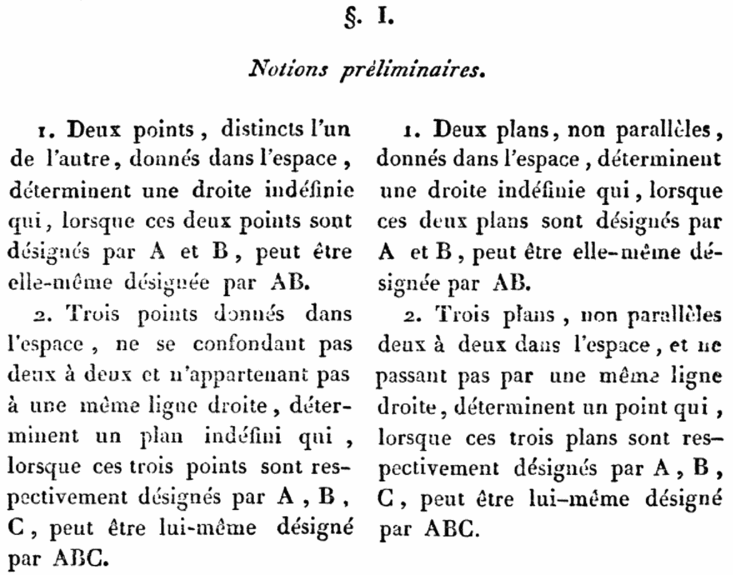
Four years later, Gergonne propounded his concept of duality as mathematical philosophy. In his 1826 article, “Considérations philosophiques sur les élémens de la science de l'étendue,” Gergonne claimed to have begun related research on “this sort of geometry in double parts” ten years prior (Gergonne Reference Gergonne1826a, 211). However, it was in 1826 that Gergonne first coined the term duality, giving an explicit, though sketchy, definition of duality as a simple exchange of the words point and line in the plane or point and plane in space to pass from a theorem to its correlative as illustrated with two facing columns (fig. 1).Footnote 19 “In planar geometry, to each theorem there always necessarily corresponds another which is deduced from it by simply interchanging the two words points and lines” (ibid., 210).Footnote 20
Gergonne's use of dual columns (Gergonne Reference Gergonne1826a).

Gergonne's description of duality was not literally true, as his proposed translation also required careful attention to corresponding verbs and adjectives: inscribe, circumscribe, tangent to, tangent at, lying on, passing through, etc. Moreover, Gergonne initially verified his results by deriving each column separately through Euclidean geometry. Even so, this rhetorical strategy emphasized a linguistic substitution without reference to a conic section, or indeed any then-recognized mathematical procedure. We will see that Gergonne soon began to use duality as a means of deriving new results, not accessible through traditional approaches.
Gergonne had first used a two-column format the year before in an article on polyhedra, with corresponding sommet and face (Gergonne Reference Gergonne1825). In his philosophical article, he explained the advantage of two columns in making the corresponding content more visually striking. “We will likewise take care, in order to render this correspondence more apparent, to present the analogous theorems in two columns, one facing the other, as we have already been accustomed to do in the article on polyhedra cited above, in such a way that the proofs can serve reciprocally as checks” (Gergonne Reference Gergonne1826a, 212).Footnote 21
He further emphasized the novel nature of his research by offering an entirely elementary treatment grounded solely in concepts from Euclidean geometry, and by citing very few predecessors, among whom Poncelet was notably absent. In this context, duality was not used as a means of proving theorems, but to show a correspondence between theorems that had been proved previously. Along with his elementary exposition of planar, spatial, and spherical geometry in dual form, Gergonne also suggested that the work of others could be rewritten and expanded through duality. As an example, he pointed out how a recent theorem of the Belgian geometer Germinal Pierre Dandelin (1794–1847) could be expressed in dual form.Footnote 22 Overall, Gergonne emphasized duality as a “philosophical fact,” whose formal character was considered even more important than the new results it generated.
Gergonne's adoption of duality marked a transition in his research activities. He claimed that geometry, la science de l'étendue, divided into metric (concerning measurable quantities) and non-metric (situational or positional) relations, and proposed that any non-metric geometric property had a dual property. Gergonne presented duality as independent of calculation and measurement, since the dual property of a theorem was found by the proper word substitutions. Further, all of the articles he referenced were, methodologically, pure geometry. The properties and proofs within his “Considérations philosophiques” implied that Gergonne's interest in duality was at this point independent from, and had to some extent supplanted, his interest in analytic methods in geometry.
At least some readers were impressed by the apparent power of this method. From its inception in 1823, the Bulletin universel summarized and reviewed almost every article published in the Annales. In the Bulletin summary, an anonymous reviewer portrayed Gergonne's contribution as deep and reaching far beyond polar reciprocity: “But if the properties of poles, polars, and polar planes places this type of duality in evidence as a notable part of geometry, this certainly does not take place in virtue of these properties, but in virtue of the nature of extension; and M. Gergonne has devoted the most recent issue of his journal principally to place this truth in a clearer light” (Bulletin 1826).Footnote 23 To convey Gergonne's evidence, the Bulletin printed an example of Gergonne's two corresponding columns, and concluded by reiterating Gergonne's suggestion of how duality and the use of dual columns could be applied to certain recent Annales articles. Gergonne's enthusiasm for duality and dual columns would also manifest in future articles submitted to his journal by the young German geometer Julius Plücker.
Plücker completed his doctorate in 1823 with a dissertation on Taylor series in geometry and mechanics awarded by the University of Marburg. Despite having studied in Paris between 1822 and 1824, Plücker claimed to not have had access to the Annales past the eighth volume (1817). Similarly, while Poncelet had published his Traité in 1822, Plücker only knew of it through catalog advertisements (Plücker 1828c).
By 1826, Plücker had returned to Bonn and was busy teaching. Throughout his mathematical career Plücker's interests lay exclusively in analytic geometry, and his first article was no exception.Footnote 24 Upon reading Poncelet's 1817 “Réflexions,” Plücker determined to show that Poncelet's results could be derived as simply through analytic geometry: “In favour of pure geometry, M. Poncelet gives very pretty constructions of geometry problems in the eighth volume of this same collection. . . . Let us see if this problem lends itself with such difficulty to methods of analytic geometry” (Plücker and Schoenflies 1904, 392).Footnote 25 Plücker's analytic geometry relied upon appropriate choice of coordinate axes and coefficient ratios to avoid excessive computation. Ultimately, he provided four different proofs of Poncelet's constructive solution.Footnote 26 The paper was divided into two sections: an introduction to Plücker's theory of tangent conics followed by applications of this theory. As Gergonne had done on several occasions, Plücker supplied further examples intended to foster conviction in the “uniform ease” of using analytic geometry. In this, Plücker was responding to the philosophical challenges of a well-known and well-regarded contemporary mathematician, albeit eight years later. His article seemed designed to participate in the methodological dialogue on the side of analytic geometry and Gergonne. However, by 1826 Gergonne had different objectives in mind, namely promoting the principle of duality.
The seventeenth volume of the Annales contained two articles by a new German contributor, “M. Pluker, doctor from the University of Bonn.” The first was classified under the subject headings “Géométrie des Courbes et Surfaces” and “Géométrie de Situation” entitled “Théorèmes et problèmes sur les contacts des sections coniques” (Plücker 1826). In the introduction, the author cited two texts: Charles Brianchon's Mémoire sur les lignes du second order (1817) and Poncelet's Traité (1822), the latter containing research on “a series of curious problems.” Without explicitly criticizing Poncelet's method, Pluker proposed to address these same problems through “very simple” considerations. Since the propositions corresponded two-by-two, the author would use the “form already adopted in different places in the present journal” of dual columns (Plücker 1826, 38). An accompanying footnote cited several recent works by Gergonne where dual columns had been employed.
The body of the text contained twenty-four theorems and sixteen problems, among them the problem that had inspired Plücker's original article. The resulting constructive solution was nearly identical to that from Poncelet's 1817 paper, which received no mention.
Regular readers of the Annales may have been struck by the similarity of form and expression between Pluker's first article and Gergonne's article on duality from the previous volume. With its dual columns, elementary considerations, and particular applications of ruler-based planar geometry, the Pluker article almost functioned as a sequel to Gergonne's. Just as Gergonne had incorporated Dandelin's results into his duality paper, Plücker's research had been rewritten to serve as evidence in favour of Gergonne's version of duality. However, while Dandelin's original results had already been published in the Annales (Dandelin Reference Dandelin1825), there was no indication that the work of Pluker was not entirely that of Plücker. Gergonne had entirely abandoned Plücker's analytic geometry and with it his methodological argument and theory of tangent conics. Finally, by changing Plücker's citations, originally limited to the eighth volume of the Annales, Gergonne gave the impression that Pluker was well-versed in recent Annales publications as well as Poncelet's Traité and Brianchon's Mémoire. On the one hand, this brought Pluker's paper into a more contemporary context. On the other hand, the article's contents, limited to planar constructions and deformations, suggested a rejection of the modern principles and theories advocated particularly in the work of Poncelet. With respect to duality, Pluker cited the exact same texts as those in (Gergonne Reference Gergonne1826a), again slighting Poncelet's contributions. Poncelet appeared only as a source of “une série de problèmes curieux,” whose proofs had been replaced by simpler ones. Further, since Plücker was living in Bonn at the time, he did not have easy access to defend, or even view, what had been published under his name.
3. The Duality Controversy Erupts (1826–1828)
The attacks and rebuttals that we alluded to in the introduction quickly escalated. Poncelet condemned Pluker's article in a letter to Gergonne (Poncelet Reference Poncelet1826), of which Gergonne published excerpts and responded with a public defense (Gergonne Reference Gergonne1827d). Following this, Poncelet wrote two more articles restating his argument for the Bulletin (Poncelet Reference Poncelet1827b; Poncelet Reference Poncelet1828b). Gergonne then republished Poncelet's Bulletin content and the remainder of Poncelet's original letter, taking the opportunity to add footnoted commentary in the Annales (Gergonne Reference Gergonne1827c; Poncelet Reference Poncelet1827b). In 1828 Plücker offered his own interpretation in the Bulletin, which elicited a reply from Poncelet (Plücker 1828c; Poncelet Reference Poncelet1829). That same year, Poncelet's original writings on polar reciprocity would finally be published, not in the Annales, as had his previous work, but in Crelle's Journal (Poncelet Reference Poncelet1829). We turn to the publicity in these texts, which together comprised the primary drama of the duality controversy. From them we will determine what the participants perceived as the stakes in the controversy, how both sides courted and curated publics for their arguments, and their development of strategies for introducing and advertising new mathematics.
In 1824, Poncelet had submitted and read a memoir on polar reciprocity to the Académie, which had yet to be reviewed by 1826. Gergonne wished to share details of this work, which he correctly surmised bore strong relations to his duality, and wrote to Poncelet requesting additional information. Poncelet's response included a lengthy preamble and postscript responding to Pluker's article and his own priority. Looking to share and comment on Poncelet's researches on polar reciprocity, Gergonne edited out the charges against Plücker and published only an excerpt, “Analyse d'un mémoire présenté à l'Académie royale des Sciences” (Poncelet Reference Poncelet1826).
Under the subject heading of “Mathematical philosophy,” Poncelet took this opportunity to promote his research. As in 1817, he limited his exposition to the bounds of a letter to the editor, and often referred the reader to his Traité for a more in-depth treatment and further examples. As we noted above, in this text Poncelet recognized his polar reciprocity as corresponding to Gergonne's duality, and used the two terms more or less interchangeably. Thus, following Gergonne's language, Poncelet used duality to reference “a simple substitution of names and letters” independent from calculation or reasoning. Both geometers viewed the mechanical or reason-free derivation of dual propositions as its primary advantage and appeal. As Poncelet wrote,
The principal goal that I set myself in this memoir is to examine which type of modification a given figure, and the relations which belong to it, undergo when one passes to its polar reciprocal, and vice versa; and to reduce this, in some sense, to a pure mechanism, a simple substitution of names and letters, written one instead of the other, the translation of all the relations, of all the properties ever so slightly general that belong to a given figure and to its reciprocal; finally to show how one can, by the simple statement of a proposition which concerns either projective relations, in general, or to relations of angles of figures situated in a plane or in space; how one can, I say, obtain immediately and without recourse to any calculation or reasoning, one, two or three other propositions, completely distinct from the first and nevertheless all also completely general. (Poncelet Reference Poncelet1826, 266)Footnote 27
Poncelet distinguished his work from Gergonne by describing the latter's treatment as “very philosophical.” He further showed that his own method was not subject to “too vague generalities” by giving several concrete examples on determining shadows of second order surfaces subject to a given light source. Furthermore, Poncelet emphasized the role of a reference conic section in deriving dual properties, which Gergonne had mentioned but not employed in his presentation.Footnote 28 While Gergonne stressed the application of duality to non-metric relations, Poncelet demonstrated that his principle could also be applied to metric properties. Finally, Poncelet hinted at even a three- or four-fold correspondence between propositions. This multiplicity suggested that the term dual and the use of dual columns, would be insufficient for conveying the entire scope of the potential relationship.
Gergonne's response followed directly, and as in 1817 he addressed the broader readership of the Annales, not specifically Poncelet. He praised Poncelet's contributions, but suggested that Poncelet himself, who worked in applied mathematics and had just revealed his apprehension toward Gergonne's philosophical leanings, might not comprehend their full significance. “Those who superficially study science as one learns a career, without taking account of philosophy will only appreciate Poncelet's beautiful work for its new theorems and as a new manner of demonstrating already known theorems” (Gergonne Reference Gergonne1827a, 272–273).Footnote 29 In their attention to concrete examples versus philosophy, Poncelet and Gergonne explicitly courted different publics. They would maintain this distinction throughout their publications on duality. Gergonne explained that duality was “important and eminently philosophical” because it revealed part of the underlying structure of geometry, where perhaps every theorem had a “double face.” Here he referred to the recent article by Pluker where more general and complete solutions were already known “as people have remarked to us already several times.” However, Gergonne argued, the form was almost everything, and this new form – showing the two sets of results “marching” side-by-side – was what principally recommended “Pluker's little memoir.” Unknown to Gergonne's readers, he was engaging in self-advertisement.
After defending his philosophical approach, Gergonne took the offensive. He acknowledged Poncelet's early contributions to duality, but insinuated that Poncelet had at first regarded polar reciprocity as “very accessory” and did not realize its import. Gergonne noted that Poncelet had diluted the significance of polar reciprocity by introducing it after his “controversial principle of continuity.” Finally, Gergonne criticized Poncelet's use of language. “It is moreover a real obstacle against easily propagating the doctrines that we and M. Poncelet are trying to popularize, and this obstacle, as we have already suggested several times, resides in the obligation to speak a language created for a much more restrained geometry than that with which we are occupied” (ibid., 275).Footnote 30 For Gergonne, popularizing new geometry demanded proper attention to old and new vocabulary. Gergonne proposed that the new theory would be the most advantageous if one could first create a language suited to it, but acknowledged that this would be difficult to make and perhaps more difficult to obtain full acceptance. He implied that duality had not yet become widespread because of an inherent conservatism in the language of geometry. This sentiment coheres with Gergonne's overall efforts toward propagating duality to a wider audience.
This tone between Poncelet and Gergonne contrasted sharply with that of 1817. Perhaps most strikingly, Gergonne now praised Poncelet's numerous contributions, while Poncelet appeared only concerned with Gergonne's research as far as it related to Poncelet's publications and legacy. This shift in their hierarchical dynamic was further reflected in the context of Poncelet's letter written only as a response to Gergonne's request. By 1826, even Poncelet's as yet unpublished work had gained a reputation that Gergonne felt would be of interest to his readers. Though as an editor Gergonne still had full power to decide what of Poncelet's letter would be printed, Poncelet had since become a well-respected and established geometer whose research was an asset in popularizing duality.
The Bulletin only devoted a paragraph to the correspondence of Poncelet and Gergonne (Bulletin 1827). The paper Poncelet submitted to the Académie was described as including more ample developments on the same subject. Poncelet's particular results were listed summarily:
he has found that a great number of theorems relative to metric relations either of angles or of lengths, are, like theorems of position, susceptible to this sort of duality introduced by M. Gergonne; and has given rules for recognizing the theorems of this class and for deducing their correlatives by simple mutations of words and symbols. (Bulletin 1827, 274)Footnote 31
By attributing duality to Gergonne, the article implied that Poncelet's results were derivative. Neither the article published in the Annales nor the Bulletin review mentioned the date of Poncelet's 1824 Académie submission, and thus the readership of the Bulletin might easily infer that Gergonne was the first to recognize duality.
The principle of duality had now extended to a new potential public, and Poncelet chose to address this public directly rather than submit to what he viewed as the unreliable medium of the Annales. The following volume of the Bulletin contained a “Note” by Poncelet commenting on recent articles published in the Bulletin (Poncelet Reference Poncelet1827b). Taking advantage of the scientific hierarchy, Poncelet addressed his paper to those geometers “who did not have the advantage of attending the Académie of sciences,” and thus had missed Poncelet's presentation on polar reciprocity on April 12, 1824. To prove his version of events as authentic, Poncelet invoked as witnesses the people who had been present, and recalled the reception of his work, “whose singularity of views has even pleased the illustrious academicians, that this was from romantic geometry, from geometry of four dimensions” (ibid., 110).Footnote 32 His 1827 article in the Annales had been only an extract of this earlier presentation, sent to Gergonne upon request. Meanwhile, Poncelet had been occupied with the professional public obligations of military service and teaching mechanics applied to machines at the engineering school in Metz. Despite this lapse in mathematical activity, Poncelet desired to claim credit for his already semi-public earlier achievements.
Rather than differentiate his contributions from Gergonne's, here Poncelet was primarily concerned with priority and public recognition. Poncelet explained that he had written about the matter in a letter to Gergonne, which had been “suppressed.” Because of his “high esteem” for Gergonne, Poncelet had initially remained silent, hoping that Gergonne would eventually address the omission publicly. The Bulletin review had prompted Poncelet to seek a new venue, in order to correct against other geometers claiming his work for their own.
Poncelet argued that he was seriously committed to research on polar reciprocity as evidenced by an entire memoir on the subject as well as treating it at length in his Traité. He contended that Académie reports had misrepresented his work as controversial by suggesting that Poncelet practiced a “type of geometry where one replaces the rigour of reasoning by lucky inductions, perceived through pure sentiment” (ibid., 115). Poncelet attributed this reproach to a lack of understanding of his entire Traité, in its entirety where his exposition was fully deductive.
We would have very badly employed our time and pains, if we had not succeeded . . . in sheltering the result of our demonstrations from all attack; perhaps even one could not say as much for many geometric writings of our time, where the severe logic of the ancients is sometimes neglected by following the rather generally acquired habit of according an almost indefinite amount of mathematical rigour to the symbols and operations of algebra. (Ibid., 116)Footnote 33
Poncelet had demonstrated the necessary “prudence” required in securing the validity of new principles. Unlike Gergonne, Poncelet had not “rushed into a revolution,” but instead proceeded from “ordinary” geometry exemplified in his Traité, which contained over 400 pages of methodical exposition.
Poncelet concluded by correcting and cautioning against the overenthusiastic generality and scope of Gergonne's duality. Gergonne had “exaggerated” the importance of duality in order to reach uncertain or even controversial conclusions. Specifically, Gergonne had incorrectly claimed that the dual of a curve of given order was another curve of the same order (Gergonne Reference Gergonne1826b). Poncelet did not think anyone “could attack the exactitude of his results,” and showed wariness toward publicizing duality in general. Instead of encouraging future research in the subject, he drew attention to his own past contributions. Poncelet's article extended his audience to reach readers of the Bulletin who were neither members of the Académie nor avid readers of the Annales.Footnote 34
However, Gergonne shifted the exchange back to his preferred audience of the Annales by republishing Poncelet's Bulletin article accompanied by the suppressed preface and postscript from Poncelet's 1826 letter (Gergonne Reference Gergonne1827c). He placed this collection of articles and notes under the subject heading “Polémique mathématique” – the first and last use of this title in the Annales. In an introduction, Gergonne described Poncelet's article as “a sort of diplomatic note, in the form of a manifesto, where, in terms too flattering to me, one perceives, in all parts, much bitterness, many reproaches, and even very serious accusations” (ibid., 125).Footnote 35 Gergonne explained to his readers that he had intended to convince Poncelet that his accusations were unfounded in private, and thus chose to leave these segments of the original letter unpublished. For Gergonne, Poncelet's demand for priority amounted to a public accusation, and so Gergonne would respond publicly as well.
By organizing his response into footnotes, Gergonne implied a sort of editorial objectivity. Poncelet's text was presented as polemical and through editorial commentary his suggestions seemed more like accusations. By contrast, Gergonne's response was delivered less as a rebuttal than a rectification. Beneath this veneer of scholarly dispassion, Gergonne's language oozed with vicious sarcasm and subtle insults. Each of Poncelet's claims was interpreted as extreme then swiftly ripped apart, still Gergonne claimed neutralit: “The reader will judge. I make no reproach, I simply announce an opinion” (ibid., 136).Footnote 36 We can organize Gergonne's defence into three main arguments that appeared repeatedly throughout his footnotes. First, in response to Poncelet's accusations that Gergonne was coveting undue credit, Gergonne supplied evidence of his earlier and independent researches in duality. Secondly, without suggesting that Poncelet was a plagiarist, Gergonne shifted the blame for Poncelet's lack of recognition to Poncelet himself. Finally, Gergonne portrayed Poncelet as melodramatic.
Similarly to Poncelet, Gergonne established the originality of his contributions with citations to specific texts and dates. With his 1826 paper, Gergonne explained that he had intended to provide an elementary introduction to duality following the shared views of Poncelet and himself. This equal division of credit implied that Gergonne's own research was independent, and Gergonne asserted that he had begun developing the idea in 1819. The duality of spherical trigonometry, Gergonne explained, was well known, “there is not a single geometer for whom this duality is a mystery” (ibid., 126).
Gergonne pointed to common and well-known sources available to both geometers. First, Gergonne had written on Euler's theorem regarding the number of vertices, edges, and faces in a polyhedra in 1819 and referenced conjugate polygons and polyhedra in which vertices and edges or faces were interchanged (Gergonne 1819). That same year, the engineer Gaspard-Gustave Coriolis had submitted a pair of unproven theorems to the Annales concerning the construction of a unique point or line from a construction involving n points or lines in a plane (Coriolis Reference Coriolis1819). Gergonne and Poncelet had privately communicated on the theorems, which resulted in Gergonne's proofs using principles of statics on centers of gravity and published in 1821 (Gergonne Reference Gergonne1821). While neither duality nor polar reciprocity appeared in these 1819 publications, the theorems could be seen as suggestive of this relationship. We will see that Gergonne later showed how one of Coriolis' theorems could follow immediately from the other by duality (Gergonne Reference Gergonne1828b). For Gergonne, both of these significantly earlier publications revealed that Poncelet did not possess a monopoly on duality researches.
Next, Gergonne demonstrated that he could not have stolen Poncelet's ideas because Poncelet had not made them public until 1824, and then only presented them to the Académie in Paris, while Gergonne was in Nîmes. He scoffed at the possibility of stealing Poncelet's private research. Gergonne followed up with a hypothetical reconstruction of the events that could have merited Poncelet's very serious accusation: Gergonne had hidden the date of Poncelet's memoir, continued to avoid citations cautiously, and finally written long memoirs on the subject of duality. Gergonne concluded that none of these events had actually occurred, and the accusation was “a pure phantom that the lightest breath could easily cause to vanish” (Gergonne Reference Gergonne1827c, 131). In truth, Gergonne reminded the reader that he had published Poncelet's notes on polar reciprocity shortly after receiving them in 1826, any delay in publicizing Poncelet's 1824 presentation was the fault of the Académie, whose members had waited three years before issuing a report.
He continued that had Poncelet wished to gain greater publicity for his work, Gergonne would have happily printed Poncelet's 1824 memoir in its entirety when it was first written: “the Annales would have gained an extremely interesting article, and all mine [Gergonne's publications on duality] would thus not have appeared until afterward” (ibid., 133).Footnote 37 By choosing a closed venue for his research, Poncelet's obscurity was perhaps his own fault. And while Gergonne acknowledged and admired Poncelet's current engineering contributions, Poncelet could not expect “the whole world to cross their arms and wait” for his eventual return to mathematics.
Turning to the mathematical content, Gergonne reinforced his earlier criticisms that Poncelet had de-emphasized the significance of duality and rendered it vulnerable through association with Poncelet's romantic geometry.
I persist in thinking, as I wrote then, that M. Poncelet has gravely compromised his teachings, in mixing with the classic, which all the world admits, the romantic which, for my part, I am very far from rejecting, but about which however one still disputes, and which MM. the commissaries of the Académie themselves, whose judgment M. Poncelet declares to attach great importance, have treated rather severely. (Ibid., 135)Footnote 38
Gergonne's version of duality showed correspondence between theorems that could be independently derived through Euclidean methods. Because of the association with the principle of continuity, Poncelet's Traité and associated memoirs were not only subject to dispute, they were also lengthy. Gergonne professed to be more interested in developing new methods than new theorems, and so perhaps some of the theorems that he proved were also contained in Poncelet's Traité. He contrasted Poncelet's 400 pages with his simple announcement that theorems of non-metric geometry: “1. are double, and 2. could be established without any form of calculation” (ibid., 139). Moreover, a change in organization may have encouraged the reception of Poncelet's work.
M. Poncelet could have begun with a geometry in the genre of that in which I have drafted the first pages . . . and against which no objections would be raised. He could have then treated the theory of transversals and projections, whose principles are equally admitted by everyone, and reserved, for the end of his book, all that which might be controversial. (Ibid.)Footnote 39
Then Poncelet would not have seemed to “rush into a revolution” and his work would have gained greater acceptance. Beginning with his principle of continuity and only treating polar reciprocity later suggested that Poncelet had not recognized the importance of duality at the time.
Finally, Gergonne interpreted the Bulletin's review as simply stating that Gergonne had reported on duality in 1826. However, Gergonne went on, “I would even want the Bulletin to be mistaken, in order to be agreeable to M. Poncelet, because the essential thing here is that the truth appears, and it matters little whether it employs this or the other organ” (ibid., 131).Footnote 40 That is, Poncelet and Gergonne were merely vessels for mathematical knowledge and any concern over priority was to ignore the collective scientific gain.
While most of Gergonne's remarks constituted a defense, not all of Poncelet's criticisms were dismissed. Gergonne conceded that when he had failed to mention Poncelet's name with respect to polar reciprocity, this was because the association was so strongly identified as to be “superfluous” – just as we invoke the properties of right triangles, “without naming Pythagoras.” With respect to the “suppressed” preamble and postscript, Gergonne suggested he had done so in Poncelet's best interest, and apologized for unintentionally obscuring the 1824 date of Poncelet's Académie submission.
Poncelet had concluded his article by pointing to a potential flaw in Gergonne's applications. Instead of addressing the error, Gergonne interpreted Poncelet's caution as a sign of a more particular version of duality. He proposed that finding the dual to a given statement was more a matter of constructing the correct language, but in this early stage of development the vocabulary was less important than the assurance that the principle of duality itself “suffered neither exceptions nor any modifications” applying to all geometric objects with “absolute generality.” Here again Gergonne drew attention to language as a key aspect of presenting geometry. While his dismissal suggests that Gergonne believed duality was distinct from polar reciprocity, we will see that in a subsequent research article he took serious consideration of Poncelet's critique.
This mock dialogue continued in Gergonne's publication of Poncelet's “suppressed” preamble and postscript. The communication was again one-sided: Poncelet addressed Gergonne directly and Gergonne spoke to his wider public. In fact, Gergonne repeatedly invoked “tout le monde” in his statements against Poncelet, thus suggesting he held a unanimous opinion. Gergonne was able to use the footnote medium to interject wherever he felt it appropriate, and his commentary formed a fragmented but consistent response.
Poncelet's postscript was entirely devoted to complaints against Plücker (who now was referred to as Plucker rather than Pluker, but we will employ the proper spelling) and his lack of sufficient citation in his 1826 articles. To Poncelet, Plücker's insufficient citation was further compounded by the use of dual columns. Poncelet found dual columns at best unnecessary for revealing the importance of polar reciprocity.Footnote 41
As for the use of putting propositions from ruler geometry into two columns, it seems to me that this is a very painful doubling of work (****), little motivated by the demonstrations (*****); and that it suffices always to indicate, after the principle of the theory of polar reciprocity, the manner of concluding one of these propositions from the others already demonstrated. (Ibid., 148)Footnote 42
Gergonne, who we know was the author of this very feature, responded that “my few articles in two columns have more efficiently served the cause of duality than have the 400 pages of his work [Poncelet's Traité].”Footnote 43
Whereas the controversy encouraged both geometers to consider the best ways to promote new findings, it also distracted Poncelet from pursuing further mathematical research. Whereas Poncelet's articles had once promised the appearance of future theories and results, here he promised only more complaints: “I have several other claims to address to you on my own account, but these will naturally find a place elsewhere, and the task will become less delicate and painful for me” (ibid., 142).Footnote 44 Gergonne categorized this behavior as bordering on censorship, suggesting its deleterious effects on scientific publications.
Poncelet's personal accusations, which Gergonne had initially withheld from publication, became exaggerated with footnote commentary. Gergonne declared them “a charge of the most egregious and shameful plagiarism” and as such “completely unrealistic.” He claimed to have been protecting Plücker as a “completely unknown man” by choosing originally not to publish this accusatory postscript. In these concluding remarks, Gergonne had painted Poncelet as not only ill-mannered, but ultimately valuing his own success over scientific progress.
Despite Gergonne's rhetoric, Poncelet's criticisms also brought to light specific areas of scientific research and served to clarify and extend Gergonne's work on duality. In the polemical exchange, Gergonne had dismissed these specific corrections blithely, but he proved more receptive in a research context. Shortly afterward, he published “Géométrie de situation. Rectification de quelques théorèmes énoncés dans les Annales,” in which he created the proper vocabulary with which to express the correlation between dual curves (Gergonne Reference Gergonne1827d). In dual columns, Gergonne defined the term degree on the left-hand side, “A planar curve is of mth degree, when it has m real or ideal intersections with a line.” On the corresponding right-hand side he defined the curve's class, “A planar curve is of mth class, when one can draw m real or ideal tangents to it from a point in its plane.” The definitions similarly held for curved surfaces. Now, Gergonne could simply substitute degree in the left hand column and class in the right hand column in order to correct his earlier theorems, a process that Gergonne described as “neither very great, nor very difficult.”Footnote 45 Most importantly, Gergonne preserved the “general laws that rule algebraic lines and surfaces of all orders” (ibid., 154; emphasis in original).Footnote 46
4. Redefining the Controversy and Plücker's Defense (1828–1832)
Though we cannot ascertain how the readership of the Annales responded to the controversy, one public's reaction sided with Gergonne. The Bulletin printed a synopsis of the mathematical polemic that described Poncelet's complaints as “baseless” and expressed disbelief that Poncelet would wish to block all research analogous to his (Bulletin 1828). Gergonne was described as having been a “zealous propagator” of Poncelet's doctrine for the past ten years. Poncelet's criticisms were dismissed as “vague” and Gergonne's inexactitudes excused based on the “novelty of the research” and “the imperfection of language.” Overall, the review was a synopsis of Gergonne's footnotes, thus prompting Poncelet's response in the Bulletin (Poncelet Reference Poncelet1828b).
Poncelet began by limiting the scope of the controversy to a priority dispute and establishing an even more far-reaching timeline of his research from 1818 onward with due credit to the earlier contributions made by Delahire, Monge, and Brianchon. By contrast, Poncelet questioned why the “indefatigable pen” of Gergonne had not published until 1826, if he had “completely fixed ideas on duality” before then. Poncelet suggested that Gergonne was disguising Poncelet's own polar reciprocity behind the more “seducing” name of duality. In contrast to the accord between duality and polar reciprocity that Poncelet and Gergonne had shared in 1826, Poncelet now sharply distinguished their principles. This general principle of duality was “empty of sense in mathematical philosophy and absurd” when divorced from the justification of polar reciprocity. According to Poncelet, the process of polar reciprocity was necessary, useful, and had been covered at length in his Traité. He wrote, “we cannot seriously dream to make a totally new doctrine of duality, independent of the theory of poles and polars, as was attempted, without success, by M. Gergonne” (Poncelet Reference Poncelet1828b, 298).Footnote 47
As far as Gergonne's efforts to correct his mathematical errors, Poncelet disapproved of the newly minted definitions of degree and class, which “tortured” the sense of the words solely in order to support Gergonne's theorem. Gergonne's defense of Plücker likewise failed to convince Poncelet. Poncelet contended that his Traité had received insufficient citation precisely in order to preserve the “scaffolding” of double columns, as a matter of “proselytizing” for Gergonne's duality.
Poncelet's argument was little changed from his earlier Bulletin notes. The article served more as clarification and condensation: Poncelet was the first to publicize polar reciprocity, later forms of duality were derivative or senseless, and, if left unacknowledged, plagiarized. The most significant departure from Poncelet's two articles was in his description of Gergonne. Whereas Gergonne had originally appeared as a knowledgeable editor who supported and encouraged Poncelet's geometrical methods, he was now portrayed as suspiciously seeking to undermine Poncelet's credit and credibility. Consequently, Plücker was merely a consenting pawn. The stakes in the priority dispute had become very personal.
No longer publishing within the Annales, Poncelet sought further venues for his research. Later that year Poncelet published his original memoir on polar reciprocity in August Leopold Crelle's Journal in Berlin (Poncelet Reference Poncelet1828a). The Académie had only just approved and issued a report on Poncelet's submission in February, nearly four years after it had been received. Aware of the current tensions, Crelle introduced the article with a very diplomatic footnote referring to the “discussion” between Gergonne and Poncelet and refraining from further comment. The article included a newly written postscript by Poncelet. He observed that the material treated in his memoir had recently been the research subject of several geometers, and wished to clarify that the version printed here conformed completely to the 1824 manuscript. Poncelet explained that he had made progress with his research since that date and included a summary of the several practical applications of his polar reciprocity theory to studying second order surfaces. The civil tone of this research article contrasted sharply with Poncelet's contemporary polemical writings, perhaps as a result of the neutral non-French venue of the Journal.
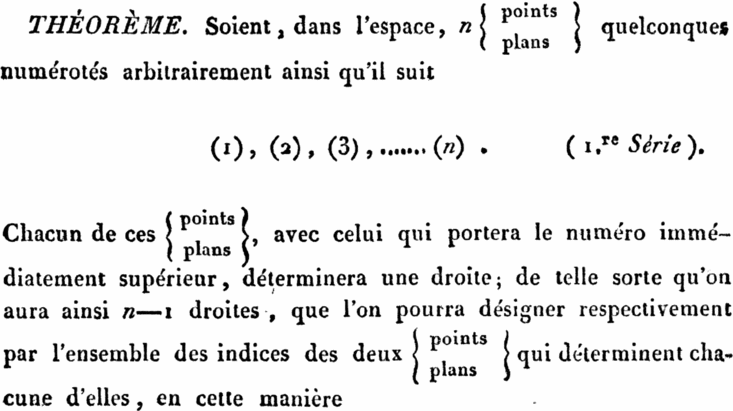
Similarly Gergonne continued research publications. In that same year, he claimed that the principle of duality was now established (Gergonne Reference Gergonne1828b). When he had first begun its study in 1821 “the ideas of duality were not yet as widely known. Today, to the contrary, as it must be very well known that all the theorems of position march two by two, it suffices for us to have demonstrated one of them . . . for the other to be admitted without contestation” (ibid., 115–116).Footnote 48 Here, instead of dual columns, Gergonne employed curly brackets, where each dual pair was presented one on top of the other in the text, as shown in the facsimile (fig. 2). This new format saved space and presented an even more striking picture of the correspondence between dual forms. In his introduction and footnotes, Gergonne described Poncelet as a severe critic who would never be completely satisfied. So as far as Gergonne was concerned, the general principle of duality could be preserved without any deep corrections.
Gergonne's alternative format (Gergonne Reference Gergonne1828b)
However, Plücker could not ignore Poncelet's criticisms so flippantly, and his defense against Poncelet's accusations appeared in the Bulletin that year as well (Plücker 1828c). He had learned of the “unjust attacks in a letter from Berlin three or four months prior.” However, he had not responded because he had been living outside of France and did not know the exact details. With Poncelet's “tireless” reiteration of the same accusations, Plücker had found an opportunity to defend himself before the Bulletin and its readers.
In short, Plücker was not responsible for the material Poncelet had found objectionable. Plücker had willingly given Gergonne “the liberty to change the writing of his memoir.” Though Plücker “was absolutely ignorant” of duality before reading the Bulletin in 1827, Gergonne had found the contents favorable to a presentation in double columns. Likewise, Gergonne had chosen to cite Poncelet's Traité, which Plücker had only heard of through the Bachelier catalogue. For the same reason, Plücker explained he had been unable to give thorough citations to Poncelet in the first volume of his text, Analytische-geometrische Entwicklung.Footnote 49
Plücker recounted that he had only learned of duality through his public involvement in the priority polemic. Since then, he had developed his own theory of duality, which he described as “very different” from that of Gergonne or Poncelet. Plücker advertised that his purely analytic method had “uncovered the secret of duality,” and concluded by hoping that Gergonne would publish it, thus demonstrating his continued faith in the editor and using his self-defense as future self-promotion.Footnote 50 Though Plücker would never explicitly criticize either of his predecessors, his decision to reform duality suggests that he was dissatisfied with earlier versions.
Plücker followed Gergonne in assuming duality as an open area of research, but Poncelet did not welcome this additional interpretation of duality (Poncelet Reference Poncelet1829). He reasoned that if Plücker had not been responsible for his article, then the polemic was entirely between Poncelet and Gergonne, the author of the double column memoir. As for Plücker, Poncelet “did not have the advantage of knowing him.” Until reading Plücker's explanation, Poncelet would never have imagined that a man of Gergonne's character would “mutilate” the work of a “foreign scholar.” Poncelet considered the Pluker article as part of Gergonne's efforts to convince readers that earlier contributions to duality (including Poncelet's Traité) were insignificant.
On a less personal level, Poncelet again contrasted his practical and original research with that of Gergonne and Plücker. He explained that his theories had “useful applications to graphic arts, and must not be stripped from all types of merit, because they have become, in the hands of MM. Gergonne and Plucker, the subject of very distant developments.”Footnote 51 In his Traité, Poncelet had briefly elaborated what he meant by graphic arts as “perspective, shadows, etc.,” thus suggesting techniques employed in a variety of visual representations (Poncelet Reference Poncelet1822, 178). By continually drawing awareness to these applications, Poncelet appealed to additional potential audiences, beyond mathematics teachers and researchers, who could find merit in his results.
Gergonne and Plücker had emphasized the importance of form over content in their novel geometric contributions. For Gergonne this was the use of dual columns, while Plücker focused on coordinate equation representation. Poncelet contended the opposite, and denigrated the importance of form as an afterthought.
The ease and simplicity with which these questions are derived, . . . only increases their merit in our eyes, as they increase it, indubitably, in the eyes of all true lovers of science, who value content still more than form, and who do not uniquely appreciate the results of mathematical research according to the ease, more or less great, of proving them a posteriori. (Poncelet Reference Poncelet1829, 332–333)Footnote 52
Thus, Poncelet's work was more useful and important, and his scientific understanding greater than that of his opponents. Poncelet's response marked the end of direct exchanges on the controversy, but research and publications continued.
5. Aftermath: Resolution and Irresolution
Plücker “invoked the principle of duality” in two subsequent articles, and presented theorems in dual column form, but without citing Gergonne or Poncelet (Plücker 1828b; Plücker 1829a). His “secret” of duality appeared in an 1830 article in Crelle's Journal (Plücker 1830). “Über ein neues Coordinatensystem” principally concerned the introduction of homogeneous coordinates, which afforded a new way of addressing “the theory of reciprocity.”Footnote 53 Plücker advertised his “purely analytic theory” as superior to all previous ones because it was independent of a conic section. In expressing duality in coordinate equations, Plücker maintained the mechanism of finding a dual that had been provided by Poncelet's form of polar reciprocity. At the same time, he achieved a method that could be applied to curves and surfaces of any degree, thus satisfying the advantage of generality inherent in Gergonne's form of duality. This division of attributes was further reflected in Plücker's citation, where both geometers were equally credited. Finally, Plücker reunited the duality controversy with the initial methodological controversy from 1817, demonstrating another practical application of analytic geometry.
The Annales ceased publication in 1832. In 1847, at the age of 78, Gergonne gave a very brief paper at the Académie des Sciences de Montpellier on the principle of duality in geometry (Gergonne Reference Gergonne1847). Spurred by a contemporary publication on poles and polars, Gergonne recalled that he had deduced a new principle of geometry, called the principle of duality, more than 30 years ago. He took this opportunity to repeat his two philosophical propositions: that duality applied to all non-metric geometry and that the duals of individual results followed directly from substitution. Gergonne asserted that by 1813 the principle of duality was “no longer a mystery” to him. As for dual columns, Gergonne credited their 1824 usage with the proliferation and publicity of the principle. “In 1824 to make this duality easier to grasp, I wrote, in two columns facing each other, the double theorems that my principle provided. Despite this precaution this principle passed almost unperceived” (ibid., 63).Footnote 54 This was Gergonne's first published admission that dual columns may not have been an effective means toward popularizing duality. After his publications, Gergonne noted that research in the duality of positional geometry had been pursued by Steiner, Pluker (whose name had reverted to the 1826 misspelling), and Chasles. Poncelet was not in this group, but rather appeared as the “sole antagonist” to Gergonne's duality principle.
According to Gergonne's reconstruction, Poncelet had read no work but his own and consequently attacked dual columns as “awkward,” “superfluous,” and even sometimes “faulty.” Poncelet, Gergonne continued, was an engineer with an admirable reputation. However, Gergonne saw more to science than practical applications.
In the century and in the country where we live, everything that can contribute to develop, to extend and to fortify the faculties of intelligence would be impossible to look upon with indifference, and it is well known, moreover, that a nation which cultivated the sciences only from the unique point of view of their practical applications and immediate material results, could not vaunt itself to see them flourish in her midst for long. (Ibid., 64)Footnote 55
In Gergonne's account, Poncelet appeared to have compromised his commitment to mathematical research by emphasizing applications. Gergonne's foreboding conclusion may have also been a comment on his perception of deeper French trends towards applications, such as those which had been celebrated by Poncelet in the 1820s.
Nearly twenty years after Gergonne's death, Poncelet republished his Traité with supplements including many of his older articles as well as “historical” commentary. Poncelet used this venue to aggressively refuse Plücker's proposed resolution to the duality controversy.
In 1828, he intended to prove that he also (Plucker) had arrived, by a purely analytic view, at the principle of reciprocity, the object of the dispute, he claimed to have presented a much more general point of view . . . . But I greatly fear that there was some error or illusion in that; because, despite the honour that he does me to cite my works as preceding those of MM. Steiner, Gergonne, and Bobillier, printed in the Annales from 1827 to 1829, I only perceive, even in the Mémoire of M. Plucker on a new system of coordinates and a new principle of Geometry . . ., more or less fruitful algebraic efforts that recall those of scholars to establish a late and incomplete preeminence of so-called purely analytic methods over mine. (Poncelet Reference Poncelet1866, 409)Footnote 56
Poncelet interpreted Plücker's resolution as continuing the 1817 methodological debate, but not successfully generalizing the principle of duality. He proceeded to list geometers who had given improper attribution to any of his results and theories, among whom Gergonne certainly counted. Poncelet died in 1867 shortly after this final attempt to leave a legacy of victory in this academic struggle.
Conclusion
Though their perceptions of the principle of duality evolved, Poncelet and Gergonne continued to disagree about the role of the surrounding controversy. At first Poncelet found Gergonne's duality as a derivative and more philosophical version of his polar reciprocity, but as the controversy developed he increasingly distanced their approaches by insisting on the role of the auxiliary conic and the importance of concrete applications as opposed to vague generalities. He classified the exchange as a priority dispute and pitted his chronology against Gergonne's (and Plücker's) list of publications. Gergonne also began by observing the connections between his and Poncelet's work, but later discounted his rival as missing the deeper meaning of duality and its potential to revolutionize geometry. He labeled the exchange as a mathematical polemic and emphasized the independence of duality from finding polar reciprocals. Each employed publicity to argue for their respective interpretations and the necessary corollaries.
Poncelet reached out to five different publications (the Académie, his Traité, the Annales, the Bulletin, and the Journal) and hence created multiple, though overlapping, publics, for which his publicity strategy remained consistent: duality was no more than the polar reciprocity Poncelet had developed and first published in his Traité. He encouraged developing practical applications of the theory of polar reciprocity with due credit, but strongly cautioned against the unproven generality of Gergonne's duality. For Poncelet, the principle of polar reciprocity was established and foundational discussions were closed (Poncelet Reference Poncelet1829).
Gergonne had only one direct publication on the matter, but enjoyed full editorial autonomy. He presented duality as an exciting, new geometrical endeavor. Gergonne desired maximal generality, and for this he urged the participation of his readers through posed problems and open questions. To communicate a new style of mathematics visually, he developed dual columns and other formatting devices. Alongside his own efforts, he suggested how Poncelet could change the vocabulary and presentation of his polar reciprocity to gain more popular support. In the controversy dispute, Gergonne reserved his harshest criticism to expose and denounce Poncelet's exclusivity.
The dichotomy between these closed and open representations of duality is further reflected in Gergonne's decision to bring Plücker into the controversy, while Poncelet attempted to dismiss him.Footnote 57 In this aspect, Gergonne's publicity strategy ultimately proved more effective. While Poncelet may have obtained a more notable position in the academic hierarchy as an esteemed engineer and regular contributor to and later member of the Académie, he had no authority over what Gergonne could print in his Annales.
At the individual level the controversy remained at a standstill from the mid-1820s until Poncelet's death forty years later. Poncelet and Gergonne often referred to specific (albeit inconsistent and receding) dates marking the origins of their unpublished ideas and continuing through past publications showing evidence of duality. Poncelet and Gergonne continued to trace their respective ideas back, ceding less and less potential influence from the other. Their last bitter attempts to have the final word suggest that the priority dispute would never be resolved satisfactorily. Gergonne continued to believe that duality had not caught on and Poncelet continued to believe that his theory had been obscured. Poncelet and Gergonne remained resolute. Further, their ultimately personal aggression jeopardized the controversy's potential for resolution. For those writing on geometry, to endorse either position could have dangerous ramifications, as the case of Plücker showed. Gergonne's reaction to Poncelet's accusations against Plücker suggest the severity of plagiarism charges, especially for one without an established career and living outside France without regular access to contemporary publications.
The controversy encompassed academic practices that are considered by present-day standards as deceitful, vindictive, and unprofessional. Yet professional standards were still being determined, as suggested by the heterogenous standards of in-text references. For instance, within the pages of the Annales, Gergonne chose to merely cite volume and page number, often without including the author's name. By contrast, Poncelet's complaint against Pluker's paper was not that the latter had failed to cite Poncelet's Traité at all, but that the work was not cited with enough detail. The duality controversy revealed that this variety of practices could be problematic if what one author thought was sufficient reference was interpreted by another as plagiarism. Young geometers, like Plücker, responded cautiously with precise and numerous citations.Footnote 58 On this matter, too, neither Poncelet nor Gergonne would cede.
Yet, the duality controversy achieved resolution. Partially obscured by the personal vitriol, Poncelet and Gergonne's mathematical criticisms signaled open questions. Each geometer wished to show the superiority of his own form of duality, and their critical exchange promoted duality as a subject of research and reform. In attempting to control their publics, neither Poncelet nor Gergonne was omnipotent. Their attention to publicity (even at the expense of research) further proves the inherent collective dimension of controversies. With this attention to publicity the duality controversy became less a dispute between Poncelet and Gergonne, as an attempt by each to craft a favorable and properly informed public.
In this dimension, their efforts could even be complementary. Their dialogue on the duality controversy brought to light how Gergonne and Poncelet believed new mathematics should be introduced. Poncelet advocated the use of synthetic geometry and Gergonne similarly chose Euclidean geometry in order to show how a new general principle could be used without risking unproven, controversial, or seemingly “romantic” material. In line with this, they used familiar problem sets to show the efficacy of the new principle. Both geometers also discussed the importance of language in new geometry. For Gergonne, duality would best succeed with a new set of vocabulary, but he admitted that the latter feature would not likely be adopted. Poncelet criticized Gergonne's definitions of degree and class, for redefining old words with new meanings solely in order to show the veracity of a result. These aspects point to the difficulty of introducing what both perceived as modern geometry and the necessary efforts involved in securing a receptive public within a presumably conservative audience. Although neither Poncelet nor Gergonne expressed satisfaction, the historical literature suggests that both respectively succeeded: Poncelet's Traité and the general principle of duality gained appreciative and dedicated audiences.
As much as geometers tried to stay clear of picking sides in the priority dispute, they were eager to employ the techniques of word and symbol substitution to gain new theorems. The establishment of Crelle's Journal, and the consequent widening of the controversy's public to an international arena, further encouraged the resolution of the controversy as much as the reviews in the Bulletin had aggravated its beginning. Following Poncelet and Gergonne's publications, geometers including Charles Sturm, Étienne Bobillier, Michel Chasles, Jakob Steiner, and Carl Gustav Jacob Jacobi employed duality or reciprocity in their research publications (for instance, see Sturm Reference Sturm1826; Bobillier Reference Bobillier1827; Chasles Reference Chasles1828a; Steiner 1828; Jacobi Reference Jacobi1828).Footnote 59 Moreover, the duality controversy revealed that Annales, the Bulletin, and Crelle's Journal were all available venues (at least until 1832) for publishing this line of research. Almost as soon as it began, the duality controversy transcended its initial antagonists.
Like Gergonne's dual columns or Poncelet's presentations to the Académie, the duality controversy served as a tool in the distribution of knowledge. Though not indispensable, texts in the duality controversy introduced new, potentially overlapping publics to duality. The controversy revealed a unique time and space where the geometrical community was secure enough to allow such unrestrained public discourse and keen enough to find an invitation within a polemic.