Studies on the acquisition of relative clauses (RCs) have shown cross-linguistically that children struggle more with RCs headed by an object as in Example (1) than with those headed by a subject as in Example (2) (Adani, Reference Adani2011; Adani, van der Lely, Forgiarini, & Guasti, et al. Reference Adani, van der Lely, Forgiarini and Guasti2010; Arosio, Guasti, & Stucchi, Reference Arosio, Guasti and Stucchi2010; Berman, Reference Berman and Shimron1997; Costa, Lobo, & Silva, Reference Costa, Lobo and Silva2011; Friedmann & Novogrodsky, Reference Friedmann and Novogrodsky2004; McDaniel, McKee, & Bernstein, Reference McDaniel, McKee and Bernstein1998; Roth, Reference Roth1984; Sheldon, Reference Sheldon1974).
-
(1) Show me the bear that the elephant is pushing __. (intervention/inclusion)
-
(2) Show me the bear that __ is pushing the elephant. (no intervention)
Asymmetric performance for object versus subject RCs also surfaces in adults, in the form of both slower processing (Cook, Reference Cook1975; Ford, Reference Ford1983; Frauenfelder, Segui, & Mehler, Reference Frauenfelder, Segui and Mehler1980; Hakes, Evans, & Brannon, Reference Hakes, Evans and Brannon1976) and avoidance in production (Contemori & Belletti, Reference Contemori and Belletti2013; Costa et al., Reference Costa, Lobo and Silva2011).
Grammatical approaches have accounted for the selective difficulty with object RCs in terms of locality constraints (Contemori & Marinis, Reference Contemori and Marinis2013; Friedman, Belletti, & Rizzi, Reference Friedmann, Belletti and Rizzi2009). In an object RC such as (1), the fronting of the object “the bear” entails crossing over a subject “the elephant” sharing similar grammatical features, here +noun phrase (+NP) because both are full NPs. In other words, the inclusion of the +NP feature on the intervening (i.e., c-commanding) lexical subject within the feature set of the target creates a dependency that is costly to parse for the computational system. The absence of an intervener, as in a subject RC (2), or a disjunction of features with the intervener, as in the “free” object RC in Example (3), where the moved element “who” does not share the +NP feature with the subject “the elephant,” renders the structure easier to parse:
-
(3) Show me who the elephant is pushing __ (intervention/disjunction)
The locality effects observed here strike an analogy with a principle that is operative in adult grammar known as relativized minimality (RM; Rizzi, Reference Rizzi1990, Reference Rizzi and Belletti2004, Reference Rizzi2013; Starke, Reference Starke2001). This principle constrains syntactic computations, along the lines of principles of minimal search (Chomsky, Reference Chomsky, Martin, Michaels and Uriagereka2000, Reference Chomsky and Kenstowicz2001). Essentially the RM principle states that a local relation between X and Y cannot hold if there is an intervener Z, which is of the same structural type as X and that can be a potential candidate for the relation (4):
-
(4)


Intervention is defined in hierarchical terms through c-command: Z structurally intervenes between X and Y when Z c-commands Y and Z does not c-command X.
RM was initially developed to account for the ungrammaticality of structures like (5), which are different from (2) in that they are not simply costly to parse, but straightforwardly ruled out by the grammar.
-
(5) *What do you wonder who built __?
According to RM, movement of what in (5) is blocked by the structural intervention of who, a wh-operator that is featurally identical to the head of the chain; that is, both who and what are +WH operators, and the structure is thus ungrammatical. In (1), the head of the object relative clause is not featurally identical to the intervening element because it is specified for both +R (being a relative operator) and +NP (being lexically restricted), while the intervening subject shares only the +NP specification. Still, these various phenomena of both child and adult grammars can be captured by recent developments of the featural RM system, where set-theoretic relations established involve different levels of complexity depending on the interaction between features: the relation of featural identity, as in Example (5ʹ), is straightforwardly ungrammatical; that of inclusion, as in Example (1ʹ), is grammatical but difficult; and finally that of disjunction, as in Example (3ʹ), is the easiest one.
-
(5’)

It has been observed recently that while a similarity in lexical NP restriction between the head and the intervener yields worse performance in children, a mismatch in features such as number and gender on the head of the dependency has the potential to improve their comprehension, with effects emerging differently across languages. For example, a mismatch in gender between the lexically restricted head of a RC and the intervening subject does not significantly improve children's performance with these structures in Italian (Adani et al., Reference Adani, van der Lely, Forgiarini and Guasti2010); however, it does so in Hebrew, arguably because gender is expressed in the verbal inflection of Hebrew but not Italian (Belletti, Friedmann, Brunato, & Rizzi, Reference Belletti, Friedmann, Brunato and Rizzi2012). The system of set-theoretic relations is thus enriched to include instances referred to as “intersection,” where the head and the target share some, but not all, the relevant features. This is illustrated in Example (6), such that while the +NP feature below is shared, the value of number here is distinct (see Belletti et al., Reference Belletti, Friedmann, Brunato and Rizzi2012, p. 1063):
-
(6)

It is important to point out that even if number was inaudible in the example above, the effect should nevertheless be present: overt inflection is not expected to be a necessary criterion for a feature to have an impact because inaudible features are also relevant for syntactic movement. However, this remains to be tested because the features studied so far (gender in Hebrew, number in Italian) have always had a corresponding morphological manifestation on the clausal inflectional head. It also remains to be determined to what extent sensitivity to these featural mismatches shows a developmental effect. Some authors report that already very young children are able to capitalize on distinctions in grammatical features leading to intersection relations (Belletti et al., Reference Belletti, Friedmann, Brunato and Rizzi2012). As a result, the child's system copes well once there is a difference in one relevant feature, leading to “noninclusion.” However, other authors report that performance with intersection relations shows a main effect of age (Adani et al., Reference Adani, van der Lely, Forgiarini and Guasti2010), possibly because sensitivity to grammatical mismatches in RCs relates to memory span, whose capacity also increases with age (Arosio et al., Reference Arosio, Guasti and Stucchi2010; Arosio, Yatushiro, Forgiarini, & Guasti, Reference Arosio, Yatushiro, Forgiarini and Guasti2012). Very young children with limited computational resources should consequently struggle to capitalize on featural mismatches more than older ones. Pursuing this reasoning, the comparison of different degrees of featural overlap, as in the case of intersection, is arguably an operation that is more complex than computing disjunction, so mastery of the former should be susceptible to developing later (see, e.g., Friedman et al., Reference Friedmann, Belletti and Rizzi2009, p. 84). The four set-theoretic relations are thus expected to be ranked in a precise gradient of distinctness as follows: identity < inclusion < intersection < disjunction.
In sum, structures involving intervention (as in object dependencies) have been shown to be more difficult than those without this configuration of intervention (subject dependencies), in particular when both the moved element and the intervening one have an NP feature, making them more similar in terms of their feature sets. Researchers working on RM have further observed that fine-grained featural differences of the intervener may improve parsing despite a similarity in NP, providing the distinct features are among those that are relevant for syntactic movement. Throughout, complexity is claimed to arise depending not on movement per se but on the similarity of the moved element and the intervener.
Movement in itself also plays a role in rendering a given structure complex and is expressed by the derivational complexity metric (DCM) provided in (7) (Jakubowicz, Reference Jakubowicz2004, Reference Jakubowicz2005, Reference Jakubowicz2011).
-
(7)
-
a. Merging αi n times gives rise to a less complex derivation than merging αi (n + 1) times.
-
b. Internal Merge of α gives rise to a less complex derivation than internal merge of α + β.
-
The central notion of the DCM is that merge operations increase complexity, including internal merge, that is, movement. Research has empirically illustrated this with respect to production data on the acquisition of wh-questions in French, where children initially perform better with in situ structures (8) than ex situ ones ([9]; Hamann, Reference Hamann2006; Jakubowicz, Reference Jakubowicz2004, Reference Jakubowicz2005; Strik, Reference Strik2008; van Kampen, Reference van Kampen1997; Zuckerman, Reference Zuckerman2001).
-
(8)
-
(9)


Children thus start by producing the least complex option, namely, wh in situ, before moving on to more computationally complex structures involving wh-fronting: athough there are reports of individual variation, French-speaking children tend to commence producing wh-questions around the age of 2 (Hamann, Reference Hamann2006; Hulk, Reference Hulk1996; Plunkett, Reference Plunkett, Greenhill, Littlefield and Tano1999), and around the age of 4 to 5 years the preference is reversed, giving rise to more questions with wh ex situ being produced than with wh in situ (Hulk & Zuckermann, Reference Hulk, Zuckerman, Howell, Fish and Keith-Lucas2000).
Few studies have examined whether the complexity added by movement reported for production carries over to comprehension. Moreover, an assessment of the contributory roles played by intervention versus movement is also largely missing from the literature. Related to this, it remains to be seen how children fare with the parsing of in situ which-NP questions, such as (10), as compared to in situ who-NP questions (11), and ex situ which/who-NP questions (12) and (13), all structural options in French.
-
(10) Les éléphants poussent quel ours?
The elephants push which bear?
-
(11) Les éléphants poussent qui?
The elephants push who?
-
(12) Quel ours les éléphants poussent?
Which bear the elephants push?
-
(13) Qui les éléphants poussent?
Who the elephants push?
Exploring the comprehension of both ex situ and in situ questions can help to further elucidate the scale of complexity impacting parsing in acquisition, and may also shed light on the syntactic analysis assigned to wh in situ. There are diverging views in the literature on this topic. Structures such as (10) and (11) above have been argued to have the same logical form as that of their ex situ counterparts (Huang, Reference Huang1982), that is, “for what x [. . . x . . .].” This view implies that wh in situ elements undergo covert phrasal movement and are thus on a par with quantifiers, ultimately producing the relevant operator–variable structure. If so, one would expect children to struggle with intervention effects not only with ex situ questions such as (12) but also with in situ questions such as (10). Other approaches suggest that wh in situ involves movement of the wh-feature only (Baunaz, Reference Baunaz2011; Cheng & Rooryck, Reference Cheng and Rooryck2000; Mathieu, Reference Mathieu, Iten and Neeleman1999; Shlonsky, Reference Shlonsky, Bruge, Cardinaletti, Giusti, Munaro and Poletto2012).Footnote 1 If so, in situ structures would be better processed because avoiding pied-piping of the entire phrase would in turn circumvent intervention effects. Acquisition of these structures in French offers a promising testing ground for these diverging theoretical perspectives. In addition, given the recent evidence of intervention effects mentioned above, it is necessary to assess the role of movement independently of intervention in order to evaluate the relative role of these two factors independently from each other in a single experiment with the same participants. Finally, it is important to compare the acquisition of wh-questions with that of other dependencies involving movement and intervention. The analysis of complexity explored here remains the same not only for questions but also for RCs (see Examples (14) and (15) for an illustration from French). RCs involving movement and intervention (15) are reportedly acquired later than those with only movement but not intervention, as in Example (14) (Adani, Reference Adani2011; Friedmann et al., Reference Friedmann, Belletti and Rizzi2009):
-
(14) Les éléphants qui poussent les ours
The elephants who push the bears
-
(15) Les ours que les éléphants poussent
The bears who the elephants push
Example (14) illustrates a subject relative clause, with the relative pronoun qui designating the subject of the clause (les elephants: the elephants). Example (15) is an object relative clause, with the pronoun que designating the object of the clause (les ours: the bears). Early reports of the acquisition of these structures in French suggested the frequent use of resumptive pronouns in RCs as compared to wh-questions, and analyzed this as indicative of the later emergence of movement in RCs as compared to wh-questions (Labelle Reference Labelle1990, Reference Labelle1996), although this analysis has not been adopted in more recent studies (Guasti & Cardinaletti, Reference Guasti and Cardinaletti2003; Guasti & Shlonsky, Reference Guasti and Shlonsky1995). Like for wh-questions, studies assessing the development of RCs specifically in French have mainly focused on production. The current work contributes to bridging the gap in studies of Aʹ-dependencies by assessing comprehension of both RCs and wh-questions in French, via the use of a specific complexity metric.
Studying participants with typically developing (TD) language can enlighten us on how these syntactic factors emerge in a typical population, and can further provide a benchmark with which to assess atypically developing populations, so as to determine whether or not their course of development is merely delayed but does not differ fundamentally from unimpaired populations. One population for whom there is a debate on these issues is autism spectrum disorder (ASD). Grammatical development is underinvestigated in ASD, and the reports thus far have yielded conflicting findings. Some authors have argued that the acquisition of syntax is delayed but globally reminiscent of that attested in TD children matched on cognitive abilities (Lord & Paul, Reference Lord, Paul, Cohen and Volkmar1997; Tager-Flusberg et al., Reference Tager-Flusberg, Calkins, Nolin, Baumberger, Anderson and Chadwick-Dias1990). Other authors have claimed that grammatical delays, in particular with noncanonical structures, may be unrelated to the children's general cognitive abilities (for object relative clauses, see Riches, Loucas, Baird, Charman, & Simonoff, Reference Riches, Loucas, Baird, Charman and Simonoff2010; for object questions, see Zebib, Tuller, Prévost, & Morin, Reference Zebib, Tuller, Prévost and Morin2013; for object clitics, see Terzi, Marinis, Kotsopoulou, & Francis, Reference Terzi, Marinis, Kotsopoulou and Francis2014). Certain reports agree that patterns of grammatical development in this population are difficult to account for in terms of general cognitive difficulties; however, they reveal that difficulties emerge also with canonical structures, and even with structures that are unproblematic at any stage of typical acquisition, hence suggesting a deviant developmental path (see, e.g., Perovic, Modyanova, Hanson, Nelson, & Wexler, Reference Perovic, Modyanova, Hanson, Nelson and Wexler2007; Perovic, Modyanova, & Wexler, Reference Perovic, Modyanova and Wexler2013, for difficulties in ASD with constraints on binding and reflexive pronominal interpretation). More work is thus necessary to gain insight into the formal language profiles of children with ASD, including with respect to how they deal with potential sources of syntactic complexity such as intervention and movement. To address whether difficulties in grammatical development are due to general cognitive difficulties, it is crucial to compare the performance of children with ASD to control children who are matched on their nonverbal abilities.
AIMS OF THE PRESENT STUDY
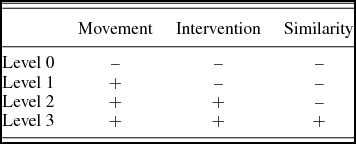
The present study has two aims. The first aim is to investigate the effect of syntactic complexity in the development of Aʹ-dependencies in French-speaking children of a wide age range based on the metric articulated in Table 1. The metric involves three cumulative factors defining four increasing levels of complexity.Footnote 2
Levels of complexity based on movement, intervention, and similarity

The test cases involve questions and RC structures spread across the four levels defined by the independent variables: movement, configurational intervention from an element that is featurally different from the moved element (the features of the moved element are disjoint from the features of the intervener), and configurational intervention from an element that is featurally similar to the moved element (the features of the moved element intersect with those of the intervener; see Methods section for details on the design). If the complexity metric reflects principles of the grammar, we predict that accuracy should significantly decrease as the number of complexity factors increases. Complexity may affect children differently depending on their developmental stage. We hypothesize that the three factors involved in the complexity metric (movement, intervention, and similarity) will affect the children's performance, but it may not affect their performance in an equal way.
The second aim addresses the impact of the complexity metric and the three factors in children with ASD. The metric in Table 1 serves as a tool for assessing whether syntactic development in children with ASD follows the same pattern as that of younger TD children who have similar nonverbal abilities, and whether their performance is related to their age and/or their nonverbal abilities. If children with ASD have a delay in the acquisition of syntax, the three factors should affect the children with ASD in a similar way to the younger TD control children. In contrast, if children with ASD follow a different developmental trajectory than TD children, the three factors may affect the children with ASD differently than the younger TD control children.
METHOD
Participants
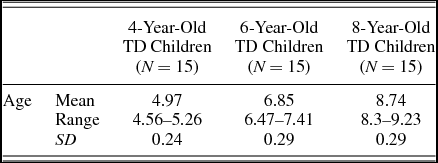
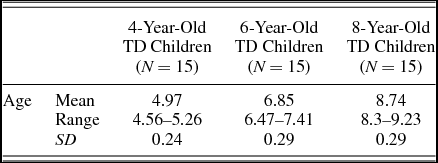
Our participants included 45 TD native French-speaking children from three school levels (mean ages = 4 years, 9 months [4;9], 6;8, and 8;8), as shown in Table 2. This enabled us to investigate how movement and intervention develop over time by comparing the performance of the three age groups, and to assess if some factors play a more crucial role at one or another stage of development.Footnote 3 The TD children were recruited from a primary school in Geneva, Switzerland.
Typically developing (TD) groups
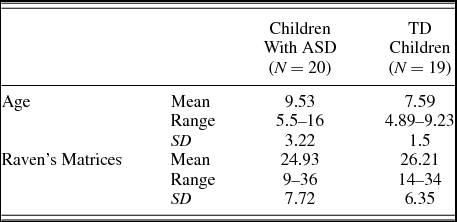
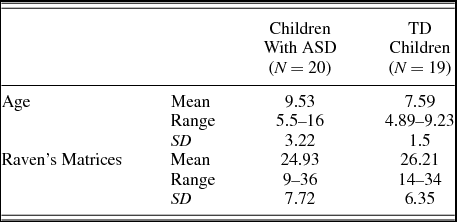
In addition, 15 children with ASD aged 6 to 16 (mean age = 9;4) also participated.Footnote 4 The children with ASD were recruited through parent associations and psychologists in the Geneva region and had been previously diagnosed by a specialist as meeting DSM-IV criteria for an autism spectrum disorder (American Psychiatric Association, Reference Association1994). A subgroup of 15 TD children from the three groups mentioned above was selected to be matched with the children with ASD on nonverbal reasoning (Raven’s Progressive Matrices; Raven, Court, & Raven, 1986), F (1, 29) = 0.236, p = .631, ηp 2 = 0.009. Matching the two groups on their nonverbal abilities is very important in research on ASD (see Tager-Flusberg, Reference Tager-Flusberg2004). If children with ASD have lower nonverbal abilities than TD children, a difference between the two groups in their verbal abilities can be the result of differences in their nonverbal abilities. By matching the two groups for their general nonverbal abilities, we will be able to address differences between them that cannot be attributed to differences in their nonverbal abilities. The TD children were younger than the children with ASD, F (1, 29) = 4.249, p = .049, ηp 2 = 0.136. Table 3 shows the children's age and scores on the Raven’s Progressive Matrices.
Matched children with autism spectrum disorder (ASD) and typically developing (TD) children
Testing for the TD group was conducted in a quiet classroom of their school, and the group with ASD was tested in the comfort of their own homes. The experiment and cognitive testing was run in two sessions of roughly 30 min, and children were offered a break in the middle. Approval for this study was obtained from the ethics committee of the Psychology Department of the University of Geneva, and parents of participants provided informed, written consent for their children to participate in the study.
Material
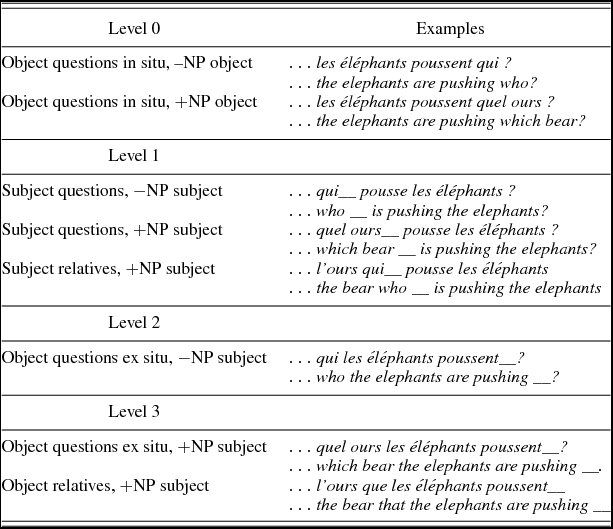
The participants took part in a sentence–picture matching task. Table 4 presents examples of the test sentences for each sentence type and condition based on the complexity matrix presented in Table 1.
Structures tested across the four complexity levels

Note: NP, Noun phrase.
Level 0 consisted of two sentence types that do not have movement, namely, object questions in situ without an NP object and object questions in situ with an NP object. Level 1 consisted of three sentence types that have movement but no intervention, namely, subject questions without an NP subject, subject questions with an NP subject, and subject relatives with an NP subject. Level 2 consisted of object questions ex situ that have movement and intervention from a dissimilar element; that is, the featural makeup of the moved object (+WH/+R, –NP, +Sg) and that of the intervening subject (+NP, +Pl) are fully disjoint. Finally, Level 3 consisted of object questions ex situ and object relatives with an NP object and an NP subject, two sentence types that include movement, intervention, and similarity; that is, the featural makeup of the moved object (+WH/+R, +NP, +Sg) and that of the intervening subject (+NP, +Pl) intersect.Footnote 5
The characters referred to by the wh-question or RC were singular or plural, and this was counterbalanced across conditions. The difference between singular and plural in the verbal inflection was always inaudible for the verbs used. All pictures (taken from Adani, Reference Adani2011) followed the same basic format, with (an) animal(s) X on the left, (an) animal(s) Y in the middle, and (an) animal(s) Z on the right. External characters were always of the same type, for example, a bear that is pushing two elephants and these two elephants are pushing another bear (see Figure 1).
Example from the sentence-picture matching task.

The image in Figure 1 was paired with one of the structures in Table 4, that is, either a RC or a wh-question, pronounced online by the experimenter. The correct answers were always located on one of the peripheries of any given picture. All items were semantically reversible, so that the child could not simply rely on understanding of the words alone to understand the sentence.
Procedure
The sentence–picture matching task was computerized and presented on a 15-in. portable computer, with the keyboard covered so as to avoid distracting participants. The total testing involved two experiments, one containing 24 RCs and the other 48 wh-questions, all sentences having been prerecorded and administered using headsets connected to the laptop. Each experiment was divided into two equal parts to allow for a break in the middle of the testing and thus keep participants engaged. The RCs were divided into 12 object relatives and 12 subject relatives with a lexically restricted (+NP) head. These were preceded by 4 familiarization items ensuring that participants knew what they had to do, and interspersed with 16 simple imperatives used as fillers, ensuring children were not overloaded and that they felt successful (e.g., “Show me the girl with the bow”). There were also 48 wh-questions, divided between +NP and –NP (i.e., bare) wh-elements, and in situ versus ex situ structures. These were preceded by 6 familiarization items and interspersed with 24 simple imperatives that served as fillers. At the very beginning of the testing, there was a lexical training phase including corrective feedback so as to check that children knew the lexicon necessary to take part in the experiment. It was common to both the RC and wh-experiments and consequently only administered once. The ordering of the tasks was counterbalanced across children, and items were randomized via e-prime throughout the two experiments.
The experiment began with the following oral instructions from the experimenter: “You will see pictures on the screen, and a voice will ask you to show one of the characters in the picture. Listen carefully and look at all of the characters, then point to the answer you think is the best.” During the testing phase, no feedback was given when the child pointed to the wrong character, except for commending them for their efforts (e.g., “Good listening!”). Children were presented with one picture at a time on the computer screen and heard one sentence. They were left as much time as they needed to answer, and the experimenter ensured that she had their full attention before moving on to the following stimulus. In some cases, the children were asked to press a button on the computer to move on to the following stimulus, because this helped them to keep concentrated on the task at hand.
Scoring and data analysis
The criteria for excluding children from the data analysis were failure to learn the characters during the lexical phase and/or below or at-chance performance in the filler items. All children succeeded in the lexical phase apart from one TD child who was excluded due to poor results on the filler items. The dependent variable was accuracy rate, as measured by whether or not the character that the child pointed to after having heard the target sentence was correct.
Descriptive statistics were conducted per structure and complexity level to explore the data. These were followed by inferential statistics using mixed repeated measures analyses of variance (ANOVAs) with group as the between factor and complexity level as the within factor to investigate differences between the groups and the levels of complexity and address the research questions. Interactions between group and complexity level were followed up using within-group analyses for each group separately and between-group analyses for each level of complexity. Follow-up analyses were conducted within ANOVAs using Bonferroni correction. All ANOVAs included partial eta-square analyses (ηp 2) that provide information about the effect size.Footnote 6 To investigate whether syntactic complexity in children with ASD develops as a function of age and/or nonverbal abilities, Pearson correlations were conducted between each level of complexity, age, and nonverbal abilities. Separate analyses were conducted to address the four aims of the study. The first set of analyses compared the three groups of TD children to address the development of the four levels of complexity. The second set of analyses addressed effects of movement intervention, and feature (NP) similarity separately within TD children. For effects of movement, we compared the two structures that did not involve movement (Level 0) to all other structures that involved movement (Levels 1–3). For effects of intervention, we compared the structures with movement but without intervention (Level 1) with the structures with movement and intervention (Levels 2 and 3). For effects of feature similarity, we compared the structures with intervention and a disjunction of features (Level 2) with the structures with intervention and an intersection of features (Level 3).
The third set of analyses compared the children with ASD to their matched controls to investigate whether computational complexity impacts children with ASD in a similar way as TD children who have similar nonverbal reasoning abilities. The final set of analyses compared the children with ASD to the TD controls for effects of movement, intervention, and feature similarity.
RESULTS
The effect of complexity in the development of Aʹ-dependencies in TD children
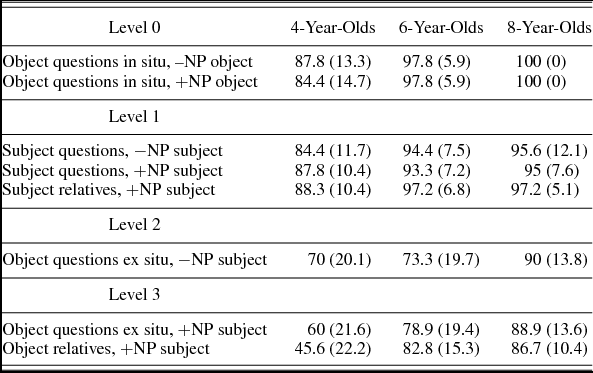
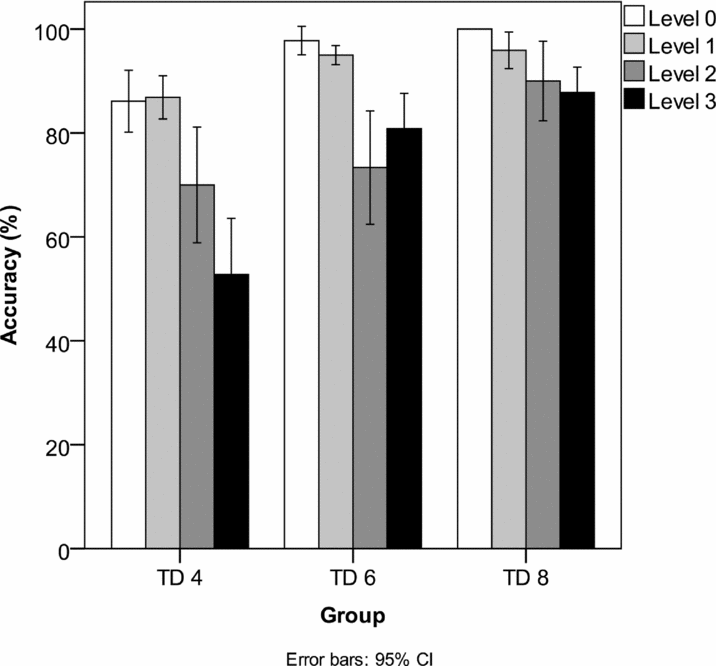
Table 5 shows the descriptive statistics for accuracy in the comprehension of the three groups of 4-, 6-, and 8-year-old TD children per structure, and Figure 2 illustrates their accuracy per level of complexity.
Mean accuracy (%) and standard deviation by structure

Note: NP, Noun phrase.
Accuracy in 4-, 6-, and 8-year-old typically developing (TD) children.
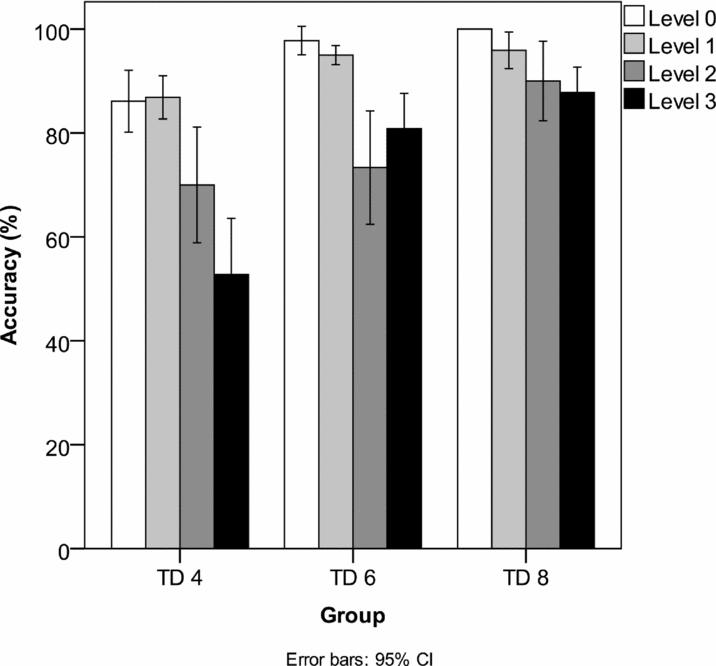
The descriptive statistics in Table 5 show overall a large degree of consistency of the structures within each level of complexity. The repeated measures ANOVA revealed a significant main effect of group, F (2, 42) = 27.952, p < .001, ηp 2 = 0.571, a significant main effect of complexity level, F (3, 126) = 36.598, p < .001, ηp 2 = 0.466, and a significant interaction between group and complexity level, F (6, 126) = 5.452, p < .001, ηp 2 = 0.206, indicating that the three groups of TD children did not show the same pattern of performance in the four levels of complexity.
The within-group analyses showed effects of syntactic complexity in all three groups of TD children. All groups had lower performance in sentences from Level 3 compared to Level 0 (4-year-olds: p < .001; 6-year-olds: p = .001; 8-year-olds: p < .001). However, 4- and 6-year-olds showed also significant differences between Level 0 and Level 2 (4-year-olds: p = .022; 6-year-olds: p = .002), Level 1 and Level 2 (4-year-olds: p = .04; 6-year-olds: p = .003), and Level 1 and Level 3 (4-year-olds: p < .001; 6-year-olds: p = .004).
The between-group analyses showed clear developmental differences between the age groups. This was evident at Level 0 (4- vs. 6-year-olds: p < .001; 4- vs. 8-year-olds: p < .001), Level 1 (4- vs. 6-year-olds: p = .002; 4- vs. 8-year-olds: p = .001), and Level 3 (4- vs. 6-year-olds: p < .001; 4- vs. 8-year-olds: p < .001). At Level 2, 4-year-olds performed similarly to 6-year-olds, but less well than 8-year-olds (4- vs. 8-year-olds: p = .013). Six-year-olds performed as well as 8-year-olds at Levels 0, 1, and 3, but not at Level 2 (p = .013).
The development of movement, intervention, and feature similarity in TD children
Effect of movement
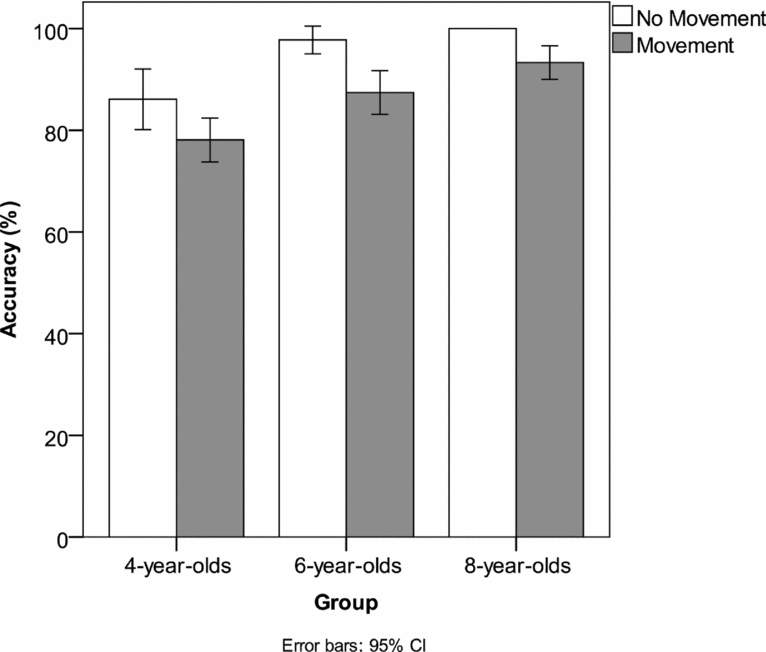
Figure 3 compares the accuracy in the comprehension of structures without movement compared to structures involving movement. The repeated measures ANOVA revealed a significant main effect of group, F (2, 42) = 25.731, p < .001, ηp 2 = 0.551, reflecting lower accuracy in 4- than 6- (p < .001) and 8-year-olds (p < .001), but no significant difference between 6- and 8-year-olds. There was also a significant main effect of movement, F (1, 42) = 47.307, p < .001, ηp 2 = 0.530, indicating lower performance in structures with movement compared to the ones without.
Structures with and without movement in typically developing children.

Effect of intervention
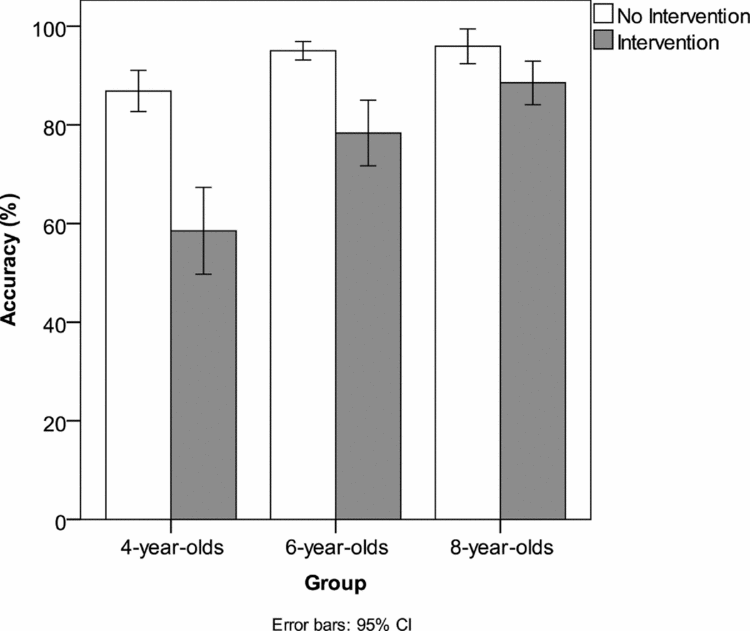
Figure 4 compares the accuracy in the comprehension of structures with movement but without intervention compared to structures with movement and intervention. The repeated measures ANOVA revealed a significant main effect of group, F (2, 42) = 33.754, p < .001, ηp 2 = 0.616, a significant main effect of intervention, F (1, 42) = 68.721, p < .001, ηp 2 = 0.621, and a significant interaction between group and intervention, F (2, 42) = 8.254, p = .001, ηp 2 = 0.282, indicating that the three groups were not affected equally by intervention effects. Within-subjects analyses showed intervention effects in all three groups, but the effect was stronger in 4-year-olds, F (1, 14) = 33.592, p < .001, ηp 2 = 0.706, and 6-year-olds, F (1, 14) = 32.034, p < .001, ηp 2 = 0.696, than in 8-year-olds, F (1, 14) = 7.417, p = .016, ηp 2 = 0.346. Between-subjects analyses showed differences between 4- and 6-year-olds (p = .002) and 4- and 8-year-olds (p = .001) in structures without intervention, F (2, 44) = 10.329, p < .001, ηp 2 = 0.330, and with intervention, F (2, 44) = 22.700, p < .001, ηp 2 = 0.519 (4- vs. 6-year-olds: p < .001; 4- vs. 8-year-olds: p < .001), but the effects in structures with intervention were stronger than the ones without, and no significant difference was attested between 6- and 8-year-olds.
Structures with and without intervention in typically developing children.

Effect of feature similarity
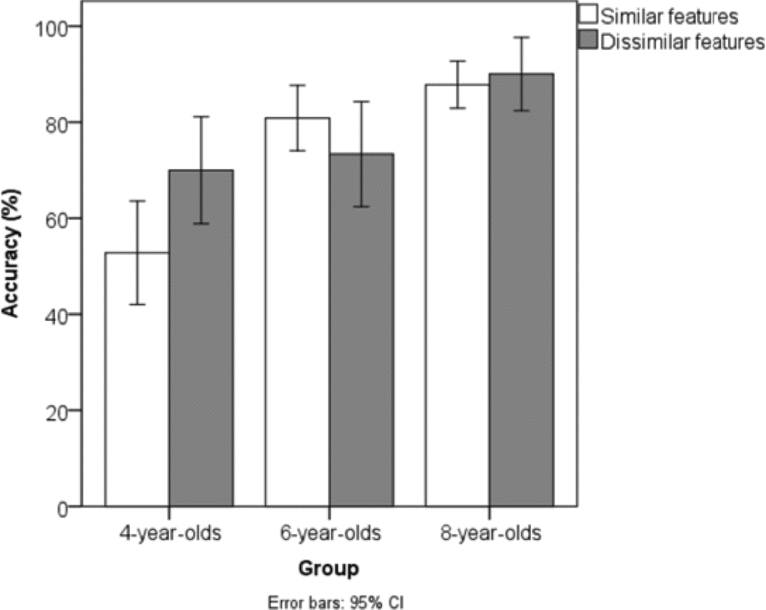
Figure 5 compares the accuracy in the comprehension of structures with intervention and disjoint feature sets compared to structures with intervention and intersecting feature sets. The repeated measures ANOVA revealed a significant main effect of group, F (2, 42) = 17.473, p < .001, ηp 2 = 0.454, and a significant interaction between group and feature similarity, F (2, 42) = 5.710, p = .006, ηp 2 = 0.214, indicating that the three groups were not affected equally by feature similarity in structures with intervention. Within-subjects analyses showed that there was an effect of feature similarity only in 4-year-olds, F (1, 14) = 7.356, p = .017, ηp 2 = 0.344. Between-subjects analyses showed that in structures with feature dissimilarity, 8-year-olds performed better than 4- (p = .013) and 6-year-olds (p = .047), F (2, 44) = 5.250, p < .009; ηp 2 = 0.200, but there was no difference between 4- and 6-year-olds. In contrast, structures with feature similarity showed that 4-year-olds performed less well than 6- (p < .001) and 8-year-olds (p < .001), F (2, 44) = 25.437, p = .009, ηp 2 = 0.548, but there was no difference between 6- and 8-year-olds.
Structures with and without feature similarity in typically developing children.

The effect of complexity in the development of A'-dependencies in children with ASD compared to TD controls
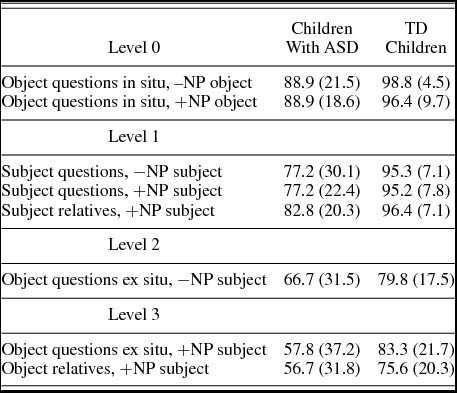
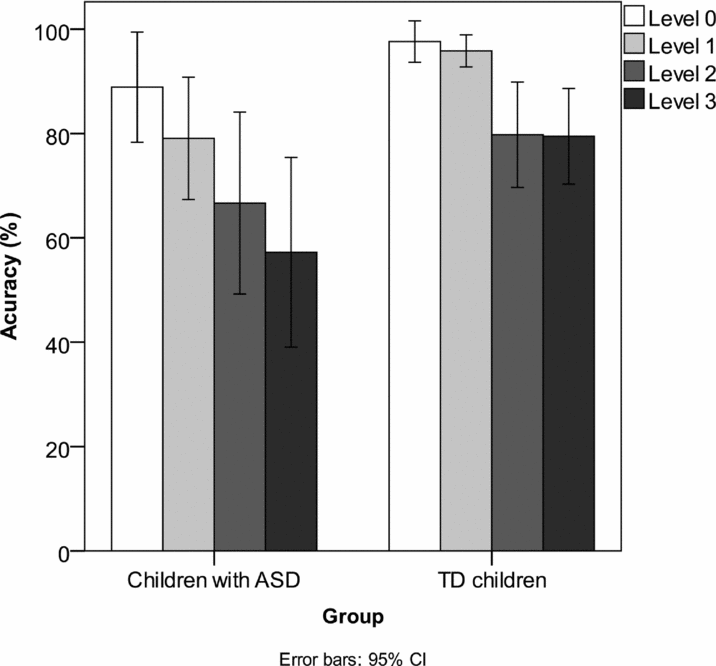
Table 6 shows the accuracy in the children with ASD compared to their TD controls per structure, and Figure 6 illustrates their accuracy per level of complexity. Table 6 shows overall a large degree of consistency of the structures within each level of complexity. The repeated measures ANOVA revealed a significant main effect of group, F (1, 27) = 6.664, p < .016, ηp 2 = 0.198, and a significant main effect of complexity level, F (3, 81) = 15.011, p < .001, ηp 2 = 0.357. There was no significant interaction between group and complexity level. This indicates that the children with ASD follow the same pattern of performance in the four levels of complexity with the TD children.
Mean accuracy (%) and standard deviation by structure

Note: ASD, Autism spectrum disorder; TD, typically developing; NP, noun phrase.
Accuracy in children with autism spectrum disorder (ASD) compared to their typically developing (TD) controls.

The within-group analyses showed a similar pattern to the performance of 4- and 6-year-olds in the previous analyses. There was a lower performance in sentences from Level 3 compared to Level 0 (p < .001) and Level 1 (p = .001) and also in sentences from Level 2 compared to Level 0 (p = .001) and Level 1 (p = .018). Moreover, there was no significant difference between sentences at Level 0 versus 1 and also Level 2 versus Level 3.
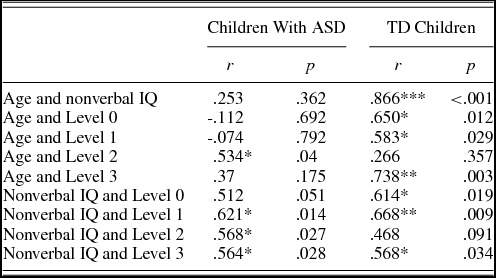
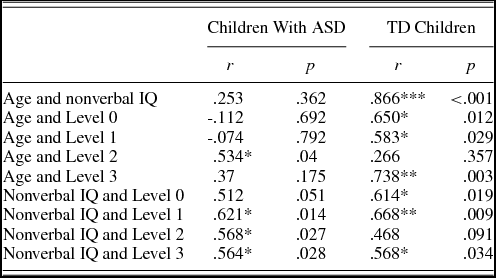
To investigate if the children's performance on the comprehension task relates to their age and nonverbal abilities, Pearson's correlations were conducted between the children's age, nonverbal IQ, and the four levels of complexity for each group separately. The results are illustrated in Table 7.
Correlations between age/nonverbal abilities and performance on the experimental task
Note: ASD, Autism spectrum disorder; TD, typically developing.
*p < .05. **p < .01. ***p < .001.
In the group of TD children, nonverbal IQ correlated with age, and all correlations between age/nonverbal abilities and levels of complexity (apart from Level 2) were significant. In the children with ASD, in contrast, nonverbal IQ did not correlate with age. Nonverbal IQ correlated with all levels of complexity (for Level 0 it was approaching significance, p = .051), but age correlated only with Level 2. All correlations were positive, indicating that older children and/or children with higher nonverbal abilities had better accuracy than younger children and/or children with lower nonverbal abilities.
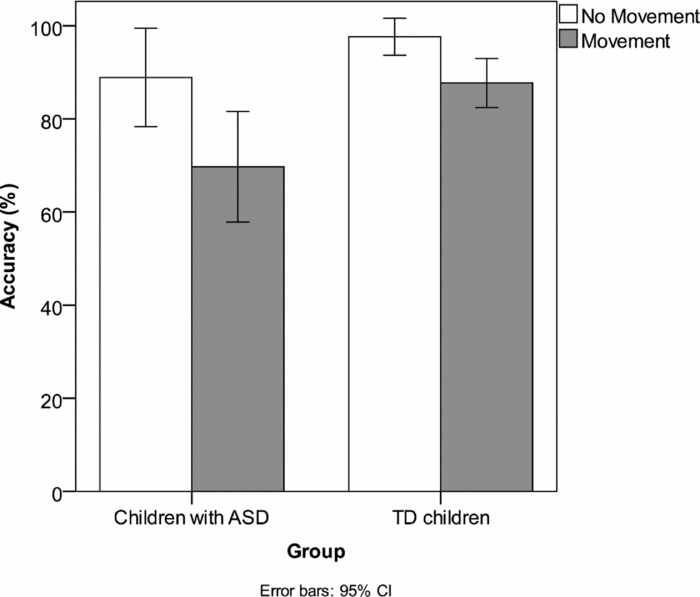
The effect of movement, intervention, and feature similarity in children with ASD compared to TD controls
Effect of movement
Figure 7 compares the accuracy in the comprehension of structures without movement compared to structures involving movement. The repeated-measures ANOVA revealed a significant main effect of group, F (1, 27) = 6.434, p = .017, ηp 2 = 0.192, reflecting lower accuracy in children with ASD compared to TD controls. There was also a significant main effect of movement, F (1, 27) = 34.830, p < .001, ηp 2 = 0.563, indicating lower performance in structures with movement compared to the ones without, and no significant Group × Movement interaction.
Structures with and without movement in children with autism spectrum disorder (ASD) versus typically developing (TD) controls.

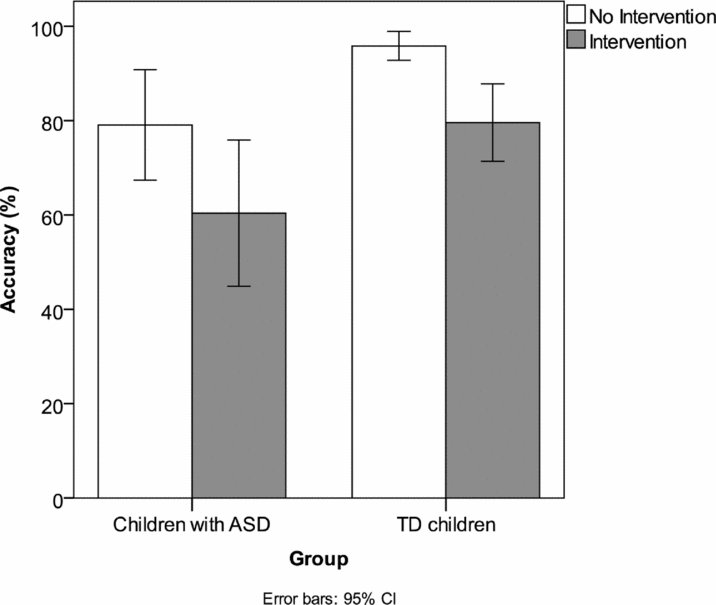
Effect of intervention
Figure 8 compares the accuracy in the comprehension of structures with movement but without intervention compared to structures with movement and intervention. The repeated-measures ANOVA revealed a significant main effect of group, F (1, 27) = 8.419, p = .007, ηp 2 = 0.238, reflecting lower accuracy in children with ASD compared to TD controls. There was also a significant main effect of intervention, F (1, 27) = 22,913, p < .001, ηp 2 = 0.459, indicating lower performance in structures with intervention compared to the ones without, and no significant Group × Intervention interaction.
Structures with and without intervention in children with autism spectrum disorder (ASD) versus typically developing (TD) controls.

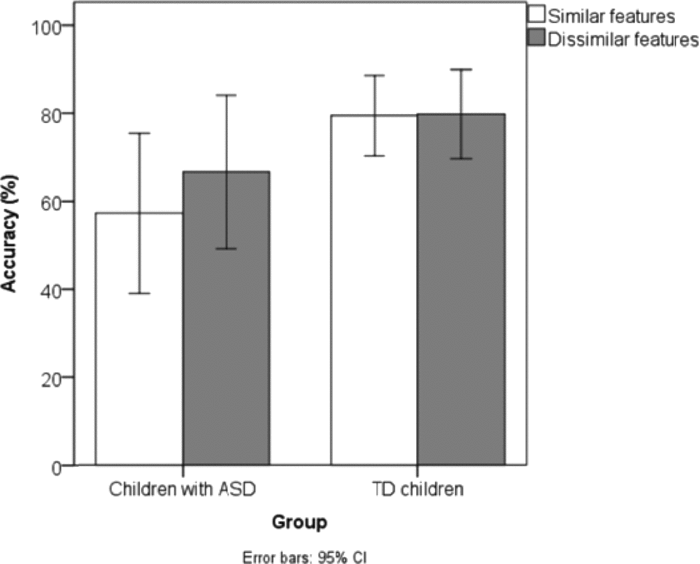
Effect of feature similarity
Figure 9 compares the accuracy in the comprehension of structures with intervention and dissimilar features (disjunction) compared to structures with intervention with similar features (intersection). The repeated measures ANOVA revealed no significant main effects or interactions, indicating similar performance in the two groups and structures.
Structures with and without feature similarity in children with autism spectrum disorder (ASD) versus typically developing (TD) controls.

DISCUSSION
The study had two aims: first, to investigate the effect of complexity in the development of Aʹ-dependencies in French-speaking children by addressing how each one of the three factors involved in the metric (movement, intervention, and feature similarity) impacts the development of Aʹ-dependencies; and second, to investigate the impact of the complexity metric and the three factors in children with ASD compared to TD controls.Footnote 7
The complexity metric was based not only on movement (expressed by the DCM), but also on the nature of intervention and the feature similarity between the moved element and the intervener (based on RM). A range of eight structures were included in this study that involve structures with and without movement; from the structures that involve movement, structures with and without intervention; and finally from the structures that have movement and intervention, structures with and without feature similarity between the element that moves and the intervener. The eight structures were classified on the basis of these three cumulative factors in four levels of increasing complexity.
The effect of complexity in TD children
The results from the TD children demonstrate that comprehension is overall affected by syntactic complexity operationalized in terms of movement, intervention, and featural similarity and a considerable degree of consistency for the structures within each level of complexity. However, the pattern of performance differed as a function of the children's age. All groups had lower performance in the most complex structures (Level 3) compared to the simplest ones (Level 0); however, age groups differed in their sensitivity to the intermediate levels. The 8-year-old children had high accuracy so that intermediate levels did not differ from each other. In contrast, 4- and 6-year-old children had low performance also in structures at Level 2 that differed from Levels 0 and 1. Movement affected all three groups in a similar way, but intervention effects were strongest in 4-year-olds and became weaker as a function of age. Feature similarity affected only 4-year-olds.
These findings support the hypothesis that movement, intervention, and feature similarity all play a significant, cumulative role in children's sentence comprehension, although to various degrees depending on children's linguistic development. That intervention effects arise even in the case of a featural disjunction between the moved element and the intervener suggests that configurational intervention has a role to play independently of featural similarity, even though similarity increases its effect, proportionally to the feature overlap: the more they overlap, the more the intervener perturbs the dependency.Footnote 8
Another finding of the present study was that structures with two NPs and therefore intersecting feature sets were not harder to process than those with disjoint feature sets for older children. The fact that having two full NPs failed to increase difficulty in that group may be due to their ability to exploit morphosyntactic differences in terms of number information on the NPs, in line with what has been reported for Italian (Adani et al., Reference Adani, van der Lely, Forgiarini and Guasti2010; Arosio et al., Reference Arosio, Yatushiro, Forgiarini and Guasti2012; see Franck, Colonna, & Rizzi, Reference Franck, Colonna and Rizzi2015, for a similar finding in French-speaking adults). While number is systematically audible on the verbal inflectional head in Italian, it was never the case on the French verbs included in the present study. That number mismatch can facilitate parsing, independently of the morphological realization of the feature follows from a feature-based account, where inaudible features remain relevant for movement and thus for locality.
The effect of NP feature similarity in 4-year-old children demonstrates that similarity in terms of lexical restriction negatively affects children's comprehension at an early stage of development, and that contrary to older children, 4-year-olds cannot reliably capitalize on number for the computation of locality. This finding is compatible with findings by Adani et al. (Reference Adani, van der Lely, Forgiarini and Guasti2010) who tested children age 5 and over when showing that number mismatch improved performance with Aʹ-dependencies, and it is also compatible with reports that sensitivity to morphological number cues emerge only after age 5 (Johnson, de Villiers, & Seymour, Reference Johnson, de Villiers and Seymour2005; Miller & Schmitt, Reference Miller, Schmitt, Brucart, Gavarro and Sola2009; Pérez-Leroux, Reference Perez-Leroux and Gurski2005).Footnote 9 Along these lines, it has been argued that the sensitivity to such grammatical features may be related to memory span, whose capacity increases with age (Arosio et al., Reference Arosio, Guasti and Stucchi2010, Reference Arosio, Yatushiro, Forgiarini and Guasti2012).
The children's accuracy for wh in situ questions regardless of the lexical restriction on the wh-head provides support for an analysis of these structures in terms of featural movement (Baunaz, Reference Baunaz2011; Cheng & Rooryck, Reference Cheng and Rooryck2000; Mathieu, Reference Mathieu, Iten and Neeleman1999; Shlonsky, Reference Shlonsky, Bruge, Cardinaletti, Giusti, Munaro and Poletto2012) rather than covert phrasal movement involving pied-piping of the entire object determiner phrase (along the lines of Huang, Reference Huang1982). If covert movement was equivalent to overt movement, one would predict the same intervention effects to arise for both object questions involving wh in situ and those involving wh ex situ. This prediction was not borne out by our results. As such, an analysis in terms of movement of the (+WH) feature on the wh-element in situ, rather than of the whole set of features present on this object, has the potential to account for the absence of intervention effects reported here for wh in situ questions such as (16):
-
(16)

The effect of complexity in children with ASD
The data from the present study provide important information on the syntactic profile of children with ASD, which has been only seldom explored to date. Previous studies on the grammatical abilities of children with ASD have demonstrated subtle difficulties in their grammatical abilities of children with ASD compared to TD control children (Perovic et al., Reference Perovic, Modyanova, Hanson, Nelson and Wexler2007, Reference Perovic, Modyanova and Wexler2013; Riches et al., Reference Riches, Loucas, Baird, Charman and Simonoff2010; Terzi et al., Reference Terzi, Marinis, Kotsopoulou and Francis2014; Zebib et al., Reference Zebib, Tuller, Prévost and Morin2013), but the groups of children with ASD and TD controls were not always matched in the same way, with some studies matching the groups on age and verbal abilities, but not on general cognitive abilities (Terzi et al., Reference Terzi, Marinis, Kotsopoulou and Francis2014), others matching them on age but not on verbal and nonverbal abilities (Riches et al., Reference Riches, Loucas, Baird, Charman and Simonoff2010), and others matching them on nonverbal and verbal abilities but not on age (Perovic et al., Reference Perovic, Modyanova and Wexler2013). To address whether syntactic development in children with ASD follows the same pattern as that of TD children who have similar nonverbal abilities and whether their performance is related to their age and/or their nonverbal abilities, we compared the performance of children with ASD to a group of younger TD children who were matched on their nonverbal abilities. The results showed that the children with ASD had overall lower performance than their younger TD controls who had similar nonverbal abilities. This indicates that nonverbal abilities per se cannot account for the difficulties children with ASD have in grammar, because if this were the case, the children with ASD would not have differed from their TD controls matched on nonverbal abilities. Furthermore, the children with ASD differed from the TD controls across all levels of complexity and not only in the most complex structures. This suggests difficulties across the board even for simple structures, which their younger TD peers have mastered, and is consistent with studies matching children with ASD to TD children on nonverbal abilities and demonstrating that children with ASD have subtle difficulties also with simple linguistic structures that have not been reported to be problematic even in early stages of TD (Perovic et al., Reference Perovic, Modyanova, Hanson, Nelson and Wexler2007, Reference Perovic, Modyanova and Wexler2013).
It is important that the performance of children with ASD was affected by syntactic complexity operationalized in terms of movement, intervention, and feature similarity. More complex structures involving movement, intervention, and similarity (Level 3) and structures involving movement and intervention with dissimilar featural sets (Level 2) were less accurate than less complex structures without movement, intervention, and feature similarity (Level 0) and with movement but without intervention and similarity (Level 1). This indicates that the syntactic complexity metric based on movement, intervention, and feature similarity plays a significant role not only in TD children but also in children with ASD. The analyses addressing each one of these factors separately provided additional evidence for the way these factors affect the performance of the children with ASD compared to the TD control children. Movement and intervention affected both groups in a similar way, and the children with ASD were less accurate than the TD controls across the board; that is, they were not affected disproportionally more than the TD children in conditions involving movement or intervention compared to the ones that did not involve movement and intervention. However, the ASD and the TD-matched children did not differ in accuracy and failed to show effects of feature similarity. This resembles the results of the older TD children in this study who did not show effects of feature similarity and suggests that they can exploit the number differences between the head and the intervener; number mismatches between the head and the intervener can facilitate parsing (see Adani et al., Reference Adani, van der Lely, Forgiarini and Guasti2010). The findings related to the complexity metric provide further support that the syntactic complexity metric adopted in the present study has psychological reality in both TD children and children with ASD.
The final important finding in the group of children with ASD regards the relationship between the children's age and nonverbal abilities and the scores on the syntactic complexity metric. Whereas the TD control children's performance developed as a function of the children's age and nonverbal abilities, which were related to each other, the ASD children's performance developed as a function of the children's nonverbal abilities and not age, given the absence of correlation with age. The correlation between nonverbal abilities and the ASD children's scores on the syntactic complexity metric indicates the importance of nonverbal abilities for the development of syntactic complexity. The lack of a correlation between age and the ASD children's scores on the syntactic complexity metric coupled with the lack of a correlation between age and nonverbal abilities suggests an asynchrony among age and nonverbal abilities along with syntactic complexity. Syntactic complexity in children with ASD does not seem to follow the smooth relation to age that is found in TD children.