Implications
Nearly 40% of reared hares die before they are sold or reach reproductive age. The main causes of mortality are enteric disorders in young hares (suckling and growing). The most frequently involved bacteria are Clostridium perfringens and Escherichia coli, followed by Clostridium spiroforme. Hares are affected by diseases resembling those of rabbits reared under intensive conditions. It is necessary to improve the husbandry of hares to reach satisfactory technical standards and to preserve their health.
Introduction
Since World War II, the European brown hare (Lepus europaeus Pallas, 1778) population across Italy has decreased because of hunting, agriculture, urbanization and introduction of new pathogens, as well as natural predation (Spagnesi and Trocchi, Reference Spagnesi and Trocchi1992; Paci and Bagliacca, Reference Paci and Bagliacca2003). Included within minor farmed species, hares had started to be farmed by 1964 thanks to the activity of the National Institute for Wildlife (now the Institute for Environmental Protection and Research, Rome) to restore local populations and to limit imports from other countries (Trocchi and Riga, Reference Trocchi and Riga2005).
Difficulties in rearing this animal have been significant, and even today, efforts are less than successful. Open-air cages have been proven to be the most successful rearing system, but technical standardization is still quite low. In particular, farms have low productive dimensions (i.e. low number of pairs) and results may vary greatly (Romboli et al., Reference Romboli, Bagliacca and Cringoli1984; Spagnesi and Trocchi, Reference Spagnesi and Trocchi1992). As a consequence, knowledge about productive performance and, more importantly, diseases of farmed hares is lacking (Trocchi and Riga, Reference Trocchi and Riga2005; Sánchez-García et al., Reference Sánchez-García, Alonso, Díez, Pablos and Gaudioso2012). In contrast, a number of studies are available on free-living European brown hares in Italy and in Europe (Strauß et al., Reference Strauß, Grauer, Bartel, Klein, Wenzelides, Greiser, Muchin, Nösel and Winter2008; Ferretti et al., Reference Ferretti, Paci, Porrini, Galardi and Bagliacca2010); these mainly focus on local wild populations or farmed hares released into the wild.
The present study was aimed at evaluating the performance and the causes of mortality of hares reared in a large farm in Veneto Region (Northern Italy) during 2010 and 2011.
Material and methods
Farm and animals
The farm was located in the province of Venice (Municipality of Santa Maria di Sala) at 13 m a.s.l. The farm housed a total of 720 cages, of which 320 were for reproducing animals and the remaining for the other hare categories, over an area of 4500 m2. A total of 318 pairs (in their 1st, 2nd and 3rd year of reproductive activity) per year were monitored during 2010 and 2011. The pairs were kept outside in roofed cages (1 m long, 1.60 m wide and 70 to 80 cm high), with wooden side and back walls and a wire net front side and floor. Cages were equipped with feeders for the manual distribution of feed and automatic nipple drinkers.
All animals were fed with a unique commercial diet specifically formulated for hares (dry matter: 89.3%; CP: 15.2%; crude fibre: 19.1%; ether extract: 3.2%). In addition, fresh alfalfa (Medicago sativa) during April to October and savoy cabbage (Brassica oleracea) during the other months were administered ad libitum to all animals. Litters were weaned at 24 to 25 days of age, moved into group cages and then sold or maintained on the farm for reproductive restocking.
Animals were vaccinated against staphylococcosis, pasteurellosis and European brown hare syndrome with aluminium hydroxide adjuvant autogenous vaccines produced by the Istituto Zooprofilattico Sperimentale della Lombardia e dell’Emilia Romagna (Brescia, Italy).
On-farm recordings
Data on performance and mortality were collected from January 2010 to December 2011 on six hare categories: newborn leverets (0 to 2 days of age), suckling leverets (3 to 25 days), growing hares (26 to 60 days), sub-adult hares (61 days until sale), reproducing hares (animals kept for reproduction) and culled hares (spent reproducing hares). The term ‘born hares’ includes all of the categories of hares (i.e. newborn, suckling, growing and sub-adult hares) born during the year.
The number of litters, leverets born alive, weaned leverets (at 25 days) and sub-adult hares per litter were recorded. Data are given as litters per present reproductive pair, litters per present fertile reproductive pair, leverets born alive per fertile reproductive pair, weaned leverets per fertile reproductive pair and sub-adult hares per fertile reproductive pair.
Sterility was estimated as the ratio between the number of hare does that never littered during the year and the total number of present hare does. The culling rate of hare does was calculated as the number of does replaced per year out of the total of present does. Hare does were replaced because of health (e.g. respiratory diseases, mastitis, sore hocks or mortality of litters due to enteritis) and behavioural problems (e.g. cannibalism of litters) or mortality.
Health monitoring and necropsy
Health status of hares was monitored daily, and dead animals were promptly removed from cages. During 2010 and 2011, a total of 2839 animals belonging to the different hare categories died, and 87% of them were necropsied by veterinarians at the laboratories of the Department of Comparative Biomedicine and Food Science (BCA).
Laboratory analyses
Samples of pathological tissues were collected for histopathological (n=83 animals), parasitological (n=67 animals), bacteriological (n=307 animals) and virological (n=55 animals) examinations to confirm the suspected diagnosis. Histopathology and parasitology were performed at the BCA Laboratories, whereas bacteriology and virology were carried out at the Clinical Diagnostic Laboratory, Istituto Zooprofilattico Sperimentale delle Venezie, Legnaro PD, Italy. Bacteriological examinations were performed according to the procedures previously described by Agnoletti et al. (Reference Agnoletti, Bano, Comin, Parenti, Marcati, Bertolin and Mazzolini2004), Pisoni et al. (Reference Pisoni, Poloni, Tosi, Gallazzi and Grilli2007) and Cocchi et al. (Reference Cocchi, Drigo, Bacchin, Bano, Marcon and Agnoletti2008). All of the other laboratory analyses were carried out according to the standard techniques in use at the laboratories.
Statistical analysis
The performance data of the 2 years were analysed by a one-way ANOVA using the GLM procedure (SAS Institute Inc., Cary, NC, USA). Differences in mortality rate and occurrence of pathological changes between the years were analysed by χ 2-test. Differences among means with P<0.05 were accepted as representing statistically significant differences.
Results
Reproductive performance and mortality
The performances of the reproductive pairs during the 2 years were very similar (Table 1). Sterility ranged from 8.2% in 2010 to 8.8% in 2011. The fertile pairs littered on average 4.8 times per year, and the average yearly number of live leverets was 10.5 per reproductive pair and 11.4 per fertile pair. The fertile pairs weaned 8.4 leverets (25 days of age) per year, and the number of growing hares (60 days of age) per reproductive pair was 7.0. The culling rate of reproducing females significantly decreased from 81.1% during 2010 to 69.2% during 2011.
Reproductive performance of hares per year during 2010 and 2011

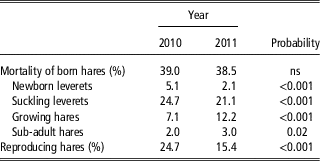
Total mortality of born hares was 39.0% and 38.5% in 2010 and 2011, respectively (Table 2). Most animals died during the suckling period with an average value of 22.9%. Neonatal mortality was 3.6% on average. A rather significant percentage of mortality (9.7%) was recorded in growing hares, whereas sub-adult hares showed the lowest mortality rate (2.5%). Although the total mortality of born hares was similar, in 2010 losses were significantly higher in newborn and suckling leverets and lower in growing and sub-adult hares than 2011. Reproducing hare mortality was also higher during 2010 compared with 2011 (24.7% v. 15.4%; P<0.001).
Mortality rate of hares during 2010 and 2011

Causes of mortality
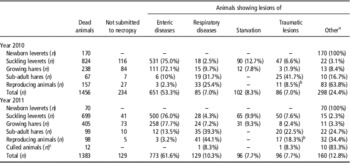
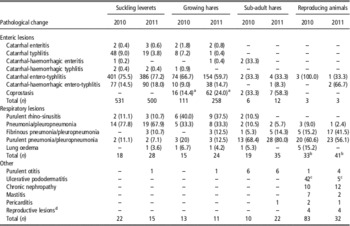
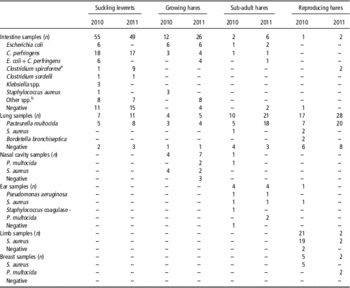
In most cases, no evident pathological changes were detected at necropsy in newborn leverets. On average, the most common causes of mortality in suckling leverets were enteric diseases (75.5% of dead leverets), followed by starvation (11.3%), traumas (7.1%) and respiratory diseases (3.4%) (Table 3). The most frequent pathological findings associated with enteric disease were catarrhal (76.3% of leverets dead for enteric diseases) and catarrhal-haemorrhagic (16.2%) entero-typhlitis with gut distension, yellow to dark brown watery gut content and undigested milk in the stomach (Table 4). Clostridium perfringens and Escherichia coli were the most commonly isolated bacteria, followed by Clostridium spiroforme (Table 5).
Causes of mortality in hares during 2010 and 2011 (the value within parenthesis is the percentage of animals affected on the total of animals submitted to necropsy)

a No evident pathological change, purulent otitis, diaphragmatic hernia, hepatitis, cystitis, ulcerative pododermatitis, chronic nephropathy, mastitis, reproductive diseases and pericarditis.
b Statistically significant difference (P<0.05) between 2010 and 2011.
c Culled animals: spent reproducing hares.
Main pathological changes associated with mortality of hares (the value within parenthesis is the percentage of animals showing the lesion on the total of animals affected)

a Statistically significant difference (P<0.05) between 2010 and 2011.
b Statistically significant difference (P<0.01) between 2010 and 2011.
c Statistically significant difference (P<0.001) between 2010 and 2011.
d Pyometra, dystocia and uterine prolapse in females; orchitis in males.
Results of bacteriological examinations of tissue samples taken at necropsy

a Identified by both bacteriological and bacterioscopic examination.
b Enterococcus spp., Bacillus spp., Pseudomonas aeruginosa, Streptococcus spp.
On average, in the 2 years, enteric diseases represented 75.9% of the causes of mortality in growing hares, followed by starvation (8.8%), respiratory diseases (8.0%) and traumas (2.3%) (Table 3). The main pathological changes associated with enteric disease were catarrhal entero-typhlitis (61.8%) and coprostasis (14.4% in 2010 and 24.0% in 2011; P<0.05) (Table 4). Coprostasis was characterized by abdominal distension with caecal impaction and gaseous watery content in the stomach and in the intestine. Sporadically, mucous colon content, splenomegaly, bladder distension and aspiration pneumonia were observed at necropsy. Either C. perfringens or E. coli or both bacteria were isolated from intestinal contents (Table 5). During autumn 2011, coccidiosis was diagnosed in two hares affected by coprostasis.
In sub-adult hares, the predominant causes of mortality were respiratory diseases (36.2%), followed by trauma (30.2%), enteric diseases (12.1%) and purulent otitis (8.1%) (Table 3). The most common respiratory pathological change was purulent pleuropneumonia (75.9%), consisting of apical and bilateral pneumonia with the presence of purulent exudate in the bronchi and alveoli and sometimes in the trachea, as well as exudative pleuritis and, in more chronic cases, pulmonary abscesses (Table 4). The aetiological agent associated with these lesions was always Pasteurella multocida (Table 5). Hares affected by purulent otitis showed head tilt, balance disorders with falling and rolling, and sometimes inappetence. At necropsy, accumulation of purulent exudate was observed in the inner and medium ear. P. multocida, Staphylococcus aureus and Pseudomonas aeruginosa were isolated at bacteriology (Table 5). Sub-adult hares (n=24) were found positive for coccidia during autumn 2011.
Although causes of mortality were rather similar in most of the hare categories over the 2 years, in reproducing hares two main differences were recorded. Respiratory diseases affected 25.4% of dead reproducing hares during 2010 and 44.1% during 2011 (P<0.01; Table 3). The most common pathological change was purulent pleuropneumonia (58.1% on average; Table 4). Ulcerative pododermatitis was detected in 32.3% and 5.4% of the specimens (P<0.001) in 2010 and 2011, respectively (Table 4). Multifocal visceral purulent lesions, such as renal and splenic abscesses, thrombo-embolic pneumonia and/or fibrinous pleuritis were also observed in association with metatarsal ulcerations. These lesions were caused by S. aureus (Table 5) and, in more chronic cases, AA-amyloid was observed histologically in sections of the liver, kidneys and spleen stained with Congo red. Furthermore, enteric diseases (2.7%), traumas (8.5% in 2010 and 18.3% in 2011, P<0.05) and purulent otitis (2.2%) were observed in reproducing hares (Table 3). Other pathological findings were purulent mastitis caused by P. multocida or S. aureus and reproductive disorders, such as pyometra, dystocia, uterine prolapse and orchitis (Tables 4 and 5). Three reproducing hares were affected by Taenia pisiformis.
Discussion and conclusions
In Lepus europeaus, reproductive activity and length are regulated by the photoperiod rather than by the environmental conditions (Trocchi and Riga, Reference Trocchi and Riga2005). Under captivity, the reproductive performance of hares seems to be similar to that observed in free-ranging hares, that is, 7.8 to 11.3 growing hares yearly produced per doe (Trocchi and Riga, Reference Trocchi and Riga2005). In the present study, the average number of growing hares (7.0) produced per fertile reproductive pair was higher than that previously reported in farmed hares (5.3) (Spagnesi and Trocchi, Reference Spagnesi and Trocchi1992), whereas the yearly number of litters per fertile pair (4.8) and the number of live leverets (10.5) were comparable to published data (from 1.3 to 5 litters/year and 4.0 to 11.1 live leverets annually) (Romboli et al., Reference Romboli, Bagliacca and Cringoli1984; Nioli, Reference Nioli2006).
Sterility of reproducing hares was lower than that reported in other studies (8.5% v. 11% to 25% according to Tocchini et al., Reference Tocchini, Fronte, Nelli, Fichi and Sammuri2000 and Mantovani, Reference Mantovani1996). The yearly culling rate (75%) was higher compared with previous findings (40% to 55%; Spagnesi and Trocchi, Reference Spagnesi and Trocchi1992; Mantovani, Reference Mantovani1996) because the hare does were replaced as soon as health or behavioural problems emerged.
Mortality of born hares was very high, as nearly 40% of hares died before sale or before reaching reproductive age. These findings are consistent with Tocchini et al. (Reference Tocchini, Fronte, Nelli, Fichi and Sammuri2000) (mortality rate: 26% to 39%) and Miragoli (Reference Miragoli2007) (48%). Romboli et al. (Reference Romboli, Bagliacca and Cringoli1984) documented a mortality of young hares (until 30 days of age) of 17.9% to 28.6%, which was significantly affected by the type of cage and whether it offered less or more protection from climatic and stressing factors.
The main causes of mortality in born hares were enteric disorders, affecting primarily young animals (i.e. suckling leverets and growing hares), which confirms the previously documented susceptibility of hares to digestive problems (Spagnesi and Trocchi, Reference Spagnesi and Trocchi1992). In both years, more than 50% of born hares showed pathological changes attributable to enteric disorders. Among these, coprostasis affected 21.1% of growing hares, in contrast to Miragoli (Reference Miragoli2007) who reported 2%. Although a similar disease named Leporine Dysautonomia has been documented in free-living hares by Griffiths and Whitwell (Reference Griffiths and Whitwell1993), the pathological condition affecting our hares rather resembled the epizootic rabbit enteropathy of farmed rabbits (Licois et al., Reference Licois, Coudert and Marlier2006). In the present study, the bacteria most frequently involved in enteric disorders were C. perfringens and E. coli, followed by C. spiroforme. These pathogens have been previously documented as a common cause of enteritis in farmed lactating (Ducluzeau et al., Reference Ducluzeau, Dubos, Martinet and Raibaud1975) and growing hares (Miragoli, Reference Miragoli2007).
On the basis of our observations and those from other studies (Ducluzeau et al., Reference Ducluzeau, Dubos, Martinet and Raibaud1975; Miragoli, Reference Miragoli2007), bacterial enteric diseases seem to be a common health problem in young captively bred hares in contrast to free-living hares (Spagnesi and Trocchi, Reference Spagnesi and Trocchi1992). As in rabbits, the suckling and weaning periods in young hares are critical for the development of a balanced gut microbiota: any disruption of the digestive equilibrium may promote the growth of potentially pathogenic bacteria, such as clostridia and coliforms (Peeters, Reference Peeters2000; De Blas et al., Reference de Blas, Chamorro, García-Alonso, García-Rebollar, García-Ruiz, Gómez-Conde, Menoyo, Nicodemus, Romero and Carabaño2012). In free-living hares, the development of intestinal microbiota is favoured by contact with soil, whereas in farmed hares, the development and composition of the gut microflora depends on the contact with parents (Spagnesi and Trocchi, Reference Spagnesi and Trocchi1992), as well as on the feeding regime.
Respiratory diseases were the second most common cause of mortality (∼10% in both years), as previously documented (7.5% of the total mortality) (Miragoli, Reference Miragoli2007) and affected mainly older animals (sub-adult and reproducing hares). Respiratory diseases were observed during autumn and winter, when sudden variations in temperature occurred, and were caused mainly by P. multocida, which was able to cause disease in older animals (Spagnesi and Trocchi, Reference Spagnesi and Trocchi1992). Furthermore, rhino-sinusitis was observed in growing hares whose parents were affected by pododermatitis or mastitis. Accordingly, transmission of P. multocida and S. aureus from reproducing hares to their progeny may be hypothesized, similarly to rabbits (Coudert et al., Reference Coudert, Rideaud, Virag and Cerrone2006; Vankraeynest et al., Reference Vankraeynest, Hermans and Haesebrouck2006).
A number of other pathological conditions were detected in the present study. Starvation in lactating and growing hares and trauma in born hares accounted for ∼10% of mortality, as already observed (15% at 25 to 75 days of age; Paci et al., Reference Paci, Folliero, Ambrogi, Pedonese, Ebani and Bagliacca1998). Ulcerative pododermatitis associated with multifocal visceral purulent lesions and generalized AA-amyloidosis was observed only in reproducing hares and was caused by S. aureus, most likely predisposed by mechanical injury from the cage wire floor, as evidenced in rabbits (Rosell and de la Fuente, Reference Rosell and de la Fuente2013). To our knowledge, ulcerative pododermatitis has never been documented in hares, but generalized AA-amyloidosis has been reported in free-living hares affected by chronic inflammation (Geisel and Linke, Reference Geisel and Linke1988).
Purulent otitis, affecting mainly sub-adult hares, was caused by P. multocida, Staphylococcus spp. and P. aeruginosa, well-known aetiological agents of suppurative otitis in rabbits (Coudert et al., Reference Coudert, Rideaud, Virag and Cerrone2006; Vankraeynest et al., Reference Vankraeynest, Hermans and Haesebrouck2006). Parasitic diseases, that is, coccidiosis and cysticercosis, were occasionally diagnosed and attributed to the administration of potentially contaminated fresh alfalfa or savoy cabbage, as previously reported (Spagnesi and Trocchi, Reference Spagnesi and Trocchi1992).
In conclusion, losses due to mortality were important and causes of mortality resembled those recognized in the intensive rearing system of rabbits. As for rabbits, most of the diseases cannot be attributed only to a specific aetiological agent but also to some important weaknesses in the farming (i.e. stocking density, protection offered by cages), feeding and management systems. Because an improvement of health status would permit owners to greatly increase their farm profitability as well as the animals welfare, further studies are needed for standardizing husbandry techniques and for defining and controlling the predisposing factors to disease.
Acknowledgements
This study was funded by Veneto Region (PSR 2007–2013 Mis. 124 – Reg. CE 1698/2005 – DGR 1604 31/07/2012) (CUP: C58C12000240002). The Authors wish to thank Dr Eliana Schiavon and Dr Fabio Rampin, Clinical Diagnostic Laboratory, Istituto Zooprofilattico Sperimentale delle Venezie, Legnaro (PD), for microbiological examinations.