The notion of responsible party government relies on the ability of disciplined parties to offer voters coherent policy packages that they can credibly commit to implement, if elected.Footnote 1 Party disunity – when legislators dissent from their party line by voting against it in parliament or by speaking out against it in the media – can potentially undermine this collective accountability mechanism.Footnote 2 The question of why intraparty dissent occurs has therefore received much scholarly attention.Footnote 3 A common argument made in this literature is that legislators have an electoral incentive to demonstrate their freedom from the party line,Footnote 4 and this has motivated scholars in a number of countries to test whether independent-minded legislators – often equated with legislative rebels – are more popular and more electorally successful than party loyalists.Footnote 5
An unresolved question in this literature is why constituents should prefer members of parliament (MPs) who demonstrate their independence from the party over those who remain staunchly loyal. Existing research proposes two types of explanations. According to the first, dissent has no direct effect on voter evaluations of a legislator. Instead, any increase in voter support comes from a profile effect whereby independent-minded legislators benefit from enhanced media coverage and name recognition. The second type of explanation suggests that voters evaluate legislator dissent conditional on political context: for instance, voters may only react positively to dissent if the policy stance taken by the dissenting legislator is more aligned with their own views, or those of the legislator’s constituents; or voters’ reactions may depend on whether they identify with the legislator’s party and therefore internalize the costs of disunity in terms of damage to the party brand.
This article argues that to better understand voter responses to dissent, we must supplement these two existing explanations with an additional one: valence signalling. This perspective emphasizes that dissent acts not just as a signal of legislator position or preferences, but also as a signal of legislator integrity and trustworthiness: constituents infer from dissent that a legislator is willing to risk punishment and personal standing within his or her party. Because integrity is a valence characteristic valued by all voters, voters see dissent per se as a positive signal about the character of the representative.Footnote 6 Hence, dissent can have a generally positive impact on voter evaluations of a legislator.
By arguing that legislative dissent can serve as a valence signal for voters, this article helps develop a new perspective on how voters respond to their representatives’ legislative activities. Traditionally, legislators’ votes, speeches and press releases have been analysed primarily as ‘position-taking’ activities that convey policy stances to constituents, with interest centring on whether constituents hold their representatives accountable for these policy stances.Footnote 7 In contrast, we build on recent research by Carson et al. showing that voters in the United States evaluate legislator behaviour less in terms of policy content and more in terms of how partisan this behaviour is, with party loyalists punished electorally.Footnote 8 While Carson et al. focus more on the implications of this for legislative behaviour, our valence signalling mechanism provides a micro-level explanation of why voters may evaluate legislators who are highly loyal to their party less positively than those who dissent. Our findings also lend support to the formal model of legislative obstruction recently proposed by Patty, since voters’ treatment of legislative behaviour as a signal of legislator character is crucial in that model.Footnote 9 More broadly, we demonstrate that the candidate valence literature provides useful theoretical tools for the study of how voters react to their representatives’ legislative behaviour.Footnote 10
We present empirical support for the valence signalling account based on observational and experimental survey data from Britain. Study 1 draws on new survey data measuring British voters’ views of their local MP. It establishes that there is a positive empirical association between perceived MP independence and MP approval. This association is observational and therefore only suggestive, but it is robust to controls for profile effects and does not appear to be strongly conditioned by partisan considerations. In Studies 2 and 3, we present evidence from conjoint analysis survey experiments in which we asked national samples of British voters to choose between pairs of hypothetical local MPs who varied randomly on several attributes, including their dissent behaviour.Footnote 11 As explained in more detail below, an experimental approach allows us to better isolate the causal effects of MP dissent by dealing with important endogeneity and measurement issues present in any observational study of how voters react to MP dissent. The conjoint analysis design of the two experiments also enhances external validity and allows us to test whether the effects of MP dissent are conditional upon partisan considerations, implied policy proximity or the motivation for dissent. In line with our valence signalling explanation, the results of both experiments suggest that dissent has a strong and largely unconditional positive effect on British voters’ evaluation of an MP.
Detailed experimental studies of voters’ reactions to legislator independence have so far been conducted only in the United States.Footnote 12 Our study in the British context not only extends this research to a new country, but for several reasons should also be more informative regarding reactions to legislative independence in parliamentary systems more generally. For one, measured in terms of legislative voting cohesion, levels of party unity in Britain are broadly similar to those in many other parliamentary democracies, and much higher than in the United States.Footnote 13 Secondly, the costs of dissenting from the party line are generally higher for legislators in parliamentary systems like the British one, because party leaders in these systems tend to have greater control over legislators’ career advancement and re-election prospects and therefore a greater ability to punish dissent.Footnote 14 Thirdly, while in the United States partisan disloyalty tends to be more common among moderate legislators, dissent in Britain and in other parliamentary systems tends not to be synonymous with moderation, often occurring when MPs hold views that are more extreme than those of the party.Footnote 15 We discuss how our findings apply to other contexts in more detail in the conclusion.Footnote 16
We begin by outlining the mechanisms through which dissent may affect voter evaluations of their representative. We then present the results from our three studies, beginning with the observational data before moving onto the experimental studies. We conclude by considering the broader implications of our findings.
THEORY AND EXPECTATIONS
Drawing on existing literature, we consider three mechanisms through which dissent may affect constituent evaluations of their legislative representative. Dissent could: (1) cause increased familiarity with the MP, creating a profile effect; (2) affect voter support conditionally based, for instance, on partisanship or policy preferences, creating varied effects among different subgroups; or (3) serve as a valence signal.
Profile Effects
The profile effects hypothesis, suggested as one possible mechanism by Kam, contends that dissenting legislators receive electoral benefits due to their enhanced media profile.Footnote 17 This increases their name recognition, which in turn leads to greater constituent approval and more support at the polls, for example via the recognition heuristic.Footnote 18 If any increased electoral success of dissenting legislators is wholly the result of such effects, then constituents do not directly react to independent-mindedness at all.Footnote 19
Conditional Evaluations
In contrast, conditional evaluation accounts posit that dissent can have a direct impact on voter evaluations of a legislator, but that the nature of this effect depends on the nature and context of the dissent and on the particular preferences of the voter.
One type of conditionality relates to partisanship. Disunity can be damaging for the electoral fortunes of a party, and voters who have a strong affective tie to that party are arguably more likely to internalize these costs.Footnote 20 If this is the case, then voters are likely to engage in partisan assessments of MP dissent. Specifically, ‘co-partisan’ voters who identify with the party of their MP – and particularly ‘strong co-partisans’ who strongly identify with that party – should negatively evaluate acts of dissent from that MP, because such actions damage the party brand.Footnote 21
The predictions regarding voters who identify with a party other than that of their MP (‘opposing partisans’) are more ambiguous: these voters may be indifferent to dissent from their MP, or may even have particularly positive evaluations of dissent, inasmuch as it damages the brand of a party that competes with their own. Finally, non-partisans may also react particularly positively to dissent if many such voters have a general dislike for partisan politics.Footnote 22
Such partisan assessments of dissent need to be distinguished from a subtly different type of conditionality that also relates to voter partisanship, which we label partisan crowding out. This refers to Kam’s argument that when voters with strong partisan attachments evaluate an individual politician, party-related considerations (including the politician’s party affiliation) tend to dominate so that there is little or no room left for any other information about the politician – such as their dissent behaviour – to have any impact.Footnote 23 In contrast, the individual attributes of a politician may more strongly influence the opinions of voters with no partisan attachments. Notice that, unlike the partisan assessments account, the partisan crowding out account does not assume that co-partisans have qualitatively different reactions to MP dissent compared to other types of voters. Rather, it would predict that any impact of dissent on voter evaluations of an MP should be attenuated among both strong co-partisans and strong opposing partisans, and should be accentuated among non-attached voters.
Partisanship is of course also related to voters’ policy preferences, which may form a further basis for conditional reactions to legislator dissent. Specifically, voters’ reactions to dissent may be conditional on policy proximity. From this perspective, dissent informs voters that the policy position of a particular legislator is distinct from that of the party, and voters react positively if the implied policy position of the legislator is closer to their own preferred policy than that of the party.Footnote 24 There is evidence from the United States that policy proximity matters for voter evaluations of a legislator’s voting behaviour, and limited evidence of this in Britain.Footnote 25 If this type of conditionality is at work, we would expect to find that reactions to dissent depend on the implied proximity of the dissenting legislator to the voter.
For reasons explained above, policy preferences and support for dissenting MPs are likely to be related in different ways in the United States and Britain. In the United States, legislators who disagree with their party tend to be those voting on cross-party lines to work with the rival party; these legislators should receive more support from moderate voters than loyalist legislators.Footnote 26 In contrast, rebellious legislators in Britain tend to be those who are more ideologically extreme, making them less attractive from a policy perspective to moderate voters.Footnote 27
Finally, a third type of conditionality relates to the perceived motivation for the dissent, based on whether disagreement arises because the legislator is a delegate or a trustee.Footnote 28 Past research consistently finds that voters generally prefer constituency delegates to trustees,Footnote 29 so we would expect voters to react more positively to legislator dissent if the underlying motivation is that of a delegate aiming to reflect the will of constituents. Dissent should be less popular if it arises due to the personal policy preferences of the legislator. Note that this type of conditionality may also be driven in part by policy proximity concerns: a voter may reasonably assume that if their local legislative representative is driven by the policy preferences of his or her constituents, then any dissent the legislator engages in is more likely to reflect the voter’s own policy preferences as one of those constituents.
Dissent as a Valence Signal
In addition to the profile and conditional support mechanisms laid out so far, we propose that legislator dissent also acts as a valence signal for voters. When deciding between candidates for office, voters not only pay attention to candidate policy or ideology but also place considerable weight on the candidates’ valence attributes – that is, those attributes that all voters can agree are intrinsically positive.Footnote 30 Such attributes include competence, charisma, devotion to public service and integrity.Footnote 31 We believe integrity is especially relevant for discussions about legislator dissent.
Simply put, we contend that dissent acts as a signal to voters that the legislator has integrity. For one, dissent shows voters that a legislator reasons on his or her own rather than engaging in lock-step partisan behaviour.Footnote 32 Moreover, especially in a parliamentary system, dissent is a costly act. These costs arise because party leaders generally control the allocation of frontbench or ministerial positions and have strong incentives to utilize this power to encourage party discipline by making advancement to these posts conditional on loyalty to the party line.Footnote 33 Even for legislators who have previously served as ministers or who believe they have little chance of ever being promoted, there are social or psychological costs to dissenting from the party.Footnote 34 From this perspective, voters observe MP dissent as a signal that the MP cares about more than just climbing the ministerial ladder or getting on with his or her Westminster colleagues. As a result, dissent should have a general positive impact on voter evaluations of an MP.
There is some evidence that voters view legislative dissent as unconditionally positive. Carson et al. show that support for legislative dissent in the United States is not based on the policy content of this dissent, although they do not directly test whether this support is conditional on co-partisanship or motivation for dissent, nor whether support varies for different types of dissent.Footnote 35 In studies asking constituents about what should motivate representative behaviour, respondents also routinely place ‘the party’ at the bottom of the list, below other influences such as constituency preferences or the representative’s own conscience.Footnote 36 Evidence from Britain also shows an increase in the importance voters place on independence as opposed to loyalty.Footnote 37
If dissent acts as a valence signal, then this also has observable implications for how voters should respond to different types of legislator dissent. There are many ways that representatives can register their disagreement with the party line, and these ways of dissenting differ in the strength of the signal they send.Footnote 38 We therefore attempt in this article to test for a broader concept of independence than just voting in parliament, which has been the focus of much of the literature thus far.
One simple way to categorize the signalling power of dissent is by distinguishing between public and private disagreement. Legislative rebellion – voting against the party line – has generally been the primary way of measuring legislator independence.Footnote 39 Representatives can dissent publicly in other ways: some involve parliamentary procedures, such as signing critical motions or asking critical questions, while others involve speaking out, whether in parliament, in the media or at public meetings.Footnote 40 Private dissent, by contrast, is not visible, taking place in closed party meetings or in one-to-one conversations between politicians. Many parties allow such private dissent, and it is an important way in which legislators can try to influence the party line. British MPs themselves often stress the importance of these private forms of voicing their opinion over more public forms of dissent.Footnote 41
However, the valence signalling account would predict that public dissent has a greater positive impact on voter evaluations of an MP than does private dissent. This is because public acts of dissent are likely to be more costly for the MP, since party leaders are likely to be more understanding of expressions of dissent made behind the scenes. If the valence signalling explanation is correct, then voters should interpret the costlier signal as a better indicator of the character of the representative, and we would expect voters to prefer public over private dissent.Footnote 42 Of course, voters will generally not be able to observe private dissent, but this argument can be tested experimentally by providing subjects with the necessary information.Footnote 43
STUDY 1: OBSERVATIONAL EVIDENCE
As a first step in our analysis, we present observational evidence from new survey data measuring British voters’ views concerning their local MP. We use this data to test whether there is a positive association between voters’ perceptions of MP independence and their approval of their MP – as predicted by the valence signalling explanation – and to check whether this association is driven by profile effects or is largely conditional on voter partisanship. While this observational analysis cannot definitively establish causal relationships, from the perspective of external validity it is nevertheless important to show that British voters’ evaluations of their MPs are consistent with our expectations.
Our data come from a survey of a representative sample of 1,758 British voters carried out by YouGov on 1–2 July 2013.Footnote 44 In this survey we measured how independent respondents rated their MP on a five-point scale.Footnote 45 Our direct measurement of perceived MP independence contrasts with previous studies of British voters, which examine whether MP approval (or likelihood of voting for an MP) is associated with objective measures of MP independence, usually legislative rebellion.Footnote 46 The latter approach leaves little scope to separate out voters’ preferences over MP behaviour and their information regarding that behaviour: for example, there may be a weak link between actual MP independence and MP approval because voters know about the behaviour of their MP but do not care, or because they do not know about the behaviour of their MP but would care if they did.Footnote 47 Furthermore, MPs can signal independence to their constituents through behaviour that is difficult to measure systematically, such as media interviews, opinion pieces or speeches in Parliament. By directly measuring respondent perceptions of their local MP’s independence, we can avoid these problems.
Valence
The valence explanation would predict that voters should be more satisfied with their MP when they perceive that MP to be more independent-minded. To test this, we estimate an ordinary least squares regression in which the outcome variable is respondent satisfaction with their local MP measured on a five-point scale,Footnote 48 and the predictor is perceived MP independence, included as a continuous predictor.Footnote 49 Because both our outcome and predictor variables are likely to be influenced by factors that vary at the constituency level, we cluster standard errors by constituency.
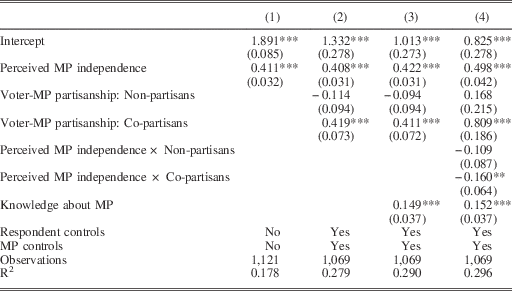
The resulting regression estimates are presented as Model 1 in Table 1 and suggest that voters’ perceptions of the independent-mindedness of their MPs are indeed positively related to their overall evaluations of the MP. The perceived MP independence coefficient is positive and both statistically and substantively significant. A one-unit increase in a voter’s perceived independence of an MP is associated with a 0.4-unit increase in average satisfaction with the MP, as measured on a five-point scale. This is roughly equivalent to one-third of the standard deviation of MP satisfaction in the sample.
Regression Models of Satisfaction with Local MP (Study 1)

Note: coefficient estimates from linear regression models with respondent satisfaction with MP as the dependent variable. Survey data described in main text. Standard errors clustered by respondent constituency. ***p<0.01, **p<0.05, *p<0.1.
Model 2 shows that the point estimate and standard error for the perceived MP independence coefficient remain virtually unchanged if we control for a number of variables that might plausibly influence both perceived independence and voter satisfaction. First, we control for respondent–MP partisan congruence, where the respondent is a ‘co-partisan’ if he or she identifies with the party of the MP, an ‘opposing partisan’ (the baseline category) if he or she identifies with a party other than that of the MP, or ‘non-partisan’ if he or she does not identify with any party.Footnote 50 Secondly, we control for a number of MP characteristics: whether or not the MP held a government payroll post or a corresponding shadow post for the opposition during the 2010 Parliament and prior to the survey fieldwork dates, gender, education, age, tenure in the House of Commons and, finally, majority size. Thirdly, we control for basic respondent characteristics including age group, gender, social grade, interest in politics and region.
Profile Effects
If the profile effects hypothesis explains voter reactions to MP independence, the observed association between perceived MP independence and MP approval may be spurious. It may be that (1) voter familiarity with their MP actually drives satisfaction with the MP, but (2) voters who are more familiar with their MP also tend to think their MP is independent as both are partly driven by the actual independence of the MP. If this were the case, we would expect the observed association between perceived MP independence and MP approval to be attenuated once we control for familiarity with the MP. We test this in Model 3 of Table 1 by adding a measure of respondent knowledge about their local MP. This is calculated based on questions asking respondents about their MP’s sex, political party and name, and ranges from 0 (no questions answered correctly) to 3 (all questions answered correctly).Footnote 51 Comparing Models 2 and 3, the coefficient on perceived MP independence remains virtually unchanged once we control for respondent knowledge of MP. In other words, consistent with the valence hypothesis, the positive relationship between voter perceptions of MP independence and satisfaction with the MP is not simply a proxy for MP profile effects.Footnote 52
This is not to say, however, that there is no evidence that profile effects are an additional mechanism through which MP independence affects constituent evaluations of an MP. After all, the estimated coefficient on MP knowledge in Model 3 is positive and significant, indicating that voters who know more about their MP also tend to be more satisfied with him or her. Moreover, in the Appendix we show that, consistent with the profile effects hypothesis, respondents tend to know more about their MP when he or she rebels more often.
Partisan Conditionality
Our survey data allow us to perform an initial test of the argument that the association between perceived MP independence and satisfaction with the MP will depend on partisanship, whether due to partisan assessments or partisan crowding out.Footnote 53 We do so in Model 4 of Table 1 by adding an interaction between perceived MP independence and the respondent–MP co-partisanship indicators. The significant and positive coefficient on the constituent term for perceived MP independence (0.49) indicates that perceived MP independence is positively associated with MP approval among ‘opposing partisans’ (the baseline voter–MP partisanship group of people who identify with a party other than that of their MP), while the non-significant coefficient on the first interaction term indicates that there is little evidence that the association differs among ‘non-partisans’. The coefficient on the second interaction term is, by contrast, significant and negative, indicating that the association between perceived MP independence and MP approval is attenuated among ‘co-partisans’ who identify with the party of their MP.
The finding that co-partisans tend to be less favourably disposed towards MP independence than opposing partisans or non-partisans provides some evidence in favour of the partisan assessments hypothesis. Nevertheless, co-partisans do still appear to be very favourably disposed to MP independence: the coefficients on the constituent term and the relevant interaction term in Model 4 indicate that a one-unit increase in perceived MP independence is associated with a 0.50 − 0.16=0.34 unit increase in average levels of satisfaction with the MP. The fact that there is a positive and substantial association between perceived MP independence and MP satisfaction even among voters who identify with the party of their MP suggests that, consistent with the valence signalling hypothesis, voters in general view MP independence positively.
Summary
Together, these observational analyses suggest that there is a robust positive relationship between how independent-minded British voters perceive their MP to be and how satisfied they are with their MP. While in Britain legislator independence from a party is often associated with more extreme policy positions, the results are nevertheless similar to those in the US context, where legislator independence tends to be associated with moderation.Footnote 54 That voters appear to have a general preference for independent-minded legislative representatives in two contexts where the policy implications of independent-mindedness tend to be quite different provides support for the argument that legislator independence from parties is viewed primarily as a valence signal, rather than judged primarily on policy grounds.
However, there are limitations to this observational evidence, which leaves open questions about the causal mechanisms driving the observed patterns of association. For example, there may be simultaneity, where respondents substitute their answers to questions about MP independence with their overall evaluation of MP quality.Footnote 55 In the next section, we employ an experimental approach to address these types of concerns.
STUDY 2: EXPERIMENTAL EVIDENCE ON PREFERENCES OVER THE FREQUENCY OF MP DISSENT
To better examine the causal effects of MP independence on voter evaluations, we conducted two conjoint analysis survey experiments. In these experiments, we asked voters to choose between pairs of hypothetical MPs who varied randomly in terms of several attributes, including their level of independence from their party. By comparing the rates at which MPs with differing characteristics win pairwise contests, we can estimate the effects of each attribute on voter preferences.
Our experimental approach has important advantages compared to an observational strategy: because MP dissent is randomly assigned, any effect on voter evaluations cannot be due to simultaneity or the strategic behaviour of MPs, either of which may cause identification problems in an observational analysis. While an observational approach makes it difficult to accurately measure the information to which voters are exposed – and therefore to account for profile effects – a survey experiment affords us control over the information respondents receive about the MPs they evaluate. Furthermore, the conjoint analysis approach we use yields additional advantages compared to other types of survey experiments. Randomizing multiple MP attributes allows us to test whether voters view an MP’s dissent behaviour as a salient factor when asked to simultaneously consider other MP attributes, whether the effect of dissent is conditional on those other MP attributes or whether voters simply view dissent as a proxy for these other attributes. Providing respondents with multidimensional choices and rounded MP profiles also increases the external validity of inferences and, by creating multiple justifications for any given response, can also reduce social desirability bias.Footnote 56
Our first conjoint analysis experiment examines whether the frequency with which an MP dissents from the party effects voter evaluations of that MP, and whether this effect is conditional upon partisans or policy proximity considerations.
Experimental Design
The experiment was fielded on 5–6 December 2012 to a YouGov sample of 1,899 British voters. After a short introduction, respondents were presented with a series of choices (choice tasks) between pairs of hypothetical MPs, each characterized in terms of several attributes whose values varied randomly. The key attribute is the frequency of dissent, defined as how often the MP ‘speaks out or votes against his/her party leadership’, with possible values ‘never’, ‘rarely’, ‘sometimes’ or ‘often’. Note that the phrasing of this attribute captures a broad notion of dissent, defined not just in terms of legislative voting records, but also in terms of an MP’s public statements.Footnote 57
In addition to frequency of dissent, MPs were characterized by a further four attributes:
∙ Party affiliation of the MP, varying between Labour and Conservative.Footnote 58
∙ Constituency effort allocation of the MP, measured as the number of days in a five-day week that the MP typically spends working on local constituency issues. Possible values varied between one/two/three/four days, with the remainder spent reviewing and working on national policies in Parliament.Footnote 59
∙ Tenure in Parliament, varying between three, ten and twenty-one years.
∙ Sex of the MP (male or female).
Several considerations went into selecting these additional attributes. First, based on past research, all MP characteristics (and particularly party affiliation) are potentially salient for voters, allowing respondents to ignore MP dissent when making their decisions.Footnote 60 Secondly, the inclusion of MP party affiliation, combined with separate measurements of respondents’ party identification and their perceived position relative to parties on a left–right scale, allows us to test whether the effects of MP dissent are conditional on partisan or policy proximity considerations. Thirdly, the inclusion of constituency effort allocation allows us account for the possibility that – in the absence of information about this attribute – respondents might prefer MPs who dissent simply because they assume that MPs who are more willing to forgo career advancement at Westminster are more likely to be assiduous constituency servants.
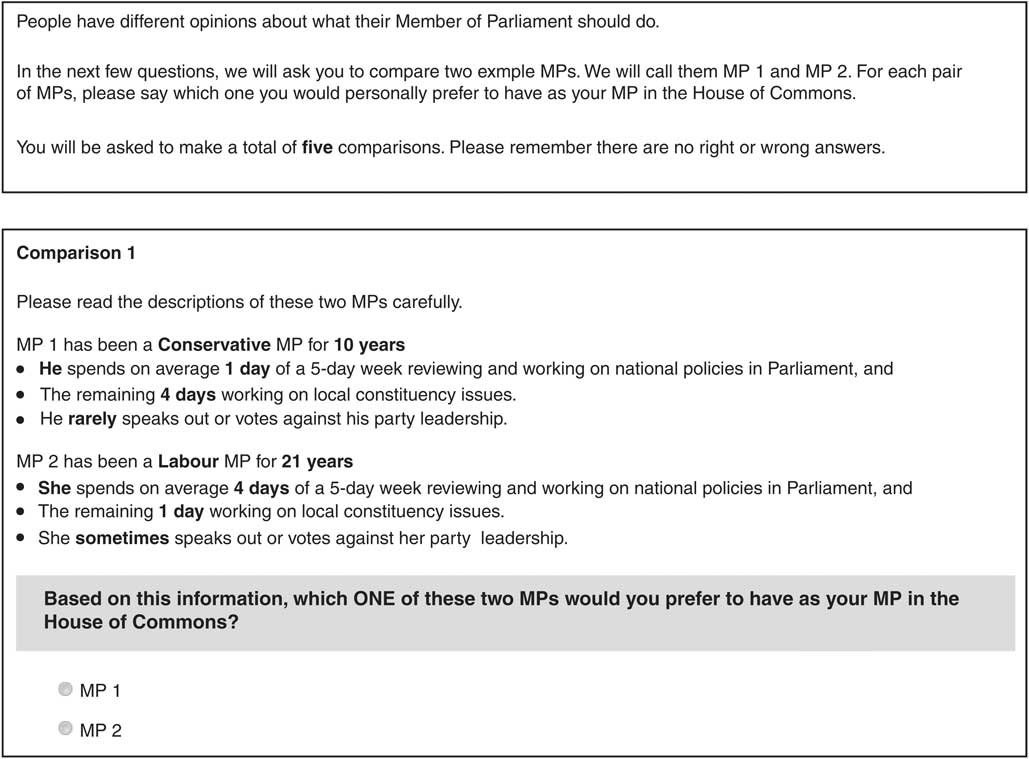
MP attribute values were assigned via completely independent randomization, such that all possible combinations of attribute values were equally likely in expectation.Footnote 61 As illustrated in the example screenshot from the experiment (Figure 1), MP descriptions were presented in the form of bulleted paragraphs, with levels of attributes highlighted in bold.
Example screen shots from conjoint analysis experiment (Study 2) Note: the upper panel shows the introductory screen that respondents saw before beginning the experiment. The lower panel shows an example of a randomly generated comparison as a respondent would have seen it.

Our outcome variable is measured based on the following question, asked after the descriptions of the two MPs: ‘Based on this information, which ONE of these two MPs would you prefer to have as your MP in the House of Commons?’Footnote 62 In each study, respondents completed a total of five choice tasks.
Analysis
We stack the resulting experimental data so that for each respondent we have ten observations, one for each of the two hypothetical MPs in each of the five choice tasks. Thus, we have 1,899×2×5=18,990 observations. Our outcome variable is a binary indicator of whether or not the hypothetical MP in question was chosen by the respondent.
Our quantity of interest is the average marginal component effect (AMCE) of each level of each attribute.Footnote 63 In this particular context, the AMCE is the change in the probability that an MP is preferred when the value of an attribute (that is, component) is changed from one level to another, averaging over all possible values of the MP’s remaining attributes and all possible values of the attributes of the other MP in the choice task. Completely independent randomization of attribute levels means that unbiased AMCE estimates can be obtained using simple difference-in-means analysis. As recommended by Hainmueller, Hopkins and Yamamoto, we estimate these differences in means using OLS regression with dummy variables for each attribute level except the baseline and clustering standard errors by respondent.Footnote 64
Main Results
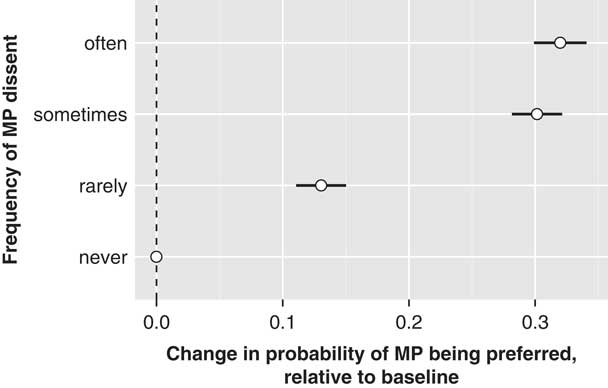
Figure 2 shows the effect of frequency of dissent on the probability that an MP is preferred. If voters perceive legislator independence as a valence signal we would expect them to react positively to an MP who dissents from their party. Figure 2 suggests that this is indeed the case. Voters are on average 13 [11, 15] percentage points more likely to prefer an MP who rarely speaks out or votes against the party to one who never does so (the baseline). Moreover, again compared to an MP who never dissents, voters are 30 [28, 32] and 32 [30, 34] percentage points more likely to prefer MPs who dissent sometimes and often, respectively. To put the magnitude of these effects into perspective, the largest estimated AMCE of any of the other MP attributes included in Study 2 is below 15 points.Footnote 65 Thus there is strong experimental evidence that, consistent with the hypothesis that voters evaluate MP dissent as a valence signal, British voters strongly prefer to have an MP who frequently dissents against his or her party leadership.
Popular preferences over MP frequency of dissent (Study 2a) Note: based on results from Study 2a. Each dot indicates the point estimate of the population AMCE relative to the baseline level of never dissenting. The bars represent the corresponding 95 per cent confidence intervals.

Partisan Conditionality
Both the partisan assessment and partisan crowding out accounts predict that voter responses to MP dissent will depend on their identification with the party of the MP. To test this we coded a measure of the respondent–MP co-partisanship based on the party affiliation of the hypothetical MP and the strength of party identification of the respondent, giving us five categories: ‘strong co-partisan’, ‘weak co-partisan’, ‘non-attached’, ‘weak opposing partisan’ and ‘strong opposing partisan’. Thus, for example, where a respondent strongly identifies with the Labour Party and is presented with a Labour MP, this is coded ‘strong co-partisan’; where the same respondent is presented with a Conservative MP, this is coded ‘strong opposing partisan’.Footnote 66
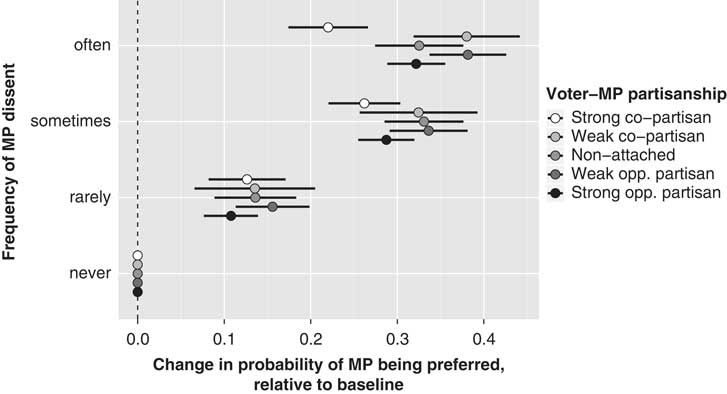
Figure 3 plots the effects of MP frequency of dissent for subsamples according to levels of respondent–MP co-partisanship. Looking first at the effect of an MP rarely dissenting (as opposed to never dissenting), the point estimates for this effect are positive and similar in magnitude across all partisanship subsamples, and the corresponding confidence intervals all overlap. Turning to the effect of an MP who sometimes dissents, the point estimates for this effect are slightly smaller for strong co-partisans and opposing partisans, but even among these groups the estimated effect is positive and large in absolute terms (increasing the probability that an MP is preferred by more than 25 percentage points. Finally, looking at the effect of an MP who often dissents, the point estimates for this effect are clearly smaller in magnitude when the respondent is a strong co-partisan of the MP, but nevertheless is still positive and large in magnitude (at around 20 percentage points).
Responses to frequency of MP dissent do not strongly depend on strength of co-partisanship (Study 2) Note: based on results from Study 2. Observations are grouped according to the strength of respondent–MP co-partisanship. For each subgroup, we estimate the effects of MP frequency of dissent relative to the baseline level of never dissenting. Each dot indicates the point estimate of the effect of a particular level of dissent for a particular level of co-partisanship (identified by dot shadings). The bars represent the corresponding 95 per cent confidence intervals.

Thus Figure 3 suggests that voters react positively to MP dissent regardless of co-partisanship. To be clear, this is not to say that reactions to MP dissent are in no way conditional on respondent–MP co-partisanship: in fact, according to an F-test there are some differences in the average effect of MP frequency of dissent across different levels of respondent–MP co-partisanship (F=3.27, p<0.01). Rather, Figure 3 illustrates that any differences by partisanship – whether due to partisan assessments of dissent or a partisan crowding out effect – are small compared to the overall positive effects of MP dissent. This is again consistent with the argument that MP dissent acts as a signal of valence qualities valued by all voters.
Policy Proximity
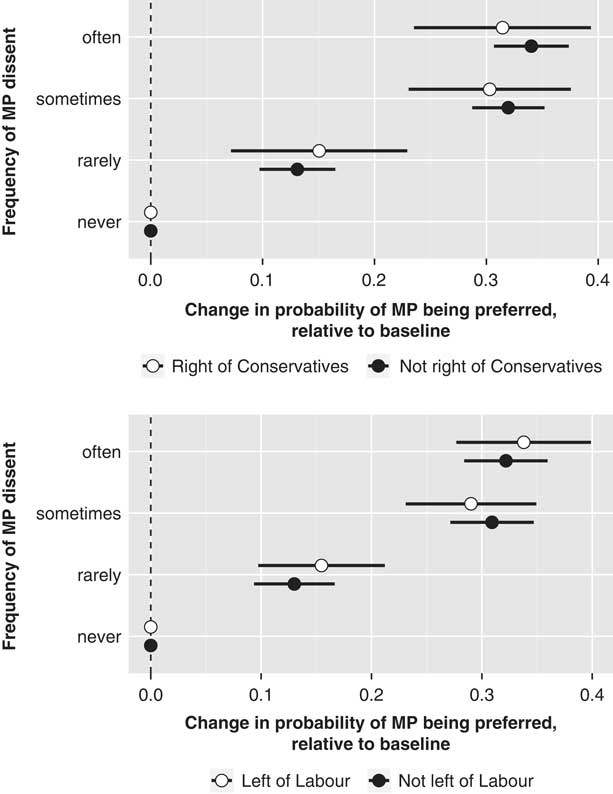
The policy proximity hypothesis predicts that voters react more positively to MP dissent that supports a policy position closer to their own views. Although in our experiment we do not give explicit information about the policy position adopted by MPs when they dissent from the party, we can indirectly examine the explanatory power of the proximity hypothesis if we assume that respondents implicitly believe that dissenting Conservative MPs are to the right of the Conservative Party and dissenting Labour MPs are to the left of the Labour Party. This assumption is not unreasonable given that, in recent history, rebel Conservative MPs have mostly been located towards the right and rebel Labour MPs towards the left of their respective parties.Footnote 67 The policy proximity hypothesis would therefore predict that, compared to other respondents, those positioned to the left of the Labour Party should react more positively to dissent from a Labour MP; likewise, those positioned to the right of the Conservatives should react more positively to dissent from a Conservative MP.
To test whether this is the case, we first divided our observations into two groups according to the party affiliation of the hypothetical MP. For observations where the MP was Conservative, we then further subdivided the sample according to whether the respondent placed themselves to the right of the Conservatives on a left-right scale (measured based on questions asked later in the survey) and estimated the effects of dissent separately for each subgroup. The top panel of Figure 4 plots the results. Whether looking at the effect of a Conservative MP dissenting rarely, sometimes or often, the estimates for respondents to the right of the Conservatives are similar in magnitude and statistically indistinguishable from those for respondents who are not.Footnote 68
Preferences over frequency of MP dissent do not strongly depend on implied policy proximity (Study 2) Note: based on results from Study 2. For the top panel, we take all observations for which an MP was Conservative and compare the effects of dissent for respondents who place themselves to the right of the Conservatives and those who do not. For the bottom panel, we take all observations with a Labour MP and compare the effects of dissent for respondents who place themselves to the left of Labour and those who do not. Each dot indicates the point estimate of dissent effects, relative to the baseline level of not speaking out. The bars represent the corresponding 95 per cent confidence intervals.

The bottom panel of Figure 4 plots the results of a similar exercise for Labour MPs. These observations are subdivided according to whether the respondents placed themselves to the left of Labour on a left–right scale. Again, the estimated effects of each level of MP dissent for respondents to the left of Labour are very similar to those for respondents who are not.Footnote 69
Of course, this is only an indirect test of the proximity argument, and it may be that voters’ reaction to dissent is more noticeably conditional on policy proximity when the policy stance adopted by a dissenting MP is more explicit. Yet the striking stability of the effects of dissent across subgroups in Figure 4 makes us sceptical that policy proximity considerations dominate voter evaluations of displays of MP independence.Footnote 70
Summary
Consistent with valence signalling, the results of this conjoint analysis experiment suggest that there is a strong and general preference among British voters for a local MP who dissents from the party. This preference was not conditioned strongly by voter–MP co-partisanship or policy proximity.Footnote 71
STUDY 3: TYPE OF DISSENT AND MOTIVATION FOR DISSENT
Our second conjoint analysis experiment examines whether voters react more positively to MP dissent when this is likely to entail higher costs, and whether the effects of dissent are conditional upon the motivation for dissent.
Experimental Design and Analysis
This experiment used a similar format to that of Study 2, with respondents choosing between pairs of MPs characterized by randomly varying attributes. However, the nature of these attributes differed in some respects from Study 2. Most importantly, rather than characterizing MPs in terms of the frequency of their dissent from the party, we varied both the motivation for dissent and the type of dissent. The motivation for dissent attribute had two possible levels: respondents were told that ‘when considering policy matters’ an MP mainly thought about their own personal views (a trustee MP) or their constituents’ views (a delegate MP). The type of dissent attribute captured how publicly an MP dissents when these ‘views on policy differ from those of the party leadership’, with three possible levels: ‘nevertheless tends not to speak out’; ‘tends to speak out at internal party meetings, but not publicly’; or ‘tends to speak out at internal party meetings and also publicly’. The three remaining attributes included in the experiment all also appeared in Study 2: MP party affiliation, constituency effort allocation and sex.Footnote 72
This experiment was fielded on 24–25 September 2013 to a YouGov sample of 1,919 British voters. Because each respondent again completed five choice tasks, we have 19,190 observations. As in Study 2, our outcome variable was a binary indicator of whether the hypothetical MP in question was chosen by the respondent.Footnote 73 Once more, we model this outcome variable using OLS.
Effects of Type of Dissent
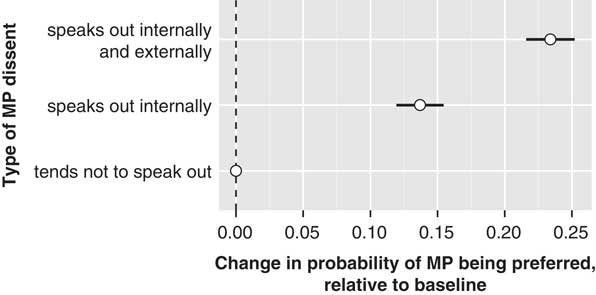
If voters perceive dissent as a valence signal, then public dissent by MPs should be preferred to private dissent, as the former is a more costly signal than the latter. Figure 5 shows AMCE estimates for these different types of dissent. As expected, while voters do clearly prefer an MP who speaks out internally to one who tends not to express dissent at all, there is a much stronger preference for an MP who speaks out both internally and externally. Comparing an MP who tends not to speak out to one who speaks out only internally, voters are on average 14 [12, 15] percentage points more likely to prefer the latter as their local representative. However, an MP who speaks out both internally and externally is 23 [22, 25] percentage points more likely to be preferred by voters than one who tends not to speak out.
Popular preferences over type of MP dissent (Study 3) Note: based on results from Study 3. Each dot indicates the point estimate of the population AMCE relative to the baseline level, ‘tends not to speak out’. The bars represent the corresponding 95 per cent confidence intervals.

Motivation for Dissent
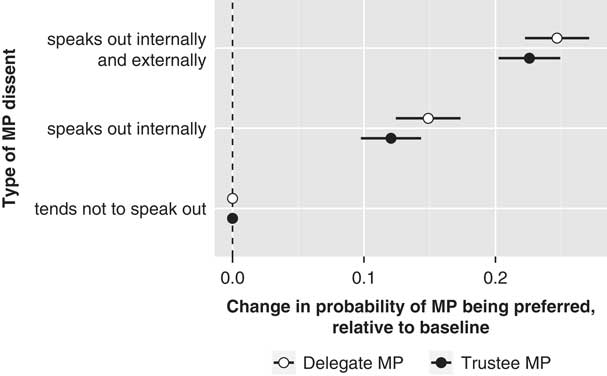
Because we varied not just the dissent behaviour of each MP, but also whether this dissent was motivated by trustee or delegate concerns, the design of Study 3 allows us to test whether voter reactions to dissent are conditional on the trustee–delegate motivation for that dissent. Figure 6 plots the estimated effects of MP dissent according to whether the MP was motivated by trustee concerns (black dots) or delegate concerns (white dots). While the point estimates of the effects of private and public dissent are slightly higher for delegate MPs than for trustee MPs, these differences are small in magnitude. In line with this, an F-test fails to reject the null hypothesis that the effects of MP dissent behaviour are not conditional on trustee/delegate motivation (F=1.58, p=0.21).Footnote 74 There is little evidence that voter preferences for MP dissent are conditional on the trustee–delegate motivation for that dissent, even when voters are given explicit information about this motivation.
Preferences over type of MP dissent do not depend strongly on whether the MP is a trustee or delegate (Study 3) Note: based on results from Study 3. The top panel presents estimates for hypothetical MPs who, ‘when considering policy matters’, mainly thought about their ‘constituents’ views’. The bottom panel presents estimates for MPs who mainly thought about their ‘own personal views’. Each dot indicates the point estimate of effects, relative to the baseline level of not speaking out. The bars represent the corresponding 95 per cent confidence interval.

DISCUSSION AND CONCLUSION
This article has considered how voters react when a legislator speaks out or votes against his or her party. We have argued that one important way in which voters consider such dissent is as a signal of legislator integrity and trustworthiness. In line with this argument, our experimental and observational studies provide clear evidence that British voters have a strong preference for MPs who are willing to act independently from their party by frequently speaking out or voting against the party. Furthermore, we find that voters react more positively to public acts of dissent, which are more costly for an MP and therefore send a stronger valence signal. Crucially, our studies also show that reactions to dissent are not strongly conditional on factors emphasized in some previous literature: the overall positive effect of dissent on MP evaluations persists regardless of voter–MP co-partisanship, policy proximity concerns or the trustee-delegate motivation for the dissent.
Our results also provide strong evidence that the effects of an MP’s dissent behaviour are unlikely to be solely attributable to that MP’s greater public profile. In the observational data, controlling for profile effects did not reduce the effects of perceived MP independence on MP approval. In the experimental data, we could rule out profile effects as all our experimental subjects were equally well informed about the behaviour of the hypothetical MPs.Footnote 75
How similar should voter responses be in other countries? The costs of dissent for individual legislators are similarly high in other parliamentary systems, and parliamentary parties are therefore generally highly cohesive. Hence, disagreeing with the party will be a similarly strong signal in other parliamentary systems. However, the valence signal generated by dissent may be particularly strong when political parties are perceived to have low levels of integrity and trustworthiness, such as in the United States and Britain today; voters in other contexts may react differently.Footnote 76 Voter responses to dissent may also depend on how candidate-centred an electoral system is. British voters may be more likely to pay attention to dissent than voters in even more party-centred contexts, for instance those that have closed-list proportional representation. At the same time, responses to dissent may be stronger and more nuanced in more candidate-centred systems such as the United States or countries with open-list proportional representation. Moreover, the British political system has historically had a strong, single-party executive with a relatively weak parliament. Even though this is less and less the case, British voters may still not be used to taking individual candidate characteristics into account, which may lead such factors to become more important over time. Future research can therefore usefully examine both cross-national and temporal variation in voter reactions to MP dissent.
Overall, we have strong evidence that valence signalling is a key mechanism at work, suggesting that support for legislator independent-mindedness is therefore more general than previously thought. These findings have implications for research on the personal vote. Previous attempts to identify a relationship between MPs’ behaviour in the British Parliament and their subsequent success at the ballot box have based their analysis on rebellion as a source of positional information, and the results of these studies have been decidedly mixed.Footnote 77 An understanding of dissent as a valence signal may be a promising future approach to studying constituent reactions to legislator behaviour. Our findings also imply that legislators may benefit from communicating their general independence as well as – or indeed instead of – the reasons for their dissent.Footnote 78
This finding also has implications for parliamentary politics, highlighting a popular ambivalence towards party discipline even in a traditionally party-centric political system such as Britain. Cohesive political parties are a vital component of democratic representation in parliamentary systems, but this would be at risk if legislators frequently dissented from the party line. Importantly, our findings show that there is general support for such dissent across British voters, so that all legislators have electoral incentives to avoid lock-step obedience to their leadership: if support for dissent were strongly conditional on policy preferences or partisanship, then incentives to engage in such behaviour would be weaker, as it would only improve an MP’s standing among a subset of constituents. From the standpoint of democratic theory, our findings appear somewhat troubling, in that they highlight a challenge for the responsible party government model of democracy.
If voters in general support independent-mindedness, this also presents a challenge to party leaders and party whips.Footnote 79 If individual legislators have an incentive to demonstrate their independence, then this of course makes party management a more challenging task. Weaker party unity can also have electoral costs if the party as a whole appears divided as a result.Footnote 80 However, we also show that voters care about voicing dissent rather than solely about rebelling in parliament. This suggests that party leaders may have an incentive to tolerate public statements of disagreement from their MPs – thus allowing individual MPs to increase their local personal support – while also enforcing tighter discipline on parliamentary votes. This in turn may act as a ‘safety valve’ for the political system more broadly, offering voters some sense that their representatives are not solely beholden to the party line while also maintaining reasonable levels of party cohesion in legislative votes. Future research could further investigate this possibility, along with other mechanisms for how parties can resolve the tension between voter demands for an independent local representative and the broader need for responsible party government.
Supplementary material
To view supplementary material for this article, please visit http://dx.doi.org/10.1017/S0007123416000223
APPENDIX: MP REBELLION AND MP PROFILE
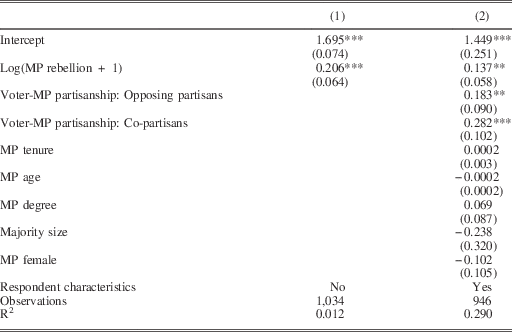
As a further test of the profile effects explanation, we examine whether levels of knowledge about a local MP are positively associated with levels of actual MP rebelliousness. To measure respondent knowledge about their MP, we asked them for their MP’s sex, political party and name. On the basis of their responses to these questions, respondents were given an MP-knowledge score from 0 (no questions answered correctly) to 3 (all questions answered correctly). To measure MP rebelliousness we take the percentage of times an MP voted against the majority of their party and transform this by adding one and taking the natural logarithm of the resulting sum. We exclude respondents whose MPs were in government payroll positions or in corresponding shadow positions for the opposition, as these MPs are highly unlikely to have rebelled against their party.
Table A1 reports the results of two OLS regressions (with standard errors clustered by constituency). In line with the profile effects argument, there is a significant and positive association between actual MP rebelliousness and respondent knowledge regarding their MP. This association is robust to the inclusion of our set of controls for MP and respondent characteristics. However, the substantive magnitude of this association is not particularly strong. For example, in Column 2, the estimated coefficient on actual MP rebellion indicates that moving from being one of the least rebellious MPs (never voting against the party) to being a moderately rebellious MP (voting against the party 5 per cent of the time) is associated with a 0.25 increase in the MP knowledge score. To place this in context, the latter scale has a standard deviation of 1.2 in our survey sample.
Regression Models for Voter Knowledge of Local MP