An important part of Nicki Crick's career was dedicated to understanding aggression in children and adolescents. In her work, she addressed a variety of issues related to understanding child and adolescent aggression. These topics have included the distinction between physical and relational aggression, gender differences in aggression, comorbidity of aggression with internalizing disorders and other clinical outcomes, and the role of social–cognitive processes in aggression (e.g., Crick & Dodge, Reference Crick and Dodge1994).
Crick's work on the social–cognitive processes of aggression was guided by the social information processing (SIP) model, developed in collaboration with Dodge (Crick & Dodge, Reference Crick and Dodge1994; Dodge & Crick, Reference Dodge and Crick1990). This model describes how aggression can be understood as the result of a series of steps. The SIP model assumes that children come to a social situation with certain biologically determined capabilities and a database of memories of past experiences. In the situation, they receive various cues as input. Their behavioral response to the situation then depends on the processing of these cues in several steps. The steps include cue encoding, cue interpretation and representation, selecting a goal, accessing a response, choosing a response, and behavioral enactment (Crick & Dodge, Reference Crick and Dodge1994). Skillful processing at each step will lead to competent behavior, whereas biased or deficient processing will lead to a deviant response to the situation that may include aggression (Dodge & Crick, Reference Dodge and Crick1990).
A large portion of the empirical work inspired by the SIP model has focused on the interpretation or representation stage of the information processing cycle. This work has focused almost exclusively on children's interpretation or representation of others’ intentions (de Castro, Veerman, Koops, Bosch, & Monshouwer, Reference de Castro, Veerman, Koops, Bosch and Monshouwer2002). In a typical study, children are asked to evaluate a series of social situations in which a peer hinders them and are asked why this person did that. Such studies have shown that children who attribute hostile intent to the other are more likely to respond unkindly or aggressively than are children who interpret the other person's intentions as benign or accidental (e.g., Dodge, Pettit, McClaskey, & Brown, Reference Dodge, Pettit, McClaskey and Brown1986). This work has led to a focus on hostile attribution bias, that is, children's tendency to perceive hostile intentions in ambiguous or nonhostile situations, which may then explain their (reactive) aggression to the situation. Dodge and Crick demonstrated the links between aggression and such distorted perceptions. Their SIP model also set the stage for a number of additional studies on the associations between children's aggression and their perceptions and interpretations of social situations. Most of these studies used vignettes of ambiguous situations to assess the potentially biased perceptions of aggressive children. In a meta-analysis, de Castro et al. (Reference de Castro, Veerman, Koops, Bosch and Monshouwer2002) identified 41 studies on the association between children's hostile attribution bias, most often measured with hypothetical vignettes, and aggression, including the original studies by Crick and Dodge. The meta-analysis demonstrated a robust association between hostile attributions and aggression across various samples.
In spite of this impressive work, further questions are remaining. The current study focused on two such questions. The first regards the measurement of social perceptions with hypothetical scenarios, and questions to what degree perceptions assessed with hypothetical vignettes correspond with perceptions about real peers in daily life. This is a measurement issue. The second question is substantive and regards the role of social status. Although the association between perception bias and aggression is clear, it has been more difficult to conceptualize and demonstrate the potential role of peer social status in the interplay between biased perceptions and actual aggressive behavior. Thus, the second question addressed the role of peer status in the association between aggression and social cognition.
Assessing Perceived Hostility and Aggression
Hypothetical vignettes have a long history of use in the social development literature. The use of hypothetical vignettes goes back as long as Shure and Spivack's (Reference Shure and Spivack1979) Preschool Interpersonal Problem Solving test. The assumption behind hypothetical vignettes is that children's responses to such measures tap into more general modes of thinking and responding that they use in actual social situations. However, a lingering question has been to what degree hypothetical vignettes are ideal measures of children social–cognitive tendencies and whether alternative measures might be available (see, e.g., Cillessen & Bellmore, Reference Cillessen, Bellmore, Smith and Hart2010). An alternative to asking children to respond to hypothetical scenarios with hypothetical peers might be to assess their perceptions of their real (classroom) peers. Children who are biased toward interpreting aggression not only may do so in hypothetical scenarios but also may perceive higher overall levels of aggression in their peer group than do children without such biases in the same peer group. Thus, the average level of aggression perceived in peers also may be an indicator of a (perception) bias toward aggression. Therefore, in this study, in addition to children responding to hypothetical scenarios involving hypothetical peers, we also assessed their overall levels of perceived aggression among their real classroom peers. Although this perception is less specific because it concerns the general level of peers' hostile behavior rather than their hostile intentions in an ambiguous situation, it may also be an indicator of a negativity bias. If aggressive children interpret others' behavior as hostile in a hypothetical situation, they may also interpret their peers' actual behavior as hostile and perceive more aggression in the peer group than low or nonaggressive children do.
Thus, the first goal of this study was to examine an alternative indicator of negative perception bias. First, we examined the association between a traditional measure and our new measure of hostile bias. It was hypothesized that children's hostile attributions in response to hypothetical scenarios would be associated with their general tendency to perceive peers as aggressive. Second, we examined the association between children's aggression and their hostile attributions, assessed with a traditional vignette measure. As a replication of previous research a positive association was expected. Third, and of much importance, we examined the association between children's aggression and their general tendency to perceive peers as aggressive. Again, a positive association was expected. Thus, we expected children's aggression to be related to both the traditional indicator (hypothetical vignettes) and the newly introduced indicator (perceiving higher levels of aggression in peers) of negative bias.
Role of Social Status
In addition to hostile attributions, another important predictor of children's aggression is their status in the peer group. Peer relationships researchers have consistently shown robust associations of peer group status with social behavior. Numerous studies have documented the associations of peer acceptance with prosocial behavior and positive school adjustment, and of peer rejection with aggression and social withdrawal (for a review, see Newcomb, Bukowski, & Pattee, Reference Newcomb, Bukowski and Pattee1993). These studies have shown clear associations of low status in the peer group or peer rejection with aggression.
Recently, research on the association between social status and aggression has undergone somewhat of a change. As it turns out, under some conditions high status can also be associated with aggression. When status is operationalized as popularity, positive associations with aggression are frequently found. Thus, it seems that aggression occurs among both low-status and high-status youths. A consideration that may reconcile these findings is that the type of aggression may differ between both groups (i.e., while the aggression of low-status children may be primarily reactive, the aggression of high-status children may be more proactive or instrumental in nature). High status has been associated with proactive aggression and low status with reactive aggression (Prinstein & Cillessen, Reference Prinstein and Cillessen2003). This might suggest that high-status children use aggression for instrumental reasons.
However, the idea of an association between high peer group status in children and aggression has raised critical questions. Crick (Reference Crick2007) strongly believed that all forms of aggression are signs of psychopathology and maladjustment, and that associations of aggression with indicators of positive peer status do not make sense. This argument contrasts with fairly robust empirical associations between aggression and popularity, especially in adolescent samples. There are also evolutionary models arguing that aggression can be adaptive and thus may be associated with high status. Using an evolutionary perspective Hawley (Reference Hawley1999) argued that high-status children combine aggressive and prosocial strategies to control resources in their peer group. The two sides of this argument may not be mutually exclusive, but an integrated solution in one framework is not yet available.
That hostile attributions and peer status are both associated with aggression leads to interesting hypotheses about possible links between hostile attributions and peer status. Children with a low position in the dominance hierarchy of the classroom are more likely than others to be victims of peer aggression, because victimization is associated with low status (Prinstein & Cillessen, Reference Prinstein and Cillessen2003). Because children with low status are likely targets of aggression, they may subsequently develop negative expectations about the intentions and behaviors of their peers. As a result, children low in status may be aggressive because they feel provoked or see others as likely to hurt them. Dodge et al. (Reference Dodge, Lansford, Burks, Bates, Pettit and Fontaine2003) found evidence for such a process; in their study, SIP partially mediated the effect of elementary school children's early rejection on later aggression.
In contrast, children with a high position in the classroom dominance hierarchy are more likely to be aggressors. Numerous studies have shown that popularity is associated with the use of aggression (Andreou, Reference Andreou2006; Cillessen & Borch, Reference Cillessen and Borch2006; Cillessen & Mayeux, Reference Cillessen and Mayeux2004, Lease, Kennedy, & Axelrod, Reference Lease, Kennedy and Axelrod2002; Prinstein & Cillessen, Reference Prinstein and Cillessen2003; Rose, Swenson, & Waller, Reference Rose, Swenson and Waller2004), bullies are more popular than their victims (Rodkin & Berger, Reference Rodkin and Berger2008), and popularity is positively associated with bullying (de Bruyn, Cillessen, & Wissink, Reference de Bruyn, Cillessen and Wissink2010). For high-status children, victimization is less probable. Because they may not expect others to dare to provoke them or may not have experienced much aggression targeted against them, they probably expect low hostility in others.
On this basis, one might expect clear associations between peer status and hostile attributions. A logical next step in research on rejection and aggression was to expect that rejection would also be associated with maladaptive or biased social perceptions. Dodge et al. (Reference Dodge, Lansford, Burks, Bates, Pettit and Fontaine2003) found that peer rejection was associated with hostile attributions. In their study, peer rejection predicted increased hostile attributional biases for instrumental peer provocations, which in turn resulted in greater levels of physical aggression. Conversely, better accepted children should not have such perceptions. Thus, our next question addressed the association of peer status with hostile attributions: we expected low-status unpopular children to be more biased toward perceiving aggression than high-status popular children.
Peer social status may play an additional role in SIP and aggression. Peer group status may not only predict children's level of hostile attributions but also moderate the association between hostile attributions and aggression. As indicated, popularity has been shown to be associated with proactive aggression, whereas low status has been shown to be associated with reactive aggression (Prinstein & Cillessen, Reference Prinstein and Cillessen2003). Children low in popularity may be aggressive because they feel provoked or see others as likely to hurt them, and thus they rely more on their (hostile) interpretations of situations to spontaneously decide to use aggression or not. For these unpopular children who are likely to aggress because of reactive motives, negative perceptions of events are thus likely to lead to aggressive behavior.
In contrast, for highly popular children, reactive motives are less likely to guide their aggressive behavior. They may be aggressive because it can help them gain positive outcomes such as improving or maintaining their position in the peer group, and in this process negative interpretations of others' actions do not necessarily play a role. Based on such different motives for aggressive behavior associated with low and high popularity, a negative perception bias may be more strongly related to aggression in unpopular children than in popular children.
Thus, the second goal of this study was to examine a possible dual role of peer status in children's hostile attributions and aggression. Status was expected to have a main effect on hostile attributions and also moderate the association between hostile attributions and aggression. First, based on their concurrent peer experiences, low-status unpopular children were expected to have more hostile expectations than did high-status popular children. Second, status was expected to moderate the effect of hostile bias on aggression in such a way that unpopular status exacerbated the effect of hostile bias on children's aggression.
Types of Aggression and Gender
In previous studies on hostile attributions and aggression, researchers have distinguished different types of aggression. Crick and Dodge (Reference Crick and Dodge1996) compared the hostile biases associated with proactive versus reactive aggression. They found that reactive-aggressive children, but not proactive-aggressive children, demonstrated hostile biases in their attributions of peers' intentions in provocation situations. Crick, Grotpeter, and Bigbee (Reference Crick, Grotpeter and Bigbee2002) also included the type of aggressive provocation in the design of their study. They found that relationally aggressive children exhibited a stronger hostile bias for relational provocation than did nonaggressive children. These findings suggest that the type of aggression should be considered in further research on children's hostile attributions and perceived peer aggression. Therefore, this study included separate measures of children's physical aggression, relational aggression, and bullying as three dominant types of peer aggression.
Gender was also taken into account in this study. In previous research, the link between hostile attribution bias and aggressive behavior was stronger in male-only samples than in mixed-gender samples (de Castro et al., Reference de Castro, Veerman, Koops, Bosch and Monshouwer2002). Thus, we expected stronger associations between aggression and hostile biases (both measures) among boys than among girls.
Further, boys are more physically aggressive than girls (Card, Stucky, Sawalani, & Little, Reference Card, Stucky, Sawalani and Little2008), and for girls relational aggression is more likely than physical aggression (Crick & Grotpeter, Reference Crick and Grotpeter1995). This has led researchers to suggest that physical aggression is a more “male” form of aggression, whereas relational aggression is a more “female” type of aggression. Thus, we also examined whether the association between aggression and hostile attributions (vignette based and perceived aggression in peers) is the strongest for gender-normative aggression (i.e., physical aggression for boys, relational aggression for girls; Crick & Grotpeter, Reference Crick and Grotpeter1995; Underwood, Reference Underwood2003).
Current Study
This study had two goals. The first goal was to present an alternative measure of hostile attributions and examine its association with children's aggression. The second goal was to examine a possible dual role of social status in hostile attribution bias and aggression. It examined whether peer status, operationalized as popularity, was related to negative bias. It also examined whether popularity moderated the association between negative bias and aggression. A stronger link between hostile bias and aggression was expected in low-status unpopular children than in high-status popular children. The roles of gender and type of aggression were also examined. In order to address these questions, data were collected in a large sample of children at the final 2 years of elementary school, a time and age group when peer relationships and social status are particularly important.
Method
Participants and procedure
A total of 387 children from 16 fifth- and sixth-grade classrooms of six elementary schools in The Netherlands were recruited. Parents received a letter describing the study and explaining that they could indicate if they did not want their child to participate, using a passive consent procedure requested by the schools. Children could refrain from participation beforehand or stop at any time during the study. Of the 387 children who were recruited, 14 did not receive parental permission, 7 were absent during data collection, and no children objected to participation themselves or stopped during the study. This yielded a final sample of 366 children (49% girls; M age = 11.07 years, SD = 0.85 year) and a 95% participation rate. The sample was predominantly Caucasian; for 88% of the children, both parents were born in The Netherlands. The participating children in each classroom completed the measures individually and simultaneously. Two research assistants and the teacher were present in the classroom during data collection and were available to answer questions.
Measures
Hostile attribution bias
Participants were presented with eight vignettes, based on the vignettes by Fitzgerald and Asher (Reference Fitzgerald and Asher1987). Each vignette described a scenario in which a target child was provoked by another child. Participating children were asked to imagine that they were the target child (protagonist) in each scenario. The intent of the provocateur was ambiguous in each scenario. An example vignette was as follows: a peer's basketball rolls under the participant's feet and causes him/her to fall during a race. Participants had to choose for each scenario whether they thought the intentions of the provocateur were hostile (“The peer intended to be mean”), coded as 1, or nonhostile (“The peer did not intend to be mean”), coded as 0. Across the eight vignettes, the total number of times a child thought the provocateur intended to be mean was counted.
Peer ratings
Participants rated each classmate on four rating scales in a round-robin fashion (excluding nonparticipating children). The four rating scales addressed physical aggression (“_____ hits or kicks others”), relational aggression (“_____ is mean to others”), bullying (“_____ bullies others”), and popularity (“How popular is _____?”). For the three behavior ratings, children rated the degree to which each item was true for each classmate on a 7-point scale (1 = not true at all, 7 very true). Popularity was also rated on a 7-point scale with 1 indicating not popular at all and 7 indicating very popular.
Aggression and popularity
The average rating received from all classmates was computed for each child for each question and indicated each participant's own level of physical aggression, relational aggression, bullying, and popularity.
Perceived peer aggression
The average rating given to all classmates was computed for each child for each question and indicated each participant's perceived levels of physical aggression, relational aggression, and bullying in his or her classmates.
Results
Preliminary analyses
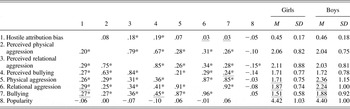
Mean gender differences in the study variables were examined first. Table 1 includes the means and standard deviations of all variables by gender and presents the results of analyses of variance comparing them. As can be seen, boys scored significantly higher than girls on aggression ratings received for each aggression type. According to the children in this study, boys were more physically and relationally aggressive, and engaged in more bullying than girls. There were no other mean gender differences.
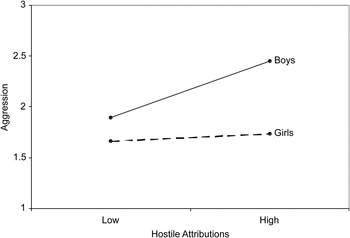
Gender moderates the association between hostile attributions and aggression.

Descriptive statistics and correlations for popularity, aggression, perceived aggression, and hostile attribution bias by gender

Note: Girls, n = 179; boys, n = 186. Correlations for girls are above the diagonal; correlations for boys are below the diagonal. Correlations and means that are underlined differ significantly between girls and boys. Correlations were compared with a two-sided Fisher Z test. Means were compared with a one-way analysis of variance.
*p < .05.
Hostile attribution bias and perceived peer aggression
Goal 1 of this study was to examine the associations between two indicators of negative bias, hostile attributions and perceived aggression in peers, and of both with children's own aggression. To address this goal, three sets of correlations were examined. They are presented separately for boys and girls in Table 1.
First, we examined the associations of children's hostile attributions, assessed with hypothetical scenarios, and the overall levels of physical aggression, relational aggression, and bullying they perceived in their peers. For girls, hostile attributions correlated with perceived levels of relational aggression and bullying. For boys, hostile attributions correlated with perceived levels of all three types of aggression. Correlations were significant but small in size. The pattern of correlations suggested somewhat stronger associations for boys than for girls, but the correlations did not differ significantly by gender.
Second, we examined the associations of children's own aggression with their hostile attributions. For boys, but not for girls, physical aggression, relational aggression, and bullying significantly and positively correlated with their hostile attributions.
Third, we examined the associations of children's own aggression (three types) with their perceived levels of aggression in their classroom peers (three types). All nine correlations were similar in size and significant for boys (range = .25–.45) and for girls (range = .21–.34). The correlation between children's own bullying and their perceived bullying in others was significantly stronger for boys (.45) than for girls (.24). The eight other associations did not differ in size by gender.
Table 1 included three additional sets of correlations not directly related to Study Goal 1. First, children's perceptions of aggression were highly correlated across the three aggression types for boys as well as for girls (range = .63–.85). Second, children's own levels of aggression also were highly correlated (and even more strongly) across the three aggression types for both genders (range = .85–.96). Third, popularity did not correlate with any other study variable for boys or for girls, with one exception. For girls, popularity correlated significantly and negatively with perceived relational aggression.
Popularity, negative bias, and aggression
Goal 2 of this study was to examine the dual role of popularity as a (negative) correlate of negative bias and as a moderator of the association between negative bias and aggression. To address this goal, two sets of analyses were conducted.
First, we examined the correlations of popularity with the two indicators of negative bias. As already indicated above (Table 1), the correlations of popularity with hostile attributions and perceived aggression were not significant, with one exception. For girls, higher levels of popularity were associated with lower levels of perceived relational aggression in peers. In order to fully exhaust all possibilities, we also examined the same correlations in the total sample (boys and girls combined). In the entire sample, significant but small negative correlations were found of popularity with perceptions of relational aggression (r = –.11, p = .04) and perceptions of bullying (r = –.13, p = .02).
Second, to examine popularity as a moderator of the connection between bias and aggression, hierarchical regression analysis was conducted. Because correlations were high across the three types of aggression (Table 1), the three measures of children's aggression were averaged to one score (α = 0.96) and the three measures of children's perceived peer aggression were averaged to one score (α = 0.90). The hierarchical regressions were then run using these composite scores. The regressions were also run on the separate measures, with very similar results. Therefore, the results for the composite scores are reported.
Two hierarchical regressions were run predicting children's aggression from gender, popularity, and negativity bias, one with hostile attributions as the indicator of negativity bias and one with perceived aggression as the indicator of negativity bias. Gender was dummy coded (girls = 1, boys = 0). Popularity and negativity bias were centered prior to analysis. Step 1 of each regression included the main effects of gender, popularity, and negativity bias; Step 2 included the two-way interactions; and Step 3 included the three-way interaction.
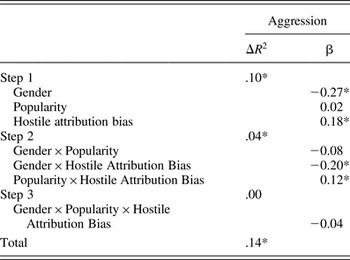
Table 2 shows the results for the analysis including hostile attribution bias. The overall model was significant, explaining 14% of children's aggression. The significant effect of gender in Step 1 indicated that girls scored lower on composite aggression than did boys. Hostile attribution bias significantly and positively predicted children's aggression. Step 2 yielded a significant interaction between gender and hostile attribution bias. The interaction is plotted in Figure 1. As can be seen, the effect of hostile attribution bias on aggression was stronger for boys than for girls.
Regression results for the prediction of aggression from hostile attribution bias, popularity, and gender

Note: N = 366.
*p < .05.
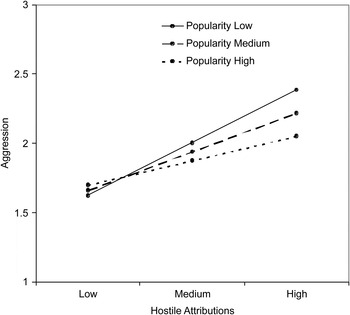
Step 2 also yielded a significant interaction between popularity and hostile attribution bias. To understand this interaction, it was plotted according to Aiken and West (Reference Aiken and West1991). As can be seen in Figure 2, and as predicted, the effect of hostile attribution bias on aggression was stronger at lower levels of popularity than at higher levels of popularity.
Popularity moderates the association between hostile attributions and aggression.

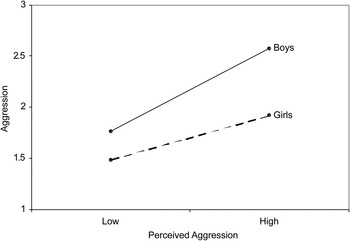
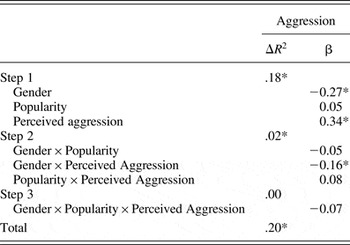
Table 3 shows the results for the analysis including perceived peer aggression. The overall model was significant, explaining 20% of children's aggression. The significant effect of gender in Step 1 again indicated that girls were less aggressive than boys. Perceived peer aggression significantly and positively predicted children's aggression. Step 2 yielded a significant interaction between gender and perceived peer aggression. The interaction is plotted in Figure 3. As before, perceived peer aggression was more strongly associated with children's own aggression for boys than for girls.
Gender moderates the association between perceived aggression and aggression.

Regression results for the prediction of aggression from perceived aggression, popularity, and gender

Note: N = 366.
*p < .05.
Discussion
After a period of intensive research in the 1980s on peer social status and its associations with social behavior (see Coie, Dodge, & Kupersmidt, Reference Coie, Dodge, Kupersmidt, Asher and Coie1990), researchers became interested in examining the associations of peer status with social–cognitive processes. As it turns out, associations between social status and social cognitions were more difficult to demonstrate than were associations between social status and social behaviors. In general, social status explained much more variance in children's social behaviors than in their social cognitions (Coie, Reference Coie, S. R. and Coie1990). The weaker associations of measures of social cognition with social status probably constrained researchers' enthusiasm for this association, and few studies on the associations between social status and social cognitive variables have emerged. We assume that there may also be a “file drawer” full of studies that include nonsignificant associations between measures of peer social status and social cognitive variables. The current study also did not demonstrate strong associations between popularity (as a main effect) and measures of a negativity bias.
Nevertheless, the area of children's peer relationships research in which work on children's social cognitions was highly successful was the study of aggression. When aggression rather than peer status was chosen as the focus variable, consistent associations with social–cognitive variables were shown. These effect sizes were also not exceptionally high, but they were significant and consistent, and yielded a clear picture when examined across multiple studies as was done in de Castro et al.'s (Reference de Castro, Veerman, Koops, Bosch and Monshouwer2002) meta-analysis.
Crick played an important role in this work on aggression and social cognition, in part owing to her successful collaboration with Dodge (Crick & Dodge, Reference Crick and Dodge1994, Reference Crick and Dodge1996; Dodge & Crick, Reference Dodge and Crick1990) and later in other work of her own (e.g., Crick, Reference Crick1995). The research presented in this study builds on that work and attempts to show that in understanding the associations, the role of SIP in children's peer relations continues to be an important endeavor, and that the search for answers to the research questions raised by Crick and her colleagues is still a highly valuable undertaking.
Hostile attribution bias and perceived peer aggression
The first goal of this study was to examine the validity of a new indicator of aggressive children's negative social expectations. Toward this end, we examined children's perceptions of their classroom peers as physically aggressive, relationally aggressive, and involved in bullying. We found that such perceptions are associated with children's hostile attributions, as assessed with a traditional hypothetical vignette measure. Although both indicators of negative bias (hostile attributions and perceptions of aggression) are not interchangeable, our findings support the idea that hostile interpretations of intent in hypothetical situations and more general negative interpretations of peers' behavior both represent biased information processing.
Children's perceptions of their peers' everyday behavior within a salient social group such as the classroom are indicators of negative bias with high ecological validity. Aggressive children not only interpret the intentions of hypothetical others as more hostile but also perceive more aggression in the actual behavior of their classmates. That the negative interpretation bias of aggressive children also actually affects their general view of their peers is important when trying to understand and intervene in aggression problems.
In this study, ratings given and received for physical aggression, relational aggression, and bullying were highly correlated. Each type of children's aggression predicted biases in the perception of other types of aggression. Apparently, at least in this age group and sample, children did not greatly distinguish different types of aggression when rating peers' aggressiveness. They perceived others as more or less aggressive and rated them accordingly on all indicators of aggression indiscriminately.
The association between children's aggression and hostile attribution bias was consistent with the meta-analysis by de Castro et al. (Reference de Castro, Veerman, Koops, Bosch and Monshouwer2002). Consistent with this meta-analysis as well, the association was stronger for boys than for girls for both indicators of negative bias. For attributions of hostile intent, the association with aggression was strong for boys, but nonexistent for girls. For perceptions of aggression, the association with aggression seemed present for both boys and girls, although stronger in boys than in girls. It is interesting that the associations between measures of attribution bias and aggression have been stronger among males in general. One possible explanation is that there is generally more variance in both phenomena among males than amond females, which makes it easier to find associations among variables. In the current study, however, differences in variability of aggression and negativity bias measures were not large. Another possible explanation is that hostile attributions are more likely to be related to reactive aggression, which tends to be more common among boys as well. However, we did not measure reactive aggression in the current study. Reactive aggression might explain the finding that the association between negative bias and aggression is stronger for boys than for girls, and for unpopular children than for popular children. Future research could examine whether the reactive use of aggression may mediate the documented moderation effects, thus examining mediated moderation.
Thus, the gender difference in the hostile attributions-aggression association remains an interesting puzzle. Especially noteworthy also is the relative absence of such an association for girls. Based on a model of relational aggression (e.g., Crick & Grotpeter, Reference Crick and Grotpeter1995), one might expect relationally aggressive girls to be especially vigilant and quick to make hostile judgments. Further research on this issue is warranted.
Moreover, children's own aggression correlated very clearly with their perceptions of aggression in others. These associations were also stronger than those of aggression with the hostile attribution measure. It is possible that the association was somewhat inflated because of shared method variance: that both measures relied on a rating-scale format, even though the informants were different (self vs. peers). Further, there is some overlap in the measures, because child A's rating of child B contributes to both B's aggression score and A's perceived aggression score. Nevertheless, the overlap regards only one data point, because the average scores given and received are determined by all classroom peers together.
The associations between aggression and perceived aggression in others were about equally strong across types of aggression and across gender, with one exception. The association between bullying and perceived bullying in others was about twice as strong for boys as it was for girls. An explanation for this finding may come from the occurrence of bully-victims (i.e., children who are bullies but who are also at the same time the targets of bullying aggression from others). Among bully-victims, boys are overrepresented (Veenstra et al., Reference Veenstra, Lindenberg, Oldehinkel, de Winter, Verhulst and Ormel2005). That boys are more likely to be bullies and victims simultaneously than are girls may explain the higher association between bullying and perceptions of bullying in others among boys.
Popularity, negative bias, and aggression
Popularity was related to perceiving less relational aggression and bullying in peers, but it was unrelated to perceptions of peers’ physical aggression and attributions of hostile intent in hypothetical situations. The association between social status and perception of aggression thus differed for the type of aggression perceived. Popular children are the main actors when it comes to relational aggression and bullying (Cillessen & Mayeux, Reference Cillessen and Mayeux2004; de Bruyn et al., Reference de Bruyn, Cillessen and Wissink2010). Unpopular children will probably notice and report this behavior in their popular peers. The popular children themselves, however, might not see themselves and their friends as “mean” or “bullying” (we were just kidding, only making a little fun of him/her) and therefore report low levels of this behavior in the peer group. For physical aggression, it is harder to deny one's own and one's friends’ actions, because they are more openly displayed and leave less room for ambiguity in interpretation.
Of importance and as hypothesized, popularity moderated the association between hostile attribution bias in hypothetical vignettes and children's aggression. Having a hostile bias was more strongly related to their own aggression for unpopular children than for popular children. In children with a low status in the peer group, the association between hostile attributions and aggression is definitely stronger. Low-status children are more likely to use aggression because of reactive motives, which may explain why for these children hostile attributions more strongly predict subsequent aggression. Consistent with our expectations, the highest levels of aggression was found for children who are low in status and have high levels of hostile expectations. For high-status children, hostile bias hardly predicted aggression. Their hostile bias may not lead to subsequent aggression because they are better able to control aggressive impulses or because they may make a cost–benefit analysis of responding with aggression and only use it when they think it will lead to beneficial outcomes.
Limitations and directions for further research
This study had some limitations. One is that our measure of hostile attributions was relatively short. Our measure was derived from one existing hypothetical vignette measure, but others exist as well. There is room for improvement of our measure. In addition, given recent research on implicit processes among children and adolescents (e.g., Lansu, Cillessen, & Bukowski, Reference Lansu, Cillessen and Bukowski2013; Lansu, Cillessen, & Karremans, Reference Lansu, Cillessen and Karremans2012), it would be worthwhile to consider developing an implicit measure of children's hostile attributions in peer relationships.
As indicated above, our measure of perceived aggression in others also leaves room for improvement. One course of action would be to remove the overlap with children's ratings received by excluding the common data point. Although this overlap is small, it nevertheless makes the measures not entirely orthogonal, which is not ideal. A strength of this measure is that it involves real peers, and this makes this measure more ecologically valid than a judgment of hypothetical peers in a hypothetical scenario. Thus, further ways should be considered to measure children's negativity biases in unobtrusive ways yet involving real (classroom) peers.
This study was limited to children from one (early adolescent) age group in one specific cultural context. The sample was European, but relatively nondiverse. Obviously, extensions of this research to other age groups, other contexts, and more diverse samples are important endeavors for future studies.
It was remarkable that correlations between popularity and both indicators of negativity bias were close to zero. This means that there is much heterogeneity in children's perceptions at both the low end and the high end of a continuum of social status (popularity). Apparently, popular and unpopular children are highly variable in their hostile biases and aggressive expectations, with high and low scores occurring within both groups. In any event, it is clear that there is no simple linear association between status and hostile attributions. One interpretation is that the determinants of hostile attributions or attributions of aggression in peers are not so clearly associated with status. The reformulated SIP model (Crick & Dodge, Reference Crick and Dodge1994) emphasized that interpretations of social situations are partly biologically constrained and partly determined by memories of past social interactions (including family histories). Thus, the factors that determine children's attributions toward aggression may be relatively independent of the factors that determine their status in their peer groups. We therefore suggest two courses of action for further research. First, a better understanding of the biological constraints and previous histories of hostile attributions that are separate from the developmental histories of peer status would be useful. Second, understanding the unique consequences of each combination of low versus high status with low versus high levels of negativity bias for concurrent and later adjustment is important. The current study made a contribution to this effort by indicating that low-status children with high levels of attribution bias are particularly likely to be aggressive. However, the consequence of other combinations for the development of internalizing or externalizing behavior problems, for example, is unknown.
Conclusion
This study was the first to examine hostile biases in association with popularity. Surprisingly little is known about the social perceptions, beliefs, and goals of popular children and adolescents. Whereas most research has focused on the SIP of aggressors or victims (de Castro et al., Reference de Castro, Veerman, Koops, Bosch and Monshouwer2002), the role of popularity has not been examined. Future studies should further examine whether and when popularity uniquely predicts SIP beyond children's aggression or victimization. The results from this study are promising in that they show that peer status plays an important role in the well-established association between children's aggression and their hostile attribution biases.