Introduction
Antimicrobial resistance (AMR) is one of the most significant global public health challenges of the 21st century. By 2050, AMR-related deaths are projected to rise to 1.9 million, with associated mortality reaching up to 82.2 million. Reference Naghavi, Vollset and Ikuta1 In response to this alarming trend, policy interventions have become a critical strategy for AMR containment. In the context of a rapidly aging global population and the promotion of Universal Health Coverage, ensuring the rational use of antibiotics in PHIs is critical for AMR prevention and control. 2 Many countries, including the United States, 3 Canada, 4 and Australia, Reference James, McIntosh and Luu5 have implemented antibiotic stewardship policies, yet these policies vary across nations, and research specifically focusing on PHIs remains limited.
As one of the largest consumers of antibiotics globally, China has introduced multiple policies aimed at optimizing antibiotic use and curbing AMR. Reference Tang, Chen and Liu6 The National Action Plan to Contain Antimicrobial Resistance (2016–2020) demonstrated significant outcomes, evidenced by a reduction in antibiotic utilization rates—from 59.4% to 36.4% for inpatients and 16.2% to 7.9% for outpatients. 7 An analysis revealing that upgrading antibiotics to the “highly restricted” tier reduced clinical usage by 100.8% within two years. Reference Du, Wushouer and Huang8 However, emerging challenges—including persistent resistance, regional disparities in stewardship capacity, and the strategic imperatives of the Healthy China Initiative—highlighted the need for an updated and more comprehensive national plan. 9 To address these issues, the Chinese government launched the subsequent National Action Plan (2022–2025) in 2022, emphasizing integrated surveillance and equitable resource allocation. Although previous studies have examined the impact of Chinese policies on antibiotic use, practical evidence from Central China remains limited, and systematic evaluations of antibiotic use patterns in PHIs are still lacking.
Central China, comprising six provinces—Shanxi, Anhui, Jiangxi, Henan, Hubei, and Hunan, serves as a crucial link between the country’s eastern and western regions as well as its northern and southern areas. 10 The six provinces in this region contribute approximately one-fifth of China’s total economic output, making it geographically, economically, and demographically representative for research purposes. Reference Mu11 In recent years, the region has actively optimized healthcare resource distribution by strengthening primary care capacity and promoting the equalization of basic public health services. Reference Zhang, Wang and Jiang12,Reference Huang13 Therefore, this study aims to conduct a comprehensive evaluation of antibiotic utilization patterns across different types of PHIs in Central China, incorporating longitudinal data analysis to assess the impact of national AMR policies.
Methods
Study design and data collections
We employed a quasi-experimental interrupted time-series (ITS) design to assess the impact of the National Action Plan to Contain Antimicrobial Resistance (2022–2025), on antibiotic use trends in PHIs in Central China. The antibiotic utilization data were sourced from procurement records obtained through China’s National Healthcare Security Administration procurement platform and public resource centers, which mandate all primary healthcare institutions (PHIs) to submit monthly procurement reports including medication names, dosage forms, strengths, procurement quantities, and dates. The data set spans from January 2021 to December 2023 and encompasses both outpatient and inpatient departments.
The study included a total of 1510 PHIs sampled from regions stratified by economic development levels. These levels were categorized as highly developed, moderately developed, and underdeveloped, based on regional GDP per capita as reported in the official statistical yearbooks of China (See Supplementary Materials). Among the sampled institutions, 119 were located in urban areas (including community health service center/ station, subdistrict health center, primary hospital and health station), while 1391 were located in rural areas (comprising township health centers and health station). (Supplementary Table S1). Urban PHIs typically provide both outpatient consultations and limited inpatient services for mild to moderate infections. Rural PHIs primarily focus on outpatient care, with some capable of offering short-term inpatient treatment for uncomplicated cases. These PHIs mainly treat common infections such as respiratory and urinary tract infections.
Policy intervention
This policy, officially launched in October 2022, 9 led by the National Health Commission of China, targeted AMR through several key measures aimed at healthcare institutions, including: (1) Prescription Restrictions: High-priority antibiotics, such as carbapenems and fluoroquinolones, are designated for restricted use. Prescriptions require approval from infectious disease specialists to ensure rational usage. (2) Enhanced Surveillance: Primary health institutions must submit monthly antimicrobial usage and resistance data through a centralized reporting system, allowing real-time monitoring and trend analysis. (3) Professional Training: All healthcare workers shall receive routine training on antimicrobial stewardship, while physicians and pharmacists must undergo mandatory periodic assessments under the Administrative Measures for Clinical Use of Antimicrobial Agents. Qualification is required to obtain or retain antimicrobial prescribing/dispensing privileges. (4) Regulatory Oversight: Health authorities implement a four-tier oversight framework covering (a) clinical prescription compliance, (b) veterinary antimicrobial reduction, (c) pharmaceutical sales control, and (d) reimbursement policy leverage. Audits enforce adherence to national standards, with non-compliant entities subject to penalties including accreditation suspension. In the context of primary care, the action plan emphasizes tier-appropriate antibiotic lists, simplified surveillance interfaces compatible with PHI infrastructure, and tailored training modules designed for non-specialist general practitioners. These adaptations aim to ensure feasibility and effectiveness of stewardship interventions at the grassroots level.
Consultation with the Central China Primary Medication Coordination Expert Group validated a 2-month preparatory period for policy operationalization at the grassroots level (including staff training and monitoring system deployment), establishing December 2022 as the intervention point.
Outcome measures
Antibiotics were defined as medications classified under the Anatomical Therapeutic Chemical (ATC) class J01, including systemic antibiotics administered orally or parenterally. 14 J01 antibiotics were further categorized into 10 ATC-3 groups: tetracyclines (J01A), amphenicols (J01B), beta-lactam antibiotics: penicillins (J01C), others beta-lactam antibacterials (J01D), sulfonamides and trimethoprim (J01E), macrolides, lincosamides, and streptogramins (J01F), aminoglycosides (J01G), quinolones (J01M), antibiotic combinations (J01R) and other antibiotics (J01X). The J01R was excluded, as it represents heterogeneous formulations with varying pharmacological profiles and therapeutic indications, making it difficult to standardize their defined daily doses (DDD).
The first outcome measure was monthly antibiotic consumption, expressed as defined daily doses and standardized per 1000 inhabitants-days, following the guidelines of the World Health Organization. For drugs without an ATC code, the DDD were estimated based on the recommended daily doses provided in the manufacturer’s guidelines, approved by the National Medical Products Administration of China. To ensure accurate population-based standardization, we made the following assumptions: (1) there was no significant difference in the distribution of the sample PHIs across the areas; (2) there was no significant difference in the distribution of the population coverage within each area by the sample PHIs. Weighted population estimates were calculated using an established equation as a proxy for the population covered by the sample PHIs. Reference Wushouer, Zhou and Zhang15
 $${Y_i} = \mathop \sum \nolimits_{i\;=\;1}^k {P_i} \times {\frac{n_i}{N_i}} \times {\frac{m_i}{M_i}}$$
Y i: Coverage inhabitants in a given year; P i: Total population in a given year in area i; n i: Number of sample PHIs in area i; N i: Number of total PHIs in area i; m i: Number of inpatients and outpatients in sample PHIs in area i; M i: Number of inpatients and outpatients in all PHIs in area i.
The second outcome measure was the proportion of broad-spectrum antibiotic use, which serves as an indicator of rational use of antibiotics. Reference Steinman, Landefeld and Gonzales16 Broad-spectrum antibiotics included third-generation cephalosporins, beta-lactam/beta-lactamase inhibitors, and fluoroquinolones. The broad-spectrum antibiotic use rate was calculated by dividing the DDDs of broad-spectrum antibiotics by the total DDDs of all antibiotics.
Statistical analysis
We utilized an ITS analysis, a reliable quasi-experimental approach, to assess the policy’s effectiveness. The analysis focused on monthly antibiotic usage (quantified in DDDs) and patterns (measured in Usage rate of broad-spectrum antibiotics). January 2021 to November 2022 served as the pre-policy period, and December 2022 to December 2023 constituted the post-policy period. Segmented regression models were applied to examine changes in antibiotic use before and after the policy implementation across different regions, types of PHIs, and medication types.
Considering seasonal variation in antibiotic use, we first used the autoregressive integrated moving average method (X12-ARIMA) to seasonally adjust the monthly data and to identify potential outliers. Reference Wang and Wu17 All segmented regression models were specified with terms for baseline level, baseline trend, post-policy level change, and post-policy trend change. Cochrane-Orcutt auto-regression procedure was applied to address autocorrelation, with Durbin-Watson (DW) tests gaging residual autocorrelations. Reference Durbin and Watson18 DW statistics indicated satisfactory goodness-of-fit for our ITS models, as affirmed through a sensitivity analysis of diverse autocorrelation structures (DW statistics value in Supplementary Table S3 and Table S4).
To encapsulate the policy’s impact, we computed absolute and relative differences between model generated December 2023 estimates incorporating post-intervention factors and those using only baseline projections. The latter represents the counterfactual scenario of no policy implementation. Reference Zhang, Wagner and Soumerai19 Relative change was determined by expressing absolute change as a proportion of the projected baseline.
All statistical tests were 2-sided, and P values < 0.05 were considered significant. All statistical analyses were performed using STATA version 15.1.0 and R software, version 4.4.2.
Ethical considerations
No patients or members of the public were involved in the design, conduct, reporting, or dissemination plans of this research. The study utilized retrospective procurement data from PHIs, which did not require direct involvement of patients or the public.
Results
Overall use of antibiotics
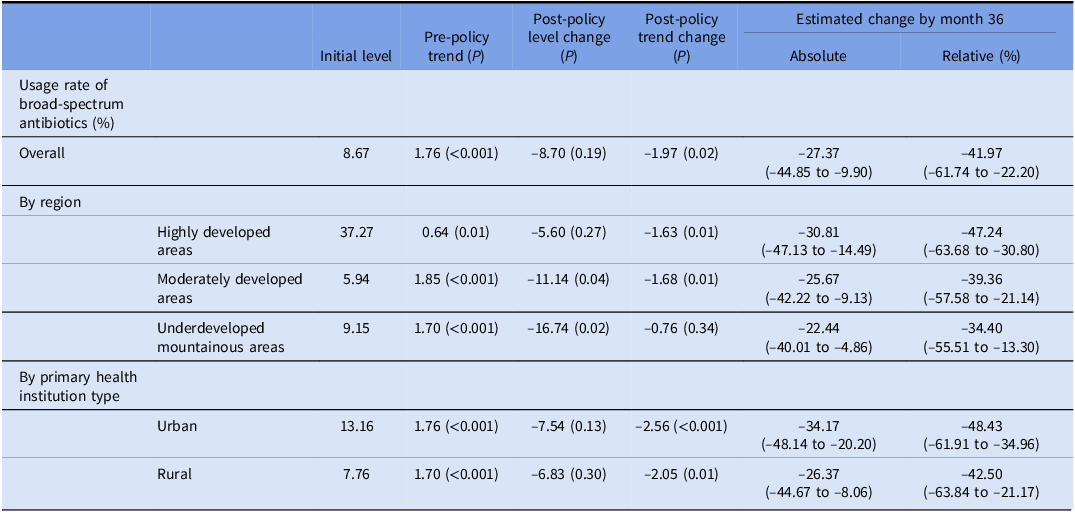
Prior to the policy intervention in December 2022, both total antibiotic consumption and the usage rate of broad-spectrum antibiotics exhibited a marked upward trend (Figure 1). After the initiation of the intervention, monthly consumption considerably declined (3.68 DDD per month, P = 0.002), with an estimated relative cumulative effect of –35.96% [–49.34% to –22.57%] by the end of the study (Table 1). Meanwhile, the significant decrease in the usage rate of broad-spectrum antibiotics was also observed (1.97% per month, P = 0.02) and the relative reduction was –41.97% [–61.74% to –22.20%] (Table 2).
Time series of seasonally adjusted monthly antibiotic consumption and usage patterns among primary healthcare institutions in Central China from January 2021 to December 2023.

Estimates from segmented regression analyses of changes in consumption of antibiotic before and after the policy, overall and by region, health institution type and medication type

* N/A indicates non-calculable relative change due to division by near-zero baseline.
Estimates from segmented regression analyses of changes in usage patterns of antibiotic before and after the policy, overall and by region and health institution type

Antibiotic use in different regions
In the stratified analysis, there were marked regional differences in antibiotic use levels and trends (Figure 2, Table S2). Both moderately developed areas and underdeveloped mountainous regions witnessed notable downward trends in antibiotic consumption post-policy implementation, with respective monthly declines of 4.90 and 7.34 DDD. Conversely, in highly developed areas, monthly antibiotic consumption exhibited a slight yet statistically significant increase following the policy intervention (1.02, P = 0.003). Regarding antibiotic usage patterns, all regions except underdeveloped mountainous areas showed evident decreases in the proportion of broad-spectrum antibiotic use trends after the policy intervention. The most significant change occurred in highly developed areas, which saw a relative decrease of –47.24% [–63.68% to –30.80%] compared to the expected proportion based on pre-policy trends by December 2023 (Table 2).
Monthly consumption of (a) and usage patterns of (b) antibiotic in different regions, before and after the policy.

Antibiotic use in different types of PHIs
Before the policy intervention in December 2022, antibiotic consumption and the usage rate of broad-spectrum antibiotics were increasing considerably (Figure 3, Supplementary Table S2). After the policy, the antibiotic consumption and the usage rate of broad-spectrum antibiotics in rural PHIs at different speeds, presented significant changes in slope, and their cumulative effects were –36.31% [–49.16% to –23.45%] and –42.50% [–63.84% to –21.17%], respectively (Tables 1 and 2). However, following the intervention, no significant change of the antibiotic consumption in urban PHIs were observed.
Monthly consumption of (a) and usage patterns of (b) antibiotic in different types of primary medical institutions, before and after the policy.

Sensitivity analysis
To further mitigate potential confounding from the COVID-19 pandemic and validate the robustness of policy effects, we conducted sensitivity analyses excluding data from January to June 2021. This period was removed to further distance our study window from the local outbreak period of the epidemic while maintaining sufficient pre-intervention observations. Using identical segmented regression methodology, the adjusted model demonstrated persistent declining trends in monthly antibiotic consumption (β = –2.97, P = 0.02) following policy implementation, accompanied by a sustained reduction in broad-spectrum antibiotic proportion (β = –1.39, P = 0.04) (Supplementary Table S5).
Discussion
This study assessed the impact of a national antimicrobial stewardship policy on antibiotic use in PHIs in Central China. The policy was associated with reductions in overall antibiotic consumption (–35.96%) and broad-spectrum antibiotic use (–41.97%). Stratified analyses revealed regional and institutional differences: antibiotic consumption decreased in moderately developed and underdeveloped areas but slightly increased in highly developed areas. Broad-spectrum antibiotic use declined significantly in all regions except underdeveloped areas. Rural facilities showed marked reductions in both indicators, while urban facilities exhibited no significant changes.
The health authorities have highlighted that, due to China’s vast territory, significant geographical differences, and disparities across provinces in terms of AMR, healthcare insurance coverage, and prescribing practices, it is challenging to implement a unified national approach to the rational use of antibiotics. 20 The 2022 National Action Plan to Contain AMR marked a departure from earlier approaches by incorporating evidence-based thresholds and a hierarchical oversight mechanism, targeting specific antibiotics. Evidence from other middle-income countries suggests that policies with clear benchmarks and robust surveillance systems can lead to significant improvements in rational antibiotic use and resistance rates. For example, antimicrobial stewardship programs in India and South Africa demonstrated reductions of up to 30% in inappropriate antibiotic prescriptions after implementing similar targeted interventions. Reference S, Vp and Zu21,Reference S, M and Y22 Additionally, European studies on WHO-aligned stewardship frameworks highlight that active policy enforcement can mitigate regional disparities, particularly in rural and under-resourced areas. Reference S, M and Y22
After the implementation of the policy, both the total consumption of antibiotics and the usage rate of broad-spectrum antibiotics showed a significant decline, indicating the strong effectiveness of the comprehensive national intervention. This finding aligns with the general trends reported in existing literature. For example, the study by Susan et al. Reference Rogers Van Katwyk, Grimshaw and Nkangu23 demonstrated that integrated regulatory and educational policies effectively curbed the misuse of antibiotics shortly after implementation. Similarly, Zhang et al. Reference Thong, Chang and Lee24 highlighted that the substantial reduction in antibiotic use during the initial phase of policy enforcement is often a direct result of intensified supervision and public education, a phenomenon corroborated by the findings of this study. However, unlike prior studies that primarily focused on developed regions, Reference Knowles, Chandler and O’Neill25 this study provides comprehensive empirical evidence of the policy’s applicability in grassroots healthcare settings. The extensive data coverage facilitates an evaluation of the policy’s practical effects across diverse healthcare contexts, offering a robust scientific basis for future policy optimization. Although the overall results demonstrate significant policy effects, attention should be paid to the dynamic changes following policy implementation. Previous studies, such as Kah et al., Reference Thong, Chang and Lee24 have suggested that the long-term effects of such policies may diminish over time. This phenomenon, however, was not observed in this study, possibly due to the relatively short duration of data coverage.
Moderately developed areas and underdeveloped mountainous regions experienced significant reductions in antibiotic use post-policy implementation. In contrast, highly developed regions exhibited a statistically significant increase. These findings are consistent with previous studies highlighting regional disparities in antibiotic usage within China. For instance, Qu et al. Reference X, C and X26 observed significant regional differences in antibiotic consumption across public general tertiary hospitals from 2011 to 2014, with cephalosporins being the most frequently used antibiotics in all regions. Similarly, Wei et al. Reference C, A and T27 reported that inappropriate use of antibiotics is prevalent across China, with significant regional variation influenced by non-biomedical factors. Several mechanisms may account for these differences. In highly developed regions, PHIs often benefit from stronger antibiotic stewardship infrastructures—such as electronic prescription review systems and access to rapid diagnostic tools—as reported in local pilot programs. 28 These technologies may enhance prescribing precision, yet providers in these areas also face increased patient expectations Reference Kizito, Lalitha and Kajumbula29 and possibly a higher proportion of complex cases, Reference Singh, Steurer and Cantey30 both of which may drive up antibiotic demand. Conversely, PHIs in underdeveloped areas confront systemic constraints: limited microbiology capacity, insufficient staffing, and low AMS training coverage all contribute to ongoing reliance on empirical, broad-spectrum use. These findings underscore the importance of region-specific interventions. In resource-limited areas, expanding point-of-care diagnostic capacity may reduce broad-spectrum overuse, while in developed regions, addressing patient-side pressures and reinforcing policy compliance are key to curbing unnecessary prescribing.
We observed that both total antibiotic consumption and broad-spectrum antibiotic use declined significantly in rural PHIs, whereas no statistically significant changes were found in urban PHIs. This finding diverges somewhat from common expectations. Numerous studies have highlighted that rural areas in China often face significant challenges in antibiotic stewardship, including widespread misuse of antibiotics, non-standard diagnostic and treatment practices, weak prescription auditing mechanisms, and limited laboratory capacity for infection diagnosis. Reference Chai, Coope and Cheng31,Reference Yin, Song and Gong32 One possible explanation is that rural PHIs had higher baseline levels of antibiotic use, allowing for greater reductions following policy intervention. Moreover, under the Plan, rural areas have been a primary focus for strengthening stewardship, including expanded prescriber training, implementation of antibiotic classification management, and enhanced prescription oversight systems. 9 These targeted efforts may have improved institutional prescribing capacity in rural areas. In contrast, urban PHIs may face greater challenges in implementing change due to more complex patient expectations, diversified service structures, and potentially conflicting incentive mechanisms. Although our study could not directly measure institutional stewardship practices, future research should explore such mechanisms to better understand differential policy effects.
Our study also has some limitations. First, the analysis relies on aggregated procurement data, which limits assessment of appropriateness and individual-level clinical outcomes. Future studies using individual-level data may better capture policy impacts. Second, the use of procurement data as a proxy for actual antibiotic use may introduce measurement bias. However, in Chinese PHIs, a national “purchase-for-use” model mandates drug procurement be based on immediate clinical need, with minimal inventory and tight linkage to Hospital Information System prescription records. Additionally, our data set excludes returned, expired, and damaged products. Although short-term lags may exist, procurement data closely approximates actual use, with minimal systematic bias. Third, the ITS design cannot fully account for unmeasured time-varying confounders such as seasonal epidemics or concurrent public health interventions. Although informal consultations with regional health administrators suggested no major overlapping policies, the lack of systematic subnational surveillance prevents us from fully ruling out contextual influence. Finally, the study focuses on PHIs in Central China, which may limit its applicability to regions with different healthcare structures. Additionally, although prescription-only regulations are increasingly enforced, our data cannot fully capture whether patients obtained antibiotics through other channels, such as occasional non-prescription antibiotic use. Although the impact may be limited, this remains a data-level limitation that should be considered when interpreting the findings.
Supplementary material
To view supplementary material for this article, please visit https://doi.org/10.1017/ice.2025.10266
Acknowledgments
This work was supported by the National Social Science Fund of China (23BGL295). All authors report no conflicts of interest relevant to this article.
Financial support
This work was supported by the National Social Science Fund of China (23BGL295).
Competing interests
All authors report no conflicts of interest relevant to this article.