Introduction
In Germany and other industrial countries, approximately 60% of all residents in nursing home facilities have some type of dementia (Weyerer and Schäufele, Reference Weyerer and Schäufele2004). The increasing prevalence of nursing home residents with dementia places new demands on institutions and particularly on staff. Caring for people with dementia can be extremely difficult and stressful due to difficult behavior and communication problems (Hagen and Sayers, Reference Hagen and Sayers1995). Inadequate contact is frequently reflected in the aggravation of problem behaviors of the residents, in the rise of restrictive care methods and in the increase of the caregivers' burden.
One indicator of such a situation is the high and frequently inappropriate use of psychotropic drugs, despite demonstrated concerns about significant serious effects (Ruths et al., Reference Ruths, Straand and Nygaard2001; Hosia-Randell and Pitkälä, Reference Hosia-Randell and Pitkälä2005; Kim and Whall, Reference Kim and Whall2006; Molter-Bock et al., Reference Molter-Bock, Hasford and Pfundstein2006, French et al., Reference French, Campbell, Spehar and Accomando2007). Sedative drugs, in particular, are sometimes used to manage problem behavior of residents with dementia, often solely for the convenience of staff. In a German study, for example, 33.3% of the residents were given sedative drugs on a regular basis (Sonntag et al., Reference Sonntag, Matschinger, Angermeyer and Riedel-Heller2006). Another indicator is the use of physical restraints, also used to manage residents with problem behaviors (Tinetti et al., Reference Tinetti, Liu, Marottoli and Ginter1991). Negative consequences such as strangulation, nerve damage, increased agitation, bed sores, incontinence and other adverse reactions have been demonstrated (Capezuti et al., Reference Capezuti, Strumpf, Evans, Grisso and Maislin1998), while the beneficial effects, particularly a reduction in falls, are not well proven. Because of this, effective preparation of the workforce is a key factor in contributing to the quality of care (Fitzpatrick and Roberts, Reference Fitzpatrick and Roberts2004). To encourage the caregivers to fulfill their roles competently and with sensitivity, in-service staff training has become an important element of long-term care.
Many intervention studies have been conducted (e.g. McCallion et al., Reference McCallion, Toseland, Lacey and Banks1999; Wells et al., Reference Wells, Dawson, Sidani, Craig and Pringle2000; Lintern et al., Reference Lintern, Woods and Phair2000; Burgio et al., Reference Burgio2000; Reference Burgio, Stevens, Burgio, Roth, Paul and Gerstle2002; Magai et al., Reference Magai, Cohen and Gomberg2002) and general research interest on this topic has increased exponentially in the past decade. In spite of this, there is still little scientific evidence as to the effectiveness of these interventions (Beck et al., Reference Beck, Ortigara, Mercer and Shue1999; Kuske et al., Reference Kuske, Hanns, Luck, Angermeyer, Behrens and Riedel-Heller2007). A comprehensive literature survey identified 21 studies, only two of which were conducted in Europe, with most showing severe methodological weaknesses (Kuske et al., Reference Kuske, Hanns, Luck, Angermeyer, Behrens and Riedel-Heller2007). Burgio et al. (Reference Burgio, Stevens, Burgio, Roth, Paul and Gerstle2002) evaluated the effects of staff training in behavioral management supplemented by three weeks of hands-on training. Results demonstrated significant and sustained positive effects on caregivers' communication skills and a reduction in residents' agitation. Following a communication program supplemented by individual follow-up sessions McCallion et al. (Reference McCallion, Toseland, Lacey and Banks1999) caregivers improved their knowledge about managing the residents' problem behavior. However, this improvement was not sustained. Residents demonstrated a sustained decrease in depressive symptoms and verbally agressive behavior. Short-term effects on the use of psychotropic medication were found. In a recent study, the use of neuroleptics could be reduced significantly following a training and support intervention that focused on alternatives to drugs for the management of agitated behavior in dementia (Fossey et al., Reference Fossey2006). Another study reported no significant decrease in the use of physical restraints, using an education program on the use of such restraints in combination with consultations (Huizing et al., Reference Huizing, Hamers, Gulpers and Berger2006).
The main objective of this study is to evaluate the effectiveness of a general training program that has been developed in Germany for caregivers of residents with dementia. This paper gives a short account of the program's development and contents, followed by a presentation of the results of the training program evaluation. The impact of training was examined from the perspective of the staff and the residents. We tested the hypotheses that training in dementia care would (1) increase the caregivers' knowledge and competencies for dealing adequately with residents with dementia (primary outcomes), (2) reduce the caregivers' levels of burnout and health complaints as a consequence of a lower workload (secondary outcomes), and (3) reduce the number of residents being given sedative drugs and/or being physically restrained (secondary outcomes).
Methods
Program development and training content
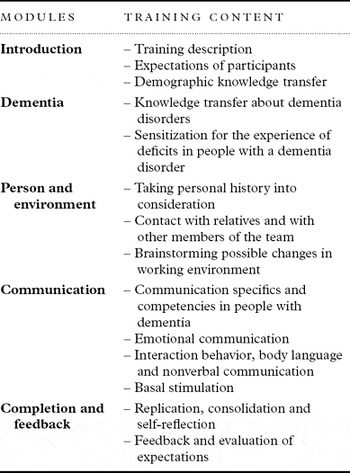
A comprehensive international literature search (Kuske et al., Reference Kuske, Hanns, Luck, Angermeyer, Behrens and Riedel-Heller2007) and a focus group which included 12 caregivers from three non-profit nursing homes helped to detect important topics for the training curriculum. Based on recent findings from the literature and on the topics identified in the focus group, we developed a training program consisting of five modules (Table 1).
Training modules

The objective of the training program was to improve the interaction between caregivers and residents. A key focus was to improve the caregivers' knowledge as well as their competencies for dealing adequately with residents with dementia. This includes sensitization to the experience of residents with dementia, communication competencies, and special and adjuvant care methods requiring little effort. Formal instructions and problem-based learning methods (Haith-Cooper, Reference Haith-Cooper2000) were combined to connect theoretical knowledge with practical experience. The pedagogical concept problem-based learning was derived from the psychology of learning and work using situations from daily care routines. On the basis of their practical experiences, the program sought to increase the caregivers' motivation and facilitate the transfer of their knowledge into practice. In particular, it sought to improve the abilities of reflection and independent problem-solving. The new information was illustrated by a Power Point presentation and taught using methods such as lectures, educational videotapes, handouts in every session, brainstorming and short games. Several exercises in areas such as empathy, sensitization and the newly learned communication skills were used to facilitate the transfer of knowledge. This was supplemented by discussions of theoretical aspects as well as video-scenarios and real-life examples. The curriculum was designed at a basic level, allowing the participation of all caregivers regardless of their education level.
Setting
The study was conducted in six nursing homes in Leipzig, Germany. Nursing homes with a minimum of 90 residents and of comparable organization were recruited and then asked to participate. From a pool of 10 nursing homes which we considered for participation, six were randomly selected by an external statistical center using a computer-generated randomization list. Four of the participating nursing homes were private institutions, the other two were institutions of a German labor welfare association. All facilities offer traditional integrative care but also integrated segregative wards enabling us to select 20 wards in which almost all residents have some type of dementia. The average staff to resident ratio ranged from about 1:9 on the first shift to 1:12 on the second shift.
Design
The study was a three-arm cluster-randomized controlled trial. Data were collected at three times: prior to the training (Baseline), immediately after the training (Post 1), and six months after the training was completed (Post 2). The impact of the training on caregivers in the intervention group (IG) was examined in comparison with two caregiver control groups, a relaxation group (RG) and a wait-list control group (CG). Caregivers of the RG received relaxation training. The six nursing homes were randomly assigned to the three treatment conditions, so that each group consisted of two nursing homes. The allocation of the nursing homes to one of the three groups was conducted independently by an external statistical centre using a computer generated randomization list. Data analysts were not aware of the treatment conditions.
Participants and procedures
Residents and caregivers were recruited between December 2004 and February 2005.
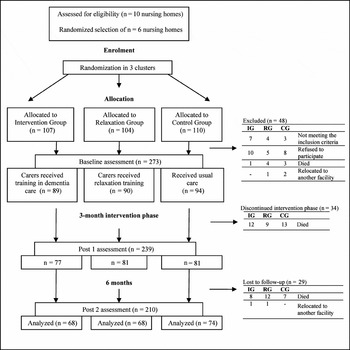
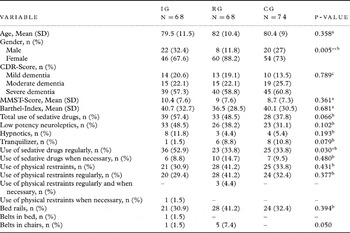
Residents. Three-hundred-and-twenty-one residents of the participating wards, their close family members or their statutory agents were told about the investigation. Consent was obtained from 298 of them, a consent rate of 93%. The consenting residents were screened according to the following eligibility criterion: a diagnosis of dementia with a Clinical Dementia Rating (CDR) score ≥ 1 (Hughes et al., Reference Hughes, Berg, Danziger, Coben and Martin1982). Residents with no care level according to German long-term care insurance were excluded. From the pool of the 321 recruited residents, 210 completed all three assessment points. The corresponding flow diagram is presented in Figure 1. The excluded residents were significantly older (84 years) than the remaining participants (80.61 years). The average age was 81 years, and the majority were female (76%). Selected characteristics of the sample of residents in the three groups are shown in Table 2.
Recruitment of nursing home residents.
Note: IG = Intervention Group; RG = Relaxation Group; CG = Control Group.

Selected baseline characteristics of residents (N = 210)

IG = Intervention Group; RG = Relaxation Group; CG = Control Group.
a = One-way ANOVA; b = χ2-Pearson; c = Kruskal-Wallis-Test: χ2; * p < 0.05; ** p < 0.01.
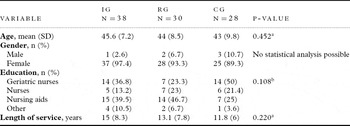
Staff. All caregivers of the targeted wards were invited to take part in the investigation and 134 caregivers entered the study at baseline (see Table 3). From this pool, 96 (72%) completed the questionnaires at all three assessment points. Caregivers who did not attend at least 10 sessions of either the IG or the RG were excluded. A total of 38 (39.6%) caregivers discontinued participation in our study during the investigation due to lack of time (N = 29) or illness (N = 9). The caregivers who did not continue did not differ significantly from those continuing in age, gender, work experience or educational level. The majority of caregivers included in the study were female (94%) with an average age of 44 years.
Selected baseline characteristics of caregivers (N = 96)

IG = Intervention Group; RG = Relaxation Group; CG = Control Group.
a = one-way ANOVA; b = χ2-Pearson; * p < 0.05.
Intervention group. Following the baseline assessment in March 2005, caregivers of the IG received 13 one-hour sessions of the training program over a 13-week intervention period from April 2005 to June 2005. Every session was offered twice a week, giving all caregivers the chance to participate. The training was delivered in small groups of up to 12 caregivers by a health and nursing scientist with applied experience in nursing. Training was offered to all staff members involved in resident care (e.g. nurses, geriatric nurses, nursing aids and occupational therapists).
Relaxation group. Caregivers of the RG received 13 concurrent one-hour sessions of relaxation training (April 2005 to June 2005). The content of the relaxation training consisted of different relaxation methods such as progressive muscle relaxation (PMR), breathing relaxation techniques and guided imaginary journeys. The objective was not to learn a special relaxation method, but to give the caregivers the opportunity to relax for one hour while at work. The sessions were delivered by a clinical psychologist.
Wait-list control group. Caregivers of the wait-list control-group received no intervention-related training until the Post 2 assessment.
Measurement
Assessment instruments were administered either by a psychologist, a specialist in health and nursing or by trained and supervised research assistants. Sociodemographic characteristics of residents were gathered from the care documentation system while those of the staff were gathered by a short questionnaire.
Screening measures
The level of cognitive impairment was measured by the Clinical Dementia Rating (CDR) (Hughes et al., Reference Hughes, Berg, Danziger, Coben and Martin1982). Six domains of cognitive and functional performance applicable to a dementia disorder are measured on a five-point scale. The global score is derived from the six individual ratings. Information necessary for the ratings is obtained by a semi-structured interview of the resident and from reliable information or collateral sources. The Mini-Mental-Status-Test (MMST; Kessler et al., Reference Kessler, Markowitsch and Denzler2000), the Barthel Index (Mahoney and Barthel, Reference Mahoney and Barthel1965) and information from the caregivers were therefore included in the global rating. The CDR demonstrated a test-retest reliability of 0.98 (Hughes et al., Reference Hughes, Berg, Danziger, Coben and Martin1982) and a good correlation (r = 0.84) with the Short Portable Mental Status Questionnaire (Pfeiffer, Reference Pfeiffer1975).
The MMST, a German version of the Mini-mental State-Examination (MMSE; Folstein et al., Reference Folstein, Folstein and McHugh1975), was used to assess global cognitive ability. The total score is 30 points, with scores of 24 or below indicating dementia. Test-retest reliabilities ranged from 0.8 to 0.98. The German version demonstrated good inter-rater (r = 0.83) and retest reliability (r = 0.89).
The Barthel Index (BI) is a simple index of independence to assess patients' ability to take care of themselves. Caregivers had to rate 10 activities of daily living (ADL). The German version of the BI (Heuschmann et al., Reference Heuschmann2005) demonstrated excellent inter-rater reliability (mean κ = 0.93). The diagnoses of dementia were determined in multidisciplinary consensus conferences held by psychiatrists, clinical psychologists and health and nursing specialists.
Outcome measures
Staff assessment. (i) Knowledge and competencies related to dementia. Knowledge and competence in dealing adequately with challenging problem behaviors of residents with dementia were assessed using the GEROLF staff questionnaire (Zimber, Reference Zimber2003). The GEROLF is a German benchmarking instrument to measure the quality of life of geronto-psychiatric residents in nursing homes. The staff questionnaire was based on the Penn State Health Care-giving Questionnaire (MHQ; Spore et al., Reference Spore, Smyer and Cohn1991) and is used to measure caregivers' level of knowledge. It consists of a 20-item multiple-choice knowledge test based on everyday scenarios of the workplace and of 18 Likert-scaled questions for assessing the caregivers' competence (expertise, methodological competence, personal competence, and social competence, and responses to colleagues). We used 15 items of the knowledge test. There were no psychometric properties, but comparative data of 170 caregivers from 15 nursing homes were used. The MHQ demonstrated moderately good test-retest-reliability (0.63) and internal consistence (Kruder-Richardson-20 = 0.51).
(ii) Level of burnout. The level of burnout was measured using the Maslach Burnout Inventory (MBI-D; Büssing et al., Reference Büssing, Glaser and Höge2003, adapted from Büssing and Perrar, Reference Büssing and Perrar1992). The instrument consists of 21 items rated on a seven-point Likert scale. Three subscales of emotional exhaustion, depersonalization and personal fulfillment can be assessed. The MBI-D has demonstrated good internal consistency ranging from 0.75 to 0.91 (Cronbach's α).
(iii) Level of health complaints. The screening measure “Beschwerdeliste” (BL), a list of health complaints (Zerssen, Reference Zerssen1976), was used to identify the extent of the global physical impairment. The instrument consists of 48 body-focused disorders, mental universal disorders and physical disorders and demonstrated very good internal consistency (0.95), high external validity and test-retest scores ranging from 0.85 to 0.95.
Resident assessment. (i) Use of physical restraints. Information on the use of physical restraints was gathered retrospectively from each nursing home's documentation. For statistical analyses, the number of all residents who received any kind of physical restraint during the four weeks prior to a fixed cut-off date of each assessment period was totaled. Additionally, the number of residents who had suffered falls was totaled during the same time period to ensure that falls did not increase when physical restraints were removed.
(ii) Use of sedative drugs. Information on the use of sedative drugs was also gathered retrospectively from each nursing home. The following groups of drugs were included: low potency neuroleptics, hypnotics, and tranquilizers. The total number of residents who received at least one sedative drug during the four weeks prior to a fixed cut-off date of each assessment period was totaled for the statistical analysis. The method of drug administration was initially differentiated as to whether the drugs were administered regularly or only given as necessary. Since the number of uses of drugs given when necessary was too small for statistical analysis, both application modes were summed to one outcome criterion: the use of sedative drugs in general.
Statistical analysis
Demographic and clinical characteristics of the groups at baseline were defined using descriptive statistics and compared using either one-way analysis of variance (ANOVA), Students t-test, χ2 Pearson test or Kruskal-Wallis test, as appropriate.
Group × time intervention effects of metric variables were analyzed by generalized linear models (GLM; Kuss and Watzke, Reference Kuss and Watzke2005). Analyses were run by calculating 3 (group) × 3 (time), with the main interest on group × time interaction effects. In order to correct for potential errors, the within-subject factors (time) were tested via Greenhouse Geisser p-values, if sphericity (Mauchly-Test) was violated. Significant time effects of the IG and RG were compared with baseline; significant group effects were compared with the CG. Furthermore, the RG was compared with the CG (basic contrast method). If there were baseline differences between the groups, the corrected effect sizes (Klauer, Reference Klauer1993) were calculated in order to detect the practical significance of significant training effects. This allowed pretest differences to be included.
Group × time interaction effects of the nominal variables “use of physical restraints and sedative drugs” were analyzed by a random-effects logit model (Liang and Zeger, Reference Liang and Zeger1986; Diggle et al., Reference Diggle, Heagerty, Liang and Zeger2002; Twisk, Reference Twisk2003). Within this multi-level model, time was set up as a vector (coding 0, 1 and 2), and the interaction within the groups served as a predictor. Data were analyzed using SPSS software version 12.0 and STATA version 9.0. For all analyses the significance level of p < 0.05 was considered as being statistically significant.
Results
Tables 2 and 3 show the selected baseline characteristics of the residents and the caregivers, respectively. There were no significant differences between the residents' groups in age, family status, cognitive status, Barthel Index (Mahoney and Barthel, Reference Mahoney and Barthel1965) and the total use of sedative medication or physical restraints (Table 2). With regard to the carers of the three resident groups (Table 3) there were no significant differences in terms of their age, gender, work experience or education level.
Knowledge and competencies related to dementia
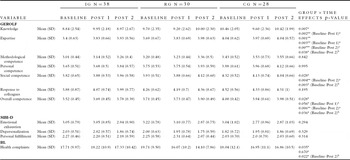
At Baseline there were differences between the three groups on knowledge and on competencies related to dementia. Caregivers in the CG had significantly more knowledge (p = 0.02, ANOVA) and competencies than the caregivers in the IG (overall competence: p = 0.00, ANOVA) and partly significantly more competencies than caregivers in the RG (overall competence: p = 0.011, ANOVA). Results of the GLM are presented in Table 4. Analyses revealed a significant group × time interaction effect on knowledge in the chronological sequence of the study (p = 0.007, F = 3.630, df = 3.980, Greenhouse Geisser). This effect was particularly significant between the Baseline and Post 1 (p = 0.004, F = 5.742, df = 2, Greenhouse Geisser). Caregivers of the IG increased their knowledge scores significantly immediately after the training, whereas the scores in the RG and the CG did not change. This effect was significant between the IG and the CG (p = 0.002, F = 10.429, df = 1, Greenhouse Geisser), but was not sustained at Post 2. The corrected effect size of this training effect was high dcorr = 0.846 (IG-CG, Baseline– Post 1). The sum-score of the IG decreased to the baseline level again (p = 0.88).
Results of the generalized linear models (GLM) relating to the caregivers

IG = Intervention Group; RG = Relaxation Group; CG = Control Group; MBI-D = Maslach-Burnout Inventory; BL = Beschwerdeliste (health complaints).
a = IG/CG; b = RG/CG; * p < 0.05; ** p < 0.01; *** p < 0.001.
In comparison with the CG, the overall competence score of the IG increased significantly from Baseline to Post 1 (p = 0.056, F = 3.773, df = 1), and continued to Post 2 (p = 0.006, F = 7.93, df = 1, Greenhouse Geisser). The corrected effect sizes of these training effects were moderate with dcorr = 0.619 (IG-CG, Baseline–Post 1) and dcorr = 0.647 (IG-CG, Baseline–Post 2). A similar group × time interaction effect occurred in the RG, which demonstrated a significant increase of the overall competence score from Baseline to Post 2 (p = 0.036, F = 4.633, df = 1, Greenhouse Geisser). The practical significance of this training effect was relatively moderate with dcorr = 0.506 (RG-CG, Baseline–Post 2). Furthermore, results of the analyses indicated significant group × time interaction effects on the GEROLF subscales expertise and social competence both in the IG and RG. Compared with the CG, the subscale score expertise of the IG increased significantly from baseline to Post 1 (p = 0.003) and to Post 2 (p = 0.000). In the RG this score increased significantly from Baseline to Post 2 (p = 0.038, F = 4.545, df = 1, Greenhouse Geisser). The practical significance of this training effect in the RG was relatively small with dcorr = 0.442 (RG-CG, Baseline–Post 2), whereas the practical significance in the IG was high with dcorr = 0.815 (IG-CG, Baseline–Post 1) and dcorr = 0.828 (IG-CG, Baseline–Post 2). By contrast, the significant increase (baseline–Post 2) of the social competence score in the IG (p = 0.004, F = 9.134, df = 1, Greenhouse Geisser) demonstrated similar practical significance with the increase of this subscale score in the RG with dcorr = 0.705 (IG-CG, Baseline–Post 2) and dcorr = 0.884 (IG-RG, Baseline–Post 2).
During the chronological sequence of the study, the comparison between the groups indicated no significant changes relating to the subscales of methodological competence (p = 0.84, F = 0.346, df = 3.892), personal competence (p = 0.99, F =0.05, df = 3.996) or the response behavior to colleagues (p = 0.19, F = 1.531, df = 3.991, Greenhouse Geisser).
Level of burnout and health complaints
On the subscales of the MBI-D, the three groups did not differ significantly at baseline (emotional exhaustion: p = 0.67, depersonalization: p = 0.37, personal fulfillment: p = 0.19, ANOVA). The GLM revealed no significant time-, group- or time × group interaction effect on the subscales of the MBI-D following the training (Table 4).
Caregivers in the IG did not differ significantly from caregivers in the RG and CG at baseline on their level of health complaints (BL sum-score: p = 0.73). During the chronological sequence of the study, statistical analyses demonstrated a significant effect on the sum-score of health complaints (p = 0.03, F = 2.760, df = 3.989, Greenhouse Geisser). When comparing the groups however, the results revealed no significant effect in the IG, but a significant time × group interaction effect in the RG. Caregivers in the RG thus reduced their health complaints sum-score following the relaxation training from baseline to the Post 2 assessment. This effect was significant compared with the CG (p = 0.051, F = 3.965, df = 1, Greenhouse Geisser). The practical significance was moderate with dcorr = 0.45 (RG-CG, baseline–Post 2).
Use of physical restraints
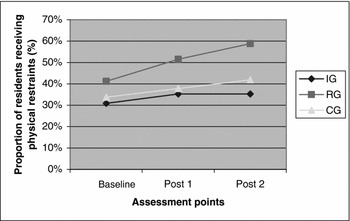
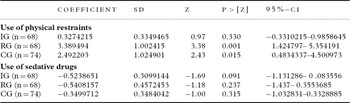
At baseline 30.9% of the residents in the IG, 41.2% of the residents in the RG and 33.8% of the residents in the CG had been subjected to physical restraint (p = 0.431). Restraints were used most often on a regularly basis. The most frequently used restraint type were bedrails in all three groups (see Table 2). The proportion of residents receiving physical restraints during the study is presented in Figure 2. Results of the random-effects logit model are summarized in Table 5. They indicated a significantly increased use of physical restraints in the RG (coefficient = 3.389494; p = 0.001) and CG (coefficient = 2.492203; p = 0.015) during the chronological sequence of the study (see Figure 2). In contrast, the use of physical restraints in the IG did not increase significantly (coefficient = 0.3274215; p = 0.330). In comparing the development of the groups during the chronological sequence of the study, there was a significant difference between the IG and the CG (p = 0.045) and between the IG and the RG (p = 0.038). At the same time, the number of residents suffering falls diminished in the IG from 11 falls at baseline to six falls at Post 2. In the CG the number of residents suffering falls increased from five falls at baseline to eight falls at Post 2.
Use of physical restraints.

Results of the random-effects logit model with regard to residents

IG = Intervention Group; RG = Relaxation Group; CG = Control Group; SD = standard deviation; CI = confidence interval; * p < 0.05.
Use of sedative drugs
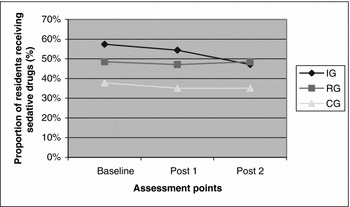
At baseline 57.4% of the residents in the IG, 48.5% of the residents in the RG and 37.8% of the residents in the CG received sedative drugs (p = 0.066). Low potency neuroleptics were the type of drug most frequently used (see Table 2). Following the training, the number of residents who received sedative drugs decreased in the IG (coefficient: −0.5238651, p = 0.091), in the RG (coefficient: −0.5408157, p = 0.237), and in the CG (coefficient: −0.3499712, p = 0.315). However, these effects were not significant (Table 5). Comparing the groups during the chronological sequence of the study revealed no significant differences between the IG and the CG (p = 0.709), between the RG and the CG (p = 0.739) or between the IG and the RG (p = 0.976). The proportion of residents receiving sedative drugs during the study is presented in Figure 3.
Use of sedative drugs.

Discussion
The present study was designed to evaluate the impact of a German training program in dementia care for nursing home staff. The main objective was to investigate whether this training would be useful in improving the quality of care of residents with dementia and in reducing caregivers' burden in the setting of German nursing homes. To our knowledge, the evaluation of this training was one of the first intervention studies on this topic in Germany.
The care staff
The results of the evaluation indicated that the training had an impact on caregivers' knowledge. In accordance with our hypothesis and with findings of earlier similar intervention studies (Cohen-Mansfield et al., Reference Cohen-Mansfield, Werner, Culpepper and Barkley1997; Lintern et al., Reference Lintern, Woods and Phair2000; Peterson et al., Reference Peterson, Berg-Weger, McGillick and Schwartz2002; Rosen et al., Reference Rosen, Mulsant, Kollar, Kastango, Mazumdar and Fox2002), the knowledge of the trained caregivers increased significantly immediately after the training. However, this effect was not sustained to the six-month follow-up, which could possibly be a consequence of a lack of further support given to the caregivers after the training. This result supports the assumption that ongoing support (e.g. advice, feedback, reinforcement sessions), changes in working conditions (e.g. more time for the residents beyond basic physical care, individual care plans), organization (e.g. regular consultation) or environment (e.g. a safe physical environment that allows unrestricted but safe wandering, environmental cues such as use of colors, symbols and music) are necessary to facilitate the implementation of the newly learned skills (Cohen-Mansfield, Reference Cohen-Mansfield2001; Aylward et al., Reference Aylward, Stolee, Keat and Johncox2003; Kuske et al., Reference Kuske, Hanns, Luck, Angermeyer, Behrens and Riedel-Heller2007).
Consistent with our expectations, the overall competency of caregivers increased significantly in the IG at Post 2. However, this result does not supply strong evidence for the impact of the training, since overall competency of caregivers in the RG had also increased significantly at the six-month follow-up. Additionally, the subscale methodological competency did not improve in either group. Caregivers probably exaggerate their interest in work or their self-efficacy because participation in a group is a welcome and stimulating break from their care routines. The corrected effect-sizes of the training effect underlie the assumption that this training was not sufficient to increase the transfer of the new knowledge into the daily care routine. Our results partially concur with previous findings, documenting positive intervention effects on communication skills (Burgio et al., Reference Burgio2000; Reference Burgio, Stevens, Burgio, Roth, Paul and Gerstle2002) or short-term effects on knowledge about the management of problem behavior (McCallion et al., Reference McCallion, Toseland, Lacey and Banks1999). However, the comparison is limited, since interventions with ongoing support were used, and there was no placebo control group.
The training program had no impact on caregivers' level of burnout. The implementation of the newly learned skills within the daily care routine possibly demands extra motivation and time, and large amounts of energy. Changing and ameliorating the working conditions might therefore be helpful in facilitating their implementation. Caregivers suffering from a burnout syndrome certainly need more assistance and individual support than an educational intervention. A lack of previous research on this subject prevents comparison with other findings. However, our results are consistent with those previous findings that measured the level of stress (Peterson et al., Reference Peterson, Berg-Weger, McGillick and Schwartz2002; Wells et al., Reference Wells, Dawson, Sidani, Craig and Pringle2000). Future research is needed to assess the possibilities of changed human resource management and an educational intervention in preventing the burnout of caregivers.
Contrary to our hypothesis, health complaints of caregivers were not reduced in the IG, but did decline in the RG at the six-month follow-up. Relaxation training seemed to have a more positive impact on health complaints than educational intervention. Given this, the limitation of our educational intervention became apparent. However, it also demonstrated the usefulness of relaxation methods on caregivers' physical health. The comparison with earlier studies was not possible, since the literature lacks intervention studies on this topic. Future research is needed to examine if relaxation methods could be a powerful intervention for caregivers in nursing homes. In this context either the impact of an educational intervention combined with relaxation training, or the implementation of relaxation opportunities or relaxation exercises should be evaluated.
The residents
The results indicate a positive training impact on the use of physical restraints, but no positive impact on the use of sedative drugs. Following the training, use of physical restraints in the IG did not decrease, but remained constant at the six-month follow-up, which differed significantly from the increased use of physical restraints in the RG and CG. This long-term effect suggests that a certain amount of time was necessary to implement the new knowledge of trained caregivers. Similar results on the use of physical restraints were found in another intervention study examining the effects of education on the use of physical restraints combined with consultation (Huizing et al., Reference Huizing, Hamers, Gulpers and Berger2006). Further caregiver support could potentially reduce the use of physical restraints.
The use of sedative drugs in the IG decreased, though the decrease was not statistically significant. This result was not surprising since the use of sedative drugs prescribed when required was extremely low at baseline (see Table 2), which was contrary to our expectations. Prescribed regular drug administration leaves little leeway for caregivers since they can only follow the physician's instructions. In our opinion, more attention should be paid to the role of physicians in prescribing the drugs. Physicians caring for nursing home residents possibly require further education on the benefits and adverse effects of psychotropic drugs in frail elderly people (Hosia-Randell and Pitkälä, Reference Hosia-Randell and Pitkälä2005). Contrary to our results, other findings showed significant reduction of psychotropic medication use (Matteson et al., Reference Matteson, Linton, Cleary, Barnes and Lichtenstein1997; McCallion et al., Reference McCallion, Toseland, Lacey and Banks1999; Huizing et al., Reference Huizing, Hamers, Gulpers and Berger2006). However, these studies used another type of intervention, supplementing their education with ongoing support, environmental changes or with a special focus on alternatives to drugs for the management of agitated behavior.
Strengths and limitations
This study had several strengths. A six-month follow-up assessment was conducted to detect long-term effects. Training impact was measured with respect to both the staff and residents. A randomized controlled trial design was used including a control and a group receiving another intervention (relaxation). Allocation was conducted by a computerized random-number generator.
However, although we aimed to conduct a methodologically strong intervention study, several inevitable limitations are apparent. The nursing homes were randomly assigned to the treatment conditions, not the single nursing units or participants. As other authors have pointed out (Burgio et al., Reference Burgio2000; Cohen-Mansfield, Reference Cohen-Mansfield2001; Kuske et al., Reference Kuske, Hanns, Luck, Angermeyer, Behrens and Riedel-Heller2007; McCallion et al., Reference McCallion, Toseland, Lacey and Banks1999), any other randomization method is impossible to implement in this setting if possibilities of interaction between the different treatment groups are to be prevented. The most important limitation of this study was that the caregivers were not blind to the treatment conditions, since nursing homes and participants only wanted to participate if they were informed about the study. However, the outcomes concerning the staff were examined using questionnaires, and the outcomes concerning the residents were gathered from document sources with the system of care so that possible effects of the data collection (detection bias) were minimized. The outcome variables of residents were measured via proxies such as the use of sedative drugs and physical restraints, which are probably appropriate in providing conclusions about residents' quality of life. Due to the frailty of some residents with dementia, the assessment of residents' outcome variables depends on such proxies or the caregivers' cooperation. Another factor that may cause bias and consequently influence the success of the training program was that not all caregivers of the units involved participated in the study. Contrary to our expectations, the knowledge of the staff was relatively high, and the use of sedative drugs when necessary was relatively low at baseline. The many non-significant findings probably could be attributed to these unexpected baseline scores. The participating nursing homes most likely had more interest in improving the care of residents with dementia than other nursing homes and so probably invested in continuing education of caregivers in the past. Baseline differences of outcome variables cannot obviate that intervention effects were biased by institutional effects. However, the calculation of the corrected effect sizes demonstrated high practical significance for the intervention effect on caregivers knowledge and greater practical significance of the intervention effect on caregivers overall competence in the IG than in the RG. Difficulties can be corrected with a replication of this study.
In accordance with other findings (Cohen-Mansfield, Reference Cohen-Mansfield2001; Kuske et al., Reference Kuske, Hanns, Luck, Angermeyer, Behrens and Riedel-Heller2007), the limitations of this study mainly result from the barriers presented by the setting. More time is vital to enable caregivers to reach a high quality of care, particularly with respect to reducing the use of restraints and also reducing the caregivers' stress symptoms.
Conclusion
Overall, the results of this study provide little scientific evidence about the efficacy of this training program. The positive effects of increased knowledge immediately following the training and the unchanged use of physical restraints at the six-month follow-up indicate that this training in dementia care has an impact on caregivers and residents. But the results also emphasize the limitations of this general in-service training. It became apparent that caregiver education is only the first step. As results from studies in other countries show, more activities which facilitate and reinforce the implementation of the newly learned skills are necessary in this setting in Germany. Future research in Germany should concentrate on other types of in-service interventions supplemented by ongoing support, and by organizational and environmental changes that allow and enable the caregivers to implement the newly learned skills within their care practice. In addition, the effects of specific interventions should be examined. The problems inherent with the setting, which compromise the methodological rigor of the study, should be controlled, incorporating at least an allocated randomization method, a control and a placebo group, blind testing and a follow-up assessment. Future studies should focus on samples of residents with mild to moderate dementia to facilitate the measurement of intervention effects from the resident's perspective. Additionally, those in charge of staff management should be more aware of the caretakers' potential and acknowledge the extent and range of their particular caring burdens. Caregivers' knowledge and work experience should be integrated in the educational programs and in the planning of environmental and organizational changes. In this context, future research should investigate the usefulness of learning relaxation techniques in order to relieve caregiver stress during daily care routines.
Conflict of interest
None.
Description of authors' roles
B. Kuske and S. Hanns managed the project, developed and provided the interventions and gathered the data. H. Matschinger and T. Luck analyzed the data. B. Kuske wrote the manuscript. T. Luck assisted in the preparation of the manuscript. S. G. Riedel-Heller, M. C. Angermeyer and J. Behrens supervised the project and provided independent adjudication and advice.
Acknowledgment
This study was supported by the Federal Ministry of Education and Research (BMBF, Project 93200045), Germany. The study is registered in the Social Science Research Information System (SOFIS) of the German Social Science Infrastructure Services (GESIS) as number: 79185. Special thanks to the management, caregivers and residents of the six participating nursing homes in Leipzig for their contributions. We also thank all the members of the Nursing Research Network Middle/South in Germany for their advice on the project management, data collection and analyses.