




No CrossRef data available.
Clinical practice guidelines for the management of psychosocial distress at the end of life
Published online by Cambridge University Press: 01 March 2004
Extract
After years of neglect, care at the end of life is receiving increasing attention and concern. It is then that the body is consumed by a progressive and mortal illness, and the person must cope not only with the bodily symptoms, but also with the existential crisis of the end of life and approaching death. As the body suffers, the mind is indeed “commanded … to suffer with the body,” as Shakespeare so well described. Thus, suffering near the end of life encompasses both the mind and the body. Providing optimal symptom relief and alleviation of suffering is the highest priority. However, evidence suggests that we continue to fall far short of this ideal (American Society of Clinical Oncology, 1996; Cassem, 1997; Cassel & Foley, 1999; Carver & Foley, 2000). Although pain management guidelines have been the most widely disseminated, we know that many patients continue to suffer not only from pain, but other troubling physical symptoms in their final days (American Nursing Association, 1991; Carr et al., 1994; American Pain Society, 1995; American Academy of Neurology, 1996; American Board of Internal Medicine, 1996; Ahmedzai, 1998). Despite clear advances in the identification and treatment of psychiatric disorders, we continue to underdiagnose and undertreat the debilitating symptoms of depression, anxiety, and delirium in the final stages of life (Carroll et al., 1993; Hirschfeld et al., 1997; Holland, 1997, 1998, 1999; Breitbart et al., 2000; Chochinov & Breitbart, 2000). And, beyond these physical and psychological symptoms, we fall even shorter of our goals of alleviating the spiritual, psychosocial, and existential suffering of the dying patient and family (Cherny & Portenoy, 1994; Cherny et al., 1996; Fitchett & Handzo, 1998; Karasu, 2000). And this is in spite of the ethical imperative “to comfort always” (Pellegrino, 2000).
Information
- Type
- REVIEW ARTICLE
- Information
- Copyright
- © 2004 Cambridge University Press
“… We are not ourselves when nature, being oppressed,
commands the mind to suffer with the body.”
King Lear, Act II, Sc. IV, Li. 116–119
INTRODUCTION
After years of neglect, care at the end of life is receiving increasing attention and concern. It is then that the body is consumed by a progressive and mortal illness, and the person must cope not only with the bodily symptoms, but also with the existential crisis of the end of life and approaching death. As the body suffers, the mind is indeed “commanded … to suffer with the body,” as Shakespeare so well described. Thus, suffering near the end of life encompasses both the mind and the body. Providing optimal symptom relief and alleviation of suffering is the highest priority. However, evidence suggests that we continue to fall far short of this ideal (American Society of Clinical Oncology, 1996; Cassem, 1997; Cassel & Foley, 1999; Carver & Foley, 2000). Although pain management guidelines have been the most widely disseminated, we know that many patients continue to suffer not only from pain, but other troubling physical symptoms in their final days (American Nursing Association, 1991; Carr et al., 1994; American Pain Society, 1995; American Academy of Neurology, 1996; American Board of Internal Medicine, 1996; Ahmedzai, 1998). Despite clear advances in the identification and treatment of psychiatric disorders, we continue to underdiagnose and undertreat the debilitating symptoms of depression, anxiety, and delirium in the final stages of life (Carroll et al., 1993; Hirschfeld et al., 1997; Holland, 1997, 1998, 1999; Breitbart et al., 2000; Chochinov & Breitbart, 2000). And, beyond these physical and psychological symptoms, we fall even shorter of our goals of alleviating the spiritual, psychosocial, and existential suffering of the dying patient and family (Cherny & Portenoy, 1994; Cherny et al., 1996; Fitchett & Handzo, 1998; Karasu, 2000). And this is in spite of the ethical imperative “to comfort always” (Pellegrino, 2000).
Clinical practice guidelines have proven to be highly effective in many areas of clinical care and especially cancer. They have served to establish a benchmark of quality care based on the delivery of evidence-based medicine (Field & Lohr, 1990, 1992; Field & Cassel, 1997; Chassin & Gavin, 1998). There is every reason to believe that guidelines should be equally effective in improving care at the end of life.
However, ensuring full application of practice guidelines poses special issues when it applies to end-of-life care. The comfort care that can be implemented is affected by a range of cultural factors: the customs and ethnicity of the patients and their families, community norms and expectations, religious and philosophical belief systems, and physicians' personal attitudes and beliefs about death. Development and evaluation of clinical practice guidelines for end-of-life care must take into account these unique aspects as well as combining medical and psychological guidelines in an integrated model that physicians find acceptable to use.
CLINICAL PRACTICE GUIDELINES FOR END-OF-LIFE CARE
The World Health Organization (WHO) Expert Committee on Cancer and Palliative Care (1996, 1998) defined end-of-life care as the active, total care of patients whose disease is not responsive to curative treatment; it seeks to attain maximal quality of life through control of physical, psychological, social, and spiritual distress of the patient and family. Hospice philosophy has long supported this integrated approach. The range of these issues, covering as they do the major components of quality of life, makes the task of developing clinical practice guidelines more formidable, but at the same time, more crucial. In its landmark report of 1997, the Institute of Medicine stated that quality care at the end of life requires the following: recommendations made by experienced professionals; clear goals; access to clinical trials, if desired; services provided in a coordinated manner; clear treatment options; availability of psychosocial services; compassionate care; integrated physical and psychosocial care (Institute of Medicine, 1997). These statements speak to the need for setting a benchmark for quality care in these areas through the establishment of clinical practice guidelines.
The call for such guidelines has been voiced also by policy analysts, health care professionals, patients, families, and third party payers. In 1996, the Task Force on Cancer Care at the End of Life, the American Society of Clinical Oncology (ASCO), set out principles for end of life care of “optimizing quality of life … with attention to the myriad physical, spiritual and psychosocial needs of the patient and family” (p. 671).
A multidisciplinary panel on Palliative Care Guidelines, chaired by Michael Levy, M.D., was organized by the National Comprehensive Cancer Network (NCCN) and has completed the first end of life clinical practice guidelines (Table 1).
Clinical practice guidelines for management of distress in end-of-life care

Table 1 sets out the current status of the major clinical practice guidelines for overall end of life care, doctor–patient communication, and psychosocial distress.
The focus of this article is the management of psychosocial distress and psychiatric disorders in palliative care, especially depression, anxiety, and delirium, and the need to fully integrate their treatment into total care (Wanzer et al., 1989; Twycross & Lichter, 1998).
COMMUNICATION WITH PATIENT AND FAMILY
Central to ensuring quality of all care at the end of life is communication between the doctor, patient, and family (Girgis & Sanson-Fisher, 1995; Ptacek & Eberhardt, 1996). Identification and management of symptoms—physical and psychological—hinge upon this interaction. Buckman, an oncologist who teaches communication, noted, “Almost invariably, the act of communication is an important part of therapy: occasionally it is the only constituent. It usually requires greater thought and planning than a drug prescription, and unfortunately it is commonly administered in subtherapeutic doses” (Buckman, 1998, p. 141). Many physicians find communication around end of life particularly difficult because of questions related to prognosis and death.
Teaching how to break bad news is the most studied aspect of doctor–patient communication. An NCCN Panel, chaired by Baile, has developed algorithm-based guidelines for delivering bad news and they are being revised for application to end of life care (Baile et al., 1999; Holland, 1999; see also Table 1). A review of the literature from 1975 to 1999 revealed that of the 166 articles published on doctor–patient communication, the majority were written in the past 5 years, reflecting the greater attention being given to communication recently (Holland & Almanza, 1999). Most publications were based on consensus opinions or clinical experience; only 14% of the studies were based on controlled trials.
Communication guidelines must be directed to finding out what the patient understands and how much information the patient actually wants; being empathic with emotions expressed by the patient; allowing time for tears and emotions to be expressed without signs of being rushed; taking into account the family and its ethnic, cultural, and religious roots, especially the traditionally uderserved with language barriers (Hastings Center, 1987; Braun et al., 2000).
Family members face similar challenges in expressing their feelings and asking questions about prognosis. In a cooperative group study of eight cancer centers, doctors said they had more trouble communicating with families than with patients (Speice et al., 2000). Patients in the study noted that their relatives often felt “left out” and “in the way.” These observations are particularly disturbing because the death vigil is a time of terrible distress for family members. They often recall in exquisite detail the sensitivity (or lack of it) of the doctor and staff when their relative was dying. Their grieving is affected by memories of how they were kept informed of changes in the medical situation, and especially how attentive the doctor and the staff were in controlling the patient's distress and physical symptoms affect (Chochinov et al., 1998; Zisook, 2000).
MANAGEMENT OF DISTRESS
Diagnosis of untreatable cancer leads to reflection on the meaning one attaches to life and death. For many in America, this may be the first real (unavoidable) confrontation with death because, as a society, we prefer to avoid thoughts of death. In fact, death is the last taboo topic. A Gallup poll in 1995 found that most people in the United States reported that they never thought about death, or almost never. Arnold Toynbee noted in 1883 that “death is considered un-American, an affront to every citizen's right to life, liberty and the pursuit of happiness.” Callahan wisely observed that much of the recent public excitement, debate, and furor about physician-assisted suicide and euthanasia is really a societal attempt to “control death” and thereby avoid facing the actual meaning of death in personal terms. (Callahan, 1993) Approaching death brings reconsideration of death/after-life issues; it also becomes a time for identifying values, beliefs, and personal resources. The psychological, social, and existential/religious/spiritual concerns are fully intertwined.
Mental health professionals, social workers, and pastoral counselors must be available to patients at the end of life because of the pronounced, complex distress many experience. However, because of continuing negative attitudes toward psychological problems, medical staff are often reluctant to ask for a mental health or psychiatric consultation, even when it is highly appropriate, out of concern that the patient or family may be offended by such a referral. Indeed, sometimes the family sees it as an affront to the patient at a time of grave illness.
A major neglected problem in palliative care is the underrecognition, underdiagnosis, and thus, undertreatment of patients with significant distress, ranging from existential anguish to anxiety and depression. As Cherny and colleagues noted in 1996, the “suffering” of patients relates to coping with the increasing physical symptoms that, by their own nature, become a major source of distress. This situation continues to exist despite the fact that, when asked, dying patients, themselves, said that maintaining a sense of control, relieving burdens (conflicts), and strengthening ties were central concerns about their care (Singer et al., 1999). Even though patients and families clearly express their wishes for attention to their nonmedical concerns and the inclusion of this domain as a core element in palliative care, there remains significant evidence that inadequate attention is given to these issues, in spite of lip service and good intentions.
DEVELOPMENT OF STANDARDS FOR MANAGEMENT OF DISTRESS
Over a 2-year period beginning in 1998, the NCCN, through a multidisciplinary panel, developed the first set of standards and clinical practice guidelines for psychosocial care in cancer. Full participation of all the supportive care disciplines (psychiatry, psychology, chaplaincy, social work, and nursing) as well as oncology and patient advocacy made this panel both highly effective and practical in its approach to improving care (Holland, 1999). The panel focused on the ambulatory setting, but the basic principles apply to and need only some modification for palliative care.
The NCCN panel chose the term “distress” (Table 1) to describe the psychological/social/spiritual domains of care because it carries no stigmatizing connotations and is inclusive in its meaning. Clinically, distress can increase along a continuum from common normal feelings of vulnerability, sadness, and fear to problems that are disabling, such as true depression, generalized anxiety, panic, and feeling isolated or in a spiritual crisis. Sadness of separation and anticipatory grief may increase to severe distress in the patient and family. The normal search for meaning may increase to become an existential crisis with spiritual or religious meanings and require the advice of a pastoral counselor (Rousseau, 2000).
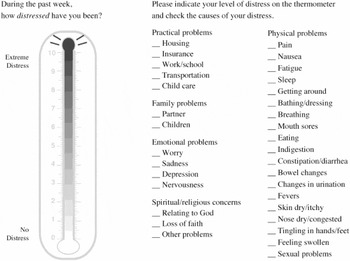
Level of distress should be assessed at each visit, whether this occurs at home, in the clinic or office, or at the hospital or hospice. The NCCN practice guidelines give an algorithm (Fig. 1) for rapid identification of patients with significant distress and the trigger for referral to supportive services. A rapid visual analog approach is used by a verbal question: “How is your distress today on a scale of 0–10?” or by making a hatch mark on the Distress Thermometer (Fig. 2). The Distress Thermometer is similar to the pain scale of 0–10 severity and allows a patient to mark their level of “distress.” A score of 5 or more is the algorithm for referral to a supportive service. The Thermometer is accompanied by the Problem List (Fig. 2) on which the patient marks the nature and source of the distress (physical, social, psychological, or spiritual) and thereby identifies the discipline to which referral is to be made (e.g., mental health, social work, pastoral counseling). Patients have found this acceptable and physicians have found that it serves as a check list to guide questions. Several other screening methods are available and should be studied and compared in a research mode (Razavi et al., 1990; Hopwood et al., 1991; Ibbotson et al., 1994; Zabora et al., 2001).

Overview of evaluation and treatment process. (Reproduced with permission of NCCN.)

The Distress Thermometer. (Reproduced with permission of NCCN.)
Physicians and nurses must be trained to use rapid screening methods to ensure that patients are asked at each visit, at all stages of illness, about their level of distress. Staff must be able to use the algorithm to refer patients to community resources for psychosocial services. Ready access to community resources is important (e.g., a phone referral list). They must be trained in how to communicate with patients and families in an empathic, compassionate, and supportive manner (Maguire & Faulkner, 1988; Fallowfield et al., 1998; Holland & Almanza, 1999; Maguire, 2000).
CLINICAL PRACTICE GUIDELINES
Management of Common Psychiatric Disorders
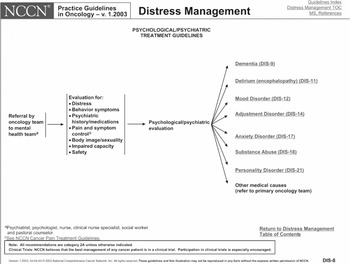
There are several common psychiatric symptoms/disorders (DSM-IV classification) that are encountered during end of life care (Table 1). Mental health professionals with expertise in end-of-life problems can substantially diminish the distress of patients, which is most frequently related to anxiety, depression (mood disorder), and delirium. The American Psychiatric Association Clinical Practice Guidelines are useful for modification to end-of-life care, as are the NCCN guidelines for the management of these disorders specifically in cancer patients (Fig. 3) (Holland 1999; Holland & Almanza, 1999; American Psychiatric Association, 2000a).

Psychological/psychiatric treatment guidelines. (Reproduced with permission of NCCN.)
Delirium
Delirium is a common psychiatric disorder toward the end of life, found to affect, according to one study, as many as 85% of patients in their final days (Massie et al., 1983). The etiology of delirium in the terminally ill cancer patient is often multifactorial due to medication side effects, infection, organ failure, metabolic derangement, and direct CNS involvement. Older individuals who have mild impairment of cognition are especially susceptible to delirium. In the final stages of life, it is unlikely that the cause of the delirium can be resolved, and attention should focus on comfort. All too often, “quiet delirium” is ignored, but patients may be distressed by frightening delusions. Patients' capacity to make health care decisions must be assessed at times and the health care proxy identified. Considerable psychopharmacologic research has gone into management of delirium (usually antipsychotics; Kress et al., 2000; see also Table 1).
Delirium is sometimes accompanied by agitation with self-injurious behavior (pulling out lines), or less likely, the risk of injuring others (Johanson, 1993). Sometimes, poor impulse control, confusion, and depression combine to result in poorly planned, impulsive suicide attempts. Loved ones are frightened by a sudden change in behavior and they need explanation as to the origin—be it related to disease or medication effects or both. Patients need explanation because they fear, “I'm losing my mind” (Chochinov & Breitbart, 2000).
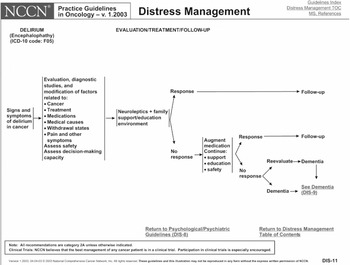
Thus, appropriate treatment of delirium includes steps to ensure early identification, safety of the patient, interventions (both to treat the delirium and its underlying cause, if possible), and education of patient and family to decrease distress associated with this disturbing symptom (see Fig. 4).

Delirium (encephalophathy)—evaluation/treatment/follow-up. (Reproduced with permission of NCCN.)
Depression (Mood Disorder)
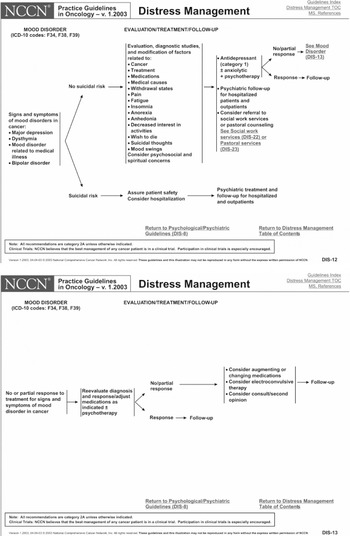
Depression is a common mood disorder at the end of life (Wilson et al., 2000; see also Table 1). The etiology must first be determined, ruling out metabolic, illness, or drug-related causes (Fig. 5). Irrespective of the etiology, depressive symptoms should be addressed and treated. Evaluation of suicidal ideation and risk is essential. It is critically important to evaluate and treat depression because of its role in requests for physician-assisted suicide. The presence of hopelessness appears to be a separate but related factor, along with depression, in suicidal wishes (Breitbart et al., 2000). The notion that depression is an ordinary occurrence at the end of life has been dispelled by careful longitudinal studies by Chochinov et al., who found a high level of fluctuation in suicidal wishes day to day, suggesting caution in assuming a patient's stated wish at a particular time will continue to be the same (Razavi et al., 1990; Passik et al., 1998; Chochinov & Breitbart, 2000).

Mood disorder—evaluation/treatment/follow-up. (Reproduced with permission of NCCN.)
Meeting criteria for true major depression (DSM-IV criteria) is not common, but when major depression is present, it should be treated as aggressively as any physical symptom, with psychological support, psychotherapy, and medication. Antidepressants and psychostimulants are of proven value. Existential forms of psychotherapy using Frankl's concepts and cognitive meaning-seeking psychotherapy are under development by our group (W. Breitbart, pers. comm.). The NCCN guideline for depression is given in Figure 5. Also useful are the clinical practice guidelines developed by the American Psychiatric Association and the Agency for Health Care Policy and Research (see Table 1).
Anxiety Disorders
Anxiety is the most common symptom of distress occurring near the end of life. It often stems from fears related to shortness of breath, pain, unremitting physical symptoms, and uncertainty about the future. Reactive anxiety symptoms alone, or mixed with depressive symptoms, constitute the mildest DSM-IV psychiatric disorder, Adjustment Disorder With Anxiety (American Psychiatric Association, 2000b). The patient requires careful evaluation for illness or medication-related causes: neuroleptic-induced akathisia, corticosteroids, hypoxia or hypercarbia, glucose imbalance, bronchodilators, drug intoxication or withdrawal, and metabolic changes. All must be considered when failure of vital organs is occurring. Diagnosis of generalized anxiety disorder, panic, or obsessive-compulsive, occurs in this context as exacerbation of prior problems. Explanation of symptoms and preparation of the patient and family for approaching death are imperatives. Communication about fears plays an essential role in modulating patient and family anxiety and distress. Assessment of patients' safety and supportive psychotherapy, with or without an anxiolytic or antidepressant medication, is indicated. Medications to control anxiety symptoms are highly efficacious, particularly when psychotherapy is not realistic because of the level of illness. Figure 6 shows the NCCN guideline for the management of anxiety.

Anxiety disorder—evaluation/treatment/follow-up. (Reproduced with permission of NCCN.)
Practice Guidelines for Supportive Services
Social Work Services Guidelines
The guidelines developed by the interdisciplinary panel of the NCCN constitute the first algorithm-based treatment guidelines for delivery of social work services in cancer (Fig. 7). Services given by social workers fall into two domains: psychosocial and concrete services (e.g., transportation). The role of social workers varies enormously across institutions. In some, they provide all psychosocial services as they address the range of psychosocial needs of both patients and families during palliative treatment. In other settings, they are a member of a larger psychosocial team that ideally includes mental health and pastoral counselors. (See Table 1 for guidelines status.)

Algorithm-based treatment guidelines for delivery of social work services in cancer. (Reproduced with permission of NCCN.)
Pastoral Counseling Guidelines
Long an integral part of hospice care, interest is growing in how to better incorporate the spiritual and religious domains in mainstream palliative care, in addition to hospice settings (Post et al., 2000). The development of pastoral counseling guidelines by the NCCN (Fig. 8) underscores the need to include them in supportive, psychosocial services (Holland, 1999). When life ebbs, beliefs and philosophy take on new meaning so that the clinician should be sensitive to these areas, and refer the patient to a pastoral counselor when concerns are expressed about spiritual or religious matters (Puchalski & Romer, 2000). The common problems referred to pastoral counselors are grief, concerns about death/afterlife, conflicted belief systems, loss of faith, concerns about the meaning/purpose of life, relationship to God, isolation from religious community, guilt, hopelessness, conflicts between religious beliefs and recommended treatment, and ritual needs (Speck, 1998). Clergy who have been trained in pastoral counseling should be available to assist in end-of-life care. Problems such as guilt, hopelessness, and grief may require mental health or social work evaluation, prompting the need for close collaboration among all staff taking care of patients in a palliative setting. (See Table 1 for guidelines status.)

Pastoral counseling guidelines. (Reproduced with permission of NCCN.)
POLICY RECOMMENDATIONS
Doctor–Patient Communication
1. Training of doctors in communication is critical to ensure quality end-of-life care by developing simple protocol/practice guidelines and standards (see Table 1). The best teaching model is one that uses faculty from the physician's own discipline (e.g., oncologists) as well as a physician or mental health clinician skilled in teaching communication. Because such workshops have a low priority for voluntary attendance, mandating participation via required risk-management lectures is useful. The content of the skills teaching sessions is best acquired when the groups are small in number, when they use video tapes of model patterns of communication, and when they include role play that enhances awareness of/sensitivity to patients' emotional responses, and also the doctor's own responses.
2. Research is needed to determine the best teaching methods. Approaches based on a theoretical model of stress are effective, such as the Transpersonal Model of Stress, which examines the physicians' and patients' responses at each phase of the discussion (Ptacek & Eberhardt, 1996).
3. Improving communication with family is recommended, especially in view of the role families now play in physical care at the end of life, and because of the intense psychological impact of this time in their lives and for years to come. We have to explore ways to educate the family in how to manage pain, distress, and other symptoms in the patient, and how to communicate with the doctor about their concerns.
Standards for Psychosocial Care
1. Standards for psychosocial care and clinical practice guidelines for supportive services should be endorsed by major organizations involved in end-of-life care. They should be promulgated in a manner similar to that used with pain management.
2. Educational standards for end-of-life care must include training in the recognition of distress and its management by the primary care team. Such standards should also be included in the curricula of both mental health professionals (psychologists, psychiatrists, psychiatric social workers, and nurses) and the clergy qualifying as pastoral counselors.
3. Pastoral counseling should be included in psychosocial services, because they should not be fragmented and distanced from other aspects of care during end of life.
4. Patients and families must be educated to understand that the psychosocial/spiritual domains are an integral part of their end-of-life care and should not be viewed as disconnected and unrelated.
5. Governmental/managed care organizations must be made aware of the inequity in reimbursement for the nonphysical aspects of end-of-life care, which impacts negatively on ensuring quality of care to reduce suffering and distress.
SUMMARY
Algorithm-based clinical practice guidelines relating to psychiatric, psychosocial, and spiritual domains can effect a major improvement in end-of-life care by defining a gold standard for clinicians in an area not previously subjected to such a level of scrutiny. This article outlines the status of these guidelines and offers recommendations for policy development relative to doctor–patient communication and management of distress (psychological, social, existential, spiritual) and psychiatric disorders. The arching principle of these standards and guidelines is the recognition that the physical and the psychosocial are interrelated and overlapping in end-of-life care, and that patients should receive their total care as a seamless integration of physical and supportive services.
References
REFERENCES
Ahmedzai, S.
(1998).
Palliation of respiratory symptoms. In
Oxford Textbook of Palliative Medicine,
2nd ed.,
Doyle, D.,
Hanks, G.W.C. &
MacDonald, N. (eds.), pp.
583–616.
New York:
Oxford University Press.
American Academy of Neurology.
(1996).
Report of the Ethics and Humanities Subcommittee of the American
Academy of Neurology: Palliative Care in Neurology.
Neurology,
46,
870–872.Google Scholar
American Board of Internal Medicine.
(1996).
Caring for the dying: Identification and promotion of physician
competency.
Educational Resource Document.
Philadelphia:
American Board of Internal Medicine.
American Nursing Association.
(1991).
Position statement on promotion of comfort and relief of pain in
dying patients.
Kansas City:
American Nursing Association.
American Pain Society Quality of Care Committee.
(1995).
Quality improvement guidelines for the treatment of acute pain and
cancer pain.
JAMA,
274,
1874–1880.Google Scholar
American Psychiatric Association.
(2000a).
APA Clinical Practice Guidelines for Psychiatric Disorders
Compendium 2000.
Washington, DC:
American Psychiatric Association.
American Psychiatric Association.
(2000b).
Diagnostic and Statistical Manual of Mental Disorders,
4th ed.,
Text Revision.
Washington, DC:
American Psychiatric Association.
American Society of Clinical Oncology.
(1996).
Outcomes of cancer treatment for technology assessment and cancer
treatment guidelines.
Journal of Clinical Oncology,
14,
671–679.Google Scholar
Baile, W.F.,
Glober, G.A.,
Lenzi, & R.,
et al.
(1999).
Discussing disease progression and end of life decisions.
Oncology,
13,
1021–1028.Google Scholar
Braun, K.L.,
Pietsch, J.H., &
Blanchette, P.L. (eds.).
(2000).
Cultural Issues in End-of-Life Decision Making.
Thousand Oaks, CA:
Sage Publications.
Breitbart, W.,
Rosenfeld, B.,
Pessin, & H.,
et al.
(2000).
Depression, hopelessness and desire for hastened death in
terminally ill patients with cancer.
JAMA,
284,
2907–2911.Google Scholar
Buckman, R.
(1998).
Communication in palliative care: A practical guide. In
Oxford Textbook of Palliative Medicine,
2nd ed.,
Doyle, D.,
Hanks, G.W.C. &
MacDonald, N. (eds.), pp.
141–150.
New York:
Oxford University Press.
Callahan, D.
(1993).
The Troubled Dream of Life: In Search of a Peaceful Death.
New York:
Simon and Schuster.
Carroll, B.T.,
Kathol, R.,
Noyes, & R.,
et al.
(1993).
Screening for depression and anxiety in cancer patients using the
hospital anxiety and depression scale.
General Hospital Psychiatry,
15,
69–74.Google Scholar
Carver, A.C. &
Foley, K.M.
(2000).
Palliative care. In
Cancer Medicine,
5th ed.,
Holland, J.F.,
Frei, E., III,
Bast, R., Jr.,
et al. (eds.), pp.
992–1000.
Hamilton, Ontario, Canada:
B.C. Decker.
Cassel, C. &
Foley, K.
(1999).
Principles for Care of Patients at the End of Life: An Emerging
Consensus among the Specialties of Medicine.
New York:
Milbank Memorial Fund.
Cassem, N.
(1997).
The dying patient. In
Massachusetts General Hospital Handbook of General Hospital
Psychiatry,
4th ed.,
Cassem, N.,
Stern, T.,
Rosenbaum, J.,
et al. (eds.), pp.
605–636.
St. Louis:
Mosby-Year Book.
Chassin, M.R. &
Gavin, R.W.
(1998).
The urgent need to improve health care quality: Institute of
Medicine Roundtable on Health Care Quality.
JAMA,
280,
1000–1005.Google Scholar
Cherny, N.,
Coyle, N., &
Foley, K.
(1996).
Guidelines in the care of the dying cancer patient. In
Pain and Palliative Care,
Cherny, N. &
Foley, K. (eds.), pp.
261–286.
Philadelphia:
Hematology/Oncology Clinics of North America.
Cherny, N. &
Portenoy, R.
(1994).
Sedation in the treatment of refractory symptoms: Guidelines for
evaluation and treatment.
Journal of Palliative Care,
10,
31–38.Google Scholar
Chochinov, H. &
Breitbart, W. (eds.).
(2000).
Handbook of Psychiatry in Palliative Medicine.
New York:
Oxford University Press.
Chochinov, H.,
Holland, J.C., &
Katz, L.
(1998).
Bereavement: A special issue in oncology. In
Psycho-oncology,
Holland, J.C. (ed.).
New York:
Oxford University Press.
Fallowfield, L.,
Lipkin, M., &
Hall, A.
(1998).
Teaching senior oncologists communication skills: Results from
phase 1 of a comprehensive longitudinal program in the United
Kingdom.
Journal of Clinical Oncology,
16,
1961–1968.Google Scholar
Field, M. &
Cassel, C. (eds.).
(1997).
Approaching Death-Improving Care at the End of Life.
Washington, DC:
National Academy Press.
Field, M. &
Lohr, K. (eds.).
(1990).
Clinical Practice Guidelines: Directions for a New Program.
Washington, DC:
National Academy Press.
Field, M. &
Lohr, K. (eds.).
(1992).
Guidelines for Clinical Practice: From Development to Use.
Washington, DC:
National Academy Press.
Fitchett, G. &
Handzo, G.
(1998).
Spiritual assessment, screening, and intervention. In
Psycho-oncology,
Holland, J.C. (ed.), pp.
790–808.
New York:
Oxford University Press.
Girgis, A. &
Sanson-Fisher, R.W.
(1995).
Breaking bad news: Consensus guidelines for medical practitioners.
Journal of Clinical Oncology,
13,
2449–2456.Google Scholar
Hastings Center.
(1987).
Guidelines on the Termination Of Life-Sustaining Treatment and the
Care of the Dying: A Report.
Briarcliff Manor, NY:
Hastings Center.
Hirschfeld, R.,
Keller, M.,
Panico, & S.,
et al.
(1997).
The National Depressive and Manic-Depressive Association consensus
statement on the undertreatment of depression.
JAMA,
277,
333–340.Google Scholar
Holland, J.C.
(1997).
Preliminary guidelines for the treatment of distress.
Oncology,
11A,
109–114.Google Scholar
Holland, J.C. (ed.).
(1998).
Psycho-oncology.
New York:
Oxford University Press.
Holland, J.C.
(1999).
NCCN practice guidelines for the management of psychosocial
distress.
Oncology,
13(5A),
113–147.Google Scholar
Holland, J.C. &
Almanza, J.
(1999).
Giving bad news: Is there a kinder, gentler way?
Cancer,
86,
738–740.Google Scholar
Hopwood, P.,
Howell, A., &
Maguire, P.
(1991).
Screening for psychiatric morbidity in patients with advanced
breast cancer: Validation of two self-report questionnaires.
British Journal of Cancer,
64,
353–356.Google Scholar
Ibbotson, T.,
Maguire, P.,
Selby, & P.,
et al.
(1994).
Screening for anxiety and depression in cancer patients: The
effects of disease and treatments.
European Journal of Cancer,
30A,
37–40.Google Scholar
Institute of Medicine,
Field, M., &
Cassel, C. (eds.).
(1997).
Approaching Death: Improving Care at the End of Life.
Washington, DC:
National Academies Press.
Jacox, A.,
Carr, D.B.,
Payne, & R.,
et al.
(1994).
Management of Cancer Pain: Adults Quick Reference Guide. No. 9.
Rockville, MD:
Agency for Health Care Policy and Research, U.S. Department of Health
and Human Services.
Jay, R. &
Olson, E.
(1974).
In living and dying.
New York:
Praeger.
Johanson, G.A.
(1993).
Midazolam in terminal care.
American Journal of Hospital Palliative Care,
10,
13–14.Google Scholar
Journal of the National Comprehensive Cancer Network.
Vol. 1, No. 3 pp.
344–374,
July 2003.
Karasu, B.
(2000).
Spiritual psychotherapy.
American Journal of Psychotherapy,
53,
143–162.Google Scholar
Kress, J.,
Pohlman, A.,
O'Connor, & M.,
et al.
(2000).
Daily interruption of sedative infusion in critically ill patients
undergoing mechanical ventilation.
New England Journal of Medicine,
342,
1471–1477.Google Scholar
Maguire, P.
(2000).
Communication with terminally ill patients and their relatives. In
Handbook of Psychiatry in Palliative Medicine,
Chochinov, H. &
Breitbart, W. (eds.), pp.
291–301.
New York:
Oxford University Press.
Maguire, P. &
Faulkner, A.
(1988).
Communicate with cancer patients: 1. Handling bad news and
difficult questions.
British Medical Journal,
297,
907–909.Google Scholar
Massie, M.J.,
Holland, J.C., &
Glass, E.
(1983).
Delirium in terminally ill cancer patients.
American Journal of Psychiatry,
140,
1048–1050.Google Scholar
Passik, S.,
Dugan, W.,
McDonald, & M.,
et al.
(1998).
Oncologists' recognition of depression in patients with cancer.
Journal of Clinical Oncology,
16,
1594–1600.Google Scholar
Pellegrino, E.
(2000).
Ethical issues in palliative care. In
Handbook of Psychiatry in Palliative Medicine,
Chochinov, H. &
Breitbart, W. (eds.), pp.
337–348.
New York:
Oxford University Press.
Post, S.,
Puchalski, C., &
Larson, D.
(2000).
Physicians and patient spirituality: Professional boundaries,
competency, and ethics.
Annals of Internal Medicine,
132,
578–583.Google Scholar
Ptacek, J. &
Eberhardt, T.
(1996).
Breaking bad news. A review of the literature.
JAMA,
276,
496–502.Google Scholar
Puchalski, C. &
Romer, A.
(2000).
Taking a spiritual history allows clinicians to understand patients
more fully.
Journal of Palliative Medicine,
3,
129–137.Google Scholar
Razavi, D.,
Delvaux, N.,
Farvacques, & C.,
et al.
(1990).
Screening for adjustment disorders and major depressive disorders
in cancer patients.
British Journal of Psychiatry,
156,
79–83.Google Scholar
Rousseau, P.
(2000).
Spirituality and the dying patient.
Journal of Clinical Oncology,
18,
2000–2002.Google Scholar
Singer, P.,
Martin, D., &
Kelner, M.
(1999).
Quality end of life care—Patients' perspectives.
JAMA,
281,
163–168.Google Scholar
Speck, P.
(1998).
Spiritual issues in palliative care. In
Oxford Textbook of Palliative Medicine,
2nd ed.,
Doyle, D.,
Hanks, G.W.C. &
MacDonald, N. (eds.), pp.
805–814.
New York:
Oxford University Press.
Speice, J.,
Harkness, J.,
Laneri, & R.,
et al.
(2000).
Involving family members in cancer care: Focus group considerations
of patients and oncological providers.
Psycho-Oncology,
9,
101–112.Google Scholar
Twycross, R. &
Lichter, I.
(1998).
The terminal phase. In
Oxford Textbook of Palliative Medicine,
2nd ed.,
Doyle, D.,
Hanks, G.W.C. &
MacDonald, N. (eds.), pp.
977–990.
New York:
Oxford University Press.
Wanzer, S.,
Federman, D.,
Adelstein, & S.,
et al.
(1989).
The physician's responsibility toward hopelessly ill
patients—A second look.
New England Journal of Medicine,
120,
844–849.Google Scholar
Wilson, K.,
Chochinov, H.,
de Faye, & B.,
et al.
(2000).
Diagnosis and management of depression in palliative care. In
Handbook of Psychiatry in Palliative Medicine,
Chochinov, H. &
Breitbart, W. (eds.), pp.
25–49.
New York:
Oxford University Press.
World Health Organization.
(1996).
Report of the WHO Expert Committee on cancer pain relief and active
supportive care: Cancer pain relief with a guide to opioid availability.
Technical Report Series 804.
2nd ed.
Geneva:
World Health Organization.
World Health Organization.
(1998).
Symptom Relief in Terminal Illness.
Geneva:
World Health Organization.
Zabora, J.,
BrintzenhofeSzoc, K.,
Curbow, & B.,
et al.
(2001).
The prevalence of psychological distress by cancer site.
Psycho-Oncology,
10,
19–28.Google Scholar
Zisook, S.
(2000).
Understanding and managing bereavement in palliative care. In
Handbook of Psychiatry in Palliative Medicine,
Chochinov, H. &
Breitbart, W. (eds.), pp.
321–334.
New York:
Oxford University Press.

Clinical practice guidelines for management of distress in end-of-life care

Overview of evaluation and treatment process. (Reproduced with permission of NCCN.)
The Distress Thermometer. (Reproduced with permission of NCCN.)
Psychological/psychiatric treatment guidelines. (Reproduced with permission of NCCN.)
Delirium (encephalophathy)—evaluation/treatment/follow-up. (Reproduced with permission of NCCN.)
Mood disorder—evaluation/treatment/follow-up. (Reproduced with permission of NCCN.)
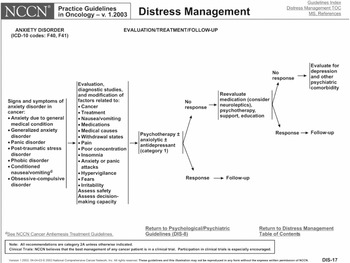
Anxiety disorder—evaluation/treatment/follow-up. (Reproduced with permission of NCCN.)
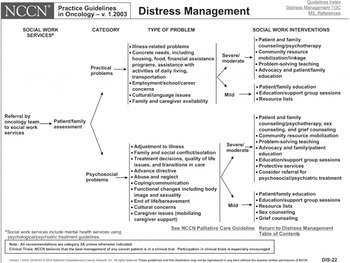
Algorithm-based treatment guidelines for delivery of social work services in cancer. (Reproduced with permission of NCCN.)
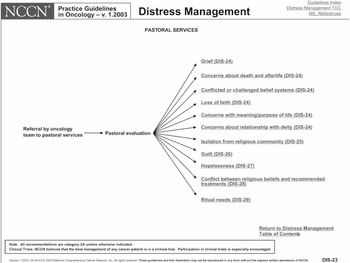
Pastoral counseling guidelines. (Reproduced with permission of NCCN.)
 You have
Access
- 27
- Cited by