1. Introduction
This article addresses the causes of England's unusually slow demographic recovery after the Black Death of 1348–1350. To do so it will be necessary to review aspects of monetary and more general economic history, which we suggest have a significant effect on the population in this period. The later Middle Ages was a period of widespread coinage debasement, which reduced the intrinsic precious metal content of coinages across Europe. The varying nature and extent of such debasements from country to country may have influenced the different rates of economic and demographic growth, which those countries experienced. Put simply, debasement increases the money supply and so raises prices. Too much debasement undermines confidence in money, while too little restricts the money supply, and constrains economic activity.
Yet, in focusing on monetary factors, we do not pretend that they alone explain the varying fortunes of the national economies of later medieval Europe. Quantity Theory, (MV = PT) embraces Money (M), Prices (P), the level of Transactions (T) (influenced of course by population), and institutional factors affect Velocity (V), so no one imagines that the Money element operates in isolation.Footnote 1 Obviously war, and social and climatic changes also influence economic and demographic development.Footnote 2 However, England's distinctive monetary policies may also have played a significant part helping to explain England's distinctive demographic and economic outcomes. In the first section, we first identify the extent to which England's monetary policy and currency strength differed from those of her neighbours’. In the second section, we set out the different demographic trends of England and her neighbours in the two centuries following the Black Death. Finally, the third section examines the interaction between demography and the economy. In the aftermath of the Black Death catastrophic mortality had enormous economic effects, but demographers also draw attention to fertility and nuptiality, which powerfully affected the possibility of any recovery of population levels, and marriage opportunities were strongly influenced by the health of the wider economy.
This article argues that the general economy was in turn strongly affected by monetary policy: later medieval English monetary policy favoured gold coinage at the expense of silver, and completely lacked any base metal small change. England's money seems to have been less suited to the economic needs of the time, which were better served by monetary policies pursued in neighbouring countries. Interestingly, population recovery occurred earlier in these neighbouring countries than in England. Better monetary policies may have permitted better economic growth in the fifteenth century, and such growth may have helped to provide the economic opportunities necessary to stimulate faster population growth.
To appreciate the importance of medieval monetary policy it is first necessary to recognise the widespread use of medieval money, which is increasingly apparent from Anglo-Saxon times through to the later Middle Ages. Since the 1960s, work on early medieval monetary history has revised received opinion about the use of money in England between the eighth and the twelfth centuries. Perhaps the earliest exponent of the new thinking, Michael Metcalf, was heavily criticised, but the new argument, that Anglo-Saxon coinage was struck in much larger quantities and much more widely used than previously thought, received powerful support from the sheer numbers in which Anglo-Saxon coins were being found in the ground, and is currently approaching the status of the new orthodoxy.Footnote 3 Rory Naismith provides a scholarly statement of new thinking about money in England in the eighth and ninth centuries, which recognises ‘a substantial monetary component to the economy’ of Anglo-Saxon England in this period, but nevertheless takes full account of earlier thinking, recognising the importance of alms, gift-giving, barter, and payments in kind or service. Naismith doubts that England had become a ‘fully monetised economy’ by this time but does conclude that the commercial use of coins and markets was ‘much more prominent than has been allowed in some recent literature and could have played an important integrative role in exchanges and in society as a whole. This use lay at the heart of a rich, well-supplied and varied sphere of monetary exchange’.Footnote 4 Very recently, and addressing a slightly later period, 924–1135, Henry Fairburn, argues that ‘widespread coinage use below the level of the elite’ would be an important symptom of a monetised economy, and he demonstrates that such use is to be found in late Anglo-Saxon and early Norman England.Footnote 5 Fairburn's article, based on his PhD Thesis, combines his own detailed assembling of direct evidence with many supporting opinions.Footnote 6
Although some medievalists may doubt the importance of money in the Middle Ages, few would argue that prices were unimportant, and money and prices are inextricably linked. It is for this reason that the later twelfth century inflation, which coincides with a marked and sudden increase in the size of the English, and European, money supply, is significant.Footnote 7 Both the upward trends in prices and money supply continue through the thirteenth century and into the first quarter of the fourteenth century, contributing to the increasing commercialisation of the economy and society, and to the rise in population, which are all a feature of this period. The commercial and monetised nature of the medieval English economy from the late twelfth century is now increasingly recognised, so the idea that money played an active role in the economy is no longer the eccentric opinion of a few numismatists. Christopher Dyer argues that almost half the English population in the later Middle Ages depended on wages for most of their income.Footnote 8 Richard Britnell and Bruce Campbell have described England in 1086–1300 as ‘a commercialising economy’, whilst John Hatcher has noted that ‘there can be no doubt…that monetary factors contributed substantially to the depression of aggregate demand in the mid-fifteenth century’.Footnote 9 Production for monetised markets was widespread, and the use of money was pervasive. Medieval coins are still found plentifully in the ground, while sums of money are met everywhere in medieval documents.Footnote 10 Yet, in the fourteenth and fifteenth centuries the period of buoyant money supply and prices came to an end, and a period of monetary shortage, stagnant prices, and economic recession followed. Contemporaries fully appreciated that shortage of money hindered trade: as Brian Rocliffe wrote to Sir William Plumpton in 1464, ‘Impedit omne forum carentia denariorum’ (‘scarcity of money hinders every market’). John Maddicott quotes a poem dated 1338 or 1339 making the same point: ‘There is a desperate shortage of cash among the people. At market the buyers are so few that a man can do no business, although he may have cloth or corn, pigs or sheep to sell, because so many are destitute’.Footnote 11 Nor can it be objected that credit would solve any shortages of coin. Nightingale has definitively demonstrated how the availability of credit depended on the availability of coin, while Briggs found no evidence that credit expanded during the monetary shortage of the 1390s. Hatcher recognised that ‘far from compensating for the fall in physical money, the supply of credit seems also to have shrunk’.Footnote 12 Though medieval credit was widespread and essential, the supply of credit followed the money supply; when money was scarce, so too was credit.
Perhaps slightly less than half of households earned their living chiefly through wages, and many households still achieved a good deal of self-sufficiency in food. But even a largely self-sufficient peasantry still had to buy and sell. Everyone needed money to pay rent, tax, and manorial dues, and to buy manufactured essentials. Before the Black Death many peasants lacked sufficient land to maintain their families without taking on additional paid work, and households were well used to pulling a living together from various sources.Footnote 13 A very significant twenty per cent of the total population are estimated to have lived in towns in the later Middle Ages, and town life necessarily required cash, as did local, regional and international trade.Footnote 14 Town and country were obviously inter-dependent, and money was essential in that relationship. Thus, historical analysis of later medieval England needs to embrace and reconcile an understanding of both self-sufficiency, and of the pervasive habit and need for coin use. Dyer has demonstrated how such a balance can be struck, taking full account of self-sufficiency, matched by an awareness of the persistence of money prices, and deeply established habits of buying and selling for money.Footnote 15 He has also very thoroughly documented both coin shortages and the means used to mitigate them, as well as describing the persistence of prices expressed in money terms, and how fully peasants used coin.Footnote 16
Medieval government certainly appreciated the importance of money and devoted an enormous amount of time and energy to it. Those best placed to appreciate the part played by coin in the Middle Ages, that is to say, the governments of the day, attended to the country's monetary requirements with very great care. English parliamentary petitions and legislation concerning money abound, and particularly address monetary shortage.Footnote 17 Parliamentary discussions flag up problems, and government constantly sought to boost mint output as much as they could. Yet beyond the production of the mints, government played an energetic role in the organisation, administration, and enforcement of monetary regulation in law courts, in markets, and in taxation. Medieval governments certainly thought money was important enough to give it a great deal of attention. For England, Christine Desan has powerfully demonstrated this essential involvement of government in the business of money. Critically she has convincingly shown that the domestic value of money was determined and conferred by government decree (nominalism), rather than by the intrinsic content of the coins themselves. Desan's study of decisions in the law courts demonstrates that English monarchs successfully enforced their valuation of the coinage in repeated judgements from the thirteenth to the seventeenth century despite the halving of its intrinsic content over that period. Money consists in whatever the market accepts, but market acceptance has usually been achieved best by royal willingness to accept its own decreed money in payment of tax, and by government enforcement in the courts. To a surprising degree, both then and now, money was and is what the government says it is.Footnote 18
This basic principle is obviously important and underpins the right and the ability of government to debase or enhance the intrinsic content of coin and to alter it as it saw fit.Footnote 19 At the practical level of individual transactions, it means that payments were made by counting coins at their government-decreed face value, rather than by weighing, or assaying them. There has been a good deal of uncertainty and confusion on this point, which obviously bears critically on governments’ ability to change the precious metal content of the currency, but uncertainty about this has now been definitively dispelled by Desan.Footnote 20 Accordingly, this article proceeds on the basis that alongside barter, labour and service rents, and deferred payments, money payments were pervasive in medieval England, and that the control and organisation of money was a critically important, and jealously guarded, function of government. The right to debase or enhance the intrinsic value of the currency was central to these functions.
2. Part one debasement
2.1. Debasement in England
Government set the price at which their mints bought bullion and turned it into coin. These mint prices for gold and silver, together with the charges made for minting bullion into coin, had profound effects on the quantity of money struck, the provision of the means of exchange within their economies, the behaviour of prices, and the ability of the economy as a whole to grow, or not. Medieval governments were not able to control national interest rates, but monetary policy had economic effects analogous to those of interest rate changes in the modern world, expanding or constraining the availability of the means of exchange.Footnote 21
In the course of the ordinary management of the mint, medieval governments often had to adjust the mint price they paid when buying bullion.Footnote 22 Later medieval England had a currency with a higher precious metal content and a higher exchange value than those of its trading partners, yet even England – the classic example of a hard money economy – reduced the weight of its currency in 1343–1351, 1412–1413, 1464–1466, and 1526.Footnote 23 On these occasions the reductions in the intrinsic content of the currency did not inflate prices.Footnote 24 The inflation-free English adjustments achieved a modest increase in the money supply in a time of chronic scarcity, but these English adjustments (1343–1526) did not go far enough to attract more precious metal. The value of silver and gold was rising throughout Europe, and other countries’ mints paid higher prices than England to acquire bullion.Footnote 25
After the survivors’ post-plague boom of 1350–1375, England experienced a prolonged recession.Footnote 26 Prices and per capita GDP leapt directly as a result of the Black Death, but stalled before the end of the fourteenth century, and flat-lined through the fifteenth century.Footnote 27 Although some towns and cloth manufacturing areas escaped the worst of the recession, the stagnant prices which characterize this period until the sixteenth century indicate that the dominant trend, for the country as a whole was at best flat. The direct exploitation of manors became increasingly unprofitable in the face of high wages and discouraging prices. Arrears mounted in the accounts until they were written off. Stagnant prices also discouraged peasant farmers, and landowners found it hard to find tenants, even at lower rents.Footnote 28 England's strong money policies kept money scarce and prices low. English parliamentary petitions and legislation concerning money abound, and particularly address monetary shortage, but the determined preference for strong money limited the effectiveness of measures to increase the availability of coin.Footnote 29
English later medieval monetary policy was also sub-optimal in other respects. Firstly, English mints bought and struck far more gold than silver and, secondly, England did not issue billon, copper coinage with little silver content used for small change. After the Black Death, English mint output markedly favoured gold rather than silver. A mere 24.4 per cent of the value of total documented English mint output of the period 1344 to 1509 was in silver. Bearing in mind that there was no copper or billon coinage in England at this time, the rest of the currency, 75.6 per cent, was in gold. For comparison we may note that the silver coinage represented 43.4 per cent by value of output in the period 1509–1542, and 64.1 percent in 1559–1649.Footnote 30
While gold has generally served well as a store of value, it circulates much less satisfactorily as a means of exchange. Finds of silver are typically significantly worn in circulation, but gold coin is usually less worn.Footnote 31 This observation, together with the obvious point that gold's value made it less suited for the smaller transactions of ordinary life, suggests that the overwhelming dominance of gold in the later medieval English money supply was problematic. The condition of surviving medieval coins is consistent with the idea that silver saw much more active circulation, while gold coin was appreciated as ‘money to hold’. Recent estimates suggest that Henry VII's propensity to hold gold may have led him to withdraw a significant proportion of the national money stock from active circulation, and such behaviour may not have been restricted to the monarchy.Footnote 32 If the circulating medium depended so heavily on relatively scarce silver, the very marked imbalance between the availability of gold and silver in the English fifteenth-century currency appears significant. Nightingale has addressed the topic, arguing that the marked gold bias of the English currency in the later fourteenth and fifteenth century had a powerful deflationary effect.Footnote 33 John Munro noted that ‘England was the only major northern European country to pursue so consistently for so long a pro-gold policy’ and that late medieval countries which favoured gold strongly ‘undoubtedly did their domestic economies a disservice’.Footnote 34
Other European countries, which struck significant quantities of gold, responded to the difficulty of attracting silver to their mints by reducing the silver content of their coinage, and also created billon coinages to ensure an adequate supply of petty coinage in the marketplace. Fourteenth-century Florence maintained a gold currency of unchanged weight and fineness, alongside a silver currency including a number of denominations struck at differing standards. The silver contents of the grosso, quatrino and denaro piccolo varied disproportionately but passed domestically at the face value set on them by the Florentine government.Footnote 35 Later medieval Venice repeatedly debased its billon petty coinage as it wrestled with the complexities involved in maintaining the fineness of both its gold ducat and silver grosso.Footnote 36 Flanders also debased its petty coinage so that it contained proportionately less silver than its larger denominations. In contrast England – in a system described by Munro as ‘peculiar’ – regulated the silver content of its small coins in proportion to that of the larger denominations.Footnote 37
Thus, England's monetary policies exacerbated a severe Europe-wide shortage of silver. The English problem was compounded by the failure to provide an adequate supply of small change. Other countries typically issued petty coins of reduced fineness, but the English attachment to a silver fineness of 92.5 per cent – the Sterling standard – was a major obstacle to the provision of an adequate supply of small change. The high silver content of the English coinage was established long before the Conquest, and its maintenance was regarded as symbolic of England's economic strength and intimately associated with the dignity and honour of the sovereign.Footnote 38 In consequence, England endured ‘a serious under-supply of small change’, which rendered the English currency system singularly ill-fitted to meet the needs of its economy.Footnote 39 The fundamentally-flawed design of the English medieval monetary system, amplified by Desan, was not conducive to economic growth.Footnote 40 In addition, for the most part England fairly consistently under-valued silver compared with gold, and compared with the corresponding values reflected in the mint prices of competing mints in northern Europe. Debasing mints bid up the price of silver in order to acquire the metal necessary for debasement, resulting in gold-silver ratios which drew silver to France, Flanders and Scotland, and sent gold to England.Footnote 41 This pro-gold policy exacerbated the scarcity of silver in the English currency.
2.2. Debasement in England's neighbours
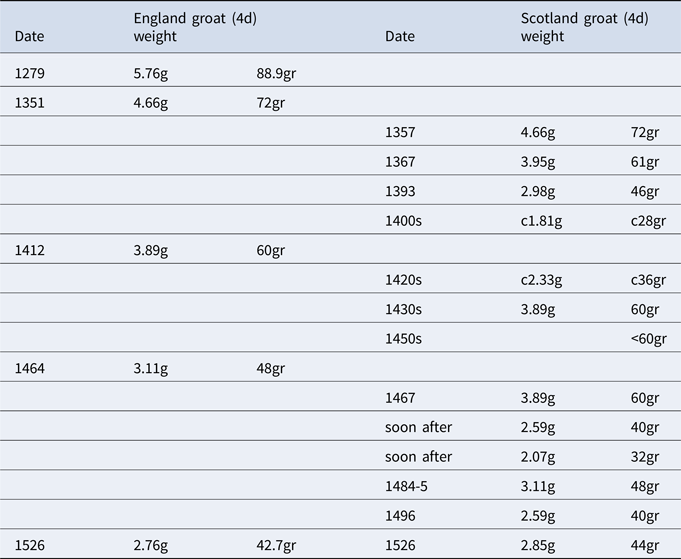
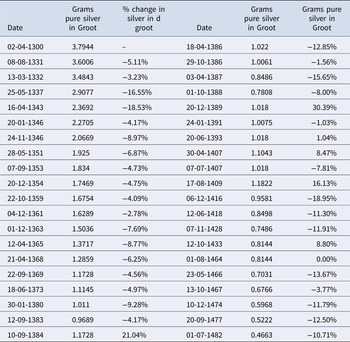
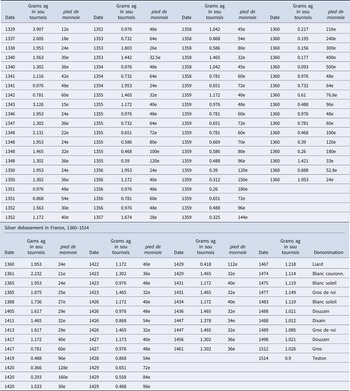
The very different course of debasement in Scotland, the Low Countries, and France contrasts strongly with the English experience (see Tables 1–3). Though it has been suggested above that England might have debased more than she did, neighbouring countries sometimes used debasement as a source of emergency government funding, particularly in time of war. Debasements were also sometimes competitive, hoping to attract bullion towards their mints rather than to those of rivals, and the Scottish government certainly justified at least one of its debasements in terms of the need to supply the country with more coinage.Footnote 42
Silver debasement in England and Scotland, 1279–1526

E. Gemmill and N. Mayhew, Changing Values in Medieval Scotland: A study of prices, money and weights and measures (Cambridge, 1995), Ch.5 esp, 138.
Silver debasement in Flanders, 1300–1482: Flemish Silver Groot

J. Munro, ‘Coinage debasements in Burgundian Flanders 1334–1482: monetary or fiscal policies?’, Table 1A The Flemish Silver Coinage from 1300 to 1482; Table 1B Alterations of the Flemish Silver Coinages 1384–1482, with Bullion Prices, Seigniorage and Brassage Fees, in D. Nicholas, B. Bachrach, J. Murray (eds.), Comparative perspectives on history and historians: Essays in memory of Bryce Lyon (1920–2007) (Kalamazoo, 2012), 336–41.
Silver debasement in France, 1329–1360

E. Fournial, Histoire monétaire de l'Occident médiéval (Paris, 1970), 100–01.
E. Fournial, Histoire monétaire de l'Occident medieval (Paris, 1970), 118, 127, 133, 137.
The Scottish gold and silver coinage stood at parity with the English until the mid-fourteenth century but by the early sixteenth century the Scottish-English silver coin equivalence stood at almost 4.5 to 1, Scots to English, and almost 5 to 1 in gold (see Table 1). In addition, Scotland issued a billon coinage to supply the need for small change.Footnote 43 Evidence from the Low Countries leaves no doubt that debasements there unquestionably reduced the silver content of their coinages significantly. Katherine Ball has compared the silver weight of English, Scottish, Flemish and Brabantine pence, demonstrating the higher precious metal content of English money compared with that of her neighbours.Footnote 44 Munro describes Flemish medieval debasement in precise and exhaustive detail illustrating the reduction in the intrinsic content of this coinage,Footnote 45 and calculating the rise in Flemish prices associated with this debasement (though it should be noted that Munro did not find or expect inflation to be directly proportional to the level of debasement).Footnote 46 Munro's data for the silver debasement in Flanders is summarised here in Table 2.
The course of later medieval debasement in France has been laid out with admirable clarity by Etienne Fournial. He records the fluctuations of the pied de monnaie, a calculation formally introduced in 1329 to indicate the intrinsic content of the silver currency. Fournial's data is summarized here in Table 3, demonstrating the extent and frequency of French mutations, (debasements and reinforcements) which contrast so strongly with England. French debasement in the fourteenth and fifteenth centuries was largely driven by the crippling costs of warfare, occasioned above all by the English invasions during the Hundred Years War. From the 1430s as the war turned in France's favour, French debasements were largely halted, but not reversed. The 1436 restoration did not equal the strength of the 1413 issue, still less that of 1329. Subsequently, gentle silver debasement continued to 1514, and after 1467 the billon ‘black money’ (petty coinage) was no longer valued in proportion with its silver content, ending the pied de monnaie system.Footnote 47 The impact of this French debasement – so famously denounced by Nicolas Oresme – has been fully described by Harry Miskimin.Footnote 48
Later medieval France experienced severe debasement, and consequent inflation. Miskimin contrasts the levels of debasement, which were often high in France and Burgundy but consistently restrained in England.Footnote 49 He also shows how French prices rose in line with debasement.Footnote 50 Miskimin documents the reduction in the intrinsic content of French gold and silver during the fifteenth century, and he notes ‘… prices rose swiftly, indeed nearly simultaneously, in response to each weakening of the coinage…’.Footnote 51 Overall, he summarised the effect of debasement on prices finding that the reduction in the intrinsic content of the coinage was ‘paralleled … by a moderate upward trend in the nominal wheat price’.Footnote 52 However, moderate French debasement was also characterised by repeated bouts of very severe debasement, which had profoundly damaging social, political and economic effects, and were one of the consequences of war, which impacted so harshly on the French population in the first half of the fifteenth century. In France, the crown and the courts insisted on the right to debase the coinage and to establish its nominal face value, but the extent of French debasement was at times so severe that the market found ways to protect the value of money to some degree, and French lawyers argued that account should be taken of the reduced intrinsic value in money when settling debts.Footnote 53 England, where the crown had long enjoyed extensive rights over the currency, remained strictly nominalist, while Continental lawyers argued for greater flexibility, perhaps reflecting the heavier debasements occurring in mainland Europe.Footnote 54
When the most extreme periods of French debasement were over, relative monetary stability returned in the second half of the century, although this did not restore the French currency to pre-debasement levels. France recorded the strength of its silver currency at this time as about one third that of the sound money of 1329, while English sterling silver coinage in the second half of the fifteenth century was slightly better than half that of its early fourteenth-century peak.Footnote 55 As a result of debasement the French nominal wheat price rose despite the fifteenth-century shortages of bullion. In contrast, English nominal prices fell slightly despite the moderate reductions in the weight of the English penny from 22 grs at the beginning of the fourteenth century to 18 grs in 1351, 15 grs in 1412, and to 12 grs in 1464 where it was held until 1526. Ball has also shown that debasement in Scotland, Flanders and Brabant was a prime mover of prices in those countries, though not in England, which had not debased so much.Footnote 56 She also notes that rents in England were flat or falling, while they were rising in Flanders.Footnote 57 England did not debase enough to reflect the rising value of silver on the international market, so failed to raise domestic prices, but it is the consequences of that failure which are addressed in the remainder of this article.
2.3. The English Recession
The observation that countries which debased more experienced more inflation is hardly contentious. However, the assumption that inflation is economically damaging needs closer examination since a degree of inflation may be preferable to a prolonged period of flat prices.Footnote 58 From the 1380s till the 1520s English prices effectively stalled at levels significantly below those typical of the earlier fourteenth century or of the sixteenth century. Keynes, writing in the depths of the Great Depression in 1931, observed, ‘cheapness which means the ruin of the producer is one of the greatest economic disasters which can possibly occur’.Footnote 59 As we have seen above, prices in the rest of Europe were not depressed.
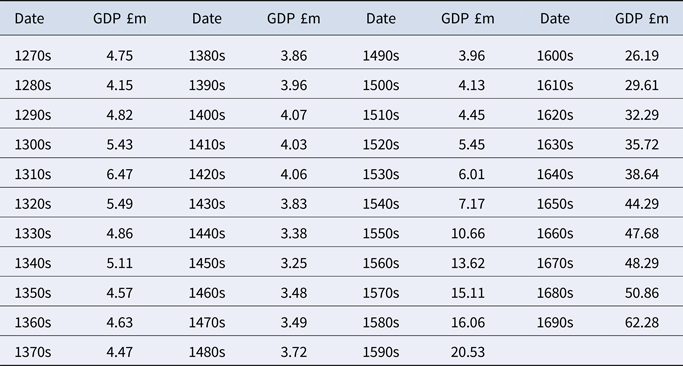
Modern economists typically define a recession as two successive quarters of negative growth. There are no quarterly estimates of English medieval GDP, but annual figures exist beginning in 1270. These authoritative estimates reach a medieval peak in the decade 1300–1309, but do not again achieve such heights for two and a half centuries. GDP per head does rise after the Black Death, but it flat-lines through the fifteenth century and only begins to achieve reasonably consistent, gentle growth in the seventeenth century.Footnote 60 The 1370s nominal GDP was not achieved again till the 1510s. These medieval GDP estimates delineate the later medieval English recession and cry out for explanation (Table 4).
Broadberry et al. estimates of Nominal GDP by decades 1270s to 1690s1

1 The Broadberry team usually presented their findings in terms of per capita and real GDP. The estimates of nominal GDP offered here were all kindly provided by the Broadberry team to me personally. Fouquet and Broadberry, ‘Seven centuries’, offer estimates of real per capita GDP.
Source: Broadberry et al., British Economic Growth.
Hatcher has provided the definitive picture of economic stagnation in later medieval England.Footnote 61 He concentrates on the mid-century slump, but sets this within ‘the long-term deflationary trend’ which ran from the late fourteenth century to at least the late fifteenth century.Footnote 62 He writes of how ‘an extraordinary range of powerful depressive forces combined to impose an enduring and wide-ranging slump of precipitous proportions upon the long-term recessionary trend’.Footnote 63 His carefully documented account of decline in a wide range of sectors shows clearly how the forces of recession spread from sector to sector infecting town and country, landlords and farmers, agriculture and industry, employers and wage earners. Even those largely self-sufficient in food had other needs and obligations, which brought them into the market.Footnote 64
Yet, despite the severity of this prolonged recession, there is plentiful evidence that wages and living standards were high. From around 1370–1380 until c.1480–c.1520 labour scarcity combined with unusually low prices to create a prolonged period of notably high real wages,Footnote 65 and fifteenth-century labourers and their wives and children were significantly better fed compared to the severe poverty of the early years of the fourteenth century.Footnote 66 Dyer and Britnell have documented the reality of the Golden Age. Bailey suggests that labourers could feed themselves and their families by working only six to eight months of the year.Footnote 67 Women in towns could find work, and their rural counterparts could earn high wages in the countryside at busy times of the agricultural year.Footnote 68 The staggering transformation in the ratio between land and labour, wrought by the Black Death, made higher wages an inescapable reality. Thorold Rogers’ Golden Age is no figment of the imagination but is documented by thousands of wages and prices actually paid and recorded in ubiquitous manorial accounts.
Nevertheless, Hatcher has rightly warned that wages did not necessarily equate with earnings.Footnote 69 Work could be hard to find, especially supplementary jobs for the children of larger families. Low prices and high wages combined to depress profits for employers. Enterprise was discouraged, but employers economised on labour where possible, notably by moving from tillage to pasture.Footnote 70 The comparison of prices and wages, which is the basis for the calculation of ‘real wages’, shows not only that wages were historically high, but also that prices were unusually flat. Hatcher's caveats about ‘unreal wages’ are well made and widely accepted, but it is important to ask: ‘why were English prices so flat for so long?’ In this respect, England was certainly unusual since, as we have seen, prices everywhere else rose.
In England, the low Price-high Wage disequilibrium created particular problems for employers. Although Europe as a whole experienced high wages as a consequence of the shortage of workers, prices on the Continent and in Scotland rose as a result of debasement. Europe achieved higher prices as a result of monetary policies, which were markedly different from those pursued in England. These higher prices raised profits and helped employers pay high wages, though in England there was no such relief.Footnote 71 Low prices drove the prolonged English recession, and the recession discouraged entrepreneurs, and denied families the confidence born of regular employment. For the thirteenth century, John Langdon and Jim Masschaele observed ‘a powerful conjunction between entrepreneurial activity and population growth, and that the former tended to lead the latter’, but in the fifteenth century high wages and flat prices squeezed the profits of employers, discouraging entrepreneurs and limiting the availability of extra jobs for family members.Footnote 72 Nightingale has also emphasised how poverty and economic recession in the fifteenth century restricted marriage opportunities and family size.Footnote 73
It is difficult to compare economic growth in England with that of neighbouring countries, since the long run of medieval English GDP estimates is unique. Guy Bois's study of eastern Normandy judged no estimates of French GDP (produit brut) possible before 1460, though he did describe sustained economic growth from c.1465 and he noted the correlation of rising prices, salaries, population, and economic output thereafter. He found economic and demographic growth both rising at about 1.5 per cent per annum.Footnote 74 In the absence of other comparable GDP estimates, comparison of demographic growth between England and neighbouring countries is instructive. Moreover, as it is more conventional to explain the recovery of prices and the end of the recession in terms of population growth, the question now becomes ‘why did population recover more slowly in England than elsewhere?’
3. Part two: demography
Estimates of English population are provided by Broadberry et al., conveniently condensing the conclusions of the tireless labours of the school of English historical demography.Footnote 75 They propose a figure of 4.81 m as England's medieval peak in 1348 before the onset of the Black Death. Their estimate of 2.60 m for 1351 declines further to a low point of 1.9 m in 1450, before beginning a recovery to 2.35 m in 1522, and 2.83 min 1541. England only reached its post-plague 1351 total of 2.6 m sometime between 1522 and 1541, as a result of ‘a marked upturn in the rate of English population growth around 1520 for reasons that remain obscure’.Footnote 76 England did not reach its pre-plague population level (4.81 m) till some point between 1600 (4.11 m) and 1650 (5.31 m).Footnote 77
Scottish demographic evidence is scanty at best, but Ball and Alexander Grant sense that Scottish population may have been recovering faster after the Black Death than England's.Footnote 78 Despite the absence of hard demographic numbers, there are certainly signs of economic growth in later medieval Scotland, with rising rents and ‘very substantial investment in land by men below laird status’ as agricultural society was ‘sufficiently prosperous to have generated a body of men with both the will and the means to invest further in land’.Footnote 79 There is stronger evidence for population in the Low Countries, offering figures for Brabant and Flanders, which suggest that these populations were almost back to 1340s levels by the 1520s. Demographic recovery in the Low Countries was not unbroken over this period – Ball has noted a dip in Flemish/Brabantine population from 1450 to 1490 – but the English population did not reach 1340s-levels till the seventeenth century.Footnote 80 Despite the uncertainties surrounding much demographic evidence, and the probability of much regional variation, it does seem that the English population probably recovered significantly more slowly than that of Scotland, or of the Low Countries. French population behaved similarly to that in Scotland and the Low Countries, but the French evidence is stronger and more plentiful.
An earlier demographic recovery in France than in England has sometimes been noticed in passing,Footnote 81 but detailed and authoritative evidence for French population is readily available.Footnote 82 The incidence of plague in France was very similar to that recorded in England, with outbreaks in 1348, 1361, 1369, 1374, 1382, 1390, 1400, and twelve more outbreaks between 1412 and 1498, of which 1412, 1439, and 1482 were most severe.Footnote 83 Similarly, instances of extremely bad weather in France, resulting in particularly poor harvests in 1437–1439, 1480–1481, 1482 correspond with similar conditions in England and Scotland.Footnote 84 So hunger and disease across northern Europe will certainly have affected population in similar ways, yet in France this was compounded by the effects of a long and punitive war, resulting in emigration from the regions worst affected, and further regional depopulation, sharpened by ‘l'incertitude du lendemain’ (uncertainty about tomorrow).Footnote 85 Sickness, hunger and war devastated France, much more severely than England, which was spared the worst effects of prolonged warfare on her own territory.Footnote 86
In France, there is clear evidence for urban contraction. The number of hearths recorded for Toulouse, Paris, and towns in Provence and Dauphiné more than halved.Footnote 87 More precise information survives from the Reims parish of St Pierre between 1422 and 1594, which indicates that over 60 per cent of households contained only two, three or four people, including children, servants, apprentices, and labourers. Families with so few children – averaging 1.7–1.9 – could not have reproduced themselves, still less increased.Footnote 88 Wills from Lyon confirm severe scarcity of children in the period 1340–1380, somewhat improving between 1460 and 1501.Footnote 89 Rural evidence also indicates a massive reduction in numbers of households in Provence, Normandie, Dauphiné, and Ile de France by the middle or third quarter of the fifteenth century.Footnote 90 The diocese of Bayeux records a reduction of between 45 per cent and 78 per cent in the number of hearths between the late twelfth century and tax assessments of 1452–1476.Footnote 91 Wills from Pourrières en Basse-Provence in 1377–1415 indicate that infant and juvenile mortality left more than half of families without direct line heirs.Footnote 92 Robert Fossier's study of the serfs of Clairvaux abbey in Champagne in 1367–1464 finds that 48 per cent of serfs had no surviving children as a result of severe child mortality.Footnote 93
While adult mortality was extremely sensitive to epidemic disease, often ending marriages early, and leaving many widows, some of whom quickly remarried, French demographers lay very great stress on the effects of crippling infant and child mortality.Footnote 94 The impression seems to be that levels of mortality played a greater part than age at marriage, though this may have been younger in France than in England. In St Pierre, girls married young, aged 15–16, though husbands were aged 20–30, resulting in women having a first child before age 20, and typically outliving their husbands. Limousin bourgeois family records in 1357–1502 suggest a female age at marriage of almost 20.Footnote 95 Such evidence for the age of female marriage is interesting in the context of the European Marriage Pattern, but this topic provokes little interest among French demographers (at any rate before 1988). It is plague, war, and child mortality which lowered population across France from 1346 to 1453.
Ben Dodds has compared population and productivity in north-east England, France and Castile. Despite widespread variations, he identified a striking contrast between strong recoveries in France and Castile even before the beginning of the fifteenth century and the evidence of further decline and stagnation in England.Footnote 96 The first half of the fifteenth century brought a pause in French recovery, and the authorities are agreed that the mid fifteenth century marks the nadir for France's medieval economy and population, but it also represents the starting point for further recovery which becomes apparent in the third quarter of the century.Footnote 97 An intense and mutually reinforcing economic and demographic recovery is observable everywhere in France during the second half of the fifteenth century: ‘la culture a besoin de bras et un nombre d’hommes acru nécessite une production accrue… la nécessité de cultiver a découlé du besoin de se nourrir’ (‘agriculture needed labourers and the growing number of men required increased production… the need to cultivate flowed from the need to feed oneself’).Footnote 98 Rental contracts from Quercy and Périgord, and inventories at Vic-Fezensac (Gers), suggest three to five brothers were not unusual. Artois saw a surge in marriages in 1460–1465. Births rise in Cambrésis from 1465 to 1490. From 1446 in Île de France families appear with more than three children. Eastern Normandy saw a demographic explosion from 1460, where Gui Bois describes a very slight fall in population from a peak in 1314 to 1347, a fall of perhaps 30 per cent resulting from the first onslaught of the Black Death, with a further 20 per cent fall between 1357 and 1374.Footnote 99 There was clear evidence of demographic recovery from 1380 till the English invasion from 1415 to 1422 which sharply reduced population again. Recovery from 1422 to 1434/5 was halted by a military, biological and economic catastrophe from 1436 to 1441/2, with a marked and sustained recovery from 1460 to 1550. M.-Th. Lorcin's study of Lyonnaise wills indicates increasing numbers of living children per family from a 1330–1410 low of 1.39, rising regularly from 1430 to a peak of 5.1 between 1470 and 1480. The wills of Figeac labourers in 1430–1500 yield an average of 4.6 living children. Some rural families in Quercy achieved seven and even nine children. This all indicates a very significant reduction in infant and child mortality, while in Périgueux, and around Lyon, adults were also living longer. A fall in mortality across almost the whole kingdom dating from 1420–1430 permitted the rise in family numbers from 1450–1460.Footnote 100
4. Part three: mortality, fertility, and the economy
Population is determined by the balance of mortality and fertility, scholars tending to favour one or the other of these two factors, though of course both fertility and mortality determined population, and the dispute concerns the relative importance of each.Footnote 101 Those who emphasise severe mortality levels as an explanation for England's disappointing demographic recovery in the later middle ages need also to explain why English death rates would have been significantly worse than those in neighbouring countries. Conversely, an emphasis on fertility and birth rates as the key to demographic recovery might see economic growth as a possible factor facilitating marriage and family formation. Although the present authors make no claims to demographic expertise, it is clear that an interpretation which favours fertility sits more easily with this article's emphasis on economic and monetary factors.
Daunting levels of mortality have been recorded in later medieval English monasteries.Footnote 102 Yet Barbara Harvey wonders how far the level of mortality among the monks of Canterbury and Westminster might have been representative of society at large and considers the factors which might have made the monastic life atypical.Footnote 103 For example, dormitories and urban life may have spread infection more easily. Yet since the pioneering work of Hatcher and Harvey, it has been possible to explore the mortality of other English later medieval groups.Footnote 104 Additionally, Nightingale has drawn attention to the mortality of creditors, which, together with other estimates of mortality from other groups which she cites, seems to suggest that recorded monastic mortality may not have been representative of a national picture, particularly in the second half of the fifteenth century.Footnote 105
For the fertility school, L.R. Poos also sensed that the severe levels of mortality found among the Canterbury monks were unlikely to have been typical.Footnote 106 With scrupulous reservations and margins of error, Poos’ work on late medieval Essex led him to conclude that while unfavourable mortality was one reason why the Essex population stagnated between 1350 and 1500, it was broadly in line with the experience of early modern England, and was ‘unlikely to have constituted the entire reason for the prolonged late-medieval depression’.Footnote 107 Fertility needed consideration too. His carefully critical study of the parish of Walden (Essex) suggested that the population and crude fertility rate there was probably stable over the fifteenth century, suggesting a demographic system in step with that established by Wrigley and Schofield for England in the early modern period. The population was stationary well into the sixteenth century, resulting from broadly unchanging mortality and fertility rates for most of the fifteenth century. He found higher mortality and lower fertility in Essex in 1350–1500 and concluded ‘the Essex evidence strongly suggests that the constraints upon fertility were the result of social-structural restrictions upon nuptiality in the later-medieval Essex countryside’.Footnote 108
Social and religious pressures minimised bastardy, so nuptiality dominates our understanding of medieval fertility. The age at which women married, and the numbers of those not marrying at all, controlled the numbers of children they might bear. The age of female marriage has been a subject of great demographic importance at least since John Hajnal first drew attention to distinctive marriage practices in North and Western Europe compared with those further South and East. The North-West European Marriage Pattern has prompted the possibility that later medieval women may have married later, or chosen not to marry at all.Footnote 109 However, Judith Bennett has shown that women in thirteenth-century England actually also married later, or not at all, and this was less a matter of choice than the result of poverty.Footnote 110 Comparison of economic growth and standards of living between the growing but hungry thirteenth and the depressed but fat fifteenth century seems to indicate that population responded more to economic opportunities than to Hatcher's ‘unreal wages’. His famous phrase referred to the fifteenth century, but might it not equally be applicable to a thirteenth century in which low wage levels were compensated by more plentiful working opportunities?
The delayed demographic recovery in England, prompts the question, was England's mortality crisis worse than that of neighbouring countries? Disease-driven mortality in France was very severely aggravated by the ravages of the Hundred Years War, which was played out at fearful cost on French territory. Yet this double disaster did not prevent a significant French population recovery, which occurred notably earlier than that which eventually came about in England. If neither age at marriage, nor severe mortality provides solutions to the problem of England's delayed demographic recovery, it may be that fertility and nuptiality were restrained by the economic recession. Such an explanation would accord well with the opinions of Richard Smith, Poos, and Bennett, who have all noted the cost of marriage and the necessity of a secure income to support it.Footnote 111 Perhaps paradoxically, no one has written more powerfully of the depth and severity of the later medieval English recession than Hatcher, and that recession seems likely to have influenced nuptiality.Footnote 112 The association of economic and demographic growth should occasion no surprise, but the comparison of English outcomes with those of neighbouring countries cries out for explanation.
5. Conclusion
The introduction to this article argues that money had a significant role in the Middle Ages. Few economic historians would deny this, but some dispute the extent of that significance. We suggest that the attention which medieval governments devoted to money indicates that English rulers certainly believed money was important. Without suggesting that money explains everything, we point particularly to the importance and extent of England's medieval price history as powerful evidence of the extent of money's influence from at least the late twelfth century. Later medieval economic history is inconceivable without price history, and prices pre-suppose the widespread use of money. Yet money, of course, is only part of the story.
Sections one and two have set out the argument that the economic and demographic recession in England was deeper and more prolonged than that in England's neighbours. This is hard to explain if high mortality were the dominant and driving force, since death and disease are no respecters of national frontiers. Yet if depressed fertility, driven by economic factors, played a larger part, at least one distinctive feature of European economic policy stands out, marking England as different: countries which debased more experienced more inflation than England. The uniquely English combination of high wages with stagnant prices discouraged landlords, yeoman farmers, and peasants, and contributed strongly to the recession. Economic depression limited opportunities and confidence in the future, and marriage plans demanded economic security. Although agricultural land was readily available, discouraging prices made it unusually difficult to make especially arable land pay. Elsewhere, in mainland Europe and in Scotland, prices were not depressed. Despite the negative consequences of debasement, which are widely recognised, over the longer term moderately rising prices stimulate economic activity, investment and growth and combat depression. No one argues that monetary factors alone explain all the problems of the later medieval English economy, but it is here suggested that flat or falling English prices fundamentally contributed to the protracted length of England's late medieval economic recession, which contrasts so clearly with the recovery discernible in France, the Low Counties, and Scotland. Many may question this hypothesis, but it remains for the moment the only explanation in the field for England's unusually slow economic and demographic recovery after the Black Death compared with the performance of other European nations.
Acknowledgements
The authors are very grateful to Richard Smith, and Christopher Briggs, for their comments on earlier versions of this paper. Mark Bailey also generously advised us at an early stage. We have also benefitted from the comments of anonymous reviewers.