Introduction
Fasciolosis caused by Fasciola hepatica (Linné 1758) is a major public and animal health problem globally. This parasite primarily infects domestic ruminants, including cattle, sheep, and goats, but it can also infect other mammals, including humans, through the ingestion of food or water contaminated with metacercariae (Esteban et al. Reference Esteban, Gonzalez, Curtale, Muñoz-Antoli, Valero, Bargues, el-Sayed, el-Wakeel, Abdel-Wahab, Montresor, Engels, Savioli and Mas-Coma2003). This parasitic disease leads to significant economic losses in the livestock sector due to reduced animal performance, the seizure of infected organs (Gonzalez Diaz et al. Reference González Díaz, Olazabal, Castañedo, Sánchez, Morales, Serrano and de Armas2002), and the costs associated with parasite control (Ogunrinade and Ogunrinade Reference Ogunrinade and Ogunrinade1980).
In Algeria, fasciolosis is recognized as an endemic parasitic disease in several regions, but the prevalence and economic impact vary depending on the climatic zones. A study conducted in Jijel’s abattoirs, an area with a humid climate, showed a notable prevalence of fasciolosis in cattle, with economic losses estimated at 10,000 euros per year due to the seizure of infected livers (Mekroud et al. Reference Mekroud, Titi, Benakhla and Rondelaud2006). Similarly, a survey in El Tarf revealed annual losses of 60,000 euros, while in the more arid region of Ouargla, losses were estimated at 4,000 euros (Ouchene-Khelifi et al. Reference Ouchene-Khelifi, Ouchene, Dahmani, Dahmani, Sadi and Mohamed2018). These data highlight the significant economic and health impact of this disease.
The objective of this study was to assess the prevalence of fasciolosis in cattle, sheep, goats, horses, and camels in eight Algerian wilayas: Skikda, El-Tarf, Jijel (humid climate), Mila, Blida (temperate Mediterranean climate), Medea, M’sila, and Laghouat (dry climate), as well as to estimate the economic losses associated with the seizure of infected organs.
Materials and methods
Study area
Our study was conducted in eight Algerian wilayas: El-Tarf, Skikda, Jijel, Blida, Mila, M’Sila, Medea, and Laghouat (Figure 1). The altitudes of these regions vary, with respective elevations above sea level of 16 m, 18 m, 10 m, 260 m, 486 m, 471 m, 1,036 m, and 764 m.
These regions exhibit diverse climatic characteristics, predominantly Mediterranean in nature.
-
• Region I: Jijel, El-Tarf, and Skikda: These wilayas have a Mediterranean climate, marked by hot, dry summers.
-
• Region II: Blida and Mila: These wilayas benefit from a temperate Mediterranean climate.
-
• Region III: Medea, M’Sila, and Laghouat: These wilayas have a Mediterranean climate with semi-arid characteristics, varying according to their geographical location and altitude.
These climatic variations allow for the exploration of diverse ecological contexts in the study of fasciolosis.
Presentation of the study area.

Animals
In this study, data were collected, between September 1, 2024, and December 20, 2024, from the Agricultural Services Departments of each wilaya. These data were initially gathered by provincial authorities from municipal abattoir inspection records. At least one qualified veterinarian examined each animal carcass. The daily records, containing infection cases among sheep, cattle, goats, camels, and horses, served as the foundation. These records are based on systematic examinations, including visualization, palpation, and incision of organs to detect abnormalities. Fasciolosis diagnosis relies on a thorough evaluation of the liver and bile ducts, combined with incisions to confirm the presence of the parasite.
In total, 349,176 cattle, 982,669 sheep, 235,639 goats, 1,882 camels, and 26 horses were inspected in 8 wilayas. In this study, region, animal species, year, and season are considered as risk factors.
Economic evaluation
The weight of livers seized at abattoirs in the three wilayas – Blida, Laghouat, and Jijel – during the study period was determined. The economic loss associated with these seizures was estimated by multiplying the total mass of seized condemned livers by the average price per kilogram of liver in Algeria and then converting the loss from Algerian dinars to US dollars.
Data analysis
All data were recorded in Microsoft Excel and analyzed using R 4.4.0 software. ANOVA was used to analyze each factor individually. Subsequently, a Kruskal-Wallis test and Tukey test were performed to confirm the ANOVA results. Principal Component Analysis (PCA) was conducted to examine the relationships between the different factors.
Results
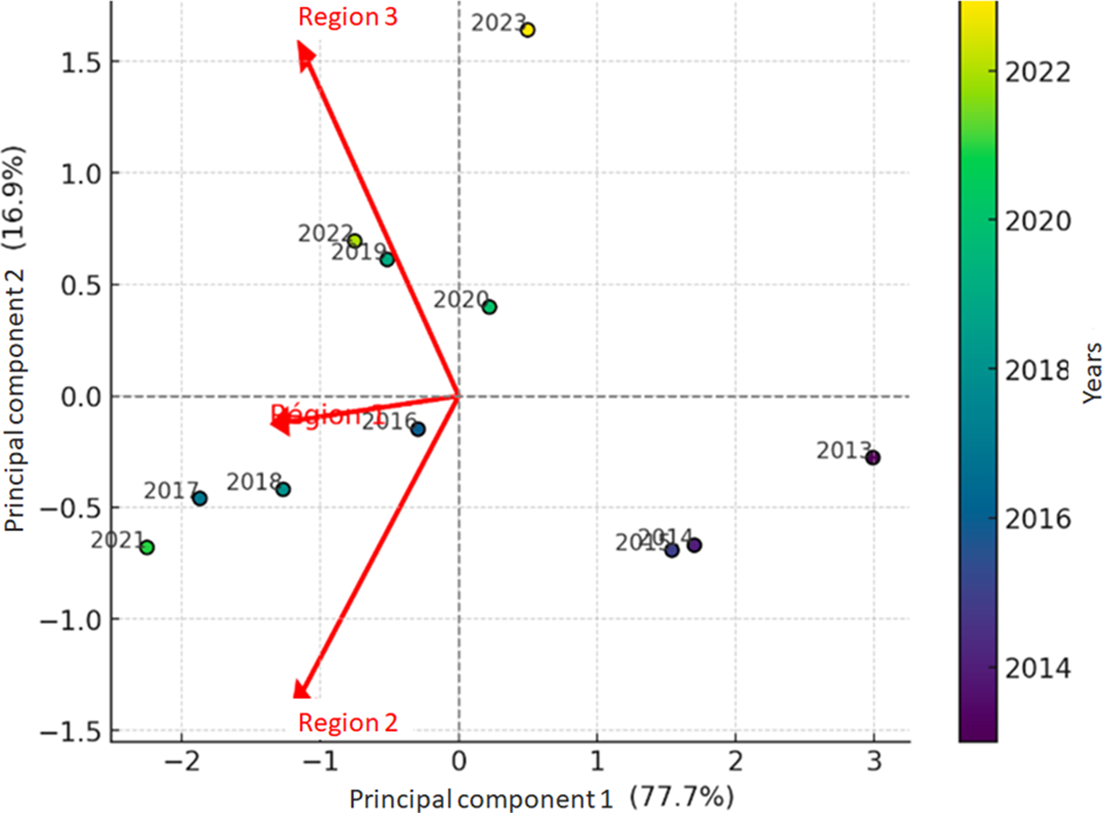
The Principal Component Analysis (PCA) reveals significant differences in the trends of Fasciola prevalence across three regions over time. The first principal component (PC1), which accounts for 77.7% of the total variance, distinguishes the regions mainly by their overall level of prevalence, while the second component (PC2, 16.9% of the variance) captures additional specific variations, likely related to regional particularities (Figure 2).
Principal Component Analysis (PCA) for the prevalence of fasciolosis in three regions.

Indeed, in Region I, there is a general upward trend in the prevalence of fasciolosis, peaking at 3.54% in 2018, followed by a slight decline to 2.23% in 2023. The highest prevalence was recorded in 2018, and the trend has been decreasing slightly in subsequent years. In Region II, the prevalence fluctuated, with a notable increase from 0.63% in 2013 to 2.23% in 2021, before decreasing to 0.69% in 2023. Meanwhile, Region III showed relatively stable prevalence over the years, with the highest point being 2.11% in 2016 and the lowest being 2.06% in 2020. The values ranged from 0.94% in 2013 to 2.47% in 2023 (Table 1).
Fasciolosis prevalence in the three regions

The letters (a, b, c): Values that do not share the same letters within the same column differ significantly, according to ANOVA and post-hoc tests.
Region I is the most affected, with its prevalence significantly higher than in Regions II and III (p < 0.01).
Table 2 presents the prevalence of fasciolosis by species in the different regions. The table shows differences in prevalence between regions for various animal species. For cattle,
Fasciolosis prevalence by species in different regions

Regions I (4.57%) and III (3.24%) have similar prevalence rates, while Region II (2.63%) has a significantly lower prevalence. A similar trend is observed for sheep, with Regions I (1.73%) and III (1.26%) showing higher prevalence than Region II (0.98%). Regarding goats, Region III (0.33%) has a significantly higher prevalence, followed by Region I (0.26%), while Region II (0.16%) has the lowest prevalence. In contrast, for equines and camelids, no differences are observed between regions, as all show a prevalence of 0%. Cattle had the highest infection rate (3.48% mean), which is significantly greater than that of sheep (1.32%; p < 0.001) and goats (0.25%; p < 0.001). Sheep prevalence is itself significantly higher than goat prevalence (p = 0.002). Both horses and camels showed zero infections, which is significantly lower than in cattle, sheep, and goats (all p < 0.0001).
Cattle had the highest infection rate (4.14% mean), which is significantly greater than that of sheep (1.32%; p < 0.001) and goats (0.25%; p < 0.001). Sheep prevalence is itself significantly higher than goat prevalence (p = 0.002). Both horses and camels showed zero infections, which is significantly lower than in cattle, sheep, and goats (all p < 0.0001).
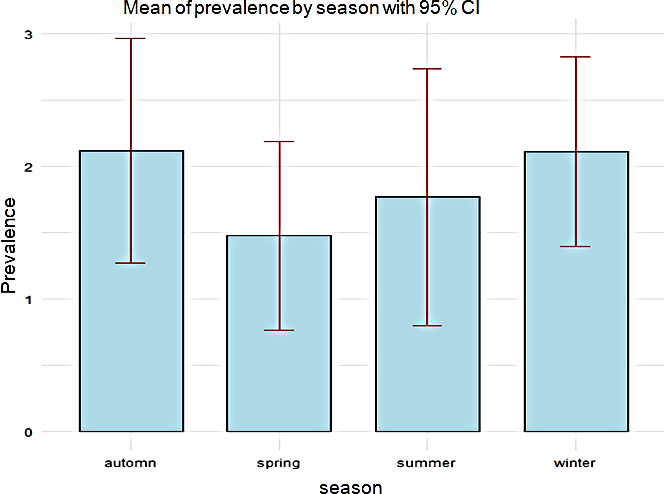
The bar chart (Figure 3) depicts the global mean prevalence of fasciolosis across four seasons, each accompanied by 95% confidence intervals. Autumn and winter show the highest average prevalences (around 2.1%), with relatively wide confidence intervals (approximately 1.3–3.0% for autumn and 1.4–2.8% for winter), indicating substantial year-to-year variability. Summer exhibits a moderate mean prevalence (about 1.8%) and a similarly broad interval (≈0.8–2.7%), while spring has the lowest average prevalence (~1.5%) and the narrowest interval (≈0.9–2.2%), suggesting more consistent seasonal rates. Overall, fasciolosis prevalence appears lowest and most stable in spring and peaks, with greater dispersion, in the cooler seasons of autumn and winter.
Bar chart showing the global mean prevalence of fasciolosis by season.

Economic losses
In Blida wilaya, a total of 503,191.7 kg and 2,078.2 kg of cattle and sheep livers were seized during the study period, resulting in a high economic loss of 10,610,667.9 USD, with an average annual loss of 1,178,963.1 USD.
In Laghouat wilaya, 48,048.5 kg and 273.2 kg of cattle and sheep livers were seized, leading to a total loss of 1,014,755.7 USD, corresponding to an average annual loss of 112,750.63 USD.
In Jijel, a total of 6,739,203.5 kg and 34,140 kg and 14 kg of cattle, sheep, and goat livers were seized, causing a direct economic loss of 142,240,507.5 USD, with an average annual loss of 17,780,063.44 USD.
Discussion
Fasciolosis is a parasitic disease with a notably uneven distribution across Algeria, with cattle experiencing a significantly higher prevalence than small ruminants. This study supports previous findings on the prevalence rates of the disease, showing consistent trends in both northern and southern regions of the country. Environmental and zootechnical factors play a crucial role in these variations, including climatic conditions, grazing behaviors, and livestock management practices. Understanding these factors is key to developing targeted control strategies to address the health and economic burden of fasciolosis in Algeria.
This study confirms an uneven distribution of fasciolosis in Algeria, with a significantly higher prevalence in cattle than in small ruminants. This is consistent with a study conducted in Algeria by Ayad et al. (Reference Ayad, Benhanifia, Balla, Moussouni, Ait-Yahia and Benakhla2019), as well as in Ethiopia by Girma et al. (Reference Girma, Genet, Teshome, Abdu and Tamir2025). Indeed, a meta-analysis (Fennouh et al. Reference Fennouh, Nabi, Ouchetati, Salhi, Ouchene, Dahmani, Haif, Mokrani and Khelifi Touhami2025) estimates the national average prevalence in Algeria at 3.91% in cattle, compared to only 0.42% in sheep and 0.12% in goats. Local slaughterhouse surveys support this trend: for example, Ouchene-Khelifi et al. (Reference Ouchene-Khelifi, Ouchene, Dahmani, Dahmani, Sadi and Mohamed2018) observed that 26.7% of cattle slaughtered in El Tarf (northern humid region) were infected, compared to only 6.5% of sheep and 2.5% of goats. Additionally, in the Saharan region (Ouargla), cattle showed only 1.7% infection, and no cases were found in sheep, goats, or camels.
Other studies conducted in Algeria have also reported bovine fasciolosis prevalence rates of 6.9% in Tizi Ouzou (Mezali et al. Reference Mezali, Nouichi, Bouabba, Hettak, Negab and Kaddour2024), 1.93% in Constantine (Gherroucha et al. Reference Gherroucha, Benhamza and Gharbi2022), 12.26% in Souk Ahras (Meguini et al. Reference Meguini, Righi, Bouchekhchoukh, Sedraoui and Benakhla2021), and 8.3% in El-Oued (Amor et al. Reference Amor, Farjallah, Merella, Alagaili and Mohammed2020). Conversely, ovine prevalence was lower, reaching 0.077% in Bordj Badji Mokhtar (Chougar et al. Reference Chougar, Mas-Coma, Artigas, Harhoura, Aissi, Agramunt and Bargues2020), 0.46% in Djelfa (Hebali et al. 2023), and 0.04% in Constantine (Gherroucha et al. Reference Gherroucha, Benhamza and Gharbi2022). Prevalence rates in goats and camels were also low, with 0.12% recorded in Béjaïa (Ayad et al. Reference Ayad, Benhanifia, Balla, Moussouni, Ait-Yahia and Benakhla2019) and 4% in Laghouat among dromedaries (Saidi et al. Reference Saidi, Mimoune, Chaibi, Abdelouahed, Khelef and Kaidi2021).
These differences in prevalence can largely be explained by environmental and zootechnical factors. On the one hand, northern regions (zone 1) benefit from high rainfall (750–900 mm/year), which feeds marshy areas and promotes the survival of vector snails (Galba truncatula) (Mekroud et al. Reference Mekroud, Benakhla, Vignoles, Rondelaud and Dreyfuss2004; Ouchene-Khelifi et al. Reference Ouchene-Khelifi, Ouchene, Dahmani, Dahmani, Sadi and Mohamed2018). Mekroud et al. (Reference Mekroud, Benakhla, Vignoles, Rondelaud and Dreyfuss2004) showed that the prevalence of liver fluke in cattle was 27% on average in Jijel (northeast) compared to only 9–6% in Constantine (central, drier), which can be explained by differences in climate. Conversely, zones 2 and 3 do not provide habitats conducive to the Fasciola life cycle (little stagnant water, high temperatures), preventing the persistence of intermediate snails and explaining the low prevalence observed, which is consistent with other findings in Algeria (Mekroud et al. Reference Mekroud, Benakhla, Vignoles, Rondelaud and Dreyfuss2004; Ouchene-Khelifi et al. Reference Ouchene-Khelifi, Ouchene, Dahmani, Dahmani, Sadi and Mohamed2018).
On the other hand, host-related factors and husbandry practices contribute to the low frequency in small ruminants. Sheep and goats are often treated preventively against fasciolosis (biannual deworming in the fall and spring), which keeps the prevalence at a low level despite local endemicity (Ouchene-Khelifi et al. Reference Ouchene-Khelifi, Ouchene, Dahmani, Dahmani, Sadi and Mohamed2018). In the study by Ouchene-Khelifi et al. (Reference Ouchene-Khelifi, Ouchene, Dahmani, Dahmani, Sadi and Mohamed2018), the prevalence of fasciolosis in sheep from El Tarf was only 6.5%, a rate significantly lower than the 16% previously reported in the region by Mekroud et al. (Reference Mekroud, Titi, Benakhla and Rondelaud2006). The authors attribute this reduction to the regular use of anthelmintics in sheep. Furthermore, the grazing biology plays a role: cattle graze in flooded meadows and drink stagnant water, thus being highly exposed to Fasciola metacercariae, whereas sheep and goats prefer drier or higher-altitude pastures where snails are rare. This feeding habit limits their ingestion of infective larvae. Thus, even in the same wet region, fasciolosis was much less frequent in goats (only 2.5% in the El Tarf study) (Ouchene-Khelifi et al. Reference Ouchene-Khelifi, Ouchene, Dahmani, Dahmani, Sadi and Mohamed2018), a rate consistent with the 0.9–3.6% observed in the literature for goats (Achi et al. Reference Achi, Zinsstag, Yèo, Dea and Dorchies2003; Blaise and Raccurt Reference Blaise and Raccurt2007; Jibat et al. Reference Jibat, Ejeta, Asfaw and Wudie2008). In conclusion, the combination of sanitary control (deworming) and lower exposure to ecological parasites explains the low prevalence in small ruminants.
The absence of cases in camels (dromedaries) and equids is mainly explained by their ecology and relative resistance. In the Saharan regions inhabited by dromedaries, the dry and hot climate does not allow the development of vector snails (Ouchene-Khelifi et al. Reference Ouchene-Khelifi, Ouchene, Dahmani, Dahmani, Sadi and Mohamed2018). All slaughterhouse studies in southern Algeria report 0% fasciolosis in camels (Ouchene-Khelifi et al. Reference Ouchene-Khelifi, Ouchene, Dahmani, Dahmani, Sadi and Mohamed2018). Globally, dromedaries can occasionally host Fasciola (prevalence up to ≈15% has been reported in some Muslim countries) Mas-Coma et al., Reference Mas-Coma, Valero and Bargues2022), but only in areas where ecological conditions are favorable.
Horses exhibit marked resistance to fasciolosis due to their specific biological and immunological characteristics. This resistance is attributed to several factors, including an effective immune response, distinct grazing behavior, and limited environmental interactions that reduce exposure to the parasite. Their immune system is capable of rapidly responding to Fasciola hepatica, preventing parasite establishment (Williams and Hodgkinson Reference Williams and Hodgkinson2017). Furthermore, their low infection rate compared to other species suggests the presence of intrinsic resistance mechanisms (Williams and Hodgkinson Reference Williams and Hodgkinson2017).
Additionally, horses typically graze in drier environments that are less favorable for the life cycle of Fasciola spp. This characteristic reduces their exposure to the intermediate host, the snail Galba truncatula (Williams and Hodgkinson Reference Williams and Hodgkinson2017). Their feeding behavior, which involves avoiding wet and potentially contaminated areas, further limits the risk of infection (Williams and Hodgkinson Reference Williams and Hodgkinson2017).
Studies have also identified genetic markers potentially associated with resistance to parasitic infections, particularly strongyles, which may also play a role in fasciolosis resistance (Costa et al. Reference Costa, Saravia, Ubios, Lores, da Costa, Festari, Landeira, Rodríguez-Zraquia, Banchero and Freire2022).
However, this resistance does not equate to complete immunity. Environmental changes and increased exposure to contaminated pastures could elevate infection risks, necessitating regular monitoring and appropriate management strategies (Williams and Hodgkinson Reference Williams and Hodgkinson2017).
In this survey, seasonal patterns of fasciolosis prevalence vary markedly. Autumn and winter show the highest average prevalence. Mas-Coma et al. (Reference Mas-Coma, Bargues and Valero2005) demonstrated that the persistence of high moisture at the end of the cropping season – due to late rains and elevated groundwater – promotes the proliferation of lymnaeid snails and triggers massive cercarial release that encyst on vegetation, thereby increasing ruminant exposure to metacercariae in autumn and winter. Dar et al. (Reference Dar, Vignoles, Rondelaud and Dreyfuss2015) further showed that irrigation practices and flooding extend the survival of these metacercariae on pastures by slowing their thermal degradation, creating a secondary peak of infestation during the cooler months.
In the Annaba area, Algeria, a survey reported significantly higher infection rates during spring and autumn (Ferhati et al. Reference Ferhati, Haloui, Chouba and Tahraoui2014). In contrast, Ouchene-Khelifi et al. (Reference Ouchene-Khelifi, Ouchene, Dahmani, Dahmani, Sadi and Mohamed2018) found in El Tarf, Algeria, two clear prevalence peaks in summer (35.0%) and winter (31.6%) (p < 0.001), suggesting that local irrigation practices and winter flooding may extend the transmission window. A similar bimodal pattern has been observed elsewhere: in Egypt (Qalyobia Province), seasonal prevalences were highest in summer and winter for both goats and cattle, albeit at lower absolute rates (≈3.5%) (Salem et al. Reference Salem, Khalifa and Abd El-Halim2022). In Ethiopia, Lakew and Alebie (Reference Lakew and Alebie2015) documented a 30.6% prevalence in Ethiopian adult cattle, peaking during the wet season.
Such regional heterogeneity underscores the need for season- and location-specific control strategies – combining targeted anthelmintic treatment of livestock before high-risk periods with environmental management of snail habitats – to reduce fasciolosis burden across Algeria.
Economically, liver condemnation losses amount to $10,610,667.9 in Blida, $1,014,755.7 in Laghouat, and $142,240,507.5 in Jijel. A preliminary study at the regional slaughterhouse of Jijel estimated annual losses at €10,000 (Mekroud et al. Reference Mekroud, Benakhla, Vignoles, Rondelaud and Dreyfuss2004). In Egypt, Abdel-Fatah et al. (Reference Abdel-Fatah, Arafa, Wahba and El-Dakhly2022) estimated losses ranging from $261,850 to $616,300 per year, depending on the region.
Conclusion
This study underscores the significant variability in the prevalence of fasciolosis across different regions of Algeria, with cattle being more affected than small ruminants. Environmental factors, such as rainfall and temperature, alongside livestock management practices like deworming, play pivotal roles in shaping the distribution of the disease. The low prevalence in small ruminants and the absence of infection in camels and horses suggest the importance of host-related factors in disease resistance. However, the economic impact of fasciolosis remains substantial, highlighting the need for enhanced surveillance and more effective control measures. Addressing these challenges through tailored management strategies could mitigate the health and economic consequences of fasciolosis in Algeria.
Competing interests
None.