Implications
The symbiotic rhizobia bacteria in red clover can fix atmospheric nitrogen, which promotes the growth of red clover itself and subsequent crops. This ability makes red clover valuable crops, especially in organic agriculture. Red clover is also a valuable ruminant feed, for example, lambs fed with red clover grow very well. Red clover is a rich source of polyphenols such as isoflavones, also referred to as phyto-oestrogens. Phyto-oestrogens can cause infertility problems in animals. As organic farming and the use of red clover is ever increasing, it is important to study what effect red clover feeding has on ewes’ reproduction.
Introduction
Forage legumes such as red clover (Trifolium pratense) are rich sources of isoflavones. Isoflavones and their metabolites can have physiological, particularly oestrogenic, activity as they are chemically similar to endogenous oestrogen and hence referred to as phyto-oestrogens (Adams, Reference Adams1995). Phyto-oestrogen research dates back to the 1940s when ewes fed with subterranean clover were reported to suffer from specific breeding problems (Bennetts et al., Reference Bennetts, Uuderwood and Shier1946). Later, phyto-oestrogen research extended to human medicine, particularly regarding the possible health benefits of the soy isoflavones glycitein, genistein, and daidzein and its metabolite equol. Currently, equol is the most studied isoflavone metabolite in human medicine (Lampe, Reference Lampe2010; Jackson et al., Reference Jackson, Greiwe and Schwen2011).
The main isoflavones in red clover are formononetin, biochanin A, daidzein and genistein (Tsao et al., Reference Tsao, Papadopoulos, Yang, Young and McRae2006). In ruminants, formononetin and daidzein are metabolized further to generate high levels of equol (Lundh, Reference Little1995), which is the main causative substance for fertility problems in ewes (Shutt and Braden, Reference Shutt and Braden1968; Shutt et al., Reference Shutt, Weston and Hogan1970). Percentage of oestrogenic clover in the pasture defines the oestrogenic potency. Pastures containing 0.3% or less formononetin in dry matter (DM) should be safe for ewes. Formononetin concentrations above 0.8% in DM can lead to fertility problems (Marshall, Reference Marshall1973; Little, Reference Little1996).
Environmental and economic considerations affect cultivation of forage legumes, particularly red clover, which features prominently in both organic and conventional agriculture. Fixation of atmospheric nitrogen by symbiotic rhizobia bacteria promotes the growth of both legumes and subsequent crops (Halling et al., Reference Halling, Topp and Doyle2004). In addition to its agricultural benefits, red clover is a valuable ruminant feed. Lambs fed with red clover had higher live-weight gain compared with lambs grazing lucerne or perennial ryegrass pastures (Speijers et al., Reference Speijers, Fraser, Theobald and Haresign2005). Dairy cows fed with red clover silage have higher DM intake, higher milk yield and are associated with a more desirable polyunsaturated fatty-acid milk composition in comparison with cows fed grass silage (Dewhurst et al., Reference Dewhurst, Fisher, Tweed and Wilkins2003; Vanhatalo et al., Reference Vanhatalo, Gäddnäs and Heikkilä2006 and Reference Vanhatalo, Kuoppala, Toivonen and Shingfield2007).
Since the discovery of clover disease in ewes (Bennetts et al., Reference Bennetts, Uuderwood and Shier1946), consumption of feed containing large amounts of plant oestrogens has been suspected to cause temporary or permanent fertility problems in ruminants. Classical clover disease in ewes can be manifested as infertility, abnormal mammary gland development or lactation and uterine prolapse in ewes, and as maternal dystocia owing to incomplete dilatation of the cervix when ewes have consumed high levels of isoflavones. A lower intake of isoflavones was shown to cause temporary infertility and prolonged exposure can lead to permanent infertility (Marshall, Reference Marshall1973; Adams, Reference Adams1995 and Reference Adams1998).
In the northern hemisphere, the predominant forage legume is red clover (Halling et al., Reference Halling, Topp and Doyle2004). There is growing interest in using forage legumes such as red clover to feed sheep and cattle both in organic and conventional farming. This has made topical the possibility of red clover-associated fertility problems in North Europe, where very little research has been conducted on this area. The aims of this experiment were to study the effects on conception and early gestation of feeding nulliparous Finnish Landrace ewes with red clover rich in formononetin. The hypothesis was that red clover feeding has a detrimental effect on ovulation processes (number of ovulation and conception) and reproductive organs.
Material and methods
Animals
A total of 20 nulliparous Finnish Landrace ewes, purchased from a single breeding herd, were used in this study. The ewes were between 4.9 and 5.4 months old at the beginning of the experiment. All the animals were normally developed and clinically healthy. They were allotted randomly to two equal groups, which were housed in two separate pens in the same room. The pens were erected on concrete floors covered with rubber matting and straw. Silage and fresh water were available ad libitum. The flocks were exercised daily in separate outdoor folds. For breeding, two Finnish Landrace rams, aged 5 months at the beginning of the experiment, were purchased from the same original herd. The experiment was approved by the Ethics Committee of University of Helsinki.
Experimental design
The feeding experiment started immediately after the purchase of the animals (15 August), and lasted for about 5 months. One group was fed an oestrogenic diet (Group E), whereas the other group served as a control and was fed a non-oestrogenic diet (Group C). The breeding period started 15 October, 2 months after the beginning of experimental feeding, and lasted 8 weeks until the 10 December. At the beginning of the breeding period, the rams were introduced into the flocks, one ram for each group. To minimize the ram effect, the rams were changed daily from one flock to the other. Six weeks after the end of the breeding period (22 January), the ewes were slaughtered and their reproductive organs were collected for analysis.
Feeding
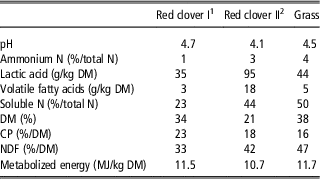
During the experiment, Group E was fed with red clover silage, whereas Group C served as the control and was fed with timothy/meadow fescue (Pheleum pratense/Festuca pratensis) grass silage. Before the breeding, the rams were fed with control silage. During the breeding period the rams received oestrogenic and control silages on alternate days, as they were changed daily from one flock to the other. Silage as well as mineral and vitamin supplement (Lammaskivennäinen, Melica Finland Oy) were offered ad libitum to ewe groups. Special attention was paid to ensure ad libitum feeding of silage. Ewe groups had access to silage at all times. Animal caretakers were advised to ensure that >5% of silage was left in the silage racks in the morning before cleaning the pens. Fresh silage was delivered in the morning in outdoor exercise folds and indoor pens. Silage racks were filled again before 1600 h. The silages were conserved in large wrapped bales. Before the experiment, all silages were analysed for energy and protein content. Two batches of red clover and one batch of grass silage were used. Chemical compositions of the silages are presented in Table 1. Ewes were weighed at the beginning of the experiment and once a week thereafter. After slaughtering, the carcasses were weighed and rated according to the national rating system.
Chemical composition of the silages made of red clover or grass

N=nitrogen; DM=dry matter.
1 Red clover I was used from 15 August until 4 December.
2 Red clover II was used from 4 December until 22 January.
Sampling
Silage samples for phyto-oestrogen determinations were collected from every bale fed to the sheep. Samples were taken from large wrapped bales with a cutter; 40 g of silage was placed into a 250 ml flask and 20 ml of water added. Samples were stored in a refrigerator until analysis. Blood samples for urea and phyto-oestrogen determinations were collected four times, every 4th week from the beginning of the breeding season until culling. Blood samples were collected in the morning before silage racks were filled again. For the urea analysis, double samples were collected at the same time in the morning on 2 consecutive days. The samples were collected by vacuum puncture of a jugular vein into plain silicone tubes (Vacutainer; Becton Dickinson Vacutainer Systems, Plymouth, UK). After centrifugation (2100×g, 10 min), serum for phyto-oestrogen analyses was harvested, frozen and stored in plastic tubes at −80°C until analysed. Plasma for urea analyses was harvested and stored at +5°C until analysed on the subsequent day. Blood plasma samples for progesterone determinations were collected once weekly, seven times, after the breeding season until slaughter by vacuum puncture of a jugular vein into heparinized tubes (Vacutainer). Immediately, after bleeding, the tubes were placed into an ice-water bath. After centrifugation (4800×g, 10 min), plasma was harvested, frozen and stored in plastic tubes at −80°C until analysed.
To monitor ram fertility, semen was collected using an artificial vagina at the beginning and at the end of the breeding period. Progressive sperm motility was assessed with a phase-contrast microscope equipped with a heated stage, at 200× magnification. The spermatozoa were stained using the Giemsa method according to Watson (Reference Watson1975), and sperm morphology was classified as described by Blom (Reference Blom1983).
The ewes were slaughtered and reproductive organs were collected for analysis 6 weeks after the end of the breeding period. Total weight of the reproductive organs, cleaned from the adipose and vulvar tissue, was recorded. The cervix was removed, opened longitudinally and the total length was measured. The ovaries were removed and numbers of corpora lutea were counted. The entire uterus (without cervix), with contents, was weighed. The number of foetuses was counted, gender determined and the foetuses were individually weighed. Biparietal diameter (BPD) and crown-rump length (CRL) were measured. Foetal fluids, as well as the uterine tissue with foetal membranes, were weighed. Histological specimens were taken from the udder, teat and vagina, three samples from the cervix (caudal, middle and cranial parts), both horns of the uterus, both the ovaries, and cotyledons from the gravid uterus. Samples were fixed in 4% buffered formaldehyde, and sections were processed routinely and stained with haematoxylin and eosin. One ewe with a mummified foetus did not have cotyledons, and therefore those specimens were not available.
Analyses
Urea analysis
The urea analysis was performed with an automatic analyser (KONE Pro Selective Chemistry Analyser; Thermo Fisher Scientific, Vantaa, Finland). An enzymatic spectrophotometric method (Gutmann and Bergmayer, Reference Gutmann and Bergmayer1974) was used to determine urea concentration in serum.
Quantitative HPLC analysis of isoflavones and metabolites
The quantitative HPLC analysis of silage and serum samples is presented in detail in a study by Mustonen et al. (Reference Mustonen, Jokela, Saastamoinen, Taponen, Taponen, Saloniemi and Wähälä2006). Briefly, the samples were analysed using two different HPLC detectors, UV–visible and/or fluorescence. Authentic reference compounds were used to identify isoflavones and metabolites.
Progesterone analysis
The concentration of progesterone was measured using a radioimmunoassay commercial kit (Coat-A-CountR Progesterone; Diagnostic Products Corporation, Los Angeles, CA, USA). All samples were analysed in a single run. The intra-assay coefficients of variation were 5.9%, 6.8% and 3.7% at the levels 5.5, 9.6 and 42.9 nmol/l, respectively. The detection limit of the assay was 0.3 nmol/l.
The estimation of the duration of pregnancy
The estimation of the duration of pregnancy was based on foetometry. The age of each foetus was estimated in two ways based on BPD and CRL. The calculations based on BPD were carried out according to the formula ‘age=21.4+1.85x’ presented by Haibel and Perkins (Reference Haibel and Perkins1989), where the BPDs were obtained from ultrasonographic measurements of Finnsheep. The calculations based on CRL were carried out with formulas presented by Joubert (Reference Joubert1956). In this study, foetal measurements were based on slaughtered animals. The foetal age based on CRL was calculated using the formula ‘age (in days)=69.88×ln(CRL cm)−130.39’. If the age was <75 days, the formula ‘age (in days)=43.08×ln(CRL cm)−47.68’ was used. A mean estimated age for each foetus was then calculated from these two approximations. The difference between these two calculations (age based on CRL and BPD measurements) was 2.3±1.4 days, with a maximum difference of 5 days. The age/duration of the pregnancy was arbitrarily decided to be the age of the largest foetus. In pregnancies with more than one foetus, the difference in the estimated age between the largest and smallest foetus was 3.0±1.7 days, with a maximum difference of 6 days. Progesterone concentrations were followed up during pregnancy. After evaluating the stage of pregnancy as described earlier, the progesterone results for the ewes were adjusted to correspond to the stage of pregnancy. For the statistical analysis, a period was selected during which progesterone results were available from at least six ewes in both groups in each week. Eventually, the differences in progesterone concentrations between the groups could be analysed from the 8th to 13th week of pregnancy.
Fertility of the rams
Semen samples from both rams were collected and analysed to ensure the fertility of the rams at the beginning of the breeding period. In one ejaculate from each ram, the sperm motility was 60% and 75%, total number of sperm 3.2×10⁹ and 3.0×10⁹, and sperm density 4.2×10⁹ and 4.0×10⁹/ml. Both rams were considered to be of normal fertility.
Histopathological examination
Histopathological examinations (cervix, mammary gland, vaginal epithelium, uterine tissue, cotyledons and ovaries) were conducted in the Pathology Unit of the Faculty of Veterinary Medicine, University of Helsinki.
Statistical analysis
Data were analysed using SPSS software, version 11.0 for Windows. Differences between the groups in carcass weight, corrected live-weight gains (the effect of weight of the uterus with its contents removed), time of conception, number of ovulations, number of foetuses, length and width of cervix, and length of teats were tested using a Mann–Whitney test. Differences in live-weight gains and urea concentrations were analysed by repeated measures ANOVA, with feeding group as the between-subject factor and time as the within-subject factors. Differences in progesterone concentrations were analysed by repeated measures ANOVA, with feeding group as the between-subject factor and stage of pregnancy as the within-subject factors. Significances of time/stage effects and time/stage by feeding group interaction effects were evaluated using Greenhouse–Geisser-adjusted P-values. The effect of feeding Group (E v. C) on the weight of foetuses (mean and total), uterus with its contents, foetal fluids and uterine tissue, including placentas and foetal membranes, were studied using covariance analysis with stage of pregnancy, number of foetuses and corrected daily weight gain as covariates. The weight gain did not have any significant effects and was then removed from the analysis. The results are expressed as means or percentages. The differences were considered significant at P<0.05.
Results
Concentrations of isoflavones
The analyses of phyto-oestrogens in feed and serum were published in detail in a study by Mustonen et al. (Reference Mustonen, Jokela, Saastamoinen, Taponen, Taponen, Saloniemi and Wähälä2006). Briefly, the mean concentrations of biochanin A, genistein, daidzein, formononetin and coumestrol in the red clover silage were 0.38%, 0.065%, 0.063%, 0.68% and 0.00% in DM, respectively. None of these substances were found in the control silage.
The evaluation of feed intake of ewes is published in a study by Mustonen et al. (Reference Mustonen, Jokela, Saastamoinen, Taponen, Taponen, Saloniemi and Wähälä2006). Briefly, the weekly weigh-in was used to evaluate the metabolized energy need of ewes. With the metabolized energy need, it was possible to evaluate daily DM intake and intake of isoflavones. The estimated daily intakes of biochanin A, genistein, daidzein and formononetin were 6, 1, 1 and 10.5 g/day, respectively. Formononetin, O-DMA and equol were detected in the serum of Group E ewes. The mean serum concentrations of formononetin, O-DMA and equol were 0.073, 0.35 and 7.7 µg/ml, respectively. No biochanin A and genistein were detected in serum. For Group C, in most of the samples, no phyto-oestrogens or their metabolites were detected.
Weights and weight gains of the ewes during the experiment
At the beginning of the experiment, the mean live weights of the ewes were 34.6±2.4 and 34.6±2.1 kg in Groups E and C, respectively. At the end of the experiment, 158 days later, the mean live weights were 69.6±3.0 and 63.0±4.7 kg, and thus daily gains were 222 and 180 g/day in Groups E and C, respectively. Despite the planned isoenergic diets, the ewes in Group E gained weight faster (P<0.001) and were significantly heavier (P<0.01) at the end of the experiment. A similar significant difference (P<0.001) was also detected in the carcass weights at slaughter, the weights being 30.5±1.5 and 25.6±2.1 kg in Groups E and C, respectively.
Plasma urea concentrations
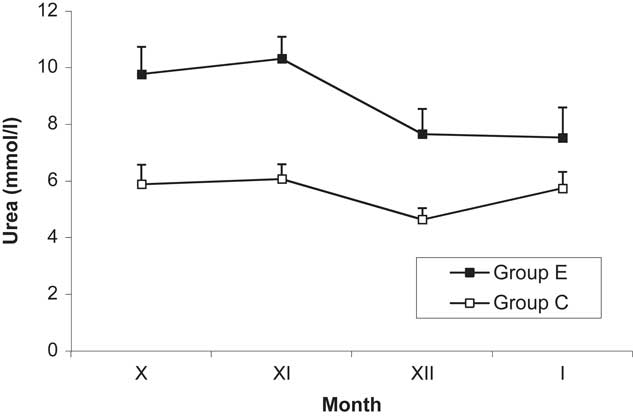
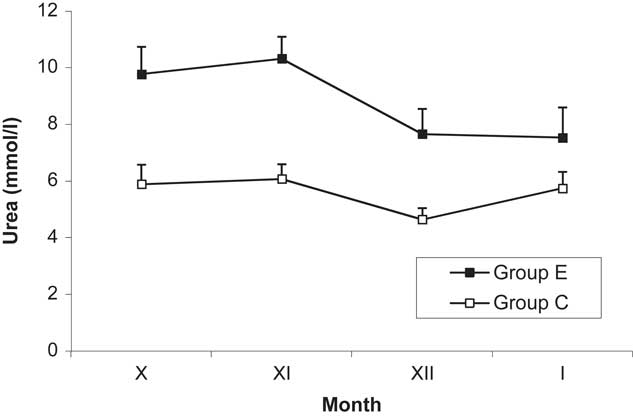
The mean plasma urea concentrations in Groups E and C during and after the breeding period are shown in Figure 1. The Group E ewes had significantly (P<0.001) higher concentrations compared with Group C ewes during the entire follow-up period. In Group E, the concentration was the highest, and the difference between the groups was the greatest during the breeding period.
The mean (+s.d.) serum urea concentrations in red clover (E) or grass silage (C)-fed ewes during the experiment. In every time point the difference is statistically significant (P<0.001).
Fertility of the ewes
All ewes in both the groups became pregnant. However, one ewe in Group C had a single mummified foetus. The results for this ewe were only used where meaningful. The mean times of conception from the beginning of the breeding period in Groups E and C were 16.3±8.8 and 10.1±9.9 days, respectively. In Groups E and C, 6 of 10 and 7 of 9 ewes, respectively, became pregnant during the first oestrous cycle. The remaining ewes conceived during the second oestrous cycle. The differences between the groups were not statistically significant. The numbers of foetuses per pregnancy were 2.1±0.7 and 2.2±0.8 in Groups E and C, respectively, but were not significantly different. The numbers of ovulations in each ewe, evaluated as the numbers of corpora lutea, were 3.2±0.4 and 3.5±1.5 in Groups E and C, respectively, without statistically significant difference. In Groups E and C, 65.6% and 62.8% of the ovulations, respectively, led to conception. In the ewe with the mummified foetus in Group C, six corpora lutea, but only one foetus, were found. Without this ewe, the proportion of ovulations that resulted in conception would have been 72.4%.
Weights of foetuses, uterus and its contents
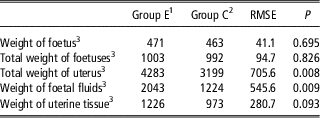
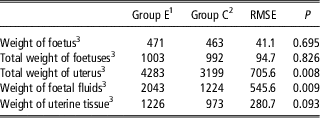
The estimated weights of the foetuses (mean and total), uterus with its contents, foetal fluids and uterine tissue, including placentas and foetal membranes in ewes in Groups E and C, are presented in Table 2. The group means were corrected for the stage of pregnancy and number of foetuses, and were evaluated at the stage of 89.6 days and 2.21 foetuses. Feeding red clover silage did not have any effect on mean or total weights of foetuses. However, the total mass of the uterus with its contents was significantly greater (P<0.01) in Group E compared with the mass in Group C. This difference was mainly explained by the greater amount of foetal fluids in Group E (P<0.01).
The effects of feeding on mean weights (g) of foetuses, uterus, foetal fluids and uterine tissue
RMSE=root mean square error.
1 Group E was fed with red clover.
2 Group C was fed with grass silage.
3 The group means were corrected for the stage of pregnancy and number of foetuses, and were evaluated at 89.6 days and 2.2 foetuses.
Progesterone
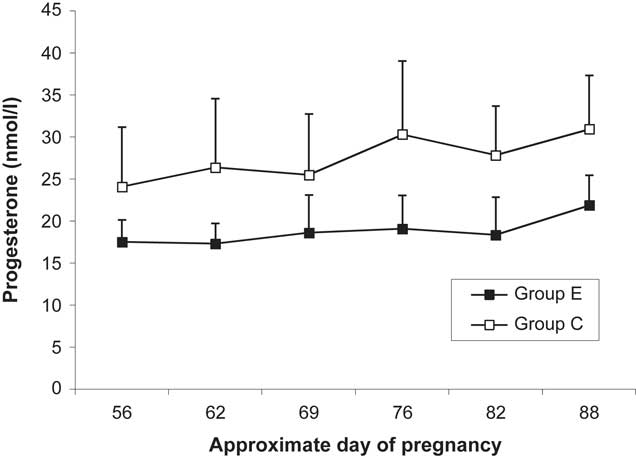
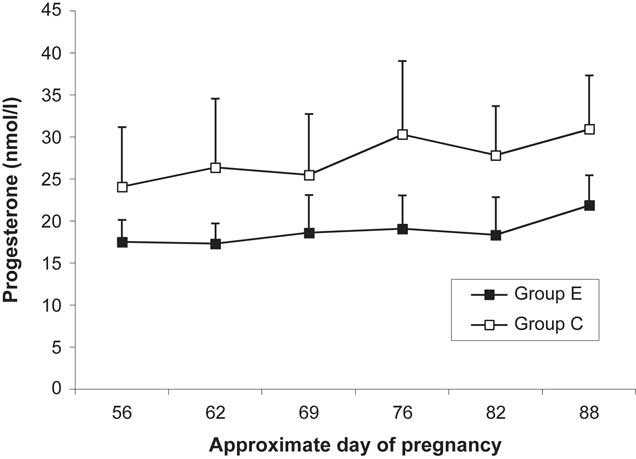
The mean (±s.d.) progesterone concentrations in Groups E and C between estimated days 56 and 88 of pregnancy are shown in Figure 2. Progesterone concentrations in Group E were significantly (P<0.01) lower during the entire period analysed. The results for the ewe with one mummified foetus were rejected from the statistical analysis. This ewe had the maximum progesterone concentration (11.5 nmol/l) in the first sampling. Thereafter, the concentration declined gradually, reaching the lowest value (1.8 nmol/l) in the last sample.
The mean (+s.d.) plasma progesterone concentrations in red clover (E) or grass silage (C)-fed ewes. In every time point the difference is statistically significant (P<0.01).
Pathological examinations
No significant differences were detected in the length or width of the cervix. In the histopathological examination, no clear cut-off differences between the study groups were established. Mammary gland samples showed variable amounts of secretory activity in all pregnant ewes. Vaginal epithelium was similarly stratified in all ewes, with the exception of the ewe with the mummified foetus, which had more cornified epithelium than the others. In all cervical samples, production of mucus was pronounced, except again in the ewe with the mummified foetus, the samples of which lacked abundant mucus production. Uterine samples indicated high numbers of active endometrial glands and slightly variable thickness of endometrium between ewes. No pathological findings in cotyledons were recorded. In ovaries, depending of the section, both luteal and follicular tissues were characteristic.
Discussion
Feeding 10 nulliparous Finnish Landrace sheep before, during and after the breeding season, with red clover silage containing abundant amounts of phyto-oestrogens did not affect the fertility of the ewes. Finnish Landrace sheep produce 1.8 and 2.5 lambs on average at first and later pregnancies, respectively (Parikka, Reference Parikka2010). The numbers of foetuses per pregnancy were 2.1±0.7 and 2.2±0.8 in Groups E and C, respectively. Thus, the fecundity of fertile Finnish Landrace ewes was not compromised by the relatively high formononetin intake. On the contrary, the fertility of ad libitum fed ewes was slightly higher than the mean national figures for this breed. Other studies, mainly from Australia, show that oestrogenic pastures significantly reduce the proportion of ewes in oestrus, the ovulation rate and the fertilization rate (Marshall, Reference Marshall1973; Lightfoot and Wroth, Reference Lightfoot and Wroth1974; Obst and Seamark, Reference Obst and Seamark1975; Anwar, Reference Anwar1994).
The red clover silage used in this study contained abundant amounts of phyto-oestrogens: especially formononetin (0.68% in DM). High concentration of metabolite equol 7.7 µg/ml was detected in the serum of ewes. The concentrations of formononetin in red clover silage and equol in serum are in good agreement with earlier studies, and show that red clover feeding in northern Europe can lead to equally high isoflavone intake as in Australia. For example, in a study by Shutt et al. (Reference Shutt, Weston and Hogan1970) daily intake of 5.5 g of formononetin (10.5 g in our study) resulted in a concentration of equol conjugates in blood of 3.0 to 4.4 μg/ml (7.7 μg/ml in our study). In his review, Marshall (Reference Marshall1973) concluded that formononetin concentration <0.3% in DM were safe, but concentration over 0.8% was potentially harmful for ewe fertility. In a study by Obst and Seamark (Reference Obst and Seamark1975), the mean formononetin content of Yarloop clover (1.2%) of the dry leaf weight reduced fertility. Anwar (Reference Anwar1994) analysed the formononetin content in two red clover varieties. In Pawera, red clover formononetin concentration in the upper parts of plants were 0.99% in DM, whereas G27 red clover it was 0.27%. The blood equol values caused by G27 and Pawera red clover varieties were 1.81 and 7.25 µg/ml, resectively. When compared with ewes fed with non-oestrogenic pasture, the G27 red clover-fed ewes did not differ in follicle growth or ovulation rate, whereas the incidence of return to service was higher in Pawera red clover-fed ewes (Anwar, Reference Anwar1994).
The mean serum progesterone concentration was significantly lower in Group E than in Group C ewes during the entire follow-up period. A similar low progesterone level was detected with oestrogenic Yarloop clover feeding being detected, but from the 90th day of pregnancy onwards (Obst et al., Reference Obst, Seamark and McGowan1971 and Reference Obst, Seamark and McGowan1972; Obst and Seamark, Reference Obst and Seamark1975). The resulting abnormally high plasma oestrogen : progesterone ratio is the suspected cause of lambing difficulties, such as incomplete dilatation of the cervix (Obst et al., Reference Obst, Seamark and McGowan1971 and Reference Obst, Seamark and McGowan1972; Obst and Seamark, Reference Obst and Seamark1975). Serum progesterone concentrations at different levels in feeding regimes have been studied intensively. Increasing dietary intake has been shown to reduce peripheral progesterone concentrations. It has been concluded that high feed intake increases liver blood flow and metabolic clearance, which leads to lowered plasma progesterone concentration (Parr et al., Reference Parr, Davis, Miles and Squires1993a and 1993Reference Parr, Davis, Miles and Squiresb). These diet-induced alterations are mediated by insulin signalling (Smith et al., Reference Smith, Stinefelt, Blemings and Wilson2006). High plane of nutrition during mating or pregnancy leads to lower progesterone concentration (Boone et al., Reference Boone, Hill, Kennedy and Henricks1975; Smith et al., Reference Smith, Stinefelt, Blemings and Wilson2006), and low feed intake can increase plasma progesterone concentration (Shevah et al., Reference Shevah, Black, Carr and Land1975). In some studies, overfeeding during mating led to lower pregnancy rates (Parr et al., Reference Parr, Davis, Fairclough and Miles1987). It remains somewhat open as to whether the decreased progesterone concentration induced by feeding clover is because of increased feed intake only or because of phyto-oestrogen intake.
The uteruses with contents were significantly heavier in the ewes fed with red clover silage than in those fed grass silage. The difference in weight was mainly because of the greater volume of foetal fluids. Despite Group E ewes gaining weight more rapidly and being heavier at the end of the experiment than Group C ewes, this is probably not the explanation for the finding because in this case the foetuses would have been expected to be heavier. Phyto-oestrogens were shown to increase the occurrence of uterine prolapses (Adams, Reference Adams1995 and Reference Adams1998). Generally, this has been thought to be caused by softening of the pelvic tissues owing to oestrogenic stimulation. In the case of phyto-oestrogens increasing the volume of fotal fluids, the intra-abdominal pressure is increased during the last weeks of pregnancy. It is also generally known that increased intra-abdominal pressure is a risk factor in vaginal prolapse (Bulgin, Reference Bulgin1997). No differences between the groups were detected in the pathological examination of cervical or vaginal epithelium or mammary gland tissue. However, the nulliparous ewes were exposed to phyto-oestrogens only for about 5 months. Mild cervical transdifferentiation is typical in permanent phyto-oestrogen infertility of ewes exposed to phyto-oestrogen for several seasons (Adams, Reference Adams1990).
Despite the planned ad libitum isoenergetic diets, the ewes in Group E gained weight faster and were significantly heavier at the end of the experiment. The difference in gains was 42 g/day. Feed consumed was not weighed; instead, live weight and growth rate of ewes were used to evaluate metabolized energy supply, DM intake and intake of isoflavones (Mustonen et al., Reference Mustonen, Jokela, Saastamoinen, Taponen, Taponen, Saloniemi and Wähälä2006). The red clover silage appeared to be tastier than the grass silage used as the control diet and the sheep ate it readily. Red clover diets with high CP were shown to promote growth and increase live-weight gain (Fraser et al., Reference Fraser, Speijers, Theobald, Fychan and Jones2004), and it has also been suggested that formononetin content in red clover can increase growth of lambs (Moorby et al., Reference Moorby, Fraser, Theobald, Wood and Haresign2004). Red clover pastures promote weight gain in ewes and lambs compared with control feeds (Speijers et al., Reference Speijers, Fraser, Theobald and Haresign2005; Graves et al., Reference Graves, McLean, Jones and Martin2012). High CP intake in red clover leads to significantly higher plasma urea concentrations. In Group E, there was a drop in CP intake when red clover batch was changed in the beginning of December (Table 1). This reflected in urea concentrations that decreased (Figure 1). It has been speculated that excess dietary urea could negatively affect viability of the embryos (McEvoy et al., Reference McEvoy, Robinson, Aitken, Findlay and Robertson1997); however, in our study there were no differences in fecundity between the feeding groups.
Conclusions
In this study, the fecundity of nulliparous Finnish Landrace sheep was not reduced by feeding red clover with high phyto-oestrogen concentrations for 5 months before, during and after the breeding season. The amount of foetal fluids was, however, increased, which may increase the risk of vaginal prolapse before term.
Acknowledgements
The authors would like to thank Professor Hannu Saloniemi for the help in organizing the experiment and laboratory technician Ilkka Saastamoinen for the phyto-oestrogen analyses.